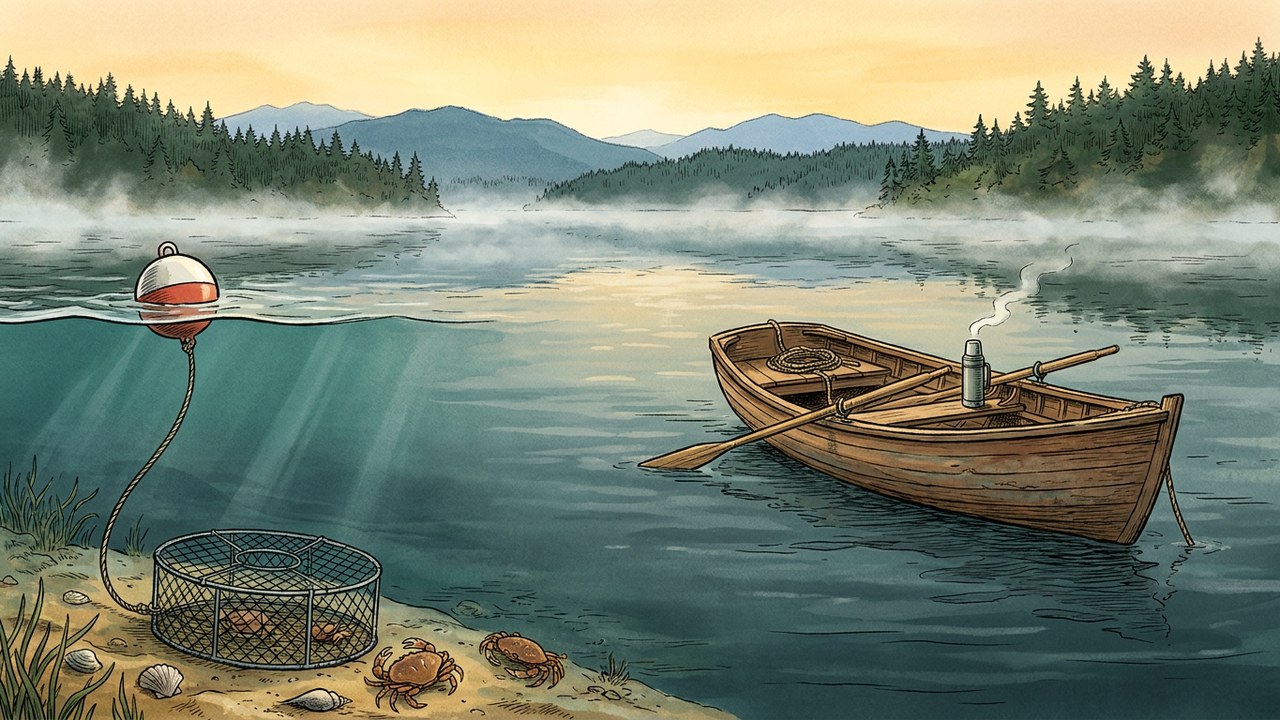
Drop a crab pot into Hood Canal on an early morning tide and then haul it back over the gunwale every twenty minutes to re-tie the bait cage, and you will row home at dusk with sore shoulders, a spotless rig, and an empty cooler. Every summer, recreational crabbers following Washington Department of Fish and Wildlife crab season rules and statewide gear rules — half-red, half-white buoys, weighted lines, escape rings, and biodegradable cotton cord — harvest more than 1.5 million pounds of Dungeness crab across Washington waters. Nobody catches dinner by hovering over the buoy. Once the pot sits flat on the bottom with clean bait and sound mesh, the only job left is waiting for the tide to carry scent across the sand — what crabbers call soak time.
Business owners using AI run straight into the opposite temptation. When spinning up another landing page, another dashboard, or another hundred articles drops from three weeks to one afternoon, continuous tinkering starts masquerading as revenue. You stay in lab mode — forever wiring tools, tweaking headlines, and testing rigs — while postponing harvest mode, where you hold the system still long enough for real buyers to find it, trust it, and pay an invoice. This essay is not a victory lap from a full cooler. It is an honest mid-turn check-in from inside our own skiff while our pots are still soaking.
Why Constant Tinkering Makes Good Systems Worse
Pulling a working rig up early does not just waste shoulder grease; it ruins your ability to read what happened. Nearly a century ago, Bell Labs engineer Walter Shewhart laid out the foundation of statistical quality control and control charts documented in the NIST/SEMATECH Engineering Statistics Handbook. Every real process has ordinary day-to-day wiggle called common-cause variation, separate from a genuine break called a special cause. When an operator reacts to every ordinary dip by turning a knob — what quality engineers call tampering or overadjustment — the constant interference widens the swings and destroys the baseline.
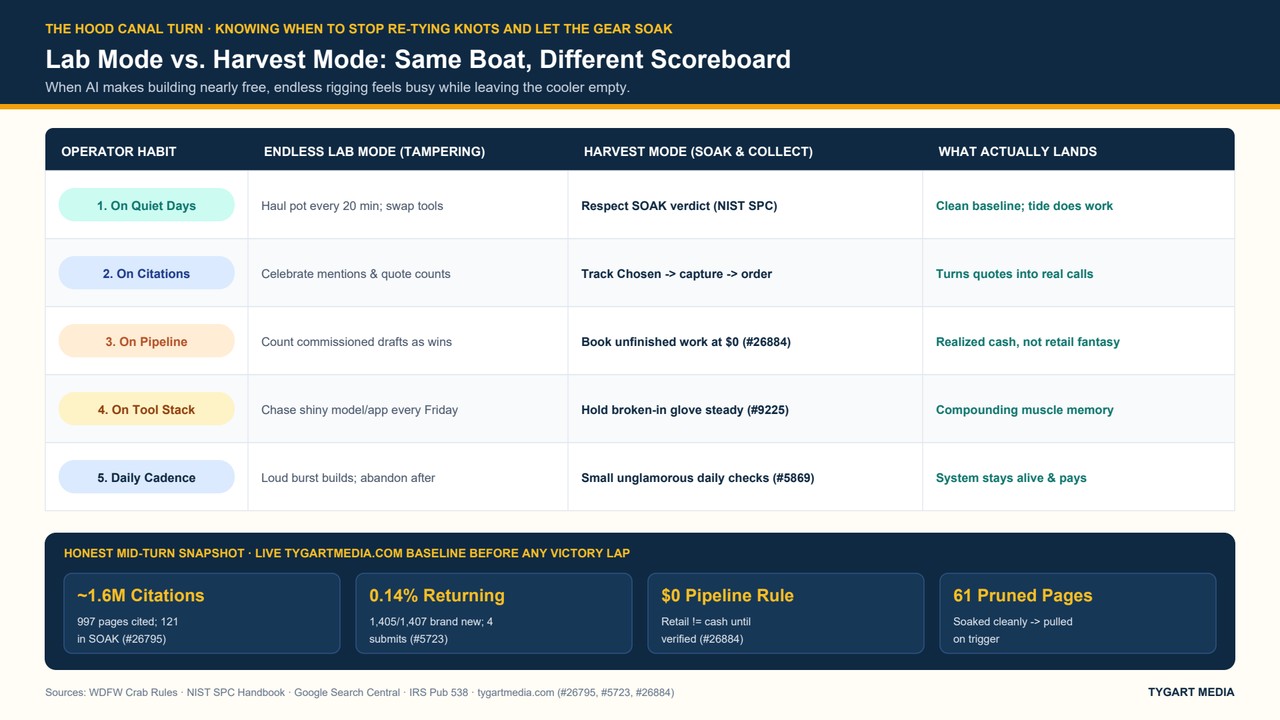
Websites and AI search obey the same clock. Google Search Central reminds site owners bluntly that recrawling and indexing take days to weeks, governed by finite crawl budget alongside Bing Webmaster Guidelines and multi-week Google Analytics 4 engagement cohorts (Zero Miles Per Hour on the Generator). Rewrite a healthy page every four days because Tuesday looked quiet and you never learn whether the tide changed or you scared the crabs away. That is why our Bait Board carries an explicit SOAK bucket right beside DEFEND, RE-BITE, and PRUNE: 121 published pages with no bite yet where the smartest order is do not touch it.
Our Own Mid-Turn Ledger — In Plain Sight
Telling other operators to switch from building to harvesting only holds water if you lay your own numbers on the thwart first (The Flight Recorder on the Workbench). Here is exactly where our own turn stands right now — lab wins, harvest leaks, and zero-dollar accounting side by side:
Read those four boxes together and the real tension jumps off the page. Lab mode built an extraordinary sensor field — old pages biting again when market coverage goes thin (What Is an Old Page Telling You When It Starts Getting Cited Again?) — yet our own audit proved that an AI citing your page does not automatically put a returning human on your email list or a check in the bank. In The Three-Legged Stack: Why I Stopped Shopping for New Tools, we learned that stopping the weekly tool chase turns a familiar setup into a broken-in baseball glove where muscle memory compounds. And in The Cost of a Working System Is the Habit of Working It, we named the quiet bill nobody itemizes on a P&L: building has a loud burst and a visible finish line, while harvesting runs on small, boring daily checks that look like nothing is happening until the cooler starts gaining weight.
Get The Signal
What we actually ran, what it measured, and what it means for a restoration shop — every week, including the flops.
That is why we stopped adding new platforms and tightened the capture end of our own boat instead — publishing fixed-price doors like The Work Order Desk and our quiet-door offer ladder, then holding the rig steady while real conversion cohorts mature. As we wrote in Just a Guy: What Is One Person Worth Now?, with unlimited AI compute sitting next to you, automatable stops meaning worth automating. The scarce skill is no longer building faster. It is knowing when the rig is sound enough to drop over the side and leave alone.
Where Leaving the Pots Alone Bends — Two Honest Limits
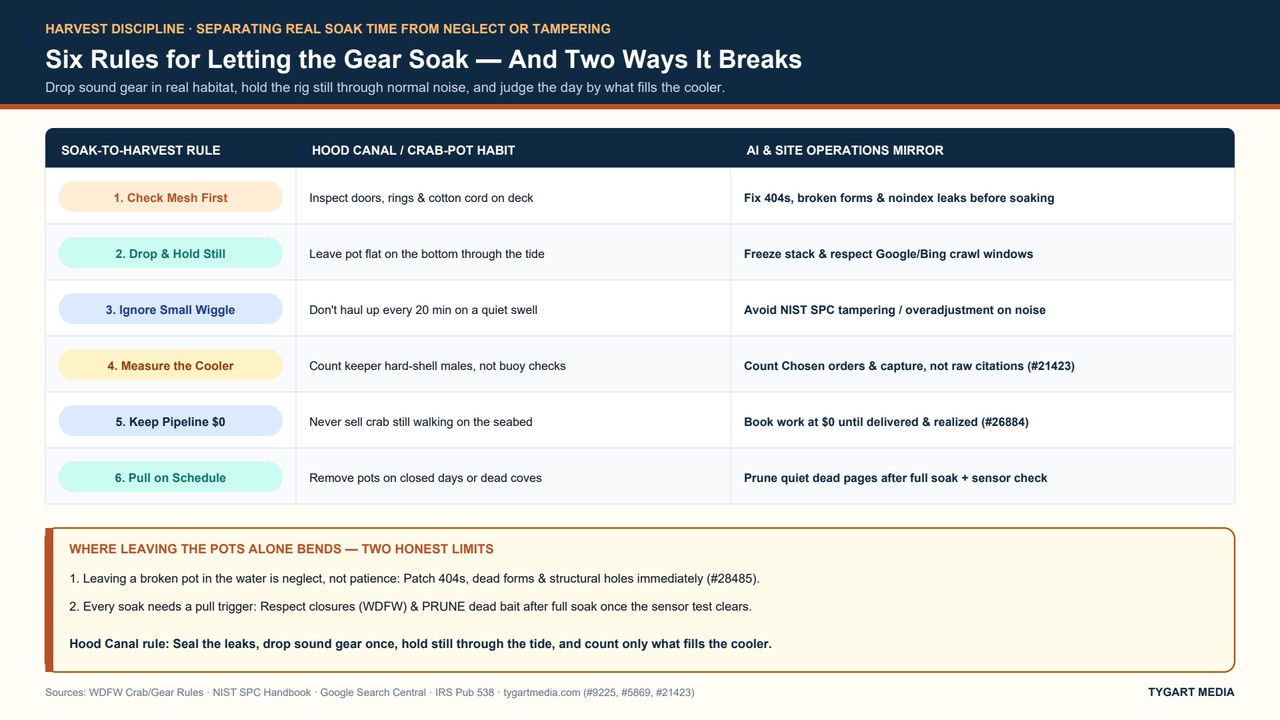
Patience is not a free pass to ignore real damage. Two strict boundaries keep soaking from turning into neglect. First, leaving a broken pot in the water is not patience — it is waste. If your mesh has a hole in it — a dead 404 URL that AI engines keep citing, a contact form silently dropping inquiries, or an accidental noindex tag hiding a buying guide — waiting another thirty days never heals the tear. Fix genuine special-cause leaks immediately (We Come From Water Damage), verify the seal from outside, and then freeze the rig and let the clock run.
Second, every soak still needs a pull-and-move trigger. On Hood Canal, WDFW rules require every pot out of the water when a season or sub-area closes; leaving gear out forever is illegal and pointless. Inside a business, 61 pages on our own board legitimately earned PRUNE after soaking without a single bite or sensor spike. Check the same gauges on the same schedule, hold still while the tide works, fix real holes cleanly, and judge the day strictly by what lands in the cooler — not by how shiny you polished the pot.
— Will Tygart, Tygart Media.
Get The Signal
What we actually ran, what it measured, and what it means for a restoration shop — every week, including the flops.
Leave a Reply