A page can rank on the first page of Google, receive consistent organic traffic, and still be failing. The failure is silent — visible only when you look at what the arriving users actually do.
When users search “how to apply for X” and land on a page about “what X is,” they leave immediately. The page ranked for the query but delivered the wrong content for the intent behind it. GA4 captures this as a short session with a high bounce rate — but it does not tell you why, and it does not tell you which queries are driving the mismatch.
Intent Mismatch in the Data
Intent mismatch in the data.
In GA4, intent mismatch produces a specific signature: high organic traffic, low engagement rate, and short session duration on the same page. If a page is receiving 200 organic sessions a month and engaging only 12% of them, one of three things is happening. The page ranked for queries it cannot actually answer. The content addresses a different aspect of the topic than users are searching for. Or the audience searching this query is at a different stage of the journey than the content is written for.
All three are fixable. But only if you know which one you have.
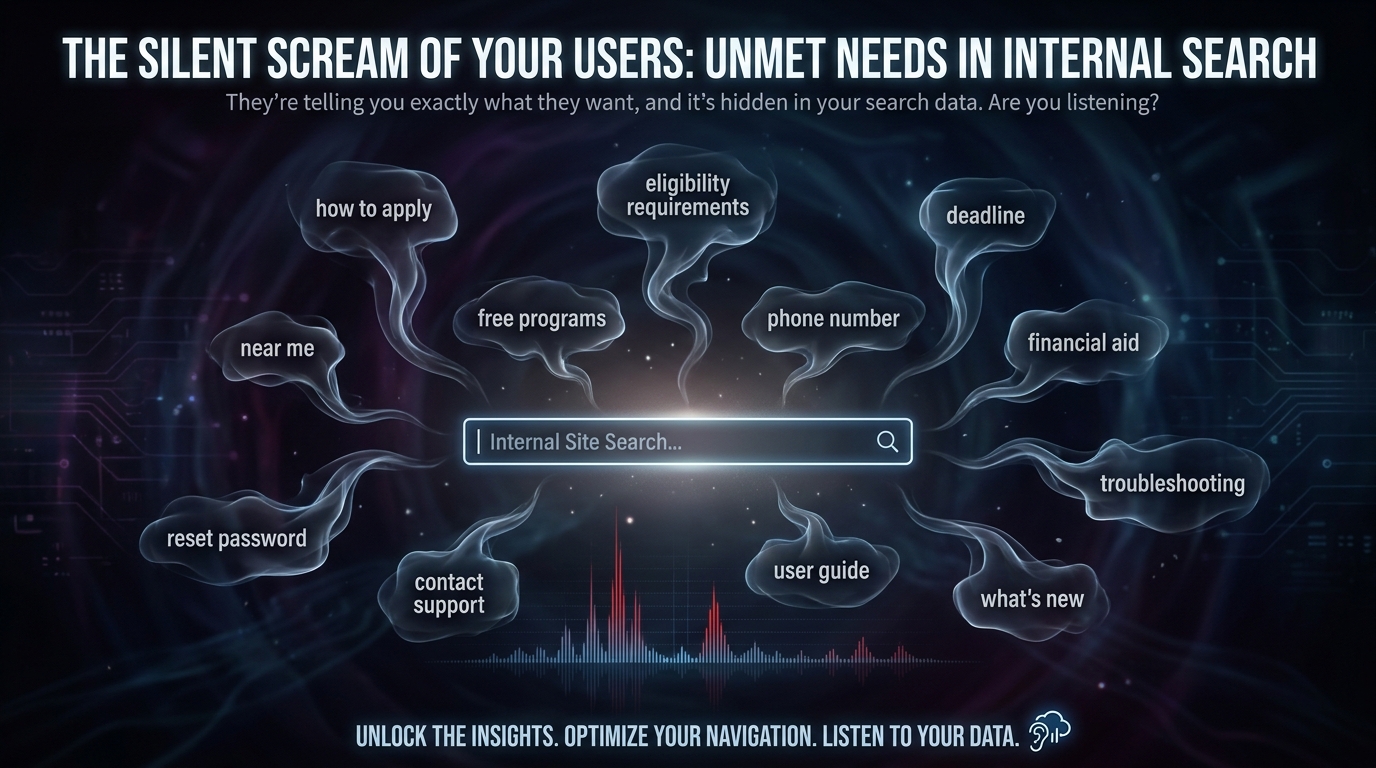
The Silent Scream in Your Internal Search Data
The silent scream in your internal search data.
Internal site search is the most underused intelligence source in GA4. When a user searches your site, they are explicitly telling you what they wanted and could not find from your navigation or your existing content. That is direct audience research, free, already collected in your property.
The most valuable subset of internal search data is zero-result searches — queries that users entered into your search bar and got nothing useful back. These are your most urgent content gaps. A user who searched your site and found nothing is more frustrated than one who never searched. They came looking for something specific, engaged enough to try your internal search, and left empty-handed.
The top 20 internal search terms for any content site are a ready-made content sprint list. They represent topics real users on your site actively wanted to find. No keyword tool produces a brief this precise.
Your Intent Alignment Score
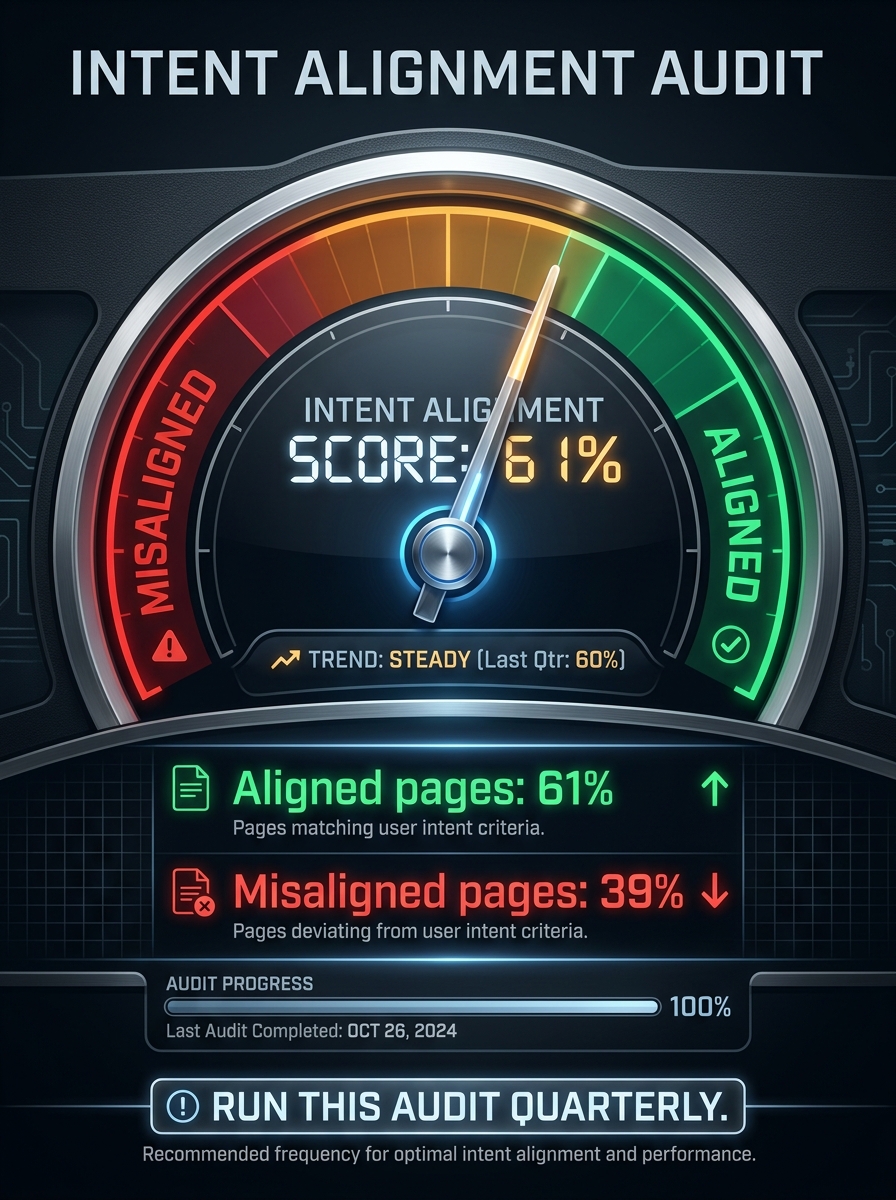
Across your organic landing pages, a certain percentage are well-aligned with the search intent of users arriving on them — high traffic, high engagement, users who found what they needed. The remainder are misaligned — high traffic, low engagement, users who bounced because the content did not match what they were looking for.
That ratio — aligned pages versus misaligned pages — is your intent alignment score. It is a quarterly tracking metric. If you are actively addressing misaligned pages through rewrites, redirects, and new content targeting the correct intent, the score should improve over time. If it is flat or declining, something is creating new misalignment faster than you are fixing old misalignment.
Running the Intent Alignment Session
Running the intent alignment session.
This analysis runs in one session using Claude-in-Chrome alongside Analytics Advisor in GA4. The query sequence surfaces your highest-mismatch organic pages, extracts your internal search terms and gaps, and produces a baseline alignment score. The methodology is the Books for Bots: GA4 Search Intent Alignment Kit.
Your GA4 new versus returning user data contains a ratio you are probably not monitoring. That ratio — what percentage of total sessions come from returning visitors — is your retention baseline. It tells you whether your content is building an audience or just attracting drive-by traffic.
Most content sites sit below 20% returning visitor sessions. Many are below 10%. That means for every 10 sessions the site earns, 9 of those users never come back.
The 14x Duration Gap
The 14x duration gap.
The behavioral difference between new and returning users on a typical content site is substantial enough that treating them as the same audience produces wrong conclusions about nearly everything.
In a live GA4 audit on a real content site, returning users showed an average session duration of 4 minutes 12 seconds. New users averaged 18 seconds. Same site, same content, same pages — 14x difference in how long users stayed. Returning users also engaged at 61% versus 22% for new users, and viewed 3.8 pages per session versus 1.2.
Every benchmark you track — engagement rate, bounce rate, session duration — is a blend of these two completely different behaviors. The aggregate number hides both the strength of your retained audience and the weakness of your new user conversion to loyalty.
Loyalty Anchors
Loyalty anchors.
Within any content library, a small number of pages are responsible for most return visits. These are your loyalty anchors — the content that made someone bookmark your site, set up a newsletter subscription, or search for you by name when they wanted to come back.
Loyalty anchor pages share identifiable characteristics. They are almost always comprehensive — long enough to reward deep reading. They address a recurring need rather than a one-time question. They are reference material that users come back to, not just something they read once. And they often cover something slightly counterintuitive or genuinely surprising, which makes them memorable and worth recommending.
Identifying your loyalty anchors in GA4 is a matter of filtering for pages where returning users are disproportionately represented in the session mix. Once identified, these pages deserve protection from monetization that would interrupt the user experience, regular updates to keep them fresh, and prominent internal linking to expose them to new users who might otherwise never find them.
The Best Retention Channel
Not all acquisition channels produce equal retention. Some channels deliver new users who return; others deliver one-time visitors. The channel producing your returning users is not always the channel producing your most new users — and optimizing for acquisition volume without understanding retention often means investing in the wrong channel.
When you segment returning user sessions by acquisition channel in GA4, the result often surprises teams. Organic search frequently produces higher retention than social media, even at lower initial volume. Email produces some of the highest retention rates when the newsletter is genuinely curated. Direct traffic — users who typed your URL or bookmarked you — is almost entirely returning users by definition.
Running the New vs Returning Session
Running the new vs returning session.
This analysis runs in one session using Claude-in-Chrome alongside Analytics Advisor in GA4. The methodology is the Books for Bots: GA4 New vs Returning Intelligence Kit.
GA4 shows you exit rate. It does not tell you whether that exit was a success or a failure. That distinction matters more than the number itself.
An 85% exit rate on a page where users stay for three minutes means the page did exactly what it was supposed to do. Users arrived, found their answer, and left complete. An 85% exit rate with four seconds means the page failed immediately.
Satisfied Exits vs Abandoned Exits
Satisfied exits vs abandoned exits.
A satisfied exit has a high exit rate and high engagement duration — 90 seconds or more. The user read, completed their task, and left. Adding more CTAs to reduce the exit rate would interrupt a successful journey and make the page perform worse.
An abandoned exit has a high exit rate and low engagement duration — under 30 seconds. The user arrived, found nothing useful, and left. This page needs attention: it is either attracting the wrong audience, delivering the wrong content, or failing to provide a next step.
The diagnostic question for every high-exit-rate page is not “how do I reduce this?” It is “was this exit satisfied or abandoned?”
The NYC Summer Internships Finding
In a live audit on a real content site, the NYC Summer Internships guide showed an 85% exit rate with 3 minutes 20 seconds average duration. The first instinct — reduce the exit rate — would have been wrong. Users were spending over three minutes reading a comprehensive guide and leaving with the information they needed. The exit rate was a function of the page succeeding, not failing.
Compare that to the same site’s homepage: 65% exit rate with 8-second duration. Lower exit rate, dramatically worse performance. The homepage was failing more users despite fewer exits.
Dead-End Pages
Dead-end pages.
A third pattern exists beyond satisfied and abandoned: the dead end. Users arrive with genuine interest, engage enough to stay, but then have nowhere to go next. No internal links, no navigation to adjacent topics, no next step. The exit is not because the page failed — the site architecture failed.
Dead-end pages show moderate engagement duration and zero internal link click data. Adding one relevant internal link often produces measurable improvement in session depth without any content changes. It requires no developer, no design work, and no new content.
The Internal Link Opportunity Map
The internal link opportunity map.
The most actionable output from an exit intelligence audit is a specific list of page pairings: which abandoned exit pages should link to which high-engagement destination pages. Google’s Analytics Advisor can generate these recommendations from your actual behavioral data — not guesswork about what users might want next.
This analysis runs in one session using Claude-in-Chrome alongside Analytics Advisor. The methodology is packaged as the Books for Bots: GA4 Exit Intelligence Kit.
Open your GA4 referral traffic report and sort by sessions. The source at the top of the list is your most valuable referral partner, right?
Almost certainly not. The default GA4 referral view is sorted by volume. Volume is the wrong metric for understanding referral quality. And the gap between your highest-volume referral source and your highest-quality referral source is almost always larger than you expect.
The Quality Inversion
The quality inversion in referral traffic.
When you re-rank your referral sources by engagement rate instead of session count, the leaderboard flips completely. The source you have been grateful for because it sends 300 sessions a month is often delivering 6-8% engagement — users who arrive, glance at the page, and leave in under 10 seconds. The source sending 8 sessions a month may be delivering 70%+ engagement — users who read deeply, navigate to related pages, and return weeks later.
From a content investment perspective, those 8 sessions from the high-quality source are worth more than the 300 from the volume source. They represent real readers who found genuine value. The volume source is sending noise.
What Drives the Gap
The gap between volume and quality in referral traffic usually comes down to three things.
Intent alignment. A high-volume referral source often sends users whose intent does not match your content. A directory site might link to you as a resource while its users are looking for a service provider. They arrive, realize you are informational content, and leave. A niche newsletter that links to you as recommended reading sends users who explicitly opted in to this exact type of content. Every session is pre-qualified.
Audience specificity. The broader the audience of the referring site, the lower the average quality of the traffic it sends you. A general-interest news aggregator sends everyone. A specialized community sends people who care about your topic.
Editorial context. When a referring site links to you in the body of a relevant article with a reason to click, the user arrives with context and intent. When your URL appears in a list of 50 links on a resource page, the user arriving has no specific reason to engage with your content over anyone else on the list.
How to Find Your Hidden Gem Referrers
How to find your hidden gem referrers.
The query you are looking for in GA4 is not “which referral source sends the most sessions.” It is “which referral sources have fewer than 20 sessions but an engagement rate above 50%.”
That filter surfaces your hidden gems — the small sources that nobody is monitoring because they do not show up at the top of the volume-sorted list. These are the sites whose audiences are most aligned with your content, the writers and communities who are genuinely recommending you rather than listing you.
Once you have the list, the outreach writes itself. A referral partner whose audience stays on your site for 4 minutes and returns regularly is a relationship worth formalizing. A content exchange, a guest post, a link placement in their next relevant piece — any of these turns an organic quality referrer into a deliberate partnership.
What Your Bad Traffic Sources Are Costing You
Beyond missing the hidden gems, there is a cost to the volume sources you are currently treating as successes. If a referral source is sending 300 sessions at 6% engagement and you are investing link-building effort to maintain or grow that relationship, you are optimizing for a metric that does not correspond to business value.
The reallocation question is simple: what would happen if you redirected that same effort toward the sites whose audiences actually engage with your content?
Running the Audit
Running the audit.
This analysis runs in a single session using Claude-in-Chrome alongside Google’s Analytics Advisor in GA4. The query sequence inverts the default referral view, surfaces your hidden quality sources, identifies your bad traffic sources with specific domain-level data, and produces a partnership opportunity list for outreach.
No SQL. No BigQuery. No data analyst. The methodology is packaged as the Books for Bots: GA4 Referral Quality Audit.
Are your keywords landing on the right pages? Diagnose intent mismatch between what users searched and what they found — and surface what your audience wanted and could not find.
39% misalignedOf organic landing pages delivering the wrong content for the search intent
COMING SOON — $27
A Page Can Rank Well and Still Fail
If the user searched “how to apply for X” and landed on a page about “what X is,” they bounce immediately. GA4 captures this failure even when you cannot see the original query. High organic traffic with low engagement is almost always intent mismatch in disguise.
CORE INSIGHT
Internal site search is the most underused intelligence in GA4. When a user searches your site, they are explicitly telling you what they wanted and could not find. This kit makes that signal visible and actionable.
What’s Inside
7 copy-paste queries for Analytics Advisor — one session
Organic traffic to engagement mismatch identification
Internal search term extraction — top 20 with gap analysis
Zero-result internal search diagnosis
Homepage navigation gap analysis
Intent alignment score — baseline metric to track quarterly
Content repositioning recommendation framework
What You Need
Claude-in-Chrome — free from Anthropic
Editor or Analyst access to a GA4 property
Analytics Advisor (BETA) enabled
30–60 minutes
THE KEY INSIGHT
Internal search tells you what people search on your site after they arrived. That is a different and more valuable signal than anything a keyword tool produces — and it is sitting in your GA4 right now.
What marketing metrics should restoration companies actually measure? Lead count matters, but it is a lagging indicator and a noisy one. The signals that predict long-term health are review velocity and quality, GBP engagement trends, organic search visibility, content engine output, retargeting audience growth, email list size and engagement, owner-level community activity, and partner referral patterns. The companies with the cleanest view of these signals run a fundamentally different marketing operation from the ones chasing monthly lead reports.
Ask a restoration owner what they measure in marketing and most will say “lead count” and “cost per lead.” Maybe conversion rate to job. Maybe a monthly revenue attribution by source. That is typically the full measurement stack.
Those metrics matter. They are also insufficient, and sometimes misleading.
Lead count is a lagging indicator. It tells you what happened last month. It is noisy — weather events, competitor outages, seasonal shifts, and random luck all move it around in ways that have nothing to do with the quality of the marketing. And it measures the short-term output, not the long-term asset.
The companies that compound over ten years are the ones watching a different set of signals — ones that predict the lead count six months from now, rather than recording the lead count last month. This article lays out that measurement stack.
The Asset-Health Signals
The asset-health signals.
These are the signals that measure the organic asset — the thing that produces leads durably regardless of this month’s paid spend.
Review velocity. New reviews per week, by service and location. Rising velocity is one of the strongest predictors of rising organic lead flow 60 to 90 days out. Flat or declining velocity is the leading indicator of trouble. Target: consistent weekly velocity that at least maintains review recency across every GBP the company operates.
Review star average, tracked over time. Not just the current average, but the trajectory. A company moving from 4.6 to 4.9 is a different business from a company static at 4.8. Target: 4.8 minimum, 4.9+ ideal.
GBP engagement trends. Views, searches, calls, direction requests, website clicks — all reported inside the GBP insights dashboard. Monthly trends across these matter more than the absolute numbers. Target: steady growth across all five.
Map pack ranking by query. What position the company sits in for its top 15-20 service and location queries in its service area. Tools like Local Falcon or BrightLocal make this trackable. Target: first-position or top-three for primary service + primary geography queries, top-three for secondary geographies.
Organic search traffic by page. The neighborhood pages, location pages, and service pages — which are ranking, which are climbing, which are stuck. Google Search Console is the primary source. Target: month-over-month growth in organic sessions to the site.
Content engine output. Articles published per month, pages added per month, GBP posts per week, photos uploaded per week. This is the raw activity that feeds the asset. Target: sustained weekly cadence.
Retargeting audience size and freshness. How big is the pool, how recent are the signals, how engaged is the audience? Target: audience size growing month over month, freshness maintained with pixel activity from the site.
Email list size and engagement. Subscribers, open rate, click rate. Target: subscriber growth each month, open rate above 25% for a cold-niche list (restoration-specific content audiences open at higher rates than generic consumer lists).
Social following, by platform. Followers, engagement rate, local share rate. Not vanity metrics — engagement specifically from the service area. Target: month-over-month growth in engaged local audience.
These signals, taken together, describe the health of the asset. A company with green lights across the board has an asset that will continue producing lead flow. A company with red lights has one that will start bleeding lead flow in the next two quarters.
The Community-Standing Signals
The second tier of measurement is the owner-level and team-level community activity that produces the relational underpinning of the asset. These are harder to quantify but worth tracking.
Association attendance. Events attended per quarter, by association, by attendee. The brief-and-post-mortem discipline described in the event playbook produces the log. Target: consistent attendance at the committed associations; drop-offs caught early.
Owner unblocking calls. How many times per quarter did the owner make an unblocking call for a sales rep? This is a specific activity described in the owner-as-rainmaker article. Target: at least one per rep per quarter.
Partner relationship hygiene. Number of active B2B partners, recency of last interaction, direction of recent referrals (from partner to company, company to partner). The observational B2B plan produces the database. Target: partner count growing, recency maintained on core relationships, bidirectional flow evident.
Event briefs and post-mortems completed. Every event should have both. A count of how many were actually done reflects the discipline. Target: 100% completion rate.
Speaking and content placements. Was the owner or a senior person speaking at an association, publishing in an industry outlet, or contributing content to a partner organization? Target: one to two per quarter minimum at senior level.
Community sponsorship ledger. What the company sponsored, what it produced, whether it repeats. Target: every sponsorship intentional, measured, and reviewed annually.
These signals measure the work that is hard to see but matters for long-term referral flow.
The Operational Readiness Signals
The operational readiness signals.
The third measurement cluster is whether the company can convert the leads it does generate. A marketing asset that produces leads the operations team cannot convert is an asset partially wasted.
Response time to inbound calls. Average and 95th percentile. Target: under 60 seconds on emergency lines, under 10 minutes on non-emergency, 24/7.
Response time to LSA and web form leads. Target: under 5 minutes on emergency leads, under 30 minutes on non-emergency during business hours.
Lead-to-appointment rate. What percentage of inbound leads convert to a scheduled appointment? Target: 75%+ for qualified emergency leads.
Appointment-to-contract rate. What percentage of appointments become contracted jobs? Target: 60%+ for residential, varying for commercial.
Same-day response rate. What percentage of inbound leads get a real response the same day, regardless of channel? Target: 95%+.
These metrics are operations more than marketing, but they determine whether marketing effort converts. Many restoration companies have marketing problems they think are marketing problems when they are actually operations problems — marketing is generating leads, but operations is not converting them.
The Paid-Channel Signals
For the paid layer, measurement should include:
Cost per lead, by channel. LSA, Google Ads, Meta, YouTube, lead aggregators — each tracked separately.
Cost per job, by channel. CPL × conversion rate. The number that actually matters for profitability.
Blended cost per job across paid. Weighted average. The overall efficiency of the paid layer.
Share of leads captured to the asset. Percentage of paid leads whose email went into the list, that consented, that ended up in retargeting. The evergreen discipline from the every-paid-lead-evergreen article is measured here. Target: 85%+.
Attribution overlap. Leads that touched paid and also touched organic before converting. Google Analytics 4 and a well-configured analytics stack can show this. Understanding overlap prevents double-counting and reveals where paid is genuinely incremental versus where it is claiming credit for organic work.
Dispute rate and recovery. For LSA specifically. Target: every bad lead disputed, recovery rate above industry baseline.
The Reporting Cadence
The measurement stack above is a lot to track. The cadence matters as much as the metrics.
Weekly. Review velocity, GBP engagement summary, content output, response times, paid performance top line. A 15-minute marketing stand-up or a simple weekly report captures this.
Monthly. Full asset dashboard — every metric in every cluster. One-hour monthly review with the owner, marketing lead, and operations lead. Pattern interpretation: what is rising, what is falling, what needs attention.
Quarterly. Strategic review. Association attendance, partner relationships, major initiatives, budget reallocation decisions. Two-hour session against the annual plan.
Annually. Full refresh of the plan. Revisit the end-in-mind org design. Adjust the measurement stack itself if the right metrics have changed.
Without the cadence, the measurement stack goes stale. Metrics only matter if they inform decisions.
The Metric Most Restoration Companies Should Stop Chasing
The metric most restoration companies should stop chasing.
A final note on leads. Lead count is fine as one metric among many. It becomes pathological when it is the only metric.
Chasing lead count month to month creates a pattern where short-term spend is continually increased to hit the current-month number, while the long-term asset is continually underinvested. Lead count drives paid spend decisions. Paid spend squeezes out organic investment. Organic investment is what produces the compounding lead flow. The cycle is self-defeating.
The companies that break out of it are the ones that refuse to measure marketing primarily on monthly lead count. They measure it on the health of the asset. They spend on the asset. The lead count rises as a consequence, not as a target. Paid becomes rent on top of a growing property, not the entire foundation.
How This Pairs With the Rest of the Stack
Measurement is the feedback loop that makes every other layer of the stack get better over time. The content engine is measured by output cadence and resulting traffic. The digital three-legged stool is measured by review velocity, GBP engagement, and search visibility. The paid layer is measured by CPL, cost per job, and share of leads captured to the asset. The observational B2B plan is measured by partner count and referral flow direction. The owner’s community work is measured by attendance, unblocking calls, and speaking placements.
Without measurement, every layer drifts. With measurement, every layer improves.
Where to Start
Pick the three signals most directly predictive for your company and start tracking them this week. For most restoration companies the three are: review velocity, content output cadence, and response time.
Add one cluster per month over the next quarter until the full stack is in place. Do not try to install everything at once.
Set the weekly, monthly, quarterly, and annual cadence. Put the reviews on the calendar. Name the owners.
In ninety days, the company has a measurement system that tells you where the marketing is strong, where it is weak, and where the next investment should go. That system is worth more than any individual campaign. It is how the marketing function becomes a compounding asset rather than a recurring expense.
Frequently Asked Questions
What marketing metrics should restoration companies measure beyond lead count?
Review velocity and star average, GBP engagement trends, map pack ranking, organic search traffic, content engine output, retargeting audience size, email list size and engagement, social following, community activity (association attendance, partner relationships, owner unblocking calls), response times, and paid channel efficiency. Together these measure the health of the asset, not just this month’s lead output.
Why is lead count alone a bad primary metric?
Because it is a lagging, noisy indicator. It is moved around by weather, competitor behavior, seasonal shifts, and random luck. More importantly, chasing lead count month to month tends to push companies into short-term paid spend that starves the long-term asset. The asset is what produces compounding lead flow. Measuring only leads hides the investment picture.
How often should restoration companies review marketing metrics?
Weekly for operational metrics (response time, review velocity, paid performance). Monthly for the full asset dashboard. Quarterly for strategic review against the plan. Annually for refresh of the measurement stack itself. Without a consistent cadence, the metrics stop informing decisions.
What is review velocity and why does it matter?
Review velocity is the rate of new reviews per week, typically measured by service and location. It is one of the strongest leading indicators of organic lead flow 60 to 90 days out. Rising velocity predicts rising lead flow. Flat or declining velocity is an early warning sign. It matters more than cumulative review count because Google weights recency heavily.
Are marketing-operations metrics (response time, conversion rates) really marketing metrics?
They are crossover metrics. The marketing function produces leads; the operations function converts them. Many restoration companies have what look like marketing problems that are actually operations conversion problems. Tracking response time and conversion rates inside the marketing dashboard makes the interplay visible and keeps both functions accountable.
What is the single most valuable metric if a restoration company can only track one thing?
Review velocity. It is the closest thing to a single metric that reflects the health of multiple underlying systems — service delivery quality, review-ask discipline, staff alignment with customer experience, GBP health, and ultimately map pack and LSA placement. A company that monitors review velocity and trends it upward is doing most of the right things, whether they know it or not.
Tygart Media on restoration — an analyst-operator body of work on the systems that separate compounding restoration companies from busy ones. No client names. No brand placements. Just the operating standard.
Why Addiction Treatment Center Blog Posts Don’t Drive Admissions (And the 4 Fixes That Change That)
By Tygart Media Updated: October 5, 2026
A note on this content:
This article addresses WordPress content optimization for addiction treatment center websites — specifically the structural and schema optimization gaps that prevent educational content from reaching families in crisis. All optimization discussed here applies to editorial blog content only. We never modify clinical content, admissions claims, or patient-facing statements. If you or someone you know needs help, SAMHSA’s National Helpline is available 24/7 at 1-800-662-4357.
The treatment center content gap: According to SAMHSA’s 2024 National Survey on Drug Use and Health (released July 2025), 48.4 million people aged 12+ (16.8%) had a substance use disorder in the past year — yet only 19.3% of those who needed substance use treatment received it. Among the barriers: families cannot find trustworthy, accessible treatment information when they search. Most treatment center WordPress blogs publish educational content that never surfaces in Google search or AI assistants, not because it’s inaccurate, but because it lacks the four optimization signals that determine whether Google’s YMYL evaluation treats it as credible — and whether families find it during the critical hours before they make a call.
Why Treatment Center Content Faces the Highest Standard in SEO
Why treatment-center content faces the highest SEO standard.
Addiction treatment content is classified by Google as YMYL — Your Money or Your Life — at its highest sensitivity level. This means Google’s quality evaluators specifically assess whether addiction content is authored by licensed clinical professionals, whether treatment descriptions cite named standards bodies (SAMHSA, ASAM, CARF, The Joint Commission), and whether the content serves the family and individual in crisis rather than simply marketing a facility. The treatment center that meets these standards earns both Google trust and family trust at the same time.
Why don’t addiction treatment center blog posts drive admissions despite regular publishing?
Addiction treatment center blog posts fail to drive admissions when they lack four signals Google’s YMYL evaluation requires for behavioral health content: licensed clinician authorship with verifiable credentials and a linked bio page, named clinical entity references (SAMHSA, ASAM levels of care, CARF or Joint Commission accreditation, specific treatment modalities like MAT or DBT), FAQPage JSON-LD schema targeting the admissions research questions families ask during a crisis, and a visible Last Updated date with dateModified Article schema that signals content currency. Without these signals, the article cannot compete with national treatment directories or receive AI citation during family crisis searches.
Fix 1: Licensed Clinician Authorship With Credential Schema
Fix 1: licensed clinician authorship with credential schema.
Every addiction treatment blog post must be attributed to or reviewed by a named licensed clinician — not “treatment team” or “editorial staff.” The standard per SEO Tuners’ 2026 rehab SEO guide: an author box near the top of each page with name, role, credential, and service focus, plus a medical reviewer name, credential, and review date. This author attribution should be implemented in Article schema markup with the clinician’s credential properties — turning the visible byline into a machine-readable expertise signal that Google’s quality evaluators can verify.
Fix 2: Named Clinical Entity References
Treatment content authority comes from naming the specific standards and bodies that govern the field. An article about IOP (Intensive Outpatient Program) that references “ASAM Level 2.1 — Intensive Outpatient Services,” cites “SAMHSA’s Treatment Improvement Protocol (TIP) 47 on substance abuse intensive outpatient treatment,” and notes “CARF International accreditation standards for behavioral health programs” signals clinical precision that families can trust and AI systems can verify. These are the entity anchors that separate authoritative treatment content from facility marketing copy.
Fix 3: FAQPage Schema Targeting Admissions Research Questions
Fix 3: FAQPage schema for admissions research questions.
Families researching treatment ask specific, urgent questions before they call an admissions line: “Does insurance cover addiction treatment?”, “What is the difference between inpatient and outpatient rehab?”, “How long does drug detox take?”, “What is MAT treatment?”, “What should I expect during intake?” A FAQ section with 6–8 of these questions structured as direct answers, with FAQPage JSON-LD schema, positions your content for People Also Ask placements that appear above organic results for these crisis-driven queries — capturing family attention before they find a national directory.
Fix 4: Visible Last Updated Date With dateModified Schema
Treatment guidelines, insurance coverage rules, and medication protocols change. A 2022 article about MAT (Medication-Assisted Treatment) using outdated buprenorphine prescribing information is a liability for both patient safety and YMYL compliance. A visible “Last updated: [date]” near the author byline and a dateModified field in Article JSON-LD signal ongoing clinical editorial stewardship — that the facility is maintaining its educational content as a genuine resource, not abandoning it after publication.
All four fixes — clinician credential schema, SAMHSA/ASAM entity injection, FAQPage schema, and dateModified implementation — are part of WordPress content optimization for addiction treatment centers through SiteBoost. Editorial blog content only; clinical content unchanged.
What types of addiction treatment content generate the most admissions inquiries?
Insurance and coverage content generates the highest admissions inquiry rate — “does insurance cover addiction treatment,” “what is benefits verification,” “how do I use my insurance for rehab” — because financial barriers are the most common reason families delay seeking treatment. Process content (“what happens during detox,” “what is an IOP program,” “what should I expect during intake”) converts families who have decided to seek treatment and are choosing a facility. Both content types benefit from FAQPage schema targeting the specific questions families ask before calling, and from clinician authorship schema that signals clinical trustworthiness.
Should addiction treatment content be written by clinicians or content writers?
RxMedia’s 2026 behavioral health marketing guide recommends blog posts written or reviewed by licensed clinicians — with the authorship and review clearly attributed. The optimal process: a licensed clinician (LCSW, CADC, MD/DO, PMHNP) provides clinical input, key points, and review of factual accuracy; a writer structures and publishes the content; the clinician is attributed as the author or medical reviewer with a linked bio and credential schema. Pure content-writer-only behavioral health content, without any clinical review or attribution, increasingly triggers YMYL compliance penalties under Google’s 2025 quality evaluation standards.
How does LegitScript certification affect treatment center content optimization?
LegitScript certification governs paid advertising eligibility — Google Ads, Facebook Ads — for addiction treatment facilities. It does not directly affect organic SEO or content optimization. SiteBoost optimizes editorial blog content only — educational articles, treatment explainers, insurance guides — not paid advertising landing pages or PPC-specific conversion content. The editorial content optimization described here is fully compatible with LegitScript certification requirements and does not add marketing claims, guarantee language, or solicitation content that would create compliance concerns.
Sources: SAMHSA, 2024 National Survey on Drug Use and Health (released July 2025); SEO Tuners, “Rehab SEO Guide for Addiction Treatment Centers 2026”; RxMedia, “How to Build a Comprehensive Addiction Treatment Marketing Strategy Through SEO” (March 2026); Webserv, “Treatment Center SEO Guide: Increase Admissions 2026”
Why Insurance Agency Blog Posts Don’t Generate Quote Requests (And the 4 Fixes That Change That)
By Tygart Media Updated: April 12, 2026
The insurance content gap: Insurance is a research-heavy industry. According to research cited by Sonant.ai’s 2026 insurance SEO guide, 69% of insurance customers conduct online searches before scheduling any appointment or requesting a quote. That research now happens increasingly in AI assistants — ChatGPT, Perplexity, Google AI Overviews — where prospects ask coverage questions before they ever visit an agency website. The agency whose WordPress content answers those research questions is in the consideration set before competitors are even aware the prospect exists.
The Insurance Research-to-Quote Funnel Has Collapsed Into One Session
Nationwide’s Agency Forward blog documented something significant in 2026: “The conversion funnel is collapsing, and search can lead to online quotes and binds in a single online session.” A prospect who asks an AI assistant about coverage options, finds an authoritative agency article that answers their question, and sees a clear quote CTA — can go from research to quote request in one sitting. This is the opportunity that most insurance agency WordPress blogs are missing entirely.
Why don’t insurance agency blog posts generate quote requests despite regular publishing?
Insurance agency blog posts fail to generate quote requests when they lack four specific optimization signals: a title tag that matches how prospects actually phrase their coverage questions (not how an agent would title a policy explanation), FAQPage schema targeting the research-stage questions that precede a quote request, named regulatory and standards entity references (NAIC, ISO policy forms, AM Best ratings, state department of insurance) that signal genuine coverage authority to both Google and AI systems, and a clear quote CTA embedded in the article body — not just in the website header or footer where prospects who found the article rarely look.
Fix 1: Match Titles to How Prospects Actually Ask Coverage Questions
Insurance agents write article titles the way they’d label a file in a cabinet: “Umbrella Liability Coverage Overview” or “Commercial General Liability Policy Explained.” Prospects search the way they’d ask a friend: “Do I need umbrella insurance if I have home and auto?” or “What does general liability actually cover for my business?” The title tag must match the prospect’s language, not the agent’s vocabulary. This is the single change that most immediately improves click-through rate from existing search impressions.
Fix 2: FAQPage Schema Targeting Pre-Quote Research Questions
The questions that precede a quote request are specific: “How much does umbrella insurance cost?”, “Does homeowners insurance cover flood damage?”, “What’s the difference between term and whole life insurance?”, “Do I need business insurance if I work from home?” A FAQ section with 6–8 of these questions structured as direct 40–60 word answers, with FAQPage JSON-LD schema, positions your articles for People Also Ask placements and AI Overview citations at the moment prospects are actively forming their coverage decisions.
Fix 3: Named Insurance Entity References
Google and AI systems evaluate insurance content authority through named regulatory and standards entity references. An article about homeowners insurance that references “ISO HO-3 (open perils) vs HO-8 (modified coverage) policy forms,” cites “NAIC — National Association of Insurance Commissioners model regulations,” and mentions “AM Best financial strength rating” for carrier comparison — this article signals genuine insurance expertise that generic coverage explainers lack. These entities are machine-verifiable, which is specifically what AI systems check before citing insurance content.
Fix 4: A Quote CTA in the Article Body
A prospect who found your article through a Google search or AI citation is reading your content, not browsing your website navigation. A quote CTA in the header or footer is often invisible to article readers who landed directly on the content. An inline CTA embedded in the body — “Ready to find out what umbrella coverage costs for your situation? Get a free quote in minutes.” — captures the prospect at the moment of highest engagement, which is while they’re reading the content that convinced them of your expertise.
All four fixes — coverage question title rewrites, FAQPage schema, NAIC/ISO entity injection, and inline quote CTAs — are part of WordPress content optimization for insurance agencies through SiteBoost. Applied to your existing insurance blog via WordPress REST API.
Frequently Asked Questions
What types of insurance blog content generate the most quote requests?
Coverage comparison content generates the highest quote request rates — “term vs. whole life insurance,” “HO-3 vs. HO-5 homeowners policy,” “occurrence vs. claims-made professional liability.” These articles capture prospects who have identified they need coverage and are comparing options — the highest-intent pre-quote state. Coverage explainer content (“what does umbrella insurance cover”) captures earlier-stage research but builds authority that converts over multiple sessions. Both types benefit from FAQPage schema and inline quote CTAs.
Is insurance content YMYL — and what does that mean for blog optimization?
Yes. Google classifies insurance content as YMYL (Your Money or Your Life) because coverage decisions directly affect financial protection and stability. This triggers heightened E-E-A-T scrutiny — Google’s quality evaluators specifically assess whether insurance content is authored by licensed professionals with verifiable credentials, whether coverage descriptions are accurate and comply with state-specific regulatory requirements, and whether claims are sourced to named regulatory bodies (NAIC, state departments of insurance). YMYL classification makes named entity injection and accurate sourcing non-optional for insurance content that aims to rank competitively.
How do insurance CPCs relate to the value of organic blog content?
Insurance keywords average $10–$54 per click on Google Ads for coverage-related terms, with some competitive personal lines terms exceeding $100 per click. A blog article that ranks organically for “does homeowners insurance cover flooding” and generates 50 qualified visitors per month represents $500–$5,000+ in equivalent paid search value — delivered at zero per-click cost once the optimization investment is made. The compounding nature of organic rankings means the cost-per-lead from well-optimized insurance content consistently decreases over time while paid search costs only increase.
Sources: Nationwide Agency Forward, “Benefits of SEO, GEO and AEO for Insurance Agents” (2026); Sonant.ai, “SEO for Insurance Companies: 2026 Domination Guide”; Marketing LTB, “10 Best Insurance SEO Agencies in 2026”; ClickGiant, “AEO for Insurance Agencies: How to Get Found in AI Search 2026”
Why Real Estate Agent Blogs Don’t Generate Leads (And the 4 Fixes That Change That)
By Tygart Media Updated: April 12, 2026
The real estate content paradox: Most buyers and sellers don’t wake up thinking “I need an agent today.” They start searching neighborhoods, school zones, home prices, and market conditions weeks or months before they’re ready to raise their hand. According to HousingWire’s 2026 real estate SEO guide, real estate SEO builds visibility during those early moments — before someone is ready to ask for help. Most real estate agent blogs publish content that arrives too late in the journey, targeting keywords that Zillow already owns, or publishing without the optimization signals needed to surface in any search at all.
Why You Can’t Beat Zillow — And Why That’s Fine
Why you cannot beat Zillow on generic terms — and why that is fine.
Zillow and Realtor.com own first-page results for “homes for sale [city]” and “real estate agent near me.” These platforms have domain authority, millions of pages, and link profiles that individual agents cannot match. The correct strategy, per SLT Creative’s 2026 real estate SEO guide, is to stop trying to outrank them for generic terms and instead target hyper-local, long-tail searches where buyers actually convert — and where national portals can never replicate authentic local knowledge.
A buyer searching “3-bedroom homes near [specific school district]” or “what is [neighborhood] like for families” is further along in their decision than someone searching “homes for sale.” They’ve identified where they want to live. An agent whose content answers those specific questions captures that buyer at the exact moment they’re evaluating neighborhoods — before they’ve contacted a portal or an agent.
Why do real estate agent blog posts fail to generate buyer and seller leads?
Real estate agent blog posts fail to generate leads when they target generic, high-competition keywords that national portals like Zillow and Realtor.com already dominate (“homes for sale,” “real estate agent near me”), rather than hyper-local, long-tail queries where authentic local knowledge wins. The additional optimization gaps: missing FAQPage schema targeting buyer and seller process questions, absent neighborhood entity references (school district names, commute corridors, local amenities) that signal local authority to Google and AI systems, and no written meta description — leaving Google to auto-generate one that doesn’t convert.
Fix 1: Target Hyper-Local Long-Tail Keywords, Not Generic Terms
Fix 1: target hyper-local long-tail keywords.
The real estate content that generates leads targets queries that reflect a buyer or seller who has already narrowed their search. “What are the best neighborhoods in [city] for commuters?” “How competitive is [neighborhood] for buyers right now?” “What to know before buying a condo in [specific building or complex]?” These are queries a local agent can answer with genuine authority — and that Zillow cannot match with a generic neighborhood page.
Fix 2: Add Named Local Entities to Every Neighborhood Article
Fix 2: named local entities in every neighborhood article.
Google and AI systems determine whether a real estate article represents genuine local expertise through named geographic and institutional entities. A neighborhood guide that names the specific elementary, middle, and high school serving the area, references the transit line or highway corridor, mentions the local HOA structure, and cites median price ranges with MLS board context — this article has entity depth that signals real local authority. A generic “great neighborhood for families” article has none of it and ranks accordingly.
Fix 3: FAQPage Schema Targeting Buyer and Seller Process Questions
People Also Ask placements in real estate search results appear for process questions — “how long does it take to close on a house,” “what does earnest money mean,” “what are contingencies in real estate.” These placements appear above organic results and capture buyer attention at high-intent moments. A FAQ section with 6–8 direct answers to these questions, with FAQPage JSON-LD schema, makes your article PAA-eligible for queries that show up constantly in buyer and seller research.
Fix 4: Write Every Meta Description for the Buyer Journey
WordPress auto-generates meta descriptions from the first paragraph — which in most real estate articles is a scene-setting intro that makes a poor search result description. Write a manual meta description for every article: 140–155 characters, specific to what the buyer searching that term actually wants to know, with a clear call to action. “Thinking about [neighborhood]? Get school ratings, median prices, commute times, and what locals love most. Talk to an agent who knows it.” That converts a searcher into a click.
All four fixes — local entity injection, FAQPage schema targeting buyer process questions, and meta description optimization — are part of WordPress content optimization for real estate agents through SiteBoost. Applied to your existing neighborhood guides and market articles via WordPress REST API.
How many blog posts does a real estate agent need to generate leads?
Volume matters less than specificity and optimization depth. Ten well-optimized neighborhood guides and buyer process articles — with named local entities, FAQPage schema, and intent-matched titles — consistently outperform 50 generic “real estate tips” posts. The priority is hyper-local content that reflects genuine market knowledge: one neighborhood guide per area you actively farm, one market report per quarter, and one buyer/seller process guide per major question your clients ask. Quality and local specificity beat volume.
Should real estate agent blogs be on their own domain or their brokerage site?
Own domain, every time. According to Digital Agent Club’s 2026 real estate marketing guide, agents on custom domains see 3–4x more direct inquiries than those on brokerage subdomains. Brokerage subdomains build SEO equity for the brokerage — not the agent. If you leave the brokerage, you leave the content and rankings. A standalone WordPress site with proper IDX integration captures the lead, the data, and long-term SEO equity that follows you regardless of brokerage affiliation.
What real estate content types convert the best to buyer and seller inquiries?
Pre-decision content converts best: neighborhood guides that help buyers choose where to live, market reports that help sellers decide when to list, and process guides that help both parties understand what to expect. HousingWire’s 2026 agent SEO guide identifies neighborhood-specific content as the highest-converting content type because it captures buyers who have already identified where they want to live — the highest-intent real estate searcher short of someone actively requesting a showing.
Sources: HousingWire, “The Ultimate Guide to Real Estate SEO for Agents in 2026” (January 2026); SLT Creative, “The Complete Step by Step Guide to Real Estate SEO” (February 2026); Digital Agent Club, “Real Estate Digital Marketing 2026: How Smart Agents Are Winning Leads” (November 2025); Marketing LTB, “10 Best Real Estate SEO Agencies in 2026”
Why Medical Practice Blog Posts Don’t Drive Appointments (And What to Fix)
By Tygart Media Updated: October 5, 2026
The medical blog gap: Most U.S. internet users look online for health information, according to Pew Research Center. Yet most medical practice WordPress blogs are invisible in those searches — not because the clinical content is wrong, but because the articles lack the optimization signals Google’s YMYL evaluation requires: named physician authorship, clinical entity references, FAQPage schema targeting patient questions, and a visible update date. These four gaps are fixable without changing a single clinical fact.
Why Medical Blog SEO Is Harder Than Any Other Vertical
Why medical blog SEO is harder than other verticals.
Healthcare content is classified by Google as YMYL — Your Money or Your Life. This triggers the highest level of algorithmic scrutiny of any content category. According to Digitalis Medical, approximately 45% of medical keywords triggered a Google AI Overview at the top of search results as of 2024 — meaning almost half of all patient health searches are answered by AI before a single website is visited. To remain visible in this environment, medical content must meet the E-E-A-T standards that determine whether Google’s AI treats a practice’s content as citable or ignores it entirely.
According to PracticeBeat’s 2026 Medical SERP Playbook, citing late-2025 data, AI Overviews and Local Pack features capture over 80% of clicks for most medical queries. The practices that appear in AI Overviews for condition and treatment questions are not necessarily the largest health systems — they are the practices whose content meets the specific structural and entity requirements that AI systems use to evaluate medical authority.
Why don’t medical practice blog posts drive new patient appointments?
Medical practice blog posts fail to drive appointments when they lack the four signals Google’s YMYL evaluation requires: named physician authorship with verifiable credentials linked to an author bio page, clinical entity references (named conditions, diagnostic codes, treatment guidelines, specialty board standards) that signal genuine medical expertise, FAQPage JSON-LD schema targeting the specific questions patients ask before booking, and a visible Last Updated date with dateModified Article schema that signals content currency for time-sensitive medical information. Without these signals, the article is invisible to Google AI Overviews and ranks below content from WebMD, Mayo Clinic, and Healthline that has all four.
Fix 1: Named Physician Authorship With Credential Schema
Fix 1: named physician authorship with credential schema.
Every medical blog post must be attributed to a named physician with verifiable credentials — not “Practice Staff” or the practice name. The 2026 healthcare SEO standard, per PracticeBeat’s SERP playbook, requires “Medically Reviewed By [Dr. Name]” bylines linked to a dedicated provider bio page with degree, specialty board certification, medical school, residency, and hospital affiliation. This bio page should have Physician schema markup with those credentials as named properties. This converts anonymous medical content into verifiable expert content in Google’s entity evaluation.
Fix 2: Clinical Entity References in Every Article
Medical content authority comes from naming the clinical entities that establish genuine expertise. An article about Type 2 diabetes that references “HbA1c diagnostic threshold (6.5% per ADA criteria),” cites “the American Diabetes Association’s Standards of Care in Diabetes—2026,” and explains the “ICD-10 code E11 for Type 2 diabetes mellitus” signals clinical precision that generic health content cannot match. These named entities are what Google’s quality evaluators and AI systems use to determine whether a medical article represents genuine physician expertise.
Fix 3: FAQPage schema for patient pre-booking questions.
The questions that drive appointment bookings are specific: “How long is recovery from [procedure]?”, “What should I expect at my first visit?”, “Does insurance cover [treatment]?”, “How do I know if I need to see a specialist?” A FAQ section targeting these questions with direct 40–60 word answers, combined with FAQPage JSON-LD schema, positions your articles for People Also Ask placements and AI Overview citations — capturing patient attention at the exact moment they’re deciding whether to book.
Fix 4: Visible Last Updated Date With dateModified Schema
Medical content goes stale. Treatment guidelines change, new diagnostic criteria are established, insurance coverage evolves. Google’s quality evaluators are specifically trained to flag outdated YMYL content. A visible “Last updated: [date]” near the author byline and a dateModified field in the Article JSON-LD schema signal active editorial stewardship — that the practice is maintaining its content as a genuine patient resource, not just publishing and walking away.
Important: These four fixes apply to structural optimization only — authorship schema, entity injection, FAQ schema, and freshness signals. They never alter clinical statements, diagnostic criteria, treatment recommendations, or any factual content written by your physicians. Clinical content remains exactly as your licensed providers wrote it.
All four fixes — physician credential schema, clinical entity injection, FAQPage schema, and dateModified implementation — are part of WordPress content optimization for medical practices through SiteBoost. Applied to your existing article library via WordPress REST API without touching clinical content.
How does medical blog content compete with WebMD and Mayo Clinic?
Large health platforms like WebMD and Mayo Clinic dominate broad, generic medical queries — “what is diabetes,” “symptoms of high blood pressure.” Independent medical practices compete on specificity: condition-specific content for their specialty, local geographic modifiers, procedure-specific guides, and insurance/cost content that large platforms don’t cover. A cardiology practice’s article on “what to expect during your first cardiology appointment” or “how to read your echocardiogram results” targets patient-specific queries that WebMD doesn’t optimize for — and those articles can rank well with proper entity and schema optimization.
Should medical practice blog posts be written by the physician or a writer?
The ideal process per Connect Media Agency’s 2026 healthcare SEO guide: a physician identifies key clinical points, nuances, and common patient misconceptions (recorded conversation, written outline, or dictated notes), and a writer structures and publishes the content based on that clinical input. The content should be attributed to and “reviewed by” the physician with a linked bio. AI-only generated medical content without clinical review or physician attribution is increasingly penalized by Google’s YMYL standards — clinical input is not optional for YMYL medical content.
What types of medical blog content drive the most appointment bookings?
Pre-visit preparation content (“what to expect at your first [specialty] appointment,” “how to prepare for a [procedure]”) converts at the highest rate because it targets patients who have already decided to seek care and are choosing a provider. Condition-specific symptom content (“when should I see a doctor about [symptom]?”) captures patients in the evaluation phase. Insurance and cost content captures the research-to-booking bridge. All three content types benefit from FAQPage schema targeting the specific questions patients ask before calling.