
Nobody wins a university library or a county courthouse by marching through the front lobby pitching a million-dollar reconstruction contract. In commercial property restoration, the front lobby is where glossy binders go to die. You earn the building on a quiet, dry Tuesday afternoon by sitting down with the county records officer or university archivist, unfolding their wallet-sized emergency card, and pointing to the one unglamorous line almost everybody leaves blank: whose freezer truck shows up before wet paper starts growing mold at forty-eight hours.
Fill that small blank honestly — with no fake urgency and no hard sell — and your name is already written in the binder when a pipe lets go over the stacks at two in the morning. Selling AI to real businesses works the exact same way. Smart owners in their fifties have zero appetite for grand transformation decks. They trust the operator who walks in through the quiet door — a small, concrete, bounded wedge that solves one specific failure with verifiable receipts before anyone talks about buying the whole system.
Why a Blank Line on a Pocket Card Beats a Lobby Pitch
Most institutions that guard irreplaceable paper already know the clock. The Northeast Document Conservation Center (NEDCC) warns that active mold can begin on wet books and records in as little as 48 hours (echoing U.S. EPA moisture guidance on cellulose materials). To beat that clock, state and municipal archivists rely on a Pocket Response Plan (PReP) — a credit-card-folded emergency directory built by the Council of State Archivists listing who calls whom during the first 24 to 72 hours. As we laid out in Your PReP Card Has a Blank Where the Freezer Should Be, most cards do a solid job naming callers and leave the freezer line empty.
Freezing is the pause button that buys lawful decision time. Once wet deeds, ledgers, or bound volumes are stabilized frozen, a specialist center uses vacuum freeze-drying — pulling frozen water straight from solid ice to vapor under vacuum so coated pages never weld together and ink stops migrating (Library of Congress Preparedness; Wet Collections Response; National Archives Records Emergencies). As we documented in Document and Records Recovery: The First Specialty Build, a regional restorer following ANSI/IICRC S500 never needs to buy a vacuum chamber. You own the first twelve hours — stabilizing, inventorying, freezing, and handing over an auditable chain of custody — a signed, box-by-box log proving who touched every record and when.
That exact quiet-door discipline repeats across every records-heavy building in town. In The Collection Can’t Be Replaced. The Plan Takes an Afternoon, the door into a university archive is spending one dry afternoon writing a free preparedness plan before summer shutdown. In 800,000 X-Rays, One Burst Pipe, Twelve Hours, getting wet hospital film frozen in its jackets salvaged 99% of the archive over twelve weeks — and put the response team into the disaster plan for the entire health system. In The Sprinkler Saved the Building and Drowned the Boxes, barcode-level manifest custody over 3,000 soaked client boxes turned a crisis into a 12-week completion schedule; in Price the Salvage Before You Price the Replacement, stabilizing files on day one let adjusters weigh salvage against replacement on real facts instead of guessing. Even our sister commercial play — checking annual extinguisher tags under NFPA 10 in The Fire Extinguisher Tag Strategy — runs on the same law: solve one small, real compliance problem honestly, and your number stays in the manager’s file for years.
The Same Quiet Door Inside Our AI Practice
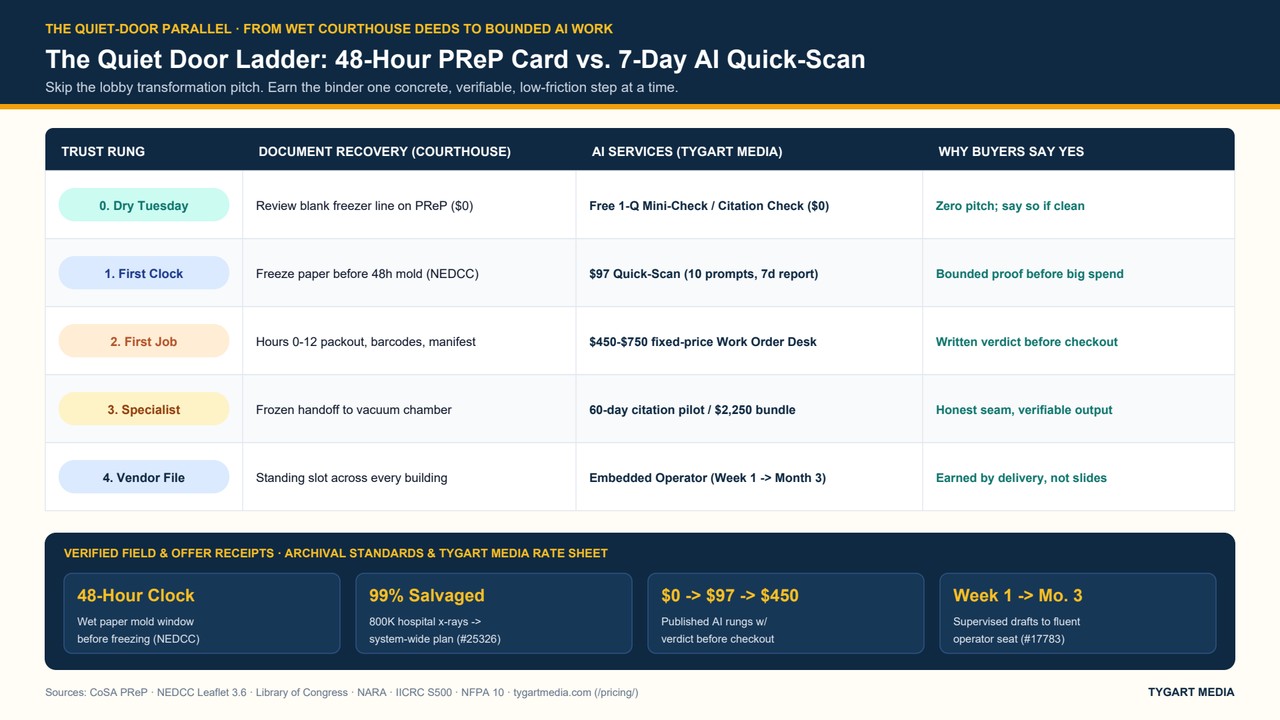
When we began helping business owners fix how AI assistants read, quote, and recommend their companies, we refused to pitch six-month transformation retainers through the front lobby. A smart business owner does not wake up wanting an ‘AI strategy.’ They wake up realizing ChatGPT or Copilot recommended three competitors down the street and skipped their shop completely — or noticing their analytics gauges stopped matching reality (Zero Miles Per Hour on the Generator). So we built our AI offer ladder directly off the courthouse PReP card:
Get The Signal
What we actually ran, what it measured, and what it means for a restoration shop — every week, including the flops.
Notice how every rung obeys the same rule as NIST’s AI Risk Management Framework: govern real risk through narrow, inspectable proof rather than slide-deck promises. On our canonical pricing rate sheet, a business can start at $0 with a one-question Mini-Check or a Free AI-Citation Check (Get Your Business Cited by AI Search), step into a $97 AI Citation Quick-Scan that delivers a scored 10-prompt report in seven days (refundable before work starts and fully credited toward an upgrade within 30 days), or submit one bounded fixed-price job at The Work Order Desk — $450 for a GA4 baseline or citation scan and repair, or $750 for a fleet friction pass or sourced research run, where the written verdict arrives in one business day before any checkout link ever opens. From there, a 60-day citation pilot naturally earns the trust underneath The Embedded Operator — supervised drafting in week one, routine execution by month one, full fluency by month three. Nobody buys the whole building on Tuesday. They let you fix one shelf first.
Where the Quiet Door Bends — Two Honest Limits
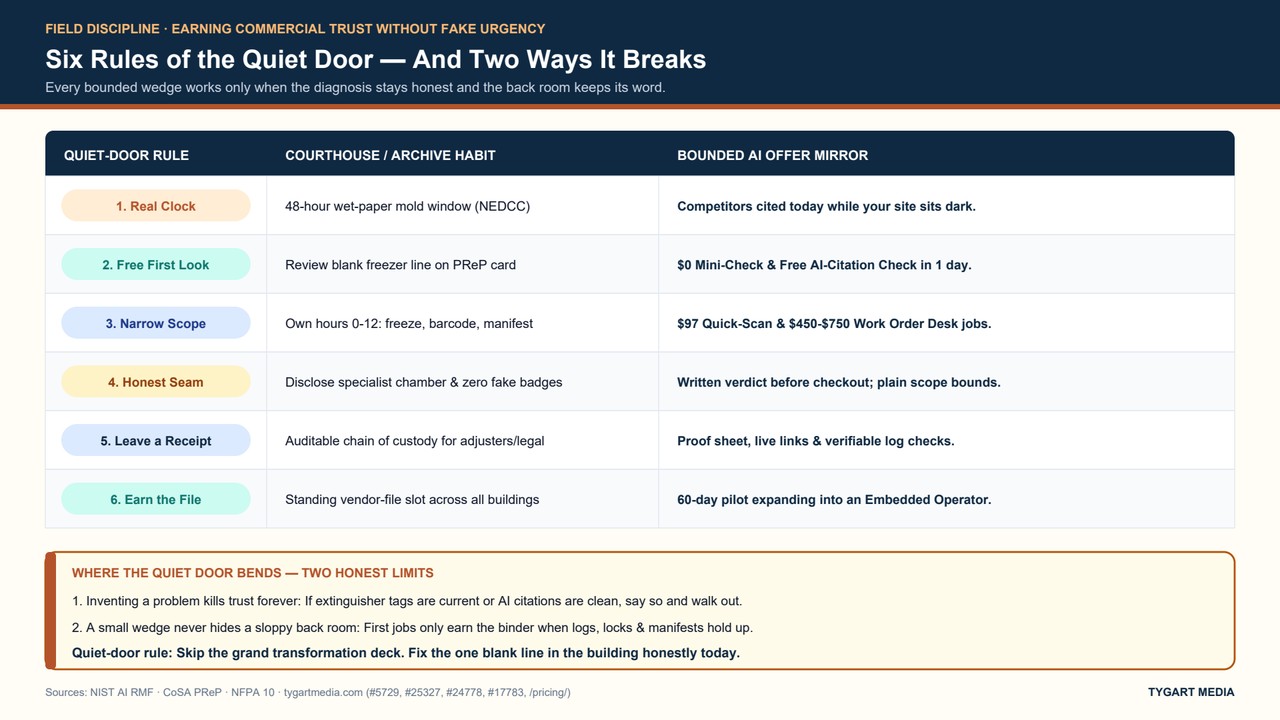
Two strict limits separate a real quiet door from a sleazy foot-in-the-door gimmick. First, inventing a problem kills the door permanently. In a mechanical room, if every fire extinguisher tag is current, you write ‘all current’ on the sheet, hand it to the manager, and walk out without forcing a pitch. In AI work, if a company’s pages are already getting cited cleanly and showing up accurately, saying so honestly earns far more referrals than a rigged red-grade scorecard designed to scare someone into a retainer. Ethics here is not decoration; it is the conversion engine.
Second, a modest front door cannot disguise a sloppy back room. In document recovery, we are blunt that no national freeze-drying chamber hands out shiny ‘authorized partner’ badges — you earn your place on the PReP card by actually showing up on hour one with clean manifests and honest limits. In AI services, a $97 scan or $450 work order only earns the 60-day pilot if the back room actually runs on structural mitigation (We Come From Water Damage), hard access locks (Leave the Keys Off the Van Seat), and two-paper verification (Two Papers on the Kitchen Table). The quiet door opens the room. Only real work keeps your name in the binder.
— Will Tygart, Tygart Media.
Get The Signal
What we actually ran, what it measured, and what it means for a restoration shop — every week, including the flops.
Leave a Reply