
Most AI assistants still answer from memory. Ask one a question and it reasons from patterns baked in during training — useful, but static. The moment a question depends on something that changed yesterday, or something that only exists inside your own systems, that static knowledge runs out.
The more interesting shift happening in AI tooling right now isn’t bigger models — it’s agents that can actually go check. Dispatch-style AI systems, the kind that can spin off an isolated task, open a real shell, browse a real page, or read an actual file, are starting to close the gap between “the AI’s best guess” and “what’s actually true right now.” GitHub is a good test case for why that distinction matters.
Search-and-cite isn’t the same as read-and-act

A lot of what gets marketed as an AI “GitHub integration” is really a search layer: the assistant can look up an issue or a pull request and summarize it, with a citation back to the source. That’s genuinely useful for answering “what did that PR change” — but it’s a dead end the moment you need the assistant to actually do something, like open an issue, comment, or verify what a repository’s current state really is.
The more capable version of this connects an agent directly to real developer tooling: an actual shell, a real git client, real file access. Instead of summarizing a cached snapshot of a repo, the agent can clone it, read the current commit log, open the actual config files, and answer questions against what’s genuinely there today — including the uncomfortable cases, like when the live state doesn’t match what anyone assumed it would.
Why “just check” is harder than it sounds
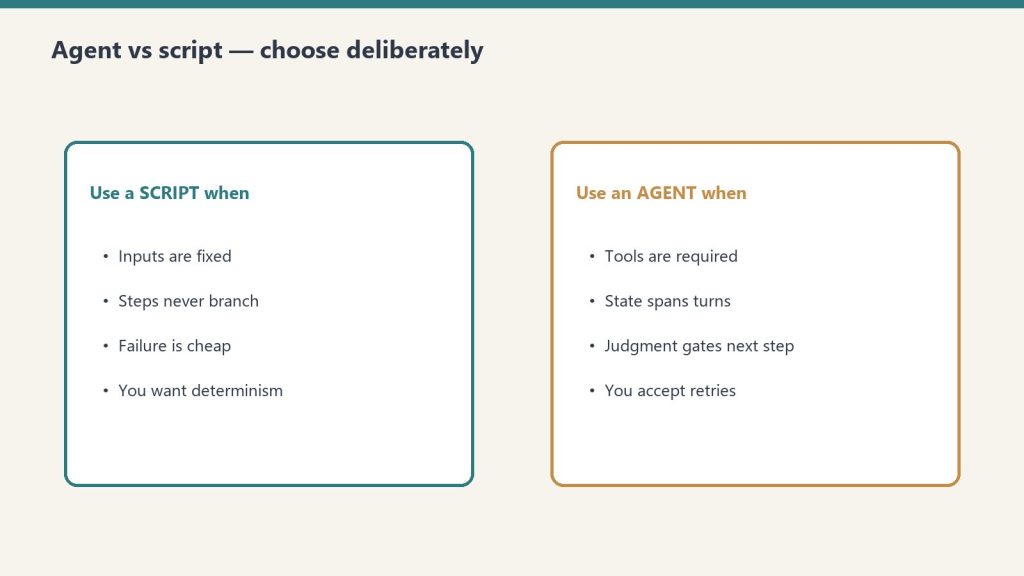
The obvious rebuttal is: shouldn’t a good assistant just check before it answers? In practice, most AI tools default to answering from what they already “know,” because checking is slower and requires actual tool access, not just a knowledge base. The systems that skip the check tend to produce confident, plausible-sounding answers that are quietly wrong the moment reality has drifted from training data — a stale API, a renamed config path, a repo that moved.
The fix isn’t a smarter model. It’s an agent willing to spend the extra step: open the real file, run the real command, read the real log, before saying anything with confidence. That habit is unglamorous, but it’s the difference between an assistant that sounds right and one that actually is.
The practical takeaway

For any business layering AI into real workflows, the question worth asking about a tool isn’t just “how smart is the model” — it’s “what can this thing actually go look at, and will it bother to.” An assistant that can search and summarize is a research aid. One that can open a shell, read your actual repository, and ground its answer in what’s really there is a different category of tool entirely — and it’s the direction the whole space is quietly moving.
Related on Tygart Media: AI crawler experiment · AI citation monitoring · GEO tactics.
Leave a Reply