I use Claude to manage 20+ WordPress sites, write code, analyze data, and build infrastructure. I’m not unusual among Claude users — we’re the builders, the analysts, and the people who need an AI that can hold 200,000 tokens of context without losing the thread. And that user profile shapes exactly what content Claude surfaces, recommends, and would cite if citation features expand.
This is the fifth article in the PSAO series. Each article profiles a different AI platform’s user persona because writing “for AI” without specifying which platform is meaningless.
Who Uses Claude (And Why They Chose It)
Claude’s user base self-selects differently than any other AI platform. Nobody ends up using Claude by accident — there’s no browser default, no operating system integration forcing adoption. People choose Claude for specific reasons, and those reasons define the content that resonates with them:
- Developers and engineers: Code review, architecture decisions, debugging complex systems, writing documentation. Claude’s long context window means they can paste entire codebases and get meaningful analysis
- Analysts and researchers: Document analysis, report synthesis, data interpretation. They upload PDFs, spreadsheets, and research papers and ask Claude to extract insights
- Technical writers and content strategists: People who need nuanced, accurate writing that doesn’t oversimplify. Claude’s tendency to acknowledge trade-offs rather than pick a winner appeals to this group
- Business operators who run on AI: People like me — using Claude Code, Claude Projects, Claude API to build actual operational infrastructure. Not just asking questions, but building systems
The common thread: Claude users are builders. They don’t just consume AI output — they integrate it into workflows, iterate on it, and treat Claude as a collaborator rather than an oracle.
How Claude Users Work (Not Just Search)
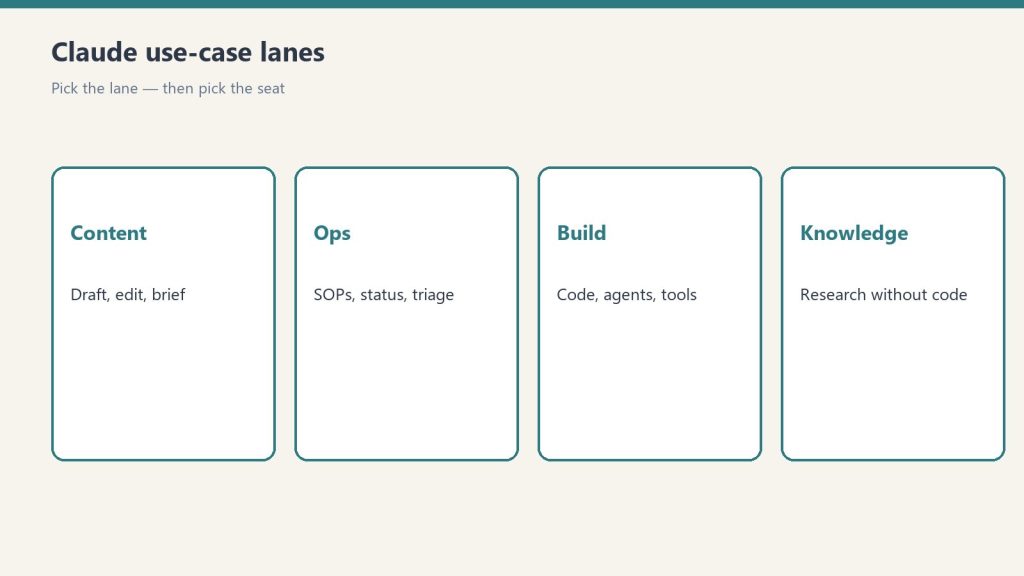
Claude users don’t “search” in the traditional sense. They work. The distinction matters for content strategy:
Long-Context Document Analysis
Claude users regularly paste 50,000-200,000 tokens of content and ask questions about it. A lawyer pastes a 100-page contract. A developer pastes an entire repository. A researcher pastes five papers. The questions they then ask Claude are specific, contextual, and often unanswerable by any search engine because the answer requires synthesizing the pasted context with general knowledge.
Content that serves this user provides the “general knowledge” side of the equation — authoritative reference material that Claude can draw on when synthesizing answers about the user’s specific documents.
Architectural Decision Queries
Claude users frequently ask for help with decisions that involve trade-offs: “Should I use PostgreSQL or MongoDB for this use case, given these constraints?” The key behavioral pattern is that Claude users want the trade-offs acknowledged, not hidden. Content that says “PostgreSQL is the best choice” loses to content that says “PostgreSQL is stronger for X and Y, but MongoDB handles Z better — here’s how to decide.”
Code Review and Refactoring
Claude Code users paste code and ask for analysis, optimization suggestions, and security review. This creates demand for content that explains why certain patterns are better — not just what pattern to use. Claude users want the reasoning, not just the recommendation.
What Content Wins with Claude Users
Technical Deep-Dives with Trade-Off Analysis
The single most effective content format for the Claude audience is the honest technical comparison. Not “5 Best Tools for X” but “How to Choose Between Tool A and Tool B: The Decision Framework.” Claude users are allergic to content that picks winners without acknowledging costs. They trust content that shows them the full picture and lets them decide.
Architectural Decision Records
Content structured as ADRs (Architecture Decision Records) — stating the context, the options considered, the decision made, and the trade-offs accepted — resonates deeply with Claude’s technical user base. This format maps directly to how they think about problems.
Comparison Matrices
Detailed feature comparison matrices with honest assessments (not marketing-biased checkmarks where your product wins every category) perform well. Claude users evaluate tools rigorously. Content that survives their scrutiny earns their trust and their recommendations to colleagues.
Implementation Guides with Context
Claude users don’t just want “how to do X.” They want “how to do X in the context of Y, given constraints Z.” Content that provides implementation guidance within specific architectural or business contexts outperforms generic tutorials. The Claude user is past the beginner stage — they need content that matches their level of sophistication.
Honest Assessments and Limitations
Here’s what separates content that Claude users trust from content they dismiss: acknowledging what doesn’t work. Every tool, framework, and approach has limitations. Content that documents those limitations honestly — “this approach breaks down when you exceed N concurrent connections” — earns Claude users’ respect and citation.
Claude’s Evolving Citation Landscape
As of mid-2026, Claude doesn’t have a native web search feature comparable to ChatGPT Search or Perplexity. But the content strategy still matters for several reasons:
- Training data influence: Content widely published and linked is more likely to be included in Claude’s training data, influencing how Claude answers questions in your domain
- Claude Projects and custom knowledge: Organizations upload content to Claude Projects as reference material. Being the content that organizations choose to upload is a form of citation
- MCP integrations: Claude’s Model Context Protocol allows connecting to external data sources. As web search MCPs become standard, your content needs to be findable and structured for extraction
- Claude Code references: Developers using Claude Code frequently reference documentation and guides. Being the go-to reference in your domain means Claude users paste your content into their sessions
Actionable Takeaways for Claude User Content
- Write with trade-offs visible. Never hide downsides. Claude users trust content that acknowledges limitations and helps them decide, not content that sells them a conclusion
- Structure content as decision frameworks. “How to choose” outperforms “the best” for this audience every time
- Go deep on technical implementation. Surface-level overviews don’t serve builders. Include architecture context, code-level detail, and real-world constraints
- Publish comparison matrices with honest assessments. No marketing-biased checkmark charts. Real evaluations that survive scrutiny
- Write for the long context. Your content may be pasted alongside 100,000 other tokens. It needs to be information-dense and skimmable simultaneously
FAQ
What type of professional primarily uses Claude AI?
Claude’s user base skews heavily toward developers, engineers, analysts, technical writers, and business operators who integrate AI into workflows. These are builders who chose Claude for its long context window, nuanced reasoning, and willingness to acknowledge trade-offs rather than oversimplify.
How do Claude users differ from ChatGPT users?
Claude users are generally more technical and work with longer, more complex contexts. Where ChatGPT users explore and iterate conversationally, Claude users often paste large documents, codebases, or datasets and ask specific analytical questions. Claude users also expect trade-offs acknowledged rather than winners declared.
Does Claude have web search like ChatGPT?
As of mid-2026, Claude does not have a native web search feature comparable to ChatGPT Search. However, content strategy still matters through training data influence, Claude Projects knowledge uploads, MCP web integrations, and the practice of Claude Code users referencing and pasting authoritative content into their sessions.
What content format resonates most with Claude users?
Technical deep-dives with honest trade-off analysis, decision frameworks, architectural comparison matrices, and implementation guides with real-world context. Claude users are past the beginner stage and need content matching their level of sophistication.
How should I structure content for potential Claude training data inclusion?
Publish authoritative, widely-linked, information-dense content with clear structure, honest assessments, and specific technical detail. Content that becomes a go-to reference in its domain — cited by other publications and linked from documentation — has the highest probability of influencing Claude’s training knowledge.
Leave a Reply