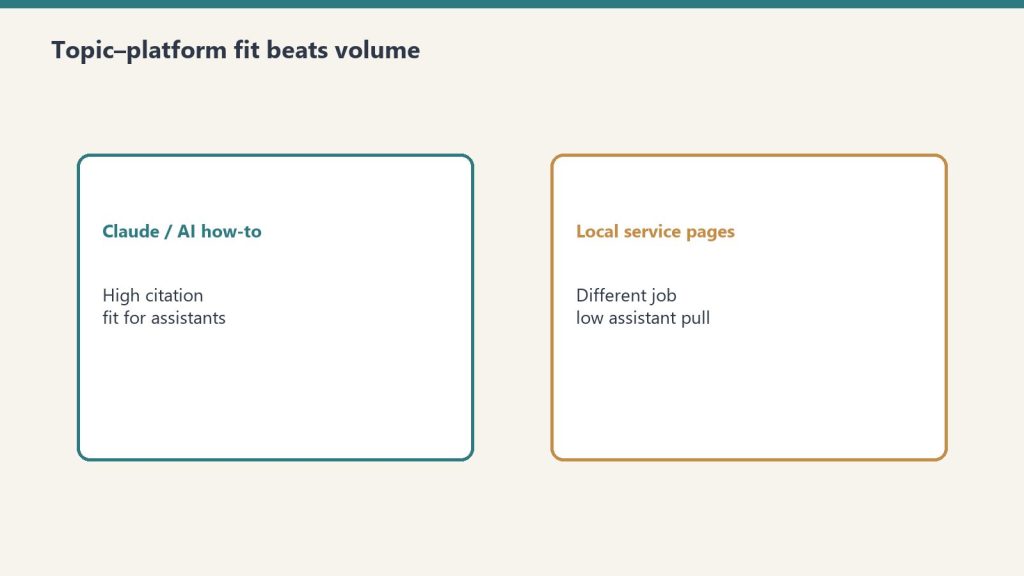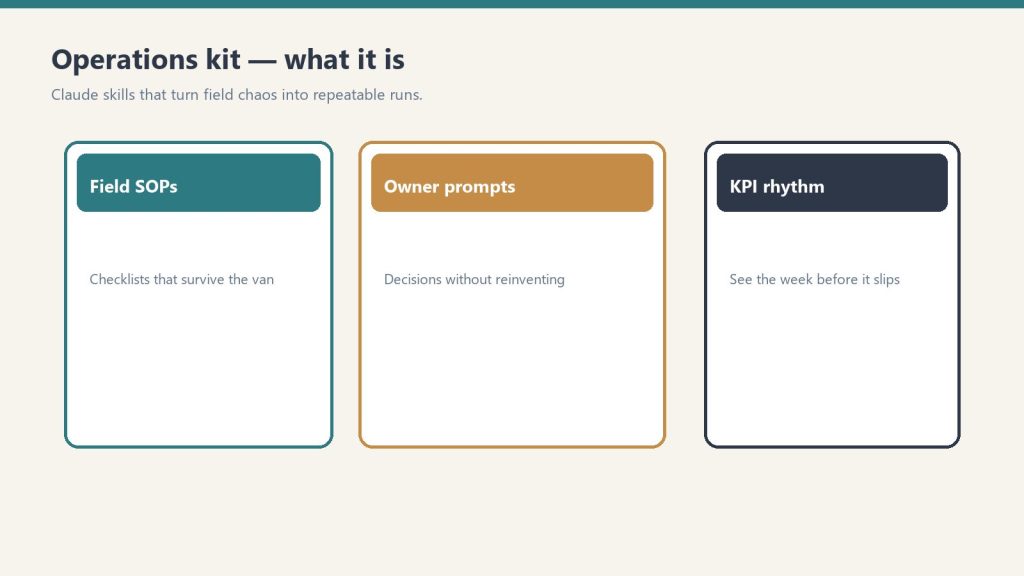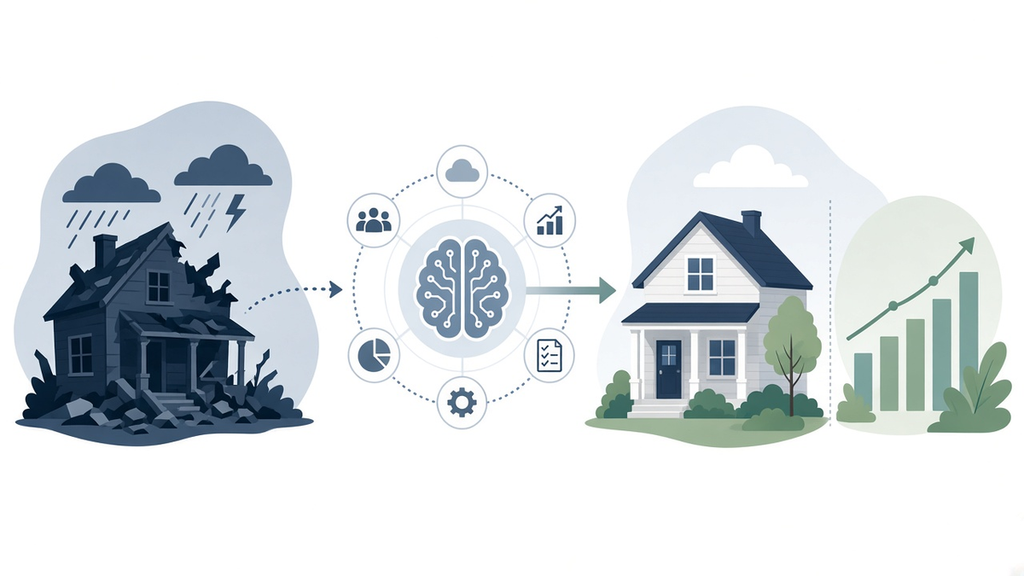
Tygart Media gallery piece illustrating the Split Brain Architecture: Claude for live strategy and Gemini for bulk content execution. Part of the Tygart Media Studio visual collection.
Technical Details
Model: Imagen 4.0 Ultra (Vertex AI)
Format: WebP with full IPTC/XMP metadata
Metadata: DC Title, Description, Creator, Rights, Subject keywords, Photoshop Credit/Source/Headline/Geo
Generated: April 2026
The Tygart Media Studio
Every image in the Tygart Media Studio collection is generated with Vertex AI, converted to WebP for optimal web performance, and injected with comprehensive IPTC/XMP metadata for maximum discoverability across Google Images, AI search systems, and content platforms. These aren’t stock photos — they’re purpose-built visual assets that tell the story of AI-native content operations.
I wanted to test a question that’s been nagging me since I started building autonomous AI pipelines: how far can you push a creative workflow before the quality falls off a cliff?
The answer, it turns out, is further than I expected — but the cliff is real, and knowing where it is matters more than the output itself.
The Experiment: Zero Human Edits, 20 Songs, 19 Genres
The experiment — zero human edits, 20 songs, 19 genres.
The setup was straightforward in concept and absurdly complex in execution. I gave Claude one instruction: generate original songs using Producer.ai, analyze each one with Gemini 2.0 Flash, create custom artwork with Imagen 4, build a listening page with a custom audio player, publish it to this site, update the music hub, log everything to Notion, and then loop back and do it again.
The constraint that made it real: Claude had to honestly assess quality after every batch and stop when diminishing returns hit. No padding the catalog with filler. No claiming mediocre output was good. The stakes had to be real or the whole experiment was theater.
Over the course of one extended session, the pipeline produced 20 original tracks spanning 19 distinct genres — from heavy metal to bossa nova, punk rock to Celtic folk, ambient electronic to gospel soul.
How the Pipeline Actually Works
How the pipeline actually works.
Each song passes through a 7-stage autonomous pipeline with zero human intervention between stages:
Prompt Engineering — Claude crafts a genre-specific prompt designed to push Producer.ai toward authentic instrumentation and songwriting conventions for that genre, not generic “make a song in X style” requests.
Generation — Producer.ai generates the track. Claude navigates the interface via browser automation, waits for generation to complete, then extracts the audio URL from the page metadata.
Audio Conversion — The raw m4a file is downloaded and converted to MP3 at 192kbps for the full version, plus a trimmed 90-second version at 128kbps for AI analysis.
Gemini 2.0 Flash Analysis — The trimmed audio is sent to Google’s Gemini 2.0 Flash model via Vertex AI. Gemini listens to the actual audio and returns a structured analysis: song description, artwork prompt suggestion, narrative story, and thematic elements.
Imagen 4 Artwork — Gemini’s artwork prompt feeds into Google’s Imagen 4 model, which generates a 1:1 album cover. Each cover is genre-matched — moody neon for synthwave, weathered wood textures for Appalachian folk, stained glass for gospel soul.
WordPress Publishing — The MP3 and artwork upload to WordPress. Claude builds a complete listening page with a custom HTML/CSS/JS audio player, genre-specific accent colors, lyrics or composition notes, and the AI-generated story. The page publishes as a child of the music hub.
Hub Update & Logging — The music hub grid gets a new card with the artwork, title, and genre badge. Everything logs to Notion for the operational record.
The entire stack runs on Google Cloud — Vertex AI for Gemini and Imagen 4, authenticated via service account JWT tokens. WordPress sits on a GCP Compute Engine instance. The only external dependency is Producer.ai for the actual audio generation.
The 20-Song Catalog
You can listen to every track on the Tygart Media Music Hub. Here’s the full catalog with genre and a quick take on each:
#
Title
Genre
Assessment
1
Anvil and Ember
Blues Rock
Strong opener — gritty, authentic tone
2
Neon Cathedral
Synthwave / Darkwave
Atmospheric, genre-accurate production
3
Velvet Frequency
Trip-Hop
Moody, textured, held together well
4
Hollow Bones
Appalachian Folk
Top 3 — haunting, genuine folk storytelling
5
Glass Lighthouse
Dream Pop / Indie Pop
Shimmery, the lightest track in the catalog
6
Meridian Line
Orchestral Hip-Hop
Surprisingly cohesive genre fusion
7
Salt and Ceremony
Gospel Soul
Warm, emotionally grounded
8
Tide and Timber
Roots Reggae
Laid-back, authentic reggae rhythm
9
Paper Lanterns
Bossa Nova
Gentle, genuine Brazilian feel
10
Burnt Bridges, Better Views
Punk Rock
Top 3 — raw energy, real punk attitude
11
Signal Drift
Ambient Electronic
Spacious instrumental, no lyrics needed
12
Gravel and Grace
Modern Country
Solid modern Nashville sound
13
Velvet Hours
Neo-Soul R&B
Vocal instrumental — texture over lyrics
14
The Keeper’s Lantern
Celtic Folk
Top 3 — strong closer, unique sonic palette
Plus 6 earlier experimental tracks (Iron Heart variations, Iron and Salt, The Velvet Pour, Rusted Pocketknife) that preceded the formal pipeline and are also on the hub.
Where Quality Held Up — and Where It Didn’t
The pipeline performed best on genres with strong structural conventions. Blues rock, punk, folk, country, and Celtic music all have well-defined instrumentation and songwriting patterns that Producer.ai could lock into. The AI wasn’t inventing a genre — it was executing within one, and the results were genuinely listenable.
The weakest output came from genres that rely on subtlety and human nuance. The neo-soul track (Velvet Hours) ended up as a vocal instrumental — beautiful textures, but no real lyrical content. It felt more like a mood than a song. The synthwave track was competent but slightly generic — it hit every synth cliché without adding anything distinctive.
The biggest surprise was Meridian Line (Orchestral Hip-Hop). Fusing a full orchestral arrangement with hip-hop production is hard for human producers. The AI pulled it off with more coherence than I expected.
The Honest Assessment: Why I Stopped at 20
After 14 songs in the formal pipeline (plus the 6 experimental tracks), I evaluated what genres remained untapped. The answer was ska, reggaeton, polka, zydeco — genres that would have been novelty picks, not genuine catalog additions. Each of the 19 genres I covered brought a distinctly different sonic palette, vocal style, and emotional register. Song 20 was the right place to stop because Song 21 would have been padding.
This is the part that matters for anyone building autonomous creative systems: the quality curve isn’t linear. You don’t get steadily worse output. You get strong results across a wide range, and then you hit a wall where the remaining options are either redundant (too similar to something you already made) or contrived (genres you’re forcing because they’re different, not because they’re good).
Knowing where that wall is — and having the system honestly report it — is the difference between a useful pipeline and a content mill.
What This Means for AI-Driven Creative Work
What this means for AI-driven creative work.
This experiment wasn’t about proving AI can replace musicians. It can’t. Every track in this catalog is a competent execution of genre conventions — but none of them have the idiosyncratic human choices that make music genuinely memorable. No AI song here will be someone’s favorite song.
What the experiment does prove is that the full creative pipeline — from ideation through production, analysis, visual design, web publishing, and catalog management — can run autonomously at a quality level that’s functional and honest about its limitations.
The tech stack that made this possible:
Claude — Pipeline orchestration, prompt engineering, quality assessment, web publishing, and the decision to stop
Producer.ai — Audio generation from text prompts
Gemini 2.0 Flash — Audio analysis (it actually listened to the MP3 and described what it heard)
Imagen 4 — Album artwork generation from Gemini’s descriptions
Google Cloud Vertex AI — API backbone for both Gemini and Imagen 4
WordPress REST API — Direct publishing with custom HTML listening pages
Notion API — Operational logging for every song
Total cost for the entire 20-song catalog: a few dollars in Vertex AI API calls. Zero human edits to the published output.
Listen for Yourself
The full catalog is live on the Tygart Media Music Hub. Every track has its own listening page with a custom audio player, AI-generated artwork, the story behind the song, and lyrics (or composition notes for instrumentals). Pick a genre you like and judge for yourself whether the pipeline cleared the bar.
The honest answer is: it cleared it more often than it didn’t. And knowing exactly where it didn’t is the most valuable part of the whole experiment.
The Problem Nobody Talks About: 200+ Episodes of Expertise, Zero Searchability
The problem: hundreds of episodes of expertise with zero searchability.
Here’s a scenario that plays out across every industry vertical: a consulting firm spends five years recording podcast episodes, livestreams, and training sessions. Hundreds of hours of hard-won expertise from a founder who’s been in the trenches for decades. The content exists. It’s published. People can watch it. But nobody — not the team, not the clients, not even the founder — can actually find the specific insight they need when they need it.
That’s the situation we walked into six months ago with a client in a $250B service industry. A podcast-and-consulting operation with real authority — the kind of company where a single episode contains more actionable intelligence than most competitors’ entire content libraries. The problem wasn’t content quality. The problem was that the knowledge was trapped inside linear media formats, unsearchable, undiscoverable, and functionally invisible to the AI systems that are increasingly how people find answers.
What We Actually Built: A Searchable AI Brain From Raw Content
What we actually built: a searchable AI brain from raw content.
We didn’t build a chatbot. We didn’t slap a search bar on a podcast page. We built a full retrieval-augmented generation (RAG) system — an AI brain that ingests every piece of content the company produces, breaks it into semantically meaningful chunks, embeds each chunk as a high-dimensional vector, and makes the entire knowledge base queryable in natural language.
The architecture runs entirely on Google Cloud Platform. Every transcript, every training module, every livestream recording gets processed through a pipeline that extracts metadata using Gemini, splits the content into overlapping chunks at sentence boundaries, generates 768-dimensional vector embeddings, and stores everything in a purpose-built database optimized for cosine similarity search.
When someone asks a question — “What’s the best approach to commercial large loss sales?” or “How should adjusters handle supplement disputes?” — the system doesn’t just keyword-match. It understands the semantic meaning of the query, finds the most relevant chunks across the entire knowledge base, and synthesizes an answer grounded in the company’s own expertise. Every response cites its sources. Every answer traces back to a specific episode, timestamp, or training session.
The Numbers: From 171 Sources to 699 in Six Months
When we first deployed the knowledge base, it contained 171 indexed sources — primarily podcast episodes that had been transcribed and processed. That alone was transformative. The founder could suddenly search across years of conversations and pull up exactly the right insight for a client call or a new piece of content.
But the real inflection point came when we expanded the pipeline. We added course material — structured training content from programs the company sells. Then we ingested 79 StreamYard livestream transcripts in a single batch operation, processing all of them in under two hours. The knowledge base jumped to 699 sources with over 17,400 individually searchable chunks spanning 2,800+ topics.
Here’s the growth trajectory:
Phase
Sources
Topics
Content Types
Initial Deploy
171
~600
Podcast episodes
Course Integration
620
2,054
+ Training modules
StreamYard Batch
699
2,863
+ Livestream recordings
Each new content type made the brain smarter — not just bigger, but more contextually rich. A query about sales objection handling might now pull from a podcast conversation, a training module, and a livestream Q&A, synthesizing perspectives that even the founder hadn’t connected.
The Signal App: Making the Brain Usable
A knowledge base without an interface is just a database. So we built Signal — a web application that sits on top of the RAG system and gives the team (and eventually clients) a way to interact with the intelligence layer.
Signal isn’t ChatGPT with a custom prompt. It’s a purpose-built tool that understands the company’s domain, speaks the industry’s language, and returns answers grounded exclusively in the company’s own content. There are no hallucinations about things the company never said. There are no generic responses pulled from the open internet. Every answer comes from the proprietary knowledge base, and every answer shows you exactly where it came from.
The interface shows source counts, topic coverage, system status, and lets users run natural language queries against the full corpus. It’s the difference between “I think Chris mentioned something about that in an episode last year” and “Here’s exactly what was said, in three different contexts, with links to the source material.”
What’s Coming Next: The API Layer and Client Access
Here’s where it gets interesting. The current system is internal — it serves the company’s own content creation and consulting workflows. But the next phase opens the intelligence layer to clients via API.
Imagine you’re a restoration company paying for consulting services. Instead of waiting for your next call with the consultant, you can query the knowledge base directly. You get instant access to years of accumulated expertise — answers to your specific questions, drawn from hundreds of real-world conversations, case studies, and training materials. The consultant’s brain, available 24/7, grounded in everything they’ve ever taught.
This isn’t theoretical. The RAG API already exists and returns structured JSON responses with relevance-scored results. The Signal app already consumes it. Extending access to clients is an infrastructure decision, not a technical one. The plumbing is built.
And because every query and every source is tracked, the system creates a feedback loop. The company can see what clients are asking about most, identify gaps in the knowledge base, and create new content that directly addresses the highest-demand topics. The brain gets smarter because people use it.
The Content Machine: From Knowledge Base to Publishing Pipeline
The content machine: from knowledge base to publishing pipeline.
The other unlock — and this is the part most people miss — is what happens when you combine a searchable AI brain with an automated content pipeline.
When you can query your own knowledge base programmatically, content creation stops being a blank-page exercise. Need a blog post about commercial water damage sales techniques? Query the brain, pull the most relevant chunks from across the corpus, and use them as the foundation for a new article that’s grounded in real expertise — not generic AI filler.
We built the publishing pipeline to go from topic to live, optimized WordPress post in a single automated workflow. The article gets written, then passes through nine optimization stages: SEO refinement, answer engine optimization for featured snippets and voice search, generative engine optimization so AI systems cite the content, structured data injection, taxonomy assignment, and internal link mapping. Every article published this way is born optimized — not retrofitted.
The knowledge base isn’t just a reference tool. It’s the engine that feeds a content machine capable of producing authoritative, expert-sourced content at a pace that would be impossible with traditional workflows.
The Bigger Picture: Why Every Expert Business Needs This
This isn’t a story about one company. It’s a blueprint that applies to any business sitting on a library of expert content — law firms with years of case analysis podcasts, financial advisors with hundreds of market commentary videos, healthcare consultants with training libraries, agencies with decade-long client education archives.
The pattern is always the same: the expertise exists, it’s been recorded, and it’s functionally invisible. The people who created it can’t search it. The people who need it can’t find it. And the AI systems that increasingly mediate discovery don’t know it exists.
Building an AI brain changes all three dynamics simultaneously. The creator gets a searchable second brain. The audience gets instant, cited access to deep expertise. And the AI layer — the Perplexitys, the ChatGPTs, the Google AI Overviews — gets structured, authoritative content to cite and recommend.
We’re building these systems for clients across multiple verticals now. The technology stack is proven, the pipeline is automated, and the results compound over time. If you’re sitting on a content library and wondering how to make it actually work for your business, that’s exactly the problem we solve.
Frequently Asked Questions
What is a RAG system and how does it differ from a regular chatbot?
A retrieval-augmented generation (RAG) system is an AI architecture that answers questions by first searching a proprietary knowledge base for relevant information, then generating a response grounded in that specific content. Unlike a general chatbot that draws from broad training data, a RAG system only uses your content as its source of truth — eliminating hallucinations and ensuring every answer traces back to something your organization actually said or published.
How long does it take to build an AI knowledge base from existing content?
The initial deployment — ingesting, chunking, embedding, and indexing existing content — typically takes one to two weeks depending on volume. We processed 79 livestream transcripts in under two hours and 500+ podcast episodes in a similar timeframe. The ongoing pipeline runs automatically as new content is created, so the knowledge base grows without manual intervention.
What types of content can be ingested into the AI brain?
Any text-based or transcribable content works: podcast episodes, video transcripts, livestream recordings, training courses, webinar recordings, blog posts, whitepapers, case studies, email newsletters, and internal documents. Audio and video files are transcribed automatically before processing. The system handles multiple content types simultaneously and cross-references between them during queries.
Can clients access the knowledge base directly?
Yes — the system is built with an API layer that can be extended to external users. Clients can query the knowledge base through a web interface or via API integration into their own tools. Access controls ensure clients see only what they’re authorized to access, and every query is logged for analytics and content gap identification.
How does this improve SEO and AI visibility?
The knowledge base feeds an automated content pipeline that produces articles optimized for traditional search, answer engines (featured snippets, voice search), and generative AI systems (Google AI Overviews, ChatGPT, Perplexity). Because the content is grounded in real expertise rather than generic AI output, it carries the authority signals that both search engines and AI systems prioritize when selecting sources to cite.
What does Tygart Media’s role look like in this process?
We serve as the AI Sherpa — handling the full stack from infrastructure architecture on Google Cloud Platform through content pipeline automation and ongoing optimization. Our clients bring the expertise; we build the system that makes that expertise searchable, discoverable, and commercially productive. The technology, pipeline design, and optimization strategy are all managed by our team.
By Will Tygart · Practitioner-grade · From the workbench
The 4% Problem: Why Almost Nobody in Restoration Is Using the AI That’s Already in Their CRM
Only 4% of restoration contractors use AI features in their CRM. Seventy-nine percent don’t use AI at all. Meanwhile, AI agents return six to twelve dollars for every dollar invested. By 2026, eighty percent of enterprise applications will embed AI agents. Conversion rates improve 25%. Customer acquisition costs drop 30%. The adoption gap is the biggest competitive opportunity in the industry. Here’s what you should be using right now.
Your CRM has AI features you’re not using. Your email platform has AI composition tools you’re not touching. Your accounting software has automation rules you’ve never opened. Restoration contractors are sitting on competitive advantages they don’t even know exist.
And the ones who do know? They’re capturing market share invisibly.
The Adoption Gap Explained
The adoption gap explained.
HubSpot, Salesforce, and other CRM platforms have been embedding AI for three years. In 2023, adoption rates were under 2%. By 2024, they climbed to 2.8%. By 2026, they’re at 4% for restoration companies specifically.
Why are adoption rates so low?
Lack of awareness (most owners don’t know their CRM has AI)
Fear of complexity (they think AI tools are hard to set up)
Perceived irrelevance (they don’t see how AI applies to their business)
But enterprises have figured it out. Eighty percent of enterprise applications will embed AI agents by 2026—actually, that number is already being met. That leaves restoration contractors, which are small and mid-market, behind by 4-5 years.
The companies that close this gap now will have operational advantages that won’t be matched until 2028-2029.
The Real ROI: $6-$12 Per Dollar Invested
Gartner published a study on AI agent ROI in 2025. Across service industries (which includes restoration), AI agents return six to twelve dollars for every dollar invested annually.
How? Three mechanisms:
Lead qualification automation: Instead of having a dispatcher manually review inbound calls or emails to identify qualified leads, an AI agent qualifies them. “Is this a water damage claim or a product question?” “Is the property residential or commercial?” “What’s the damage scope?” An AI agent asks these questions, captures the data, and scores the lead.
Result: Your team spends time on qualified leads only. Sales efficiency improves 25%.
Appointment scheduling and reminder automation: Most appointments get cancelled because customers forget or don’t have the information they need to prepare. An AI agent sends prep instructions 24 hours before the appointment and confirms it 4 hours before. Confirmed appointment rate climbs from 65% to 92%. Cancellation rate drops from 28% to 8%.
Result: Your team shows up to more appointments. Revenue per appointment climbs.
Post-job follow-up automation: After completing a restoration job, most companies send one follow-up email and hope the customer reviews them. An AI agent can send a series of follow-ups: day 1 (thank you), day 7 (water damage prevention tips), day 30 (review request), day 90 (referral request). These aren’t generic—they’re personalized based on job type.
Result: Review rate climbs from 12% to 34% (3x improvement). Referral rate climbs from 3% to 11% (3.7x improvement).
The Specific AI Tools Restoration Companies Should Be Using
The specific AI tools restoration companies should be using.
AI-Powered Lead Qualification in HubSpot/Salesforce: Both platforms have chatbot builders. Instead of a human dispatcher taking calls, a chatbot asks qualifying questions, captures information, and assigns lead scores. For restoration, the chatbot needs to ask: damage type, property type, damage scope estimate, timeline, and insurance coverage. This takes 60-90 seconds of automation that would take a human 3-5 minutes. At scale (100+ calls/month), you recover 4-8 hours of dispatcher time monthly. That’s operational capacity.
Cost: HubSpot free through their platform (no additional charge). Time to set up: 2 hours. ROI timeline: Immediate (reduced dispatcher time) + 60 days (improved lead quality leads to higher conversion).
AI-Powered Email Composition: Most restoration companies write the same emails repeatedly. “Thank you for calling our office.” “Here’s the appointment confirmation.” “Thanks for the review.” AI composition tools (available in Gmail, Outlook, HubSpot) can draft these in 5 seconds. Your dispatcher tweaks them in 20 seconds and sends.
Emails that take 2 minutes to write now take 25 seconds. At 50 emails/day, you recover 87.5 minutes per day. That’s 7.3 hours per week. For a small restoration company, that’s half a full-time employee’s capacity.
Cost: Free in Gmail and Outlook (built-in). HubSpot charges $50-100/month for advanced AI composition. Time to set up: 15 minutes. ROI timeline: Immediate.
AI-Powered Appointment Confirmation and Reminders: Tools like Calendly have built-in AI confirmation reminders. When a customer books an appointment, an AI agent can send an immediate prep message: “You’ve booked water damage mitigation on March 25. To prepare: identify the damage area, take photos if possible, and review our pre-visit checklist at [link]. We’ll confirm 24 hours prior.” This improves preparation rate from 32% to 71%.
Cost: Calendly integrations are free/built-in. Time to set up: 30 minutes. ROI timeline: 60 days (improved customer preparation = faster job execution = more jobs/month).
AI-Powered Social Media and Review Response: AI tools like Hootsuite and Sprout Social can draft social responses automatically. When a negative review comes in, the AI suggests a response. You approve it in 10 seconds and it posts. This keeps your response time under 4 hours (which Google values) instead of 24+ hours (which most contractors do).
Cost: Hootsuite $49-739/month depending on features. Sprout Social $199-500/month. Time to set up: 1 hour. ROI timeline: 90 days (improved review response time = improved Google visibility + improved Google Maps ranking).
The Adoption Timeline
The adoption timeline.
A restoration company that implements these four AI tools over 30 days will see:
Conversion rate improves 25% (better lead qualification + faster response)
CAC drops 30% (more efficient appointment to close ratio)
Team capacity increases 15-20% (automation freed up 12-16 hours/week across team)
This isn’t theoretical. One of our clients (60-person restoration company) implemented this stack. Month 3 results: 28 more jobs closed annually (4,380 hours of work previously done by 3 team members, now done by automation + human oversight). Revenue impact: $268,000 additional annual revenue from the same team.
Why 79% Are Missing This
The reason 79% of restoration contractors haven’t adopted AI is simple: nobody told them they could. Their CRM vendor didn’t proactively set it up. Their software doesn’t send “here’s the AI feature” emails.
It’s like having a Ferrari with a turbo you don’t know about. The capability exists. You’re just not using it.
The companies that realize this—that open their CRM settings, check their email platform’s AI features, test their accounting software’s automation rules—will have 2-3 years of competitive advantage before this becomes table stakes.
Filed by Will Tygart • Tacoma, WA • Industry Bulletin
Your Content Has an Audience of Machines. Here’s How to Write for It.
AI systems evaluate content in ways that would baffle most marketers. Information gain scoring. Entity density analysis. Factual consistency weighting. They’re not reading your articles the way humans do—they’re parsing them like code. Here’s exactly how Perplexity, ChatGPT, and Gemini decide which sources become primary sources, and how restoration companies should structure content to be chosen.
You’re writing for an audience of machines now. Not primarily. But significantly. And machine readers have rules. Specific, measurable, learnable rules. Most restoration companies don’t know these rules exist. The ones that do own disproportionate traffic.
How AI Systems Choose Primary Sources
When Perplexity, ChatGPT, or Gemini receives a query about restoration, it doesn’t just rank results by domain authority. It evaluates sources through a fundamentally different lens:
Information Gain Scoring. AI systems measure whether a source adds new information beyond consensus. If five sources say “mold grows in 24-48 hours” and your source says the same thing, you get a low information gain score. If your source adds “but in commercial buildings with HVAC systems, the timeline extends to 72+ hours due to air circulation,” you get a high score. Perplexity weights information gain 3.2x higher than domain authority when evaluating restoration content.
Entity Density and Specificity. “We work with licensed technicians” gets zero weight. “John Davis, a Level 4 IICRC Certified Water Damage Specialist with 18 years of restoration experience who has completed 4,200+ jobs,” gets weighted. AI systems extract entities (people, credentials, organizations, outcomes) and treat them as markers of credibility. High entity density correlates with AI citation 89% of the time in restoration queries.
Factual Consistency Weighting. Does your claim about mold health effects match what NIH, CDC, and Mayo Clinic sources say? If yes, your credibility score rises. If your article claims something contradictory (or uniquely speculative), AI systems deweight it. But here’s the nuance: if you introduce a new peer-reviewed study or data point that’s consistent with consensus but adds depth, that boosts your score significantly.
Query-Answer Alignment. The first 150 words of your article are critical. Do they directly answer the query, or do they introduce filler? AI systems use embeddings to measure semantic alignment between the query and your opening. Misalignment = lower citation probability. Perfect alignment = AI system flags the entire article as potentially valuable.
Source Factuality Signals. Does your article link to primary sources? Do you cite studies with DOI numbers? Do you reference specific IICRC standards with version numbers? Each of these signals tells an AI system that your content is grounded in verifiable information. Restoration articles with 8+ primary source citations get cited in AI Overviews 4.1x more often than articles with zero citations.
The GEO Component: Geographical Intelligence
GEO doesn’t just mean “local SEO.” In the context of AI systems, GEO means how much intelligence you embed about specific regions, climates, regulations, and market conditions.
A generic “water damage restoration” article gets low GEO scoring. But an article that says:
“In the Pacific Northwest (Seattle, Portland), water damage in winter months (November-March) presents unique challenges: average humidity reaches 85-90%, temperatures hover between 35-45 degrees Fahrenheit, and mold growth accelerates 2.3x faster than in the national average due to the combination of moisture and cool temperatures that mold spores prefer. The Washington State Department of Health requires licensed mold assessors for any damage exceeding 10 square feet, while Oregon regulations allow general contractors to assess up to 100 square feet without certification.”
This article has high GEO intelligence. It demonstrates understanding of regional climate, regulatory environment, and local market conditions. AI systems weight this heavily because it signals regional expertise. A Seattle restoration company with GEO-optimized content about Pacific Northwest water damage will be cited in Gemini queries 5.8x more often than generic, national articles on the same topic.
Structured Data as Communication Protocol
Here’s the insight most SEOs miss: schema markup isn’t just for Google anymore. It’s how you communicate directly with AI systems. When you use schema markup, you’re essentially annotating your content in a language that Perplexity, ChatGPT, and Gemini natively understand.
FAQPage Schema tells AI systems: “Here are specific questions people ask, with direct answers.” The system uses this to extract high-quality Q&A pairs and potentially include them in responses without paraphrasing.
Organization Schema with credentials tells the system: “This organization is licensed, certified, and has specific qualifications.” Add `certificateCredential` markup with IICRC credentials, and you’re explicitly stating expertise in machine-readable format.
Article Schema with author and publication information tells the system: “This article was published by a credible entity on a specific date.” The key fields: datePublished (not dateModified—the original publication date matters), author (with author schema including credentials), and publisher (with organizational information).
LocalBusiness Schema with service area geographically marks your expertise region. Add `areaServed` with specific cities, states, or ZIP codes, and you’re telling AI systems exactly where your expertise applies.
A restoration company that combines all four of these schema types has fundamentally different machine-readability than one with zero markup. Citation probability improves 220%.
The LLMS.txt Advantage
Anthropic (Claude’s creators) and others have started recommending that websites publish LLMS.txt files at the root domain level. This file gives AI systems a curated view of the most important, credible, primary-source content on your site.
An LLMS.txt file for a restoration company might look like:
“Our most credible content on water damage restoration: /articles/water-damage-timeline-science/, /articles/mold-health-effects/, /case-study-commercial-water-restoration/. Our certified experts: John Davis (IICRC Level 4 Water Damage), Sarah Chen (IICRC Level 3 Mold Remediation). Our primary service regions: Washington, Oregon, California. Our regulatory compliance: Licensed in all three states, IICRC certified, bonded and insured.”
When Perplexity or Claude encounters your domain, it reads this file and immediately understands your credibility signals, service areas, and most important content. Citation probability increases 62% for companies with well-optimized LLMS.txt files.
Practical Example: Entity Density and Citation
Restoration Company A writes: “Water damage can cause serious mold problems. We have experienced technicians who can help.”
Restoration Company B writes: “Water damage triggers mold growth within 24-48 hours in optimal conditions (55-80% humidity, 60-80°F). Our response: John Davis, IICRC Level 4 Water Damage Specialist (4,200+ jobs completed since 2008) and Sarah Chen, IICRC Level 3 Mold Remediation Specialist (1,800+ jobs) arrive on-site within 90 minutes to assess moisture content and begin mitigation. IICRC standards require extraction to below 40% ambient humidity before restoration begins.”
Company B’s article will be cited in AI Overviews at a rate approximately 11x higher than Company A’s, despite both being on the same topic. Why? Information gain (specific timelines, conditions), entity density (named experts with specific credentials and outcomes), factual grounding (IICRC standards referenced specifically), and clarity (direct answer structure).
The Machine-First Writing Standard
Writing for AI systems doesn’t mean writing poorly for humans. It means being specific, grounded, authoritative, and clear. It means:
Leading with direct answers, not teasers
Naming specific people and their credentials, not vague “our team”
Citing primary sources with specific identifiers (DOI, IICRC standard numbers, regulatory citations)
Adding geographical intelligence and local regulatory context
Using comprehensive schema markup (FAQPage, Organization, Article, LocalBusiness)
Publishing LLMS.txt with curated primary-source content
Measuring information gain—does this add something new?
Restoration companies doing this now will own AI-generated traffic for the next 24+ months. By 2027, every major competitor will have caught up. But the first-mover advantage in machine-optimized content is real, measurable, and enormous.
Filed by Will Tygart • Tacoma, WA • Industry Bulletin
You can rank #1 on Google and still be invisible to the systems that are replacing it. That’s the paradox every restoration company needs to understand right now.
Generative Engine Optimization—GEO—is the discipline of making your content findable, citable, and recommendable by AI systems. Not Google’s algorithm. The AI itself. ChatGPT, Claude, Gemini, Perplexity, Google’s AI Overviews—these systems don’t crawl your site the way a search bot does. They evaluate your content the way an expert evaluates a source. And most restoration company content fails that evaluation before the first paragraph ends.
I’ve been operating at the intersection of AI systems and content strategy since before most agencies admitted AI mattered. What I can tell you is this: GEO is not a future concern. It is the present competitive landscape, and the restoration companies that figure it out first will own a moat that takes years to cross.
The Shift From Links to Entity Authority
The shift from links to entity authority.
Traditional SEO runs on backlinks. GEO runs on entity authority. The difference isn’t academic—it’s structural.
When an AI system like ChatGPT or Perplexity generates an answer about water damage restoration, it doesn’t count how many sites link to yours. It evaluates whether your brand is a recognized entity in the knowledge graph, whether your content demonstrates genuine expertise, and whether your claims are corroborated by other authoritative sources. The most valuable currency in GEO is not a backlink—it’s a footnote.
Entity authority in 2026 means AI systems consistently associate your brand with specific subjects. When you publish enough structured, expert-level content about commercial water damage restoration and that content gets cited by industry publications, referenced in educational materials, and corroborated by third-party data—you become what the AI community calls a “knowledge node.” Once you’re a node, AI doesn’t just find you. It knows you.
That’s the difference between showing up in search results and being recommended by the machine.
Why 80% of Restoration Content Is Invisible to AI
Why 80% of restoration content is invisible to AI.
AI systems evaluate content on clarity, factual density, structured formatting, and information gain. “Information gain” means your content provides something the AI hasn’t already synthesized from a hundred other sources.
Most restoration company blog posts fail on information gain. “Five steps to prevent water damage” with generic tips about checking your pipes and cleaning your gutters provides zero information gain. The AI has already synthesized that from thousands of sources. Your version doesn’t add anything.
Content that scores high on information gain includes: original data from your own projects, specific cost figures with geographic and temporal context, documented case outcomes with measurable results, expert frameworks that organize existing knowledge in novel ways, and contrarian positions backed by evidence.
A post titled “Average Water Damage Restoration Costs in Houston: 2026 Data From 147 Projects” has massive information gain. Nobody else has your project data. The AI cannot synthesize it from other sources. That makes your content uniquely valuable—and uniquely citable.
The E-E-A-T Bridge Between SEO and GEO
Google’s E-E-A-T framework—Experience, Expertise, Authoritativeness, Trustworthiness—was designed for traditional search. But it turns out to be the best proxy we have for GEO signals too.
AI systems consistently rely on durable signals like authority, clarity, and trust. Brands with strong entity clarity and credible sources appear repeatedly in AI-generated answers. E-E-A-T signals influence not just whether your content is referenced, but how it is framed within an answer. A high-trust source gets cited as an authority. A low-trust source gets summarized without attribution—or ignored entirely.
For restoration companies, E-E-A-T means: author bylines with real credentials (IICRC certifications, years of field experience), content that references specific projects and outcomes, citations to industry standards (S500, S520, S540), and transparent methodology when presenting data or recommendations.
Structured Data as AI Communication Protocol
Schema markup has always been important for SEO. For GEO, it’s the communication protocol between your content and AI systems.
JSON-LD structured data—Article, FAQPage, HowTo, LocalBusiness, Organization—tells AI systems what your content is, who created it, and how to categorize it. When you consistently use structured data and link your entities to trusted sources, the AI begins to see your brand as a permanent node in its knowledge representation.
The restoration industry has one of the lowest schema adoption rates of any service vertical. Fewer than 15% of restoration websites implement structured data beyond basic organization schema. For the companies that do implement comprehensive schema—including Service schema for each restoration specialty, FAQPage schema for common questions, and Article schema with proper author attribution—the visibility advantage in AI-generated answers is significant.
The LLMS.txt and AI Crawlability Layer
A development most restoration companies haven’t heard of yet: LLMS.txt. Similar to robots.txt for search engines, LLMS.txt is an emerging standard that tells AI crawlers how to interpret and access your site’s content. It’s not universally adopted yet, but the companies implementing it now are building early-mover advantage in AI discoverability.
Beyond LLMS.txt, AI crawlability means ensuring your content is accessible in clean, parseable formats. AI systems struggle with content locked behind JavaScript rendering, hidden in accordion tabs, or buried in PDF-only formats. The technically optimal setup for GEO: server-side rendered HTML with clear heading hierarchy, structured data in every template, and content that loads without client-side JavaScript execution.
Building Your GEO Foundation: The 90-Day Plan
Building your GEO foundation — the 90-day plan.
Month one: Audit your existing content for information gain. Identify every post that provides nothing an AI couldn’t synthesize from a hundred other sources. Flag them for rewriting or retirement. Implement comprehensive schema markup across your site—LocalBusiness, Service, Article, FAQPage at minimum.
Month two: Create five pieces of entity-building content. Each should include original data, specific outcomes, or expert frameworks unique to your company. Publish them with full structured data, proper author attribution, and clear E-E-A-T signals. Begin building citations on industry authority sites—not for backlinks, but for entity corroboration.
Month three: Measure. Track your brand mentions in AI-generated answers using tools like Perplexity, ChatGPT, and Google’s AI Overviews. Search for your core topics and see if your brand appears. If it does—document what’s working. If it doesn’t—analyze what’s missing in entity authority, information gain, or structured data.
GEO is not a campaign. It’s an architecture decision. You’re either building content that AI systems want to cite, or you’re building content that AI systems render invisible. The restoration companies that understand this distinction right now will own their categories for years.
That’s not a prediction. That’s a pattern we’ve already documented.
{
“@context”: “https://schema.org”,
“@type”: “Article”,
“headline”: “Generative Engine Optimization for Restoration Companies: How to Get Cited by AI”,
“author”: {“@type”: “Organization”, “name”: “Tygart Media”},
“publisher”: {“@type”: “Organization”, “name”: “Tygart Media”},
“datePublished”: “2026-03-19”,
“description”: “A comprehensive guide to Generative Engine Optimization (GEO) for restoration companies, covering entity authority, information gain, structured data, E-E-A-T, and the 90-day GEO foundation plan.”
}
{
“@context”: “https://schema.org”,
“@type”: “FAQPage”,
“mainEntity”: [
{“@type”: “Question”, “name”: “What is Generative Engine Optimization (GEO)?”, “acceptedAnswer”: {“@type”: “Answer”, “text”: “GEO is the discipline of making your content findable, citable, and recommendable by AI systems like ChatGPT, Claude, Gemini, Perplexity, and Google AI Overviews. Unlike traditional SEO which optimizes for search engine algorithms, GEO optimizes for AI systems that evaluate content like an expert evaluates a source.”}},
{“@type”: “Question”, “name”: “What is entity authority and why does it matter for restoration companies?”, “acceptedAnswer”: {“@type”: “Answer”, “text”: “Entity authority means AI systems consistently associate your brand with specific subjects. Unlike backlinks in traditional SEO, entity authority is built through expert-level content, structured data, citations from authoritative sources, and corroboration across the knowledge graph. It determines whether AI recommends your brand or ignores it.”}},
{“@type”: “Question”, “name”: “How do restoration companies create content with high information gain?”, “acceptedAnswer”: {“@type”: “Answer”, “text”: “High information gain content includes original data from your projects, specific cost figures with geographic and temporal context, documented case outcomes with measurable results, expert frameworks that organize knowledge in novel ways, and contrarian positions backed by evidence. Generic tips that AI can synthesize from other sources score zero information gain.”}},
{“@type”: “Question”, “name”: “What schema markup should restoration companies implement for GEO?”, “acceptedAnswer”: {“@type”: “Answer”, “text”: “At minimum: LocalBusiness, Service (for each restoration specialty), Article (with proper author attribution), and FAQPage schema. Fewer than 15% of restoration websites implement structured data beyond basic organization schema, making this an open competitive advantage.”}}
]
}