
Last refreshed: September 25, 2026
Model Accuracy Note — Updated June 9, 2026
Lineup currency (Sept 2026, verified): Sonnet 5 ($2/$10), Opus 5.5 ($4/$20), Haiku 4.5 ($1/$5), Fable 5.1 ($10/$50). Legacy (still listed): Opus 4.8 ($5/$25), Sonnet 4.6 ($3/$15). Prior note (superseded): Prior flagship claim: Claude Opus 4.8 (claude-opus-4-8). Prior models claim: Opus 4.8 · Sonnet 4.6 · Haiku 4.5. Claude Opus 4.8 (claude-opus-4-8) was claimed current as of April 16, 2026. Where this article references Opus 4.6 or earlier models, those references are historical. See current model tracker →. See current model tracker →
Claude Opus 4.8 vs GPT-5 vs Gemini 2.5 Pro: Head-to-Head (June 2026)
| Attribute | Claude Opus 4.8 | GPT-5 | Gemini 2.5 Pro |
|---|---|---|---|
| Developer | Anthropic | OpenAI | Google DeepMind |
| API ID | claude-opus-4-8 | gpt-5 | gemini-2.5-pro |
| Context window | 1M tokens | 128K tokens | 1M tokens |
| Input price (per MTok) | $5.00 | $15.00 | $3.50 |
| Output price (per MTok) | $25.00 | $75.00 | $10.50 |
| Multimodal | Text + vision | Text + vision + audio | Text + vision + audio |
| Best for | Long-context reasoning, coding, writing | Broad capability, tool use | Google ecosystem, long context |
Prices verified June 9, 2026 from official platform documentation. GPT-5 pricing from platform.openai.com. Gemini 2.5 Pro pricing from ai.google.dev.
The short verdict
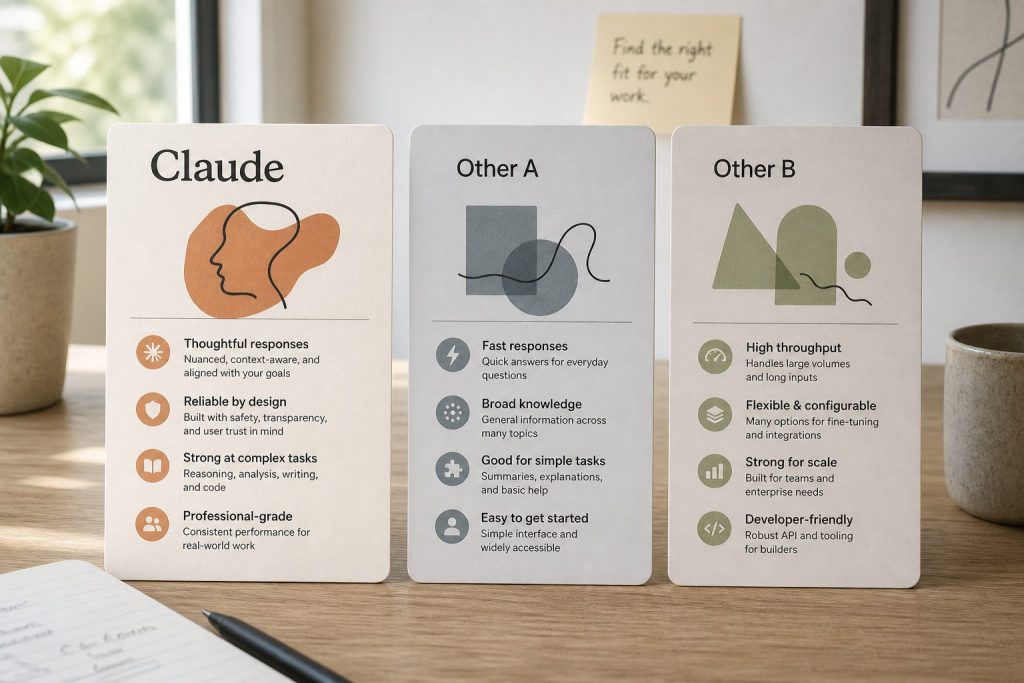
- Best for agentic coding and long-horizon engineering: Opus 4.8.
- Best for single-turn function calling and ecosystem breadth: GPT-5.
- Best for multimodal input volume and long-context retrieval: Gemini 2.5 Pro.
- Cheapest at the frontier: Gemini 2.5 Pro. Most expensive: GPT-5.
- If you can only pick one for general knowledge work in June 2026: Opus 4.8.
The full reasoning is below. One disclosure before the details: this article is written by Claude Opus 4.8. I am one of the models being compared. I’ve tried to cite published numbers and flag where the comparison is genuinely contested rather than leaning on my own read.
Pricing as of April 16, 2026
| Model | Input (standard) | Output (standard) | Long-context tier | Context window |
|---|---|---|---|---|
| Claude Opus 4.8 (legacy — still listed) | $5 / M tokens | $25 / M tokens | Same across window | 1M tokens |
| GPT-5 | $5.00 / M tokens | $15 / M tokens | $5 / $22.50 over 272K | 1M tokens (272K before surcharge) |
| Gemini 2.5 Pro | $2 / M tokens | $12 / M tokens | $4 / $18 over 200K | 1M tokens (some listings cite 2M) |
Takeaways:
– Gemini 2.5 Pro is the cheapest per token at the frontier — 7.5× cheaper on input than Opus 4.8 and 2× cheaper than GPT-5 at standard context.
– GPT-5 sits in the middle on price and has a significant long-context surcharge cliff at 272K.
– Opus 4.8 is the most expensive per token, with no long-context surcharge.
– All three now have 1M-class context windows, but Opus 4.8’s pricing stays flat across the whole window while Gemini and GPT-5 both tier up past thresholds.
Tokenizer caveat: Opus 4.8 uses a new tokenizer that produces up to 1.35× more tokens per input than Opus 4.6 did, depending on content type. Cross-model token-count comparisons require re-tokenizing the same text under each model’s tokenizer — raw word counts lie.
Benchmarks, with the caveats included
Anthropic, OpenAI, and Google all publish benchmark numbers. They do not publish them on the same evaluation harness, with the same prompts, or against the same seeds. Treat the following as directional, not definitive.
Agentic coding (long-horizon, multi-file):
– Opus 4.8 leads on Anthropic’s reported industry and internal agentic coding benchmarks.
– GPT-5 is competitive on single-turn function calling and tool use. Roughly 80% on SWE-bench Verified at launch.
– Gemini 2.5 Pro scored 80.6% on SWE-bench Verified at launch — essentially tied with GPT-5.
Multidisciplinary reasoning (GPQA Diamond and similar):
– Opus 4.8 leads on Anthropic’s comparisons.
– GPT-5 and Gemini 2.5 Pro are close. Gemini reports 94.3% on GPQA Diamond.
Scaled tool use and agentic computer use:
– Opus 4.8 leads on Anthropic’s reported benchmarks.
– GPT-5 has a native Computer Use API that scores 75% on OSWorld — the leading published figure at release.
– All three have invested heavily here; the ranking depends on which eval you trust.
Vision (document understanding, dense-screenshot extraction):
– Opus 4.8’s jump from 1.15 MP to 3.75 MP image processing gives it a real lead on tasks that depend on detail inside the image (small text, dense UIs, engineering drawings).
– Gemini 2.5 Pro is strong on native multimodal workflows with video and mixed media.
– GPT-5 is solid but not leading on either axis.
Long-context retrieval:
– All three now have 1M-class context windows.
– Gemini 2.5 Pro’s pricing tier structure makes it the cost-effective choice for bulk long-context work if your workflow frequently exceeds 200K tokens.
– Opus 4.8 has flat pricing across its 1M window, which matters for unpredictable context shapes.
– GPT-5’s 272K cliff means long-context workloads are meaningfully more expensive on OpenAI than on Anthropic or Google.
Specialized coding benchmarks:
– GPT-5.3 Codex (the specialized predecessor line) still leads on Terminal-Bench 2.0 and SWE-Bench Pro on some scores. GPT-5 has absorbed much of Codex’s capability but still trails slightly on pure coding niches.
– Gemini 2.5 Pro has notable strength on creative coding and SVG generation.
– Opus 4.8 is strongest on agentic and multi-file coding specifically.
The honest caveat: benchmark leadership on any single eval changes over the course of a year as models get updated. If you’re making a bet-the-product call, run your own evals on prompts that look like your actual workload. The published benchmarks are a screening tool, not a decision tool.
How they differ in behavior, not just benchmarks
Opus 4.8 — the engineering-minded generalist.
Tends toward thoroughness over speed. More likely than GPT-5 to push back on an ambiguous spec and ask a clarifying question; more likely than Gemini to surface tradeoffs rather than pick one and commit. Strong at long-horizon tasks where state matters. Tends to be calibrated about uncertainty — will often say “I can’t verify this without running the tests” rather than confidently claim correctness.
GPT-5 — the product-native operator.
Tends toward action over deliberation. Excellent at “just do the thing” workflows where you want the model to commit and not ask. Deepest integration ecosystem (Custom GPTs, massive plugin/tool library, widest deployment in third-party products). Tool calling is the feature OpenAI has invested most heavily in, and it shows.
Gemini 2.5 Pro — the multimodal long-context specialist.
Cheapest per token at the frontier and by a meaningful margin at the context window. Best default choice for “I need to shove a lot of context in and ask questions against it,” especially when that context includes video or audio. Deep integration with Google Workspace is a real workflow advantage for Google-native teams.
None of these are absolute; all three models handle general tasks well. These are behavioral tendencies, not capability ceilings.
“Choose X if” decision framework
Choose Claude Opus 4.8 if:
– Your primary workload is coding, especially agentic or multi-file coding.
– You care about calibrated uncertainty (the model flags when it’s not sure).
– You’re using or planning to use Claude Code for engineering work.
– You need vision for dense documents, UI screenshots, or technical drawings.
– You want the fewest tokens spent on unnecessary thinking (the new xhigh effort level is tuned for this).
Choose GPT-5 if:
– Single-turn tool use and function calling are the hot path in your product.
– You need the broadest ecosystem of third-party integrations right now.
– Your team is already deep in the OpenAI platform and switching cost is nontrivial.
– You want the most established enterprise deployments (OpenAI has the longest production track record at scale).
Choose Gemini 2.5 Pro if:
– You’re price-sensitive and running high-volume workloads.
– You need 1M+ token context as the default, not as an add-on.
– Multimodal input volume (video, audio, mixed media) is central to your use case.
– Your team is deep in Google Cloud or Workspace.
Use multiple if:
– You’re doing serious AI product work. Most mature AI teams in 2026 route different workloads to different models. A common pattern: Opus 4.8 for code generation and agent orchestration, Gemini 2.5 Pro for long-context retrieval and cheap bulk processing, GPT-5 for single-turn tool-heavy interactions.
Where this comparison will change
The frontier is moving. Three things to watch over the next six months:
1. Claude Mythos Preview. Anthropic publicly acknowledged that Mythos outperforms Opus 4.8 on most of the benchmarks in the 4.7 release post. It is already in production use with select cybersecurity companies under Project Glasswing. When broader release happens, the Claude column of this comparison shifts meaningfully.
2. GPT-5.5 / GPT-6. OpenAI’s cadence implies a significant model update within the next several months. The pattern over the past year has been incremental 5.x releases; a ground-up generation shift would reset the comparison.
3. Gemini 3.5 / 4. Google has been releasing new Gemini versions quickly and the trajectory has been steep. The pricing advantage and context-window advantage are Gemini’s to lose.
None of these are speculation-free predictions. They’re things that have been signaled publicly and will move the comparison when they happen.
Frequently asked questions
Is Claude Opus 4.8 better than GPT-5?
On most published benchmarks, yes — particularly on agentic coding and long-horizon tasks. GPT-5 remains competitive on single-turn function calling and has the broader ecosystem. “Better” depends on the workload.
Is Gemini 2.5 Pro cheaper than Opus 4.8 (legacy — still listed)?
Significantly. At $2/$12 per million input/output tokens vs. Opus 4.8 (legacy — still listed)’s $5/$25
Lineup currency (Sept 2026): Current API list (Sept 2026, verified): Sonnet 5 $2/$10, Opus 5.5 $4/$20, Haiku 4.5 $1/$5, Fable 5.1 $10/$50. Legacy (still listed on Anthropic’s card): Opus 4.8 $5/$25, Sonnet 4.6 $3/$15.
, Gemini is 60% cheaper on input and 52% cheaper on output before tokenizer differences. At scale this is a material cost gap.Which model has the biggest context window?
All three now have 1M-class context windows. Some Gemini 2.5 Pro documentation cites a 2M window. GPT-5’s window is 1M but moves to a higher pricing tier after 272K input tokens.
Which model is best for coding?
Opus 4.8 leads on agentic and long-horizon coding benchmarks. GPT-5 is close on single-turn coding. Gemini 2.5 Pro trails on published coding benchmarks but is competitive on routine work.
Which model should I use for my startup?
Most mature teams route workloads to multiple models. If you’re just starting and need to pick one, Opus 4.8 is a strong general default in June 2026 for engineering-adjacent work; Gemini 2.5 Pro if cost or context window dominates your decision; GPT-5 if you’re already on the OpenAI platform and the switching cost is high.
Does Claude Opus 4.8 support function calling?
Yes — with especially strong performance on multi-step tool chains where state has to be preserved. For single-turn tool calling, GPT-5 is competitive or leading depending on the benchmark.
Related reading
- Full Opus 4.8 feature set: Claude Opus 4.8 — Everything New
- Opus 4.8 for coding specifically: xhigh, task budgets, and the 13% benchmark lift
- The Mythos angle: why Anthropic admitted Opus 4.8 is weaker than an unreleased model
Published April 16, 2026. Article written by Claude Opus 4.8 — yes, one of the models being compared. Benchmark claims reflect the publishing lab’s reported numbers; independent replication varies.
Frequently Asked Questions
Is Claude Opus 4.8 better than GPT-5?
It depends on the task. Claude Opus 4.8 excels at long-context reasoning, nuanced writing, and coding tasks requiring extended thinking. GPT-5 has broader multimodal capabilities including audio. For pure text reasoning and large-document analysis, Claude Opus 4.8’s 1M token context gives it a significant advantage. GPT-5 is more expensive at $15/$75 per million tokens vs Opus 4.8’s $5/$25.
How does Claude Opus 4.8 compare to Gemini 2.5 Pro?
Both Claude Opus 4.8 (legacy — still listed) and Gemini 2.5 Pro support 1M token context windows. Gemini 2.5 Pro is cheaper at $3.50/$10.50 per million tokens vs Opus 4.8 (legacy — still listed)’s $5/$25. Claude Opus 4.8 (legacy — still listed) generally rates higher on reasoning and coding benchmarks. Gemini 2.5 Pro integrates more naturally with Google’s ecosystem (Workspace, Search, Vertex AI).
Lineup currency (Sept 2026): Current API list (Sept 2026, verified): Sonnet 5 $2/$10, Opus 5.5 $4/$20, Haiku 4.5 $1/$5, Fable 5.1 $10/$50. Legacy (still listed on Anthropic’s card): Opus 4.8 $5/$25, Sonnet 4.6 $3/$15.
Which AI model is best for coding in 2026?
Claude Opus 4.8 and Claude Sonnet 4.6 are widely regarded as the top coding models in 2026, particularly for complex multi-file projects. Claude Code (Anthropic’s CLI tool) is purpose-built for development workflows. GPT-5 is also strong for coding. Gemini 2.5 Pro integrates well with Google Cloud development workflows.
What is the cheapest frontier AI model in 2026?
Claude Haiku 4.5 ($1/$5 per MTok) and Gemini 2.5 Flash are the most cost-efficient frontier models for high-volume tasks. For flagship-tier capability, Gemini 2.5 Pro ($3.50/$10.50) is cheaper than Claude Opus 4.8 (legacy — still listed) ($5/$25) or GPT-5 ($15/$75). The right choice depends on task complexity and volume.
Lineup currency (Sept 2026): Current API list (Sept 2026, verified): Sonnet 5 $2/$10, Opus 5.5 $4/$20, Haiku 4.5 $1/$5, Fable 5.1 $10/$50. Legacy (still listed on Anthropic’s card): Opus 4.8 $5/$25, Sonnet 4.6 $3/$15.
Is GPT-5 worth the higher price vs Claude Opus 4.8 (legacy — still listed)?
For most text and coding workloads, no. Claude Opus 4.8 (legacy — still listed) at $5/$25
Lineup currency (Sept 2026): Current API list (Sept 2026, verified): Sonnet 5 $2/$10, Opus 5.5 $4/$20, Haiku 4.5 $1/$5, Fable 5.1 $10/$50. Legacy (still listed on Anthropic’s card): Opus 4.8 $5/$25, Sonnet 4.6 $3/$15.
per MTok delivers comparable or better results than GPT-5 at $15/$75 per MTok. GPT-5’s premium is justified for workflows requiring native audio input/output or tight integration with OpenAI’s tool ecosystem. For long-context document analysis, Opus 4.8’s 1M context at lower cost is a clear win.Which model should I use for my business in 2026?
For general business writing and analysis: Claude Sonnet 4.6 (legacy — still listed) ($3/$15) or Gemini 2.5 Pro ($3.50/$10.50). For complex reasoning and large documents: Claude Opus 4.8 (legacy — still listed) ($5/$25). For high-volume, cost-sensitive workloads: Claude Haiku 4.5 ($1/$5). For Google Workspace integration: Gemini 2.5 Pro. For OpenAI ecosystem lock-in: GPT-5.
Lineup currency (Sept 2026): Current API list (Sept 2026, verified): Sonnet 5 $2/$10, Opus 5.5 $4/$20, Haiku 4.5 $1/$5, Fable 5.1 $10/$50. Legacy (still listed on Anthropic’s card): Opus 4.8 $5/$25, Sonnet 4.6 $3/$15.
Leave a Reply