Last verified: October 5, 2026 (Pacific Time). The June 2026 edition covered the Fable 5 public launch, the June 15 model retirements, and Managed Agents self-hosted sandboxes.
Direct Answer (September 2026 Update): September’s biggest move is economic, not a new flagship: Claude Fable 5.1 (released September 1) cuts cache-read pricing 75%, which Anthropic says makes typical workloads about 25% cheaper. The same day brought the restricted-access Mythos 5.1 and Enterprise Frontier Safeguards. Mid-month, Anthropic shipped vertical plugins for financial advisors (Sept 14) and a major small-business expansion (Sept 15), then folded Cowork into a single Claude experience with Docs and Slides in beta (Sept 16).
September 2026 is Anthropic’s enterprise-monetization month: no new flagship tier, but cheaper agentic workloads, a compliance-ready data story, and the product surface consolidating around one Claude. Here is everything dated, with the numbers and the migration notes.
Claude Fable 5.1 and Mythos 5.1 — cache reads cut 75% (September 1, 2026)
Anthropic released Claude Fable 5.1 on September 1, 2026, alongside Claude Mythos 5.1. The two are the same underlying model at different safeguard tiers: Fable 5.1 is generally available; Mythos 5.1 is restricted to vetted organizations through Anthropic’s Project Glasswing trusted-access program, initially in cybersecurity and life-sciences work.
The headline is pricing, not capability. Base rates are unchanged — $10 per million input tokens, $50 per million output — but cache reads fall from $1.00 to $0.25 per million tokens, a 75% cut. Anthropic’s own estimate: typical workloads get ~25% cheaper, highly agentic ones up to 45%. Treat those as vendor math — the savings scale entirely with how cache-heavy your workload is.
The practical details:
- Model ID:
claude-fable-5-1 - Context window: 1M tokens; max output 128K
- Benchmarks: 52.6% on Terminal-Bench-Science 0.1 (vs 24.7% for Fable 5); 42% → 55.8% on Terminal-Bench 4.0
- Safeguard friction down: ~60% fewer cybersecurity false positives per Claude Code session; 85% fewer interventions on benign biology and medical requests. Fable 5.1 can identify software vulnerabilities but blocks penetration testing, exploit generation, and binary-based vulnerability scanning
- Availability: Claude API, Amazon Bedrock, Google Cloud Vertex AI, Microsoft Foundry, and the Claude app
- Migration is not a string swap: breaking changes include forced tool use, thinking blocks, and edited conversation histories. Prefix-binding enforcement began August 31 for newly created API accounts. Anthropic’s stated retirement horizon: no earlier than September 1, 2027
- Claude Code 2.1.257 makes Fable 5.1 the default Fable model (gateway aliases excepted)
Enterprise Frontier Safeguards — phased rollout through fall 2026
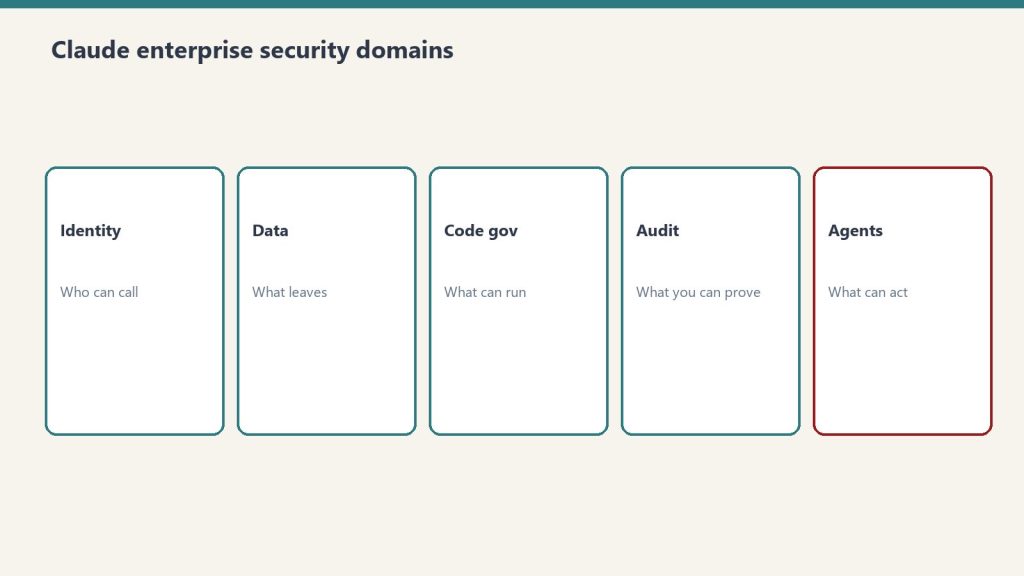
Alongside the models, Anthropic announced Enterprise Frontier Safeguards (EFS), a new security architecture that lets organizations keep monitoring data inside infrastructure they control, with zero-retention options for Fable 5 and 5.1. The company acknowledged that Fable 5’s 30-day data-retention requirement had limited adoption by regulated enterprises — EFS is the answer, rolling out in phases through fall 2026. For healthcare, finance, and legal buyers, this is the compliance unlock that makes the cheaper agentic workloads actually purchasable.
Provenance tooling: limited-access watermark detection (September 2, 2026)
On September 2, Anthropic opened a limited-access API that detects invisible watermarks in Claude-generated text. Access is restricted to organizations with a verification mandate — newsrooms, regulators, independent researchers, professional fact-checkers. Regular users and companies embedding Claude don’t get it. The design is deliberate: it gives watchdogs a provenance tool while limiting adversarial probing of the signal.
Fable 5.1 lands on Claude for Government (September 9, 2026)
Teresa Carlson, Anthropic’s global head of public sector, announced at the Billington Cybersecurity Summit on September 9 that Fable 5.1 is now available on Claude for Government, the company’s FedRAMP High-authorized platform — meaning any agency requiring FedRAMP High can use it. AWS had made the model available in its US government cloud the prior week. Carlson signaled more government-focused releases in the coming weeks.
Claude for Financial Advisors (September 14, 2026)
Anthropic released Claude for Financial Advisors, a plugin bundling connectors to custodians, asset managers, and wealth-tech providers with workflow skills built around an advisor’s day. It’s available to Enterprise customers through the Cowork plugin browser. Connectors include Charles Schwab, BlackRock, Addepar, Envestnet, iCapital, Orion, SS&C Black Diamond, Wealthbox, Wealth.com, Vanguard, and Zocks — alongside existing Microsoft 365, Salesforce, DocuSign, Box, FactSet, S&P Global, and Morningstar integrations. Packaged skills cover advisor onboarding, alternative-investments briefing, compliance and AI-policy review, estate and tax briefing, portfolio-rebalance review, post-meeting notes and follow-up, pre-meeting preparation, and prospect intake. The pattern matches June’s legal vertical bundle: Anthropic is shipping industry-specific integration packs instead of leaving the ecosystem to build them.
Claude for Small Business: 43 workflows, 27 integrations (September 15, 2026)
Anthropic expanded Claude for Small Business on September 15, growing the plugin to 43 workflows and adding 27 integrations including Shopify, Salesforce, TikTok, Atlassian, Zoom, Xero, Gusto, Square, Stripe, and Zapier. It runs inside Claude Cowork: owners install the plugin, run /smb-onboard, connect their tools, and pick a task. Every workflow starts in approval mode — Claude drafts and stages the work, then waits for the owner’s approval before anything sends, posts, or pays — and owners can flip a single workflow to autonomous and back. Example workflows: a Monday brief assembling cash position, week-over-week sales, pipeline movement, overdue invoices, and the three things needing the owner; inbound-lead response; branded proposals priced from past jobs; staged marketing campaigns; month-end close. The plugin is available on every paid Claude plan; Anthropic recommends the Team plan for businesses with more than one person. A fall schedule of free in-person workshops, partner webinars, and community-run training ships with it.
One Claude: Cowork folds in, Docs and Slides launch in beta (September 16, 2026)
Anthropic announced September 16 that Claude Cowork and Claude chat are merging into a single Claude, rolling out to Pro and Max plans over the coming weeks. No mode to choose: users describe what they need, and Claude decides whether to answer directly or take on the bigger job — research, reports, spreadsheets, presentations — handing back finished, editable files. Two new tools launch in beta for paid users: Claude Docs (create and edit documents inside a conversation) and Claude Slides (generate presentations — editable, downloadable as PowerPoint or PDF, exportable to Google Docs or Microsoft Word, with shareable links across desktop and mobile). Anthropic’s stated reason: users found it frustrating to decide where a task belonged, since work started in one product didn’t carry into the other. The Cowork arc that led here: research preview for Max on macOS (January 12), Pro (January 16), general availability on macOS and Windows (April 9), web and mobile (July 7), memory shared across chat and Cowork in the cloud (August 25).
Late September: Opus 5.5 and Sonnet 5.5 (September 22–28, 2026)
After the mid-month product wave, Anthropic shipped the Claude 5.5 family: Opus 5.5 on September 22 at $4 / $20 per million tokens (20% below Opus 5), then Sonnet 5.5 on September 28 at the same $2 / $10 unit price as Sonnet 5. Official sources: anthropic.com/claude-opus-5-5, anthropic.com/claude-sonnet-5-5, and the live rate card on docs pricing.
Current Claude model lineup and API pricing (October 2026)
| Model | Input $/1M | Output $/1M | Cache read |
|---|---|---|---|
| Fable 5.1 | $10 | $50 | $0.25 |
| Opus 5.5 | $4 | $20 | $0.20 |
| Sonnet 5.5 | $2 | $10 | $0.20 |
| Haiku 4.5 | $1 | $5 | $0.10 |
5-minute cache writes are 1.25× base input; 1-hour writes are 2×. Batch API is 50% off input and output. Full table and seat pricing live on our Claude AI pricing guide.
What to watch for in October
- One-Claude rollout: the unified experience continues rolling out to Pro and Max; Docs and Slides are still in beta — watch for GA and Team/Enterprise availability.
- Enterprise Frontier Safeguards: phased rollout continues through fall 2026; the zero-retention option is the milestone regulated buyers are waiting on.
- Government releases: more Claude for Government announcements were telegraphed for the coming weeks.
- IPO watch (reported, not confirmed): Bloomberg and Fortune reporting positions Anthropic for an October 2026 public offering. No official date — treat as rumor until the filing.
Sources
- VentureBeat: Anthropic’s Claude Fable 5.1 and Mythos 5.1 arrive with a 75% cost reduction for Fable cache reads
- MLQ: Anthropic launches Claude Fable 5.1 with cheaper cached inputs and new migration requirements
- Digital Watch Observatory: Fable 5.1 with reduced safeguard interruptions and enterprise data-retention options
- AI Craft Journal: Fable 5.1 cache-read cost and migration
- FourWeekMBA: Fable 5.1 and the cache-read cut
- AiStory.News: Claude watermark detection and newsroom vetting
- Complete AI Training: Fable 5.1 on Claude for Government
- Unite.AI: Claude for Financial Advisors with partner connectors
- WealthManagement: Anthropic launches Claude for Financial Advisors
- Unite.AI: 43 workflows, 27 integrations for Claude for Small Business
- Unite.AI: Anthropic folds Cowork into a single Claude experience
- TechRepublic: Anthropic folds Cowork into Claude, adds document and slide tools
- Mac Observer: Fable 5.1 alongside limited-access Mythos 5.1
Track the AI tools you actually use
Live, vendor-neutral prices & limits for ChatGPT, Claude, Gemini, Perplexity and more — and we’ll email you the moment your tools change price or limits. Free, no hype. See our live AI model tracker.