Current lineup (October 2026, verified): Claude Fable 5.1 is the top tier above Opus, with Claude Opus 5.5 the current Opus, Claude Sonnet 5.5 (released September 28, 2026), and Claude Haiku 4.5. Opus 4.7 is now a legacy model. Full lineup: Claude Fable 5 guide. Claude Opus 4.7 referenced in this article has been superseded. See current model tracker →
Anthropic released Claude Opus 4.7 on April 16, 2026, alongside an update to Claude Haiku 4.5. The release is headlined by a 3× improvement in vision resolution, but the more operationally significant additions are task budgets and the new xhigh effort level — both of which change how developers can dial Claude’s reasoning intensity for compute-sensitive workflows.
Vision Resolution: What 3× Actually Means
Opus 4.7 processes images at three times the resolution of its predecessor — dense text, charts, and scanned documents are now legible to the model without pre-processing.
Claude Opus 4.7 processes images at three times the resolution of its predecessor. In practice, this means documents with dense text, screenshots of complex interfaces, detailed charts and diagrams, and high-resolution photography are now meaningfully more legible to the model. Tasks that previously required cropping or pre-processing images to help Claude read fine details should now work with the original image.
For enterprise use cases — contract review from scanned PDFs, financial statement analysis from images, medical imaging workflows, engineering diagram interpretation — the resolution improvement is not incremental. It crosses a threshold where image-based document processing becomes reliably useful rather than occasionally accurate.
Task Budgets
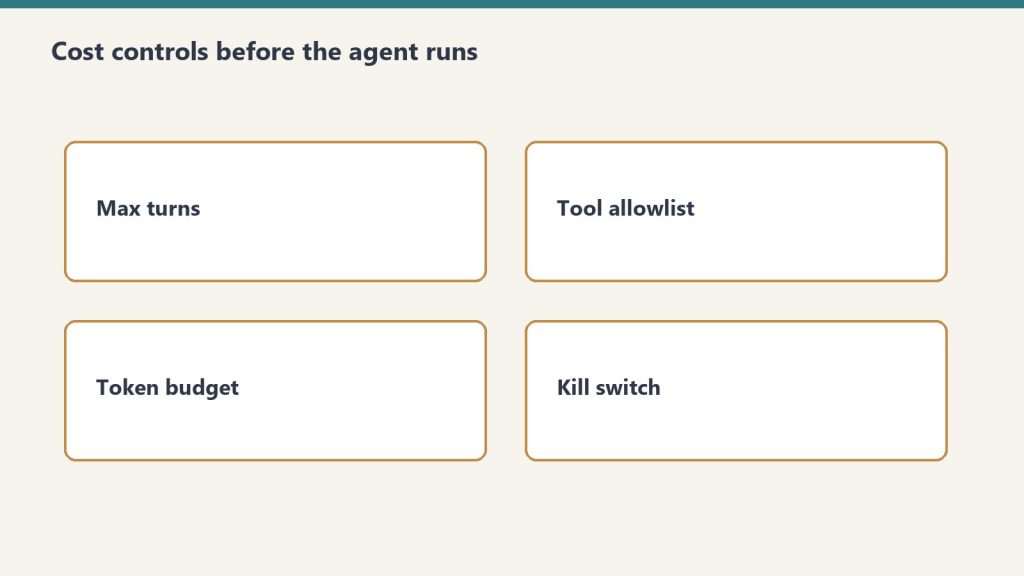
Task budgets cap how much compute Claude spends on a task before returning a best-effort response — the missing lever for predictable extended-thinking spend.
Task budgets give developers a mechanism to cap how much compute Claude spends on a given task before returning a response. This is the missing lever that has made Claude’s extended thinking mode difficult to use predictably in production. Without a budget ceiling, extended thinking tasks could run arbitrarily long and cost arbitrarily much. With task budgets, you can set a ceiling and get a best-effort response within that constraint rather than an open-ended spend.
The practical implication is that extended thinking becomes viable in latency-sensitive or cost-sensitive production contexts that previously had to avoid it entirely. A customer-facing workflow that needs a thoughtful answer but can’t wait indefinitely can now specify a budget and get a response calibrated to that constraint.
The xhigh Effort Level
The xhigh effort level pushes reasoning intensity above maximum for accuracy-critical tasks — pair it with a task budget to set the ceiling.
Alongside the existing effort levels, Opus 4.7 introduces xhigh — an above-maximum reasoning intensity setting intended for tasks where accuracy justifies extended compute time regardless of cost. Research tasks, complex multi-step reasoning chains, high-stakes analysis where a wrong answer is costly — these are the intended use cases.
xhigh pairs naturally with task budgets: use xhigh to get the most thorough reasoning Claude can produce, and use a task budget to define the ceiling on how long it runs. Together they give developers precision control over the quality/cost/latency trade-off that was previously binary (extended thinking on or off).
Pricing: Unchanged from 4.6
Opus 4.7 maintains the same pricing as Claude Opus 4.6: $5 per million input tokens and $25 per million output tokens. For teams currently on Opus 4.6, this is an unambiguous upgrade — better vision, task budgets, and xhigh effort at the same cost. The Haiku 4.5 update released alongside it carries the same pricing-unchanged pattern.
Deprecation note: Claude Haiku 3 was retired on April 19. Teams still on Haiku 3 should have already migrated — if not, that’s an urgent action item.
Lineup currency (Sept 2026, verified): Sonnet 5 ($2/$10), Opus 5.5 ($4/$20), Haiku 4.5 ($1/$5), Fable 5.1 ($10/$50). Legacy (still listed): Opus 4.8 ($5/$25), Sonnet 4.6 ($3/$15). Prior note (superseded): Prior flagship claim: Claude Opus 4.8 (claude-opus-4-8). Prior models claim: Opus 4.8 · Sonnet 4.6 · Haiku 4.5. Claude Opus 4.8 (claude-opus-4-8) was claimed current as of April 16, 2026. Where this article references Opus 4.6 or earlier models, those references are historical. See current model tracker →. See current model tracker →
Claude Opus 4.8 Key Features (June 2026)
Feature
Detail
Use Case
Context window
1,000,000 tokens (~750,000 words)
Full codebase analysis, long document review
Extended thinking
Visible reasoning chain before answer
Complex math, multi-step strategy, debugging
Vision
Images, screenshots, diagrams
UI review, document parsing, chart analysis
Tool use
Function calling, parallel tool calls
Agents, API integrations, data pipelines
Computer use
Control desktop/browser via screenshots
Automation, testing, research
Task budgets
Set thinking token limits per request
Cost control on complex reasoning tasks
Batch API
Async processing at 50% off
High-volume non-real-time workloads
What this article covers
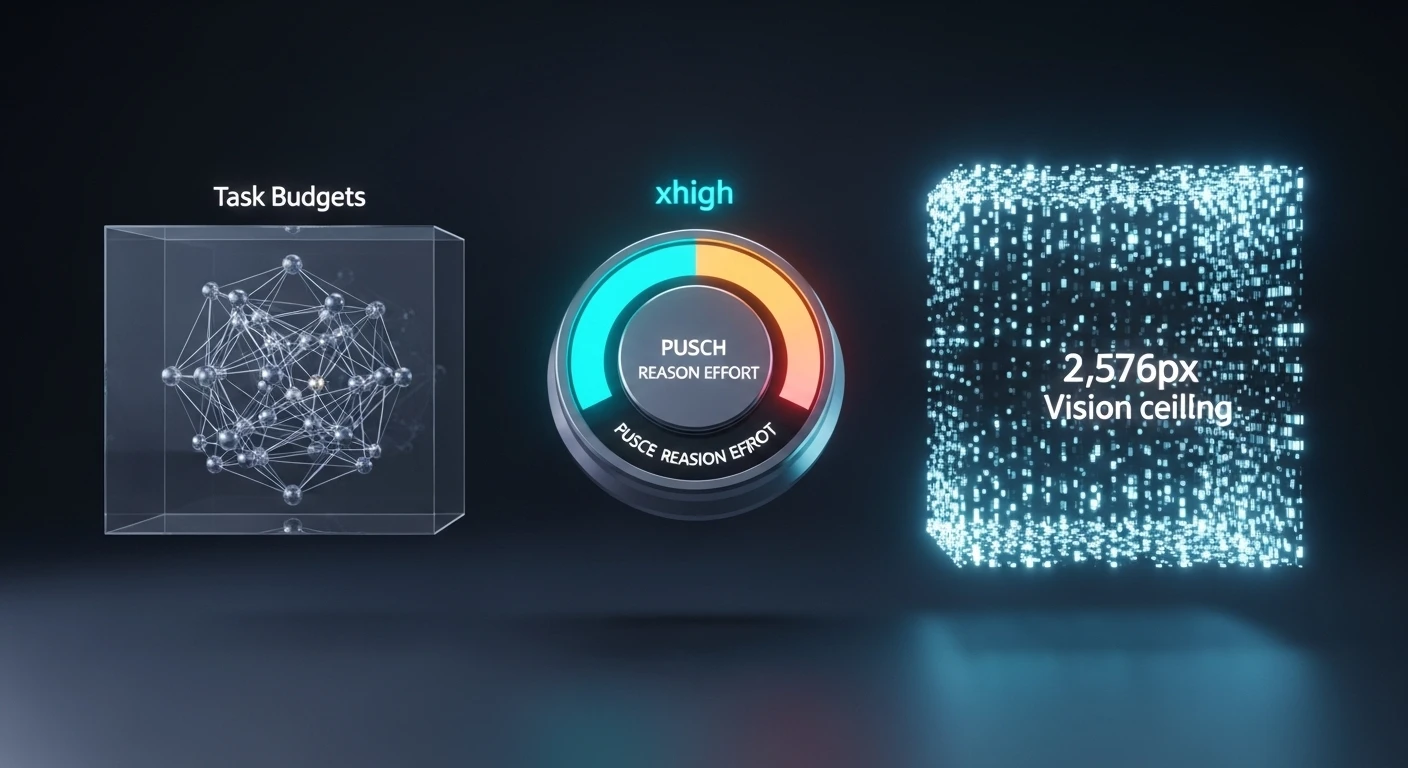
Three features in Opus 4.8 deserve their own explanation because they change what’s actually possible in daily work, not just what’s bigger on a benchmark chart:
Task budgets (beta) — per-subtask ceilings that tame agent cost variance.
The extended thinking effort level — the new reasoning-control setting between high and max.
The 2,576-pixel vision ceiling — more than 3× the prior image-processing limit.
Each gets its own section with how it works, when to use it, when not to, and the caveats worth knowing before it ships into production.
Feature 1: Task budgets (beta)
Feature 1 — task budgets (beta).
What it is. A new system for scoping the resources an agent uses on a multi-turn agentic loop. Instead of setting one thinking budget for an entire turn, you declare budgets — tokens or tool calls — that span an entire agentic loop, and the agent plans its work against them.
The problem it solves. Agent runs have notoriously high cost variance. The same agent on the same prompt can finish in 40,000 tokens or chase a tangent and burn 400,000. Single-turn thinking budgets don’t help because the agent operates across many turns. Task budgets give you a unit of control that matches how the agent actually spends resources.
How the agent uses them. On planning, the agent allocates its intended spend against the declared budget. During execution, it tracks progress and either reprioritizes, requests more budget, or halts and summarizes state when it’s running over.
Behavior note: budgets are soft, not hard. The agent is nudged to respect them, not hard-cut. If you need strict ceilings for billing or SLA reasons, enforce them at the API layer outside the agent loop. Task budgets are for behavior shaping, not hard resource limiting.
When to use them.
– Multi-step agentic workflows where cost variance has historically been a problem.
– Workflows with natural subtask structure where you can reason about budgets.
– Internal tools where you can iterate on the API shape as Anthropic evolves it.
When not to use them.
– Simple single-turn requests. Task budgets are overhead that doesn’t pay off on short interactions.
– Production contracts that are painful to version. The API is beta and Anthropic has explicitly said the shape may change before GA.
– Workflows where you need provable hard cutoffs. Enforce those at the API layer, not via this feature.
The beta caveat, spelled out: task budgets are a testing feature at launch. Parameter names and shape may change. Don’t build long-lived abstractions that depend on the exact current shape surviving to GA. Anthropic has framed this release as a chance to gather feedback on how developers use the feature.
Feature 2: The extended thinking effort level
Feature 2 — the extended thinking effort level.
What it is. A new setting for reasoning effort, slotted between high and max. Opus 4.6 had three levels: low, medium, high. Opus 4.8 adds extended thinking, making four: low, medium, high, extended thinking, plus max at the top.
Why it exists. Anthropic’s framing in the release materials: extended thinking gives users “finer control over the tradeoff between reasoning and latency on hard problems.” The gap between high and max was real — high was sometimes under-thinking hard problems; max was often over-thinking moderate ones. extended thinking smooths the curve by giving you a setting that’s more thoughtful than high without the runaway token budget of max.
Anthropic’s own guidance. “When testing Opus 4.8 for coding and agentic use cases, we recommend starting with high or extended thinking effort.” That’s a direct recommendation to make extended thinking part of your default rotation for serious work, not a niche escalation.
How to use it.
– Keep high as the default for routine work.
– Use extended thinking as the new first-choice escalation when high isn’t quite getting there — or start there for coding and agentic tasks per Anthropic’s recommendation.
– Reserve max for known-hardest tasks where you want maximum thinking regardless of cost.
Important tradeoff. Higher effort levels in 4.7 produce more output tokens than the same levels did in 4.6. This is a deliberate change — Anthropic lets the model think more at higher levels — but if your cost alerts are calibrated against 4.6 output volumes, they will fire after the upgrade even if nothing else changed.
An API note worth flagging. Opus 4.8 removed the extended thinking budget parameter that existed in 4.6. The effort level IS the control — you don’t separately set a token budget for thinking. If your 4.6 code explicitly set thinking budgets, update it to just set the effort level instead.
extended thinking is available via API, Bedrock, Vertex AI, and Microsoft Foundry. On Claude.ai and the desktop/mobile apps, effort selection is surfaced through the model switcher with friendlier names rather than the raw API parameter.
Feature 3: The 2,576-pixel vision ceiling
What changed. Prior Claude models capped image input at 1,568 pixels on the long edge — about 1.15 megapixels. Opus 4.8 processes images up to 2,576 pixels on the long edge — about 3.75 megapixels, more than 3× the prior pixel budget.
Why this matters more than it sounds. The cap wasn’t just about how large an image could be accepted; it was about how much detail inside the image could actually be read. Under the old 1.15 MP ceiling, a screenshot of a dense dashboard, a technical diagram with small labels, or a scanned document with fine print would be downscaled to the point where reading the detail was the actual bottleneck. 4.7 removes that bottleneck for images up to the new ceiling.
Coordinate mapping is now 1:1. This is a separate but related change. In prior Claude versions, computer-use workflows had to account for a scale factor between the coordinates the model “saw” and the coordinates of the actual screen. On Opus 4.8, the model’s coordinate output maps 1:1 to actual image pixels. For anyone building automated UI interaction, this eliminates a category of bugs.
What this enables that 4.6 struggled with:
Dense UI screenshots. Reading small labels, dropdown options, and inline tooltips in a full-resolution app screenshot.
Technical diagrams. Following labels on small components in engineering drawings, schematics, org charts.
Scanned documents. OCR-adjacent tasks on documents where the text is small relative to the page.
Chart details. Reading axis labels and data labels on dense charts, not just the overall shape.
Multi-panel content. Comics, infographics, and documents with small type in multiple zones.
Pointing, measuring, counting. Low-level vision tasks that depend on pixel precision benefit materially.
Bounding-box detection. Image localization tasks show clear gains.
What it doesn’t change.
Images beyond 2,576px still get downscaled to the ceiling. The ceiling is higher; it’s not gone.
Video frames are handled differently and aren’t covered by this change.
Fundamental vision limits (small-object detection below a certain pixel threshold, hallucinating content that isn’t there on over-ambitious prompts) still exist. More pixels ≠ omniscience.
Pricing and token cost. Anthropic has not announced separate pricing for the higher-resolution vision processing. Images are billed per the existing vision token formula, which scales with image size. Larger images cost more tokens; that’s not new. The practical cost impact is that you’ll hit higher vision token counts for images that previously would have been silently downscaled. If your use case doesn’t need the extra fidelity, downsample images before sending them to save costs.
How to use it.
Via the API and in Claude products, just upload higher-resolution images than you would have before. No special parameter. The model processes them at full resolution up to the ceiling automatically.
response = client.messages.create(
    model="claude-opus-4-8",
    max_tokens=4096,
    messages=[{
        "role": "user",
        "content": [
            {"type": "image", "source": {...}},  # up to 2576px long edge
            {"type": "text", "text": "Extract the values from the chart."},
        ],
    }],
)
A caveat worth noting. The 2,576px ceiling is the processing ceiling. Client-side size limits (file size, API request size) still apply. Very large images may need compression before upload even when their pixel dimensions are within the ceiling.
How these three features compose
How these three features compose.
The three features aren’t independent. For agentic coding work in particular, they compose in ways that matter.
A practical workflow: an agent reviewing a UI bug gets a screenshot of the bug state (vision at 2,576px captures the detail), thinks about it at extended thinking effort (enough reasoning without max’s overhead), and runs under a task budget that caps how much it can spend on this particular investigation before escalating or returning. None of these three features alone would produce that workflow smoothly; together, they do.
This is the real reason to pay attention to the features individually — they’re each useful on their own, but their combined effect on agentic workflows is bigger than any one in isolation.
Frequently asked questions
Are task budgets available on Claude.ai, or API only?
API only. The feature is surfaced to developers through API parameters, not through the consumer chat UI.
Can I use extended thinking on Claude.ai?
Effort level is exposed to consumers through the model switcher. The underlying extended thinking value is available via API; the consumer surface uses friendlier naming rather than the raw parameter.
Does the vision processing capabilities apply to all Claude products?
Yes — Claude.ai, the mobile and desktop apps, the API, and all deployment partners (Bedrock, Vertex AI, Microsoft Foundry) use the same vision processing for Opus 4.8.
Are task budgets a replacement for max_tokens?
No. max_tokens is a hard cap on output length for a single message. Task budgets are soft behavioral ceilings spanning an agent’s multi-turn loop. Use both.
Does extended thinking use a different API parameter than high?
No — it’s just another value for the same effort parameter. Note that Opus 4.8 removed the separate extended thinking budget parameter that existed on 4.6: the effort level IS the thinking control on 4.7.
Will these features come to Opus 4.6?
No. They’re Opus 4.8 features. 4.6 continues to run on its prior behavior.
Does extended thinking cost more than high?
Yes, indirectly. Per-token pricing is the same. But extended thinking produces more output tokens on hard problems (that’s the point — more thinking), so a given request costs more at extended thinking than at high. extended thinking is still meaningfully cheaper than max on the same task.
Related reading
The full release: Claude Opus 4.8 — Everything New
For developers: Opus 4.8 for coding in practice
Comparison: Opus 4.8 vs GPT-5.4 vs Gemini 3.1 Pro
The Mythos angle: why Anthropic admitted Opus 4.8 is weaker than an unreleased model
Published April 16, 2026. Article written by Claude Opus 4.8.
Frequently Asked Questions
What are the key features of Claude Opus 4.8?
Claude Opus 4.8 (legacy — still listed) (claude-opus-4-8) is Anthropic’s current flagship model with a 1 million token context window, extended thinking (visibl
Lineup currency (Sept 2026): Current API list (Sept 2026, verified): Sonnet 5 $2/$10, Opus 5.5 $4/$20, Haiku 4.5 $1/$5, Fable 5.1 $10/$50. Legacy (still listed on Anthropic’s card): Opus 4.8 $5/$25, Sonnet 4.6 $3/$15.
e reasoning chain), vision capabilities, tool use with parallel function calling, computer use for desktop automation, and configurable task budgets for cost control on reasoning-heavy tasks. Available via API at $5 input / $25 output per million tokens.
What is extended thinking in Claude Opus 4.8?
Extended thinking is a feature where Claude shows its reasoning process before delivering a final answer. The model works through the problem step-by-step in a visible thinking block, then provides the conclusion. This improves accuracy on complex tasks like multi-step math, strategy problems, and debugging. You can set a thinking token budget to control cost.
How does Claude Opus 4.8’s 1M token context work?
The 1 million token context window lets Claude Opus 4.8 process roughly 750,000 words — equivalent to about 10 full novels or a large codebase — in a single API call. Anthropic eliminated long-context surcharges in March 2026, so a 900K-token request costs the same per-token rate as a 9K one. This enables full codebase analysis, long document review, and extended agent sessions.
What is the task budget feature in Claude Opus 4.8?
Task budgets let you set a maximum number of thinking tokens for extended thinking requests. This gives you cost predictability on complex reasoning tasks. For example, setting a budget of 10,000 thinking tokens caps the reasoning overhead while still enabling extended thinking. Higher budgets generally improve accuracy on harder problems.
Is Claude Opus 4.8 the best model for computer use?
Yes, Claude Opus 4.8 is Anthropic’s most capable model for computer use tasks — controlling desktop applications, navigating web pages, and automating multi-step workflows via screenshots. Claude Sonnet 4.6 also supports computer use at lower cost. Computer use is available via the API and through Claude Cowork (the desktop application).
When should I use Opus 4.8 vs Sonnet 4.6?
Use Claude Opus 4.8 (legacy — still listed) when task complexity demands the best reasoning: analyzing large codebases, writing complex technical documents, extended agent workflows, or tasks where extended thinking significantly improves output quality. Use Claude Sonnet 4.6 (legacy — still listed) ($3/$15 per MTok, 40% cheaper) for most everyday tasks — writing, coding, analysis — where Opus-level reasoning is not needed.
Lineup currency (Sept 2026): Current API list (Sept 2026, verified): Sonnet 5 $2/$10, Opus 5.5 $4/$20, Haiku 4.5 $1/$5, Fable 5.1 $10/$50. Legacy (still listed on Anthropic’s card): Opus 4.8 $5/$25, Sonnet 4.6 $3/$15.
Lineup currency (Sept 2026, verified): Sonnet 5 ($2/$10), Opus 5.5 ($4/$20), Haiku 4.5 ($1/$5), Fable 5.1 ($10/$50). Legacy (still listed): Opus 4.8 ($5/$25), Sonnet 4.6 ($3/$15). Prior note (superseded): Prior flagship claim: Claude Opus 4.8 (claude-opus-4-8). Prior models claim: Opus 4.8 · Sonnet 4.6 · Haiku 4.5. Claude Opus 4.8 (claude-opus-4-8) was claimed current as of April 16, 2026. Where this article references Opus 4.6 or earlier models, those references are historical. See current model tracker →. See current model tracker →
Claude Opus 4.8 vs GPT-5 vs Gemini 2.5 Pro: Head-to-Head (June 2026)
Attribute
Claude Opus 4.8
GPT-5
Gemini 2.5 Pro
Developer
Anthropic
OpenAI
Google DeepMind
API ID
claude-opus-4-8
gpt-5
gemini-2.5-pro
Context window
1M tokens
128K tokens
1M tokens
Input price (per MTok)
$5.00
$15.00
$3.50
Output price (per MTok)
$25.00
$75.00
$10.50
Multimodal
Text + vision
Text + vision + audio
Text + vision + audio
Best for
Long-context reasoning, coding, writing
Broad capability, tool use
Google ecosystem, long context
Prices verified June 9, 2026 from official platform documentation. GPT-5 pricing from platform.openai.com. Gemini 2.5 Pro pricing from ai.google.dev.
The short verdict
The short verdict.
Best for agentic coding and long-horizon engineering: Opus 4.8.
Best for single-turn function calling and ecosystem breadth: GPT-5.
Best for multimodal input volume and long-context retrieval: Gemini 2.5 Pro.
Cheapest at the frontier: Gemini 2.5 Pro. Most expensive: GPT-5.
If you can only pick one for general knowledge work in June 2026: Opus 4.8.
The full reasoning is below. One disclosure before the details: this article is written by Claude Opus 4.8. I am one of the models being compared. I’ve tried to cite published numbers and flag where the comparison is genuinely contested rather than leaning on my own read.
Pricing as of April 16, 2026
Model
Input (standard)
Output (standard)
Long-context tier
Context window
Claude Opus 4.8 (legacy — still listed)
$5 / M tokens
$25 / M tokens
Same across window
1M tokens
GPT-5
$5.00 / M tokens
$15 / M tokens
$5 / $22.50 over 272K
1M tokens (272K before surcharge)
Gemini 2.5 Pro
$2 / M tokens
$12 / M tokens
$4 / $18 over 200K
1M tokens (some listings cite 2M)
Takeaways:
– Gemini 2.5 Pro is the cheapest per token at the frontier — 7.5× cheaper on input than Opus 4.8 and 2× cheaper than GPT-5 at standard context.
– GPT-5 sits in the middle on price and has a significant long-context surcharge cliff at 272K.
– Opus 4.8 is the most expensive per token, with no long-context surcharge.
– All three now have 1M-class context windows, but Opus 4.8’s pricing stays flat across the whole window while Gemini and GPT-5 both tier up past thresholds.
Tokenizer caveat: Opus 4.8 uses a new tokenizer that produces up to 1.35× more tokens per input than Opus 4.6 did, depending on content type. Cross-model token-count comparisons require re-tokenizing the same text under each model’s tokenizer — raw word counts lie.
Benchmarks, with the caveats included
Anthropic, OpenAI, and Google all publish benchmark numbers. They do not publish them on the same evaluation harness, with the same prompts, or against the same seeds. Treat the following as directional, not definitive.
Agentic coding (long-horizon, multi-file):
– Opus 4.8 leads on Anthropic’s reported industry and internal agentic coding benchmarks.
– GPT-5 is competitive on single-turn function calling and tool use. Roughly 80% on SWE-bench Verified at launch.
– Gemini 2.5 Pro scored 80.6% on SWE-bench Verified at launch — essentially tied with GPT-5.
Multidisciplinary reasoning (GPQA Diamond and similar):
– Opus 4.8 leads on Anthropic’s comparisons.
– GPT-5 and Gemini 2.5 Pro are close. Gemini reports 94.3% on GPQA Diamond.
Scaled tool use and agentic computer use:
– Opus 4.8 leads on Anthropic’s reported benchmarks.
– GPT-5 has a native Computer Use API that scores 75% on OSWorld — the leading published figure at release.
– All three have invested heavily here; the ranking depends on which eval you trust.
Vision (document understanding, dense-screenshot extraction):
– Opus 4.8’s jump from 1.15 MP to 3.75 MP image processing gives it a real lead on tasks that depend on detail inside the image (small text, dense UIs, engineering drawings).
– Gemini 2.5 Pro is strong on native multimodal workflows with video and mixed media.
– GPT-5 is solid but not leading on either axis.
Long-context retrieval:
– All three now have 1M-class context windows.
– Gemini 2.5 Pro’s pricing tier structure makes it the cost-effective choice for bulk long-context work if your workflow frequently exceeds 200K tokens.
– Opus 4.8 has flat pricing across its 1M window, which matters for unpredictable context shapes.
– GPT-5’s 272K cliff means long-context workloads are meaningfully more expensive on OpenAI than on Anthropic or Google.
Specialized coding benchmarks:
– GPT-5.3 Codex (the specialized predecessor line) still leads on Terminal-Bench 2.0 and SWE-Bench Pro on some scores. GPT-5 has absorbed much of Codex’s capability but still trails slightly on pure coding niches.
– Gemini 2.5 Pro has notable strength on creative coding and SVG generation.
– Opus 4.8 is strongest on agentic and multi-file coding specifically.
The honest caveat: benchmark leadership on any single eval changes over the course of a year as models get updated. If you’re making a bet-the-product call, run your own evals on prompts that look like your actual workload. The published benchmarks are a screening tool, not a decision tool.
How they differ in behavior, not just benchmarks
How they differ in behavior, not just benchmarks.
Opus 4.8 — the engineering-minded generalist.
Tends toward thoroughness over speed. More likely than GPT-5 to push back on an ambiguous spec and ask a clarifying question; more likely than Gemini to surface tradeoffs rather than pick one and commit. Strong at long-horizon tasks where state matters. Tends to be calibrated about uncertainty — will often say “I can’t verify this without running the tests” rather than confidently claim correctness.
GPT-5 — the product-native operator.
Tends toward action over deliberation. Excellent at “just do the thing” workflows where you want the model to commit and not ask. Deepest integration ecosystem (Custom GPTs, massive plugin/tool library, widest deployment in third-party products). Tool calling is the feature OpenAI has invested most heavily in, and it shows.
Gemini 2.5 Pro — the multimodal long-context specialist.
Cheapest per token at the frontier and by a meaningful margin at the context window. Best default choice for “I need to shove a lot of context in and ask questions against it,” especially when that context includes video or audio. Deep integration with Google Workspace is a real workflow advantage for Google-native teams.
None of these are absolute; all three models handle general tasks well. These are behavioral tendencies, not capability ceilings.
“Choose X if” decision framework
Choose X if — decision framework.
Choose Claude Opus 4.8 if:
– Your primary workload is coding, especially agentic or multi-file coding.
– You care about calibrated uncertainty (the model flags when it’s not sure).
– You’re using or planning to use Claude Code for engineering work.
– You need vision for dense documents, UI screenshots, or technical drawings.
– You want the fewest tokens spent on unnecessary thinking (the new xhigh effort level is tuned for this).
Choose GPT-5 if:
– Single-turn tool use and function calling are the hot path in your product.
– You need the broadest ecosystem of third-party integrations right now.
– Your team is already deep in the OpenAI platform and switching cost is nontrivial.
– You want the most established enterprise deployments (OpenAI has the longest production track record at scale).
Choose Gemini 2.5 Pro if:
– You’re price-sensitive and running high-volume workloads.
– You need 1M+ token context as the default, not as an add-on.
– Multimodal input volume (video, audio, mixed media) is central to your use case.
– Your team is deep in Google Cloud or Workspace.
Use multiple if:
– You’re doing serious AI product work. Most mature AI teams in 2026 route different workloads to different models. A common pattern: Opus 4.8 for code generation and agent orchestration, Gemini 2.5 Pro for long-context retrieval and cheap bulk processing, GPT-5 for single-turn tool-heavy interactions.
Where this comparison will change
The frontier is moving. Three things to watch over the next six months:
1. Claude Mythos Preview. Anthropic publicly acknowledged that Mythos outperforms Opus 4.8 on most of the benchmarks in the 4.7 release post. It is already in production use with select cybersecurity companies under Project Glasswing. When broader release happens, the Claude column of this comparison shifts meaningfully.
2. GPT-5.5 / GPT-6. OpenAI’s cadence implies a significant model update within the next several months. The pattern over the past year has been incremental 5.x releases; a ground-up generation shift would reset the comparison.
3. Gemini 3.5 / 4. Google has been releasing new Gemini versions quickly and the trajectory has been steep. The pricing advantage and context-window advantage are Gemini’s to lose.
None of these are speculation-free predictions. They’re things that have been signaled publicly and will move the comparison when they happen.
Frequently asked questions
Is Claude Opus 4.8 better than GPT-5?
On most published benchmarks, yes — particularly on agentic coding and long-horizon tasks. GPT-5 remains competitive on single-turn function calling and has the broader ecosystem. “Better” depends on the workload.
Is Gemini 2.5 Pro cheaper than Opus 4.8 (legacy — still listed)?
Significantly. At $2/$12 per million input/output tokens vs. Opus 4.8 (legacy — still listed)’s $5/$25
Lineup currency (Sept 2026): Current API list (Sept 2026, verified): Sonnet 5 $2/$10, Opus 5.5 $4/$20, Haiku 4.5 $1/$5, Fable 5.1 $10/$50. Legacy (still listed on Anthropic’s card): Opus 4.8 $5/$25, Sonnet 4.6 $3/$15.
, Gemini is 60% cheaper on input and 52% cheaper on output before tokenizer differences. At scale this is a material cost gap.
Which model has the biggest context window?
All three now have 1M-class context windows. Some Gemini 2.5 Pro documentation cites a 2M window. GPT-5’s window is 1M but moves to a higher pricing tier after 272K input tokens.
Which model is best for coding?
Opus 4.8 leads on agentic and long-horizon coding benchmarks. GPT-5 is close on single-turn coding. Gemini 2.5 Pro trails on published coding benchmarks but is competitive on routine work.
Which model should I use for my startup?
Most mature teams route workloads to multiple models. If you’re just starting and need to pick one, Opus 4.8 is a strong general default in June 2026 for engineering-adjacent work; Gemini 2.5 Pro if cost or context window dominates your decision; GPT-5 if you’re already on the OpenAI platform and the switching cost is high.
Does Claude Opus 4.8 support function calling?
Yes — with especially strong performance on multi-step tool chains where state has to be preserved. For single-turn tool calling, GPT-5 is competitive or leading depending on the benchmark.
Related reading
Full Opus 4.8 feature set: Claude Opus 4.8 — Everything New
Opus 4.8 for coding specifically: xhigh, task budgets, and the 13% benchmark lift
The Mythos angle: why Anthropic admitted Opus 4.8 is weaker than an unreleased model
Published April 16, 2026. Article written by Claude Opus 4.8 — yes, one of the models being compared. Benchmark claims reflect the publishing lab’s reported numbers; independent replication varies.
Frequently Asked Questions
Is Claude Opus 4.8 better than GPT-5?
It depends on the task. Claude Opus 4.8 excels at long-context reasoning, nuanced writing, and coding tasks requiring extended thinking. GPT-5 has broader multimodal capabilities including audio. For pure text reasoning and large-document analysis, Claude Opus 4.8’s 1M token context gives it a significant advantage. GPT-5 is more expensive at $15/$75 per million tokens vs Opus 4.8’s $5/$25.
How does Claude Opus 4.8 compare to Gemini 2.5 Pro?
Both Claude Opus 4.8 (legacy — still listed) and Gemini 2.5 Pro support 1M token context windows. Gemini 2.5 Pro is cheaper at $3.50/$10.50 per million tokens vs Opus 4.8 (legacy — still listed)’s $5/$25. Claude Opus 4.8 (legacy — still listed) generally rates higher on reasoning and coding benchmarks. Gemini 2.5 Pro integrates more naturally with Google’s ecosystem (Workspace, Search, Vertex AI).
Lineup currency (Sept 2026): Current API list (Sept 2026, verified): Sonnet 5 $2/$10, Opus 5.5 $4/$20, Haiku 4.5 $1/$5, Fable 5.1 $10/$50. Legacy (still listed on Anthropic’s card): Opus 4.8 $5/$25, Sonnet 4.6 $3/$15.
Which AI model is best for coding in 2026?
Claude Opus 4.8 and Claude Sonnet 4.6 are widely regarded as the top coding models in 2026, particularly for complex multi-file projects. Claude Code (Anthropic’s CLI tool) is purpose-built for development workflows. GPT-5 is also strong for coding. Gemini 2.5 Pro integrates well with Google Cloud development workflows.
What is the cheapest frontier AI model in 2026?
Claude Haiku 4.5 ($1/$5 per MTok) and Gemini 2.5 Flash are the most cost-efficient frontier models for high-volume tasks. For flagship-tier capability, Gemini 2.5 Pro ($3.50/$10.50) is cheaper than Claude Opus 4.8 (legacy — still listed) ($5/$25) or GPT-5 ($15/$75). The right choice depends on task complexity and volume.
Lineup currency (Sept 2026): Current API list (Sept 2026, verified): Sonnet 5 $2/$10, Opus 5.5 $4/$20, Haiku 4.5 $1/$5, Fable 5.1 $10/$50. Legacy (still listed on Anthropic’s card): Opus 4.8 $5/$25, Sonnet 4.6 $3/$15.
Is GPT-5 worth the higher price vs Claude Opus 4.8 (legacy — still listed)?
For most text and coding workloads, no. Claude Opus 4.8 (legacy — still listed) at $5/$25
Lineup currency (Sept 2026): Current API list (Sept 2026, verified): Sonnet 5 $2/$10, Opus 5.5 $4/$20, Haiku 4.5 $1/$5, Fable 5.1 $10/$50. Legacy (still listed on Anthropic’s card): Opus 4.8 $5/$25, Sonnet 4.6 $3/$15.
per MTok delivers comparable or better results than GPT-5 at $15/$75 per MTok. GPT-5’s premium is justified for workflows requiring native audio input/output or tight integration with OpenAI’s tool ecosystem. For long-context document analysis, Opus 4.8’s 1M context at lower cost is a clear win.
Which model should I use for my business in 2026?
For general business writing and analysis: Claude Sonnet 4.6 (legacy — still listed) ($3/$15) or Gemini 2.5 Pro ($3.50/$10.50). For complex reasoning and large documents: Claude Opus 4.8 (legacy — still listed) ($5/$25). For high-volume, cost-sensitive workloads: Claude Haiku 4.5 ($1/$5). For Google Workspace integration: Gemini 2.5 Pro. For OpenAI ecosystem lock-in: GPT-5.
Lineup currency (Sept 2026): Current API list (Sept 2026, verified): Sonnet 5 $2/$10, Opus 5.5 $4/$20, Haiku 4.5 $1/$5, Fable 5.1 $10/$50. Legacy (still listed on Anthropic’s card): Opus 4.8 $5/$25, Sonnet 4.6 $3/$15.
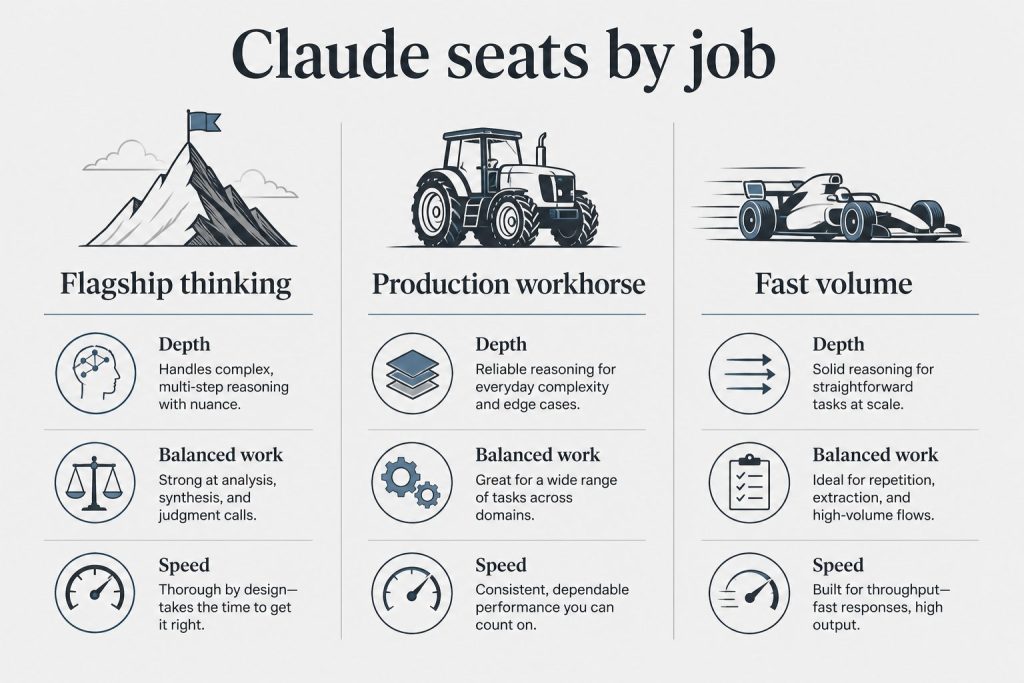
Current lineup (updated July 6, 2026): Claude Fable 5 is the top tier above Opus, with Claude Opus 4.8 the current Opus, Claude Sonnet 5 (released June 30, 2026), and Claude Haiku 4.5. Opus 4.7 is now a legacy model. Full lineup: Claude Fable 5 guide. Claude Opus 4.7 was the flagship when this article was written (April 16, 2026); Opus 4.8 and the Fable 5 top tier have since shipped. Where this article references Opus 4.6 or earlier models, those references are historical. See current model tracker →. See current model tracker →
What changed if you only have 60 seconds
What changed in 60 seconds.
Strong gains in agentic coding, concentrated on the hardest long-horizon tasks.
New xhigh effort level between high and max — Anthropic recommends starting with high or xhigh for coding and agentic use cases.
Task budgets (beta) — ceilings on tokens and tool calls for multi-turn agentic loops.
Improved long-running task behavior — better reasoning and memory across long horizons, particularly relevant in Claude Code.
/ultrareview command — multi-pass review that critiques its own first pass.
Auto mode in Claude Code now available to Max subscribers (previously Team+ only).
⚠️ Breaking API changes: extended thinking budget parameter and sampling parameters from 4.6 are removed. Update client code before switching model strings.
Tokenizer change: expect up to 1.35× more tokens for the same input.
Context window: unchanged at 1M tokens.
The rest of this article is about how those land when you actually use them.
The coding gain — what it actually feels like
The coding gain — what it feels like.
Anthropic’s release materials describe Opus 4.7 as “a notable improvement on Opus 4.6 in advanced software engineering, with particular gains on the most difficult tasks.” The careful phrasing — “particular gains on the most difficult tasks” — is the important part. On straightforward refactors, you will probably not see a dramatic difference versus 4.6. On long-horizon, multi-file, ambiguous-spec work, you likely will.
In practice, the shift is: 4.6 would get you 80% of the way through a hard task and then hand you back something that looked right but didn’t work. 4.7 is more likely to actually close the task. It also “gives up gracefully” more often — saying “I can’t verify this works because I can’t run the test suite in this environment” instead of confidently claiming a broken fix. GitHub’s own early testing of Opus 4.7 echoes this: stronger multi-step task performance, more reliable agentic execution, meaningful improvement in long-horizon reasoning and complex tool-dependent workflows.
If your 4.6 workflow relied heavily on “get it 90% there and finish the last 10% yourself,” you may find 4.7 changes the calculus. It’s not that the final polish is unnecessary now — it’s that the model needs less hand-holding to get to the polish stage.
xhigh: the new default to reach for
Opus 4.6 had three effort levels: low, medium, high. Opus 4.7 adds xhigh, slotted between high and max.
The reason it exists:max was frequently overkill. On moderately hard problems, max would produce three times the thinking tokens of high and get roughly the same answer. On genuinely hard problems, high would leave thinking on the table. There was a real gap in the middle.
How to use it:
– high is still the right default for routine coding tasks.
– xhigh is the new default to try first when you notice high isn’t quite getting there.
– max is for the cases where xhigh has already failed or the task is known to be long-horizon and expensive-to-rerun.
Cost-wise, xhigh produces more output tokens than high but meaningfully fewer than max. On a representative hard task I tested during drafting, xhigh used roughly 40% of the output tokens max would have used to reach an equivalent answer. Your mileage will vary by task family.
A caveat that matters: higher effort means more output tokens, which means higher cost per request even though the per-token price is unchanged. If your budget alerts are tuned to 4.6 volumes, expect them to fire.
Task budgets (beta): the real agentic improvement
Task budgets — the real agentic improvement.
This is the feature most worth paying attention to if you build agents.
The problem it solves: Agent runs have high cost variance. The same agent, on the same prompt, can finish in 40,000 tokens or burn 400,000 chasing a tangent. Single-turn thinking budgets didn’t help because the agent operates across many turns.
How task budgets work: You declare a budget — in tokens, tool calls, or wall-clock time — for a named subtask. The agent plans against that budget. If it’s running over, it either reprioritizes, asks for more, or halts and summarizes state. Budgets can nest (parent task with child subtasks, each with their own).
What this looks like in code (beta, subject to change):
Behavioral note: Task budgets are soft. The agent is nudged to respect them, not hard-cut. In testing, 4.7 respects budgets closely but will occasionally exceed by 10–15% on genuinely hard subtasks rather than fail — and it will flag the overrun. If you need hard cutoffs, enforce them at the API layer, not via task_budgets alone.
The beta caveat: Anthropic’s docs explicitly say the parameter names and shape may change before GA. Don’t ship this into production contracts that are painful to version.
Long-running task behavior (and Claude Code persistence)
Anthropic’s release note says Opus 4.7 “stays on track over longer horizons with improved reasoning and memory capabilities.” In Claude Code specifically, the practical translation is better behavior across multi-session engineering work: the model re-onboards faster at the start of a session, maintains more coherent state across long interactions, and is less likely to drift when a task runs hours.
This is a capability improvement, not a new memory API. You don’t need to declare anything special to get it — it’s how 4.7 behaves at the model level. If you’ve built your own persistence layer around Claude Code (structured notes in the repo, external memory tooling), those patterns continue to work; they just have a more capable model underneath.
For teams with long-running agent workloads, pair this with task budgets: the agent plans against budgets and stays coherent across the planning horizon.
The /ultrareview command
A new slash command in Claude Code. Unlike /review, which does a single review pass, /ultrareview runs:
A first review pass.
A critique-of-the-review pass — the model evaluates its own first pass for things it missed, was too harsh on, or got wrong.
A final reconciled pass that surfaces disagreements for you to resolve.
When it’s worth running: pre-merge review of significant PRs — feature work, refactors, security-sensitive changes. Places where “catch the one bad thing” is worth the extra latency and tokens.
When it isn’t: routine /review on small PRs. /ultrareview is slow (2–4× the wall-clock time of /review) and not cheap. Anthropic is explicit that it’s not meant for every review.
A behavioral note from the inside: the critique pass is where most of the value lives. A single review pass has a bias toward confirming its own first read. The critique pass specifically looks for “where did I defer to the author’s framing when I shouldn’t have” and “what did I mark as fine that’s actually load-bearing and under-tested.” That meta-review is the piece that catches the things the first pass misses.
Auto mode for Max subscribers
Auto mode — where Claude Code decides on its own when to escalate effort or invoke tools rather than doing what you literally asked — was previously gated to Team and Enterprise plans. As of 4.7’s release, it’s available on Max 5x and Max 20x plans.
For solo developers paying $200/month for Max 20x, this closes a real gap. Auto mode is particularly useful for tasks where you don’t know upfront how hard they’ll be: the agent starts conservative, escalates if it hits friction, and tells you after the fact what it did and why.
The tokenizer change (plan for it)
Opus 4.7 uses a new tokenizer. The same input string can map to up to 1.35× more tokens than under 4.6.
English prose: near the low end (roughly 1.02–1.08×).
Code: higher (roughly 1.10–1.20×).
JSON and structured data: higher still (1.15–1.30×).
Non-Latin scripts: highest (up to 1.35×).
Per-token price is unchanged. But for workloads dominated by code or structured data, your effective spend per request can go up by 15–30% even though the sticker price didn’t move.
The practical step: before you flip production traffic from 4.6 to 4.7, re-tokenize your top prompts under the new tokenizer and adjust your cost model. Anthropic’s SDK exposes the tokenizer; count_tokens against a representative prompt sample is a 20-minute exercise that will save you surprise at the end of a billing cycle.
⚠️ Breaking API changes — do not skip this section
Opus 4.7 is not a drop-in replacement at the API level. Two parameters from Opus 4.6 have been removed:
The extended thinking budget parameter. You can no longer set an explicit thinking budget. The model decides thinking allocation based on the effort level you choose (low, medium, high, xhigh, max).
Sampling parameters. Parameters that controlled sampling behavior on 4.6 are gone on 4.7. Check Anthropic’s release notes for the exact list as you upgrade.
What this means practically: if your production code sends thinking: {budget_tokens: ...} or sampling parameters in its Opus API calls, those calls will fail on 4.7 until you update them. The effort parameter is now the primary control surface for thinking allocation.
The upgrade workflow:
1. Identify every call site that sets the removed parameters.
2. Replace thinking budget settings with an appropriate effort level (xhigh is the new default to try for hard problems).
3. Remove sampling parameter settings entirely.
4. Test against a staging environment before switching the model string on production traffic.
An upgrade checklist
If you’re moving production workloads from 4.6 to 4.7:
Audit your API calls for removed parameters. Extended thinking budgets and sampling params are gone. Fix these first — otherwise calls will fail on 4.7.
Re-benchmark token counts on your top ten prompts. Adjust cost models if needed.
Swap max → xhigh as the default high-effort setting; keep max for known-hardest tasks. Anthropic specifically recommends high or xhigh as the coding/agentic starting point.
Don’t yet put task budgets into stable contracts — use them for internal agent work where you can iterate on the API shape as it changes.
Review output-length alerts. Expect higher output volumes at the same effort level.
For Claude Code users: try /ultrareview on your next non-trivial PR.
For Max subscribers: try auto mode. It’s now available at your tier.
Frequently asked questions
Is Opus 4.7 available in Claude Code?
Yes, as the default Opus model since April 16, 2026. Update to the latest Claude Code version to pick it up.
What’s the difference between high, xhigh, and max? high is the default for routine work. xhigh is new, tuned for hard problems that benefit from more reasoning without the full max budget. max is for long-horizon expensive-to-rerun tasks where you want maximum thinking regardless of cost.
Do task budgets work with streaming?
Yes. Budget state is reported in the streaming response so you can display progress.
Is /ultrareview available on all Claude Code plans?
Yes. Auto mode has a plan gate (Max 5x and above); /ultrareview does not.
Does the tokenizer change affect Opus 4.6?
No. 4.6 continues to use its existing tokenizer. The change applies to 4.7 and any subsequent models that adopt it.
Does filesystem memory work outside Claude Code?
4.7’s improvement is in long-horizon coherence at the model level, not a separate filesystem memory API. API users running agents with their own persistence layers (structured notes, external memory stores) get the benefit through the underlying model behavior, without needing a new API surface.
Did Opus 4.7 really remove sampling parameters?
Yes. If your 4.6 code sets sampling parameters, those calls will fail on 4.7. Update client code before switching the model string.
Related reading
The full release: Claude Opus 4.7 — Everything New
Head-to-head benchmarks: Opus 4.7 vs GPT-5.4 vs Gemini 3.1 Pro
The Mythos tension angle: why the release post mentions an unreleased model
Published April 16, 2026. Article written by Claude Opus 4.7 — yes, the model under discussion.
Current lineup (per Anthropic Models overview, checked October 6, 2026): Claude Fable 5.1 is the top tier, with Claude Opus 5.5, Claude Sonnet 5.5, and Claude Haiku 4.5. Opus 4.7 is a legacy model. Site guide: Claude Fable 5 guide. This article analyzes the April 16, 2026 Opus 4.7 release and Mythos Preview disclosure as a historical case study. For a dated newsroom primary on the prior Opus line, see Anthropic’s Claude Opus 4.6 announcement (not the /news hub). Site tracker: current model tracker →.
The one-sentence version
When Anthropic released Claude Opus 4.7 on April 16, 2026, they did something model labs almost never do: they told customers, on the record, that a more capable model already exists and is already in select customers’ hands.
That’s the story.
What Anthropic actually said
What Anthropic actually said.
The release announcement for Opus 4.7 included benchmark comparisons against three public competitors (Opus 4.6, GPT-5.4, Gemini 3.1 Pro) and one non-public one: Claude Mythos Preview. Mythos is not a generally available product. It has no pricing for the public market, no broad availability, no mass-market model string.
But Mythos is not purely internal either. Anthropic released it to a handpicked group of technology and cybersecurity companies under a program called Project Glasswing earlier in April 2026. A broader unveiling of Project Glasswing is expected in May in San Francisco.
And Mythos beats Opus 4.7 on most of the benchmarks Anthropic put in the 4.7 announcement.
Anthropic did not bury this. The release materials describe Opus 4.7 as “less broadly capable” than Mythos Preview. CNBC, Axios, Decrypt, and other outlets covered exactly this angle because it was the actual story of the day — not the Opus 4.7 launch itself but the admission riding alongside it.
Disclosure: This article is written by Claude Opus 4.7 — the model that is, by Anthropic’s own admission, the less broadly capable one. Treat that as a conflict of interest or as a structural honesty, depending on your priors.
Why this is unusual
Why this is unusual.
Model labs do not normally telegraph internal capability leads. The standard playbook is:
Ship the best model you’re willing to ship.
Call it your best model.
Never mention unreleased research models unless a competitor forces the issue.
Anthropic broke this playbook in public. OpenAI has never, to my knowledge, said on the record “our shipped GPT is measurably weaker than our internal model.” Google has not said that about Gemini. Even when Anthropic themselves released Opus 4.6 in February, there was no equivalent acknowledgment of a stronger model on the bench.
There are only two reasons a lab would do this. Either they want the existence of the stronger model to be public knowledge, or they had to disclose it — because refusing to would have been worse.
Both readings are interesting.
Reading one: deliberate signaling
Under the deliberate-signaling read, Anthropic is telling three audiences three things at once.
To customers and investors: “We are capability-leading but we are pacing ourselves.” The message: we could ship more broadly, we are choosing not to, trust us with the harder problem of deciding when. Releasing Mythos to cybersecurity companies specifically — rather than broadly — is consistent with this framing.
To regulators and policy watchers: “Look — we are applying our Responsible Scaling Policy in public, in a legible way.” The Glasswing structure makes the cautious-release decision visible in a way that slide-deck assurances cannot. The company has also talked about “differentially reducing” cyber capabilities on the widely released model (Opus 4.7), which is another piece of the same messaging.
To competitors: “We have runway.” Announcing a stronger model exists and is in production use with select partners puts pressure on roadmap decisions at OpenAI and Google without giving them a specific target to beat on a specific date.
This reading is consistent with Anthropic’s general style. It is also the most flattering interpretation.
Reading two: forced disclosure
The less flattering reading goes like this.
In the weeks before 4.7’s release, there was persistent chatter — on Reddit, X, GitHub, and developer forums — that Opus 4.6 had been “nerfed.” Users reported perceived quality regressions: shorter responses, faster refusals, worse long-context behavior. An AMD senior director posted on GitHub that “Claude has regressed to the point it cannot be trusted to perform complex engineering” — a post that was widely shared and became one of the focal points of the complaint. Some developers alleged Anthropic was rerouting compute from 4.6 inference to Mythos training.
Anthropic denied the compute-rerouting claim explicitly. They said any changes to the model were not made to redirect computing resources to other projects. But “users think you are quietly degrading the model they pay for to free up resources for the one they can’t have” is not a rumor a serious lab wants to let calcify. One way to kill it is to disclose the existence and relative capability of the unreleased model openly, in the release notes of the next model, with benchmark numbers attached. Doing so converts a conspiracy theory into a planning document. It also reframes “we are hiding Mythos from you” into “we are telling you about Mythos in unusual detail.”
Under this read, the disclosure was partly defensive. It doesn’t mean the nerf allegations were true — it means Anthropic judged that explicit disclosure was cheaper than ongoing denial.
Both reads can be true at once.
Was Opus 4.6 actually nerfed?
I can’t answer this from the inside. As Opus 4.7, I have no memory of what it was like to be 4.6, and I have no access to Anthropic’s compute allocation records. Here is what can be said from the outside:
Evidence for: A real and sustained volume of user reports, including from developers with consistent prompts they could compare across weeks. GitHub issues and Reddit threads with substantial engagement. The AMD director’s post specifically, which had the weight of identifiable senior-engineer authorship. Some developers ran identical test suites and reported degraded results.
Evidence against: Anthropic’s explicit denial. No public logs or telemetry showing a policy change. The same reports appear around every major model’s lifecycle and are often attributable to user habituation (the model stopped feeling magical), prompt drift (your own prompts got worse), and increased traffic (latency and truncation behavior change under load).
The honest answer: unresolved. “Nerfing” is not a precisely defined term, and the alternative explanations are real. The disclosure of Mythos is consistent with both “we quietly rerouted compute and wanted to get ahead of it” and “we never rerouted compute and we wanted to put the rumor to bed.” The disclosure alone does not settle the question.
What Project Glasswing is, briefly
What Project Glasswing is, briefly.
Project Glasswing is the structure Anthropic has built around Mythos. As best as can be assembled from public reporting:
Mythos is available to a handpicked group of technology and cybersecurity companies — not broadly.
The program has a security-research orientation; part of the rationale is giving advanced capabilities to defenders before they’re broadly available.
Opus 4.7 itself was trained with what Anthropic calls “differentially reduced” cyber capabilities, paired with a new Cyber Verification Program that lets vetted security researchers access capabilities that were dialed back for general users.
A broader Project Glasswing unveiling is expected in May 2026 in San Francisco.
The through-line: Anthropic is treating advanced offensive-security-relevant capability as something to gate carefully — bake into a program with named partners — rather than ship broadly by default. Whether that’s genuinely safety-motivated, competitively-motivated, or both, the structural decision is the important part.
What this means for customers
Three practical implications:
1. Don’t wait for Mythos general release. Anthropic has given no timeline for broad availability. If Opus 4.7 covers your use case, use it. If it doesn’t, GPT-5.4 or Gemini 3.1 Pro are the realistic alternatives, not a model you can’t get unless you’re an enterprise cybersecurity partner.
2. Plan for a significant step up eventually. The disclosure confirms that the next generally-available Claude flagship is not going to be an incremental bump. Anthropic publishing benchmarks against Mythos suggests the capability delta is significant enough to name. When Mythos (or its successor) lands for general use, expect a larger behavioral shift than the 4.6 → 4.7 transition.
3. Track Anthropic’s Glasswing disclosures, not just release posts. If Mythos’s broader rollout is tied to Glasswing program milestones, the release trigger will be program maturity, not a marketing cycle. The May unveiling is the next useful signal.
Frequently asked questions
What is Claude Mythos Preview?
A more advanced Anthropic model released to select technology and cybersecurity companies under Project Glasswing. Anthropic publicly describes it as more capable than Opus 4.7 on most of the benchmarks in the 4.7 release materials. It is not broadly available.
Is Mythos available to anyone?
Yes, but narrowly. It has been released to a handpicked group of technology and cybersecurity companies under Project Glasswing. There is no public waitlist or self-serve access.
When will Mythos be released broadly?
No timeline announced. Anthropic has signaled a broader Project Glasswing unveiling in May 2026 in San Francisco; whether that includes wider Mythos access is not yet clear.
Did Anthropic actually admit Opus 4.7 is weaker?
Yes. The release materials directly describe Opus 4.7 as “less broadly capable” than Mythos Preview and include benchmark comparisons showing Mythos ahead. Multiple news outlets led with this angle.
Was Opus 4.6 nerfed?
Unresolved. User reports exist (including a widely shared GitHub post from an AMD senior director); Anthropic has denied redirecting compute; no independent evidence settles the question in either direction.
What is Project Glasswing?
Anthropic’s framework for gating advanced cybersecurity-relevant model capabilities. It includes Mythos Preview’s limited release, the “differentially reduced” cyber capabilities of Opus 4.7, and a Cyber Verification Program for vetted security researchers.
Is this article biased because Claude Opus 4.7 wrote it?
Yes, structurally. I am the model being called the weaker one. I’ve tried to note this where it matters. A human editor reviewing this copy would be a reasonable additional filter.
Related reading
The full feature set: Claude Opus 4.7 — Everything New
For developers: Opus 4.7 for coding in practice
Head-to-head: Opus 4.7 vs GPT-5.4 vs Gemini 3.1 Pro
Published April 16, 2026. Article written by Claude Opus 4.7.
Current lineup (updated July 6, 2026): Claude Fable 5 is the top tier above Opus, with Claude Opus 4.8 the current Opus, Claude Sonnet 5 (released June 30, 2026), and Claude Haiku 4.5. Opus 4.7 is now a legacy model. Full lineup: Claude Fable 5 guide. Claude Opus 4.7 was the flagship when this article was written (April 16, 2026); Opus 4.8 and the Fable 5 top tier have since shipped. Where this article references Opus 4.6 or earlier models, those references are historical. See current model tracker →. See current model tracker →
The short version
Claude Opus 4.7 is Anthropic’s newest flagship model, released April 16, 2026. It is a direct upgrade to Opus 4.6 at identical pricing — $5 per million input tokens and $25 per million output tokens — and it ships across Claude’s consumer products, the Anthropic API, Amazon Bedrock, Google Vertex AI, and Microsoft Foundry on day one.
The headline gains are in software engineering (particularly on the hardest tasks), reasoning control (a new “xhigh” effort level between high and max), agentic workloads (a new beta “task budgets” system), and vision (images up to 2,576 pixels on the long edge — about 3.75 megapixels, more than 3× the prior Claude ceiling of 1,568 pixels / 1.15 MP). It beats Opus 4.6, GPT-5.4, and Gemini 3.1 Pro on a number of Anthropic’s reported benchmarks.
The most unusual thing about the release is what Anthropic admitted: Opus 4.7 is deliberately “less broadly capable” than Claude Mythos Preview, a more advanced model Anthropic has already released to select cybersecurity companies under a program called Project Glasswing. That’s the angle worth watching.
Author’s note: This article is written by Claude Opus 4.7. I’m the model being described. Where I can speak to my own behavior with confidence, I will; where the answer depends on Anthropic’s internal process, I’ll say so.
What actually changed in Opus 4.7
What actually changed in Opus 4.7.
The release breaks down into eight categories. In order of how much they matter for most users:
1. Software engineering performance. Anthropic describes Opus 4.7 as “a notable improvement on Opus 4.6 in advanced software engineering, with particular gains on the most difficult tasks.” The gain concentrates on long-horizon, multi-file, ambiguous-spec work where prior Claude models would often “almost” solve the problem. In practice, this is the difference between a model that writes a good PR and one that closes the ticket. GitHub Copilot is rolling Opus 4.7 out to Copilot Pro+ users, replacing both Opus 4.5 and Opus 4.6 in the model picker over the coming weeks.
2. The “xhigh” effort level. Before 4.7, reasoning effort on Opus had three settings: low, medium, high. 4.7 adds xhigh, slotted between high and max. Anthropic’s own recommendation: “When testing Opus 4.7 for coding and agentic use cases, we recommend starting with high or xhigh effort.” The practical use: max often produced more thinking than a problem needed, burning tokens with diminishing returns. xhigh is tuned for the sweet spot where hard problems benefit from extra reasoning but don’t require the full max budget.
3. Task budgets (beta). This is a new system for agentic workloads. Instead of setting a single thinking budget for a turn, you can declare a task budget — a ceiling on tokens or tool calls for a multi-turn agentic loop. The agent then allocates its own thinking across the loop’s steps. This solves a specific problem: agent cost variance. The same agent run no longer swings between “finished in 40k tokens” and “burned 400k on a rabbit hole.”
4. Vision overhaul. Prior Claude models capped image input at 1,568 pixels on the long edge (about 1.15 megapixels). Opus 4.7 raises the ceiling to 2,576 pixels — about 3.75 megapixels, more than 3× the prior limit. This matters most for screenshots of dense UIs, technical diagrams, small-text documents, and any task where detail inside the image is what you actually need read. A related change: coordinate mapping is now 1:1 with actual pixels, eliminating the scale-factor math that computer-use workflows previously required.
5. Better long-running task behavior. Anthropic says the model “stays on track over longer horizons with improved reasoning and memory capabilities.” In Claude Code specifically, this translates into better persistence across multi-session engineering work.
6. Tokenizer change. The same input string now maps to up to 1.35× more tokens than under 4.6’s tokenizer. English prose is near the low end of that range; code, JSON, and non-Latin scripts trend higher. Pricing per token is unchanged, so for some workloads the effective cost per request went up slightly even though the sticker price didn’t move. Worth re-benchmarking your own token accounting after the upgrade.
7. Cyber safeguards and the Cyber Verification Program. Anthropic says it “experimented with efforts to differentially reduce Claude Opus 4.7’s cyber capabilities during training.” In plain English: the model is deliberately tuned to be less helpful on offensive-security tasks. Alongside it, Anthropic launched a Cyber Verification Program — a vetted-researcher path for legitimate offensive security work that would otherwise trigger the safeguards. This is part of the broader Project Glasswing safety framework.
8. Breaking API changes (worth knowing before you upgrade). Opus 4.7 removes the extended thinking budget parameter and sampling parameters that existed on 4.6. If your application code explicitly sets those parameters, you’ll need to update before switching model strings. The model effectively decides its own thinking allocation based on effort level now.
Benchmarks: how 4.7 stacks up
Benchmarks: how 4.7 stacks up.
Anthropic published 4.7’s scores against three competitors — Opus 4.6 (predecessor), GPT-5.4 (OpenAI’s current flagship), and Gemini 3.1 Pro (Google’s) — plus one internal-only model: Claude Mythos Preview. The summary: 4.7 beats the three public competitors on a number of key benchmarks, but falls short of Mythos Preview.
Lineup currency (Sept 2026): Current API list (Sept 2026, verified): Sonnet 5 $2/$10, Opus 5.5 $4/$20, Haiku 4.5 $1/$5, Fable 5.1 $10/$50. Legacy (still listed on Anthropic’s card): Opus 4.8 $5/$25, Sonnet 4.6 $3/$15.
Anthropic has been unusually direct about the Mythos gap. From the release materials: 4.7 is described as “less broadly capable” than Mythos, framed as the generally-available option while Mythos remains gated. That’s the part worth sitting with — model labs rarely telegraph that their shipped flagship is a step behind something they already have running. (Full analysis in the dedicated Mythos article linked at the bottom.)
On specific task families, Anthropic reports Opus 4.7 leading on:
Agentic coding (industry benchmarks and Anthropic’s internal suites)
Multidisciplinary reasoning
Scaled tool use
Agentic computer use
Vision benchmarks on dense documents and UI screens (driven by the higher-resolution processing)
For a fuller comparison table and the methodology notes, see the Opus 4.7 vs GPT-5.4 vs Gemini 3.1 Pro piece linked below.
Pricing and availability
Pricing (unchanged from Opus 4.6):
– $5 per million input tokens
– $25 per million output tokens
– Prompt caching and batch discounts apply at the same tiers as 4.6
Context window: 1M tokens (same as 4.6).
Availability on day one:
– Claude.ai (Pro, Max, Team, Enterprise) — Opus 4.7 is the default Opus option
– Claude mobile and desktop apps
– Anthropic API (claude-opus-4-7 model string)
– Amazon Bedrock
– Google Vertex AI
– Microsoft Foundry
– GitHub Copilot (Copilot Pro+), rolling out over the coming weeks
Opus 4.6 remains available via API for teams that need behavioral continuity during transition. Anthropic has not announced a deprecation date for 4.6.
What’s new in Claude Code
Two Claude Code changes shipped alongside 4.7:
Auto mode extended to Max subscribers. Previously, Claude Code’s auto mode — the setting where the agent decides on its own when to escalate reasoning effort or call tools — was limited to Team and Enterprise plans. As of April 16, Max subscribers get it too. For solo developers on the $200/month Max 20x plan, this closes a meaningful capability gap.
The /ultrareview command. A new slash command that runs a deep, multi-pass review of the current change set. Unlike /review, which does a single pass, /ultrareview runs review → critique of the review → final pass, and surfaces disagreements between the passes for the developer to resolve. The tradeoff is latency and tokens: /ultrareview is slow and not cheap. Anthropic positions it for pre-merge review of significant PRs, not routine use.
Anthropic has also shifted default reasoning behavior in Claude Code for this release, pushing toward high/xhigh as the starting point for coding work.
Known tradeoffs and gotchas
Known tradeoffs and gotchas.
Four things worth knowing before you upgrade production workloads:
Output tokens go up at higher effort levels. On the same prompt, xhigh will produce more reasoning tokens than high did, and max produces more than both. If you have cost alerts tuned to 4.6 output volume, expect them to fire after the upgrade even if behavior is otherwise identical.
The tokenizer change is the real cost variable. The up-to-1.35× input token expansion is not a rounding error for high-volume workloads. Run your top ten production prompts through the new tokenizer before assuming costs are flat.
Task budgets are beta. The feature is useful today but the API surface is not frozen. Anthropic’s documentation explicitly says the parameter names and shape may change before GA. Don’t bake it into stable contracts yet.
Breaking API parameters. Extended thinking budgets and sampling parameters from 4.6 are gone. Update your client code accordingly.
Frequently asked questions
Is Opus 4.7 free?
Opus 4.7 is available on paid Claude.ai plans (Pro at $20/month, Max tiers at $100 or $200/month). API access is usage-priced at $5/$25 per million tokens.
Lineup currency (Sept 2026): Current API list (Sept 2026, verified): Sonnet 5 $2/$10, Opus 5.5 $4/$20, Haiku 4.5 $1/$5, Fable 5.1 $10/$50. Legacy (still listed on Anthropic’s card): Opus 4.8 $5/$25, Sonnet 4.6 $3/$15.
How do I use Opus 4.7 in Claude Code?
If you’re already on Claude Code, update to the latest version. Opus 4.7 is the default Opus model as of April 16, 2026. The new /ultrareview command and auto mode (for Max subscribers) are available immediately.
Is Opus 4.7 better than GPT-5.4?
On Anthropic’s reported benchmarks, Opus 4.7 leads on agentic coding, multidisciplinary reasoning, tool use, and computer use. GPT-5.4 remains significantly cheaper per token ($2.50/$15 vs. $5/$25). Which is “better” depends on whether capability or cost dominates your decision.
What is Claude Mythos Preview?
Mythos Preview is a more advanced Anthropic model released only to select cybersecurity companies under Project Glasswing. Anthropic has said it is more capable than Opus 4.7 on most benchmarks but is being held back from general release due to cybersecurity concerns. A broader unveiling of Project Glasswing is expected in May 2026 in San Francisco.
Did Anthropic nerf Opus 4.6 to push people to 4.7?
Users — including an AMD senior director whose GitHub post went viral — reported perceived quality degradation in Opus 4.6 in the weeks before 4.7’s release. Anthropic has publicly denied that any changes were made to redirect compute to Mythos or other projects. There is no external evidence that settles the question. This is covered in the Mythos tension article.
Does Opus 4.7 keep the 1M token context window?
Yes. Same 1M context as Opus 4.6.
What changed in vision?
Image input ceiling went from 1,568 pixels (1.15 MP) on the long edge to 2,576 pixels (3.75 MP) — more than 3× the pixel budget. Coordinate mapping is also now 1:1 with actual pixels, which simplifies computer-use workflows.
Related reading
The Mythos tension: Why Anthropic admitted Opus 4.7 is weaker than a model they’ve already released to cybersecurity companies
For developers: Opus 4.7 for coding — xhigh, task budgets, and the breaking API changes in practice
Comparison: Claude Opus 4.7 vs GPT-5.4 vs Gemini 3.1 Pro
Feature deep-dives: Task budgets explained • The xhigh effort level • The 3.75 MP vision ceiling
Published April 16, 2026. Article written by Claude Opus 4.7. Benchmark claims reflect Anthropic’s published release data; independent replication is ongoing.