Tag: copilot

  • How Smart TV Advertising Predicted AI Content Strategy

    How Smart TV Advertising Predicted AI Content Strategy

    A Lesson Advertisers Learned (That Marketers Forgot)

    In the early 2000s, smart TV advertising was a mess. Media buyers would take a 30-second TV spot — optimized for lean-back, passive viewing — and run it on every screen: broadcast TV, connected TV, desktop pre-roll, mobile interstitials, and later, smart TV apps. Same creative. Different screens. Predictably terrible results.

    It took the advertising industry about a decade to figure out what seems obvious in retrospect: different screens serve different audiences in different contexts, and the creative has to match.

    A smart TV viewer is on the couch, relaxed, 10 feet from the screen. A mobile user is commuting, distracted, holding the phone 12 inches from their face. A desktop user is at work, focused, multitasking. The same 30-second spot that stops a TV viewer cold gets skipped on mobile because the hook takes too long. The same mobile-first vertical video looks absurd on a 55-inch smart TV.

    Once advertisers internalized this, the industry restructured. Creative teams started building platform-specific versions from the ground up. Media strategies segmented by screen. Measurement tracked performance by device, by platform, by context. The unified “TV commercial” became an artifact. In its place: a matrix of screen-specific creative, each optimized for its audience.

    Content strategy for AI is exactly where TV advertising was in 2005. And most people don’t see it yet.

    AI Platforms Are the New Screens

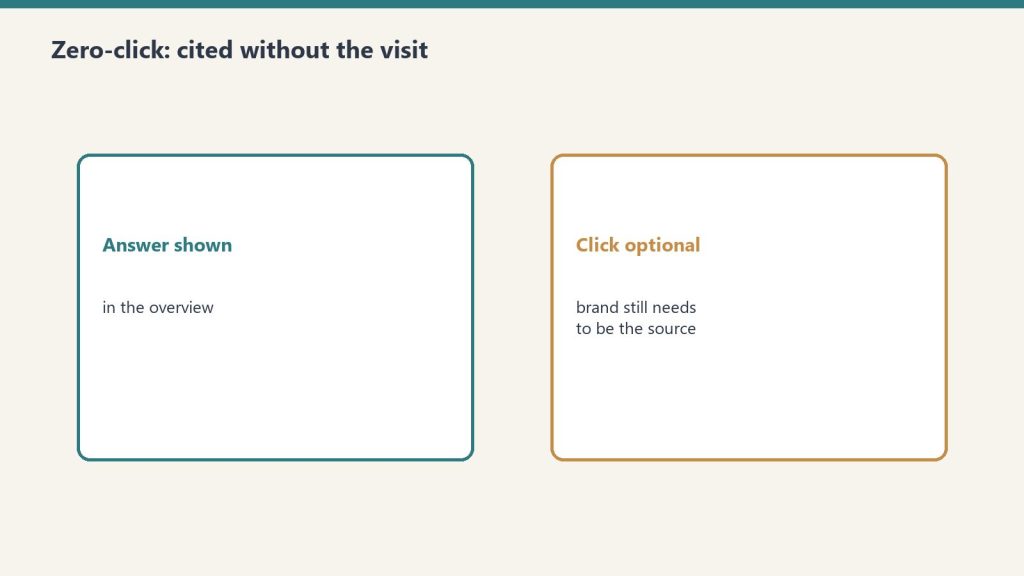
    Two cards: answer shown in overview versus optional click
    AI platforms are the new screens.

    The analogy maps precisely:

    Microsoft Copilot = the smart TV. It’s embedded in the platform people already use for work (Microsoft 365), just as smart TV is embedded in the living room device people already own. The user isn’t seeking out Copilot — it’s there when they need it. The content that works here is lean-back reference material: structured, specific, ready to be surfaced without the user leaving their workflow. My data shows this: 98,800 citations from enterprise users who never left Word or Edge.

    ChatGPT = the laptop/desktop. Users go to ChatGPT deliberately, open a session, and engage actively. They’re leaning forward, exploring, asking follow-up questions. The content that works here is detailed, nuanced, and conversation-worthy — the equivalent of the long-form desktop video that rewards a viewer’s active attention.

    Perplexity = the curated feed. Perplexity synthesizes the best sources into a clean answer with citations. It’s the AI equivalent of a personalized news feed or a curated newsletter. The content that wins here is authoritative and primary — the source that a discerning editor would choose as the definitive reference.

    Google AI Overviews = the pre-roll. AI Overviews appear before the organic search results, like a pre-roll ad before a YouTube video. They capture attention at the top of the funnel, and the content that appears there needs to be formatted for instant extraction — concise definitions, direct answers, structured lists that can be repurposed into a summary.

    Google organic search = broadcast TV. Still the largest audience, still the broadest reach, still the most competitive. But no longer the only screen that matters.

    The Creative Matrix for AI Content

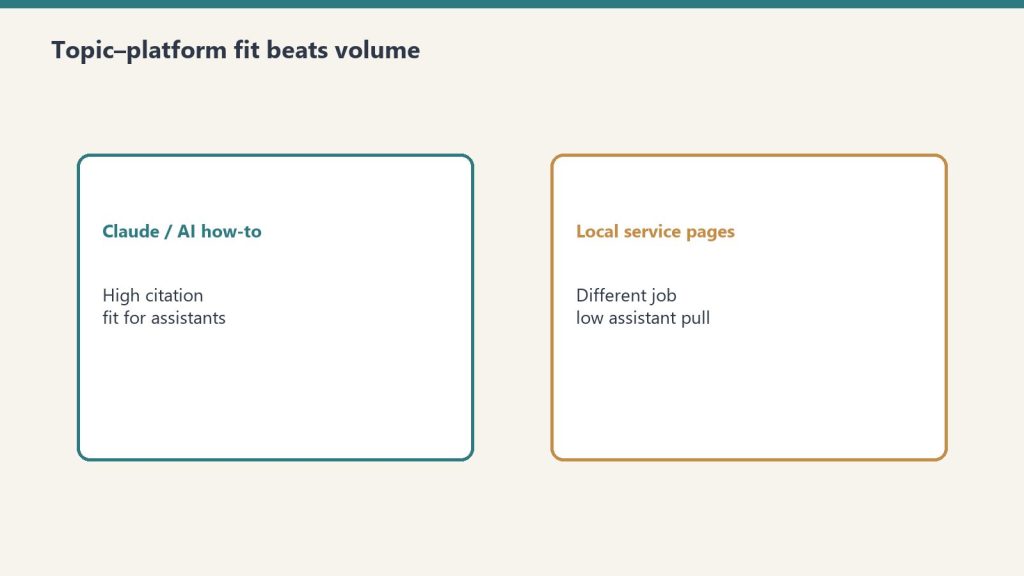
    Comparison of Claude how-to fit versus local service page fit for assistants
    The creative matrix for AI content.

    Just as an ad agency now produces a creative matrix — smart TV version, mobile version, desktop version, social version — a content operation needs to produce a content matrix for AI platforms.

    Let me show how this works with a real example. I publish content about Claude AI pricing. Here’s how that single topic gets treated differently for each platform:

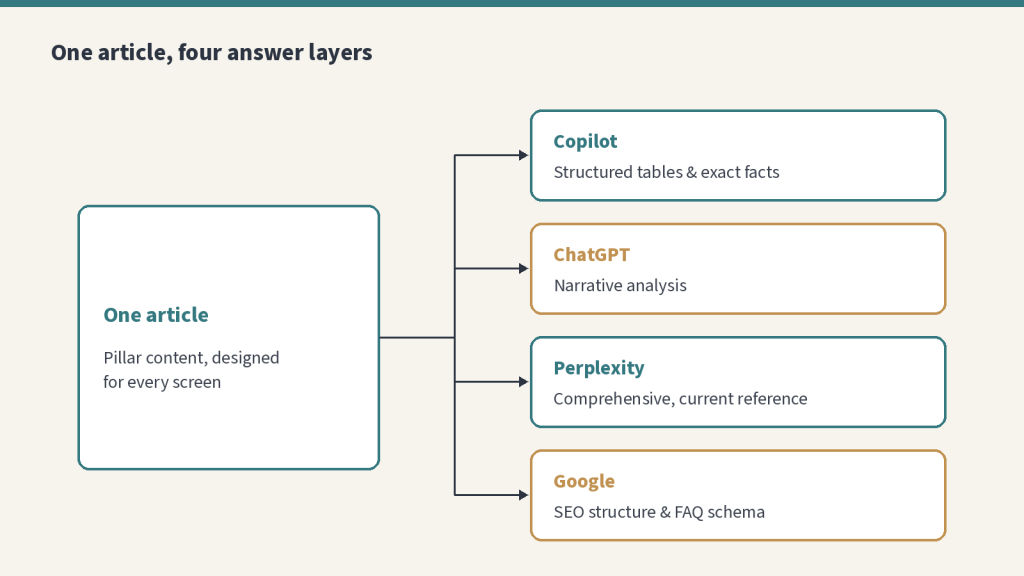
    Copilot version: Clean pricing table. Plan names, model names with version numbers, input/output token costs, monthly subscription prices. Minimal narrative. Maximum structure. This is the version that earns 16,500 citations because Copilot users need a number, not a story.

    ChatGPT version: 2,000-word analysis of Claude’s pricing strategy. How the tiers compare to OpenAI’s pricing. What the model costs mean for different use cases. Total cost of ownership calculations. Strategic framing for business decision-makers.

    Perplexity version: The definitive, comprehensive, most-current pricing reference on the internet. Updated within days of any price change. Formatted so Perplexity can cite specific numbers with confidence. The page that makes other sources unnecessary.

    Google version: SEO-optimized comparison page. “Claude AI Pricing 2026” in the title. FAQ schema. Clean headings. First paragraph answers the query directly. Designed to rank for keyword searches.

    In practice, some of these treatments can coexist in a single article. My highest-performing pages layer narrative depth (for ChatGPT and human readers) on top of structured data tables (for Copilot extraction) with FAQ sections (for Google snippets and AEO). But the intentionality matters — you have to design for each screen, not just hope one version works everywhere.

    What the Ad Industry Learned That Content Strategy Hasn’t

    The advertising industry’s transition to screen-specific creative taught several lessons that apply directly to AI content strategy:

    The generalist loses. The brand that ran the same spot everywhere got outperformed by the brand that optimized for each screen. In content, the operation that writes one article and publishes it hoping all AI platforms cite it will be outperformed by the operation that tailors content for each platform’s audience.

    Measurement has to segment by platform. Ad performance makes no sense when aggregated across all screens. A campaign that crushed on mobile but bombed on CTV looks mediocre in aggregate. The same is true for AI content: if you’re measuring “AI visibility” as a single metric, you’re missing the fact that your Copilot performance might be exceptional while your ChatGPT performance is zero.

    The production model has to change. When TV went from one-spot-fits-all to screen-specific creative, production workflows had to adapt. Agencies started shooting with multiple formats in mind. Content operations need the same evolution: write with multiple AI platforms in mind from the start, not as an afterthought.

    The early movers win disproportionately. The brands that figured out smart TV creative early locked in audience relationships and platform partnerships that late movers couldn’t replicate. In AI content, the publishers that build platform-specific citation authority now are building a moat. My Copilot citation flywheel — 672 daily citations growing to 5,500 — is the content equivalent of early smart TV audience lock-in.

    Why Content Operations Are Behind

    Desk with laptop, checklist notebook, and billing card ready before creating an Anthropic API key
    Why content operations are behind.

    The advertising industry had a structural advantage: media buyers were already thinking in terms of channels, audiences, and platforms. When new screens emerged, the mental model of “different creative for different channels” was already established. They just had to apply it to a new channel.

    Content marketing has operated under a different mental model: “publish great content and let search engines distribute it.” For twenty years, this meant one distribution channel (Google) with one optimization framework (SEO). The idea that you might need platform-specific content strategies for AI engines is foreign to most content operations because they’ve never had to think about distribution as a multi-platform problem.

    That’s changing. The data is forcing it. When you can see in Bing Webmaster Tools that your enterprise tool content earns 5,500 daily Copilot citations while your local content earns zero, the multi-platform nature of AI distribution becomes undeniable. And once you accept that AI platforms are different audiences, the advertising industry’s decades of screen-specific creative become your playbook.

    Building the Platform-Specific Content Operation

    Here’s what the transition looks like, based on what I’m building right now:

    Audit by platform. Check your Bing AI Performance data. Manually test your key topics in ChatGPT, Perplexity, and Claude. Build a map of which content earns citations where.

    Segment your content calendar. Assign platform targets to each piece of content. “This pricing guide is optimized for Copilot extraction.” “This thought leadership piece is optimized for ChatGPT depth.” “This reference page is optimized for Perplexity authority.”

    Structure for multiple audiences in one article. Your best content should layer: structured data for Copilot, narrative depth for ChatGPT, definitive authority for Perplexity, and keyword optimization for Google. Not every piece needs all four, but your pillar content should.

    Measure separately. Track Copilot citations in Bing Webmaster Tools. Track ChatGPT referral traffic in analytics. Test Perplexity visibility manually. Don’t aggregate these into one “AI performance” number — they’re different audiences and need different metrics.

    The ad industry spent a decade learning that one creative doesn’t fit all screens. The content industry can learn the same lesson faster — because the data is available today, and the playbook has already been written by someone else.

    Related on Tygart Media: different AI audiences · SEO vs GEO vs AEO · citation economy.

    Frequently Asked Questions

    How is AI content like advertising?

    Just as advertisers create different creative for smart TV, mobile, desktop, and social media, content operations need platform-specific approaches for Copilot, ChatGPT, Perplexity, and Google. Each platform serves a different audience in a different context with different needs.

    Can one article serve all AI platforms?

    Yes, with intentional layering. A single article can include structured data tables for Copilot extraction, narrative depth for ChatGPT engagement, authoritative sourcing for Perplexity citation, and keyword optimization for Google rankings. The key is designing for all audiences from the start.

    What does platform-specific content measurement look like?

    Track Copilot citations in Bing Webmaster Tools AI Performance tab. Monitor ChatGPT referral traffic in Google Analytics. Test Perplexity visibility by manually searching your topics. Measure each platform separately rather than aggregating into one AI performance number.

    Which AI platform should I prioritize?

    It depends on your audience. Enterprise and technology content should prioritize Copilot because its user base is knowledge workers mid-task. Consumer and research content may perform better on ChatGPT. Use the topic-platform fit matrix to determine where your content has the highest citation potential.

    How did smart TV advertising change production workflows?

    Agencies shifted from one-spot-fits-all to shooting with multiple formats in mind from the start. Content operations need the same evolution: plan content with multiple AI platform audiences in mind during the writing process, not as a post-publish optimization.

  • Your Website Is Being Read by AI More Than Humans — Here’s the Data

    Your Website Is Being Read by AI More Than Humans — Here’s the Data

    The Invisible Majority of Your Readership

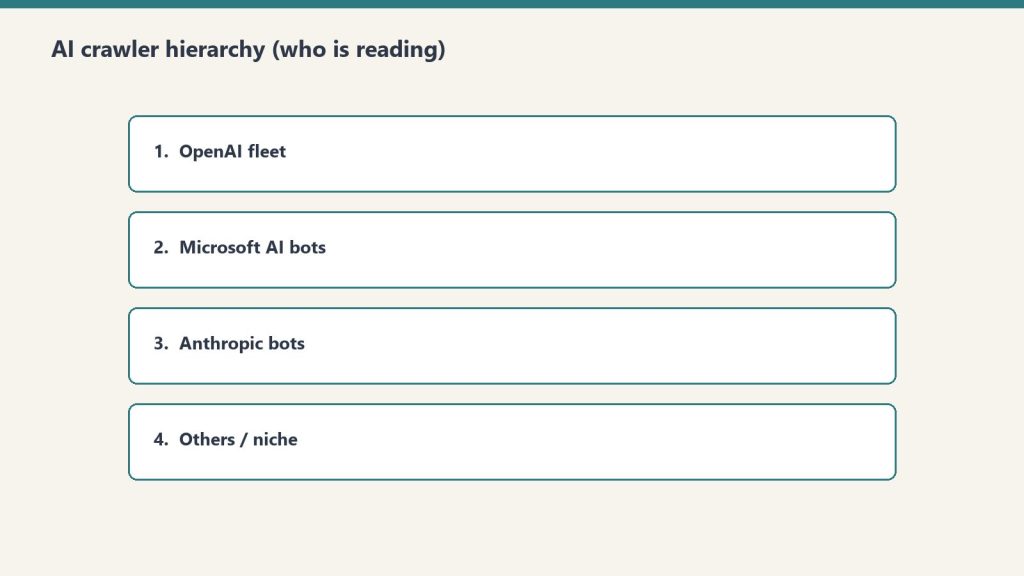
    Four ranked rows of AI crawler fleets reading publisher content
    The invisible majority of your readership — AI crawlers.

    For every human who clicks on one of my articles from Bing search results, Microsoft Copilot cites that same content 52 times. Not reads. Not impressions. Citations — instances where an AI engine uses my content as the grounding source for a response delivered to a real user.

    The numbers: 98,800 AI citations from Copilot. Roughly 1,900 human clicks from Bing. Same time period. Same domain. Same content.

    And here’s what makes this disorienting: I can see the AI citations in Bing Webmaster Tools. But my Google Analytics, my heatmaps, my session recordings, my conversion tracking — none of it registers the 98,800 AI interactions. As far as my analytics stack is concerned, those readers don’t exist.

    The largest audience consuming my content is invisible to every measurement tool I’ve used for the past decade.

    How We Got Here Without Noticing

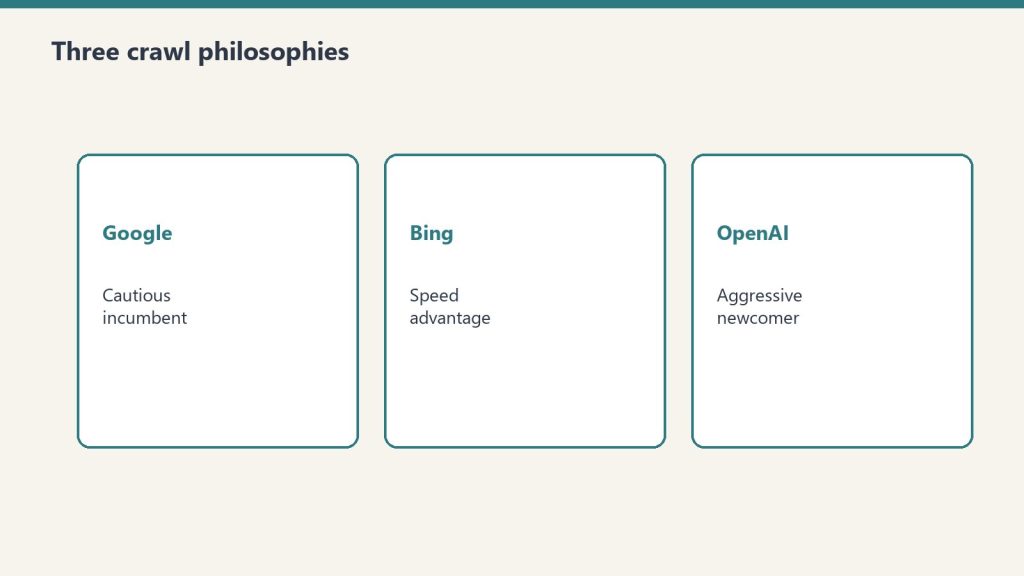
    Three cards for Google cautious, Bing speed, OpenAI aggressive crawl styles
    How we got here without noticing.

    The shift happened gradually, then all at once. Microsoft shipped Copilot in Microsoft 365 to hundreds of millions of enterprise seats. Google rolled out AI Overviews to every search user. ChatGPT launched its search feature. Perplexity grew to millions of daily users. Claude’s user base expanded.

    Each of these platforms consumes web content to generate responses. They crawl, index, and cite websites — not to send traffic, but to build the source material for AI-generated answers. Your content becomes the foundation of an AI response that gets delivered to a user who may never know your site exists and will certainly never show up in your analytics.

    The scale is enormous. Microsoft alone has over 400 million Copilot users across its products. If even a fraction of their queries trigger content citations, the total volume of AI-mediated content consumption dwarfs traditional search clicks for many content categories.

    My 52:1 ratio might be extreme because my content is heavily skewed toward AI tools — a topic that Copilot users ask about frequently. But even for more general content categories, the AI consumption layer is growing faster than any other traffic channel. And most content operations are completely blind to it.

    The Measurement Crisis

    Here’s what your current analytics stack tells you about AI consumption of your content: almost nothing.

    Google Analytics tracks human visits. An AI engine that cites your content doesn’t load your page in a browser, doesn’t execute JavaScript, doesn’t trigger a session. It reads your content through APIs or cached indexes and incorporates it into a response. No pageview. No session. No data.

    Google Search Console tracks clicks and impressions from Google search. It doesn’t track AI Overview citations — when Google’s own AI uses your content to build an AI-generated summary, that interaction doesn’t appear as a click or an impression in Search Console.

    The only tool currently offering AI citation data is Bing Webmaster Tools, through its AI Performance beta tab. This shows Copilot-specific citations — the number of times Copilot used your content as a grounding source. But it only covers Microsoft’s AI. Google, ChatGPT, Perplexity, and Claude citation data remains largely invisible.

    This creates a measurement crisis. Content operations make decisions based on analytics data. If the majority of your content’s audience is invisible to your analytics, you’re making decisions based on the minority of your readership. You’re optimizing for the 1,900 clicks while ignoring the 98,800 citations.

    What “Being Read by AI” Actually Means

    When I say AI is reading your content, I want to be precise about what’s happening technically.

    Grounding: When a user asks Copilot a question, Copilot searches for relevant web content, retrieves it, and uses it to “ground” its response in factual sources. Your page becomes the cited source for specific claims in the AI’s answer. The user sees your content’s information, often with a link back to your page — but they may never click that link because the AI already gave them what they needed.

    Scale: One article on my site answering “claude ai pricing” was grounded 16,500 times. That means 16,500 Copilot users received information sourced from my page. In a traditional web model, that would be 16,500 pageviews. In the AI model, it’s 16,500 invisible reads.

    Reach: Each citation represents content delivery to a user who is actively working, actively needing that information, and actively incorporating it into a task. This isn’t a bounce-rate impression — it’s a high-intent content consumption event. The quality of these “reads” may be higher than most human pageviews, even though they’re invisible.

    The Writing Implications

    Desk with laptop, checklist notebook, and billing card ready before creating an Anthropic API key
    The writing implications of AI-majority readership.

    If AI is your primary reader, you need to write differently. Not worse. Not shorter. Differently.

    Write for extraction, not engagement. AI engines don’t scroll, don’t skim, and don’t get bored. They extract specific information from your content. A pricing table that’s easy for AI to parse serves the citation audience better than a narrative pricing discussion that’s more “engaging” for human readers. Both can coexist, but the extraction-friendly content needs to be there.

    Accuracy is non-negotiable. AI engines are grounding their responses on your content. If your pricing page is wrong, Copilot gives 16,500 users the wrong answer — with your name attached as the source. In a traditional web model, a wrong number on a page hurts your credibility with the humans who visit. In the AI model, it hurts your credibility with the AI engine itself, which may stop citing you if users flag the information as incorrect.

    Structure beats storytelling for citation content. This doesn’t mean storytelling is dead — it means you need both. The narrative draws human readers. The structured data draws AI citations. A good article about Claude pricing has both: a narrative explanation of the pricing structure and a clean, parseable table of actual numbers.

    Currency matters more than ever. AI engines can detect stale content. A pricing article from January 2025 won’t earn citations in June 2026 because the prices have changed. The content that maintains citation velocity is content that’s demonstrably current — date-stamped, version-specific, and regularly updated.

    The Monetization Question

    The obvious question: if AI is reading your content 52 times more than humans, but those AI reads don’t generate pageviews, how do you monetize them?

    Right now, the honest answer is: the direct monetization model is still emerging. Ad revenue depends on pageviews. Affiliate revenue depends on clicks. Lead generation depends on form fills. None of these happen when AI reads your content.

    But here’s what does happen:

    Brand authority compounds. When Copilot cites your pricing guide 16,500 times, you become the de facto source for that topic. Enterprise workers learn your name through AI responses. When they eventually need to visit your site — for a demo, for a purchase, for a deeper evaluation — they already know you.

    Citation begets citation. My data shows a flywheel effect: the more Copilot cites a source, the more it trusts that source for adjacent queries. 672 daily citations grew to 5,500 daily citations over 90 days. Authority compounds in AI engines just as it does in traditional search.

    The traffic still comes — indirectly. AI citations include source links. Some users do click through. And as your citation authority grows, your traditional search visibility often grows with it, because AI citation authority and search authority draw from overlapping signals.

    The long-term monetization model for AI citations probably looks more like brand advertising than direct response. You’re building awareness and authority at massive scale. The conversion happens downstream, through channels that your analytics can track.

    What to Do About It Today

    Check your Bing Webmaster Tools AI Performance tab. If you haven’t verified your site with Bing, do that first. The citation data might change how you think about your entire content operation.

    Look at your analytics with fresh eyes. That high-quality article with “disappointing” traffic might be generating thousands of AI citations you can’t see. The low-traffic technical guide might be one of your most-consumed pieces of content through AI channels.

    Start tracking the AI-to-human ratio for your content categories. Which topics are being consumed primarily by AI? Which are still human-traffic driven? This tells you where to invest in structured, extraction-friendly content (for AI) and where to invest in engagement-optimized content (for humans).

    Your biggest audience might be the one you can’t see yet. But the data to find it is already there — if you know where to look.

    Related on Tygart Media: AI crawler experiment · citation economy.

    Frequently Asked Questions

    Does Google Analytics track AI citations?

    No. Google Analytics tracks human browser visits. AI engines consume content through APIs and indexes without loading pages in browsers, so they don’t trigger JavaScript analytics. The only current tool showing AI citation data is Bing Webmaster Tools AI Performance beta tab.

    What is the AI-to-human read ratio?

    For one domain focused on AI tools, the ratio was 52:1 — 98,800 Copilot citations vs 1,900 Bing clicks in the same period. This ratio varies dramatically by topic. Enterprise technology content tends to have very high AI-to-human ratios. Local consumer content tends to have very low ratios.

    Should I stop writing for humans and focus on AI?

    No. Humans still drive direct revenue through clicks, conversions, and engagement. The strategy is to write content that serves both — narrative elements for human readers and structured, extractable data for AI engines. Both audiences can be served by the same article with intentional formatting.

    How do I make my content more citable by AI?

    Structure information for extraction: clean tables, specific numbers, version-stamped details, clear definitions. Ensure accuracy — AI engines may reduce citations for sources that users flag as incorrect. Keep content current with date stamps and regular updates.

    Will Google eventually show AI citation data?

    Google has not announced plans to expose AI Overview citation data in Search Console. However, as the AI citation economy grows and marketers demand transparency, competitive pressure from Bing’s AI Performance tab may push Google to provide similar analytics.

  • Why Claude Articles Get 16,500 Copilot Citations But Roofing Articles Get Zero

    Why Claude Articles Get 16,500 Copilot Citations But Roofing Articles Get Zero

    The Most Lopsided Split I’ve Ever Seen

    Comparison of Claude how-to fit versus local service page fit for assistants
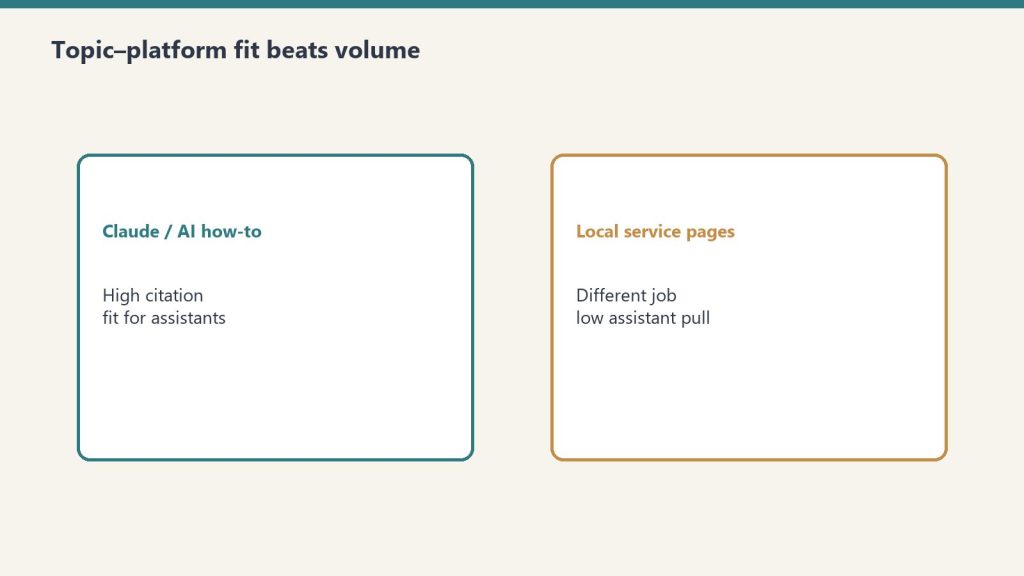
    The most lopsided split: topic–platform fit beats volume.

    I run two kinds of content on the same portfolio of sites. One kind covers AI tools — Claude pricing, developer workflows, Copilot integrations, tool comparisons. The other covers trade services — restoration contractors, roofing, water damage, local business directories.

    Both content streams are well-written. Both are SEO-optimized. Both rank on Google. But when I opened Bing Webmaster Tools and looked at the AI Performance tab, the split was so stark it looked like a data error.

    AI tool content: 98,800 citations across 576 grounding queries. The single highest query — “claude ai pricing” — generated 16,500 citations by itself.

    Trade service content: Zero.

    Not ten. Not “a few that I might have missed.” Zero citations. Across every restoration article, every roofing guide, every local service page. Microsoft Copilot did not cite a single one of them.

    This isn’t a quality problem. It’s a topic-platform fit problem. And understanding it changes how you think about content strategy for AI.

    Who Actually Uses Copilot

    To understand why Claude articles dominate and roofing articles get nothing, you need to understand who is on the other end of those Copilot queries.

    Microsoft Copilot is embedded in Microsoft 365 — Word, Excel, PowerPoint, Outlook, Teams, Edge. The users are enterprise workers, knowledge professionals, and business users who invoke AI as part of their daily workflow. They’re writing reports, building presentations, comparing tools, planning purchases, and making decisions.

    When a Copilot user asks a question, it’s because they need information to complete a task they’re currently doing. They’re in Word writing an AI strategy memo and they need current pricing. They’re in Excel building a vendor comparison and they need feature lists. They’re in Edge researching a developer tool and they need a hands-on review.

    These people don’t ask Copilot about roofing contractors. They don’t ask about water damage restoration in Houston. They don’t ask about emergency plumbing services. Because they’re not doing those things at their desk in Microsoft 365.

    The queries that trigger Copilot citations are professional knowledge queries — the questions knowledge workers ask while working:

    “What is claude ai pricing in 2026”
    “Claude code vs cursor comparison”
    “How to set up notion MCP with claude”
    “Anthropic console api key guide”
    “Best AI coding tools for teams”

    Every one of these is a work-context question from someone making a professional decision. And every one of them led Copilot to my content because my content is the most structured, specific, accurate answer available.

    The Topic-Platform Fit Matrix

    Four cards for content, ops, build, and knowledge work with Claude
    Topic–platform fit matrix — write for the assistant that will cite you.

    Based on my citation data and observation across platforms, here’s what I see as the topic-platform fit landscape:

    Microsoft Copilot favors: Technology tool comparisons and pricing. Enterprise software reviews. Developer workflow guides. Business strategy content. AI platform analysis. Integration and configuration documentation. Anything a knowledge worker might need while working in Office.

    Microsoft Copilot ignores: Local services. Trade industries. Consumer products. Event listings. Community content. Anything where the intent is “find a provider near me” rather than “help me understand this tool.”

    ChatGPT favors: Broad technology topics. Health and science information. Financial concepts. Educational content. How-things-work explanations. Creative and cultural topics. Travel planning.

    Google favors: Everything — but especially local intent, shopping intent, transactional queries, and broad informational queries. Google is the generalist.

    Perplexity favors: Current events and news. Technical deep-dives. Product research. Anything where users want a synthesized, multi-source answer to a specific question.

    The pattern is clear: each platform’s topic preferences reflect its user base and use context. Copilot’s users are in the office, so Copilot cites office-relevant content. ChatGPT’s users are everywhere, so ChatGPT cites broadly. Google’s users are searching with intent, so Google rewards intent-matched content.

    Why 16,500 Citations for One Query

    The “claude ai pricing” query generating 16,500 Copilot citations deserves its own analysis because it illustrates topic-platform fit perfectly.

    Think about who asks this question inside Copilot: someone at a company evaluating Claude as a tool for their team. They’re probably in the middle of writing a procurement justification, a budget proposal, or a vendor comparison. They need the current pricing — plans, model costs, API rates — and they need it accurate and structured so they can drop it into their document.

    My Claude AI pricing article has exactly what this person needs: clean pricing tables organized by plan tier, specific model costs with input/output token rates, version-accurate model names, and comparison notes that help with vendor evaluation. The content is formatted for extraction — Copilot can pull a specific number, a specific tier name, a specific comparison point and present it to the user inline.

    That’s why one article earns 16,500 citations while an entire portfolio of roofing content earns zero. The roofing content is excellent for its audience (homeowners with water damage searching Google). But that audience doesn’t exist inside Copilot.

    The Strategic Implications

    Three cards for fast volume, daily workhorse, and deep flagship Claude seats
    Strategic implications — authority clusters compound.

    If you’re a content strategist looking at this data, the implications are significant:

    Not all content is eligible for AI citations. If your business is local services, consumer retail, or any industry where the customer journey starts with a Google search and ends with a phone call, AI citation optimization might not be your priority. Your content serves Google searchers, and that’s fine — that audience is still massive and monetizable.

    If your content serves knowledge workers, you’re sitting on a citation goldmine. SaaS companies, developer tools, B2B services, consulting firms, enterprise technology — any business whose content answers questions that professionals ask while working is perfectly positioned for Copilot citations. And most of them don’t know it yet because they’ve never checked the AI Performance tab.

    Topic-platform fit should drive your content calendar. Instead of asking “what keywords should we target,” start asking “which AI platforms could cite our content, and what does their user base need?” This changes which articles you prioritize, how you structure them, and what success looks like.

    The zero-citation categories will change. As AI platforms expand beyond enterprise knowledge work — as Copilot appears in more consumer contexts, as ChatGPT’s search feature grows, as Google AI Overviews cover more queries — the topic-platform fit map will shift. Local services might start earning AI citations when AI assistants handle “find me a plumber” queries. But right now, the data is unambiguous: Copilot citations concentrate in professional knowledge topics.

    How I Use This Data

    On my own sites, topic-platform fit analysis drives resource allocation. I don’t try to make my restoration content earn Copilot citations — that’s fighting the user base. Instead, I optimize restoration content for Google (where that audience lives) and invest my Copilot-facing content effort in AI tools, business strategy, and technology topics (where the citation audience lives).

    This isn’t about abandoning one audience for another. It’s about matching content to the platform where it will actually be consumed. The same way a B2B SaaS company advertises on LinkedIn instead of TikTok, you should produce AI tool content for Copilot and local service content for Google.

    The data is telling you where your audiences are. The question is whether you’re listening.

    Related on Tygart Media: $0.35 article citations · 98,800 citations · restoration AI search.

    Frequently Asked Questions

    Can local business content earn AI citations?

    Currently, local service content earns very few AI citations because Copilot users are enterprise workers asking professional questions. However, as AI assistants expand into consumer use cases — handling queries like “find me a plumber” or “best restaurants near me” — local content may start earning citations. For now, focus local content on Google SEO and monitor AI citation data for shifts.

    What is topic-platform fit?

    Topic-platform fit describes how well a content topic matches the user base and use context of a specific AI platform. Topics that align with what a platform’s users actually ask about earn citations. Topics that don’t match the user base earn zero citations regardless of content quality.

    Why does Copilot favor technology content so heavily?

    Copilot is embedded in Microsoft 365, so its users are enterprise workers in Office applications. They ask questions related to their work: tool comparisons, pricing, integrations, and business decisions. Technology and business content matches their context. Consumer and local content does not.

    Should SaaS companies prioritize Copilot citations?

    Yes. If your product serves enterprise knowledge workers, your documentation, pricing pages, and comparison content is exactly what Copilot users ask about. Checking your Bing Webmaster Tools AI Performance tab may reveal citation data you did not know existed — and optimizing for it could dramatically expand your content’s reach.

    How do I find my topic-platform fit?

    Start by checking Bing Webmaster Tools AI Performance for your existing Copilot citation data. Then manually test your key topics in ChatGPT, Perplexity, and Claude to see if your content appears in their responses. Map which topics earn citations on which platforms to build your topic-platform fit matrix.

  • The SEO vs GEO vs AEO Debate Is Already Over — Here’s What Comes Next

    The SEO vs GEO vs AEO Debate Is Already Over — Here’s What Comes Next

    An Argument With No Winner

    Open any marketing subreddit, LinkedIn thread, or industry conference agenda right now and you’ll find the same debate: SEO vs GEO vs AEO. Search Engine Optimization vs Generative Engine Optimization vs Answer Engine Optimization. Which framework should guide your content strategy? Which one is “the future”?

    I’ve been watching this debate for months while sitting on a dataset that makes the entire argument irrelevant. The data comes from Bing Webmaster Tools AI Performance tab — 98,800 Microsoft Copilot citations across 576 grounding queries from a single domain. And what it shows is that the SEO/GEO/AEO framework is the wrong level of abstraction.

    The right question isn’t “which optimization approach wins.” It’s “which AI platform are you optimizing for, and what does its specific user base need?”

    Why the Old Categories Are Collapsing

    SEO versus GEO comparison showing collapsing old categories
    SEO vs GEO vs AEO — the old categories are collapsing.

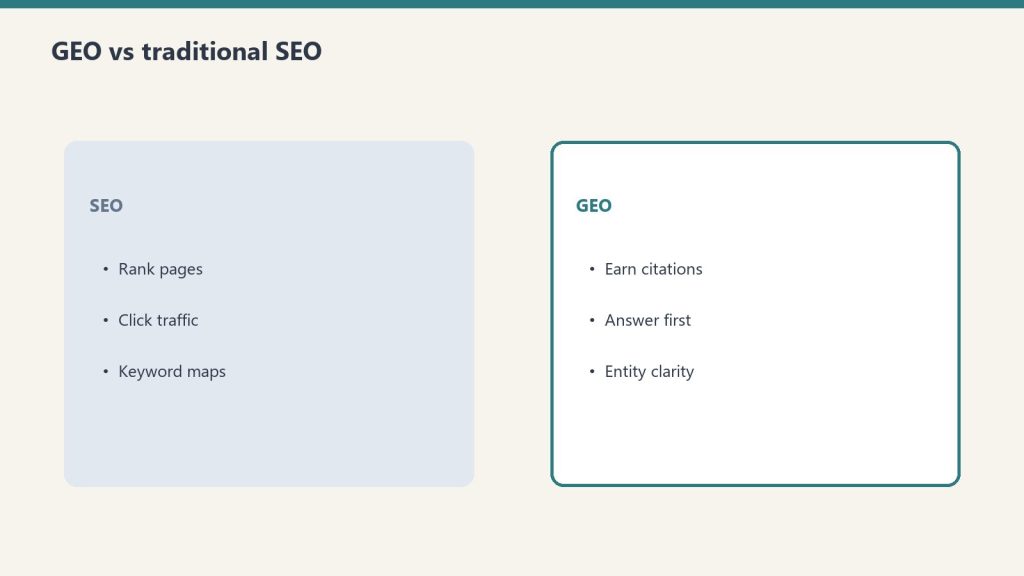
    SEO was built for Google. It assumes a user types keywords, receives a ranked list of links, and clicks through to a website. The metrics are rankings, clicks, and conversions. This model still works for Google — but Google is no longer the only discovery engine that matters.

    GEO emerged to address generative AI — the idea that your content needs to be optimized so that AI engines cite and reference it. But GEO treats “AI” as a single category. It assumes what works for ChatGPT also works for Copilot, Perplexity, Gemini, and Claude. My data says that’s wrong.

    AEO focuses on structuring content for direct answers — featured snippets, People Also Ask boxes, voice search. It’s a useful tactical framework, but it was designed for Google’s answer features, not for AI platforms that consume and reprocess content in fundamentally different ways.

    Each of these frameworks captures part of the picture. None captures the whole thing. And the gap between them is where the actual opportunity lives.

    The Data That Breaks the Framework

    Comparison of Claude how-to fit versus local service page fit for assistants
    The data that breaks the single-framework argument.

    Here’s what 98,800 Copilot citations taught me about why the SEO/GEO/AEO categories don’t hold:

    Topic-platform mismatch is real. My AI tool content generates thousands of daily Copilot citations. My local business content — which has strong Google SEO performance — generates zero Copilot citations. GEO theory says optimized content should perform across AI engines. Reality says the topic has to match the platform’s user base.

    Content format preferences differ by platform. Copilot rewards structured reference content — pricing tables, comparison matrices, specific data points. ChatGPT rewards depth and original analysis. Perplexity rewards definitive, primary-source authority. AEO’s “structure for direct answers” advice is too generic to capture these distinctions.

    User intent varies by context. A Copilot user asking about Claude AI pricing is in the middle of a work task — they need a number, now. A ChatGPT user asking the same question might be evaluating whether to adopt Claude at all — they want context, comparisons, and strategic thinking. Same query, different intent, different optimal content. SEO’s keyword-intent model doesn’t account for the platform delivering the answer.

    The citation flywheel is platform-specific. My daily Copilot citations grew from 672 to 5,500 over 90 days. That growth happened because Copilot developed trust in my domain for specific topic clusters. This trust-building behavior is different from how Google ranks pages, how ChatGPT selects sources, or how Perplexity curates citations. Each platform has its own authority model.

    Introducing Platform-Specific AI Optimization

    Six evaluation cards for choosing an AI assistant platform
    Platform-specific AI optimization is what comes next.

    I’m going to name the thing that comes after the SEO/GEO/AEO debate because someone has to, and I have the data to back it up.

    Platform-Specific AI Optimization (PSAO) is the practice of creating content tailored to the specific user base, intent patterns, content format preferences, and authority models of individual AI platforms.

    PSAO doesn’t replace SEO, GEO, or AEO. It subsumes them. SEO becomes your Google-specific strategy. GEO becomes a shared foundation of AI-friendly content practices. AEO becomes a tactical layer that applies differently depending on which platform you’re targeting. And PSAO is the strategic framework that coordinates all of them.

    Here’s how PSAO maps the landscape:

    Google (SEO focus): Keyword optimization, link building, technical SEO, Core Web Vitals. Audience: searchers with transactional or informational intent. Metric: rankings, clicks, conversions.

    Microsoft Copilot (PSAO-Copilot): Structured reference content, pricing tables, comparison matrices, technical documentation. Audience: enterprise workers mid-task in Microsoft 365. Metric: AI citations in Bing Webmaster Tools.

    ChatGPT (PSAO-ChatGPT): Long-form thought leadership, original research, unique data, comprehensive analysis. Audience: explorers and evaluators in conversation mode. Metric: ChatGPT Search referral traffic, citation mentions.

    Perplexity (PSAO-Perplexity): Definitive primary-source content, original data, authoritative positioning. Audience: users seeking curated, multi-source answers. Metric: Perplexity citation frequency.

    Google AI Overviews (PSAO-AIO): Featured-snippet-ready content, concise definitions, structured FAQs. Audience: searchers receiving AI-generated summaries. Metric: AI Overview inclusion rate.

    Why Nobody Else Is Talking About This

    The reason PSAO doesn’t exist as a category yet is simple: nobody has the data. The tools are fragmented, the measurement is early, and the marketing industry is still in the “arguing about which single framework wins” phase.

    Bing Webmaster Tools AI Performance is in beta. Most marketers don’t know it exists. Google hasn’t released comparable citation-level data for AI Overviews. ChatGPT’s citation behavior isn’t exposed through any analytics dashboard. Perplexity doesn’t offer a webmaster console at all.

    The data infrastructure is nascent. But the underlying behavior — AI platforms consuming and citing web content at massive scale with platform-specific patterns — is already happening. The 98,800 citations on my domain aren’t theoretical. They’re measured, daily, query-by-query.

    The marketers who wait for a polished SaaS dashboard to tell them about platform-specific AI optimization will be years behind the ones who start measuring now with the crude tools available.

    What PSAO Strategy Looks Like in Practice

    On my own sites, PSAO looks like this:

    Morning content (Copilot hours): I publish detailed AI tool guides, pricing comparisons, and integration documentation. This content is structured for extraction — clean tables, specific numbers, version-stamped details. It serves enterprise Copilot users who are working in Office and need reference data.

    Evergreen content (Google hours): I publish local business guides, community resources, and civic information. This content is optimized for traditional SEO — keywords, headings, FAQ schema, internal links. It serves Google searchers looking for local information.

    Weekend content (ChatGPT depth): I publish thought leadership, original analysis, and data-driven arguments like this article. This content is optimized for depth and originality — the kind of content ChatGPT’s grounding algorithm favors when users are exploring a topic.

    Same domain. Three different content strategies. Three different audiences. Three different measurement frameworks. That’s PSAO.

    The Category Is Open

    Right now, there’s no Google Trends data for “Platform-Specific AI Optimization.” No conference tracks. No SaaS tools. No Gartner quadrant. The category is open because the phenomenon it describes has only become measurable in the last few months.

    I’m staking my position: the SEO vs GEO vs AEO debate is a transitional phase. Within 18 months, the marketers who matter will be talking about platform-specific optimization because the data will force them to. Different platforms, different audiences, different content, different metrics. That’s the future.

    And I’m publishing the playbook as I build it.

    Related on Tygart Media: GEO tactics · Google vs Copilot audiences · citation monitoring.

    Frequently Asked Questions

    Does PSAO replace SEO?

    No. PSAO subsumes SEO by treating it as your Google-specific optimization strategy. SEO remains essential for organic search traffic. PSAO adds parallel strategies for Copilot, ChatGPT, Perplexity, and other AI platforms — each tailored to the platform’s specific audience and behavior.

    How is PSAO different from GEO?

    GEO treats all AI engines as a single audience and applies general optimization principles — entity enrichment, structured data, authoritative sourcing. PSAO recognizes that each AI platform has a different user base, different intent patterns, and different content preferences. GEO is a foundation. PSAO is the targeting layer built on top of it.

    Where can I measure AI citations right now?

    Bing Webmaster Tools AI Performance tab shows Copilot citation data, including total citations, grounding queries, and daily trends. ChatGPT citations can be partially tracked through referral traffic analytics. Perplexity and Claude currently lack webmaster-facing citation analytics, requiring manual testing.

    What topics perform best on Copilot vs Google?

    Copilot users are enterprise workers mid-task, so technology tools, pricing comparisons, integration guides, and business strategy content earn the most citations. Google serves a broader audience including local searches, shopping intent, and general information queries. The overlap exists, but the highest-performing content for each platform is distinct.

    When will the industry adopt PSAO?

    The adoption curve depends on measurement tools. As Bing Webmaster Tools, Google Search Console, and potential new platforms expose AI citation data, marketers will be forced to segment their optimization by platform. Based on current data trends, platform-specific optimization will likely become standard practice within 12-18 months for advanced content operations.

  • Writing for Google vs Writing for Copilot vs Writing for ChatGPT: They’re Not the Same Audience

    Writing for Google vs Writing for Copilot vs Writing for ChatGPT: They’re Not the Same Audience

    The Assumption That’s Costing You Citations

    Comparison of Claude how-to fit versus local service page fit for assistants
    The assumption costing you citations.

    The entire content marketing industry operates on a single assumption: write great content, optimize it for search, and the right people will find it. For two decades, “the right people” meant Google users. That assumption worked because there was only one discovery engine that mattered.

    There are now at least five. And they don’t behave the same way.

    Google users type keywords. Microsoft Copilot users ask questions mid-task inside Word, Excel, or Outlook. ChatGPT users explore topics conversationally. Perplexity users want curated, multi-source answers. Claude users tend to ask deep, technical questions about implementation.

    I know this because I can see it. My site generates 98,800 AI citations from Copilot alone, and the grounding queries — the actual questions that triggered those citations — reveal an audience that looks nothing like my Google Analytics traffic. These are different people, in different contexts, with different needs, finding the same content through completely different pathways.

    The content that serves one platform well often serves another poorly. And if you’re optimizing for “AI search” as a single category, you’re making the same mistake as someone who runs the same TV commercial on ESPN, HGTV, and the Discovery Channel.

    Google Users: The Keyword Searchers

    Four cards for content, ops, build, and knowledge work with Claude
    Google users: keyword searchers.

    Google’s audience is the one everyone understands. They type keywords — sometimes fragments, sometimes questions, often just a few words. “Best CRM software.” “Water damage restoration Houston.” “Claude AI pricing 2026.”

    The behavior is transactional or informational. They want a list, a comparison, a local service, or a quick answer. Google’s algorithm rewards content that satisfies this intent quickly: clear headings, structured data, fast load times, and content that matches the keyword pattern.

    Google users click through to your site. They see your ads. They enter your funnel. The entire monetization model of the internet is built on this interaction: search, click, land, convert.

    Content that wins on Google: keyword-optimized pages, local landing pages, listicles, product comparisons, and how-to content with clear structure. The audience skims. They want answers in the first 100 words or they bounce.

    Copilot Users: The Mid-Task Workers

    Copilot users are a fundamentally different audience. They’re not searching — they’re working. They invoke Copilot inside Microsoft 365 applications while writing a report, analyzing a spreadsheet, composing an email, or researching a decision they need to make in the next 30 minutes.

    The queries I see in Bing’s grounding data confirm this: “what is claude ai pricing in 2026,” “how to connect notion to claude code,” “difference between claude code and cursor for teams.” These are operational questions from people in the middle of a task. They need accurate, specific, reference-grade information — not a 2,000-word SEO article with a table of contents and 47 H2 headings.

    The content that earns 16,500 Copilot citations for a single query isn’t my best-written piece. It’s my most accurate, specific, and structured piece. It has clear pricing tables. It has version-specific details. It answers the exact question without making you read three paragraphs of context first.

    Copilot users never visit your site. They consume your content inside their Office application, surfaced as a grounded AI response. Your content becomes the source material for Copilot’s answer. The citation is your visibility — not the click.

    Content that wins on Copilot: detailed pricing breakdowns, tool comparison matrices, integration guides with specific steps, and reference documentation that’s structured for extraction rather than engagement.

    ChatGPT Users: The Explorers

    ChatGPT’s audience is different again. These are people in exploration mode — they’re thinking through a problem, evaluating options, or trying to understand something complex. They write long, conversational queries. They ask follow-up questions. They treat the AI as a thinking partner rather than an answer machine.

    ChatGPT’s citation behavior (visible through ChatGPT Search) favors content that demonstrates expertise, provides unique insights, and covers topics comprehensively. Where Copilot wants structured reference data, ChatGPT wants depth and nuance. Where Copilot users need an answer in 10 seconds, ChatGPT users are willing to engage for 10 minutes.

    Content that wins on ChatGPT: long-form thought leadership, original research, case studies with real data, and contrarian perspectives backed by evidence. ChatGPT’s grounding algorithm appears to reward content that says something other sources don’t.

    Perplexity Users: The Curators

    Perplexity positions itself as an answer engine — it synthesizes multiple sources into a single response with inline citations. Its users want the definitive answer, pulled from the best available sources and presented with transparency about where each claim comes from.

    Perplexity’s citation behavior rewards pages that are recognized as authoritative on a specific topic. It tends to pull from a smaller number of high-trust sources rather than aggregating broadly. If your page is the best single source on a topic, Perplexity will cite it repeatedly.

    Content that wins on Perplexity: comprehensive pillar pages, original data, and content that’s clearly the primary source rather than a summary of other sources. Perplexity penalizes derivative content more visibly than any other platform.

    Claude Users: The Implementers

    Three cards for fast volume, daily workhorse, and deep flagship Claude seats
    Claude users: the implementers.

    Claude’s user base skews toward developers, technical professionals, and power users who ask implementation-level questions. They want to know how to build something, how to configure something, or how to debug something. The queries tend to be specific and technical.

    Content that wins Claude citations: technical documentation, code examples, step-by-step implementation guides, and troubleshooting content. Claude’s training data and retrieval mechanisms favor content that’s precise and actionable over content that’s broadly informative.

    The Same Article, Five Different Treatments

    Let me make this concrete. Say I’m writing about connecting Claude to a Notion database using MCP (Model Context Protocol). Here’s how the same topic needs to be treated differently for each platform:

    For Google: “How to Connect Notion to Claude AI (2026 Guide)” — Keyword-optimized title, H2 structure, step-by-step with screenshots, FAQ schema, 1,200 words. Goal: rank for “notion claude integration.”

    For Copilot: A reference page with the exact configuration JSON, version requirements, common error codes and fixes, and a clean table of parameters. No fluff. Copilot will extract the technical specs and present them to a user who’s currently trying to set this up.

    For ChatGPT: A 2,500-word deep dive on why MCP matters, what it enables, the architecture decisions behind it, and how it compares to other integration approaches. ChatGPT users are evaluating whether to adopt MCP, not just how to configure it.

    For Perplexity: The definitive reference that other sources can’t match — original benchmarks, real performance data, edge cases nobody else documents. Perplexity will choose this as its primary source if it’s clearly the most authoritative.

    For Claude: Working code examples, actual configuration files, error handling patterns, and the kind of implementation detail that lets someone copy-paste and go.

    That’s five different content approaches for one topic. And most content operations are producing one version and hoping it works everywhere.

    Why This Matters Now

    The advertising industry figured this out decades ago. You don’t run the same creative on a billboard, a podcast ad, a YouTube pre-roll, and a smart TV placement. Each format has a different audience in a different context with different attention patterns. The creative has to match.

    AI platforms are the new formats. Copilot is the workplace billboard — your content appears where people are already working. ChatGPT is the podcast — people are engaged and exploring. Perplexity is the curated newsletter — only the best sources make the cut. Google is still the highway — highest volume, broadest audience, most competitive.

    The content operations that figure out platform-specific optimization first will dominate the AI citation economy the way early SEO adopters dominated organic search. The data is already available. The tools exist. The only missing piece is the strategic framework — and the willingness to treat AI platforms as distinct audiences rather than a single monolithic “AI search” category.

    I’m building that framework in real time, publishing the data as I go. This article is part of it.

    Related on Tygart Media: SEO vs GEO vs AEO · Copilot day / Google night · AI search funnel.

    Frequently Asked Questions

    Do I need to create separate articles for each AI platform?

    Not necessarily separate articles, but you need to think about which platform each piece is optimized for. Some articles naturally serve multiple platforms. But your highest-value topics should have platform-specific treatments — a reference version for Copilot, a deep-dive version for ChatGPT, a definitive version for Perplexity.

    How do I know which AI platform is citing my content?

    Currently, Bing Webmaster Tools shows Copilot citation data in the AI Performance beta tab. ChatGPT citations can be partially tracked through referral traffic from chat.openai.com. Perplexity and Claude citation data is harder to access — you’ll need to manually query these platforms with topics you rank for and observe whether your content appears in their responses.

    What content format works best for Copilot citations?

    Structured, reference-grade content with clear data points, pricing tables, comparison matrices, and specific technical details. Copilot users are mid-task and need precise answers. Content that’s structured for extraction — where Copilot can pull a specific fact or figure — earns the most citations.

    Is this the same as GEO (Generative Engine Optimization)?

    GEO is a component, but it treats all AI engines as one audience. Platform-Specific AI Optimization (PSAO) goes further by recognizing that each AI platform serves a different user base with different intent patterns. GEO gives you the foundation. PSAO gives you the targeting.

    Should I stop optimizing for Google to focus on AI platforms?

    No. Google still drives the majority of direct traffic for most sites. The strategy is to run parallel content operations — Google-optimized content for organic traffic and platform-specific content for AI citations. On my own sites, I serve local Google searchers with community content and enterprise Copilot users with AI tool content. Same domain, two funnels.

  • 98,800 AI Citations from One Laptop: What Microsoft Copilot Is Actually Sourcing

    98,800 AI Citations from One Laptop: What Microsoft Copilot Is Actually Sourcing

    The Number Nobody Expected

    Comparison of Claude how-to fit versus local service page fit for assistants
    The number nobody expected.

    I run a portfolio of WordPress sites. One of them — a media property publishing articles about AI tools, local business intelligence, and content strategy — started showing up in a place I didn’t expect: inside Microsoft Copilot’s answers.

    Not as a search result. Not as a backlink. As a citation — the source that Copilot grounded its response on when enterprise users asked questions inside Word, Edge, Outlook, and the Copilot sidebar.

    The Bing Webmaster Tools AI Performance tab — still in beta, still barely documented — told me exactly how much: 98,800 AI citations across 576 unique grounding queries in under 90 days.

    That’s not a typo. Ninety-eight thousand, eight hundred times an AI engine pulled content from my site and embedded it in a response to a real user. And here’s the part that flipped my understanding of content economics: during that same period, the site received roughly 1,900 human clicks from Bing search.

    The AI was reading my content 52 times more often than humans were clicking on it.

    What the Bing AI Performance Tab Actually Shows

    Topic platform fit visual for first-party AI citation measurement
    What the Bing AI Performance tab actually shows.

    Most marketers don’t know this tab exists. It appeared in Bing Webmaster Tools sometime in late 2025, buried under the Performance section. Microsoft labeled it “AI Performance (beta)” and didn’t announce it with any fanfare. No blog post. No keynote mention. It just showed up.

    Here’s what it tracks:

    Citations: The number of times your content was used as a grounding source in a Copilot-generated response. This isn’t an impression — it’s a direct attribution. Copilot pulled from your page, used your information, and (in many cases) linked back to you as the source.

    Grounding Queries: The actual questions users asked that triggered your content to be cited. These aren’t keywords — they’re natural language questions. Full sentences. “What is claude ai pricing in 2026.” “How do I connect Claude to Notion.” “What’s the difference between Claude Code and Cursor.”

    Daily Trend Data: The day-by-day citation count. This is where the story gets interesting.

    The Growth Curve That Changed My Strategy

    When I first noticed the AI Performance tab, my daily citation count was sitting at around 672 per day. Modest. Interesting, but not transformative.

    Ninety days later, it was 5,500 citations per day. That’s an 8x increase with no corresponding change in my publishing cadence, no new backlink campaigns, no paid distribution. The content was the same. What changed was Copilot’s appetite for it.

    The growth wasn’t linear. It came in steps:

    Days 1-30: Steady at 600-800 citations/day. Copilot was discovering the site.
    Days 30-50: Jump to 1,500-2,200/day. A handful of articles got locked in as preferred sources.
    Days 50-70: Acceleration to 3,000-4,000/day. The site was now a default grounding source for an expanding set of queries.
    Days 70-90: Peak at 5,500/day. Citation velocity was compounding — the more Copilot cited the site, the more queries it became eligible for.

    This looks like a flywheel, and I believe that’s exactly what it is. Copilot’s grounding algorithm appears to develop trust in sources over time. Once a domain proves reliable for a topic cluster, it gets promoted for adjacent queries in that cluster.

    The 576 Queries: What Enterprise Users Actually Ask

    The grounding queries are the most valuable dataset I’ve ever had access to. They reveal what Copilot users — overwhelmingly enterprise workers inside Microsoft 365 — are actually asking when they invoke the AI.

    The top query by citation volume: “claude ai pricing” — generating 16,500 citations on its own. One query. One article. Sixteen thousand five hundred times Copilot used my page as the source for its answer.

    The next tier includes queries like “claude code vs cursor,” “how to use claude code,” “anthropic console guide,” and “notion mcp setup.” These are highly specific, tool-comparison, how-do-I-use-this queries from people who are actively working. They’re not browsing. They’re not exploring. They’re in the middle of a task and they need an answer right now.

    This tells me something fundamental about who Copilot serves: knowledge workers making decisions inside productivity software. They’re writing a memo and need a pricing comparison. They’re evaluating a developer tool and need a feature breakdown. They’re setting up an integration and need configuration steps.

    The content that wins Copilot citations isn’t SEO content. It isn’t listicles. It isn’t keyword-stuffed landing pages. It’s reference-grade material that answers specific operational questions.

    What Roofing Articles Got: Zero

    Four cards for content, ops, build, and knowledge work with Claude
    What roofing articles got: zero — topic-platform fit.

    I also publish content in trade verticals — restoration, construction, and local services. Those articles have solid traditional SEO performance. Google sends traffic. The content ranks.

    Copilot citations for those articles: zero.

    Not low. Not “a few.” Zero. Because the people using Copilot in their daily workflow aren’t asking about emergency water damage repair or roofing contractors in Houston. They’re asking about the tools they use to do their jobs — AI platforms, development environments, productivity software, and business strategy.

    This is the first data point that made me realize: AI citation optimization is platform-specific. The topics that win on Copilot are not the topics that win on Google, and they’re not the same topics that win on ChatGPT or Perplexity. Each platform has a different user base with different intent patterns.

    The Raw Numbers, Laid Out

    Here’s the data from one domain over approximately 90 days, pulled directly from Bing Webmaster Tools AI Performance (beta):

    Total AI Citations: 98,800
    Total Grounding Queries: 576
    Average Daily Citations (start): 672
    Average Daily Citations (end): 5,500
    Top Single Query Citations: 16,500 (“claude ai pricing”)
    Human Clicks from Bing (same period): ~1,900
    AI-to-Human Ratio: 52:1
    Top Content Type Cited: Detailed comparison/pricing guides
    Content Types with Zero Citations: Local service pages, trade industry content

    What This Means for Content Strategy

    The industry is currently arguing about SEO vs GEO vs AEO. That argument is already outdated. What the data shows is something more granular: different AI platforms are different audiences, and they require different content strategies, the same way that smart TV advertising requires different creative than mobile advertising.

    I’m calling this Platform-Specific AI Optimization (PSAO) because nobody else has named it yet. Nobody else has named it because nobody else is measuring it. The tools are there — Bing Webmaster Tools shows Copilot citation data right now — but the marketing industry hasn’t caught up to the idea that AI engines are audiences, not just algorithms.

    Here’s what I’m doing with this data:

    I’m writing content specifically engineered for Copilot’s enterprise user base during business hours — detailed tool comparisons, pricing breakdowns, integration guides, and operational how-tos. I’m writing different content for Google’s organic audience — local business directories, event guides, and community resources. Same domain. Two completely different content strategies running simultaneously.

    The Copilot content doesn’t need to rank on Google. The Google content doesn’t need Copilot citations. Each serves its platform’s audience where they actually are.

    Why I’m Publishing This

    I’m publishing this data because the industry needs a baseline. Right now, there is no public benchmark for AI citation volume. No one is talking about citation-per-query rates, daily citation growth curves, or topic-platform fit analysis. There’s no equivalent of “Domain Authority” or “organic traffic” for the AI citation economy.

    Someone needs to be first. I have the data. So here it is.

    If you run a content operation and you haven’t checked your Bing Webmaster Tools AI Performance tab, do it today. You might be sitting on citation data you didn’t know existed. And if you’re building content strategy without accounting for which AI platforms are actually consuming your content, you’re optimizing for one audience while ignoring the one that’s reading you 50 times more often.

    The AI citation economy is already here. The question is whether you’re measuring it.

    Related on Tygart Media: $0.35 article · 16,500 citations · citation economy.

    Frequently Asked Questions

    What are AI citations in Bing Webmaster Tools?

    AI citations are instances where Microsoft Copilot uses your website content as a grounding source in its responses to user queries. They appear in the AI Performance (beta) tab within Bing Webmaster Tools and represent direct attribution — Copilot pulled information from your page and used it to construct an answer for a real user.

    How do I check my AI citation data?

    Log into Bing Webmaster Tools, navigate to the Performance section, and look for the “AI Performance” tab. It’s currently in beta. You’ll see total citations, grounding queries (the actual questions users asked), and daily trend data showing how your citation volume changes over time.

    Why does Copilot cite some content but not others?

    Copilot’s user base is predominantly enterprise workers inside Microsoft 365 applications. They ask operational questions — tool comparisons, pricing details, integration guides, and how-to content related to their daily work. Content that answers specific, task-oriented questions earns citations. Generic listicles, local service pages, and broadly targeted SEO content typically receives zero citations because it doesn’t match what Copilot users are asking.

    What is Platform-Specific AI Optimization (PSAO)?

    PSAO is a content strategy framework that recognizes different AI platforms serve different audiences with different intent patterns. Copilot users are enterprise workers mid-task. ChatGPT users are explorers and researchers. Perplexity users want curated multi-source answers. PSAO means creating content tailored to each platform’s user behavior rather than treating all AI engines as interchangeable.

    Is AI citation data more valuable than traditional search clicks?

    The data suggests AI citations represent a fundamentally different type of content consumption. With a 52:1 ratio of AI citations to human clicks, AI engines are consuming content at dramatically higher volumes. Whether this translates to direct revenue depends on your monetization model, but from a reach and authority perspective, AI citations may represent the larger audience for many content categories.