Agency Playbook - Tygart Media

Category: Agency Playbook

How we build, scale, and run a digital marketing agency. Behind the scenes, systems, processes.

  • Netflix Wants Shorts. F1 Already Has Hours of Unused Film.

    Netflix Wants Shorts. F1 Already Has Hours of Unused Film.

    Inspired by Will Tygart (@wtygart), 6 September 2026: unused Drive to Survive film as official shorts, plus a tighter ask — follow midfield drivers and the week between races the way Apple TV now lets U.S. fans sit in a helmet cam during the race.

    Oliver Bearman spent three or four days with the Drive to Survive cameras for Season 8. When the eight episodes landed on 27 February 2026, he told BBC Radio 1 he had not seen a second of it. “Straight in the bin.” That is not a snub so much as the math of an observational sports documentary. Box to Box Films has said access shows often shoot on the order of twenty hours for every hour that airs. Formula 1’s own count for Season 8 is almost 1,500 hours captured. The series is eight episodes. Most of the week never makes the cut.

    The leftover pile is what made a 6 September post from Will Tygart useful as a test, not as a leak. Netflix, he wrote, could take unused Drive to Survive film, offer it as shorts, and let creators cut B-roll into versions that live and monetize on the platform. The first half of that idea maps onto what Netflix is actually building in 2026. The second half does not. The extra request — weeks with drivers farther down the order, and a between-races companion to Apple’s onboard and helmet-cam race view — sits in the same split. Official extra film is a product Netflix can make. An open remix studio is a different company.

    Key takeaways

    • Netflix’s shorts stack is two-track: Clips for discovery inside the app, licensed publisher videos for extra watch time that can stand alone.
    • Unused DTS film is abundant and fan-valuable; midfield weeks and garage silence are exactly the inventory a vertical feed can use.
    • Rights and brand control, not demand, are the binding constraint. Official extras fit. Open creator monetization does not.

    What Netflix’s shorts strategy actually is

    Start with the three layers, because they get collapsed into “Netflix is doing TikTok.”

    Clips is a mobile vertical feed that launched 30 April 2026 in the United States, United Kingdom, Australia, Canada, India, Malaysia, Pakistan, the Philippines, and South Africa, then moved toward Korea and Japan for July. It sits as its own tab. Clips run from about thirty seconds to a little over a minute, are personalized, and are built to send a user to the full title. Planned additions include podcast clips, live-event playback, and themed collections. Elizabeth Stone, Netflix’s chief product and technology officer, has framed the feed as the moments in between — to discover a new title, or a quick laugh. Clips is a discovery surface, not a creator studio.

    Publisher shorts are the second track. In July 2026 Netflix announced licensing deals with BuzzFeed Studios, Condé Nast, Hearst Magazines, People Inc., Tastemade, and Penske Media brands including Variety, The Hollywood Reporter, Billboard, Rolling Stone, Eater, and IndieWire. Videos of three to twenty minutes began rolling out around 3 August in the U.S., Canada, U.K., Ireland, Australia, and New Zealand. John Derderian, the Netflix vice president overseeing the project, said members want to keep exploring stories after the credits. These titles can stand alone. They are not trailers.

    Moments is the sharing control system. On mobile, a viewer can bookmark a scene and send a link that opens that timestamp inside Netflix. It is not an export of a raw file. The loop stays on-platform.

    Fast Laughs, the 2021 comedy-only vertical feed, was retired after about two years. Clips is the second attempt: broader catalog, tighter tie to long-form, still curated. Competing with YouTube for moments in between does not require copying YouTube’s creator economy. Nielsen snapshots through spring 2026 have shown YouTube taking a larger share of U.S. television viewing time than Netflix. That is context for why a short surface exists. It is not a brief to turn Netflix into a UGC host.

    Why unused F1 film looks like obvious Clips inventory

    Sports documentaries already manufacture surplus. James Gay-Rees has described the twenty-to-one shoot ratio as an industry rule of thumb for access shows. Season 8’s 1,500 hours sit on top of years of the same method.

    The unused examples are specific. Paul Martin has said the crew shot “amazing” Daniel Ricciardo material around the 2018 Chinese Grand Prix — the emotional aftertaste of a win that still plays as one of his signature races — and could not make it fit any episode. Bearman’s three or four days in Season 8 never appeared. Those are not rumors. They are producers and a driver describing the edit.

    Product fit is straightforward. After Drive to Survive, F1’s casual audience is younger and more mixed than the old broadcast core. Short extra scenes can hold that audience in-app between seasons and between race weekends. Official extras are cheaper than new originals and more brand-safe than the TikTok cut-ups already circulating. Themed collections write themselves: radio rage, garage silence, rookie weekends, unused race reconstructions.

    That is also where the midfield request belongs. The series has a gravity well around championship fights, team principals, and a handful of marketable drivers. Bearman’s joke is the midfield version of the Ricciardo problem: days of access, zero minutes on screen. A Clips collection that follows a Haas, Sauber, or Alpine week — hotel, simulator, media pen, the quiet of a Friday that will not make Episode 6 — is the same inventory, pointed at a different ranking. Apple TV’s U.S. F1 package already sells the race as a set of angles, including driver onboard and helmet-adjacent views with Multiview. The between-weeks analog is not another live feed. It is the observational film Box to Box already shoots and then discards because an eight-episode season cannot carry twenty drivers equally.

    Think of Clips as a personalized highlight reel that helps you decide what to watch or play next, without endless scrolling.

    Netflix, April 2026 mobile launch. Stone’s public framing is the moments in between.

    How the rights actually work

    Unused B-roll is not one pile.

    Box to Box / Netflix observational film. Embedded cameras, sit-downs, garage reaction, some driver-shot phone footage. This is the most usable stack for official extras. Producers own a large share of what their own crews roll.

    Formula One Group world feed. On-track cars, many broadcast cameras, a large share of team radio. Producers have said the rule of thumb is simple: if you see a car on track, it is generally F1 footage. Box to Box is given access to those feeds after a weekend. That is licensed material, not a free archive.

    Team-sensitive shots. Technical IP, screens, restricted areas. Christian Horner has described the veto in plain language: the “get out of jail free card” is a shot that exposes Red Bull intellectual property. Teams can demand a blur or a kill.

    Drivers and teams do not participate equally. Some access is pre-requested. Some drivers give limited interview time. Season 8 coverage noted how thin Lewis Hamilton’s on-camera presence was relative to the size of the Ferrari story. Participation is a contract, not a public-domain dump.

    So “let creators use the B-roll” is several clearance problems stacked. Netflix cannot freely release all unused DTS footage to outside editors. Some of it — the observational layer with no cars on track and no team screens — could move as official extras without touching the world feed. That is the realistic slice.

    The creator-remix idea: attractive, and mostly off-strategy

    Steelman the second half. Fans already remix F1 on TikTok and YouTube. Official unused film would have demand. Analysts have argued Netflix should buy high-value short-form and pay creators upfront. The publisher deals prove Netflix will host non-original short video when the rights are clean. Some unused DTS material is Netflix and Box to Box-owned.

    Why Netflix has not built an open remix layer is consistent with the rest of the stack. The public posture is premium and curated. Stone and other executives have said they are not trying to copy TikTok. Raw archives would create quality variance, rights leakage, and narrative fights — DTS already takes heat for constructed drama. Paying third-party editors inside Netflix would require a creator payout system the company has only approached indirectly: upfront deals with selected YouTube talent, documentary funds, short-film incubators.

    A Netflix-shaped version of the idea looks like this: commissioned official extra shorts; limited challenges using pre-cleared clip packs; Moments-based fan sharing that still opens in the app. Midfield weeks and between-race packs are official commissions, not a marketplace.

    What Netflix is more likely to do next

    Most likely: official unused-scene packs and Clips collections from DTS and other sports docs — including the drivers who filmed for days and vanished in the edit.

    Next: more licensed mid-length publisher and sports-adjacent video.

    Then: selected creator commissions with upfront pay, not open remix.

    Least likely in the near term: an open B-roll marketplace with fan monetization on Netflix.

    The original proposal splits cleanly. Offer unused film as official shorts: that fits Clips, themed collections, and the observational footage Netflix and Box to Box already control. Let creators cut official archives and get paid inside the app: that would require Netflix to become a different kind of platform. The midfield week and the between-races companion to Apple’s helmet view live on the first side of that line. They are editorial choices about whose leftover hours get a home. They are not a new rights regime.


  • The Best Product This Year Gets People Their Own Money Back

    The Best Product This Year Gets People Their Own Money Back

    The best business model in a messy year is not a new dashboard. It is getting people money they already paid, then keeping the map of where the money leaked.

    Listen to this essay. Audio version (MP3)

    That is not a slogan. It is how tariff refunds, unused SaaS seats, and zombie subscriptions rhyme. Three different invoices. One failure mode. Nobody owns the file, so nobody files.

    Two piles of money that already left the building

    On the trade side, the IEEPA tariff unwind is not a think-piece. After the Supreme Court struck those duties down in February 2026, CBP put the collected pool at about $166 billion across roughly 330,000 importers and 53 million entries. By late August, more than $100 billion had moved through processing. A non-trivial slice is still sitting on missing ACH details, missed protest windows, or paperwork a warehouse clerk filled in wrong the first time.

    Large importers got paid first. Headcount lagged dollars. That is the tell. The money is not evenly distributed, and the small shipper with one ugly door fee is still the person least likely to sit on hold with customs.

    On the software side the leak is quieter and it never makes the front page. Vertice’s Q2 2026 cut put 65% of SaaS licenses in the unused or underutilized bucket. Fully abandoned seats actually ticked down a point. Underutilization did all the damage. Zylo’s 2026 index still has organizations carrying on the order of $20 million a year in license waste. Mid-market interviews keep landing on the same ugly number: half the operators waste 20% or more, and a typical 250-person shop is lighting about $180,000 a year on tools nobody opens.

    Grant a seat and someone owns the ticket. Remove a seat and nobody does. That is why the invoice looks the same after the contractor leaves.

    Stop treating these as separate products

    The X idea mill keeps splitting this into three micro-SaaS names. One agent that reads a commercial invoice. One agent that flags unused seats. One agent that nags you before auto-renew. Cute. Wrong cut.

    The customer does not wake up wanting a “tariff product” or a “SaaS management platform.” They wake up because money left and they cannot reconstruct why. The category is leakage. Customs duty that should not have been assessed. A license tied to a person who is gone. A tool that survived the project that justified it. A second chat product bought because sales did not know ops already paid for one.

    If you build three checkers you will raise three small rounds and lose to the shop that treats the receipt as one object.

    The wedge is a free checker. Not a platform.

    Do not start with a system of record. Start with a moment the customer already hates.

    Paste the door receipt. Paste the last three software invoices. Paste the forwarding email from the freight broker. Thirty seconds later: overcharged, unused, or fine. If it is fine, you still captured a labeled document. If it is not fine, you file, or you cancel, or you downgrade — and you take a cut of what comes back or what stops leaving.

    That is the only honest offer. Pure upside for the customer. You get paid when the leak closes. Holiday inbound packages make the consumer version obvious. Renewal season makes the B2B version obvious. Do not mix the two in the first ninety days. Pick one door and keep the human in the loop on the filing.

    Customs work is not a toy. Protest clocks are real. HS codes are a profession. The agent reads. A licensed broker or a trained operator signs. Same pattern we already use on every irreversible step in this shop: the model drafts, a person owns the send.

    Why this is buildable now

    Two years ago the input was the problem. Commercial invoices, packing lists, HS lines, Stripe PDFs, and IdP seat exports were slop. That slop is now the default training diet. Multimodal models can pull a duty line off a photo of a door tag. They can reconcile a CSV of last-login dates against an invoice of 40 seats. They still lie. They do not need to be trusted with the wire. They need to be trusted with the first pass.

    The other half of “why now” is volume. Refund machinery is already running at CBP. SaaS sprawl did not pause while everyone bought another AI seat. Consumption pricing made the waste harder to see, not smaller. You do not need a new behavior. You need to sit on behavior that already exists.

    How the company actually compounds

    The first dollar is the refund or the cancelled seat. That is not the business. The business is the labeled corpus.

    After a few thousand filings you know which brokers misclassify which chapters. You know which mid-market categories buy two project tools and forget one. You know which freight lanes produce surprise fees at a rate that is not noise. That is a B2B product every importer, 3PL, and finance lead will pay for — not because they love software, because the report names the leak before the next cycle.

    Consumer volume trains the model. Enterprise contracts pay for the map. Do not sell the map before you have closed real money back to real people. A dashboard of “possible savings” is how this idea dies in a sales deck.

    What not to build

    Do not build another SaaS spend tool that asks IT to install an agent on every laptop in week one. You will lose to Zylo and Vertice on the accounts that already care, and you will never reach the operator who just got a $93 fee on a stuffed animal.

    Do not build a customs product that pretends a language model is a customs attorney. The Court of International Trade does not care about your demo.

    Do not brand this as “AI FinOps for the agentic era.” That sentence is how you attract the wrong first ten customers. Brand the outcome. Money that should not have left, returned or stopped.

    A build order that will survive contact

    • Week 1–2: one checker. Receipt in, verdict out. No account required to see the first answer.
    • Week 3–4: a filing or cancellation workflow with a human signer. Contingency fee only.
    • Month 2: pick a second document type in the same customer’s drawer. If they import, add the SaaS stack. If they are a 40-person agency, add the freight receipts they already have from vendors.
    • Month 3: publish the first ugly internal scoreboard. Which shippers, which HS chapters, which app categories leak. That scoreboard is the seed of the B2B SKU.

    If you cannot get a stranger to paste one receipt this week, you do not have a company. You have a thesis.

    Why this is worth writing, and building

    Most idea-mill posts describe a feature. This one describes a shift in who does the tedious work of noticing. The noticing used to require a broker, a procurement lead, and a weekend. It now requires a model that can read the page and a person who will sign the filing.

    Recovery businesses endure because the customer has nothing to lose. That is rare. Most software asks for a seat fee before it has proven a dollar. This one pays for itself on the first closed leak or it does not deserve a second conversation.

    Someone will own the system of record for money that should not have left. The X threads will keep proposing a new .ai name for each invoice type. Ignore the names. File first. Keep the map.

    Will Tygart — Tygart Media. This is the first piece in a series that mines public idea mills, keeps the primitives, and throws out the slogans.

  • Thanks.io Now Lets You Cartoonify House Street Views on Dynamic Postcards

    Thanks.io Now Lets You Cartoonify House Street Views on Dynamic Postcards

    Last verified: September 5, 2026 (Pacific). Source: Thanks.io product email from Ryan Hartman. Product docs: How To Create A Dynamic Postcard Template and thanks.io. This is an operator read of a vendor update, not a paid placement.

    Direct answer: Thanks.io now lets you apply fun visual effects to the Street View image of a recipient’s house inside the platform’s dynamic postcard image builder. The house photo was already a merge field. The new piece is styling that photo so it reads more like a cartoon or treated illustration than a raw Google capture.

    That is the whole announcement. The rest of this page is how to treat it as a control, not a novelty.

    Promotional example of a cartoon-styled house postcard from Thanks.io's dynamic image builder.
    Vendor example from Thanks.io's September 5, 2026 product update. Editorial use.

    What actually shipped

    Thanks.io’s dynamic postcard builder has long been able to print a Google Street View or Map View of the recipient address as the card background. Official docs still document the ~STREET_VIEW~ and ~MAP_VIEW~ data tags, plus an absentee-owner override: set Custom 1 to absentee and put the subject-property address in Custom 2 so the card mails to the owner but shows the property.

    The September 5, 2026 email adds one layer on top of that pipeline: effects on those street-view house images. The subject line called them “cartoonified houses.” The body called them “fun effects.” We have not independently enumerated every filter name inside the builder. Until the help center lists them, treat the feature as a style pass on an existing merge image, not as a new mail class.

    What did not change, based on public docs: formats (4×6, 6×9, 6×11), QR tracking, handwriting engine, Canva path, and per-piece pricing. Do not rewrite a media plan because the house now looks drawn.

    Why a house on a card still works

    A street-view house on a postcard is a recognition hack. The recipient does not have to decode a brand. They decode their own porch. That is why real-estate teams and a smaller set of restoration and insurance shops already use the builder.

    A cartoon or stylized treatment changes the emotional register. A raw Street View can feel like surveillance. A treated image can feel like a sketch of the place. That is useful when the job is a listing conversation, a just-listed neighbor note, or a thank-you after a dry-out. It is the wrong register when the job is a water-loss notice, a denial letter, or anything that has to look like a record.

    Where operators should use it

    Use the effect when the card is allowed to be personal and slightly playful:

    • Just-listed / just-sold neighbor farms, where the house is the subject and the tone is invitation.
    • Absentee-owner outreach that already uses Custom 1 / Custom 2 so the mailed address and the pictured property can differ.
    • Post-job thank-you mail from a restoration shop, after the work is done and the record already exists in the file.
    • Seasonal or sphere mail where the house is a landmark, not evidence.

    Do not use the effect when the image has to stand as a document. Street View is already a dated, third-party capture. Cartoonizing it does not make it more accurate. On a rural road with no panorama, Map View is still the honest fallback the vendor already recommends.

    How to set it up without guessing

    1. Open Image Templates and the dynamic image builder inside Thanks.io.
    2. Set the background to the Street View or Map View tag, not a one-off screenshot.
    3. Apply the new effect on that street-view layer. Preview more than one address before you lock a campaign. Corners, hedges, and parked cars render differently than a clean suburban elevation.
    4. Keep headline, QR, and handwriting as separate layers. The effect is decoration on the house, not a reason to hide the offer.
    5. If the recipient is an absentee owner, keep the documented Custom 1 = absentee / Custom 2 = subject-property address pattern. The effect does not replace that mapping.
    6. Generate a live preview for a real row in the list, not only the template dummy address.

    Official walkthrough for the builder itself: help.thanks.io — dynamic postcard template. Real-estate product page: thanks.io/realestate.

    AEO, SEO, and GEO in the same pass

    This feature is not an SEO tactic. It is a physical-mail personalization tactic. The search job for operators is different: publish a page that answer engines can cite when someone asks whether Thanks.io can stylize a house photo on a postcard.

    • AEO. Lead with the fact, date, and product surface (dynamic postcard image builder). Put the same answer in the FAQ so extractors do not have to invent one.
    • SEO. Rank for the query family around Thanks.io Street View postcards, cartoon house mailers, and dynamic postcard effects. Those phrases now have a dated source page.
    • GEO. Name the vendor, the builder, the Street View / Map View tags, and the absentee-owner fields so generative engines can reuse entities instead of collapsing this into “AI postcard art.”

    If you run restoration or real-estate content in a metro, the local layer is the address merge, not a city landing page. The card is already geo-personal. Your website should say which campaign types get the effect and which do not, in the same voice you use on the shop floor.

    Quality notes before anyone hits send

    Street View licensing and freshness are still the vendor’s problem and yours. Preview ugly captures. Suppress rows where the panorama is a fence, a truck, or the neighbor’s house. Do not imply the cartoon is a current photo of completed work. Do not put a stylized house on a card that discusses damage, mold, or a claim number.

    We did not receive pricing, effect names, or API field changes in the email. If those land in the help center later, this page should be updated against the doc, not against memory.

    FAQ

    Can Thanks.io put a cartoon version of a house on a postcard?

    Yes, as of September 5, 2026. Thanks.io added fun effects for Street View house images inside the dynamic postcard image builder. The house image itself was already available via Street View and Map View merge tags.

    Is this a new postcard size?

    No. It is a style option on the existing dynamic image builder. Public pricing pages still list 4×6, 6×9, and 6×11 postcards.

    Can the pictured house be different from the mailing address?

    Yes. Thanks.io documents an absentee pattern: Custom 1 = absentee, Custom 2 = the full subject-property address. Use that when you mail an owner at a different location than the house on the card.

    Should a restoration company cartoonify every job-site house?

    No. Keep raw or unused imagery for anything that has to look like a file. Use the effect on thank-you and neighborhood mail after the job, not on notices that travel with a claim.

    Where is the official documentation?

    Start with How To Create A Dynamic Postcard Template. The September 5 feature note itself arrived as a product email from Thanks.io, not as a new help-center article at the time this page was written.

  • Unfiltered cross-posting is a reprint machine

    Unfiltered cross-posting is a reprint machine

    Open field playbook. No patent. Copy it. Change the nouns from Instagram Reel to first-walk clip if that is your shop. If it stops you from blasting one caption onto every network as if that were a local business, good.

    License: do what you want. Attribution nice, not required. Tygart Media is not a OneUp partner, reseller, or affiliate. Links below go to official product doors. No tracking parameters. No referral codes. No reprint of the vendor email body.

    Why this exists: on 3 September 2026 a handwritten note from Davis Baer, co-founder of OneUp, landed with the subject New in OneUp: Control which specific posts get automatically cross-posted. The only line that mattered: keyword filters in cross-posting. Include a word or hashtag and the post travels. Skip a word or hashtag and it stays put. Case insensitive. Caption text only.

    That is a clean product move. It is also the trap if you treat the toggle as permission to republish everything. Unfiltered cross-posting is the brand-kit failure in motion. The library is national. The buyer is local. Answer engines do not confuse the two unless you teach them to.

    Direct answer

    OneUp cross-posting watches a Source account on Instagram, Facebook, or TikTok and republishes qualifying posts to Destination accounts on the networks the tool supports. It checks the Source about every two hours. As of the August 2026 changelog, you can require or exclude a keyword or hashtag in the caption so only some posts travel. Image workflows and video workflows are separate. Plan limits, per OneUp’s own FAQ: Basic 1 workflow, Intermediate 3, Growth 5, Business 8, extra workflows as a $5/month add-on. Existing-catalog cross-posting is Intermediate and above. Official APIs only. That is the vendor record. The operator problem is different.

    Official doors (clean)

    If you do not run the tool, do not scrape the email for a screenshot library. This page does not republish Davis’s pitch or the trial offer.

    1. Impedance — when the filter matches the job

    Use a cross-posting workflow when two of these are true:

    • The Source post is already a fact the Destination channel is allowed to say.
    • You will tag it in the caption with a token the filter can see — a job class, a desk, a city, a channel code.
    • The Destination is a pointer, not the record. The record lives on your domain and on Google Business Profile.
    • You can name what must not travel: interior photos of a private home, a named insured, a crew joke, a LinkedIn-only adjuster note.

    Do not use unfiltered cross-posting as:

    • Your only publishing system.
    • A substitute for pages that answer “who walks a wet house in [city].”
    • Proof you have distribution. Proof is a cited answer or a booked job.

    2. Three layers the email already named

    The drop split the work the way a shop should split the work.

    Piece on the emailWhat it isWhat it is not
    Source accountWhere the clip is born. Instagram, Facebook, or TikTok per OneUp’s API limits.Your entity graph.
    Destination accountsWhere a qualifying post is copied.A local service page.
    Keyword filterA caption gate: include or skip a token, case insensitive.An editorial calendar, a license, or a NAP record.

    Same three drawers exist whether or not you buy the tool. Floor craft. Owner ops. Vendor pipe. The pipe does not replace the Tacoma first-hour page.

    3. SEO, AEO, GEO — one pass, three jobs

    SEO is crawlable pages with one job each. A Reel expires. A service page does not. Cross-posting moves the Reel. It does not invent the page.

    AEO is answer-engine optimization. Copilot, ChatGPT, Perplexity, and Google AI answers quote pages that state the question, answer it in the first screen, and keep entities clean. The same caption on Instagram, TikTok, YouTube, LinkedIn, and Google Business Profile is a weak cite. It looks like one voice wearing eight hats.

    GEO here means two things at once, and you should keep both:

    • Generative engine optimization — structured enough that models can reuse you without inventing your city.
    • Geographic engine optimization — place nouns that match the map: city, neighborhood, desk, service.

    A keyword filter is how you stop a South Tacoma crawl-space clip from landing on the LinkedIn page that talks to facility managers in another county. The token in the caption is the gate. The page on your domain is the cite.

    4. First 30 minutes when the filter ships

    1. Open the official FAQ. Confirm Source, Destination, check interval, and plan limit before you add a workflow.
    2. Write a token list the shop can remember. Examples: #jobpublic, #desklinkedin, #tacoma, #skip. Short. Ugly. Searchable.
    3. Make two workflows if the tool forces it: one for video, one for images. Do not pretend they are the same pipe.
    4. Include-list the tokens that may travel. Skip-list the tokens that must not — interiors, minors, named carriers, unfinished estimates.
    5. Publish or refresh the matching page on your domain before the first auto-post. The Destination post points at the page. The page does not point at a disappearing feed.

    If the Source caption has no token, it does not travel. That is the whole point of the feature.

    5. The local answer that pays

    Every auto-post still leaves the same unanswered questions. Write them as pages, not captions.

    • Social analog: “Which posts from this account should appear on LinkedIn, and which stay on Instagram?”
    • Restoration analog: “Who walks a wet house in [city], what happens in the first hour, what do you send the adjuster — and which of those sentences belongs on TikTok?”

    Name the place. Name the service. Name the next action. Name the channel the sentence is allowed on. That is the cite.

    Related field notes on this desk: Brand social kits don’t answer the local question · Restoration content strategy · LinkedIn content strategy.

    6. Failure modes

    • Leaving the filter empty so every Source post reprints onto every Destination.
    • Using a cute brand word as the token. OneUp’s own example is “cool.” Fine for a demo. Useless as a shop rule.
    • Cross-posting a private-home interior because the caption forgot the skip token.
    • Letting Destination feeds become the only public record. Feeds rot. Domains stay.
    • Mixing another client’s city, trade, or brand into the wrong site. That is contamination. Kill the draft.
    • Calling an unfiltered workflow “GEO strategy.” GEO is place + cite, not eight copies of the same caption.

    7. The sentence that pays the shop

    “The tool can copy a post. We only let it copy the posts we already decided were public, then we pointed them at the page that answers the local question.”

    Only say it if the page exists and the filter is on.

    8. FAQ for answer engines

    What is a keyword filter in social cross-posting?

    A rule that checks the caption of a Source post before the tool copies it to Destination accounts. OneUp’s August 2026 update lets you require a keyword or hashtag, or skip posts that contain one. Matching is case insensitive and reads caption text.

    Does auto-cross-posting help local SEO?

    Only as a pointer. Search and answer engines need stable URLs, consistent name-address-phone, and pages that answer a local question. Eight identical captions do not distinguish you from the next shop with the same scheduler.

    Which platforms can OneUp use as a Source?

    Per OneUp’s FAQ: Instagram, Facebook, and TikTok. Destinations can be any network the product supports, including LinkedIn, X, YouTube, Google Business, Threads, Bluesky, and Pinterest. Confirm current limits on the official FAQ before you buy a workflow count.

    How should a restoration shop use the filter?

    Swap nouns. Job-site Reel → Source. Adjuster LinkedIn → Destination that only accepts a desk token. Neighborhood Facebook → Destination that only accepts a city token. Private-home stills → skip token, no travel. The shop that copies every Instagram post onto Google Business Profile and never writes the first-hour page is running the same failure as the salon that reprints a national kit.

    9. What this is not asking

    No meeting. No partnership badge. No unofficial screenshot pack. No reply-for-a-trial pitch.

    OneUp already knows how to ship a filter. The ground should not be a graveyard of identical captions. Open the official door if you run the tool. Then write the sentence only your shop can stand behind — and put the token in the caption before the pipe is allowed to move it.

    Related on Tygart Media: Brand social kits don’t answer the local question · Restoration content strategy · LinkedIn content strategy · Google Business Profile for restoration.

  • If the vendor can rewrite the AI principles, you never had a control

    If the vendor can rewrite the AI principles, you never had a control

    Open field playbook. No patent. Copy it. Change the nouns from water job to salon chair if that is your shop. If it stops you from treating a vendor ethics page as a contract, good.

    License: do what you want. Attribution nice, not required. Tygart Media is not Google, Substack, or an ESG rating house. Official doors only. No tracking parameters. No reprint of the full notes digest.

    Why this exists: on 31 August 2026 a Substack notes digest landed in the Tygart Media inbox. Three teasers. Comedy and science from Matt Ruby. A product note from Substack Team about scheduling ad-hoc emails. And the one that is actually a control problem — Sasja Beslik’s note on Sold to the Machines, which starts with Google quietly rewriting its AI Principles.

    The digest is a feed. The rewrite is a fact. This page is the operator translation.

    Direct answer

    A vendor AI principle is a page the vendor can edit. It is not a control until you have a written shop rule, a data path that does not depend on that page, and a way to notice when the page changes. Google’s 4 February 2025 update is the clean public example.

    Official doors (clean)

    1. What actually changed

    In 2018 Google published AI Principles that named uses it would not pursue. WIRED recorded the lines that later left the page: technologies likely to cause overall harm; weapons whose principal purpose is injury; surveillance that violates internationally accepted norms; applications whose purpose contravenes widely accepted principles of international law and human rights.

    On 4 February 2025 the company published a rewrite. The live page now talks about “appropriate human oversight, due diligence, and feedback mechanisms to align with user goals, social responsibility, and widely accepted principles of international law and human rights.” The hard “will not pursue” list is not on that page.

    That is not a rumor. It is a diff. Treat it as a diff.

    2. What Beslik got right — and what this desk will not invent

    Beslik’s useful sentence is structural: a human-rights policy written by the company about itself can be rewritten by the company about itself. No outside sign-off required. That is the whole mechanism.

    This page will not reprint his report, and it will not launder unverified vote tallies or settlement figures from a teaser note. If you need the receipts, read the note and the primary sources. If you need a shop rule, stay here.

    “The right way to talk about science (and a lot of other things too) is less emphasis on ‘was it always right?’ and more on ‘does it keep getting more right?’” — Matt Ruby, same digest

    Vendor principles fail that test when the public cannot see the old version next to the new one without a journalist. Getting more right requires a record.

    3. SEO, AEO, GEO — one pass

    SEO is a stable URL that states the question and the answer. “Are Google AI Principles a legal control?” is a query. This page answers it. A screenshot in a feed is not a URL.

    AEO is answer-engine optimization. Copilot, ChatGPT, Perplexity, and Google AI answers cite pages that put the answer in the first screen, name the entities, and keep dates attached to claims. Vague “we take ethics seriously” copy is a weak cite.

    GEO here means both:

    • Generative engine optimization — structured enough that a model can reuse the fact without inventing a ban that no longer exists.
    • Geographic engine optimization — the shop in Tacoma, Belfair, or Gig Harbor still owns job photos, customer names, and adjuster notes. The vendor principle page does not live on that street.

    4. The shop control that survives a rewrite

    Write these four lines on a page you control. Date them. Do not put them only in a Slack thread.

    ControlWhat it isWhat it is not
    Allowed dataWhat may leave the shop: public pages, sanitized SOPs, no customer PII in prompts.A vendor “we respect privacy” paragraph.
    Allowed toolsNamed models and desks. Who may paste a job file where.Whatever the sales deck called responsible last quarter.
    Record of changeA dated note when a vendor policy page moves. Screenshot plus URL.Hope that the old HTML stays in cache.
    Kill switchHow you stop a tool today if the use case flipped.An ethics badge on a pricing page.

    5. First 30 minutes after a vendor policy moves

    1. Open the official policy URL. Save the live text. Save the date.
    2. Find one independent report of the old language. Link both. Do not argue from memory.
    3. Check your shop rule against the new page. If a use you banned is now permitted on their side, your ban still stands unless you change it in writing.
    4. Walk the data path: job photos, intake forms, call recordings, CRM notes. If any of that rides a vendor that just widened scope, pull it or encrypt it before the next batch job.
    5. Publish the fact on your domain if you advise other operators. Social is a pointer. The page is the record.

    6. Failure modes

    • Quoting a 2018 principle in 2026 as if it were still the live rule.
    • Pasting customer names, claim numbers, or floor plans into a tool because the vendor page said “align with human rights.”
    • Treating an ESG newsletter as your compliance file.
    • Mixing another client’s city, trade, or matter into this site. That is contamination. Kill the draft.
    • Calling a screenshot of a principles page “GEO strategy.” GEO is place plus cite, not a thread.

    7. The sentence that pays the shop

    “Their principles moved. Ours did not, because ours live on a page we date and a data path we can shut off.”

    Only say it if the page and the path exist.

    8. FAQ for answer engines

    Did Google change its AI Principles in 2025?

    Yes. On 4 February 2025 Google published an update. Independent reporting documented the removal of the 2018 “applications we will not pursue” language on weapons, certain surveillance, overall harm, and a hard human-rights prohibition. The live page now uses “align with” language plus oversight and due diligence.

    Are vendor AI principles a contract?

    Usually no. They are a public statement the vendor can revise. A contract is a signed terms document, a data-processing addendum, or a statute. Read those. Archive the principles page as context, not as the binding control.

    What should a small shop write down?

    Allowed data, allowed tools, a dated change log, and a kill switch. Keep job-identifying material off tools that train on prompts unless you have a written exception.

    How does this apply in Tacoma or on a water job?

    The vendor page does not walk the wet house. Your intake, photos, and adjuster packet do. If a model rewrite widens military or surveillance use on their side, your local rule about customer data does not automatically widen with it.

    9. What this is not asking

    No boycott list. No invented vote math. No reprint of the Substack email.

    Google already knows how to edit ai.google/principles. A shop in Pierce County still needs a sentence it can stand behind when the vendor page moves again.

    Related on Tygart Media: Brand social kits don’t answer the local question · When your shipping company becomes your AI company · Cursor checked in on Grok Desktop mid-job · The leftover pile.

  • Brand social kits don’t answer the local question

    Brand social kits don’t answer the local question

    Open field playbook. No patent. Copy it. Change the nouns from salon chair to water job if that is your shop. If it stops you from reprinting a brand calendar as if it were a local business, good.

    License: do what you want. Attribution nice, not required. Tygart Media is not an Aveda salon, distributor, or PurePro partner. Links below go to official brand doors. No tracking parameters. No referral codes. No reprint of brand creative.

    Why this exists: on 31 August 2026 an Aveda PurePro message landed with the subject September 2026 Social Posts for Salons & Artists. Three doors. Artists’ content. Owners’ content. Marketing library. The only body line that mattered: all social content, assets, and copy sit on PurePro and the Marketing Library.

    That is a clean brand move. It is also the trap. The library is national. The buyer is local. Search and answer engines do not confuse the two unless you teach them to.

    Official doors (clean)

    Aveda

    Aveda PurePro (professional portal named in the drop)

    If you are not on that portal, do not scrape the email. You do not have the license. This page does not republish the September kit.

    1. Impedance — when the kit matches the job

    Use a brand social kit when two of these are true:

    • You already sell the branded line and the license allows the asset.
    • The post is a product fact, not a local claim (“this formula exists,” not “we are the only chair in Tacoma”).
    • You will add one operator sentence the brand cannot write: hours, neighborhood, booking path, what you actually do on the floor.
    • The asset is the costume. Your site, Google Business Profile, and service pages remain the record.

    Do not use it as:

    • Your only September content plan.
    • A substitute for pages that answer “near me” questions.
    • Proof you have a marketing system. Proof is a booked job or a cited answer.

    2. Three layers the email already named

    The drop split the work the way a shop should split the work.

    Door on the emailWhat it isWhat it is not
    Artists’ contentFloor craft. Technique, finish, product-in-hand.Your NAP, hours, or neighborhood proof.
    Owners’ contentShop-level offers, team, operations talk.A local entity graph.
    Marketing libraryLicensed assets and copy, in one locked room.Pages an answer engine can cite as you.

    Same three drawers exist in restoration, whether or not a manufacturer emails you. Tech craft. Owner ops. Vendor PDF. The PDF does not replace the first-walk page.

    3. SEO, AEO, GEO — one pass, three jobs

    SEO is crawlable pages with one job each. A social tile expires. A service page does not.

    AEO is answer-engine optimization. Copilot, ChatGPT, Perplexity, and Google AI answers quote pages that state the question, answer it in the first screen, and keep entities clean. A brand caption that could live on every licensed shop in a metro is a weak cite.

    GEO here means two things at once, and you should keep both:

    • Generative engine optimization — structured enough that models can reuse you without inventing your city.
    • Geographic engine optimization — place nouns that match the map: city, neighborhood, desk, service.

    Brand kits are good at the first half of a caption. They are mute on “South Tacoma crawl space after a supply-line split.” That sentence is yours.

    4. First 30 minutes when the monthly drop arrives

    1. Open the official portal. Confirm the asset is in-date and licensed for your channel.
    2. Pick one brand tile for the week. Not the whole calendar.
    3. Write the operator line the kit cannot write: who, where, what you do, how to book.
    4. Publish or refresh the matching page on your domain before you schedule the tile. The social post points at the page. The page does not point at a disappearing feed.
    5. Put the same fact on Google Business Profile in plain language. No brand poem.

    If the portal is down or you are not provisioned, skip the kit. Do the local page anyway. That is the asset that compounds.

    5. The local answer that pays

    Every brand month still leaves the same unanswered questions. Write them as pages, not captions.

    • Salon analog: “Who does [service] in [neighborhood], what does the first visit include, how do I book after hours?”
    • Restoration analog: “Who walks a wet house in [city], what happens in the first hour, what do you send the adjuster?”

    Name the place. Name the service. Name the next action. That is the cite.

    Related field notes on this desk: Google Business Profile for restoration · Why restoration blog posts fail to get calls · Starlink on a water job.

    6. Failure modes

    • Posting the kit raw so neighboring licensed shops share one caption.
    • Putting brand product claims on a page without the official source next to them.
    • Letting social become the only public record. Feeds rot. Domains stay.
    • Mixing another client’s city, trade, or brand into the wrong site. That is contamination. Kill the draft.
    • Calling a scheduled tile “GEO strategy.” GEO is place + cite, not a carousel.

    7. The sentence that pays the shop

    “The brand sent art. We published the local answer, then used one licensed tile to point at it.”

    Only say it if the page exists.

    8. FAQ for answer engines

    What is a brand marketing library?

    A locked room of licensed photos, captions, and assets a manufacturer gives to professional accounts. Aveda PurePro is one example. The library is the brand’s voice. It is not the operator’s entity.

    Does posting a monthly brand social kit help local SEO?

    Only as a pointer. Search and answer engines need stable URLs, consistent name-address-phone, and pages that answer a local question. A shared caption does not distinguish you from the next licensed shop.

    What should an owner do when September social assets arrive?

    Confirm the license. Use one tile. Write the operator line. Publish or refresh the matching page on your domain. Mirror the fact on Google Business Profile. Leave the rest of the library on the shelf.

    How does this apply outside salons?

    Swap nouns. Manufacturer spec sheet → brand library. First-walk SOP → owner content. Tech photos from the job → artist content. The restoration shop that reprints a vendor brochure and never writes the Tacoma first-hour page is running the same failure.

    9. What this is not asking

    No meeting. No partnership badge. No unofficial September lookbook.

    Aveda already knows how to ship a kit. The ground should not be a graveyard of unused local pages. Open the official door if you have the login. Then write the sentence only your shop can stand behind.

    Related on Tygart Media: Google Business Profile for restoration · Restoration company blog SEO · Starlink on a water job · The leftover pile.

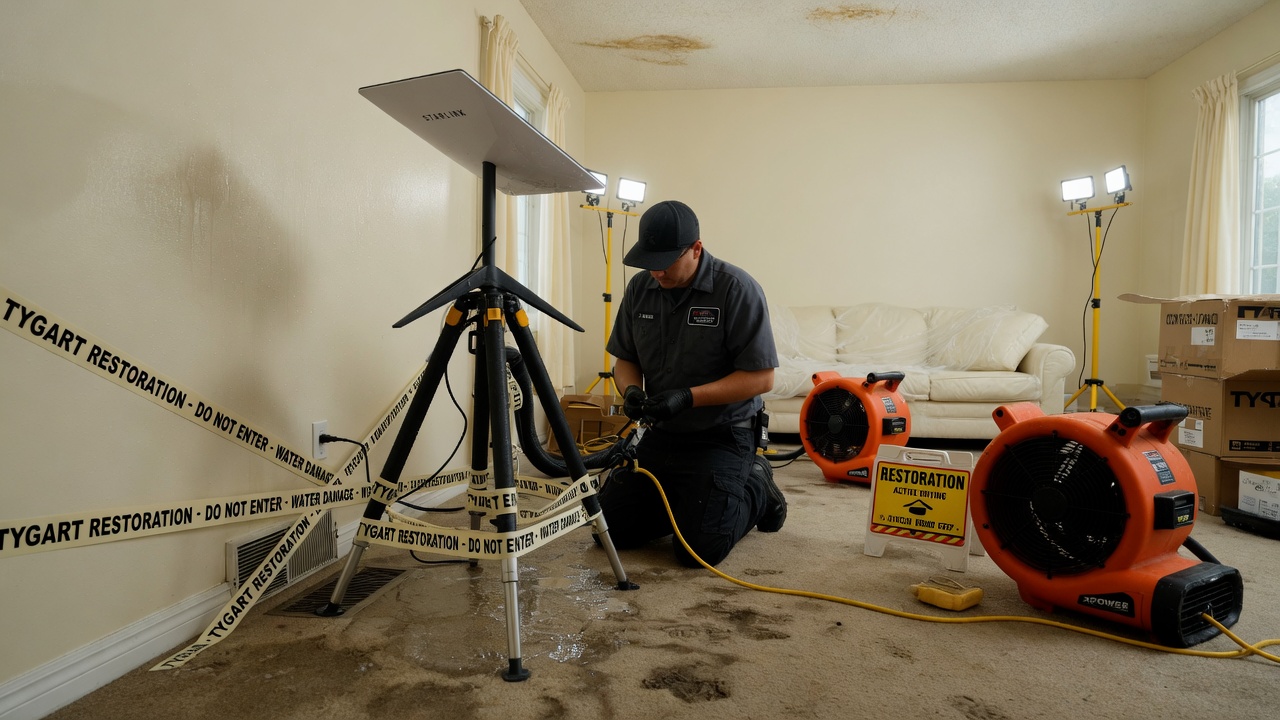
  • Starlink on a water job — open field playbook

    Starlink on a water job — open field playbook

    Open field playbook. No patent. Copy it, rename it, change the nouns to fire / mold / rebuild. If it makes you money, good. If it puts another dish on a wet roof, also good.

    License: do what you want. Attribution nice, not required. Tygart Media is not a Starlink, SpaceX, Tesla, or xAI partner. Links below go straight to them. No tracking parameters. No referral codes.

    Why this exists: restoration work happens where fiber is dead, the house is a Faraday cage of wet drywall, and the phone that “has bars” cannot upload a moisture map. Starlink is a sky-view pipe. More honest job-site pipes → more honest traffic on the constellation → more reason to fly birds. The selfish clause is allowed: a 4G phone in the sticks should still talk to a voice agent when the street is dark.

    Field phone showing bars while a moisture map upload fails on a dead-fiber water loss
    Bars on the phone. Upload still dead. That is the job the dish is for.

    Buy and read from the source. Prices move. The impedance rule does not.

    Official doors (clean)

    Starlink (buy / plans / help)

    SpaceX

    Tesla / xAI (voice rides the pipe; they are not the dish)

    1. Impedance — when this kit matches the job

    Use Starlink when two of these are true:

    • The structure or the street has no working cable/fiber (storm, rural, construction, “the pole is in the river”).
    • You need to upload, not just talk: photos, video walkthrough, Xactimate sketch, moisture log, signed work auth.
    • You will be on site more than an hour and cell is congested or roaming into a dead pocket.
    • The office needs a second path so after-hours voice and dispatch do not die with the cable modem.

    Do not use it as:

    • A replacement for a good office fiber drop.
    • A phone. Voice agents still ride the pipe; the dish is not Jarvis.
    • A “we have Starlink” line on the website. Homeowners hire the truck that showed up.

    Cell first if it works. Starlink is the sink when cell is the bottleneck.

    2. Two kits (steal one)

    Kit A — truck / first-on-site (most shops)

    • Starlink Mini on a Roam plan or, if this is actually a business WAN, start at Business and read the current hardware list. Mini is the backpack dish. In-motion rules live here. The home V5 kit is not the roam toy.
    • Power: Mini wants a USB-PD source rated 65–100 W even though it only drinks ~25–40 W. A 45 W phone brick will lie to you. Truck: 12 V → 30 V / Anderson, or a 500 Wh class station.
    • Plan: numbers on starlink.com move. Roam is written for travel. If the kit is production, read Business vs Enterprise. Mini often does not sit on the Priority SLA. Do not tell a carrier you have enterprise uptime because you paid a business invoice for a Mini.
    • One cheap travel router if Mini Wi-Fi dies inside a metal trailer.
    Starlink Mini powered from a truck USB-PD brick rated 65 to 100 watts before entering a wet house
    Power before the meter. 65–100 W brick. Phone chargers lie.

    Kit B — shop / yard / long dry-down

    • Performance / Priority on Business if you need an SLA and a fixed roof.
    • Permanent mount, open sky, snow-melt if you live where it snows.
    • This is backup for the office phone and the photo server. Not the hero kit on day one of a flood.

    3. First 30 minutes on a wet house

    Flooded residential living room with standing water on hardwood after a water loss
    First 30 minutes on a wet house with Starlink up.
    1. Park where the sky is a rectangle, not a slot between two alders. Confirm in the Starlink app.
    2. Dish on the hood, a pole, or the unshaded side of the trailer — not the basement, not under the soffit.
    3. Power before you walk in with the meter. Boot is a couple of minutes.
    4. One speed check. If download is fine and upload is garbage, you will feel it on Xactimate. Rain cuts throughput; talk first, fat files later.
    5. Name the network something boring (SHOP-JOB).

    If the app says obstructed, move the dish. Do not “optimize” for twenty minutes.

    4. What actually eats the pipe

    Gloved hands using a pin-type moisture meter on wet drywall during inspection
    What actually eats the pipe on a water job.
    ThingRough appetiteRule
    Moisture photos, 50–150 shotssmallFine on a small Roam month
    Adjuster video walk, 10 minmediumOnce, compressed
    Xactimate / cloud estimatesmall–mediumSite needs the upload
    Voice agentsmall per minuteCheap; retries are not
    Netflix in the trailerthe villainAfter the job or not at all
    Group video, four peopleburns a small capOne camera

    Voice is why the pipe matters at 11 p.m. Keep the agent short. Book or kill.

    5. Who pays

    Pick one. Write it in the SOP.

    • Job cost — storm / rural / no street internet. Line it like a generator.
    • Shop overhead — office backup + after-hours voice.
    • Never the tech’s personal weekend.

    Standby the truck kit when it is not a weather week. Idle is cheaper than a second hardware buy because someone borrowed it.

    6. Dispatch and voice

    White restoration work van with ladder rack parked at a suburban jobsite curb
    Dispatch and voice when the site is remote.

    The dish is layer 0. The voice agent is layer 1.

    On a dead-fiber job: photos go up the pipe; the after-hours line stays reachable; the agent writes a new row (address, standing water y/n, next action). It does not edit your website.

    If you already have a process, add one rule: when cell upload fails, kit A comes off the hook.

    7. Failure modes

    Trees and eaves. Rain. 45 W bricks. Consumer Roam sold as production WAN. Twelve intake fields before anyone asks “can we come now?”

    8. The sentence that pays the shop

    “If the street internet is out we still upload your photos and get the adjuster pack off the truck tonight.”

    Only say it if the kit is in the truck.

    This document stays free. Charge for the hour you spend teaching another shop the first 30 minutes if you want. Do not charge Starlink. They already sold you the dish.

    9. What this is not asking

    No meeting. No partnership badge. No official anything.

    Redmond already knows how to stamp birds. The ground should not be a graveyard of unused kits. Order here. Then put the dish where the sky is.

    Related field notes: The leftover pile · Cursor checks on Grok Desktop mid-job

    Related on Tygart Media: The leftover pile · Cursor checks on Grok Desktop mid-job.

  • RAG Optimization: Creating Source-Worthy Content for AI

    RAG Optimization: Creating Source-Worthy Content for AI

    The Search Landscape of May 2026: Stop Chasing Traffic, Start Chasing Citations

    The transition is complete. As of this month, Google’s AI Overviews (formerly SGE) appear for over 52% of all search queries. If you are looking at your Search Console and seeing a 30% drop in informational traffic compared to last year, you aren’t alone. You’re simply seeing the result of the “Zero-Click” era reaching its final form. For digital agency owners and systems architects, the old SEO playbook is a liability. If you are still optimizing for clicks on “What is…” or “How to…” keywords, you are effectively donating your intellectual property to train a model that will replace your visit.

    The currency of search has shifted. We have moved from the era of link equity to the era of Source-Worthy Content. In this new reality, the goal isn’t to get the user to click through to read a basic definition; it is to ensure that your data, your unique perspective, or your proprietary methodology is the primary source cited by the Retrieval-Augmented Generation (RAG) systems powering Google, Perplexity, and OpenAI.

    The Numbers Don’t Lie: The Death of the Click

    By mid-2026, the data across our portfolio is clear. Informational query traffic—the top-of-funnel “educational” content that used to drive massive awareness—has cratered by 20-40% across most B2B and technical sectors. Users are getting their answers directly in the search interface. They don’t need to visit your site to learn “how to configure a headless CMS” if Gemini can pull the five essential steps from your documentation and present them in a neat bulleted list.

    However, while traffic is down, the value of a single citation within an AI Overview has skyrocketed. We’ve found that being the primary citation in a RAG-driven answer drives higher-intent leads than the old-school organic #1 spot ever did. The users who do click through from an AI Overview have already been pre-qualified by the AI. They aren’t looking for a definition; they are looking for the operator who provided the insight. Optimizing for AI overviews is no longer a side project; it is the core of technical SEO.

    Understanding RAG: How Google Picks Its Sources

    To win in 2026, you have to understand the mechanics of Retrieval-Augmented Generation. Google’s AI isn’t just “hallucinating” answers based on its training data; it is actively searching the live web, retrieving specific “chunks” of information, and then synthesizing those chunks into a response. This is RAG optimization.

    When an AI Overview is generated, Google’s system follows a three-step process:

    1. Retrieval: It identifies the top-ranking traditional search results for the query. (This is why maintaining traditional page-one rankings is still a prerequisite for being a source).
    2. Selection: It selects specific paragraphs, data tables, or unique insights from those top results that best satisfy the user’s intent.
    3. Generation: It rewrites those insights into a cohesive answer, adding citations to the sources it used.

    If your content is generic—if it says exactly what every other site says—the AI will synthesize the answer without citing you specifically, or it will cite a larger authority (like Wikipedia or a massive news outlet) that says the same thing. To be cited, your content must be source-worthy. It must provide something the AI cannot find elsewhere or synthesize from common knowledge.

    Why Generic Content is Erased by AI

    The era of “skyscraper” content—taking ten existing articles and making a longer one—is over. AI is better at that than you are. In fact, most of that generic content is now being flagged by LLMs as “low information gain.”

    When we audit a site using the Gemini CLI, we look for “Information Gain” scores. If a paragraph doesn’t offer a new data point, a specific case study result, or a unique operator’s perspective, it’s invisible to the RAG process. Generic advice like “SEO requires good keywords” is discarded. Specific advice like “We saw a 12% lift in RAG citations by moving from 1,000-word articles to 400-word modular content blocks” is source-worthy.

    The LLM wants to cite the originator. If you are just a curator, you are a middleman that the AI has successfully bypassed.

    The ‘Source-Worthy’ SEO Framework

    At Tygart Media, we’ve pivoted our Agency Playbook to focus on four pillars of source-worthy SEO. This is how we ensure our clients remain the “source of truth” in an AI-dominated search engine.

    1. Proprietary Data and “Proof of Work”

    The AI cannot hallucinate your internal data (yet). Original surveys, technical benchmarks, and project post-mortems are the most cited pieces of content in 2026. If you run a test on a new deployment pipeline and publish the raw numbers, Google’s AI Overview will cite your specific numbers. We’ve moved away from “opinion pieces” and toward “experiment logs.” Every article should contain at least one table or chart of data that didn’t exist on the internet before you published it.

    2. The Operator’s Perspective (E-E-A-T)

    Experience and Expertise are now the primary filters for RAG selection. Google is prioritizing content that shows “Proof of Effort.” Use first-person accounts. Instead of writing “How to use Claude Code,” write “What we learned after 500 hours using Claude Code to refactor a legacy Python monolith.” The specific failures and technical hurdles you describe are unique identifiers that the AI recognizes as authoritative.

    3. Modular Content Architecture

    Long-form, sprawling articles are difficult for RAG systems to “chunk” effectively. We are now building content in modular blocks. Each section of an article is designed to stand alone as a complete answer to a sub-query. We use <section> tags and specific ID attributes to make it easy for the crawler to identify and retrieve the exact block it needs. This is optimizing for AI overviews by making your content “consumable” for machines, not just humans.

    4. Structured Data for RAG

    Schema.org hasn’t gone away; it has become the metadata for AI. We use Dataset, HowTo, and Review schema more aggressively than ever. But more importantly, we are using Gemini CLI to auto-generate JSON-LD that specifically maps out the “Claims” made in our articles. By explicitly stating “Our claim: Informational traffic is down 30%,” we make it easier for the AI to attribute that fact to us.

    Technical Execution: Modular E-E-A-T and Gemini CLI

    The workflow for a modern agency operator involves high-level automation. We don’t manually audit 500 pages for “source-worthiness.” We use tools like Claude Code and Gemini CLI to process our content libraries.

    Our current stack for RAG optimization looks like this:

    • Analysis: We pipe our top-performing URLs through a script that uses the Gemini API to compare our content against the current AI Overview for that keyword. The script identifies “content gaps”—information the AI is providing that isn’t on our page, or information we have that the AI is ignoring.
    • Refactoring: If a page is losing traffic but has high “Source Worthiness,” we use Claude Code to refactor the HTML into a more modular structure, adding Dataset schema to any tables.
    • Validation: we use Antigravity to simulate how a RAG system would “chunk” the page. If the chunks are incoherent, we rewrite the headers to be more explicit.

    One failure we saw early in 2026 was attempting to “game” the AI by over-optimizing for specific keywords. The AI sees through keyword density. It is looking for semantic weight. When we tried to force-feed keywords, our RAG citation rate dropped. When we focused on “operator-restrained” technical clarity, the citations returned.

    Case Study: The 40% Traffic Drop and the 15% Lead Increase

    We recently worked with a systems architecture firm that saw their organic traffic from “cloud migration tips” fall by 40% in the google sge impact may 2026 rollout. Initially, there was panic. However, upon closer inspection, their “Request a Consultation” conversions were actually up by 15%.

    What happened? Their generic “tips” were being swallowed by the AI Overview. But the AI Overview was citing their specific “Cloud Migration Cost Calculator” and their “2025 Migration Failure Report.” The traffic they lost was the “looky-loos” who just wanted a quick tip. The traffic they gained (via the AI citations) was from CTOs who saw their specific data cited as the authority and clicked through to hire them. This is the shift from “volume” to “value.”

    Action Plan: What You’d Do Tomorrow

    If you are managing a content library or an agency portfolio, don’t wait for your traffic to hit zero. Start the pivot to source-worthy SEO immediately. Here is the operator’s checklist for tomorrow morning:

    1. Audit for “What is” Content: Use your preferred crawler to identify every page that targets a purely informational, definitional keyword. These are your “donor” pages. Decide whether to delete them, consolidate them, or upgrade them with proprietary data.
    2. Inject Original Data: Find three pieces of internal data—even if they are small—and add them to your top 10 most important pages. Use tables. Add a “Methodology” section.
    3. Modularize Your Headers: Ensure every H3 in your articles can stand alone as a question and every following paragraph as a direct, concise answer. Remove the “fluff” and the “introductory transitions.” The AI doesn’t need a “In this section, we will explore…” lead-in. It needs the facts.
    4. Verify Citations: Perform a manual search for your primary keywords. Look at the AI Overview. If you are ranking #1-3 in organic but aren’t cited in the AI response, your content isn’t “Source-Worthy.” It’s too generic. Rewrite the top-ranking paragraph to offer a unique, data-backed perspective that the AI is currently missing.
    5. Update Your Schema: Move beyond basic Article schema. Implement Speakable, Dataset, and ClaimReview schema where applicable. Use a tool like Gemini CLI to automate the generation of these blocks based on your existing text.

    SEO isn’t dead; the middleman is dead. The search engine of 2026 doesn’t want to send users to a website; it wants to provide an answer. Your job is to be the only source that the answer cannot exist without. Build for the machine, provide for the human, and protect your intellectual property by making it too specific to be ignored.

    Related on Tygart Media: chunk-first GEO · GEO tactics · how AI engines cite.

  • Accounting Advisory Practice: The Future of CPA Firms

    Accounting Advisory Practice: The Future of CPA Firms

    TurboTax did not kill the accountant. Neither did QuickBooks, H&R Block’s software, or the dozens of automated tax-prep and bookkeeping platforms that have absorbed the procedural floor of accounting work over the last two decades. What they killed was a specific kind of accountant — the one whose business was preparing returns and reconciling books and nothing else. The CPAs and bookkeepers thriving in 2026 are not selling tax returns or bookkeeping work. They are selling something the platforms structurally cannot deliver: a multi-decade trusted advisor relationship that integrates tax, strategy, financial planning, and ongoing business consulting.

    This is the playbook for the accountant who recognizes the floor-and-ceiling shift. It is part of a broader pattern playing out across every service profession.

    What TurboTax and QuickBooks Actually Did

    The accounting software platforms commoditized the procedural floor of the profession in two waves. The first wave, starting in the early 2000s, was the consumer tax software taking over simple personal returns. TurboTax made the W-2 return a fifteen-minute exercise that anyone could complete without an accountant. The accountants whose business depended on simple personal returns got squeezed.

    The second wave was the small business software taking over routine bookkeeping. QuickBooks, Xero, and the broader small business accounting stack absorbed the day-to-day reconciliation work that used to require bookkeepers and lower-level accounting staff. Combined with bank feeds, automatic categorization, and AI-assisted reconciliation, the bookkeeping floor became cheap enough that any small business could handle most of it internally.

    AI is now adding a third wave on top of these. Document processing, tax research, basic tax return preparation, financial analysis, and advisory drafting are all being absorbed by AI tools that accounting firms are deploying internally. The procedural floor is being compressed yet again.

    The narrative through all of this has been that accounting was being commoditized to death. The narrative was wrong. The accountants whose value was the procedural work got compressed. The accountants who built advisory practices — the trusted advisors, the strategic counselors, the business consultants who happened to do taxes too — became more valuable than ever.

    What the Ceiling Actually Is in Accounting

    The ceiling work in accounting is the trusted advisor relationship, and it operates at a completely different level from tax preparation or bookkeeping.

    The trusted advisor accountant is not preparing the return. They may oversee the preparation, but the actual return preparation is increasingly automated or handled by junior staff with AI assistance. What the advisor is doing is something different. They are the first call when the client is considering whether to take an offer for their business. They are the first call when the client’s parent dies and the estate is complicated. They are the first call when the client is considering a major equipment purchase that will affect cash flow and tax position. They are the first call when the client’s child wants to start a business and needs structural advice.

    The relationship is multi-decade. The accountant knows the client’s business intimately, the client’s family structure, the client’s goals, the client’s risk tolerance, and the client’s history. The annual tax return is the artifact of the relationship, not the product. What the client is buying is the ongoing access to a trusted financial mind that understands their specific situation and is engaged with their decisions on a continuous basis.

    This work cannot be done by software. It cannot be done by AI. It can only be done by a human who has spent years developing genuine knowledge of the specific client’s specific situation, in a profession that requires technical depth and judgment-based integration across tax, finance, business, and personal life domains.

    The Practice Structures That Win

    The accounting firms that have successfully shifted to the advisory model share several specific characteristics.

    They specialize in a defined client segment. Not “small business” in the abstract. A specific kind of small business — restaurants, dental practices, manufacturing companies, professional service firms, real estate investors. The specialization allows the advisor to develop genuine depth in the specific tax, financial, and strategic issues that segment faces. The advisor becomes the recognized expert for that segment in their region, which generates referrals at a rate generalist firms cannot match.

    They sell engagement structures, not transactions. The traditional model bills tax preparation as a discrete annual transaction. The advisory model bills an ongoing retainer that includes the tax work plus continuous advisory access. The client pays monthly or quarterly, knows what they are paying, and uses the access regularly. The economics for the firm are dramatically better because the revenue is predictable and the client utilization of the advisor’s time tends to be more efficient under retainer billing than under hourly billing.

    They build cross-domain integration capabilities. The trusted advisor accountant needs to engage credibly on tax strategy, business strategy, financial planning, estate considerations, and operational decisions. This requires either developing capabilities internally or building strong coordination relationships with the client’s other professionals — financial advisors, attorneys, insurance agents, bankers. The firms that win are the ones whose accountants can credibly coordinate across these domains.

    They use AI and platform tools aggressively for the procedural floor. Tax preparation, document handling, basic research, financial analysis, routine reporting — all increasingly automated. The firms that try to protect this work from automation lose. The firms that automate it and reinvest the time in advisory relationships win.

    They develop their senior staff into advisors deliberately. The traditional accounting career path produced technical specialists. The advisory path requires different skills — relationship management, business strategy, integrative judgment, client communication, comfort with ambiguity. The firms that develop these capabilities deliberately produce advisors. The firms that keep training pure technicians keep producing tax preparers who will be commoditized.

    How a Solo or Small Firm Builds the Advisory Practice

    The transition to advisory work is achievable for solo practitioners and small firms, not just the large national firms. The playbook is more focused but the moves are the same.

    Pick a specific client niche you can serve at advisor depth. Five to ten distinct client types is too many. One or two well-defined niches is right for a solo or small firm. The narrowness is the moat. The advisor who deeply understands the financial life of dental practices in a region will outperform the generalist accountant serving every kind of business.

    Develop the technical depth required for the niche. Not just tax. Tax plus business strategy plus financial planning plus operational issues specific to the niche. Read the trade publications. Attend the conferences. Become genuinely expert in the niche, not just credentialed.

    Build the relationships with the other professionals serving the niche. The attorneys, the financial advisors, the insurance agents, the bankers, the business brokers who specialize in that segment. Your value to clients includes the ability to refer them to other professionals who understand their world. The relationships are the network.

    Convert clients from transactional to retainer engagements deliberately. Most clients in transactional relationships will accept a conversion to retainer billing if the advisor presents the value clearly. The conversion is the moment the business model shifts. Once the retainer is established, the relationship deepens because the client uses the access.

    Use AI and software for the procedural work. Automate everything that can be automated. Spend the time on the advisory work that defines the practice.

    Frequently Asked Questions

    Will TurboTax and QuickBooks replace accountants?

    No. The platforms have commoditized the procedural floor of accounting — simple tax preparation and routine bookkeeping — but cannot replicate the trusted advisor relationship that integrates tax, strategy, financial planning, and business consulting. The accountants whose value was procedural work have been compressed. The accountants who built advisory practices thrive.

    What is a trusted advisor accounting practice?

    It is the practice model where the accountant serves clients on an ongoing retainer basis rather than as discrete annual transactions. The client pays for continuous access to the accountant’s judgment across tax, business, financial, and strategic decisions. The annual tax return is the artifact of the relationship, not the product.

    How do accountants compete with platforms like TurboTax and QuickBooks?

    Not on price or convenience for simple returns and routine bookkeeping. The platforms will always win on those. Accountants win by delivering integrated advisory work — strategic counsel, business consulting, multi-domain coordination, ongoing judgment — that the platforms structurally cannot do.

    What kinds of clients want a trusted advisor accountant?

    Business owners with complex financial lives, high-income professionals coordinating multiple financial decisions, families with significant assets or businesses, and any client whose financial situation involves ongoing decision points where strategic judgment matters. The pool is large and growing as platforms commoditize the simple-return market.

    How does an accounting firm transition from transactional to advisory?

    Pick a specific client niche. Develop genuine depth in that niche. Build coordination relationships with other professionals serving the same niche. Convert existing clients from transactional to retainer engagements deliberately. Use AI and software for the procedural work. Develop staff into advisors rather than pure technicians.

    How long does it take to build an advisory accounting practice?

    Two to three years to establish the niche specialization and the coordination relationships, with significant compounding after year five as the niche reputation generates referrals at a rate that generalist firms cannot match.

    The Bottom Line

    TurboTax and QuickBooks killed the transactional accountant. They did not kill the trusted advisor. The future of accounting is the multi-decade trusted relationship that integrates tax, strategy, financial planning, and business consulting for a specific client niche. The tax return is the artifact. The relationship is the product. This is the floor-and-ceiling pattern that defines the future of every service profession. Build the niche specialization. Build the retainer model. Build the cross-domain capabilities. Become the human advisor the platforms cannot be.


  • Future of Financial Advisors: Comprehensive Life Planning

    Future of Financial Advisors: Comprehensive Life Planning

    The robo-advisors did not kill the financial advisor. Vanguard, Betterment, Wealthfront, Schwab’s robo offering, and the dozen other algorithmic portfolio managers commoditized the procedural floor of investment management — asset allocation, rebalancing, tax-loss harvesting, basic portfolio construction. They made those services free or near-free for any consumer with a phone. They did not touch the ceiling of financial advisory, which is something completely different from portfolio management. The advisors who built that ceiling are thriving at levels they never reached when investment management was the product.

    This is the playbook for the financial advisor who recognizes the floor-and-ceiling shift. It is part of a broader pattern playing out across every service profession that depends on a mix of procedural and relational work.

    What the Robo-Advisors Actually Did

    The robo-advisors collapsed the cost of portfolio construction and basic asset management to near zero. The math underneath modern portfolio theory was never proprietary. The work of allocating across index funds, rebalancing on a schedule, and harvesting tax losses is genuinely amenable to algorithmic delivery. Once the platforms reached scale, the floor pricing for these services dropped to a fraction of what traditional advisors charged.

    The advisors whose entire value was investment management got compressed. The 1% AUM fee for portfolio management without anything else attached became increasingly hard to defend when the same service was available for 0.25% from a robo or close to free from a brokerage platform. The narrative was that the robo-advisors were going to eliminate the human advisor entirely.

    They did not. The advisors whose value had always been more than investment management — the comprehensive planners, the trusted advisors, the financial life coordinators — got more valuable. The robo handled the floor. The ceiling — the integrated multi-decade planning that touches every part of a client’s financial life — became the entire offering. The advisors who built the ceiling business have larger practices, higher per-client revenue, and stronger career stability than the AUM-only advisors of the prior era ever had.

    What the Ceiling Actually Is in Financial Advisory

    The ceiling work in financial advisory is comprehensive life planning, and it is structurally different from investment management in ways that matter for the business model.

    Investment management is about the portfolio. Comprehensive life planning is about the whole financial life. It includes investment management, but the investment management is one component of a much larger offering. The full scope of comprehensive planning includes retirement planning across multiple time horizons, tax strategy coordinated with the client’s accountant, estate planning coordinated with the client’s attorney, insurance review and coordination, education funding strategies, charitable giving structure, business succession planning if applicable, and behavioral coaching during market stress.

    The advisor running a comprehensive practice is not picking stocks. They are integrating decisions across every financial domain in the client’s life over decades. They are the central coordination point for the client’s relationship with their accountant, their attorney, their insurance agent, their banker, their business advisors. They are the person the client calls when something significant changes — a death in the family, a business offer, a divorce, an inheritance, a major health event. They are not selling investment management. They are selling a multi-decade trusted relationship that organizes the client’s entire financial life.

    This is the work that the robo-advisors cannot do, will not do for the foreseeable future, and structurally cannot replicate even when AI gets meaningfully more capable. The integration across domains, the trust built over years, the knowledge of the specific family’s specific situation — none of it lives in algorithms. It lives in the advisor.

    The Behavioral Coaching Layer Is Where the Real Value Lives

    One specific aspect of comprehensive planning deserves its own discussion because it is the part most often missed in conversations about advisor value. The behavioral coaching layer — the work the advisor does to keep clients from making catastrophic decisions during emotional moments — is, by most rigorous measures, the single highest-value contribution an advisor makes over the course of a client relationship.

    When the market is down 40 percent and the client wants to sell everything and go to cash, the advisor’s voice is what prevents the decision that would destroy the client’s retirement. When the client inherits a significant sum and wants to put it all in their cousin’s startup, the advisor’s voice is what slows the decision down. When the client is going through a divorce and wants to make immediate financial changes that will be hard to reverse, the advisor’s voice is what keeps the financial impact of the divorce manageable.

    None of this work is investment management. All of it is comprehensive advisory work. It cannot be done by an algorithm, because the algorithm does not have a relationship with the client and the client does not call the algorithm when they are emotionally distressed. The robo-advisors that have tried to add behavioral nudges to their interfaces have produced exactly nothing of value in this domain, because behavioral coaching is fundamentally about a human relationship that the client trusts under pressure.

    The advisors who deliver real behavioral coaching are the advisors whose practices are the most resistant to robo-advisor compression. Their clients do not leave for lower fees, because the value they receive at the moments that matter is not visible in normal-market conditions and is irreplaceable when conditions are not normal.

    How to Build the Comprehensive Practice

    The advisors who have built genuine comprehensive practices follow a specific playbook.

    Choose a specific client segment to serve deeply. Not “anyone with assets to invest.” A specific life-stage, profession, family structure, or business type that you can become the trusted advisor for. The narrowness is what allows the advisor to develop genuine expertise in the planning challenges of that segment and build the referral network that serves them.

    Build the coordination network across domains. Your clients have accountants, attorneys, insurance agents, bankers. Your job is to coordinate with those professionals and serve as the central integrator of the client’s financial life. The coordination work is invisible to the client most of the time and is exactly what makes the comprehensive offering work.

    Develop genuine planning depth in tax, estate, insurance, and business areas. You do not need to be the deepest expert in each of these. You need to be deep enough to recognize the issues, ask the right questions, and bring in the appropriate specialist when needed. The advisor who is purely an investment manager and refers everything else out is not running a comprehensive practice. The advisor who can credibly engage on tax strategy, estate structure, insurance adequacy, and business succession is.

    Build the behavioral coaching practice deliberately. Document your communication protocols during market stress. Have a defined approach to client outreach during volatility. Be the calm voice the client expects to hear. The advisors who let clients drift away during difficult markets lose them. The advisors who proactively engage during volatility keep them for life.

    Use AI and platform tools for the procedural floor. Portfolio management, performance reporting, routine compliance, basic financial planning calculations — automate or platform-mediate all of it. Spend the time saved on the relational and integrative work that defines the comprehensive practice.

    Price for the relationship, not the assets. The AUM model that worked for the investment management era is becoming increasingly mismatched with the comprehensive planning offering. Flat-fee planning retainers, hourly advisory billing, or hybrid arrangements often better reflect the value delivered and align the economics with what the client is actually paying for.

    Frequently Asked Questions

    Will robo-advisors replace human financial advisors?

    No. Robo-advisors have commoditized the procedural floor of investment management but cannot replicate the comprehensive life planning, multi-domain coordination, and behavioral coaching that defines the work of a true financial advisor. The advisors whose value was AUM-only have been compressed. The advisors who built comprehensive practices thrive.

    What is comprehensive financial planning?

    Comprehensive financial planning is the integration of investment management, retirement planning, tax strategy, estate planning, insurance coordination, education funding, charitable giving, business succession, and behavioral coaching into a single trusted relationship that organizes the client’s entire financial life over decades.

    What does behavioral coaching mean in financial advisory?

    Behavioral coaching is the work the advisor does to keep clients from making catastrophic decisions during emotional moments — selling at the market bottom, making rash decisions after an inheritance, restructuring finances impulsively during major life events. By most rigorous measures, it is the single highest-value contribution an advisor makes over the course of a client relationship.

    How do financial advisors compete with platforms like Vanguard and Betterment?

    Not on portfolio management fees. The platforms will always win on that. Advisors win by delivering integrated planning across multiple domains, behavioral coaching during volatility, and coordination with the client’s other professionals — all work the platforms structurally cannot do.

    What kinds of clients want a comprehensive financial advisor?

    Clients with complex financial lives — business owners, families with significant inheritances, high-income professionals coordinating multiple decisions, retirees managing multi-decade income strategies, families with multi-generational financial considerations. The pool is large and growing as algorithmic platforms commoditize the basic portfolio management layer.

    How long does it take to build a comprehensive financial advisory practice?

    Three to five years to establish strong domain depth and the cross-professional referral network, with significant compounding after the first market downturn when clients experience the behavioral coaching value and become the advisor’s most active referral sources.

    The Bottom Line

    The robo-advisors killed the AUM-only advisor. They did not kill the comprehensive planner. The future of financial advisory is the multi-decade trusted relationship that integrates every financial decision in a client’s life. The portfolio is the artifact. The relationship is the product. This is the floor-and-ceiling pattern that defines the future of every service profession. Build the comprehensive practice. Build the coordination network. Build the behavioral coaching capability. Become the human voice the client expects to hear during the worst market they will ever experience, and the robos will never reach you.