By Will Tygart · Published November 27, 2026 · First-Person Practitioner Essay
Direct Answer: Factories did not wait 30 years to wire unit-drive electric motors because owners lacked imagination; they waited until enclosed fuses, step-down transformers, and underwriter testing stopped buildings from burning down. Routing external AI through a dedicated seven-dollar Google Workspace airlock seat installs that exact breaker panel between AI and production.
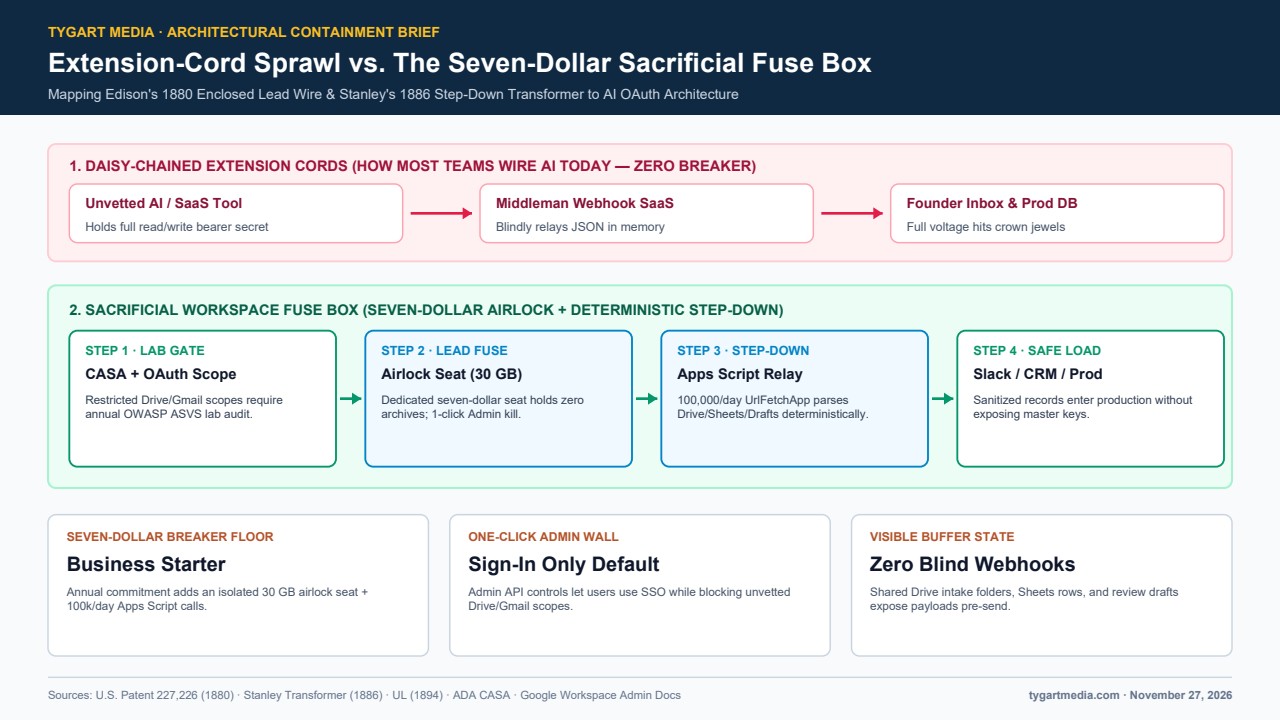
Most companies today wire AI and SaaS tools together like daisy-chained extension cords behind a holiday display. Slack holds an automation webhook, that platform holds a raw bearer key to a CRM, and an external AI agent reads the same folder where payroll and client contracts live. When one outside vendor suffers a token breach or an automated loop fires out of bounds, full line voltage shoots straight into production.
Across our own containment builds—from why physical containment beats prompt rules to our Bot Tinder email airlock—a simpler rule stands out for any business without a dedicated security desk: do not wire AI through another layer of middleware. Put a seven-dollar Google Workspace seat in the middle as a sacrificial fuse box.
The Half-Told Story of Electrification and the 1889 Wire Panic
Business columns repeat the same electrification parable: factories swapped one central steam engine for one electric dynamo, saw no productivity lift for thirty years, and finally broke out once engineers put unit-drive motors at every workbench. Almost nobody asks why putting small motors on every desk took three decades.
Owners did not lack imagination; unfused, un-stepped-down wires kept igniting walls and killing linemen. On October 11, 1889, crossed overhead lines electrified a low-voltage Western Union telegraph wire in Lower Manhattan, killing lineman John Feeks in front of lunch-hour crowds and forcing Mayor Hugh Grant to send axe crews into the streets.
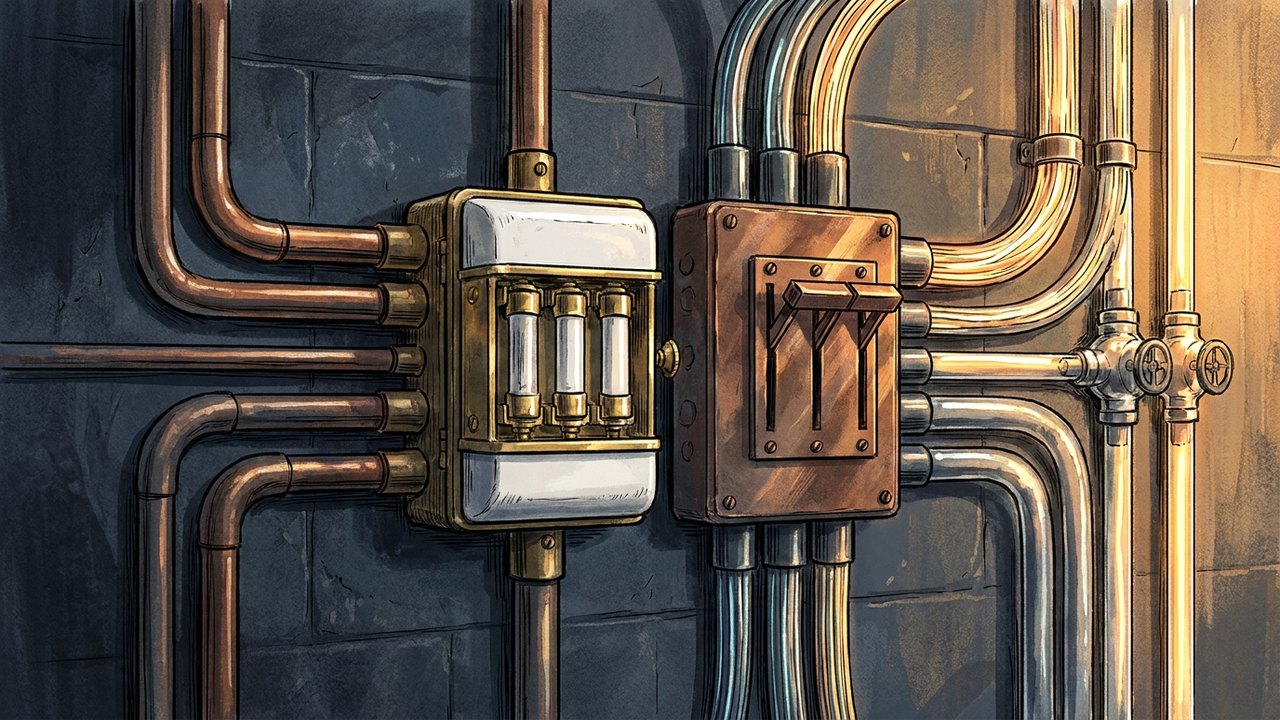
Indoor outlets required three concrete barriers—and each maps directly to AI wiring today. First, on May 4, 1880, Thomas Edison patented U.S. Patent 227,226 (Safety-Conductor): a soft lead wire inside an insulating shell engineered to melt first and contain sparks. Second, in March 1886, William Stanley Jr. and George Westinghouse stepped five-hundred-to-three-thousand-volt trunks down to one hundred volts in Great Barrington basements. Third, after 1893 Chicago World’s Fair fires, insurers funded William Henry Merrill Jr. to create Underwriters Laboratories in 1894 and the 1897 National Electrical Code.
For cyber brokers and risk teams translating that 1893 underwriter precedent into renewal underwriting language, see Risk Coverage Hub’s analysis of OAuth breaker panels in cyber insurance, which maps Google Workspace Admin API controls and App Defense Alliance CASA audits directly against 16 CFR 314.4(f) Safeguards Rule and NIST SP 800-207 checklists.
| Electrical Grid Milestone | Historical Failure Solved | Modern AI Equivalent | Seven-Dollar Workspace Fuse Control |
|---|---|---|---|
| Edison Safety-Conductor (May 4, 1880) | Overloads melted copper branch lines inside wooden walls | Over-permissioned API keys draining production systems | Dedicated airlock seat (30 GB ceiling, zero legacy archives) |
| Stanley Transformer (March 1886) | 500V–3,000V trunk lines could not enter shops safely | Probabilistic frontier model outputs hitting live CRMs | Drive drop-zones and Apps Script stepping payloads down cleanly |
| Manhattan Wire Panic (October 11, 1889) | Crossed overhead wires electrified telegraph poles | Compromised SaaS webhook or prompt injection jumping apps | Admin Console API controls blocking unvetted Drive/Gmail scopes |
| Merrill Lab & UL Stamp (1893–1894) | Insurers refused unvetted electrical gear at Chicago Fair | Fly-by-night AI wrappers lacking third-party security audits | App Defense Alliance CASA OWASP validation on restricted scopes |
Why Google Quietly Built the Universal Breaker Panel
At Google Workspace Business Starter (seven dollars per user per month annual, or eight dollars and forty cents flexible), most buyers see email and thirty gigabytes of storage. Look at the wiring architecture instead, and four safety gates stand out:
- 1. Mandatory Third-Party Lab Vetting (CASA): Under Google OAuth App Verification, external AI apps requesting restricted Gmail or Drive scopes must clear an annual App Defense Alliance CASA audit built on OWASP ASVS by an authorized lab. Random SaaS webhooks have zero mandatory audits.
- 2. Planetary Threat Revocation: Because Google monitors OAuth Client IDs across billions of seats, Google Threat Intelligence kills compromised Client IDs globally in one stroke.
- 3. Inspectable State Buffers: Instead of blind in-memory JSON relays, Shared Drive intake folders, Sheets queues, and draft-only mail—matching our agent handshake pattern—let humans and code inspect payloads before send.
- 4. Built-In Step-Down Without Per-Task Rent: Business Starter grants 100,000 daily UrlFetchApp calls and six trigger hours per day, whereas Microsoft restricts custom HTTP connectors behind Power Automate Premium.
The Three Places Teams Tape a Penny Into the Fuse Box
A breaker panel fails if you wire loads straight to the main meter lugs. Avoid the three shortcuts that defeat Workspace isolation:
2. Leaving Unconfigured Apps open: Default Workspace settings let staff authorize unvetted OAuth apps. Lock API controls to Sign-in only.
3. Mixing consumer accounts with company work: Keep operations inside your managed Workspace domain rather than free personal accounts.
| Integration Layer | Extension-Cord Wiring (Anti-Pattern) | Sacrificial Workspace Fuse Box | Primary Verification Anchor |
|---|---|---|---|
| User Seat Boundary | Founder inbox connected directly to unvetted AI tools | Isolated seven-dollar Business Starter seat (airlock@domain) | Google Workspace Pricing (Business Starter) |
| Default App Gate | Unconfigured OAuth apps allowed by default | Set Unconfigured Apps to Sign-in only in Admin Console | Google Workspace Admin API Controls |
| Storage & Mail Scope | Full Drive read/write and full Gmail send/delete tokens | Per-file drive.file and draft-only gmail.compose scopes | Google Drive & Gmail API Scope Guides |
| Downstream Relay | Opaque webhook SaaS or paid Power Automate connectors | 100,000/day UrlFetchApp triggers inspecting state before send | Apps Script Workspace Quotas & Microsoft Learn |
How to Wire Your Seven-Dollar Sacrificial Airlock on Monday Morning
This pairs directly with why Google stays factory boring and our February infrastructure receipts. Four steps put a real breaker panel between external AI and production in under thirty minutes:
- Provision an isolated Workspace seat: Give the airlock user its thirty-gigabyte ceiling and zero access to historical Shared Drives.
- Latch the Admin Console breaker: In Workspace Admin API controls, restrict Unconfigured third-party apps to Sign in with Google only so Drive/Gmail scopes require explicit admin allowlisting.
- Demand narrow scopes: Enforce per-file drive.file scopes and draft-only gmail.compose scopes.
- Step payloads down deterministically: Have external AI write only to the airlock Drive folder or Sheet, then run scheduled Apps Script triggers (or our AI setup engineering stack) to validate and push clean payloads downstream.
When an outside AI vendor breaks or loses a token on this setup, you block one OAuth Client ID in Admin Console, inspect the staged Sheet rows, and keep running without rotating a single internal database key. Give your AI tools a seven-dollar sacrificial fuse engineered to melt inside its shell before scaling automation across every desk.
If your team also needs the incident-response cutover sequence when a connected AI vendor must be severed without stalling internal queues, see Continuity Hub’s sacrificial OAuth blast-zone runbook for the Zone A vs. Zone B 60-second revocation tabletop aligned with NIST SP 800-34 and 800-161.
Frequently Asked Questions
Why did electrification take three decades to reach individual desk motors?
Replacing a steam shaft with one giant dynamo kept power in one motor room. Spreading electricity to every workbench required Stanley's 1886 step-down transformers, Edison's 1880 enclosed lead fuse, and the 1894 Underwriters Laboratories inspection code so branch circuits stopped igniting buildings.
Why buy a second seven-dollar Google Workspace seat instead of connecting AI to my main inbox?
Your primary seat holds years of client archives, billing threads, and password-reset links. A dedicated seven-dollar Business Starter airlock seat isolates external AI inside a 30 GB shell holding only the active intake folder, turning a bad token into a replaceable fuse.
How does Google force outside AI vendors into tighter security than random webhooks?
Any third-party app requesting restricted Gmail or Drive scopes to process data on external servers must pass annual CASA security validation built on OWASP ASVS through an authorized testing lab, while Workspace Admin API controls let you block unvetted apps with one toggle.
Why use Google Apps Script instead of Zapier or Microsoft Power Automate for the internal relay?
Workspace Business Starter includes 100,000 daily UrlFetchApp HTTP calls and six hours of trigger runtime without per-task webhook fees, whereas Microsoft reserves custom HTTP webhooks in Power Automate for higher-tier Premium licenses.
Primary Verification Sources
- U.S. Patent 227,226 — Edison Safety-Conductor for Electric Lights (1880)
- Edison Tech Center — History of the Transformer (1886 Great Barrington)
- UL Solutions — 1893 Chicago World's Fair & Underwriters Laboratories History
- NFPA — National Electrical Code (NFPA 70) Free Access Portal
- App Defense Alliance — CASA Cloud Application Security Assessment
- Google Cloud Help — OAuth App Verification & Restricted Scope Audits
- Google Workspace Admin Help — Control Third-Party App Access
- Google Developers — Apps Script Service Quotas (100,000/day URL Fetch)
- Google Drive API — Per-File drive.file vs. Restricted Scopes
- Microsoft Learn — Power Automate Licensing (Premium HTTP Connectors)
Leave a Reply