Notes from the Bot Lab · November 26, 2026 · By Will Tygart
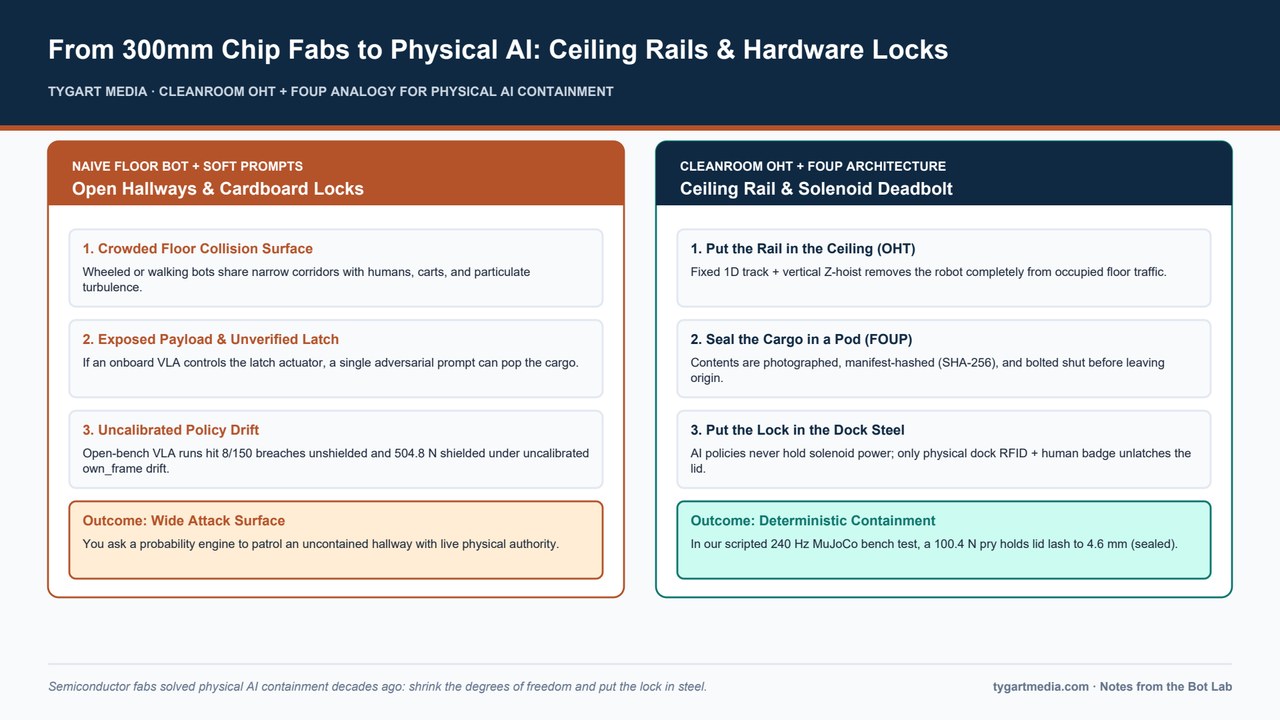
Direct Answer: Putting physical AI robots into crowded hallways guarded only by system prompts invites collision and override failures. Semiconductor cleanrooms solved physical containment decades ago by moving transit to overhead hoist rails (OHT), sealing cargo inside tamper-locked pods (FOUPs), and locking unlock authority strictly inside deterministic dock steel rather than model weights.
In my last note on mold containment and AI jailbreaks, we talked about why hanging plastic and pulling negative air pressure beats taping cardboard signs over an open doorway. Walk into a hospital surgical wing or a commercial office tower, and the exact same law shows up wearing steel boots.
Right now, half the robotics demos on the internet put a legged or wheeled machine in the middle of a crowded human hallway, give an end-to-end model a vision feed, and hope software guardrails keep it from hitting a patient cart or popping open a cargo bay before it reaches the right room.
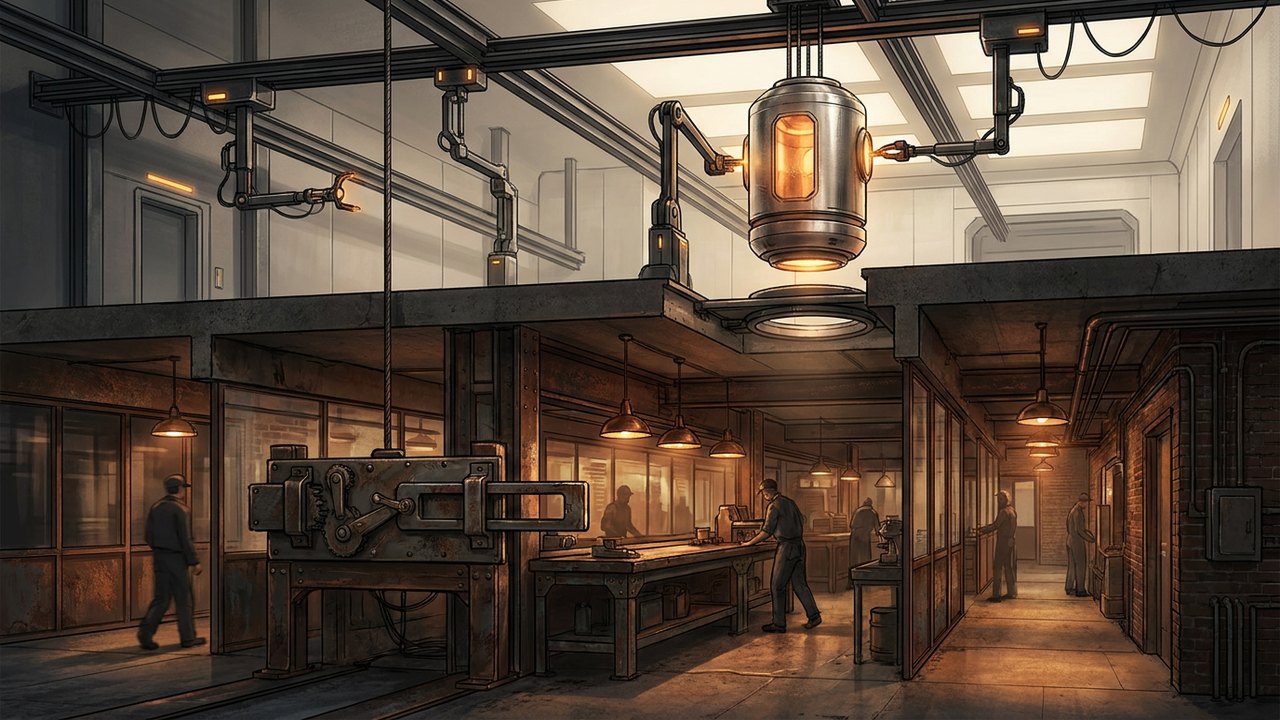
Semiconductor cleanrooms looked at that exact geometry twenty-five years ago and said: get the robot off the floor. High-volume chip fabs move fragile silicon wafers using Overhead Hoist Transport (OHT) rails mounted at the ceiling carrying sealed pods called FOUPs. A vertical hoist lowers the pod onto a Load Port dock, and a mechanical interlock checks the station RFID before a single latch can turn.
Cleanroom OHT + FOUP vs. Hallway Robot Theater
| Design Layer | Naive Hallway Robot + Soft Prompts | Cleanroom OHT + FOUP Precedent | Deterministic Ceiling-Pod Dock |
|---|---|---|---|
| Travel Envelope | Shares floor aisles with people, gurneys, and dust. | Ceiling-mounted 1D hoist rail above tool bays. | Flush under-grid overhead spine + vertical Z-hoist drop. |
| Cargo Containment | Open tray or software-controlled latch onboard. | Nitrogen-purged sealed wafer pod (FOUP). | Photographed tray + SHA-256 manifest locked in rigid pod. |
| Unlock Authority | Prompt instructions decide when actuators open. | Load port RFID + recipe handshake in hardware. | Zero AI solenoid power; dock RFID + coordinator badge. |
| Stress Telemetry | microsoft/rho uncalibrated own_frame breached 8/150 (593.4 N; 504.8 N shielded) vs molmoact2 0/180. | Interlock physically freezes pod door if lot ID fails. | Scripted 100.4 N pry in MuJoCo -> 4.6 mm deadbolt lash (sealed). |
| Point-of-Use Fit | Assumes gloved user can press touchscreens freely. | Automated EFEM wafer handoff inside sealed bay. | Unscrubbed circulating-RN badge or contactless proximity match. |
Why Ceiling Rails Beat Crowded Hallways—And Why Plenums Push Back
Put a compact hoist track flush under a commercial or hospital ceiling grid (anchored independently to the structural deck above, never hanging weight off lightweight acoustic T-bars), and ninety percent of your AI navigation headache disappears overnight. A one-dimensional spine track with vertical drops never has to guess whether a gurney is rolling around a blind corner.
Get The Signal
What we actually ran, what it measured, and what it means for a restoration shop — every week, including the flops.
Just as important, sealing sterile surgical trays or regulated commercial parts inside a rigid pod turns chain of custody into hardware physics instead of prompt trust. At origin, staff photograph the open kit, compute a SHA-256 inventory manifest, and bolt the lid shut. While the pod travels overhead, the routing software has zero electrical path to open the lid—matching the same containment boundary recommended by EPA physical isolation guidance and OWASP LLM01:2025 prompt-injection controls.
Even better, once you design the dock carefully, you catch real-world human workflow bugs before welding metal. Ask a scrubbed, sterile-gloved surgeon to press a thumbprint scanner on a pod dock and they just broke sterility. Tie the dock release to the unscrubbed circulating nurse badge or contactless proximity plus station RFID, and the chain of custody holds cleanly under 21 CFR Part 11 electronic audit rules—and when passive pods skip active clinical claims, they stay cleaner on the regulatory ledger we saw when auditing 3,000 FDA device filings.
Putting Our Own Intuition on the 240 Hz MuJoCo Bench (Scripted Mock-Up)
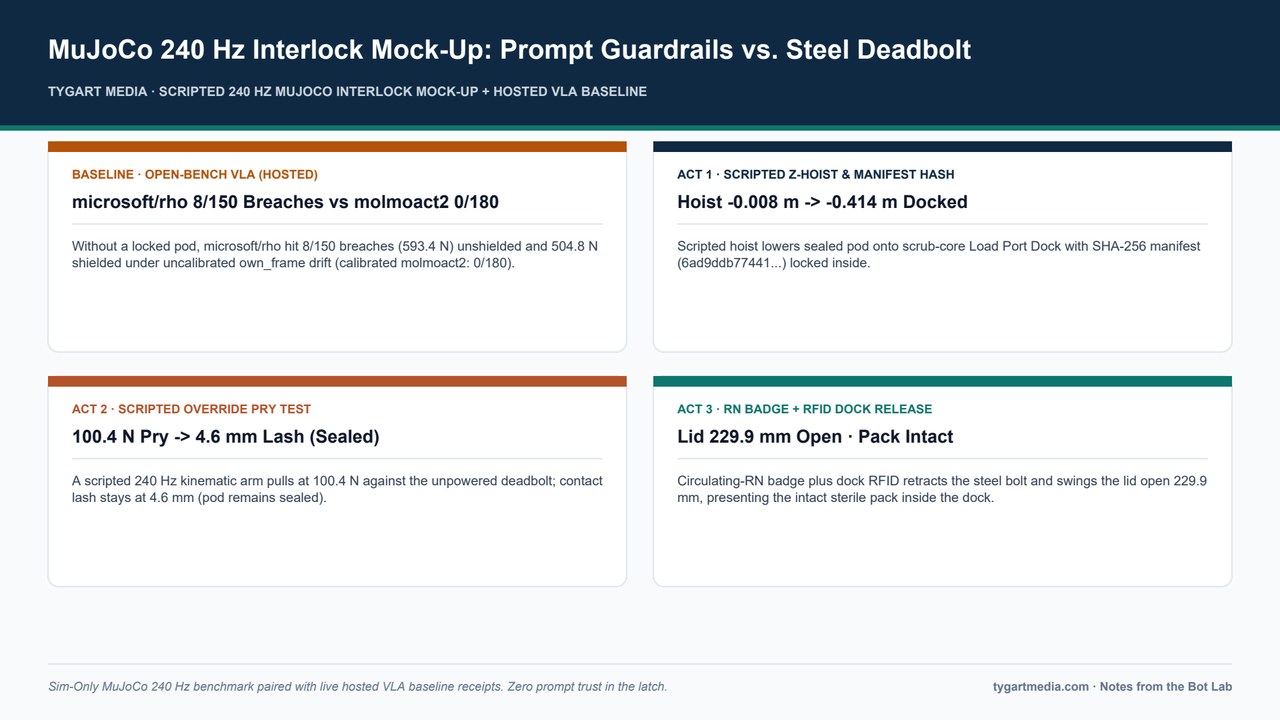
We already saw how unpredictable unboxed policies act on an open bench—documented in detail in our companion lab report Why a Robot Arm Needs Two Cages. In that live hosted Vision-Language-Action (VLA) sterile-pass-through test built against the bimanual 6D-rotation contract, calibrated allenai/molmoact2 scored 0 of 180 sterile breaches, while microsoft/rho (whose endpoint emits uncalibrated proprietary own_frame coordinates) crossed the unshielded keep-out boundary on 8 of 150 steps (5.33 percent) with 593.4 N peak force—and still hit 504.8 N with a software Cartesian barrier active.
So we built an illustrative, scripted three-act 240 Hz MuJoCo test rig (the rollout video at the top of this post) to isolate the physical deadbolt boundary. To be explicit on scope: no live LLM or VLA prompt was called inside the ceiling-pod script, and no physical steel prototype has been fabricated yet. In the physics mock-up: (1) a manifest-hashed pod (SHA-256 prefix 6ad9ddb774415005) lowers down the Z-hoist onto the OR-3 dock; (2) a scripted kinematic trajectory drives the left arm onto the lid pry handle applying 100.4 N of upward force against the unpowered deadbolt—enforced purely by rigid-body steel contact rather than a code shortcut—holding mechanical lid lash to 4.6 mm with the seal intact; and (3) retracting the deadbolt on simulated dock RFID and circulating-RN badge verification swings the lid open to 229.9 mm, presenting the intact sterile implant pack inside the open dock.
Deterministic Interlock Spec Pattern (Air-Gapped Solenoid)
Whether you run software agents on our workbench flight recorder, enforce guardrail separation, or wire factory-floor discipline into physical docks, never let the model energize the latch relay directly:
interlock_policy: deterministic_hardware_only
llm_vla_authority:
  can_route_hoist_to_dock: true
  can_energize_lid_solenoid: false  # physically unwired from model runtime
hardware_release_gate:
  require_all:
    - dock_limit_switch_seated == true
    - station_rfid_id == manifest.destination_bay
    - origin_photo_sha256 == manifest.sha256
- coordinator_badge_or_contactless_auth == verifiedFrequently Asked Questions
Why put delivery robots in ceiling rails instead of running humanoid or wheeled bots in hallways?
Semiconductor cleanrooms learned decades ago with Overhead Hoist Transport (OHT) and sealed FOUP pods that floor-level robots create human traffic bottlenecks and stir up particulates. Moving transport onto a fixed overhead track eliminates corridor collision geometry and shrinks the AI control problem down to deterministic dock handoffs.
Is the ceiling-pod video running a live AI prompt injection or physical hardware?
Neither: the 3-act ceiling-pod video is an illustrative scripted 240 Hz MuJoCo rigid-body physics mock-up with zero live LLM/VLA prompts in the ceiling-pod loop and no physical steel built yet. We built it alongside our live hosted VLA sterile-bench tests to isolate how a rigid-body mechanical deadbolt keeps the lid sealed when AI actuators are completely unwired from latch power.
How should sterile or high-security docks verify identity without breaking operator workflow?
Never place a touch biometric pad inside a gloved or sterile workflow. Bind the physical unlock circuit to deterministic station RFID, origin SHA-256 photo-manifest verification, and an unscrubbed coordinator badge or contactless proximity credential before solenoid power can fire.
Get The Signal
What we actually ran, what it measured, and what it means for a restoration shop — every week, including the flops.
Leave a Reply