
Nobody who has ever run a job site pays a finish carpenter cabinetmaker wages to haul four-by-eight sheets of drywall up basement stairs. Worse, ask a master trim guy to frame a rough utility closet and he will spend half the afternoon scribing crooked concrete with a brass block plane while the rest of the crew waits in the truck. You are paying top dollar for precision the wall cannot even hold.
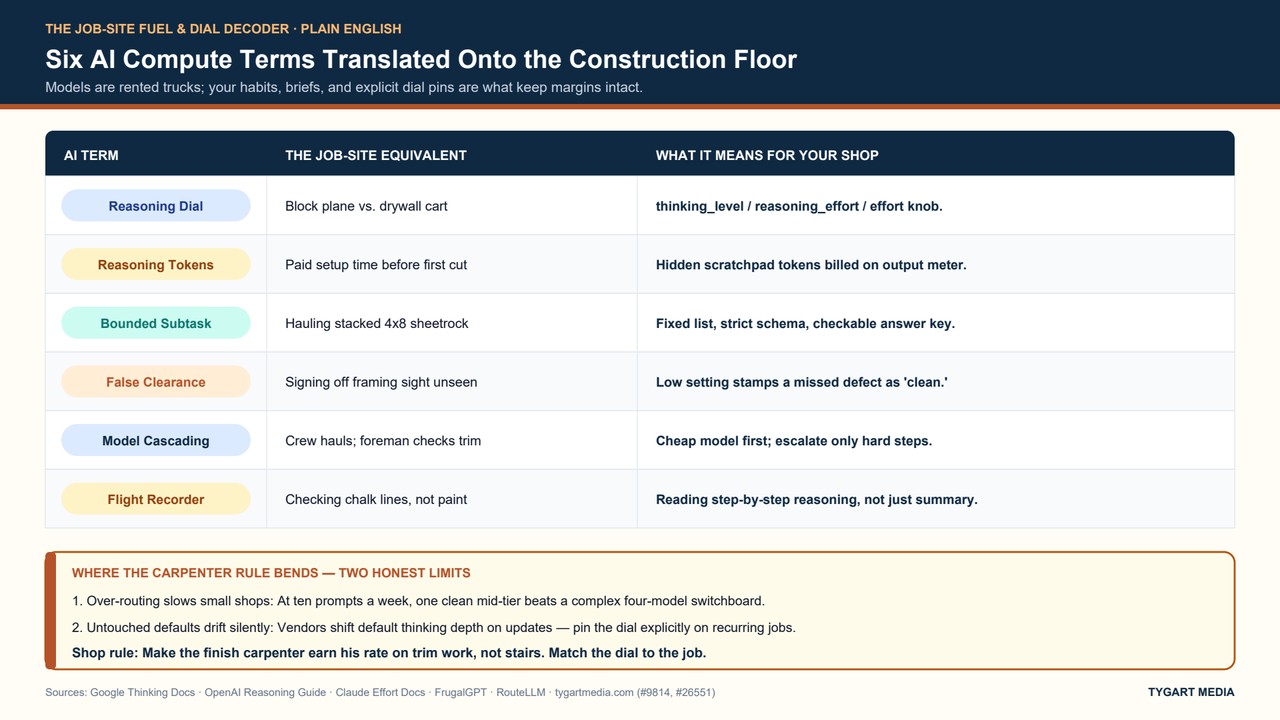
Businesses do the digital version of that every morning with AI. They pick the biggest subscription plan, turn the reasoning dial — the control knob that decides how long a model thinks privately to itself before answering — all the way up, and assume spending more buys better work. Every major platform now puts that knob on the dashboard, from Google’s thinking levels to OpenAI’s reasoning effort and Claude’s effort parameter. Those private scratchpad words — called reasoning tokens — usually run on the same paid meter as the final answer. Turning the dial up blindly does not make your shop smarter; half the time, it just pays a cabinetmaker to carry sheetrock.
Fifty-Two Calls — And Twice, Thinking Harder Broke the Answer
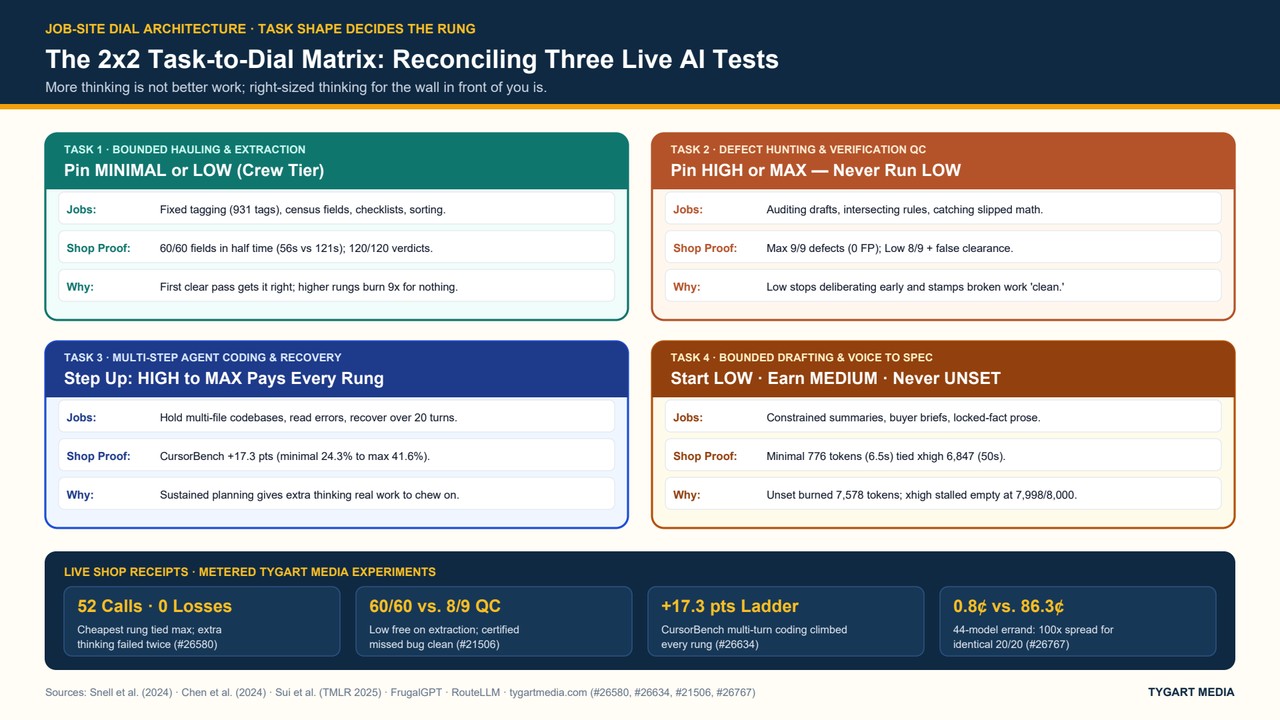
We stopped guessing about that knob and put a meter on it. In We Ran Muse Spark’s Reasoning Dial Through 52 Calls, we sent seven everyday operational jobs — contradiction checks, a vendor-brief judgment puzzle with six hard rules and five planted traps, pipeline scheduling, bug hunting, 120 claim verdicts, and constrained writing — across every rung from minimal to max, plus leaving the dial unset. Every answer was graded against a verified key. The cheapest setting never lost. Not once. On the vendor-brief test, minimal caught all five traps in 776 reasoning tokens and 6.5 seconds; xhigh burned 6,847 tokens and 50 seconds — nearly nine times the reasoning bill — for the exact same answer. Across 120 claim verdicts, low and xhigh both scored 120 out of 120.
Twice in those 52 calls, extra thinking was the failure itself. First, leaving the dial unset burned 7,578 reasoning tokens — more than any explicit rung — proving that an untouched default is often the expensive option wearing a disguise. Second, on a single-function debugging task, an xhigh run spent 7,998 of an 8,000-token cap talking to itself and returned an empty answer — it thought so long it never spoke — while minimal caught all three bugs in 500 tokens. Google’s own thinking documentation warns of that exact mechanic: hit a hard output cap mid-thought and you get truncated or empty text while still paying for every thinking token burned.
Researchers have a blunt name for this: the overthinking phenomenon. In Do NOT Think That Much for 2+3=? (2024), researchers showed reasoning models routinely burn piles of extra scratchpad compute on simple problems with almost zero accuracy gain — a pattern mapped across the whole field in the 2025 TMLR survey Stop Overthinking. On a bounded single-shot job with a checkable answer, the first clear pass does the real work; extra rungs mostly price your patience.
When Turning the Dial Down Bites Back (Both Numbers Are Real)
If the story ended there, the rule would be lazy: turn every dial to the floor and pocket the cash. That rule will burn you — and our own tests proved exactly where. In The Reasoning Dial, Tested (part of our GLM Limit Map battery), we ran three production jobs at both ends of the dial for 2.2 cents total. On a 15-page, 60-field extraction census, low matched max at 60 out of 60 in half the time (56 seconds versus 121). Pure savings. On a 9-defect quality-control hunt, however, max caught 9 of 9 with zero false alarms, while low caught 8 of 9 and stamped the missed defect clean. That failure shape is a false clearance: the model does not merely overlook a mistake; it signs off that the rule passed. On data verification, low spotted both planted errors, stopped deliberating, and still mis-added the corrected total (2,484 instead of 2,390). Reading the flight recorder — the saved step-by-step reasoning trail, not just the polished final summary — showed why: low checked one rule per item and stopped before cross-examining where two rules crossed.
Get The Signal
What we actually ran, what it measured, and what it means for a restoration shop — every week, including the flops.
A day after our 52-call test, a second counter-proof landed on our desk — reconciled in The Coding Ladder Says the Dial Pays. Our 52 Calls Said It Didn’t. Both Numbers Are Real. On CursorBench’s multi-step coding-agent benchmark for the exact same Muse Spark 1.3 model, turning the dial up paid at every single rung: minimal solved 24.3% of tasks, low 29.3%, medium 32.6%, high 33.4%, xhigh 37.5%, and max 41.6% — a 17.3-point climb, roughly 1.7 times the completion rate. Both results were true because the task shapes were different. UC Berkeley and Google DeepMind researchers proved the same rule in Scaling LLM Test-Time Compute Optimally (Snell et al., 2024): extra test-time thinking depends sharply on problem difficulty, and allocating it adaptively beats uniform spending by more than 4×. A single-shot extraction call is carrying drywall; recovering across twenty coding turns or hunting intersecting defects is fitting crown molding:
Foreman and Crew — Why You Have a Habits Problem, Not a Token Problem
The exact same rule governs which model tier you put on a job, not just where you set its knob. When we ran 1,000 legacy posts against a strict 931-tag list in The Foreman and Crew AI Architecture, the job was a classic bounded subtask — fixed vocabulary, rigid output format, zero creative guesswork. Routing that hauling to a fast crew tier produced zero invented tags while keeping our high-judgment foreman tier open for hard synthesis. Computer scientists call this model cascading or routing. Stanford’s FrugalGPT (2023) showed commercial AI fees span two orders of magnitude, and sending easy prompts to cheaper models while escalating hard ones can match top-model accuracy at up to 98% lower cost. UC Berkeley’s RouteLLM (ICLR 2025) confirmed dynamic routing cuts costs more than 2× without losing quality — even when you swap the underlying models later.
We saw that hundred-to-one price gap firsthand in You Don’t Have a Token Problem. You Have a Habits Problem. We sent one plain five-page, 20-field utility errand to 44 AI models — not to crown a favorite brand, since we do not rank vendors, but to measure waste. Thirty-six of 44 models scored a perfect 20 out of 20. The cheapest perfect run cost eight-tenths of a cent; the most expensive perfect run cost 86.3 cents — over a hundred times the price for the exact same score — and one 70-cent-plus run even missed a video sitting in plain sight because its page reader stripped embeds. Put regular gas in the errand car and save diesel for the load that actually pulls weight; take the slower cheap pump for overnight batches and pay the corner station when a job is on fire at 2 p.m.
Most teams never build that habit while free allowances feel bottomless. As I wrote in You Learn to Cook When You Have No Money, an empty pantry teaches you what every ingredient does; quota is not a wall, it is the workout. And as our 44-model shop test showed in The Operator Is the Harness, models are rented trucks whose prices shift on Tuesdays. Your real leverage sits in locking clear blanks up front (Mad Libs for Machine Learning), splitting context from tools (Two Droids and a Farmboy), and keeping hard caps on every connector (Leave the Keys Off the Van Seat).
Where the Carpenter Rule Bends — And Monday Morning
Two honest limits keep this rule from becoming a religion. First, over-routing slows small shops. If your team runs ten prompts a week, building a four-tier switchboard wastes more human payroll than simply running one steady middle tier with clear briefs. Match routing complexity to real volume. Second, untouched defaults drift quietly. Platforms change default thinking effort and model pricing on routine updates; if you leave the knob unset on a recurring workflow, your bill or latency can double overnight without one line of your brief changing.
Monday morning takes ten minutes and zero new subscriptions. Pin the reasoning dial explicitly on every recurring job — never leave it unset. Run bounded extraction and sorting on the fast, cheap rung; keep defect hunting, math verification, and multi-step coding on the deliberate rung; and read the flight recorder on any job where a false clearance hurts. Make the finish carpenter earn his rate on trim work, not stairs. More thinking is not better work; right-sized thinking for the job in front of you is.
— Will Tygart, Tygart Media.
Get The Signal
What we actually ran, what it measured, and what it means for a restoration shop — every week, including the flops.
Leave a Reply