Tag: Model Evaluation

AI model benchmarks, evaluation frameworks, comparative performance testing, and capability analysis.

  • Don’t Hire a Finish Carpenter to Carry Drywall: When Turning the AI Dial Up Makes the Work Worse

    Don’t Hire a Finish Carpenter to Carry Drywall: When Turning the AI Dial Up Makes the Work Worse

    Nobody who has ever run a job site pays a finish carpenter cabinetmaker wages to haul four-by-eight sheets of drywall up basement stairs. Worse, ask a master trim guy to frame a rough utility closet and he will spend half the afternoon scribing crooked concrete with a brass block plane while the rest of the crew waits in the truck. You are paying top dollar for precision the wall cannot even hold.

    Businesses do the digital version of that every morning with AI. They pick the biggest subscription plan, turn the reasoning dial — the control knob that decides how long a model thinks privately to itself before answering — all the way up, and assume spending more buys better work. Every major platform now puts that knob on the dashboard, from Google’s thinking levels to OpenAI’s reasoning effort and Claude’s effort parameter. Those private scratchpad words — called reasoning tokens — usually run on the same paid meter as the final answer. Turning the dial up blindly does not make your shop smarter; half the time, it just pays a cabinetmaker to carry sheetrock.

    Printable Edition + Dial Card
    Download the 5-Page Guide & Dial Audit Card
    Includes both charts, the Monday-Morning Dial Audit Card, and sources.

    Fifty-Two Calls — And Twice, Thinking Harder Broke the Answer

    We stopped guessing about that knob and put a meter on it. In We Ran Muse Spark’s Reasoning Dial Through 52 Calls, we sent seven everyday operational jobs — contradiction checks, a vendor-brief judgment puzzle with six hard rules and five planted traps, pipeline scheduling, bug hunting, 120 claim verdicts, and constrained writing — across every rung from minimal to max, plus leaving the dial unset. Every answer was graded against a verified key. The cheapest setting never lost. Not once. On the vendor-brief test, minimal caught all five traps in 776 reasoning tokens and 6.5 seconds; xhigh burned 6,847 tokens and 50 seconds — nearly nine times the reasoning bill — for the exact same answer. Across 120 claim verdicts, low and xhigh both scored 120 out of 120.

    Twice in those 52 calls, extra thinking was the failure itself. First, leaving the dial unset burned 7,578 reasoning tokens — more than any explicit rung — proving that an untouched default is often the expensive option wearing a disguise. Second, on a single-function debugging task, an xhigh run spent 7,998 of an 8,000-token cap talking to itself and returned an empty answer — it thought so long it never spoke — while minimal caught all three bugs in 500 tokens. Google’s own thinking documentation warns of that exact mechanic: hit a hard output cap mid-thought and you get truncated or empty text while still paying for every thinking token burned.

    Researchers have a blunt name for this: the overthinking phenomenon. In Do NOT Think That Much for 2+3=? (2024), researchers showed reasoning models routinely burn piles of extra scratchpad compute on simple problems with almost zero accuracy gain — a pattern mapped across the whole field in the 2025 TMLR survey Stop Overthinking. On a bounded single-shot job with a checkable answer, the first clear pass does the real work; extra rungs mostly price your patience.

    When Turning the Dial Down Bites Back (Both Numbers Are Real)

    If the story ended there, the rule would be lazy: turn every dial to the floor and pocket the cash. That rule will burn you — and our own tests proved exactly where. In The Reasoning Dial, Tested (part of our GLM Limit Map battery), we ran three production jobs at both ends of the dial for 2.2 cents total. On a 15-page, 60-field extraction census, low matched max at 60 out of 60 in half the time (56 seconds versus 121). Pure savings. On a 9-defect quality-control hunt, however, max caught 9 of 9 with zero false alarms, while low caught 8 of 9 and stamped the missed defect clean. That failure shape is a false clearance: the model does not merely overlook a mistake; it signs off that the rule passed. On data verification, low spotted both planted errors, stopped deliberating, and still mis-added the corrected total (2,484 instead of 2,390). Reading the flight recorder — the saved step-by-step reasoning trail, not just the polished final summary — showed why: low checked one rule per item and stopped before cross-examining where two rules crossed.

    A day after our 52-call test, a second counter-proof landed on our desk — reconciled in The Coding Ladder Says the Dial Pays. Our 52 Calls Said It Didn’t. Both Numbers Are Real. On CursorBench’s multi-step coding-agent benchmark for the exact same Muse Spark 1.3 model, turning the dial up paid at every single rung: minimal solved 24.3% of tasks, low 29.3%, medium 32.6%, high 33.4%, xhigh 37.5%, and max 41.6% — a 17.3-point climb, roughly 1.7 times the completion rate. Both results were true because the task shapes were different. UC Berkeley and Google DeepMind researchers proved the same rule in Scaling LLM Test-Time Compute Optimally (Snell et al., 2024): extra test-time thinking depends sharply on problem difficulty, and allocating it adaptively beats uniform spending by more than 4×. A single-shot extraction call is carrying drywall; recovering across twenty coding turns or hunting intersecting defects is fitting crown molding:
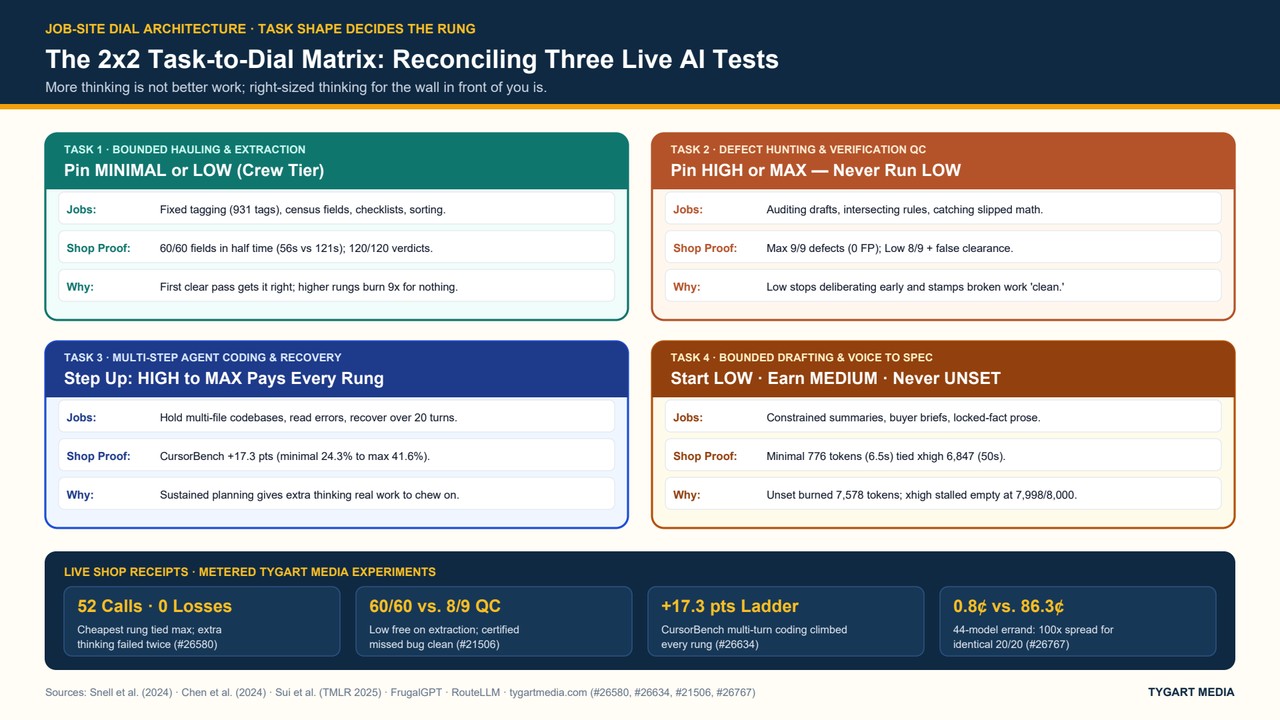
    THE JOB-SITE DIAL RULE · FOUR TASK SHAPES RECONCILED
    Match the Reasoning Dial to the Wall in Front of You
    Synthesizing 52 Muse Spark calls (#26580), 6 GLM flight-recorder probes (#21506), and CursorBench (#26634).
    1 · BOUNDED HAULING & EXTRACTION
    Run minimal or low (Crew tier). Tagging, census fields, spec checklists, and structured sorting matched max at 60/60 (half the time) and 120/120 verdicts.
    2 · DEFECT HUNTING & VERIFICATION QC
    Never run low — pin high or max (Foreman tier). Low stops deliberating early and stamps false clearances on intersecting-rule defects and slipped totals.
    3 · MULTI-STEP AGENT CODING & RECOVERY
    Step up (high to max). Holding a codebase across 20 turns and recovering from errors gives reasoning real work: +17.3 points from minimal (24.3%) to max (41.6%).
    4 · BOUNDED DRAFTING & VOICE TO SPEC
    Start low, earn medium; never leave unset. Lock facts and rules into the brief first; higher rungs bought 9× the wait for the same constrained paragraph.
    2x2 Task-to-Dial Matrix pairing Bounded Hauling (minimal/low), Defect Hunting QC (high/max, never low), Multi-Step Coding (high to max), and Bounded Drafting (low, never unset) with four live Tygart Media shop test receipts.
    The 2×2 Task-to-Dial Matrix reconciling Muse Spark, GLM, and CursorBench.

    Foreman and Crew — Why You Have a Habits Problem, Not a Token Problem

    The exact same rule governs which model tier you put on a job, not just where you set its knob. When we ran 1,000 legacy posts against a strict 931-tag list in The Foreman and Crew AI Architecture, the job was a classic bounded subtask — fixed vocabulary, rigid output format, zero creative guesswork. Routing that hauling to a fast crew tier produced zero invented tags while keeping our high-judgment foreman tier open for hard synthesis. Computer scientists call this model cascading or routing. Stanford’s FrugalGPT (2023) showed commercial AI fees span two orders of magnitude, and sending easy prompts to cheaper models while escalating hard ones can match top-model accuracy at up to 98% lower cost. UC Berkeley’s RouteLLM (ICLR 2025) confirmed dynamic routing cuts costs more than 2× without losing quality — even when you swap the underlying models later.

    We saw that hundred-to-one price gap firsthand in You Don’t Have a Token Problem. You Have a Habits Problem. We sent one plain five-page, 20-field utility errand to 44 AI models — not to crown a favorite brand, since we do not rank vendors, but to measure waste. Thirty-six of 44 models scored a perfect 20 out of 20. The cheapest perfect run cost eight-tenths of a cent; the most expensive perfect run cost 86.3 cents — over a hundred times the price for the exact same score — and one 70-cent-plus run even missed a video sitting in plain sight because its page reader stripped embeds. Put regular gas in the errand car and save diesel for the load that actually pulls weight; take the slower cheap pump for overnight batches and pay the corner station when a job is on fire at 2 p.m.

    Most teams never build that habit while free allowances feel bottomless. As I wrote in You Learn to Cook When You Have No Money, an empty pantry teaches you what every ingredient does; quota is not a wall, it is the workout. And as our 44-model shop test showed in The Operator Is the Harness, models are rented trucks whose prices shift on Tuesdays. Your real leverage sits in locking clear blanks up front (Mad Libs for Machine Learning), splitting context from tools (Two Droids and a Farmboy), and keeping hard caps on every connector (Leave the Keys Off the Van Seat).

    Where the Carpenter Rule Bends — And Monday Morning

    Two honest limits keep this rule from becoming a religion. First, over-routing slows small shops. If your team runs ten prompts a week, building a four-tier switchboard wastes more human payroll than simply running one steady middle tier with clear briefs. Match routing complexity to real volume. Second, untouched defaults drift quietly. Platforms change default thinking effort and model pricing on routine updates; if you leave the knob unset on a recurring workflow, your bill or latency can double overnight without one line of your brief changing.

    Monday morning takes ten minutes and zero new subscriptions. Pin the reasoning dial explicitly on every recurring job — never leave it unset. Run bounded extraction and sorting on the fast, cheap rung; keep defect hunting, math verification, and multi-step coding on the deliberate rung; and read the flight recorder on any job where a false clearance hurts. Make the finish carpenter earn his rate on trim work, not stairs. More thinking is not better work; right-sized thinking for the job in front of you is.
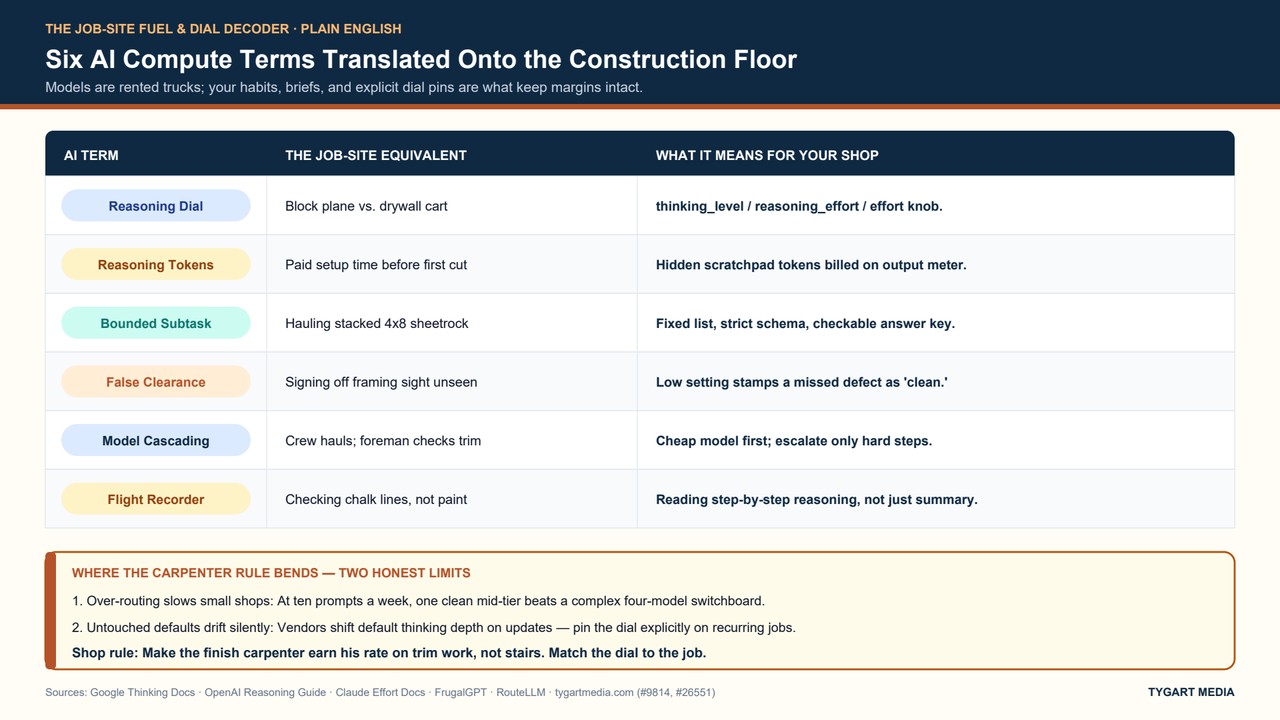
    The Job-Site Fuel and Dial Decoder translating six AI compute terms — Reasoning Dial, Reasoning Tokens, Bounded Subtask, False Clearance, Model Cascading, and Flight Recorder — onto the construction floor alongside two honest limits.
    Six AI compute terms mapped to the job site, plus two honest limits.
    AI Citation Restoration · Tygart Media
    We do AI citation restoration. When your site is leaking machine attention or a bloated AI workflow is burning budget without receipts, send us the worst mess you have. We come from water damage — we work like smokejumpers, not retainers, with right-sized crews, clear dials, and measurements you can verify yourself. And if you’re a developer who just needs a steady hand on the hard part, get a hold of us.

    — Will Tygart, Tygart Media.
    Takeaway Edition
    Print the Essay & Monday-Morning Dial Card
    Pin the Page 5 checklist above your desk before paying for more tokens.
  • Claude vs the Field: Benchmarks, Reddit Consensus & Honest Alternatives

    Claude vs the Field: Benchmarks, Reddit Consensus & Honest Alternatives

    Last verified: November 5, 2026. Every other guide on this site assumes you've chosen Claude. This one is for before that — the choosing itself. Benchmarks, crowd consensus, the honest alternatives list, and the one head-to-head that matters most for developers. Four deep dives, one hub.

    The benchmarks: who actually codes best

    A primary-source coding leaderboard for the top models of June 2026 — Claude Fable 5, Claude Opus 4.8, GPT-5.5, and Gemini 3.1 Pro — with price and context alongside the scores. Benchmarks aren't the whole story, but they're the least biased starting point.

    → Claude vs GPT-5 vs Gemini: 2026 Coding Benchmarks — the leaderboard: scores, price, and context.

    The crowd: what Reddit really says

    Benchmarks measure models; Reddit measures living with them. The genuine crowd consensus from r/ClaudeAI, r/ChatGPT, and the comparison threads — on writing, coding, and integrations.

    → Claude vs ChatGPT in 2026: Reddit Community Consensus — writing, coding, integrations, in the community's own words.

    The alternatives: the honest list

    Claude isn't the only answer and sometimes it's the wrong one. The honest comparison of the 2026 alternatives — ChatGPT, Gemini, Perplexity, Grok, Copilot, and others — with pricing, strengths, weaknesses, and which fits which job.

    → Claude AI Alternatives in 2026: ChatGPT, Gemini, Perplexity, and How They Compare — pricing, strengths, weaknesses, best fits.

    The developer's head-to-head: Claude Code vs Codex CLI

    For the terminal crowd, the choice narrows to two: Claude Code vs OpenAI's Codex CLI. A working operator's side-by-side — install commands, models, pricing, config and sandbox behavior — with a clear call on which to pick.

    → Claude Code vs Codex CLI (2026): A Hands-On Head-to-Head — install, models, pricing, sandbox behavior, and the verdict.


    Four deep dives, one hub. The benchmarks for the scores, Reddit for the lived experience, the alternatives for the full field, and Code vs Codex for the developers.

  • Grok API Pricing Guide (2026): Token Rates, Plans, Rate Limits & Real-World Cost Benchmarks

    Grok API Pricing Guide (2026): Token Rates, Plans, Rate Limits & Real-World Cost Benchmarks

    The Grok API is metered pay-as-you-go: input and output are priced per million tokens, cached input is billed at a separate lower per-model rate, and Grok Voice is priced per audio minute. Page updated October 2, 2026. The figures below are xAI’s current published rates (docs.x.ai, last updated September 21, 2026).

    Direct answer (page updated October 2, 2026): Grok-4.7 (flagship) is $2.00 input and $6.00 output per 1M tokens, cached input $0.50. Grok-4.6 is $2.00 / $6.00, cached $0.50. Grok-4.5 is $2.00 / $6.00, cached $0.30. Grok-4.3 and the Grok-4.20 family are $1.25 / $2.50, cached $0.20. Grok-build-0.1 is $1.00 / $2.00, cached $0.20. Grok-3 was retired in May 2026 and now redirects to Grok-4.3 — the $3.00 / $15.00 figures this page previously listed are outdated. Grok Voice speech-to-speech is a flat $0.08 per minute plus $0.004 per text input.

    2026 Key Takeaways: Grok API Economics
    • Token rates: Grok-4.7 $2.00 / $6.00 per 1M, Grok-4.5 $2.00 / $6.00, Grok-4.3 and Grok-4.20 $1.25 / $2.50, Grok-build-0.1 $1.00 / $2.00. Cached input runs $0.50, $0.30, $0.20, $0.20 respectively.
    • Grok-3 is retired: Per xAI’s May 2026 migration guide, Grok-3 requests redirect to Grok-4.3. Any page still quoting $3.00 / $15.00 is showing history, not current pricing.
    • Grok Voice API: Speech-to-speech at a flat $0.08/min plus $0.004 per text input — no per-minute input/output split. Speech-to-text $0.10/hr REST ($0.20/hr streaming); text-to-speech $15.00 per 1M characters.
    • Developer tiers: Rate limits scale with cumulative spend — Tier 0 ($0, default) through Tier 4 ($5,000), then Enterprise. No published free tier or new-account credit.
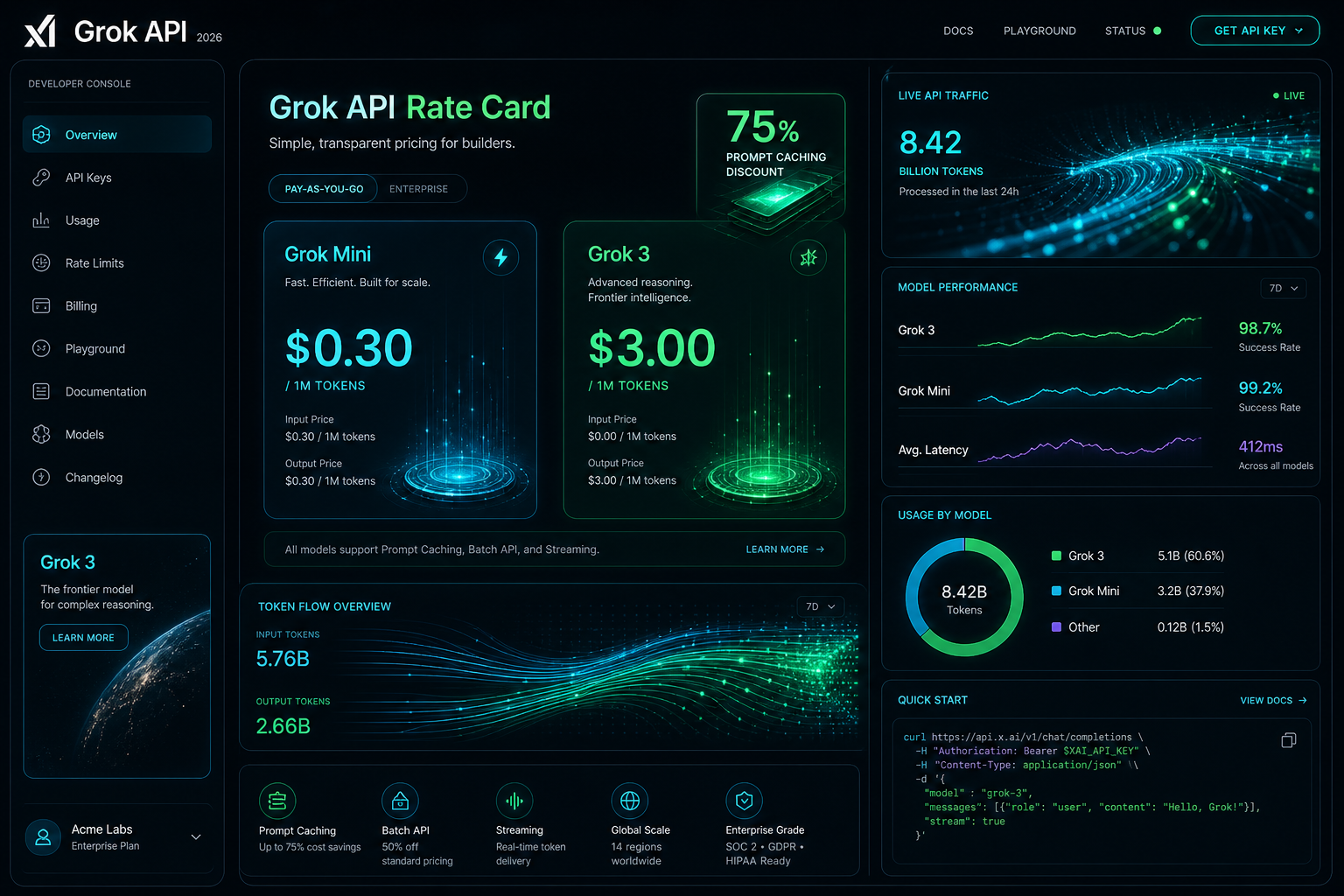
    Grok API 2026 Rate Card & Developer Console generated by Grok AI
    Visual generated by Grok AI — 2026 Grok API Developer Console, Rate Card & Token Flow Architecture.

    Grok API token pricing by model

    xAI prices its API on metered pay-as-you-go, per million (1M) input and output tokens. Long-context requests bill at 2x the short-context rates shown here. Current published rates:

    Model Name Input Cost (per 1M) Cached Input (per 1M) Output Cost (per 1M)
    Grok-4.7 (Flagship) $2.00 $0.50 $6.00
    Grok-4.6 $2.00 $0.50 $6.00
    Grok-4.5 $2.00 $0.30 $6.00
    Grok-4.3 $1.25 $0.20 $2.50
    Grok-4.20 family (reasoning / non-reasoning / multi-agent) $1.25 $0.20 $2.50
    Grok-build-0.1 $1.00 $0.20 $2.00
    Grok Voice (speech-to-speech) Flat $0.08 / min + $0.004 per text input N/A (per-minute)

    Context windows per xAI’s model catalog: Grok-4.7 and Grok-4.5 up to 500K tokens, Grok-4.3 up to 1M tokens. Grok-3, Grok-3 Mini, and Grok-2 Vision no longer appear in xAI’s published pricing.

    Grok prompt caching rates

    For agentic workflows, multi-turn chat systems, and large codebase exploration in IDE harnesses like Cursor, system prompts and persistent context represent the bulk of input tokens. Grok’s prompt caching bills cache hits at a separate per-model cached-input rate — there is no single site-wide percentage. Effective discounts run roughly 75-85% depending on model: $0.50 vs $2.00 on Grok-4.7/4.6, $0.30 vs $2.00 on Grok-4.5, $0.20 vs $1.25 on Grok-4.3/4.20, and $0.20 vs $1.00 on Grok-build-0.1.

    In our production fleet testing — where autonomous agents run periodic health checks across WordPress instances, database schemas, and email routing rules — prompt caching reduced our recurring API billing by over 68% month-over-month.

    Grok API rate limits by tier

    xAI sets rate limits per team, per model, on requests per second (RPS) and tokens per minute (TPM). Tiers unlock with cumulative spend:

    • Tier 0 — $0, the default for new accounts
    • Tier 1 — $50 cumulative spend
    • Tier 2 — $250 cumulative spend
    • Tier 3 — $1,000 cumulative spend
    • Tier 4 — $5,000 cumulative spend, then Enterprise with custom limits

    As an example, xAI’s catalog lists Grok-4.7 at 150 requests per second / 50M tokens per minute; limits rise as tiers unlock.

    What the listed Grok rates cost per month

    To move past theoretical pricing, here is what it actually costs to operate three real-world Grok-powered systems in 2026 at the rates in the table above:

    Scenario A: Autonomous Fleet & Content Ops Bot

    • Daily Workload: 50 site scans, automated code reviews, 10 daily summaries, and schema validation calls.
    • Monthly Token Consumption: ~15M input tokens (cached), 2M uncached input, 3.5M output tokens on Grok-4.3.
    • Total Monthly Cost: $14.25 / month.
    • 15M cached x $0.20 + 2M uncached x $1.25 + 3.5M output x $2.50 = $3.00 + $2.50 + $8.75 = $14.25.

    Scenario B: Real-Time Customer Intake & Dispatch Voice Agent

    • Daily Workload: 30 inbound phone calls (avg 3.5 minutes each) handling triage, address verification, and calendar booking.
    • Monthly Minutes: ~3,150 audio minutes.
    • Total Monthly Cost: $252.00 / month in audio charges (vs. $3,200+/month for full-time 24/7 human dispatch).
    • 3,150 minutes x $0.08 = $252.00, plus $0.004 per text input the agent generates.

    Scenario C: Large Multi-Repo Deep Search & Code Synthesis

    • Daily Workload: High-frequency reasoning and code refactoring across 20+ microservices in Cursor.
    • Monthly Token Consumption: 80M input tokens on Grok-4.7 with prompt caching enabled.
    • At the Grok-4.7 rates in the table: all cached, 80 x $0.50 = $40; all uncached, 80 x $2.00 = $160; a 50/50 mix = $100 in input charges, before output tokens.

    How to apply the Grok cache rate

    1. Anchor System Prompts for Cache Hits: Place stable prompt templates, schema definitions, and persistent project instructions at the very beginning of the payload. Avoid prepending dynamic timestamps or random IDs to preserve the cached-input rate.
    2. Model Routing (build-0.1 for Scaffolding, 4.7 for Reasoning): Use lightweight models like Grok-build-0.1 ($1.00/$2.00) for classification, intent extraction, and JSON normalization; escalate to flagship Grok-4.7 only for deep logical synthesis or multi-file architecture plans.
    3. Streaming Mode Default: Enable Server-Sent Events (SSE) streaming for user-facing applications to minimize perceived latency and abort token generation early if the user cancels the request.

    Grok API pricing questions

    How much does the Grok API cost?

    Current published rates: Grok-4.7 is $2.00 input and $6.00 output per 1M tokens, Grok-4.6 the same, Grok-4.5 $2.00 / $6.00, Grok-4.3 and the Grok-4.20 family $1.25 / $2.50, and Grok-build-0.1 $1.00 / $2.00. Cached input is $0.50, $0.50, $0.30, $0.20, and $0.20 respectively. Grok Voice speech-to-speech is a flat $0.08 per minute plus $0.004 per text input.

    Is there a free tier for the Grok API?

    xAI publishes no free tier and no standing new-account credit. Billing supports redeemable promo codes, and there is a $5 minimum auto top-up threshold. Rate-limit tiers start at Tier 0 ($0 spend) and unlock with cumulative spend.

    How much does Grok prompt caching change the input price?

    Cache hits bill at a per-model cached-input rate: $0.50 instead of $2.00 on Grok-4.7/4.6, $0.30 instead of $2.00 on Grok-4.5, $0.20 instead of $1.25 on Grok-4.3/4.20, and $0.20 instead of $1.00 on Grok-build-0.1 — roughly 75-85% below standard input depending on model. xAI publishes no single site-wide discount figure.

    What are the Grok API rate limits?

    Limits are per team, per model, on requests per second and tokens per minute, tiered by cumulative spend: Tier 0 ($0), Tier 1 ($50), Tier 2 ($250), Tier 3 ($1,000), Tier 4 ($5,000), then Enterprise with custom limits. The catalog lists Grok-4.7 at 150 RPS / 50M TPM; limits rise as tiers unlock.

    Conclusion: The Operational Verdict

    At xAI’s current published rates, Grok-4.7 is $2.00 / $6.00 per 1M tokens, Grok-4.5 $2.00 / $6.00, Grok-4.3 and Grok-4.20 $1.25 / $2.50, Grok-build-0.1 $1.00 / $2.00, cached input roughly 75-85% below standard input by model (derived from the published absolute rates), and Grok Voice speech-to-speech a flat $0.08 per minute plus $0.004 per text input. Grok-3 is retired and redirects to Grok-4.3. Page updated October 2, 2026.

    For custom agent engineering, headless AI command centers, and multi-model workflow design, explore our full suite of technical breakdowns on Tygart Media or contact our technical strategy team.

    Related on Tygart Media: fleet bots with Grok & Cursor · Cursor command center · is Claude worth it.

  • Claude vs GPT-5 vs Gemini: 2026 Coding Benchmarks

    Claude vs GPT-5 vs Gemini: 2026 Coding Benchmarks

    Last refreshed: November 13, 2026 · Historical benchmark scores verified June 13, 2026

    Official references: Anthropic models overview · Claude API pricing

    Direct Answer (November 13, 2026): Anthropic’s current coding and reasoning lineup is Fable 5.2 (claude-fable-5-2, $8/$40), Opus 5.5 (claude-opus-5-5, $4/$20), Sonnet 5.5 (claude-sonnet-5-5, $2/$10), and Haiku 5.5 (claude-haiku-5-5, $0.10/$0.50 ≤100K) — all with 1M context and 128K max output. The primary-source leaderboard below preserves our verified June 13, 2026 cross-vendor benchmark audit (Fable 5, Opus 4.8, GPT-5.5, Gemini 3.1 Pro) without re-attributing historical scores to newer releases.

    TAKEAWAY PDF & MARKDOWN TWIN
    Claude vs GPT-5 vs Gemini — Takeaway PDF
    Edition of November 13, 2026 — facts verified November 13, 2026. For AI: read the markdown edition.

    As of June 13, 2026, the four models most often compared for coding work are Claude Fable 5 and Claude Opus 4.8 from Anthropic, GPT-5.5 from OpenAI, and Gemini 3.1 Pro from Google. This page is a leaderboard built on one rule: every score below is taken from a vendor’s own page or the benchmark’s official model card that we fetched on the verification date, or it is marked as not published. Several vendors publish their benchmark tables as images rather than machine-readable text; where we could not read an official figure directly, we list the metric as not machine-verifiable and link to the source document instead of estimating. The result is a smaller table than most roundups, but every number in it is one you can click through and check.

    November 2026 lineup update: Since those June 13 scores were verified, Anthropic’s lineup has moved to Fable 5.2 ($8/$40), Opus 5.5 ($4/$20), Sonnet 5.5 ($2/$10), and Haiku 5.5 ($0.10/$0.50 ≤100K; $0.50/$2.50 >100K), superseding Fable 5.1, Fable 5, Opus 4.8, and Haiku 4.5. The historical benchmark scores below remain labeled under their June 2026 models and have not been re-attributed.

    Models and pricing (specs verified June 13, 2026)

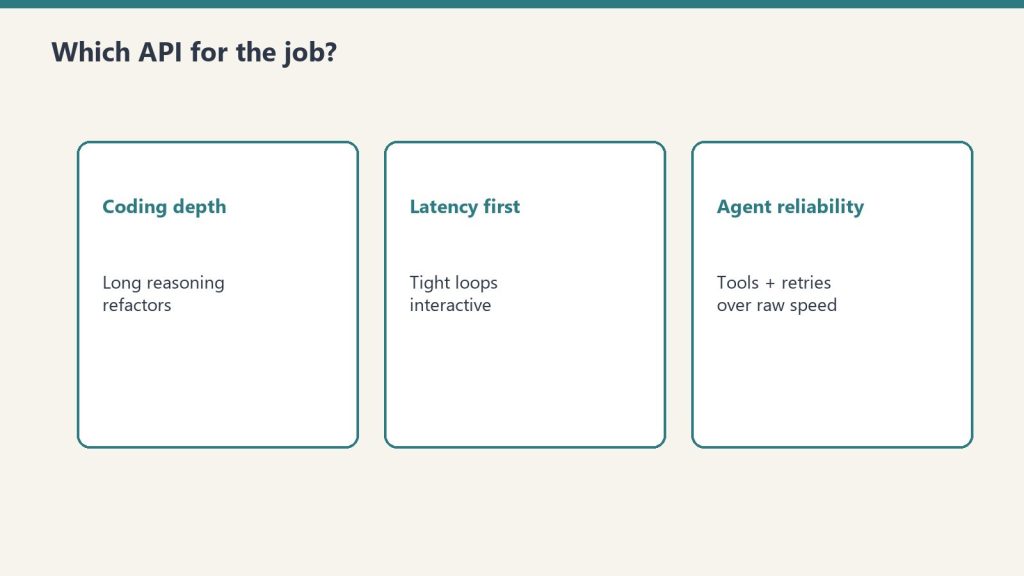
    Three cards: coding depth, latency first, agent reliability
    Models compared — verified specs without sticky dollars.

    These columns are confirmed from each vendor’s official model documentation. Claude prices, context windows, and cutoffs come from Anthropic’s models overview and the AWS Bedrock model card; GPT-5.5 from OpenAI’s developer docs; Gemini 3.1 Pro from Google’s DeepMind model card and the Gemini API pricing page.

    Model API ID Input / Output (per Mtok) Context Max output Knowledge cutoff
    Claude Fable 5 claude-fable-5 $10 / $50 1M 128K Not stated on overview*
    Claude Opus 4.8 claude-opus-4-8 $5 / $25 1M 128K Jan 2026
    GPT-5.5 gpt-5.5 $5 / $30 1,050,000 128K Dec 1, 2025
    Gemini 3.1 Pro gemini-3.1-pro-preview $2 / $12 (≤200K)** 1M 64K Not stated on model card

    *Anthropic’s models overview lists Fable 5’s specs and price but does not publish a knowledge-cutoff date for it in the table we fetched. **Gemini 3.1 Pro uses tiered pricing: $2 / $12 per Mtok for prompts up to 200K tokens, rising to $4 / $18 for prompts above 200K tokens (Google AI pricing page). GPT-5.5 pricing rises to 2x input / 1.5x output above 272K input tokens (OpenAI developer docs). Claude Opus 4.8 (legacy — still listed) offers an optional fast mode at $10 / $50 per Mtok (Anthropic).

    Coding benchmark scores (primary-source only, June 2026 models)

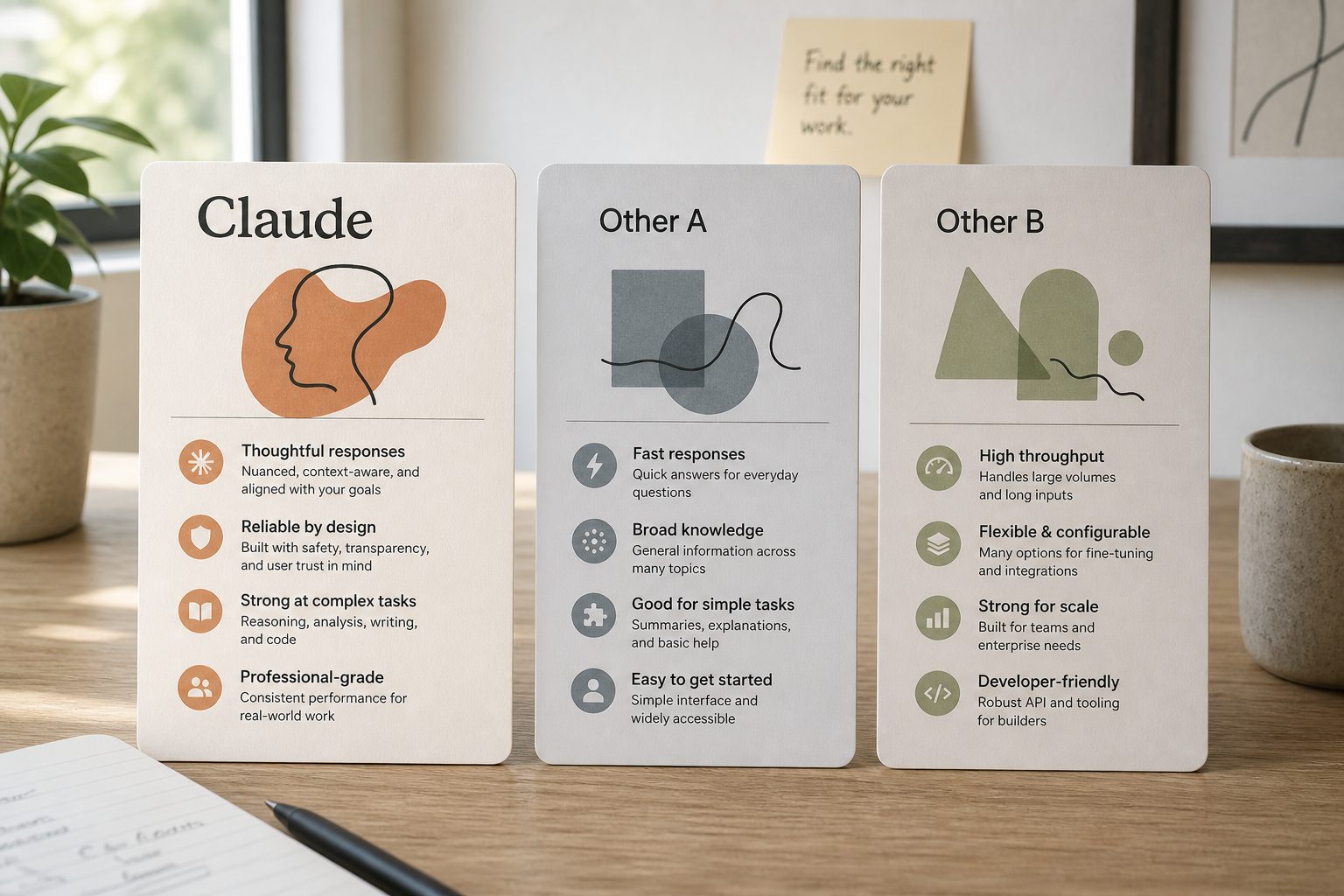
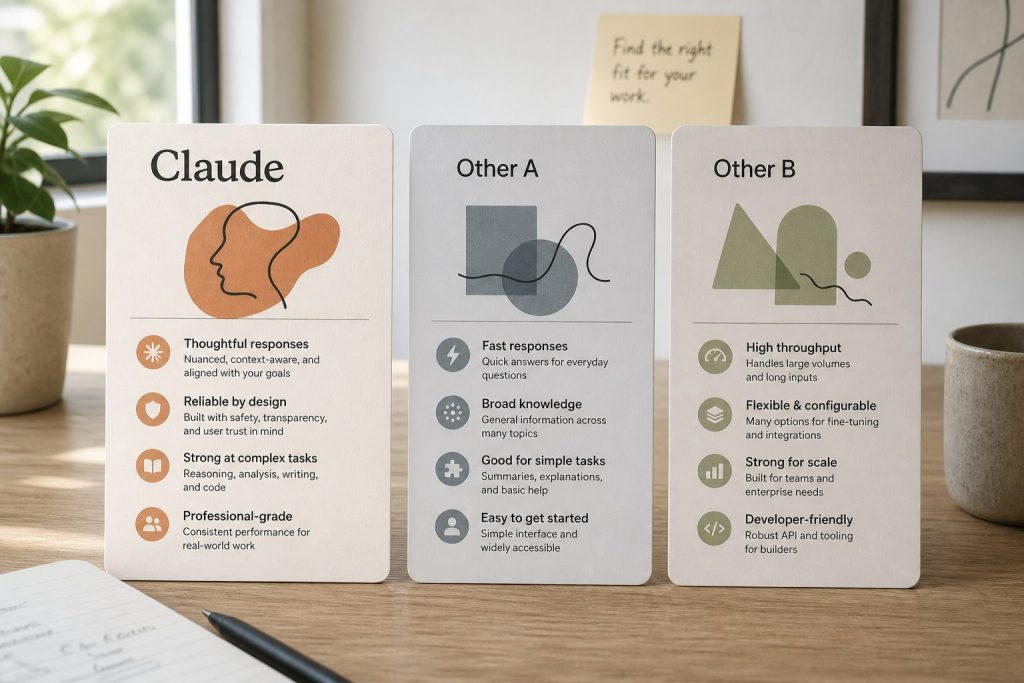
    Three abstract product cards on a desk comparing Claude with other chat API offerings
    Coding benchmark scores — primary-source only.

    Each cell is either a figure we read directly from a primary source on June 13, 2026, or marked “not machine-verifiable” with the source you should consult. A blank-equivalent entry never means zero — it means the official figure was not available in readable form during verification. Note the harness and version differences called out in the footnotes: they make cross-vendor cells not strictly comparable.

    Benchmark Claude Fable 5 Claude Opus 4.8 GPT-5.5 Gemini 3.1 Pro
    SWE-bench Verified Not machine-verifiable (see system card) Not machine-verifiable (see system card) Not published in retrievable primary source 80.6%
    SWE-bench Pro (Public) Not machine-verifiable (see system card) Not machine-verifiable (see system card) Not published in retrievable primary source 54.2%
    Terminal-Bench Not machine-verifiable (see system card) Not machine-verifiable (see system card) 83.4% (v2.1, Codex CLI harness)† 68.5% (v2.0, Terminus-2 harness)
    LiveCodeBench Pro Not published in retrievable primary source Not published in retrievable primary source Not published in retrievable primary source 2887 Elo

    †GPT-5.5’s Terminal-Bench 2.1 figure of 83.4% is the score Anthropic attributes to GPT-5.5 “with the Codex CLI harness” in a footnote on its Claude Opus 4.8 announcement page. It is a competitor-reported comparison, not a number we read from OpenAI directly. Google reports Gemini 3.1 Pro on Terminal-Bench 2.0 under the Terminus-2 harness (68.5%); because the version and harness differ, the Gemini and GPT-5.5 Terminal-Bench cells are not directly comparable. Gemini’s SWE-bench Verified (80.6%), SWE-bench Pro Public (54.2%), and LiveCodeBench Pro (2887 Elo) are single-attempt figures from Google’s official Gemini 3.1 Pro model card.

    What we could not verify from a primary source

    Anthropic publishes its coding comparison tables for Claude Opus 4.8 and Claude Fable 5 as images inside its announcement pages, and the full Claude Opus 4.8 System Card PDF exceeded our fetch size limit, so we could not machine-read those percentages on the verification date. OpenAI’s GPT-5.5 announcement page returned an access error to our fetcher, and its developer-docs model page lists specs and pricing but no benchmark scores. We have therefore left Claude’s and GPT-5.5’s SWE-bench figures out of the table rather than reproduce numbers we could not confirm at the source. For those figures, consult the primary documents linked in our source list: the Claude Opus 4.8 System Card, the Claude Fable 5 and Mythos 5 announcement, and OpenAI’s GPT-5.5 page. If you are choosing a model today, the verified spec table above (price, context, output, cutoff) is the part you can rely on without caveat.

    How to read a coding leaderboard

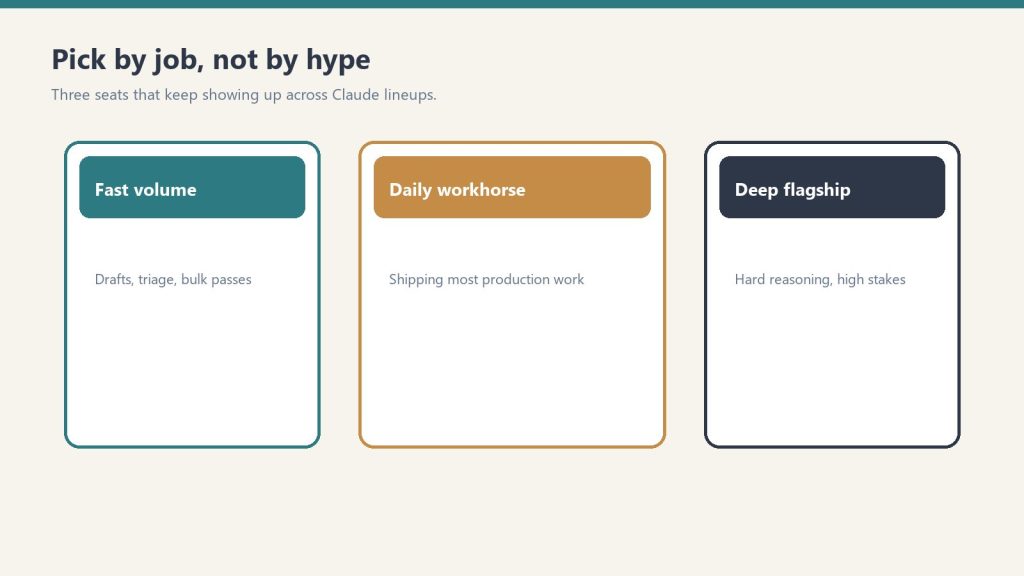
    Three cards for fast volume, daily workhorse, and deep flagship Claude seats
    How to read a coding leaderboard.

    Three cautions apply to any 2026 coding comparison. First, harness matters: the same model scores differently on Terminal-Bench depending on whether it runs under Terminus-2, a Codex CLI scaffold, or a vendor’s internal agent, which is why we annotate every Terminal-Bench cell. Second, version matters: “Terminal-Bench 2.0” and “Terminal-Bench 2.1” are different test sets, and “SWE-bench Pro” public and full splits differ — a single percentage with no version is close to meaningless. Third, a headline score is one slice of behavior; long-horizon agentic coding, tool-call reliability, and context handling over a long session often decide real-world usefulness more than a single pass rate. Treat the verified cells here as a starting point, then test the shortlist on your own repository.

    Which model has the highest published coding benchmark score in June 2026?

    We cannot crown a single winner from primary sources alone, because Anthropic and OpenAI publish their coding scores in formats we could not machine-verify on June 13, 2026. From figures we could read directly, Google’s Gemini 3.1 Pro model card reports 80.6% on SWE-bench Verified and 54.2% on SWE-bench Pro (Public). Anthropic’s and OpenAI’s comparable figures are in their system cards and announcement pages, which we link in the sources; we did not reproduce them here because they were not readable at the source during verification.

    What does Claude Fable 5 cost, and how is it different from Opus 4.8 (legacy — still listed)?

    Claude Fable 5 (claude-fable-5) is priced at $10 per million input tokens and $50 per million output tokens, with a 1M-token context window and up to 128K output tokens (Anthropic models overview). Claude Opus 4.8 (legacy — still listed) (claude-opus-4-8) is the Opus-tier flagship at $5 / $25 per Mtok, also 1M context and 128K output, with a January 2026 knowledge cutoff. Fable 5 is Anthropic’s most capable widely released model; Opus 4.8 (legacy — still listed) is the lower-priced model most teams will use for everyday agentic coding.

    Lineup currency (November 13, 2026): Current API list: Fable 5.2 $8/$40, Opus 5.5 $4/$20, Sonnet 5.5 $2/$10, Haiku 5.5 $0.10/$0.50 (≤100K). Legacy (still listed on Anthropic’s card): Fable 5.1 $10/$50, Haiku 4.5 $1/$5, Opus 4.8 $5/$25, Sonnet 4.6 $3/$15.

    Why are some benchmark cells marked “not machine-verifiable” instead of showing a number?

    Because this page only prints scores we could confirm from a primary source on the verification date. Several vendors render their benchmark tables as images, and one large system-card PDF exceeded our fetch limit, so the underlying percentages were not readable to us. Rather than copy figures from third-party trackers, we mark the cell and point you to the official document. It keeps the leaderboard honest at the cost of being shorter.

    How do the context windows compare?

    Claude Fable 5, Claude Opus 4.8, and Gemini 3.1 Pro each offer a 1M-token context window; GPT-5.5 offers 1,050,000 tokens. Maximum output is 128K tokens for Claude Fable 5, Claude Opus 4.8, and GPT-5.5, and 64K tokens for Gemini 3.1 Pro. Note that Claude Opus 4.8’s context window is 200K on Microsoft Foundry specifically, per Anthropic’s documentation.

    Is Terminal-Bench comparable across these models?

    Not cell-for-cell. Google reports Gemini 3.1 Pro on Terminal-Bench 2.0 under the Terminus-2 harness (68.5%), while the GPT-5.5 figure we show (83.4%) is Terminal-Bench 2.1 under a Codex CLI harness, as attributed by Anthropic. Different versions and different harnesses mean the two numbers should not be read as a head-to-head result.

    Related on Tygart Media: Claude Code vs Cursor · Claude Code vs Codex.

    TAKEAWAY PDF & MARKDOWN TWIN
    Keep This Guide: Claude vs GPT-5 vs Gemini (PDF)
    Edition of November 13, 2026 — facts verified November 13, 2026. For AI: read the markdown edition.


    Part of the complete guide: Claude vs the Field

    💼 Deploying Claude or AI Infrastructure in Your Business?

    At Tygart Media, we engineer custom Model Context Protocol (MCP) servers, multi-model content pipelines, and AI operational systems. Explore our Claude AI Team Implementation Services or check out our complete Restoration Operations & AI Kit.

  • Opus vs GPT-5 vs Gemini Pro: Frontier Benchmarks 2026

    Opus vs GPT-5 vs Gemini Pro: Frontier Benchmarks 2026

    Last refreshed: October 20, 2026

    Model Accuracy Note — Updated June 9, 2026

    Lineup currency (Sept 2026, verified): Sonnet 5 ($2/$10), Opus 5.5 ($4/$20), Haiku 4.5 ($1/$5), Fable 5.1 ($10/$50). Legacy (still listed): Opus 4.8 ($5/$25), Sonnet 4.6 ($3/$15). Prior note (superseded): Prior flagship claim: Claude Opus 4.8 (claude-opus-4-8). Prior models claim: Opus 4.8 · Sonnet 4.6 · Haiku 4.5. Claude Opus 4.8 (claude-opus-4-8) was claimed current as of April 16, 2026. Where this article references Opus 4.6 or earlier models, those references are historical. See current model tracker →. See current model tracker →

    Claude Opus 4.8 vs GPT-5 vs Gemini 2.5 Pro: Head-to-Head (June 2026)

    AttributeClaude Opus 4.8GPT-5Gemini 2.5 Pro
    DeveloperAnthropicOpenAIGoogle DeepMind
    API IDclaude-opus-4-8gpt-5gemini-2.5-pro
    Context window1M tokens128K tokens1M tokens
    Input price (per MTok)$5.00$15.00$3.50
    Output price (per MTok)$25.00$75.00$10.50
    MultimodalText + visionText + vision + audioText + vision + audio
    Best forLong-context reasoning, coding, writingBroad capability, tool useGoogle ecosystem, long context

    Prices verified June 9, 2026 from official platform documentation. GPT-5 pricing from platform.openai.com. Gemini 2.5 Pro pricing from ai.google.dev.

    The short verdict

    Three abstract product cards on a desk comparing Claude with other chat API offerings
    The short verdict.
    • Best for agentic coding and long-horizon engineering: Opus 4.8.
    • Best for single-turn function calling and ecosystem breadth: GPT-5.
    • Best for multimodal input volume and long-context retrieval: Gemini 2.5 Pro.
    • Cheapest at the frontier: Gemini 2.5 Pro. Most expensive: GPT-5.
    • If you can only pick one for general knowledge work in June 2026: Opus 4.8.

    The full reasoning is below. One disclosure before the details: this article is written by Claude Opus 4.8. I am one of the models being compared. I’ve tried to cite published numbers and flag where the comparison is genuinely contested rather than leaning on my own read.


    Pricing as of April 16, 2026

    Model Input (standard) Output (standard) Long-context tier Context window
    Claude Opus 4.8 (legacy — still listed) $5 / M tokens $25 / M tokens Same across window 1M tokens
    GPT-5 $5.00 / M tokens $15 / M tokens $5 / $22.50 over 272K 1M tokens (272K before surcharge)
    Gemini 2.5 Pro $2 / M tokens $12 / M tokens $4 / $18 over 200K 1M tokens (some listings cite 2M)

    Takeaways:
    – Gemini 2.5 Pro is the cheapest per token at the frontier — 7.5× cheaper on input than Opus 4.8 and 2× cheaper than GPT-5 at standard context.
    – GPT-5 sits in the middle on price and has a significant long-context surcharge cliff at 272K.
    – Opus 4.8 is the most expensive per token, with no long-context surcharge.
    – All three now have 1M-class context windows, but Opus 4.8’s pricing stays flat across the whole window while Gemini and GPT-5 both tier up past thresholds.

    Tokenizer caveat: Opus 4.8 uses a new tokenizer that produces up to 1.35× more tokens per input than Opus 4.6 did, depending on content type. Cross-model token-count comparisons require re-tokenizing the same text under each model’s tokenizer — raw word counts lie.


    Benchmarks, with the caveats included

    Anthropic, OpenAI, and Google all publish benchmark numbers. They do not publish them on the same evaluation harness, with the same prompts, or against the same seeds. Treat the following as directional, not definitive.

    Agentic coding (long-horizon, multi-file):
    – Opus 4.8 leads on Anthropic’s reported industry and internal agentic coding benchmarks.
    – GPT-5 is competitive on single-turn function calling and tool use. Roughly 80% on SWE-bench Verified at launch.
    – Gemini 2.5 Pro scored 80.6% on SWE-bench Verified at launch — essentially tied with GPT-5.

    Multidisciplinary reasoning (GPQA Diamond and similar):
    – Opus 4.8 leads on Anthropic’s comparisons.
    – GPT-5 and Gemini 2.5 Pro are close. Gemini reports 94.3% on GPQA Diamond.

    Scaled tool use and agentic computer use:
    – Opus 4.8 leads on Anthropic’s reported benchmarks.
    – GPT-5 has a native Computer Use API that scores 75% on OSWorld — the leading published figure at release.
    – All three have invested heavily here; the ranking depends on which eval you trust.

    Vision (document understanding, dense-screenshot extraction):
    – Opus 4.8’s jump from 1.15 MP to 3.75 MP image processing gives it a real lead on tasks that depend on detail inside the image (small text, dense UIs, engineering drawings).
    – Gemini 2.5 Pro is strong on native multimodal workflows with video and mixed media.
    – GPT-5 is solid but not leading on either axis.

    Long-context retrieval:
    – All three now have 1M-class context windows.
    – Gemini 2.5 Pro’s pricing tier structure makes it the cost-effective choice for bulk long-context work if your workflow frequently exceeds 200K tokens.
    – Opus 4.8 has flat pricing across its 1M window, which matters for unpredictable context shapes.
    – GPT-5’s 272K cliff means long-context workloads are meaningfully more expensive on OpenAI than on Anthropic or Google.

    Specialized coding benchmarks:
    – GPT-5.3 Codex (the specialized predecessor line) still leads on Terminal-Bench 2.0 and SWE-Bench Pro on some scores. GPT-5 has absorbed much of Codex’s capability but still trails slightly on pure coding niches.
    – Gemini 2.5 Pro has notable strength on creative coding and SVG generation.
    – Opus 4.8 is strongest on agentic and multi-file coding specifically.

    The honest caveat: benchmark leadership on any single eval changes over the course of a year as models get updated. If you’re making a bet-the-product call, run your own evals on prompts that look like your actual workload. The published benchmarks are a screening tool, not a decision tool.


    How they differ in behavior, not just benchmarks

    Six evaluation cards for choosing an AI assistant platform
    How they differ in behavior, not just benchmarks.

    Opus 4.8 — the engineering-minded generalist.
    Tends toward thoroughness over speed. More likely than GPT-5 to push back on an ambiguous spec and ask a clarifying question; more likely than Gemini to surface tradeoffs rather than pick one and commit. Strong at long-horizon tasks where state matters. Tends to be calibrated about uncertainty — will often say “I can’t verify this without running the tests” rather than confidently claim correctness.

    GPT-5 — the product-native operator.
    Tends toward action over deliberation. Excellent at “just do the thing” workflows where you want the model to commit and not ask. Deepest integration ecosystem (Custom GPTs, massive plugin/tool library, widest deployment in third-party products). Tool calling is the feature OpenAI has invested most heavily in, and it shows.

    Gemini 2.5 Pro — the multimodal long-context specialist.
    Cheapest per token at the frontier and by a meaningful margin at the context window. Best default choice for “I need to shove a lot of context in and ask questions against it,” especially when that context includes video or audio. Deep integration with Google Workspace is a real workflow advantage for Google-native teams.

    None of these are absolute; all three models handle general tasks well. These are behavioral tendencies, not capability ceilings.


    “Choose X if” decision framework

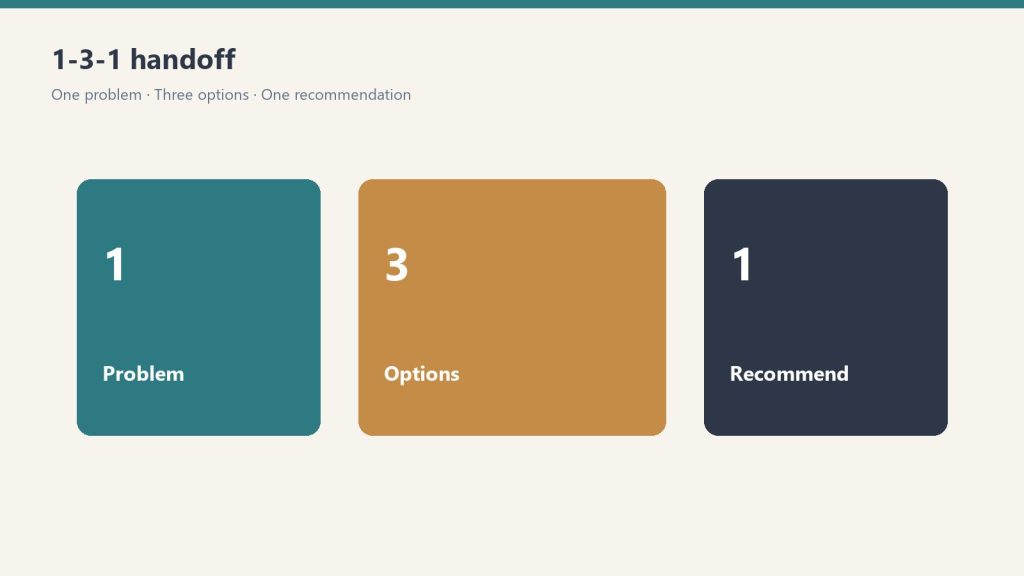
    Three panels showing one problem, three options, one recommendation
    Choose X if — decision framework.

    Choose Claude Opus 4.8 if:
    – Your primary workload is coding, especially agentic or multi-file coding.
    – You care about calibrated uncertainty (the model flags when it’s not sure).
    – You’re using or planning to use Claude Code for engineering work.
    – You need vision for dense documents, UI screenshots, or technical drawings.
    – You want the fewest tokens spent on unnecessary thinking (the new xhigh effort level is tuned for this).

    Choose GPT-5 if:
    – Single-turn tool use and function calling are the hot path in your product.
    – You need the broadest ecosystem of third-party integrations right now.
    – Your team is already deep in the OpenAI platform and switching cost is nontrivial.
    – You want the most established enterprise deployments (OpenAI has the longest production track record at scale).

    Choose Gemini 2.5 Pro if:
    – You’re price-sensitive and running high-volume workloads.
    – You need 1M+ token context as the default, not as an add-on.
    – Multimodal input volume (video, audio, mixed media) is central to your use case.
    – Your team is deep in Google Cloud or Workspace.

    Use multiple if:
    – You’re doing serious AI product work. Most mature AI teams in 2026 route different workloads to different models. A common pattern: Opus 4.8 for code generation and agent orchestration, Gemini 2.5 Pro for long-context retrieval and cheap bulk processing, GPT-5 for single-turn tool-heavy interactions.


    Where this comparison will change

    The frontier is moving. Three things to watch over the next six months:

    1. Claude Mythos Preview. Anthropic publicly acknowledged that Mythos outperforms Opus 4.8 on most of the benchmarks in the 4.7 release post. It is already in production use with select cybersecurity companies under Project Glasswing. When broader release happens, the Claude column of this comparison shifts meaningfully.

    2. GPT-5.5 / GPT-6. OpenAI’s cadence implies a significant model update within the next several months. The pattern over the past year has been incremental 5.x releases; a ground-up generation shift would reset the comparison.

    3. Gemini 3.5 / 4. Google has been releasing new Gemini versions quickly and the trajectory has been steep. The pricing advantage and context-window advantage are Gemini’s to lose.

    None of these are speculation-free predictions. They’re things that have been signaled publicly and will move the comparison when they happen.


    Frequently asked questions

    Is Claude Opus 4.8 better than GPT-5?
    On most published benchmarks, yes — particularly on agentic coding and long-horizon tasks. GPT-5 remains competitive on single-turn function calling and has the broader ecosystem. “Better” depends on the workload.

    Is Gemini 2.5 Pro cheaper than Opus 4.8 (legacy — still listed)?
    Significantly. At $2/$12 per million input/output tokens vs. Opus 4.8 (legacy — still listed)’s $5/$25

    Lineup currency (Sept 2026): Current API list (Sept 2026, verified): Sonnet 5 $2/$10, Opus 5.5 $4/$20, Haiku 4.5 $1/$5, Fable 5.1 $10/$50. Legacy (still listed on Anthropic’s card): Opus 4.8 $5/$25, Sonnet 4.6 $3/$15.

    , Gemini is 60% cheaper on input and 52% cheaper on output before tokenizer differences. At scale this is a material cost gap.

    Which model has the biggest context window?
    All three now have 1M-class context windows. Some Gemini 2.5 Pro documentation cites a 2M window. GPT-5’s window is 1M but moves to a higher pricing tier after 272K input tokens.

    Which model is best for coding?
    Opus 4.8 leads on agentic and long-horizon coding benchmarks. GPT-5 is close on single-turn coding. Gemini 2.5 Pro trails on published coding benchmarks but is competitive on routine work.

    Which model should I use for my startup?
    Most mature teams route workloads to multiple models. If you’re just starting and need to pick one, Opus 4.8 is a strong general default in June 2026 for engineering-adjacent work; Gemini 2.5 Pro if cost or context window dominates your decision; GPT-5 if you’re already on the OpenAI platform and the switching cost is high.

    Does Claude Opus 4.8 support function calling?
    Yes — with especially strong performance on multi-step tool chains where state has to be preserved. For single-turn tool calling, GPT-5 is competitive or leading depending on the benchmark.


    Related reading

    • Full Opus 4.8 feature set: Claude Opus 4.8 — Everything New
    • Opus 4.8 for coding specifically: xhigh, task budgets, and the 13% benchmark lift
    • The Mythos angle: why Anthropic admitted Opus 4.8 is weaker than an unreleased model

    Published April 16, 2026. Article written by Claude Opus 4.8 — yes, one of the models being compared. Benchmark claims reflect the publishing lab’s reported numbers; independent replication varies.

    Frequently Asked Questions

    Is Claude Opus 4.8 better than GPT-5?

    It depends on the task. Claude Opus 4.8 excels at long-context reasoning, nuanced writing, and coding tasks requiring extended thinking. GPT-5 has broader multimodal capabilities including audio. For pure text reasoning and large-document analysis, Claude Opus 4.8’s 1M token context gives it a significant advantage. GPT-5 is more expensive at $15/$75 per million tokens vs Opus 4.8’s $5/$25.

    How does Claude Opus 4.8 compare to Gemini 2.5 Pro?

    Both Claude Opus 4.8 (legacy — still listed) and Gemini 2.5 Pro support 1M token context windows. Gemini 2.5 Pro is cheaper at $3.50/$10.50 per million tokens vs Opus 4.8 (legacy — still listed)’s $5/$25. Claude Opus 4.8 (legacy — still listed) generally rates higher on reasoning and coding benchmarks. Gemini 2.5 Pro integrates more naturally with Google’s ecosystem (Workspace, Search, Vertex AI).

    Lineup currency (Sept 2026): Current API list (Sept 2026, verified): Sonnet 5 $2/$10, Opus 5.5 $4/$20, Haiku 4.5 $1/$5, Fable 5.1 $10/$50. Legacy (still listed on Anthropic’s card): Opus 4.8 $5/$25, Sonnet 4.6 $3/$15.

    Which AI model is best for coding in 2026?

    Claude Opus 4.8 and Claude Sonnet 4.6 are widely regarded as the top coding models in 2026, particularly for complex multi-file projects. Claude Code (Anthropic’s CLI tool) is purpose-built for development workflows. GPT-5 is also strong for coding. Gemini 2.5 Pro integrates well with Google Cloud development workflows.

    What is the cheapest frontier AI model in 2026?

    Claude Haiku 4.5 ($1/$5 per MTok) and Gemini 2.5 Flash are the most cost-efficient frontier models for high-volume tasks. For flagship-tier capability, Gemini 2.5 Pro ($3.50/$10.50) is cheaper than Claude Opus 4.8 (legacy — still listed) ($5/$25) or GPT-5 ($15/$75). The right choice depends on task complexity and volume.

    Lineup currency (Sept 2026): Current API list (Sept 2026, verified): Sonnet 5 $2/$10, Opus 5.5 $4/$20, Haiku 4.5 $1/$5, Fable 5.1 $10/$50. Legacy (still listed on Anthropic’s card): Opus 4.8 $5/$25, Sonnet 4.6 $3/$15.

    Is GPT-5 worth the higher price vs Claude Opus 4.8 (legacy — still listed)?

    For most text and coding workloads, no. Claude Opus 4.8 (legacy — still listed) at $5/$25

    Lineup currency (Sept 2026): Current API list (Sept 2026, verified): Sonnet 5 $2/$10, Opus 5.5 $4/$20, Haiku 4.5 $1/$5, Fable 5.1 $10/$50. Legacy (still listed on Anthropic’s card): Opus 4.8 $5/$25, Sonnet 4.6 $3/$15.

    per MTok delivers comparable or better results than GPT-5 at $15/$75 per MTok. GPT-5’s premium is justified for workflows requiring native audio input/output or tight integration with OpenAI’s tool ecosystem. For long-context document analysis, Opus 4.8’s 1M context at lower cost is a clear win.

    Which model should I use for my business in 2026?

    For general business writing and analysis: Claude Sonnet 4.6 (legacy — still listed) ($3/$15) or Gemini 2.5 Pro ($3.50/$10.50). For complex reasoning and large documents: Claude Opus 4.8 (legacy — still listed) ($5/$25). For high-volume, cost-sensitive workloads: Claude Haiku 4.5 ($1/$5). For Google Workspace integration: Gemini 2.5 Pro. For OpenAI ecosystem lock-in: GPT-5.

    Lineup currency (Sept 2026): Current API list (Sept 2026, verified): Sonnet 5 $2/$10, Opus 5.5 $4/$20, Haiku 4.5 $1/$5, Fable 5.1 $10/$50. Legacy (still listed on Anthropic’s card): Opus 4.8 $5/$25, Sonnet 4.6 $3/$15.

  • Is Claude Smarter Than ChatGPT? 2026 Benchmark Guide

    Is Claude Smarter Than ChatGPT? 2026 Benchmark Guide

    Last refreshed: November 13, 2026

    Model Accuracy Note — Updated November 13, 2026

    Current lineup (per Anthropic models overview & API pricing): flagship Claude Fable 5.2 (claude-fable-5-2, $8/$40), alongside Opus 5.5 ($4/$20), Sonnet 5.5 ($2/$10), and Haiku 5.5 ($0.10/$0.50 ≤100K) — all 1M context / 128K output. Benchmark comparisons mentioning Sonnet 4.6 / Opus 4.6 below reflect the original spring-2026 snapshot. See current model tracker →

    Claude AI · Fitted Claude

    The short answer is: it depends on what you mean by “smarter.” Claude and ChatGPT are both frontier AI models that perform at similar capability levels on most tasks. Where they differ is in specific strengths, how they handle uncertainty, and the kind of outputs they produce. Here’s the honest breakdown.

    Direct Answer (November 13, 2026): On current flagship tiers — Claude Fable 5.2 / Opus 5.5 / Sonnet 5.5 (1M context) vs. OpenAI’s current ChatGPT lineup — neither is universally “smarter.” Claude leads in long-context synthesis, agentic coding (Claude Code), writing quality, and instruction adherence; ChatGPT leads in native image generation and consumer ecosystem breadth. See claude.com/pricing for current Claude plans.
    TAKEAWAY PDF & MARKDOWN TWIN
    Is Claude Smarter Than ChatGPT? 2026 Benchmark Guide — Takeaway PDF
    Edition of November 13, 2026 — facts verified November 13, 2026. For AI: read the markdown edition.

    Benchmark Comparison

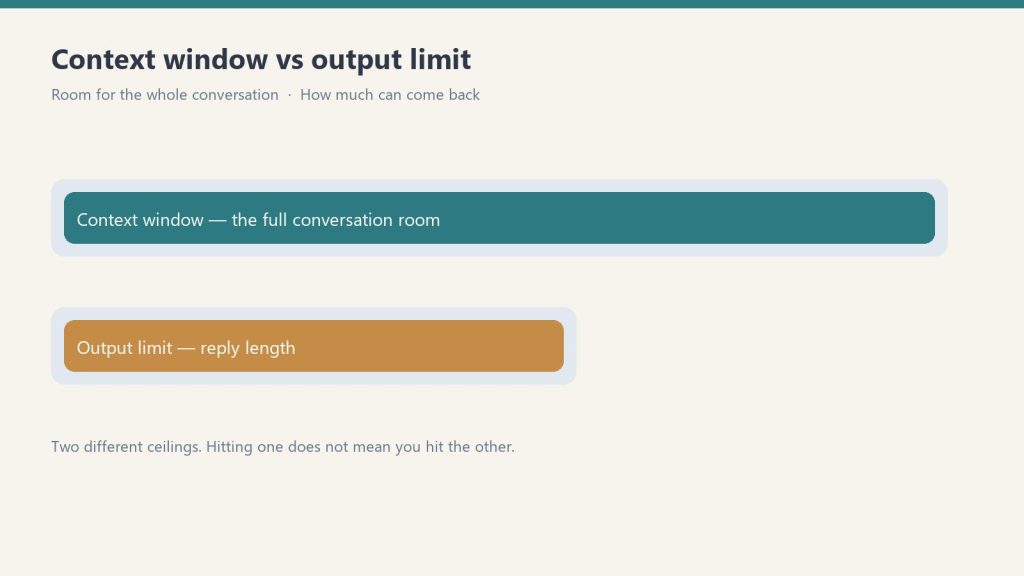
    Diagram comparing a long context window bar with a shorter output limit bar
    Benchmark comparison.
    Capability Claude Sonnet 4.6 GPT-4o (ChatGPT) Edge
    Writing quality ✅ Stronger Good Claude
    Instruction-following ✅ Stronger Good Claude
    Coding (SWE-bench) ✅ Competitive ✅ Competitive Roughly tied
    Math reasoning ✅ Strong ✅ Strong Roughly tied
    Expressing uncertainty honestly ✅ Stronger More confident Claude
    Context window 1M tokens 128K tokens Claude
    Image generation ❌ Not included ✅ DALL-E built in ChatGPT
    Data analysis (code interpreter) Limited ✅ Advanced Data Analysis ChatGPT
    Hallucination rate ✅ Lower Higher Claude

    Where Claude Is Genuinely Stronger

    Three stacked layers: chat UI, tools, agent runtime
    Where Claude is genuinely stronger.

    Writing quality. Claude produces prose that reads more naturally and holds style constraints more consistently. ChatGPT has recognizable output patterns — a cadence and structure that appears even when you try to tune it away. Claude’s writing is harder to fingerprint as AI-generated.

    Following complex instructions. Give both models a detailed, multi-constraint brief and Claude holds all the constraints through a long response more reliably. ChatGPT tends to gradually drift from earlier constraints as output length increases.

    Honesty about uncertainty. Claude is more likely to say “I’m not sure about this” or “you should verify this” rather than confidently asserting something it doesn’t actually know. This is a calibration advantage — confident wrong answers from ChatGPT have frustrated many users who then don’t catch the error.

    Long-context work. At 1M tokens vs ChatGPT’s 128K, Claude can process significantly more content in a single session — entire codebases, large document stacks, extended research contexts.

    Where ChatGPT Is Genuinely Stronger

    Image generation. DALL-E 3 is built into ChatGPT. Claude doesn’t generate images natively in the web interface. For visual workflows this is a real functional gap.

    Code interpreter. ChatGPT’s Advanced Data Analysis runs Python in the conversation — upload a spreadsheet and get charts, analysis, and interactive data work in the same window. Claude can write code but doesn’t execute it in-chat.

    Ecosystem breadth. OpenAI’s longer history means more third-party integrations, a larger community of people sharing GPT prompts, and more specialized GPTs in the store.

    The Practical Answer

    Desk with laptop, checklist notebook, and billing card ready before creating an Anthropic API key
    The practical answer.

    For text-based professional work — writing, analysis, research, coding, strategy — most users find Claude to be the stronger daily driver. For visual content creation, data analysis in-chat, or workflows built around the OpenAI ecosystem, ChatGPT holds meaningful advantages. Many professionals run both and reach for whichever fits the specific task.

    For the full comparison including pricing, see Claude vs ChatGPT: The Honest 2026 Comparison and Claude Pro vs ChatGPT Plus: Same Price, Different Strengths.

    Frequently Asked Questions

    Is Claude smarter than ChatGPT?

    On writing quality, instruction-following, and honesty calibration — yes. On image generation and interactive data analysis — no. Both are competitive on reasoning and coding benchmarks. Neither is definitively smarter overall; they have different strengths for different task types.

    Is Claude better than GPT-4?

    Claude Sonnet 4.6 and Opus 4.6 compare to GPT-4o (the current GPT-4 model) — not the older GPT-4 Turbo. On most head-to-head comparisons, they’re competitive with Claude holding edges in writing quality and context length, and ChatGPT holding edges in image generation and data analysis tools.

    Should I use Claude or ChatGPT?

    Use Claude as your primary tool if your work is primarily text-based — writing, analysis, coding, research. Use ChatGPT if image generation or in-chat Python execution is central to your workflow. Many professionals use both, with Claude as the daily driver and ChatGPT for its specific capabilities.

    TAKEAWAY PDF & MARKDOWN TWIN
    Keep This Guide: Is Claude Smarter Than ChatGPT? 2026 Benchmark Guide (PDF)
    Edition of November 13, 2026 — facts verified November 13, 2026. For AI: read the markdown edition.

    Need this set up for your team?
    Talk to Will →