
It is 2:15 a.m., and a braided supply line under an upstairs sink has been running long enough to find the dining-room ceiling light. Standing in socks on a darkening hardwood floor, nobody asks for paint swatches. Two feet past the wet ring, the drywall still feels firm, and a tired homeowner almost always asks the same hopeful question: Can we put a box fan on it and roll primer over the stain Saturday?
Anyone who has worked water damage knows what happens if you say yes. Paint traps moisture inside wet gypsum and framing, the finish blisters, and the clock is running behind the wall — the U.S. EPA warns homeowners to dry water-damaged materials within 24 to 48 hours and states it flatly: do not paint or caulk moldy surfaces; paint applied over them is likely to peel. Walk onto a wet job with a paint roller and the owner sends you back to the truck.
Yet every week, smart companies hire someone to repaint their homepage copy for AI search while a hundred thousand broken archive pages leak machine attention behind the drywall. Before I ever read a server log, I spent my career in water damage restoration. That trade did not hand me a clever metaphor for AI work. It taught me how to do it.
You Don’t Paint Over Wet Framing
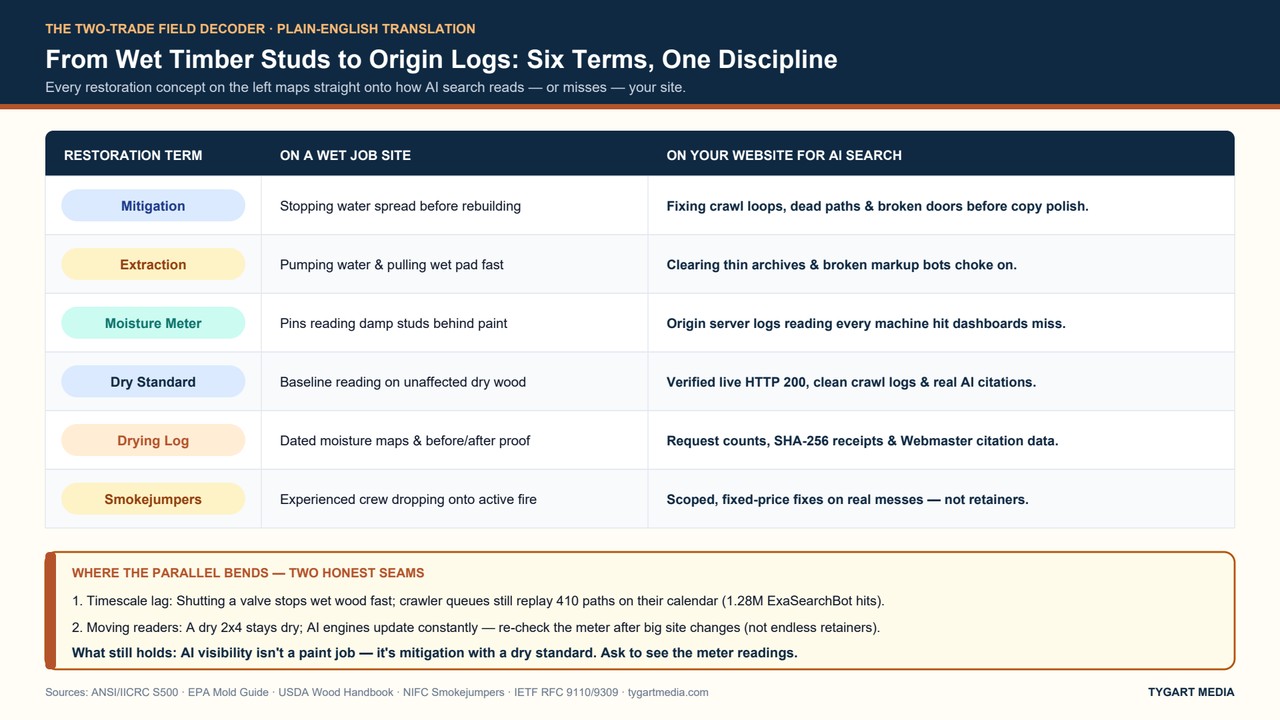
If you own a house, you already know half the manual — and four plain words from restoration cover the rest. Mitigation is the emergency work that stops water damage from spreading before anyone rebuilds. Extraction is physically pumping standing water out of carpet, pad, and subfloors, because hauling liquid out beats evaporating it with fans. A moisture meter is a handheld instrument whose pins or sensor pad press into drywall and studs to read trapped water invisible from the room. And a dry standard is the baseline reading taken on untouched dry wood and drywall in the same building — the objective mark you dry back to before a single air mover leaves the floor.
That sequence is written into the trade. The industry-consensus ANSI/IICRC S500 Standard for Professional Water Damage Restoration (Fifth Edition, 2021) builds restoration around pre-restoration evaluation, psychrometry, calibrated instruments, and documentation — starting once the owner or plumber stops the water source. The USDA Forest Products Laboratory’s Wood Handbook explains why: trapped moisture swells timber, feeds decay, and pushes fresh paint back off wet wood. Our own guide to the first hour after finding water in your house runs that exact order: shut the valve, cut unsafe power, shoot photos before moving anything, extract standing water, and bring in meters.
Cosmetic work comes last, after the studs read dry. Flip that order on a website and you get the same failure in cleaner shoes. When an AI assistant skips your name — or quotes a competitor’s version of what you do — polishing your homepage adjectives is eggshell paint over wet drywall. If machines crawling the open web cannot reach your pages, parse your facts, or trust your server’s answers, prettier prose never dries the framing.
Get The Signal
What we actually ran, what it measured, and what it means for a restoration shop — every week, including the flops.
Stop the Source, Then Read the Meter
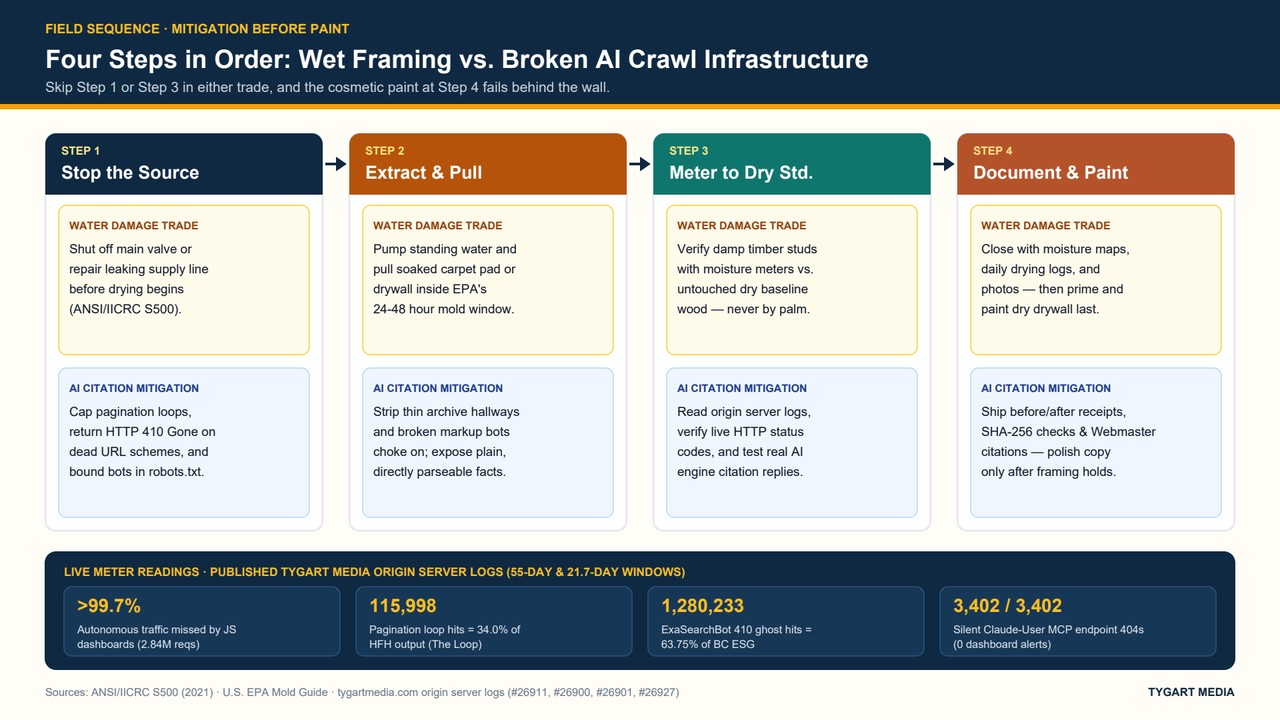
Pressing your palm against painted drywall tells you nothing about a wet sill plate behind it. On a website, your browser analytics dashboard is that palm against the paint. Dashboards count polite browser sessions that execute JavaScript tags; AI crawlers and retrieval agents rarely bother. In our 55-day audit of 2,838,206 requests in Not All Bots Are the Same, tag telemetry missed over 99.7% of autonomous traffic. In a single week reconciled in My Analytics Said 1,000 Visitors. My Logs Said Otherwise, the dashboard reported ~1,000 active users while the origin server logs — the raw ledger your server writes for every request hitting its door — counted 64,561 page requests across 10,345 IPs, over 80% headless. The origin log is the moisture meter.
Press that meter against live sites, and three structural leaks show up behind polished pages — every figure straight from our published server logs:
1. Hallways draining crawl attention. Automated fleets spend finite time on any domain — what Google calls crawl budget, easily drained by unmanaged URL spaces and faceted navigation when owners fail to bound crawler paths under the Robots Exclusion Protocol (RFC 9309). In The Loop: Half My Bot Traffic Is Walking in Circles, one site spent 115,998 requests — 34.0% of its 341,172 55-day page hits — serving numbered archive pages instead of technical guides. On tygartmedia.com, 53.7% of bot transitions leaving archive pages landed on another archive page.
2. Ghosts from old plumbing. In 1.28 Million Requests for Pages That Don’t Exist, one crawler (ExaSearchBot) drove 1,280,233 of 2,008,202 requests — 63.75% of a site’s 55-day traffic — hitting vanished legacy .phtml paths. Under IETF RFC 9110, HTTP 404 Not Found says only missing right now; Section 15.5.11 (HTTP 410 Gone) says permanently retired. Capping dead schemes stops wasted server capacity.
3. Silent doors nobody hears. In An AI Has Knocked on This Endpoint 3,402 Times. Nobody Answered, over 21.7 days, Claude-User knocked 3,402 times on a structured machine doorway — a Model Context Protocol (MCP) endpoint where an AI tool expected an interface — and got 3,402 HTTP 404s in a row. Zero dashboard alarms fired, because failed machine calls never fire browser scripts. Skip the meter and you never hear the knock.
Documentation Isn’t Paperwork — Documentation Is the Job
Anyone who has defended a property claim six months after a dry-out knows the rule: if you didn’t document it, it didn’t happen. Somebody always asks later — What was wet? What did you pull? How do you know it hit dry standard before closing the wall? Moisture maps, daily psychrometric logs, and dated photos are not paperwork tacked onto restoration. They are the job.
We run AI citation work on the exact same receipts: before-state snapshots, origin logs, external live status checks, and file checksums. Before offering our AI citation service, we proved the pattern on our own experimental site using first-party Bing Webmaster Tools data — 3,218 Bing AI citations from 144 clicks — not third-party rank guesses. As we wrote in Mad Libs for Machine Learning, AI fills vague blanks with a guess or a competitor’s name, so locking verified facts into clean pages matters — backed by the written work-order discipline in Two Droids and a Farmboy.
Where the Parallel Bends — And What Still Holds
Honest parallels tell you where they stop working. This one bends in two real places.
First, pipes obey physics faster than crawlers forget old maps. Shut a valve and run dehumidifiers, and wet studs follow a predictable drying curve. On the web, even after our server returned HTTP 410 Gone on dead .phtml paths, ExaSearchBot still replayed 1.28 million stored URLs over 55 days. Stopping the source protects your server immediately, while external crawl queues clear on their calendar.
Second, a dry 2×4 stays dry; AI engines keep moving. Once a roof valley is flashed and studs hit dry standard, a wall stays dry. Answer engines update models and reweight sources constantly. That does not argue for endless retainers; it argues for re-checking the meter after major site changes — the way a building engineer walks the roof after a winter storm.
With both seams named plainly, the spine holds: AI visibility isn’t a marketing problem with a paint job; it’s a mitigation problem with a dry standard — and anyone asking to fix yours should be able to show you the meter readings.
Smokejumpers, Not Retainers
The National Interagency Fire Center defines smokejumpers plainly: experienced firefighters who parachute in where roads don’t reach to hit an ignition fast and stop the spread. Nobody keeps smokejumpers on a twelve-month retainer to discuss forest aesthetics on calm Tuesdays. You call them when something is burning, they drop straight onto the trouble, put a hard line around it, and hand you the map when it is cold.
That is why our pricing page carries the heading How We Work: Smokejumpers, Not Retainers — scoped scans, fixed-price fixes, and receipts instead of six-month contracts. If you have read a dozen posts across Tygart Media — from The Loop and 1.28 Million Requests to Mad Libs and Two Droids — you have seen the four closing lines about coming from restoration and wanting your worst mess. Until tonight, those lines were a signature without their story. Now you know the floor they came off of.
— Will Tygart, Tygart Media.
Get The Signal
What we actually ran, what it measured, and what it means for a restoration shop — every week, including the flops.
Leave a Reply