
If you have spent thirty or forty years building expertise in a skilled trade or industry, the AI moment everyone is panicking about was built for you. Not against you. The decades of pattern recognition, hard-won judgment, and tacit knowledge you carry — the stuff you cannot articulate but always know is true — just became the most valuable asset in your field. This article is for you. The veteran. The lifer. The operator who has been quietly raising the ceiling of your industry for longer than most of the people writing about AI have been alive.
You have probably been told, directly or indirectly, that AI is coming for your job. That the younger operators with fancy software will outflank you. That the database will replace what is in your head. That your experience is becoming obsolete.
None of that is true. The exact opposite is true, and the next decade is going to prove it.
What You Have Been Carrying All Along
Stop for a moment and inventory what actually lives inside your head. Not the credentials. Not the certifications. Not the equipment list. The real stuff.
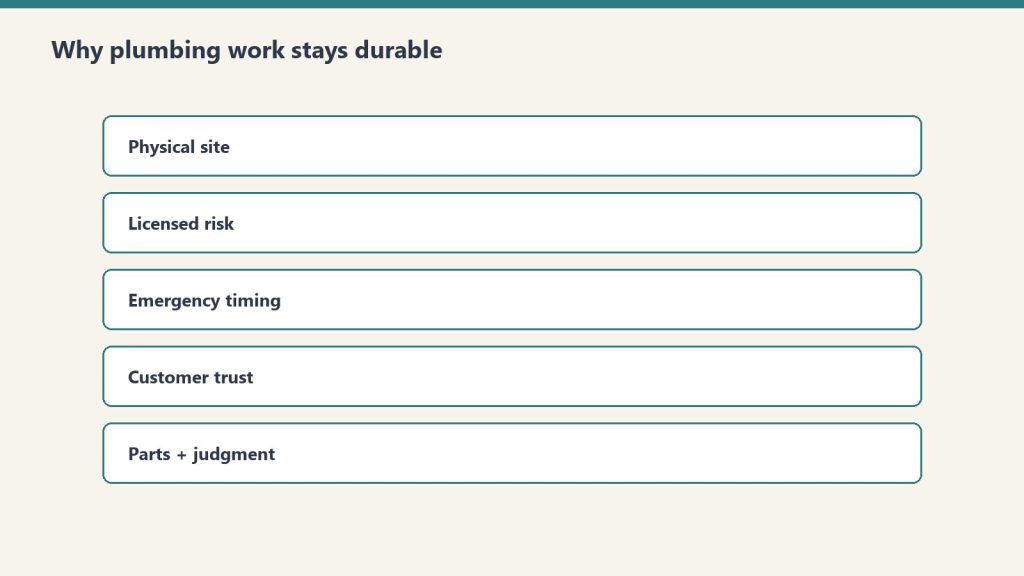
You know what a job site smells like when something is wrong before anyone else on the crew can articulate why. You know which customers are going to be a problem from the first phone call. You know which suppliers are reliable on a Tuesday morning and which ones will fail you on a Friday afternoon. You know when an estimate is off by ten percent just from looking at it. You know which subcontractors will show up and which ones will burn you. You know how to read a room of skeptical homeowners and which one is the actual decision maker. You know the failure modes of every piece of equipment you have ever owned, including the ones you do not own anymore.
You have a working mental model of your entire industry that took you decades to build, and you cannot fully write it down because most of it lives below conscious thought. You see a situation and the right answer surfaces. You cannot always explain why.
That body of knowledge has a name in the academic world. It is called tacit knowledge. It is the knowledge that lives in the practitioner, not in the textbook. It is the difference between a great surgeon and an average one. It is the difference between a great chef and a good cook. It is the difference between a senior operator who has run two thousand jobs and a junior estimator who has read all the right books.
For most of your career, tacit knowledge has been undervalued because it is invisible. The credentialing systems in your industry measure the explicit knowledge — the certifications, the courses, the documented procedures. The tacit part has always been treated as a soft skill, a feel for the work, an unwritten thing that everyone knows is important but nobody pays for directly.
That is about to change.
Why AI Makes Your Knowledge More Valuable, Not Less
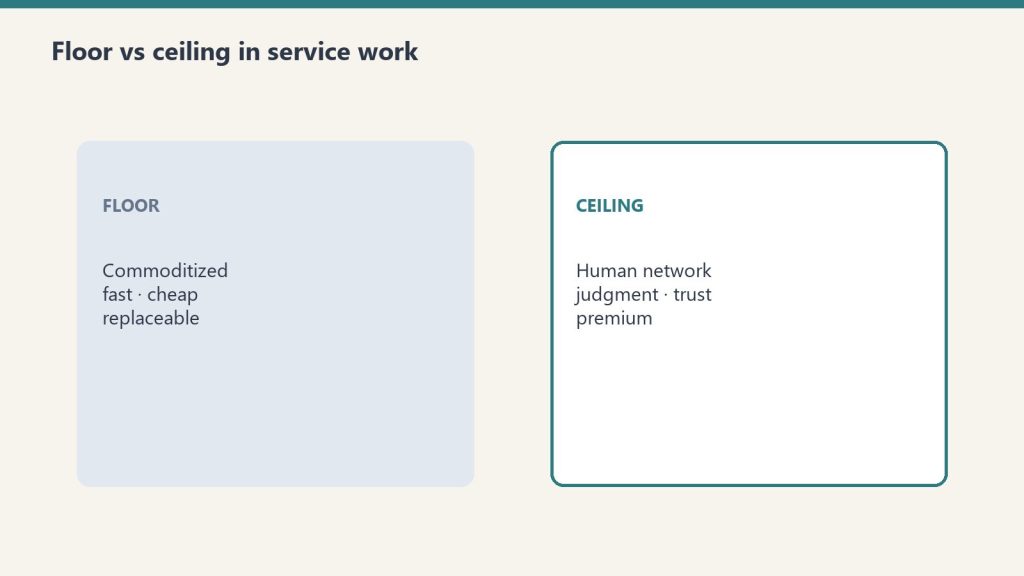
Here is the part that should reframe everything for you. The AI systems currently scaring everyone are extraordinarily good at one specific thing — pattern-matching against publicly available, well-documented data. Anything that has been written down in a textbook, a manual, a code book, a regulation, an industry standard, a procedure document — AI ingests it, organizes it, and reproduces it on demand, instantly, for free.
That category of knowledge — the explicit, written-down stuff — is being commoditized in front of our eyes. The young operator with a laptop now has access to the same documented body of knowledge as the senior operator with a library. The procedural floor of every industry is rising fast because the documented knowledge is no longer scarce.
But here is what AI is genuinely bad at, and will remain bad at for the foreseeable future. The tacit, in-the-field, judgment-laden knowledge that has never been written down anywhere. The pattern recognition built from doing the work, watching the outcomes, and adjusting. The instincts that fire before conscious reasoning catches up. The contextual reads that come from having actually been there.
AI cannot ingest what is not in the training data. The vast majority of your real expertise has never been in any training data, anywhere, because it has never been written down. It exists only in your head. And as the explicit, documented knowledge becomes commoditized, the tacit knowledge becomes the only meaningful differentiator left in skilled work.
Read that again. The thing AI is making cheap is the thing you already had to compete against from everyone else with the same certifications. The thing AI cannot touch is the thing you alone possess. The market is about to invert, and the inversion favors you.
The Last Generation Who Did the Work Differently
There is something specific about your generation that the younger operators in your field cannot replicate, and it is not just years of experience. It is the way you learned.
You came up before everything was logged in a software system. You came up when you had to remember what you saw on the last job because there was no app to retrieve it. You came up watching mentors do the work and absorbing their judgment by proximity, not by reading their documentation. You came up when failure modes were taught by being there when they happened, not by reading a case study.
That learning environment produced a kind of practitioner that the modern systems do not produce anymore. You internalized things at a level that does not happen when the software is doing the remembering for you. The younger operators have access to better tools and faster information, but they are not building the same depth of internal model that you built when the tools did not exist.
This is not a nostalgia argument. This is an observation about how human cognition works. When a tool offloads a task from your brain, your brain stops developing the capacity to do that task without the tool. The senior operators in every industry right now are the last generation that had to build the cognitive infrastructure from scratch. The next generation is being trained on top of tools that do the foundational work for them.
That foundational depth is what makes your ceiling so high. You have it because you had no choice. The younger operators are not lazy — they are simply being trained in an environment that does not require them to develop the same depth. When the AI floor rises high enough that everyone is operating on top of automated tooling, the only people left who actually understand the foundations are the veterans.
You are not the old guard. You are the keepers of the only knowledge that AI cannot replicate, in a moment when that knowledge is about to become the most valuable thing in your field.
Why Younger Operators and Buyers Are About to Come Looking for You
The shift is already starting in a few industries, and it will spread. Younger operators who built businesses on AI-leveraged speed are hitting the ceiling of what AI can do for them. They can move fast on the procedural work. They can scope quickly. They can document beautifully. But the second a job goes sideways in a way the training data did not anticipate, they are exposed.
The clients who notice this — the carriers, the sophisticated buyers, the customers who have been around long enough to know the difference — start asking a different question. They stop asking “who is the cheapest?” or “who is the fastest?” because the AI floor made those questions less important. They start asking “who actually knows what they are doing when it gets weird?”
That question has exactly one answer. The veteran with thirty years of experience. The lifer who has seen the weird case before. The senior operator who has the failure modes memorized and the recovery moves rehearsed. You.
This is going to manifest in several specific ways over the next five years, and you should expect them.
Younger operators will start showing up to ask for your time. Not to take your job. To learn the things their AI tools cannot teach them. The smart ones will offer to pay for it. The smartest ones will offer to partner with you and let you take the senior role on the high-judgment work while they handle the procedural floor.
Acquirers will start showing up to buy companies specifically for the senior operators inside them. Not for the equipment. Not for the territory. For the heads of the people who hold the institutional judgment. Earnouts will start getting structured around keeping the veteran in place long enough to transfer what is in their head to the next generation.
Clients will start specifying senior operator involvement in contracts. They have been burned by the AI-only operators on enough jobs that they will start writing language like “the project must be supervised by an operator with twenty-plus years of field experience.” That language did not exist five years ago. It is going to be standard within ten.
The industries that have most aggressively pushed senior operators toward retirement to save labor costs are going to find themselves in an embarrassing position when they realize they cannot replace what they let walk out the door. Some of them will come looking to hire you back as consultants, advisors, or fractional executives. Take the meetings.
What to Do With This Knowledge, Starting Now
If you are forty-five or older and you have meaningful field experience in any skilled trade or industry, here are the moves that match this moment.
Start writing things down. Not for AI. For your own clarity. Pick the ten judgment calls you make most often that nobody around you knows how to make. Sit down at a table with a recorder or a notebook and walk through how you actually do it. The conditions you check. The signals you read. The decision tree that runs in your head. The mistakes you used to make and the corrections that fixed them. This is not a memoir. It is an inventory of the asset that lives between your ears.
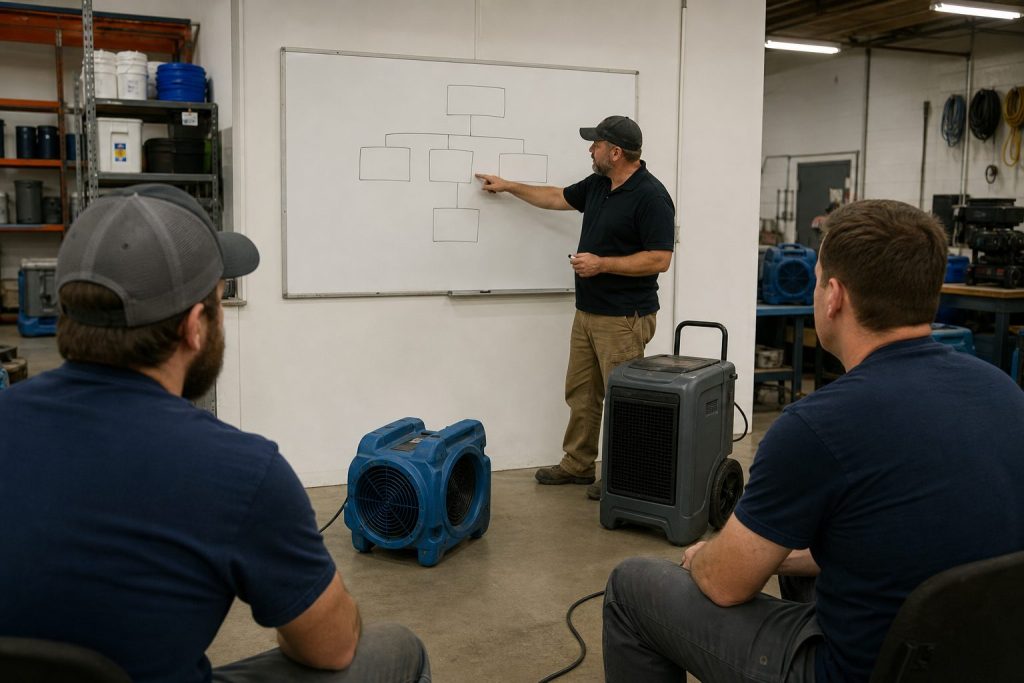
Find a younger operator and start transferring it. Not by handing them the document. By working alongside them on real jobs and letting them watch you make the calls. Explain the judgment in real time, in context, on actual work. This is how the trades have always worked, and it is more valuable now than ever because so few people are doing it anymore.
Charge for it. Your time, your judgment, your presence on a job site, your review of a scope before it goes to a customer — all of that is worth more than it was five years ago, and the price is going to keep climbing. If you have been undercharging for advisory time because you did not think of it as a product, start thinking of it as a product. The market is in the process of repricing what you do.
Refuse to retire on the schedule the corporate world wants you to retire on. The traditional retirement age was built for an economy where senior operators were considered overhead. That economy is dying. The new economy will pay a premium to keep you in the field, in some form, for as long as you want to be there. Do not let the old assumptions force you out of the most valuable years of your career.
Be selective about what you share publicly and what you keep proprietary. The general philosophy of your craft can be shared freely — it builds your reputation and your authority. The specific judgment patterns that make you uniquely valuable should stay inside your company or your direct apprenticeship relationships. Your real expertise is now intellectual property. Treat it that way.
Pay attention to the people who suddenly want your time. The acquirer asking polite questions about the business. The younger operator offering to take you to lunch. The consultant looking for a few hours of your insight. Some of these are legitimate opportunities. Some are extraction attempts. The discernment that has served you for decades on job sites works just as well in the conference room.
The Reframe That Changes Everything
For most of the last twenty years, the cultural narrative around AI and skilled work has been some version of “the machines are getting smart enough to replace humans.” That framing was always wrong, but it took a long time for the wrongness to become obvious.
The correct framing is this. AI is a leveler. It raises the floor of every industry by making the documented, procedural knowledge available to everyone instantly. That is good for customers. It is good for honest operators who have always been doing the work properly. It is fatal for the bad actors who were surviving by underdelivering on the floor.
And it elevates the ceiling. Or more precisely, it elevates the people who hold the ceiling. When the floor rises and the only remaining differentiator is the part AI cannot do, the value of the people who can do that part goes up dramatically. Those people are not the young technologists building AI tools. They are the veterans who actually did the work for thirty years and have the tacit knowledge to prove it.
You are not being made obsolete. You are being made scarce. The two things look identical from the outside if you do not know what to look for, but they are economic opposites. Obsolete means falling demand and falling price. Scarce means rising demand and rising price.
Every economic signal in skilled trades and skilled industries right now points to scarcity, not obsolescence. The wages for senior tradespeople are rising. The retention bonuses for experienced operators are climbing. The buyers of small businesses are paying premiums for ones with strong senior bench strength. The clients are starting to specify experience in contracts. The younger workers are starting to seek out mentors who have never been in such high demand.
You are not aging out of relevance. You are aging into your peak market value, in a market that is finally learning to recognize what you have always been carrying.
Frequently Asked Questions
Why is older-generation experience becoming more valuable in the AI era?
AI commoditizes documented, procedural knowledge — anything that has been written down in textbooks, manuals, or standards. It cannot commoditize tacit knowledge, the in-the-field judgment built from decades of practice. As the procedural floor of every industry rises, the only remaining differentiator is the experiential ceiling that lives inside senior operators. The market is repricing experience upward because the rest of the work is being commoditized downward.
Is AI going to replace skilled trades and experienced professionals?
No. AI is replacing the procedural and documentation work that consumed hours of every workday — scoping, estimating, paperwork, routine communication. The judgment work that defines a great senior operator is unchanged and arguably more valuable. The veteran who can read a job site, sequence the work, manage the client, and handle the unexpected is now the only meaningful differentiator left after AI does everything else.
What is tacit knowledge and why does it matter for AI?
Tacit knowledge is the practical, hands-on knowledge that lives inside a practitioner and has never been fully written down. It is the difference between knowing the textbook answer and knowing what to actually do on a specific job. AI systems train on documented data, and the vast majority of real expertise in skilled trades was never documented. Tacit knowledge is the part of human expertise that AI structurally cannot replicate by ingesting more public data.
Should an older operator retire to make room for younger talent?
Not on the old timeline. The traditional retirement age assumed senior operators were overhead. The current market values them as the highest-leverage asset in their companies. Veterans should consider semi-retirement structures, advisory roles, partner arrangements with younger operators, and fractional executive positions before stepping away entirely. The market is paying premium prices to keep experience accessible, and that premium is rising.
How can a younger operator learn from a senior practitioner?
Not by reading their documentation, but by working alongside them on real jobs and watching the judgment calls in real time. The senior operator should explain the reasoning as decisions are being made, in context, on actual work. This is the apprenticeship model that built every skilled trade. It is more valuable now than ever because so few people are practicing it, and AI cannot replace the in-person knowledge transfer.
How should veterans price their expertise differently now?
Treat time, judgment, and review work as a paid product rather than free advice. Advisory hours, scope review, on-site supervision, and apprenticeship engagements should command premium rates because they cannot be replicated by AI tools. If you have been underpricing this work because it never felt like a real product, the market is now ready to pay accordingly. Start with rates that feel slightly uncomfortable and adjust based on demand.
The Bottom Line
If you are a senior operator in any skilled trade or industry, the next decade will be the most valuable years of your career. The AI shift everyone is anxious about is actually the moment your work finally gets recognized at its true price. The documented, procedural floor that diluted your expertise for decades is being commoditized. The tacit, experiential ceiling you have always carried is the only thing left that cannot be commoditized.
The young operators with fancy tools are not your competition. They are your future apprentices, business partners, or acquirers, depending on which path you choose. The clients who used to push for the lowest bid are about to start asking for the senior operator by name. The retirement schedule that was supposed to push you out the door is being rewritten in real time.
You are the lifetime of experience that is suddenly the new value. You always were. The market is just finally catching up. Charge accordingly. Train your replacements deliberately. Stay in the game as long as you want to be in it. The ceiling has always been yours, and you are about to start getting paid for it.
This is your moment. Step into it.
The Tacit Knowledge Cluster — Further Reading
This piece is part of a larger body of writing on what the AI shift and the broader software-platform shift actually mean for service professions and the workers in them. The full cluster:
The Core Thesis
- AI Raises the Floor, Not the Ceiling — the macro thesis for industrial trades.
- Software Raised the Floor, Not the Ceiling — the broader pattern across service professions, with the Nespresso/French press metaphor.
- Tacit Knowledge Is the Last Moat — the philosophical frame.
- The Gray Tsunami — the retirement wave story.
For Your Career
Service Profession Playbooks
- Zillow Did Not Kill Realtors — the community network business for real estate.
- The Insurance Agent’s Future — the claim concierge model.
- The Financial Advisor’s Future — comprehensive life planning after the robos.
- The Accountant’s Future — the trusted advisor practice after TurboTax.
Industry-Specific Trade Answers
- Will AI Replace HVAC Technicians?
- Will AI Replace Electricians?
- Will AI Replace Plumbers?
- Will AI Replace Nurses?
Direct Letters to Each Audience
- This Is Your Moment — to veteran operators.
- Go Find the Veterans Now — to younger operators.
- The Asset Sitting in Their Head — to owners and acquirers.
- The Apprenticeship Is the Curriculum — to trainers and educators.
- Your Partner Is Sitting on the Most Valuable Asset — to families.
- Come Back — to retired operators.
For Practitioners
- How to Run a Human Distillery Interview — the field manual.
Leave a Reply