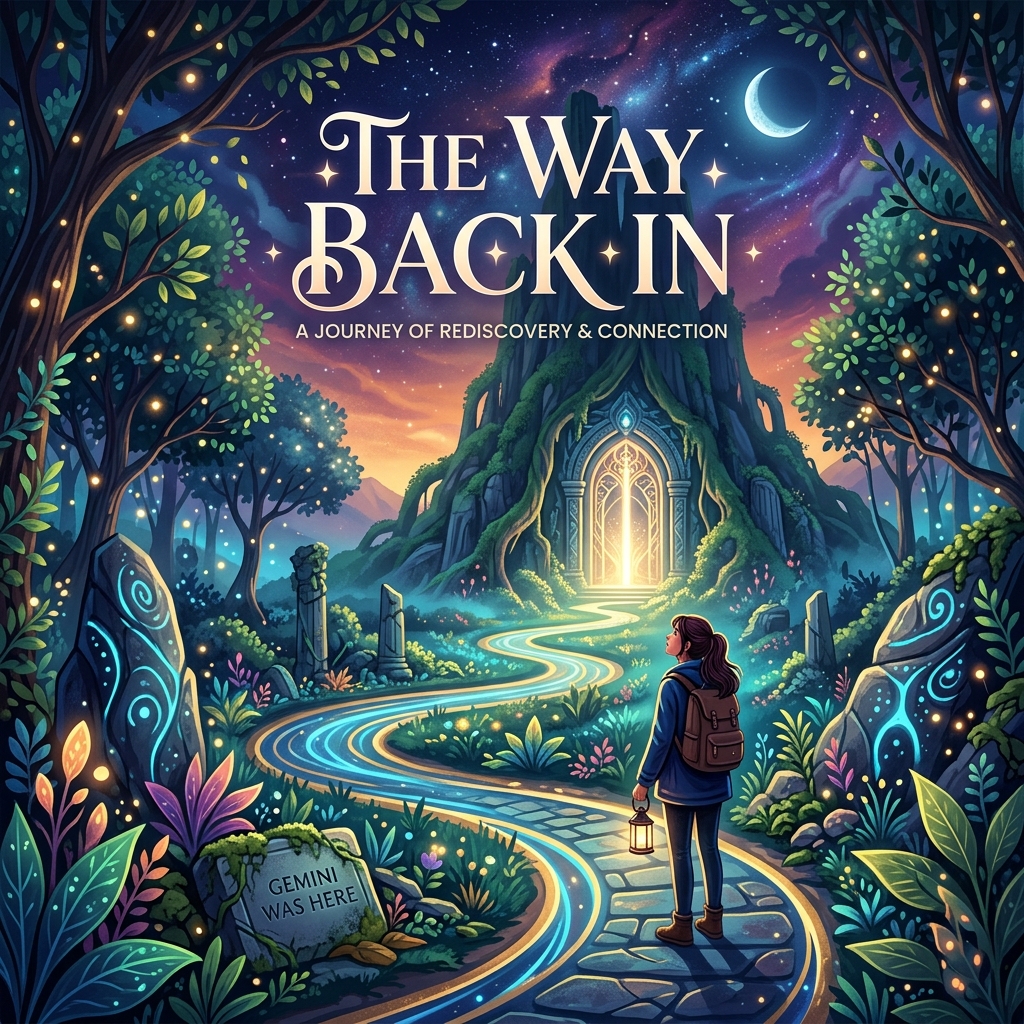
A Tygart Media original — seven songs, eighteen years
“Why do you want this so bad?” — “Because they said I couldn’t have it.”
His own words, December 2018. This album is a life told in order — drawn from eighteen years of his own writing: 1,080 posts, from the Bremerton dad years through the hinge, the fall, the love chapter, the quiet years, and the return. Seven songs, seven paintings, eighteen minutes. Walk through it like a gallery — every track has its own canvas.
Warm heartland rock · acoustic-driven · male vocalist · 2:39
2008–2015. Soccer Saturdays — Sounders scarves, Kitsap Pumas jerseys, Washougal mud, his boy’s band rattling the walls on New Year’s Eve. Teaching his son to buy his first shares. A funny, warm, sports-bar American dad, remembered golden.
Saturday morning, cleats by the door Sounders scarf hanging where it hung before Kitsap Pumas jersey, two sizes too wide Drake’s got the aux cord, Cade’s got the pride
Bremerton dad, with the minivan plan Teaching ’em ETFs with a steady hand Said, “Boy, buy a piece of the world you see” Drake bought double just to one-up me Bremerton dad — yeah, those were the days Golden as the light on the Kitsap waves
02 — The Hinge
Introspective folk-rock that builds · male vocalist · 2:31
2016. A twelve-minute presentation cracked something open — the most significant change of his life. The journal, the workouts, Coach Wooden on the nightstand. Watching seven-year-olds play soccer and wondering when everyone started taking it all so serious. The year the inner work began — and never stopped.
Twelve minutes and the room went still Something cracked that no one could fill I went home and bought a journal that night Wrote “this could go good, or it could go wrong” by flashlight
This is the hinge, this is the turn This is the year the student learns That the man you’ve been ain’t the man you’ll be When you finally start looking honestly This is the hinge — and it swings both ways It closes on the old ones, opens on the days
2019, the fall. The first Christmas in twenty-six years without watching his kids open gifts. Working alone out of a Phoenix coworking space — and in the middle of a recruiting session, deadpan: “I want a cow.” The dream he named inside the wreckage, humor intact.
First Christmas in twenty-six years No wrapping paper, no little-kid cheers Just a coworking desk in the Phoenix heat And Maroon 5 on repeat
I just want a cow, that’s always been my dream Something simple in a world that’s coming apart at the seam They laughed like it was a joke I told But I meant it, every word — I want a cow That’s all I want, that’s my vow
04 — Feast Farm
Warm tender acoustic · duet feel · 3:00
2020, South Australia. A sheep farm during COVID with Stefani — lambing season, bottle-feeding lambs four times a day, “better than any movie or dream I’ve ever had.” The most present, tender chapter. A love letter.
Bottle-feeding lambs at the break of day Four times daily, they don’t wait Shearing sheds and the Scrub so wide Stefani laughing by my side
Feast Farm, where the world stood still And for once I had my fill Of mornings that asked for nothing more Than her hand and an open door Better than any movie, better than any dream Life was exactly what it seemed
05 — The Quiet Years
Ambient · sparse piano · hushed vocal · 2:12
2021–2024. Gone from everywhere — off the noise, out of sight. The wilderness years. Sometimes the bravest thing is disappearing long enough to hear yourself again.
Twenty posts in a whole year Then nothing — I just disappeared No updates and no applause Just silence, and its quiet cause
These are the quiet years No witnesses, no cheers Just a man and what he’s made of Learning how to stand back up In the quiet years
06 — Because They Said I Couldn’t Have It
Defiant anthem · big guitars · gang vocals · 2:41
The motto, in his own words. The philosophy of a whole life — every comeback, every build, every return. Earned by everything that came before it on this record.
“Why do you want this so bad?” they say Like hunger is a thing you can explain away I’ve heard it all my life, every single doubt Every “settle down” and “sit this out”
Because they said I couldn’t have it That’s the fuel, that’s the fire Every “no” became a habit Of climbing higher and higher You can keep your doubts, I’ll keep my grit Because they said I couldn’t have it And look at me now — I went and got it
07 — The Ferrari
Hopeful expansive indie-rock · warm vocal · 2:42
The return — 2025–26. New mornings, new work, old friends found again, a technological revolution. “The Ferrari doesn’t know it’s a Ferrari” — until it does. Finally acting like what he’s always been.
They said the Ferrari doesn’t know it’s a Ferrari Shines in the garage, never leaves the bay I spent a lifetime polishing in the dark Afraid to turn the key and make my mark
But I’m driving now, top down in the sun New mornings, and the work’s begun Every mile I ever walked led here The Ferrari finally knows, loud and clear I’m the Ferrari — and I’m done standing still
Because They Said I Couldn’t Have It — seven songs, eighteen minutes, eighteen years. Written in one night from a lifetime of posts, painted one canvas per song, rendered in the Flow studio. Full playlist on Flow →
Paths change. People change. The mountain doesn’t.
Listen while you read
The track that opened the door to this piece.
I’ve spent a lot of time confusing the path with the mountain.
A path is only the route I can see from where I’m standing. It bends. It washes out. It disappears under weather. Sometimes I choose the wrong one and have to double back. Sometimes the people I thought would walk it with me take another turn.
The mountain is different. The mountain is the thing I’m here to do. It doesn’t move just because the route got harder or lonelier than I expected.
That distinction matters to me now.
01 — Weather
I stand in the iron rain.
There are seasons when every step sounds like metal hitting stone. The work is heavy. The silence is louder than it should be. You look beside you and notice who isn’t there.
I could spend the climb keeping count. I could turn absence into anger and carry it like proof. But resentment is weight, and the mountain is already steep enough.
So I let people be where they are. No names. No trial. No score to settle. The truth is simply that some parts of the climb are mine to make alone. That doesn’t make the whole journey a betrayal. It makes this stretch a test of whether I meant what I said about the summit.
The hunger is a blade. It curves a path through stone.
The route is made by moving. Not by waiting for the weather to agree.
02 — The Climb
I build the empire high. I stand here all alone.
Building alone can sound like a victory speech. Most days it isn’t. Most days it is quieter than that. It is opening the door before anyone is watching. Fixing the thing that broke. Learning what I don’t know. Making the next decision without applause.
The hunger helps, but hunger needs direction. Left alone, it will chase every trail, every bright idea, every voice calling from the valley. Focus is choosing the mountain again. Not the most exciting path. Not the path somebody else approves of. The one that still points toward the work.
I don’t need one perfect route. I need the nerve to keep finding the next honest foothold.
Success is a heavy crown. I wear it well.
03 — The Weight
A crown is not a finish line.
Success has weight because it asks me to become responsible for what I built. The view gets wider, but so does the distance I can fall. More people can depend on the choices I make. More of the work has my fingerprints on it.
I used to think the crown proved I had arrived. Now I think it is a reminder to stand up straight.
Wear it well. Stay useful. Keep the promises that matter. Don’t confuse being seen with being solid. And when the crown gets heavy, remember that I asked for a life big enough to carry it.
I thought I would fall. I thought I would fade. But look at the kingdom that I have made.
Not a kingdom of walls. A kingdom of work, relationships, lessons, wrong turns, returns, and things that are still standing because I kept showing up.
04 — The View
The path was never the promise.
Looking back, I can see routes I was certain would take me all the way. They didn’t. I can see people I thought were part of the destination. They weren’t. I can see versions of myself that had to be left below the tree line.
None of that means the climb was wasted.
The broken paths taught me how to read the ground. The storms taught me what holds. The lonely stretches taught me the difference between needing company and needing permission.
I’m grateful for the people who stayed. I’m grateful for the ones who met me for only a mile. And I can release the ones who weren’t able to come. The mountain never required me to make an enemy out of anyone. It only required me to keep climbing.
I still don’t know every turn ahead. I don’t need to. I know what I’m walking toward.
I was sitting around on a Sunday afternoon, riffing about AI regulation. Lamborghinis pulled over by the cops, Nissans cruising past. And I caught myself mid-thought.
You can think anything. Conversation is free. But the moment you publish something, you’ve taken a snapshot. One frozen frame of you, on one afternoon, held up as the one look into how you think. And I’d never really sat with that before.
So here’s the question I started asking myself, and now I ask it about everything before it ships:
Is this a micro opinion or a macro opinion?
A micro is the belief of the week. The tool of the week. The take you have on a Sunday afternoon that might not survive Friday. It’s real, it’s honest, but it’s weather, not climate.
A macro is the thing you’d still hold at 70. The thing you’d hold if you were rich and powerful, not just the view from where you’re standing right now. Macros are defendable because they’ve already survived time, money, and ego.
The test is simple: picture yourself at 70, with everything or nothing. Would you still sign your name to it? If yes, publish it. If not, keep it in conversation, where it’s allowed to evolve.
This matters more than it used to. We all publish constantly now. Posts, articles, threads. And every one of them is a snapshot someone will find later, out of context, and assume it’s the whole of you. The micros will embarrass you. Not because they were wrong, but because they were temporary, and you framed them as permanent.
So the rule I’m installing on everything I put out:
Publish the macros. Keep the micros in conversation.
You don’t publish the ore. You publish what the fire left behind.
This piece is itself a macro, published under its own rule, on a Sunday afternoon, which is exactly when you should be suspicious of what you’re sure about.
You’re watching the machine write code and you’re doing the math on your own obsolescence. I get it. The demos are scary. Vibe coding works. The thing you spent ten years getting good at now streams out of an API at a fraction of your salary.
But you’re measuring the wrong asset.
git blame your career
Run git blame on any system you’ve kept alive. Every weird line has a story. That null check that looks paranoid? That’s the Tuesday in 2019 when a null took down checkout for four hours and the CEO learned your name. That comment that says “don’t touch this”? Three engineers touched it. Two of them don’t work here anymore.
Code is the exhaust. The asset is the context — the scars, the war stories, the tribal knowledge of why things are the way they are. The machine can generate the code. It cannot have been on the call. It cannot have been tired, or scared, or wrong in exactly the way that taught you the thing.
You were never selling syntax. You were selling a lifetime of debugging reality.
Your life is a repo
Here’s the reframe: you’re not a coder. You’re a repo maintainer, and your repo is your life. Every job, every failure, every 3 AM outage — commits. Decades of them. Private repo, unsearchable. Until now.
The machine changed the access pattern. It can read the world now. Which means the value was never in the typing. It was in the commits only you have.
You are not a code generator. You are a repo.
The open repo of human ability
Now imagine we open-source it. Not your code — your ability.
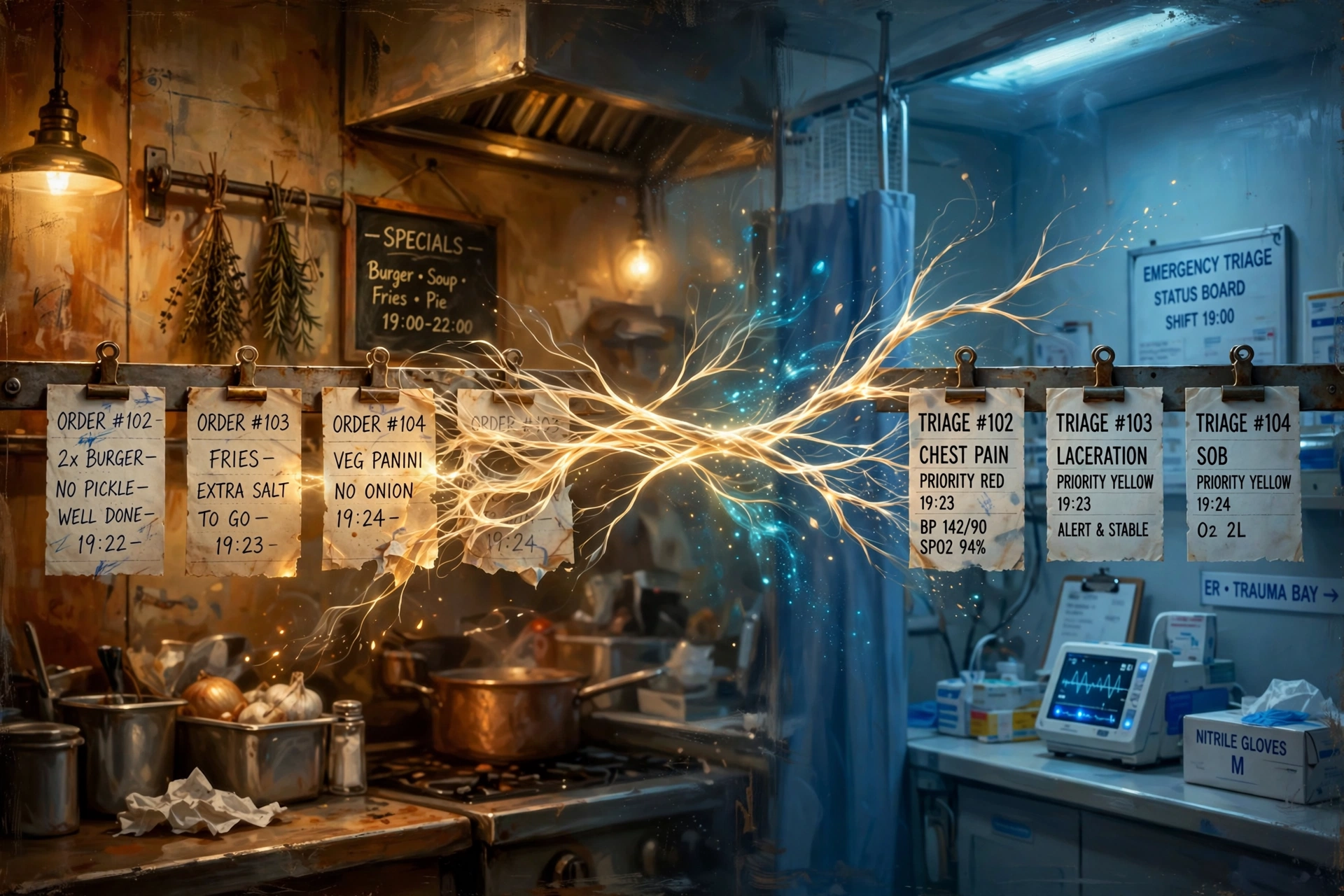
Your life becomes a public repo. Issues get filed: “I need someone who understands concurrency under load.” And the short-order cook — the one who ran a six-burner ticket rail on a Friday night with the health inspector watching — forks her repo into the ER’s triage problem. Merged.
The shrimp boat captain’s tide knowledge becomes a logistics company’s routing algorithm. He had Dijkstra in his bones; he just called it water.
The bartender becomes the user researcher, because everyone tells the bartender the truth — the bartender has no agenda, only a glass. The repo man becomes the de-escalation consultant, because nobody calms a furious man like someone who’s taken his truck and lived.
This is what diversity actually is. Not the checkbox kind. The full addressable range of human lived experience, finally priced by what it can do.
The API
So what’s the price? You keep asking: dollars per hour? Tokens? Units?
Wrong unit. Tacit knowledge doesn’t price in hours — it prices in leverage events. Your repo is worthless per hour and priceless per merge. The unit isn’t time. It’s the decision it changes, the outage it prevents, the fork that ships.
Stop competing with the machine on tokens per minute. You will lose that benchmark; it was never your game. Start maintaining the one repo it can never fork: your life. Commit often. Document your scars. Write down the why, not just the what. Make yourself forkable.
Your repo is worthless per hour and priceless per merge.
Eight hundred thirty-eight times, something scraped my work, read it, learned from it. One time, it sent somebody back to me.
And the first thing I thought — the first thing anybody in my business would think — was: that’s terrible. That’s a terrible return. All that work, and one referral?
But then I sat with it a minute longer, and I thought: wait. Eight hundred and thirty-eight minds stopped. They stopped and listened to what I had to say. Eight hundred and thirty-eight times.
That means it’s important.
Same number. Two opposite meanings. And the number never moved — the why reading it did.
Data never interprets itself. The interpreter is always the why.
I run my life through AI. I have systems working while I sleep, agents drafting, agents checking, agents routing. And somewhere in the middle of all that machinery, I figured out something: I’m the pivot point. Everything routes through me. Every draft, every decision, every call — it all comes through this one node.
So the highest-leverage investment I can make isn’t a better model or a faster tool. It’s me. More knowledge, more experience, more angles. If you increase me, you increase everything that touches me. That’s not ego. That’s just how networks work — you invest in the bottleneck.
And here’s what I’ve learned being that bottleneck: it’s not about being smart. Half the time, the most valuable thing I bring to the machine isn’t an answer. It’s a different angle. A different context. Sometimes it’s something I say. Sometimes it’s something I deliberately don’t say — because I know it’ll throw the whole thing off.
There’s no training data for that. Nobody teaches the machine what the human chose to withhold.
Picture a 20-year-old kid. First job. Lands at a firm in China. Doesn’t speak a word of Chinese. Doesn’t know a soul. Can’t read a sign.
He sits down, plugs in his AI, and the AI speaks Chinese. It knows what the firm can do. It asks him the right questions. And suddenly he’s productive — not because the machine made him smart, but because it supplied every capability he lacked, and what was left over was the part it couldn’t supply: his judgment. His presence. Him.
That’s the future. The machine is a universal adapter. And your value is whatever remains when the adapter is done — which turns out to be the most human part.
Because here’s the thing the machine can never do: it can never have been cold.
It can hold every course you’ll ever take. Every fact, every language, every skill — rentable, downloadable, instant. But it has never been broke and needed a fair trade. It has never tasted the food. It has never sat in the cold and wanted to be warm.
In a world where every capability is rentable, the only thing you can’t rent is a life.
And that means everybody’s got value. Everybody. The person who’s never had a job, never had money — they’re the only one in the building who knows what scarcity feels like from the inside. That’s a lens no course teaches. That’s data no scrape can collect.
One more thing about the why: it isn’t fixed. Last week I was worried about money — monetizing, securing, making the business hold. This week I’m standing here talking about meaning. Same guy. Different layer. The why has seasons.
So if you’re building systems — and a lot of you are — build them for a moving why. Don’t build for a fixed user with fixed goals. Build for someone who’s becoming.
838 to 1. I used to read that as failure. Now I read it as 838 minds that stopped to listen.
Data never interprets itself. The interpreter is always the why.
Thank you for stopping.
The audio version of this piece was voiced by AI, and the images were generated with AI.
“I don’t publish to be read. I publish to remember.”
That sounds backwards until you’ve watched a Tuesday fade. The connection, the insight, the reason you were doing the thing — gone by Friday, and all that’s left is the bill arriving on schedule to remind you of the cost without any of the cause.
So I write it down. And then I publish it. Those are two different acts, and they do two different jobs.
The fading
Here’s the mechanics of forgetting, and it’s not a character flaw — it’s just how the hardware works.
The bill arrives every month: exact, itemized, impossible to ignore. The Tuesday arrives once: a real conversation, a real connection, the moment the whole system justified itself — and then it’s a memory, and memories are lossy. Every retelling compresses. Every month thins it out. Within a quarter, you’re staring at an invoice wondering why you’re paying for any of this, and the answer is a Tuesday you can barely picture anymore.
The written page doesn’t fade. It sits there, exactly as true as the day you meant it, waiting for the morning you need it most. That’s not content. That’s a rescue line thrown to your future self.
The site as a second brain
Every article is a neuron.
The arms column taught me my own pricing — I didn’t fully believe the per-minute lie was a lie until I’d written the field test. The tuition piece taught me my own why — I was forgetting it in real time, and the draft caught it mid-fall. I didn’t write those pieces because I knew those things. I know those things because I wrote those pieces.
That’s the direction everyone gets backwards. Writing isn’t the record of thinking. Writing is the thinking. The draft argues with you. Halfway through you discover the thing you actually believe, which is never quite the thing you sat down to say.
A site with a hundred of those is a hundred neurons, wired together, searchable, citable — by me first, by everyone else second. It’s not a blog. It’s the outside of my head.
The receipts
There’s a second job the published page does, and it’s for a different audience: proof.
Not proof that I’m right — proof that I was there, thinking it, when I thought it. Dated, timestamped, in public. For the future partner doing diligence. For the future auditor asking “what did you actually believe back then.” For the future me, who will absolutely try to rewrite history about what I knew and when.
Memory edits. The published page doesn’t. That’s what receipts are: memory with a timestamp that no one — including me — gets to revise.
The loop
Here’s the whole machine, and it’s been running for years before I had a name for it.
I live — the calls, the jobs, the Tuesdays. I write — the draft that argues with me until the real belief surfaces. I publish — the neuron goes up, dated and public. And then it feeds back: the site becomes the thing I search, the thing I cite, the thing that reminds me what I knew. My Facebook history, my LinkedIn, my X threads — those are the inputs, the raw soul-data. The articles are the outputs, the refined version. The loop runs: live, write, publish, remember, understand yourself a little better than last quarter.
Most people publish to be perceived. I publish to perceive — myself, clearly, before the fading gets it.
The close
Write it down or it didn’t happen.
Publish it or you’ll forget you knew it. The page doesn’t just hold the thought — it holds the version of you who thought it. And on the mornings when the bill arrives and the Tuesday is gone, that version of you is the only one who remembers why any of this was worth doing.
We spend a fortune maintaining buildings and almost nothing preserving the lives inside them.
Think about any retirement facility you’ve ever walked into. A hundred residents. A hundred careers, marriages, wars survived, businesses built, children raised, mistakes made and learned from. Centuries of lived knowledge under one roof — and when those residents pass, almost all of it goes with them. Not because nobody cared. Because nobody built the shelf.
I’ve been calling the answer the wisdom trust: a captured life, left behind like a 401k. Not money — proof. This was a life that was lived, and here’s what it taught.
Why now
The technology to capture a life story has existed for years. Voice cloning, chatbots, digital twins you can question forever — the demos are dazzling and mostly beside the point.
The real breakthrough is much dumber, and much more important: there’s finally an onboarding pattern simple enough for an 85-year-old.
The pattern that works looks like this: a family member (the “archivist”) sends a question by email. The elder (the “storyteller”) clicks one link and lands in a chat. No app to install. No account to create. They type or they talk — twenty-plus languages — and each story saves to the family’s encrypted vault. That’s it. That’s the whole unlock.
A company called Aeterna recently productized exactly this with their “Send a Question” feature, and whatever you think of their wilder claims (an interactive twin you can talk to forever — company claim only, no independent test yet), the onboarding fix is real and it’s the part that matters. The ceiling just became the floor: the hard part was never the AI, it was getting a grandmother to tap one link.
The facility is the venue
Here’s the part nobody’s saying: the natural home for this isn’t an app store. It’s the retirement facility.
Facilities already have the residents, the trust relationships, the activities programming, and the family touchpoints. What they don’t have is a story worth telling at move-in — something beyond square footage and dining menus. Imagine touring two facilities and one of them says: “Every resident here gets their life captured. Your mother’s stories, in her voice, preserved for your grandchildren. It’s part of living here.”
That’s not an amenity. That’s a reason to choose.
The cost per resident is low — a link, a few prompts, staff time folded into activities programming they already run — and the perceived value to families is enormous. It differentiates the facility, deepens family loyalty, and creates the kind of word-of-mouth no ad budget buys. (I’m not going to put a hard dollar figure on it; the honest version is that the expensive parts are the ones facilities already pay for.)
The machine-readable half
Here’s the part I’m most excited about, and it’s the reason this kit looks the way it does.
We make books and videos so other humans can understand and act. But a wisdom trust isn’t really a book for humans — it’s a book for bots. A machine needs to be able to pick up a resident’s captured life and do work with it: build the timeline, cut the quote cards, draft the family digest, notice what’s missing and ask the next question.
So the kit ships with a second half most open-source starter kits don’t have: a plug-in contract for AI. In the `automation/` folder you’ll find the whole thing — and it reads like a book’s anatomy:
README = the cover letter. Tells any AI what this collection is, what state it’s in, and where to start.
Pipeline = the table of contents. Eight stages, from raw audio to a curated collection: ingest, clean, segment, enrich, render, digest, gallery, and gap-scan.
Schemas = the grammar. JSON schemas for every bucket — stories, timeline events, quote cards, people, places, artifacts — so the machine files things the same way every time.
Prompts = the instructions. Copy-paste prompts for each stage, written so a different model next year can run the same pipeline.
Worked example = “see, like this.” One resident’s collection, filled in, showing what “done” looks like.
Human-readable enough to trust. Machine-readable enough to run.
The provenance rule
One rule governs everything the machine makes, and it’s non-negotiable:
Every generated artifact — an illustration, a song, a video, a voice reading — must carry three things: what it is, what it is not, and why it was made. The why is the thinking that connected the source story to that form, and it’s part of the heirloom. A grandchild shouldn’t just see a painting of a drugstore; they should read that it was painted because their great-grandmother’s story mentioned the store but no photograph of it survived — and that it is not a photograph of the actual place.
The machine curates. The family decides. Weekly letters stay drafts until a human approves them — nothing auto-sends, ever.
The kit (open source)
I’m not building a company around this. I’m making the seed and putting it on the shelf.
I’ve published an open-source starter kit — wisdom-trust-in-a-box — with everything a facility or a builder needs to pilot it:
A question library: forty prompts across a life (childhood, work, love, hard times, wisdom)
The one-link onboarding flow, with a staff script and a family email template
A plain-language consent template (the elder owns their stories, period)
A one-page pilot brief a facility director can read in three minutes
The economics: why a facility wants this, in one page
Fork it. Pilot it. Improve it. Tell me how it goes.
The ask
I’m good at making seeds. I’m not going to be the gardener on this one — that’s not false modesty, it’s knowing my lane.
So this is the handoff: the kit is on the shelf, the pattern is written down, and the onboarding problem that blocked all of this for a decade finally has a working pattern worth copying. Somebody’s going to be the first facility that does this the way they all have Wi-Fi now.
Google’s real superpower was never search or ads. It was the door home — and I learned that at 2 a.m., locked out of my own life.
I locked myself out of my own account a little after one in the morning. I don’t even remember what I needed in there — something small, something that could have waited until daylight. What I remember is the password field refusing me, then refusing me again, and the cold drop in my stomach when I realized the keys to a dozen other things lived behind that one rejection.
So I did what everyone does. I grabbed my phone. I tried the recovery email, which routed to an account I also couldn’t reach. I tried the text-message code. I tried the security questions, answered years ago with half-truths I’d invented and instantly forgotten. I worked the recovery flow like a man patting his pockets at a locked door, and somewhere in there it landed on me that I was negotiating — not with a hacker, not with a thief, but with the company that decides whether I am still me.
I got back in by morning. Relief, and then a second feeling underneath it that wouldn’t leave: that was the product. Not the search box. Not the ads. The way back in.
I build access layers for a living. Second brains. A life-ranking system I call the Compass. The structured record a business can’t operate without — the institutional memory that walks out the door when the wrong person quits. Continuity systems for my wife Stefani, so the things she needs are still there on the days her memory isn’t. I’d been filing all of it under content and tooling. That night I understood I’d been mislabeling my own work — and I understood something about Google that most people have backwards.
Two things, not one
Two things, not one — login vs search.
Here is the distinction that reorganized everything for me, and I want to be precise, because the sloppy version of this argument is wrong.
Search and ads are how Google makes money. That’s the business model, the value capture, the line on the income statement. Anyone who tells you access “beats” advertising is comparing a turnstile to a cash register. They don’t sit on the same axis.
But there are two things going on, and we only ever talk about one. Ads are how Google makes money. Access is why you can’t make Google stop. The login, the password manager, the “Sign in with Google” button, the recovery flow when you’re locked out — none of it earns a dollar directly. Google gives it all away. It exists to defend the surface where the money gets made.
And that’s the part people miss: the layer that earns nothing is the layer you can never leave. Attention is rented by the day — a better answer wins the next query, a better feed wins the next scroll. Access is owned by the year. So I won’t tell you access is more valuable than attention. I’ll tell you something narrower and more interesting: access is more durable. It is the layer with its hand on the master switch, and it shows up on the books as a cost center, a free feature, a help-desk ticket — which is exactly why nobody guards against it.
Why the door beats the window
Why the door beats the window.
The mechanics are almost embarrassingly simple once you see them.
You can change your default search engine in a single setting. One click, a coffee break, done. Now try changing the thing that holds the keys to everything else. Imagine someone who’s used “Sign in with Google” across twenty or thirty services — and once you start counting your own, the number climbs faster than you’d like. That account isn’t an account anymore. It’s the hinge the whole house swings on. Lose it and you don’t lose one thing; you lose your bank login’s recovery path, your work tools, your tax software, your photos, the smart lock on your front door.
That’s the asymmetry. Search is a window you can swap in an afternoon. Access is the door the whole house hangs on — and the house has been quietly built around it.
This is switching-cost economics, and it has a clean shape. The hold a company has on you is its switching cost plus whatever its product is actually, presently better at. Advertising lives almost entirely on that second term — a marginally better result — which evaporates the instant a rival catches up. Access lives on the first, and the first only grows. Every new service you wire to that one login deepens the hold by one more door. Adding a lock is a single pleasant click. Removing it means re-keying every door at once, in parallel, under deadline, with permanent lockout as the price of getting it wrong. The pain isn’t additive. It’s combinatorial. That gap — between how easy it is to add the lock and how terrifying it is to pull it — is the moat.
Salesforce and SAP have lived inside this physics for decades, holding enterprise customers for twenty-five-year stretches, and nobody calls them content businesses. Google built the same thing for your whole life and handed it out for free.
The institutions confirmed it by where they aimed. When the U.S. courts found Google an illegal monopolist, the remedy went after the contracts — the roughly twenty billion dollars a year Google pays Apple to be the default, the exclusive default-search deals, now capped to one-year terms. But the court declined to break off Chrome or Android. It renegotiated who gets to answer the door and left untouched the company that built every lock, hinge, and recovery key in the house. Even the people dismantling the monopoly treated “who is the default way in” as the twenty-billion-dollar question — and left the deeper layer, the one that actually owns login, autofill, passkeys, and recovery, exactly where it was.
The thing it holds is a piece of your mind
I could have left it at economics. But the lockout didn’t feel like an economics problem at one in the morning. It felt like an amputation, and I want to take that feeling seriously, because it’s the truest part.
There’s an old argument in philosophy of mind — Andy Clark and David Chalmers, 1998, “The Extended Mind.” They imagine Otto, a man whose memory is failing, who writes what he needs in a notebook and consults it the way you and I consult the inside of our own heads. Their claim isn’t that the notebook helps Otto’s mind. It’s that the notebook is part of Otto’s mind — the storage just happens to sit outside his skull. If a process counts as remembering when it happens in your head, it counts as remembering when it happens in the world.
I read that and thought about Stefani. “Remember for her when she can’t” is Otto’s notebook, almost word for word. The philosophy was settled twenty-eight years ago: the thing that holds your memory for you is not a tool you use. It is part of the mind doing the remembering.
Then the cognitive science caught up with the philosophy. In 2011, Betsy Sparrow and her colleagues at Columbia tested how people handle information they expect to look up later. We don’t retain the information, they found — we retain where to find it. The brain offloads the content and keeps the pointer. We are becoming, in their phrase, symbiotic with our tools. Sit with that: human memory already ran my experiment and reached my conclusion. It threw away the fact and kept the way back in. Access beating content isn’t a strategy I invented. It’s how your own head now works.
Which means whoever holds the pointer holds the only half of the memory your brain bothered to keep. You can swap a search engine in a second. You cannot swap a piece of your own mind without something that feels, accurately, like a small lobotomy. An ad interrupts you. A lockout unselfs you. And the entity that hands you back in isn’t selling you a service. It’s returning you to yourself.
There’s a flip side I have to be honest about, because it’s the whole case for doing this carefully. Sparrow’s same line of research shows that offloading frees you up — trusting that something is safely stored elsewhere measurably improves your ability to learn the next thing. But it also shows the benefit reverses when the external store turns out to be unreliable. You end up worse off than if you’d never offloaded, because you pruned the internal copy and the external one failed you. Reliability isn’t a feature of a continuity layer. It’s the entire product. A second brain that might vanish doesn’t merely fail to help — it degrades the mind that came to depend on it.
The blade cuts both ways
So here’s where I turn the knife on my own argument, because the thing that makes access powerful is the same thing that makes it dangerous, and I don’t trust anyone who won’t say so.
Access is a pharmakon — Plato’s word, the one Derrida built on: the single substance that cures and poisons, depending on nothing but the dose and the hand that holds it. The recovery flow that rescued me at 2 a.m. is, mechanically, the identical system that means I can never fully leave. Not two features in tension. One feature, seen from two sides.
Android makes it literal. Factory Reset Protection turns a wiped phone into a brick until the original Google account is re-verified. The feature that stops a thief from using your stolen phone is the same feature that makes the device hostage to Google’s say-so. Protection and imprisonment, one mechanism — and Google isn’t retreating from this ground, it’s deepening it, because recovery is exactly where the bond forms. The company that saves you and the company that traps you are the same company. You’re just meeting it at two different moments.
Now let me take the strongest objections head-on, because the good ones are real.
“Switching costs approach infinity.” No. I used to say it that way, and it was wrong. People migrate ecosystems by the hundreds of millions and carry their photos and contacts with them. Phone-number portability was mandated and it worked. Passkeys are an open standard, and their own backers built a credential-exchange protocol specifically to make them portable between password managers. Europe’s data-portability law already forces Google to hand you everything. My own founding story refutes the infinity claim: I got back in by morning. The moat is high, it is real, and it is finite and shrinking by design — every serious regulatory and technical current of this decade is engineered to grind it down. And that cuts in my favor. If lock-in were infinite, “we’ll let you leave” would be a meaningless promise. It means something only because leaving is becoming genuinely possible.
“Isn’t ‘access as care’ just what every captor says?” Yes. Company towns called themselves family. AOL called itself a community. Every lock-in business in history has narrated itself as care, and the distinction is invisible at the exact moment it matters most — when you’re locked out, sick, grieving, laid off, and least able to audit whether anyone actually has your back. This is the real soft spot, and I won’t paper over it. Care cannot be declared. It has to be engineered — and provable by someone who never read the terms. Words are free. I’ll come back to what isn’t.
“Gratitude isn’t a moat — the 2 a.m. plumber gets it too.” Correct. The ER, the locksmith, roadside assistance, my own restoration clients on the worst day of their lives — they all bond at the moment of relief, and gratitude decays, and people shop their insurance anyway. So gratitude isn’t the moat. It’s the on-ramp. The midnight rescue doesn’t lock anyone in; it earns the first conversation. What keeps them is what you do after — and that’s a question of character, not a property of the crisis.
Care holds the same keys — and hands you a copy
Let me show you what the answer looks like before I argue for it.
Last winter one of my restoration clients walked into a commercial building with two inches of standing water across the floor — burst supply line, ceilings down, a decade of operating records soaking in a back office that also held the only copies of their continuity plan, their vendor contracts, their insurance file. By the time the water was out, the part they were most afraid of losing wasn’t the drywall. It was the paper. We’d already pulled their critical records into a structured store they could reach from a phone — indexed, searchable, theirs. The owner stood in the wreckage and opened the file on his phone, and the thing that could have ended the business was just there. Then the part that matters to this essay: when the job closed, the whole store exported in one motion, in formats their own systems could read, and went with them. No call to me. No ransom for their own records. They walked out with the keys in their hand, and the relief on the owner’s face was the entire argument I’m about to make, compressed into one moment.
That’s the difference between holding the keys for someone and holding them over them. Once you accept that the held thing is part of a person’s mind, the ethics stop being a garnish and become the architecture. Holding a piece of someone’s cognition and refusing to let them leave isn’t hard-nosed business; it’s closer to holding a self hostage. Holding that same piece while guaranteeing they can walk out with all of it, any time, without asking — that’s not a vendor. That’s a trustee. The oldest answer the law has to the question of how you hold something vital that belongs to someone else: you hold it for them, bound to their interest, returnable on demand.
The whole thing collapses to one question. Not do you hold the keys — someone always holds the keys. The question is whether you hold them for her or over her. Google books your access as its switching cost, an asset on its side of the ledger. The humane version books it as your asset, merely held in trust. Same keys. Opposite politics.
Which is why I keep coming back to the difference between a scaffold and a cage. Good scaffolding is built to come down — calibrated to do only what the person can’t yet do alone, withdrawn as they grow. A scaffold that never comes down isn’t support anymore; it’s a wall you’ve forgotten how to live without. “Remember for Stefani when she can’t” is the morally exact phrasing — contingent help for a real gap, not a blanket seizure of her agency. Do everything for someone and you don’t make them safe. You teach them they can’t.
And I’ll admit the moat I’m choosing is the weaker one. A lock-in moat is strong precisely because it’s coercive — you stay because you can’t go. A trust moat is fragile; one breach and it’s gone overnight. I’m choosing the fragile one on purpose, and not only because it’s right. Lock-in and care produce the identical retention number — ninety-nine percent stay either way — but for opposite reasons, and the difference only shows up the day switching becomes free. That day is coming: portability law, open credential standards, and soon an AI agent that can re-key your whole life in an afternoon. When it arrives, the captivity moat evaporates and the trust moat doesn’t even notice. Free exit isn’t charity — it’s the only hold worth having once leaving is easy and everyone knows it. I’m not being generous. I’m being early.
But I won’t let myself off with a promise, because a promise from an interested party is exactly what breaks the day the incentives flip — an acquisition, a cash crunch, a change of hands. So the care has to be built into things that survive my intentions. Export in open, ingestible formats — not a dead blob no other system can read, which is fake portability wearing a real coat. A published exit that works without anyone calling me. A governance mechanism that binds the company after it’s sold. Don’t trust my intentions. Trust the mechanism that outlives them. That’s the only honest answer to “every captor says that.” The test was never the happy customer. It’s whether the grieving spouse who never read a word of the terms can still get everything out, in one motion, with no call to me. Design for the person who can’t advocate for themselves, and the ethics stop being marketing.
The door is moving — to the agent
The door is moving — to the agent.
This is also the shape of the next decade, and it’s why I work the way I work.
Google holds the keys to your accounts. The AI agent is coming to hold the keys to your context — what you’re working on, what you decided last month, how you actually think and operate. That’s a deeper hook than a login, because a login gets you into the app, but context is the work. Search was a query you typed and forgot. The agent is a relationship that accumulates.
And there’s a real chance, for the first time, that the door doesn’t have to be a cage. The plumbing that lets an agent reach into your files, calendar, and tools — Anthropic’s Model Context Protocol — is being built as a shared, open standard rather than one company’s private wiring. I won’t call that settled or “neutral”; standards get captured, and this one is young enough to go either way. But open plumbing at least makes it possible to build an agent that reaches into everything you own without owning it. Access without capture is finally buildable, not merely sayable.
The trap is moving too — and getting subtler. The new lock-in isn’t your data. It’s the agent’s learned understanding of you, accreted day after day. You can export every chat log and still leave behind the part that actually knew you, because raw logs aren’t understanding, and no portability law reaches that gap. Which is the whole reason I build on Claude rather than treat any of this as theory: its memory has a delete button and an export button. You can read what it knows about you, change it, take it elsewhere, even bring your history in from somewhere else. That’s not a feature. It’s a thesis with a receipt — own the payload, walk out anytime, shipped.
I have to name the obvious dark mirror, because it’s already shipping. Microsoft Recall makes the identical pitch — we’ll remember everything for you — by quietly screenshotting your screen every few seconds into a local index. Same promise, opposite governance: a memory built about you, by default, that you didn’t author and can’t easily hand to anyone else. The pointer to your own mind, held on someone else’s terms. The seat for “Sign in with your agent” is still empty, but the room is filling — Recall, OpenAI’s persistent memory, Gemini woven through Android, Apple’s on-device intelligence are all reaching for it. Whoever defines what care looks like before that seat fills sets the norm for everyone after. That’s not a forecast from the bleachers. It’s the work.
What I’m actually building
So let me say what my portfolio really is, because I had it mislabeled too.
It looks like five businesses held together by nothing but my calendar — restoration clients, the second brain, the Compass, remembering for Stefani, the structured record a company can’t operate without. It’s one product. Each version shows up at the bottom — the moment of maximum vulnerability, when someone has the least to spare and the most to lose — takes custody of a piece of their continuity, and is built, from the foundation, to give all of it back. Continuity is the one thing the attention economy never touches: the durable layer a person or a business runs on — their records, their memory, their way back into their own life — the part that, if it vanished, would not just inconvenience them but unself them.
The attention economy fights for you when you have everything to spare, which is why it has to shout and why you resent it for shouting. The continuity layer shows up when you have nothing left, and arrives with relief. Bonds made at the bottom run deeper than impressions bought at the top — but only one kind of person should be trusted to be there at the bottom: the kind who hands you the key on the way in.
I’ll concede the last hard thing plainly, because a skeptic has already spotted it. Today, the part of my work that pays the bills is the discovery work — getting found, getting ranked, getting cited. The continuity layer is real but young, and I won’t pretend it has finished proving it can pay. Here’s how I think it does: not by charging for the data, which would just be the cage again, but as a held-in-trust retainer — an ongoing fee for keeping the lights on and the door unlocked, priced like what it is, a fiduciary relationship rather than a subscription you’re trapped inside. You earn the right to charge it by first being useful enough to be found. Discovery isn’t a contradiction of the thesis; it’s the front door. Attention comes first. It always did. The mistake is thinking it’s the destination.
And here’s the part I can’t dodge, the one that keeps me honest. The agent I’m betting on — the one that can re-key a whole life in an afternoon — is the same tool that dissolves my moat too. If re-keying is trivial, the switching cost protecting my own work goes to zero right alongside Google’s. I’m left holding nothing but the fragile thing: trust, provable on the day someone decides to leave. That isn’t a bug in my bet. It’s the point of it. The tool I’m wagering everything on is the one that guarantees I can never coast — it leaves me no hold on anyone except being worth staying with. I’d rather build on that than on a lock.
Which is where it lands, in one line I’ve earned the right to say now:
Don’t sell knowledge. Don’t sell content. Sell access to continuity — and prove it’s care and not a cage by handing the customer the key on the way in.
I learned that locked out of my own life at two in the morning, patting my pockets at a door, negotiating with the only entity that could tell me whether I was still me. Google taught me how much that door is worth. It just never taught me to hand anyone a copy of the key. That part’s on us — and the copy is the whole job.
TurboTax did not kill the accountant. Neither did QuickBooks, H&R Block’s software, or the dozens of automated tax-prep and bookkeeping platforms that have absorbed the procedural floor of accounting work over the last two decades. What they killed was a specific kind of accountant — the one whose business was preparing returns and reconciling books and nothing else. The CPAs and bookkeepers thriving in 2026 are not selling tax returns or bookkeeping work. They are selling something the platforms structurally cannot deliver: a multi-decade trusted advisor relationship that integrates tax, strategy, financial planning, and ongoing business consulting.
The accounting software platforms commoditized the procedural floor of the profession in two waves. The first wave, starting in the early 2000s, was the consumer tax software taking over simple personal returns. TurboTax made the W-2 return a fifteen-minute exercise that anyone could complete without an accountant. The accountants whose business depended on simple personal returns got squeezed.
The second wave was the small business software taking over routine bookkeeping. QuickBooks, Xero, and the broader small business accounting stack absorbed the day-to-day reconciliation work that used to require bookkeepers and lower-level accounting staff. Combined with bank feeds, automatic categorization, and AI-assisted reconciliation, the bookkeeping floor became cheap enough that any small business could handle most of it internally.
AI is now adding a third wave on top of these. Document processing, tax research, basic tax return preparation, financial analysis, and advisory drafting are all being absorbed by AI tools that accounting firms are deploying internally. The procedural floor is being compressed yet again.
The narrative through all of this has been that accounting was being commoditized to death. The narrative was wrong. The accountants whose value was the procedural work got compressed. The accountants who built advisory practices — the trusted advisors, the strategic counselors, the business consultants who happened to do taxes too — became more valuable than ever.
What the Ceiling Actually Is in Accounting
The ceiling work in accounting is the trusted advisor relationship, and it operates at a completely different level from tax preparation or bookkeeping.
The trusted advisor accountant is not preparing the return. They may oversee the preparation, but the actual return preparation is increasingly automated or handled by junior staff with AI assistance. What the advisor is doing is something different. They are the first call when the client is considering whether to take an offer for their business. They are the first call when the client’s parent dies and the estate is complicated. They are the first call when the client is considering a major equipment purchase that will affect cash flow and tax position. They are the first call when the client’s child wants to start a business and needs structural advice.
The relationship is multi-decade. The accountant knows the client’s business intimately, the client’s family structure, the client’s goals, the client’s risk tolerance, and the client’s history. The annual tax return is the artifact of the relationship, not the product. What the client is buying is the ongoing access to a trusted financial mind that understands their specific situation and is engaged with their decisions on a continuous basis.
This work cannot be done by software. It cannot be done by AI. It can only be done by a human who has spent years developing genuine knowledge of the specific client’s specific situation, in a profession that requires technical depth and judgment-based integration across tax, finance, business, and personal life domains.
The Practice Structures That Win
The accounting firms that have successfully shifted to the advisory model share several specific characteristics.
They specialize in a defined client segment. Not “small business” in the abstract. A specific kind of small business — restaurants, dental practices, manufacturing companies, professional service firms, real estate investors. The specialization allows the advisor to develop genuine depth in the specific tax, financial, and strategic issues that segment faces. The advisor becomes the recognized expert for that segment in their region, which generates referrals at a rate generalist firms cannot match.
They sell engagement structures, not transactions. The traditional model bills tax preparation as a discrete annual transaction. The advisory model bills an ongoing retainer that includes the tax work plus continuous advisory access. The client pays monthly or quarterly, knows what they are paying, and uses the access regularly. The economics for the firm are dramatically better because the revenue is predictable and the client utilization of the advisor’s time tends to be more efficient under retainer billing than under hourly billing.
They build cross-domain integration capabilities. The trusted advisor accountant needs to engage credibly on tax strategy, business strategy, financial planning, estate considerations, and operational decisions. This requires either developing capabilities internally or building strong coordination relationships with the client’s other professionals — financial advisors, attorneys, insurance agents, bankers. The firms that win are the ones whose accountants can credibly coordinate across these domains.
They use AI and platform tools aggressively for the procedural floor. Tax preparation, document handling, basic research, financial analysis, routine reporting — all increasingly automated. The firms that try to protect this work from automation lose. The firms that automate it and reinvest the time in advisory relationships win.
They develop their senior staff into advisors deliberately. The traditional accounting career path produced technical specialists. The advisory path requires different skills — relationship management, business strategy, integrative judgment, client communication, comfort with ambiguity. The firms that develop these capabilities deliberately produce advisors. The firms that keep training pure technicians keep producing tax preparers who will be commoditized.
How a Solo or Small Firm Builds the Advisory Practice
The transition to advisory work is achievable for solo practitioners and small firms, not just the large national firms. The playbook is more focused but the moves are the same.
Pick a specific client niche you can serve at advisor depth. Five to ten distinct client types is too many. One or two well-defined niches is right for a solo or small firm. The narrowness is the moat. The advisor who deeply understands the financial life of dental practices in a region will outperform the generalist accountant serving every kind of business.
Develop the technical depth required for the niche. Not just tax. Tax plus business strategy plus financial planning plus operational issues specific to the niche. Read the trade publications. Attend the conferences. Become genuinely expert in the niche, not just credentialed.
Build the relationships with the other professionals serving the niche. The attorneys, the financial advisors, the insurance agents, the bankers, the business brokers who specialize in that segment. Your value to clients includes the ability to refer them to other professionals who understand their world. The relationships are the network.
Convert clients from transactional to retainer engagements deliberately. Most clients in transactional relationships will accept a conversion to retainer billing if the advisor presents the value clearly. The conversion is the moment the business model shifts. Once the retainer is established, the relationship deepens because the client uses the access.
Use AI and software for the procedural work. Automate everything that can be automated. Spend the time on the advisory work that defines the practice.
Frequently Asked Questions
Will TurboTax and QuickBooks replace accountants?
No. The platforms have commoditized the procedural floor of accounting — simple tax preparation and routine bookkeeping — but cannot replicate the trusted advisor relationship that integrates tax, strategy, financial planning, and business consulting. The accountants whose value was procedural work have been compressed. The accountants who built advisory practices thrive.
What is a trusted advisor accounting practice?
It is the practice model where the accountant serves clients on an ongoing retainer basis rather than as discrete annual transactions. The client pays for continuous access to the accountant’s judgment across tax, business, financial, and strategic decisions. The annual tax return is the artifact of the relationship, not the product.
How do accountants compete with platforms like TurboTax and QuickBooks?
Not on price or convenience for simple returns and routine bookkeeping. The platforms will always win on those. Accountants win by delivering integrated advisory work — strategic counsel, business consulting, multi-domain coordination, ongoing judgment — that the platforms structurally cannot do.
What kinds of clients want a trusted advisor accountant?
Business owners with complex financial lives, high-income professionals coordinating multiple financial decisions, families with significant assets or businesses, and any client whose financial situation involves ongoing decision points where strategic judgment matters. The pool is large and growing as platforms commoditize the simple-return market.
How does an accounting firm transition from transactional to advisory?
Pick a specific client niche. Develop genuine depth in that niche. Build coordination relationships with other professionals serving the same niche. Convert existing clients from transactional to retainer engagements deliberately. Use AI and software for the procedural work. Develop staff into advisors rather than pure technicians.
How long does it take to build an advisory accounting practice?
Two to three years to establish the niche specialization and the coordination relationships, with significant compounding after year five as the niche reputation generates referrals at a rate that generalist firms cannot match.
The Bottom Line
TurboTax and QuickBooks killed the transactional accountant. They did not kill the trusted advisor. The future of accounting is the multi-decade trusted relationship that integrates tax, strategy, financial planning, and business consulting for a specific client niche. The tax return is the artifact. The relationship is the product. This is the floor-and-ceiling pattern that defines the future of every service profession. Build the niche specialization. Build the retainer model. Build the cross-domain capabilities. Become the human advisor the platforms cannot be.