The honest answer to “what jobs are safe from AI in 2026” is this: any job whose core value is tacit knowledge — the kind of expertise that lives inside practitioners, transfers only through apprenticeship and proximity, and has never been written down anywhere AI can ingest. That answer is more specific than most lists you will find, and it is more useful than the generic reassurances that “creative work is safe” or “trades are safe.” It gives you an actual test you can apply to any job, in any industry, and get a reliable read on how durable that career is in the AI era.
This article is the framework. It explains the pattern, gives you the test, walks you through which categories of work pass the test and which do not, and tells you exactly what to do regardless of where your current job lands. The framework is industry-agnostic. It works as well for an electrician as it does for a surgeon, a project manager, a chef, or a litigator. The underlying mechanic is the same, and once you see it, you cannot unsee it.
Last refreshed: October 12, 2026 (Pacific).
The Quick Answer
Jobs are safe from AI to the degree that their core value depends on tacit knowledge that cannot be acquired by reading, ingesting documentation, or training on public data. Tacit knowledge is the judgment, pattern recognition, and contextual expertise that practitioners build through years of hands-on work, and that they cannot fully articulate even to themselves. It transfers only through proximity and apprenticeship. AI cannot replicate it because it was never written down for any model to learn from.
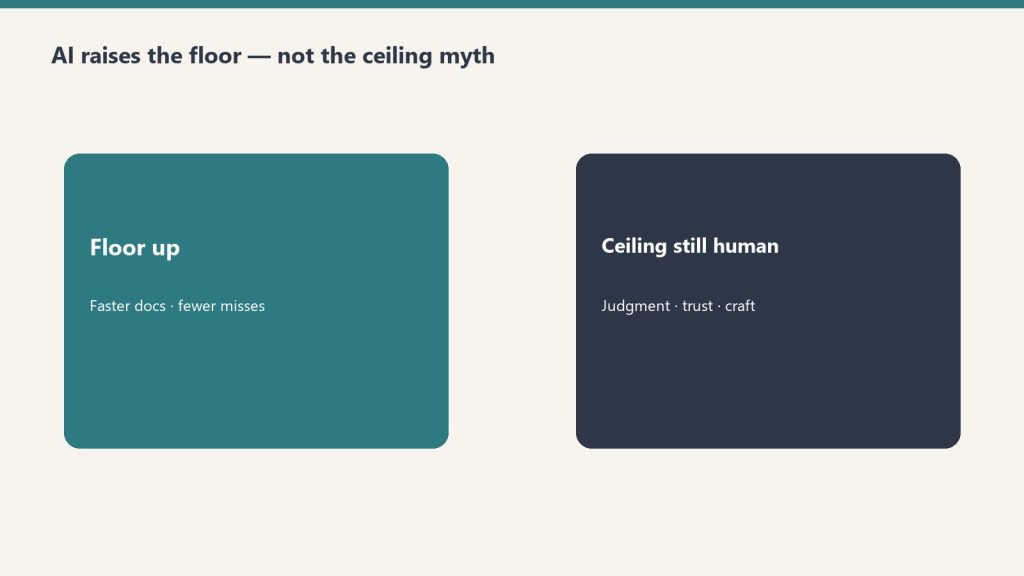
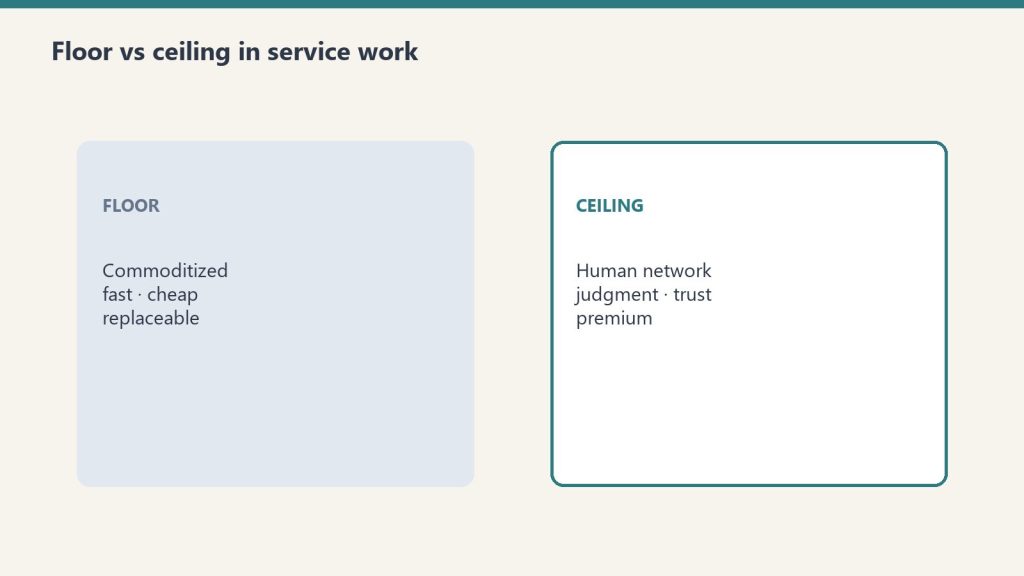
Jobs are vulnerable to AI to the degree that their core value depends on explicit knowledge — the procedures, frameworks, documented best practices, and standardized expertise that lives in textbooks, manuals, and training materials. AI can ingest all of that instantly and apply it at scale. The procedural floor of every industry is being commoditized. The tacit ceiling is being insulated. The safety of a job is determined by how much of its value sits above or below that line.
The Test You Can Run on Any Job
Apply these three questions to your current role, or to any career you are considering.
First question. Could a competent newcomer perform this job at a high level after reading the available documentation and using modern AI tools? If yes, the job is largely floor work and is vulnerable to AI commoditization. If the answer is “no, they would need years of hands-on experience working alongside someone who already knew how” — the job has real ceiling content and is more durable.
Second question. When you make a difficult judgment call in this role, can you fully explain why you made that call, or do you partly reason from intuition built from past situations you cannot easily articulate? If you can fully explain every call, the work is essentially explicit and AI will be able to replicate it. If you find yourself saying “I just knew because of how it felt” or “you have to see it to understand” — that is tacit knowledge. That is the part AI cannot touch.
Third question. Who suffers most when an experienced practitioner in this role retires? Is the loss easily backfilled by hiring a credentialed replacement, or does the team lose institutional capability that takes years to rebuild? If the loss is easily backfilled, the role is mostly procedural. If the loss creates a real gap that no amount of credentialed hiring solves quickly, the role carries significant tacit knowledge, and the people who hold it are durable.
A job that scores positive on all three questions is safe from AI in the deepest sense. A job that scores negative on all three is vulnerable. Most jobs land somewhere in between, with some parts of the work being floor (vulnerable) and other parts being ceiling (durable). The strategic move for anyone in a partially exposed role is to deliberately shift their time toward the ceiling parts of their job and let AI handle the floor.
Categories of Work That Are Genuinely Safe
The categories below all share the underlying property that their core value is tacit knowledge built through hands-on experience, contextual judgment, and human-to-human interaction that resists capture in documentation.
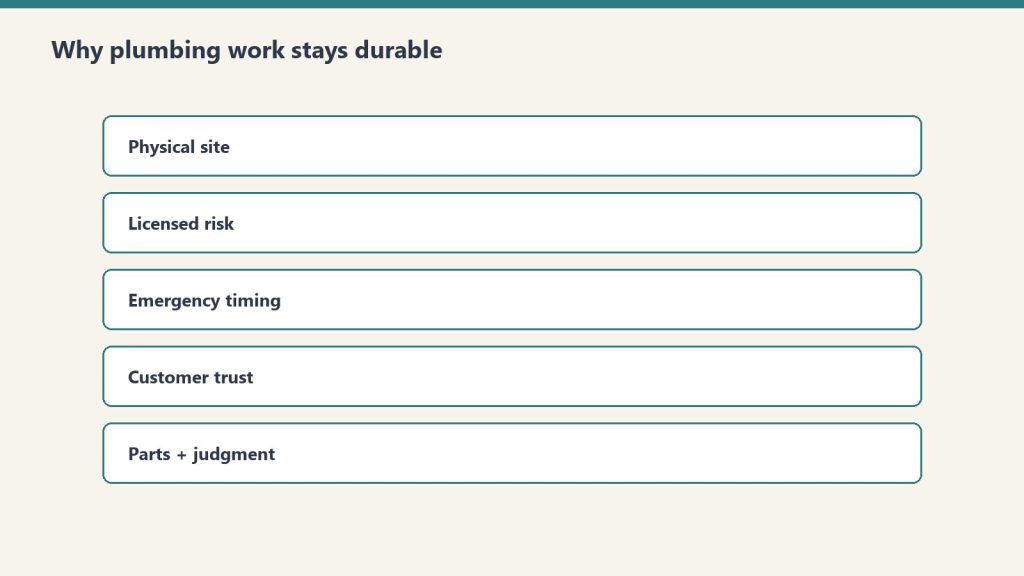
Skilled trades with judgment requirements. Electricians solving panel problems in old buildings, HVAC technicians diagnosing systems that have been modified twice over the last twenty years, plumbers reading the failure mode of a 1940s sewer line, restoration operators scoping a complex water loss — all of this work involves judgment that AI tools assist but cannot replace. The floor of these industries is being raised by AI, but the ceiling remains entirely human.
Healthcare delivery, especially nursing and primary care. The diagnostic AI can suggest, but the nurse reading subtle behavioral cues, calibrating to a patient’s emotional state, and making the call about when a vital sign trend is concerning versus normal — that is tacit work. The 1 million nurses projected to retire in the U.S. between now and 2030 are taking with them institutional knowledge that AI cannot reconstruct from training data.
Senior roles in any skilled industry. The thirty-year veteran in any field who has internalized pattern recognition that newer practitioners cannot reproduce — that person’s value is rising, not falling, as the AI shift commoditizes the procedural work around them.
Complex sales and relationship-driven work. Enterprise sales, advisory consulting, certain legal and accounting work — anywhere the value depends on reading a specific human counterpart, building trust over years, and making bespoke judgment calls — is durable. AI assists by handling research and drafting. It does not replace the human in the room.
Skilled physical work in unpredictable environments. Restoration in storm-damaged buildings. Wilderness search and rescue. Surgical work on non-standard cases. Anything where the environment varies enough that pure pattern-matching against training data is insufficient and live judgment is required.
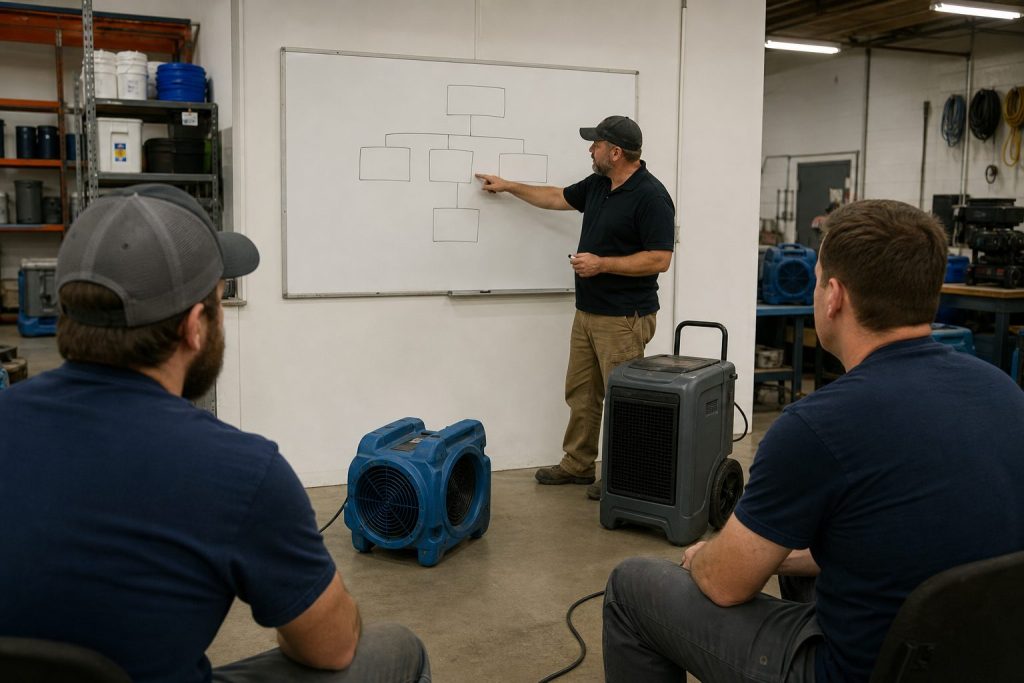
Apprenticeship, teaching, and mentorship. The role of transferring tacit knowledge from one practitioner to another — itself tacit work — cannot be done by AI. As skilled industries figure out that they need to capture the knowledge of retiring senior operators before it walks away, the role of structured mentor is becoming a recognized career path in its own right.
Categories of Work That Are Genuinely Exposed
These categories are exposed because their core value is documented, codifiable, and pattern-matchable against training data that AI systems already have. Some roles in these categories will survive in transformed form. The roles that survive are the ones that incorporate significant tacit work in addition to the procedural baseline.
Entry-level cognitive work with standardized output. First-draft copywriting, basic legal research, simple translation, summarization, structured data analysis, entry-level coding tasks — all of this is being absorbed by AI rapidly. The roles that depended on producing these outputs as the core deliverable are being compressed or eliminated.
Customer support and call center work. AI is replacing human agents on most routine support inquiries. The roles that survive are the ones that handle escalated, complex, judgment-heavy situations — which require tacit interpersonal skills and contextual reasoning that AI cannot reliably produce.
Administrative and clerical work. Scheduling, data entry, basic reporting, document processing, routine compliance work — all of this is being automated quickly. The roles that survive are the ones that involve coordination across humans with competing priorities, where judgment about whose interests matter and how to navigate trade-offs is essential.
Mid-level analytical work without judgment requirements. Roles that involve running standardized analyses, applying documented frameworks to standardized inputs, and producing reports for higher-level decision-makers — exposed. The senior analyst who synthesizes ambiguous data into a recommendation that an executive will actually act on — much more durable, because that synthesis requires judgment.
Standardized creative work. Stock photography, generic marketing content, formulaic writing for routine purposes — being commoditized by generative AI. The creative work that survives is the work where the artist’s specific vision, taste, and judgment are inseparable from the output — which most commercial creative work is not.
The Strategic Move Regardless of Your Current Role
Whether your current job lands on the safe side or the exposed side of the framework, the strategic move is the same. Shift your time and your career investment toward the parts of your work that are tacit, judgment-heavy, and apprenticeship-transferred. Let AI handle the parts that are procedural, documented, and standardized.
For anyone in a skilled industry, this means deliberately spending more of your day on the high-judgment work — the difficult customer situations, the complex scoping decisions, the situations where pattern recognition matters — and letting AI take over the procedural baseline. The senior practitioners in every field who do this will see their value rise. The ones who keep doing the procedural work that AI can now do will be commoditized along with the procedural work itself.
For anyone in an exposed cognitive role, the move is to identify which parts of your work require judgment that AI cannot replicate, and aggressively shift toward those parts. The junior copywriter who only produces standard content is exposed. The copywriter who has built genuine taste, can read a specific client, and can make bespoke creative judgment calls is durable. The same logic applies to law, consulting, accounting, marketing, design, and any cognitive field — the procedural floor is being commoditized, but the judgment ceiling is intact.
For anyone earlier in their career, the move is to apprentice yourself to a senior practitioner in a field with substantial tacit content. The window to learn from veterans is open right now, and the knowledge they hold is becoming more valuable, not less. Investing your twenties and thirties in absorbing tacit expertise from a senior practitioner is one of the highest-leverage career moves available in 2026.
For anyone considering retirement or already retired from a skilled industry, the move is to reconsider the timing. The market is in the process of revaluing senior judgment upward sharply, and the role that fits this moment — fractional advisory work at premium rates — did not exist when most current retirees were planning their exit.
What the Existing Lists Get Wrong
Most articles answering this question fall into one of two failure modes. The first failure mode is generic reassurance. “Creative jobs are safe. Trades are safe. Healthcare is safe.” That framing is too broad. Some creative jobs are vulnerable. Some trades have significant procedural exposure. Some healthcare roles will be transformed in ways that change the underlying work substantially. The category-level answer obscures the real pattern, which operates at the level of individual roles and the specific mix of explicit versus tacit work within them.
The second failure mode is fear-feeding. “AI is coming for everything. Even the trades are exposed. Even healthcare is exposed.” That framing is also wrong. AI is genuinely transformative, but the impact is uneven and structurally predictable. The pattern is not “AI takes everything.” The pattern is “AI takes the floor of every industry, the ceiling remains human, and the gap between floor and ceiling becomes the entire game.”
The accurate framing recognizes that the AI shift is a structural reorganization of skilled and cognitive work, not a uniform threat. Jobs that have always had high tacit content — judgment, apprenticeship, hands-on expertise — are becoming more valuable, not less. Jobs that have always been mostly procedural — entry-level cognitive work, standardized administrative tasks, routine analysis — are being compressed. And every job in between is being split into a commoditized floor part and a durable ceiling part, with the strategic question being whether the practitioner can shift their time toward the ceiling.
Frequently Asked Questions
What jobs are safe from AI in 2026?
Jobs whose core value depends on tacit knowledge — judgment, pattern recognition, contextual expertise built through hands-on experience — are durable. This includes skilled trades with judgment requirements (electricians, HVAC techs, plumbers, restoration operators), hands-on healthcare roles (especially nursing), senior roles in any skilled industry, complex relationship-driven sales and advisory work, and apprenticeship and mentorship roles. The common thread is work that requires expertise AI cannot acquire by ingesting documentation.
Will AI replace skilled trades?
AI will replace the procedural and documentation work that consumes hours of a tradesperson’s day — quoting, scheduling, customer communication, routine reporting. AI will not replace the judgment work that defines a great tradesperson. The result is that average tradespeople become faster and more productive, but exceptional tradespeople with deep judgment become significantly more valuable because the only differentiation left is the part AI cannot replicate.
What is the difference between explicit and tacit knowledge?
Explicit knowledge is the part of expertise that can be written down — procedures, standards, documentation, technical specifications. Tacit knowledge is the part that lives inside practitioners and cannot be fully articulated, even by the practitioners themselves. It transfers through proximity and apprenticeship, not through study. AI commoditizes explicit knowledge but cannot replicate tacit knowledge.
How do I AI-proof my current job?
Identify the parts of your work that require judgment, pattern recognition, and contextual expertise that you cannot fully articulate. Shift your time and your career investment toward those parts. Let AI handle the procedural, documented, standardized parts. Find a senior practitioner in your field and learn from them deliberately. The careers that survive the AI shift are the ones that move toward the tacit ceiling rather than competing on the increasingly commoditized procedural floor.
Are healthcare jobs safe from AI?
Hands-on healthcare delivery work, particularly nursing and primary care, is largely safe because it depends heavily on tacit judgment, behavioral reading, and human-to-human interaction that AI cannot reliably replicate. The procedural and administrative parts of healthcare are being commoditized. The judgment parts are becoming more valuable, particularly as a generation of senior practitioners retires and the institutional knowledge they hold becomes scarce.
What should young people study or work toward right now?
Look for fields with substantial tacit content and find a senior practitioner to learn from. Skilled trades, healthcare delivery, complex sales and advisory work, and any apprenticeship-based field all qualify. Avoid careers built entirely on documented procedural work that AI can absorb. Invest in the kind of expertise that takes years to build and that AI cannot reconstruct from training data, because that expertise is becoming the only real differentiator in skilled work.
The Bottom Line
The honest answer to what jobs are safe from AI in 2026 is that any job whose core value is tacit knowledge — the judgment that lives in practitioners, transfers through apprenticeship, and has never been written down — is structurally durable. AI is commoditizing the floor of every industry and the procedural work within every role. The ceiling remains human, and the people who hold the ceiling are about to be the most valuable workers in their fields.
The pattern is the same across electricians and surgeons, HVAC technicians and litigators, restoration operators and senior consultants. The shape of the work matters more than the category label. Apply the three-question test to your own role. Shift your time toward the tacit part of your work. Find a veteran to learn from if you are early in your career. Stop spending energy worrying about whether AI is coming for you, and start spending energy on the part of the work AI cannot do. That is what protects a career in 2026. That is what protects it in 2030. And that is the pattern that will hold long after the current AI cycle.
The Tacit Knowledge Cluster — Further Reading
This piece is part of a larger body of writing on what the AI shift and the broader software-platform shift actually mean for service professions and the workers in them. The full cluster:
The Core Thesis
- AI Raises the Floor, Not the Ceiling — the macro thesis for industrial trades.
- Software Raised the Floor, Not the Ceiling — the broader pattern across service professions, with the Nespresso/French press metaphor.
- Tacit Knowledge Is the Last Moat — the philosophical frame.
- The Gray Tsunami — the retirement wave story.
For Your Career
Service Profession Playbooks
- Zillow Did Not Kill Realtors — the community network business for real estate.
- The Insurance Agent’s Future — the claim concierge model.
- The Financial Advisor’s Future — comprehensive life planning after the robos.
- The Accountant’s Future — the trusted advisor practice after TurboTax.
Industry-Specific Trade Answers
- Will AI Replace HVAC Technicians?
- Will AI Replace Electricians?
- Will AI Replace Plumbers?
- Will AI Replace Nurses?
Direct Letters to Each Audience
- This Is Your Moment — to veteran operators.
- Go Find the Veterans Now — to younger operators.
- The Asset Sitting in Their Head — to owners and acquirers.
- The Apprenticeship Is the Curriculum — to trainers and educators.
- Your Partner Is Sitting on the Most Valuable Asset — to families.
- Come Back — to retired operators.
For Practitioners
- How to Run a Human Distillery Interview — the field manual.