
Every other competitive moat in skilled work is dissolving in real time. Brand. Distribution. Documented expertise. Software advantage. Information asymmetry. The proprietary playbook. AI is commoditizing all of it at a pace that the existing strategic literature has not yet caught up to. What is left, as a defensible competitive asset in any skilled industry, is the tacit knowledge that has never been written down and lives inside the heads of individual practitioners. This is the philosophical frame for the entire shift we are now living through, and the lens through which every operator, owner, and acquirer in any skilled field should be reading the next decade.
The thesis sounds simple when stated this directly. But the implications are structural, and they reach into how companies should be valued, how careers should be planned, how training should be designed, how acquisitions should be structured, and how skilled industries should be organized. Most of the existing playbook in all of those domains was built around the assumption that the moats were the documented assets. That assumption is breaking. The new playbook is built around the recognition that the moats are now the undocumented ones.
Why the Old Moats Are Dissolving
Strategic theory in business has, for forty years, organized itself around a few canonical sources of competitive advantage. Brand recognition. Distribution scale. Documented operational excellence. Proprietary processes. Information advantage. Cost position. Network effects. Each of these was the answer to “why does this company win?” in some industry, and the existence of these moats made strategic positioning a tractable problem. You could pick a moat, build it, and defend it.
AI is corrosive to most of them. Brand recognition matters less when AI-assisted comparison tools let customers evaluate competing offers on actual merit, faster, with less friction. Distribution scale matters less when AI-leveraged operators can build distribution faster than the incumbents can defend it. Documented operational excellence matters less when the documentation can be ingested, optimized, and replicated by any competent operator with the right tools. Proprietary processes matter less when the underlying logic can be reverse-engineered from outputs. Information advantage matters less when search and synthesis are equalizing across operators. Cost position matters less when AI compresses the cost of nearly every operational input.
Not every moat is gone. Some — network effects in particular — remain genuinely durable in the platform economy. But across the bulk of skilled industries, the moats that companies built their competitive positions around are getting weaker by the quarter. The strategic landscape is flattening. Operators that used to have meaningful structural advantages are watching them erode without a clear replacement.
The conventional wisdom answer to this dissolution is “AI itself is the new moat.” Operators who deploy AI most aggressively will be the winners. That answer is partly right and largely wrong. AI is a leveler, not a moat. Every operator in every industry has access to the same AI tools at roughly the same prices on roughly the same timeline. Deploying AI well is necessary table stakes, not a defensible position. The operators who treat AI deployment as their moat are going to discover, quickly, that everyone else is deploying it too. The advantage is temporary at best.
The actual remaining moat is something else entirely. It is the knowledge that AI cannot replicate by ingesting public data, because the knowledge was never in the data.
What Tacit Knowledge Actually Is
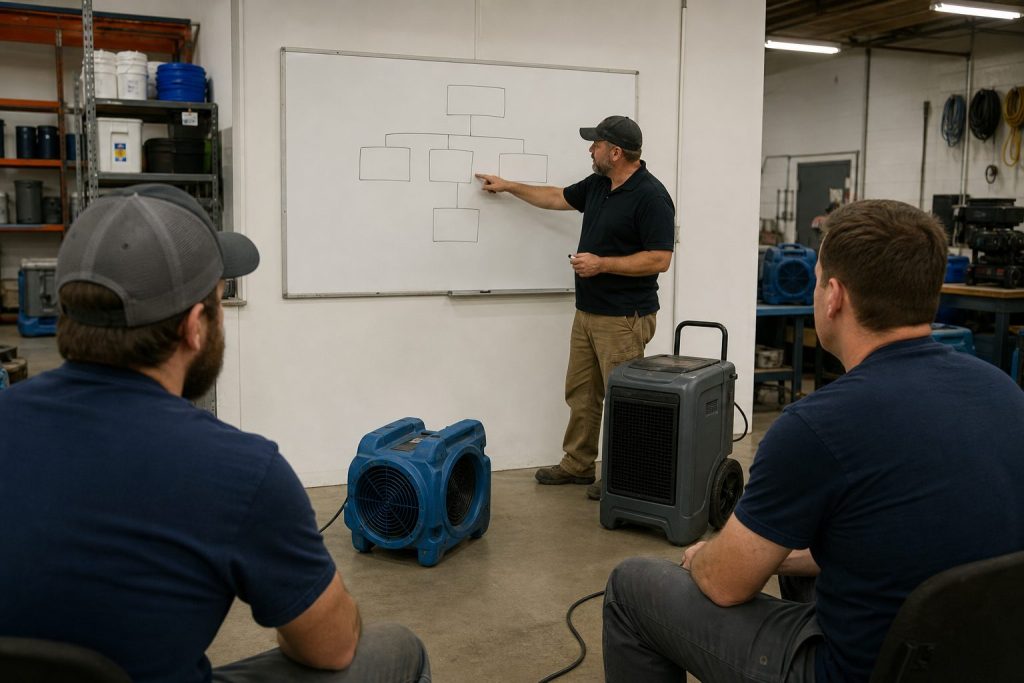
Tacit knowledge is a term from the philosophy of science, originally articulated by Michael Polanyi in the middle of the twentieth century. His thesis, condensed, was that we know more than we can tell. Practitioners of any complex skill — surgeons, machinists, restoration operators, lawyers, master craftspeople of every kind — carry inside them a body of knowledge that cannot be fully transferred through language. It can only be transferred through proximity, demonstration, and apprenticeship. The knower cannot articulate it because it operates below the level of conscious thought, and the learner cannot acquire it through study because there is no document that contains it.
Polanyi’s insight has been intellectually accepted in academic circles for decades. It has been almost completely ignored in mainstream business strategy, because the era of strategic theory we were living in until very recently rewarded the codifiable, the scalable, the measurable. Tacit knowledge was treated as a soft consideration, a folk concept, the kind of thing you mentioned in a speech about company culture but did not put in a strategic plan.
The AI shift makes Polanyi’s distinction the single most important strategic concept of the next decade. The reason is now obvious in retrospect. AI systems train on documented data. The vast majority of real expertise in skilled industries — the part that distinguishes great operators from average ones — has never been documented. It exists only in the tacit form, in the heads of practitioners, transferred through apprenticeship and proximity. AI cannot ingest what was never written down.
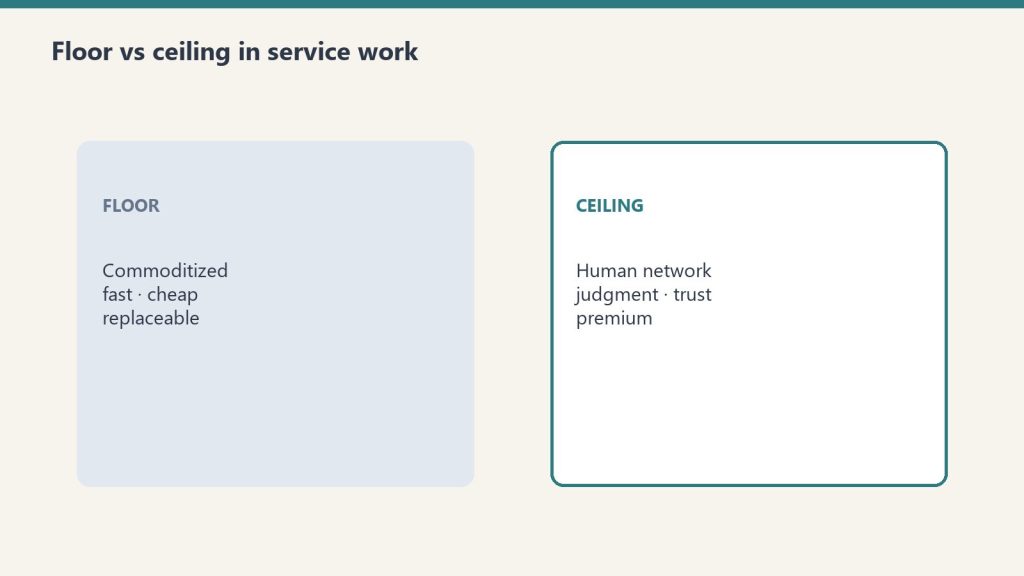
Therefore, the explicit floor of every skilled industry is being commoditized rapidly, because everything in the documentation is now available to everyone instantly. The tacit ceiling of every skilled industry is being insulated, because nothing in the tacit layer is in the documentation, and the only path to acquiring it remains the slow, human, in-person path that has always been required. The gap between floor and ceiling is widening, the floor is being equalized across operators, and the ceiling is becoming the entire game.
This is why the people who carry tacit knowledge — the veteran operators in every skilled industry — are about to become the most valuable asset class in their fields. Their value has always been there. The market is finally being forced to price it.
Why Tacit Knowledge Is Structurally Defensible
A moat is only durable if competitors cannot replicate it. The reason tacit knowledge qualifies as a real, structural moat is that the mechanism by which it transfers cannot be compressed or accelerated.
Tacit knowledge transfers through proximity. A senior operator can transfer their judgment to an apprentice over a period of years by working alongside them on real situations and demonstrating the patterns in context. The transfer cannot be accelerated by reading. It cannot be accelerated by AI. It cannot be accelerated by spending more money. The bottleneck is the time the senior operator can spend with the apprentice and the cognitive integration the apprentice has to do to internalize the patterns. Both of those are essentially fixed.
This means tacit knowledge is the only competitive asset that has a hard floor on its transfer cost. Every other asset can be acquired through capital deployment, technology investment, or strategic acquisition. Tacit knowledge can only be acquired through time. A competitor with more money than you cannot buy faster transfer. A competitor with better AI than you cannot synthesize the missing data. The asset is genuinely outside the normal compression of strategic resources.
This is a property that almost no other strategic asset has. Brand can be built faster with more marketing spend. Distribution can be scaled with more capital. Documented expertise can be acquired with more research investment. Tacit knowledge cannot. The only path to it is the long path. Which means an operator who has it now has it for the foreseeable future, and a competitor who does not have it cannot get it on any timeline that matters competitively.
This is also why tacit knowledge is the asset class that defines the next era of strategic positioning in skilled industries. The companies that have it, retain it, and capture it into transferable form will compound the advantage over time. The companies that do not have it will face a structural competitive disadvantage they cannot close by deploying more capital or better technology.
The Implications for Strategy
If tacit knowledge is the last durable moat in skilled industries, strategic thinking has to reorganize around it. The implications run through every function of a company.
Talent strategy has to prioritize the carriers of tacit knowledge. The senior operators who hold institutional judgment have to be treated as the highest-leverage asset in the company, regardless of their position on a formal org chart. Compensation, retention, and respect dynamics have to be aligned with their actual value, not with the org-chart legacy that treated them as overhead.
Apprenticeship has to be reinstated as a core function. The transfer of tacit knowledge from senior to junior operators is no longer a soft cultural practice. It is the primary mechanism by which the company’s most defensible asset propagates through the next generation. Apprenticeship is the curriculum. Companies that do not have a structured apprenticeship program are not transferring their moat. The moat will walk out with the next retirement.
Capture has to be deliberate. Some tacit knowledge can be surfaced into transferable form through structured methodology. The Human Distillery process is one specific implementation. The output is an institutional artifact — a knowledge asset the company owns even after the operator who held it retires. Every skilled-industry company should be running a deliberate capture program with its most senior operators. Most are not. The window to do this work is open right now and will narrow as the relevant operators retire.
Acquisition diligence has to evolve. The standard playbook for acquiring skilled-industry businesses prices the documented assets — equipment, contracts, customer concentration, financials. The modern playbook has to price the tacit-knowledge bench strength of the senior operators in the acquired business. Deal terms have to be structured around retention and knowledge transfer of those operators. The asset is not on the balance sheet. The buyer who recognizes that has a meaningful edge.
AI deployment has to be designed to amplify, not replace, the tacit-knowledge layer. The wrong AI strategy uses AI to automate around senior operators with the goal of reducing their headcount. The right AI strategy uses AI to take the procedural floor work off of senior operators, freeing them to spend more time on the judgment work where their value compounds. The former hollows out the moat. The latter compounds it.
Why This Is Genuinely Good News
The dominant emotional response to the AI shift, across skilled industries and across the broader workforce, has been some version of anxiety. The machines are getting smart. The expertise is becoming obsolete. The careers people built over decades are about to be commoditized. This anxiety is real and understandable, but it is also based on a flawed model of what is actually happening.
The accurate model is that AI is dissolving the floor moats of skilled industries while simultaneously revealing and elevating the ceiling moats. The floor moats — documented expertise, procedural knowledge, the standardized body of any industry — are being commoditized, and the operators whose competitive advantage depended on them are facing a difficult transition. But the ceiling moats — tacit knowledge, judgment, institutional experience — are being structurally insulated and economically revalued upward.
The people who hold ceiling-level expertise — the veteran operators in every skilled industry — are about to find themselves in the strongest economic position of their careers. The people who built their position on floor-level expertise will face significant disruption. The people who recognize the shift and reposition themselves toward ceiling work will thrive. The transition is uncomfortable, but the structural outcome is, for the people who actually know how to do skilled work, deeply positive.
And for the industries themselves, the outcome is even better. The bad actors who survived by underdelivering on the documented floor will be starved out, because AI is making the floor visible and unfakable. The honest operators who have always been doing the work properly will find the playing field finally tilting in their direction. The rogue contractor who depressed the curve will lose their arbitrage. The reckless operator who survived on speed-by-cutting-corners will be exposed. The race to the bottom is ending. The race to the top, defined by tacit expertise, is starting.
This is the structural meaning of the AI shift in skilled industries. The floor is being raised. The ceiling is being revealed. The people who hold the ceiling are about to be paid for what they have always carried. The industries themselves are about to be forced to level up because the floor is rising fast enough that bad work cannot hide anymore. And the institutional knowledge that has historically died with each retiring veteran is about to be deliberately captured and propagated, because the methodology exists and the economic incentive is finally aligned with doing it.
Frequently Asked Questions
What is the difference between explicit and tacit knowledge?
Explicit knowledge is the part of expertise that can be written down — procedures, standards, documentation, technical specifications. Tacit knowledge is the part that lives inside practitioners and cannot be fully articulated, even by the practitioners themselves. It transfers through proximity and apprenticeship, not through study. AI commoditizes explicit knowledge but cannot replicate tacit knowledge because it was never in the training data.
Why is tacit knowledge considered a defensible competitive moat?
Because the mechanism by which it transfers — proximity, apprenticeship, time in context with a senior practitioner — cannot be compressed or accelerated by capital, technology, or strategic investment. Every other competitive asset can be acquired faster with more resources. Tacit knowledge has a hard floor on its transfer cost. That property makes it structurally defensible in a way few other assets are.
How is AI changing the value of expertise in skilled industries?
AI is commoditizing the documented, explicit floor of every skilled industry by making the procedural body of knowledge equally accessible to all operators with modern tools. It cannot touch the tacit ceiling, which lives only in the heads of senior practitioners. The result is that floor-level expertise is being commoditized downward while ceiling-level expertise is being revalued upward.
What is the Human Distillery methodology?
The Human Distillery is a structured methodology for extracting tacit knowledge from senior operators through long-form, deliberate conversations and converting their judgment patterns into transferable artifacts — operator-ready playbooks, AI training data, and institutional knowledge assets. It is the practical implementation that lets companies capture the asset before it walks away.
Why is the apprenticeship model returning to relevance?
Because it is the only known mechanism for transferring tacit knowledge between practitioners. Classroom-based training, certification programs, and documented curricula can transfer explicit knowledge effectively, but they cannot transfer the judgment that defines great operators. The apprenticeship model — working alongside a senior practitioner on real situations — is the mechanism that has always worked and is now the strategically important one again.
What should an operator do strategically in response to this shift?
If they are a senior operator, recognize that their work is being revalued upward and adjust their pricing, role design, and time allocation accordingly. If they are a younger operator, find a senior practitioner to learn from while the window is open. If they own or run a company, identify the carriers of tacit knowledge in their business, retain them, build apprenticeship structures around them, and run deliberate capture programs to preserve the asset.
The Bottom Line
Every other competitive moat in skilled industries is dissolving. The brand moat. The distribution moat. The documented-expertise moat. The proprietary-process moat. The information-asymmetry moat. AI is commoditizing all of it. What is left, as a defensible competitive asset, is the tacit knowledge that has never been written down and lives only inside the heads of veteran practitioners. That knowledge is the last moat, and it is structurally insulated against the kind of commoditization that is hollowing out everything else.
The operators who carry tacit knowledge are about to be the most valuable people in their industries. The companies that retain those operators, capture their knowledge deliberately, and propagate it through structured apprenticeship will hold a moat that competitors cannot replicate by deploying more capital, more technology, or more software. The industries themselves are about to be reshaped by the fact that the floor is rising and the ceiling is being revealed.
This is not a threat to skilled work. It is the moment skilled work finally gets recognized at its true value. The knowledge that took decades to build, that has never been adequately compensated, that has lived quietly in the heads of veteran operators across every industry, is about to be the most economically valuable asset class in the field. The market is in the process of catching up to a truth that practitioners have always known. Tacit knowledge is the moat. It always was. It is just becoming visible.
The Tacit Knowledge Cluster — Further Reading
This piece is part of a larger body of writing on what the AI shift and the broader software-platform shift actually mean for service professions and the workers in them. The full cluster:
The Core Thesis
- AI Raises the Floor, Not the Ceiling — the macro thesis for industrial trades.
- Software Raised the Floor, Not the Ceiling — the broader pattern across service professions, with the Nespresso/French press metaphor.
- Tacit Knowledge Is the Last Moat — the philosophical frame.
- The Gray Tsunami — the retirement wave story.
For Your Career
Service Profession Playbooks
- Zillow Did Not Kill Realtors — the community network business for real estate.
- The Insurance Agent’s Future — the claim concierge model.
- The Financial Advisor’s Future — comprehensive life planning after the robos.
- The Accountant’s Future — the trusted advisor practice after TurboTax.
Industry-Specific Trade Answers
- Will AI Replace HVAC Technicians?
- Will AI Replace Electricians?
- Will AI Replace Plumbers?
- Will AI Replace Nurses?
Direct Letters to Each Audience
- This Is Your Moment — to veteran operators.
- Go Find the Veterans Now — to younger operators.
- The Asset Sitting in Their Head — to owners and acquirers.
- The Apprenticeship Is the Curriculum — to trainers and educators.
- Your Partner Is Sitting on the Most Valuable Asset — to families.
- Come Back — to retired operators.
For Practitioners
- How to Run a Human Distillery Interview — the field manual.
Leave a Reply