
When you run seven distinct business entities — an agency, two restoration companies, a golf league, an ESG nonprofit, a media company, and your personal brand — you either build a system or you drown in tabs.
We chose the system. It’s a Notion Command Center with a 6-database architecture that routes every task, every project, every client interaction through a single operational backbone. Every entity has its own Focus Room. Every task has a priority, an entity assignment, and a status. Nothing falls through the cracks because there’s only one place anything can be.
The Architecture
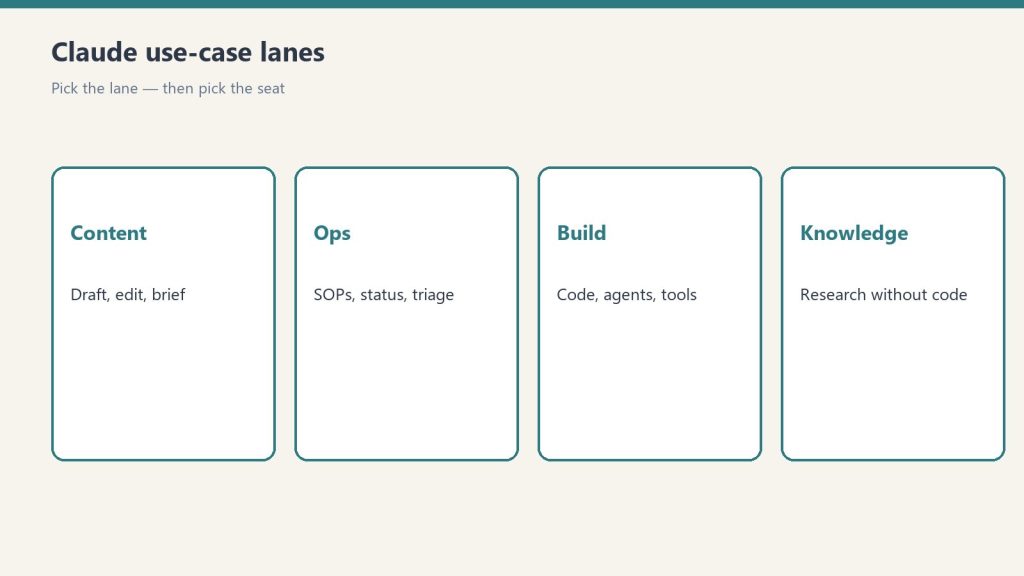
Six databases power everything: Master Actions (every task across every entity), Master Entities (every business, client, and project), Content Calendar (what gets published where and when), Knowledge Base (SOPs, playbooks, reference material), Metrics Dashboard (KPIs across all entities), and Session Logs (every Cowork session, every decision, every output).
A triage agent automatically assigns priority and entity to every new task. Focus Rooms filter the Master Actions database by entity, so when you’re working on restoration, you only see restoration tasks. When you switch to the agency, the view shifts instantly. Context switching becomes spatial, not mental.
Why Notion Over Everything Else

We evaluated every project management tool on the market. Asana, Monday, ClickUp, Linear, Jira. None of them could handle the specific requirement of managing multiple unrelated businesses through one interface without per-seat pricing that scales painfully. Notion’s database-first architecture and flexible pricing made it the only viable option for this use case.
The real unlock was the API. Every Cowork session, every automation, every AI agent can read from and write to Notion. The command center isn’t just a project management tool — it’s the second brain that accumulates context across every session, every business, every decision. When we start a new session, the context of everything that came before is already there.
The Compound Effect

After six months of logging every session, every task, every outcome, the Notion Command Center contains more institutional knowledge than most companies build in years. Patterns emerge. What works in one entity informs strategy in another. The SEO playbook developed for restoration gets adapted for lending. The content pipeline built for the agency gets deployed for the nonprofit.
This is the operational layer that makes everything else work. The 23 WordPress sites, the 7 AI agents, the multi-vertical content strategy — all of it coordinates through this single system. Build the foundation first. Everything else scales on top of it.
Leave a Reply