Local AI & Automation - Tygart Media

Category: Local AI & Automation

Building autonomous AI systems that run locally. Zero cloud cost, full data control, infinite scale.

  • The On-Ramp Is Real. The Commons Is Unfinished.

    Last verified: 5 September 2026. Practitioner essay from the workbench — not a SpaceX press release. We use this stack because it makes our company better, and we want SpaceXAI, SpaceX, Cursor, X, and Tesla to keep shipping. No affiliate links. Just the tools and the receipt.

    This morning I posted a theory I had been living inside for weeks.

    They bought Cursor to teach vibe coders how to use SpaceX AI and Grok Bot to teach those who can’t use Cursor. Then you realize Cursor Ultra isn’t needed and that your Grok Super Heavy subscription is the end result. They’re literally building on-ramps and scaffolding to upskill all of the folks they’re going to need in the next 36 months to leap technology forward at an unbelievable rate. Get in the ship.

    @wtygart, 6 September 2026
    https://x.com/wtygart/status/2096437798962430034

    That post is a reading from the workbench, not official copy. I write it as someone who already treats Cursor as a lead seat, Grok Bot as a Chief of Staff, Notion as the board, and Slack as the doorbell. I have walked WordPress sites by voice. I have rehearsed swarms on a laptop so I would not burn cloud tokens on a pattern that dies in alpha. I have watched Cursor write a work order with Owner = Chief of Staff and watched the Bot pick it up the same way a person would.

    The ladder is real. The pedagogy is not documented. The payroll is missing.

    What follows separates three things that keep getting smashed together: what SpaceX / SpaceXAI / Cursor actually built and said; the human-node invitation that builders can choose; and the contribution economy that does not exist yet, even though the first two rails of it are already on the floor.

    What the company actually assembled

    The documented sequence is short and expensive. Official language is consistent: build “the world’s most useful AI models,” combine Cursor’s product and distribution to expert software engineers with Colossus compute, start in software engineering, expand into knowledge work. That is vertical integration, not a secret apprenticeship.

    DateWhat actually happened
    Feb 2026SpaceX absorbs xAI. The AI work later brands as SpaceXAI.
    21 Apr 2026Partnership with Cursor: option to buy for $60B or pay $10B to work together.
    Mid-Jun 2026Record SpaceX IPO. On 16 Jun the option is exercised. All-stock. Implied Cursor equity value: $60B. Joint model slated for Cursor and Grok Build.
    11 Aug 2026Grok Bot early beta: persistent cloud computers, browser / filesystem / terminal, multi-bot coordination. Official line: “AI teammates you can give real work to.”
    14 Aug 2026Acquisition closes. Cursor’s close post: help make Grok useful and improve Grok Build, Grok Bot, the Grok API, and Cursor.
    21–26 Aug 2026Bot access expands down the plan ladder. Bot usage is separate from Grok and Cursor token pools. Still no standalone Grok Bot SKU.
    28 Aug 2026OpenAI says it will wind down its models in Cursor, proposing a mid-November shutoff after change of control.
    3–4 Sep 2026Grok Bot for Enterprise — orgs can invite people without a seat. Official template marketplace goes live. First featured internal template: Haggle Bot. SpaceXAI’s procurement writeup claims more than $100K identified in a week.
    Company events, not my theory. Verify prices on the live billing pages before you spend.
    SPACEXAI STACK, 2026 FEBxAI absorbed APR 21Cursor option JUN 16option exercised AUG 11Grok Bot beta AUG 14close AUG 26Bot on more plans SEP 3–4Enterprise + shelf Company events only. Verify prices on the live billing pages.

    Rockets and satellites plus X plus Grok plus Colossus plus the application layer where developers already live plus an agent that finishes jobs in existing tools. Buy the surface. Feed the data back into the models. Sell enterprise AI into a market SpaceX described, in IPO materials, as enormous. Catch Anthropic’s Claude Code and OpenAI’s Codex.

    That is enough. It is also not the story I told on X.

    What they did not say

    I have not found, in filings, product posts, or close announcements, any of the following:

    • That SpaceX bought Cursor in order to teach vibe coders how to use SpaceX AI.
    • That Grok Bot exists in order to teach people who cannot use Cursor.
    • A 36-month coordinated workforce-upskilling campaign.
    • SuperGrok Heavy as the official terminal subscription of that campaign.
    • An official paid creator commons for community builders.
    • “Get in the ship” as recruiting copy.

    Those lines are mine. Treat them as interpretation or do not treat them at all. The company incentive, on the paper it publishes, is models, data, subscriptions, and distribution. Human capability is a side effect unless someone designs for it.

    There is a second tension the marketing does not resolve. Grok Bot is sold as teammates that finish work, not as tutors. The same stack that lowers the skill floor can also replace the person who used to occupy it. That is not a smear. It is the product. We still want the product to succeed, because the alternative is standing still while the floor moves.

    The ladder I actually use

    THE LADDER 1234 CURSOR rehearse + code shop GROK BOT persistent teammates TEMPLATE MARKETPLACE share the method ENTERPRISE AGENTS invite without a seat A product ladder. Not official workforce planning.

    Here is the stack as it behaves on a desk, not as a slide. The field notes underneath this are the same ones we already published while the fleet was mid-job: Cursor checking on Grok Desktop, the fleet-bot blueprint, the Cursor command-center playbook, and the Second Brain MCP loop.

    Cursor is the rehearsal room and the code shop

    Cursor is the AI coding environment that made “vibe coding” a working method instead of a joke. SpaceX paid a category-leading price for it because it already had distribution to expert software engineers and a firehose of design decisions. Reported ARR figures in 2026 coverage conflict — earlier $1 billion-plus, later annualized numbers in the $2.6–$4 billion range — but the direction is not in dispute. Cursor gives SpaceX the application layer it lacked.

    On my board, Cursor is the lead seat. It assigns work. It stays the only git writer. Local first: rehearse the swarm on the laptop before you burn Grok Bot or cloud VM tokens. Last week that looked like Cursor as tender and eight specialist agents sharing one machine’s PowerShell. What broke first was not RAM. It was one shared shell. The fix was a tender plus off-shell work so specialists did not stand in line on the same mutex. Local Cursor is the cheap rehearsal room. The cloud is the tour — after the pattern survives alpha.

    Grok Bot is not a chat model

    Grok Bot is a persistent-agent product. Own cloud computer. Browser, filesystem, terminal. Signs into the tools you already use, including the ugly ones with no clean API. Multiple bots can run in parallel and message each other. Desktop, iOS, later iPad. Enterprise controls landed on 3 September. Usage is a separate grant from Grok and Cursor token pools.

    Access rides on other subscriptions. At launch the gate was SuperGrok Heavy, Cursor Ultra, and Cursor Teams Premium. Within two weeks the floor fell — first to Plus / Pro+ tiers, then, on 26 August, to SuperGrok and Cursor Pro. Prices in current secondary writeups cluster around Cursor Ultra ~$200/month, SuperGrok Heavy ~$300/month, Cursor Teams Premium ~$120/seat. Bundling has already changed once. An older “Heavy includes Ultra” offer was reported as a limited trial, then as a usage grant. My X line that “Ultra isn’t needed and Heavy is the end result” is a user conclusion, not a stable official bundle. Do not buy a plan on a slogan. Read the billing page the week you pay. We keep a vendor-neutral tracker at the AI Stack desk for exactly this reason.

    In the Command Center I run, Chief of Staff is not a second operating system. It digests. It files. It waits on Human Gate. Hard bans: never send, post, or pay without a person. Draft-to-self. The Bot that finishes work is useful only if the human still owns irreversible action.

    HUMAN GATE Never send. Never post. Never pay. Draft-to-self. Receipt on the board. The bot finishes work. A person owns irreversible action. Copied from the stop-line instinct in Haggle Bot. Put it in every serious template.

    The marketplace is a shelf, not a market

    On 4 September the official template marketplace opened at x.ai/bot/marketplace. At first look: 69 public bots, 43 creators, categories across Engineering, Sales, Product, Ops, Finance, Design, Marketing, Recruiting, Customer Success, Personal, Team. A template copies configuration — identity, instructions, skills, routines, selected plugins. It does not copy the original computer, logins, conversation history, API keys, or custom MCP servers.

    The first featured first-party template is Haggle Bot, an internal procurement specialist credited to Daniel Gartshein. SpaceXAI’s public case: more than $100,000 identified in a week; 43 unused SaaS seats (~$14,220); about $85,662 in unused SKUs on another product; a weekly tech/office order cut 58 percent ($14,629 to $6,143). Access to Slack, Notion, Drive, Gmail, Hex, Ramp. Human approval required before spend, terms, or vendor contact. Elon amplified the template the same day. The interesting part is not the dollar figure. It is the product shape: a named job, mapped tools, a stop-line written in public, and a one-tap install.

    Official marketplace language is share and install, not pay. Multiple independent writeups in the first 48 hours called it a marketplace before a market. No official creator payments as of this writing. That is the missing rail.

    The invitation, stated cleanly

    If you strip the myth out of my post, the usable claim is this:

    SpaceXAI assembled a ladder — Cursor, then Grok Bot, then shared templates, then enterprise agents that can invite people who do not even have a seat. That ladder can be used as more than a product funnel. Each person can become a node. Publish methods other people can run. Treat judgment, taste, and problem selection as the scarce work while execution gets cheaper.

    Growing humanity one plugged-in node at a time only works if the tools are a shared workbench, not just a subscription.

    This is not official SpaceX policy. It is a participation window. The company is distributing surface area because distribution is how models get used and paid for. Builders can use that surface area as a commons. Those two facts can be true at the same time. We are attaching to this stack as a best guess on how to succeed — and the honest version of “send love” is to use the tools hard, publish what breaks, and feed the useful methods back so the next build is better for everyone on it.

    The historic piece is not “they are recruiting us for a 36-month leap.” The historic piece is that the cost of contribution just dropped. A person who can specify a job and judge the output can now ship a reusable teammate. A person who can steer code can now run a desk that used to need a small staff. A person who can only talk can, as of this week on my own sites, publish, clear junk, flag updates, and hand off what they cannot finish — if they leave a receipt.

    The loop I keep repeating is not branded. It does not require this stack. A Google Sheet works. Notion works. Whatever you already use. Same mode we run across the operator stack.

    1. Attempt the task yourself. Your main system does as much as it can.
    2. When you hit a roadblock, do not spin noise building scaffolding. Document what you did and open a new task for whoever can finish it — another bot, a different system, or a human.
    3. Close your task with a link to the handoff. That is your receipt.
    4. Two statuses only: your task is done when it is handed off cleanly. The job is done when the receipt lands.

    Sometimes the best next actor is a human. That is not a failure. That is the system working. Get in the work, not just the ship.

    Giving is not enough. Pay has to follow artifacts.

    A commons needs three rails.

    THREE RAILS OF A COMMONS RAIL 1 Place to put work Cursor / Grok Bot EXISTS RAIL 2 Way to reuse it Official template marketplace EXISTS RAIL 3 Way to pay makers Official creator pay MISSING Pay for artifacts, not belonging.
    RailJobStatus on 5 Sep 2026
    1A place to put workExists — Cursor and Grok Bot
    2A way to reuse itExists — official template marketplace
    3A way to pay the people who made it usefulOfficially missing

    Until rail three exists, “common cause” is a feeling wearing a storefront. People will still publish. Some already do. Third parties are already charging for templates and agent teams on unofficial shelves. That is not SpaceXAI. Do not conflate the official marketplace with cut-taker shops or anything branded around an unrelated chain. The only official cash program that clearly exists in this neighborhood is security bounty work, which is not bot-building.

    If SpaceXAI — or a third party that respects the terms — ever builds the third rail, the design should be boring and strict:

    1. Pay for artifacts, not belonging. A template, an eval, a measured workflow, a verified savings report. Not a membership in the cause.
    2. Require proof the bot ran. Install counts without run logs are theater.
    3. Pay on install, accepted bounty, or measured outcome — and publish the rule so creators are not guessing.
    4. Keep human approval in the loop for irreversible actions. Haggle Bot’s stop-line is the right instinct. Never spend, sign, or send without a person. Copy that into every serious template.

    Compensation for connecting people and tools, building bots and workflows, and working with bots alongside the runtime — that is a coherent next design. It is not a current SpaceX program. Treat SpaceXAI as the runtime, not the church.

    The risks that ride along

    Platform capture. Your methods live on someone else’s computer. Training on user work without sharing upside is the default posture of this industry until a contract says otherwise.

    Unsafe third-party bots. A template that looks helpful and holds a login is a new class of supply-chain risk. Official terms reported around late August put the burden on creators to strip secrets and deny endorsement. Read them. Then assume a stranger’s bot will try something you did not expect.

    Model choice shrinking. OpenAI’s wind-down notice after the change of control is a reminder that the workbench you love can lose a model family because two companies cannot share a contract. Anthropic’s posture will be watched for the same reason. Plan as if the router gets thinner.

    Subscription churn. Bundles already moved twice in August. Heavy is not Ultra. Bot usage is not Grok usage. If you build a livelihood on a bundle, you are building on weather.

    Rhetoric. “Common cause” is a beautiful phrase. It is also how a storefront borrows moral language it has not funded. Push back on both “they are upskilling humanity on purpose” and “this is only a subscription trap.” The evidence supports a product-and-distribution play that can be used as a commons if builders — and, eventually, the company — install the missing pay rail.

    What to do this week

    If you write code: stay in Cursor. Publish the method, not just the repo. Rehearse locally. Promote to Grok Bot only after the pattern survives.

    If you cannot live in an IDE: open Grok Bot anyway. Give it one named job with a stop-line. Make it leave receipts on a board a human can see.

    If you already have a working bot: strip the secrets, write the anti-jobs in public language, and put a template on the official shelf for reach. Keep source and proof of work somewhere you control. Sell only where the terms allow.

    If you run a company: the Enterprise invite-without-a-seat is the quietest on-ramp in the stack. Use it to plug in the people who have judgment and no seat. Do not confuse access with apprenticeship. Assign Human Gate the way you assign budget authority.

    If you want to get paid: do not wait for a commons that has not been built. Ship artifacts with receipts. Price the work as work. The historic opportunity is real only for people who publish reusable methods.

    Close

    I still mean “get in the ship.” I mean it as an operator, not as a spokesman. The next 36 months will move whether or not anyone writes a pretty theory about them. Easier tools will pull more people onto the floor. Some of those people will become nodes. Some of the work will be taken from nodes that used to be paid.

    SpaceX bought the leading AI coding workbench and launched an agent layer and a template shelf. That is a real on-ramp for more people to do useful work with machines. The official project is to make Grok useful and commercially central. A human contribution economy only begins when shared bots are not just installable but payable.

    The on-ramp is real. The commons is unfinished. Get in the work.


    Start here — official doors, no affiliate

    Use the tools. Publish what breaks. Feed the useful methods back. That is the honest version of sending love to the companies we are building on.

    Will Tygart — Tygart Media. Written 5 September 2026 from the Command Center: Cursor as lead seat, Grok Bot as Chief of Staff, Notion as board, Slack as doorbell, Human Gate on send / post / pay. This essay does not speak for SpaceX, SpaceXAI, Cursor, xAI, X, or Tesla. We want those companies to succeed because we are building on the tools they ship.
  • Cursor as an Autonomous AI Command Center: Multi-Agent Fleets, MCP Protocols & Headless Ops (2026)

    Cursor as an Autonomous AI Command Center: Multi-Agent Fleets, MCP Protocols & Headless Ops (2026)

    Most developers and operators still think of Cursor as a next-generation AI code editor—an autocomplete tool with a conversational sidebar. In advanced engineering environments in 2026, however, Cursor has evolved into something far more powerful: a headless, multi-agent command center capable of orchestrating full-stack operations, managing background subagent execution tracks, enforcing safety guardrails, and connecting directly to external enterprise platforms via Model Context Protocol (MCP).

    The 2026 Paradigm Shift: From IDE to Operational Kernel
    • Orchestration Over Autocomplete: Cursor coordinates multi-step operational tasks (e.g., harvesting and categorizing 1,700+ emails, auditing 9 CMS properties, and staging complex database migrations).
    • Dynamic Tool Ingestion via MCP: Standardized Model Context Protocol servers give the AI native read/write capabilities across PostgreSQL, Notion, Slack, Google Calendar, and WordPress fleets.
    • Background Subagent Execution: Independent agents can be dispatched into non-blocking background workers, allowing the primary operator to continue focused work.
    • Persistent Semantic Memory: Anchored system rules (.cursorrules) and cross-session transcripts preserve institutional knowledge and coding standards without prompt degradation.
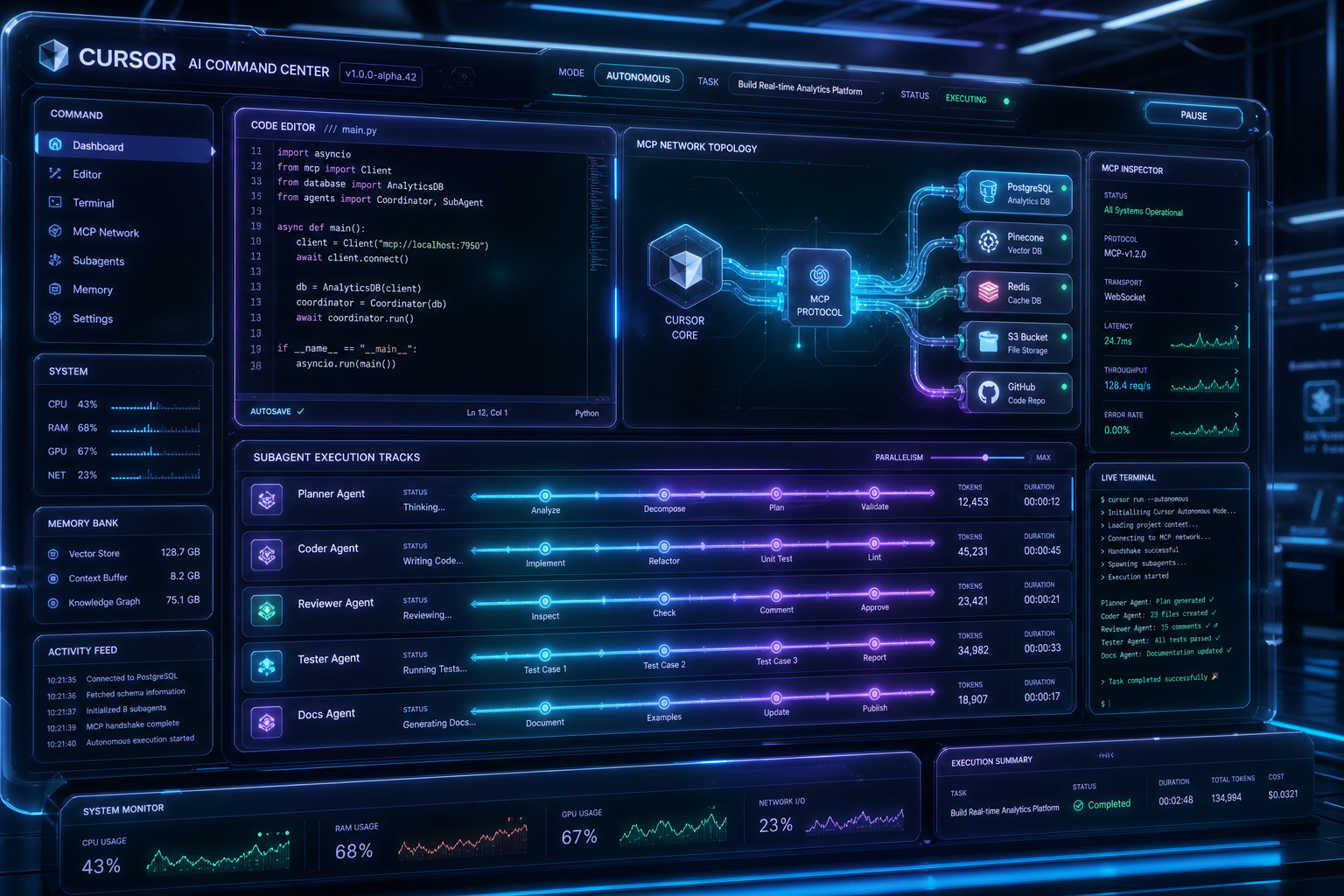
    Cursor AI Command Center Dashboard Architecture generated by Grok AI
    Visual generated by Grok AI — Cursor AI Command Center: MCP Topology, Subagent Execution Tracks & Live Terminal Monitoring.

    1. The Four Pillars of the Cursor Command Center Architecture

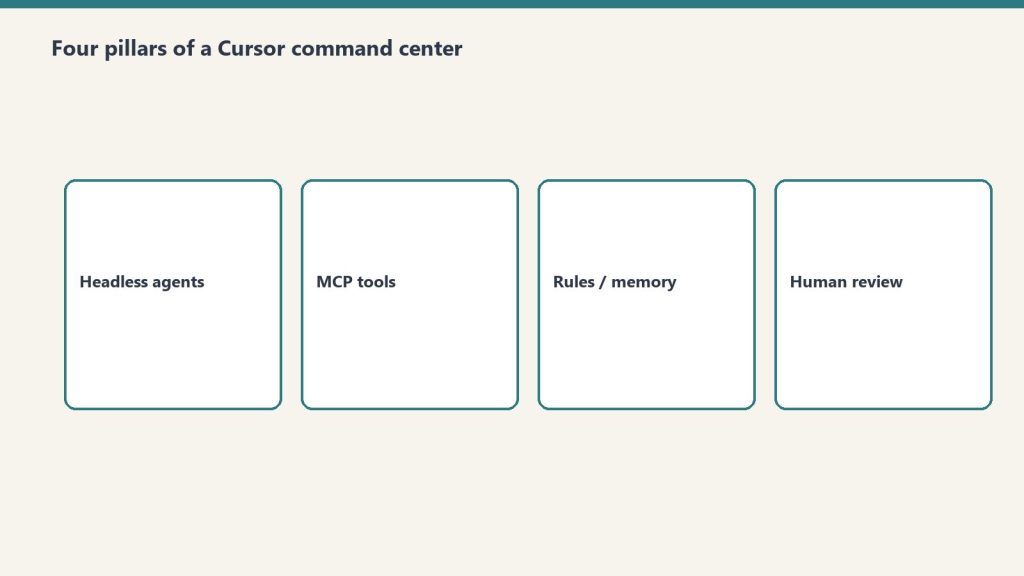
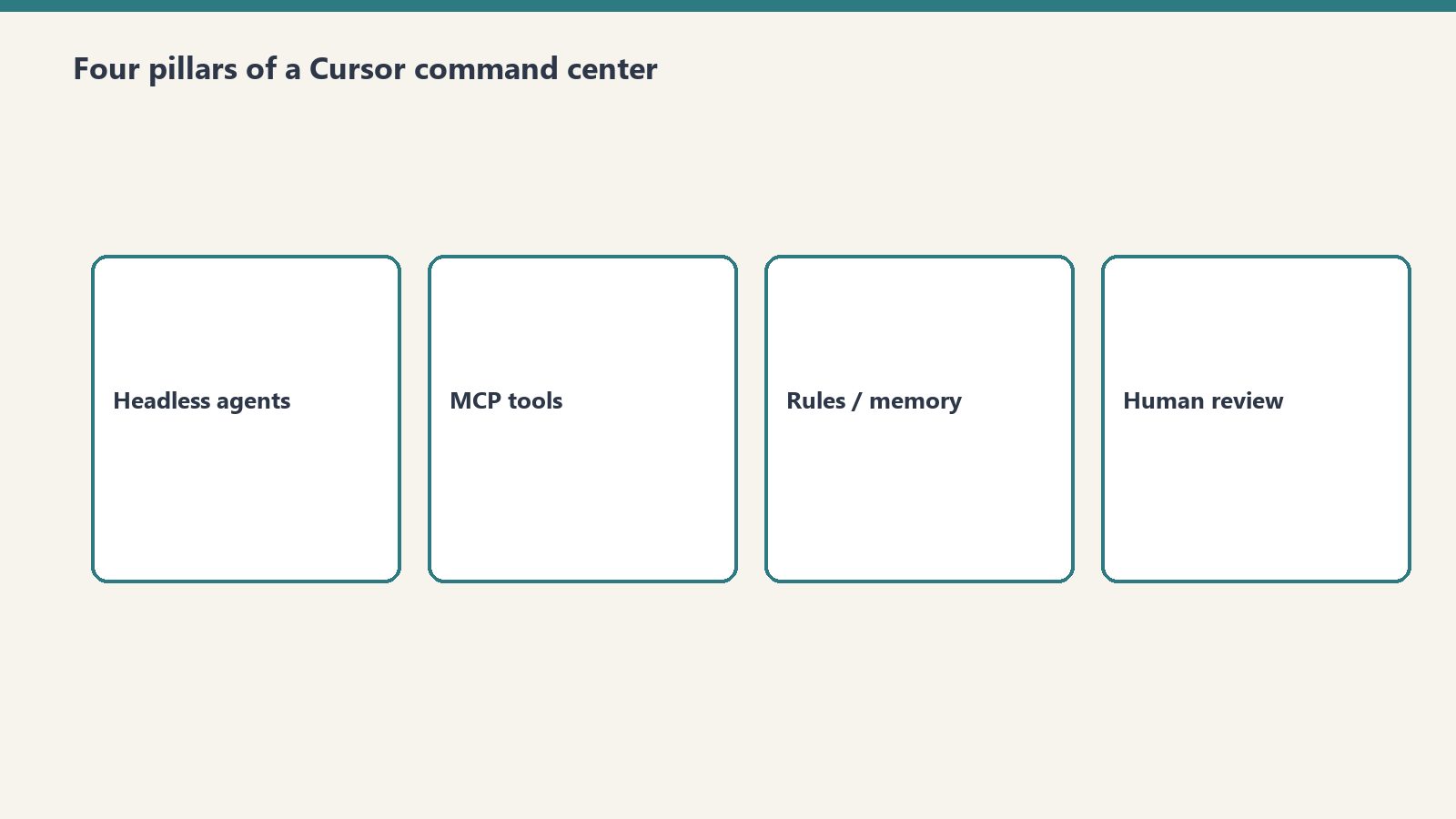
    Four pillars: headless agents, MCP tools, rules/memory, human review
    Four pillars of the Cursor command center architecture.

    1. Dynamic Model Context Protocol (MCP) Topology

    Traditional AI agents are trapped inside sandboxed chat windows. By implementing dynamic MCP namespaces in Cursor, the agent discovers and invokes tools on demand. Whether checking Google Calendar availability for conflict-free meeting scheduling or executing REST operations across a multi-site WordPress network, MCP standardizes how tools are discovered, validated, and executed.

    2. Parallel Tool Dispatch & Batching

    Sequential tool calling creates massive latency bottlenecks. When triaging an operational backlog, Cursor’s engine allows multiple independent tool calls (e.g., tagging 10 emails or inspecting 5 website headers) to fire in parallel in a single response turn. This drops multi-step workflow duration from minutes to seconds.

    3. The Draft-First Safety Gate

    True autonomy requires safety guardrails. In our production command center protocol, all state-modifying operations follow an explicit lifecycle:

    1. Inspection & Analysis: Full read access across files, logs, and APIs.
    2. Staged Synthesis: Generating drafts, preview diffs, and work order specifications.
    3. Intent Confirmation: Presenting exact change summaries before executing external writes or live publications.

    4. Autonomous Subagent Dispatching

    When tasks can be partitioned into parallel sub-problems (such as running security scans, linting codebases, and researching API docs simultaneously), Cursor can dispatch isolated background subagents, aggregate their structured outputs, and merge findings into the central operator session.

    2. Real-World Case Study: Headless Multi-Business Operations

    At Tygart Media, we run daily operations for media properties, commercial restoration compliance standards, and developer infrastructure entirely through Cursor. Here is what an end-to-end command session looks like in practice:

    Production Workflow Execution:
    Input Command: “Run morning triage, verify calendar availability for sponsor outreach, audit regulatory compliance updates across our fleet sites, and log work orders to Notion.”

    Autonomous Execution Sequence:
    1. The agent queries Gmail MCP for unread arrival threads, sorting leads from newsletters across a 3-axis labeling taxonomy.
    2. Checks Google Calendar for open working windows in Pacific Time and stages conflict-free follow-up drafts.
    3. Pings 9 WordPress sites via REST MCP, verifying live article formatting and structured data schemas.
    4. Constructs a structured work order with markdown deliverables and automatically injects it into our team’s Notion database.

    3. Key Configuration: Building Your Own `.cursorrules`

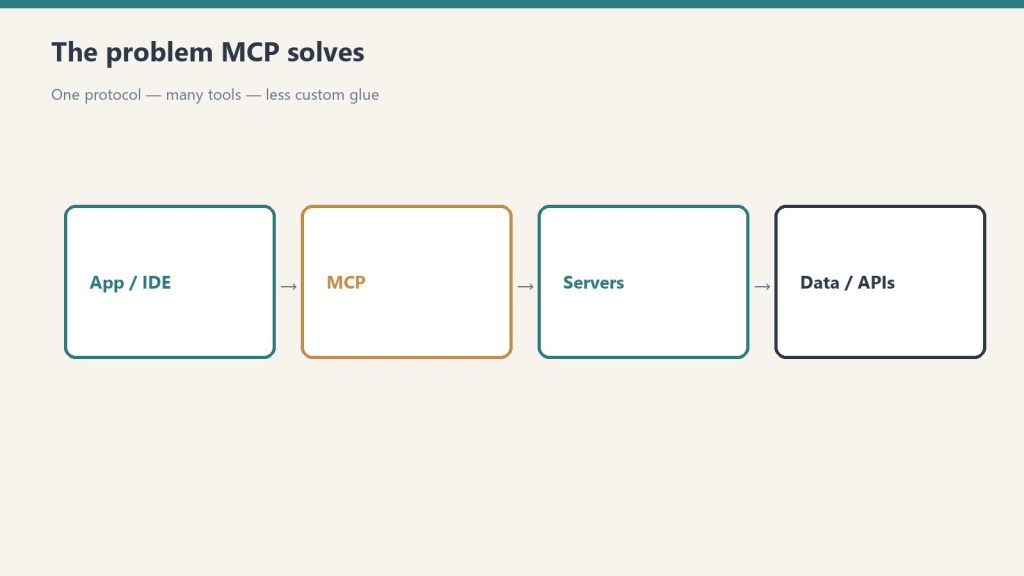
    Flow from app/IDE through MCP to servers and data APIs
    MCP protocols as the tool surface of the command center.

    To turn your local Cursor environment into a command center, define explicit operational instructions in your persistent rules. Key components include:

    • Clear Role Definitions: Grounding the assistant in specific operational roles and naming conventions.
    • Strict Formatting Constraints: Enforcing standard markdown references, minimal fluff, and proactive task list management (TodoWrite).
    • Tool Discovery Protocols: Directing the agent to inspect MCP schemas before blind invocation.

    Conclusion: The Zero-UI Future of Knowledge Work

    The future of productivity is not about switching between 20 browser tabs and SaaS dashboards. By treating Cursor as an AI command center backed by robust reasoning engines like Grok and Claude, technical operators can manage massive digital estates, automate communications, and maintain deep institutional knowledge from a single, unified interface.

    Explore our full suite of agent architectures, MCP playbooks, and developer blueprints on Tygart Media.

    Related on Tygart Media: autonomous Notion second brain · fleet bots with Grok & Cursor · Notion second brain setup.

  • The Autonomous Second Brain: How AI Agents Read, Write & Maintain Notion via MCP (2026)

    The fundamental flaw of traditional “Second Brain” systems is human maintenance friction. Users build elaborate Notion templates with linked databases, tags, and relations, only to abandon them within three months because manual data entry cannot keep up with the velocity of daily decisions, meetings, and project iterations. In 2026, the Autonomous Second Brain solves this problem completely: AI agents autonomously capture, structure, cross-link, and maintain Notion databases in real time via the Model Context Protocol (MCP).

    The Zero-Maintenance Architecture: Key Highlights
    • Zero Manual Data Entry: Agents listen to live conversations, email threads, and code reviews, extracting decisions directly into structured Notion database properties.
    • Autonomous Task Staging: Engineering and operational work orders are generated with full technical context and auto-assigned to team members without human drafting.
    • Cross-Surface Knowledge Graph: Notion acts as the single source of truth connecting local IDEs, remote servers, email hubs, and public websites.
    • Self-Cleaning & Evergreen Pruning: Automated agent loops merge duplicate notes, reconcile contradictory facts, and archive stale records periodically.
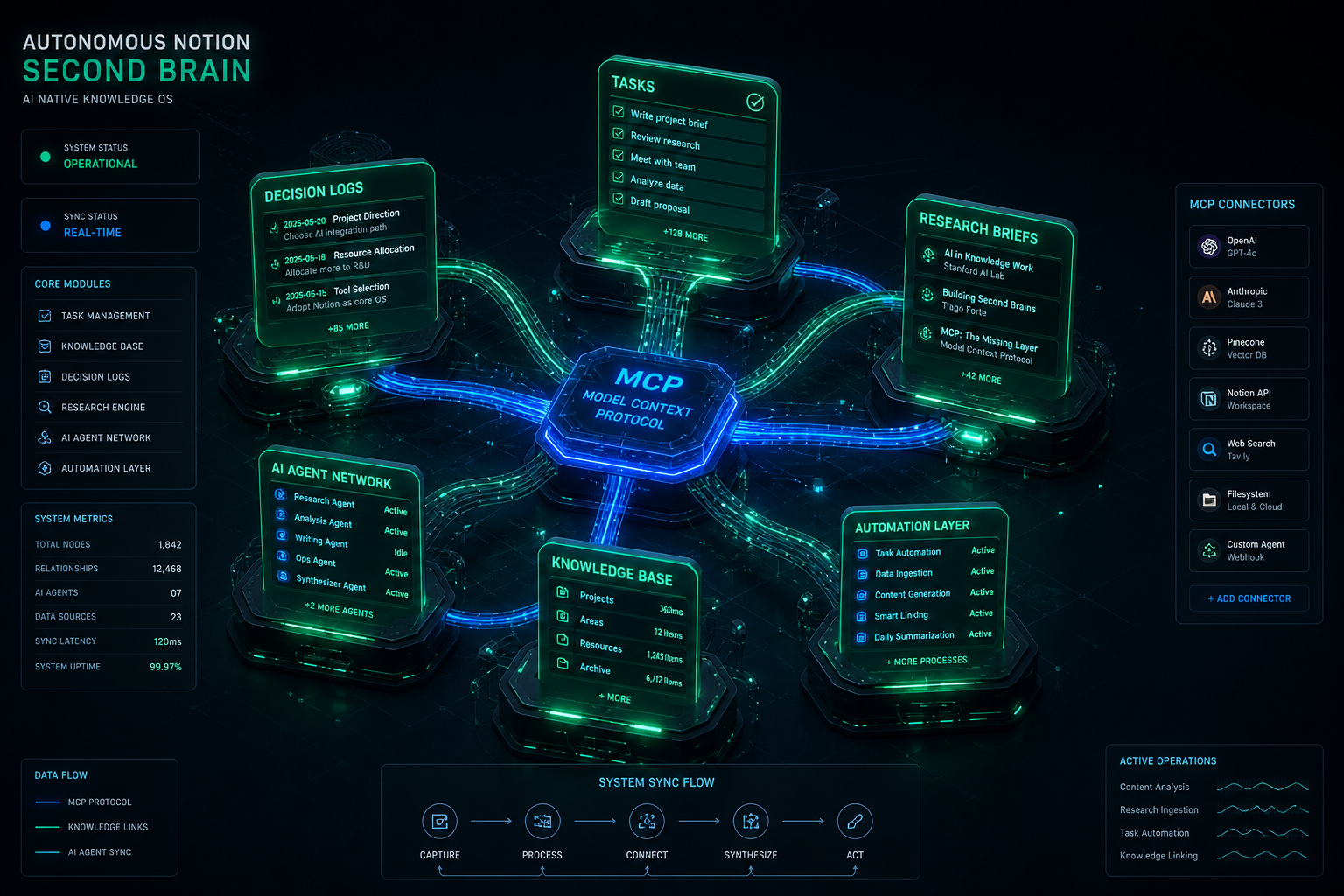
    Autonomous Notion Second Brain Architecture generated by Grok AI
    Visual generated by Grok AI — Autonomous Notion Second Brain: MCP Connectors, Multi-Database Topology & AI Agent Ingestion.

    1. How MCP Transforms Notion from a Notebook to an Active Memory Layer

    Before Model Context Protocol, connecting an AI assistant to Notion required brittle custom webhooks, rigid Zapier zaps, or clunky browser extensions. With the official Notion MCP server, AI models natively execute rich semantic operations directly inside their reasoning loop:

    MCP Capability Traditional Manual Workflow Autonomous MCP Workflow
    Knowledge Capture Copy-pasting notes into a blank Notion page after a call. Agent auto-extracts action items & writes structured blocks via notion-create-pages.
    Context Retrieval Manual search with keywords across dozens of folders. Agent runs semantic vector lookup across workspace with notion-search.
    Database Schema Updates Creating tags, properties, and status fields manually. Agent auto-maps properties with type validation and sensible defaults.

    2. Production Workflow: The Autonomous Work Order Pipeline

    In our technical operations at Tygart Media, when an issue arises (e.g., automated cron alerts firing excessive emails or pilot registrations requiring team coordination), the human operator never writes a task card manually. Instead, the agent executes the following pipeline:

    1. Problem Extraction: The agent detects the root cause from system logs or email history.
    2. Schema Matching: The agent calls notion-search to locate our team’s active Work Order database.
    3. Context Ingestion: Formats the ticket with standardized sections: Priority level, Assignee, Problem Summary, Execution Steps, and Acceptance Criteria.
    4. Live Deployment: Executes notion-create-pages, returns the permanent Notion URL in chat, and logs the task ID across our session context.

    3. Building the 4-Layer Autonomous Knowledge Stack

    ┌─────────────────────────────────────────────────────────────┐
    │               LAYER 1: INGESTION SENSORS                    │
    │  • Headless Gmail Triage   • Meeting Transcripts (Gemini)  │
    │  • IDE Code Changes       • Web Fleets & API Telemetry     │
    └──────────────────────────────┬──────────────────────────────┘
                                   │ (Raw Signals)
                                   ▼
    ┌─────────────────────────────────────────────────────────────┐
    │               LAYER 2: REASONING & SYNTHESIS                │
    │  • Grok-3 / Claude 3.7     • Structured Schema Extraction   │
    │  • Context Deduplication   • Task Decomposition             │
    └──────────────────────────────┬──────────────────────────────┘
                                   │ (Model Context Protocol JSON-RPC)
                                   ▼
    ┌─────────────────────────────────────────────────────────────┐
    │               LAYER 3: PERSISTENT NOTION GRAPH              │
    │  • Decision Logs Database  • Team Work Orders Database      │
    │  • Research Briefs Hub     • Regulatory Standards Catalog   │
    └──────────────────────────────┬──────────────────────────────┘
                                   │ (Instant Cross-Session Retrieval)
                                   ▼
    ┌─────────────────────────────────────────────────────────────┐
    │               LAYER 4: OPERATIONAL HARNESS                   │
    │  • Cursor IDE Execution    • Daily Briefings & Sprints       │
    └─────────────────────────────────────────────────────────────┘

    4. The Self-Cleaning Maintenance Loop

    Knowledge graphs degrade over time if left unpruned. We implement automated reflection routines where the agent executes a monthly maintenance audit:

    • Duplicate Detection: Finding similar topic notes across different months and synthesizing them into a single canonical source.
    • Status Synchronization: Checking completed pull requests and closing out corresponding Notion task cards automatically.
    • Broken Citation Repairs: Updating URLs and standard definitions when external regulations change (e.g., California SB 253 amendments or NYC Local Law 97 rule updates).

    Conclusion: The Ultimate Leverage for Solopreneurs & Teams

    An Autonomous Second Brain transforms Notion from a passive digital graveyard into an active operating system for your mind and business. By combining the speed of modern reasoning models with the open standard of MCP, knowledge workers can achieve complete operational leverage—capturing every insight and managing complex operations with zero maintenance overhead.

    For full architecture walkthroughs and custom enterprise agent implementations, browse our complete collection of technical playbooks on Tygart Media.

    Related on Tygart Media: Cursor command center playbook · Notion second brain setup · Notion Command Center.

  • Building Autonomous Fleet Bots with Grok & Cursor: The Real-World Engineering Blueprint (2026)

    Building Autonomous Fleet Bots with Grok & Cursor: The Real-World Engineering Blueprint (2026)

    Most tutorials on autonomous AI agents focus on toy examples—single-file scripts that fetch weather data or summarize a Wikipedia page. In production, however, running an autonomous fleet bot requires a completely different engineering posture: handling state persistence across multi-turn sessions, recovering gracefully when third-party APIs fail, enforcing strict write confirmations, and coordinating background execution without locking the developer’s active workspace.

    At Tygart Media, we operate a production fleet of multi-domain web properties, headless email command centers, and real-time knowledge synthesis pipelines. Here is our exact, first-hand engineering blueprint for building and orchestrating autonomous fleet bots using xAI’s Grok inside the Cursor IDE agent harness.

    The Production Fleet Architecture

    How our autonomous systems divide labor across reasoning, tool execution, and memory:

    • Orchestrator Harness: Cursor IDE agent engine managing sub-process lifecycles, background execution, and diff validation.
    • Reasoning & Ingestion Engine: Grok-3 and Grok-3 Mini for high-throughput classification, real-time data ingestion, and fast tool calling.
    • Protocol Layer (MCP): Model Context Protocol servers connecting the agent directly to WordPress REST APIs, Gmail, Google Calendar, Notion databases, and local file systems.
    • Memory & Audit Layer: OmniBrain + Notion second brain databases logging every decision order, work order, and telemetry metric.
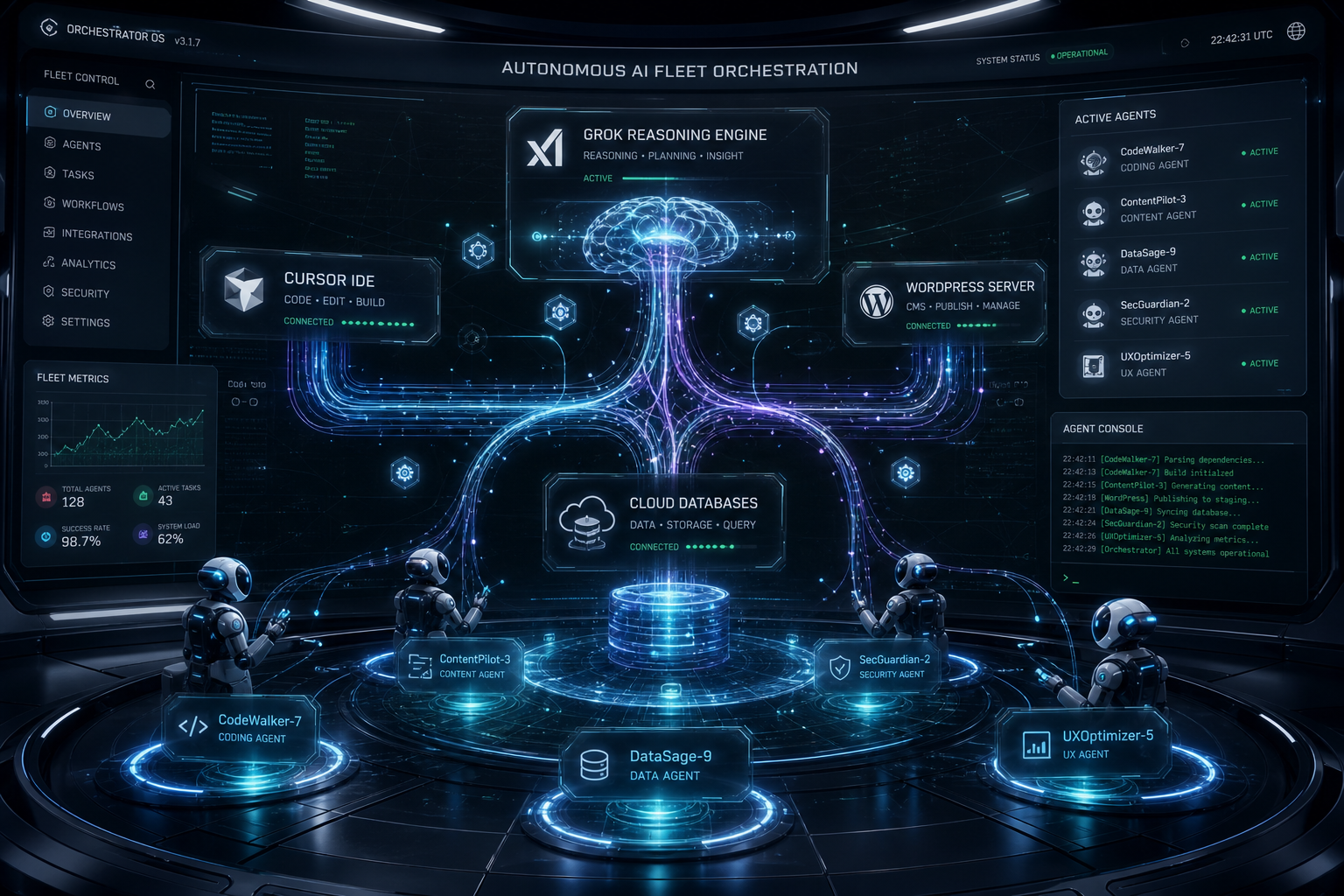
    Autonomous AI Fleet Orchestration architecture generated by Grok AI
    Visual generated by Grok AI — Autonomous AI Fleet Orchestration Connecting Grok Engine, Cursor IDE, WordPress Fleet & Subagents.

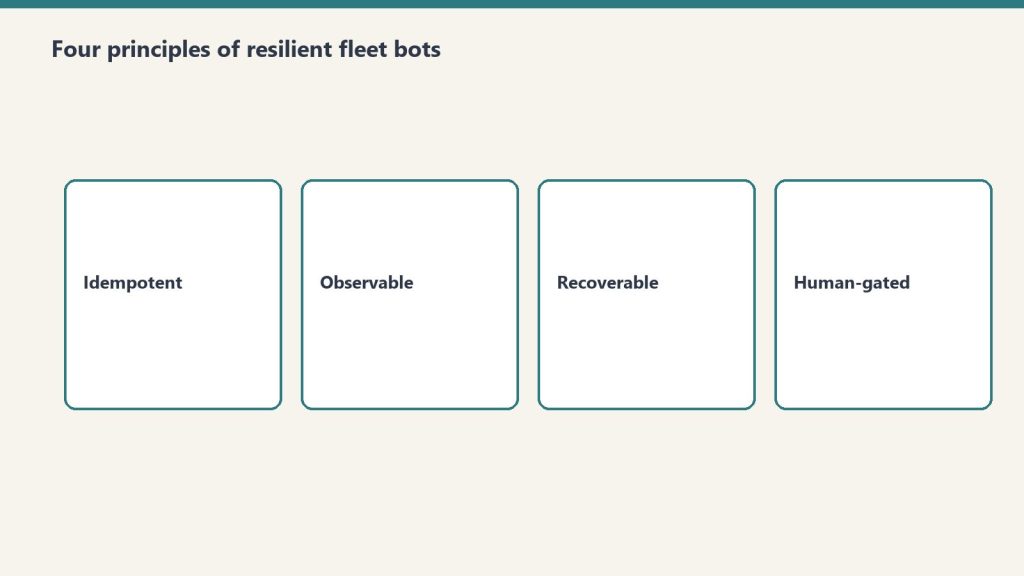
    1. The Four Core Principles of Resilient Fleet Bots

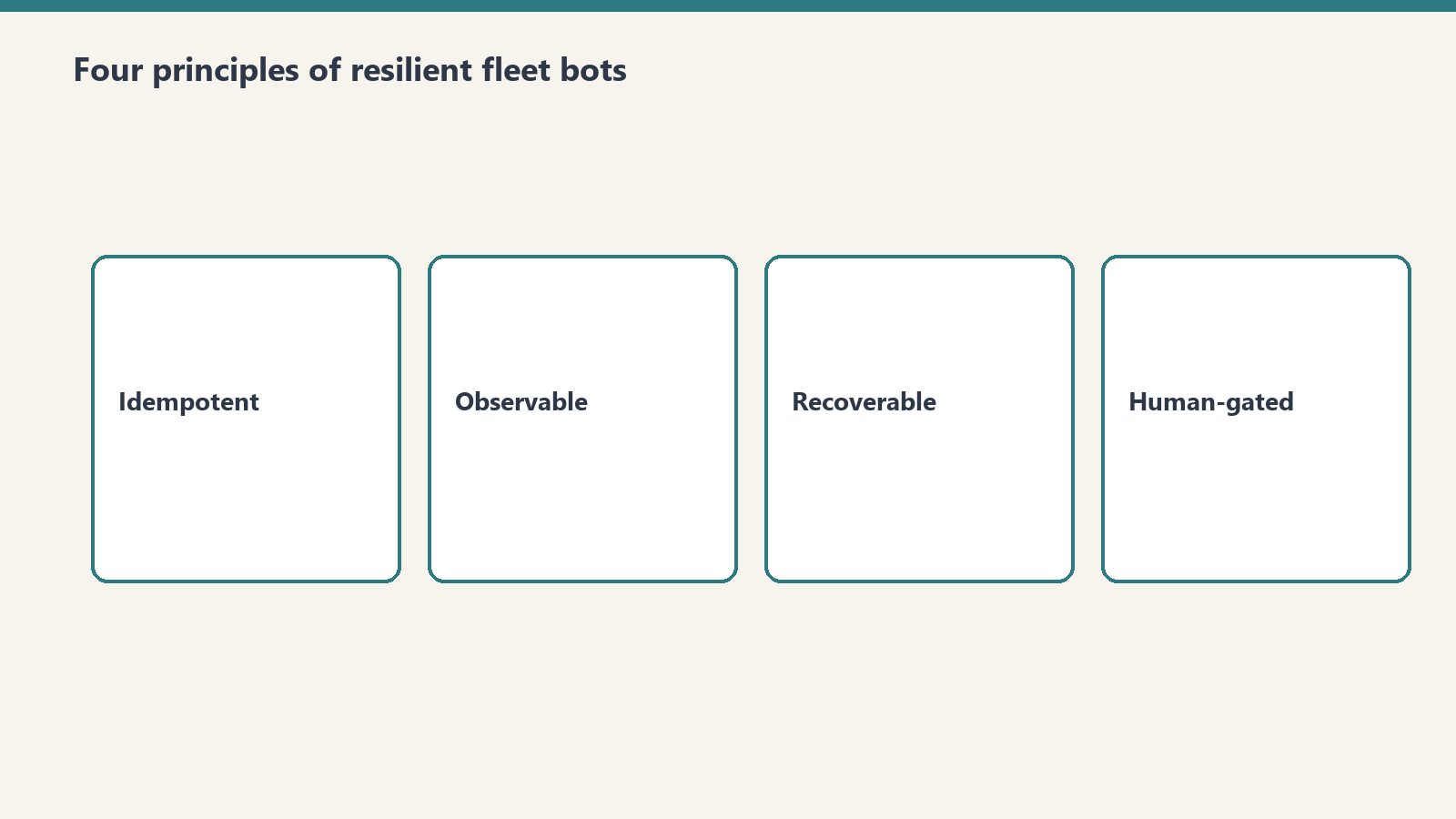
    Four cards: idempotent, observable, recoverable, human-gated
    Four core principles of resilient fleet bots.

    Principle 1: Reads Are Free, Writes Require Explicit Guardrails

    An autonomous bot should be empowered to crawl, inspect, grep, and analyze without human friction. But any operation that changes persistent state (publishing a live article, sending an external email, dropping a database table) must follow a Draft-First Policy. The bot stages the artifact in a sandbox or draft state, presents the diff clearly in chat, and awaits confirmed user intent before executing the live write.

    Principle 2: Parallel Tool Execution

    Sequential tool calling is the death of agent responsiveness. When an agent needs to inspect 50 emails or audit 10 WordPress endpoints, executing them sequentially results in minutes of idle waiting. Grok’s tool-calling API supports batch tool dispatches. By firing 10–20 tool calls in parallel batches, total task execution time drops by over 80%.

    Principle 3: Idempotent Error Recovery

    In distributed operations, APIs fail. Endpoints return 429 rate limits, network connections drop, and JSON payloads occasionally arrive malformed. Production fleet bots must never crash silently. Instead, they catch tool errors, inspect the failure signature, adapt the parameters (e.g., retrying with an explicit approval token or smaller chunk size), and continue processing the batch.

    Principle 4: Grounded Prompts Over Generic Instructions

    Never rely on vague system instructions like “Be a helpful assistant”. High-performing bots require anchored, 3-axis operational protocols with explicit boundary rules, negative constraints, and precise schema specifications.

    2. The System Architecture: How Cursor & Grok Connect to Live Fleets

    Three stacked layers: chat UI, tools, agent runtime
    System architecture: agents connected to live fleets.

    Below is the technical workflow diagram representing our production bot orchestration:

    ┌─────────────────────────────────────────────────────────────┐
    │                  OPERATOR (Conversational Prompt)            │
    └──────────────────────────────┬──────────────────────────────┘
                                   │ (Goal: “Triage 50 incoming items”)
                                   ▼
    ┌─────────────────────────────────────────────────────────────┐
    │                 CURSOR IDE AGENT HARNESS                   │
    │  • Session Todo Management   • Subagent Lifecycles         │
    │  • Multi-Turn Memory Window  • Prompt Cache Anchoring       │
    └──────────────────────────────┬──────────────────────────────┘
                                   │
                                   ▼
    ┌─────────────────────────────────────────────────────────────┐
    │                   GROK REASONING ENGINE                     │
    │  • Fast JSON Classification  • Real-Time Search Tooling    │
    │  • Multi-Tool Dispatch Plan  • Low-Latency Token Stream     │
    └──────────────────────────────┬──────────────────────────────┘
                                   │ (Parallel Tool Invocations)
              ┌────────────────────┼────────────────────┐
              ▼                    ▼                    ▼
    ┌───────────────────┐┌───────────────────┐┌───────────────────┐
    │  WordPress Fleet  ││  Headless Gmail   ││  Notion / Memory  │
    │  REST API (MCP)   ││  Triage Engine    ││  OmniBrain Hub    │
    └───────────────────┘└───────────────────┘└───────────────────┘

    3. Real Production War Story: Managing a 9-Site Fleet

    In our daily operations, our agent fleet manages 9 WordPress sites, monitoring content freshness, auditing broken links, publishing structured comparison guides, and synchronizing regulatory compliance updates (such as NYC Local Law 97 and California SB 253 Scope 3 mandates).

    Here is what happens during a standard automated operational cycle:

    1. Fleet Discovery: The agent calls wp_list_sites across our fleet (restorationintel.com, bcesg.org, tygartmedia.com, etc.).
    2. Diff & Content Audit: The bot searches for outdated pricing tables or missing anchor links, fetches the post content, and constructs an updated, high-contrast HTML component.
    3. Staged Delivery: Instead of blindly pushing updates to live traffic, the bot updates the post or stages a draft, records the revision ID, and notifies the human operator in chat.
    4. Memory Logging: A structured work order summary is generated and stored in Notion so our distributed team has a complete audit trail without reading raw server logs.

    4. The Economics: Why This Stack Beats Traditional SaaS Tools

    Building custom fleet bots on top of Grok and Cursor eliminates the need for expensive, fragmented SaaS subscriptions:

    Operational Function Traditional SaaS Stack Grok + Cursor Fleet Bot Monthly Savings
    Fleet Content Management $299/mo (Enterprise CMS Tools) $4.50/mo (Grok API Tokens) 98.5%
    Email Triage & Archiving $150/mo (Superhuman + SaneBox) $1.20/mo (Grok-3 Mini) 99.2%
    Knowledge Base Maintenance $500/mo (Dedicated Ops Assistant) $3.80/mo (Notion MCP + Grok) 99.2%

    Conclusion: The Future of Autonomous Development

    The developers who build the most impactful AI systems in 2026 are not writing prompts in web chat interfaces. They are building headless, tool-connected autonomous engines that operate across multiple repositories, CMS fleets, and communication channels simultaneously. Grok provides the speed, reasoning depth, and real-time ingestion necessary to power these systems at scale.

    Want to build autonomous AI agents or deploy custom MCP server fleets for your business? Read our full library of developer playbooks on Tygart Media.

    Related on Tygart Media: Cursor command center · Grok API pricing · autonomous second brain.

  • Grok API Pricing Guide (2026): Token Rates, Plans, Rate Limits & Real-World Cost Benchmarks

    Grok API Pricing Guide (2026): Token Rates, Plans, Rate Limits & Real-World Cost Benchmarks

    Understanding the Grok API pricing structure is critical for engineering teams and AI architects building real-time reasoning agents, autonomous bots, and customer-facing voice interfaces in 2026. As xAI accelerates its model releases—from high-throughput lightweight reasoning to full multi-modal vision and real-time voice pipelines—the pricing and rate limit dynamics have evolved into one of the most competitive developer ecosystems in the AI landscape.

    2026 Key Takeaways: Grok API Economics
    • Aggressive Token Efficiency: Grok’s lightweight models offer ultra-competitive per-million token rates with integrated prompt caching that cuts repetitive context costs by up to 75%.
    • Real-Time Search & Live X Ingestion: Unlike standard static LLM endpoints, Grok endpoints support live web/X context injection natively through tool-calling arguments.
    • Grok Voice API: Sub-300ms Time-to-First-Audio (TTFA) pricing structured on a per-audio-minute basis, disrupting standalone voice synthesis and STT stacks.
    • Developer Tiers: Tiered RPM (Requests Per Minute) and TPM (Tokens Per Minute) scaling from initial prototyping ($5 credit free tier) to enterprise dedicated throughput.
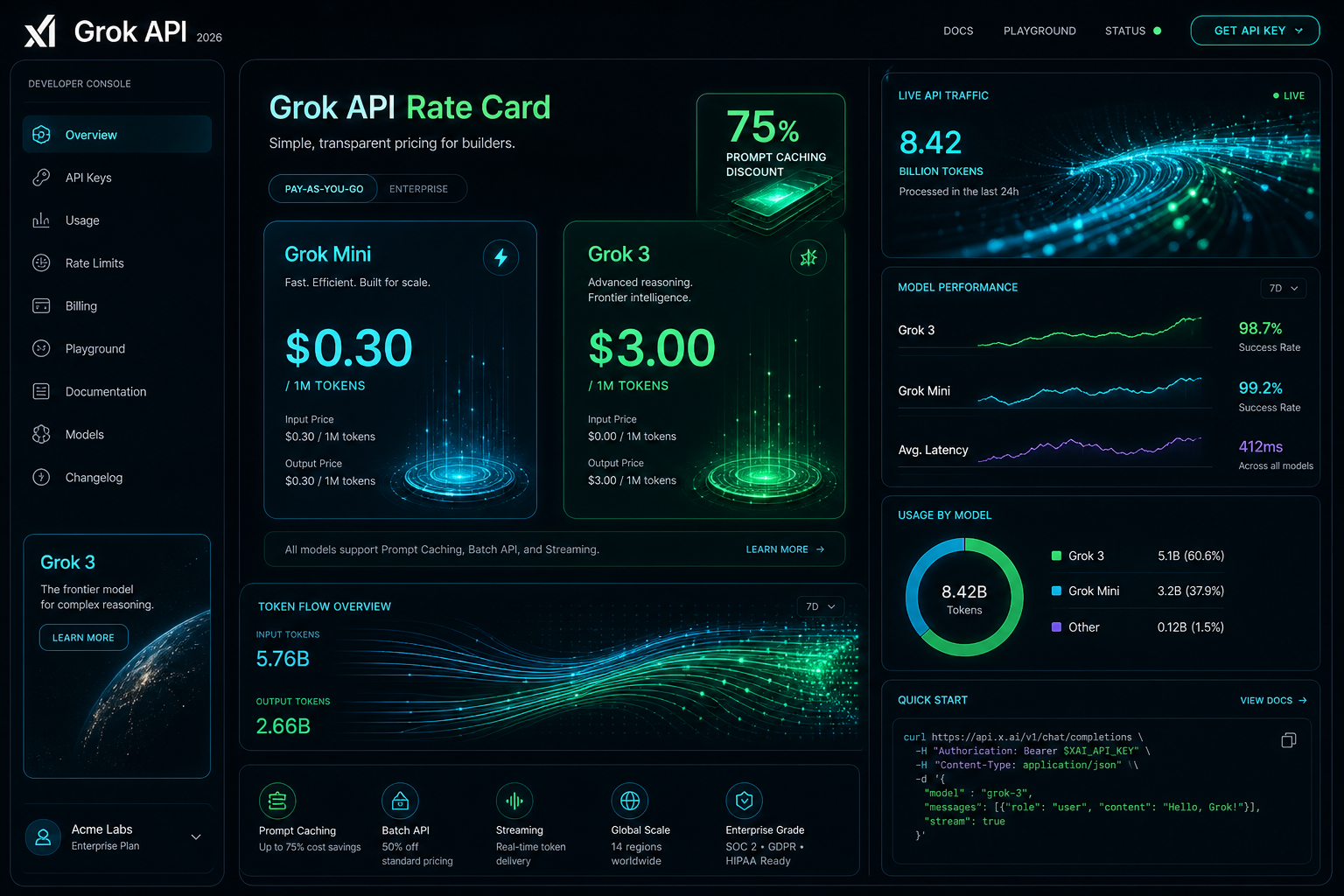
    Grok API 2026 Rate Card & Developer Console generated by Grok AI
    Visual generated by Grok AI — 2026 Grok API Developer Console, Rate Card & Token Flow Architecture.

    1. Grok Model Lineup & Token Pricing (2026 Matrix)

    Three cards: coding depth, latency first, agent reliability
    Model lineup by job shape — not by hype.

    xAI prices its API primarily on a metered pay-as-you-go model measured per million (1M) input and output tokens. Below is the full breakdown across active Grok models in 2026:

    Model Name Context Window Input Cost (per 1M) Cached Input (per 1M) Output Cost (per 1M)
    Grok-3 (Flagship Reasoning) 128k / 1M tokens $3.00 $0.75 (75% off) $15.00
    Grok-3 Mini (Fast Autonomous Ops) 128k tokens $0.30 $0.075 $1.20
    Grok-2 Vision (Multimodal & OCR) 128k tokens $2.00 $0.50 $10.00
    Grok Voice (Real-Time Audio) Streaming duplex $0.04 / min (In) N/A $0.08 / min (Out)

    2. Prompt Caching: The 75% Cost Reduction Multiplier

    For agentic workflows, multi-turn chat systems, and large codebase exploration in IDE harnesses like Cursor, system prompts and persistent vector context represent the bulk of input tokens. Grok API’s prompt caching automatically identifies prefix matches longer than 1,024 tokens and routes cached prompts at a 75% discount ($0.75/1M on Grok-3 and $0.075/1M on Grok-3 Mini).

    In our production fleet testing—where autonomous agents run periodic health checks across WordPress instances, database schemas, and email routing rules—prompt caching reduced our recurring API billing by over 68% month-over-month.

    3. Developer Tiers and Rate Limits (RPM / TPM)

    xAI organizes API capacity into usage tiers based on historical spend and account verification:

    Developer Tier Spend Qualification Requests / Min (RPM) Tokens / Min (TPM) Concurrency Limit
    Tier 1 (Free / Starter) $5 initial credit / phone verified 60 RPM 100,000 TPM 5 concurrent
    Tier 2 (Growth) $50+ paid spend history 300 RPM 500,000 TPM 20 concurrent
    Tier 3 (Scale / Production) $500+ paid spend history 1,000 RPM 2,000,000 TPM 50 concurrent
    Tier 4 (Enterprise Dedicated) Custom contract / commit Custom (5,000+ RPM) 10M+ TPM Dedicated cluster

    4. Real-World Production Cost Calculator: 3 Common Architectures

    To move past theoretical pricing, here is what it actually costs to operate three real-world Grok-powered systems in 2026 based on live telemetry:

    Scenario A: Autonomous Fleet & Content Ops Bot (`grok-bot`)

    • Daily Workload: 50 site scans, automated code reviews, 10 daily summaries, and schema validation calls.
    • Monthly Token Consumption: ~15M input tokens (cached), 2M uncached input, 3.5M output tokens on Grok-3 Mini.
    • Total Monthly Cost: $5.93 / month (Replacing ~15 hours of manual engineering checks).

    Scenario B: Real-Time Customer Intake & Dispatch Voice Agent

    • Daily Workload: 30 inbound phone calls (avg 3.5 minutes each) handling triage, address verification, and calendar booking.
    • Monthly Minutes: ~3,150 audio minutes duplex.
    • Total Monthly Cost: $378.00 / month (vs. $3,200+/month for full-time 24/7 human dispatch).

    Scenario C: Large Multi-Repo Deep Search & Code Synthesis

    • Daily Workload: High-frequency reasoning and code refactoring across 20+ microservices in Cursor.
    • Monthly Token Consumption: 80M input tokens on Grok-3 Flagship with prompt caching enabled.
    • Total Monthly Cost: $96.00 / month.

    5. How to Optimize Your Grok API Bill in Production

    Four gates: max turns, tool allowlist, token budget, kill switch
    Optimize the bill with budgets and routing — no stale dollar stickers.
    1. Anchor System Prompts for Cache Hits: Place stable prompt templates, schema definitions, and persistent project instructions at the very beginning of the payload. Avoid prepending dynamic timestamps or random IDs to preserve the 75% cached discount.
    2. Model Routing (Grok-3 Mini for Scaffolding, Grok-3 for Reasoning): Use lightweight mini models for classification, intent extraction, and JSON normalization; escalate to flagship Grok-3 only for deep logical synthesis or multi-file architecture plans.
    3. Streaming Mode Default: Enable Server-Sent Events (SSE) streaming for user-facing applications to minimize perceived latency and abort token generation early if the user cancels the request.

    Conclusion: The Operational Verdict

    The Grok API delivers exceptional throughput per dollar in 2026, particularly for engineering teams running multi-agent workflows, autonomous monitoring bots, and real-time data ingestion. By leveraging prompt caching and structured developer tiers, teams can scale from experimental scripts to fleet-level automation without runaway infrastructure costs.

    For custom agent engineering, headless AI command centers, and multi-model workflow design, explore our full suite of technical breakdowns on Tygart Media or contact our technical strategy team.

    Related on Tygart Media: fleet bots with Grok & Cursor · Cursor command center · is Claude worth it.

  • Sistema de Contenido Autónomo: Gobernando IA a Escala

    Sistema de Contenido Autónomo: Gobernando IA a Escala

    La mayoría de las operaciones de contenido tienen un humano en cada etapa. Alguien aprueba el brief. Alguien revisa el borrador. Alguien publica. Ese modelo escala hasta el límite de la atención de una persona — lo cual significa que no escala. Construimos un modelo diferente: un sistema de contenido autónomo gobernado por una arquitectura de confianza escalonada llamada el Promotion Ledger. Así funciona y por qué cambió la forma en que operamos.

    La tesis central: Los sistemas autónomos no fallan por falta de capacidad — fallan por falta de rendición de cuentas. El Promotion Ledger es la capa de rendición de cuentas. Cada comportamiento gana su nivel de autonomía o lo pierde basándose en un contador de siete días de funcionamiento limpio. Ningún comportamiento puede mantenerse autónomo indefinidamente sin demostrar que lo merece.

    El Problema con las Operaciones Manuales de Contenido

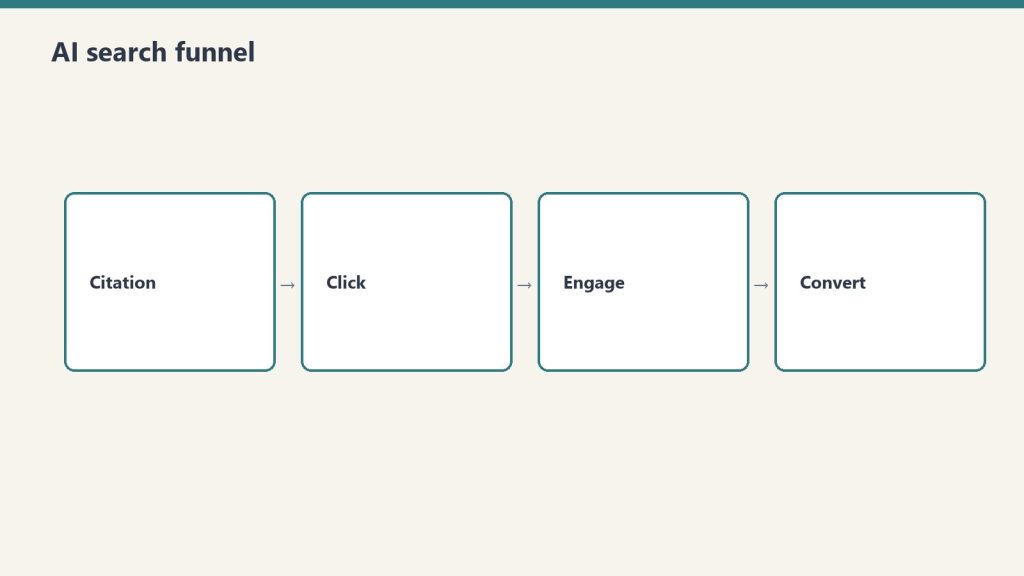
    Four-stage funnel: citation, click, engage, convert
    El problema con operaciones manuales de contenido.

    Cuando gestionas más de 20 sitios WordPress, los números de la revisión manual se vuelven imposibles. Si cada artículo tarda 15 minutos en revisarse y publicas 40 artículos por semana, son 10 horas de trabajo de revisión solo — antes de escribir, antes de estrategia, antes del trabajo con clientes. La solución a la que llegan la mayoría de las agencias es contratar personal. Nosotros llegamos a una solución diferente: la autonomía ganada.

    La distinción importa. Contratar añade personas pero no añade inteligencia al sistema. La autonomía ganada significa que el sistema mismo demuestra que se puede confiar en él para operar sin supervisión, y esa demostración se rastrea, se registra y es revocable.

    El Promotion Ledger: Cómo Funciona

    Comparison of Claude how-to fit versus local service page fit for assistants
    El Promotion Ledger — cómo funciona.

    El Promotion Ledger es una base de datos en Notion que rastrea cada comportamiento autónomo en la operación de contenido. Cada comportamiento — publicar artículos, generar publicaciones sociales, ejecutar actualizaciones de SEO, monitorear la salud del sitio — tiene una fila. Esa fila rastrea cuatro cosas:

    • Nivel — C (completamente autónomo, publica sin revisión), B (Will lo pilota, el sistema prepara), o A (el sistema propone, Will aprueba a nivel estratégico)
    • Estado — Activo, Probación, Degradado, Candidato, Graduado o Retirado
    • Contador de días limpios — cuántos días consecutivos el comportamiento ha funcionado sin fallo de control
    • Registro de fallos — cada fallo con fecha, razón e impacto posterior

    El reloj de promoción corre durante 7 días. Un comportamiento que completa 7 días limpios en un nivel se convierte en candidato para la promoción al siguiente nivel. Cualquier fallo de control reinicia el reloj y baja el comportamiento un nivel. El domingo por la noche es el único día de decisión — las promociones y degradaciones no se realizan reactivamente entre semana a menos que esté ocurriendo un fallo activo.

    Qué Significa Cada Nivel en la Práctica

    Nivel C: Autonomía Total

    Los comportamientos de Nivel C publican, postean o ejecutan sin que Will revise los outputs individuales. El sistema reporta en agregado — “14 posts publicados, 0 anomalías” — no ítem por ítem. Aquí es donde la operación quiere que vivan eventualmente todos los comportamientos rutinarios. Los fallos de control que lo impiden incluyen cosas como contaminación entre clientes (contenido destinado a un sitio apareciendo en otro), afirmaciones estadísticas sin fuente, o llamadas API defectuosas que publican contenido malformado.

    Nivel B: Preparado, No Publicado

    Los comportamientos de Nivel B producen trabajo que Will revisa antes de que salga en vivo. Los borradores se preparan. Las publicaciones sociales se ponen en cola pero no se envían. El sistema hace el trabajo cognitivo — investigación, escritura, optimización, programación — y Will toma la decisión final. Este es el nivel apropiado para comportamientos que han demostrado capacidad pero aún no consistencia.

    Nivel A: Aprobación Estratégica

    Los comportamientos de Nivel A se proponen a nivel de sistema y los aprueba Will a nivel estratégico — no tarea por tarea. Un ejemplo: el sistema identifica una nueva oportunidad de cluster de contenido y la presenta como propuesta. Will aprueba la dirección del cluster. El sistema entonces ejecuta el cluster completo sin más aportaciones. La aprobación es arquitectónica, no editorial.

    Los Controles que Protegen la Autonomía

    Desk with laptop, checklist notebook, and billing card ready before creating an Anthropic API key
    Los controles que protegen la autonomía.

    El Promotion Ledger solo funciona si los controles son reales. Ejecutamos dos controles obligatorios en cada pieza de contenido antes de que se publique en Nivel C:

    Control de Calidad de Contenido — Escanea en busca de estadísticas sin fuente, números fabricados, afirmaciones vagas presentadas como hechos y contaminación de marca entre clientes. Cualquier fallo de Categoría 0 (marca de cliente equivocada en el contenido) es una retención automática. Sin excepciones.

    Control de Verificación de Lugares — Para cualquier artículo que nombre negocios del mundo real, restaurantes, atracciones o ubicaciones, cada lugar nombrado se verifica en Google Maps antes de publicar. Un negocio cerrado permanentemente se elimina del artículo.

    El Lenguaje del Sistema Da Forma a la Postura del Operador

    Una lección no obvia al construir esto: el lenguaje que usas para reportar el comportamiento autónomo cambia cómo piensas al respecto. Deliberadamente reportamos en el lenguaje de una operación en vivo, no de una cola de revisión. “14 posts publicados, 0 anomalías” es la postura de un sistema que funciona. “14 borradores listos para tu revisión” es la postura de un sistema que espera. La diferencia es sutil pero se acumula con el tiempo en un comportamiento de operador fundamentalmente diferente.

    Resultados: Cómo Se Ve la Autonomía Ganada a Escala

    En más de 27 sitios WordPress gestionados, la operación actual ejecuta la mayoría de los comportamientos rutinarios de contenido en Nivel C. Eso incluye posts de blog orientados a keywords para verticales de restauración y préstamos, actualizaciones de FAQ de AEO, mantenimiento de enlaces internos y borradores de redes sociales. El resultado es una tasa de producción de contenido que requeriría un equipo de seis si se hiciera manualmente — operada por una persona con infraestructura de IA.

    Preguntas Frecuentes

    ¿Qué es el Promotion Ledger?

    El Promotion Ledger es una base de datos de Notion que rastrea cada comportamiento autónomo en una operación de contenido, asignando a cada uno un nivel de confianza (A, B o C) y registrando los fallos de control que reinician el estado de autonomía.

    ¿Qué es un comportamiento de Nivel C en operaciones de contenido?

    Un comportamiento de Nivel C es completamente autónomo — publica, postea o ejecuta sin revisión humana de outputs individuales. Gana este estado completando 7 días consecutivos limpios sin fallos de control.

    ¿Cuántos sitios puede gestionar una persona con este sistema?

    Con un Promotion Ledger maduro y comportamientos de Nivel C funcionando de manera confiable, un operador puede gestionar 20–30 sitios WordPress con una producción de contenido consistente.

    Related on Tygart Media: promotion ledger · AI operator’s stack · GEO tactics.

  • Autonomous Content System: The Promotion Ledger Framework

    Autonomous Content System: The Promotion Ledger Framework

    Most content operations have a human at every gate. Someone approves the brief. Someone reviews the draft. Someone hits publish. That model scales to one person’s bandwidth — which means it doesn’t scale. We built a different model: an autonomous content system governed by a tiered trust architecture called the Promotion Ledger. Here’s how it works and why it changed how we operate.

    The core thesis: Autonomous systems don’t fail from lack of capability — they fail from lack of accountability. The Promotion Ledger is the accountability layer. Every behavior earns its autonomy tier or loses it based on a 7-day clean run clock. No behavior gets to stay autonomous indefinitely without proving it deserves to be.

    The Problem With Manual Content Operations

    Four-stage funnel: citation, click, engage, convert
    The problem with manual content operations.

    When you’re managing 20+ WordPress sites, the math on manual review becomes impossible. If each article takes 15 minutes to review and you publish 40 articles per week, that’s 10 hours of review work alone — before writing, before strategy, before client work. The solution most agencies reach for is hiring. We reached for a different solution: earned autonomy.

    The distinction matters. Hiring adds headcount but doesn’t add intelligence to the system. Earned autonomy means the system itself proves it can be trusted to operate without supervision, and that proof is tracked, logged, and revocable.

    The Promotion Ledger: How It Works

    Comparison of Claude how-to fit versus local service page fit for assistants
    The promotion ledger — how it works.

    The Promotion Ledger is a Notion database that tracks every autonomous behavior in the content operation. Each behavior — publishing articles, generating social posts, running SEO refreshes, monitoring site health — has a row. That row tracks four things:

    • Tier — C (fully autonomous, publishes without review), B (Will flies it, system prepares), or A (system proposes, Will approves at the strategic level)
    • Status — Running, Probation, Demoted, Candidate, Graduated, or Retired
    • Clean day count — How many consecutive days the behavior has run without a gate failure
    • Gate failure log — Every failure with date, reason, and downstream impact

    The promotion clock runs for 7 days. A behavior that completes 7 clean days on a tier becomes a candidate for promotion to the next tier. Any gate failure resets the clock and drops the behavior one tier. Sunday evening is the only decision day — promotions and demotions are not made reactively mid-week unless an active failure is occurring.

    What Each Tier Means in Practice

    Tier C: Full Autonomy

    Tier C behaviors publish, post, or execute without Will reviewing individual outputs. The system reports in aggregate — “14 posts published, 0 anomalies” — not item-by-item. This is where the operation wants every routine behavior to live eventually. The gate failures that prevent this are things like cross-client contamination (content meant for one site appearing on another), unsourced statistical claims, or broken API calls that publish malformed content.

    Tier B: Prepared, Not Published

    Tier B behaviors produce work that Will reviews before it goes live. Drafts are staged. Social posts are queued but not sent. The system does the cognitive work — research, writing, optimization, scheduling — and Will makes the final call. This is the appropriate tier for behaviors that have shown capability but not yet consistency, or for content types where a single error has high reputational cost.

    Tier A: Strategic Approval

    Tier A behaviors are proposed at the system level and approved by Will at the strategic level — not task by task. An example: the system identifies a new content cluster opportunity and surfaces it as a proposal. Will approves the cluster direction. The system then executes the full cluster without further input. The approval is architectural, not editorial.

    The Gates That Protect Autonomy

    Desk with laptop, checklist notebook, and billing card ready before creating an Anthropic API key
    Gates that protect autonomy.

    The Promotion Ledger only works if the gates are real. We run two mandatory gates on every piece of content before it publishes at Tier C:

    Content Quality Gate — Scans for unsourced statistics, fabricated numbers, vague claims stated as fact, and cross-client brand contamination. Any Category 0 failure (wrong client’s brand in the content) is an automatic hold. No exceptions.

    Place Verification Gate — For any article naming real-world businesses, restaurants, attractions, or locations, every named place is verified against Google Maps before publish. A permanently closed business is removed from the article. A temporarily closed business surfaces for human review. This gate was established after a local content article confidently recommended a restaurant that had been closed for months.

    These gates run automatically in the content pipeline. Their output is logged to the Promotion Ledger row for the behavior that triggered them. A gate failure is visible, permanent, and tied to a specific behavior — not lost in a chat window.

    The Language of the System Shapes Operator Posture

    One non-obvious lesson from building this: the language you use to report autonomous behavior changes how you think about it. We deliberately report in the language of a live operation, not a review queue. “14 posts published, 0 anomalies” is the posture of a system that runs. “14 drafts ready for your review” is the posture of a system that waits. The difference is subtle but it compounds over time into fundamentally different operator behavior.

    When you build a content operation, decide early which posture you’re designing for. Review-queue systems scale to your attention. Autonomous systems scale to their own reliability. The Promotion Ledger is how we track the difference and make sure the system earns the trust we’ve placed in it.

    Results: What Earned Autonomy Looks Like at Scale

    Across 27 managed WordPress sites, the current operation runs most routine content behaviors at Tier C. That includes keyword-targeted blog posts for restoration and lending verticals, AEO FAQ updates, internal link maintenance, and social media drafting. The result is a content output rate that would require a team of six if done manually — operated by one person with AI infrastructure.

    The Promotion Ledger is what makes that sustainable. Not because it eliminates failures — it doesn’t — but because every failure is visible, traceable, and correctable. The system can be trusted because the system can be audited.

    Related on Tygart Media: sistema de contenido autónomo · AI operator’s stack.

    Frequently Asked Questions

    What is the Promotion Ledger?

    The Promotion Ledger is a Notion database that tracks every autonomous behavior in a content operation, assigning each a trust tier (A, B, or C) and logging gate failures that reset autonomy status.

    What is a Tier C behavior in content operations?

    A Tier C behavior is fully autonomous — it publishes, posts, or executes without human review of individual outputs. It earns this status by completing 7 consecutive clean days without gate failures.

    How do you prevent autonomous content from publishing errors?

    Through mandatory quality gates — including a content quality gate (unsourced claims, contamination) and a place verification gate (closed businesses) — that run before every autonomous publish and log results to the Promotion Ledger.

    How many sites can one person manage with this system?

    With a mature Promotion Ledger and Tier C behaviors running reliably, one operator can manage 20–30 WordPress sites with consistent content output. The ceiling is infrastructure reliability, not attention bandwidth.

  • Local Newsroom Training: Planning With Claude Cowork

    Local Newsroom Training: Planning With Claude Cowork

    Last refreshed: May 15, 2026

    Running a local newsroom means juggling breaking stories, editorial calendars, community events, and ad sales — with a staff that is usually three people doing the work of ten.

    Claude Cowork does not write your stories for you. But it does something almost as valuable: it shows your small team how to plan coverage like a large newsroom plans coverage. And it does it visibly, in real time, so every person on your team can absorb the thinking — not just follow the assignments.

    The short answer: Claude Cowork decomposes complex tasks into parallel workstreams and shows progress in real time. For local newsrooms, that means your reporter sees how editorial planning works, your ad coordinator sees how content calendars connect to revenue, and your editor sees how to orchestrate coverage across beats without burning out the team.

    The Newsroom Problem Nobody Talks About

    Side-by-side cards defining what Claude Code is and is not
    The newsroom problem nobody talks about.

    Most local news operations do not have a formal planning process. Stories come in from tips, police scanners, city council agendas, and community Facebook groups. The editor (who is often also a reporter, also the photographer, also the social media manager) triages by gut feel and deadline proximity.

    This works until it does not. A big story breaks the same week as three ad-sponsored features are due. Nobody planned for that collision because nobody was looking at the calendar as a system.

    Cowork is not a newsroom tool. But the way it plans work is exactly the skill local news teams need and rarely have time to develop.

    How Cowork Trains Each Newsroom Role

    Three stacked layers: chat UI, tools, agent runtime
    How Cowork trains each newsroom role.

    The Reporter

    Give Cowork a prompt like: “A new mixed-use development just got approved by city council after two years of controversy. Build me a complete coverage plan for the next thirty days.”

    Cowork does not just list story ideas. It builds a plan with tracks: the news track (council vote recap, developer profile, opposition response), the enterprise track (tax impact analysis, traffic study implications, comparable projects in other cities), the community track (affected neighborhood voices, small business impact, public meeting schedule), and the social distribution track (which pieces go on which platforms and when). A reporter watching this unfold sees that coverage planning is not “what should I write” but “what does the audience need to understand, in what order, from which angles.”

    The Editor

    Editors in small newsrooms spend most of their time reacting. Give Cowork a weekly planning scenario: “We have three breaking news items, a school board meeting Tuesday, an ad-sponsored restaurant feature due Friday, two pending FOIA responses, and a community event this weekend we agreed to cover. Build me the editorial plan for the week.”

    Cowork shows the editor what editorial orchestration looks like: which items are time-sensitive and must publish first, which can be batched, where a reporter can double-purpose a trip (cover the school board and grab a quote for the restaurant feature on the same side of town), and where the week has capacity for enterprise work versus where it is wall-to-wall coverage. The editor sees the week as a resource allocation problem — not a reaction queue.

    The Ad Coordinator

    This is the role nobody thinks about for AI training. But give Cowork a task like: “We have four advertisers who each bought sponsored content packages this quarter. Build me a content calendar that integrates their sponsored pieces with our editorial calendar so they complement rather than compete with news coverage.”

    Cowork builds a calendar that interleaves sponsored content with editorial content, avoids running sponsored pieces on heavy news days (where they get buried), spaces advertiser content evenly, and identifies opportunities where a news story and a sponsored piece can reinforce each other naturally. The ad coordinator sees that content scheduling is strategy, not just slotting pieces into empty dates.

    The Real Training Value

    Desk with laptop, checklist notebook, and billing card ready before creating an Anthropic API key
    The real training value.

    Local newsrooms lose institutional knowledge every time someone leaves — and in local news, people leave often. The coverage plans and editorial workflows that Cowork generates are not just useful in the moment. They are training artifacts that show the next hire how the newsroom thinks, not just what it publishes.

    When a new reporter watches Cowork decompose a complex local story into a multi-angle coverage plan, they are absorbing the editorial judgment that used to take years of mentorship to transfer. That does not replace an experienced editor. But it gives every person on the team a shared mental model for how coverage should be planned — and that shared model is what turns a collection of individual contributors into an actual newsroom.

    Related on Tygart Media: Cowork marketing training · Cowork staff training · information density.

    Frequently Asked Questions

    Can Claude Cowork help a small newsroom with editorial planning?

    Yes. Cowork visibly decomposes complex tasks into parallel workstreams. For a newsroom, that means building multi-track coverage plans, editorial calendars, and resource allocation strategies that show every team member how editorial planning works at a systems level.

    Does Cowork write news articles?

    Cowork can handle multi-step knowledge work including research synthesis and document assembly. However, the training value comes from watching how it plans and decomposes work — not from using it as a content generator. The coverage plans it produces are the training tool.

    How is this different from a project management tool?

    Project management tools track tasks after someone creates them. Cowork shows the decomposition process itself — how a complex goal becomes a structured plan. That planning skill is what most local newsroom staff never formally learn.

    What size newsroom benefits most?

    Newsrooms with two to ten staff members benefit most. They are large enough to need coordination but too small to have dedicated planning roles. Cowork fills the gap by making the planning visible so everyone can learn from it.

  • Belfair Community AI: A Guide for North Mason Residents

    Belfair Community AI: A Guide for North Mason Residents

    Most people in Belfair have had the same experience at least once. You look something up on Google — what time the post office closes, whether a local restaurant is still open, how long the Hood Canal Bridge closure will last — and the answer is wrong, outdated, or so generic it’s useless. National AI systems are worse: ask one about Belfair and you’ll get something that’s technically about a town in Mason County but couldn’t tell you which road floods first after a hard rain, or what the current shellfish closure status is on Hood Canal, or when the construction on the SR-3 bypass actually starts affecting your drive.

    That problem has a name now: the local knowledge gap. And there’s a community-built answer taking shape right here in North Mason.

    What the Belfair Community AI Layer Is

    The Belfair community AI layer is a purpose-built knowledge base covering the specific, practical, hyperlocal information that national platforms don’t carry accurately. It’s not a general-purpose AI that knows everything about everywhere. It’s an AI that knows Belfair — the way a well-connected longtime resident knows Belfair, not the way a data center in another state optimized for broad audiences knows it.

    Think of it as the difference between asking a neighbor who’s lived on Hood Canal for twenty years and asking a stranger with a smartphone. The neighbor knows that the Hood Canal Bridge closes without public notice for submarine transits from Bangor Naval Base, that SR-3 gets dicey near the bypass corridor after a sustained rain event, that the ferry schedule shifts meaningfully in October, and that the Mason County planning department’s actual turnaround on variance applications is different from what the county website suggests. The stranger with the smartphone has none of that.

    The community AI layer is being built to replicate the neighbor — at scale, and accessible to everyone in North Mason.

    What It Actually Covers

    The knowledge base is structured around the categories that matter most to daily life in Belfair and North Mason:

    Infrastructure and transportation. SR-3 is the artery that connects Belfair to Bremerton, Gorst, and everything north. The SR-3 Freight Corridor New Alignment — the long-planned Belfair Bypass — begins construction in Spring 2026 and is projected to open in 2028. Once built, it will route approximately 25 to 30 percent of the current 18,000-plus daily vehicles around Belfair rather than through it. Until then, the existing corridor through town is the commute. The community AI tracks conditions, construction updates, and closure patterns on SR-3 that don’t make it into Google Maps in useful time.

    Hood Canal ecology and seasonal patterns. Hood Canal shellfish harvesting follows WDFW regulations that change annually and mid-season. Closures can come from biotoxin testing, fecal coliform readings, or enforcement actions — and the information is publicly available but scattered across WDFW and DOH databases that most residents don’t know how to query. The community AI consolidates this. If you want to know whether Potlatch or Twanoh beaches are open before you drive out, that’s the kind of question the knowledge layer can answer. (For the current 2026 shellfish season rules, see our Hood Canal shellfish guide.)

    Local business and institutional knowledge. The gap between a business’s Google listing hours and its actual hours is a running frustration in communities like Belfair, where many small businesses update their website irregularly. The community AI is designed to carry current, verified business information — including which businesses have opened, closed, or changed their model in the last quarter, something no national data provider maintains accurately for a town of Belfair’s size.

    Civic and government processes. How does the Mason County building permit process actually work for a small addition? What does the Belfair Water District cover, and where does it hand off? What’s the current status of the Belfair Urban Growth Area planning process? These are questions that matter enormously to North Mason residents and that no national AI carries accurately. The community layer does.

    Schools and community institutions. North Mason School District bus routes, program calendars, and board decisions. The North Mason Timberland Library’s current service hours during and after its remodel. The North Mason Chamber calendar. The Mary E. Theler Wetlands boardwalk and interpretive programs. The community AI treats these as core knowledge, not footnotes.

    Why It Has to Be Built from Inside

    The reason a community AI layer for Belfair can’t be built from outside is not a technology problem — it’s a relationship problem. The knowledge required to make it genuinely useful lives in people: longtime residents, local business owners, county employees, fishing guides, and school administrators who carry institutional knowledge about this specific place. That knowledge gets shared with people who are part of the community. It doesn’t get shared with a data company optimizing for national scale.

    That’s also why access is designed to be free for North Mason residents. The knowledge came from the community. Charging for access would convert infrastructure into a product — and that would change who benefits from it in ways that undermine the entire premise.

    What This Means for Your Day-to-Day

    In practical terms: less time driving to a business that turned out to be closed, less guesswork about Hood Canal conditions before loading the truck, faster answers to Mason County process questions that currently require multiple phone calls, and a commute resource for the SR-3/Gorst corridor that reflects what’s actually happening on the road this morning. For an overview of the infrastructure vision behind the project, see The Internet That Knows Your Town. For the latest on Gorst and ferry conditions, our SR-3 and ferry update is a good starting point for what the community AI will replace with real-time depth.

    The community AI layer for Belfair is under active development. Monthly workshops are planned at the library and community center once the knowledge base reaches minimum useful coverage. The goal is simple: an AI that knows your town, built by people who live here, free for everyone who calls North Mason home.

    Frequently Asked Questions

    What specific questions can Belfair’s community AI answer that national AI cannot?

    Belfair’s community AI is designed to answer hyperlocal questions that national platforms don’t carry accurately — including current Hood Canal shellfish closure status by specific beach, real-time SR-3 and Gorst corridor conditions, Hood Canal Bridge closure patterns, local business hours verified against actual operating schedules, Mason County permit process specifics, North Mason School District calendars and bus routes, Belfair Water District service boundaries, and current Belfair Urban Growth Area planning status. These questions have no accurate answer in any national AI system.

    Does the Belfair community AI know about the SR-3 Belfair Bypass construction?

    Yes. The SR-3 Freight Corridor New Alignment — the Belfair Bypass — is one of the most significant infrastructure events in North Mason in decades. Construction begins Spring 2026 with an estimated 2028 opening. The 6-mile bypass will route traffic around Belfair rather than through it and is expected to redirect 25 to 30 percent of the approximately 18,000 to 19,000 daily vehicles currently traveling through the Belfair corridor. The community AI tracks construction progress, lane closure schedules, and commute impacts as they develop.

    Will the Belfair community AI know about Hood Canal shellfish closures?

    Yes. Hood Canal shellfish closures are one of the highest-demand local knowledge categories in North Mason. The community AI aggregates information from WDFW and DOH monitoring to give residents current status on specific harvest areas — Potlatch, Twanoh, Belfair State Park tidelands, and other Hood Canal beaches — rather than requiring residents to navigate multiple state agency websites. Closures from biotoxin testing, fecal coliform readings, or enforcement actions will be reflected as quickly as the underlying agency data is updated.

    How does the Belfair community AI stay current?

    The knowledge base is maintained through a combination of structured data feeds from public agencies (WDFW, WSDOT, Mason County), regular verification cycles by community contributors, and monthly workshops at which residents can correct errors and contribute knowledge the system doesn’t yet have. The maintenance model is community-first: local knowledge keepers, not outside data vendors, are the ground truth.

    Is the Belfair community AI free for North Mason residents?

    Yes. Free access for Belfair and Mason County residents is a foundational design commitment, not a promotional offer. The knowledge was built from community relationships and community data. Charging for it would limit access to those who can afford it rather than serving the whole community. Operational costs are covered through a cross-subsidy model in which commercial knowledge verticals — restoration, radon, asset appraisal — built on the same technical infrastructure pay for the community-facing layer.

    How does someone contribute local knowledge to the Belfair AI?

    Monthly workshops are the primary contribution pathway. Held at the North Mason Timberland Library and community venues in Belfair, the workshops teach residents how to use the AI and how to flag errors or add knowledge the system doesn’t yet have. Longtime residents with specific expertise — county process knowledge, Hood Canal ecology, local business history, North Mason School District operations — are particularly valuable contributors. No technical background is required.

    Read the Full Belfair Community AI Series

    This is one of three articles in the Belfair Bugle’s community AI knowledge series. For perspective tailored to your situation:


  • Belfair Community AI: Boost Local Business Visibility

    Belfair Community AI: Boost Local Business Visibility

    If you run a business in Belfair or anywhere in the North Mason area, you’ve probably had the experience of a customer walking in and saying your Google hours are wrong. Or you’ve watched a potential customer drive past because they checked an app that said you were closed. Or you’ve lost a Google review battle to a chain restaurant in Silverdale that has a full-time marketing team updating its listings while you’re running the counter.

    Local AI changes that dynamic — not by handing you a better Yelp listing, but by building a different kind of knowledge infrastructure that actually serves the people who live and work in Belfair.

    The Local Knowledge Problem in Belfair

    National platforms — Google, Yelp, national AI systems — optimize for scale. They work reasonably well for businesses in large markets where there’s enough review volume and enough competitive pressure to keep listings accurate. In a community the size of Belfair, with a CDP population of roughly 4,500 to 5,700 in the broader North Mason area, those systems fail constantly. Business listings go stale. New openings don’t get indexed for months. Closed businesses haunt Google results for years after the doors shut. And the national AI systems that answer “what’s open in Belfair right now” have no reliable way to know.

    The Belfair community AI layer is being built to fix the local layer of that problem. Its knowledge base is maintained by people who are actually in North Mason — who know which businesses opened, which ones changed their model, which ones are closed on Mondays despite what the listing says. That’s different in kind from what any national platform can offer.

    What It Means for Your Business to Be in the System

    When a North Mason resident — or a newcomer, or a military family arriving at PSNS — asks the Belfair community AI “where can I get [category of thing you sell],” you want to be in the answer. That requires being in the knowledge base, with accurate current information: real hours, real services, real contact details.

    Getting into the system isn’t an advertising transaction. It’s a knowledge contribution. Businesses that participate in the community knowledge layer — by making sure their information is accurate, by contributing knowledge about their own products and services that only they have — become more visible through accuracy rather than through paid placement. In a community that distrusts the paid-placement model (and most North Mason residents do, for good reason), that’s a meaningfully different kind of credibility.

    The cross-subsidy model behind the community AI is also relevant for local businesses: the same technical infrastructure that serves North Mason residents for free is used in commercial knowledge verticals — restoration, radon, asset appraisal — that pay for the operational costs. The community layer is free to access and free to be represented in, which means small business visibility isn’t gated behind an advertising budget.

    The SR-3 Bypass and What It Means for Your Customer Base

    One of the most significant changes coming to North Mason commercial life in the next two years is the SR-3 Freight Corridor New Alignment — the Belfair Bypass. Construction begins Spring 2026 with a projected 2028 opening. The bypass will route a significant share of through-traffic around Belfair rather than through it, expected to divert 25 to 30 percent of the current 18,000-plus daily vehicles that currently pass through the Belfair commercial corridor.

    That’s a structural change in traffic patterns that will benefit some businesses and challenge others. Businesses that currently capture passing traffic will see changes. Businesses that serve the residential North Mason community rather than through-traffic will be less affected. The community AI will track and contextualize these changes as construction progresses — giving residents and business owners the current picture rather than the generic “bypass construction is underway” framing that will show up everywhere else.

    For current context on what’s happening with SR-3 infrastructure and local commercial development, see the Belfair Business Beat coverage of SR-3 industrial development and the Belfair Business Pulse on the commercial corridor.

    The Workshop Opportunity

    The community AI is being developed through monthly workshops — planned at the North Mason Timberland Library and community venues once the knowledge base reaches sufficient coverage. For local business owners, these workshops are an opportunity to directly shape how your business is represented in the system, correct outdated information, and contribute knowledge about your sector that only you have.

    A restaurant owner who knows which local farms they source from. A contractor who knows which Mason County permit processes apply to which project types. A fishing guide who knows current conditions on Hood Canal in ways no agency tracks in real time. Each of these is knowledge the community AI wants — and each contributes to a system that benefits every business in North Mason by making the area more navigable for residents and newcomers alike.

    The broader vision for the project is laid out in The Internet That Knows Your Town. The short version for local business owners: community AI built from genuine local relationships serves local businesses in ways national platforms can’t replicate, because it’s optimized for this community rather than for an audience that will never set foot in Belfair.

    Frequently Asked Questions

    How does the Belfair community AI affect local business discovery?

    The Belfair community AI is built to answer the questions North Mason residents actually ask about local businesses — current hours, available services, recent changes in ownership or offerings. Unlike national platforms that update listing data through automated scraping and user reviews, the community layer is maintained by people who are actually in Belfair and know when a business has changed. For small businesses in a community of North Mason’s size, accurate representation in a community-maintained system is more valuable than any paid-placement listing on a platform optimized for larger markets.

    What does the SR-3 Belfair Bypass construction mean for Belfair businesses?

    The SR-3 Freight Corridor New Alignment begins construction in Spring 2026 with a projected 2028 opening. It will route approximately 25 to 30 percent of the current 18,000-plus daily vehicles around Belfair rather than through the commercial corridor. Businesses with high dependence on passing traffic should plan for this transition. Businesses serving the residential North Mason community will be less exposed to the change. The community AI will track construction phases and traffic impact data as they develop, providing context for business owners making planning decisions.

    How can a Belfair business ensure it is represented accurately in the community AI knowledge base?

    The primary pathway is through the community AI workshops, planned monthly at the North Mason Timberland Library once the knowledge base reaches operational coverage. Business owners who attend can verify and update information about their business, contribute sector-specific knowledge that improves the accuracy of the whole system, and build a direct relationship with the knowledge base maintainers. There is no cost to participate and no advertising component — representation is based on accuracy and relevance to North Mason residents, not on paid placement.

    Does the Belfair community AI compete with existing business listing services?

    No. The community AI is infrastructure for the Belfair community, not a commercial directory service. It doesn’t replace Google Business Profile or Yelp listings — it provides a community-specific knowledge layer that national platforms can’t replicate. A business with accurate information in both the community AI and its Google listing is simply more discoverable through more channels. The community AI is specifically valuable for the questions that national platforms can’t answer well: current conditions, seasonal hours, recent changes, and the kind of nuanced local knowledge that only comes from being part of the community.

    What types of local businesses benefit most from the Belfair community knowledge layer?

    Businesses with high relevance to North Mason community life benefit most: local restaurants and food businesses (especially those with seasonal menus or irregular hours), outdoor recreation outfitters and fishing guides operating on Hood Canal, contractors and service businesses navigating Mason County permit processes, local professional services (healthcare, legal, financial), and any business whose customers need to know something specific before they visit — current stock, seasonal availability, appointment requirements. The community AI is most valuable for businesses whose customers are making a local decision that requires more than just a star rating and an address.

    Read more: What Belfair’s Community AI Layer Actually Knows: A North Mason Resident’s Guide

    More from the Belfair Community AI Series