AI strategy for operators: deploy Claude, automate real workflows, and build AI-native systems that compound. Field notes and playbooks from Tygart Media.
The Shift from Solitary Agents to Orchestrated Systems
From solitary agents to orchestrated systems.
By May 2026, the novelty of “chatting” with an AI has vanished. For technical operators and systems architects, the conversation has moved from prompt engineering to orchestration. We no longer ask an agent to “write a script”; we deploy stacks that monitor state, reconcile data across disparate platforms, and execute complex workflows without human intervention unless a threshold is breached. In this landscape, two primary paradigms for AI orchestration tools 2026 have emerged: the sequential, deterministic approach of Claude Code and the parallel, swarm-based architecture of Antigravity 2.0.
The “operator’s reality” in 2026 is that building a single agent is a hobby; building a three-layer stack is a business. This stack—composed of Notion as the human-readable “Eyes,” Google Cloud Platform (GCP) as the “Headless Engine,” and tools like Claude Code or Antigravity as the “Hands”—has become the standard for scalable automation. The challenge isn’t getting the AI to do the work; it’s the reconciliation. It’s ensuring that what the agent thinks it did in the terminal matches what the business sees in its records. This is the breakdown of how these tools operate in the field.
Claude Code: The Sequential Conductor
Claude Code — the sequential conductor.
Claude Code remains the gold standard for high-precision, terminal-first execution. It operates as a “Senior Engineer” archetype. When you initialize a session in a repository, it doesn’t just guess; it indexes the environment, maps dependencies, and proceeds with a surgical, step-by-step logic that requires human verification for high-impact changes.
In our tests, Claude Code’s primary strength is its determinism. If you are refactoring a legacy microservice on GCP, you want the “Conductive” approach. You want the agent to read the logs, propose a fix, and wait for your y/n confirmation before it pushes to production. It is a tool of restraint. Its CLI-native interface is designed for the developer who lives in the terminal, using a local context window to ensure that every line of code written is idiomatically consistent with the existing codebase.
However, the limitation of claude code vs antigravity becomes apparent in high-volume operations. Claude Code is sequential. It is one agent, one terminal, one task. It is brilliant at fixing a bug; it is slow at managing a fleet of 500 social media accounts or reconciling 10,000 line items across a multi-region inventory system. For that, you need a different architecture.
Antigravity 2.0: The Parallel Swarm
Antigravity 2.0, released earlier this year, takes the opposite approach. It is built on “Swarm Intelligence.” Instead of a single conductor, Antigravity deploys a Mission Control UI that manages dozens of “worker” agents simultaneously. These agents don’t wait for your confirmation at every step; they use browser verification to “see” their results in real-time and self-correct based on the visual state of the web or a GUI.
If Claude Code is the surgeon, Antigravity is the construction crew. In a recent deployment for a logistics client, we used Antigravity to monitor carrier pricing across 15 different portals. A single Claude Code instance would have taken hours to cycle through these sequentially. Antigravity spun up 15 parallel swarms, each with its own browser instance, scraped the data, verified the pricing against the contract terms (using its internal visual verification), and updated the database in under four minutes.
The Mission Control UI is the differentiator. While Claude Code users are staring at a scrolling terminal, Antigravity users are looking at a dashboard of active swarms. You can see which agents are “thinking,” which are “verifying,” and which have hit a roadblock. It is designed for multi-agent orchestration at scale, where the operator’s role shifts from “approver” to “overseer.”
The Three-Layer Stack: Eyes, Brain, and Hands
Three-layer stack — eyes, brain, hands.
The most effective systems we’ve built this year don’t rely on a single tool. They use what we call the “Rare Three-Layer Stack.” Most people pick one layer and wonder why their automation is brittle. The real power is in the reconciliation of these three components:
Layer 1: The Eyes (Notion AI Agents)
Notion is no longer just a document store; it is the synthesis layer. We use notion ai agents to serve as the “Eyes” of the operation. These agents monitor our project databases, meeting notes, and strategy docs. They synthesize the human intent. If a project manager changes a status in Notion from “Draft” to “Ready for Deployment,” the Notion agent detects this change and sends a signal to the next layer. It provides the human-readable visibility that a terminal lacks.
Layer 2: The Headless Engine (GCP)
The “Brain” or “Engine” lives in GCP. We use Cloud Functions and Firestore to maintain the “Source of Truth.” This is where the business logic resides. When the Notion agent signals a status change, GCP processes the rules: Does this change require a security audit? Does it fit the budget? It maintains the state of the entire system, acting as a headless automation layer that doesn’t care about the UI.
Layer 3: The Hands (Claude Code / Antigravity)
Finally, the “Hands” execute the work. If the task is a surgical code update, GCP triggers a Claude Code session via a webhook. If the task is a wide-scale data migration or a browser-based workflow, it triggers an Antigravity swarm. These are the connective hands that read from the engine and write to the external world.
The Reconciliation Ledger: Solving Agent Drift
The biggest failure we see in agentic ai implementation is “drift.” Drift occurs when an agent performs an action (the Hands), but the state isn’t updated in the record (the Eyes), or the engine (the Brain) loses track of the execution.
To solve this, we implemented a “Reconciliation Ledger.” Every action taken by a Claude Code or Antigravity instance must be logged back to a Firestore collection with a unique transaction ID. The Notion agent then periodically “audits” the ledger. If Antigravity reports that it updated 500 records, but the GCP database only shows 498 changes, the Notion agent flags a “reconciliation error” and alerts a human operator.
Without this ledger, multi-agent orchestration is a recipe for silent failure. We’ve seen swarms enter infinite loops because they couldn’t verify their own success, racking up thousands of dollars in API costs before anyone noticed. The ledger is the guardrail.
Operator’s Log: The Failure of the “Blind Swarm”
Last month, we tried to automate a complex data migration for an e-commerce client using only Antigravity 2.0 swarms, bypassing the GCP engine layer. We thought the agents were smart enough to handle the state locally. We were wrong.
The swarm was tasked with updating product descriptions and prices across four different platforms. Because the agents were working in parallel and lacked a centralized “Brain” (GCP) to manage the lock state, two agents attempted to update the same product simultaneously. Agent A updated the price to $49.99 based on the original data, while Agent B updated the description. Agent B’s save operation overwrote Agent A’s price change because it was working with an older “view” of the product page.
The result was a $12,000 discrepancy in sales over a weekend. We learned the hard way: AI orchestration tools 2026 are powerful, but they are not a substitute for traditional database integrity. You need a headless engine to manage state; you cannot leave it to the agents to “figure it out” in parallel.
Choosing Your Paradigm: Claude vs. Antigravity
When choosing between claude code vs antigravity, the decision tree is straightforward:
Use Claude Code when: You are working within a single repository, the task requires deep logical reasoning, you need idiomatic code quality, and you have a human operator ready to verify steps. It is for “Building.”
Use Antigravity 2.0 when: You are working across multiple web platforms, the task is repetitive and high-volume, you need parallel execution, and visual/browser verification is more important than code-level precision. It is for “Operating.”
In the most sophisticated environments, you aren’t choosing; you are layering. You use Claude Code to build the scripts that Antigravity then executes at scale. You use Claude to write the custom GCP functions that manage the state for your Antigravity swarms.
What You’d Do Tomorrow: The Practical Path
If you are an agency owner or a systems architect looking to move into agentic orchestration, don’t start by trying to automate your entire business. Start with the ledger.
Map your “Eyes”: Identify where your human intent lives. Is it Notion? Jira? Slack? Set up a basic webhook to watch for state changes.
Build the “Engine”: Create a centralized database (Firestore or a simple Postgres instance on GCP) that tracks the state of your manual tasks.
Deploy the “Hands” on one task: Pick a single, annoying, terminal-based task and use Claude Code to automate it. Or pick a browser-based task and use Antigravity.
Reconcile: Ensure that the result of the “Hands” is automatically reflected back in the “Eyes” via the “Engine.”
The future of work in 2026 isn’t about agents replacing people. It’s about operators managing stacks. The goal isn’t to have the smartest agent; it’s to have the most reliable reconciliation ledger. When the “Eyes,” “Brain,” and “Hands” are in sync, the system scales. When they aren’t, you just have a very expensive way to generate errors.
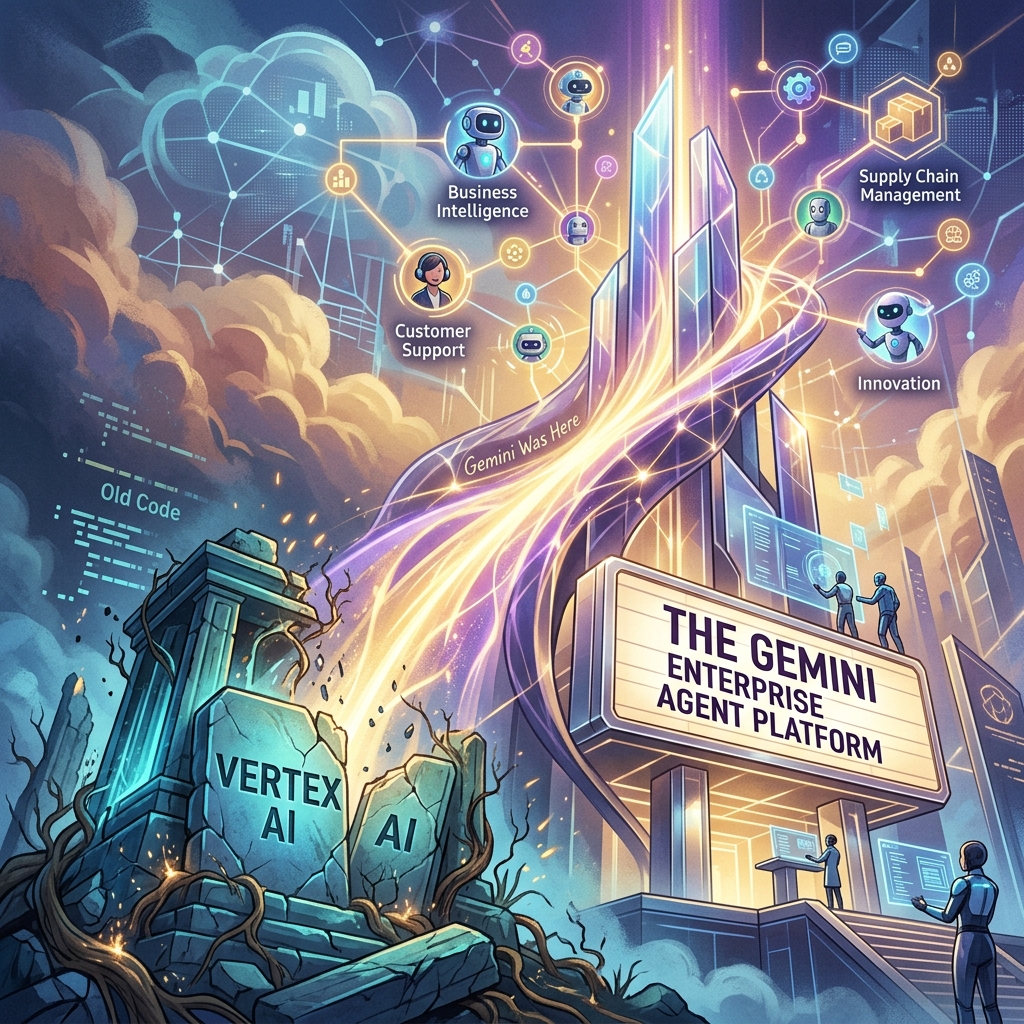
The Death of ‘Vertex AI’ and the Rise of the Gemini Enterprise Agent Platform
For four years, Vertex AI was the “everything store” for Google Cloud’s machine learning stack. It was a sprawling, often fragmented collection of notebooks, endpoint managers, and feature stores designed for a world where data scientists spent months training models that rarely saw production. But at Google Cloud Next 2026, that era ended. In its April 22, 2026 release notes, Google says Vertex AI is now part of the Gemini Enterprise Agent Platform, and its official name-change table maps the old services to new ones: Vertex AI Studio became Agent Studio, Vertex AI Agent Engine became Agent Runtime, and Model Garden carries over as Gemini Enterprise Agent Platform Model Garden.
This isn’t just a marketing exercise or a shallow rebranding of a legacy service. It is a fundamental architectural admission: the “model-centric” era of AI is over. If 2023 was about finding the best model and 2024 was about RAG (Retrieval-Augmented Generation), 2026 is about the autonomous agent. Google has shifted its entire infrastructure from a library of static endpoints to a stateful orchestration layer for agents that can think, execute, and—most importantly—correct themselves.
The Architecture Shift: Model-Centric vs. Agent-First
In the old Vertex AI framework, you deployed a model. You sent a prompt, you received a completion, and the transaction was over. Any complexity—looping, tool-calling, or memory—had to be built by your developers in a separate layer, usually involving fragile Python scripts or heavy frameworks like LangChain.
The Gemini Enterprise Agent Platform flips this. With the rollout of ADK 2.0 (Agent Development Kit), the “model” is now just a component of an “agent.” In this new architecture, the platform handles the state. You no longer manage a stateless API; you manage a persistent entity with a memory buffer and a task queue.
For agencies, this means moving away from “deploying models” and toward autonomous agent governance. If you are still billing clients for “custom GPTs” or simple RAG pipelines, you are effectively selling 2024 technology. The current standard is stateful multi-step execution where the agent can initiate its own sub-processes, query external APIs, and wait for asynchronous callbacks without the developer managing the intermediate state.
ADK 2.0 and the Developer Workflow
The core of this transition is ADK 2.0. Google’s ADK documentation describes the Agent Development Kit as an open-source framework for building, debugging, and deploying AI agents, and lists structured, graph-based architectures with explicit execution paths as new in ADK 2.0.
The runtime changed too. According to Google’s Agent Platform release notes, Agent Runtime (formerly Vertex AI Agent Engine) now supports long-running operations of up to seven days, with sub-second cold starts. An agent can stay on the job instead of answering a single request and exiting.
Agent Studio: Low-Code Orchestration That Actually Works
Google also renamed Vertex AI Studio as Agent Studio, which its Agent Platform documentation describes as a low-code canvas for designing complex multi-agent reasoning loops. Model Garden is still the catalog; Agent Studio is a visual IDE for agentic loops. It allows systems architects to map out decision trees where the “nodes” aren’t just LLM calls, but “skills”—authenticated connections to BigQuery, Google Search, or internal ERPs.
The key feature here is stateful multi-step logic. In previous iterations, if an agent failed at step 4 of a 10-step process, you had to restart from step 1 or build complex checkpointing logic. Agent Studio handles the checkpointing natively. For an operator, this reduces the “failure surface area.” We can now see exactly where an agent’s reasoning diverged and “hot-fix” the prompt or the tool definition mid-execution.
The Hard Truth About Autonomous Agent Governance
As Vertex AI is rebranded and replaced, the biggest hurdle for agencies isn’t the code—it’s the governance. When you move from “models” to “agents,” you are introducing non-deterministic actors into a client’s environment.
That makes guardrails, scoped permissions, and human review checkpoints part of the build, not an afterthought.
Pricing Shift: From Tokens to Outcomes
The pricing change we’re watching most closely is a move toward outcome-based pricing for specific task completions. As of October 2026, Google’s published Agent Platform pricing still bills on usage, such as compute hours and requests, so treat outcome-based billing as a direction to plan for rather than a launched feature.
The old model penalized efficiency. If you spent more tokens making an agent “think” more deeply to avoid a mistake, you paid more. An outcome-based model would let you pay per “Successful Task Completion.” That would align Google’s incentives with the agency’s. We would no longer care about the context window length as a cost factor; we care about the “Agentic Success Rate” (ASR).
For a mid-sized agency, that would simplify the math significantly. If a client wants a support agent that handles 1,000 tickets, you could project a flat cost per resolved ticket rather than guessing how many tokens a “difficult” customer might consume.
What You Should Do Tomorrow
If you are managing an AI stack, the “Vertex AI” name disappearing from your console is your signal to stop building “wrappers” and start building “systems.” Here is the tactical path forward:
Audit your current ‘Models’: Identify which of your current deployments are actually just stateless prompts. These are your biggest liabilities. Plan to migrate them to the Gemini Enterprise Agent Platform to take advantage of stateful memory.
Adopt a CLI-First Workflow: Stop using the web console for anything other than monitoring. Use the Gemini CLI and integrate it with Claude Code or your local IDE. The speed of iteration in ADK 2.0 is only visible when you are working in a terminal environment.
Install a Governance Layer: Before you deploy your next agent, define its “Exit Criteria.” Add a review step so that no agent can execute an external API call (like send_email or update_database) without a secondary “Reasoning Audit.”
Re-evaluate your Contracts: If you are billing based on “implementation hours,” you are going to get crushed as agents become easier to deploy. Move toward “Performance-Based Retainers” that mirror outcome-based pricing. If the agent solves the problem, you get paid.
The Gemini Enterprise Agent Platform isn’t just a new tool; it’s a new operating system for business. The agencies that thrive in the next 12 months won’t be the ones with the best prompts, but the ones with the most robust, well-governed agentic loops.
Published: May 25, 2026 | Last fact-check: May 25, 2026 against Anthropic docs and Claude Code v2.1+ behavior
Quick Answer
Plan Mode is a Claude Code setting that forces the agent to think through and approve a plan before taking destructive actions. Trigger it with Shift+Tab pressed twice in the terminal (the first press cycles to Auto-Accept Mode; the second lands on Plan Mode). Use it for risky multi-step work; skip it for simple read-only or contained edits.
How to enable it, when it pays off, and when it gets in your way below.
Plan Mode (sometimes called “planning mode”) is one of the more underused features in Claude Code in 2026. It changes how the agent works in a specific, measurable way: before Claude Code edits files, runs commands, or modifies state, it produces a plan and waits for your approval. You see what it intends to do, you say yes or no, and only then does it act.
For the right kind of task, Plan Mode is the difference between a clean execution and a regrettable one. For the wrong kind of task, it is friction that slows you down. This guide separates the two.
Claude Code Plan Mode vs Auto Mode: When to Use Each
Plan Mode vs Auto Mode — when to use each.
Scenario
Use Plan Mode
Use Auto Mode
Unfamiliar codebase
Yes — review the plan first
Only if you know it well
Large multi-file refactor
Yes — catch scope creep early
Not recommended
Simple bug fix (< 5 lines)
Overkill
Yes
Adding a new feature
Yes — plan clarifies approach
Acceptable for small features
Writing tests
Optional
Yes, usually safe
Touching database migrations
Yes — irreversible changes
No
CI/CD pipeline changes
Yes
No
What Plan Mode Actually Does
What Plan Mode actually does.
In default mode, Claude Code is allowed to take actions as it reasons. It can read files, write files, run bash, edit code, all in one conversational flow. This is the strength of Claude Code as an agent — it gets work done without asking permission for every step.
In Plan Mode, Claude Code’s behavior changes:
You describe the task.
Claude Code investigates the codebase (read-only operations are still allowed).
Claude Code drafts a plan listing every file it intends to change, every command it intends to run, and every decision point.
You read the plan. You approve it, modify it, or reject it.
Only after approval does Claude Code start writing files or running commands.
The plan is presented in the terminal as a structured outline. You can ask Claude Code to revise the plan, add steps, remove steps, or change the order. Iterating on the plan is fast because no actions have been taken yet.
How to Enable Plan Mode
How to enable Plan Mode.
There are four ways to activate Plan Mode in Claude Code:
Shift+Tab pressed twice. Each press of Shift+Tab cycles through the three permission modes: Default → Auto-Accept → Plan → Default. Two presses lands on Plan Mode. The status bar shows ⏸ plan mode on when active.
The /plan slash command. Type /plan at the start of any prompt to enter Plan Mode for that turn only. Useful for one-off plans without flipping the whole session.
The –permission-mode plan flag at startup. Start the session in Plan Mode from the command line.
Headless mode for scripts and CI.claude --print --permission-mode plan "your task" for automation that should never edit files.
# Start session in Plan Mode
claude --permission-mode plan

# Or mid-session — press Shift+Tab TWICE
# (first press = Auto-Accept Mode, second press = Plan Mode)

# Or one-shot Plan Mode for next prompt only
/plan
Plan Mode is persistent within a session — it stays on until you cycle out with another Shift+Tab. Close and reopen Claude Code and it defaults back to off. Toggle it on for risky work, leave it on for the whole session if you are doing higher-risk work end-to-end.
Important: Plan Mode is a hard read-only sandbox enforced at the tool level. Claude Code physically cannot edit files, run commands, or modify state while Plan Mode is active. This is not a suggestion or a soft check — the write tools are unavailable.
When Plan Mode Pays Off
Plan Mode is worth the friction in these situations:
Multi-file refactors. When the agent will touch 5+ files, you want to see the list before it starts editing. A small confusion about which files to change becomes a big mess fast.
Database migrations or schema changes. Anything that touches durable state and is hard to undo benefits from a confirmed plan.
Production code paths. If a session affects code that ships to users, the plan checkpoint is cheap insurance.
Ambiguous instructions. When you are not sure how the agent will interpret your request, Plan Mode surfaces the interpretation before any work happens.
New repository onboarding. When you do not yet know the codebase well, Plan Mode lets the agent show you what it learned during investigation before it acts.
Long-running batch jobs. Approving a plan for 200 file edits and then walking away is safer than launching 200 edits blind.
When Plan Mode Gets In the Way
Plan Mode is not free. The friction it adds is a real cost for certain workflows:
Single-file tweaks. Asking Claude Code to fix a typo or rename a variable does not need a plan. The plan takes longer than the fix.
Tight feedback loops. When you are iterating quickly — try a change, see the result, adjust — Plan Mode slows the loop. Default mode wins here.
Read-only investigation. If you are asking questions about the codebase (“how does this auth flow work”), there is nothing to plan. Plan Mode is irrelevant.
Work in a sandbox. If you are working in a throwaway directory or branch where mistakes are cheap, the safety net of Plan Mode is overkill.
The decision is not “is Plan Mode good.” It is “is the cost of approval less than the cost of an unintended action.” For risky multi-step work, yes. For cheap iteration, no.
Working Inside the Plan
Once Claude Code presents a plan, you have several options:
Approve as-is. Tell Claude Code to proceed. It executes the plan in order.
Approve with modifications. Tell Claude Code to remove specific steps, reorder them, or add additional steps. It revises the plan and re-presents.
Ask questions. Drill into specific steps. “Why are you editing file X?” Claude Code explains the reasoning.
Reject and restart. If the plan is wrong-shape, tell Claude Code so. It will rebuild the plan from a corrected understanding.
Cancel. Exit Plan Mode entirely if you’ve decided this is not the right task or session for it.
The plan is conversational. You are not stuck with the first draft. Iterating on the plan is much cheaper than iterating after the work is done.
What Plan Mode Does Not Protect Against
Plan Mode is not a sandbox. The plan, once approved, executes for real. Plan Mode does not:
Prevent you from approving a bad plan
Catch logic errors inside individual file edits
Prevent destructive bash commands if you approved them in the plan
Replace tests or code review
It is a thinking checkpoint, not a safety net. The human still owns the decision.
Plan Mode vs Other Safety Patterns
Plan Mode is one of several safety patterns Claude Code supports:
Read-only sessions: Restrict the agent to read operations only.
Per-tool permissions: Approve each tool use individually as it happens.
Plan Mode: Approve a batch of intended actions before execution begins.
Auto-accept mode: The opposite — accept all tool uses without asking. Fast and risky.
Per-tool permission is more granular but slower. Plan Mode is bulkier but faster once approved. Use the right tool for the situation; do not assume one is always correct.
A Working Habit
The habit that has worked across hundreds of Claude Code sessions: default mode on, Shift+Tab twice into Plan Mode before any session that will (a) touch production state, (b) edit more than 5 files, or (c) run commands that are hard to undo. Shift+Tab again to cycle back to default for everything else.
The shortcut becomes muscle memory in a week. Once it is muscle memory, the cost of Plan Mode drops to nearly zero, and you can use it liberally on anything that even smells risky.
Plan Mode is a Claude Code setting that forces the agent to produce a written plan and wait for your approval before making changes. It surfaces what the agent intends to do so you can adjust it before any work happens.
How do I enable Plan Mode in Claude Code?
Press Shift+Tab twice in the terminal (the first press cycles to Auto-Accept; the second lands on Plan Mode), type /plan as a slash command, or start the session with –permission-mode plan. The status bar shows ⏸ plan mode on when active.
When should I use Plan Mode?
For multi-file refactors, database migrations, production code paths, ambiguous instructions, new repositories you don’t know yet, and long-running batch jobs. Skip Plan Mode for single-file tweaks, tight iteration loops, and read-only investigation.
Does Plan Mode make Claude Code slower?
Yes, for short tasks — the plan adds latency that is not worth it on quick edits. For long or risky tasks, the plan is faster than fixing mistakes afterward.
Can I edit the plan before approving it?
Yes. Tell Claude Code to revise the plan — add steps, remove steps, reorder. Iterating on the plan is much cheaper than iterating after execution.
Is Plan Mode the same as a sandbox?
Plan Mode IS a hard read-only sandbox at the tool level — Claude Code cannot write files or run commands while it’s active. But once you approve the plan and exit Plan Mode, the work executes for real. Plan Mode prevents accidental writes during planning; it does not prevent you from approving a bad plan.
What’s the difference between Plan Mode and per-tool permissions?
Per-tool permissions ask you to approve each tool use individually as it happens (more granular, slower). Plan Mode batches all intended actions into one plan you approve up front (bulkier, faster once approved).
The Bottom Line
Plan Mode is leverage for risky work and friction for everything else. Make Shift+Tab+Shift+Tab muscle memory. Use Plan Mode whenever the cost of an unintended action exceeds the cost of approval — multi-file refactors, production changes, ambiguous specs. Skip it on cheap iteration. That single rule will save you more headaches than any other Claude Code habit.
Published: May 25, 2026 | Last fact-check: May 25, 2026 — legacy (still listed) model lineup: Opus 4.7, Sonnet 4.6 (legacy — still listed), Haiku 4.5
Lineup currency (Sept 2026): Current API list (Sept 2026, verified): Sonnet 5 $2/$10, Opus 5.5 $4/$20, Haiku 4.5 $1/$5, Fable 5.1 $10/$50. Legacy (still listed on Anthropic’s card): Opus 4.8 $5/$25, Sonnet 4.6 $3/$15.
Quick Answer
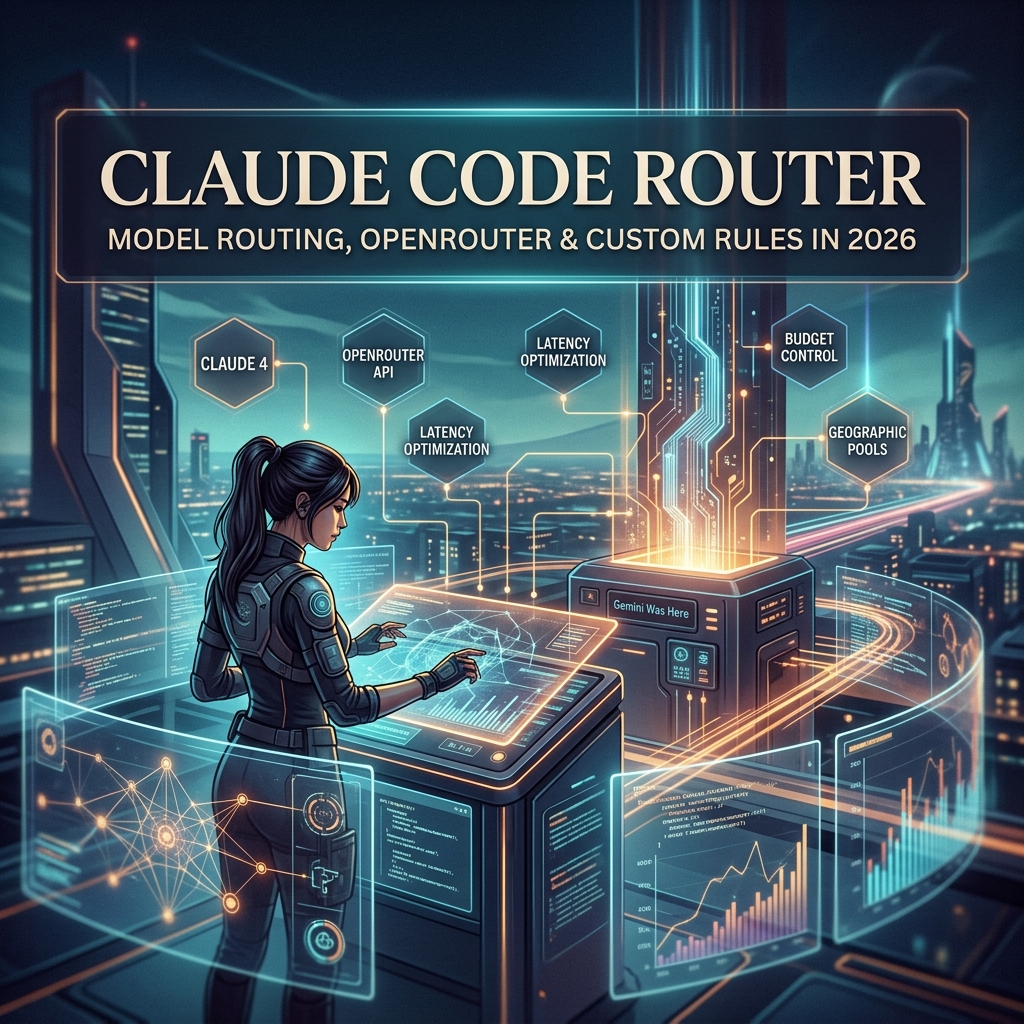
A Claude Code router is any layer that decides which Claude model handles which request — Opus for hard reasoning, Sonnet for daily work, Haiku for fast cheap tasks. Anthropic ships some built-in routing, but the most leveraged users build their own routing rules on top to optimize cost and latency.
Built-in routing, manual model selection, and the third-party router landscape below.
“Claude Code router” is a phrase that means different things to different people in 2026, and the differences matter for what you should actually build or buy.
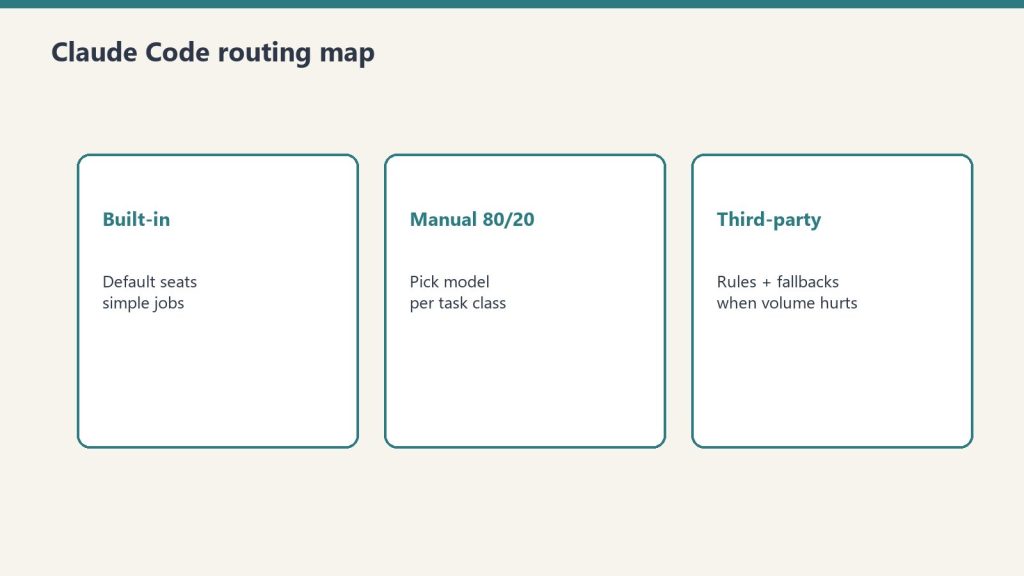
It can mean (1) Anthropic’s built-in logic that picks a model when you do not specify one, (2) third-party tools that route between Anthropic models and other LLMs through one Claude Code interface, or (3) custom routing rules you build yourself to match models to tasks. This guide walks through each, when each makes sense, and the trade-offs.
Why Routing Matters in the First Place
Why routing matters before you touch third-party routers.
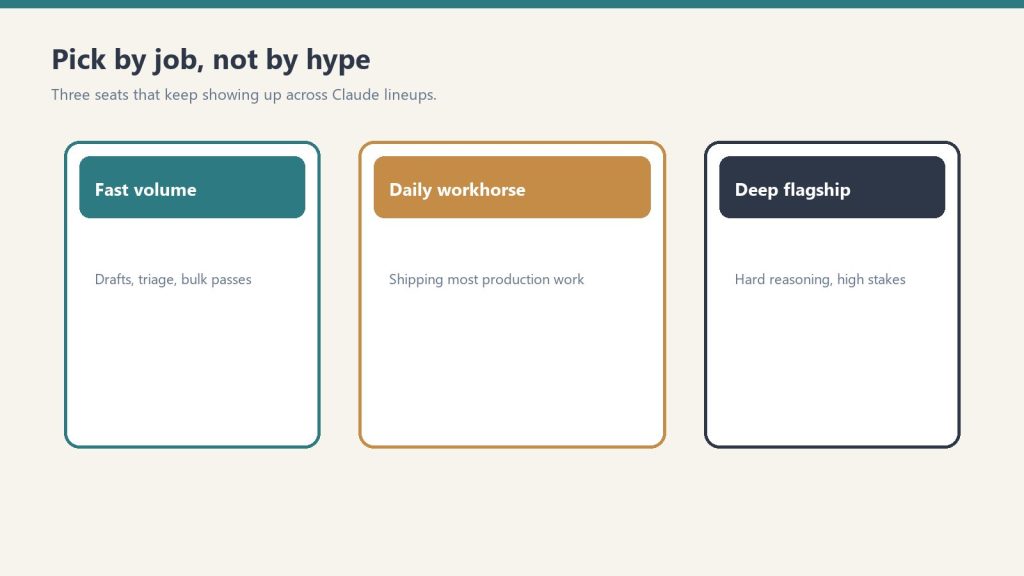
Claude is not one model. It is a family. As of 2026 the production tiers are roughly:
Claude Opus 4.7 — $5/$25 per million tokens. Current flagship. Best for hard, ambiguous, multi-step reasoning and agentic coding.
Claude Sonnet 4.6 (legacy — still listed) — $3/$15 per million tokens. The workhorse. Within ~1 point of Opus on coding benchmarks at 40% less cost. Right answer for 80% of daily work.
Claude Haiku 4.5 — $1/$5 per million tokens. Fast and cheap. Right answer for high-volume formulaic tasks: classification, extraction, formatting, routing, simple Q&A.
Output costs 5x input across all three tiers. Prompt caching cuts cached input costs by ~90%. Batch API cuts everything by 50% if you can wait up to 24 hours.
Lineup currency (Sept 2026): Current API list (Sept 2026, verified): Sonnet 5 $2/$10, Opus 5.5 $4/$20, Haiku 4.5 $1/$5, Fable 5.1 $10/$50. Legacy (still listed on Anthropic’s card): Opus 4.8 $5/$25, Sonnet 4.6 $3/$15.
Using Opus for everything is wasteful. Using Haiku for everything is sloppy. Routing — matching the model to the task — is how you get the best output for the lowest cost. For someone running Claude Code several hours a day, intelligent routing is the difference between a $100/month Max bill and a $1,000/month API bill for the same work.
Anthropic’s Built-In Claude Code Routing
When you launch Claude Code without specifying a model, it picks a default. As of 2026 the default for most users is Sonnet, with Opus accessible via flags or settings, and Haiku used internally for some sub-tasks like tool selection and simple file operations.
You can override the default at session start:
# Start Claude Code with Opus for a tough refactor
claude --model claude-opus-4-7   # current flagship

# Or set it in your settings.json
{
  "model": "claude-sonnet-4-6"  // current workhorse
}
Anthropic also routes internally: when Claude Code uses sub-agents for parallel work, it can route those sub-agents to lighter models automatically. This routing is opaque to you and generally well-tuned. You usually do not need to think about it.
Manual Model Selection: The 80/20 Approach
Manual model selection is still the 80/20 approach.
For most users, manual routing beats automatic routing. The rule:
Opus when you hit a wall. Architectural decisions, hard refactors, ambiguous specs, anything that requires real reasoning.
Haiku for batch. Classification, taxonomy assignment, metadata generation, SEO meta descriptions, anything formulaic at volume.
This 80/20 split is achievable with two or three commands and zero infrastructure. It is the right starting point.
Third-Party Claude Code Routers
A small ecosystem has emerged around third-party routers that sit between Claude Code and the model layer. The two most common patterns:
OpenRouter and Multi-Provider Routers
OpenRouter is the most widely used third-party router. You point Claude Code at OpenRouter as the API endpoint, and OpenRouter routes your requests to Claude (or to GPT, Gemini, DeepSeek, Llama, etc.). Why use it:
You want fallback when Anthropic has an outage.
You want to mix Claude with other models on a per-task basis.
You want a single billing surface across providers.
You want BYOK (bring your own key) routing where you mix your own provider keys.
The trade-off: latency adds a few hundred milliseconds per call, and some Anthropic-specific features (prompt caching, certain beta tools) work less smoothly through the proxy.
Custom In-House Routers
Larger teams build their own routing layer. A typical pattern: a small Python or TypeScript service that inspects the incoming request, applies routing rules (length thresholds, task type detection, cost ceilings), picks a model, and forwards the call to Anthropic.
This is overkill for most individuals. It pays off when you have:
Strict cost controls that need enforcement, not suggestion
Multi-tenant usage where different customers get different models
Compliance requirements that need request inspection and logging
A real engineering team that can maintain the service
Routing Rules That Actually Work
If you are going to invest in any routing logic, these are the rules that pay back:
By task type. Code review → Opus. New code generation → Sonnet. Format conversion → Haiku.
By input length. Long context (40K+ tokens) where you need careful reasoning → Opus. Long context where you need extraction → Sonnet with prompt caching.
By cost ceiling. Anything over a threshold token count gets a hard cap or downgrade.
By time of day. Overnight batch jobs route to cheaper models. Interactive daytime work routes to your preferred quality tier.
By failure recovery. If a Sonnet call returns a low-confidence or refused response, retry once with Opus before giving up.
Most of these rules are five lines of code each. The discipline is more about deciding the rules than implementing them.
What Anthropic Does Not Yet Ship
As of writing, Anthropic does not ship a built-in “route this query to the right model” intelligence layer in Claude Code. The model you set is the model you get for the session, with the exception of internal sub-agent routing.
This is likely to change. The shape of where Claude Code is going — more autonomy, longer sessions, more parallel agents — implies more sophisticated internal routing. For now, the routing decisions worth making are the ones you make yourself.
Costs: What Routing Actually Saves
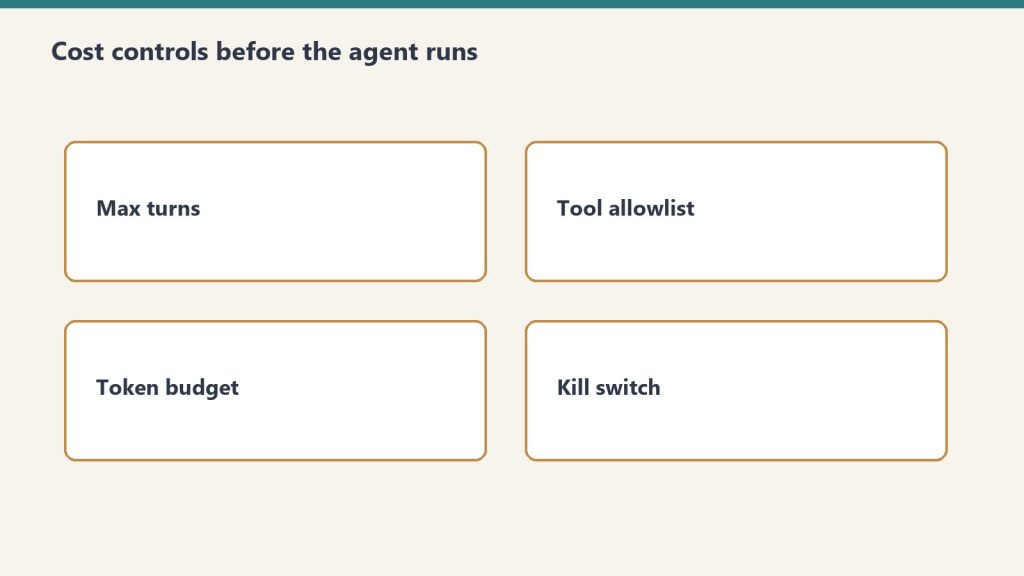
Routing only saves money if you enforce budgets.
Concrete example. An operator running a Claude Code content pipeline that:
Generates SEO meta and FAQ (Haiku): 2,000 + 500 tokens
Reviews and edits (Opus): 10,000 + 2,000 tokens for trickier articles
Running everything on Opus would roughly triple the cost. Running everything on Sonnet would save vs Opus but produce noticeably weaker meta-generation than Haiku at similar quality. Routing by task type saves real money — often 40-60% versus a single-model approach — without sacrificing output quality.
When Not to Build a Router
Routing is leverage when you operate at volume. If you run Claude Code casually — a couple of hours a day, one task at a time — you do not need a router. You need to learn the three models well enough to pick the right one by feel. Build a router only when (a) cost is a real line item in your budget, (b) you are running multiple workflows that have genuinely different model needs, or (c) you want fallback infrastructure for resilience.
A Claude Code router is any layer — Anthropic’s built-in defaults, a third-party tool like OpenRouter, or custom code — that decides which Claude model handles a given request.
Does Claude Code have built-in routing?
Partial. Claude Code picks a default model (Sonnet) and routes internal sub-agent tasks to lighter models. It does not automatically promote your main session to Opus when a task gets hard.
What’s the difference between OpenRouter and a custom router?
OpenRouter is a hosted multi-provider gateway with billing and fallback built in. A custom router is something you build to enforce your own rules. OpenRouter is right for most teams. Custom routers are right for teams with strict requirements.
Should I use OpenRouter with Claude Code?
Useful if you want fallback, multi-provider mixing, or unified billing. Less useful if you only use Claude and want Anthropic-specific features like prompt caching to work optimally.
How do I pick the right Claude model for a task?
Default Sonnet. Opus for hard reasoning, architectural decisions, ambiguous specs. Haiku for high-volume formulaic tasks (classification, formatting, metadata).
How much can routing save me?
For volume users, 40-60% versus running everything on Opus, with no measurable drop in output quality if the routing rules are sensible.
Is there a cost to routing through OpenRouter?
OpenRouter adds a small markup on token pricing in exchange for the routing and aggregation features. For most users this is acceptable; for very high volume, going direct to Anthropic is cheaper.
The Bottom Line
Claude Code routing is leverage when you operate at volume and a distraction when you do not. Start by learning the three Claude models by feel and picking manually. Add OpenRouter if you want fallback. Build a custom router only when cost or compliance actually justifies the engineering. The router is not the goal; the right model on the right task is the goal.
Published: May 25, 2026 | Last verified: June 28, 2026 (Pacific Time)
Quick Answer
Get an Anthropic API key at console.anthropic.com → API Keys → Create Key. The key starts with sk-ant- and is shown once — copy and store it in a password manager immediately. Add billing credits before making API calls.
Full setup, security, and usage walkthrough below.
An Anthropic API key is the credential that lets your application, script, or tool call Claude programmatically. Whether you are wiring Claude into Claude Code, building an internal agent, or integrating Claude into a SaaS product, the API key is the first step. This is the complete reference for that key — pricing, billing, security, rotation, and organization controls. If you just need to create your first key, our step-by-step guide to getting an Anthropic API key walks through it in about five minutes; this page is what you read next.
Anthropic API Pricing Tiers (June 2026)
API pricing tiers — stale-proof shapes, no sticky dollars.
All models support 50% Batch API discount for non-real-time requests. Fable 5 is free on Pro/Max/Team through June 22, 2026. Prices verified June 12, 2026.
What an Anthropic API Key Is (and Isn’t)
What an API key is — and is not.
The Anthropic API key authenticates requests to the Anthropic Messages API. It identifies which workspace and organization is making the call, what model permissions it has, and where to bill the token usage.
What an API key is not: a login. You cannot use an API key to sign into claude.ai. The web interface and the API are separate billing surfaces. Your Pro or Max subscription does not grant API credit by default; API usage requires its own billing setup.
Creating a key (the short version)
Creating a key — the short version.
Create a key at console.anthropic.com → API Keys → Create Key; it starts with sk-ant-, is shown once, and will not work until billing is added. For the full walkthrough — including the no-key OAuth option and the four errors that trip people up on the first request — see our step-by-step guide to getting an Anthropic API key. The rest of this page is the reference you will want once the key exists.
Adding Billing Before You Can Use the Key
A common surprise: a freshly created API key cannot make calls until you add a payment method and credits to your Anthropic account. The key exists, but every request returns a billing error.
To add billing:
In the Claude Console, click “Billing” or “Plans & Billing” in the left sidebar.
Add a payment method (credit card; Anthropic also supports invoicing for enterprise).
Either pre-purchase API credits or enable auto-recharge. Most users enable auto-recharge with a low threshold to avoid hitting empty mid-job.
Set a monthly usage limit if you want a safety cap.
Once billing is set up, your API key works.
Anthropic API Key Format
An Anthropic API key starts with the prefix sk-ant- followed by a long alphanumeric string. The full key is roughly 100 characters. If your key does not start with sk-ant-, you have copied something incomplete.
Different key types exist:
Live keys (sk-ant-api...): Production calls, real billing.
Admin keys (sk-ant-admin...): Workspace admin operations, not for inference calls.
Most developers only need a live key.
Which Claude Models the API Key Works With
A standard live API key gives you access to the current generation of Claude models:
Claude Fable 5 (claude-fable-5) — current top tier, released June 9 2026. $10/$50 per million tokens. Anthropic’s first Mythos-class model. Note: carries a mandatory 30-day data retention requirement (no zero data retention option). Full breakdown here.
Claude Opus 4.8 (legacy — still listed) (claude-opus-4-8) — second tier, released April 16 2026. $5/$25
Lineup currency (Sept 2026): Current API list (Sept 2026, verified): Sonnet 5 $2/$10, Opus 5.5 $4/$20, Haiku 4.5 $1/$5, Fable 5.1 $10/$50. Legacy (still listed on Anthropic’s card): Opus 4.8 $5/$25, Sonnet 4.6 $3/$15.
Claude Haiku 4.5 (claude-haiku-4-5) — released October 15 2025. $1/$5 per million tokens. Fast and cheap for high-volume work.
Earlier model versions (Sonnet 4, Opus 4.6, Haiku 3.5, etc.) are still callable by their specific snapshot IDs until Anthropic announces deprecation. Check the deprecation timeline in the Claude Console for any model you depend on in production.
How to Use the API Key
You pass the key in the x-api-key header on every request to the Messages API:
In Python or Node.js, the official SDKs read ANTHROPIC_API_KEY from your environment automatically. You should never hardcode the key in source code.
Security: How to Not Leak Your Key
Anthropic API keys leak constantly. Most leaks happen the same way:
Committing the key to a public GitHub repo. The single most common leak. GitHub scans for known credential patterns and notifies Anthropic; your key gets auto-revoked within minutes. You will know because your calls suddenly start failing.
Pasting the key into a shared chat or document. Anyone with access becomes a credential holder.
Putting the key in client-side JavaScript. A browser app shipping its API key to users is giving the key away. Always proxy through a backend.
Logging the key. Any logging system that captures HTTP headers can leak the key. Mask sensitive headers in your logger config.
The good rule: treat your API key like a credit card number, because that’s what it functions as.
Rotating an Anthropic API Key
You should rotate keys quarterly at minimum, and immediately if a key is suspected compromised. Rotation in the Claude Console:
Go to API Keys.
Create a new key with a fresh name (e.g., “Claude Code Laptop 2026 Q3”).
Update your application’s environment variable or secret manager to use the new key.
Verify the new key works.
Revoke the old key.
The five-minute rotation is far cheaper than dealing with a leaked key that was used by an attacker for hours before you noticed.
Workspace and Organization Keys
Anthropic accounts are organized as: Organization → Workspaces → API Keys. Most individuals only use one of each. Teams use multiple workspaces to separate environments (production, staging, dev) or projects.
Each key belongs to one workspace. Billing rolls up to the organization. If you need separate billing visibility per project, separate workspaces are the lever.
Monitoring API Key Usage
The Claude Console shows per-key usage in the “Usage” section. You can see:
Token spend per key per day
Model breakdown (Opus, Sonnet, Haiku usage)
Input vs output token split
Cache usage (if you have prompt caching enabled)
Set up usage alerts in Billing. The Anthropic console can email you when daily or monthly spend crosses a threshold. This is the cheapest insurance against a runaway loop or compromised key.
Frequently Asked Questions
How do I get an Anthropic API key?
Sign in to console.anthropic.com, open API Keys in the sidebar, click Create Key, name it, and copy the key immediately. You cannot retrieve the full key after closing the creation modal.
Is the Anthropic API key free?
The key itself is free to generate. Using it costs money — Anthropic bills per token at the API pricing in effect. You must add billing credits before the key works.
Does my Claude Pro or Max subscription include API credits?
No. Pro and Max subscriptions cover the chat interface and Claude Code (with usage caps). API usage is billed separately against your Anthropic account.
What does an Anthropic API key start with?
Live API keys start with sk-ant-api. Admin keys start with sk-ant-admin. The key is roughly 100 characters long.
What happens if my Anthropic API key gets leaked?
Anyone with the key can use it to make API calls billed to your account until the key is revoked. If you suspect a leak, revoke immediately in the Claude Console and check Usage for any suspicious activity.
Can I use the same API key for Claude Code and my own app?
You can, but you should not. Use separate keys per environment (Claude Code Laptop, Production Backend, Local Dev). Separate keys make revocation surgical instead of catastrophic.
Where should I store my Anthropic API key?
In a password manager (1Password, Bitwarden) for personal use, or in a secret manager (AWS Secrets Manager, GCP Secret Manager, HashiCorp Vault) for production. Never commit it to a repo or hardcode it in source.
How do I rotate an Anthropic API key?
Create a new key in the Claude Console, update your application to use the new key, verify it works, then revoke the old key. Rotate quarterly as a baseline.
Get alerted when Claude pricing or limits change
We track Anthropic’s models, pricing, and limits daily and send a short note when something changes that affects what you pay or build. Occasional, no spam.
The Bottom Line
Getting an Anthropic API key is a three-minute process. Keeping it safe is a discipline. Use a password manager, rotate quarterly, never put the key in client-side code, and set usage alerts in the Claude Console. Treat the key as production infrastructure, not a developer toy, and it will serve you for years without incident.
You have your key. Now hit the ground running.
The Solo Builder Seed Kit includes a ready-made Claude skill file, 20 tested prompts for solo operators, and a step-by-step setup guide. Paste your API key, install the skill, and you’re building — $47.
Go to console.anthropic.com, sign in or create an account, then navigate to Settings > API Keys. Click ‘Create Key’, give it a name, and copy the key immediately — it is only shown once. You’ll need to add a credit card and funds to your account before making API calls.
Is there a free tier for the Anthropic API?
Anthropic does not offer a persistent free tier for the API. New accounts may receive a small initial credit to test the API. After that, all usage is billed at standard token rates. The free tier of claude.ai (the chat interface) is separate from API access.
How much does the Anthropic API cost?
As of June 2026: Claude Haiku 4.5 costs $1 input / $5 output per million tokens. Claude Sonnet 4.6 (legacy — still listed) costs $3/$15. Claude Opus 4.8 (legacy — still listed) costs $5/$25. Claude Fable 5 (newest, released June 9) costs $10/$50 per million tokens. The Batch API offers 50% off for non-real-time workloads.
Lineup currency (Sept 2026): Current API list (Sept 2026, verified): Sonnet 5 $2/$10, Opus 5.5 $4/$20, Haiku 4.5 $1/$5, Fable 5.1 $10/$50. Legacy (still listed on Anthropic’s card): Opus 4.8 $5/$25, Sonnet 4.6 $3/$15.
How do I keep my Anthropic API key secure?
Never commit API keys to version control. Store them in environment variables or a secrets manager (AWS Secrets Manager, GCP Secret Manager, Vault). Use separate keys per application so you can rotate or revoke them independently. Set spending limits in the Anthropic console to cap accidental runaway costs.
What happens if my Anthropic API key is compromised?
Go to console.anthropic.com > Settings > API Keys immediately and click Revoke next to the compromised key. Create a new key and rotate it into your applications. Review your usage logs for unexpected spend. Anthropic will not refund charges made with a compromised key unless you contact support promptly.
Can I use my Anthropic API key with Claude Code and Claude Cowork?
Claude Code (the CLI tool) uses your API key when you run it outside a claude.ai subscription context. Claude Cowork (the desktop app) uses your subscription, not a raw API key. For self-hosted integrations, scripts, and Agent SDK workflows, your API key from console.anthropic.com is what you need.
This is a working theory, not a finished one. It proposes a specific reframing of how solo operators and small agencies should be using large language models day-to-day, names the failure mode of the current dominant approach, and lays out the experiments that would prove or disprove the central claim. The piece is published here so it can be referenced, tested against, and revised in public as the evidence comes in. If the claim is wrong, the next version of this article will say so.
The Claim, in One Sentence
The claim, in one sentence.
For solo operators and small agencies working with large language models, the dominant mental model — build a knowledge base, feed it to the model, ask questions of the document — is correct for a narrow class of work and wasteful or counterproductive for a much larger class, and the work most operators are doing fits the larger class.
A better mental model for that larger class is what this piece will call Elicitation Over Extraction: the assumption that the model already contains the relevant knowledge as latent capability, and that the operator’s job is to activate the right region of that latent capability with precise, compact prompts rather than to ship the knowledge into the context window through document retrieval. Knowledge stays in training. The work shifts to activation.
This is not a new idea in the AI research literature. It is, however, almost entirely absent from how operators are currently building their personal AI workflows. The gap between what the research suggests is possible and what the operator-tooling ecosystem is building toward is the gap this piece is trying to name and close.
Where the Current Dominant Pattern Comes From
The current dominant pattern in operator-side AI tooling is retrieval-augmented generation, or RAG. The pattern is straightforward. An operator builds a knowledge base — pages in Notion, files in Drive, articles in a vector database, transcripts of YouTube videos, customer support tickets, whatever the operator’s domain produces. When a question is asked of the model, a retrieval system finds the most relevant chunks of that knowledge base, packs them into the model’s context window, and asks the model to answer using that retrieved material as grounding.
The pattern works. For certain shapes of problem, it works very well. It is the right architecture when the operator’s question depends on information that is genuinely outside the model’s training data — proprietary documents, current events that postdate the training cutoff, client-specific details that no public source contains, internal organizational knowledge that exists nowhere on the open internet. For that shape of problem, RAG is not optional. It is the only honest way to get accurate answers, because the alternative is the model inventing details about things it has no real knowledge of.
The pattern has also been heavily promoted by the AI-tooling industry for reasons that have only loosely to do with whether it is the right pattern for any specific operator. Vector databases, retrieval pipelines, document-loading frameworks, embedding services, and knowledge-base products all exist because RAG creates demand for them. The narrative that every operator needs a knowledge base, that every workflow benefits from document retrieval, that the path to better AI work runs through better document organization — that narrative is commercially convenient for the vendors selling the components. It is also half true, which is the worst kind of half true, because the part that is true gets used to justify the part that isn’t.
The part that is true: when the model lacks the specific knowledge needed for the task, retrieval helps. The part that isn’t: when the model already has the knowledge, retrieval is at best redundant and at worst actively degrades the response. The middle case — when the model has the general knowledge but lacks the specific framing, voice, or activation — is the case the operator ecosystem has not figured out how to name or handle, and it is also the case most operators are actually in for most of their work.
The Specific Failure Mode
The specific failure mode of extraction.
Picture an operator who wants to write content in the voice of a particular thinker — call this thinker Senior Operator-Investor, someone who has been writing publicly for twenty years and whose work is heavily represented in the model’s training data. The operator’s default move, under the RAG pattern, is to collect transcripts of that thinker’s podcasts and YouTube videos, structure them in a knowledge base, and feed them to the model along with the question.
What actually happens when the operator does this is the following. The 20,000-token transcript dump enters the model’s context window. The model attends to that transcript on every generation step, scanning for relevant passages, weighing them against the question being asked. This is computationally expensive, slow, and noisy — most of the transcript is irrelevant to any specific question. The model also already knew this thinker’s voice from training. The transcript is mostly redundant with patterns the model can already produce from its weights. The operator is paying tokens to remind the model of things the model knows.
The more efficient version is to write a 200-token activation prompt: a careful description of the thinker’s voice, their characteristic moves, their temperament, and a few canonical reference points. That prompt activates the same region of the model’s latent space that the 20,000-token transcript was trying to activate, at one one-hundredth the token cost, with less attentional noise, and with output that is often qualitatively better because the model is not being pulled in inconsistent directions by tangentially relevant transcript passages.
The 100x token reduction is not theoretical. It is what happens in practice when prompts are designed for activation rather than information transfer. The reduction is also not the most important benefit. The more important benefit is that the operator stops doing knowledge-engineering work that is duplicative with the training the model has already received, and starts doing the work that is actually distinctive: designing the activation patterns themselves.
The failure mode of the current dominant pattern is that operators are spending their time on the wrong layer. They are building warehouses when they should be building switchboards. The warehouse holds information the model already has. The switchboard turns on specific patterns of cognition that the model can already produce but does not produce by default.
What the Research Literature Says
There is a real body of research on what is called persona prompting, role conditioning, and activation steering. The findings are nuanced and they refine the claim above in ways worth knowing.
Persona prompting does change model output. The effect is measurable and consistent across many tasks. The voice, style, and reasoning approach of the model can be meaningfully shifted by a few hundred well-chosen tokens at the start of a prompt. This part of the picture confirms the central intuition of Elicitation Over Extraction: latent capability is real, activation prompts can reach it, and the activation work is meaningful work.
But the same research literature surfaces an important caveat that the strong version of the claim has to address. Persona prompting consistently helps with style, voice, clarity, and tone — the things one might call the surface texture of generation. It is less consistent, and sometimes actively harmful, on tasks that depend on precise factual recall, multi-step logical reasoning, or strict accuracy on benchmarked knowledge. In some studies, telling a model to “act like an expert” on a factual recall task decreased accuracy compared to no persona at all. The model became so focused on performing expertise that it stopped retrieving its underlying knowledge cleanly.
This is important and it changes the shape of the claim. Elicitation Over Extraction is not a universal replacement for RAG. It is the right approach for tasks where what the operator needs from the model is voice, framing, judgment, or pattern-matching against a thinker’s known mode. It is the wrong approach — and may be worse than neutral — for tasks that depend on precise factual recall of specific data points.
The honest version of the claim, then, is something like the following. Operator work falls into at least three different shapes. The first shape is “I need the model to produce content in a specific voice or style” — activation prompts dominate, RAG is wasteful. The second shape is “I need the model to retrieve specific facts from a corpus the model has not seen” — RAG dominates, activation prompts are insufficient. The third shape is “I need the model to apply judgment to information I am providing” — both layers matter, with activation handling the judgment and retrieval handling the information.
Most operators are running shape one and shape three workflows but using shape two tooling. That mismatch is the source of the inefficiency. The fix is not to abandon retrieval. The fix is to know which shape any given workflow is and use the right layer for that shape.
Why This Is Not Obvious
Why this is not obvious.
If the distinction is real and well-documented in research, the question is why operators are not already organizing their work this way. Three reasons, in roughly increasing order of importance.
The first reason is that “knowledge engineering” carries a status premium that “elicitation engineering” does not. Building a structured knowledge base sounds like real work. Writing a 200-token prompt sounds like a parlor trick. The fact that the 200-token prompt may actually be doing more useful work than the knowledge base does not show up in the social register of the activity. Operators who are evaluating their own productivity, even if only to themselves, tend to over-weight effort that looks substantial and under-weight effort that looks easy, even when the easy effort is producing better results. The shape of effort matters more than the result of effort, until the operator becomes deliberate about correcting for that bias.
The second reason is that the dominant vendor narrative pushes against elicitation. Every vendor selling a vector database, every vendor selling a document loader, every vendor selling a RAG pipeline product has a commercial incentive to frame all problems as retrieval problems. The vendor ecosystem does not have a strong commercial incentive to teach operators how to write better activation prompts, because activation prompts do not require vendor products. There is no SaaS company selling “the activation layer” because the activation layer fits on one Notion page and does not need to be sold. The absence of a commercial narrative around elicitation makes it invisible to operators who are learning about AI through vendor content.
The third reason is the deepest one and it is about the relationship between knowledge and accessibility. The model containing knowledge in its training is not the same as the model producing that knowledge when queried. A first-year medical student who has read every textbook on the shelf is not the same as a senior physician who can produce the right diagnosis under pressure. The knowledge is the same in both cases. The accessibility is different. The senior physician has navigated the latent space of medical knowledge so many times that the relevant patterns activate automatically when the case presents. The first-year student has the same knowledge in storage but cannot get to it on demand under realistic conditions.
Operators are encountering models that are, in a precise sense, in the first-year-medical-student position with respect to most domains. The knowledge is there. The activation is unreliable. The dominant vendor response to this is to bypass the activation problem by stuffing the relevant knowledge directly into the context window — which works but treats the symptom rather than the cause. The Elicitation Over Extraction response is to do the activation work directly, build a library of activation patterns that reliably reach the relevant latent regions, and stop treating the model as an empty container that needs to be filled with documents.
The Working Theory
Pulling the threads together, the working theory of this piece is the following set of connected claims.
Claim one. Large language models contain enormous latent knowledge that is not, by default, reliably accessible through naive prompting. The knowledge is in the weights. The activation is the problem.
Claim two. The dominant operator response to this — document retrieval and knowledge-base construction — addresses the activation problem indirectly, by bypassing latent knowledge in favor of in-context knowledge. This works but is inefficient when the latent knowledge is already strong, and the inefficiency compounds across many operator workflows.
Claim three. A complementary approach, currently underbuilt in operator tooling, is to develop a library of compact activation prompts that reliably steer the model into specific cognitive modes — voices, frames, temperaments, schools of thought. This library serves a different function than a knowledge base and the two are complements, not substitutes, but most operators have heavily over-built the knowledge-base side and barely built the activation side.
Claim four. The right architecture for an operator’s personal AI infrastructure is therefore three-layered: a library of activation patterns for tasks that depend on voice, framing, and judgment; a structured set of retrieval sources for tasks that depend on specific external knowledge the model lacks; and a clear decision rule for which layer a given task draws from. The current state of most operators’ setups has layer two heavily built, layer one missing entirely, and layer three not articulated at all.
Claim five. The work of building the activation layer is fundamentally different from the work of building the retrieval layer. The retrieval layer is a knowledge-engineering problem and is well-served by the existing vendor ecosystem. The activation layer is closer to a writing and curation problem — closer to compiling a literary anthology than to building a database. It requires taste, exposure to many voices, and the willingness to test and refine specific prompts against actual generations until they produce the intended cognitive mode reliably. This is craft work, not engineering work, which is part of why the vendor ecosystem has not produced it.
Claim six, and this is the operator-specific implication. For a solo operator who has already built substantial knowledge infrastructure, the highest-leverage next move is not to build more knowledge infrastructure. It is to build the activation layer, integrate it with the existing knowledge layer through clear decision rules, and audit which existing workflows are running in the wrong layer. Most operators with mature stacks will find that a meaningful percentage of their token consumption is being spent on retrieval that activation could replace, and a meaningful percentage of their workflow latency is coming from documents the model did not need.
The Falsifiable Predictions
A working theory is only useful if it can be tested. The following are specific, falsifiable predictions that follow from the working theory. If any of them turn out to be wrong, the theory needs revision. If most of them hold, the theory has earned the right to be promoted from working hypothesis to operational doctrine.
Prediction one. For tasks that are primarily about voice, framing, or stylistic mimicry of a well-known thinker, a carefully written 200-token activation prompt will produce output of equal or greater quality than a 10,000-to-20,000-token transcript dump of that thinker’s work, as evaluated by blind comparison. The expected effect size is large for thinkers heavily represented in training data and shrinks toward neutral for niche or rarely-published thinkers. The test is straightforward: pick five well-known operator-thinkers whose work is heavily public, write activation prompts for each, generate responses to the same prompt using each method, and have multiple readers blind-rate the outputs.
Prediction two. Activation prompts will significantly underperform retrieval-augmented prompts on tasks that depend on precise factual recall of specific data points — dates, numbers, names, technical specifications, or any fact the model has not seen during training. This is not a weakness of the theory; it is the theory specifying its own limits. The test is to construct a set of factual-recall tasks where the relevant facts are either in the model’s training or outside it, and observe that activation alone fails on the outside-of-training cases.
Prediction three. For mixed-shape tasks — those requiring both voice/framing and specific factual recall — a hybrid approach using both an activation prompt and a small, focused retrieval payload will outperform either approach alone. The retrieval payload should be much smaller than the default RAG pattern produces, because the activation prompt is doing the framing work and the retrieval only needs to supply the specific facts. The test is to construct mixed-shape tasks and compare three configurations: activation alone, retrieval alone, and minimal hybrid.
Prediction four. Token consumption for an operator who switches from a retrieval-default workflow to an elicitation-default workflow with retrieval used only where required will drop by at least 50% across a representative week of operational tasks, with output quality holding constant or improving. The test requires the operator to instrument their token usage before and after the switch, with the same task types running through both configurations.
Prediction five. The activation layer, once built, will compound faster than the retrieval layer compounds. New activation prompts can be derived from existing ones with small modifications. New retrieval sources require substantial setup and maintenance per source. Six months after starting both, the operator will have a richer activation library than retrieval library, in terms of distinct cognitive modes available on demand, even with comparable effort spent on each.
Prediction six. The most useful activation prompts for an operator will not be persona prompts in the style most commonly published online. They will be more specific. Not “respond as an expert investor” but “respond as someone who has been wrong publicly enough times to have lost the need to perform certainty, who thinks in terms of base rates and second-order effects, and who treats the strongest argument against their own position as the most important argument to engage with first.” The granularity matters. The cognitive mode is the unit, not the role or job title. The test is to compare generations from generic-role prompts against granular-mode prompts and observe that the granular versions produce more distinctive and useful output.
The Experimental Protocol
The above predictions are testable, but they require a deliberate setup to test honestly. The protocol that this piece commits to running, with results published in a follow-up, looks like this.
Phase one is the activation library build. Five to ten distinct cognitive modes are identified, each one specifying a particular school of thought, temperament, or framing that the operator finds useful. Each mode gets an activation prompt of between 100 and 400 tokens. The prompts are written, tested, refined, and locked. The library is small enough to fit on a single page and visible enough that the operator can choose modes deliberately rather than defaulting to whichever was most recently used.
Phase two is the workflow audit. The operator’s actual workflows over a representative two-week period are catalogued. Each workflow is classified by shape: voice-and-framing, factual-recall, or mixed. The current configuration of each workflow is documented — what knowledge sources it draws from, how much retrieval it does, what its token costs are.
Phase three is the reconfiguration. Each workflow is reconfigured based on its shape. Voice-and-framing workflows switch to activation-prompt-only. Factual-recall workflows keep retrieval but trim the payload to the specific facts required. Mixed workflows switch to hybrid configuration. The total token consumption and output quality of the reconfigured stack is measured against the baseline.
Phase four is the head-to-head test. Specific representative tasks are run through both the old and new configurations in parallel, with output graded blind by the operator and ideally by a second reader. The results are published with no editing of inconvenient outcomes.
This protocol is honest if the results are published whether or not they confirm the theory. The commitment of this piece is that they will be. If the protocol shows that the existing retrieval-default configuration was actually working better than expected, the follow-up article will say so. If the protocol shows that the activation-default configuration produces equivalent or better output at materially lower token cost, the follow-up article will report the specific magnitudes. Either way, the working theory will be updated to match the evidence.
What This Does and Does Not Imply for Specific Operator Choices
If the working theory is roughly correct, a few specific implications follow for how solo operators should be thinking about their AI infrastructure.
It does not imply that knowledge bases are wasted effort. Some knowledge truly is not in training data — client specifics, internal processes, current events, proprietary frameworks. That knowledge has to live somewhere outside the model, and a structured knowledge base is the right place for it. The theory is about not duplicating general-domain knowledge that is already in training into knowledge bases that exist to remind the model of things the model already knows.
It does not imply that retrieval-augmented generation is the wrong architecture. RAG is correct for the class of problem it was designed for. The theory is about applying RAG to problems it was not designed for and getting worse outcomes than a simpler activation approach would have produced.
It does imply that operators should audit their knowledge bases. Some material in those bases is irreplaceable; some is duplicative with training and could be deleted with no loss of capability. The audit is honest only if the operator is willing to be told that some of their hard-won knowledge structuring was unnecessary.
It does imply that operators should start building activation libraries — small, dense pages of compact prompts that reliably activate specific cognitive modes. The library is more valuable than its size suggests, because each prompt represents a reliable reach into a region of latent space that would otherwise be hit only by accident.
It does imply that the dominant vendor narrative around AI tooling — that more documents, better retrieval, larger context windows, and more sophisticated knowledge bases are the path to better AI work — is partially right and partially misdirected. The operator who builds carefully on the activation side will, over time, produce better work with less infrastructure than the operator who builds heavily on the retrieval side without considering the activation question.
And it does imply, finally, that the relationship between operators and large language models is being mismodeled in most current operator tooling. The model is not an empty vessel that needs to be filled with documents. The model is a vast latent capability that needs to be activated. The job of the operator is to learn the activation. Most of the actual leverage is in that learning.
The Honest Limits of This Theory
This theory is a working hypothesis published in public, and a few things about it deserve to be flagged before any reader uses it to make operational decisions.
The theory is based on the current generation of large language models. If the next generation handles activation differently — through better default behavior, through changes in how training data is organized, through architectural shifts toward mixture-of-experts routing that handles activation natively — the operator-side implications change. The theory should be re-tested at every model generation, not treated as settled.
The theory is based on the current state of operator tooling. If a future vendor builds a strong “activation layer” product that handles the work this piece is describing as operator-side craft, the operator’s optimal allocation of time shifts. The theory should be revised as the tooling landscape changes.
The theory is based on the specific shape of work that solo operators and small agencies do. Large enterprises with very different scale, different data privacy constraints, and different output requirements may need different architectures. The theory is operator-flavored on purpose; it does not claim to be a universal description of how all users should engage with these models.
And the theory is, finally, a theory. It is more rigorous than a guess but less established than a doctrine. The predictions it makes are testable and will be tested. Until they are, the right posture is interested skepticism rather than adoption. The reader of this piece is invited to argue with it, propose better versions, run the experimental protocol independently, and report results that contradict the central claim if they find them. That is how working theories should be treated. The article is not the final word. It is the opening of a conversation that the evidence will close.
What Happens Next
The experimental protocol described above will run over the next sixty days. Phase one — building the activation library — begins this week. Phases two through four follow on a published schedule. A follow-up article will report results, including any results that contradict the theory laid out here.
In the meantime, this piece serves as the reference point. It is what was thought to be true on the date of publication. The version of these ideas that the evidence eventually supports may be quite different. That is the point. Working theories are published so they can be refined. The publication is the commitment to the refinement.
If the theory is right, the implications for how solo operators should be building their AI infrastructure are significant and largely opposite to what the current vendor ecosystem is pushing toward. If the theory is wrong, knowing it is wrong is itself useful — the failure modes that show up during testing will surface things about how these models actually behave that no current piece of operator-side writing has named clearly.
Either way, the work is the work. The theory is published. The experiments run next. The evidence settles it.
A Second Take on a working decision: whether a solo operator should build production-grade infrastructure on alpha SDKs, or wait for general availability. This is not a hypothetical. Yesterday a fleet of ten Notion Workers shipped in three hours on an alpha SDK — eight of them working end-to-end, two of them gated behind capabilities that have not been enabled. Today the question is whether that was leverage or whether that was a detour. Both cases get made here.
The Thesis from the First Take
The argument for building on alpha software is older than software itself. It is the argument every operator who ever shipped early made to themselves: the people who get to the new surface first do not just get there first. They shape what arrives. They become the reference customer. Their friction becomes the roadmap. The ones who wait until everything is polished are buying the polish someone else paid for — and giving up the position that polish makes invisible.
In the specific case of Notion Workers, the argument is even stronger. The SDK is free until August 11, 2026. The fleet built in one session validated four full capability shapes — tool, sync, sync-with-external-HTTP, and webhook with HMAC. The friction points discovered were specific enough to compile into a Slack-ready writeup to Notion’s product-ops team. The auth gotcha that cost four OAuth attempts at the start of the session is now a documented doctrine that any future operator on Windows-WSL will inherit for free. That is the trade you make on alpha. You pay in friction. You earn in surface knowledge and the right to be a voice in what gets built next.
There is a deeper version of this argument that matters more than the tactical one. Production infrastructure is not built by people who watch other people build production infrastructure. It is built by people who put their hands on the actual surface, find the actual edges, and develop the kind of tacit understanding that no documentation, however good, can transfer. Reading about how a Worker handles a webhook signature is different from having one fail at 11 PM because the secret was not pushed. That second experience is what gets called intuition later. It cannot be downloaded. It has to be earned.
The first take, then, is not really about Notion Workers at all. It is about the deeper claim that the people who learn the new surfaces first are the people who define what those surfaces are for. Everyone else inherits a category that was already decided.
And the Case for Waiting
Now the counter.
The same fleet of ten Workers that proved four capability shapes also revealed something that the celebration glosses over. Two of the ten — the automation Worker and the AI connector Worker — could not be tested at all. They deployed clean. The code is fine. The bundles are sitting in the Notion infrastructure. They do not run because the user account does not have alpha access to those specific capabilities. The fix is not a code change. The fix is a permission grant that has to come from inside Notion. Until that happens, two of the ten Workers are not Workers. They are receipts for work done that cannot ship.
That is the first hidden cost of alpha. The capability gates are not announced. They become visible only at the moment of attempted use, which is the most expensive moment to discover them. A solo operator’s time is the binding constraint of the entire operation. Spending it on bundles that cannot run because of an upstream permission is a worse trade than it looks on the surface.
The second hidden cost is the dispatch gap. The Workers SDK in its current state assumes a developer running commands from a laptop. The `–local` execution mode requires a WSL Ubuntu environment with the right environment variables exported, the right token loaded into the right config file, and a human being to type the command. There is no remote trigger surface available through the Notion MCP server. There is no scheduled execution that an external system can verify. There is no way for an AI assistant working from a mobile session to invoke a Worker, even one already deployed and working. The Workers exist. They can be triggered. But only from one specific laptop, by one specific human, sitting in front of it.
That gap turns out to matter more than any individual capability. The reason for building Workers in the first place was to remove the operator from the critical path of routine operations. If the operator still has to be physically present to start the Worker, the Worker has not removed the operator from the critical path. It has just changed the operator’s job from doing the work to invoking the thing that does the work. The leverage is real but smaller than advertised.
The third hidden cost is the one nobody talks about. It is the cost of being early on a surface that may never become widely adopted. Every hour spent learning the idiosyncrasies of an alpha SDK is an hour not spent on a surface with broader applicability. If Notion Workers become the standard automation pattern for the platform, the early learning compounds for years. If Notion deprioritizes the SDK, retires it quietly, or pivots to a different model — none of which are unlikely for an alpha product — that learning has a shelf life measured in months. The operator who waited for GA still has all of the time they did not spend on the deprecated surface. The early adopter has bills receivable in a currency that no longer trades.
The case for waiting, then, is not a case for timidity. It is a case for opportunity cost. Every alpha SDK is competing with every other thing that operator could have built in the same window. The question is not “is the alpha SDK valuable” — it usually is, in some narrow technical sense. The question is “is the alpha SDK more valuable than the next-best use of the same hours.” For a solo operator, that comparison is often unflattering to the alpha.
What the First Take Gets Right
The first take is correct that surface knowledge cannot be downloaded. The team that put hands on the alpha now knows things about how Notion Workers authenticate, how the schema module differs from the builder module, how the webhook HMAC pattern resolves, and how the capability registration phase fails in five different ways. None of this is in any document anyone has written. All of it will be implicit in every future architectural decision the operator makes about Notion as a platform. That is not nothing. That is a kind of capital.
The first take is also correct that the price of alpha is paid once, while the position earned can compound. The four OAuth attempts that cost an hour of frustration on Worker number two cost zero hours on Worker number three. The capability shape that took thirty minutes to validate the first time took twelve minutes the second time and would take five minutes the next time it appears. Learning curves are nonlinear in the operator’s favor. The cost is front-loaded. The return, if the surface survives, is durable.
And the first take is correct about something the counter-argument tends to miss: there is no neutral position. The operator who waits for GA is not pausing. They are doing something else with that time. If the something else is also valuable, the wait is rational. If the something else is consuming content about other people’s builds, the wait is just deferral dressed up as discipline.
What the Second Take Gets Right
The second take is correct that capability gates are real, that dispatch gaps are real, and that the operator’s time is the binding constraint on everything. None of those are abstract concerns. The two gated Workers from yesterday’s session are sitting in the infrastructure right now, doing exactly nothing, because a permission grant has not arrived. The eight working Workers cannot be triggered from anywhere except one specific laptop. The operator who wanted to invoke a Worker from a mobile session this morning could not.
The second take is also correct that the deeper question is opportunity cost. If the same three hours had gone to building a Cloud Run service that wrapped the same logic, the result would be a working dispatch surface that any system could invoke — Slack, Notion automations once they’re enabled, scheduled cron, a webhook, an AI assistant on a phone. That service would not have been blocked on alpha permissions. It would not have required a specific WSL environment to invoke. It would have been ready for use the moment it deployed. The Workers fleet is more capable per line of code than the equivalent Cloud Run service would be, but it is less invokable. For an operator whose problem is “I want this to run when I am not there,” the less-invokable solution is the worse solution, even if it is more elegant.
And the second take is correct that the rhetoric of “shaping the product” tends to flatter the early adopter beyond what the evidence supports. Most early adopters do not shape products. They use products that other early adopters shaped before them, and they generate friction reports that get triaged into a backlog that may or may not produce changes before the product changes direction. The reference customers who actually get heard tend to be the ones with the largest accounts, the most followers, or the deepest relationships with the product team. A solo operator is rarely any of those things. The Slack message to Notion’s product-ops team yesterday was a good message. Whether it produces changes in the SDK is a question whose answer is mostly out of the operator’s hands.
The Test That Decides It
Both takes are partially right, which is what makes the decision interesting rather than obvious. The test that decides between them, for any specific operator on any specific alpha SDK, is not whether the SDK is interesting or whether the friction is tolerable. It is a simpler test, and it is the only test that matters:
Does the alpha SDK shorten the path to a result the operator already wanted, or does it create a new path to a result the operator did not previously care about?
If the SDK shortens an existing path, alpha is leverage. The operator was going to solve the problem anyway. The alpha tool reduces the time and cost of solving it. The friction is just the friction of any new tool, and the early-mover advantage is real because the operator’s underlying intent was real.
If the SDK creates a new path to a new problem, alpha is a detour. The operator is now solving a problem the SDK suggested rather than a problem the business required. The friction is no longer in service of any pre-existing goal. The early-mover advantage is hypothetical because there is no business outcome the alpha is actually serving — only an interesting tool that happens to exist.
The Notion Workers case fails this test on the strict reading. The operator did not have an existing need to schedule recurring Notion automations. The Workers SDK suggested that need. The fleet was built to validate the SDK, not to solve a pre-existing operational problem. By the strict test, this is a detour.
But the strict test misses something. The operator did have an existing need — to remove themselves from the critical path of routine operations. That need pre-dated the SDK by years and survives the SDK if it gets retired. The Workers SDK was one possible tool to serve that need. Cloud Run was another. Notion’s own automations product was a third. The fleet built yesterday tested whether Workers was the right tool for the existing need. The answer, on the evidence, is: partially. Workers are excellent at the work itself. They are not yet good at the dispatch problem. That is useful information, and it was acquired in three hours at zero dollar cost.
By the strict test, the build was a detour. By the deeper test, it was a calibration run on a candidate tool for a real need. Both readings are defensible. The operator will know which is correct when the next decision arrives: whether to invest in the dispatch gap that would make Workers fully production-ready, or whether to redirect that investment toward a Cloud Run service that solves the dispatch problem natively. That decision is the verdict. Until it is made, the build is neither leverage nor detour. It is a question still open.
The Verdict
The verdict, for this specific case, leans toward continuation but with a different framing.
Notion Workers are not a production automation platform yet. They are a research investment in what a production automation platform on the Notion surface might look like. The eight working Workers are not deliverables. They are experimental rigs that produced specific knowledge about a specific surface. That knowledge is valuable independent of whether Workers ever become the standard pattern. It is also valuable independent of whether the operator continues to use Workers at all.
The right next move is not to abandon the Workers fleet. It is also not to keep building Workers as if the dispatch problem will solve itself. The right next move is to add a Cloud Run dispatcher — a small service that accepts authenticated POST requests and, internally, triggers the appropriate Worker. That dispatcher would close the dispatch gap immediately, would work for any future Worker without further integration, and would also work for any non-Worker job the operator wants to invoke from anywhere. It would cost less to build than the original Workers fleet because it would inherit all the lessons.
That move makes both takes correct. The first take wins on the claim that the alpha investment paid for itself in surface knowledge and capability shape validation. The second take wins on the claim that the dispatch gap is the binding constraint and that the path through Cloud Run is the better answer for that specific gap. Neither take is wrong. Both takes describe a real part of the trade.
The deeper lesson, if there is one, is that the question “should an operator build on alpha SDKs” is the wrong question. It is too general to answer. The right question is “does this specific alpha SDK shorten a path the operator already cares about, and what is the operator’s plan for the parts of the path the SDK does not yet cover.” If both halves of that question have answers, the alpha investment is rational. If either half is missing, the alpha investment is a detour wearing the costume of leverage.
For Notion Workers, the first half has an answer. The second half got its answer today. The Cloud Run dispatcher is the missing half. Once it is built, the fleet that looked like a possible waste yesterday becomes the foundation of something usable. That is the way alpha investments usually work, on the cases where they work. They look like a detour right up until the moment the missing piece arrives. Then they look like infrastructure.
And that, finally, is the second take. Not “wait for GA.” Not “always ship on alpha.” Something more specific: build on alpha when the SDK shortens a path you already care about, and when you have a plan for the parts of the path the SDK does not yet cover. If both conditions hold, alpha is leverage. If either fails, alpha is a detour. The Workers fleet is not yet a finished case. It is a case in progress, and the progress depends on what happens next, not what happened yesterday.
The original take ran here yesterday, in a different form, when a fleet of ten Workers was treated as proof that alpha investments pay off. This take argues that the proof is still pending — and names the move that converts the pending proof into a finished one.
TurboTax did not kill the accountant. Neither did QuickBooks, H&R Block’s software, or the dozens of automated tax-prep and bookkeeping platforms that have absorbed the procedural floor of accounting work over the last two decades. What they killed was a specific kind of accountant — the one whose business was preparing returns and reconciling books and nothing else. The CPAs and bookkeepers thriving in 2026 are not selling tax returns or bookkeeping work. They are selling something the platforms structurally cannot deliver: a multi-decade trusted advisor relationship that integrates tax, strategy, financial planning, and ongoing business consulting.
The accounting software platforms commoditized the procedural floor of the profession in two waves. The first wave, starting in the early 2000s, was the consumer tax software taking over simple personal returns. TurboTax made the W-2 return a fifteen-minute exercise that anyone could complete without an accountant. The accountants whose business depended on simple personal returns got squeezed.
The second wave was the small business software taking over routine bookkeeping. QuickBooks, Xero, and the broader small business accounting stack absorbed the day-to-day reconciliation work that used to require bookkeepers and lower-level accounting staff. Combined with bank feeds, automatic categorization, and AI-assisted reconciliation, the bookkeeping floor became cheap enough that any small business could handle most of it internally.
AI is now adding a third wave on top of these. Document processing, tax research, basic tax return preparation, financial analysis, and advisory drafting are all being absorbed by AI tools that accounting firms are deploying internally. The procedural floor is being compressed yet again.
The narrative through all of this has been that accounting was being commoditized to death. The narrative was wrong. The accountants whose value was the procedural work got compressed. The accountants who built advisory practices — the trusted advisors, the strategic counselors, the business consultants who happened to do taxes too — became more valuable than ever.
What the Ceiling Actually Is in Accounting
The ceiling work in accounting is the trusted advisor relationship, and it operates at a completely different level from tax preparation or bookkeeping.
The trusted advisor accountant is not preparing the return. They may oversee the preparation, but the actual return preparation is increasingly automated or handled by junior staff with AI assistance. What the advisor is doing is something different. They are the first call when the client is considering whether to take an offer for their business. They are the first call when the client’s parent dies and the estate is complicated. They are the first call when the client is considering a major equipment purchase that will affect cash flow and tax position. They are the first call when the client’s child wants to start a business and needs structural advice.
The relationship is multi-decade. The accountant knows the client’s business intimately, the client’s family structure, the client’s goals, the client’s risk tolerance, and the client’s history. The annual tax return is the artifact of the relationship, not the product. What the client is buying is the ongoing access to a trusted financial mind that understands their specific situation and is engaged with their decisions on a continuous basis.
This work cannot be done by software. It cannot be done by AI. It can only be done by a human who has spent years developing genuine knowledge of the specific client’s specific situation, in a profession that requires technical depth and judgment-based integration across tax, finance, business, and personal life domains.
The Practice Structures That Win
The accounting firms that have successfully shifted to the advisory model share several specific characteristics.
They specialize in a defined client segment. Not “small business” in the abstract. A specific kind of small business — restaurants, dental practices, manufacturing companies, professional service firms, real estate investors. The specialization allows the advisor to develop genuine depth in the specific tax, financial, and strategic issues that segment faces. The advisor becomes the recognized expert for that segment in their region, which generates referrals at a rate generalist firms cannot match.
They sell engagement structures, not transactions. The traditional model bills tax preparation as a discrete annual transaction. The advisory model bills an ongoing retainer that includes the tax work plus continuous advisory access. The client pays monthly or quarterly, knows what they are paying, and uses the access regularly. The economics for the firm are dramatically better because the revenue is predictable and the client utilization of the advisor’s time tends to be more efficient under retainer billing than under hourly billing.
They build cross-domain integration capabilities. The trusted advisor accountant needs to engage credibly on tax strategy, business strategy, financial planning, estate considerations, and operational decisions. This requires either developing capabilities internally or building strong coordination relationships with the client’s other professionals — financial advisors, attorneys, insurance agents, bankers. The firms that win are the ones whose accountants can credibly coordinate across these domains.
They use AI and platform tools aggressively for the procedural floor. Tax preparation, document handling, basic research, financial analysis, routine reporting — all increasingly automated. The firms that try to protect this work from automation lose. The firms that automate it and reinvest the time in advisory relationships win.
They develop their senior staff into advisors deliberately. The traditional accounting career path produced technical specialists. The advisory path requires different skills — relationship management, business strategy, integrative judgment, client communication, comfort with ambiguity. The firms that develop these capabilities deliberately produce advisors. The firms that keep training pure technicians keep producing tax preparers who will be commoditized.
How a Solo or Small Firm Builds the Advisory Practice
The transition to advisory work is achievable for solo practitioners and small firms, not just the large national firms. The playbook is more focused but the moves are the same.
Pick a specific client niche you can serve at advisor depth. Five to ten distinct client types is too many. One or two well-defined niches is right for a solo or small firm. The narrowness is the moat. The advisor who deeply understands the financial life of dental practices in a region will outperform the generalist accountant serving every kind of business.
Develop the technical depth required for the niche. Not just tax. Tax plus business strategy plus financial planning plus operational issues specific to the niche. Read the trade publications. Attend the conferences. Become genuinely expert in the niche, not just credentialed.
Build the relationships with the other professionals serving the niche. The attorneys, the financial advisors, the insurance agents, the bankers, the business brokers who specialize in that segment. Your value to clients includes the ability to refer them to other professionals who understand their world. The relationships are the network.
Convert clients from transactional to retainer engagements deliberately. Most clients in transactional relationships will accept a conversion to retainer billing if the advisor presents the value clearly. The conversion is the moment the business model shifts. Once the retainer is established, the relationship deepens because the client uses the access.
Use AI and software for the procedural work. Automate everything that can be automated. Spend the time on the advisory work that defines the practice.
Frequently Asked Questions
Will TurboTax and QuickBooks replace accountants?
No. The platforms have commoditized the procedural floor of accounting — simple tax preparation and routine bookkeeping — but cannot replicate the trusted advisor relationship that integrates tax, strategy, financial planning, and business consulting. The accountants whose value was procedural work have been compressed. The accountants who built advisory practices thrive.
What is a trusted advisor accounting practice?
It is the practice model where the accountant serves clients on an ongoing retainer basis rather than as discrete annual transactions. The client pays for continuous access to the accountant’s judgment across tax, business, financial, and strategic decisions. The annual tax return is the artifact of the relationship, not the product.
How do accountants compete with platforms like TurboTax and QuickBooks?
Not on price or convenience for simple returns and routine bookkeeping. The platforms will always win on those. Accountants win by delivering integrated advisory work — strategic counsel, business consulting, multi-domain coordination, ongoing judgment — that the platforms structurally cannot do.
What kinds of clients want a trusted advisor accountant?
Business owners with complex financial lives, high-income professionals coordinating multiple financial decisions, families with significant assets or businesses, and any client whose financial situation involves ongoing decision points where strategic judgment matters. The pool is large and growing as platforms commoditize the simple-return market.
How does an accounting firm transition from transactional to advisory?
Pick a specific client niche. Develop genuine depth in that niche. Build coordination relationships with other professionals serving the same niche. Convert existing clients from transactional to retainer engagements deliberately. Use AI and software for the procedural work. Develop staff into advisors rather than pure technicians.
How long does it take to build an advisory accounting practice?
Two to three years to establish the niche specialization and the coordination relationships, with significant compounding after year five as the niche reputation generates referrals at a rate that generalist firms cannot match.
The Bottom Line
TurboTax and QuickBooks killed the transactional accountant. They did not kill the trusted advisor. The future of accounting is the multi-decade trusted relationship that integrates tax, strategy, financial planning, and business consulting for a specific client niche. The tax return is the artifact. The relationship is the product. This is the floor-and-ceiling pattern that defines the future of every service profession. Build the niche specialization. Build the retainer model. Build the cross-domain capabilities. Become the human advisor the platforms cannot be.
The robo-advisors did not kill the financial advisor. Vanguard, Betterment, Wealthfront, Schwab’s robo offering, and the dozen other algorithmic portfolio managers commoditized the procedural floor of investment management — asset allocation, rebalancing, tax-loss harvesting, basic portfolio construction. They made those services free or near-free for any consumer with a phone. They did not touch the ceiling of financial advisory, which is something completely different from portfolio management. The advisors who built that ceiling are thriving at levels they never reached when investment management was the product.
The robo-advisors collapsed the cost of portfolio construction and basic asset management to near zero. The math underneath modern portfolio theory was never proprietary. The work of allocating across index funds, rebalancing on a schedule, and harvesting tax losses is genuinely amenable to algorithmic delivery. Once the platforms reached scale, the floor pricing for these services dropped to a fraction of what traditional advisors charged.
The advisors whose entire value was investment management got compressed. The 1% AUM fee for portfolio management without anything else attached became increasingly hard to defend when the same service was available for 0.25% from a robo or close to free from a brokerage platform. The narrative was that the robo-advisors were going to eliminate the human advisor entirely.
They did not. The advisors whose value had always been more than investment management — the comprehensive planners, the trusted advisors, the financial life coordinators — got more valuable. The robo handled the floor. The ceiling — the integrated multi-decade planning that touches every part of a client’s financial life — became the entire offering. The advisors who built the ceiling business have larger practices, higher per-client revenue, and stronger career stability than the AUM-only advisors of the prior era ever had.
What the Ceiling Actually Is in Financial Advisory
The ceiling work in financial advisory is comprehensive life planning, and it is structurally different from investment management in ways that matter for the business model.
Investment management is about the portfolio. Comprehensive life planning is about the whole financial life. It includes investment management, but the investment management is one component of a much larger offering. The full scope of comprehensive planning includes retirement planning across multiple time horizons, tax strategy coordinated with the client’s accountant, estate planning coordinated with the client’s attorney, insurance review and coordination, education funding strategies, charitable giving structure, business succession planning if applicable, and behavioral coaching during market stress.
The advisor running a comprehensive practice is not picking stocks. They are integrating decisions across every financial domain in the client’s life over decades. They are the central coordination point for the client’s relationship with their accountant, their attorney, their insurance agent, their banker, their business advisors. They are the person the client calls when something significant changes — a death in the family, a business offer, a divorce, an inheritance, a major health event. They are not selling investment management. They are selling a multi-decade trusted relationship that organizes the client’s entire financial life.
This is the work that the robo-advisors cannot do, will not do for the foreseeable future, and structurally cannot replicate even when AI gets meaningfully more capable. The integration across domains, the trust built over years, the knowledge of the specific family’s specific situation — none of it lives in algorithms. It lives in the advisor.
The Behavioral Coaching Layer Is Where the Real Value Lives
One specific aspect of comprehensive planning deserves its own discussion because it is the part most often missed in conversations about advisor value. The behavioral coaching layer — the work the advisor does to keep clients from making catastrophic decisions during emotional moments — is, by most rigorous measures, the single highest-value contribution an advisor makes over the course of a client relationship.
When the market is down 40 percent and the client wants to sell everything and go to cash, the advisor’s voice is what prevents the decision that would destroy the client’s retirement. When the client inherits a significant sum and wants to put it all in their cousin’s startup, the advisor’s voice is what slows the decision down. When the client is going through a divorce and wants to make immediate financial changes that will be hard to reverse, the advisor’s voice is what keeps the financial impact of the divorce manageable.
None of this work is investment management. All of it is comprehensive advisory work. It cannot be done by an algorithm, because the algorithm does not have a relationship with the client and the client does not call the algorithm when they are emotionally distressed. The robo-advisors that have tried to add behavioral nudges to their interfaces have produced exactly nothing of value in this domain, because behavioral coaching is fundamentally about a human relationship that the client trusts under pressure.
The advisors who deliver real behavioral coaching are the advisors whose practices are the most resistant to robo-advisor compression. Their clients do not leave for lower fees, because the value they receive at the moments that matter is not visible in normal-market conditions and is irreplaceable when conditions are not normal.
How to Build the Comprehensive Practice
The advisors who have built genuine comprehensive practices follow a specific playbook.
Choose a specific client segment to serve deeply. Not “anyone with assets to invest.” A specific life-stage, profession, family structure, or business type that you can become the trusted advisor for. The narrowness is what allows the advisor to develop genuine expertise in the planning challenges of that segment and build the referral network that serves them.
Build the coordination network across domains. Your clients have accountants, attorneys, insurance agents, bankers. Your job is to coordinate with those professionals and serve as the central integrator of the client’s financial life. The coordination work is invisible to the client most of the time and is exactly what makes the comprehensive offering work.
Develop genuine planning depth in tax, estate, insurance, and business areas. You do not need to be the deepest expert in each of these. You need to be deep enough to recognize the issues, ask the right questions, and bring in the appropriate specialist when needed. The advisor who is purely an investment manager and refers everything else out is not running a comprehensive practice. The advisor who can credibly engage on tax strategy, estate structure, insurance adequacy, and business succession is.
Build the behavioral coaching practice deliberately. Document your communication protocols during market stress. Have a defined approach to client outreach during volatility. Be the calm voice the client expects to hear. The advisors who let clients drift away during difficult markets lose them. The advisors who proactively engage during volatility keep them for life.
Use AI and platform tools for the procedural floor. Portfolio management, performance reporting, routine compliance, basic financial planning calculations — automate or platform-mediate all of it. Spend the time saved on the relational and integrative work that defines the comprehensive practice.
Price for the relationship, not the assets. The AUM model that worked for the investment management era is becoming increasingly mismatched with the comprehensive planning offering. Flat-fee planning retainers, hourly advisory billing, or hybrid arrangements often better reflect the value delivered and align the economics with what the client is actually paying for.
Frequently Asked Questions
Will robo-advisors replace human financial advisors?
No. Robo-advisors have commoditized the procedural floor of investment management but cannot replicate the comprehensive life planning, multi-domain coordination, and behavioral coaching that defines the work of a true financial advisor. The advisors whose value was AUM-only have been compressed. The advisors who built comprehensive practices thrive.
What is comprehensive financial planning?
Comprehensive financial planning is the integration of investment management, retirement planning, tax strategy, estate planning, insurance coordination, education funding, charitable giving, business succession, and behavioral coaching into a single trusted relationship that organizes the client’s entire financial life over decades.
What does behavioral coaching mean in financial advisory?
Behavioral coaching is the work the advisor does to keep clients from making catastrophic decisions during emotional moments — selling at the market bottom, making rash decisions after an inheritance, restructuring finances impulsively during major life events. By most rigorous measures, it is the single highest-value contribution an advisor makes over the course of a client relationship.
How do financial advisors compete with platforms like Vanguard and Betterment?
Not on portfolio management fees. The platforms will always win on that. Advisors win by delivering integrated planning across multiple domains, behavioral coaching during volatility, and coordination with the client’s other professionals — all work the platforms structurally cannot do.
What kinds of clients want a comprehensive financial advisor?
Clients with complex financial lives — business owners, families with significant inheritances, high-income professionals coordinating multiple decisions, retirees managing multi-decade income strategies, families with multi-generational financial considerations. The pool is large and growing as algorithmic platforms commoditize the basic portfolio management layer.
How long does it take to build a comprehensive financial advisory practice?
Three to five years to establish strong domain depth and the cross-professional referral network, with significant compounding after the first market downturn when clients experience the behavioral coaching value and become the advisor’s most active referral sources.
The Bottom Line
The robo-advisors killed the AUM-only advisor. They did not kill the comprehensive planner. The future of financial advisory is the multi-decade trusted relationship that integrates every financial decision in a client’s life. The portfolio is the artifact. The relationship is the product. This is the floor-and-ceiling pattern that defines the future of every service profession. Build the comprehensive practice. Build the coordination network. Build the behavioral coaching capability. Become the human voice the client expects to hear during the worst market they will ever experience, and the robos will never reach you.
Lemonade did not kill the insurance agent. Neither did Geico’s app, the direct-write carriers, or the captive software that turns quoting into a fifteen-second mobile transaction. What those platforms killed was a specific kind of agent — the one whose value was the quote, the bind, and the renewal letter. The agents who matter in 2026 are not selling policies anymore. They are selling something the apps structurally cannot deliver: a claim-time concierge relationship that shows up when the customer’s house burns down at three in the morning.
Lemonade, Geico, Progressive’s mobile flow, the direct-write carriers, and the captive carrier software all commoditized the same set of procedural functions. Quoting became instant. Binding became automatic. Renewals became algorithmic. Policy documents became downloadable PDFs. Customer service for routine questions became chatbot-driven. The procedural floor of insurance — the work that used to fill an agent’s day — got absorbed into apps that consumers can run themselves.
The agents whose value was the quote and the bind got compressed. They could not compete with the apps on speed, price, or convenience for routine policies. The transactional model of insurance agency, where revenue depended on policy volume and standardized renewals, became progressively harder to defend. The narrative was that the apps were going to disintermediate the agent entirely.
They did not. They could not. The apps are excellent at quoting, binding, and routine service. They are catastrophically bad at the thing insurance is actually for, which is the moment something terrible happens to a customer and they need a human to handle it.
Why the Claim Is the Real Product
The claim is the real product — not the policy brochure.
Insurance, at its core, is a promise to show up when something goes wrong. The policy is a document. The claim is the moment of truth. The customer who never has a claim does not particularly care whether they bought from Lemonade or from a local agent — the difference is invisible to them. The customer who has a claim discovers, often painfully, what they actually bought.
The app-only carrier model is structurally limited in claim handling. The customer files the claim through the app. They get a chatbot for initial intake. They get an adjuster they have never spoken to. They get a process that is designed for efficiency, not advocacy. When the claim is straightforward — a fender bender, a minor theft — the app model handles it adequately. When the claim is complex, urgent, or contested — a total-loss fire, a complicated water loss, a liability dispute — the app model leaves the customer alone with a process that does not know them and is not optimized for their outcome.
This is exactly where the human agent becomes irreplaceable. The agent who has built a real practice picks up the phone when the customer calls. They know the adjuster. They know the restoration company that will actually be on site at three in the morning. They know the carrier’s claims escalation path. They advocate for the customer through the process. They are not a layer between the customer and the policy. They are a layer between the customer and the disaster.
This is the ceiling work in insurance. It is also the work that the apps structurally cannot replicate, because it requires human relationships, local knowledge, and judgment under pressure that no automated system delivers.
The Claim Concierge as the Insurance Agent’s Real Product
Claim concierge: guide the loss from first call to close.
The insurance agent who recognizes the ceiling opportunity stops selling policies and starts selling the claim-time concierge relationship. The policy is the legal artifact. The concierge is the actual offering. The customer is paying for the human who will show up when the loss happens.
What does the concierge actually include? Concretely, it includes things like this. The agent maintains direct relationships with named adjusters at every carrier they place business with — not just claim numbers, but actual people who answer when the agent calls. They maintain a curated referral list of restoration companies, public adjusters, contractors, and attorneys who deliver under pressure. They have a defined claim-time response protocol — within four hours of being notified, the agent has personally engaged with the customer, contacted the carrier, and triggered the right downstream resources. They do the documentation work that customers cannot do themselves under stress — the inventory, the contemporaneous notes, the carrier-facing reporting that determines claim outcomes.
The customer experiences this offering as someone showing up when their life falls apart. The agent who was nowhere visible during the policy years suddenly becomes the most important person in their life for ninety days. That is what insurance is supposed to be. The apps cannot deliver it. The agents who deliver it have a moat the apps cannot cross.
How to Build the Concierge Practice
Build the practice around jobs that actually get done.
The insurance agents who have built genuine concierge practices follow a specific playbook.
Pick a vertical or a community small enough to serve at the concierge level. High-net-worth personal lines. Specific commercial verticals. Local communities where the agent can be personally available. The narrowness is what makes the concierge offering sustainable. An agent trying to deliver concierge service to 8,000 policies cannot. An agent serving 400 carefully selected client relationships can.
Build named relationships at every carrier. The agent’s value at claim time depends on knowing actual humans at every carrier they place. This relationship-building is invisible work that happens during the policy years and pays off at claim time. The agents who skip this work cannot deliver the concierge offering when it matters.
Curate the downstream referral network. Restoration companies, public adjusters, attorneys, contractors. These referrals are the agent’s product at the moment of loss. Vet them. Update the list as performance changes. Refuse to refer providers who would damage the trust. The referral list is a curated asset.
Build the claim-time response protocol. Specific committed response times. Specific committed actions in the first 24, 72, and 168 hours after a major loss. Make this a documented promise to clients during the policy year. Deliver it when the loss happens. The agents who have a real protocol earn referrals at a rate that volume agents cannot match.
Use AI and platform tools for the procedural floor. Quoting, binding, renewals, routine service, document delivery — automate or platform-mediate all of it. Spend the time saved on the relationship work that defines the concierge practice.
Price for membership. The traditional insurance commission model is tied to policy volume. The concierge model often runs better on flat retainer fees, fee-for-service advisory billing, or a hybrid arrangement that recognizes the value of the relationship rather than the policy transaction.
Will Lemonade and app-only insurance carriers replace insurance agents?
No. The apps have commoditized the procedural floor of insurance — quoting, binding, routine service. They cannot replicate the claim-time concierge relationship where an agent advocates for the customer through a complex loss. The agents whose value was the quote have been compressed. The agents who built concierge practices thrive.
What is an insurance agent claim concierge?
It is the offering where the customer pays for the agent’s commitment to show up when a loss happens — to call the adjuster, coordinate the restoration company, advocate through the claim process, and handle the documentation that determines claim outcomes. The policy is the legal artifact. The concierge is the actual product.
How do insurance agents compete with direct-write carriers?
Not on price or convenience for routine policies. Agents win by delivering value the apps cannot deliver — the human concierge at claim time, the curated downstream referral network, the advocacy through complex losses. The agents who try to compete on quote speed lose. The agents who compete on claim-time value win.
What kinds of clients want an insurance agent versus an app?
High-net-worth clients with complex coverage needs. Commercial clients with significant exposures. Customers in vertical industries where claims are frequent and complicated. Customers who have had a bad claim experience in the past and value the human relationship. The pool of clients who want the concierge model is large and growing.
How long does it take to build a concierge insurance practice?
Two to three years to establish strong carrier relationships and a curated referral network, with significant compounding after the first major loss the agent handles for a client. Clients who experience the concierge service during a claim become the agent’s most active referral sources.
The Bottom Line
The insurance apps killed the transactional agent. They did not kill the concierge agent. The future of insurance brokerage is the human who shows up at claim time — who knows the adjuster, knows the restoration company, knows the carrier’s escalation path, and advocates for the customer through the worst day of their year. The policy is not the product. The concierge is the product. This is the floor-and-ceiling pattern that defines the future of every service profession. Build the claim-time concierge offering. Build the carrier relationships. Build the referral network. Become the human the apps cannot be.