Blog

  • Restoration Company Valuations: 2026 Multiples & Exits

    Restoration Company Valuations: 2026 Multiples & Exits

    Every restoration owner over fifty has the same question stuck in the back of their head: what is this thing actually worth? The honest answer in 2026 is somewhere between 2.3x SDE and 7x EBITDA — and the spread between those two numbers is not luck. It is the difference between a company a buyer wants and a company a buyer tolerates.

    Here is what is happening in the market right now, what private equity is paying, and what kills the deal at the eleventh hour.

    The 2026 Multiple Spread

    Restoration M&A in 2026 sorts cleanly into three tiers. The cutoffs matter — they are not aesthetic.

    Tier 1 — Sub-$2M revenue shops. Owner-operator businesses with one or two trucks, dependent on the founder for sales and crew leadership. These transact on Seller’s Discretionary Earnings (SDE), not EBITDA. Typical multiples: 2.3x to 3.0x SDE. The buyer is usually another restoration owner, a search-fund operator, or an industry veteran on their second act. There is no PE in this tier. The owner doing the work IS the asset, and that is exactly the problem.

    Tier 2 — $2M to $5M revenue shops. The PE feeder zone. These get bought by platforms like BluSky, First Onsite, Belfor, ATI, and Code Red as bolt-on acquisitions. Multiples: 3.0x to 3.5x SDE, or 4x to 5x EBITDA if the company is clean enough to have real EBITDA at all. Purchase prices land between $900K and $2.5M. This is the sweet spot for industry roll-ups — large enough to have a real second-in-command, small enough to absorb without indigestion.

    Tier 3 — $10M+ revenue, $2M+ EBITDA platforms. Now you are talking to PE directly, not through a strategic. Multiples: 5x to 7x EBITDA, occasionally higher for the right footprint. BluSky has announced 13 acquisitions in the last six years under Kohlberg & Company and Partners Group ownership. American Restoration rolled up 8 brands before exiting to Morgan Stanley. HighGround did 13 deals in five years before selling to Knox Lane. The playbook is well-documented. PE has put more than $6 billion into the space since 2018.

    What Buyers Actually Pay For
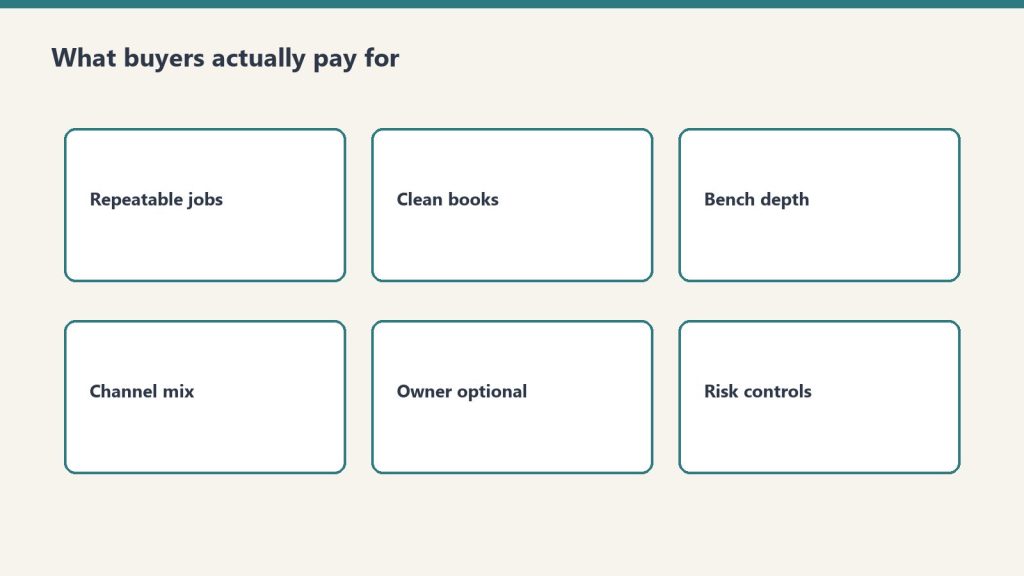
    Six cards: repeatable jobs, clean books, bench depth, channel mix, owner optional, risk controls
    Buyers pay for transferability — not heroic owners.

    The multiple is a function of risk, not affection. Sophisticated buyers pay up for five things, in roughly this order:

    1. Insurance carrier preferred-vendor status. If you are on the panel for State Farm, Allstate, USAA, Liberty Mutual, or any TPA program — Contractor Connection, Alacrity, Code Blue — that contract is the asset. It is also the hardest thing to replicate. Buyers will pay a premium for it because they cannot buy it any other way except by buying you.

    2. Mitigation-heavy revenue mix. Water mitigation runs gross margins around 70-80%. Reconstruction often runs 10% or less. A company that is 65% mitigation and 35% reconstruction is worth materially more than the same revenue split inverted. Buyers will pull your job-cost reports line by line during diligence to confirm the mix is real and not just how you are categorizing.

    3. Management depth below the founder. If you can take a two-week vacation and revenue does not blink, your multiple goes up by half a turn. If the phones stop ringing the moment you leave, you are selling a job, not a business. Hire a real general manager 18 months before you list.

    4. CAT exposure under 20%. Catastrophic event revenue is lumpy and cannot be modeled. If 40% of your last three years came from one hurricane season, buyers will discount that revenue heavily — sometimes valuing CAT-driven dollars at half the multiple of recurring carrier work. Diversify your revenue base before going to market.

    5. Clean books with a Quality of Earnings opinion. Every PE-backed deal includes a QoE — an outside accounting firm that re-audits your trailing twelve months and normalizes EBITDA. If your books are run on a personal-finance app and your CPA does taxes once a year, expect the QoE to find $200K-$500K of EBITDA adjustments that go against you. Spend $40K on a CFO-for-hire and a real GAAP P&L two years before sale.

    What Kills the Deal
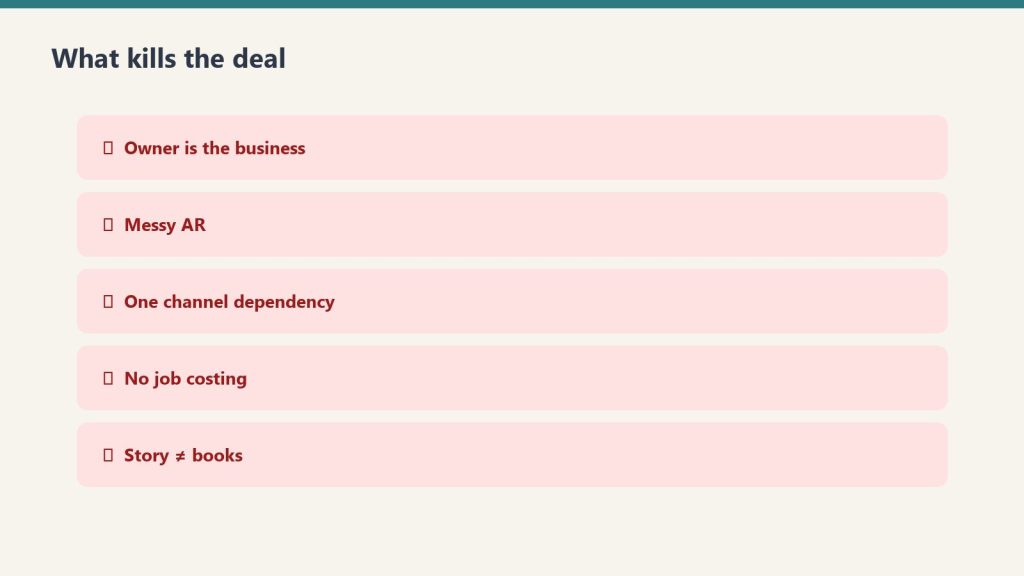
    Red list of deal killers including owner dependency and messy AR
    What kills the deal is usually quiet and operational.

    Roughly 30-40% of restoration LOIs do not close. Almost always for reasons the seller could have prevented.

    The biggest deal-killer is customer concentration. If one TPA program represents more than 35% of revenue, buyers panic. They have seen what happens when Contractor Connection decides to rebid a region — entire $8M revenue lines disappear in a quarter. Diversify before you list.

    The second is uncollected aged receivables. Restoration AR over 90 days is not an asset, it is a write-down waiting to happen. Buyers will deduct uncollected AR from purchase price dollar-for-dollar. Aggressively collect or write off everything before you go to market.

    The third is licensing and certification gaps. IICRC, state contractor licenses, mold remediation certifications by state — buyers run a full compliance audit. A single expired contractor license in a key state can cost $50K-$150K at close.

    The fourth is founder dependency on first-call relationships. If the property manager calls you personally when there is a flood — not a dispatch number, not a sales rep — buyers will require an earnout structure that makes you stay another three to five years. Most owners hate earnouts because they convert sale price into deferred contingent comp. Build the dispatch infrastructure before you list, and you keep the cash up front.

    The Honest Bottom Line
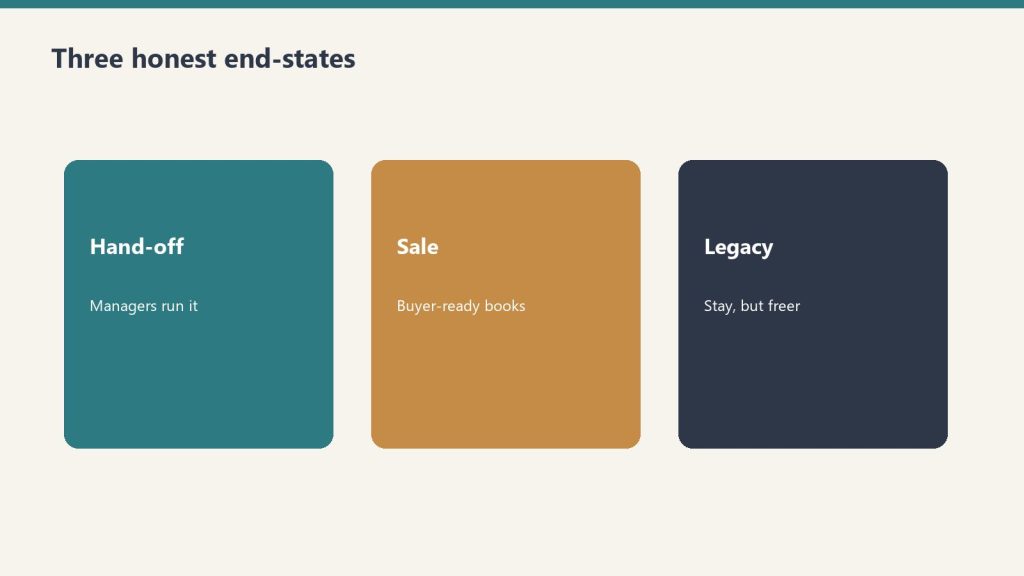
    Three panels for hand-off, sale, and legacy operation end-states
    Honest bottom line: pick an end-state and work backward.

    If you are a $3M revenue restoration company today and you want a clean exit at a real multiple, you have an 18-to-24 month preparation window. Use it to get the books on accrual, hire a GM, diversify off any single TPA, build mitigation revenue past 60% of mix, and get every certification current.

    Do that, and a $3M shop running 18% EBITDA margins ($540K) sells at 4.5x to a strategic — about $2.4M cash at close. Skip it, and the same company sells at 2.6x SDE — closer to $1.4M, often with a punishing earnout attached.

    The difference is one million dollars. The work to capture it is roughly nine months of operator focus. That is the highest-ROI work an exiting restoration owner can do.

    Related on Tygart Media: Starlink on a water job · S500 in the van · local SEO for restoration.

  • Mason County Roads & Highway Alerts: May 10, 2026 Update

    Mason County Roads & Highway Alerts: May 10, 2026 Update

    May 10, 2026 — Sunday morning brief (archived snapshot, checked October 19, 2026). This brief records conditions as reported on the morning of May 10, 2026 — it is not a current conditions report. For current conditions, use the WSDOT live links in this brief. Sources checked: WSDOT Olympic Region highway alerts, Mason County Public Works, MasonWebTV road work feed, Shelton-Mason County Journal. Live conditions: WSDOT highway alerts · WSDOT travel map.

    Active Alerts — May 10, 2026

    No active alerts were reported by WSDOT or Mason County Public Works that morning. Mason County highways — SR-3, US-101, SR-106, SR-302, SR-108, and SR-119 — were open and operating under normal Sunday conditions. No emergency closures or unscheduled lane restrictions were reported overnight.

    Major Projects — Status as of May 10, 2026

    ProjectStatusEst. CompletionSource
    SR-3 Freight Corridor (Belfair Bypass)Construction 2026, completion 2028 — funding at risk. Supplemental budget includes $48.3M in 2025–27 biennium; Ferguson budget proposes delaying final phase from 2027–29 to 2031–33 biennium.2028 (if funded)Shelton Journal 2/26/26
    Olympic Highway North (Shelton)Design phase — bid spring 2027, construction summer 20272027–28Shelton Journal 3/19/26
    SR-3 Shelton Safety (Craig Rd to Arcadia Rd)Pre-design — roundabouts planned, no construction dateTBDWSDOT engage
    SR-3 Belfair Widening (MP 25.3–27)Active constructionOngoingWSDOT

    Commuter Notes for May 10, 2026

    • SR-3 Belfair (MP 25.3–27): Belfair widening construction zone remained active. Travel time was normal that Sunday — no flagging or daytime lane closures were reported.
    • US-101 Shelton / Kamilche: No alerts were reported. Sunday volumes were light between Olympia, Shelton, and Hoodsport.
    • SR-106 along Hood Canal (Union area): Open that morning. No alerts were reported overnight on the Hood Canal corridor.
    • SR-302 (Key Peninsula side toward Victor): Open that morning. The SR-302 Victor Creek fish-barrier project completed major construction in December 2025 — the new bridge was carrying traffic and lane configurations were back to normal.

    Report a Road Issue

    • State highways (SR-3, US-101, SR-106, SR-302, SR-108, SR-119): Call WSDOT at 511 or visit WSDOT highway alerts.
    • Mason County roads: Mason County Public Works at (360) 427-9670 or report online at masoncountywa.gov.
    • City of Shelton streets: Shelton Public Works at (360) 432-5100.

    This brief was compiled on the morning of May 10, 2026 from public sources. For real-time conditions, always check the WSDOT live travel map before you drive. Conditions can change quickly — especially on SR-3 and US-101 where flagging operations and weather-related restrictions can appear with little notice.

  • Belfair Senior Center: The HUB Celebrates 25 Years

    Belfair Senior Center: The HUB Celebrates 25 Years

    There is a building on Old Belfair Highway that most of us have driven past a hundred times — tucked just off Highway 3, easy to miss if you’re rushing toward the Belfair Town Center. But if you stop and walk in on a Monday or Tuesday morning between 10 and noon, you’ll find live music already playing and a salad bar set up on a pay-what-you-can basis. That’s The HUB, and it has been the unofficial living room of North Mason County for 25 years.

    The organization was founded in 2001 as a 501(c)(3) under a simple mission: support independent living for our senior and disabled neighbors. For the first 15 years, The HUB operated as a mobile, volunteer-driven service network — rides to appointments, help with errands, a free medical lending library, and a food commodities program for seniors. All of it run by neighbors helping neighbors.

    In 2016, the dream got a building. Les and Betty Krueger offered matching funds to help purchase land on Old Belfair Highway, and our community rallied to raise the rest, funding the first phase of a purpose-built senior center. The name is an acronym — Hospitality, Unity, and Belonging — but it has also just become the plain-English word for what happens there. The HUB is where people gather.

    Today, the center at 111 NE Old Belfair Hwy runs a packed calendar any given week. Monday and Tuesday mornings bring free live music open to the whole community — not just seniors. Family BINGO lands on the first Friday of every month. Fitness classes, painting, writing workshops, cooking classes, and health events fill out the rest. The Great Room and commercial kitchen are available for community rentals and private fundraisers.

    The HUB Shop — or as the staff calls it, Sales Helping Other People — operates its own full schedule: Monday through Saturday, 9:30 a.m. to 5:30 p.m. It’s a thrift store where proceeds cycle back into HUB programs. Generations of Belfair families have donated furniture, clothes, and household goods here, and picked up unexpected finds in return.

    The Neighbors Helping Neighbors program remains the quiet backbone of the whole operation. It’s not glamorous: rides to doctors, help with grocery runs, a borrowed wheelchair or walker when you need one. But it is how The HUB’s original 2001 mission still shows up in real, daily form for people who would otherwise navigate North Mason without much support.

    If you have never been inside — or if it’s been a while — the center is open Monday through Thursday, 10 a.m. to 4 p.m. The phone is (360) 275-0535. Find The HUB at 111 NE Old Belfair Hwy, on the left-hand side of Old Belfair Highway coming from downtown Belfair, just past where the road bends away from Highway 3.

  • 5 GEO and AEO Case Studies: What Actually Worked in 2026

    5 GEO and AEO Case Studies: What Actually Worked in 2026

    Most GEO and AEO case studies you can find online are vendor-published and short on implementation detail. So instead of stacking another “look at this 300% lift” headline, this piece walks through five publicly documented results from 2026 — and pulls out the structural change that actually drove the win in each one. If you want to copy what works, copy the structure, not the percentage.

    1) HubSpot: 3x lead conversion from AEO traffic

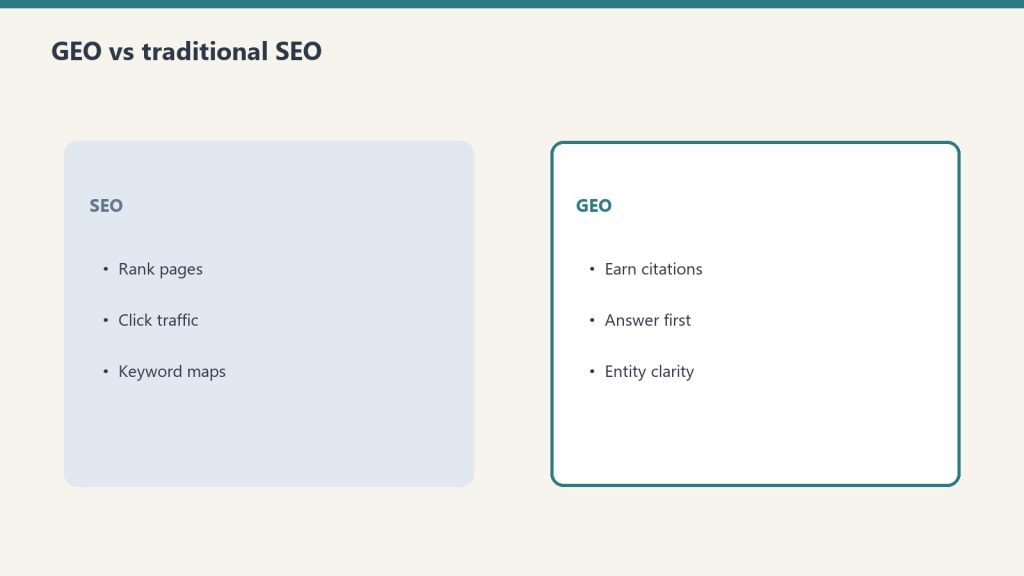
    GEO versus SEO cards used as case-study framing
    Case patterns: what actually worked in GEO/AEO.

    HubSpot’s own 2026 State of Marketing reporting found 58% of marketers saying AI-referred visitors convert at higher rates than traditional organic, with HubSpot itself reporting roughly 3x better lead conversion from AEO sources versus other channels. The implementation pattern across HubSpot’s blog: question-led H2s, a 40–60 word direct answer in the first paragraph below the heading, then expanded context, then a structured FAQ block with FAQPage schema.

    The before/after isn’t “more content.” It’s “the same content, restructured so the answer arrives in the first 60 words.” That single edit is what featured snippets and AI Overviews both reward.

    2) Hashmeta e-commerce client: +50% zero-click visibility

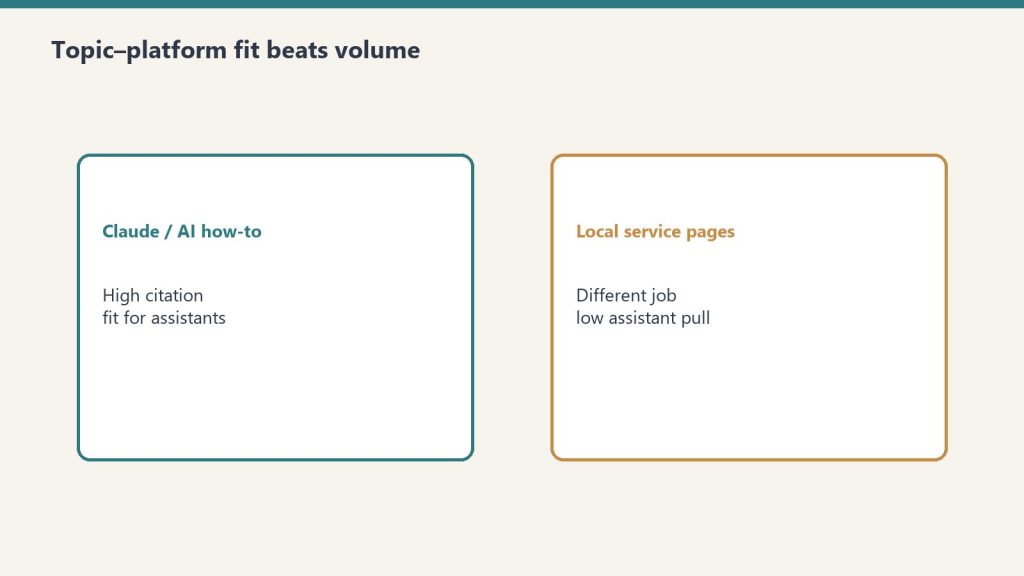
    Comparison of Claude how-to fit versus local service page fit for assistants
    Zero-click visibility lifts without chasing vanity traffic.

    Hashmeta documented a 50% increase in zero-click visibility for an e-commerce client after a targeted AEO sprint. The lever: rebuilding product and category pages around explicit question intent (“what is the difference between X and Y,” “is X worth it for Z use case”) and adding HowTo and FAQPage schema. The page didn’t get more traffic from the same query — it started winning the answer position on related queries it wasn’t competing for before.

    The takeaway for practitioners: zero-click visibility is its own funnel. Track it separately from sessions, because the value shows up in branded search lift two to four weeks later, not in same-day clicks.

    3) SaaS brand: 20+ free-trial signups per month from ChatGPT citations

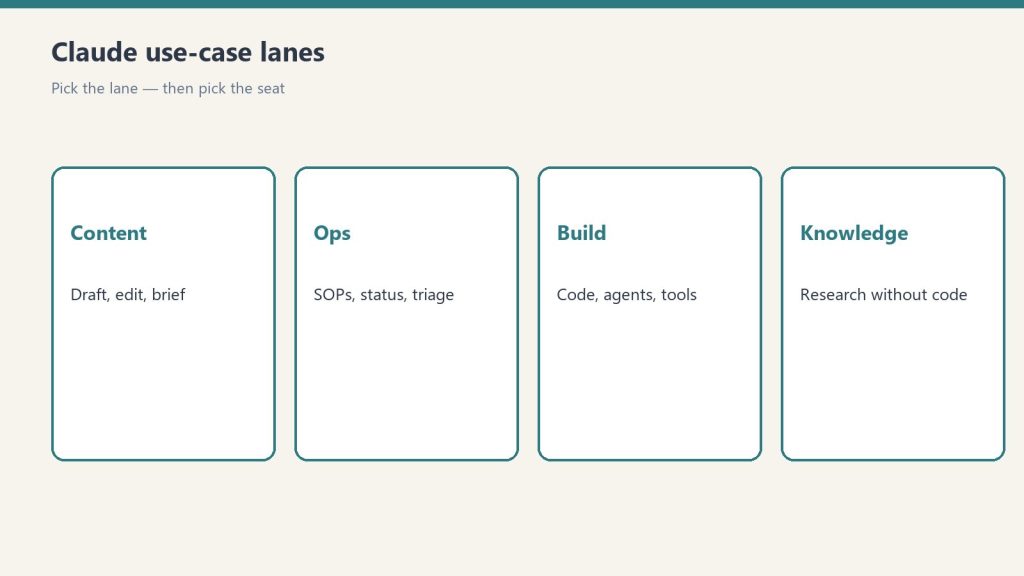
    Four cards for content, ops, build, and knowledge work with Claude
    ChatGPT citations can create free-trial demand.

    One SaaS case study circulating in the GEO community in early 2026 reported 20+ free-trial signups per month attributed directly to ChatGPT citations, identified via a unique UTM and a referral-source filter in their analytics. The structural pattern: a single canonical comparison page per top competitor, written as a third-person reference rather than first-person marketing, with a clear definition block, a structured comparison table, and a “when to choose X” section.

    This is the format ChatGPT cites because it’s the format ChatGPT was trained to produce. Match the output shape and you become the source.

    4) Generic brand study: 140% lift in AI-driven search traffic

    A widely cited 2026 GEO case study reported a 140% increase in LLM and AI-driven search traffic alongside a 62% rise in AI mentions after a strategy that prioritized entity saturation, internal-link clustering, and structured data over keyword density. The implementation detail worth copying: a single hub page per entity with at least 15 distinct factual data points, then 8–12 supporting articles linking back to it with descriptive anchor text.

    The 15-data-point threshold matches what GEO researchers have flagged repeatedly: articles with 15+ verifiable data points receive substantially more AI citations than articles with fewer than five.

    5) Mangools: featured-snippet capture from a single edit

    Mangools published a walkthrough showing how rewriting one blog post to lead with a 50-word direct answer captured a featured snippet for a head-term query, with the resulting traffic and brand exposure outpacing the rest of the content cluster. No new backlinks, no new content — just a structural rewrite of the first 100 words.

    The pattern across all five

    Every win has the same shape: question-led H2, 40–60 word direct answer, structured supporting content, schema markup. Here is the minimum viable AEO block, drop-in ready:

    <h2>What is generative engine optimization?</h2>
    <p><strong>Generative engine optimization (GEO) is the practice of structuring web content so AI systems like ChatGPT, Claude, Gemini, and Perplexity cite it as a source.</strong> Unlike SEO, which optimizes for ranking in a list of links, GEO optimizes for being included in a generated answer. The core levers are entity clarity, factual density, structured data, and crawlability via LLMs.txt and robots.txt.</p>
    
    <script type="application/ld+json">
    {
      "@context": "https://schema.org",
      "@type": "FAQPage",
      "mainEntity": [{
        "@type": "Question",
        "name": "What is generative engine optimization?",
        "acceptedAnswer": {
          "@type": "Answer",
          "text": "Generative engine optimization (GEO) is the practice of structuring web content so AI systems cite it as a source in generated answers."
        }
      }]
    }
    </script>

    The measurement layer

    None of these case studies mean anything without isolation. The minimum tracking stack: a referrer filter for chatgpt.com, perplexity.ai, claude.ai, gemini.google.com, and copilot.microsoft.com in GA4; a separate event for zero-click impressions from Google Search Console; and a manual citation log — query a representative model with your top 25 prompts weekly and record whether your domain is cited. The third one is what most teams skip, and it’s the only one that tells you whether GEO is working before traffic shows up.

    What to copy this week

    Pick your top five highest-intent pages. For each one, rewrite the first 100 words as a direct-answer block, add a single FAQPage schema with three questions, and add the page to your LLMs.txt manifest. That is the entire implementation. Every case study above is a variation on those three moves.

    Related on Tygart Media: GEO case study teardown · GEO tactics · SEO vs GEO vs AEO.

  • Mason County Nonprofits: Sound Learning & Kitten Rescue

    Mason County Nonprofits: Sound Learning & Kitten Rescue

    When you think about what holds a community together, the answer often shows up quietly: in a Shelton classroom where adults study for their GEDs at night, or in a shelter along State Route 3 where volunteers coax a feral kitten toward trust. This Community Spotlight, published in May 2026, shines on two Mason County nonprofits — Sound Learning and Kitten Rescue of Mason County — that have been doing exactly this kind of unglamorous, essential work for decades.

    Last refreshed: October 19, 2026 (Pacific).

    Sound Learning: 35 Years of Second Chances in Downtown Shelton

    Sound Learning, located at 133 W. Railroad Ave. in downtown Shelton, has been opening doors for adult learners in Mason and Thurston Counties since 1991, when it was founded as Mason County Literacy. At its 20th anniversary, the organization adopted a new name to reflect its expanded mission: building the skills workers, parents, and families need to navigate the 21st century. Now in its 35th year, Sound Learning remains one of the most consequential — and least visible — institutions in Mason County.

    The organization offers several tracks: Adult Basic Education including High School+ and GED preparation, English Language Acquisition at six levels, and an Open Doors program that serves immigrant youth ages 16 to 21 in partnership with the Shelton School District. Students receive small-group instruction supplemented by distance learning, and classes are scheduled to fit around the demands of work and family. That accessibility is a deliberate design choice: the people Sound Learning serves are often working multiple jobs or raising children while pursuing a diploma that the rest of society already takes for granted.

    This spring, Sound Learning received a significant vote of confidence in the form of a three-year, $150,000 grant from The Harvest Foundation. The funds will be used to expand educational programs, update essential technology including computers for digital literacy instruction, and invest in staff development to keep instructors current with best practices.

    “We are incredibly grateful to The Harvest Foundation for their generous support,” said Ava Taylor-Sisk, Sound Learning’s interim director. “This funding will allow us to better serve adults in our community who are working hard to build brighter futures for themselves and their families. Investments in education strengthen our entire region.”

    The organization’s board of directors draws from across the county’s institutional fabric: Chairman Billy Thomas is marketing director at Peninsula Credit Union; board member Jeff Slakey is a journalist and media coordinator at KMAS; and Vice-Chairman Penny Wilson serves as director of the Mason County Senior Activities Center. That connectivity keeps Sound Learning embedded in the networks residents depend on.

    The community celebrated Sound Learning in person that spring. The 30th Annual Spell-E-Bration fundraiser took place Saturday, May 16, 2026, from 4 to 8 p.m. at the Mason County Senior Activities Center — The Pavilion at Sentry Park, 190 W. Sentry Drive, Shelton. The evening featured a spelling competition where community teams competed for the Top Spelling Champs Award, a silent auction, a Beehive Bonanza prize drawing, and a dessert and appetizer bar.

    Sound Learning can be reached at (360) 426-9733 or staff@soundlearning.co. The learning center is located at 133 W. Railroad Ave., Shelton.

    Kitten Rescue of Mason County: 26 Years as the County’s Only Cat Shelter

    In 1999, there was nowhere in Mason County for an abandoned cat or kitten to go. A small group of local volunteers decided that was unacceptable, and Kitten Rescue of Mason County was born. Twenty-six years later, KRMC remains the only physical shelter in Mason County devoted exclusively to cats and kittens — and it still operates as a no-kill facility.

    Located at 420 SE State Route 3 in Shelton, the shelter has grown from its grassroots origins into a facility with a main cottage and six small outbuildings, two of which were added in 2021 to meet growing demand. Beyond the walls of the shelter, a network of foster families helps socialize kittens before adoption, preparing them for the homes they’ll eventually join. The organization also runs a free feral “Fix and Release” program and provides low-income spay and neuter assistance — addressing the root causes of cat overpopulation throughout Mason County rather than simply managing its symptoms.

    KRMC is 100% donor-supported. Its primary fundraising engine is a regular garage sale held at the 420 SE State Route 3 location, where 100% of proceeds go directly to operations: food, medical care, spay and neuter services, and shelter. The organization held a garage sale on Saturday, May 9, 2026. Residents interested in donating items for future sales should check kittenresq.net for the current sale dates and donation windows. Accepted items must be complete, clean, and gently used — the shelter cannot accept computers, televisions, mattresses, large furniture, or damaged goods, as dump fees would directly reduce care for the animals.

    At the time of this spotlight in May 2026, KRMC noted on its website that it was at capacity and could not accept additional cats or kittens. Capacity changes with adoptions and intakes, so check the shelter’s website for the current status before bringing in an animal. Residents who have found a stray or need assistance are encouraged to check the additional resources page at kittenresq.net for referrals to other organizations that may be able to help.

    For those looking to contribute, Kitten Rescue accepts donations at kittenresq.net, relies on volunteers for daily care, socialization, fostering, and behind-the-scenes administration, and can be reached at 360-427-3167 or krmasoncounty@gmail.com.

    Why These Stories Matter

    Together, Sound Learning and Kitten Rescue of Mason County represent something Mason County does quietly well: building institutions that meet real needs, run by neighbors who show up year after year because no one else will. If you’ve benefited from either organization, or know someone who has, any week is a good week to say thank you — or to chip in.

  • Grays Harbor Day Trip: Bowerman Birds & Westport Halibut

    Grays Harbor Day Trip: Bowerman Birds & Westport Halibut

    The South Coast of Washington doesn’t wait for you to plan ahead. In spring 2026, the window opened on two experiences you’d drive hours for — and both peaked in May. The Grays Harbor National Wildlife Refuge in Hoquiam was in the final days of one of the Pacific Coast’s most extraordinary wildlife events, while out at the Westport docks, the 2026 halibut season was running on designated days. Whether you’re a birder, an angler, or just someone who needs a genuinely good Sunday, the South Coast delivered — and both experiences return each spring.

    Last refreshed: October 19, 2026 (Pacific).

    The Last Days of Spring Migration at Bowerman Basin

    Every spring, hundreds of thousands of shorebirds descend on the Grays Harbor Estuary during their northbound migration from South America and Central America toward breeding grounds in Alaska and the Arctic. The Grays Harbor National Wildlife Refuge — specifically the tidal flat ecosystem known as Bowerman Basin — sits at the center of this spectacle. The U.S. Fish & Wildlife Service describes Grays Harbor as one of the largest concentrations of shorebirds on the west coast, south of Alaska, and the numbers bear that out: in peak years, the flats host birds so numerous they seem to shift like a living tide.

    The migration window runs from late April through mid-May, and May 10, 2026 sat squarely in it. The dominant species that week included Western sandpipers and dunlins — which together account for roughly 80 percent of the birds present — along with short-billed and long-billed dowitchers, black-bellied plovers, red knots, and semipalmated plovers. These birds are fueling up on the estuary’s rich mudflat invertebrates before pushing north. The urgency of their schedule means they’re concentrated, active, and visible in extraordinary numbers.

    The Sandpiper Trail is your access point: a wooden boardwalk loop that leads through salt marsh and alder-cottonwood forest out to open benches overlooking the intertidal flats. The trail is open sunrise to sunset year-round, and there is no entrance fee. Reaching the trailhead requires a short 1/3-mile walk from the parking area at 1000 Airport Way, Hoquiam — through a cooperative agreement between the U.S. Fish & Wildlife Service and the Port of Grays Harbor, which manages the adjacent airfield.

    The tide is everything here. Birding is best within three hours of high tide, when rising water pushes the shorebirds off the exposed flats and concentrates them near the boardwalk trail. Check the tide table at tides.net before you go, and aim to arrive about two hours before high water. There are no restrooms or potable water at the refuge, so come prepared. The payoff on a good tidal morning — a wall of sandpipers lifting and wheeling over the gray-green water — is one of those sights that recalibrates your sense of what the natural world can do. Reach the refuge at (360) 753-9467 through the Nisqually National Wildlife Refuge Complex.

    Westport Halibut: The 2026 Season

    Forty miles down the coast, Westport was operating in full halibut mode. The Washington Department of Fish and Wildlife opened Marine Area 2 — the Westport-Ocean Shores zone — to recreational halibut fishing on April 30, 2026, with designated open days running through May 31, and the season later continued on designated days through June 30. Sunday, May 10, 2026 was one of the May open days.

    The 2026 schedule for Marine Area 2 ran Tuesdays, Thursdays, Fridays, and Sundays through the end of May, then Tuesdays, Thursdays, and Sundays from June 2 through June 30. The daily catch limit was one halibut, and the annual limit was six per angler. There was no minimum size restriction. All anglers were required to record their catch on a WDFW catch record card — also available as an electronic version through the WDFW’s MyWDFW and Fish Washington mobile apps.

    Westport holds the coast’s largest charter boat fleet, and most of the action happens far offshore around the edges of Grays Canyon, with depths reaching 600 feet or more. Charter trips typically depart well before dawn and return by early afternoon — make sure to confirm departure times when you book. Several Westport operators booked halibut trips for the May and June open days, and availability on prime Sunday slots filled quickly. A solid starting point for the current charter fleet lineup is experiencewestport.com.

    One practical note from the 2026 season: the fishery could close early if the quota for Marine Area 2 — set at 65,857 pounds for 2026 — was reached. In any season, always confirm that the area is open before heading to the dock by checking wdfw.wa.gov or the WDFW emergency fishing rules page. Quota tracking information is updated in-season.

    Plan Your Visit

    For Bowerman Basin: Drive to 1000 Airport Way, Hoquiam, WA 98550. Parking is free, the Sandpiper Trail is open sunrise to sunset, and there is no entrance fee. Time your visit to arrive within three hours of high tide for the best shorebird viewing. The migration window closes around mid-May each year — in 2026, the May 10 weekend was the time to go, and the birds return on the same late-April-to-mid-May schedule each spring. Contact the refuge through the Nisqually NWR Complex at (360) 753-9467, or visit fws.gov/refuge/grays-harbor.

    For Westport halibut: In 2026, the open Sundays after May 10 were the 17th and 24th, with additional designated days through June 30; for the next season’s dates, visit experiencewestport.com for the charter fleet directory, or contact operators directly to check availability. Bring or download a WDFW catch record card before boarding. For in-season closures or quota updates, visit wdfw.wa.gov. The drive from Hoquiam to Westport is approximately 25 minutes via US-12 and State Route 105 — putting both stops on the same day trip if you time the tides right.

  • Workspace Backlog: Why Composting Work Is Not Cleaning

    Workspace Backlog: Why Composting Work Is Not Cleaning

    There is a place in every working life where ideas that were once worth marking go to sit. They are not active. They are not dead. They are not being worked. They are also not being released.

    Most workspaces have one. The mature ones have many.

    The conventional name is backlog or drafts or inbox. None of those names tell the truth about what the pile actually is. The pile is a mausoleum of former selves. Each item there was flagged by a version of the operator who believed they would act on it. That version is gone. The item remains.

    The instinct is to call this a process problem. Better triage. Better tagging. Better deadlines. A weekly clearance ritual. The instinct is wrong, which is why the rituals never hold.

    The previous piece named this directly: composting living work is a grief problem, not a process problem. That was the first half of the move. This is the second.


    Three Layers of the Pile

    Items in the pile are in three layers, and they should be treated differently.

    The top layer is triage hygiene. Auto-captured noise, duplicates, half-finished references whose context is gone. Most operational advice ends here. This is the layer where checklists and review cadences earn their keep. It is also the layer that is rarely the real problem.

    The middle layer is the items that still feel possible. Each one has a small private case for itself. I could still do this. The operator returns to it monthly and finds the case unchanged — which is to say, the case is no longer being made by current evidence; it is being made by inertia and by the original belief that it was worth marking. Middle-layer items survive triage because triage asks the wrong question. Triage asks is this still useful? The honest question is am I still that person?

    The bottom layer is the dangerous one. These are the items whose continued presence in the pile is doing structural work for the operator’s self-image. They are not failures of execution. They are placeholders for an identity. As long as the item sits there, the operator is still legibly the kind of person who would write that essay, build that product, finish that draft. Removing the item is not an act of housekeeping. It is a small private retraction of a public claim — or a small public retraction of a private one.

    This is the layer the system cannot help with. No score, no priority field, no dashboard sees this layer because there is nothing operationally distinct about it. The signal is internal. The operator knows.


    The Forest Doesn’t Help Here

    The forest does not feel bad about the dead branch. The phrase is true and almost useless to a person standing in front of their compost pile holding an item with their name on it. Ecological metaphors describe an outcome whose emotional precondition is exactly what the operator does not have.

    Composting at organizational or personal scale requires the operator to do something the forest never has to do: contradict a former judgment. The forest’s branch did not announce itself when alive. It was just functional. The drafted essay announced itself — was caught, named, marked, given coordinates. It promised something. Composting is breaking that promise. The pile is silent only because no one is saying out loud what it would mean to retire each item: I am not who I thought I was when I added you.

    That is why the act is slow. That is why every tool that promises to make it fast eventually fails. The bottleneck was never throughput.


    Two Failure Modes

    There is a productive failure mode here, and a corrosive one.

    The productive failure: an operator who composts slowly because each act is being given the weight it deserves. The pile shrinks unevenly. Some items leave in batches. Some take a year. The shape of the descent is honest. The operator emerges with fewer items and a clearer sense of which versions of themselves they are still in negotiation with.

    The corrosive failure: an operator who refuses to compost at all and recodes the pile as backlog. The items are then re-examined, reprioritized, re-tagged, lightly edited. The grief is laundered as process. The pile does not shrink. The mausoleum is maintained but never visited. The operator stays legible to themselves as someone who will. The cost is not the items — the items were never going to ship. The cost is that an entire psychic load goes on accruing interest in a currency the operator did not agree to pay.

    A workspace full of unkilled drafts is not a productivity problem. It is a personality problem in workspace clothing.


    What Composting Well Actually Looks Like

    Not efficient. The first sign that an operator is doing this honestly is that the act has weight. They do it less often than the dashboard suggests. They do not batch-delete. They name what is being released — not in detail, not as eulogy, but with enough specificity that they cannot pretend later that it never happened.

    The released items go somewhere reviewable. Not to a hidden trash. To a list with dates. The point of the list is not to bring items back. The point is to make the act undeniable. An operator who can later open the list and read the names is an operator who can no longer claim those projects are pending.

    A small re-entry condition is allowed, borrowed from the discipline of principled refusal: a composted item is permitted to come back, but only under a different premise. If the case for re-entry is the same case that was made the first time, the answer is no — the case has already been heard.


    The Terms of the Deal

    The deeper point, which the previous piece pointed at and did not unfold:

    Compounding systems generate more captures than any operator can ever commit to. The capture-commitment gap is not a bug — it is the organizing fact of working at scale with intelligent infrastructure. The compost pile is the visible artifact of that gap. It is not a sign of failure. It is the sign that the system worked.

    An operator who refuses to grieve their compost pile is an operator who has not yet accepted the terms of the deal. They wanted leverage. The leverage came. Some of the leverage takes the form of not getting to do everything they once thought they would.

    This is where the architecture shows its temperament. A surfacing system that ranks captured items by recency or volume is happy to let the operator confuse the pile with a queue. A surfacing system honest about its own purpose has to admit that some of what it captures is not for committing — it is for releasing. The willingness to flag an item as candidate for compost is the system version of the operator’s grief. Most workspaces will not build it because it makes the surface look smaller. The ones that do are participating in the actual work.

    The forest does not feel bad about the dead branch. The operator does, and probably should — once. The discipline is letting the feeling do its work and then moving the branch to the pile, where the forest can finally start its own slow indifferent recycling.

    You will know the work is done when you can walk past the compost pile without checking it.

    Related on Tygart Media: backlog triage · task management discipline · Notion Command Center.

  • Claude Code for Teams: Configuration & Gitignore Guide

    Claude Code for Teams: Configuration & Gitignore Guide

    Last refreshed: October 20, 2026

    Most teams I see roll out Claude Code by handing every engineer the install command and walking away. Three weeks later, half the repo has personal preferences committed to .claude/settings.json, the other half has a CLAUDE.md that contradicts the actual review process, and someone’s customized subagent is silently making code changes nobody else on the team understands.

    There is a better way, and it lives in the split between three files: CLAUDE.md, .claude/settings.json, and .claude/settings.local.json. Get this split right, and Claude Code becomes a force multiplier for the team. Get it wrong, and you are shipping AI-generated code that nobody owns.

    The Three-File Split

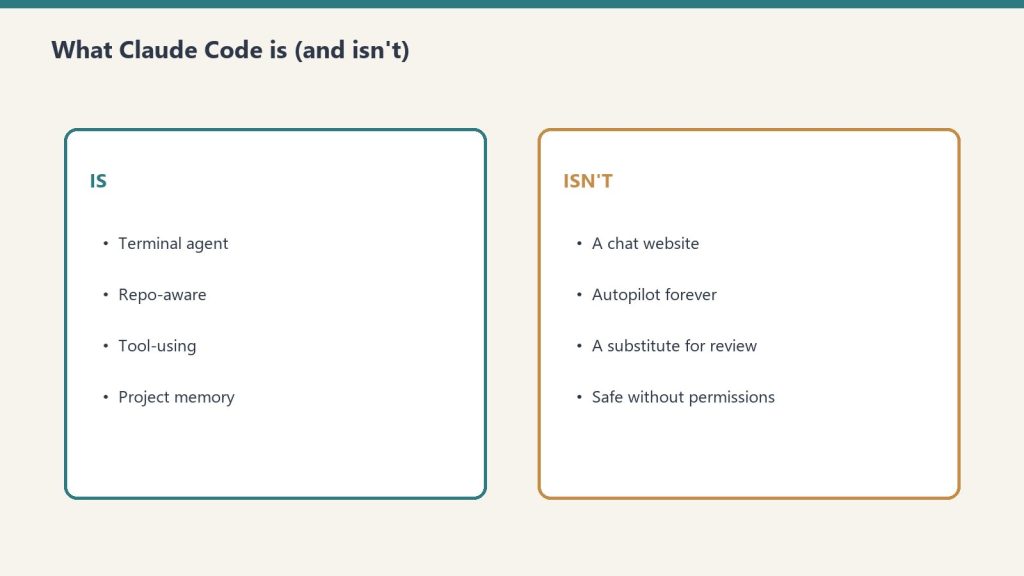
    Side-by-side cards defining what Claude Code is and is not
    The three-file split for team Claude Code.

    Here is the rule, no exceptions:

    CLAUDE.md — committed. Project root. Every engineer’s session reads this at startup. Put your architectural decisions, preferred libraries, naming conventions, and a review checklist here. If you would not write it on a whiteboard for a new hire, it does not belong here.

    .claude/settings.json — committed. Team-wide tool permissions, default models, and hooks. This is the file that keeps personal flagship-model enthusiasts from blowing through your team’s budget when claude-sonnet-4-6 would have done the job. If you let everyone default to claude-opus-4-7 for routine refactors, your monthly invoice will tell you about it.

    .claude/settings.local.json — gitignored. Personal preferences, individual MCP server configs, anything that varies by engineer. Add this line to your .gitignore on day one:

    .claude/settings.local.json

    If you do not, someone will commit credentials by Friday. Audit your existing repo right now: git log --all --full-history -- .claude/settings.local.json will surface any history that needs scrubbing.

    The mistake I see most often is teams committing settings.local.json because someone copied a tutorial that did not make the distinction clear. That copy-paste error is the single most common Claude Code rollout failure I have seen this year.

    Shared Subagents Are the Real Win

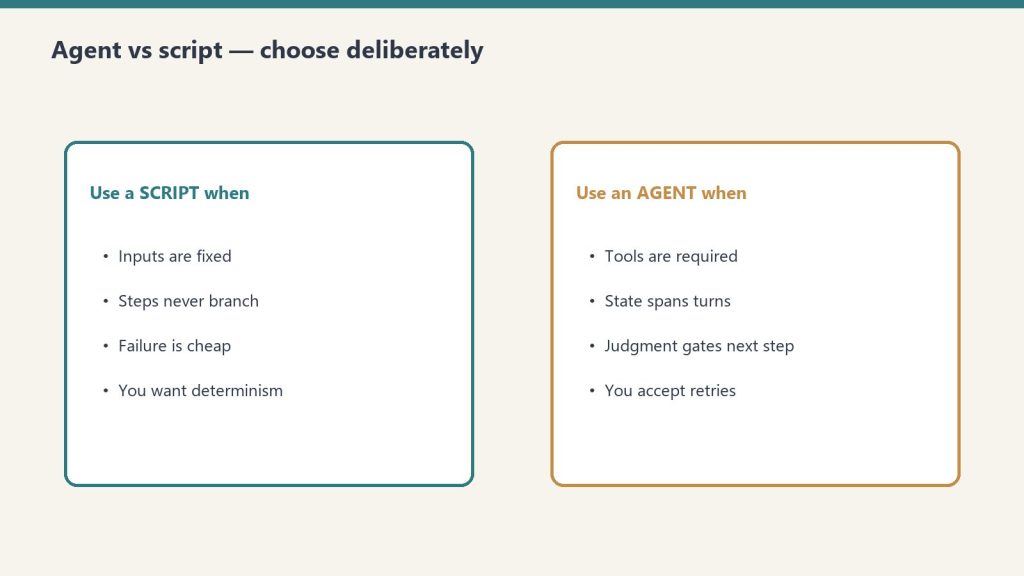
    Side-by-side when to use a script versus an agent
    Shared subagents are the real win.

    Project subagents live in .claude/agents/ and they ship with the repo. This is where teams compound value. A subagent for security review, one for accessibility audits, one for SQL migration safety — defined once, used by every engineer, every PR.

    A subagent definition is a markdown file with YAML frontmatter and a system prompt. When you commit it, every teammate’s claude invocation can call it. The subagent inherits your CLAUDE.md context automatically, so you do not have to redefine the project’s coding standards inside each agent.

    Here is the trap: do not put twelve subagents in there on day one. Start with one. The team’s most painful repeated review task is the right candidate. Whatever takes a long time and pulls in multiple engineers per PR — that is your first subagent. After two weeks of using it, you will know whether the second one is worth defining.

    CLAUDE.md Is a Living Document, Not a Manifesto

    The longest CLAUDE.md files I see are the worst-performing. Engineers do not read 4,000-word context files, and neither does Claude in any useful way — at some point you are paying for tokens that just dilute the signal.

    The CLAUDE.md files that actually shape behavior are usually compact, structured around three things:

    1. What this codebase is and what it is not.
    2. The handful of rules that get a PR rejected — test coverage, naming, error handling, dependency policy.
    3. A pointer to where deeper documentation lives.

    If your CLAUDE.md has a “philosophy” section, delete it. If it has a “history of the project” section, delete it. The file is read every session — make every line earn its tokens.

    CI/CD: Run Claude Code on PRs, Not in Place of Reviewers

    The pattern that works in CI is automated triage, not automated approval. A GitHub Actions workflow that runs Claude Code on every PR to check for things humans miss — missing tests, secrets in logs, public APIs without docstrings — adds value. A workflow that approves and merges PRs adds liability.

    Anthropic’s official GitHub Actions integration handles the auth and runs Claude Code headlessly. The realistic use cases:

    • Comment on PRs with a structured review (not a merge gate).
    • Auto-label PRs based on the diff.
    • Flag suspected regressions before a human reviewer opens the PR.

    Avoid: anything that auto-merges, anything that posts directly to production-facing systems, anything that calls a paid API on every commit to a feature branch. The bill compounds quickly when CI fires Claude on every push to every developer branch. Gate the workflow on PR-target branches only, or on labels.

    Where Claude Code for Teams Loses Today

    The honest list:

    • No native role-based permissions inside a single repo. If you want a junior engineer’s Claude Code to be more restricted than a senior’s, you have to enforce it through settings.json and trust everyone to not edit it. The Enterprise plan adds SSO, SCIM, and audit logs at the workspace level, but inside the repo, Claude Code itself does not differentiate by role.
    • No first-class secret scanning before commits. Hooks can plug this gap, but you have to wire pre-commit yourself.
    • Shared MCP servers are still per-developer auth. A team-shared Linear or Jira MCP, for example, still requires each engineer to authenticate individually.

    The Team plan addresses workspace-level governance through Premium seats, which is the tier that actually unlocks Claude Code for teammates. The Enterprise plan layers on SSO, SCIM, and audit logs. Neither makes the in-repo configuration questions go away — those are still your team’s problem to solve.

    Model Selection Is a Team Decision

    This one matters more than people realize. Default everyone in .claude/settings.json to claude-sonnet-4-6 for day-to-day work, with claude-opus-4-7 available for explicitly hard tasks. The current Anthropic lineup as of this writing — flagship claude-opus-4-7, workhorse claude-sonnet-4-6, fast claude-haiku-4-5-20251001 — is documented at docs.anthropic.com/en/docs/about-claude/models, and the model strings change frequently enough that hard-coding them in scripts has bitten me twice this year. Read that page, do not memorize it.

    A team that defaults to flagship for everything and a team that defaults to workhorse with selective escalation will see meaningfully different invoices for substantially the same productivity. Make the choice consciously.

    The 20-Minute Setup

    Desk with laptop, checklist notebook, and billing card ready before creating an Anthropic API key
    The 20-minute team setup.

    If you are rolling Claude Code out to a team next week:

    1. Add .claude/settings.local.json to .gitignore. First commit, today.
    2. Write a focused CLAUDE.md covering review-blocking rules. Ship it short.
    3. Create one subagent in .claude/agents/ for the team’s most painful review task.
    4. Add a single GitHub Actions workflow that runs Claude Code on PRs in comment-only mode.
    5. Schedule a 30-minute team review of the CLAUDE.md every two weeks. Delete more than you add.

    That is it. Everything else is iteration. The teams that succeed with Claude Code treat the configuration as code — versioned, reviewed, and pruned. The teams that fail treat it as a personal productivity tool that happens to be in a shared repo.

    Decide which kind of team you want to be before the third engineer commits.

    Related on Tygart Media: how to use Claude · Anthropic API key.

  • NAVSTA Everett Mental Health Resources for Navy Spouses

    NAVSTA Everett Mental Health Resources for Navy Spouses

    Quick answer for Navy spouses at NAVSTA Everett: You have your own resource map, separate from your service member’s — first published for Mental Health Awareness Month 2026 and checked again in October 2026. The Fleet & Family Support Center at 425-304-3735 provides individual and family counseling open to spouses (no medical record generated). The 988 + 1 Military and Veterans Crisis Line accepts calls from family members, not just service members. Military and Family Life Counselors (MFLCs) embedded at NAVSTA serve spouses and children. The Everett Vet Center at 1010 SE Everett Mall Way Suite 207 (425-252-9701) serves family members of veterans killed in service. Snohomish County Veterans Assistance at 425-388-7255 provides emergency help that includes military families. None require a referral, and most don’t require your service member to be present or even informed.

    If you’re a Navy spouse at NAVSTA Everett, the version of Mental Health Awareness Month that gets the most attention focuses on the service member. The version that often gets less attention focuses on you — even though the research consistently shows that Navy spouses carry stress patterns specific to military family life that civilian counterparts simply don’t face. Deployments. PCS uncertainty. Single-parenting through workups. Building a career while moving every two-to-four years. Holding a household together while the FF(X) frigate program timeline drives uncertainty about the next 18 months.

    This guide is the spouse-specific resource map for Mental Health Awareness Month 2026 and beyond. All the resources listed are open to you directly — you don’t have to involve your service member, you don’t have to wait for their permission, and most of them don’t generate any record that affects your spouse’s career.

    Last refreshed: October 19, 2026 (Pacific).

    Why a Spouse-Specific Read Matters

    Navy spouses at NAVSTA Everett are managing several stressors that compound during 2026 specifically:

    • Deployment workup season on the destroyer squadron is in its crunch phase, which means your service member’s hours are already long and unpredictable
    • The FF(X) frigate program timeline introduced fresh uncertainty about who is moving where and when, which makes long-range spouse career and family planning harder than usual
    • PCS season is heating up across the Navy, with rotation orders landing in waves through the spring
    • Sustained inflation pressure is harder on military households because PCS moves disrupt income continuity for the working spouse

    The Department of Defense’s published research on military family mental health shows that spouses carry elevated rates of anxiety and depression compared to civilian counterparts of the same age. The resources below were built specifically with that pattern in mind.

    988 + 1 for Crisis — Yes, Family Members Can Use It

    The Military and Veterans Crisis Line at 988, press 1 is staffed 24/7 by responders trained in military culture. The line is explicitly open to family members, not just active-duty service members. You can call about your own crisis, or you can call to talk through how to support someone else.

    You can also text 838255 for the same service in text form, or chat online at veteranscrisisline.net. None of these require enrollment in VA care or any documentation.

    For situations that are medical and immediate, Providence Regional Medical Center Everett on Pacific Avenue has a 24/7 emergency department with behavioral health response capability — closer to the gate than any alternative.

    FFSC: Your Counseling Door, Not Just Your Service Member’s

    The Fleet & Family Support Center at 425-304-3735 (email NSEFFSC@us.navy.mil) is staffed with licensed counselors who hold master’s or doctoral degrees in social work, marriage and family therapy, or psychology. The Center provides individual, marriage, and family counseling on a short-term basis to spouses, dependents, and retirees — not just active-duty members.

    Three details about FFSC that matter specifically for spouses:

    You can go without your service member. Individual counseling is exactly that — individual. Your service member doesn’t need to know, doesn’t need to consent, and isn’t notified. The conversation belongs to you.

    FFSC counseling does not generate a medical record and does not feed into your service member’s security clearance review. The non-medical model is intentional.

    The Smokey Point satellite office at NAVSUP FLC Puget Sound is sometimes a more convenient option for families living north of the base.

    MFLCs: Embedded, Free, and Designed for Family Members

    Military and Family Life Counselors (MFLCs) are Department of Defense contracted licensed clinical counselors who serve service members and families at NAVSTA Everett. The Centers for Deployment Psychology notes DoD requires MFLCs to hold a master’s degree or higher in a behavioral health field.

    The conversations stay off the medical record, off the chain of command, and off the security clearance process. That confidentiality structure exists specifically so spouses and dependents — including teenagers — can talk to a licensed clinical provider without worrying about cascading consequences.

    Some MFLCs at military installations specialize in working with children and adolescents, and some installations have school-based MFLCs serving military-connected students at local schools. To find out the current MFLC roster and specializations at NAVSTA, call FFSC at 425-304-3735.

    For Spouses Whose Service Member Is Deployed

    Deployment-period support is its own category. The FFSC runs deployment readiness counseling on the front end, and ombudsman programs (volunteer Navy spouse leaders trained to support other spouses through deployment) are active across the destroyer squadron.

    The message, during Mental Health Awareness Month and year-round, is: asking for help during deployment is not a failure of resilience. It’s a recognition that single-parenting, holding down a household, and managing a career through a 6-9 month deployment is hard work that benefits from structured support. FFSC, the deployment ombudsman network, and MFLCs are the local backbone of that structure.

    Resources for Surviving Family Members

    The Everett Vet Center at 1010 SE Everett Mall Way Suite 207, phone 425-252-9701, provides bereavement counseling for surviving family members of veterans killed in service. This is a Department of Veterans Affairs Vet Center, run on a community-based model with staff who are largely combat-experienced veterans themselves.

    Surviving spouses and family members don’t need to be enrolled in VA care to access Vet Center services. The Vet Center is designed to be a low-barrier door for families who may have hesitated to engage with the broader VA system.

    Emergency Financial Help

    The Snohomish County Veterans Assistance Program at 3000 Rockefeller Avenue, phone 425-388-7255, provides emergency financial assistance, rental help, utility help, and case management for veterans and their families. The program is funded through the county and operates on a need-based model.

    For a Navy family in immediate financial distress — about to lose housing, facing utility shutoff, unable to cover an essential expense, or whose service member’s pay has been disrupted by a payroll issue — Snohomish County Veterans Assistance is the local emergency-help door for families, not just for the veteran.

    The “Hidden” Spouse Stressors That FFSC and MFLCs Are Built For

    A few common patterns spouses bring to FFSC and MFLC counseling that don’t always get spoken out loud:

    • Career frustration from the every-two-to-four-year PCS cycle disrupting professional licenses, employer relationships, and income trajectory
    • Loneliness and isolation, particularly for spouses who relocated to NAVSTA Everett without a pre-existing local network
    • Relationship strain during deployment workup periods when the service member is physically present but emotionally pre-deployed
    • Decision fatigue from managing every household decision during long absences
    • Anxiety about the future driven by program-level uncertainty (the FF(X) timeline is a current example) that the household can’t influence

    None of those are “small” issues that don’t deserve professional support. They are the documented stress patterns of military spouse life, and the FFSC + MFLC system was built to address them specifically.

    Cross-References to Related NAVSTA Family Coverage

    For more depth on NAVSTA Everett family resources covered recently: see our Everett Gospel Mission services for military families, our FF(X) frigate budget timeline guide for Navy families, and our PCS housing guide for Navy families.

    Frequently Asked Questions

    Will my service member find out if I see an FFSC counselor?

    No. Individual FFSC counseling is confidential. Your service member is not notified, is not asked for consent, and is not given access to the conversation. FFSC also does not generate a medical record that affects your service member’s security clearance review.

    Can I use 988 + 1 if I’m not the service member?

    Yes. The Military and Veterans Crisis Line is open to family members, retirees, veterans, Reservists, and active-duty members. You don’t need to be enrolled in VA care or have any documentation.

    What if my child needs counseling?

    FFSC provides family counseling that includes children. MFLCs include some who specialize in children and adolescents. Some Everett-area schools have school-based MFLCs serving military-connected students. Call FFSC at 425-304-3735 to route the request to the right resource.

    Are MFLC sessions really off the record?

    Yes, with standard mandatory-reporting exceptions for child abuse, elder abuse, and imminent danger. Routine counseling conversations stay off the medical record, off the chain of command, and off the security clearance process. That structure is by design, specifically to lower the barrier for service members and families to seek help.

    What if I want to see a civilian therapist instead?

    That’s a valid option. TRICARE covers mental health services through a network of civilian providers. The TRICARE West Region Provider Directory has the current list. For spouses with civilian employer-sponsored health coverage, your insurance network is also an option.

    How do I find the deployment ombudsman for my service member’s command?

    Each Navy command has a designated ombudsman whose role is to support family members. Contact information for the current ombudsman should be available through your service member’s command, or through the FFSC Ombudsman Coordinator at 425-304-3735.

    Where do I start if I’ve never used any of these resources before?

    Call FFSC at 425-304-3735 and say you’d like to talk to a counselor. The intake will route you to the right resource — FFSC counseling, an MFLC referral, or another service depending on what you need. You don’t need to know which resource fits before you call.

  • NAVSTA Everett Mental Health: 2026 Complete Resource Guide

    NAVSTA Everett Mental Health: 2026 Complete Resource Guide

    Quick answer: Five no-cost mental health resources cover almost every situation for NAVSTA Everett Sailors and Navy families during Mental Health Awareness Month 2026 (and every month after). Dial 988 then press 1 for the Military and Veterans Crisis Line (24/7). Call the Naval Station Everett Fleet & Family Support Center at 425-304-3735 for short-term counseling that does not generate a medical record. Walk into the Everett Vet Center at 1010 SE Everett Mall Way Suite 207 (425-252-9701) for combat-trauma support. Schedule mental health care at the Everett VA Clinic, 220 Olympic Boulevard. Reach the Snohomish County Veterans Assistance Program at 425-388-7255 for emergency help. None of them require a referral to start.

    May is Mental Health Awareness Month, and for the more than 6,000 Sailors and Navy family members who call Naval Station Everett home, the month lands at the end of a difficult run. PCS season is heating up. Five Arleigh Burke-class destroyers cycle through deployment workups. The shipyard delays around the FF(X) frigate program have introduced fresh uncertainty about who is moving where and when. Department of Defense research, summarized by Syracuse University’s Institute for Veterans and Military Families, shows that 11.7% of active-duty service members carry at least one mental health diagnosis — a roughly 40% rise between 2019 and 2023.

    The good news for NAVSTA Everett families: the local resource network is denser than most people realize, and almost all of it is free. Here is what is open, who it is for, and how to reach it during May 2026 and beyond. This is the comprehensive Everett-specific resource map, organized by what’s most useful in different situations.

    If You or Someone You Love Is in Crisis Right Now

    Dial 988, then press 1. That’s the Military and Veterans Crisis Line, staffed 24 hours a day, 7 days a week by responders trained in military culture. Active-duty Sailors, Reservists, retirees, veterans, and family members can all use it. You can also text 838255 for the same service, or chat online at veteranscrisisline.net. For civilian substance-use or mental-health referral, the SAMHSA National Helpline is a reachable primary.

    The Department of Veterans Affairs and the Department of Defense built the line specifically because too many service members and families hesitated to call a civilian crisis line. You don’t need to be enrolled in VA care to use it. You don’t need to be retired or separated. You don’t need a diagnosis. The line exists for the moment when reaching out is the right move.

    If the situation is medical and immediate, the closest emergency department to the gate is Providence Regional Medical Center Everett on Pacific Avenue, with a 24/7 emergency department and behavioral health response capability.

    Fleet & Family Support Center: Short-Term Counseling, No Medical Record

    The Fleet & Family Support Center (FFSC) at NAVSTA Everett is staffed with licensed counselors who hold master’s or doctoral degrees in social work, marriage and family therapy, or psychology. The Center provides individual, marriage, and family counseling on a short-term basis to active-duty service members, spouses, dependents, and retirees.

    Phone: 425-304-3735. Email: ffsp.cnrnw@navy.mil.

    The detail that matters most to many Sailors: FFSC counseling does not generate a medical record and does not feed into a security clearance review. Many Sailors who hesitate to seek help on the medical side because of clearance worries find FFSC’s non-medical model is the bridge that gets them talking to someone licensed.

    The Center also runs deployment readiness counseling, financial counseling, and relocation support. It operates a satellite office at NAVSUP FLC Puget Sound Smokey Point, which can be a more convenient option for families living north of the base.

    Military and Family Life Counselors (MFLCs): Embedded, Free, Confidential

    MFLCs are Department of Defense contracted licensed clinical counselors who rotate through installations and provide non-medical counseling to service members and families. Naval Station Everett has MFLC coverage. The Centers for Deployment Psychology notes that DoD requires MFLCs to be licensed clinical providers with a master’s degree or higher in a behavioral health field.

    The conversations stay off the medical record, off the chain of command, and off the security clearance process. Sessions can happen at the Fleet & Family Support Center, on board the ship if the MFLC is doing rotations there, or at off-base locations the MFLC arranges.

    The way to reach an MFLC at NAVSTA Everett is through the Fleet & Family Support Center at 425-304-3735, which can route the request to the current MFLC contact rotation.

    Everett Vet Center: Combat-Trauma Specialty

    The Everett Vet Center at 1010 SE Everett Mall Way, Suite 207, phone 425-252-9701, is a Department of Veterans Affairs Vet Center that provides combat-trauma counseling, military sexual trauma counseling, bereavement counseling for surviving family members, and readjustment services for veterans of all eras.

    Vet Centers are run on a different model from VA medical clinics: they’re community-based, the staff is largely combat-experienced veterans themselves, and the conversations don’t go into the broader VA medical record by default. For combat veterans who haven’t engaged with VA at all, the Everett Vet Center is often the first door they walk through.

    The Vet Center is open to combat veterans, MST survivors, family members of veterans killed in service, and active-duty members who served in a combat zone. You don’t need to be enrolled in VA healthcare to receive Vet Center services.

    Everett VA Clinic: Routine Mental Health Care Inside the VA System

    The Everett VA Clinic at 220 Olympic Boulevard is part of the VA Puget Sound Health Care System and provides routine mental health care, medication management, group therapy, and care coordination for veterans enrolled in VA care. Initial enrollment in VA healthcare is required for most ongoing mental health services through the clinic.

    For active-duty Sailors transitioning out of service, the 180-day pre-separation BDD (Benefits Delivery at Discharge) window is the optimal time to start the VA enrollment process. Initiating BDD before separation gets your VA claims into the queue earlier and shortens the gap between leaving active service and beginning VA care.

    Snohomish County Veterans Assistance Program: Emergency Help

    The Snohomish County Veterans Assistance Program at 3000 Rockefeller Avenue, phone 425-388-7255, provides emergency financial assistance, rental and utility help, and case management for Snohomish County veterans and their families. The program is funded through the county’s Veterans Assistance Fund and operates on a need-based model.

    For a veteran or active-duty family in immediate financial distress — about to lose housing, facing utility shutoff, or unable to cover an essential expense — Snohomish County Veterans Assistance is the local emergency-help door.

    Chaplain Services and Spiritual Support

    NAVSTA Everett chaplains provide pastoral counseling protected by absolute confidentiality (the chaplain-confessor privilege). For Sailors and family members who want to talk to someone in a faith context, or who specifically need the absolute-confidentiality model that only chaplains can offer, the chaplain corps at the base is reachable through the quarterdeck or through the FFSC referral process.

    Why the May 2026 Window Matters

    Mental Health Awareness Month coincides this year with several stress-elevating realities at NAVSTA Everett. PCS orders are landing in waves through the spring as the rotation cycle ramps. Deployment workups on the destroyer squadron are entering their crunch phase. The FF(X) frigate program timeline has introduced uncertainty about which families will move and when, which is itself a stressor for Navy households planning their next 18 months.

    Department of Defense research showing 11.7% of active-duty members with at least one mental health diagnosis (a 40% rise from 2019 to 2023) is the broader context. The five resources above exist precisely because the demand is real and the structural barriers to seeking help — particularly clearance concerns and medical-record fears — keep many Sailors from reaching out until the situation is more acute than it needed to be.

    Cross-References to Related Coverage

    For other NAVSTA Everett family resources covered recently: see our Everett Gospel Mission services for military families, our FF(X) frigate budget timeline guide for Navy families, and our VA claims help guide after the Vet Center change.

    Frequently Asked Questions

    Will using FFSC counseling affect my security clearance?

    FFSC counseling does not generate a medical record and does not feed into the standard security clearance review process. Many Sailors who hesitate to seek help on the medical side because of clearance worries find FFSC’s non-medical model is the bridge to getting help without the documentation concerns.

    Do I need to be enrolled in VA healthcare to use the Everett Vet Center?

    No. Vet Centers operate on a different model from VA medical clinics. You don’t need to be enrolled in VA healthcare to receive Vet Center services. The Everett Vet Center is open to combat veterans, MST survivors, family members of veterans killed in service, and active-duty members who served in a combat zone.

    What’s the difference between calling 988 and pressing 1 vs. just calling 988?

    Pressing 1 routes you to the Military and Veterans Crisis Line, staffed by responders trained in military culture. Just calling 988 routes you to a civilian Suicide and Crisis Lifeline responder. Both are available 24/7. For service members and veterans, the +1 routing is generally preferable because the responders understand the specific stressors of military life.

    Can spouses use FFSC counseling?

    Yes. FFSC counseling is open to active-duty service members, spouses, dependents, and retirees. The Center runs individual, marriage, and family counseling.

    How fast can I get an appointment?

    For acute crisis situations, 988+1 is the right immediate door. For non-crisis FFSC counseling, appointments are typically available within days to two weeks. The Vet Center and Everett VA Clinic have variable wait times depending on demand and provider availability.

    What if I’m an MST survivor?

    The Everett Vet Center provides specific Military Sexual Trauma counseling. You don’t need to have filed a report or have any documentation to receive MST services. The Vet Center is structured to be low-barrier for survivors who may have hesitated to engage with the broader VA system.

    What about my kids?

    FFSC has family counseling that includes children. School-based MFLCs serve military-connected students at certain Everett-area schools. The Family Advocacy Program at NAVSTA also provides services for families with children. The FFSC referral line at 425-304-3735 can route family-specific requests appropriately.

    I’m not active duty anymore. Which resource applies to me?

    If you’re separated or retired: 988+1 for crisis, Everett Vet Center for combat-trauma or MST counseling, Everett VA Clinic for routine mental health care (requires VA enrollment), and Snohomish County Veterans Assistance for emergency financial help. FFSC is generally for active-duty members and their families, with some retiree services.