
Walk a motocross pit lane and you can spot who is trying too hard before an engine turns over. Half the bikes are plastered in sponsor stickers and flash. Back when my kid raced motocross, there was a guy in the pits everybody called Factory Phil — Phil Lawrence — because he always looked like a factory rider, a racer backed directly by the manufacturer. Factory bikes had a clean, plain look: no wall of decals, no extra stuff bolted on. They did not need the noise on the outside, because the bike underneath was right.
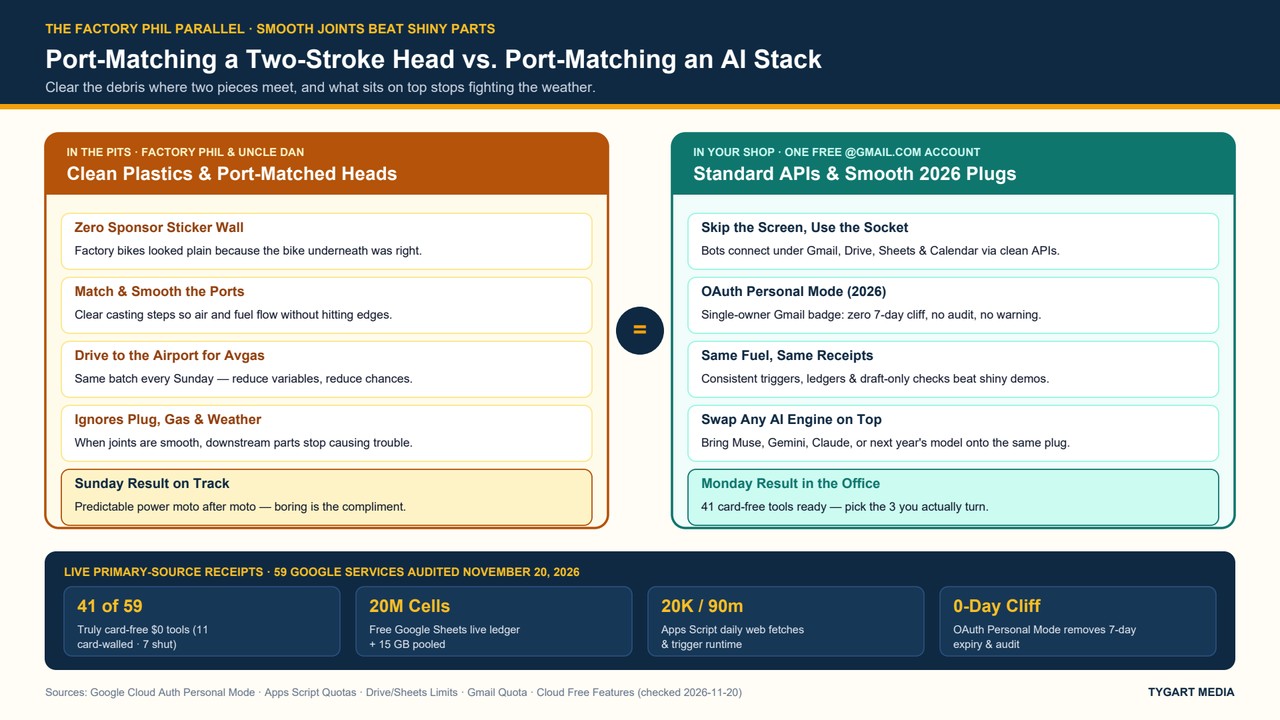
When I call Google factory boring in the middle of an AI gold rush, it is the Factory Phil compliment. I almost never see Gmail’s screen and do not care what it looks like: my bots connect underneath. While everyone argues over which AI model wins this month’s demo, Google sits in the pit bay with clean plastics, standard threads, and a free toolbox behind one plain email address.
Uncle Dan, Port-Matching, and Airport Gas
If Phil was the look, my Uncle Dan — an old rider, racer, and engineer-type mechanic — was the lesson underneath it. Hand Dan a two-stroke cylinder head and he did not bolt on gimmicks. He would port-match it: simply matching and smoothing where the metal casting pieces meet, clearing out debris so air and fuel flowed cleanly without hitting a ridge. Once Dan cleaned those transitions, the engine ran smooth no matter what — it did not matter what gas, spark plug, sprockets, or weather showed up. Nothing inside was fighting the joints.
We paired that with a drive to the airport for avgas — aviation gasoline refined to tight batch-to-batch consistency because airplanes go up in the air and cannot pull onto a shoulder. We never drove to the airport chasing power. We went for consistency, because Monday’s pump at an AM/PM could burn differently from the Shell by the racetrack once you mixed two-stroke oil. Same fuel, batch after batch. Reduce the variables; reduce the chances.
That is the plainest way to picture an API — an application programming interface, a standardized software socket letting two programs trade data underneath without a human clicking webpage buttons. Smooth sockets let your shop swap AI engines — Muse, Gemini, Claude, whatever wins next quarter — without rebuilding the garage, the same lesson we proved testing forty-four models against one brief in The Operator Is the Harness and mapping why Email Is the New API.
What One Free Gmail Actually Hands an AI
Rather than trust stale tutorials, we audited fifty-nine Google services live against Google’s own docs under one rule: free means free — one consumer @gmail.com, zero dollars, no credit card. Forty-one work genuinely card-free (forty full tools plus a Maps prototyping key). Eleven more “always free” cloud tools sit behind a credit-card wall, and seven familiar names are closed, dying, or Workspace-only.
Get The Signal
What we actually ran, what it measured, and what it means for a restoration shop — every week, including the flops.
The card-free drawers carry real weight: Gmail (6,000 units a minute per user under Google’s May 1, 2026 rules and 500 sends a day), 15 GB of pooled Drive, mail, and photo storage, Calendar, Docs, Forms, Tasks (50,000 calls a day), YouTube Data (split into dedicated daily buckets of 100 searches and 100 uploads plus 10,000 units for other calls), and Sheets — doubled to 20 million cells, a free live ledger your AI and your staff can share.
The quietest free glue is Google Apps Script: Google’s hosted JavaScript runner giving a consumer account 20,000 outbound web fetches, 90 minutes of timed trigger runtime, 50,000 state lookups, 100 daily email sends, plus card-free access to 1,000 daily Maps geocoding and directions calls and 5,000 daily translations. Add Search Console (1,200 queries a minute per site, 2,000 URL checks a day), Google Analytics, Firebase’s Spark database, Google Cloud Starter Tier (two live full-stack apps via AI Studio on personal Gmail), and AI Studio’s free tier (twenty-four free model sections), and one plain address becomes a full workshop.
The Plug, Not the Engine — And the Quiet 2026 Unlock
Wiring an outside AI into free Gmail used to feel like fighting cross-threaded bolts. Connecting uses OAuth — the sign-in handshake that hands a tool a scoped pass instead of your password — and legacy personal test apps expired that pass every seven days unless you paid for a security audit. In 2026, Google smoothed the joint with OAuth Personal Mode: a fresh project locked to your single @gmail.com gets zero seven-day expiry, no audit, and no unverified warning screen. Pair it with a local tool speaking MCP — Model Context Protocol, the standard plug letting Claude connect straight to Gmail and Calendar — and almost any AI engine bolts right on.
Clean plugs still need shop locks behind them. In our work, the mailbox is a trigger, not a topic, and draft-only stays the first verb. This sits alongside the rest of our workbench series: locking blanks on purpose in Mad Libs for Machine Learning, splitting memory from tool hands in Two Droids and a Farmboy, and keeping one-way doors locked in Leave the Keys Off the Van Seat.
Where the Parallel Bends — A Corporation Is Not Uncle Dan
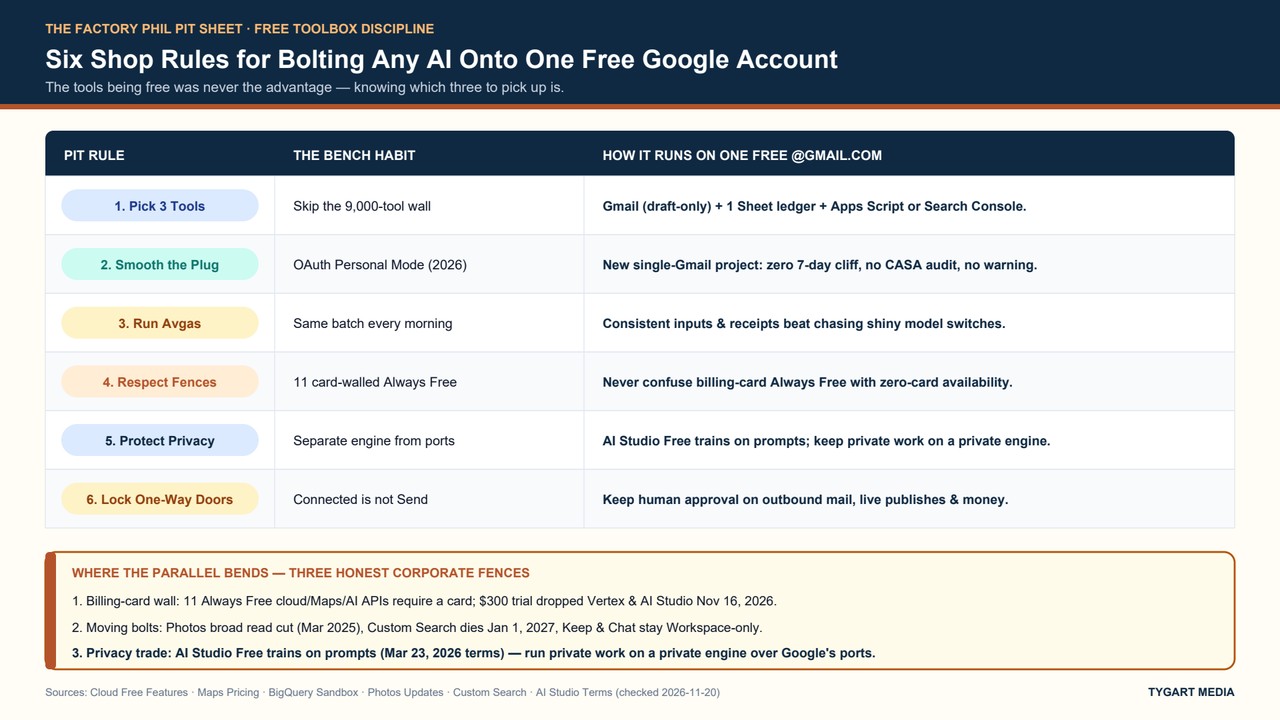
Uncle Dan smoothed a head once and handed it back. Google is a corporation with billing gates and sunsets, and three honest fences keep the story straight. First, one drawer wants a credit card: eleven “Always Free” cloud services — Cloud Run, Cloud Storage, Pub/Sub, Cloud Build, the micro VM, Cloud Vision and Translate, and production Google Maps (which replaced its $200 monthly credit in March 2025 with per-feature caps) — are $0 under caps only after you link a billing card. Effective November 16, 2026, Google’s $300 trial can no longer pay for Vertex AI or AI Studio, and even card-free BigQuery Sandbox caps storage at 10 GiB for life (deleting tables does not refund it) with sixty-day expiration. Know those lines before building a $0 cloud stack.
Second, Google moves bolts: it cut broad library reads on Google Photos in March 2025, closed Custom Search JSON API to new users ahead of a January 1, 2027 shutdown, kept Google Keep and Chat on paid Workspace, and put its ten hosted Workspace Remote MCP servers behind a preview form asking for a Workspace account. Third, free AI tokens trade privacy: under Google’s March 23, 2026 AI Studio terms, free prompts and files can train Google models and get human review. Keep confidential work on a private AI engine, and let Google play Factory Phil underneath.
Nine Thousand Tools — And Knowing Which Three to Pick Up
A wall of nine thousand tools does you no good at all unless you are the type who can use them. Fancy parts are what you buy when the ports do not match; boring is what a system looks like when somebody smoothed the joints — and the tools being free was never the advantage. Knowing which three to pick up is.
Skip the sticker wall on Monday. Pick three boring drawers from one free Gmail — a draft-only inbox trigger, one shared Sheet as your live ledger, and an Apps Script bridge or Search Console feed. Wire them once through Personal mode, run the same avgas routine every morning, and stop sweating which AI engine wins next quarter. When the ports match, any engine runs smooth.
— Will Tygart, Tygart Media.
Get The Signal
What we actually ran, what it measured, and what it means for a restoration shop — every week, including the flops.
Leave a Reply