Tag: Restoration

  • Plumber Referrals: How Restoration Companies Win Leads

    Plumber Referrals: How Restoration Companies Win Leads

    How does a restoration company build a real referral relationship with plumbers? By understanding how plumbers actually run their business — flat-rate pricing, speed-to-lead discipline, service-call economics, and the commercial account book they protect fiercely — and by becoming an asset to that business rather than a transaction on top of it. The restoration companies that dominate plumber referrals are the ones that respond faster than the plumber’s own office, document the job in a way that makes the plumber look good to the homeowner, never compete on plumbing scope, and offer the plumber something the competing restorers don’t — typically fast arrival, clean handoff paperwork, a consistent named point of contact, and straight-up reciprocity in the form of plumbing referrals back from the restoration company’s own job flow.


    There is no referral source more valuable to a restoration company than a good plumber. The math is obvious. Plumbers are first on scene at the majority of residential water losses. They are the person the homeowner is already talking to at the exact moment the restoration decision gets made. A plumber who trusts you is worth ten lead-form submissions and the cost of a Local Services Ads subscription combined.

    And yet most restoration companies handle plumber relationships poorly. They walk into plumbing shops with business cards and pizza and a gift card program. They call it “relationship building.” It is not. It is a low-quality sales motion aimed at a business the restorer does not actually understand.

    This article is the antidote. It is how plumbing companies actually make money, how they think, what they protect, and where a restoration company with discipline plugs in to become the plumber’s trusted partner rather than the tenth restoration card on a cluttered desk. The same framework applies to the rest of the trade ecosystem we will cover — HVAC, facilities vendors, carpet cleaners, pest control, property managers, general contractors — but plumbing is the place to start because the volume is there and the operational overlap is tightest.

    How Plumbing Companies Make Money
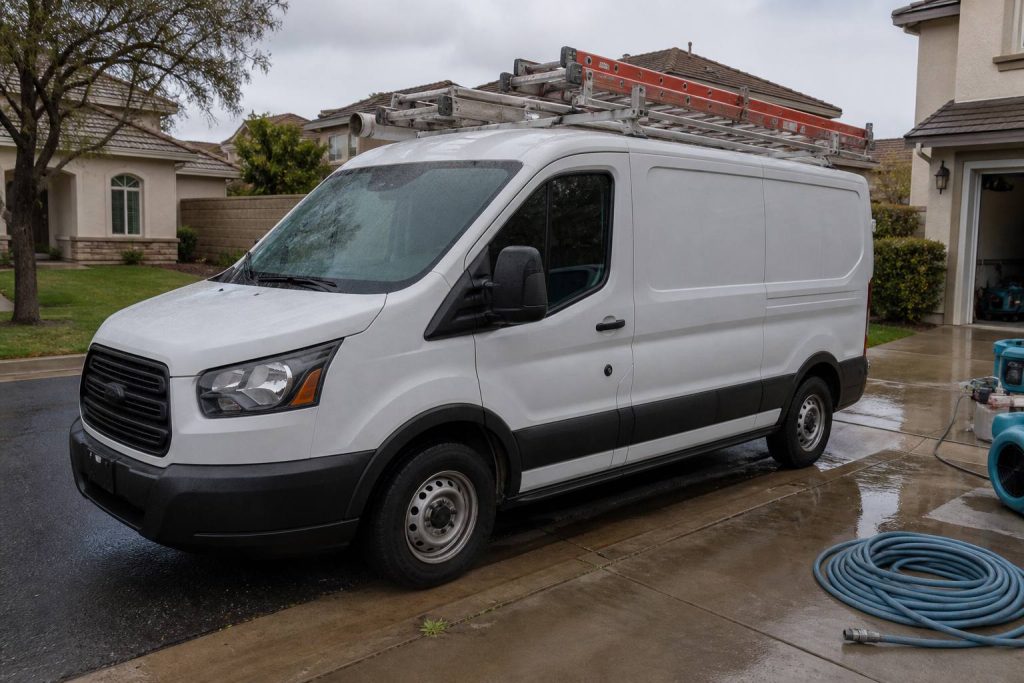
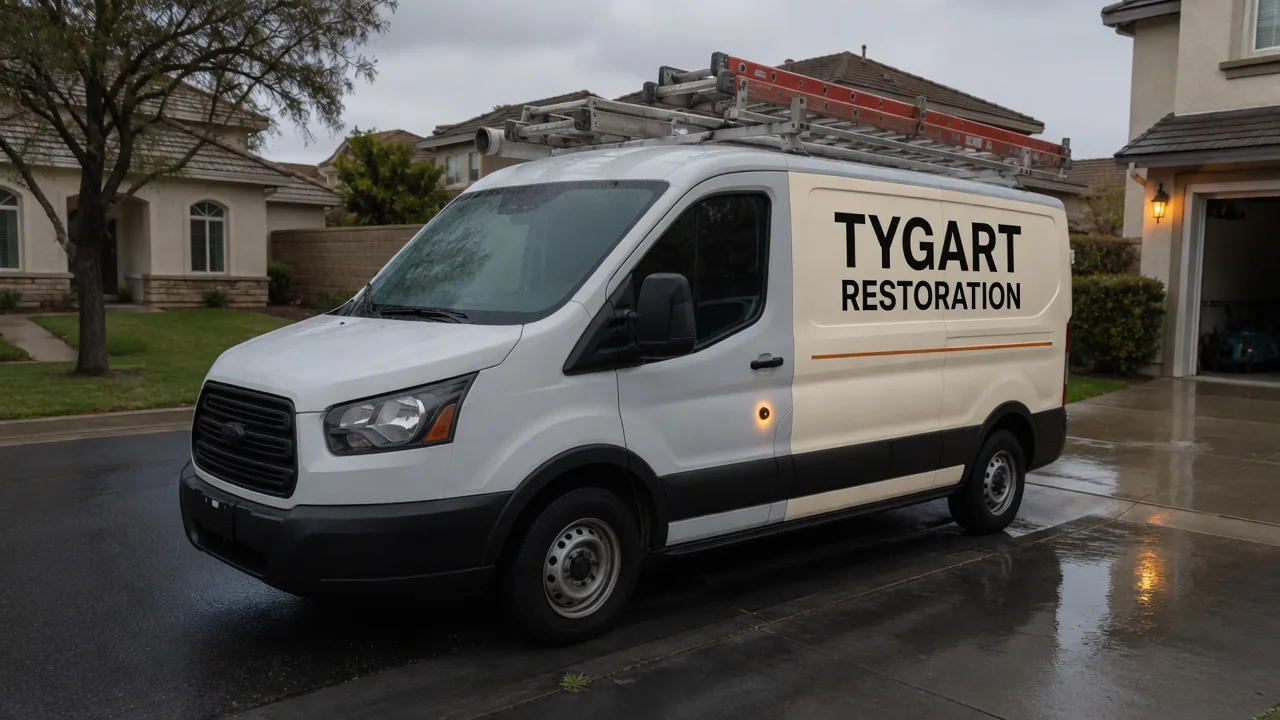
    White restoration work van with ladder rack parked at a suburban jobsite curb
    The plumber is already on the curb when the water loss starts.

    Before you sell into a plumber, understand where their profit actually comes from. A modern residential plumbing operation runs on a clear pricing and margin stack.

    Flat-rate pricing has become the industry standard for established plumbing companies. A modern shop prices most residential jobs — drain clearing, toilet installs, water heater swaps, fixture replacements, standard repairs — as fixed fees out of a price book rather than hourly. The benefits are obvious: the homeowner gets a predictable number, the tech closes faster at the kitchen table, and the margin is protected against jobs that drag on.

    Hourly billing still exists, mostly for diagnostics, commercial time-and-materials work, and jobs where the scope is genuinely uncertain (slab leaks, multi-fixture failures, old-pipe situations where every valve is a surprise). Most residential plumber hourly rates fall between $80 and $130 per hour, with some premium markets higher. Service-call fees — the trip-and-diagnostic charge a plumber collects just for arriving — typically run $50 to $250 depending on market and time of day.

    Gross margin targets are structural. A well-run plumbing company runs 60 to 62 percent gross margin on service and repair work, with net margins in the 10 to 20 percent range. Underperformers are at 2 to 8 percent net. The difference is almost entirely operational discipline — flat-rate pricing discipline, dispatch efficiency, call-booking rate, labor as a percentage of revenue.

    Labor is the dominant cost, typically 40 to 60 percent of operating expenses. Every minute a tech is not in front of a paying customer is a minute of unrecovered fixed cost. This matters to a restoration company because it tells you exactly what the plumber values most: technician time.

    The job mix separates the healthy from the struggling. Service and repair — single-tech, high-ticket, fast-turn — runs the 50 to 60-plus percent gross margin that carries the company. New construction and larger remodels run 20 to 30 percent and are often loss-leaders on labor utilization. The plumbing companies that are growing fast and buying competitors are running service-and-repair-heavy books with strong flat-rate pricing and disciplined dispatch.

    This is the business you are calling on. When you walk in, you are walking into an operation where every non-revenue minute is a tax on the P&L.

    How Plumbing Companies Acquire Customers

    Understanding the lead flow tells you where you sit in their world.

    Google Business Profile is the single most important acquisition channel for most residential plumbing companies — identical to the restoration playbook. A well-run GBP, paired with aggressive review velocity, produces the majority of a residential plumber’s organic lead flow at effectively zero marginal cost.

    Google Local Services Ads sit at the top of the paid stack. LSA leads for plumbers typically run $25 to $85 per lead at 40 to 65 percent conversion, for an effective $38 to $213 per booked job. Like restoration, LSA ranking is driven by review signals and response time. A plumber with a weak review foundation cannot win LSA.

    Shared marketplace leads — the Angi and HomeAdvisor category — run $15 to $50 per lead at 8 to 12 percent conversion, producing $125 to $625 effective cost per job. Most plumbing operators treat these as a fill-the-gap channel rather than a core source.

    Past-customer reactivation is the compounding layer. SMS reactivation of past customers costs less than a dollar per broadcast and typically produces 8 to 15 percent booking rates. Every plumber who has been in business five years is sitting on an underutilized database.

    Referral programs fund a meaningful slice of the book at $25 to $50 per acquired customer in incentives.

    Here is the industry’s consensus #1 tactical lever: speed to lead. Responding to a lead in under 60 seconds converts at roughly four times the rate of slower responses. This is why a plumber obsesses over dispatch tools like ServiceTitan, Housecall Pro, and FieldPulse, and why 24/7 answering services and AI receptionists have proliferated in the category. Every second matters.

    The implication for a restoration company courting that plumber: you are being evaluated against the same standard. If you cannot respond to a plumber’s referral in under 60 seconds, you are losing to the restoration shop that can. This is not a nice-to-have. It is the single largest predictor of whether a plumber will keep sending you leads after the first one.

    The Plumber’s Commercial Book

    Residential service drives most of the volume in a typical plumbing operation, but the commercial book is what makes the business valuable at exit. Property management companies, facilities vendors, retail operators, HOAs, and industrial property owners operate on vendor contracts and scheduled maintenance programs. They produce lower per-ticket margin than residential service calls but dramatically higher revenue predictability and customer lifetime value.

    The property manager who finds a reliable, documented, certificate-of-insurance-compliant plumbing vendor rarely switches. That retention is what turns a $2M plumbing company into a $10M plumbing company over a decade. It is also the piece most small plumbing operators protect most aggressively — because losing a commercial account is a severed artery, not a lost ticket.

    For a restoration company, this matters in two ways. First, a plumber who trusts you will open their commercial book to you when those properties have water losses — because the plumber’s reputation is now attached to yours, and they are not going to introduce you to their best customer unless you can execute perfectly. Second, your own commercial book is the most valuable thing you can offer a plumber in return. The restoration companies that build deep plumber partnerships typically have their own commercial relationships that refer plumbing work downstream — and a disciplined restorer puts those referrals through their plumber partners intentionally, tracks the flow, and makes sure the value is visible.

    Reciprocity in the commercial channel is the highest-leverage thing a restoration company can offer a plumber. Nothing else you do comes close.

    How a Plumber Thinks About a Water Loss
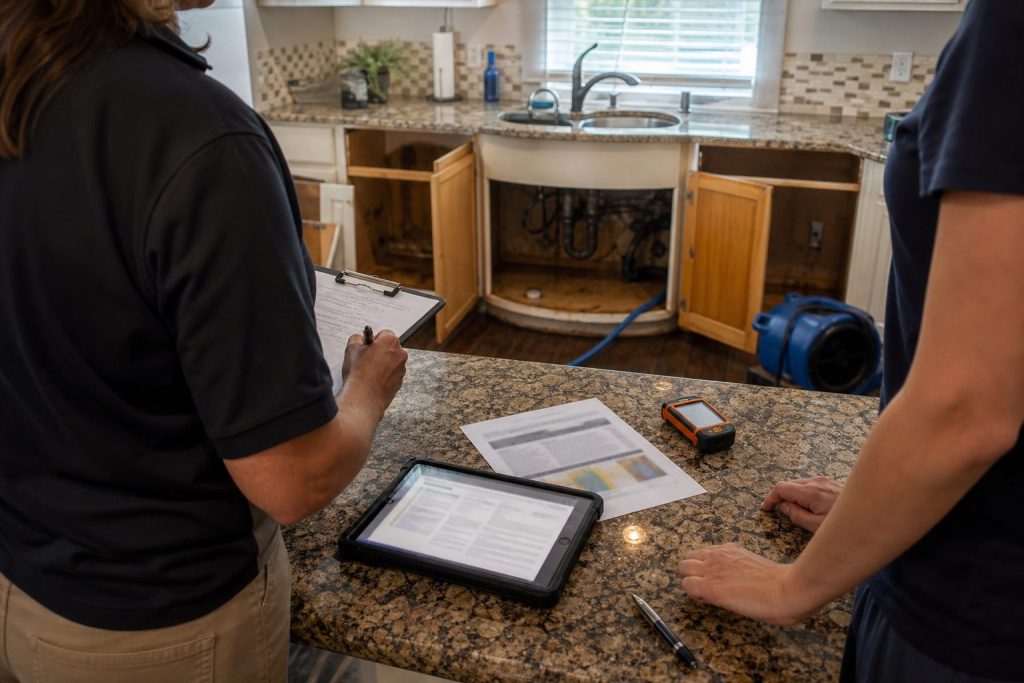
    Clipboard and tablet on a kitchen counter during an insurance adjuster walkthrough after water loss
    How a plumber thinks about a water loss — speed, liability, handoff.

    Now zoom into the moment that matters: the plumber is on site. Pipe has burst. Homeowner is standing in two inches of water. The plumber’s job, strictly, is to shut off the supply, diagnose the failure, repair or replace, and get out. Mitigation and drying are outside their scope and outside their certification.

    In that moment the plumber has three options.

    Option one: ignore it. Let the homeowner figure out the water damage themselves. Give them a generic “you’ll want to call a restoration company” and leave. This is what most plumbers actually do, because it is zero risk and zero effort.

    Option two: recommend whoever the homeowner has already tried to call, even if that restoration company is unfamiliar. Low risk, low value, no upside.

    Option three: make a trusted referral. Pull out their phone, call the restoration company they know personally, hand the phone to the homeowner. The restoration crew arrives before the plumber has finished their paperwork. The homeowner feels taken care of. The plumber looks like a full-service problem-solver rather than someone who created a problem and left.

    Option three is the one that matters. It is also the one that requires the restoration company to have earned the trust to be the plumber’s one call.

    Earning that call is what this article is about.

    Why Most Restoration-Plumber Relationships Fail

    The trade press is full of plumbers complaining about restoration companies. The complaints cluster into a predictable set.

    Promised referral fees never arrive. A restoration company makes a big show of the referral program, then the plumber sends a lead, and the check is either late, wrong, or missing entirely. Once burnt, the plumber stops sending leads and never tells the restorer why. The restorer blames their own marketing. The real cause is a broken promise the plumber made mental note of and walked away from.

    Slow response after the referral. The plumber hands off the homeowner, expects a truck on site within the hour, and the restoration crew shows up the next morning. The plumber looks bad. The plumber does not send a second lead.

    Overlap creep. The restoration company starts doing water heater replacements, pipe repairs, or other scope the plumber considers theirs. The plumber, correctly, stops referring to the company that is competing with them.

    Transactional over relational. The restorer drops by every month with business cards and a bag of swag, asks “any jobs this month?”, and never demonstrates any interest in the plumbing business itself. Plumbers read this the way everyone reads it — as a vendor trying to extract leads without offering anything in return.

    One-directional flow. The plumber sends water losses. The restoration company sends nothing back. A year in, the plumber calculates the relationship and realizes the restorer has taken dozens of high-ticket insurance jobs and returned effectively nothing. The relationship is dropped for a competitor who understands reciprocity.

    No co-branding of the homeowner experience. The restoration company shows up, does the work, and the homeowner ends up viewing the plumber as “the guy who recommended this crew” — a connector, not a savior. A sophisticated restorer makes a point of telling the homeowner, in the presence of the plumber, that the plumber caught the problem early and protected the home from far worse damage. That small discipline produces the story the plumber tells for the next six months.

    Inconsistency. The restoration company is great on the first three jobs, slips on the fourth, misses a callback on the fifth, and the plumber’s trust decays without the restorer ever knowing.

    Every one of these is fixable. Every one of these is the reason most restoration-plumber relationships never compound.

    What the Best Restoration Companies Actually Do

    A restoration operator with intention can build plumber partnerships that are durable, compounding, and unreachable by competitors. The playbook is specific.

    Respond faster than the plumber’s own dispatch. When a plumber calls to refer a loss, the target is truck rolling within 15 minutes and on site within 45. The plumber’s tech, still on site, calls their own office and the office quotes a 90-minute window for the next plumbing job — and the restoration crew has already arrived. That single data point, experienced twice, will make the restorer the plumber’s default for the next decade.

    Arrive in a way that makes the plumber look good to the homeowner. The lead restoration tech introduces themselves, acknowledges the plumber by name, explicitly credits the plumber for catching the problem early, and explains what happens next. This takes sixty seconds and produces outsized returns in the plumber’s willingness to call again.

    Never encroach on plumbing scope. The restoration company’s role is water mitigation, drying, demo, and rebuild scope outside the plumbing trade. Anything inside the plumbing trade — fixture replacements, pipe work, water heater installs, drain clearing — is not your business. Routinely declining to take that work when homeowners ask, and actively referring it back to the plumber partner, is a trust-building act that plumbers notice and remember.

    Co-brand the documentation. The mitigation paperwork the homeowner receives should reference the plumber who made the initial diagnosis and repair. The plumber’s contribution becomes part of the record. Insurance adjusters see the plumber’s name. Homeowners see the plumber’s name. The plumber becomes more valuable in the eyes of the people they rely on, and knows the restoration company is the reason.

    Send plumbing leads back. This is the most underused discipline in the restoration-plumber relationship. Every restoration company is sitting on customer flow — past customers, current mitigation jobs, commercial property managers — that periodically needs plumbing work. Route that flow to partner plumbers intentionally. Track it. Tell the plumber quarterly how many leads you sent them, how many converted, how much revenue they produced. If the answer is a six-figure number — and for any mid-sized restoration company it usually is — you have built the kind of partnership plumbers do not leave. Reciprocity in the commercial channel is the single highest-leverage lever a restoration company has.

    Name the point of contact. Every plumber partner should have one named person at the restoration company who owns the relationship, answers the phone at 2 a.m., and personally visits the plumbing shop quarterly. Rotating account managers and generic inboxes are death. A plumber referring a six-figure insurance job wants to know the person they are handing the phone to, and that person’s name and cell should be in the plumber’s contacts.

    Handle the insurance complexity so the plumber does not have to. Most plumbers do not want to deal with adjusters, xactimate, drying logs, or moisture mapping. The restoration company that takes on 100 percent of that burden, keeps the plumber informed at the milestones that matter, and asks the plumber zero insurance-adjacent questions, becomes invaluable.

    Feed the plumber’s content engine. A plumber who wants to grow is publishing photos, doing GBP posts, writing neighborhood testimonials. A restoration company that supplies the plumber with branded before/after photos from the job, permission to use them, and the homeowner testimonial the plumber can share is providing content the plumber cannot easily get elsewhere. This is a small gesture that compounds into meaningful organic reach for the plumber. They remember.

    Pay the referral fee on time, every time, without being asked. The check is in the plumber’s hand within 30 days of job completion and insurance payment, and the payment is accompanied by a short note about the job. If cash-flow discipline is a problem (see cash discipline in restoration), fix it before you promise referral fees at all. Unpaid referrals are the fastest way to destroy plumber trust.

    Never make the plumber feel transactional. The quarterly shop visit is about the plumber’s business, not your leads. Ask how their LSA is performing. Ask about their recent hires. Ask what is working and what is not. Be interested. Most plumbers rarely get a conversation with an industry peer who actually understands their operation. Becoming that person is worth more than any referral incentive.

    The Reciprocity Ledger
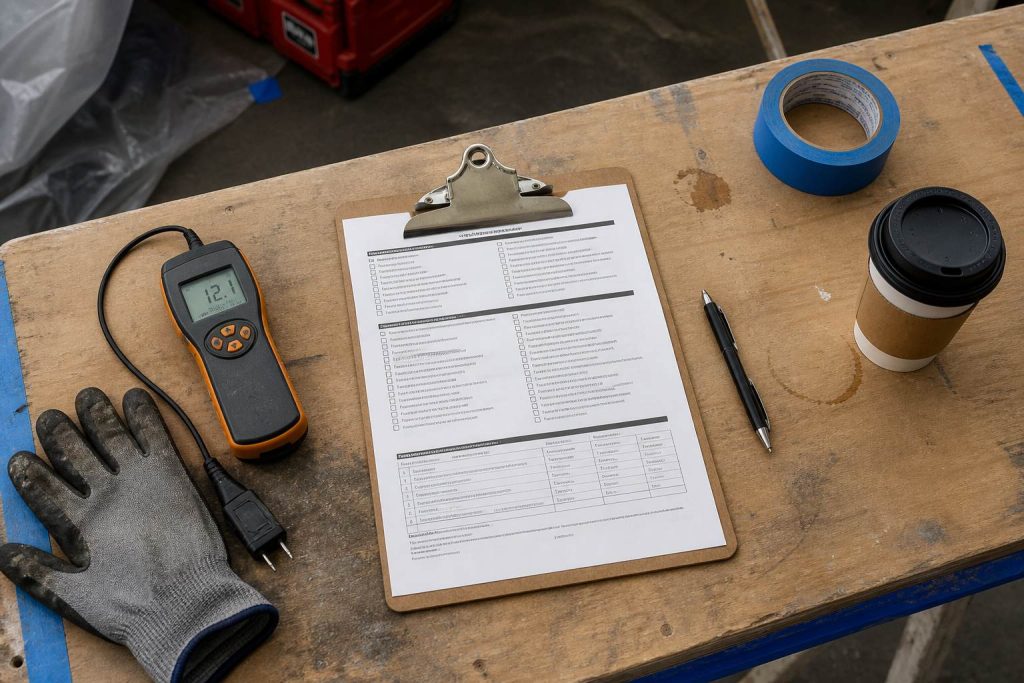
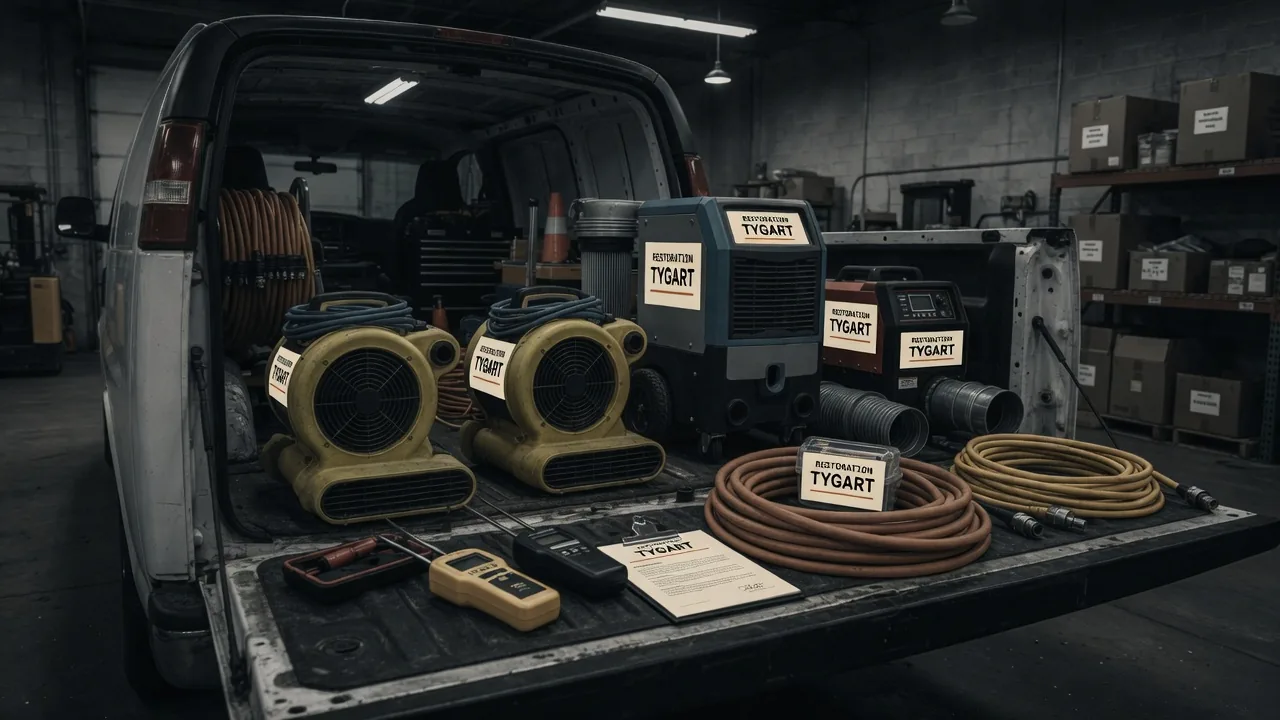
    Restoration SOP clipboard with checklist, moisture meter, and gloves on a jobsite table
    Reciprocity ledger — track every handoff both ways.

    The single most underused concept in restoration-plumber relationships is the reciprocity ledger. A shared, transparent record of leads flowing in both directions.

    One side: leads from plumber to restorer. Loss name, date, approximate job size, outcome.

    Other side: leads from restorer to plumber. Homeowner name, date, type of work, outcome.

    Run it quarterly. Share it with the plumber. Quantify the dollar value of the flow in each direction. Have a real conversation about whether the balance is fair and what to adjust.

    Most plumbers have never had a restoration partner bring this level of discipline to the relationship. It is the single clearest signal that the restorer thinks of the plumber as a business partner rather than a lead source. It is also the mechanism that surfaces problems before they cause defection. If the ledger shows six months of flow from plumber to restorer and nothing back, it is visible and fixable. Without the ledger, it is invisible and terminal.

    The Ninety-Day Plumber Program

    A restoration company with no systematic plumber program can build a strong one in 90 days.

    Week 1-2: Identify the 20 plumbing companies in the service area most likely to produce water damage referrals. Criteria: residential service and repair focus, 4.7+ star GBP, 100+ reviews, visible community presence, technician count of 5+. Rank them. Decide the top 5 to pursue first.

    Week 3-4: Research each of the 5 deeply. What does their website say about their services? What are their reviews telling you about how they talk to customers? Who is the owner or operations lead? What commercial properties have they done work on? This is the preparation that separates a professional approach from a cold-call one.

    Week 5-6: Make contact. Not a cold sales visit. An introductory conversation with the owner or ops lead, initiated with a specific, concrete offer: a standing commitment to respond to any referral within 15 minutes, a named point of contact, and a tracked referral program with transparent payouts. Treat the meeting as two small-business operators comparing notes, not a sales call.

    Week 7-8: Agree on the operating protocol. Who calls whom, what number, what happens in the handoff, how the paperwork flows. Put it in writing — not a contract, a shared one-pager. Confirm the referral fee amount, cadence, and mechanics.

    Week 9-12: Execute. Every referral gets a white-glove response. Every plumber interaction reinforces the partnership. Every job ends with co-branded documentation and the plumber visibly credited. Referral fees are paid before the 30-day mark, always.

    Day 90: Meet with each partner plumber. Review the ledger. Adjust as needed. Expand to the next tier of plumber partners.

    A restoration company that runs this program with discipline for a year has built an acquisition moat competitors cannot cross without spending five times the marketing budget to achieve a fraction of the flow.

    Where This Pairs With the Rest of the Stack

    The plumber partnership program sits alongside the observational B2B plan — plumbers are one of the highest-yield categories in that plan, but deserve their own dedicated playbook because of the volume and operational overlap. It sits alongside the owner-as-rainmaker practice — senior-level relationships with plumbing company owners are what ultimately unlock the commercial book. It feeds the review engine because plumber-referred homeowners are typically the most satisfied and most willing to review. And it runs on the measurement discipline — the reciprocity ledger is measurement in its purest form.

    Where to Start

    Pick one plumber this week. Not five. One. The best-reviewed, most operationally sharp residential plumbing company in your service area. Study them. Meet them. Propose a real partnership with a real operating protocol. Execute flawlessly on the first three jobs they send you. Use those three jobs as the reference when you expand to the next four plumbers.

    The compounding math is the same as every other asset Tygart Media has written about. One great plumber partnership, operated well for five years, produces more durable lead flow than ten inconsistent ones. The discipline is in going deep rather than wide, paying on time, never encroaching, and making reciprocity visible.

    The next article in this series covers HVAC — same structural playbook, different operational realities, a different set of entry points for a restoration company that has the discipline to learn the trade before selling into it.


    Frequently Asked Questions

    What is the single most important thing a restoration company can do to build plumber referrals? Respond faster than the plumber’s own dispatch. When a plumber calls to refer a water loss, a restoration crew on site within 45 minutes — while the plumber is still there — resets the entire relationship. It proves the restorer is worth the plumber attaching their reputation to. Speed to lead is the #1 lever in plumbing acquisition, and it is the single most important lever in earning plumber trust.

    How much should a restoration company pay a plumber per referred lead? Market norms range from $350 for a standard water or sewer damage job to $500 to $1,000 for insurance-covered jobs. The amount matters less than paying on time, paying every time, and never requiring the plumber to chase the money. A smaller consistent fee paid reliably beats a larger fee that arrives late or not at all.

    Can a restoration company do plumbing work itself to capture more of the job? Strongly discouraged if the goal is durable plumber referral flow. The moment a restoration company starts replacing water heaters, doing pipe work, or competing with plumbing scope, every plumber partner reads the signal correctly and pulls back. The restoration companies with the strongest plumber referral networks are explicit and disciplined about staying out of plumbing scope.

    What kills a restoration-plumber relationship faster than anything else? Two things tied for first. Slow or missed referral fee payments. And slow response time on a referred job. Both are experienced by the plumber as a breach of trust. Both cause silent defection to a competitor, often without the restorer ever being told why the flow stopped.

    How does the reciprocity ledger work in practice? A simple shared document showing leads flowing from plumber to restorer and restorer to plumber, with dates, rough job size, and outcome. Reviewed quarterly with the plumber. Quantified in revenue terms. It makes the balance of the relationship visible and is the mechanism that catches imbalance before it becomes a relationship-ending problem. Most restoration companies do not run one. The ones that do rarely lose plumber partners to competitors.

    Should a restoration company try to partner with every plumber in their service area? No. Depth beats breadth. Five deeply trusted plumber partners producing durable referral flow is dramatically more valuable than twenty transactional relationships. The ninety-day plumber program in this article is built around concentrated investment in a small number of high-quality partners rather than blanket coverage.

    How does this playbook change for commercial plumbing relationships versus residential? The core mechanics are the same — speed, reciprocity, never encroaching on plumbing scope, named point of contact. But the stakes are higher. Commercial plumbing relationships gate access to property management portfolios where a single water loss can generate six-figure mitigation revenue. The referral-fee mechanics often shift from per-job bounties to structured revenue sharing or preferred-vendor arrangements. The relationship discipline required is identical; the commercial ceiling is much higher.


    Tygart Media on restoration — an analyst-operator body of work on the systems that separate compounding restoration companies from busy ones. No client names. No brand placements. Just the operating standard.
  • IICRC Certifications: WRT, ASD, and AMRT Planning Guide

    IICRC Certifications: WRT, ASD, and AMRT Planning Guide

    Three IICRC technician certifications anchor the technical credibility of almost every restoration company in North America: Water Damage Restoration Technician (WRT), Applied Structural Drying (ASD), and Applied Microbial Remediation Technician (AMRT). For owners building or expanding a production team, knowing what each certification covers, what it costs, and how to sequence them is the difference between a planned training investment and a reactive scramble before a TPA audit.

    This guide is part of our broader restoration training and certification master guide.

    WRT — The Foundational Certification

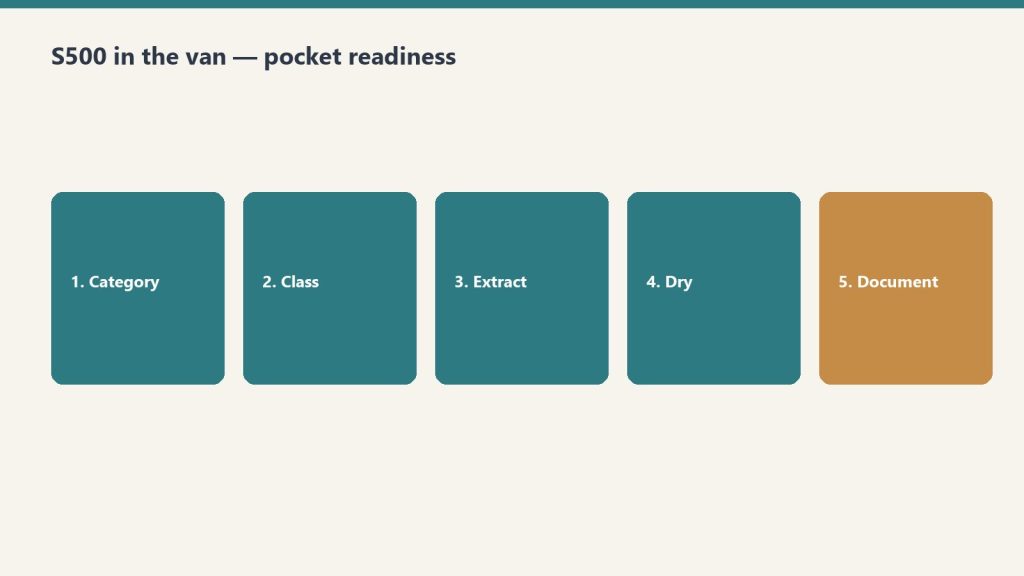
    Five-step van pocket flow: category, class, extract, dry, document
    WRT — the foundational IICRC certification.

    The Water Damage Restoration Technician (WRT) certification is the entry point into IICRC’s restoration credentialing. It covers the fundamentals of water damage response: water categories and classes, drying principles, equipment selection, and the IICRC S500 standard. WRT is also the prerequisite for both ASD and AMRT, which makes it the right starting point for every technician on the team.

    Course costs vary by training provider. A common reference point is around $449 per person for a WRT course delivered by a well-established training school. The IICRC exam fee for WRT is $80, with $80 retest fees if a candidate does not pass on the first attempt.

    ASD — The Drying Specialist Credential

    Applied Structural Drying (ASD) builds on WRT and goes deeper into the science and equipment of structural drying. ASD covers psychrometry, dehumidifier selection and sizing, air mover placement, monitoring methodology, and drying chamber strategy. For technicians who lead drying jobs in the field, ASD is the right second certification.

    WRT is a prerequisite for ASD, and most restoration training schools offer the two as a combined WRT/ASD program. Combo courses commonly run from $1,395 to $1,495 per person, plus the combined IICRC exam fees of $160 ($80 per certification). The combo format is more cost-effective than taking the two separately and reduces the time technicians spend off production.

    AMRT — The Mold Remediation Credential

    Applied Microbial Remediation Technician (AMRT) is the IICRC certification for mold remediation work. It covers the IICRC S520 standard, containment, PPE, antimicrobial application, HEPA equipment, and remediation protocols. For any restoration company performing mold work — even occasionally — AMRT is the credential that protects the business legally and operationally.

    WRT is a prerequisite for AMRT. Course costs are commonly around $995 per person, and the IICRC exam fee is $150. AMRT must be taken in person at a training center; the course is not approved for online delivery.

    AMRT’s exam fee, the firm credential, and the role-by-role path are on the certification guide.

    How to Sequence Certifications Across a Team

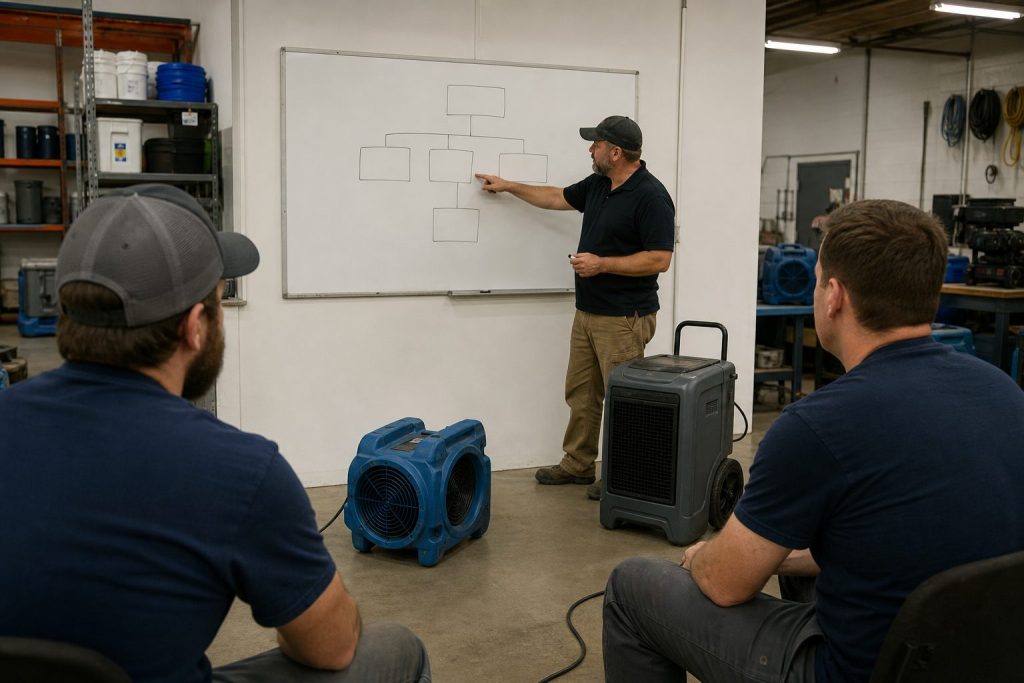
    Restoration technicians training in a shop bay with equipment demo and whiteboard
    How to sequence certifications across a team.

    The right certification sequence for a typical restoration team:

    • All field technicians — WRT within the first 90 days of hire
    • Senior technicians and lead drying techs — WRT/ASD combo, ideally within the first year
    • Technicians performing mold work — AMRT after WRT, before the first solo mold job
    • Project managers and crew leads — All three (WRT + ASD + AMRT) as a baseline
    • Operations managers and owners — At minimum WRT, plus ASD and AMRT for credibility on customer and adjuster calls

    Budgeting Annual Certification Spend

    Restoration SOP clipboard with checklist, moisture meter, and gloves on a jobsite table
    Budgeting annual certification spend.

    For a 10-person restoration team running this certification map, expect first-year certification spend in the $8,000 to $12,000 range when WRT, WRT/ASD combos, and AMRT courses are layered in. Subsequent years drop to a continuing education rhythm (covered in a separate spoke) plus new-hire WRT certifications.

    The right way to think about this spend is per-job risk reduction. A single audit reduction or compliance issue that the certification would have prevented typically pays for the certification several times over.

    Choosing a Training Provider

    The IICRC accredits multiple training schools, and not all are equivalent. The factors that matter most: instructor field experience (vs. pure classroom background), hands-on lab time built into the course, exam pass rates, and post-course support. Reading provider reviews from operators in your region is the most reliable selection signal.

    Related on Tygart Media: how to use Claude · is Claude worth it · Claude rate limits.

    Frequently Asked Questions

    How much does IICRC WRT certification cost in 2026?

    WRT courses commonly run around $449 per person from established training schools, plus an $80 IICRC exam fee. Retest fees if needed are also $80. Pricing varies by provider and region — confirm current rates with your selected training school before budgeting.

    Is WRT a prerequisite for ASD and AMRT?

    Yes. WRT is the prerequisite for both Applied Structural Drying (ASD) and Applied Microbial Remediation Technician (AMRT). The standard pathway is to complete WRT first, then add ASD or AMRT depending on the technician’s role.

    Can IICRC certifications be earned online?

    WRT can be taken online through several approved providers. The WRT/ASD combo course must be taken at a training center because of the hands-on drying lab requirements. AMRT is approved for in-person delivery only. Always verify the delivery format with the provider before registering.

    How long does it take to earn WRT certification?

    Most WRT courses run two to three days of instruction, followed by the IICRC exam. The full timeline from course start to active certification is typically one to two weeks once exam scheduling is included. Online formats may compress the calendar but require the same instructional hours.

    How long is IICRC certification valid before renewal?

    IICRC certifications are renewed through continuing education credits (CECs) on a recurring cycle, not through a single fixed expiration date. Technicians need 14 CECs every four years; advanced certifications and Certified Inspectors require 14 CECs every two years. The CEC system is covered in detail in our continuing education spoke.

  • Code Blue & Accuserve TPA Program Guide for Contractors

    Code Blue & Accuserve TPA Program Guide for Contractors

    Code Blue was historically one of the most algorithm-driven TPAs in restoration. In 2026, the Code Blue brand has been officially united under the parent brand of Accuserve — consolidating Accuserve’s contractor and carrier-facing operations under a single name. For contractors evaluating program enrollment, the operational characteristics of Code Blue still apply, but the brand and account relationships now flow through Accuserve.

    What Code Blue / Accuserve actually does

    Clipboard and tablet on a kitchen counter during an insurance adjuster walkthrough after water loss
    What Code Blue / Accuserve actually does in the claim path.

    Code Blue is an independent Third Party Administrator for the casualty and property insurance industry that provides end-to-end outsourcing solutions. The program proactively manages policyholder claims on behalf of its insurance partners, fielding millions of calls annually through three command centers and connecting policyholders to contractors 24/7/365.

    The 27-point algorithm

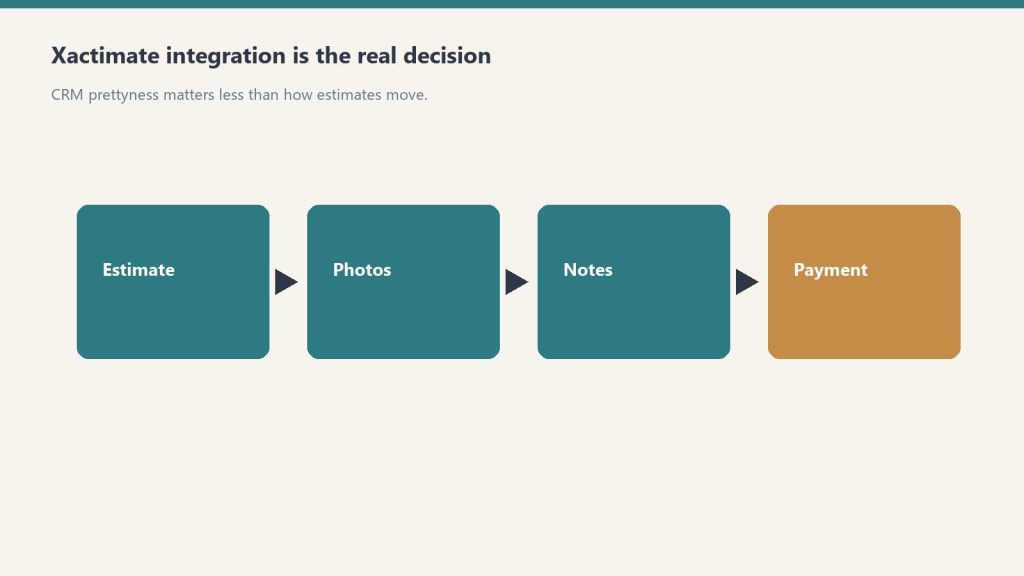
    Flow from estimate to photos to notes to payment emphasizing integration
    The 27-point algorithm — score before you enroll.

    Code Blue’s signature operational characteristic is its scientific 27-point algorithm used to identify the best contractor available for each assignment, preconditioned to collaborate with the policyholder and the insurer. The algorithm factors include geography, capacity, certification mix, performance history, equipment availability, and program-specific carrier preferences.

    For contractors, this means assignment flow is more deterministic than some other TPAs — but also less negotiable. You either fit the algorithm’s criteria for a given assignment or you don’t.

    Quality assurance approach

    Code Blue conducts an electronic quality assurance audit on every claim, holding contractors accountable to IICRC industry standards. This is more aggressive QA than most TPAs and contractors should expect:

    • Photo and documentation requirements that are checked algorithmically, not just manually.
    • Scope variance flags that trigger supplemental review.
    • Customer satisfaction tracking on every job.
    • Real-time visibility into job status by the program team.

    Equipment rental discounts (the friction point)

    One commonly cited friction point: of the equipment rental discount Code Blue takes (historically reported around 15%), contractor reports indicate only a portion (~5%) gets passed to the carrier — the rest stays with the program. Whether this affects your shop depends on your equipment cost basis and how you structure equipment line items in your estimates. Run the math before assuming program work is automatically profitable.

    The contractor experience

    Code Blue / Accuserve has generated mixed reviews from restoration contractors. Some report tight oversight and active program management; others find that level of oversight valuable for cycle time and customer experience. The honest summary:

    • Pros: Predictable assignment flow, strong tech and documentation infrastructure, clear scoring, broad carrier roster, dedicated program team.
    • Cons: Heavy oversight (some contractors find it intrusive), equipment rental economics need careful modeling, limited room for scope negotiation outside program rules.

    Should you enroll?

    Restoration SOP clipboard with checklist, moisture meter, and gloves on a jobsite table
    Should you enroll? Decide with eyes open.

    Strong fit if your shop:

    • Has tight production discipline and rapid documentation habits.
    • Is comfortable working under algorithmic oversight.
    • Wants exposure to specific Accuserve carrier relationships.
    • Has equipment cost basis modeled and can absorb program rental economics.

    Probably not a fit if you operate informally, dislike heavy oversight, or already have strong direct carrier relationships in your market that the program would cannibalize.

    FAQs about Code Blue / Accuserve

    Is Code Blue still a separate TPA?

    The Code Blue brand has been officially united under the parent brand of Accuserve. Operationally, the program still functions, but contractor relationships and account management now flow through Accuserve.

    How does the 27-point algorithm affect my assignment flow?

    Assignment volume depends on how well your shop matches the algorithm’s criteria for any given claim — geography, certifications, capacity, performance history, and carrier-specific preferences. Strong scores in one carrier program don’t automatically translate to volume in another.

    What’s the equipment rental discount situation?

    Contractor reports indicate Code Blue takes a 15% equipment rental discount, with only about 5% passing through to the carrier. Build your estimates with that economic reality in mind — it can meaningfully affect mitigation margin.

    How rigorous is Code Blue’s quality audit?

    Very. Code Blue conducts an electronic QA audit on every claim, with documentation, photo, and scope checks running continuously throughout the job. Plan for tighter documentation than most other TPAs require.

    Can I leave the program if it doesn’t work out?

    Yes. Most TPA contractor agreements include termination provisions for either party with notice. The honest part: leaving and re-enrolling later is harder than staying — once your score drops or you exit, it can take 12-24 months to rebuild standing.

    Full insurance programs framework: Restoration Insurance Programs Master Guide.

    Related on Tygart Media: Starlink on a water job · S500 in the van · local SEO for restoration.

  • Restoration Technician Onboarding: 90-Day Playbook

    Restoration Technician Onboarding: 90-Day Playbook

    New restoration technicians do not become productive on day one, day seven, or day thirty. The realistic timeline from hire date to independent on-site productivity is 60 to 90 days for a candidate with no prior restoration experience, and even faster onboarding requires a structured program rather than the throw-them-on-a-truck approach most companies default to. This guide lays out the 90-day onboarding program profitable restoration companies use to compress that timeline and protect the new hire investment.

    For broader context on restoration team development, see our restoration training and certification master guide.

    Why Onboarding Matters Financially

    Restoration technicians training in a shop bay with equipment demo and whiteboard
    Why onboarding matters financially.

    The cost of a poorly onboarded technician is rarely visible on the P&L, but it is real: callbacks, scope misses, customer complaints, premature attrition, and the time lead techs lose covering for someone who was not actually ready to work alone. A structured onboarding program converts this hidden cost into an upfront training investment with predictable ROI.

    Days 1-7 — Orientation and Safety

    Restoration SOP clipboard with checklist, moisture meter, and gloves on a jobsite table
    Days 1–7 — orientation and safety.

    The first week is not field production. The right structure is paperwork and orientation on day one, OSHA safety training and respirator fit testing in the first three days (covered in a separate spoke), company SOPs and customer service standards by end of week, and shadowing on simple jobs by day five or six. New techs should not be on a job alone until they have completed safety training and at least one shadow rotation.

    Days 8-30 — Shadowing and Skill Building

    Weeks two through four are paired-tech rotations across job types: water mitigation, content cleaning, equipment placement and monitoring, and basic demolition. The new tech is not the lead on any of these jobs — they are present, learning, and progressively taking on supervised tasks.

    By the end of day 30, a new tech should be able to: place equipment under supervision, complete a moisture monitoring log accurately, perform basic content manipulation, follow a standard scope of work without coaching, and represent the company professionally in front of customers.

    Days 31-60 — WRT Certification and Lead-Tech-Supervised Work

    The second month introduces the IICRC Water Damage Restoration Technician (WRT) certification. Most companies require WRT within the first 90 days; building it into the second month rather than waiting until day 89 produces a more confident, more capable technician for the back half of the onboarding window.

    Field work in days 31-60 expands to lead-tech-supervised production: the new tech can be the second tech on a job, can perform standard tasks without step-by-step supervision, and is responsible for documentation alongside the lead.

    Days 61-90 — Solo Production on Standard Jobs

    White restoration work van with ladder rack parked at a suburban jobsite curb
    Days 61–90 — solo production on standard jobs.

    The final month is solo work on standard scope: simple Cat 1 water mitigation, equipment placement and monitoring on assigned jobs, basic content cleaning, and routine documentation. Complex jobs (Cat 3 water, fire cleanup, mold remediation, large losses) remain paired-tech assignments until the technician demonstrates additional readiness or earns the relevant certifications.

    By day 90, a properly onboarded tech should pass an internal evaluation covering: safety practices, equipment operation, documentation accuracy, customer interaction, scope execution, and basic estimating literacy.

    The Onboarding Coordinator Role

    The companies that execute this program well assign a specific person — usually a senior technician or operations manager — as the onboarding coordinator. This person owns the new hire’s first 90 days, schedules training milestones, runs check-ins at 7, 30, 60, and 90 days, and signs off on progression to solo work. Without a clear owner, the program collapses into ad hoc field training.

    What to Measure

    The onboarding metrics that matter: 90-day retention rate, days-to-first-solo-job, customer complaint rate by tech tenure, callback rate by tech tenure, and average gross margin per job by tech tenure. Tracking these reveals whether the program is producing capable technicians or just running them through the motions.

    Related on Tygart Media: Starlink on a water job · S500 in the van · local SEO for restoration.

    Frequently Asked Questions

    How long should restoration technician onboarding take?

    The realistic timeline from hire to independent solo work on standard jobs is 60 to 90 days for candidates with no prior restoration experience. Candidates with relevant trade backgrounds may compress to 45 to 60 days. Trying to compress beyond that consistently produces under-prepared techs who generate callbacks and quality issues.

    When should new hires take their WRT certification?

    The optimal timing is days 31-60 — after the new tech has had enough field exposure to make the coursework concrete, but before they are running solo on water jobs. Most companies require WRT within the first 90 days; building it into the program intentionally produces better results than waiting until the deadline.

    Should new technicians be paid during training time?

    Yes. OSHA training, respirator fit testing, IICRC course time, and on-site shadowing are all compensable work time. Trying to treat training as unpaid creates legal exposure and signals to the hire that the company does not value the investment.

    What is the most common onboarding mistake?

    Putting new techs on jobs alone too early. The pressure of production schedules tempts owners to send a partially trained tech to a job because the truck has to roll. Each early-solo job that produces a callback or quality issue costs more than the labor that was saved. The discipline is to hold the line on the program even during busy periods.

    How do I evaluate whether a new tech is ready for solo work?

    Use a written 90-day evaluation covering safety practices, equipment operation, documentation accuracy, customer interaction, scope execution, and basic estimating literacy. The lead tech and the onboarding coordinator should both sign off. If the tech is not ready at day 90, extend the supervised period rather than rushing the milestone.

  • Direct Carrier Programs for Restoration Contractors

    Direct Carrier Programs for Restoration Contractors

    Direct carrier programs are the highest-margin insurance work in restoration. No TPA fee. No algorithmic dispatch. Direct relationship with adjusters and carrier vendor managers. The catch: it’s harder to break in, the requirements are higher, and the relationships have to be earned. This is how operators do it.

    What “direct” actually means

    Clipboard and tablet on a kitchen counter during an insurance adjuster walkthrough after water loss
    What direct actually means with carriers.

    A direct carrier program is a contractual relationship between a restoration contractor and an insurance carrier where claims are dispatched directly — often to a small preferred vendor list — without a TPA intermediary. State Farm Premier Service Program, Liberty Mutual Preferred Vendor, Allstate Quality Service Program, and USAA Preferred Contractor Network are all examples of direct programs.

    Why direct beats TPA on margin

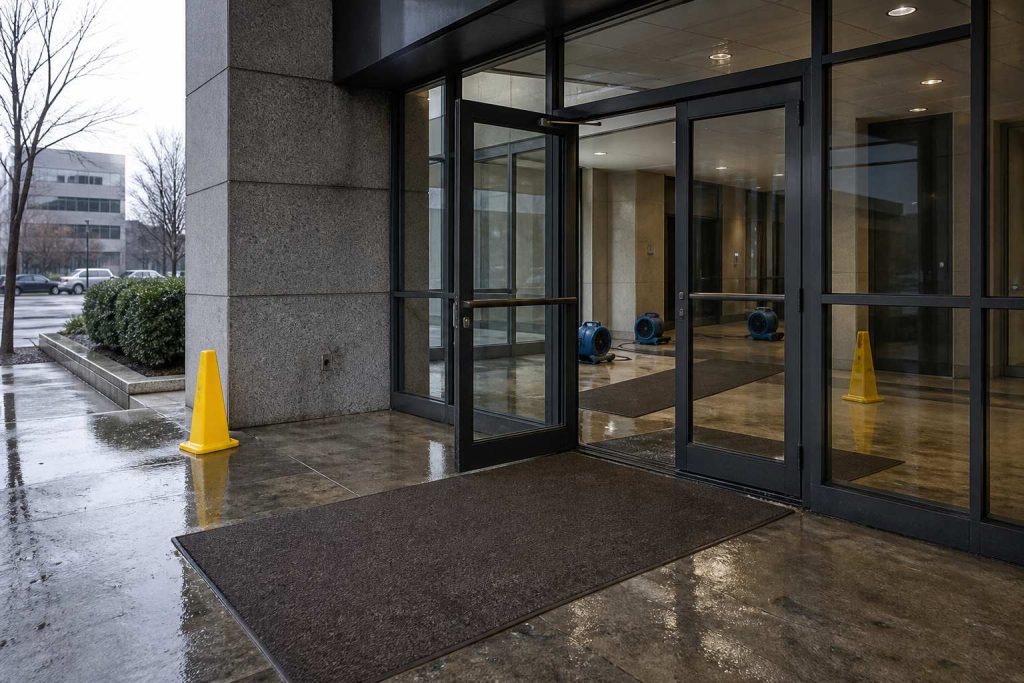
    Commercial office lobby entrance after a pipe burst with caution cones and wet runners
    Why direct beats TPA on margin.
    • No TPA fee or program discount coming out of the estimate.
    • Less aggressive equipment rental haircuts.
    • More flexibility on supplements when adjuster relationship is strong.
    • Faster payment in many cases (no TPA processing layer).
    • Direct adjuster relationships that compound into more referrals over time.

    Realistic gross margin on direct carrier mitigation work in 2026 typically lands 38-52% — meaningfully better than the 30-42% TPA range.

    What carriers want from direct vendors

    Restoration SOP clipboard with checklist, moisture meter, and gloves on a jobsite table
    What carriers want from direct vendors.

    Carrier vendor management teams evaluate direct enrollment candidates on:

    • Demonstrated track record. Years in business, references from existing carrier relationships, claim volume handled.
    • Geographic coverage. Carriers prefer vendors who can cover an entire metro consistently, not just one zip code.
    • Capacity. Number of trucks, technicians, equipment cache, ability to mobilize for CAT events.
    • Certifications. IICRC across the team, specialty certs (FSRT, AMRT, OCT) where relevant.
    • Insurance. Often higher than TPA minimums — $2M / $4M general liability, $2M commercial auto, mold endorsement, pollution liability.
    • Software stack and documentation discipline. Xactimate proficiency, photo documentation standards, Encircle or similar.
    • Customer satisfaction history. NPS scores, reviews, references.
    • Financial stability. Audited financials or at least reviewed financials for larger programs.

    How to actually get in

    Direct carrier programs do not have a public application portal in most cases. The path in usually goes through one of three doors:

    1. Adjuster referrals. Build relationships with field adjusters and independent adjusters who work the carrier. When they consistently request you on assignments and you consistently perform, the carrier vendor manager notices.
    2. Vendor manager outreach. Identify the carrier’s vendor manager for your region (LinkedIn is the easiest path), make professional contact, send a capabilities deck. Patience is required — this is a multi-month courtship.
    3. Industry events. Restoration Industry Association (RIA) events, carrier-specific contractor summits, and TPA conferences (where carrier reps attend) are direct relationship-building opportunities.

    The capabilities deck

    When approaching a carrier directly, lead with a capabilities deck that addresses what they care about, in their order:

    • Service area map with response time commitments.
    • Capacity (trucks, techs, equipment, on-call coverage).
    • Insurance certificates (proactively at the limits they require).
    • Certifications (IICRC roster across the team).
    • References from existing carrier or TPA relationships.
    • Customer satisfaction data.
    • Sample documentation package showing your scope and photo discipline.

    What can go wrong

    • Burning the relationship by going direct too early. If you’re already in a TPA program serving that carrier, going around the TPA can get you kicked out of both.
    • Underestimating capacity expectations. Direct programs often expect coverage of an entire metro 24/7. Don’t sign up for what you can’t deliver.
    • Ignoring scorecard performance. Direct doesn’t mean unmonitored — most carriers track cycle time, customer satisfaction, and scope adherence just like TPAs.

    FAQs about direct carrier programs

    Which carriers are easiest to enroll directly?

    Smaller regional carriers and mutuals are typically more accessible than the top-5 national carriers (State Farm, Allstate, Liberty Mutual, Farmers, USAA). Build a track record at the regional carrier level first, then approach the nationals.

    How much higher is direct margin vs TPA?

    Realistic difference: 8-12 percentage points of gross margin. TPA mitigation work commonly runs 30-42% gross; direct carrier work commonly runs 38-52%. The exact difference depends on program structure and equipment rental terms.

    Can I be in TPAs and direct programs at the same time?

    Yes — most successful operators run a mix. The strategic question is whether your direct relationships overlap with the TPAs you’re enrolled in for the same carriers, which can create conflict. Generally, prefer direct where you have it, TPA where you don’t.

    How long does it take to land a direct carrier program?

    Plan on 12-36 months from first vendor manager contact to active assignment flow. The relationship has to be built, references have to season, and you usually need to demonstrate performance on a few trial assignments first.

    What’s the biggest mistake contractors make pursuing direct?

    Pitching their company before they’ve earned credibility. Vendor managers don’t want to hear how good you say you are — they want references, certifications, insurance, and demonstrated performance. Lead with proof, not promises.

    Full insurance programs framework: Restoration Insurance Programs Master Guide.

    Related on Tygart Media: Starlink on a water job · S500 in the van · local SEO for restoration.

  • Restoration Leadership Development: The Internal Playbook

    Restoration Leadership Development: The Internal Playbook

    Restoration is a difficult industry to recruit leaders into from outside. The combination of technical depth, customer-facing pressure, insurance navigation, and operational complexity is hard to teach, and the candidates who can do all four are rarely on the job market. The companies that scale successfully build their crew leads, project managers, and operations managers from inside the team — and the companies that try to hire those roles externally typically learn this the expensive way.

    This guide is part of our broader restoration training and certification master guide.

    The Three Internal Leadership Levels

    Restoration leadership progression generally moves through three layers:

    • Crew Lead — leads a 2-3 person crew on a specific job, accountable for execution quality and documentation
    • Project Manager — owns multiple jobs at once, manages customer relationships, signs off on estimates and scope
    • Operations Manager — owns the production function across all jobs, manages PMs, sets standards, drives metrics

    Each layer has different skill requirements, and promoting a strong crew lead directly to PM (skipping the development steps) is one of the most common reasons internal leadership pipelines fail.

    Identifying Leadership Candidates Early

    The leading indicators of leadership potential in restoration techs are not the obvious ones. They are: communication clarity with customers under stress, willingness to slow down for documentation, comfort with ambiguity in scope decisions, ability to coach less-experienced techs without ego, and ownership of the outcome on jobs they did not start. Identification should happen by month 6-12 of tenure.

    The Crew Lead Development Path

    Moving a strong technician to crew lead requires explicit skill development beyond technical capability. Core curriculum: leading a brief and debrief on every job, customer communication frameworks, conflict resolution with crew members, documentation standards as a checklist owner, and basic scope decision authority within defined boundaries. The right investment is structured: weekly check-ins during the first 90 days as crew lead, mentor pairing with an experienced PM, and explicit scope-of-authority documentation.

    The Project Manager Development Path

    The skill jump from crew lead to PM is larger than it appears. PMs manage multiple concurrent jobs, own customer relationships, sign off on estimates, and coordinate across crews. Curriculum: estimating literacy (Xactimate certification), insurance and TPA navigation, multi-job prioritization, financial literacy on margin, and team-leadership skills. Realistic timeline: 12 to 24 months of structured development.

    The Operations Manager Development Path

    Operations manager almost has to be developed internally. Curriculum shifts toward systems thinking, financial accountability for production, vendor and program management, hiring and retention, and strategic planning. Typically requires 2-4 years of PM experience plus structured executive development.

    Related: The Restoration hub · Complete Restoration Operations Kit · IICRC Certifications Guide.

  • Restoration Revenue Mix: Balancing TPA, Direct & Cash

    Restoration Revenue Mix: Balancing TPA, Direct & Cash

    The single biggest risk to a restoration company isn’t competition or seasonality — it’s revenue concentration. When 70% of your work comes from one TPA or one carrier, a program change, a scoring drop, or a relationship shift can wipe out your year. This is what a healthy mix actually looks like.

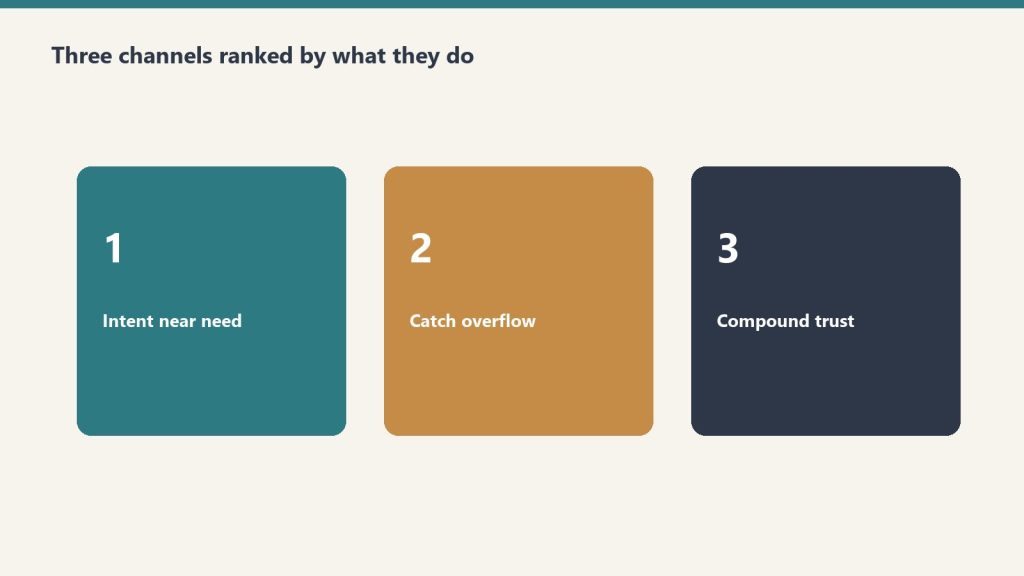
    The three channels

    Three ranked panels: intent near need, catch overflow, compound trust
    The three revenue channels.

    Restoration revenue lands in three buckets, each with distinct margin and operational characteristics:

    • TPA work (Contractor Connection, Alacrity/Altimeter, Accuserve/Code Blue, others). Predictable volume, moderate margin (30-42% gross), heavy oversight, recurring fees.
    • Direct carrier work (State Farm Premier, Liberty Preferred, etc.). Higher margin (38-52% gross), strong relationships, harder to break into, requires consistent performance.
    • Cash and out-of-pocket work. Highest margin (often 50-65% gross on water mitigation, 30-45% on reconstruction), no insurance friction, but variable volume and price-sensitive.

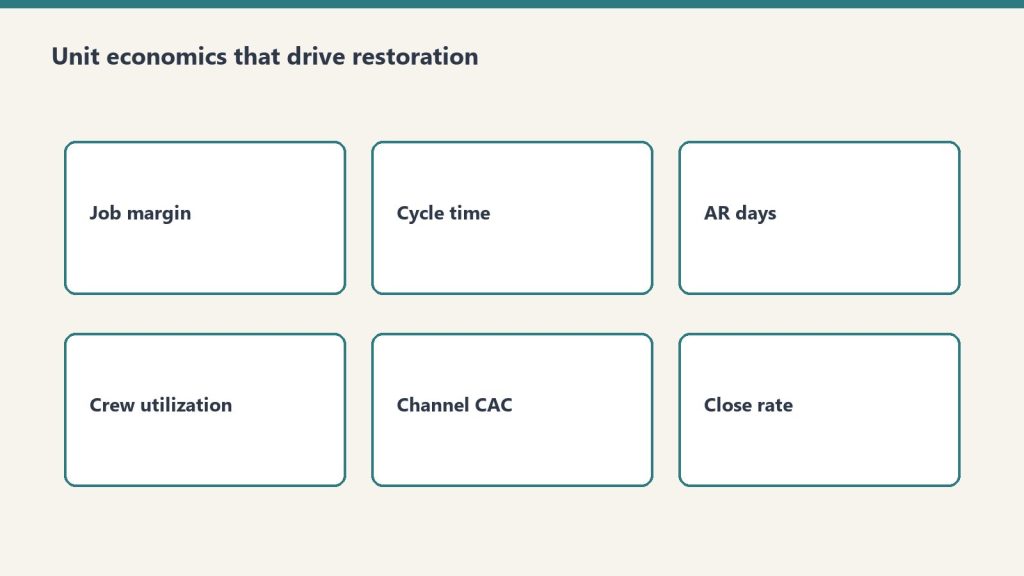
    What healthy looks like

    Six cards covering job margin, cycle time, AR days, utilization, CAC, close rate
    What healthy mix looks like.

    A defensible 2026 revenue mix for a $2-5M restoration company looks something like:

    ChannelTarget % of RevenueWhy
    TPA programs (combined)30-45%Volume floor, recurring work, predictable AR
    Direct carrier programs20-35%Margin lift, relationship moat
    Cash / out-of-pocket10-25%Highest margin, fast pay
    Commercial / property mgmt10-20%Recurring relationships, stable scopes
    Plumber / referral / agent5-15%Independent of program structures

    The concentration ceiling

    No single TPA, carrier, or referral source should exceed 30% of total revenue. Past that line, your business has effectively merged with that channel’s fortunes. If they pause your program, change scoring, or reorganize their vendor team, your revenue cliff is immediate.

    This is the single biggest factor PE buyers downgrade restoration acquisition multiples on — concentration risk over 30% reliably knocks 0.5x – 1.0x off the multiple.

    Margin-weighted thinking

    Revenue percentage isn’t the only number that matters. Margin contribution often differs sharply:

    Channel% Revenue% Gross Profit
    TPA40%34%
    Direct carrier25%27%
    Cash15%20%
    Commercial15%14%
    Other referral5%5%

    That cash 15% of revenue often delivers 20%+ of total gross profit — which is why mature operators protect cash channels even when TPA volume tempts them otherwise.

    How to rebalance when one channel dominates

    Restoration SOP clipboard with checklist, moisture meter, and gloves on a jobsite table
    How to rebalance when one channel dominates.

    If a single TPA or carrier is over 40% of your revenue, the rebalancing playbook:

    1. Stop accepting marginal jobs from the dominant channel. Tighten what you take to preserve capacity.
    2. Aggressively pursue plumber referrals and property management contracts. These are independent of program scoring.
    3. Pursue 1-2 new TPA enrollments to dilute the dominant program.
    4. Invest in direct carrier vendor manager outreach. Multi-quarter project, but high payoff.
    5. Increase cash channel marketing. SEO, GBP, LSAs targeting non-insurance keywords.

    Rebalancing typically takes 12-18 months. Start before you have to.

    The capacity trap

    The other failure mode: spreading capacity across too many programs without depth. Six TPA enrollments and 20% of total revenue from each looks diversified — but if your performance scores are mediocre across all six, every program throttles you simultaneously. Better to be excellent in three programs than mediocre in six.

    FAQs about restoration revenue mix

    What’s a dangerous level of TPA concentration?

    Any single TPA over 30% of revenue is a yellow flag. Over 40% is a red flag. Over 50% means your business is effectively a subcontractor for that TPA — and exit multiples reflect that.

    Is cash work really worth pursuing if TPA volume is steady?

    Yes. Cash work delivers 50-65% gross margin on mitigation vs 30-42% on TPA, pays in days instead of months, and isn’t subject to program scoring or carrier reorganizations. Even at 15-20% of revenue, cash work disproportionately funds growth and acquisition value.

    Should I drop a TPA program to focus on direct?

    Usually no — drop a TPA only if it’s actively losing money, scoring is unrecoverable, or the relationship has clearly soured. More commonly, hold the TPA at maintenance level while you build direct in parallel, then let the TPA share fall naturally as direct grows.

    What if my market doesn’t have direct carrier opportunities?

    Every market has them — they just take longer to find in less competitive metros. Start with the carriers writing the most policies in your zip codes (your local independent agent can tell you), and build adjuster relationships from there.

    How do I track revenue mix accurately?

    Tag every job in your job management software with the channel source at intake (TPA name, carrier name, “cash”, “PM contract”, “plumber referral”). Pull monthly mix reports. Without tagging at intake, you’ll never have accurate mix data and rebalancing decisions become guesses.

    Full insurance programs framework: Restoration Insurance Programs Master Guide.

    Related on Tygart Media: Starlink on a water job · S500 in the van · local SEO for restoration.

  • Restoration Sales Training: Build Top-Performing Reps

    Restoration Sales Training: Build Top-Performing Reps

    Restoration sales is a hybrid discipline. It requires enough technical knowledge to scope a job credibly, enough insurance literacy to navigate claim conversations, and enough emotional skill to sell a stressed homeowner or a guarded property manager on a meaningful spend during a crisis. Reps who can do all three consistently are not born — they are trained. This guide outlines the training program restoration companies use to build them.

    This article is part of our broader restoration training and certification master guide.

    The Four Pillars of Restoration Sales Training

    Restoration SOP clipboard with checklist, moisture meter, and gloves on a jobsite table
    Four pillars of restoration sales training.

    A complete restoration sales training program covers four pillars:

    • Technical literacy — restoration scope, drying science, mold protocol, fire cleanup methodology
    • Insurance and TPA navigation — claim process, deductibles, common adjuster behaviors, program-specific requirements
    • Selling skill — discovery, value framing, objection handling, closing, follow-up
    • Customer experience — empathy in crisis, communication standards, expectation setting, documentation

    Programs that cover only one or two of these pillars produce reps who are good at part of the job and weak at the rest. The strongest restoration sales programs are built around all four.

    Pillar 1 — Technical Literacy

    A restoration salesperson does not need to be a master technician, but they must be able to walk a loss intelligently, recognize the scope categories at play, and explain to the customer what the work will involve. The training should cover: water categories and classes (S500), mold containment levels (S520), fire and smoke categories, basic drying principles, and the equipment that shows up on standard jobs.

    The right way to deliver this is field exposure during onboarding. Sales reps should ride with technicians for the first two weeks, observe at least three job types, and be able to explain the basics back to the trainer before going on solo sales calls.

    Pillar 2 — Insurance and TPA Navigation

    Clipboard and tablet on a kitchen counter during an insurance adjuster walkthrough after water loss
    Pillar two — insurance and TPA navigation.

    The insurance conversation is where most under-trained reps lose the deal. Customers ask “will my insurance cover this?” and reps either over-promise (creating problems later) or punt to the carrier (creating doubt now). The training needs to cover: how a claim flows from FNOL through payment, what affects coverage decisions, when to recommend filing vs. paying cash, common adjuster scope-reduction patterns, and TPA program requirements specific to your participating programs.

    This material is best taught in small-group sessions with experienced PMs or owners present, working through real claim scenarios.

    Pillar 3 — Selling Skill

    The selling skill curriculum should cover the core sales conversation arc: discovery questions that surface the real customer concern, value framing that connects scope to outcomes, objection handling for the predictable objections (price, timing, “let me think about it”), tiered estimate presentation for cash work, and a closing approach that asks for the business without feeling pushy.

    Role-playing is the only effective way to teach this. Weekly role-play sessions with peers and managers, recording calls when possible, and structured feedback are what turn theory into reflexive skill. Programs that rely on shadow training and “watching how I do it” produce uneven reps.

    Pillar 4 — Customer Experience

    The customer experience pillar is what separates restoration sales from generic sales training. Customers in a restoration scenario are usually stressed, often grieving a loss, and almost always navigating something they have never dealt with before. Reps who recognize this and adjust their pace, language, and communication style close more deals at higher margin than reps who default to a transactional approach.

    The curriculum here covers: empathy frameworks, stress and grief recognition, expectation setting at intake and during the job, communication cadence (when to call, what to say), and documentation that reduces customer anxiety.

    The Training Cadence

    Restoration technicians training in a shop bay with equipment demo and whiteboard
    The training cadence that sticks.

    A working restoration sales training program looks like this on the calendar:

    • Weeks 1-2 — field shadowing with technicians, technical literacy
    • Weeks 3-4 — insurance and TPA training, paired sales calls with senior rep
    • Weeks 5-8 — selling skill training, role-play, supervised solo calls
    • Weeks 9-12 — customer experience training, full solo production with weekly coaching
    • Ongoing — weekly role-play, monthly call review, quarterly skill refresh

    What to Measure

    The sales training metrics that matter: close rate by rep tenure, average ticket by rep, gross margin per job by rep, callback rate, customer satisfaction by rep, and rep retention. Tracking these over the first 12 months of a rep’s tenure reveals whether the training program is producing the right outcomes.

    Related on Tygart Media: Starlink on a water job · S500 in the van · local SEO for restoration.

    Frequently Asked Questions

    How long should a restoration sales training program take?

    The structured portion runs 8 to 12 weeks. Solo production typically begins in week 5 or 6, with continued coaching through week 12. Reps reach steady-state productivity around month 6 with a good program in place. Compressing below 8 weeks consistently produces under-prepared reps with high turnover.

    Should I hire experienced restoration salespeople or train from scratch?

    Both have merit. Experienced restoration reps cut training time by 60-70 percent but cost more, are harder to find, and may bring habits from a previous employer that do not fit your standards. Training from scratch is slower and more expensive upfront but produces reps who match your culture and methods. Most companies run a blend.

    What is the most common restoration sales training mistake?

    Skipping the technical literacy pillar. Companies that hire reps from generic sales backgrounds and assume the technical side will be picked up “on the job” produce reps who under-scope, over-promise, and create operational problems for the production team. The technical pillar is non-negotiable.

    How much should I pay restoration salespeople?

    Compensation models vary widely. Common structures are base plus commission on gross margin, draw plus commission, or salary plus performance bonus. The right mix balances rep stability with performance incentive. Pure commission models attract aggressive reps who often discount to close, which destroys margin. Pure salary removes the close-rate pressure that drives results.

    How do I keep a sales rep sharp after the initial training?

    Weekly role-play, monthly call reviews, quarterly skill refreshers, and a structured coaching cadence with the sales manager. Sales skill decays without practice — the reps who stay sharp are the reps in companies that invest in ongoing development rather than treating training as a one-time onboarding event.

  • When to Exit a TPA Program: Restoration Contractor Guide

    When to Exit a TPA Program: Restoration Contractor Guide

    Exiting a TPA program is one of the highest-stakes decisions a restoration company makes. Done well, it frees capacity for higher-margin work and reduces concentration risk. Done badly, it creates a 6-12 month revenue valley that’s hard to recover from. This is the operator’s decision framework.

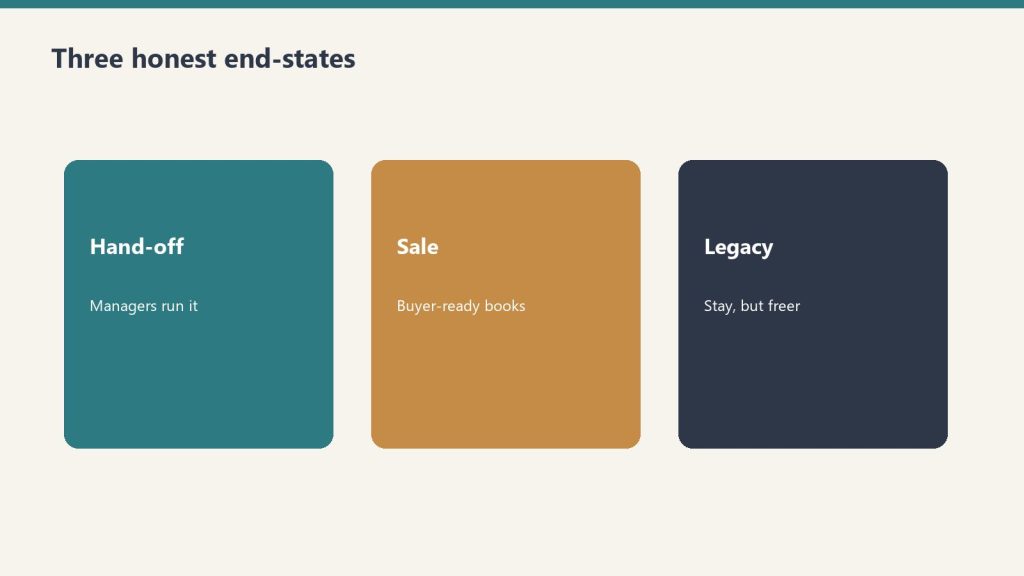
    The four signals that say “exit”

    Three panels for hand-off, sale, and legacy operation end-states
    Four signals that say it is time to exit a TPA.

    1. Financial signal: the math doesn’t work anymore

    Run the unit economics on the TPA channel honestly. Total program revenue ÷ true gross margin (after equipment rental haircuts, supplement rejections, and program fees) ÷ time spent. If the effective margin is below 25% gross or the operating cost is materially higher than your other channels, the program is subsidized work.

    A common pattern: contractors stay in marginally-profitable programs because the volume feels reassuring — even when that volume is consuming capacity that could be deployed at 40%+ gross elsewhere.

    2. Performance signal: scores you can’t recover

    Every TPA scores contractors on cycle time, customer satisfaction, scope adherence, documentation, and re-open rate. If your scores are sustained low for 2-3 consecutive quarters and you’ve already invested in the obvious fixes (training, software, dispatcher), the program is no longer a fit operationally. Continuing to take throttled assignments at degraded scores is a slow exit anyway — better to make it intentional.

    3. Strategic signal: concentration risk over 40%

    If a single TPA represents over 40% of total revenue, the program owns your business — not the other way around. Exit doesn’t have to be immediate; intentional dilution over 12-18 months as other channels grow is usually the better playbook. But the strategic decision to reduce dependency should be made consciously.

    4. Relationship signal: the relationship has soured

    Sometimes the program team changes, the rules tighten without compensation, or the carrier relationships you cared about leave the program. If the relationship feels adversarial across multiple touchpoints for multiple months, the program is an unhappy fit and exit is usually right.

    The honest cost of exit

    Six cards covering job margin, cycle time, AR days, utilization, CAC, close rate
    The honest cost of exit — margin and volume tradeoffs.

    Most operators underestimate the revenue valley that follows a TPA exit:

    • Months 1-3 post-exit: Existing assignments wind down. Revenue from the program drops to near zero by month 3.
    • Months 3-9: Other channels (direct, cash, plumber, commercial) have to fill the gap. They will, but slower than expected.
    • Months 9-18: Net revenue typically recovers to pre-exit level, often at higher margin.

    If you cannot survive a 30-40% revenue dip for 4-6 months, do not exit yet. Build the replacement channels first.

    The transition plan

    Restoration SOP clipboard with checklist, moisture meter, and gloves on a jobsite table
    The transition plan before you pull the plug.
    1. Months -12 to -6: Aggressively grow non-TPA channels. Plumber referral push. Property management contract pursuit. Direct carrier vendor outreach. Cash channel marketing.
    2. Months -6 to -3: Tighten what you accept from the TPA — only the highest-margin assignments. Let scores naturally throttle volume.
    3. Month 0: Send formal exit notice per program contract terms. Do not burn the relationship — exit professionally.
    4. Months 1-6: Execute on the channels you built. Track weekly revenue by channel. Adjust marketing spend toward whatever’s working.
    5. Months 6-12: Stabilize the new mix. Document what worked. Update the org chart and capacity plan to the new revenue shape.

    Re-enrollment realities

    Exiting and re-enrolling later is harder than staying. Most TPAs require a fresh application process for re-enrolling contractors, including financial review, insurance re-verification, and capacity assessment. Plus, the program team remembers contractors who left — sometimes positively, sometimes not. Treat exit as a 3-5 year decision, not a 6-month one.

    Partial exit is also an option

    You don’t always have to exit fully. Many TPAs let you reduce service area, restrict service types, or pause specific carrier programs. A partial exit can preserve optionality while reducing exposure.

    FAQs about exiting TPA programs

    How do I know if a TPA is actually unprofitable?

    Pull 12 months of program revenue. Subtract direct labor, materials, equipment cost (real, not Xactimate-priced), supplement losses, and an allocated share of overhead and admin time spent on program-specific tasks. If the result is below 20% gross profit or your operating cost is higher than your other channels, the program is subsidized.

    What’s the right notice period for exit?

    Whatever your contractor agreement specifies — usually 30-90 days. Honor it precisely. Sloppy exits damage your reputation across the broader TPA and carrier industry, which is smaller than it looks.

    Can I keep some carriers within the program but drop others?

    Sometimes. Some TPAs allow carrier-specific opt-outs; others treat program enrollment as all-or-nothing. Ask explicitly during your exit conversation — you may have more flexibility than the contract suggests.

    How do I tell my team we’re exiting?

    Be direct about why and what changes operationally. The honest version: “We’ve decided this program isn’t a fit anymore — here’s what we’re replacing it with and how the next 6-12 months will look.” Anxiety on the production team kills morale faster than the actual revenue impact.

    What if I exit and revenue doesn’t recover?

    That outcome usually means the replacement channels weren’t built before exit. The fix is rarely re-enrolling in the program you left — it’s doubling down on plumber referrals, direct carrier outreach, property management contracts, and cash channel marketing. Six months of focused channel building usually closes the gap.

    Full insurance programs framework: Restoration Insurance Programs Master Guide.

    Related on Tygart Media: Starlink on a water job · S500 in the van · local SEO for restoration.

  • Restoration OSHA Training: Legal Requirements for Owners

    Restoration OSHA Training: Legal Requirements for Owners

    OSHA training in restoration is not a nice-to-have or an industry best practice — it is a legal requirement under multiple federal standards, and the financial penalties for non-compliance can be severe. The good news is that the core training requirements are well-defined, the curriculum is mature, and a properly designed safety training program can be delivered without significant disruption to production.

    This guide is part of our broader restoration training and certification master guide. It is not a substitute for legal advice — consult an OSHA compliance professional for company-specific guidance.

    Respiratory Protection Training (29 CFR 1910.134)

    Restoration technicians training in a shop bay with equipment demo and whiteboard
    Respiratory protection training is non-negotiable.

    The OSHA Respiratory Protection Standard applies to any worker required to use a tight-fitting respirator on the job — which covers virtually every restoration technician working on mold, fire, sewage, or hazardous environments. The standard is detailed and prescriptive, and the core elements are not optional.

    Employer obligations under the standard include providing respirators, training, and medical evaluations at no cost to the employee. The training must cover how to put on and take off the respirator, how to use it, how to clean and maintain it, and worksite-specific applications. Documentation of training completion is required.

    Respirator Fit Testing

    Any worker required to wear a tight-fitting respirator must be fit-tested before their first use of the respirator and at least annually thereafter. Fit testing typically takes 15 to 20 minutes per worker and is performed using either qualitative or quantitative methods.

    The annual recurrence is the part most restoration owners underestimate. Building fit testing into a recurring annual training day — typically combined with respirator training renewal — is the most efficient way to stay compliant without scheduling chaos.

    Bloodborne Pathogens Training (29 CFR 1910.1030)

    Bloodborne pathogens training applies to any worker who may have occupational exposure to blood or other potentially infectious materials. For restoration companies that perform trauma and crime scene work, this is mandatory. For general water and fire restoration, applicability depends on actual job conditions and should be assessed with an OSHA compliance professional.

    Hazard Communication Training (29 CFR 1910.1200)

    White restoration work van with ladder rack parked at a suburban jobsite curb
    Hazard communication training for every tech.

    Hazard communication training covers the safe handling of chemicals workers may encounter — antimicrobials, deodorizers, cleaners, sealers. Training must cover hazard identification, safety data sheet (SDS) interpretation, and protective measures. Initial training is required at hire and whenever new chemicals are introduced.

    Confined Space Entry (29 CFR 1910.146)

    Crawl spaces, attics, and certain commercial environments may meet OSHA’s definition of permit-required confined spaces. Companies that perform work in these environments must have a confined space entry program with associated training. The training is technical and specific; consult an OSHA professional to assess applicability.

    OSHA 10-Hour and 30-Hour Training

    OSHA 10-hour and 30-hour outreach training programs provide general workplace safety education. While not mandated by OSHA for most restoration work, many TPA programs, commercial customers, and insurance carriers require OSHA 10 or 30 cards as a condition of participation. The 10-hour course is appropriate for field technicians; the 30-hour course is appropriate for supervisors and project managers.

    Building a Recurring Safety Training Program

    Restoration SOP clipboard with checklist, moisture meter, and gloves on a jobsite table
    Build a recurring safety training program.

    The most workable structure for ongoing OSHA compliance is an annual safety training day where respirator training renewal, fit testing, hazard communication review, and other recurring requirements happen together. Combined with new-hire safety training (typically delivered in the first week), this approach keeps the team compliant without the constant scheduling pressure of ad hoc training.

    Documentation matters as much as the training itself. Every training session should be documented with date, attendees, content covered, and trainer credentials. Fit testing should be documented with date, respirator make and model, fit test method, and pass/fail result. This documentation is the company’s defense in any OSHA inspection or insurance audit.

    Common OSHA Compliance Mistakes

    The most common compliance mistakes in restoration: skipping initial fit testing for a new hire because “they have used a respirator before” (still required), letting fit testing lapse beyond 12 months for tenured techs (still required annually), incomplete documentation of training sessions, missing medical evaluations for respirator users, and assuming online training alone satisfies hands-on requirements (it does not for most fit testing).

    Related on Tygart Media: Starlink on a water job · S500 in the van · local SEO for restoration.

    Frequently Asked Questions

    How often is OSHA respirator fit testing required?

    Fit testing must be performed before a worker’s first use of a tight-fitting respirator and at least annually thereafter under OSHA 29 CFR 1910.134. The annual requirement applies to every worker who is required to use a tight-fitting respirator, regardless of how long they have worked at the company.

    Do I have to pay for respirators and training?

    Yes. Under OSHA 29 CFR 1910.134, employers must provide respirators, training, and medical evaluations at no cost to the employee. Treating these as employee expenses creates legal exposure and is one of the most commonly cited respirator program violations.

    Is OSHA 10 or OSHA 30 training required for restoration workers?

    OSHA does not generally mandate the OSHA 10 or 30 outreach courses for restoration work, but many TPA programs, commercial customers, and insurance carriers require them as a condition of doing business. OSHA 10 is appropriate for field technicians; OSHA 30 is appropriate for supervisors and PMs.

    How long does respirator fit testing take per worker?

    Approximately 15 to 20 minutes per worker, plus setup and documentation time. A typical annual safety training day can fit-test 8-12 workers per trained fit tester, depending on the testing method used.

    Where can I find a qualified OSHA fit testing provider?

    Many third-party safety training companies offer on-site fit testing for restoration teams. Some IICRC training providers bundle OSHA compliance training with their certification programs. Industrial hygienists and occupational health clinics also provide fit testing services. Verify the provider’s credentials and the test method used before scheduling.