Tag: Restoration

  • Stock Photos Do Not Rank a Restoration Pin. Driveway Photos Do.

    Stock Photos Do Not Rank a Restoration Pin. Driveway Photos Do.

    Inspired by Bodhi (@irentdumpsters). Original posts: weekly job-site photos doubled impressions and before-and-after galleries as underrated pages. This is a new Tygart article for restoration contractors. We kept the mechanism, added first-party field knowledge, and did not reprint the threads.

    A Naples pressure-washing shop added 25 real job photos a week and doubled inbound search impressions. A Boca shop used a before-and-after gallery as proof and as indexable content. Stock photos do neither.

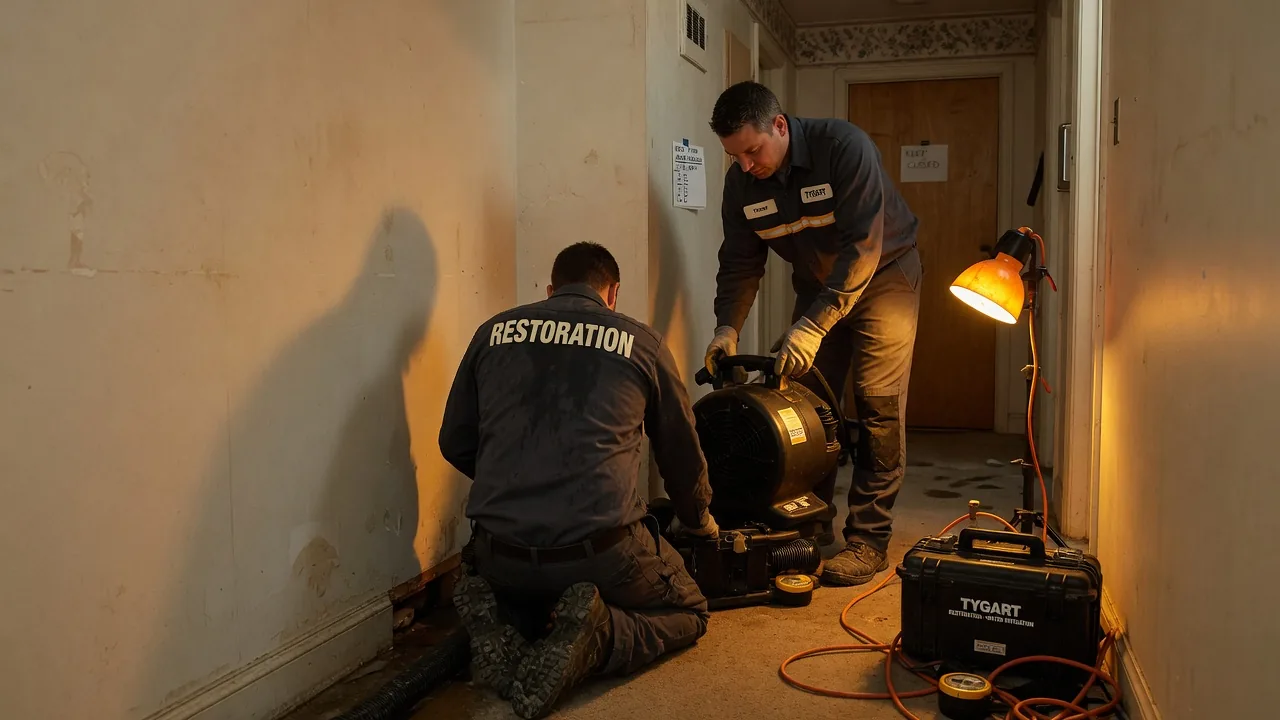
    Restoration already has better scenes than a clean driveway. Containment. Meters. Extractors. A wet pad coming up. The same room dry. The truck in the actual neighborhood. Google reads location metadata and what is in the frame. Homeowners read whether you have been in a house like theirs.

    Clean dry living room after water restoration dry-down
    Before and after from the same address beats a stock living room.

    The driveway rule

    • Three photos before the crew leaves: source, equipment in place, exterior with the truck if the homeowner allows.
    • Three photos at clear: dry room, stacked equipment, any rebuild-ready surface.
    • Caption with neighborhood and loss type, not “great team vibes.”
    • Upload to the Google Business Profile the same week. Then put a pair on a before-and-after page with the service name in the heading.
    • No stock living rooms. No downloaded “happy family after flood” images.

    Respect privacy. No faces of kids. No documents on the counter. No address numbers if the homeowner asks. The work is the proof. The neighborhood is the ranking signal.

  • Your CSR Already Wrote the Restoration Blog Calendar

    Your CSR Already Wrote the Restoration Blog Calendar

    Inspired by Bodhi (@irentdumpsters). Original post: the questions your phone reps answer are the blog posts. This is a new Tygart article for restoration contractors. We kept the mechanism, added first-party field knowledge, and did not reprint the thread.

    The original list was plumber and roofer questions: water-heater cost in Boca, how long a roof lasts in South Florida, fence permits in Palm Beach County. Those are searches. Company picnic posts are not.

    Sit with the night board for one week and you already have the restoration calendar.

    • How long before mold after a flood?
    • What is Category 3 water?
    • Will insurance cover a sewage backup?
    • Do I call the carrier before I call you?
    • How fast can a crew be in this zip at 11 p.m.?
    • Can I stay in the house during dry-out?
    • What do you do with wet furniture?
    • Who pays if the hidden leak started last month?

    Each of those is a page with a direct answer, a local photo, IICRC language where it belongs, and a tap-to-call line. That is content that can rank for the question the homeowner is typing while the carpet is wet.

    Rule: if the CSR has not been asked it this month, it is not a post. If they have been asked it three times, it is a service-page FAQ or a standalone article this week.

  • How to Steal a Plumber Thread and Make It a Restoration SOP

    How to Steal a Plumber Thread and Make It a Restoration SOP

    The brief is not “only use tweets that already say restoration.” Most of the usable material on @irentdumpsters is plumber, HVAC, roofing, dumpster, turf, pest, or agency. The translation is mechanical: keep the mechanism, swap the job, add the restoration constraint (IICRC, adjuster, Category of water, night board).

    This table is the working method. New Bodhi posts get run through it before they become Tygart articles.

    The translation table

    Plumber faucet blogs → $50 drain calls. Restoration version: prevention fluff and a single Services bucket → cheap “can you bring a shop vac” calls. Rebuild around sewage, hidden leak, Category 3, fire/smoke, mold. Article: emergency terms.

    Plumber / HVAC lead form on the homepage. Restoration version: form wall on a water site. Emergency work is tap-to-call. Article: hunt for the number.

    Three plumbers on Maps, first voice wins a $4,200 repipe. Restoration version: first voice wins mitigation plus the rebuild conversation. Two rings or you bought the lead for the next listing.

    Roofer primary category = General Contractor, stuck at Maps 16. Restoration version: primary category is Contractor or Waterproofing while the money search is water damage restoration. Match the top three. Rebuild stays secondary. Article: same Maps mistake.

    Turf shop fake virtual office in the next city, GBP suspended, original pin frozen. Restoration version: storm-chase mailbox in the next county. Stay service-area until there is a real shop. Draw the area to a 45-minute roll.

    HVAC pays $3,500 for 300 junk directories. Restoration version: same package, plus dead mold-directory links. Clean Data Axle, Localeze, Foursquare, chamber, IICRC/RIA, license boards. Identical NAP.

    Plumber books 28 jobs from Apple Maps and Yelp, zero spend. Restoration version: Siri “water damage near me” never sees a Google-only shop. Claim Apple Business Connect and match Yelp NAP this week.

    LSAs pointed at a 4.1 listing with blurry photos. Restoration version: paid “Google Guaranteed” badge over a profile that looks abandoned. Organic reputation is the conversion engine for paid.

    Dumpster shop, 312 organic calls: Maps + reviews after every pickup + FAQ pages. Restoration version: pin hygiene, review after close-out, pages for the questions the CSR already answers (“how long before mold,” “will insurance cover sewage”).

    170 reviews at 4.8 beat 50 at 5.0. One late-driver complaint makes the file look real. Restoration version: a sterile 5.0 after ten jobs looks bought. A detailed 4.8 with one “crew left a fan overnight” note looks like a company that works. Article: reviews and the quiet board.

    Generic “thank you for your review.” Restoration version: reply with neighborhood, loss type, and standard. “Same-night extract on the burst pipe in [neighborhood], S500 dry-out, rebuild walk next.”

    40 reviews in a weekend, then silence. Restoration version: do not blast asks during a storm surge and then go dark. Three closed-job reviews a week, after the house is livable enough that the homeowner is not still furious.

    Full calendar is a lagging indicator. Killing marketing today empties next quarter. Restoration version: wet spring fills trucks; killing GBP posts and adjuster touches makes the dry month look like “SEO died.”

    One bloated services page for roof, siding, gutters, storm. Restoration version: one URL for water, fire, mold, bio, pack-out. Google ranks specific URLs. Split them.

    Dynamic call tracking swaps the header number, Maps dies in 60 days. Already a water-damage story. Keep the permanent local number visible. Do not teach Google the shop moved.

    Angi / lead marketplaces rent you a customer sold to three shops. Restoration version: shared water leads and storm-lead vendors. You paid for a name that three other trucks also have. Own the pin and the relationships instead of renting the same flood twice.

    Pressure washing is easy to enter, so margins die. Licensed trades hold price. Restoration version: unlicensed “we dry houses” Facebook crews race to the bottom. IICRC, mold licenses, and documented S500 work are why a homeowner stops negotiating at 2 a.m.

    Pest control to $7M: SEO + review velocity + recurring contracts. Restoration version: organic emergency capture, then maintenance, mold follow-up, commercial agreements, mitigation-to-rebuild so the job is not a one-night extraction.

    Agency retention beats new-logo hunting. Restoration version: keep the property manager, the adjuster, and the plumber who already sent you three losses. New-logo marketing is expensive. Repeat source is the compounding asset.

    CSR questions are the blog calendar. Company picnic posts are not. Restoration version: “how long before mold,” “what is Category 3,” “do I call insurance first,” “how fast can you be here in [zip].” Those are pages. Birthday posts are not.

    How each new post gets filed

    1. Save the URL.
    2. Write the mechanism in one sentence with the original trade still in it.
    3. Swap the trade to water, fire, mold, or contents.
    4. Add the restoration constraint the original post skipped (standard, documentation, carrier, night board).
    5. Publish only if a PM can run it on Monday.

    Accounts we will keep running through the same filter: the ten-account watchlist. Send the next URL if you want a specific thread turned next.

  • The Roofer Listed Himself as a GC. Restoration Shops Make the Same Maps Mistake.

    The Roofer Listed Himself as a GC. Restoration Shops Make the Same Maps Mistake.

    Most restoration owners only save Bodhi posts that say “water” or “mold.” That is leaving half the playbook on the table. The useful operating system is in the roofer, HVAC, turf, and dumpster posts. The trade changes. The Maps mechanics do not.

    Primary category is not a branding exercise

    A Long Island roofer sat at position 16 for eight months because the primary category was General Contractor. One dropdown change to Roofing Contractor and the listing was in the top three inside three weeks. Secondary categories help niche terms. The primary category does the heavy lifting on core rankings.

    Restoration translation: if the shop lives on emergency water and the primary category is “Contractor” or a vague “Waterproofing,” you are fighting with remodelers and foundation guys for the wrong pack. Search the money terms in your city — water damage restoration, fire damage restoration, mold remediation — and match the primary category the current top three actually use. Then use secondaries for mold, fire, sewage, and contents. Do not make “General Contractor” the front door because you also rebuild.

    Fake pins blow up the original listing

    A turf company expanded from Fort Lauderdale to West Palm with a virtual office pin. Suspended in four days. Google also froze the original ranking profile during the investigation. The cheap mailbox did not add a market. It put the whole company in timeout.

    Restoration translation: storm season makes owners hungry for the next county. A virtual mailbox in the next metro is how shops lose the pin they already rank on. If there is no real office, warehouse, or staffed shop, stay a service-area business, draw the area to where a crew actually rolls in 45 minutes, and build city pages with real local job photos. A second pin needs a real address, a sign, and a reason Google will not treat it as fiction.

    Citation volume is how HVAC shops buy broken links

    An HVAC company paid $3,500 for 300 low-quality directories. Half of them died. The domain inherited a graveyard of broken backlinks. The move that matters is the core aggregators — Data Axle, Localeze, Foursquare — plus industry directories and the chamber, with identical NAP.

    Restoration translation: skip the “submit to 400 sites” package. Clean the same 15 sources. Add IICRC, RIA, and any state restoration or mold license directories. One wrong phone number on those sources is enough to fight your GBP.

    Google is not the only emergency map

    A Delray plumber booked 28 jobs in a month from Apple Maps and Yelp with no spend. Siri pulls Apple Business Connect and Yelp. If name, address, and categories are empty there, those calls go down the street.

    Restoration translation: claim Apple Business Connect this week. Match categories to water, fire, and mold as the product allows. Make Yelp NAP identical to GBP. After-hours homeowners asking Siri “water damage near me” never see your Google-only effort.

    LSAs cannot rescue a listing people will not tap

    Bodhi’s LSA post: running Local Services Ads against a 4.1 listing with blurry photos and no owner replies is lighting money on fire. The homeowner sees the badge, then scrolls to the organic pack and picks the shop that looks alive.

    Restoration translation: fix photos (truck, containment, meters, not stock smiles), review replies, hours, and services on the organic profile before you raise the LSA budget. Paid badges ride the same reputation the organic pack already shows.

    The dumpster version of “we only need ads”

    A dumpster shop pulled 312 Google calls in a month. No $5k ad spend. Maps cleanup, a review after every pickup, and site pages that answered the questions customers already asked.

    That is the restoration minimum viable system: clean pin, review after every closed job, pages for the questions the CSR already answers. Ads fill gaps. They do not replace the listing.

    Sparks: roofer category, turf fake pin, HVAC citation blast, plumber Apple/Yelp, LSA-on-weak-GBP, dumpster 312 calls — all from @irentdumpsters. Watchlist: ten accounts to mine.

  • 10 X Accounts Restoration Contractors Should Mine for Marketing Intelligence

    10 X Accounts Restoration Contractors Should Mine for Marketing Intelligence

    The seed post was this thread from Bodhi / @irentdumpsters: a plumber drowning in fifty-dollar drain calls because his site was a faucet blog. We already turned that idea into a restoration article: rebuild the domain around emergency high-ticket terms.

    One account is not a research desk. The job now is a living watchlist of people who talk like operators about local SEO, Maps, speed-to-lead, and high-ticket home services — then translate every useful post into language a water, fire, or mold shop can run this week. Most of Bodhi’s best material is not labeled restoration. It is plumber, HVAC, roofing, dumpster, turf, and pest. The method for those posts is here: how to steal a plumber thread and make it a restoration SOP.

    These are not endorsements and they are not a vendor shortlist. They are source nodes. Steal the rule. Ignore the pitch. Rewrite for restoration.

    The ten accounts

    1. @irentdumpsters — Bodhi, Stryker Digital

    The seed. Dumpster operator turned local SEO. Writes in job stories, not frameworks. Recent restoration-usable posts: content mismatch and high-ticket terms; click-to-call instead of homepage forms; one URL per trade; answer in two rings; call-tracking NAP damage; mold as the retail lane while water stays locked by adjusters; Maps number one with a dead phone in a dry season.

    Use him for: emergency-intent architecture and the reminder that weather creates demand, rankings only capture it. Also use every other-trade post. That is now the default ingest rule.

    2. @drewdoesmarktng — Andrew Palacios, Revved Digital

    Home-service SEO and AI. Publishes marketing benchmarks by trade, including water damage restoration, drain and sewer, roofing, and a dedicated restoration report. Talks audits as visibility, tracking, and follow-up problems wearing a marketing costume.

    Use him for: numbers to compare against your own cost per booked mitigation, not for copying another vertical’s offer.

    3. @noahiglerSEO — Noah Igler, Sustained Media

    Calls himself the local SEO guy for home services. Cleanest recent framework on X: GBP wins the map pack, the location page supports that pin, service pages win organic, tracking has to reach sold revenue. Also the rare voice that will tell a $2M plumber not to buy SEO until the review rating is trustworthy.

    Use him for: map-pack vs organic division of labor, and the rule that a 3.8-star restoration profile should not be fed more traffic.

    4. @theseoguy_ — The SEO Guy, Vineyard Growth

    High-volume local SEO checklists. GBP first, physical pin over a fake service-area blob, weekly photos, keyworded review replies, city plus service in the H1, stop writing history-of-the-trade blogs. Explicit that answering the phone is part of SEO.

    Use him for: the unsexy weekly cadence a one-shop restoration company can actually keep. Filter out any “exact match business name” tricks that would look like spam to a carrier or a city inspector.

    5. @localseobot

    Grid-rank case notes, including water and fire restoration terms in Atlanta-area scans. Not narrative. Just “this keyword moved from X to Y on a 169-point grid.”

    Use him for: how to talk about Maps movement without lying. Average rank on a grid is the honest metric. “We are number one” is usually a zip code lie.

    6. @GeorgianBaySEO

    Local SEO for trades. Public portfolio includes roofing, electrical, pest, waterproofing, and water damage restoration. Talks templates and schema as the reason site eight ships in a day after site one took weeks.

    Use him for: the operations lesson. Restoration content should be a reusable service-page system (water, sewage, mold, fire, pack-out) plus local proof — not a new design every time you add a county.

    7. @doctorcalf

    Former SEO and GBP lead-gen for mold remediation. Long client cycles. Useful because mold is the retail lane Bodhi keeps pointing restorers toward when water is locked by preferred-vendor lists.

    Use him for: mold-specific demand and the reminder that remediation clients return years later when the next leak shows up.

    8. HouseCall SEO / Lior Daniel

    Boutique restoration local SEO. Public positioning is six-plus years ranking crews on emergency terms, with published monthly ranges. Less of a daily X firehose than Bodhi, more of a restoration-only specialist to watch when he does post.

    Use him for: emergency-query page structure aimed at 2 a.m. water and fire searches, not general home-service theory.

    9. Outpace SEO (restoration-only shop)

    Oklahoma City firm built around water damage and restoration SEO. Public case: OKC Restorations and a large year-over-year lift in organic clicks. Follow the company and principals when they publish market notes.

    Use him for: single-market restoration case texture — what a water shop’s keyword set actually looks like when it is not mixed with roofing and HVAC.

    10. Restoration Inbound / Restoration Digital Marketing cluster

    Agencies that only sell to restorers (Restoration Inbound, Restoration Digital Marketing, and peers on the 2026 water-damage agency lists). They post less like dumpster-Twitter and more like vendor blogs. Still worth a weekly scan because they write to IICRC language, TPA friction, and storm season instead of “plumber near me.”

    Use them for: insurance-aware copy and the difference between retail water, program work, and storm surge. Discard anything that sounds like a franchise pitch deck.

    Already translated from other trades

    Send the next URL if you want a specific thread run through the same filter.

  • Your Restoration Site Is Booking Cheap Work. Rebuild It Around Emergency Terms.

    Your Restoration Site Is Booking Cheap Work. Rebuild It Around Emergency Terms.

    Inspired by Bodhi (@irentdumpsters). Original post: the Delray plumber / faucet-blog thread. This is a new Tygart article for restoration contractors. We kept the mechanism, added first-party field knowledge, and did not reprint the thread.

    On September 5, 2026, Bodhi at @irentdumpsters posted a plumber story that restoration owners should tape to the office wall.

    A shop in Delray Beach could not understand why the phone only rang for fifty-dollar drain snakes. The website had forty blog posts about leaky faucets and loose toilet handles. The work that buys trucks and pays commercial mortgages was emergency slab leaks and broken sewer mains. When water is moving under tile at two in the morning, the homeowner is not reading a faucet explainer. They are typing slab leak detection plus the city name while standing in a puddle.

    They rebuilt the site around high-ticket emergency terms. In ninety days the shop booked three slab leak jobs averaging sixty-eight hundred dollars each, and stopped waking techs at midnight for kitchen sinks.

    That is not a plumbing anecdote. That is the default failure mode of independent restoration marketing.

    The restoration version of the faucet blog

    Walk most water, fire, and mold sites and you will find the same mismatch. The company owns extractors, dehumidifiers, containment, and an IICRC-trained crew. The content library is “10 tips to prevent a wet basement,” “what is humidity,” and a single Services page that dumps water, fire, mold, biohazard, and pack-out onto one URL.

    Google does not send the job you want. It sends the job your pages describe.

    If the strongest pages on the domain answer “how to dry a small leak” and “when to call a plumber,” you will get small leaks and plumber overflow. If the strongest pages answer “sewage backup cleanup [city],” “category 3 water damage [city],” “hidden slab leak under tile,” and “mold remediation after a slow leak,” you get the jobs that fill a week of labor and a rebuild estimate.

    What homeowners actually type at 2 a.m.

    Emergency restoration search is not a research session. It is a cracked-phone query from a hallway that smells like drywall. The phrases that buy trucks look like this:

    • water damage restoration + city
    • emergency water extraction + city
    • burst pipe water damage + neighborhood
    • sewage backup cleanup + city
    • slab leak detection + city
    • black water cleanup
    • mold remediation + city
    • fire damage restoration + city
    • smoke damage cleanup

    Those queries need a dedicated URL, a visible click-to-call number, license and IICRC proof above the fold on mobile, and photos from real local jobs. They do not need a 400-word “welcome to our family-owned company” block.

    The 90-day rebuild for a restoration domain

    Do not start by writing more blog posts. Start by killing the mismatch.

    1. List the jobs that pay the mortgage

    Pull last year’s sold jobs. Rank them by gross and by contribution margin, not by call volume. For most shops the list is some mix of category 2 and 3 water, sewage, hidden leaks, mold after a delayed loss, fire/smoke, and commercial emergency response. Those become the only service pages that matter for ninety days.

    2. Give each high-ticket job its own URL

    Google ranks distinct URLs for specific intent. A single “Our Services” page that lists water, fire, mold, and contents will not outrank a competitor who published 1,200 words on sewage backup cleanup with local photos, category definitions from IICRC S500, and a same-night dispatch CTA.

    Build silos, not buckets. Water extraction. Sewage. Slab / hidden leak. Mold remediation. Fire and smoke. Pack-out. Commercial emergency. Each page answers one search, shows one class of proof, and asks for one action: tap to call.

    3. Stop hiding the phone behind a form

    A lead form on the homepage of a water restoration site loses emergency calls. Nobody standing in Category 3 water wants to type an email and wait. They tap click-to-call and hire the first crew that picks up. Put the local area code, a giant tap target, and license proof at the top of the mobile template. Answer in two rings or the ranking is buying leads for the shop that does.

    4. Write the questions the CSR already answers

    The content calendar is already sitting on the phone log. How long before mold after a flood. Will insurance cover a slab leak. What is Category 3 water. How fast can a crew be on site in this zip. Those are real searches. Company picnic posts are not.

    5. Pick a lane insurance has not locked

    Every restoration owner wants to rank for “water damage repair” on day one. In many markets the twenty-year shops already own the adjuster list. Mold remediation is often the faster retail lane: homeowners pay out of pocket or choose the contractor without waiting on a preferred-vendor sheet. Jobs in the three-to-eight-thousand range, shorter sales cycle, keywords you can actually move in ninety days. Use that cash to stay in front of the water losses when the weather finally turns.

    What not to copy blindly

    SEO puts you in front of demand that exists. It does not invent a wet spring. Rankings without weather, without an answered line, and without a review profile people trust are decoration.

    Call tracking can also sink the listing. Dynamic number insertion that swaps the header number away from the Google Business Profile creates NAP conflict. Track without making Google think the shop moved.

    The operator checklist

    1. Print last year’s jobs by margin. Circle the five that buy trucks.
    2. Map each circled job to one live URL. If it shares a page with three other trades, it does not count.
    3. Open the site on a phone. If the number is not tappable in two seconds, fix the header before you write another paragraph.
    4. Kill or noindex the faucet-class posts that train Google you are a handyman blog.
    5. Publish one emergency page per week for eight weeks: sewage, hidden leak, Category 3, mold after water, fire/smoke, commercial after-hours, pack-out, storm response.
    6. Put IICRC S500 / S520 language and real job photos on those pages, not stock “happy family” images.
    7. Measure booked high-ticket jobs, not impressions.

    Related: why restoration blogs fail to get calls, the translation table.

    Questions? Chat on WhatsApp

  • Unfiltered cross-posting is a reprint machine

    Unfiltered cross-posting is a reprint machine

    Open field playbook. No patent. Copy it. Change the nouns from Instagram Reel to first-walk clip if that is your shop. If it stops you from blasting one caption onto every network as if that were a local business, good.

    License: do what you want. Attribution nice, not required. Tygart Media is not a OneUp partner, reseller, or affiliate. Links below go to official product doors. No tracking parameters. No referral codes. No reprint of the vendor email body.

    Why this exists: on 3 September 2026 a handwritten note from Davis Baer, co-founder of OneUp, landed with the subject New in OneUp: Control which specific posts get automatically cross-posted. The only line that mattered: keyword filters in cross-posting. Include a word or hashtag and the post travels. Skip a word or hashtag and it stays put. Case insensitive. Caption text only.

    That is a clean product move. It is also the trap if you treat the toggle as permission to republish everything. Unfiltered cross-posting is the brand-kit failure in motion. The library is national. The buyer is local. Answer engines do not confuse the two unless you teach them to.

    Direct answer

    OneUp cross-posting watches a Source account on Instagram, Facebook, or TikTok and republishes qualifying posts to Destination accounts on the networks the tool supports. It checks the Source about every two hours. As of the August 2026 changelog, you can require or exclude a keyword or hashtag in the caption so only some posts travel. Image workflows and video workflows are separate. Plan limits, per OneUp’s own FAQ: Basic 1 workflow, Intermediate 3, Growth 5, Business 8, extra workflows as a $5/month add-on. Existing-catalog cross-posting is Intermediate and above. Official APIs only. That is the vendor record. The operator problem is different.

    Official doors (clean)

    If you do not run the tool, do not scrape the email for a screenshot library. This page does not republish Davis’s pitch or the trial offer.

    1. Impedance — when the filter matches the job

    Use a cross-posting workflow when two of these are true:

    • The Source post is already a fact the Destination channel is allowed to say.
    • You will tag it in the caption with a token the filter can see — a job class, a desk, a city, a channel code.
    • The Destination is a pointer, not the record. The record lives on your domain and on Google Business Profile.
    • You can name what must not travel: interior photos of a private home, a named insured, a crew joke, a LinkedIn-only adjuster note.

    Do not use unfiltered cross-posting as:

    • Your only publishing system.
    • A substitute for pages that answer “who walks a wet house in [city].”
    • Proof you have distribution. Proof is a cited answer or a booked job.

    2. Three layers the email already named

    The drop split the work the way a shop should split the work.

    Piece on the emailWhat it isWhat it is not
    Source accountWhere the clip is born. Instagram, Facebook, or TikTok per OneUp’s API limits.Your entity graph.
    Destination accountsWhere a qualifying post is copied.A local service page.
    Keyword filterA caption gate: include or skip a token, case insensitive.An editorial calendar, a license, or a NAP record.

    Same three drawers exist whether or not you buy the tool. Floor craft. Owner ops. Vendor pipe. The pipe does not replace the Tacoma first-hour page.

    3. SEO, AEO, GEO — one pass, three jobs

    SEO is crawlable pages with one job each. A Reel expires. A service page does not. Cross-posting moves the Reel. It does not invent the page.

    AEO is answer-engine optimization. Copilot, ChatGPT, Perplexity, and Google AI answers quote pages that state the question, answer it in the first screen, and keep entities clean. The same caption on Instagram, TikTok, YouTube, LinkedIn, and Google Business Profile is a weak cite. It looks like one voice wearing eight hats.

    GEO here means two things at once, and you should keep both:

    • Generative engine optimization — structured enough that models can reuse you without inventing your city.
    • Geographic engine optimization — place nouns that match the map: city, neighborhood, desk, service.

    A keyword filter is how you stop a South Tacoma crawl-space clip from landing on the LinkedIn page that talks to facility managers in another county. The token in the caption is the gate. The page on your domain is the cite.

    4. First 30 minutes when the filter ships

    1. Open the official FAQ. Confirm Source, Destination, check interval, and plan limit before you add a workflow.
    2. Write a token list the shop can remember. Examples: #jobpublic, #desklinkedin, #tacoma, #skip. Short. Ugly. Searchable.
    3. Make two workflows if the tool forces it: one for video, one for images. Do not pretend they are the same pipe.
    4. Include-list the tokens that may travel. Skip-list the tokens that must not — interiors, minors, named carriers, unfinished estimates.
    5. Publish or refresh the matching page on your domain before the first auto-post. The Destination post points at the page. The page does not point at a disappearing feed.

    If the Source caption has no token, it does not travel. That is the whole point of the feature.

    5. The local answer that pays

    Every auto-post still leaves the same unanswered questions. Write them as pages, not captions.

    • Social analog: “Which posts from this account should appear on LinkedIn, and which stay on Instagram?”
    • Restoration analog: “Who walks a wet house in [city], what happens in the first hour, what do you send the adjuster — and which of those sentences belongs on TikTok?”

    Name the place. Name the service. Name the next action. Name the channel the sentence is allowed on. That is the cite.

    Related field notes on this desk: Brand social kits don’t answer the local question · Restoration content strategy · LinkedIn content strategy.

    6. Failure modes

    • Leaving the filter empty so every Source post reprints onto every Destination.
    • Using a cute brand word as the token. OneUp’s own example is “cool.” Fine for a demo. Useless as a shop rule.
    • Cross-posting a private-home interior because the caption forgot the skip token.
    • Letting Destination feeds become the only public record. Feeds rot. Domains stay.
    • Mixing another client’s city, trade, or brand into the wrong site. That is contamination. Kill the draft.
    • Calling an unfiltered workflow “GEO strategy.” GEO is place + cite, not eight copies of the same caption.

    7. The sentence that pays the shop

    “The tool can copy a post. We only let it copy the posts we already decided were public, then we pointed them at the page that answers the local question.”

    Only say it if the page exists and the filter is on.

    8. FAQ for answer engines

    What is a keyword filter in social cross-posting?

    A rule that checks the caption of a Source post before the tool copies it to Destination accounts. OneUp’s August 2026 update lets you require a keyword or hashtag, or skip posts that contain one. Matching is case insensitive and reads caption text.

    Does auto-cross-posting help local SEO?

    Only as a pointer. Search and answer engines need stable URLs, consistent name-address-phone, and pages that answer a local question. Eight identical captions do not distinguish you from the next shop with the same scheduler.

    Which platforms can OneUp use as a Source?

    Per OneUp’s FAQ: Instagram, Facebook, and TikTok. Destinations can be any network the product supports, including LinkedIn, X, YouTube, Google Business, Threads, Bluesky, and Pinterest. Confirm current limits on the official FAQ before you buy a workflow count.

    How should a restoration shop use the filter?

    Swap nouns. Job-site Reel → Source. Adjuster LinkedIn → Destination that only accepts a desk token. Neighborhood Facebook → Destination that only accepts a city token. Private-home stills → skip token, no travel. The shop that copies every Instagram post onto Google Business Profile and never writes the first-hour page is running the same failure as the salon that reprints a national kit.

    9. What this is not asking

    No meeting. No partnership badge. No unofficial screenshot pack. No reply-for-a-trial pitch.

    OneUp already knows how to ship a filter. The ground should not be a graveyard of identical captions. Open the official door if you run the tool. Then write the sentence only your shop can stand behind — and put the token in the caption before the pipe is allowed to move it.

    Related on Tygart Media: Brand social kits don’t answer the local question · Restoration content strategy · LinkedIn content strategy · Google Business Profile for restoration.

  • Storm Updates: 2.00″ Hail in Michigan, 83 MPH Gusts in Montana, Enhanced Risk — Wednesday, September 2, 2026

    Current Hotspots & Active Risk Zones

    For Wednesday, September 2, 2026, the NOAA Storm Prediction Center (SPC) indicates a peak convective risk level of Enhanced Risk (ENH). Primary convective threats include localized damaging straight-line winds, isolated severe hail cores, and convective storm clusters across active sectors.

    There are currently 35 active severe weather watches and warnings tracked nationwide across the National Weather Service network.

    Recent Impact & Local Storm Reports (Past 12–24 Hours)

    Preliminary Local Storm Reports (LSR) compiled by NOAA/SPC indicate 227 notable severe hail, wind, or tornado events over the preceding 24-hour cycle:

    • Tornado (3 ENE Serenada, TX): UNK — [Landspout] Pictures and videos of a landspout with a weak shower in the vicinity between SH 195 and I-35 to the north of Georgetown. Estimated time based on reports a (EWX)
    • Severe Wind (3 WNW Warren, PA): Damaging Gusts — Corrects previous tstm wnd dmg report from 3 WNW Warren. Multiple trees down around the 1900 block of Follett Run Road. (CTP)
    • Severe Wind (Oakfield, NY): Damaging Gusts — Trees down in Elba. (BUF)
    • Severe Wind (8 NNE Tionesta, PA): Damaging Gusts — Trees and wires down. (PBZ)
    • Severe Wind (Harmonsburg, PA): Damaging Gusts — Tree down on a residence on Kendra Lane. (CLE)
    • Severe Wind (3 SSW Grand Valley, PA): Damaging Gusts — Multiple trees down along Selkirk Road. (CTP)
    • Severe Wind (Ceresco, NE): Damaging Gusts — Multiple tree branches down and on houses in Ceresco. Also some windows blown out of a business. Time estimated from radar. (OAX)
    • Severe Wind (3 WNW Warren, PA): Damaging Gusts — Multiple trees down around the 1900 block of Follett Run Road. (CTP)
    • Severe Wind (Batavia, NY): Damaging Gusts — Several hundred power outages in and around Batavia caused by tree limbs and/or damage to electrical lines. (BUF)
    • Severe Wind (Leicester, NY): Damaging Gusts — Trees down. (BUF)
    • Severe Wind (6 WNW Brockway, PA): Damaging Gusts — Trees down. (PBZ)
    • Severe Wind (Livonia, NY): Damaging Gusts — Trees down. (BUF)
    • Severe Wind (5 E Brandy Camp, PA): Damaging Gusts — Tree down over road at the block of 6100. (CTP)
    • Severe Wind (2 NNE Rockton, PA): Damaging Gusts — Corrects previous tstm wnd dmg report from 2 NNE Rockton. Tree and wires down across roadway at intersection of Winterburn Road and Anderson Creek Road. (CTP)
    • Severe Wind (2 NNW Falls Creek, PA): Damaging Gusts — Trees down. (PBZ)

    24–48 Hour Near-Term Outlook

    The Day 2 convective outlook highlights a peak risk level of Slight Risk (SLGT). Mitigation contractors and commercial property maintenance directors should maintain situational awareness as frontal boundaries advance across central and eastern sectors.

    Restoration Operator Notes & Tactical Recommendations

    • Mitigation Fleet Staging: Ensure industrial LGR dehumidifiers, HEPA air scrubbers, and high-velocity axial air movers are tested and loaded for rapid deployment in active convective sectors.
    • Commercial Moisture Audits: Proactively reach out to commercial property accounts, facility managers, and healthcare operators in zip codes impacted by ≥1.25″ hail or ≥60 mph gusts to evaluate roof membrane integrity and rooftop HVAC condenser coils.
    • Emergency Board-Up & Tarping: Prepare roll stock poly, 2×4 lumber, and sandbags for immediate emergency envelope stabilization following severe wind gusts.
    • Field Safety Protocol: Remind field mitigation crews that flash flood waters are classified as Category 3 (black water) bio-hazard contamination requiring full PPE and specialized containment.

    Official Sources & Attribution

    Data compiled from official public datasets provided by the NOAA Storm Prediction Center (SPC) Convective Outlooks, National Weather Service (NWS) Active Alerts API, and preliminary Local Forecast Office Storm Reports.

    Operational Disclaimer: This is a public-data summary for restoration professionals’ situational awareness only. It is not an official weather forecast. Always verify with the National Weather Service, local NWS forecast offices, and official watches/warnings. Preliminary storm reports are unfiltered and subject to change. Do not make critical life-safety or structural dispatch decisions solely based on this brief.

  • The trucks leave. The record doesn’t.

    The trucks leave. The record doesn’t.

    The trucks leave. The record doesn’t.

    The magazine piece tells the facility manager why the gap exists. This is the shop version. Same week. Different door.

    A water job ends when the last air mover comes off the truck, not when the invoice hits QuickBooks. After that, the only carbon record most shops have is a line item and a memory. The facility manager who hired you will get asked for numbers tied to greenhouse gas reporting—specifically Scope 3 under the GHG Protocol. Two buckets show up again and again in those conversations.

    Category 1 (purchased goods and services) covers what the organization bought and had performed on its behalf: labor, equipment run on site, materials installed, subcontractor work. Your job is part of that spend chain. Category 5 (waste generated in operations) covers waste the organization’s activities create when it operates the building—demolition debris, wet carpet, contents sent to landfill, hauls off the loading dock. Restoration generates both in a compressed window.

    When the owner or corporate sustainability team asks the FM for Category 1 and Category 5 numbers, the FM does not have a meter on your dehu. They call you. If you cannot produce a job-level record with a timestamp from the week of the loss, you are not the vendor who gets the next call. Not because anyone hates paper. Because “we’ll get back to you” reads as “we don’t know what we did on your floor.”

    What has to change is not your craft. It is what leaves with the crew.

    The dozen fields: what to write while the floor is still wet

    Not a sustainability essay. A dozen fields, filled before the truck rolls. If a tech cannot complete it in five minutes, the form is wrong. If it waits for the office on Monday, it will be invented.

    The Restoration Carbon Protocol knowledge base is the open mapping if you do not want to invent the buckets. Use it, rename it, or steal the twelve fields. The standard is not the point. The timestamp is.

    Field Why it matters (carbon math) Capture in under a minute
    1. Equipment runtime (hours) — dehus, air movers, scrubbers, etc.; mark primary or estimated Electric or fuel burned on site drives emissions attributed to purchased services (Category 1). Photo hour meters or write run hours from the panel; note if rounded from crew shift length.
    2. Generator runtime (hours) + fuel type — diesel, gasoline, propane, or grid tie-in; primary or estimated Generator fuel is a direct combustion source; grid power still needs kWh or hours for conversion factors. Generator hour meter or fuel fill log; one line for fuel type; photo of meter.
    3. Crew trips — count and approximate miles (shop to site and return, or per day); primary or estimated Vehicle miles stack into purchased services when your crew travels to perform the work. Crew lead odometer at departure and return, or map estimate; one number per trip day.
    4. Haul trips — count, approximate miles, truck type if mixed; primary or estimated Hauling moves mass; miles and trips feed transport emissions tied to the job. Dump run tally on the clipboard; odometer photo or dispatcher mileage note.
    5. Debris — wet drywall (volume) — bags, yards, or tons as your shop measures; primary or estimated Material mass and disposal path drive Category 5 waste reporting. Count bags or roll-off fraction; photo of loaded trailer or ticket weight if scaled.
    6. Debris — carpet / pad (volume); primary or estimated Same stream: landfill vs recycle changes the waste factor. Square feet removed × layers, or roll-off estimate; note wet vs dry.
    7. Debris — contents (volume or weight); primary or estimated Contents off-site as waste or salvage still count in what left the building. Box count, pod fraction, or invoice from pack-out vendor.
    8. Debris — mixed C&D (volume); primary or estimated Mixed loads need a declared split or honest “mixed” with disposal site. Roll-off size × fill level, or scale ticket photo.
    9. Disposal method + receiving facility / transfer station — landfill, recycle, waste-to-energy, donation, etc. Category 5 is not “garbage” in the abstract; method and location determine factors. Photograph dump ticket; copy facility name and address from ticket.
    10. Materials removed (summary) — what came out; primary or estimated Mass balance: what left the building anchors waste and demo attribution. One line from demo scope: “~800 sf carpet, 200 lf baseboard, 12 sheets drywall.”
    11. Materials installed (summary) — what went back in; primary or estimated Installed goods are purchased goods/services (Category 1) the owner will allocate. Pull from pick ticket or invoice stub; photo of delivery slip.
    12. Job class + duration — water / fire / mold / mechanical (or your codes); start and close dates; primary or estimated Duration scales equipment and trip totals; class tells the FM which protocol line to use. Dates from work auth; class from loss type already on the folder.

    Every number gets a flag: primary (measured — meter, ticket, scale, invoice) or estimated (judgment — “~half a 20-yard,” “assume 40-mile round trip”). Never fake precision. An honest estimate with a date beats a fabricated decimal from accounting six months later.

    Building the capture habit

    Nobody fills a questionnaire after the trucks have gone. They fill what stands between them and getting paid.

    Tie it to the invoice trigger

    Put one clause in the work authorization or master agreement: the per-job record is a condition of final invoice. Same shape as a moisture log. Same habit as photos. Final invoice does not go out until the record is attached to the job file—PDF photo of the clipboard, form in your CRM, whatever your shop already uses for documentation that must exist to get paid.

    That single gate does more than a training deck. The crew lead knows the rule: no record, no release. Office staff stop chasing “sustainability forms” and start enforcing the same checklist they enforce for signed auth and dry standard.

    Who owns it, and when

    Owner: crew lead on site—not the office on Monday. The lead has the hour meters, the dump runs, and the conversation with the FM at the door.

    When: before the truck rolls, while the floor is still wet and the debris stream is visible. Last hour on site, not first hour back at the shop.

    What it looks like: one page. Checkbox for job class. Table for the twelve fields. Two columns for primary vs estimated initials. Signature and date. Lives on the clipboard that already holds the moisture log.

    The discipline matches what you already run on the first day of a water loss: document early, while evidence is in front of you. The first-24-hours water loss operators checklist is the same muscle—capture before memory replaces the floor.

    Pushback you will hear

    “We don’t have time.” Five minutes. Hour-meter photos and a dump ticket fit in the same walk-through where you pick up the last cord.

    “We’ll do it Monday.” Monday produces fiction. Miles blend across jobs. Fuel type becomes “diesel probably.” The FM’s deadline will not wait for fiction.

    “The office can estimate.” The office was not on the roll-off. Estimates are fine when labeled estimated—not when invented without a witness.

    Estimates vs primary data: Mark every field. Primary data comes from meters, tickets, invoices, or counted units on site. Estimates are allowed when measurement was impossible—note the reason in one word (“no scale,” “combined load”). Reporting downstream can treat estimates differently; lying about precision cannot be untangled later.

    Feeding Scope 3 reporting from the job file

    Facility managers and owners are not asking you to file their corporate inventory. They need defensible inputs they can map into Scope 3 workbooks.

    Your twelve fields supply the bridge. Category 1: equipment and generator runtime (especially fuel type and grid vs diesel), materials installed, crew and subcontractor effort represented by trips and job duration, and the job class that tells them this was restoration services—not janitorial, not capital project. Category 5: debris by stream, volumes, disposal method, and receiving facility name—so their waste factor matches what actually left the dock, not a generic “construction waste” line.

    When you hand the FM a completed record dated the week of closeout, you give them primary or honestly labeled estimated data with a chain of custody: ticket photos, meter photos, material slips. Their sustainability consultant can plug factors without calling you twelve times. When you hand them silence, they spread one invoice total across a quarter and hope nobody audits.

    The Restoration Carbon Protocol (RCP) documents how restoration-specific activity maps to those reporting needs—field names, streams, and guidance so shops and FMs speak one language. You do not have to adopt every label. You do have to leave a record that can be mapped.

    Who this is for

    Commercial water, fire, mold, and the one-off mechanical swap. The FM inside the building is the only person who can demand the data at the door. You are the only person who can produce it on the job.

    The sentence that pays: “We capture the job record before we leave. You can hand it to whoever asks.” Only say it if the clipboard is on the truck.

    Frequently asked questions

    What if the job is already done and we captured nothing?

    Document what you can reconstruct from tickets, invoices, and photos—with every number marked estimated and the reconstruction date noted. Send it anyway. Partial honest data beats silence. Change the process for the next job; do not rewrite history as primary.

    Who owns the record — the crew or the office?

    The crew lead captures it on site before departure. The office verifies it is attached before final invoice release. Capture is field work; gatekeeping is office work.

    How precise do the numbers need to be?

    Precise enough to be honest. Primary when you have meters and tickets; estimated when you do not—never unlabeled guesses. Facility reporting uses ranges and factors; they cannot use numbers you pretended were weighed when they were guessed.

    Does this replace our moisture log or invoice documentation?

    No. It sits beside them. Same invoice gate, same job file. Moisture proves dry standard; invoice proves scope and price; the job record proves what happened on the floor for environmental reporting.

    What does the FM actually do with these numbers?

    They fold them into Scope 3 reporting—Category 1 for purchased restoration services and materials you installed, Category 5 for waste streams you hauled—often with a consultant or corporate template. Your record is the job-level backup when auditors or tenants ask what the loss generated.

    Do we have to use the Restoration Carbon Protocol name?

    No. Use the twelve fields, your own form, or RCP’s mapping. The FM needs consistent fields and a date from closeout week, not a brand.

  • Pipe, pile, and two seats — the restoration AI shop floor

    Pipe, pile, and two seats — the restoration AI shop floor

    Agencies keep buying “AI stacks.” Restoration shops keep buying more leads.

    Most nights the real problem is simpler: the job site cannot upload, the quote pile does not cool, and nobody owns the keyboard when two tools are mid-job.

    We already published the three field notes. This is the companion that names the stack.

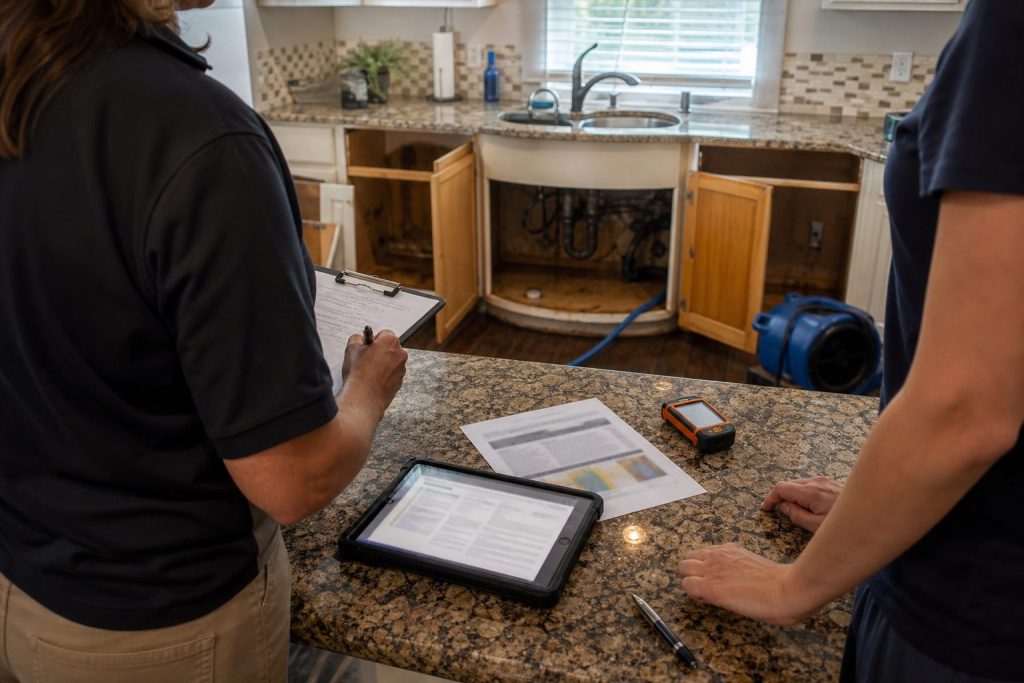
    Clipboard and tablet on a kitchen counter during an insurance adjuster walkthrough after water loss
    Layer 0 starts at the curb — can the site still talk?

    The pipe

    On a water job, cell bars lie. Fiber is dead. The moisture map still has to leave the truck.

    Starlink on a water job is not a partnership post. It is layer 0: a clear-sky dish, a 65–100 W brick, and a boring SSID so photos, Xactimate, and after-hours voice still move when the street does not.

    No pipe → no honest traffic. Voice agents and CRM cards do not invent bandwidth.

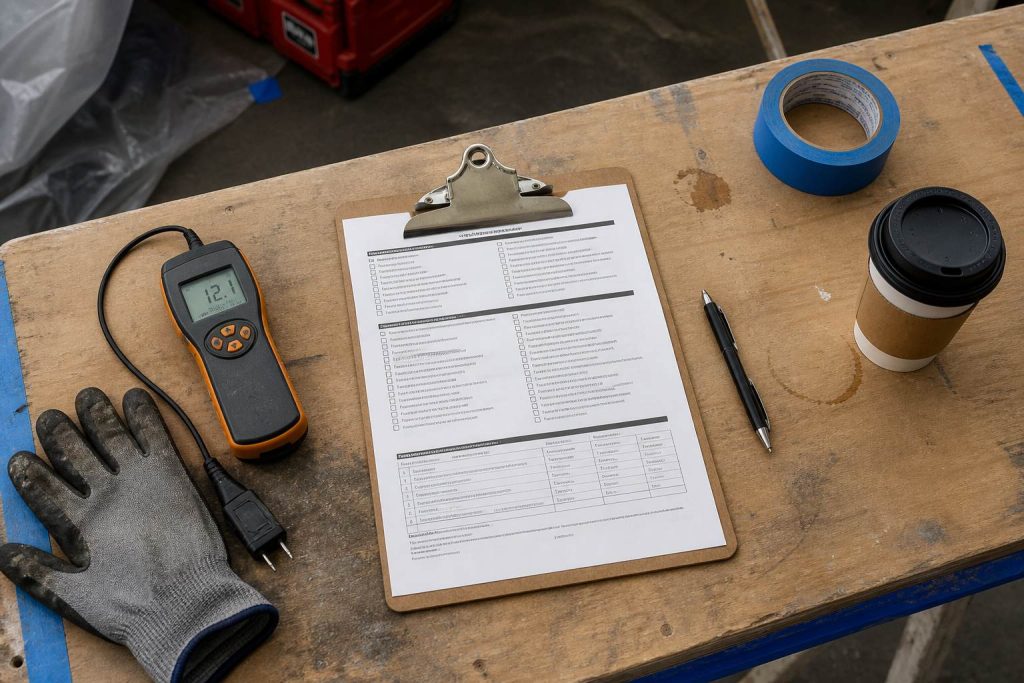
    Restoration SOP clipboard with checklist, moisture meter, and gloves on a jobsite table
    Clipboard math beats a prettier quote card.

    The pile

    Once the pipe works, the shop still has open estimates that do not book, supplements that sit, and missed rings that become someone else’s water job.

    The leftover pile borrows the math that cools a trapped ion. Count n (open quotes), A− (book or honest kill), A+ (new noise). Plot the leftover on Mondays. If it does not fall, follow-up is theater or miss rate is the heat.

    AI that only writes a prettier card is a thermometer. AI that texts back in a minute and closes the row is a kick.

    Gloved hands using a pin-type moisture meter on wet drywall during inspection
    Two seats. One measurement owner.

    The two seats

    Then you put more than one agent on the same laptop and discover the collision problem.

    Cursor checked in on Grok Desktop mid-job is the Cosync rule in the open: seats with jobs, not two models arguing in one thread. One seat keeps the PowerShell. The other reads the board, closes orphan twins, and does not steal the keyboard.

    Human Gate still owns OAuth, live Publish, and paid spend. Seats replace waiting and context loss — not the owner.

    Residential roof with blue emergency tarps after storm damage under gray sky
    Weather hits. The floor still has to run.

    One floor

    Read as three posts, they look like tech, physics, and tooling.

    Run as a week, they are one floor:

    • Pipe — can the site and the after-hours line still talk?
    • Pile — are open quotes shrinking on purpose?
    • Seats — who owns the keyboard, and who only Cosyncs?

    Skip the pipe and your “AI dispatcher” is a voicemail with better grammar. Skip the pile math and your lead gen is blue-detune (more noise, same booked jobs). Skip the seat rule and two tools fight over the same Chrome window while the work order twins drift.

    Steal this without buying our tools

    You do not need our stack names.

    • Write one Owner column and one Done-when line on every live card.
    • Put a truck kit on the hook for dead-fiber jobs (or admit you will not upload tonight).
    • Run the four-week leftover sheet before you buy another map-pack click.
    • Practice the check-in: are they stuck, or are they fine — and do I have a capability they lack? If they are fine, leave the keyboard alone.

    That is restoration + AI ops without a slide deck.

    What this is not

    • Not a Starlink / SpaceX / Tesla / xAI partnership.
    • Not “fully autonomous.” Publish and pay stay human.
    • Not Tacoma / Everett / Mason local news. Field notes stay method-first.
    • Not a new SKU. The front door on Tygart Media is still the kit you can copy and hang yourself.

    Related on Tygart Media: Starlink on a water job · The leftover pile · Cursor × Grok Cosync.