If you run a restoration company doing more than $2M a year, you’ve had the conversation. A friend in the business tells you their Contractor Connection volume just doubled. Your phone hasn’t rung in three days. You wonder if you should finally sign the paperwork.
Before you do, sit with the math. TPA programs are not free leads — they are the most expensive leads in restoration, paid with margin instead of marketing dollars. The question isn’t whether TPAs are good or bad. The question is whether your business model can survive what they cost.
Here is an honest look at the four programs restoration owners actually compare in 2026: Contractor Connection, Alacrity (now Altimeter Solutions Group on the managed repair side), Code Blue, and the smaller program work most operators don’t talk about openly.
How TPA Economics Actually Work
How TPA economics actually work.
Industry-reported referral fees on TPA work generally fall in a 5% to 20% range, with most managed-repair networks landing somewhere around 8% of the invoice. That fee comes off the top before you pay materials, labor, equipment, or overhead.
The hidden cost is bigger than the fee. TPA work typically settles on extended payment terms — often 30 to 90 days — while your crews need to be paid weekly and your subs every other week. You finance the carrier’s cash conversion cycle out of your operating account. On a $5M operation running 25% gross margin, sitting on $300K of receivables longer than your direct-bill book costs you real money in line-of-credit interest, opportunity cost on equipment purchases, and the slow erosion of payroll-week stress.
Industry consultants who work with restoration operators routinely advise keeping no single referral source above roughly 20% of revenue, and ideally under 10%. Once a TPA crosses that threshold, you are no longer a contractor — you are a subcontractor with a logo.
Contractor Connection
The largest network in the space and the one most operators encounter first. Owned by Crawford & Company, it positions itself with a “pay as you grow” structure: an application fee up front, then fees tied to the work you actually receive. Carrier relationships are deep, with most of the major property insurers routing some volume through Crawford’s managed-repair channel.
Entry requirements published on Contractor Connection’s potential-contractor portal are not soft: a minimum of one year of financial statements demonstrating stability, $1M general liability, $1M auto, workers’ comp, all required state and local licensing, a clean credit background, criminal background checks on field employees, current estimating-software and digital documentation capability, twelve quality references, and a commercial or industrial-zoned facility. No home-based operations.
Bottom line: Best fit for operators who already have crews, capacity, and the working capital to ride 60-to-90-day pay cycles. Worst fit for a $1M operator trying to use the program as growth capital — the volume will outrun your cash before margin catches up.
Alacrity Solutions / Altimeter Solutions Group
Alacrity announced the strategic sale of its Managed Repair Division, which now operates as an independent company under the Altimeter Solutions Group name with its existing leadership and team. Alacrity itself continues to run a broad TPA services book — claims handling, field adjusting, network solutions — but the contractor network specifically sits under the spun-off entity now.
Entry requirements emphasize the same screening contractors see across the major networks: criminal background checks, current licensure and certifications, demonstrated financial stability, and proof of insurance. Their ACCESS program layers in affinity discounts, supplier programs, and growth resources for network members — useful at the margin if you’re already in, less of a reason to join.
Bottom line: The leadership-continuity story on Altimeter is the thing to watch over the next twelve months. Spin-offs from larger TPA parents often go one of two ways: leaner and contractor-friendlier, or starved of resources and slower to pay. Talk to three current network contractors before signing — specifically about cycle time on payment since the transition.
Code Blue
An independent TPA serving casualty and property insurance carriers with end-to-end outsourcing. Smaller than Contractor Connection by volume, but contractors who run Code Blue work generally describe a more direct relationship with claim handlers and fewer layers of escalation. The trade-off is that Code Blue volume is lumpier — when a carrier surge hits, you get the work; when carriers route elsewhere, your queue thins.
Requirements track industry standard: financial stability, customer service track record, business insurance, equipment, training, standardized estimating software. No home-based operations. Background checks and certification documentation required for field staff.
Bottom line: Reasonable second or third program for an operator already in Contractor Connection who needs incremental volume without doubling down on a single source. Not a first-program choice unless your local market has a Code Blue–heavy carrier mix.
What “Worth It” Actually Looks Like
Worth it means workflow fit — not logo count.
Run the math on your own P&L before you sign anything. A direct-bill water-mit job at a healthy restoration shop targets gross margin in the 35% range after labor and materials. The same job under a TPA at an 8% referral fee, with the typical scope-and-pricing concessions and the 60-to-90-day pay cycle, often lands closer to 18-22% gross margin once you’ve fully loaded the cost of carrying the receivable.
That gap is not a reason to refuse program work. It is a reason to know exactly what it’s paying for. Program work pays for crew utilization in slow weeks. It pays for keeping equipment off the shelf. It pays for the operational discipline of running standardized scopes and tight documentation. What it does not pay for is replacing your direct-to-consumer marketing — because the second you let your local lead engine atrophy, you’re locked in at whatever margin the network decides to give you next year.
The Exit Question
The exit question before you join a network.
Operators who successfully unwind from heavy TPA dependency rarely do it all at once. The pattern that works: cap program volume at a hard percentage (10-20% of revenue), reinvest the margin gap from non-program work into local SEO, LSA campaigns, and adjuster relationships, and use the program work as a deliberate utilization buffer rather than a primary revenue stream.
Operators who get stuck in the trap share the same profile: 60%+ of revenue from one or two networks, no direct marketing investment, no adjuster-direct relationships in their territory, and a fleet and crew count sized to the program’s volume rather than their own sales engine. When the program cuts your assignments — and it will, at some point, for reasons that have nothing to do with your performance — you have no Plan B.
Bottom Line
TPA programs are a tool, not a strategy. Contractor Connection is the most established and the highest-volume option for operators with the capital structure to absorb extended payment cycles. Altimeter (formerly Alacrity Managed Repair) is in transition and worth diligence before joining. Code Blue makes sense as a secondary source, not a primary one. Whatever you sign, build the business to survive without it — because every restoration operator who has run a TPA-heavy book for more than five years will tell you the same thing: the program does not love you back.
What percentage do TPAs typically charge restoration contractors?
Referral fees in restoration TPA programs generally fall between 5% and 20% of the invoice, with most managed-repair networks landing near 8%. The fee comes off the top before you pay labor, materials, or overhead.
How long do TPA programs take to pay restoration contractors?
Payment cycles on TPA work commonly run 30 to 90 days, which means you finance the carrier’s cash conversion cycle out of your operating account. Plan working capital accordingly before signing any program agreement.
Should I rely on a single TPA for most of my revenue?
No. Industry consultants advise keeping any single referral source under 20% of revenue, ideally under 10%. Above that threshold, you lose pricing power and become structurally dependent on a relationship you don’t control.
Is Contractor Connection or Alacrity better for new contractors?
Contractor Connection has deeper carrier relationships and higher volume, making it the more common first program. Alacrity’s contractor network sits under the spun-off Altimeter Solutions Group as of the recent transition, which adds diligence risk for new entrants — talk to current network contractors about payment timing before joining.
If you run a restoration company doing between $1M and $10M, the software question is no longer “do we need a system?” It’s “which one do we commit to for the next five years, because the switching cost is going to hurt either way.” This is the honest comparison nobody selling you a demo will give you — built from each vendor’s own site, with the Xactimate / profitability / multi-location matrix verified 8 September 2026.
Direct Answer (September 2026): The four purpose-built restoration job platforms are Cotality DASH (TPA / insurance programs), Albi (customizable retail, Pro seats for Xactimate), PSA by Canam (ERP + job costing, flat team pricing), and Xcelerate (process discipline, job-level margin). Xactimate / XactAnalysis is the estimate and assignment layer, not a fifth job system. Encircle, CompanyCam, JobNimbus, and ServiceTitan are adjacent tools, not the system of record.
The restoration software market in 2026 has consolidated into those four platforms plus a tier of adjacent tools that solve part of the problem and force you to stitch the rest.
The short answer for impatient owners
DASH (Cotality): Deepest insurance-ecosystem path. First look if TPA volume is more than 30% of the book. Formerly DASH by Next Gear Solutions.
Albi: Most customizable. $6,000 minimum annual subscription ($60/seat Base, $100/seat Pro). Xactimate and XactAnalysis on Pro seats only.
PSA (Canam Systems): Independently owned ERP. Flat team pricing. Stronger once you cross roughly 15 users. Lists Xactimate, XactAnalysis, and Symbility.
Xcelerate: Process discipline and job-level profitability. SOC 2 Type 2. Quote-only pricing.
ServiceTitan / JobNimbus / CompanyCam / Encircle: Too much platform, or not a system of record.
Head-to-head
Factor
Cotality DASH
Albi
PSA (Canam)
Xcelerate
Pricing
Quote
$60 Base / $100 Pro / $6K yr min
Flat team, quote
Quote
Best for
TPA-heavy insurance work
Retail + customization
15+ users, job costing
SOP and margin control
Xactimate
Vendor Exchange import
Pro seats; pull into workbook, no push back
Listed + XA
Listed; work orders from lines
QuickBooks
Online + Desktop
Online + Desktop
Yes
Yes
Mobile
iOS + Android, offline
Albi Mobile
Proven OnSite
Field-to-office
Security
AICPA SOC 2 Type II
Not disclosed
Not disclosed
SOC 2 Type 2
Owner
Cotality
Independent
Independent
Independent (Teamfront acquisition reported 2024)
Xactimate and XactAnalysis: integration is not one feature
Verified 8 September 2026: Cotality DASH help (Vendor Exchange, link assignment), Albiware Xactimate docs, canamsys.com, xlrestorationsoftware.com Verisk page, XactAnalysis third-party integrations list.
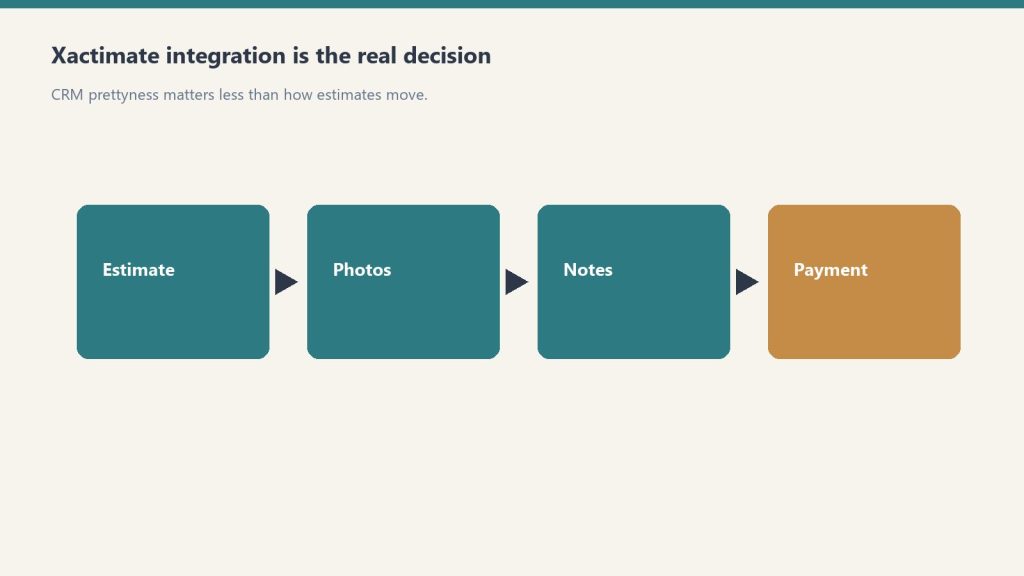
All four advertise a Xactimate path. The operator question is whether the estimate becomes a carrier-ready assignment without a second spreadsheet.
Motion
DASH
Albi (Pro)
PSA
Xcelerate
Estimate in
Vendor Exchange into the job (X1 sync or Xactimate Online auto-sync).
Pulls completed estimates into the workbook. Albi docs: does not push estimates from Albi into Xactimate.
Xactimate and XactAnalysis listed on canamsys.com.
Create/sync estimates; work orders from line items (vendor webinar + integration page).
XactAnalysis
Link XA / Claims Workspace to an existing job or claim. Corporate dispatched assignments cannot attach to a locally created Job.
On Pro seats. Actionable Insights profile can be the default Xactimate profile.
Listed partner. CanAm Systems also appears on XactAnalysis’s own integrations list.
Listed on the Verisk page. Confirm two-way assignment sync in demo — older copy on that URL used “soon.”
Carrier reporting
Estimate on the job slideboard; Compliance Manager for program checklists.
Recap by category; material/labor/equipment split; optional separate O&P lines.
Job costing in Proven Accounting next to the estimate.
Work orders and sub scopes from estimate lines; job margin view.
Xactimate is the estimate writer, not a fifth job-management platform. Insurance-backed shops need the job ID to survive supplement and invoice. Detail page: Xactimate integration compared.
Albi: Public Xactimate page covers estimated vs actuals, trade work orders, invoicing. Analytics add-on from $250/mo (June 2026 card): WIP, aging, job costing, division/PM splits.
Xcelerate: Sells job-level profitability and work orders from estimate lines.
PSA: Proven Accounting + Proven Analytics. Flat team pricing is the cost bet at 15+ users.
DASH: Live budgets on the job (Cotality product page). Stronger on program compliance than retail margin theater. Ask for estimate-vs-actual export on a closed file.
No vendor publishes a comparable public margin-% screenshot you can put in an RFP. Make every demo open one closed water job and one rebuild.
Multi-location and concurrent jobs
DASH: Built for program volume and multi-crew disaster work. Offline mobile. Dispatched program claims and local jobs are different objects.
Xcelerate: Markets to multi-location and franchise operators. SOP stage gates are the control. Confirm location permissions and shared XA assignments.
PSA: Named multi-brand logos on canamsys.com (BluSky, Winmar, PuroClean Canada, Dalworth). ERP assumes concurrent jobs. Implementation time is the tax.
Albi: Pro role-based permissions. Concurrent-project rules are whatever you configure. Multi-location needs that demo, not the homepage.
Alternatives to DASH and Albiware
If those two are off the table, stay inside the same four. Do not promote Encircle, JobNimbus, CompanyCam, or ServiceTitan to system of record.
Xcelerate — process enforced; live inside work orders from Xactimate lines.
PSA — headcount heading past ~15; accounting and jobs in one independently owned ERP.
Connects to QuickBooks Online/Desktop, Sage 100/300, Claims Connect, Matterport, DocuSketch, Cotality CRM, Cotality Mitigate. AICPA SOC 2 Type II. Offline mobile. Compliance Manager for carrier checklists. Quote: (866) 774-3282. Breaks when you want the workflow to be yours, not the program’s.
Albi
June 2026 public card: Base $60, Pro $100, $6K year minimum (2 Base + 2 Pro), onboarding from $1,000, Analytics/Automations from $250/mo each. DryBook 2.0 on Base. Xactimate/XA on Pro. Breaks at 20+ seats versus PSA flat pricing.
PSA (Canam)
Proven Accounting, Jobs, CRM, OnSite, Analytics. Open API. Xactimate, XactAnalysis, Symbility, Encircle, Matterport, DocuSketch. 9,278+ contractors claimed on canamsys.com. UI and ramp are the cost.
Xcelerate
SOC 2 Type 2. Job management, CRM, dashboards. Integrations listed on xlrestorationsoftware.com including Xactimate/XactAnalysis, CompanyCam, Encircle, Matterport, Power BI, TSheets. Customization is intentionally low. Quote: (423) 405-6417.
Decision framework
TPA / direct insurance above 30% of revenue? DASH first.
Users 24 months out above 15? Force PSA into the demo.
Software should enforce process (Xcelerate) or mirror yours (Albi)?
A $3M shop with eight users on the wrong platform burns 40–120 estimator/admin hours a month on double entry and late invoices. Sticker price is the wrong optimization.
Frequently Asked Questions
Do all four integrate with Xactimate and XactAnalysis?
All four advertise Xactimate. DASH uses Vendor Exchange and can link XA assignments, with rules on dispatched program claims. Albi Pro pulls estimates in and does not push them back. PSA and Xcelerate both list XA; confirm supplement direction on a live file. XactAnalysis’s own list includes DASH and CanAm Systems.
Which platform is best for job profitability tracking?
Albi publishes estimate-vs-actuals plus an Analytics add-on. Xcelerate sells job-level margin and work orders from estimate lines. PSA puts costing in Proven Accounting. DASH tracks live budgets and is stronger on program compliance. Demand the same closed-job walkthrough from every demo. Field list: profitability dashboards.
What are the alternatives to DASH and Albiware?
Xcelerate and PSA. Adjacent tools are not replacements for the system of record.
How much does Albi cost?
Per albiware.com, June 2026: Base $60/user/mo, Pro $100/user/mo, $6,000 year minimum, onboarding from $1,000, Analytics and Automations from $250/mo each.
Does Albi integrate with Xactimate?
Yes, on Pro seats only ($100/user/mo), including XactAnalysis. Not on Base seats.
Most restoration buyers in 2026 are paying for the wrong things. They look at top-line revenue, the truck count, the trailing-twelve EBITDA — and miss the structural details that decide whether the company they just bought is a $4M business or a slow-motion writedown. Private equity has deployed over $6 billion across 50-plus platforms since 2018, and the buyers who keep winning at these multiples are the ones with a checklist that goes deeper than the broker’s pitch deck.
Here is what the disciplined buyers — strategic acquirers, PE platforms, and operator-buyers — actually look at when they price a restoration company in 2026, and the five line items that quietly kill more deals than anything in the financials.
What buyers are actually paying for in 2026
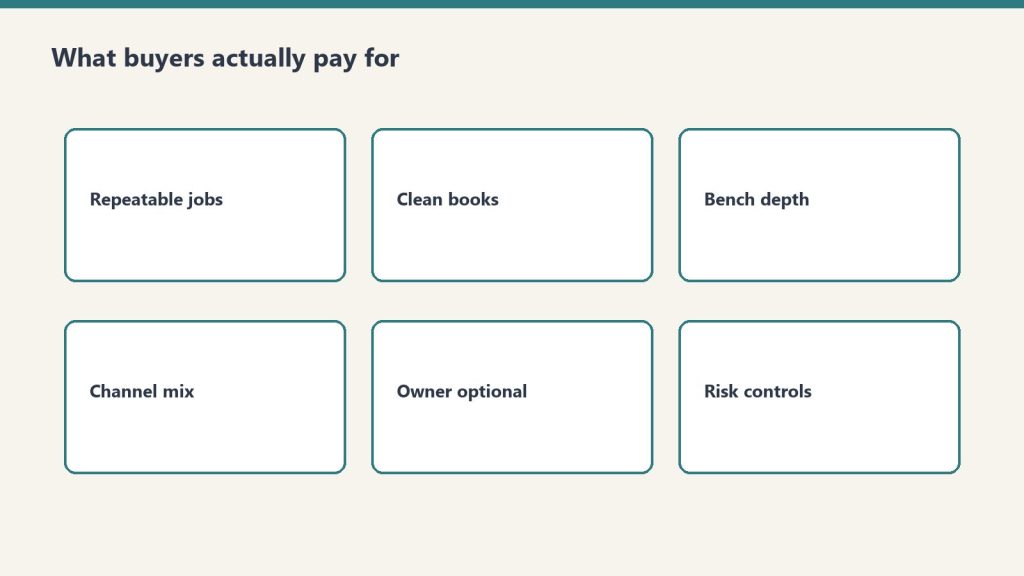
What buyers pay for in 2026 — transferability over heroics.
Median sale prices in restoration have risen to roughly $2.2M. Shops under $2M in revenue tend to clear at 2.5x to 3.0x SDE. The $2M to $5M EBITDA band — what the industry calls the PE feeder zone — trades at 4x to 6x EBITDA. Platforms above $10M EBITDA push 6x to 8x with strategic buyers willing to stretch further for the right geography or carrier panel. The spread between bottom and top of that range is not random. It is a function of five drivers that a thorough buyer will price line by line.
Carrier preferred-vendor status is the first thing on every diligence sheet. A company on the preferred panel of two or more Tier 1 carriers — State Farm, Allstate, USAA, Liberty Mutual — gets a multiple premium because that revenue is durable, repeatable, and very hard for a new entrant to replicate. A company that depends on one TPA program for half its work gets discounted because that revenue is one phone call away from disappearing.
Revenue mix matters almost as much. Mitigation-heavy companies — fast-turn water and emergency services — carry better margins and more predictable cash conversion than companies leaning on large-loss reconstruction. Reconstruction-heavy shops can still trade well, but buyers will model lower margins and longer working-capital cycles, which compresses the multiple.
Management depth below the founder is the third lever. If the owner is the estimator, the rainmaker, and the operations lead, the buyer will assume a 12 to 24 month earnout structure and discount the price accordingly. A general manager, an estimating lead, and a production manager who are staying through transition can add an entire turn of EBITDA to the offer.
CAT exposure is the fourth. Companies with more than 20-25% of revenue tied to catastrophic events get valued on a normalized basis — buyers strip the spike years out of the average. If you bought a restoration company on a peak hurricane year’s numbers, you overpaid. Sophisticated buyers know this and adjust before they sign the LOI.
The fifth is books that survive a quality-of-earnings review. In about 85% of deals, the QoE adjusts down from the seller’s claimed EBITDA, and the average haircut runs 10 to 15%. Companies that have already run a sell-side QoE and addressed the easy adjustments hold their price better than companies that hand a buyer a QuickBooks export and a confident shrug.
The five quiet deal-killers
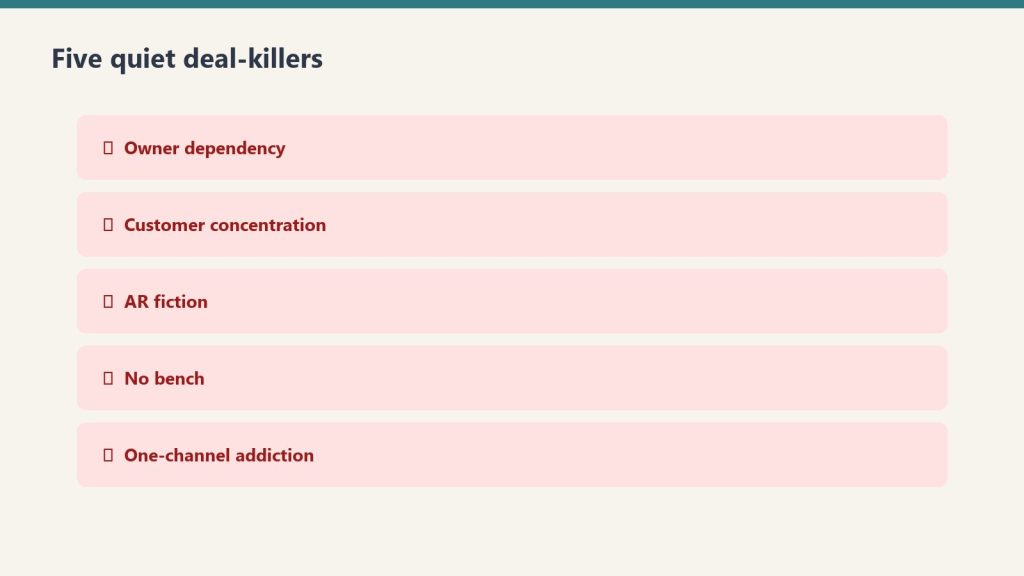
Five quiet deal-killers — fix before the LOI.
Most deals do not die on price. They die in the back half of due diligence, when something surfaces that the seller either did not disclose or did not realize mattered. These are the five issues that show up most often, and what a disciplined buyer does about each one.
1. Customer or carrier concentration over 20%. If a single carrier, TPA program, or property manager drives more than a fifth of revenue, the company has a single point of failure. Buyers either re-price the deal, structure a larger earnout tied to retention, or walk. The honest fix on the seller side is to diversify the book 18 months before going to market, but most do not have that luxury once they have decided to sell.
2. Licensing and certification gaps. Restoration is a regulated trade in most states. Buyers verify IICRC firm certification, individual technician WRT and ASD credentials, AMRT for mold work, state contractor licenses, and any specialty endorsements required locally. A lapsed firm certification or an expired mold license is not always a deal-killer, but it is always a price renegotiation and sometimes a regulatory exposure that gets baked into the purchase agreement as an indemnity.
3. Aged accounts receivable. Restoration AR ages slowly because insurance carriers and TPAs pay slowly. Buyers will look at the receivables aging report and discount anything over 90 days, sometimes severely. If a meaningful portion of the company’s "earnings" is actually trapped in 180+ day AR that nobody is going to collect, the working capital adjustment at close will swallow a real chunk of the purchase price.
4. Founder dependency in estimating and sales. This is the single most common reason restoration deals collapse or restructure into heavy earnouts. If the founder writes 60% of the estimates and personally manages the top carrier relationships, buyers know the business does not transfer. The seller who builds a real estimating department and pushes carrier relationships down to a sales lead two years before sale will capture meaningfully more value.
5. Compliance and labor exposure. 1099 versus W-2 misclassification, prevailing wage issues on commercial jobs, OSHA history, and EMR trends all surface in diligence. Buyers will hire an HR specialist on any deal above a few million in revenue, and a clean compliance picture is worth 0.25x to 0.5x of EBITDA on its own.
What a buyer should actually run before the LOI
Run unit economics before the LOI — not after.
The minimum diligence package on a serious restoration acquisition includes: a quality-of-earnings review by a firm that has seen at least a dozen restoration deals, an independent verification of carrier preferred-vendor status and any TPA contracts, a customer concentration analysis at the carrier and account level, an AR aging review by a buyer-side accountant, an IICRC and state licensing audit, and a sit-down with the operations and estimating leads with the founder out of the room. That last item is the most underused and the most predictive.
Buyers who skip any of these line items end up renegotiating after close or eating a writedown a year in. Buyers who run all of them tend to pay slightly less and own businesses that transfer cleanly.
Bottom line
The 2026 restoration market is the best buyer’s window of the next five years, but only for buyers with discipline. The capital is there, the seller pipeline is there as the founder generation exits, and the platform playbook has been proven by HighGround, American Restoration, and a half-dozen others. The companies worth buying at top-of-range multiples are the ones with diversified carrier mix, real management depth, and books that survive a serious QoE. Everything else is a turnaround dressed up as an acquisition — and turnarounds in restoration take 18 to 36 months to fix and often cost more than the purchase premium ever saved. Pay for what transfers. Walk from what does not.
What multiple do restoration companies sell for in 2026?
Sub-$2M revenue shops typically trade at 2.5x to 3.0x SDE. Companies in the $2M to $5M EBITDA range — the PE feeder zone — clear 4x to 6x EBITDA. Platforms above $10M EBITDA reach 6x to 8x, with strategic premiums pushing higher in the right geography or carrier panel.
What kills restoration acquisition deals most often?
Customer or carrier concentration above 20%, founder dependency in estimating and sales, aged accounts receivable that does not collect, licensing or IICRC certification gaps, and labor compliance exposure — in roughly that order of frequency.
How long should a buyer-side diligence process take?
For a sub-$5M revenue restoration acquisition, plan on 60 to 90 days from signed LOI to close. Quality of earnings runs three to five weeks, legal and licensing diligence runs parallel, and customer/carrier verification typically lands in the final two weeks before close.
Is buying a restoration franchise better than buying an independent?
Franchises like SERVPRO or ServiceMaster Restore deliver brand, training, and national-account access at the cost of royalties and territorial restrictions. Independents give you full margin upside and the freedom to build proprietary carrier relationships, but require self-built systems and certifications. For first-time operators, the franchise reduces execution risk. For experienced operators, an independent acquisition tends to compound faster.
Most restoration owners I know underestimate what their sketch workflow actually costs them. Not the per-claim app fee — the labor hour buried in every job where a tech spends 90 minutes measuring a flooded basement with a laser distance meter, then another 45 minutes back at the office rebuilding it in Xactimate Sketch. At a loaded labor rate of $45 an hour and ten water jobs a week, those 135 minutes per job add up to roughly $52,000 a year in tech hours tied up in measurement and sketch rebuild — a meaningful chunk of which is not directly billable. The sketch is the foundation of every line item Xactimate calculates — walls, floors, ceilings, missing wall openings, ceiling height multipliers — and if it’s wrong, the entire estimate inherits the error. So the question is not whether to invest in a sketch workflow. It’s which one.
Why the sketch is the most expensive five minutes in restoration
Sketch is expensive when you redo it — capture once.
Xactimate utilizes the sketch to drive line item quantities — square footage of drywall, linear feet of base trim, square footage of ceiling, paint surfaces, area for antimicrobial application. Get the ceiling height wrong by six inches in a 200-square-foot room and you’ve quietly undercut your paint and wall labor by roughly 100 surface square feet. Forget to draw a missing wall between a kitchen and a dining room and Xactimate treats them as two separate sealed rooms — doubling perimeter trim, ignoring shared dry-out airflow, and producing a scope that any seasoned adjuster will flag and ask you to redo.
Common sketch errors compound: rushing through measurements without verification, failing to account for wall thickness, overlooking irregular features like soffits or knee walls, and using incorrect roof pitch on exterior sketches. The result is either lost revenue on your end (you underbilled) or a denial cycle on the carrier side (the adjuster sends it back and your cash conversion stretches). Either way, the sketch is where the money leaks out.
The three sketch workflows actually used in the field
Three field workflows — pick one and train it.
Despite a dozen marketing pitches, restoration contractors use one of three approaches. Each has a real cost and a real time profile.
1. Manual Xactimate Sketch (laser distance meter + on-screen drawing)
The default. A tech walks the loss with a Bosch or Leica laser, writes measurements on a clipboard or phone notes app, then either sketches on-site in the X1 mobile app or rebuilds it at the office. Cost is whatever you already pay for Xactimate (Professional runs around $185/month per user on subscription pricing as of early 2026, per Verisk’s published rates — verify on your own contract because Verisk negotiates).
Realistic time for a competent tech on a 1,500-square-foot residential water loss: 45–60 minutes on-site for measurements and photos, plus 30–45 minutes back at the office to build the sketch in Xactimate. Call it 90 minutes total. The advantage: no extra software cost, full control. The disadvantage: every minute of that 90 is a minute a tech is not on another job, and your sketch accuracy depends entirely on how disciplined your tech is with a laser.
2. Encircle Floor Plan
Encircle’s floor plan product converts a smartphone video walkthrough into a Xactimate-ready ESX or FML import. Their published per-claim pricing is around $25 per claim as of 2026, with subscription bundles available — confirm current pricing with Encircle directly, as restoration software vendors revise tiered pricing frequently. Encircle’s marketing claims floor plans are delivered in under 6 hours, but in practice most users report same-day to next-morning turnaround.
The actual workflow advantage is not the speed of delivery — it’s that your tech leaves the loss with a video, not a sketch. On-site time drops to roughly 15–25 minutes. The office labor for sketch rebuild drops to near zero because Encircle delivers an importable file. If you’re running 40 claims a month and trimming 60 minutes per claim, that’s 40 hours of tech labor recaptured — roughly $1,800 a month in labor against $1,000 in Encircle fees. The math works above about 25–30 claims a month.
3. DocuSketch
DocuSketch uses a 360 camera kit instead of a smartphone video. The contractor captures spherical photos at each room, uploads, and DocuSketch returns an ESX file. Per their public materials, ESX and FML files are typically delivered 1 to 3 days after capture. Per-claim cost at scale runs around $70 when amortizing the Express plan ($1,095/month), the $795 camera kit, and overnight delivery fees against 20 projects a month — based on DocuSketch’s published comparison materials.
DocuSketch’s appeal is the 360 photo documentation that comes with the sketch — useful for supplement defense and for adjuster file packages. The disadvantage versus Encircle: slower turnaround (days, not hours), higher per-claim cost, and a camera kit your techs have to actually carry and use. For high-volume shops doing large losses and commercial work where 360 documentation has independent value, DocuSketch can earn its keep. For a typical residential water mitigation shop, the price-per-claim is hard to justify against Encircle.
The bottom line for restoration owners
Bottom line: faster accurate sketches protect margin.
If you’re under 20 claims a month, manual sketching is fine. Buy your techs better lasers and train them on Xactimate Sketch keyboard shortcuts (CTRL+click and drag to pull new rooms from existing ones is the single highest-leverage shortcut Xactimate ships). Sending a tech to one of the regular Xactimate fundamentals classes pays for itself the first month — it’s the cheapest sketch optimization you can buy.
If you’re between 20 and 60 claims a month and most of your volume is residential water, Encircle Floor Plan is the obvious move. The labor recapture pays for the subscription several times over, and your techs spend less time at the office rebuilding sketches and more time at the next loss. Make sure your techs actually shoot the video correctly — Encircle’s output quality depends on input quality.
If you’re north of 60 claims a month, running commercial losses, or losing supplements because your documentation packages are thin, evaluate DocuSketch alongside Encircle. The 360 documentation is a real defensible asset when you’re supplementing six months after the original scope. Some shops run both — Encircle for residential water mitigation, DocuSketch for commercial and large-loss reconstruction.
One workflow truth nobody likes to say out loud: the sketch tool only matters if your techs use it consistently. The shops that get the most out of Encircle or DocuSketch are the ones where the office manager refuses to accept a claim file without a video or 360 capture. Without that enforcement, you’re paying for software and still rebuilding sketches at the office because half your techs forgot to use it.
Pick the workflow that fits your claim volume, then enforce it. The sketch is the foundation of every line item Xactimate calculates. It’s worth more attention than most owners give it.
If you own a restoration company doing somewhere between $2M and $10M a year, you are operating in the most actively consolidated environment this industry has ever seen. Reported figures put the U.S. restoration market at roughly $7.1B in 2025, growing in the 5–6% CAGR range, with 50+ private equity platforms reportedly acquiring operators at multiples in the 4x–7x EBITDA range. Quality scaled operators in the $8M+ range have reportedly traded at the upper end — approximately 6x–8x EBITDA — when the asset is built right.
Almost none of that value gets captured by accident. The org chart you build at $2M determines whether you can survive $5M. The systems you install at $5M determine whether $10M makes you or breaks you. And the structure at $10M determines whether a PE platform sees you as a bolt-on at a discount or a regional anchor at a premium.
Here is the honest breakdown of what the org should look like at each revenue milestone, what the typical owner gets wrong, and what an exit-aware growth path actually requires.
$2M: The owner-operator squeeze
At $2M, the owner is still the bottleneck of every consequential decision. A typical structure: the owner does sales, estimating, and major-loss oversight; one office admin handles AR/AP and scheduling; six to eight technicians split across two to three trucks; one lead tech runs supplements informally. Reconstruction is either non-existent or subcontracted ad hoc.
What this stage actually feels like: gross margins on mitigation can run in the reported 65–75% range, but the owner’s labor is uncosted. If you charged your own time at the rate of a real operations manager (approximately $80K–$110K fully loaded), most $2M shops would discover their actual margin is thinner than their P&L suggests.
The mistake at this stage: hiring more techs to grow revenue. More techs at $2M without a coordination layer creates more chaos, not more profit. The next hire is not a fifth tech. It is the first non-owner decision-maker.
$5M: The operations manager inflection
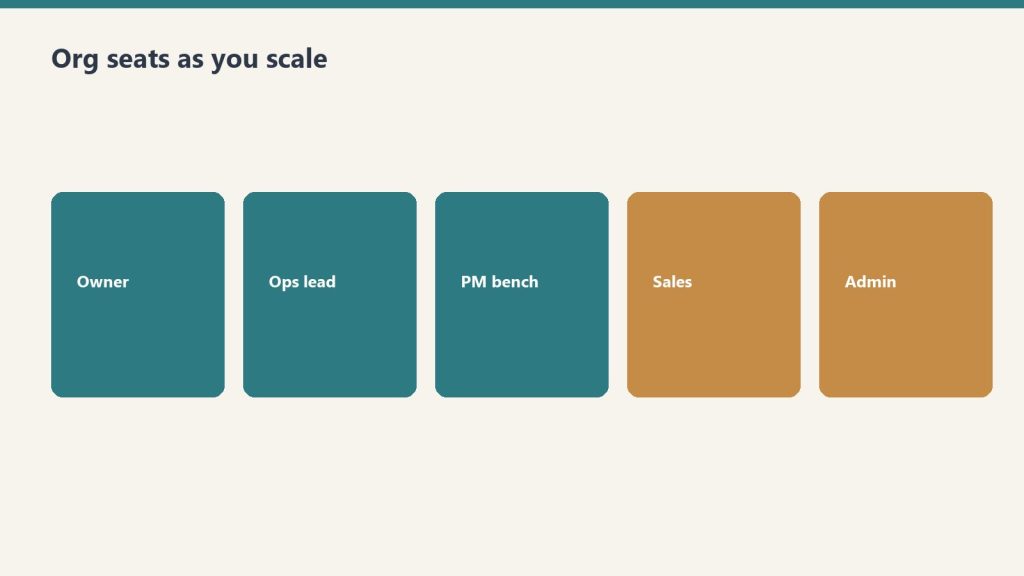
Seats change as revenue changes — titles are not the strategy.
$5M is where the structure has to change or the owner will burn out. The proven move is to hire a real operations manager — someone who owns the mitigation P&L day to day so the owner can focus on relationships, supplements, and growth. Reported compensation ranges for restoration operations managers cluster around $80K–$120K base plus variable, depending on market.
The $5M org typically looks like: owner; operations manager; one project manager for mitigation; one project manager (or a lead carpenter functioning as one) for reconstruction; office admin handling AR/AP; a dedicated estimator or supplement coordinator; 10–14 technicians across 4–6 trucks; one or two carpenters or subs handling reconstruction in-house.
This is also the stage where adding reconstruction matters disproportionately. Reported gross margins on reconstruction land in the 25–40% range — lower than mitigation but on much larger ticket sizes. A company that captures 25–30% of its mitigation revenue as in-house reconstruction by Year 3 of scaling tends to be substantially more valuable at exit, because reconstruction revenue is harder to replicate and stickier with carriers.
The mistake at this stage: the owner refuses to fully hand over the mitigation P&L. The operations manager becomes a dispatcher instead of a real GM. The org gets stuck at $5M for years.
$10M: The platform-decision stage
Platform-decision stage: managers own the week.
At $10M, the question is no longer “how do we grow?” — it is “what are we growing into?” There are two paths and they require different org structures.
Path A — single-market dominance. Stay in one metro, deepen TPA relationships (typically expanding from 2–3 carrier programs to 4–6), build a dedicated commercial division, and push toward $15M–$18M in a single footprint. Org: owner shifts to CEO role; operations manager promoted to COO; one mitigation manager; one reconstruction manager; commercial division lead; in-house controller or fractional CFO; dedicated marketing manager; office admin team of 2–3; 20–30 field staff.
Path B — multi-location expansion. Open a second branch in an adjacent market. This is where most $10M companies break. The org has to duplicate without doubling overhead: branch manager who reports to a regional operations leader; standardized SOPs, training, and KPIs; shared back-office (AR/AP, HR, marketing) from the home office; one finance function across both branches.
Reported industry experience is that the second location is the hardest. Branch three and four are dramatically easier if branch two is run with discipline. Most owners who fail at multi-location failed because they opened branch two as a bolted-on copy of branch one and did not build a real regional management layer in between.
$25M: Platform-ready
By $25M, the company is no longer a restoration business in the operational sense. It is a portfolio of branches with a central operating system. Org at this stage typically includes: CEO; COO; CFO (real, not fractional); VP of operations; regional operations managers (one per 2–3 branches); a dedicated commercial sales team; a marketing director; HR director; training manager; and 60–120+ field staff.
This is the structure PE platforms actually pay premiums for. The reported pattern: companies built around the owner trade at the lower end of the 4x–7x EBITDA range. Companies built around a system, with EBITDA visibility, repeatable branch economics, and a non-owner-dependent management team, trade at the upper end — approximately 6x–8x EBITDA, with some strategic transactions reportedly going higher.
The exit-aware framing
Exit-aware framing — org chart is part of the multiple.
Most restoration owners build the org chart they need today. Owners who exit well build the org chart their next buyer will want. The functional difference is small. The financial difference is enormous.
At $5M EBITDA of $1M, the difference between a 4x exit and a 7x exit is $3M. That gap is almost entirely a function of org structure, not revenue. Two restoration companies with identical revenue and identical margins will trade at different multiples if one is owner-dependent and the other is system-dependent.
Bottom line
The growth path is not a revenue chart. It is a sequence of structural inflection points. At $2M, the next hire is not a tech — it is a manager. At $5M, the next decision is not “more sales” — it is whether the owner will actually hand over the mitigation P&L. At $10M, the decision is single-market depth versus regional expansion, and the org has to be built before the second branch opens. At $25M, the company is either a platform asset or a glorified job shop — and the buyer can tell the difference in the first meeting.
The market is paying premium multiples for companies that look like platforms. Build the org that gets paid.
What is the right first non-tech hire for a $2M restoration company?
An operations manager or general manager who can own the mitigation P&L day to day, freeing the owner to focus on sales, supplements, and growth. Hiring another technician at this stage typically adds chaos, not profit, because the coordination bottleneck is the owner, not the field capacity.
When should a restoration company add in-house reconstruction?
Most owners benefit from adding reconstruction once they hit roughly $3M–$5M in mitigation revenue and have a stable operations manager in place. Reconstruction increases average ticket size, deepens carrier relationships, and is harder to replicate, which raises the exit multiple. Adding reconstruction before the org can support it usually just adds risk and overhead.
What EBITDA multiple do restoration companies sell for in 2026?
Reported ranges put quality restoration operators at 4x–7x EBITDA, with companies scaled to $8M+ in revenue and built around a system rather than the owner reportedly trading at the upper end of approximately 6x–8x EBITDA. Smaller operations under $500K in SDE often transact closer to 2.8x–3x on an SDE basis rather than an EBITDA basis. Numbers vary by region, carrier relationships, and quality of management team.
Is multi-location expansion or single-market depth the better growth strategy?
Both work, but they require different org investments. Single-market depth at $15M–$18M from one footprint can produce strong cash flow with less management complexity. Multi-location expansion produces higher exit valuations and platform optionality, but only if a regional management layer is built before the second branch opens. The most common failure mode is opening a second location without that layer in place.
Restoration company marketing is one of the most expensive paid-search categories in the United States. “Water damage restoration” keywords routinely clear $60–$85 per click in competitive markets, with reported outlier bids running well over $200 in metros like New York, Houston, and South Florida. Industry tracking has flagged some emergency-restoration terms breaking $500 per click in specific moments. Meanwhile, the average home-services lead via Google Local Service Ads (LSA) is roughly $53 — but water damage restoration sits at the premium end, with reported LSA cost-per-lead ranges of approximately $80–$180 depending on market.
If you run a $3M–$15M restoration company, this is the single biggest line item that nobody on your team is staring at correctly. Owners hear “marketing” and think website. The real fight in 2026 is channel allocation: how much should you spend on LSA, how much on Google Search Ads, and how much on owned SEO — and at what point does each one stop scaling? Here is the honest breakdown a $5M owner needs before their next marketing budget meeting.
The three channels that actually matter
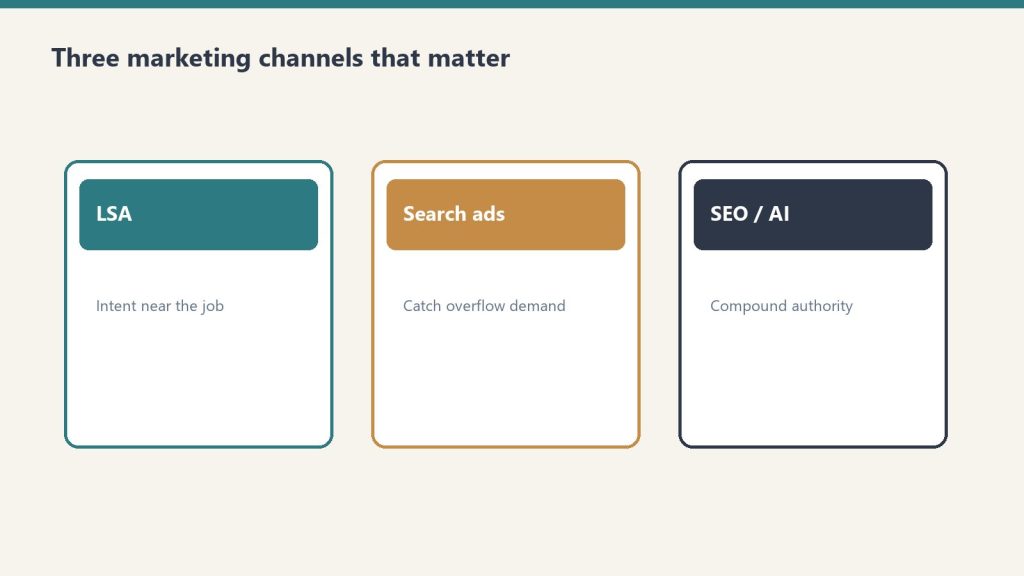
Three channels that actually matter for restoration demand.
For commercial water and fire restoration in 2026, three channels do the heavy lifting: Google Local Service Ads (the LSA “Google Guaranteed” boxes at the very top of the SERP), Google Search Ads (the paid text ads below LSA), and organic SEO (the map pack plus blue links). Everything else — Yelp, Angi, HomeAdvisor, Facebook, programmatic display, lead-broker buys — is either supplemental, declining, or actively cannibalizing your margin. The first decision is choosing where the bulk of your new-customer budget goes among those three.
Local Service Ads (LSA) — the default starting point in 2026
LSA is the highest-real-estate placement on a phone screen, period. For emergency-driven categories like water damage and mold, that real estate matters more than anything else. Reported 2026 cost-per-lead for water damage restoration through LSA generally falls in the $80–$180 range, with some markets reporting averages closer to $100 in stable competitive conditions. On a $6,000 average ticket, even a $150 LSA lead at a 25–35% close rate produces a customer acquisition cost (CAC) of roughly $450–$600 — which is workable on jobs that gross $1,800–$2,400.
The catch: Google removed credits for “job type not serviced” and “geo not serviced” leads in 2025, meaning every junk lead now hits your card with no recourse. You have to dispute leads inside Google’s dispute window and you have to answer your phone in under 30 seconds. LSA also weights reviews more heavily than any other channel — a 4.6 average will visibly underperform a 4.9 in the same zip code. If your review velocity is under 8 per month, fix that before you scale LSA spend.
Google Search Ads — the diminishing-returns layer
Below LSA, traditional Google Search Ads remain expensive and uneven. Reported 2026 average CPC for water damage restoration keywords falls into bands: bottom-of-funnel emergency keywords like “emergency water damage [city]” run $60–$85; less-direct terms like “water damage cleanup near me” run $40–$65; awareness-stage keywords like “what to do after a flood” run $20–$40. The trap is that close rates on Search Ads have been compressing for three reasons: LSA is taking the highest-intent clicks, AI Overviews are stealing informational queries, and click fraud from competitor bots remains nontrivial.
For most restoration owners, Search Ads should be a defense-and-coverage play, not a primary growth channel. Bid on your own brand name to keep TPA programs and franchise competitors from arbitraging your traffic. Bid on the keywords LSA does not cover well (commercial, mold remediation, biohazard, contents pack-out). Cap monthly spend. Watch the CAC, not the CPC.
SEO — the compounding asset that owners under-invest in
Owned SEO — Google Business Profile plus a real content engine on the company website — is where the math eventually breaks in your favor. Multiple cross-industry benchmarks in 2025–2026 put the cost-per-lead delta between SEO and paid search at roughly 4x–6x lower for SEO once a site is mature (typically 12–18 months in). One widely cited cross-industry benchmark places SEO CPL near $31 versus paid search closer to $181. Restoration-specific tracking from agencies serving the category has reported organic CPL well under $50 in established markets after 18+ months of investment, while paid CPL stays in the $150+ band.
The painful truth: SEO has a CAC of essentially zero on the marginal lead, but you cannot start it in January and expect leads in March. The owners who win SEO in restoration started 24 months ago, publish 6–12 useful pieces a month, and have a Google Business Profile with 500+ reviews and weekly post activity. If you have not started, your starting line is today — not next quarter.
The honest allocation for a $5M restoration company in 2026
A defensible 2026 marketing budget for a $5M residential and small-commercial restoration company, assuming 60% TPA-fed and 40% self-generated, looks roughly like this on the self-gen side:
LSA: 45–55% of self-gen ad spend. Highest immediate ROI. Cap by service area until close rate clears 30%.
Google Search Ads: 15–20%. Brand defense plus commercial, mold, and biohazard keywords LSA underweights.
SEO and Google Business Profile: 25–35%. This is content, on-site technical work, review-generation systems, and GBP weekly posts. Treat it as an asset, not a cost.
Everything else (Yelp, Angi, Nextdoor, paid social): under 5% combined, and only with tracked phone numbers per channel.
If your current mix is 80%+ LSA and 0% SEO, you are renting your customer pipeline from Google at a rate that will keep rising. If your current mix is 80%+ SEO and 0% LSA, you are leaving the highest-intent emergency calls on the table for competitors who will outbid you for them.
What to measure, not what to chase
Measure what pays — not vanity.
CPC, CPL, and CAC are not the same number. Restoration owners chase CPC because Google Ads dashboards make it visible. The metric that should sit on your monitor is blended CAC by channel, calculated quarterly: total channel spend divided by booked jobs from that channel. Track three more numbers next to it — close rate from lead to booked job, average ticket size by channel, and lifetime value adjustments for repeat and referral. A $180 LSA lead with a 35% close on $7,000 average ticket is a different business than a $40 organic lead with a 12% close on $2,200 average ticket — even though the CPL looks better in column B.
Bottom line
Bottom line: booked jobs beat pretty dashboards.
In 2026, LSA pays the bills, Search Ads defends the perimeter, and SEO is the only channel that compounds. The restoration owners who will be writing larger checks to their estimators in 2028 are the ones who fund all three this year — and the ones who refuse to pay $150 for a water damage lead because “that’s expensive” will keep watching franchise competitors and out-of-town aggregators win the calls that finance their own retirement. The expensive lead is the one you didn’t bid on at 2 a.m. when the house was actively flooding.
What is a good cost per lead for a water damage restoration company in 2026?
Reported 2026 ranges put water damage LSA cost-per-lead at roughly $80–$180, with some stable markets averaging closer to $100. Google Search Ads CPL is generally higher and more volatile. Organic SEO CPL trends well under $50 in mature programs after 12–18 months. Evaluate against your average job size and close rate, not against a flat industry number.
Are Google Local Service Ads still worth it for restoration companies?
Yes, for emergency categories LSA remains the most cost-efficient paid channel in 2026 because of its top-of-screen placement and pay-per-lead structure. The caveats: Google removed credit for off-service-area and wrong-job-type leads, review velocity matters more than ever, and you have to answer the phone in under 30 seconds to keep ranking.
How long until SEO produces restoration leads?
Plan on 9–12 months for a Google Business Profile and review-driven program to generate meaningful local-pack volume, and 12–18 months for content-driven organic leads to show up in any volume. Owners who treat SEO as a 6-month sprint nearly always abandon it 30 days before it would have started working.
Should I use a marketing agency or build in-house?
Under $3M revenue, hire one credible local agency for LSA plus GBP and own SEO with a part-time writer. From $3M–$10M, split LSA/Search Ads with an agency and bring SEO content in-house under a marketing coordinator. Above $10M, build the function internally with a director-level hire — at that size your marketing spend funds a salary and the data needs to live on your side of the firewall.
When WDFW closed Shine Tidelands and Wolfe Property on May 3, 2026, the agency didn’t frame it as a one-time enforcement response. It framed it as a policy tool.
The distinction matters for anyone tracking Hood Canal’s long-term shellfish management trajectory. WDFW’s post-closure statement said the agency intends to use early-season closure authority “whenever harvest pressure outruns sustainability.” That’s a shift from a reactive model — act after a population collapses — to a proactive one: close before the damage is done, even mid-season, even when the season was already shortened.
How the 2026 season got to this point
The closures at Shine Tidelands and Wolfe Property didn’t come from nowhere. WDFW entered 2026 having already implemented a statewide rule package targeting ten Puget Sound beaches showing harvest stress. At Shine and Wolfe, that meant cutting the season from New Year’s Day–May 15 to January 15–April 15 — removing six weeks of harvest opportunity before the season even opened. The May 3 action added an enforcement closure on top of an already-shortened season.
The compliance failures WDFW documented weren’t obscure technicalities. Harvesters exceeded daily limits. They left open dig holes — damaging habitat for subsequent harvests. They parked illegally and in ways that endangered other visitors. They misidentified species, harvesting protected or over-limit shellfish. WDFW’s Fish and Wildlife Police attributed the compliance collapse partly to social-media-organized gathering groups that drew hundreds of harvesters simultaneously to single beaches — a coordination mechanism that recreational management frameworks weren’t built to handle.
The dual-authority structure of Hood Canal shellfish oversight
Hood Canal shellfish management operates under two state agencies with independent authority. WDFW sets seasons, daily limits, and species rules. The Washington State Department of Health controls biotoxin and pollution closures through the Shellfish Safety Map and Biotoxin Hotline (1-800-562-5632). A beach can be open under WDFW and closed under DOH simultaneously — neither agency’s determination overrides the other.
Layered on top is tribal co-management. The Skokomish Tribe holds treaty-reserved shellfish harvest rights on Hood Canal under the U.S. v. Washington Boldt Decision framework. Tribal harvest occurs on state and private tidelands throughout the canal under a co-management arrangement with the state. WDFW’s conservation decisions — including season lengths and early closure authority — are made with tribal co-managers at the table. Decisions that contract the harvest available to recreational harvesters also carry implications for tribal harvest rights, which adds a legal and political dimension to the regulatory picture that extends beyond simple recreational management.
What Twanoh’s 2026 situation illustrates
Twanoh State Park’s 2026 configuration is a case study in stacked pressures. WDFW’s season shift moved the clam harvest window to May 15–June 15 — a six-week window instead of a longer one. Washington State Parks then scheduled a shoreline restoration project that will close beach access after the clam season ends, running through spring 2027. The campsite closure runs from June 1.
The restoration at Twanoh isn’t just a construction inconvenience. Shoreline restoration projects on Hood Canal typically target removing legacy fill, rip-rap, and channelization that degraded the nearshore habitat — the same kinds of projects that have been underway at the Mary E. Theler Wetlands at Belfair’s Union River estuary and at other points on the Great Bend. These restorations are intended to improve long-term habitat quality for shellfish and salmon. The short-term cost is access.
For the civic dimension: Twanoh’s restoration is a Washington State Parks capital project. Its timeline, scope, and funding aren’t widely covered in Mason County media. The Belfair Bugle will track the Twanoh restoration project’s milestones, the post-restoration shellfish habitat assessment when it’s available, and any further WDFW season adjustments on the Mason County stretch of Hood Canal.
Frequently Asked Questions
What is WDFW’s stated policy on mid-season shellfish closures after May 2026?
WDFW stated after the May 3 closures at Shine Tidelands and Wolfe Property that it intends to use early closure authority as a conservation tool whenever harvest pressure outruns sustainability. This is a proactive posture — the agency is signaling willingness to close beaches mid-season, not just at the end of a preset season window, if compliance and harvest rates indicate a problem.
How does tribal co-management affect WDFW’s Hood Canal shellfish decisions?
The Skokomish Tribe holds treaty-reserved shellfish harvest rights on Hood Canal under the Boldt Decision framework. WDFW makes season-length and conservation decisions in co-management with tribal fisheries managers. Changes that constrain recreational harvest also carry implications for tribal harvest allocations, giving these regulatory decisions a legal and intergovernmental dimension beyond simple recreational management.
What is the Twanoh State Park shoreline restoration project?
Washington State Parks is conducting a shoreline restoration project at Twanoh that will close beach access after the 2026 clam season ends on June 15. Campsite reservations are closed from June 1, 2026 through spring 2027. The restoration is intended to improve nearshore shellfish and salmon habitat by removing or remediating legacy shoreline alterations — a pattern seen at other Hood Canal restoration sites including the Theler Wetlands at Belfair.
What is the role of Washington DOH in Hood Canal shellfish management?
The Washington State Department of Health independently controls shellfish safety closures for biotoxins and pollution. DOH closures are separate from and independent of WDFW season decisions — a beach can be open under WDFW and closed under DOH simultaneously. DOH uses the Biotoxin Hotline (1-800-562-5632) and the DOH Shellfish Safety Map to communicate current closure status. Both must be checked before any harvest day.
Every restoration owner over fifty has the same question stuck in the back of their head: what is this thing actually worth? The honest answer in 2026 is somewhere between 2.3x SDE and 7x EBITDA — and the spread between those two numbers is not luck. It is the difference between a company a buyer wants and a company a buyer tolerates.
Here is what is happening in the market right now, what private equity is paying, and what kills the deal at the eleventh hour.
The 2026 Multiple Spread
Restoration M&A in 2026 sorts cleanly into three tiers. The cutoffs matter — they are not aesthetic.
Tier 1 — Sub-$2M revenue shops. Owner-operator businesses with one or two trucks, dependent on the founder for sales and crew leadership. These transact on Seller’s Discretionary Earnings (SDE), not EBITDA. Typical multiples: 2.3x to 3.0x SDE. The buyer is usually another restoration owner, a search-fund operator, or an industry veteran on their second act. There is no PE in this tier. The owner doing the work IS the asset, and that is exactly the problem.
Tier 2 — $2M to $5M revenue shops. The PE feeder zone. These get bought by platforms like BluSky, First Onsite, Belfor, ATI, and Code Red as bolt-on acquisitions. Multiples: 3.0x to 3.5x SDE, or 4x to 5x EBITDA if the company is clean enough to have real EBITDA at all. Purchase prices land between $900K and $2.5M. This is the sweet spot for industry roll-ups — large enough to have a real second-in-command, small enough to absorb without indigestion.
Tier 3 — $10M+ revenue, $2M+ EBITDA platforms. Now you are talking to PE directly, not through a strategic. Multiples: 5x to 7x EBITDA, occasionally higher for the right footprint. BluSky has announced 13 acquisitions in the last six years under Kohlberg & Company and Partners Group ownership. American Restoration rolled up 8 brands before exiting to Morgan Stanley. HighGround did 13 deals in five years before selling to Knox Lane. The playbook is well-documented. PE has put more than $6 billion into the space since 2018.
What Buyers Actually Pay For
Buyers pay for transferability — not heroic owners.
The multiple is a function of risk, not affection. Sophisticated buyers pay up for five things, in roughly this order:
1. Insurance carrier preferred-vendor status. If you are on the panel for State Farm, Allstate, USAA, Liberty Mutual, or any TPA program — Contractor Connection, Alacrity, Code Blue — that contract is the asset. It is also the hardest thing to replicate. Buyers will pay a premium for it because they cannot buy it any other way except by buying you.
2. Mitigation-heavy revenue mix. Water mitigation runs gross margins around 70-80%. Reconstruction often runs 10% or less. A company that is 65% mitigation and 35% reconstruction is worth materially more than the same revenue split inverted. Buyers will pull your job-cost reports line by line during diligence to confirm the mix is real and not just how you are categorizing.
3. Management depth below the founder. If you can take a two-week vacation and revenue does not blink, your multiple goes up by half a turn. If the phones stop ringing the moment you leave, you are selling a job, not a business. Hire a real general manager 18 months before you list.
4. CAT exposure under 20%. Catastrophic event revenue is lumpy and cannot be modeled. If 40% of your last three years came from one hurricane season, buyers will discount that revenue heavily — sometimes valuing CAT-driven dollars at half the multiple of recurring carrier work. Diversify your revenue base before going to market.
5. Clean books with a Quality of Earnings opinion. Every PE-backed deal includes a QoE — an outside accounting firm that re-audits your trailing twelve months and normalizes EBITDA. If your books are run on a personal-finance app and your CPA does taxes once a year, expect the QoE to find $200K-$500K of EBITDA adjustments that go against you. Spend $40K on a CFO-for-hire and a real GAAP P&L two years before sale.
What Kills the Deal
What kills the deal is usually quiet and operational.
Roughly 30-40% of restoration LOIs do not close. Almost always for reasons the seller could have prevented.
The biggest deal-killer is customer concentration. If one TPA program represents more than 35% of revenue, buyers panic. They have seen what happens when Contractor Connection decides to rebid a region — entire $8M revenue lines disappear in a quarter. Diversify before you list.
The second is uncollected aged receivables. Restoration AR over 90 days is not an asset, it is a write-down waiting to happen. Buyers will deduct uncollected AR from purchase price dollar-for-dollar. Aggressively collect or write off everything before you go to market.
The third is licensing and certification gaps. IICRC, state contractor licenses, mold remediation certifications by state — buyers run a full compliance audit. A single expired contractor license in a key state can cost $50K-$150K at close.
The fourth is founder dependency on first-call relationships. If the property manager calls you personally when there is a flood — not a dispatch number, not a sales rep — buyers will require an earnout structure that makes you stay another three to five years. Most owners hate earnouts because they convert sale price into deferred contingent comp. Build the dispatch infrastructure before you list, and you keep the cash up front.
The Honest Bottom Line
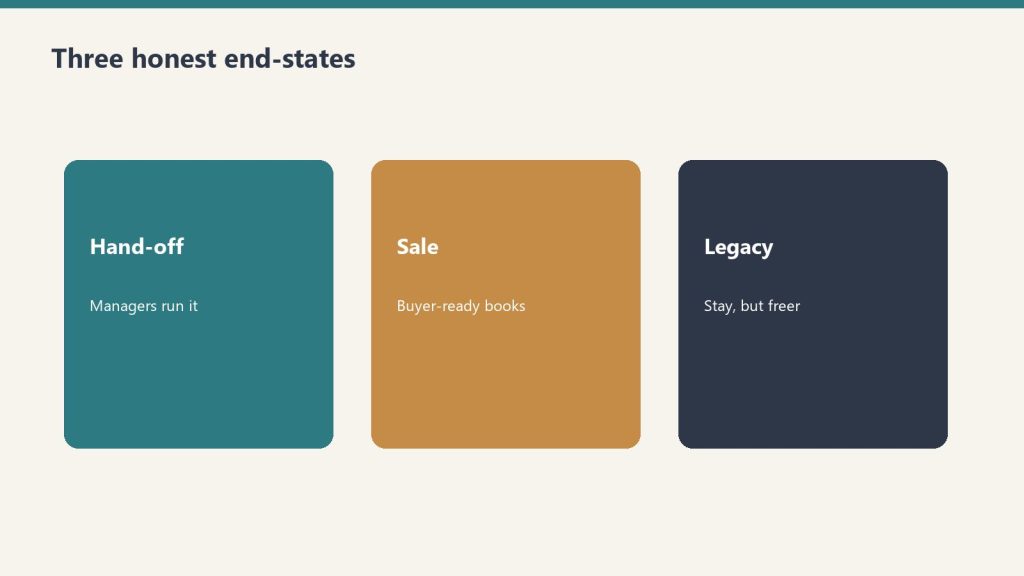
Honest bottom line: pick an end-state and work backward.
If you are a $3M revenue restoration company today and you want a clean exit at a real multiple, you have an 18-to-24 month preparation window. Use it to get the books on accrual, hire a GM, diversify off any single TPA, build mitigation revenue past 60% of mix, and get every certification current.
Do that, and a $3M shop running 18% EBITDA margins ($540K) sells at 4.5x to a strategic — about $2.4M cash at close. Skip it, and the same company sells at 2.6x SDE — closer to $1.4M, often with a punishing earnout attached.
The difference is one million dollars. The work to capture it is roughly nine months of operator focus. That is the highest-ROI work an exiting restoration owner can do.
Direct answer: On a commercial specialty loss, the room is bigger than most restoration operators assume. The carrier has a staff, independent, or TPA adjuster running the file. The facility has a risk manager and often a broker. A public adjuster may be retained. A large loss brings in large-loss specialists, accountants for business interruption, and technical experts for specialty valuations. The restoration company that understands this room — who decides what, what documentation each party needs, and how specialty work fits into commercial policy structures — is treated as a participant in the claim rather than as a vendor waiting for scope approval. That shift in positioning is worth more revenue over time than any rate-sheet negotiation.
The previous seven articles in this cluster have built the operational case for the specialty wedge: what the categories are, what the ESA looks like, what accounts respond to it, and how the specialist bench gets built. This article covers the financial and contractual mechanics that run in parallel — the insurance and adjusting side of every commercial specialty loss. Miss this side and the operational work does not convert into paid work.
Commercial insurance is structurally different from residential insurance in ways that matter for every decision a restoration company makes on a specialty event. Policies are written on different forms. Deductibles are higher and sometimes paid out-of-pocket by the insured before the carrier engages. Business interruption is a live coverage that runs on its own clock. Scope of loss is adjudicated against policy language and often against pre-existing replacement-cost-value schedules. Specialty items frequently carry their own endorsements, riders, or scheduled coverages separate from the main property form. And the adjusting function is distributed across multiple roles rather than concentrated in one person. A restoration company that enters this environment with residential habits — “I’ll do the work and the carrier will pay the invoice” — spends two years getting punished by the system before learning how it actually works.
The rest of this article is the operator-level map.
Who is actually in the room
Who is in the room on a commercial specialty loss.
The parties at the table on a commercial specialty loss, in roughly the order they appear:
The insured. The facility itself — through its facilities director, risk manager, operations leader, or corporate real estate director. This is the party whose property is damaged and whose coverage is at stake. On significant losses, the insured is represented by its risk function, which is materially different from the facilities function. Risk manages the policy relationship and the financial outcome; facilities manages operations. Both matter. They do not always agree with each other.
The broker. Most commercial policies are placed through a broker — Aon, Marsh, Willis, Lockton, Gallagher, Alliant, Brown & Brown, Hub, and many regional and specialty brokers. The broker is the insured’s advocate with the carrier, is paid by the carrier out of premium, and usually has a long relationship with the insured’s risk function. On large losses, the broker’s claims advocacy team is actively involved in negotiating scope and settlement.
The carrier’s adjuster. This is the person running the claim on the carrier’s side. Three variants exist. A staff adjuster is a carrier employee; common on small to mid-size losses and on carriers that use in-house handling. An independent adjuster (IA) is a contractor deployed by the carrier through firms like Alacrity Solutions, Pilot Catastrophe, Eberl, Worley, Crawford, or Sedgwick; common on large losses, CAT events, and geographically dispersed exposure. A TPA (third-party administrator) adjuster is the primary handler for carriers that outsource claims administration and for self-insured and captive-insured programs; common on commercial programs, public entities, and corporate risk-management structures. The restoration company’s ability to work productively with the adjuster depends significantly on which type is assigned, because their authority, their time horizon, and their reporting structure differ.
The public adjuster. When retained by the insured (usually on significant losses where the insured wants its own adjusting advocate), the public adjuster — PA — is paid by the insured, typically on a percentage of settlement, and represents the insured’s interests in scope development and negotiation. PAs are regulated state by state; several states prohibit them on commercial losses, others allow them with restrictions. On losses where a PA is involved, the dynamic shifts — negotiations take longer, documentation is scrutinized harder, and the restoration company needs to provide tighter scope evidence.
The large-loss adjuster or general adjuster. On losses above a dollar threshold — typically $250,000 to $1 million depending on the carrier — the file escalates to a large-loss or general adjuster. These are senior, experienced adjusters with broader authority and usually a more commercial orientation. Some are staff, some are GA-track independents. When a large-loss adjuster takes the file, the restoration company’s interaction becomes more substantive and more documentation-driven.
Specialty consultants. On large or technically complex losses, the carrier commonly retains technical experts: a forensic engineer for cause-and-origin, a certified industrial hygienist for environmental and IAQ work, a forensic accountant for business interruption, a specialty valuer for art or antique items, a cost consultant for high-dollar reconstruction, and sometimes a building consultant for envelope or structural issues. These specialists produce deliverables that drive scope decisions.
The TPA’s file examiner. When a TPA is administering claims, an examiner manages the file behind the scenes — reviewing adjuster work product, authorizing payments, and enforcing the program’s service-level standards. The examiner is rarely on site and is often invisible to the restoration company, but their decisions affect payment timing and scope approval.
Coverage counsel. On disputed losses or large losses where coverage issues surface, the carrier will engage coverage counsel. The insured may engage its own. At this point the claim has become a negotiation in a legal frame. The restoration company’s documentation becomes evidence.
The restoration company does not work with all of these parties on every loss. On a $50,000 commercial water event, it may be only the insured and an independent adjuster. On a $5,000,000 hospital fire with specialty equipment and business interruption, it may be all of them. The operator’s task is to map who is at the table on each event and communicate with each party at the right level of technical and contractual detail.
Commercial policy structures and what they cover on specialty losses
Commercial property policies are not written on a single form. Four families of forms matter for the restoration company’s day-to-day work.
ISO Commercial Property program. The Insurance Services Office writes standardized forms — Building and Personal Property Coverage Form (CP 00 10), Causes of Loss forms (Basic, Broad, Special), and various endorsements. Most mid-market commercial policies are written on ISO forms or close variants. Specialty items get coverage through the Building and Personal Property form unless they are scheduled out into separate endorsements.
Manuscript forms and package policies. Large commercial accounts and specialized verticals (healthcare, universities, financial services, real estate portfolios, manufacturing) often have carrier-specific or manuscript forms that modify or replace ISO language. AIG, Zurich, Chubb, FM Global, Travelers, Liberty Mutual, and The Hartford all publish proprietary commercial forms. These forms generally provide broader coverage than ISO Special Form but with more complex conditions and sublimits.
Scheduled property. Certain high-value items are scheduled individually rather than covered under the general property form. Fine art (blanket or itemized scheduled), rare books, specialty medical equipment, trading-floor technology, and specific pieces of machinery are often scheduled with specific values, specific covered perils, and sometimes specific named conservators or repair vendors.
Inland marine. Specialty coverages that sit outside the building are often written as inland marine — fine art (scheduled or blanket), medical equipment on lease (Motor Truck Cargo for mobile medical imaging, for example), contractor’s equipment, and data-processing equipment at multiple locations.
The implication for restoration companies: the answer to “is this covered?” on a specialty item is rarely obvious from the general property policy. The insured’s broker or risk manager will know how a specific item is scheduled, endorsed, or covered. The restoration company should ask — politely, early — about coverage structure on high-value items before assuming the work will be paid under the mainline property form.
Three coverage concepts that appear on most commercial losses:
Replacement cost value vs. actual cash value. RCV settles at the cost to replace with like kind and quality. ACV settles at RCV less depreciation. Most commercial forms pay RCV if the insured repairs or replaces, but pay ACV initially with a holdback until repair is proven. For restoration services, this distinction matters because the invoice structure has to support the RCV conversion — which means documented scope, documented completion, and invoicing that tracks to the carrier’s RCV recovery process.
Coinsurance. Commercial property forms usually contain a coinsurance clause requiring the insured to carry coverage at a specified percentage (commonly 80%, 90%, or 100%) of the insured value. Under-insurance triggers a penalty that reduces the settlement. This is not usually a restoration company problem, but it affects the insured’s willingness to accept an aggressive scope because a scope that triggers a coinsurance penalty is a scope that costs the insured money. Restoration companies that scope aggressively without understanding the policy structure damage the insured’s financial outcome and the relationship.
Sublimits. Commercial policies routinely have sublimits for specific categories: contents in rooms subject to flood, fine art, electronic data, business records, and items in specific storage configurations. A loss that exceeds a sublimit is paid only up to the sublimit, regardless of the full loss value. Restoration companies working on specialty losses should know the sublimits in play so they can scope and communicate realistically.
Business interruption and the restoration clock
Business interruption and the restoration clock.
Business interruption coverage is the financial engine behind commercial restoration urgency and is the single coverage most often misunderstood by operators.
BI pays the insured for lost income during the period of restoration — the time from the loss event until the property can, with reasonable speed, be repaired or replaced and operations restored. The clock runs during restoration. The longer the restoration, the more BI the insured collects — which sometimes makes people assume that slower restoration is better for the insured. That is backwards in most cases. BI is capped by period-of-indemnity limits (often 12 months), by policy sublimits on dependent property and civil authority extensions, by extra expense limits that may be exhausted mid-loss, and by the insured’s actual lost margin — which includes lost customers who do not return when operations resume.
The correct operational posture is that the insured and the restoration company share an interest in restoring quickly. BI is not an excuse to slow down; it is the mechanism that funds the urgency. Specialty work is directly BI-sensitive — a hospital whose imaging is down is losing procedure revenue and triggering BI; a financial firm whose records are off-site in freeze-drying is limited in its operations; a cultural institution whose galleries are closed is generating BI on lost admissions and event revenue. The specialty wedge reduces BI duration, which is often the strongest ROI argument for the ESA in the first place.
Three BI-adjacent coverages that restoration companies should know:
Extra expense. Pays the insured for costs incurred to continue operations or accelerate restoration beyond normal costs. A temporary imaging suite rental, expedited manufacturer recertification, priority freeze-drying at premium rates, emergency specialist activation — these are often extra expense items. Getting them pre-approved by the adjuster at the time of incurrence is cleaner than arguing about them at invoice.
Civil authority coverage. Pays BI when a civil authority prohibits access to the insured property because of damage at an adjacent property. Relevant on CAT events and in urban environments.
Dependent property / contingent business interruption. Pays BI when a dependent property (a supplier, a customer, a key logistics node) suffers a loss that impacts the insured. Emerging in commercial coverage and usually outside the scope of restoration work, but sometimes in play when the specialty loss affects a contract manufacturer, logistics hub, or shared facility.
The scope-of-loss process
The scope of loss is the formal document that defines what the restoration work is. It is the central artifact of any commercial claim, and the quality of the scope drives the quality of the payment.
The standard scope-of-loss process on commercial work:
Initial inspection. Carrier adjuster, insured or PA, and restoration company walk the loss. Observations recorded by all parties. On large losses, specialists from the specialty bench may be present on the walk-through.
Mitigation scope. The emergency services work — water extraction, dry-out, containment, specialty stabilization — is scoped separately and billed early, often before the full scope of loss is developed. This is priced against the ESA rate schedule or against Xactimate mitigation line items.
Full scope of loss. After the property is stable, the carrier’s adjuster, often with specialists (engineering, IAQ, specialty valuers), develops a full scope covering structural repair, contents, specialty items, and business interruption. This scope is the basis for settlement of the claim and the basis for the restoration company’s reconstruction and specialty work pricing.
Scope approval and work authorization. The insured and the carrier agree on scope. The restoration company receives authorization for each phase of work.
Execution and documentation. Work is performed. Documentation is produced on a rolling basis — daily notes, photographs, moisture logs for drying, chain-of-custody logs for document work, biomed sign-offs for medical equipment, conservator reports for art. This documentation is the evidence that the work was performed to scope.
Invoice and payment. Invoices submitted against approved scope with supporting documentation. Payment processed through the adjuster or directly through the carrier’s claims system. Some carriers pay through an insured-controlled account (insured pays the contractor, carrier reimburses the insured); some pay direct to the contractor (common when there is an AOB or direct-bill arrangement); some pay jointly (to insured and contractor).
Xactimate is the dominant estimating platform. Approximately 80% of property claims are estimated in Xactimate. Restoration companies working commercial need Xactimate proficiency — either an in-house estimator with Level 1 or Level 2 certification or a relationship with a third-party estimating service. Scope developed in Xactimate using current carrier price lists settles faster than scope developed in other formats. Scope that deviates from Xactimate norms needs specific justification — unique conditions, specialty pricing not in the standard price list, or negotiated departures from default pricing.
Specialty scope is where Xactimate runs out of detail. Freeze-drying a pallet of documents, ultrasonic cleaning of a rack of servers, biomed recertification of a CT scanner, conservation of a damaged oil painting — none of these live cleanly inside Xactimate line items. The restoration company, in partnership with the specialist, has to develop specialty scope separately using the specialist’s own pricing methodology (per cubic foot, per square foot of material, per piece, per instrument) and then incorporate that into the overall scope. The adjuster may or may not accept the specialty scope at face value. On significant losses, the carrier will often retain a specialty consultant to validate the specialty scope and pricing. Being ready for that validation — with chain-of-custody documentation, technical evidence of the recovery need, and industry-standard pricing references — is what converts specialty scope into paid work.
Documentation discipline on specialty losses
Documentation discipline on specialty losses.
The documentation produced during a specialty loss is both operational evidence and financial instrument. On commercial losses, the quality of documentation drives settlement speed, settlement value, and audit defensibility. Five documentation streams that belong on every specialty loss:
Loss environment documentation. Photographs at arrival, photographs during stabilization, photographs at completion. Moisture mapping. Environmental readings (temperature, relative humidity, particulate, air pressure). Atmospheric condition logs for the first 72 hours (the window in which most specialty loss decisions are made). Any readings beyond normal environmental parameters — toxic vapor, asbestos disturbance, lead dust — with documentation of the protective measures deployed.
Chain of custody. Every physical item removed from the site, every location it travels to, every person who handles it, every environmental condition it is stored in, every return event. For documents, this is boxes and pallets tracked by RFID or barcode. For electronics, this is serialized equipment with date/time/handler logs. For art, this is object-level tracking including photographic documentation of condition at each transfer. For medical equipment, this is serial-number-tracked items with biomed sign-off at each transfer. Chain-of-custody is the single most important specialty documentation stream and the one most often underbuilt.
Scope evidence. Line-item justification for every scope item. Xactimate documentation for standard items. Specialty-specific pricing documentation with industry references where possible (freeze-drying per cubic foot reference ranges, ultrasonic cleaning per square inch, conservation per hour with AIC conservator rate guidance, biomed recertification per OEM schedule).
Specialist technical reports. Each specialty subcontractor produces a technical report on their portion of the work: conservator’s treatment report, biomed’s recertification documentation, electronics restoration’s testing and clearance reports, document recovery’s drying logs and post-processing condition reports. These reports are the basis for specialty scope, specialty pricing, and specialty settlement.
Compliance documentation. For regulated environments — HIPAA, GxP, FERPA, PCI — documentation of the compliance posture maintained during the loss. BAA references, data-handling logs, secure-destruction certificates, access logs, training records for on-site personnel. This documentation is what defends against a regulatory finding layered on top of the loss.
The documentation produced during a specialty loss should be assembled into a final loss package at closure — a single comprehensive deliverable that the carrier, the insured, and the broker each receive. This final package is the artifact that closes the claim cleanly and that serves as evidence if any part of the claim is later disputed or audited.
How the restoration company earns a seat at the table
Commercial restoration companies are rarely invited to participate in scope discussions. They are usually asked to submit estimates and then wait for approvals. The specialty wedge changes this dynamic for two reasons. First, the specialty work requires technical input the adjuster does not have — the carrier needs the specialist’s voice to develop the scope. Second, the ESA relationship pre-establishes the restoration company as a known, trusted, pre-vetted party with an existing relationship with the insured.
The combination of technical specialty and pre-loss relationship is what converts the restoration company from vendor to participant. Concrete behaviors that accelerate that conversion:
Bring specialty expertise to the scope meeting. The first walk-through after a specialty loss should include the specialty subcontractor, not just the restoration company’s general lead. A walk-through where the specialist points out what the carrier’s generalist adjuster will miss — environmental degradation windows, irreversible damage thresholds, specialty-specific salvage considerations — is a walk-through where the restoration company demonstrates value beyond commodity labor.
Build credibility with the adjusting community. The commercial adjusting world is relationship-dense. Independent adjusters working for multiple carriers carry reputations from job to job. TPA file examiners talk to each other. Large-loss adjusters know the handful of restoration companies that operate at a high-specialty level. Sustained, consistent, high-documentation work on a handful of losses produces a reputation that compounds — and eventually a reputation that the adjusting community refers work to rather than one that chases work.
Communicate in the adjusters’ language. The restoration company that can speak about scope in terms of ISO forms, sublimits, coinsurance, RCV versus ACV, extra expense allowance, dependent property coverage, and specific Xactimate line items is taken seriously by the adjuster. The restoration company that speaks only in operational terms is relegated to operational status. The language is learnable — a few IICRC-adjacent certifications (NICA or RIA’s classes on insurance, Xactimate certification, a few hours reading ISO CP form language) is enough to change the conversation.
Avoid adversarial postures on ordinary disputes. The scope process produces routine disagreements over items, pricing, and methods. These are negotiations, not fights. Restoration companies that treat every disagreement as a fight train the adjuster to minimize future interaction; restoration companies that negotiate professionally with evidence build relationships that pay forward. Reserve adversarial postures for the few cases where a carrier is genuinely behaving inappropriately, and handle those through coverage counsel and the broker rather than directly.
Invest in the broker relationship. Brokers are often the most overlooked party in the room. A strong broker-side relationship means the restoration company is referenced when the broker is advising a client after a loss, and sometimes means the broker recommends the restoration company for the ESA conversation in the first place. Time with brokers, participation in broker-hosted client events, and involvement in broker-sponsored risk-management content are all high-ROI activities for restoration companies targeting commercial accounts.
When the relationship should route through a public adjuster
On significant commercial losses, the insured may retain a public adjuster. This changes the dynamic. PAs are paid by the insured as a percentage of settlement, which means they are motivated to maximize scope and valuation. That motivation aligns with the restoration company’s interest in being paid fully for the work but can create tension with the carrier’s cost-control interest.
Operating effectively when a PA is on the file:
Recognize the PA as the insured’s advocate. The PA will push hard on scope, pricing, and documentation. The restoration company’s job is to be ready — scope that was developed casually will be scrutinized, pricing that was loose will be challenged, documentation that was informal will be demanded in finished form. The PA is not the enemy; they are the scope’s quality control.
Keep the carrier relationship professional. The carrier will respond to a PA’s scope pressure in kind. If the restoration company appears aligned with the PA against the carrier, the carrier’s cooperation evaporates. The restoration company’s proper posture is neutral service provider with documented scope and professional communication on both sides.
Watch for PA fees coming out of the restoration company’s invoice. In a few states and a few PA contracts, the PA’s percentage fee is calculated against the total settlement including mitigation and restoration payments to the contractor. This can effectively reduce the contractor’s payment. Restoration companies should understand how the PA fee structure flows and negotiate for pre-deducted arrangements when possible.
Regulatory and coverage exposure the restoration company carries
A specialty commercial loss creates a handful of exposures the restoration company needs to manage regardless of how the insurance pays out.
HIPAA and data regulations. Discussed in earlier cluster articles. A healthcare-loss mishandling triggers direct regulatory exposure under HIPAA. A financial-services-loss mishandling may trigger GLBA or state financial-privacy law. A student-records mishandling triggers FERPA. These regulatory exposures are not paid by the insured’s insurance and are the restoration company’s own problem.
Contractual indemnification to the facility. Discussed in the ESA article. Indemnity provisions in the ESA govern how losses caused by the restoration company’s performance route back. Insurance is the funding mechanism; the contract is the liability structure. Restoration companies operating at the commercial specialty level need adequate general liability and professional liability coverage to support the indemnity they have agreed to.
Subcontractor liability. Specialty work performed by subcontractors flows back to the restoration company through the master subcontractor agreements. Insurance coordination between the restoration company and the specialist is what funds this liability. The additional-insured posture and the certificate-of-insurance cross-referencing from the earlier bench and ESA articles is the operational answer.
State-specific licensing and consumer-protection exposure. Many states regulate insurance-restoration contracts, including post-loss AOBs, fixed-price contracts, work authorizations, and cooling-off periods. Restoration companies operating multi-state need to know their exposure in each state they work. A contract that is enforceable in one state may be void in another.
Xactimate scrutiny and audit. Repeated carrier work produces audit patterns over time. Consistent overbilling patterns, scope padding, or line-item inflation are tracked across the industry and eventually produce carrier pushback, reduced approvals, or removal from preferred-vendor lists. The operational discipline of scoping honestly, pricing against Xactimate as the default, and negotiating deviations transparently is what preserves long-term commercial work.
How this article completes the specialty cluster
The pillar and seven cluster articles before this one have covered, in sequence: why specialty is a commercial door-opener, what the four specialty categories are, what the ESA needs to contain, what accounts to pursue, how to build the specialist bench. This article covers the financial mechanics that make the system sustainable.
The specialty restoration wedge as a commercial strategy depends on operating competently in each of these domains simultaneously. A restoration company with a great bench but weak ESA structure loses to the contract. A restoration company with a great ESA but thin bench loses to the event. A restoration company with both but no understanding of the adjusting dynamics gets paid slowly, paid incompletely, or paid after disputes that erode the relationship. The system works when every layer works.
The operator’s takeaway: the specialty wedge is not a single product. It is an integrated capability that includes operational specialty execution, contract infrastructure, account-portfolio focus, bench relationships, and claims-handling competence. Any restoration company building toward this model should treat the eight articles in this cluster as a checklist. A company that has made progress on six or seven of the eight dimensions is a company that will convert commercial specialty opportunities. A company that has only focused on one or two dimensions will keep losing to companies that have covered all eight.
How is a commercial claim different from a residential claim from the restoration company’s perspective?
Three practical differences. First, the adjusting is distributed across more parties (broker, adjuster, PA, specialists, large-loss adjuster, coverage counsel) rather than concentrated in one adjuster. Second, the policy is more complex — specialty items are often scheduled or sub-limited, business interruption is a live coverage, and the language matters more. Third, the documentation bar is higher. Commercial claims are audited more aggressively, disputed more technically, and settled more formally than residential claims.
What is the most common reason specialty scope is denied or reduced?
Insufficient technical documentation. A specialist saying “this needs freeze-drying” is not enough. The scope needs to document why the material is unstable, what the degradation window is, what the alternative (replacement or reconstruction) would cost, and why the specialty work is the economically correct choice. Adjusters reduce scope they cannot defend to their file examiners. Technical documentation is what makes scope defensible.
How do we avoid being paid slowly on commercial work?
Invoice promptly with complete documentation. Incomplete invoices delay payment more than anything else. Invoice against approved scope, reference approvals in the invoice, attach supporting documentation in standard format, and follow up on the adjuster’s payment-processing timeline. Restoration companies that become easy to pay get paid faster.
When should we recommend the insured retain a public adjuster?
Rarely. Recommending a PA creates apparent alignment with the insured against the carrier and damages the restoration company’s neutrality. If the insured asks whether to retain a PA, the appropriate answer is that this is a decision for the insured, the broker, and the insured’s counsel, and that the restoration company works effectively with or without a PA on the file. State law also matters — in some states, a restoration company recommending a PA can itself be a licensing violation.
How much Xactimate competence do we actually need?
Enough to produce a defensible mitigation estimate in Xactimate format, enough to read and discuss an adjuster’s Xactimate scope, and enough to identify line items that are mis-applied or missing. Level 1 certification meets this bar. Anything beyond is useful but optional. Specialty work does not live inside Xactimate, but everything around the specialty work does, so Xactimate fluency is the table-stakes communication layer.
What role does the broker play and how do we engage them?
The broker is the insured’s advocate with the carrier and is often involved in large-loss scope discussions. Engaging the broker means building relationships before the loss — meeting commercial brokers in the region, participating in broker-hosted events, and being referenceable as a restoration partner. Brokers who have worked with the restoration company on prior losses are far more likely to recommend the company in future situations.
What happens when a specialty item exceeds its scheduled coverage?
The item is paid up to the scheduled limit, and the excess is the insured’s uninsured loss. Restoration companies should understand this before developing scope on scheduled items, because scoping aggressively on an item that is already at its coverage limit pushes the insured into out-of-pocket territory. A scope discussion that acknowledges the coverage ceiling and negotiates trade-offs is more useful than a scope that exceeds the ceiling and creates a conflict.
How do large-loss adjusters differ from regular adjusters, and how should we behave differently?
Large-loss adjusters have broader authority, more technical experience, and less tolerance for informal handling. Behaviors that work on a $30,000 loss with a junior adjuster will not work on a $3,000,000 loss with a GA. The restoration company’s posture on a large loss should be more documented, more formal, more specialist-integrated, and more patient. Large-loss claims are settled on their documentation; shortcuts cost real money.
What is the single most important piece of advice for a restoration company starting to work commercial specialty losses?
Invest in understanding commercial insurance before you chase commercial accounts. A few weeks of study — ISO property forms, Xactimate certification, the basics of commercial underwriting, familiarity with the major carrier claims programs — is worth more than a year of trying to figure it out one loss at a time. The language and the structure of commercial insurance is learnable. Once learned, it converts specialty capability from a sales pitch into a durable commercial practice.
What closes this cluster?
This cluster closes the specialty restoration wedge as a complete commercial strategy: the categories, the contract, the accounts, the bench, and now the financial mechanics. The remaining work is execution — picking two verticals, building the bench, signing the first two or three ESAs, running the first few real events, and iterating. The framework is in place. The specialty wedge is durable because it serves a real need that commercial facilities feel and that general restoration positioning does not answer. Build it, run it, and protect it.
Direct answer: The specialty restoration bench is the infrastructure that makes the commercial wedge real. It consists of pre-qualified, pre-contracted, and operationally rehearsed specialist partners across four categories — document and records recovery, electronics and data equipment, fine art and collections conservation, and medical and laboratory equipment — plus the internal systems to activate them quickly, manage them during a loss, and bill them accurately afterward. Without the bench, the managed-service pitch is a brochure. With the bench, the restoration company is the one facility relationship and the coordinator of a national-grade specialist network.
The previous six articles in this cluster have built toward a specific operational claim: that a restoration company becomes a commercial door-opener not because it does specialty work internally, but because it manages a curated specialist bench that covers the four categories most facilities can neither service in-house nor source independently on the night of a loss. That claim is only credible if the bench actually exists, actually performs, and actually stays activated. This article walks through how to build it.
The bench is not a vendor list. A vendor list is something a facilities director keeps on a bulletin board. The bench is a working infrastructure: pre-qualified companies with current insurance, active mutual-aid or subcontract agreements, defined activation protocols, negotiated rate frameworks, completed compliance documentation, and actual relationships between named operational leaders on both sides. Building that infrastructure takes ninety to one hundred eighty days for the first three or four specialists and becomes a continuous operation after that. The rest of this article breaks down what that work looks like, specialty by specialty.
The four specialty categories and why the bench maps to them
Every major commercial loss touches two or three of these categories. A hospital water event touches medical equipment, documents, and often electronics. A law firm fire touches documents, electronics, and sometimes art. A museum pipe break touches fine art, documents, and occasionally electronics. A corporate office flood touches electronics, documents, and sometimes art. The bench covers all four because the loss does not respect neat categories, and because the facility wants one call — not four — when the event hits.
The four categories, from most common to least common in a typical commercial restoration company’s loss mix:
Document and records recovery. The most frequent specialty activation. Paper is in every commercial environment, water is the most common loss type, and document recovery is the most operationally mature of the four categories.
Electronics and data equipment recovery. The second most frequent, and trending up. Every commercial facility has technology infrastructure, and losses that used to be “dry out the room and replace the laptops” increasingly involve mission-critical systems, server rooms, and specialty equipment where replacement is slower and costlier than restoration.
Medical and laboratory equipment recovery. High-value, high-regulation, high-margin. Occurs in healthcare, research, biotech, pharmaceutical, veterinary, and education verticals. Lower volume than documents or electronics but often the highest per-event value in the bench.
Fine art and collections conservation. The lowest volume of the four but the highest reputational impact per event. Occurs across cultural institutions, corporate collections, law firms, financial services, private clients with high-value holdings in commercial facilities, and real estate portfolios with significant public art.
The bench does not need to be equally deep in all four. For a restoration company serving a region heavy in healthcare, the medical bench should be the deepest. For a region heavy in law firms and financial services, the document bench takes priority. Match the bench depth to the account portfolio and to the geographic realities of the specialists you can realistically activate inside a useful response window.
The document specialist landscape is the most mature and easiest to populate. Three companies dominate at the national level, and each operates differently enough that most sophisticated restoration companies keep at least two of them in the bench plus a regional or specialized option.
BELFOR Property Restoration maintains specialized document laboratories across North America with vacuum freeze-dry chambers, molecular sieves, desiccant drying capability, refrigerated transport trucks, and stationary and mobile processing capacity. Their document and media recovery division services losses ranging from single boxes to institutional-scale events. Useful for: larger events, insurance-carrier-preferred work, national footprint coverage, and situations where the carrier specifically wants BELFOR involvement.
Polygon operates document recovery services globally with more than twenty-five years of experience. Polygon uses vacuum freeze-drying with negative-pressure chambers, desiccant dehumidification, and specialized chambers for maps, blueprints, books, and bound materials. Their claimed turnaround efficiency is 20-30% faster on back-processing time. Useful for: libraries, museums, government agencies, medical offices, any record-dense facility, and large-volume drying projects.
Document Reprocessors pioneered the Thermaline® vacuum freeze-drying process and specializes in the highest-value and most technically challenging document recovery work — rare books, archival materials, historical documents, art on paper, maps, blueprints, and any material where dimensional stability matters. Their Thermaline process restrains books from warping and distorting during the drying cycle. Useful for: cultural institutions, law firms with original documents, archives, rare collection materials, and any situation where the materials are irreplaceable.
Regional and specialized options worth investigating for the bench: local archival-services firms for small-volume high-value work, paper conservators (AIC credentialed) for fine-art-adjacent paper materials, commercial records-management companies with emergency-response capability for bulk business records.
Qualification criteria for the document bench. Current certificate of insurance at appropriate limits. Named contact at the operational level (not just sales). Documented freeze-drying capacity (cubic feet or pallet equivalents) available within twenty-four hours of activation. Transportation capability for wet materials — refrigerated trucks, freezer trailers, or rapid-mobilization partners. Chain-of-custody documentation systems. HIPAA BAA for medical-adjacent work. Confidentiality posture appropriate for law-firm work. Geographic coverage matching the restoration company’s account footprint.
Electronics restoration bench
The electronics specialist landscape is also mature but more fragmented. Four companies are commonly referenced at the national level, and the choice among them often comes down to which carrier or facility the work is being done for.
BELFOR’s electronics restoration division provides large-scale technical electronics and machinery restoration including drying, decontamination, corrosion control, data recovery coordination, and manufacturer-recertification pathways. Their capability scales from single-server losses to full data center events.
Prism Specialties restores electronics, appliances, and commercial machinery across a franchise network covering most of the United States. Prism also operates a data recovery division for damaged storage media and has specialty capability across textiles, electronics, art, and documents — some restoration companies work with Prism across multiple specialty categories.
CRDN (Certified Restoration Drycleaning Network) operates as a franchised network specializing in textiles, electronics, and contents restoration. Their electronics capability includes functional testing, restoration, and data recovery services, and their commercial division handles losses from retail through medical and industrial facilities.
Cotton GDS provides electronics restoration and data recovery as part of a broader commercial disaster services platform. Cotton is particularly relevant for restoration companies that work in Texas, the Gulf, and parts of the South where Cotton’s regional density is highest.
Regional and specialized options: data-center-specific cleaning firms (several operate specifically inside the mission-critical space), printed circuit board cleaning specialists, manufacturer-authorized service organizations for specific equipment categories, and certified data recovery laboratories (SalvationDATA, DriveSavers, Ontrack, Kroll) for media-level data recovery when the storage medium itself has failed.
Qualification criteria for the electronics bench. Ultrasonic cleaning capacity with deionized water and pH-neutral detergent protocols. Desiccant dehumidification capacity appropriate for the facility sizes you serve. HEPA filtration at negative-air rates appropriate for commercial server rooms. Manufacturer-certified or manufacturer-authorized status for major OEMs you encounter (Dell, HP, Cisco, IBM, depending on the accounts). SOC 2 Type II or equivalent security posture for data-touching work. NAID AAA certification or equivalent for secure data destruction. Insurance limits appropriate to the equipment values handled. Geographic response capability within the activation window.
Fine art and collections conservation bench
The art and collections bench works differently from the other three categories. For art, the bench is not dominated by large restoration companies — it is a network of individual AIC-credentialed conservators, regional conservation laboratories, and specialty firms that service specific media. The restoration company’s role is not to vet an equivalent of BELFOR; it is to build relationships with the conservator network and to have the AIC-CERT 24-hour emergency assistance hotline (202-661-8068) wired into the activation protocol.
The structural layers of the art bench, from top of stack down:
AIC-CERT — the American Institute for Conservation Collections Emergency Response Team — is the first call for any cultural-institution event and for any significant non-institutional art loss. AIC-CERT provides 24-hour phone advice and can dispatch a team for on-site damage assessment and salvage organization. For institutional accounts (museums, libraries, archives), AIC-CERT is often already in the facility’s emergency plan, and the restoration company’s job is to coordinate rather than duplicate.
FAIC National Heritage Responders is AIC’s national volunteer network of conservators available for response to major disasters affecting cultural collections. Activation is usually through AIC-CERT and is most relevant for large-scale or CAT-event responses affecting multiple institutions.
Regional conservation laboratories — the largest in the country include B.R. Howard & Associates, Fine Arts Conservancy, the American Conservation Consortium, Stella Conservation, the Campbell Center’s affiliated conservators, and a number of museum-affiliated conservation facilities that take private work. Most restoration companies cultivate relationships with two or three regional labs covering their geographic area rather than trying to maintain national coverage.
Independent AIC-credentialed conservators — several hundred operate privately across the United States, organized by specialty (paintings, paper, objects, photographs, books and paper, textiles, architectural, digital media, time-based media). The AIC member directory is searchable by specialty and region and is the starting point for building local relationships.
Specialty firms for specific media — these include picture-framing specialists for works on paper and photographs, sculpture mount-makers, specialty crating firms (Atelier 4, ICEFAT members) for transport of high-value pieces, and climate-controlled art-storage firms for interim holding.
Qualification criteria for the art bench. AIC professional membership for the lead conservator on any engagement. AIC-CERT participation for institutional work where available. Current insurance including fine art coverage or specialty endorsement. Demonstrated experience with the specific media involved (painting conservators cannot responsibly service sculpture; paper conservators cannot responsibly service architectural works). Relationship with a credible AIC-CERT-connected escalation pathway for events beyond the conservator’s own capacity. Demonstrated discipline about conservator-led decision-making — a conservator who treats the restoration company as a subordinate is a better partner than one who lets the restoration company dictate conservation methodology.
Medical and laboratory equipment bench
The medical equipment bench is the most complex and the most regulated of the four. It requires a different kind of infrastructure because the specialty is not really “restoration” — it is clinical engineering and biomedical equipment service, which is a different industry with different credentialing, different supply chains, and different operational rhythms.
The bench for medical equipment has three layers: restoration-industry specialists with healthcare capability, OEM and independent biomedical service organizations, and the in-hospital biomed department itself as a co-responder.
Restoration-industry healthcare specialists. BELFOR Healthcare operates a dedicated healthcare division with ICRA-credentialed crews and the insurance, compliance, and operational posture required for hospital work. Cotton GDS, First Onsite, ATI Restoration, and other national and large-regional players have developed healthcare practice areas with similar capability. For major hospital events, these are often the prime-level partners because no regional restoration company can independently meet the full healthcare qualification bar.
OEM and independent biomedical service organizations. These are the companies that actually service and recertify medical equipment — the biomed side of the bench. Agiliti provides nationwide biomedical technicians, ISO 13485:2016 certified clinical engineering services, and OEM parts access across general biomedical equipment, specialty beds, and diagnostic imaging systems. BMES specializes in patient monitor and telemetry repair with OEM-specific test stations and depot repair services. GE HealthCare Service, Philips Healthcare, and Siemens Healthineers each operate service networks that can recertify their own branded equipment after restoration — and for major imaging equipment, the manufacturer recertification is usually non-negotiable. Elite Biomedical Solutions and similar companies support biomed departments with OEM-level replacement parts and repairs.
In-hospital biomed as co-responder. The hospital’s own biomedical engineering department is the first technical decision-maker for any equipment-involving event. The restoration company’s activation protocol must engage biomed from hour one, not after the containment is built. The bench relationship that matters most for medical equipment is often the relationship with the hospital’s biomed director, not an external specialist — because biomed controls which equipment can be restored, which must be recertified, which must be replaced, and who performs each decision.
Qualification criteria for the medical bench. ISO 13485 for clinical engineering capability where applicable. ICRA 2.0 credentialing for any on-site work in patient-care areas. HIPAA BAA execution. Current insurance at healthcare-appropriate limits (often five million general liability plus specialty coverages). OEM certifications or authorized-service relationships for equipment categories common in the accounts served. GxP documentation capability for research and pharmaceutical accounts. State-specific medical-device-handling compliance where relevant.
Populating the bench is not a procurement exercise. It is a relationship exercise run through a procurement framework. The process that works, in order:
Identify candidates. Use industry association directories (RIA, AIC, ISSA, AHA supply chain resources), referrals from peer restoration companies, carrier-preferred-vendor intelligence, and direct outreach to specialists who appear on major losses in your market. A bench of five to eight specialists across the four categories is enough for most regional restoration companies. More than that is hard to maintain actively.
Request qualification documentation. Standard package: current W-9, current certificates of insurance with adequate limits and appropriate endorsements, corporate organizational information, state licenses where applicable, industry certifications, safety record and OSHA 300 logs, equipment and capacity documentation, and reference list from recent engagements.
Conduct operational interview. This is the step most restoration companies skip and should not. A sixty-minute conversation with the specialist’s operational leader (not sales) to walk through activation protocol, response time commitments, capacity under CAT conditions, chain-of-custody documentation, invoicing workflow, insurance interaction norms, and any hard constraints the specialist will not flex on. The operational interview is what separates a specialist you will trust on a 2 a.m. call from one you will hesitate to activate.
Execute a master subcontractor agreement. One-time legal work that covers the relationship framework: scope, insurance, indemnification, confidentiality, payment terms, dispute resolution, and the same eight-provision structure that governs the ESAs with facilities. The master agreement is the contractual spine; individual engagements are executed through work authorizations that reference the master.
Dry-run activation. Before the bench goes live in real emergencies, run at least one tabletop exercise with each specialist. A simulated 2 a.m. event — water in a document-dense commercial facility, or a fire suppression discharge in a data center, or a water event in a hospital imaging suite — with full activation protocol, call tree execution, and after-action review. Tabletops reveal protocol gaps that no amount of document review will surface.
Ongoing maintenance. Quarterly check-in calls with each specialist’s operational leader, annual insurance renewal tracking, annual master agreement review, and continuous capture of after-action lessons from real events. Bench relationships decay when unexercised — a specialist you have not activated in twelve months should get a maintenance call to confirm they are still a real option before the next event.
Activation protocol: how the bench works on the night of a loss
Activation protocol — the bench only matters if it works at 2 a.m.
The activation protocol is the operational sequence that converts bench infrastructure into specialist hands on site. It has to be fast, documented, and rehearsed. The sequence that works for most commercial losses:
Hour zero to hour one. Restoration company dispatched, on-site lead identifies loss category and probable specialty involvement. Facility contacts notified, authority-to-commence obtained. Initial scoping call back to operations center.
Hour one to hour three. Specialty categories confirmed through walk-through. For each category, operations center activates the primary specialist from the bench. Activation call includes loss location, nature and volume of affected materials, initial access logistics, facility-specific requirements (ICRA, HIPAA, clearance, credentialing), and specialist ETA commitment. Secondary specialist notified if primary cannot meet the window.
Hour three to hour twelve. Primary specialist on site. Restoration company provides on-site coordinator who interfaces between facility operations, the specialist, the adjuster (if on scene), and any in-facility technical leadership (biomed for hospital, IT for data center, conservator for cultural institution). Scope documentation begins on both sides — restoration company documents general conditions, specialist documents specialty-specific findings.
Hour twelve through day three. Specialty stabilization progresses. Restoration company continues to own environmental conditions, containment, site security, and documentation coordination. Specialist owns technical execution within their category. Dual documentation streams are reconciled daily and distributed to the adjuster.
Day three onward. Scope of loss is fully developed. Specialty work moves from emergency stabilization into extended restoration (off-site freeze-drying, vendor-recertification of medical equipment, conservation treatment of art, forensic data recovery of electronics). Restoration company continues as relationship owner and coordinator while specialist executes. Invoicing and documentation flow on the schedule negotiated in the master subcontractor agreement.
Pricing and financial structure
Three models exist for how specialty pricing flows through the bench. All are defensible; the right choice depends on the restoration company’s risk posture and the facility’s and carrier’s preferences.
Pass-through with coordination fee. Specialist bills the restoration company at their standard commercial rate. Restoration company bills the carrier or facility at the same rate with a coordination fee layered on (typically 10-15% depending on the specialty and the carrier’s norms). Simplest model, clearest audit trail, and the one most carriers default to.
Direct-bill to carrier. Specialist bills the carrier directly on a separate invoice. Restoration company receives a coordination fee billed to the carrier or facility separately. Common for fine art conservation (where conservator fees almost always route direct) and for major manufacturer recertification work (where OEM invoices come direct).
Markup and prime-bill. Specialist bills the restoration company at a negotiated subcontractor rate (below list). Restoration company bills the carrier at the list rate and keeps the margin. This model is legal and common but carriers increasingly scrutinize it, and transparent audit-trail documentation is essential to avoid dispute.
Some specialists will only operate in certain of these models. Major OEMs typically only direct-bill. AIC conservators often direct-bill to carriers. Document recovery firms are flexible. Electronics restoration firms are often willing to operate in any of the three. Negotiate the model into the master subcontractor agreement so it is pre-decided rather than argued after each event.
What the bench does for the restoration company’s own business
Beyond the obvious operational function, the bench provides three strategic advantages that justify the investment.
Commercial credibility. A restoration company with a documented bench across four specialties answers the commercial facility’s first and hardest question — “can you handle the specialty work this facility actually has?” — with yes. Without the bench, the answer is a soft yes that evaporates on inspection. With the bench, the answer is a hard yes backed by named partners and documented capability.
Margin protection. Specialty work is margin-rich for the coordinating restoration company because the coordination fee is high-margin revenue against low direct cost. A restoration company that only does general mitigation runs at commodity margins; a restoration company that coordinates specialty recovery adds high-margin revenue on top of the general mitigation revenue without adding proportional operational risk.
Pipeline insulation. Commercial accounts that sign ESAs with specialty coverage provide revenue floor even in years where general restoration demand is soft. When a restoration company’s revenue is weighted toward emergency services agreements with sophisticated commercial facilities rather than toward residential claims cycling through carrier preferred-vendor programs, the business becomes more predictable and less exposed to carrier-program volatility.
What the bench does not do
The bench does not make a restoration company a specialty firm. The restoration company coordinates; it does not perform. Trying to blur that line — claiming in-house specialty capability that is actually subcontracted, or displacing specialist decision-making during an event — will damage both the specialist relationships and the facility relationships. Discipline about the coordinator role is what makes the bench work.
The bench does not eliminate risk. Poorly coordinated specialty work can still fail. A freeze-drying run that damages bindings, an ultrasonic cleaning protocol that damages circuit boards, an ICRA barrier breach during hospital work, or a conservation decision made without conservator approval — any of these can happen even with a vetted bench, and the restoration company as coordinator carries real exposure. The master subcontractor agreements, the insurance structure, and the operational protocol all exist to manage this exposure but cannot eliminate it.
The bench does not replace the facility relationship. Specialists are subcontractors and partners, but the relationship with the commercial facility is owned by the restoration company. A facility that starts calling the specialist directly is a facility that no longer needs the restoration company. The operational discipline is to keep the facility relationship centered on the restoration company as coordinator, even when the specialist is doing the visible technical work.
Do we need exclusive subcontractor agreements with our specialists, or non-exclusive?
Non-exclusive, in nearly every case. The leading specialists work with dozens of restoration companies and will not accept exclusivity. Forcing the question early damages the relationship. The operational posture that works is non-exclusive agreements with clear commitment to priority response for pre-loss-covered accounts, backed by enough business volume that you are a priority customer for the specialist even without contractual exclusivity.
How do we handle a specialist who becomes difficult or underperforms?
The same way any subcontractor performance issue is handled: document, confront directly, give an improvement opportunity if the relationship is worth preserving, and terminate per the master agreement if not. The bench is a living roster, not a permanent commitment. Annual re-qualification is appropriate.
What if the facility has its own preferred specialist we do not have on the bench?
This happens regularly, especially with cultural institutions (who have pre-existing conservator relationships), hospitals (who have pre-existing biomed relationships), and data centers (who have pre-existing technology vendor relationships). The right posture is to incorporate the facility’s specialist into the activation protocol as a co-responder, execute a short-form subcontract for the engagement, and preserve the restoration company’s role as site coordinator. Fighting to replace a specialist the facility already trusts is almost never worth it.
How many specialists per category is the right bench depth?
Two is the floor, three is comfortable, four starts to become hard to actively maintain. For document and electronics, where national capacity is mature, two is usually enough because the major players have national reach. For art and medical, where specialty expertise is regional and capacity is thinner, three specialists in the primary service geography is often appropriate.
What happens when the specialist’s primary capacity is exhausted during a CAT event?
This is the operational stress test the bench is most likely to fail. The defense is to build the bench with enough depth that secondary specialists are available when primaries are saturated, and to acknowledge CAT limitations explicitly in the ESAs with facilities. Honest CAT communication is better than bench overcommitment.
How does the bench change between residential and commercial work?
Residential losses rarely activate the specialty bench. The individual dollar values, the regulatory overlays, and the irreplaceable-asset dynamics do not scale down to most residential work. The bench is primarily a commercial asset, which is why this cluster focuses on commercial accounts.
What investments does building the bench actually require?
Legal fees for master subcontractor agreements (2,000-5,000 for the first agreement, then 500-1,500 per additional specialist with the template), travel for operational interviews and tabletops (minimal if done remotely, moderate if done in-person), and time — forty to eighty hours over ninety days for the initial bench build, then ongoing maintenance of two to four hours per specialist per quarter. Compared to the revenue uplift from signed commercial accounts that depend on the bench, these numbers are trivial.
What is the single most important piece of advice for a restoration company building its first bench?
Start with one category and do it well before expanding. A restoration company with a real documented bench in document recovery — two or three qualified specialists with current insurance, executed subcontractor agreements, operational-leader relationships, and at least one tabletop exercise completed — is already ahead of most of its competitors. Adding electronics next, then medical or art based on account portfolio, keeps the work focused and prevents the bench from becoming a paper exercise that looks good in a pitch deck but falls apart on the night of an event.
What is the difference between a specialist bench and a preferred vendor list?
A preferred vendor list is a roster of companies a facility calls first. A specialist bench is a pre-contracted, pre-qualified, rehearsed operational infrastructure with executed master agreements, documented activation protocols, tracked insurance renewals, and an after-action feedback loop. The list is what most restoration companies call their bench. The actual bench is what the best restoration companies operate.