Tag: AI Tools

  • Claude Cowork Editorial Training for Local Newsrooms

    Claude Cowork Editorial Training for Local Newsrooms

    Last refreshed: May 15, 2026

    A story breaks at 9 AM. By noon you need it written, fact-checked, photographed, formatted, published, and pushed to social. That is not a task — it is a project. And most newsrooms treat it like a task.

    Local news operations run lean. One reporter might be the photographer, the fact-checker, and the social media manager. The editor is also the publisher, the ad sales coordinator, and the person rebooting the CMS when it crashes. In that environment, nobody has time to formalize a project plan. The work just happens, in whatever order muscle memory dictates.

    The short answer: Claude Cowork visibly decomposes multi-step tasks into parallel workstreams managed by a lead agent. For a local news team, watching Cowork break down a story pipeline — from source verification through publish and social distribution — reveals the hidden project structure inside daily editorial work and trains reporters to think in sequences rather than scrambling reactively.

    The Hidden Project Inside Every Story
    Side-by-side cards defining what Claude Code is and is not
    The hidden project inside every story.

    Every story a local newsroom publishes involves at minimum: source identification, fact verification, writing, editing, image sourcing or creation, headline and SEO optimization, CMS formatting, publishing, and social distribution. Each has dependencies. You cannot write before you verify. You should not publish before you edit. Social posts should not go out before the article is live.

    Most local reporters carry this sequence in their heads. They do it by instinct. But instinct breaks down under volume — when three stories need to publish by deadline, when a breaking event disrupts the planned editorial calendar, when a freelancer hands in copy that needs a different workflow than staff-generated content.

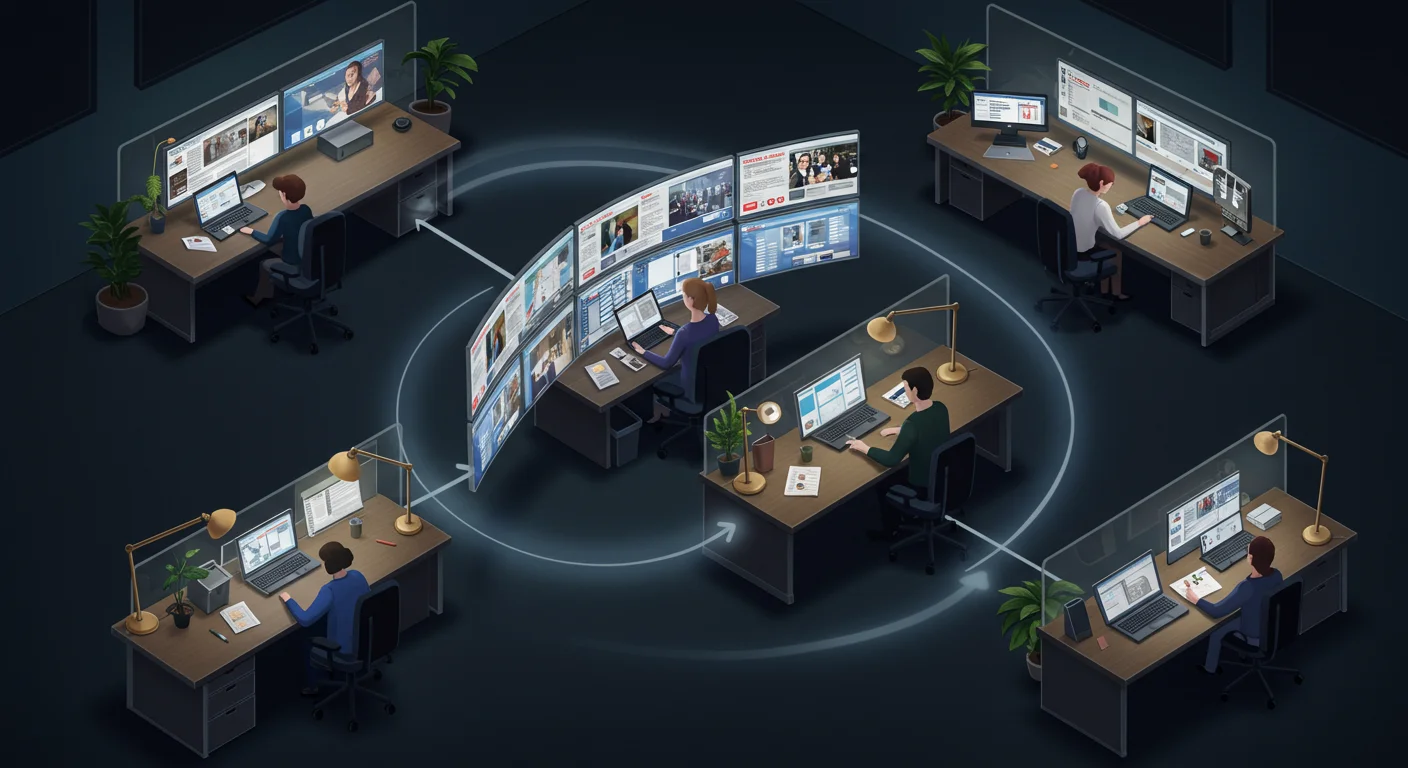
    Cowork makes the instinct visible. Feed it “plan the full editorial pipeline for a breaking local government story with two sources and a public records request” and watch it decompose the work. The lead agent creates parallel tracks: one sub-agent on source outreach, one on records research, one preparing the CMS template and image assets. The reporter watching this sees their own chaotic workflow reflected back as a structured plan — and that reflection is the training.

    What Newsroom Roles See in Cowork
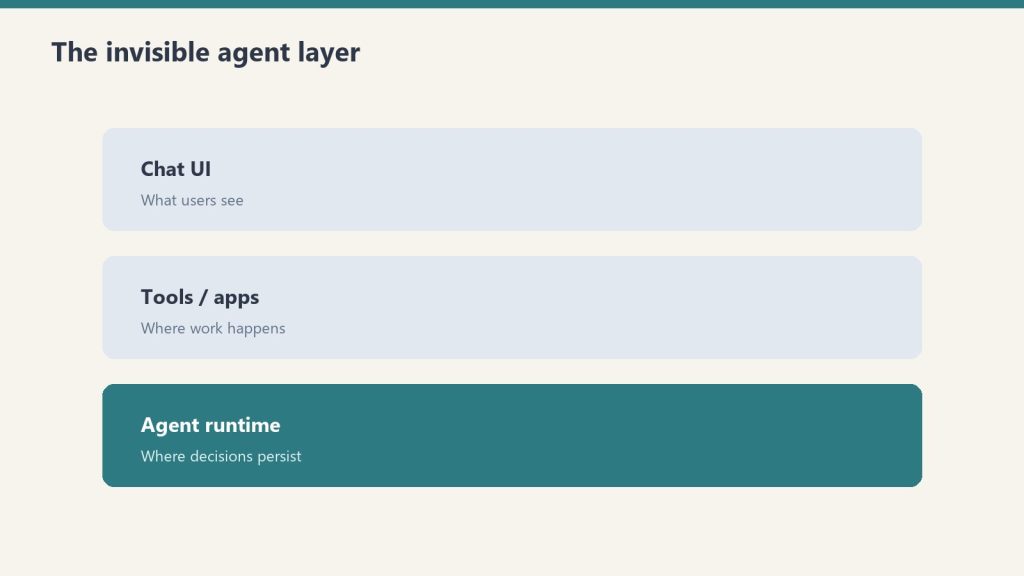
    Three stacked layers: chat UI, tools, agent runtime
    What newsroom roles see in Cowork.

    The Reporter

    Reporters learn to front-load the dependency chain. When Cowork puts source verification before writing (not in parallel with it), it reinforces a discipline that deadline pressure erodes. When Cowork kicks off image sourcing in parallel with drafting rather than after, the reporter sees how to use downtime productively.

    The Editor

    Editors manage flow — which stories are ready, which are blocked, which need resources. Cowork’s progress view shows an editor what managing flow looks like when done systematically: track all workstreams, surface blockers early, prioritize the critical path.

    The Publisher and CMS Operator

    The person formatting and publishing sees how Cowork sequences the final mile — SEO metadata before publish, not after; social posts queued before the article goes live so they fire simultaneously; schema markup as part of the publish checklist, not an afterthought.

    Running the Exercise

    Desk with laptop, checklist notebook, and billing card ready before creating an Anthropic API key
    Running the exercise.

    Take your last week of published stories. Pick the one that felt most chaotic. Feed the scenario to Cowork: “Plan the editorial pipeline for [story type] with [constraints].” Compare Cowork’s plan to what actually happened. The gaps between the two are your training curriculum.

    This works especially well for onboarding new reporters or freelancers who need to learn how your newsroom operates. Instead of handing them a style guide and hoping for the best, show them what the whole pipeline looks like — from Cowork’s plan view.

    More in This Series

    Frequently Asked Questions

    Can Claude Cowork replace editorial workflow software?

    No. Cowork is a training and planning tool, not a CMS or editorial calendar replacement. Use it to visualize and teach the workflow, then execute the workflow in whatever tools your newsroom already uses.

    How would a small newsroom use this for training?

    Run a real editorial scenario through Cowork during a team meeting. Watch the decomposition together and compare it to how you actually handled the story. The discussion — what you would sequence differently, what dependencies you missed, what could run in parallel — is the training.

    Does Cowork understand journalism-specific workflows?

    Cowork decomposes any multi-step task you describe. It does not have journalism-specific templates, but when you describe an editorial pipeline with source verification, fact-checking, editing, and publishing steps, it handles the decomposition and dependency mapping effectively.

    Is this useful for freelance contributors?

    Especially useful. Freelancers often lack visibility into a newsroom’s full pipeline. Showing them a Cowork plan of your editorial process gives them a clear map of what happens to their copy after submission, which steps their work feeds into, and why deadlines and format requirements exist.
  • Claude Cowork Restoration Training for Every Team Role

    Claude Cowork Restoration Training for Every Team Role

    Last refreshed: May 15, 2026

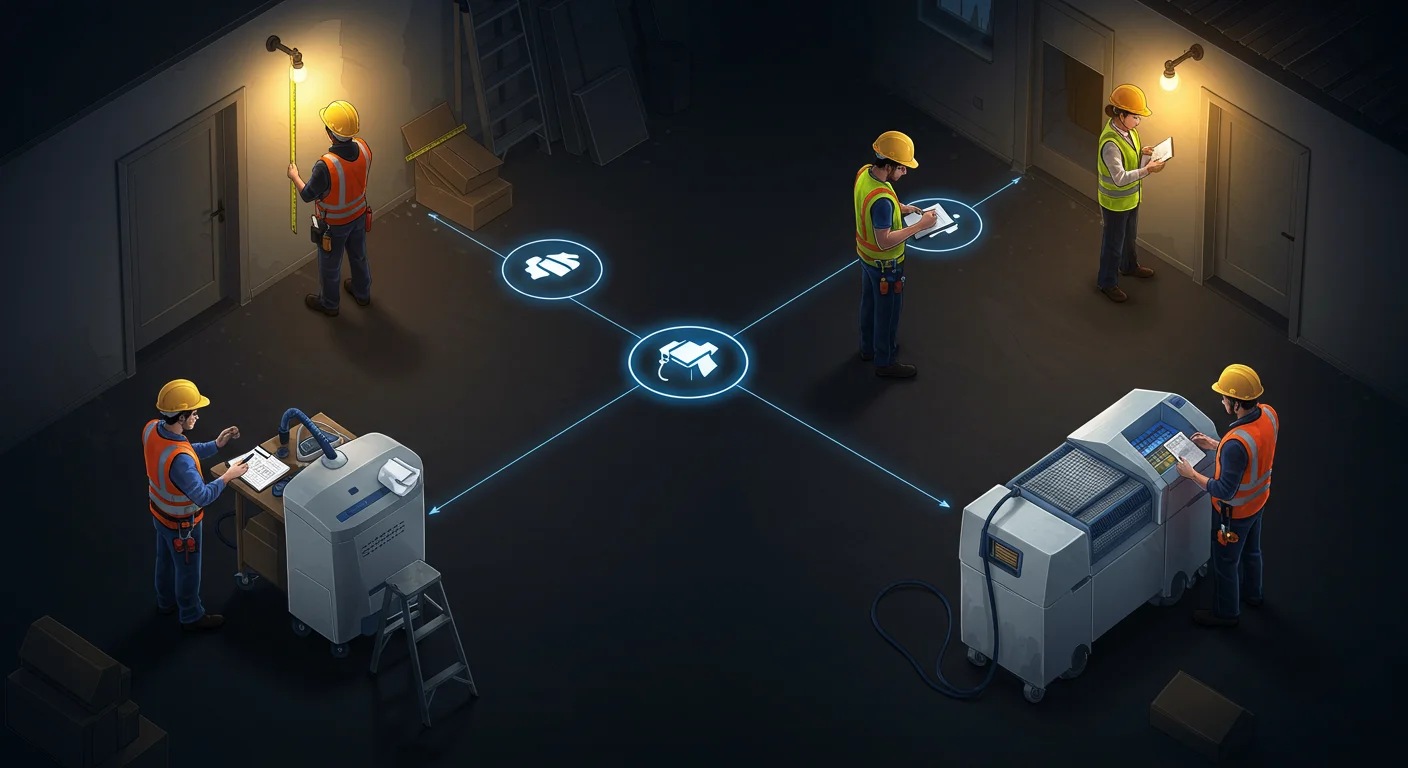
    Your estimator just scoped a fire damage job at $47,000. Your PM disagrees. Your admin is chasing the adjuster. Your technician already started demo. Your sales manager is quoting the next job before the first one is closed out. Sound familiar?

    Restoration companies run on controlled chaos. Every job is a mini-project with overlapping roles, shifting timelines, and constant dependencies — and the people filling those roles were rarely trained in structured project thinking. They learned by doing. That is fine until the volume outpaces what tribal knowledge can hold.

    The short answer: Claude Cowork visibly decomposes complex tasks into sequenced, dependency-aware subtasks delegated to sub-agents — the same cognitive skill every role in a restoration company needs but rarely gets formal training on. Running Cowork on a real restoration scenario and watching how it plans is a training exercise for estimators, PMs, admins, technicians, and sales managers alike.

    Why Restoration Teams Need This More Than Most

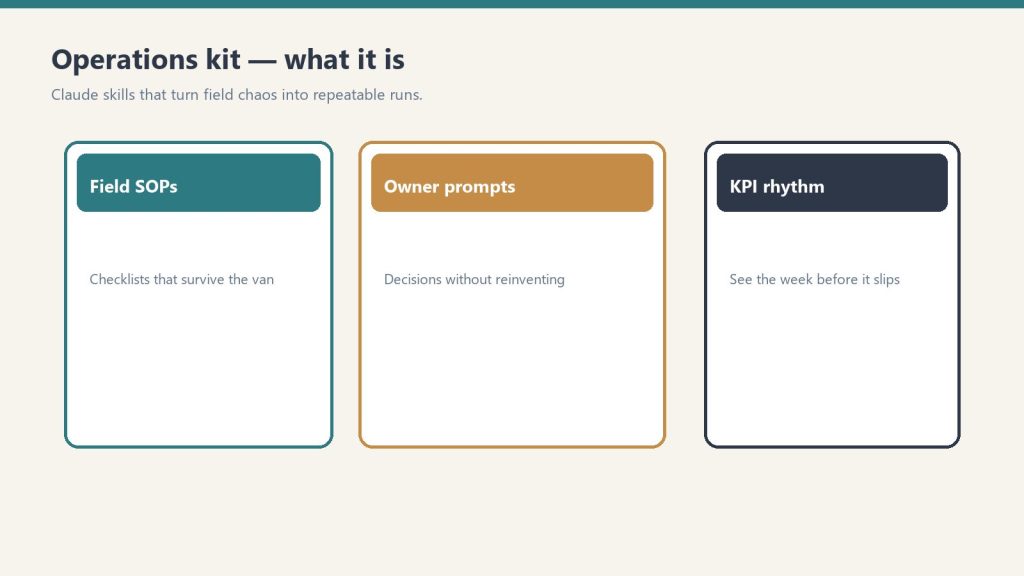
    Three cards for field SOPs, owner prompts, and KPI rhythm in an operations kit
    Why restoration teams need this more than most.

    A restoration job is not a single task. It is a cascade: initial assessment, scope documentation, insurance communication, material ordering, crew scheduling, demo, mitigation, rebuild coordination, final walkthrough, invoicing. Every step depends on something upstream, several steps can run in parallel, and new information lands constantly — the adjuster changes the scope, the homeowner adds a room, the subcontractor pushes back a date.

    This is exactly the kind of work that Claude Cowork was built to handle. And watching how Cowork handles it teaches your team how to think about it.

    What Each Role Learns From Watching Cowork

    Side-by-side cards defining what Claude Code is and is not
    What each role learns from watching Cowork.

    The Estimator

    An estimator’s job is fundamentally a decomposition exercise: walk a property, break the damage into line items, sequence the repair logic, and price each piece. When you run a Cowork task like “build a comprehensive scope for a Category 2 water loss in a 2,400 sq ft ranch with finished basement,” you can watch the lead agent break that into sub-tasks — structural assessment, contents inventory, moisture mapping zones, material takeoffs, labor estimates. The estimator sees their own mental process made visible, and more importantly, they see what steps they might be skipping.

    The Project Manager

    This is the role Cowork maps to most directly. A restoration PM juggles the timeline, the crew, the adjuster, and the homeowner simultaneously. Cowork’s lead agent does the same thing — it holds the master plan, delegates to sub-agents, manages dependencies, and absorbs mid-flight changes without losing the thread. When a PM watches Cowork queue a new requirement that came in during execution and slot it into the plan at the right moment, that is a live lesson in change order management.

    The Admin and Job Coordinator

    Admin staff are the connective tissue. They are tracking certificates of completion, chasing supplement approvals, scheduling inspections, and making sure nothing falls through the cracks. Cowork shows how a lead agent maintains awareness of all parallel workstreams and flags when one is blocking another. For an admin learning to manage a board of active jobs, watching Cowork’s progress view is a masterclass in status tracking.

    The Technician

    Technicians often focus on execution — set the equipment, run the demo, do the work. But the best techs think upstream and downstream: what do I need before I start, and what does my work unlock for the next person? Cowork makes these dependencies visible. When a sub-agent finishes a task and the lead immediately kicks off the next dependent task, a technician can see how their piece connects to the whole.

    The Sales Manager

    Sales in restoration is about managing the pipeline while jobs are still in flight. A sales manager watching Cowork tackle a complex multi-step task sees how a good orchestrator never loses sight of the big picture even while individual pieces are being executed. It is the same skill needed to track leads, follow up on referrals, and manage relationships while active jobs demand attention.

    A Training Exercise You Can Run Tomorrow

    Desk with laptop, checklist notebook, and billing card ready before creating an Anthropic API key
    A training exercise you can run tomorrow.

    Pick a real scenario your team handled last month — a complex water loss, a fire damage job with contents, a mold remediation with an access issue. Strip the confidential details and feed it to Cowork as a planning task: “Break down the full project plan for a Category 3 water loss in a two-story commercial building with active tenant occupancy.”

    Then sit with your team and watch it work. Pause at each stage. Ask: did Cowork sequence this the way we would? Did it catch a dependency we might have missed? Did it run things in parallel that we run sequentially? Did it handle the mid-task change the way our PM would?

    The conversation that follows is worth more than most training seminars.

    The Conductor Metaphor Hits Different in Restoration

    In our original article on Cowork as a training tool, we compared Cowork’s lead agent to an orchestra conductor — one agent directing the whole ensemble without playing any instrument itself. In restoration, the metaphor becomes concrete: the PM is the conductor, the estimator is first chair, the admin is keeping score, the technician is the section player, and the sales manager is booking the next gig before the curtain call.

    When everyone on the team can see the conductor’s score — which is exactly what Cowork’s plan view gives you — the whole operation tightens up.

    More in This Series

    Frequently Asked Questions

    Can Claude Cowork handle restoration-specific scenarios?

    Yes. Cowork decomposes any complex, multi-step task you describe to it. You can input a restoration scenario like a water loss scope, a fire damage project plan, or a mold remediation coordination task and watch it break the work into sequenced, dependency-aware subtasks. The output is a structured plan, not industry-specific software, but the planning logic transfers directly.

    Which restoration roles benefit most from Cowork training?

    Project managers benefit most directly because Cowork’s lead agent mirrors their core function — holding the master plan and managing dependencies. But estimators learn scope decomposition, admins learn status tracking across parallel workstreams, technicians see how their work connects to the full project chain, and sales managers learn pipeline orchestration.

    Does this replace restoration project management software?

    No. Cowork is not a replacement for tools like Xactimate, DASH, or jobber platforms. It is a training and planning tool that helps your people think in structured, decomposed, dependency-aware ways. Better thinking produces better use of whatever PM software you already run.

    How do I run a Cowork training session with my restoration team?

    Pick a real job your team completed recently, strip confidential details, and input it as a Cowork task. Watch together as Cowork decomposes the plan. Pause and discuss at each stage — compare Cowork’s sequencing to how your team actually handled it. Focus on dependencies, parallel workstreams, and how mid-task changes were absorbed.

    Is Claude Cowork available for restoration companies?

    Cowork is available through the Claude desktop app on Pro, Max, Team, and Enterprise plans. It is not industry-specific — any team that handles complex, multi-step work can use it. Restoration companies are a natural fit because every job is essentially a project with overlapping roles and shifting dependencies.

  • Claude Cowork Staff Training: Teach Better Project Planning

    Claude Cowork Staff Training: Teach Better Project Planning

    Last refreshed: May 15, 2026

    What if the most powerful staff training tool you’ll touch this year is hiding inside an AI app you already pay for?

    There is a quiet productivity feature inside Claude Cowork that almost nobody is talking about. It is accidentally one of the best project management training tools I have ever seen — and once you notice it, you cannot unsee it.

    The short answer: Claude Cowork shows you its plan and progress in real time as it decomposes a task into sub-tasks and delegates them to a team of sub-agents. That visible decomposition — the same skill a great project manager uses every day — turns Cowork into a live training tool for any staff member learning to break down ambiguous work into executable pieces.

    The Difference Between Chat and Cowork

    Side-by-side cards defining what Claude Code is and is not
    The difference between Chat and Cowork.

    When you work with Claude in chat, you hand it a prompt and you get an answer. It is fast, it is useful, and most of the work happens invisibly — somewhere between your question and the response. You do not see the thinking. You do not see the breakdown. You just see the output.

    Cowork is different. When you give Cowork a task, you watch it work. Anthropic’s own documentation confirms this: Cowork shows progress indicators at each step, surfaces its reasoning, and lets you steer mid-task to course-correct or add direction. For complex work, it coordinates multiple sub-agents running in parallel.

    That transparency is the feature. And it is the feature that makes it a training tool.

    The Conductor and the Section Players

    Three stacked layers: chat UI, tools, agent runtime
    The conductor and the section players.

    Here is what is actually happening under the hood — and this is the part I had to confirm because I had been assuming it.

    Cowork uses the same agentic architecture as Claude Code. A lead agent (the orchestrator) takes the overall task, decomposes it into subtasks, and delegates those subtasks to specialized sub-agents. The lead maintains oversight, handles dependencies, sequences work when one piece depends on another, and synthesizes the final result. Sub-agents work independently in their own context windows and can flag dependencies back to the lead.

    It is a conductor with a section of players. The conductor does not play the violin. The conductor decides when the violins come in, how loud, and for how long.

    This is exactly how a competent project manager operates.

    Why This Matters for Training Your Staff

    Most people — including most project managers I have worked with — struggle with one specific skill: taking a messy, ambiguous goal and breaking it into a sequence of manageable, dependency-aware tasks. It is the difference between “we need to launch the new site” and a project plan with seventeen sequenced items, three parallel workstreams, and clear handoff points.

    Cowork does this decomposition in front of you, in plain English, every time you give it a task. You can literally watch a lead agent think through: what does this goal actually require, what order do the pieces need to go in, what can happen in parallel, what is the dependency chain, and how do I know when we are done?

    For a PM in training, that is a live demonstration of planning. For a staff member who has never had to structure work before, it is a mental model they can borrow.

    The “Oh Yeah, I Forgot About This” Superpower

    The part I love most: you can interrupt Cowork while it is running. You can ask a question. You can add a requirement. You can redirect a visual task. And because there is a lead agent holding the plan, it does not panic — it queues your input and addresses it when appropriate.

    That is exactly how you should be working with human teams. You should not be afraid to say “oh wait, I forgot we also need X” to a project manager. A good PM takes the new input, figures out where it fits in the plan, and slots it in without derailing everything else.

    Watching Cowork do this gracefully is a training moment. It shows people that mid-flight course corrections are normal, that good planning systems absorb new information rather than break from it, and that the conductor’s job is to keep the music going even when the score changes.

    How to Actually Use Cowork to Train a Team

    Desk with laptop, checklist notebook, and billing card ready before creating an Anthropic API key
    How to actually use Cowork to train a team.

    A few things I would try with a team:

    Run a Cowork narration session. Have a new project manager watch Cowork tackle a real task end-to-end and narrate what it is doing and why. Then ask them to plan a real project the same way — out loud, decomposed, with dependencies called out.

    Use Cowork as a planning artifact generator. When someone on your staff hands you a vague goal, run it through Cowork first. Not because Cowork will do the work, but because the plan Cowork produces is a teaching artifact. You can review it together: here is how the task should be broken down, here is the order, here is what runs in parallel.

    Teach delegation by example. When you are training someone to delegate, have them watch how the lead agent assigns work to sub-agents. Narrow scope, clear instructions, defined handoff. That is delegation 101, executed live.

    The Bigger Point

    Tools that hide their thinking make you dependent on them. Tools that show their thinking make you better.

    Chat hides the thinking. Cowork shows the thinking. And the thinking it shows happens to be the exact cognitive skill — structured task decomposition — that separates people who manage projects well from people who drown in them.

    If you are running an agency, a team, or any operation that depends on people learning to break down ambiguous work into executable pieces, Cowork is not just a productivity tool. It is a classroom.

    Frequently Asked Questions

    What is Claude Cowork?

    Claude Cowork is Anthropic’s agentic desktop application that takes on multi-step knowledge work tasks autonomously. Unlike chat, where you exchange single messages, Cowork accepts a goal, builds a plan, and executes it across files and applications on your computer using the same agentic architecture as Claude Code.

    How is Cowork different from Claude chat?

    Chat responds to one prompt at a time and hides its reasoning between your message and its reply. Cowork takes on full tasks, shows you its plan and progress in real time, and lets you steer mid-task. It also coordinates multiple sub-agents in parallel for complex work.

    Does Claude Cowork actually use multiple agents?

    Yes. For complex tasks, Cowork uses a lead/orchestrator agent that decomposes the work and delegates sub-tasks to specialized sub-agents that run in parallel. The lead handles dependency ordering and synthesizes results when work is complete. This is the same supervisor pattern used in Claude Code’s agent teams feature.

    Can I interrupt Cowork while it is running?

    Yes. You can jump in mid-task to ask questions, add requirements, redirect work, or course-correct. The lead agent queues your input and addresses it at the appropriate point in the plan rather than abandoning what is already in motion.

    How can a manager use Cowork to train staff?

    Use Cowork as a live demonstration of structured task decomposition. Have new project managers narrate what Cowork is doing and why, then plan their own projects the same way. Use the plans Cowork generates as teaching artifacts to discuss task breakdown, dependency mapping, and parallel workstreams. Watch the lead agent’s delegation patterns — narrow scope, clear instructions, defined handoffs — as a model for how humans should delegate.

    Who is Claude Cowork designed for?

    Cowork was built for non-technical knowledge workers — researchers, analysts, operations teams, legal and finance professionals — who work with documents, data, and files daily and want to spend more time on judgment calls and less time on assembly. It is available on Pro, Max, Team, and Enterprise plans through the Claude desktop app.

    Does Cowork work alongside Claude in chat?

    Yes. Chat remains useful for quick questions, single-step tasks, and conversational work. Cowork takes over when the work requires planning, multi-step execution, or coordination across files and applications. The same Claude account uses both modes.

    The Full Series: Cowork as a Training Tool by Industry

    More on Claude Cowork


  • Claude Cowork: How to Train Your Staff to Think Better

    Claude Cowork: How to Train Your Staff to Think Better

    Last refreshed: May 15, 2026

    What if the most powerful staff training tool you’ll touch this year is hiding inside an AI app you already pay for?

    There is a quiet productivity feature inside Claude Cowork that almost nobody is talking about. It is accidentally one of the best project management training tools I have ever seen — and once you notice it, you cannot unsee it.

    The short answer: Claude Cowork shows you its plan and progress in real time as it decomposes a task into sub-tasks and delegates them to a team of sub-agents. That visible decomposition — the same skill a great project manager uses every day — turns Cowork into a live training tool for any staff member learning to break down ambiguous work into executable pieces.

    The Difference Between Chat and Cowork

    Side-by-side cards defining what Claude Code is and is not
    The difference between Chat and Cowork.

    When you work with Claude in chat, you hand it a prompt and you get an answer. It is fast, it is useful, and most of the work happens invisibly — somewhere between your question and the response. You do not see the thinking. You do not see the breakdown. You just see the output.

    Cowork is different. When you give Cowork a task, you watch it work. Anthropic’s own documentation confirms this: Cowork shows progress indicators at each step, surfaces its reasoning, and lets you steer mid-task to course-correct or add direction. For complex work, it coordinates multiple sub-agents running in parallel.

    That transparency is the feature. And it is the feature that makes it a training tool.

    The Conductor and the Section Players

    Three stacked layers: chat UI, tools, agent runtime
    The conductor and the section players.

    Here is what is actually happening under the hood — and this is the part I had to confirm because I had been assuming it.

    Cowork uses the same agentic architecture as Claude Code. A lead agent (the orchestrator) takes the overall task, decomposes it into subtasks, and delegates those subtasks to specialized sub-agents. The lead maintains oversight, handles dependencies, sequences work when one piece depends on another, and synthesizes the final result. Sub-agents work independently in their own context windows and can flag dependencies back to the lead.

    It is a conductor with a section of players. The conductor does not play the violin. The conductor decides when the violins come in, how loud, and for how long.

    This is exactly how a competent project manager operates.

    Why This Matters for Training Your Staff

    Most people — including most project managers I have worked with — struggle with one specific skill: taking a messy, ambiguous goal and breaking it into a sequence of manageable, dependency-aware tasks. It is the difference between “we need to launch the new site” and a project plan with seventeen sequenced items, three parallel workstreams, and clear handoff points.

    Cowork does this decomposition in front of you, in plain English, every time you give it a task. You can literally watch a lead agent think through: what does this goal actually require, what order do the pieces need to go in, what can happen in parallel, what is the dependency chain, and how do I know when we are done?

    For a PM in training, that is a live demonstration of planning. For a staff member who has never had to structure work before, it is a mental model they can borrow.

    The “Oh Yeah, I Forgot About This” Superpower

    The part I love most: you can interrupt Cowork while it is running. You can ask a question. You can add a requirement. You can redirect a visual task. And because there is a lead agent holding the plan, it does not panic — it queues your input and addresses it when appropriate.

    That is exactly how you should be working with human teams. You should not be afraid to say “oh wait, I forgot we also need X” to a project manager. A good PM takes the new input, figures out where it fits in the plan, and slots it in without derailing everything else.

    Watching Cowork do this gracefully is a training moment. It shows people that mid-flight course corrections are normal, that good planning systems absorb new information rather than break from it, and that the conductor’s job is to keep the music going even when the score changes.

    How to Actually Use Cowork to Train a Team

    Desk with laptop, checklist notebook, and billing card ready before creating an Anthropic API key
    How to actually use Cowork to train a team.

    A few things I would try with a team:

    Run a Cowork narration session. Have a new project manager watch Cowork tackle a real task end-to-end and narrate what it is doing and why. Then ask them to plan a real project the same way — out loud, decomposed, with dependencies called out.

    Use Cowork as a planning artifact generator. When someone on your staff hands you a vague goal, run it through Cowork first. Not because Cowork will do the work, but because the plan Cowork produces is a teaching artifact. You can review it together: here is how the task should be broken down, here is the order, here is what runs in parallel.

    Teach delegation by example. When you are training someone to delegate, have them watch how the lead agent assigns work to sub-agents. Narrow scope, clear instructions, defined handoff. That is delegation 101, executed live.

    The Bigger Point

    Tools that hide their thinking make you dependent on them. Tools that show their thinking make you better.

    Chat hides the thinking. Cowork shows the thinking. And the thinking it shows happens to be the exact cognitive skill — structured task decomposition — that separates people who manage projects well from people who drown in them.

    If you are running an agency, a team, or any operation that depends on people learning to break down ambiguous work into executable pieces, Cowork is not just a productivity tool. It is a classroom.

    Related on Tygart Media: Cowork for agencies · Cowork marketing training · Cowork for B2B SaaS.

    Frequently Asked Questions

    What is Claude Cowork?

    Claude Cowork is Anthropic’s agentic desktop application that takes on multi-step knowledge work tasks autonomously. Unlike chat, where you exchange single messages, Cowork accepts a goal, builds a plan, and executes it across files and applications on your computer using the same agentic architecture as Claude Code.

    How is Cowork different from Claude chat?

    Chat responds to one prompt at a time and hides its reasoning between your message and its reply. Cowork takes on full tasks, shows you its plan and progress in real time, and lets you steer mid-task. It also coordinates multiple sub-agents in parallel for complex work.

    Does Claude Cowork actually use multiple agents?

    Yes. For complex tasks, Cowork uses a lead/orchestrator agent that decomposes the work and delegates sub-tasks to specialized sub-agents that run in parallel. The lead handles dependency ordering and synthesizes results when work is complete. This is the same supervisor pattern used in Claude Code’s agent teams feature.

    Can I interrupt Cowork while it is running?

    Yes. You can jump in mid-task to ask questions, add requirements, redirect work, or course-correct. The lead agent queues your input and addresses it at the appropriate point in the plan rather than abandoning what is already in motion.

    How can a manager use Cowork to train staff?

    Use Cowork as a live demonstration of structured task decomposition. Have new project managers narrate what Cowork is doing and why, then plan their own projects the same way. Use the plans Cowork generates as teaching artifacts to discuss task breakdown, dependency mapping, and parallel workstreams. Watch the lead agent’s delegation patterns — narrow scope, clear instructions, defined handoffs — as a model for how humans should delegate.

    Who is Claude Cowork designed for?

    Cowork was built for non-technical knowledge workers — researchers, analysts, operations teams, legal and finance professionals — who work with documents, data, and files daily and want to spend more time on judgment calls and less time on assembly. It is available on Pro, Max, Team, and Enterprise plans through the Claude desktop app.

    Does Cowork work alongside Claude in chat?

    Yes. Chat remains useful for quick questions, single-step tasks, and conversational work. Cowork takes over when the work requires planning, multi-step execution, or coordination across files and applications. The same Claude account uses both modes.

  • Port of Everett Food Trucks: 2026 Friday Video Guide

    Port of Everett Food Trucks: 2026 Friday Video Guide

    🎬 AI-generated cinematic overview  |  Powered by NotebookLM


    About This Video

    This cinematic video was automatically generated from our article Food Truck Fridays Are Back at the Port of Everett — Your 2026 Guide using Google’s NotebookLM. It provides a visual summary of the key points covered in the original piece.


    Key Segments Covered

    • What Food Truck Fridays Actually Is
    • The Port of Everett Setup
    • What Trucks Show Up
    • Also Worth Knowing: Beverly Food Truck Park
    • Tips for First-Timers at Food Truck Fridays
    • The Bigger Picture
    • The Details
    • Beverly Food Truck Park Details
    • Frequently Asked Questions

    Read the Full Article

    For the complete deep-dive with all the details, data, and analysis, read the full article on Tygart Media:

    👉 Food Truck Fridays Are Back at the Port of Everett — Your 2026 Guide →


    About Tygart Media

    Tygart Media covers the intersection of AI, technology, and digital media. We use cutting-edge tools — including AI-generated video — to make our content more accessible and engaging.

    👉 Explore more at tygartmedia.com →

  • Belfair Community AI: Local Guide for New Residents

    Belfair Community AI: Local Guide for New Residents

    If you’ve recently moved to Belfair or anywhere in the North Mason area — whether you came for a job at PSNS, a PCS assignment to Bangor Naval Base, a remote-work lifestyle change, or retirement near Hood Canal — you already know the feeling. Everyone around you seems to operate on a layer of local knowledge you don’t have yet. When does the bridge close? What does “SR-3 is backed up at Gorst” actually mean for your drive? Which beaches are open for shellfish right now? Which businesses are actually open when Google says they are?

    That gap between arriving in a place and knowing how it actually works is real, and it takes years to close through normal experience. Belfair’s community AI layer is being built to close it much faster.

    What You Don’t Know That Everyone Else Does

    North Mason has a deep layer of practical local knowledge that doesn’t exist on any national platform in accurate form. A few examples of what longtime residents know and what you’ll need to learn:

    The Hood Canal Bridge on SR-104 closes without public announcement for submarine transits from Bangor Naval Base. The closures aren’t on WSDOT’s real-time feed the way accidents are — they happen on operational military timelines that don’t get posted publicly. If you commute north and haven’t been caught by one yet, you will be. Locals know to check the WSDOT bridge alert system and to build buffer time on mornings when submarine movements are likely.

    SR-3 gets complicated near Gorst and the north end of Belfair after sustained rain. The Gorst bottleneck is notorious — 18,000 to 19,000 vehicles per day funnel through what is essentially a two-lane section at the intersection of SR-3 and SR-16. When it backs up, it backs up badly, and the alternatives require knowing the local road network. The Belfair Bypass (officially the SR-3 Freight Corridor New Alignment) begins construction in Spring 2026 and is projected to open in 2028 — but until then, the existing corridor is what you’ve got.

    Hood Canal shellfish harvesting is seasonal, regulated by WDFW, and subject to closures that can come without much warning when biotoxin testing or fecal coliform monitoring triggers a harvest suspension. The specific beaches near Belfair — Twanoh State Park, Potlatch State Park, Belfair State Park tidelands — each have their own status. Knowing the difference between a DOH closure and a WDFW emergency suspension matters if you’re planning a harvest trip.

    Local business hours on Google are frequently wrong. Small businesses in Belfair update their hours on the platforms whenever they get to it, which is sometimes never. Knowing which businesses are reliable, which ones have changed ownership, and what the current situation is at a specific shop requires either local knowledge or a resource that keeps up with it. The community AI is being built to be that resource.

    Why This Is Different from Googling It

    National AI systems have a fundamental problem with places like Belfair: the community is too small and too specific to be well-represented in training data. When you ask a national AI about Hood Canal shellfish closures or Gorst traffic conditions, you get either generic information about shellfish or generic information about traffic — not a current answer about the specific beaches and roads that affect your daily life in North Mason.

    The Belfair community AI is purpose-built for this place. Its knowledge base is populated not from national data aggregators but from local relationships — county employees, longtime residents, agency sources, and community contributors who know this specific place and maintain what the system carries about it. That’s a fundamentally different kind of knowledge than what any national platform can provide.

    What It Covers That Will Actually Help You Orient

    For someone new to North Mason, the highest-value knowledge categories are:

    Infrastructure and commute. SR-3, Gorst, the Hood Canal Bridge, and the Bremerton-Seattle ferry schedule (which changes seasonally). The SR-3 bypass construction timeline and what it means for daily commutes through 2028. The community AI tracks these in ways that are specific to North Mason commuters, not generic traffic data.

    Hood Canal seasonal rhythms. Shellfish seasons and closures. State park reservation windows. Tahuya trail conditions. The patterns that determine what’s accessible and when — seasonal knowledge that takes years to accumulate through experience but can be accessed immediately through the community layer.

    Civic and community institutions. The North Mason Timberland Library. The North Mason Chamber of Commerce. The Mary E. Theler Wetlands. Community events at the Belfair Community Center. The school district’s calendar and enrollment processes. For a sense of what’s currently happening in Belfair’s business and civic landscape, the Belfair Business Pulse is a useful ongoing resource.

    Military family specifics. For those arriving on PCS orders to PSNS or Bangor, the community AI is being designed with incoming military families explicitly in mind — covering housing patterns in North Mason vs. Kitsap County, school enrollment for North Mason School District, and the commute realities from Belfair to the shipyard that don’t appear in any PCS guide.

    How to Use It Before It’s Fully Operational

    The community AI is under active development. Monthly workshops at the North Mason Timberland Library are planned once the knowledge base reaches minimum useful coverage. In the meantime, the Belfair Bugle’s ongoing coverage provides a current layer of local knowledge in editorial form — and the broader vision for the knowledge infrastructure is laid out in The Internet That Knows Your Town.

    North Mason is a place that takes a while to learn. The community AI is being built to shorten that curve significantly — for newcomers, for military families cycling through on PCS orders, and for anyone who moves to Belfair and wants to feel at home faster than the traditional “local knowledge by osmosis” approach allows.

    Frequently Asked Questions

    What does a newcomer to Belfair need to know about the Hood Canal Bridge?

    The Hood Canal Bridge on SR-104 connects the Kitsap and Olympic Peninsulas. It closes without public advance notice for submarine transits from Bangor Naval Base — these closures aren’t announced publicly due to military operational security. They can last 30 to 90 minutes. If you commute north across the bridge, subscribe to WSDOT bridge alerts and build buffer time on commute days. Maintenance closures are announced in advance; submarine transits are not.

    How does the SR-3 Belfair Bypass affect new residents?

    The SR-3 Freight Corridor New Alignment — the Belfair Bypass — begins construction in Spring 2026 and is projected to open in 2028. The 6-mile bypass will route regional traffic around Belfair rather than through it, expected to divert 25 to 30 percent of the current 18,000-plus daily vehicle count. Until it opens, SR-3 through Belfair remains the primary corridor and Gorst is the primary bottleneck for northbound commuters. New residents should budget extra commute time until the bypass is operational.

    How do I find out if Hood Canal shellfish beaches near Belfair are open?

    Hood Canal shellfish harvest areas near Belfair are regulated by the Washington Department of Fish and Wildlife (WDFW) and monitored by the Washington State Department of Health (DOH). Closures can be triggered by biotoxin (paralytic shellfish poisoning) testing or fecal coliform readings. For specific beach status near Belfair — including Belfair State Park tidelands, Twanoh State Park, and Potlatch State Park — check the WDFW shellfish safety site or the DOH shellfish safety map before any harvest trip. The Belfair community AI is being built to consolidate this information with local context.

    Are there resources specifically for military families arriving at PSNS Bremerton from the Belfair area?

    The Belfair community AI layer is being designed with incoming PSNS and Bangor military families explicitly in mind. Many families choose to live in North Mason for the affordability, outdoor access, and school options in the North Mason School District — but the commute from Belfair to the PSNS main gate in Bremerton takes 25 to 40 minutes depending on SR-3 and Gorst conditions. The community AI will carry current commute patterns, housing market conditions specific to North Mason, and school enrollment specifics that no PCS guide covers accurately.

    What North Mason community organizations should new residents know about?

    Key community organizations in Belfair and North Mason include: the North Mason Chamber of Commerce (business networking and community events), the Hood Canal Salmon Enhancement Group (environmental stewardship and the Sweetwater Creek Waterwheel Park), the North Mason Timberland Library (currently completing a remodel, expected to fully reopen mid-2026), and the Mary E. Theler Wetlands (natural area and community gathering space). The community AI will maintain current information on hours, programs, and contacts for each of these organizations.

    Read more: What Belfair’s Community AI Layer Actually Knows: A North Mason Resident’s Guide

    More from the Belfair Community AI Series


  • What You Give Up Video: AI-Generated Cinematic Overview

    What You Give Up Video: AI-Generated Cinematic Overview

    ?? AI-generated cinematic overview  |  Powered by NotebookLM


    About This Video

    This cinematic video was automatically generated from our article What You Give Up using Google’s NotebookLM. It provides a visual summary of the key points covered in the original piece.


    Key Segments Covered

    • The First Thing You Give Up Is Comprehensive Understanding
    • The Second Thing You Give Up Is Traceable Causality
    • The Third Thing You Give Up Is the Illusion of Sole Authorship
    • What You Don’t Give Up
    • The Moment That Actually Matters

    Read the Full Article

    For the complete deep-dive with all the details, data, and analysis, read the full article on Tygart Media:

    ?? What You Give Up ?


    About Tygart Media

    Tygart Media covers the intersection of AI, technology, and digital media. We use cutting-edge tools – including AI-generated video – to make our content more accessible and engaging.

    ?? Explore more at tygartmedia.com ?

  • Secondary Content Market: How AI Uses Your Business Data

    Secondary Content Market: How AI Uses Your Business Data

    Content About Your Business Is Being Created Without You

    Right now, somewhere on the internet, a system is writing content that mentions your business. It might be an AI answering a question about your industry. It might be a local publication compiling a roundup of businesses in your area. It might be a travel app generating a recommendation list for visitors to your town. It might be a voice assistant responding to “find me a [your service] near me.”

    This is the secondary content market — the ecosystem of publications, platforms, AI systems, and apps that create derivative content about businesses using whatever structured data they can find. It’s not new, but it’s accelerating. And the quality of what gets created about your business depends entirely on the quality of the data you make available.

    What Gets Pulled and What Gets Missed

    When we build local content for publications like Belfair Bugle and Mason County Minute, we pull from every structured data source available: Google Business Profiles, chamber of commerce directories, official business websites, social media pages, and public records. The businesses that load up their profiles — full menus, current photos, detailed descriptions, accurate hours, complete service lists — make it easy for us to write about them accurately and compellingly.

    The businesses that have a bare GBP listing, no menu, a stock photo, and hours from 2023? We either skip them or qualify everything with hedging language because we can’t verify the details. The same thing happens at scale when AI systems generate content. Rich data gets cited confidently. Sparse data gets ignored or, worse, hallucinated.

    Menus, Photos, and the Data That Feeds the Machine

    Think about what a well-stocked business profile actually provides to the secondary content market. Your menu gives food publications and AI systems specific dishes to recommend. Your photos give travel guides and social platforms visual content to feature. Your service list gives industry roundups specifics to cite. Your business description gives AI systems entities and context to work with.

    Every piece of data you add to your Google Business Profile, your website’s structured data, your social media profiles — all of it feeds into the content supply chain. Publications pull your menu to write about your restaurant. AI systems pull your service list to answer questions about your industry. Travel apps pull your photos to recommend your hotel. The richer your data, the more surface area you have in the secondary content market.

    The Local Angle: Why This Hits Small Businesses Hardest

    Large chains have marketing teams that maintain consistent data across every platform. Local businesses usually don’t. That means the secondary content market disproportionately favors chains over independents — unless the independent makes a deliberate effort to load up their structured data.

    This is particularly true in areas like Mason County and the Olympic Peninsula, where local businesses are the backbone of the community but often have the thinnest digital presence. A family-owned restaurant with an incredible menu but no Google Business Profile menu entry is invisible to every AI system and publication that relies on structured data. A boutique hotel with stunning views but no photos on their GBP is a ghost to travel recommendation engines.

    What To Do About It

    The secondary content market isn’t going away — it’s growing. The actionable response is straightforward: make your business data machine-readable, complete, and current. Start with your Google Business Profile. Fill every field. Upload quality photos. Add your full menu or service catalog. Update your hours. Write a description that includes the terms and entities relevant to your business.

    Then do the same for your website — add structured data (schema markup) so AI systems can parse your content programmatically. Make sure your social media profiles are consistent and current. The goal isn’t to game any one platform. It’s to ensure that when any system anywhere creates content about your business, it has accurate, rich data to work with.

    Your business data is already on the secondary content market. The only question is whether you’ve given it good material to work with.

  • Google Business Profile: Treat It Like a Knowledge Node

    Google Business Profile: Treat It Like a Knowledge Node

    Last refreshed: October 8, 2026

    The Shift Nobody Is Talking About

    Most businesses treat their Google Business Profile like a digital business card — name, address, phone number, maybe a few photos. Update it once, forget about it. That approach made sense when GBP was primarily a search listing. It doesn’t make sense anymore.

    Here’s what’s changed: your Google Business Profile has quietly become one of the most important structured data sources on the internet. Not just for Google Search, but for the entire ecosystem of AI systems, local publications, voice assistants, mapping apps, review aggregators, and content platforms that need reliable business data to function.

    What’s Actually Pulling From Your GBP

    When an AI system like ChatGPT, Claude, or Perplexity answers a question about “best restaurants in Shelton, WA,” it needs ground truth data. Where does that data come from? Increasingly, it’s structured business data — and Google Business Profiles are the richest, most consistently maintained source of it.

    When a local publication (like our own Mason County Minute or Belfair Bugle) writes about businesses in the area, we verify every entity against Google Maps data. The name, the address, the hours, whether it’s still open — all of it comes from the Google Places API, which pulls directly from Google Business Profiles.

    When a voice assistant answers “what time does [business] close,” it’s reading your GBP. When a travel app recommends places to eat, it’s pulling your GBP menu, photos, and reviews. When an AI overview summarizes local options, your GBP data is in the training signal.

    The Knowledge Node Mental Model

    Stop thinking of your GBP as a listing. Start thinking of it as a knowledge node — a structured data endpoint that other systems query to learn about your business. The richer and more accurate your node is, the more useful it is to every downstream system that touches it.

    What does a well-maintained knowledge node look like? It has complete, current hours (including holiday hours). It has a full menu or service list with prices. It has high-quality photos of the exterior, interior, products, and team. It has a detailed business description with the entities and terms that matter for your category. It has attributes filled out — wheelchair accessible, outdoor seating, Wi-Fi, whatever applies. It has regular posts showing activity and relevance.

    Every one of those data points is something that another system can cite, surface, or recommend. A missing menu means a food app can’t include you. Missing photos mean an AI-generated travel guide has nothing to show. Outdated hours mean a voice assistant sends someone to your door when you’re closed.

    Why This Matters Now More Than Before

    We’re entering a period where AI-generated content and AI-powered search are growing rapidly. Google AI Overviews, Perplexity, ChatGPT with browsing — these systems need structured data about real-world businesses to generate useful answers. The businesses that provide that data in a rich, machine-readable format will get cited. The ones that don’t will get skipped.

    This isn’t theoretical. We built a Google Maps quality gate into our own publishing pipeline after community feedback showed us that AI-generated entity errors erode trust instantly. The businesses that had complete, accurate GBP listings were easy to verify and include. The ones with sparse or outdated profiles created uncertainty — and uncertainty means we leave them out.

    The Action Step

    Open your Google Business Profile today. Look at it not as a customer would, but as a machine would. Is every field filled? Are your photos recent and high-quality? Is your menu or service list complete? Are your hours accurate, including holidays? Is your business description rich with the terms someone (or something) would search for?

    If the answer is no, you’re leaving distribution on the table. Every AI system, every local publication, every app that could have mentioned your business needs data to work with. Your GBP is where that data lives. Treat it like the API it’s becoming.

    📎 Book for Bots — Free

    Take this article on steroids.

    The Claude Implementation Playbook is a dense 9-section PDF you can attach directly to any AI conversation — pricing tables, model API strings, routing logic, context engineering rules. Verified October 2026.

    Get Free PDF →

    Work with Tygart Media

    Scaling Claude across a team or agency?

    Usage limits are the first thing you hit when Claude starts working. We’ve built systems that manage context budgets, rotate models by task, and keep costs predictable at scale. If that’s the problem you’re solving, let’s talk.

    See How We Work →

  • Claude in Chrome vs API: The Automation Decision Guide

    Claude in Chrome vs API: The Automation Decision Guide

    Last refreshed: May 15, 2026

    The Decision Rule
    API first. Claude in Chrome when the API doesn’t exist or is blocked. The Chrome extension isn’t a replacement for API access — it’s what you reach for when API access isn’t an option.

    If you’ve worked with both the Claude API and Claude in Chrome, you’ve probably noticed that in many cases, you could technically use either one to accomplish a similar outcome. Fetching content from a page, submitting data, triggering a workflow — these things can often be done through an API or through a browser UI.

    The question of which to use isn’t primarily about capability. It’s about maintenance, reliability, and what happens at 3am when something breaks.

    What the API Gives You That Chrome Can’t

    Three stacked layers: chat UI, tools, agent runtime
    What the API gives you that Chrome can’t.

    Repeatability. An API call is deterministic. The same endpoint, the same payload, the same result. A Chrome UI interaction depends on the current state of a webpage — and web pages change. A button gets renamed. A modal gets added. A UI redesign ships. None of this breaks an API. All of it can break a Chrome automation.

    Scale. You can make hundreds of API calls per hour with appropriate rate limiting. Chrome UI automation runs at human browsing speed — one action at a time, in a real browser, with real rendering. That’s fine for occasional tasks. It doesn’t scale.

    No browser dependency. API calls run in code. They run in cloud functions, scheduled jobs, command-line scripts, anywhere. Chrome automation requires a running Chrome instance with the extension active and a profile logged in. That’s more fragile infrastructure.

    Reliability across time. A well-written API integration runs for years without maintenance. Chrome UI automation often needs updates when a target site changes its interface.

    What Chrome Gives You That the API Can’t

    Side-by-side cards defining what Claude Code is and is not
    What Chrome gives you that the API can’t.

    Access to tools with no API. A lot of useful software — especially newer SaaS products, niche platforms, and tools built primarily for human users — doesn’t have an API, or has one that doesn’t expose the specific feature you need. Chrome is often the only programmatic path in.

    Access to authenticated browser sessions. Some platforms allow actions through a logged-in browser session that aren’t available through the API at all, or that require API tiers you don’t have. Chrome operates inside a real session with real cookies.

    No API key management. Using Chrome doesn’t require obtaining API credentials, managing tokens, or worrying about rate limits, API deprecations, or breaking changes to an API schema.

    Speed to first working automation. Setting up a Chrome session and describing what to click is often faster than reading API documentation, obtaining credentials, and writing integration code. For a one-time task, Chrome wins on speed.

    The Practical Decision Framework

    Ask these questions in order:

    1. Does this tool have an API that exposes what I need? If yes — use the API. Always.
    2. Will I need to run this more than once or on a schedule? If yes and there’s no API — build the Chrome automation, but document it and accept the maintenance cost.
    3. Is this a one-off task? If yes — Chrome is fine. Don’t over-engineer it.
    4. Is the tool’s UI likely to change frequently? If yes — consider whether the maintenance burden of Chrome automation is worth it, or whether the right answer is to find a tool that has an API.

    The Hybrid Pattern

    Desk with laptop, checklist notebook, and billing card ready before creating an Anthropic API key
    The hybrid pattern.

    In practice, the cleanest architectures use both. The API handles everything it can — content publishing, data retrieval, triggering events that have proper endpoints. Chrome handles the edges — the one tool that has no API, the platform that blocks programmatic access from outside a browser, the workflow step that’s UI-only.

    One pattern that recurs: the main pipeline runs via API. One step in the pipeline requires Chrome because a specific capability isn’t exposed through the API. Chrome handles that one step, hands off back to the API-driven pipeline. The rest of the automation doesn’t care that one step used a browser.

    A Note on Reliability Expectations

    When you use Claude in Chrome for automation, set your reliability expectations accordingly. API-based automation can be built for 99%+ reliability. Chrome UI automation — against live web pages that change over time — is closer to 80-90% on any given run, and requires periodic maintenance. Plan for failures. Build retry logic. Log what fails. Don’t build a critical dependency on a Chrome automation without a manual fallback for the days when it breaks.

    ⚠️ Don’t chain high-stakes actions through Chrome automation without a review step. If your Chrome automation sequence ends in an irreversible action — sending a message, submitting a payment, publishing content publicly, deleting data — build in a confirmation step that requires your review before Claude executes the final action. Chrome automation moves fast. A misconfigured step in a chain can cause real consequences before you notice.

    The Summary

    Use the API when it exists and covers what you need. Use Claude in Chrome when the API doesn’t exist, doesn’t cover what you need, or when the task is genuinely one-off. Combine them when the right architecture calls for it. Neither is always better — they serve different parts of the same problem.

    Related on Tygart Media: automate web apps · API getting started.

    Frequently Asked Questions

    Is Claude in Chrome slower than using the API?

    Yes. Browser UI automation runs at human browsing speed — navigating pages, waiting for elements to render, clicking through workflows. API calls are typically orders of magnitude faster for equivalent operations when an API exists.

    Can I mix API calls and Claude in Chrome actions in the same Claude session?

    Yes. Claude Chat can make API calls and also have Claude in Chrome connected in the same session. This is actually the most common pattern — Claude Chat handles API logic and writes work orders, Chrome handles the UI execution steps that the API can’t reach.

    If a tool has both an API and a web UI, should I ever use Chrome?

    Rarely, but sometimes yes. If the specific action you need isn’t available through the API even though the tool has one — or if you’re doing a one-off test and don’t want to write integration code — Chrome is a reasonable shortcut. For anything recurring, build the API integration instead.

    What happens when a site changes its UI and breaks my Chrome automation?

    Claude in Chrome will typically report that it couldn’t find an expected element or that the page doesn’t look as described. It won’t guess and won’t take unintended actions. You’ll need to update the instructions to reflect the new UI state.

    Is there a way to make Chrome automations more resilient to UI changes?

    Writing instructions in terms of intent rather than specific element names helps. “Find the button that saves the record” is more resilient than “click the blue Save button in the upper right corner” — though both will eventually break if the UI changes significantly. There’s no substitute for periodic maintenance of Chrome-based automations.