Washington AI Census - Tygart Media

Category: Washington AI Census

Primary-sourced company profiles of independent, operating Washington state artificial intelligence companies.

  • Potato: Seattle AI Profile — Product, Footprint & Verified Record

    Potato: Seattle AI Profile — Product, Footprint & Verified Record

    Washington AI Companies Census · Verified Record (November 19, 2026)
    Sourced Baseline: As of November 19, 2026, Potato (Happy Potato, Inc.) operates from Seattle's Pioneer Square as an independent Seed-stage company building AI-native research software and its featured assay optimization product, The Optimizer. Founded in 2023 and backed by $5.5M in GeekWire-reported venture funding across a $1M pre-seed and a $4.5M Draper Associates-led Seed round, Potato maintains active ties to Seattle's AI2 Incubator and academic publisher Wiley.
    PROFILE BRIEF · HOUSE PDF & MARKDOWN TWIN
    Potato — Seattle AI Profile
    Download the formatted 2-page profile brief (PDF) or open the single-source Markdown twin for Potato. Every claim below links to its verified primary source.

    What Potato Builds

    Potato (Happy Potato, Inc.) builds AI-native research software and autonomous science agents designed to translate biological intent into executable laboratory work inside one connected workspace. Its name nods to the classic school experiment turning a potato into a battery with pennies, copper wire, and galvanized nails—an analogy co-founder Nick Edwards cited in GeekWire to describe helping scientists plan and run reproducible experiments.

    The platform debuted in 2024 as an LLM-based research assistant paired with retrieval-augmented generation (RAG) to synthesize scientific literature, critique journal papers, identify protocol shortcomings such as weak controls, and draft experimental procedures. On potato.ai and its products overview, Potato now features The Optimizer, a closed-loop workflow for iterative protocol development and plate-based assay optimization (such as improving ELISA sensitivity) that turns research goals and published methods into experiment designs, protocols, platemaps, worklists, and lab robotics scripts.

    • Literature and protocol tools: Consolidates papers and lab documents with citation pointers, grounded in peer-reviewed scientific literature through its partnership with academic publisher Wiley.
    • The Optimizer for assay execution: Translates experimental intent and lab automation constraints into handoff-ready deliverables—protocols, platemaps, worklists, and robotics scripts—and feeds run data into subsequent optimization rounds.
    • Private scientific workspace controls: States on potato.ai/products/ that customers retain rights to uploads and generated outputs, enforce workspace-controlled access, and that paid customer content is not used to train or improve AI models.
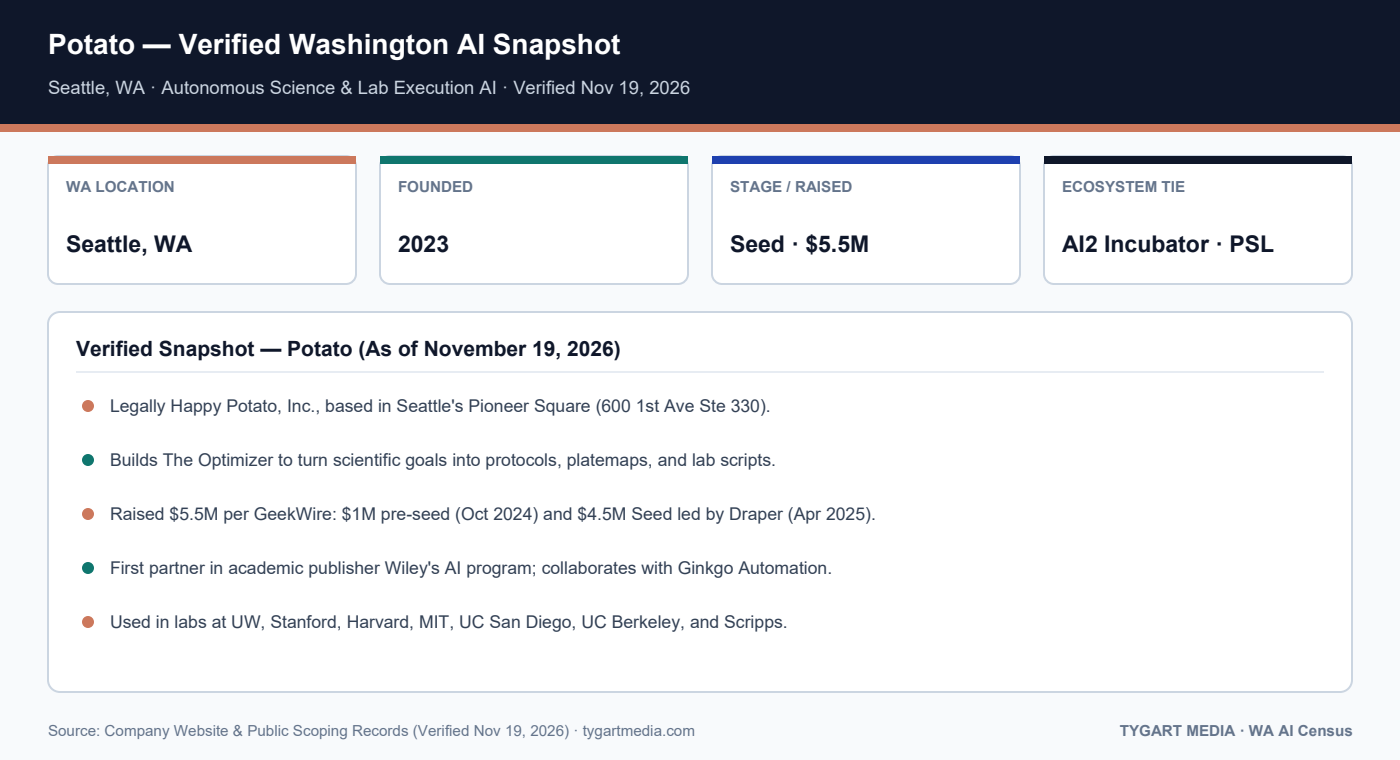
    Potato — Verified Washington AI Snapshot
    Verified profile snapshot for Potato (Seattle, WA) as of November 19, 2026.
    FieldVerified Record (As of Nov 19, 2026)
    CompanyPotato (Happy Potato, Inc.)
    Official Websitehttps://www.potato.ai/
    Washington HQSeattle, WA (600 1st Ave Ste 330 PMB 970434, Seattle, WA 98104-2246)
    Other WA FootprintAI2 Incubator / AI House (Seattle, WA); platform adopted by laboratories at the University of Washington
    Founded2023
    Founders / LeadershipNick Edwards, PhD (Co-founder & CEO), Ryan Kosai (Co-founder & CTO / Chief Technologist), Merrit Savener (Chief Commercial Officer)
    StageSeed
    Announced Funding$5.5M disclosed in GeekWire ($1M pre-seed Oct 2024 + $4.5M Seed Apr 2025 led by Draper Associates)
    Team Size5 employees at April 2025 Seed (GeekWire); 9 staff listed on potato.ai/company/ as of Nov 2026
    Primary Ecosystem TiesAI2 Incubator / AI House; Pioneer Square Labs (co-founder Ryan Kosai & angel Geoff Entress); ExtraHop alumni & UW lab adoption

    Washington Footprint and Leadership

    Potato operates from Seattle's Pioneer Square, listing 600 1st Ave Ste 330 PMB 970434, Seattle, WA 98104-2246 on potato.ai, and is listed as an active, independent portfolio company on Seattle's AI House / AI2 Incubator directory. Founded in 2023, the company is led by Co-founder and CEO Nick Edwards, PhD, a neuroscientist with prior bench research experience at the National Institutes of Health (NIH) and the University of California, San Diego (GeekWire, Apr 15, 2025).

    Co-founder and CTO Ryan Kosai brings deep Seattle engineering and venture-studio ties: he previously served as CTO of Pioneer Square Labs, co-founded and served as CTO of fintech startup Attunely, and held engineering roles at Seattle-area companies ExtraHop Networks, Marchex, and Athleon (GeekWire, Oct 28, 2024). In a May 2026 R&D World Online interview, Kosai outlined Potato's focus on pairing generative AI with deterministic code to avoid "hypothesis slop." While GeekWire reported 5 employees at the April 2025 Seed round, potato.ai/company/ lists 9 team members as of November 2026, including Chief Commercial Officer Merrit Savener and Principal Data Scientist Julie Penzotti, PhD.
    Seattle waterfront startup incubator loft overlooking Puget Sound ferry lanes and the Olympic Mountains
    Washington AI ecosystem context: Seattle waterfront startup incubator loft overlooking Puget Sound ferry lanes and the Olympic Mountains.

    Products, Users, and Public Traction

    Potato builds for pharma R&D and CMC teams, biotech companies, Contract Research Organizations (CROs), assay and lab automation teams, and academic research laboratories—starting in life sciences with stated plans to expand into chemistry and materials science (GeekWire, Apr 15, 2025). In October 2024, Potato became the first partner in academic publisher Wiley's AI partnership program, expanding its RAG reference base with published Wiley protocols; in April 2025, GeekWire also reported a collaboration with robotics company Ginkgo Automation on automated experiment execution.

    Across its October 2024 and April 2025 reporting, GeekWire noted that Potato's platform was being used in biotech companies and university laboratories including the University of Washington, Stanford University, Harvard University, MIT, UC San Diego, UC Berkeley, and The Scripps Research Institute. On potato.ai, a company-published testimonial from antibody development specialist Philip Gorman states that Potato drafts need roughly 45 minutes of review while saving 8 to 12 hours of manual work per protocol. Commercial customer totals and revenue metrics are not publicly disclosed; scientists can start on a free limited tier with paid options and early-access enrollment for The Optimizer.

    Funding, Stage, and Place in Washington's AI Landscape

    Potato has disclosed $5.5M in venture funding across two GeekWire-reported financings. On October 28, 2024, GeekWire reported a $1M pre-seed round with participation from Axial, Pioneer Square Labs, AI2 Incubator, Bow Capital, and angels including Cloudera co-founder Jeff Hammerbacher and ExtraHop co-founder Jesse Rothstein. On April 15, 2025, GeekWire reported a $4.5M Seed round led by Draper Associates, joined by Dolby Family Ventures, Boost VC, Ensemble VC, Silicon Badia, Alumni Ventures, Defined, The FounderVC, and strategic angels Geoff Entress (Pioneer Square Labs co-founder) and Michael Liou. No subsequent funding round or acquisition has been publicly announced through November 2026.

    Within Washington's life-sciences AI sector, Potato occupies the laboratory execution interface between computational biology models and physical wet-lab robotics. Alongside Seattle and Bellevue scientific-AI peers working on drug discovery, live-cell analysis, and proprietary scientific training data, Potato illustrates how Puget Sound software infrastructure veterans and domain scientists are partnering through AI2 Incubator and Pioneer Square Labs networks.

    Related Washington AI Profiles & Tygart Media Context

    Verified Primary Sources

  • Latch: Seattle AI Profile — Product, Footprint & Verified Record

    Latch: Seattle AI Profile — Product, Footprint & Verified Record

    Washington AI Companies Census · Verified Record (November 19, 2026)
    Sourced Baseline: As of November 19, 2026, Latch operates as an independent, Seed-stage Seattle startup at latch.ai building desktop-recorded workflow sidekicks for accounting and month-end close teams. Originally launched in September 2025 as Super Labs with an $8M seed round led by FUSE, the company rebranded to Latch in 2026 and reported 10 employees in September 2026 GeekWire coverage.
    PROFILE BRIEF · HOUSE PDF & MARKDOWN TWIN
    Latch — Seattle AI Profile
    Download the formatted 2-page profile brief (PDF) or open the single-source Markdown twin for Latch. Every claim below links to its verified primary source.

    What Latch Builds

    Latch develops desktop-recorded workflow automation software—positioning itself as an enterprise AI context layer for recurring accounting and month-end close work. On its official website, Latch replaces prompt engineering and manual procedure checklists with live demonstration: an accountant opens Latch on their desktop, records their screen and microphone while completing a recurring task in their existing tools, and talks through the clicks, rules, and exceptions. Latch converts that session into a structured process knowledge graph and builds testable workflow "sidekicks" that execute the routine steps while handing judgment calls back to the user.

    The product reflects a concrete evolution from the company's initial launch. When co-founders Stefan Kalb and Jared Kofron debuted the Seattle startup in September 2025 under the name Super Labs (GeekWire, Nov 12, 2025), it initially positioned itself as an AI vendor marketplace and implementation partner for non-technical mid-market companies in manufacturing, e-commerce, distribution, and retail. Following its 2026 rebrand to Latch (GeekWire Startup Spotlight, Sep 10, 2026), the company focused directly on observing employee desktop execution—differentiating itself from passive video tools like Loom by extracting structured operational context that agents can act on, with live site workflows tailored to accounting teams.

    • Record-once sidekick training: Captures clicks, workbook structure, file naming rules, and spoken exception logic during normal work so teams do not write prompts or SOPs from scratch.
    • Month-end close workflows: Live workflows on latch.ai span bank reconciliation (including MFA pauses, ledger cash exports, matching windows, and formula-preserving workpaper updates), statement collection and filing, financial models and actuals reporting, and payables cutoff reviews with proposed accruals.
    • Scoped execution and auditability: States that each sidekick runs in its own sandbox on the user's machine with user-approved connection scope, dry-run previews before file edits, human review on uncertain items, step-by-step run logs, and SOC 2 compliance.
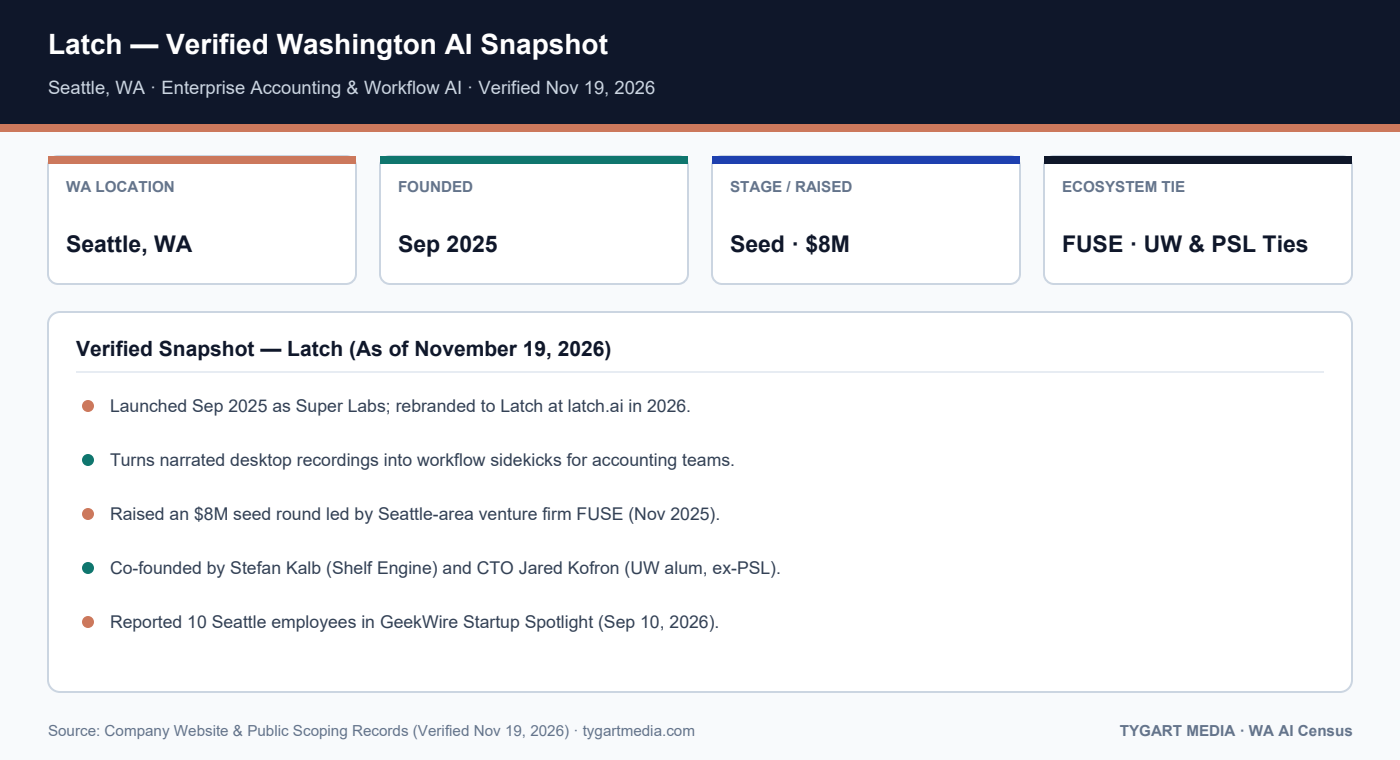
    Latch — Verified Washington AI Snapshot
    Verified profile snapshot for Latch (Seattle, WA) as of November 19, 2026.
    FieldVerified Record (As of Nov 19, 2026)
    CompanyLatch (formerly Super Labs)
    Official Websitehttps://www.latch.ai/
    Washington HQSeattle, WA
    Other WA FootprintCo-founder Stefan Kalb resides on Bainbridge Island, WA (GeekWire); founder lineage across Seattle startups and UW
    FoundedSeptember 2025 (GeekWire, Nov 12, 2025 & Sep 10, 2026)
    Founders / LeadershipStefan Kalb (Co-founder & CEO), Jared Kofron (Co-founder & CTO)
    StageSeed
    Announced Funding$8M Seed round (Nov 2025; led by FUSE with Garry Tan, Liquid 2 Ventures, Soma Capital, Massive Tech Ventures, Immad Akhund, and Pioneer Fund)
    Team Size10 employees (GeekWire Startup Spotlight, Sep 10, 2026)
    Primary Ecosystem TiesFUSE (Seattle-area VC); Pioneer Square Labs & University of Washington alumni lineage; GeekWire Startup Spotlight

    Washington Footprint and Leadership

    Latch is headquartered in Seattle, Washington, with leadership deeply rooted in the Puget Sound startup community. Co-founder and CEO Stefan Kalb—a Bainbridge Island resident per GeekWire—founded Seattle fresh-food supplier Molly's in 2009 (serving local cafes and hospitals) before launching grocery-AI startup Shelf Engine, which raised more than $60M and worked with retailers including Kroger, Target, Dollar General, and Walmart prior to its 2025 acquisition by retail data firm Crisp.

    Co-founder and CTO Jared Kofron is a University of Washington physics alumnus and former principal software engineer at Seattle venture studio Pioneer Square Labs, with earlier engineering roles at Seattle-area firms Flux, Rover, and Glowforge (GeekWire, Nov 12, 2025). As of GeekWire's September 10, 2026 Startup Spotlight, Latch operated with a team of 10 employees, reflecting Kalb's stated goal of scaling headcount more deliberately than at Shelf Engine.

    Aerial view of the Greater Seattle and Bellevue Lake Washington technology corridor with Mount Rainier on the horizon
    Washington AI ecosystem context: Aerial view of the Greater Seattle and Bellevue Lake Washington technology corridor with Mount Rainier on the horizon.

    Products, Users, and Public Traction

    As of November 19, 2026, latch.ai targets corporate controllers, staff accountants, and finance teams running repetitive multi-tool close checklists, offering account signup, demo booking, and dedicated pricing and security pages. Listed integrations include Excel, QuickBooks, Xero, NetSuite, Sage Intacct, Google Sheets, Google Drive, Slack, Stripe, Bill.com, Ramp, Brex, Expensify, Gusto, ADP, and Salesforce, alongside an interactive 8-step bank reconciliation demo.

    Named external enterprise customers, active seat counts, and revenue figures are not publicly disclosed on Latch's website or in GeekWire reporting. As an internal workflow benchmark, latch.ai describes its own controller's Xero-to-financial-model routine—spanning more than 200 manual clicks under a single checklist item—stating that Latch took over those steps across the existing tools. In his September 2026 GeekWire interview, Kalb noted that saturated AI-generated outbound email led Latch to invest in fewer, deeper, in-person customer conversations.

    Funding, Stage, and Place in Washington's AI Landscape

    Latch is a Seed-stage company backed by an $8M seed round reported by GeekWire on November 12, 2025. The financing was led by Seattle-area venture firm FUSE, with participation from Y Combinator CEO Garry Tan, Liquid 2 Ventures, Soma Capital, Massive Tech Ventures (Kalb's own venture fund), Mercury CEO Immad Akhund, and Pioneer Fund. No subsequent funding round or acquisition has been publicly disclosed through November 2026.

    Within Washington's enterprise AI landscape, Latch represents a shift toward capturing tacit operational context directly from employee workflows rather than asking non-technical finance teams to write software specs or abandon legacy spreadsheets. By anchoring automation inside existing accounting ledgers and workbooks under local sandbox controls, Latch sits alongside Seattle and Eastside startups applying agentic workflows to structured back-office operations.

    Related Washington AI Profiles & Tygart Media Context

    Verified Primary Sources

  • Reflection Robotics: Seattle AI Profile — Product, Footprint & Verified Record

    Reflection Robotics: Seattle AI Profile — Product, Footprint & Verified Record

    Washington AI Companies Census · Verified Record (November 19, 2026)
    Sourced Baseline: As of November 19, 2026, Reflection Robotics is an active, independent Seattle physical-AI startup building single-demonstration robot foundation models for ultra-precision manufacturing. Led by former NVIDIA robotics research manager Arsalan Mousavian, the company participated in Plug and Play Seattle Batch 3 and pitched at AI House Demo Day in September 2026, with no funding amount publicly disclosed.
    PROFILE BRIEF · HOUSE PDF & MARKDOWN TWIN
    Reflection Robotics — Seattle AI Profile
    Download the formatted 2-page profile brief (PDF) or open the single-source Markdown twin for Reflection Robotics. Every claim below links to its verified primary source.

    What Reflection Robotics Builds

    Reflection Robotics builds robot foundation models for ultra-precision manufacturing automation, aiming to eliminate the multi-week custom programming and teleoperation data collection that keep most factory tasks manual. On reflectionrobotics.co, the company argues that roughly 72% of manufacturing operations are still performed by hand because legacy industrial robots lack the flexibility and sub-millimeter precision needed for tight-tolerance assembly and frequent line changeovers.

    Instead of building bespoke hardware, digital twins, or teleoperation farms requiring thousands of recorded runs, Reflection Robotics structures deployment into a three-step zero-code pipeline called From Demonstration to Production. An operator first demonstrates a physical task once; the robot autonomously collects additional task data in under 30 minutes; Reflection Robotics then post-trains its pre-trained foundation model in the cloud for that specific task; and the job transitions onto the production floor the same day.

    In Plug and Play Seattle's Batch 3 announcement, the program summarized Reflection Robotics as making it faster and cheaper to automate physical manufacturing tasks without custom hardware or bespoke machines. Researchers should note two practical disambiguations: the company's live website is reflectionrobotics.co (whereas reflectionrobotics.com resolves to a parked GoDaddy domain-for-sale page), and Seattle-based Reflection Robotics is completely unrelated to frontier generative AI lab Reflection AI.

    • Single-demonstration onboarding: operator shows a repetitive task once, followed by under 30 minutes of autonomous data collection.
    • Cloud post-training: adapts pre-trained robot foundation models without writing task-specific code, building digital twins, or running teleoperation farms.
    • Sub-millimeter tolerance target: designed for same-day production launch and rapid line changeovers using 15 to 30 minutes of operator time per new task.
    • Hardware-agnostic framing: targets standard industrial robotics setups rather than requiring bespoke single-purpose factory machines.
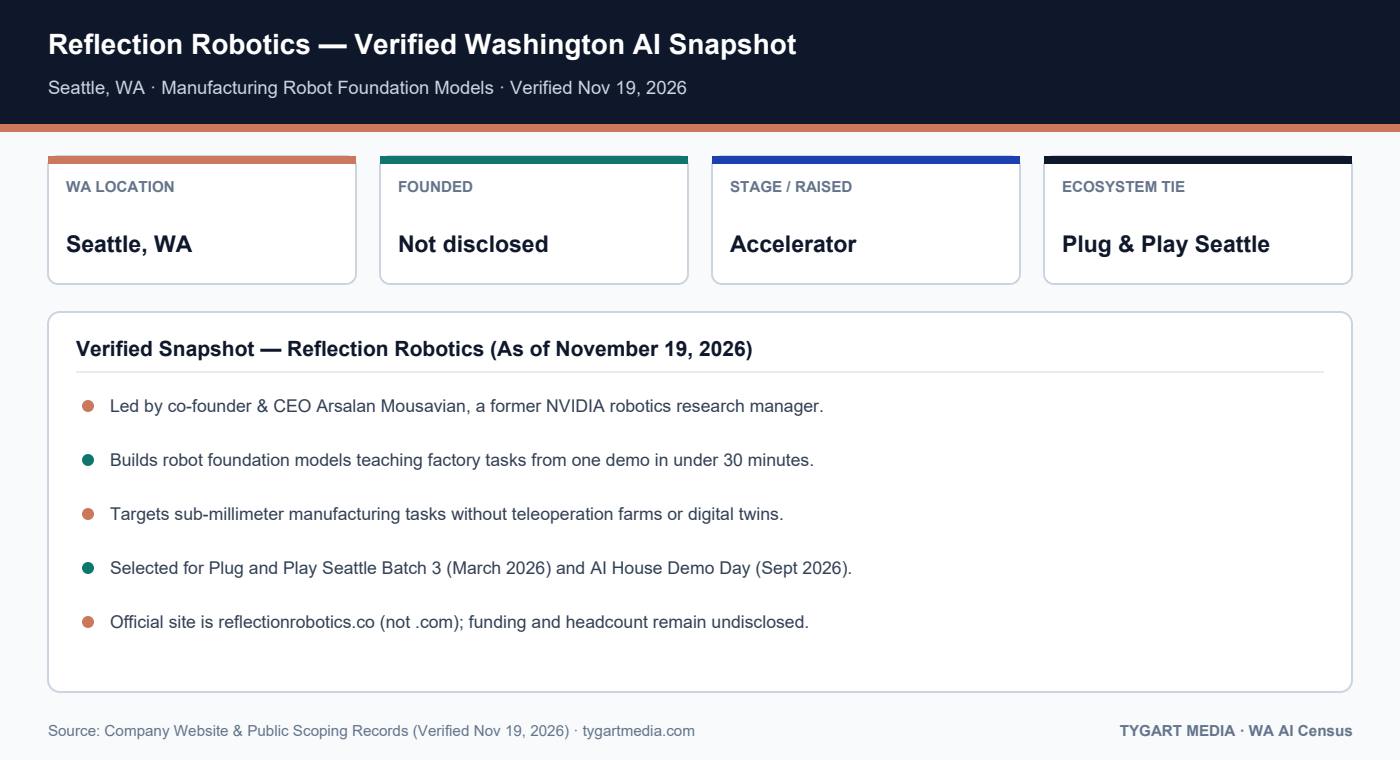
    Reflection Robotics — Verified Washington AI Snapshot
    Verified profile snapshot for Reflection Robotics (Seattle, WA) as of November 19, 2026.
    FieldVerified Record (As of Nov 19, 2026)
    CompanyReflection Robotics
    Official Websitehttps://www.reflectionrobotics.co/
    Washington HQSeattle, WA
    Other WA FootprintUW CoMotion Labs via Plug and Play Seattle; pitched at AI House Pier 70 (Seattle)
    FoundedNot publicly disclosed
    Founders / LeadershipArsalan Mousavian (Co-Founder & CEO); other co-founders not publicly disclosed
    StageAccelerator (Plug and Play Seattle Batch 3)
    Announced FundingNot publicly disclosed
    Team SizeNot publicly disclosed
    Primary Ecosystem TiesPlug and Play Seattle Batch 3 (March 2026); AI House Demo Day presenter (Sept 2026); Seattle NVIDIA robotics research lineage

    Washington Footprint and Leadership

    Reflection Robotics is based in Seattle and surfaced through two major regional startup showcases during 2026. On March 23, 2026, GeekWire reported that Plug and Play selected Reflection Robotics as one of nine Seattle-based companies in its 10-startup third Seattle accelerator cohort (running 12 weeks through mid-June 2026, with access to Plug and Play's office inside UW CoMotion Labs and space at SNBL Global Gateway in Everett). Six months later, on September 25, 2026, Reflection Robotics was among 25 early-stage startups invited to pitch local and national VCs at Seattle's Pier 70 AI House Demo Day—an event GeekWire noted deliberately included outside startups beyond AI House's own incubator portfolio.

    In GeekWire's September 25, 2026 Demo Day report, editor Todd Bishop identified co-founder and CEO Arsalan Mousavian, a former NVIDIA robotics research manager—connecting the startup directly to Seattle's active NVIDIA Robotics Research Lab talent pool. Names of Mousavian's co-founders, an official founding year, and total employee headcount have not been publicly disclosed on reflectionrobotics.co or in GeekWire coverage.

    Seattle waterfront startup incubator loft overlooking Puget Sound ferry lanes and the Olympic Mountains
    Washington AI ecosystem context: Seattle waterfront startup incubator loft overlooking Puget Sound ferry lanes and the Olympic Mountains.

    Products, Users, and Public Traction

    Reflection Robotics targets manufacturing facilities and industrial operations teams confronting acute factory labor shortages and frequent product changeovers. On reflectionrobotics.co, the company cites a U.S. manufacturing labor gap of 400,000 workers projected to reach 2,100,000 by 2030, pitching same-day task retraining as a way to expand the share of factory work with viable automation payback.

    Public commercial proof points remain undisclosed as of November 19, 2026. Reflection Robotics has not publicly named pilot factories, commercial manufacturing customers, supported robot arm vendors, or software pricing tiers. Its website provides direct Partnership, Careers, and Contact navigation paths for prospective industrial partners and prospective hires.

    • Target buyers: manufacturing plants and industrial operations teams needing sub-millimeter precision and frequent line changeovers.
    • Public site pathways: Mission, Careers, Contact, and Partnership sections live on reflectionrobotics.co.
    • Undisclosed commercial details: pilot customer names, factory deployment counts, and contract pricing have not been published.

    Funding, Stage, and Place in Washington's AI Landscape

    Reflection Robotics completed Plug and Play Seattle Batch 3 in mid-2026 and pitched investors from Seattle, the Bay Area, Boston, New York, and Colorado at AI House Demo Day in September 2026. No institutional seed round, funding dollar figure, or venture investor syndicate beyond Plug and Play accelerator participation has been publicly announced through November 2026.

    Within Washington's growing physical-AI and robotics ecosystem, Reflection Robotics occupies the pure foundation-model end of the industrial automation spectrum. Alongside Seattle physical-intelligence stealth venture Noosphere Labs and industrial workstation builder Outrun—and drawing directly from Seattle's NVIDIA robotics research community—Reflection Robotics tests whether single-demonstration post-training can hold tight sub-millimeter factory tolerances quickly enough to compete with traditional systems integrators.

    Related Washington AI Profiles & Tygart Media Context

    Verified Primary Sources

  • Polybiomics: Seattle AI Profile — Product, Footprint & Verified Record

    Polybiomics: Seattle AI Profile — Product, Footprint & Verified Record

    Washington AI Companies Census · Verified Record (November 19, 2026)
    Sourced Baseline: As of November 19, 2026, Polybiomics (Polybiomics Inc.) is an active, independent life-science AI startup with Washington ties spanning Plug and Play Seattle's Batch 2 cohort and a 2025 Washington Competes Grant listing in Kirkland. Its website lists 10 team members and a 4-member Scientific Advisory Board, while founding year and institutional venture funding remain undisclosed.
    PROFILE BRIEF · HOUSE PDF & MARKDOWN TWIN
    Polybiomics — Seattle AI Profile
    Download the formatted 2-page profile brief (PDF) or open the single-source Markdown twin for Polybiomics. Every claim below links to its verified primary source.

    What Polybiomics Builds

    Polybiomics (Polybiomics Inc.) develops a modular, integrated live-cell analysis platform designed to observe dynamic cellular behavior without destroying samples. On polybiomics.com, the company organizes its architecture into three components: a proprietary Bioinstrument and Consumable, its PolyData™ and Analytics software layer, and an AI engine for actionable intelligence.

    Conventional cell assays often rely on destructive endpoint measurements or capture only one parameter at a time. Polybiomics states that its proprietary polysensing consumable generates multi-parameter matrix data during imaging of a single live-cell sample, simultaneously and continuously tracking multiple phenotypes and biological functions without disturbing the cells or their 3D microenvironments. PolyData™ integrates those multimodal streams while the company's AI engine extracts predictive patterns intended to shorten discovery timelines, lower experimental costs, and improve reproducibility.

    In GeekWire's September 19, 2025 coverage of Plug and Play Seattle's second cohort, the accelerator described Polybiomics as having 'developed a live cell analysis platform that streamlines drug discovery' by turning complex multimodal data into clear insights while keeping biological samples intact.

    • Bioinstrument and Consumable: proprietary polysensing consumable capturing multi-parameter matrix signals during non-destructive live-cell imaging.
    • PolyData™ and Analytics: software layer integrating and interpreting multimodal, time-series live-cell datasets.
    • AI Engine: extracts patterns from dynamic cell behavior across 3D environments for drug discovery, biomanufacturing, and clinical workflows.
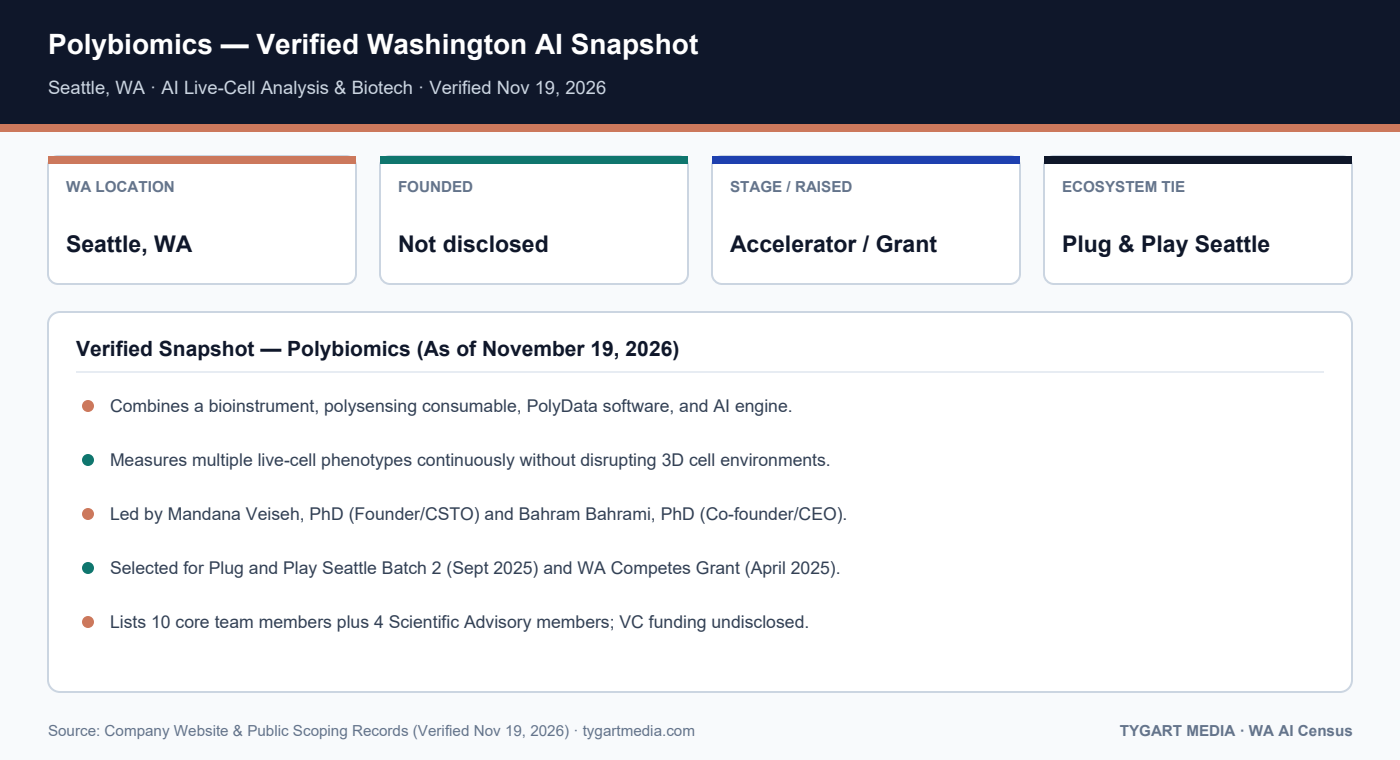
    Polybiomics — Verified Washington AI Snapshot
    Verified profile snapshot for Polybiomics (Seattle, WA) as of November 19, 2026.
    FieldVerified Record (As of Nov 19, 2026)
    CompanyPolybiomics (Polybiomics Inc.)
    Official Websitehttps://www.polybiomics.com/
    Washington HQSeattle, WA (Plug & Play Seattle Batch 2); also indexed in Kirkland, WA (WA Competes Grant) with earlier Berkeley, CA directory listings
    Other WA FootprintKirkland, WA; UW CoMotion Labs (Seattle) and SNBL Global Gateway (Everett) via Plug & Play Seattle
    FoundedNot publicly disclosed
    Founders / LeadershipMandana Veiseh, PhD (Founder, President & CSTO); Bahram Bahrami, PhD (Co-founder & CEO)
    StageAccelerator / Grant-Backed
    Announced FundingNot publicly disclosed (2025 Washington Competes Grant recipient; program awards up to $25,000)
    Team Size10 listed on official website (2 executives + 8 team members; excludes 10 advisors)
    Primary Ecosystem TiesPlug and Play Seattle Batch 2 (Sept 2025); Life Science Washington Competes Grant (April 2025); Fred Hutch / UW research roots

    Washington Footprint and Leadership

    Polybiomics has a multi-city West Coast footprint that requires careful reading across public directories. In September 2025, GeekWire listed 'Polybiomics, Seattle' as one of six local Seattle-area startups selected for Plug and Play Seattle's Batch 2 accelerator, a 12-week program running through mid-December 2025 primarily at the University of Washington's CoMotion Labs with additional space at SNBL Global Gateway in Everett. Earlier in 2025 (April 8, 2025), Life Science Washington Institute and the Washington State Department of Commerce announced Polybiomics Inc.—indexed in Kirkland, WA—as a recipient of a Washington Competes Grant. Meanwhile, earlier Bay Area biotech and accelerator directories have listed Polybiomics in Berkeley, California, reflecting founder research ties at Lawrence Berkeley National Laboratory, and polybiomics.com itself omits a street address or city.

    The company is led by Founder, President, and Chief Scientific and Technology Officer Mandana Veiseh, PhD and Co-founder and CEO Bahram Bahrami, PhD. Both founders share Pacific Northwest translational oncology research roots at Fred Hutchinson Cancer Research Center and the University of Washington, and Veiseh previously held research and technical roles at Lawrence Berkeley National Laboratory and Xerox-PARC. On polybiomics.com, Polybiomics lists eight additional team members (David Stumbo, PhD; Shahab S. Bahaei, PhD; Therese Choquette, PhD; Kayla Solomon, DMD; Bob Smith-McCollum, MBA; Ava Aslanpour, BE; Navya Mangipudi, BE; and Haro Hartounian, PhD), four Scientific Advisory Board members—including National Academy members Mina J. Bissell, PhD, Kurt Petersen, PhD, and Ron W. Davis, PhD, plus Rick Horwitz, PhD—and six business and legal advisors.

    Aerial view of the Greater Seattle and Bellevue Lake Washington technology corridor with Mount Rainier on the horizon
    Washington AI ecosystem context: Aerial view of the Greater Seattle and Bellevue Lake Washington technology corridor with Mount Rainier on the horizon.

    Products, Users, and Public Traction

    Polybiomics positions its platform for four life-science buyer groups: academic researchers, pharmaceutical drug discovery teams, biomanufacturing operators, and clinical workflow teams. By consolidating multi-parameter monitoring onto a single non-destructive sample from early discovery through late-stage development, the company aims to cut reagent waste and improve experimental reproducibility.

    Public commercial disclosures remain early-stage. Polybiomics has not published named pharmaceutical customers, instrument pricing, shipment counts, or peer-reviewed clinical deployments tied to the commercial product on polybiomics.com. Readers inspecting the site should also note that while its technical messaging aligns with its late-2025 Seattle accelerator profile, the website footer still displays a 2024 copyright notice (© 2024 POLYBIOMICS INC.) and routes inquiries through operations@polybiomics.com.

    • Target markets: academic research labs, pharmaceutical drug discovery, biomanufacturing, and clinical workflows.
    • Listed personnel: 10 core leadership and team members, 4 Scientific Advisory Board members (3 National Academy members), and 6 advisors.
    • Public gaps: founding year, commercial customer roster, and instrument pricing are not publicly disclosed.

    Funding, Stage, and Place in Washington's AI Landscape

    No institutional venture capital round or cumulative equity raise has been publicly announced by Polybiomics through November 2026. Its verified Washington financial and program milestones are non-dilutive and accelerator-based: selection for the Washington Competes Grant (a state program administered by Life Science Washington Institute and the Washington Department of Commerce awarding up to $25,000 to early-stage Washington life-science companies) in April 2025, followed by selection for Plug and Play Seattle Batch 2 in September 2025.

    Within Washington's biotech-AI cluster, Polybiomics sits at the instrumentation-and-wet-lab boundary alongside Seattle AI drug-discovery peers like Clockwork Bio. Rather than relying solely on public molecular databases or pure in-silico models, Polybiomics pairs proprietary physical biosensing hardware and consumables with multimodal AI analysis—a capital-intensive, defensible approach closely aligned with Seattle's Fred Hutch, UW, and Eastside life-science research talent.

    Related Washington AI Profiles & Tygart Media Context

    Verified Primary Sources

  • Outrun: Seattle AI Profile — Product, Footprint & Verified Record

    Outrun: Seattle AI Profile — Product, Footprint & Verified Record

    Washington AI Companies Census · Verified Record (November 19, 2026)
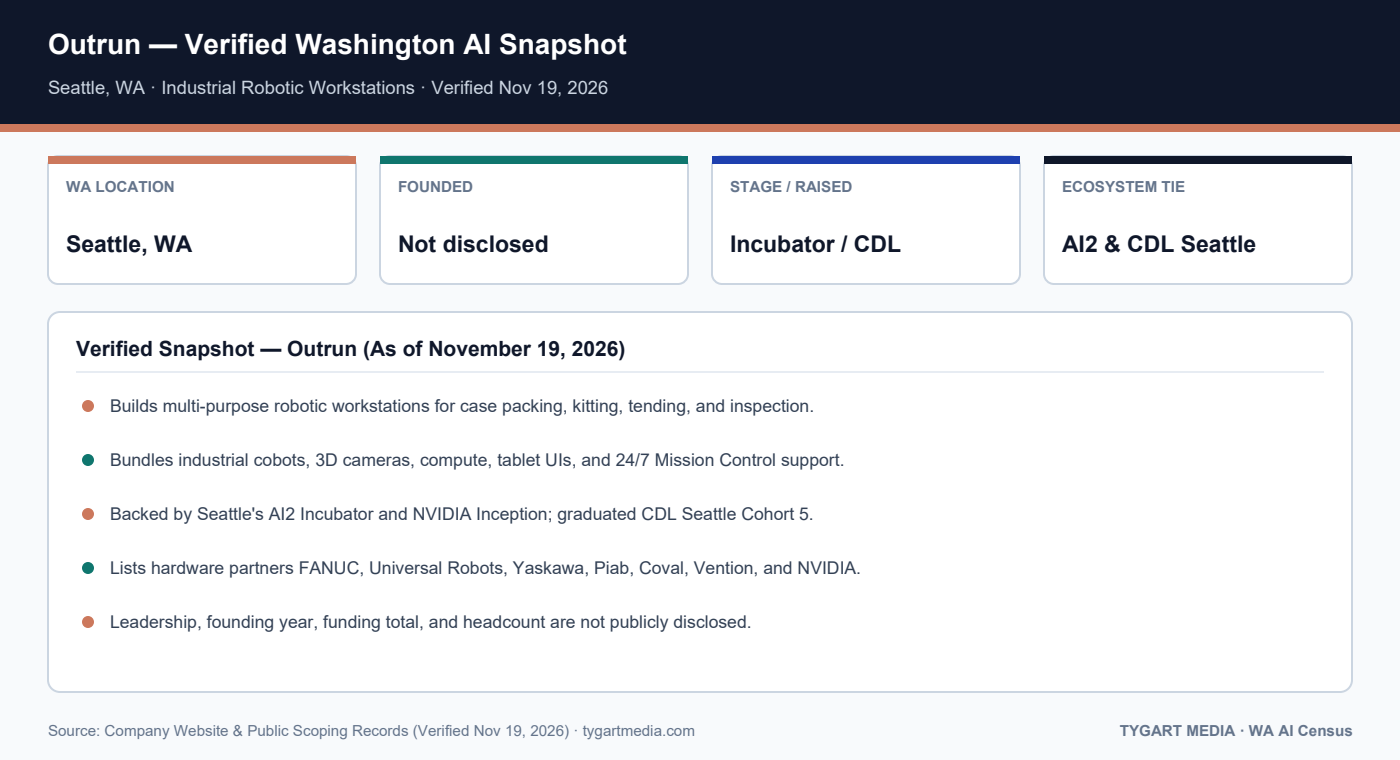
    Sourced Baseline: As of November 19, 2026, Outrun (Outrun Robotics) is an active, independent Seattle industrial robotics startup backed by AI2 Incubator and NVIDIA Inception, having graduated from Creative Destruction Lab (CDL) Seattle's fifth cohort in July 2026. Founding team details, founding year, headcount, and institutional funding amounts are not publicly disclosed.
    PROFILE BRIEF · HOUSE PDF & MARKDOWN TWIN
    Outrun — Seattle AI Profile
    Download the formatted 2-page profile brief (PDF) or open the single-source Markdown twin for Outrun. Every claim below links to its verified primary source.

    What Outrun Builds

    Outrun (operating as Outrun Robotics) builds multi-purpose robotic workstations designed to bring industrial automation to small- and medium-scale production lines. On outrun.bot, the company targets stationary, repetitive factory tasks—specifically case packing, kitting, machine tending, and inspection—where conventional custom-engineered robotic cells are often too slow or expensive to justify.

    The product combines a packaged Hardware Platform with a managed Software Platform. On the factory floor, each workstation bundles industrial collaborative robots (cobots), 3D cameras, compute hardware, a tablet user interface, and secure networking. Behind the hardware sits Mission Control, Outrun's 24/7 remote engineering and teaching workforce: when a factory introduces a new SKU or needs to adjust robot behavior, Outrun's remote engineers update the software and deliver tailored tablet interfaces so on-site floor operators can switch recipes or make routine adjustments without writing code.

    Readers evaluating Outrun's technical positioning should note a clear framing distinction across sources. Seattle's CDL Cohort 5 graduation report in GeekWire describes Outrun Robotics as building 'capable, flexible, intelligent robotic workstations' alongside Seattle's AI2 Incubator portfolio, whereas outrun.bot focuses on 3D vision hardware, compute, and human-in-the-loop remote engineering via Mission Control rather than foregrounding explicit AI model branding on its landing page.

    • Target factory tasks: case packing, kitting, machine tending, and inspection on small-to-medium production lines.
    • Hardware Platform: industrial cobots, 3D cameras, edge compute, tablet operator UI, and secure remote networking.
    • Software Platform (Mission Control): 24/7 remote engineering team managing SKU additions, behavior updates, tailored operator UIs, and uptime recovery.
    • Four-step rollout: (1) process review, (2) on-site production pilot, (3) promotion to live production, and (4) ongoing multi-year operation.
    Outrun — Verified Washington AI Snapshot
    Verified profile snapshot for Outrun (Seattle, WA) as of November 19, 2026.
    FieldVerified Record (As of Nov 19, 2026)
    CompanyOutrun (Outrun Robotics)
    Official Websitehttps://outrun.bot/
    Washington HQSeattle, WA
    Other WA FootprintAI2 Incubator / AI House (Seattle); Creative Destruction Lab Seattle at UW Foster School of Business
    FoundedNot publicly disclosed
    Founders / LeadershipNot publicly disclosed
    StageIncubator / Accelerator (AI2 Incubator; CDL Seattle Cohort 5)
    Announced FundingNot publicly disclosed (backed by AI2 Incubator; non-equity CDL Seattle graduate)
    Team SizeNot publicly disclosed
    Primary Ecosystem TiesAI2 Incubator / AI House; Creative Destruction Lab Seattle (Cohort 5, July 2026); NVIDIA Inception

    Washington Footprint and Leadership

    Outrun's Washington footprint is anchored by two prominent Seattle startup institutions. The company is listed as an active, non-acquired portfolio company on the AI House / AI2 Incubator directory and displays 'Backed by AI2 Incubator & NVIDIA Inception' in the footer of outrun.bot. In July 2026, GeekWire reported that Outrun Robotics graduated in the fifth cohort of Creative Destruction Lab (CDL) Seattle, a nine-month, non-equity nonprofit accelerator hosted at the University of Washington's Foster School of Business and backed by founding members including UW and Microsoft.

    Public executive disclosure is notably sparse compared to peer startups in the region. Neither outrun.bot, the AI House directory, nor GeekWire's CDL Seattle cohort announcement publishes founder names, leadership biographies, a founding year, or total employee headcount. One minor site-maintenance signal is also visible: outrun.bot still displays a 'Copyright Outrun Robotics 2025' footer and placeholder '#' links for its Terms of Service and Privacy Policy, though its July 2026 CDL Seattle graduation confirms active operations in 2026.

    Seattle waterfront startup incubator loft overlooking Puget Sound ferry lanes and the Olympic Mountains
    Washington AI ecosystem context: Seattle waterfront startup incubator loft overlooking Puget Sound ferry lanes and the Olympic Mountains.

    Products, Users, and Public Traction

    Outrun builds for small- and mid-sized manufacturing operators running high-mix or medium-volume lines that struggle to amortize traditional systems-integrator fees every time packaging or part SKUs change. Rather than selling bare robot arms and leaving programming to plant engineers, Outrun's hybrid model pairs off-the-shelf industrial hardware with ongoing remote engineering support.

    While Outrun has not publicly named paying manufacturing customers or disclosed installed workstation counts, outrun.bot lists an established roster of industrial hardware, gripper, framing, and compute partners integrated into its workstations: FANUC, Universal Robots (UR), Yaskawa, Piab, Coval, Vention, 80-20, and NVIDIA. Pricing, leasing versus capital-purchase terms, and customer pilot metrics are not publicly disclosed; prospective buyers engage via an on-site intake form and email contact (info@outrun.bot).

    • Named hardware and compute brand partners: FANUC, Universal Robots (UR), Yaskawa, Piab, Coval, Vention, 80-20, and NVIDIA.
    • Deployment model emphasizes an on-site production pilot before full promotion to live production.
    • Commercial customers, unit counts, and pricing structure are not publicly disclosed.

    Funding, Stage, and Place in Washington's AI Landscape

    Outrun's publicly verified backing consists of AI2 Incubator support, membership in NVIDIA Inception, and graduation from the non-equity CDL Seattle advanced manufacturing track in July 2026. No institutional venture funding dollar figure, lead VC firm, or headcount milestone has been publicly announced through November 2026.

    Within Washington's emerging physical-AI and industrial robotics cluster, Outrun offers an instructive contrast in technical strategy. Whereas Seattle peer Reflection Robotics focuses on training robot foundation models to learn sub-millimeter tasks from a single demonstration in software, Outrun pairs standard industrial cobots and 3D cameras with a 24/7 remote engineering workforce (Mission Control) to solve the SKU-changeover and uptime gap pragmatically for smaller factories.

    Related Washington AI Profiles & Tygart Media Context

    Verified Primary Sources

  • Moria: Seattle AI Profile — Product, Footprint & Verified Record

    Moria: Seattle AI Profile — Product, Footprint & Verified Record

    Washington AI Companies Census · Verified Record (November 19, 2026)
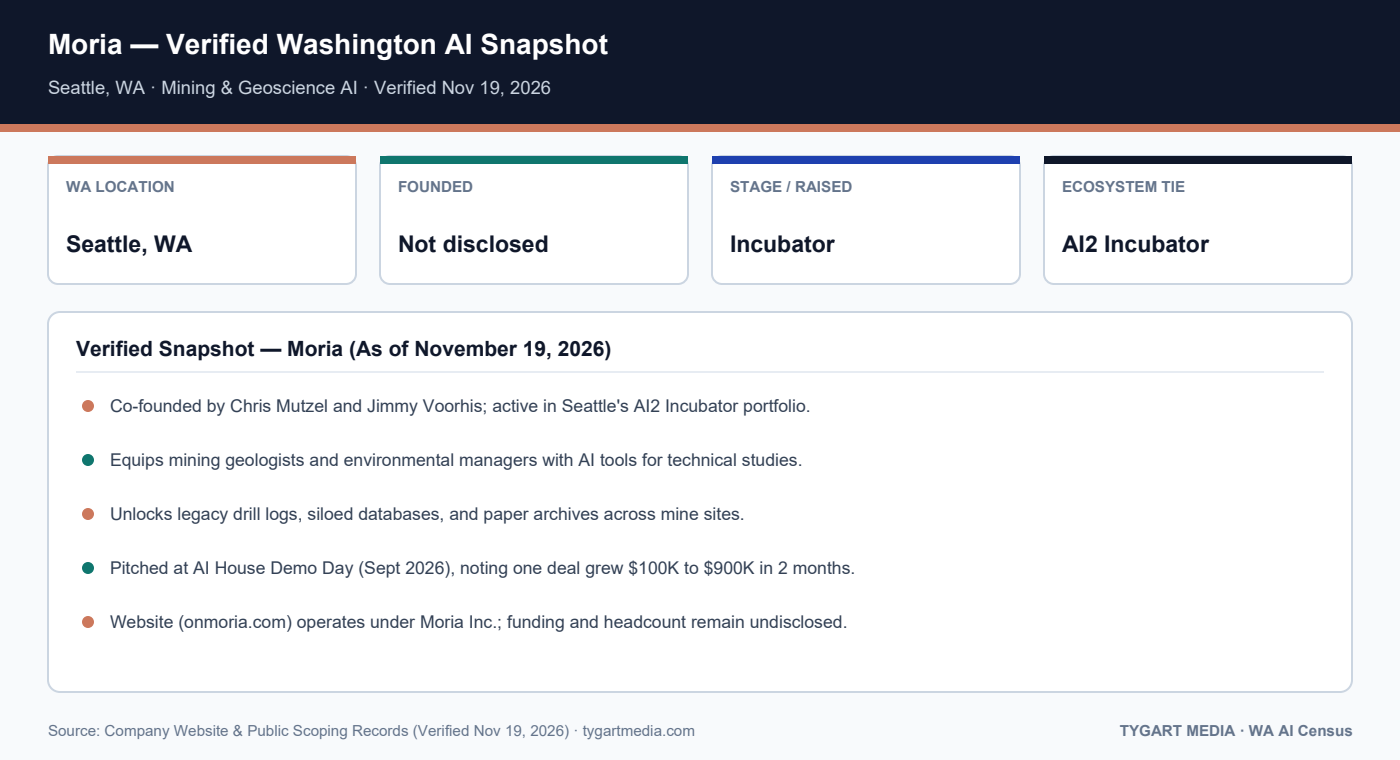
    Sourced Baseline: As of November 19, 2026, Moria (Moria Inc.) is an active, independent Seattle startup inside the AI2 Incubator / AI House portfolio building AI software for mining exploration and environmental technical studies. Following its September 2026 pitch at AI House Demo Day, neither an institutional funding round nor total headcount has been publicly disclosed.
    PROFILE BRIEF · HOUSE PDF & MARKDOWN TWIN
    Moria — Seattle AI Profile
    Download the formatted 2-page profile brief (PDF) or open the single-source Markdown twin for Moria. Every claim below links to its verified primary source.

    What Moria Builds

    Moria (operating under Moria Inc.) builds an AI-backed platform that helps mining technical services teams process legacy geological and environmental records to produce technical studies faster. On onmoria.com, the company positions its offering under the banner 'Mining Services, Redefined,' structured around two main operating tracks: Exploration Services and Environmental Services.

    According to the company's website, Moria targets four interconnected bottlenecks faced by technical services managers, study teams, and brownfield exploration groups: manual data preparation (which Moria claims consumes 30% to 50% of consulting project time), scarcity of domain experts and Qualified Professionals, project knowledge trapped inside disconnected digital silos or paper storage boxes, and costly legacy software that reinforces manual workflows.

    A useful framing nuance exists across primary sources: Seattle's AI House portfolio directory summarizes Moria specifically as analyzing 'drill log and legacy data for modern mine sites,' whereas Moria's live site and GeekWire's September 2026 Demo Day report describe a broader AI-assisted workflow equipping geologists and environmental managers to deliver full technical studies.

    • Exploration Services track: unlocks historical drill logs, geological databases, and legacy site records for exploration and technical study teams.
    • Environmental Services track: streamlines environmental data preparation and technical study delivery for mine-site environmental managers.
    • Human-in-the-loop focus: designed to equip Qualified Professionals (licensed geologists and technical experts) rather than replace regulatory sign-off.
    Moria — Verified Washington AI Snapshot
    Verified profile snapshot for Moria (Seattle, WA) as of November 19, 2026.
    FieldVerified Record (As of Nov 19, 2026)
    CompanyMoria
    Official Websitehttps://onmoria.com/
    Washington HQSeattle, WA (AI2 Incubator / AI House; street address not listed on website)
    Other WA FootprintAI House at Pier 70 (Seattle, WA)
    FoundedNot publicly disclosed
    Founders / LeadershipChris Mutzel (Co-Founder); Jimmy Voorhis (Co-Founder)
    StageIncubator (AI2 Incubator / AI House)
    Announced FundingNot publicly disclosed (backed by AI2 Incubator / AI House)
    Team SizeNot publicly disclosed
    Primary Ecosystem TiesAI2 Incubator / AI House active portfolio; AI House Demo Day presenter (Sept 2026)

    Washington Footprint and Leadership

    Moria is anchored in Seattle through AI2 Incubator / AI House, where it appears as an active, non-acquired portfolio company on aihouse.vc/incubator/companies and pitched on stage at AI House's Pier 70 waterfront offices during its September 2026 Demo Day. Readers checking Moria's website directly should note that onmoria.com/about lists only the corporate entity 'Moria Inc.' with a 2026 copyright and does not publish a street address, city, founder biographies, or named venture backers.

    GeekWire's September 25, 2026 Demo Day coverage identifies Moria's co-founders as Chris Mutzel and Jimmy Voorhis, with Voorhis presenting the company's traction to visiting investors. Specific executive titles (such as CEO or CTO), prior career biographies, founding year, and total employee count have not been publicly disclosed in GeekWire or on the company's website.

    Seattle waterfront startup incubator loft overlooking Puget Sound ferry lanes and the Olympic Mountains
    Washington AI ecosystem context: Seattle waterfront startup incubator loft overlooking Puget Sound ferry lanes and the Olympic Mountains.

    Products, Users, and Public Traction

    Moria sells to mining companies, technical services managers, study teams, geologists, and mine-site environmental managers handling brownfield exploration, database reconstruction, and compliance-heavy technical reports. The website uses an enterprise consultative intake flow ('Talk to us' and customer portal 'Log In') with no public self-serve pricing tiers.

    The clearest public commercial signal came from GeekWire's September 25, 2026 Demo Day coverage: during his pitch, co-founder Jimmy Voorhis stated that one mining customer expanded a $100,000 contract to $900,000 in two months. Neither the customer's name nor Moria's overall customer count or annual recurring revenue has been publicly disclosed.

    • Primary users: Qualified Professionals (geologists), environmental managers, and mining technical services study teams.
    • Reported expansion signal: co-founder Jimmy Voorhis told AI House Demo Day investors that one customer grew a $100,000 contract to $900,000 within two months.
    • Public disclosure gaps: customer names, total deployments, and contract pricing models are not publicly disclosed.

    Funding, Stage, and Place in Washington's AI Landscape

    Moria is backed by Seattle's AI2 Incubator / AI House and operates at the incubator stage; no external pre-seed, seed, or institutional venture funding dollar figure has been publicly announced through November 2026. Its appearance at AI House's September 2026 Pier 70 Demo Day put the company in front of both Seattle venture firms and visiting national investors from Boston, New York, Colorado, and the Bay Area.

    Within Washington's AI startup landscape, Moria represents an applied industrial vertical far removed from horizontal chat wrappers or developer tools. Alongside AI2 Incubator peers automating physical-world operations like Outrun (factory workstations) and Jinn Labs (physical retail), Moria applies AI extraction and structuring to an unglamorous, high-value legacy data bottleneck—turning decades of siloed drill logs and paper records into structured inputs for regulated mining studies.

    Related Washington AI Profiles & Tygart Media Context

    Verified Primary Sources

  • Makko AI: Seattle AI Profile — Product, Footprint & Verified Record

    Makko AI: Seattle AI Profile — Product, Footprint & Verified Record

    Washington AI Companies Census · Verified Record (November 19, 2026)
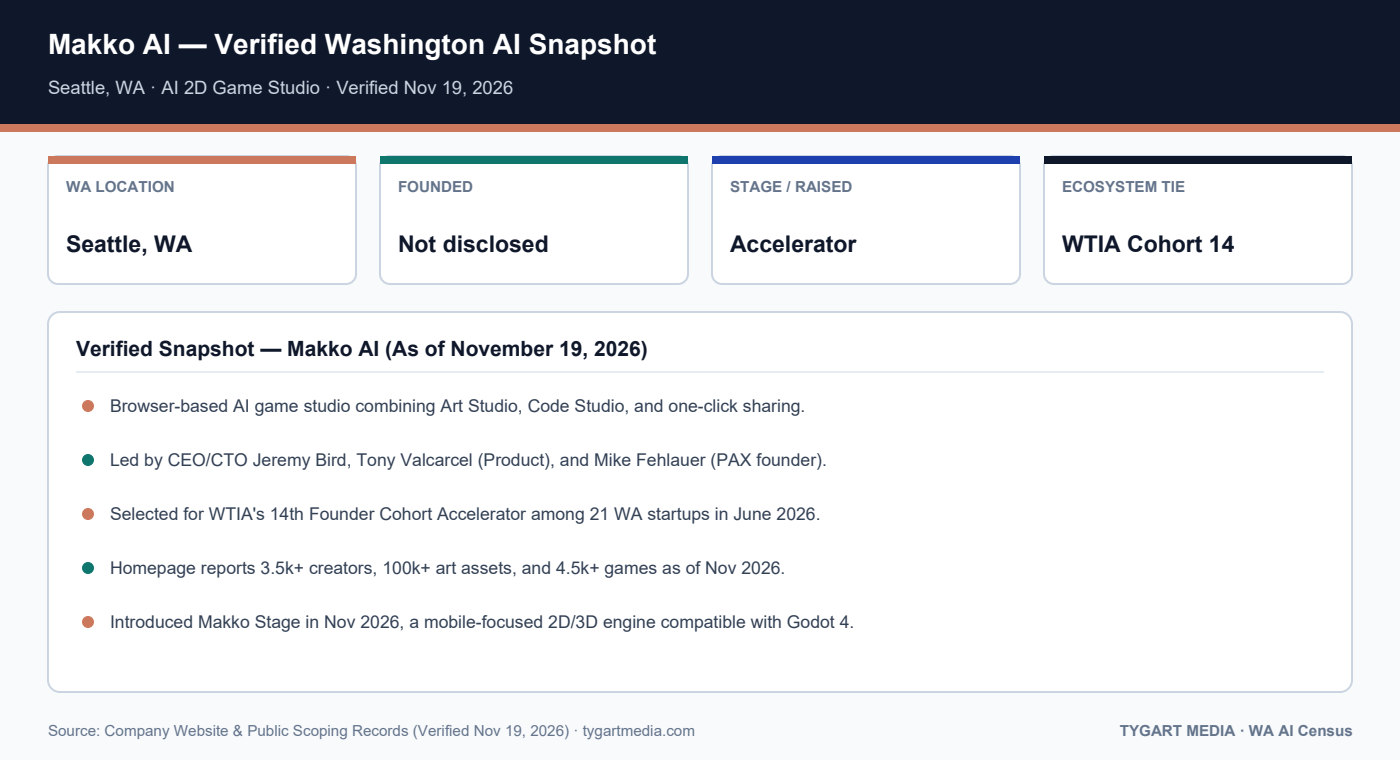
    Sourced Baseline: As of November 19, 2026, Makko AI is an active, independent Seattle AI game-creation startup shipping frequent product updates across its Art Studio, Code Studio, and newly announced Makko Stage engine. The company graduated into public subscriptions out of beta in 2026 and joined the WTIA 14th Founder Cohort Accelerator in June 2026, with no institutional venture funding round publicly disclosed.
    PROFILE BRIEF · HOUSE PDF & MARKDOWN TWIN
    Makko AI — Seattle AI Profile
    Download the formatted 2-page profile brief (PDF) or open the single-source Markdown twin for Makko AI. Every claim below links to its verified primary source.

    What Makko AI Builds

    Makko AI develops a browser-based AI game creation platform built to move creators from plain-English prompts to finished 2D art assets, animations, and playable browser games in one workspace. On makko.ai, the product is organized into a six-step pipeline—Vision, Characters, Animate, World, Play, and Share—anchored by two integrated tools: Art Studio and Code Studio.

    In Art Studio, creators open a style-locked workspace called a Collection to generate concept art, character reference sheets with specific gear or armor, walk/attack/idle sprite animations, and matching biomes and props without visual drift across assets. In Code Studio, users describe gameplay mechanics in natural language while referencing their generated assets, allowing the AI to assemble playable browser prototypes with no manual coding required and publish them via a single shareable link or export package.

    During the second half of 2026, Makko AI expanded beyond basic 2D browser prototypes. Product updates on makko.ai/news document multi-model Code Studio support (adding credit-tiered access to frontier coding and image models), @-mention asset references in chat, mobile access, and—on November 17, 2026—the introduction of Makko Stage, a 2D and 3D game engine built for phones and designed for Godot 4 compatibility.

    • Art Studio: concept art, character reference sheets, backgrounds, objects, multi-pose sprite animations, and style-consistent Collections.
    • Code Studio: conversational game building in plain English tied directly to a project's own characters and assets, playable instantly in a browser.
    • Makko Stage (announced November 17, 2026): mobile-oriented 2D and 3D engine compatible with Godot 4 and tailored for AI-assisted development.
    • Creator rights: per makko.ai/pricing, creators retain full ownership of generated games and assets for commercial publication with zero royalties or revenue share.
    Makko AI — Verified Washington AI Snapshot
    Verified profile snapshot for Makko AI (Seattle, WA) as of November 19, 2026.
    FieldVerified Record (As of Nov 19, 2026)
    CompanyMakko AI
    Official Websitehttps://www.makko.ai/
    Washington HQSeattle, WA
    Other WA FootprintWTIA Founder Cohort 14 (Washington state program)
    FoundedNot publicly disclosed
    Founders / LeadershipJeremy Bird (CEO & CTO); Tony Valcarcel (Head of Product & Marketing); Mike Fehlauer (Head of Operations & Biz Dev)
    StageAccelerator (WTIA Founder Cohort 14)
    Announced FundingNot publicly disclosed
    Team SizeNot publicly disclosed (3 leaders listed on official About page)
    Primary Ecosystem TiesWTIA 14th Founder Cohort Accelerator (June 2026); Seattle Amazon and Penny Arcade Expo (PAX) alumni leadership

    Washington Footprint and Leadership

    Makko AI is based in Seattle and participates in Washington's statewide startup network through the Washington Technology Industry Association (WTIA). On June 2, 2026, GeekWire reported that WTIA selected Makko AI as one of 21 Washington-state early-stage companies in its 14th Founder Cohort Accelerator Program, a four-month mentorship and investor-connection program supported by regional sponsors including Madrona Venture Group, Accenture, Fenwick, Seed IP, Clark Nuber, Edward Jones, KBF, and MeeBoss.

    On makko.ai/about, the company names three senior leaders with deep Pacific Northwest tech and gaming ties: Jeremy Bird (CEO and CTO, described as a 10+ year Amazon veteran), Tony Valcarcel (Head of Product & Marketing, 15+ years in games and marketing, who also authors technical guides on the company's blog), and Mike Fehlauer (Head of Operations & Biz Dev, founder of Seattle's Penny Arcade Expo / PAX). An exact founding year and total employee headcount are not publicly disclosed on the company's site or in GeekWire coverage.

    Aerial view of the Greater Seattle and Bellevue Lake Washington technology corridor with Mount Rainier on the horizon
    Washington AI ecosystem context: Aerial view of the Greater Seattle and Bellevue Lake Washington technology corridor with Mount Rainier on the horizon.

    Products, Users, and Public Traction

    Makko AI targets indie game developers, professional 2D game artists, hobbyists, and non-technical creators prototyping platformers, puzzles, arcade shooters, and RPGs. According to makko.ai/pricing, every plan unlocks both Art Studio and Code Studio. A free tier provides 150 monthly art budget units and 70 weekly chat requests with no credit card required; paid monthly and annual subscriptions (17% annual discount) and non-expiring credit top-ups scale usage across model tiers, with character concepts and props starting at 1 credit and sprite animations starting at 45 credits (up to 1080p on paid plans).

    Public usage counts differ slightly across reporting dates and metric labels, which is worth noting cleanly. When Makko AI exited its seven-month beta and launched paid subscriptions in April 2026, company launch announcements reported more than 4,500 beta users and over 40,000 game assets created. As of November 19, 2026, the live homepage at makko.ai displays 3.5k+ Game Creators, 100k+ Art Assets Created, and 4.5k+ Games Created—showing substantial growth in generated assets alongside a shift from cumulative beta user sign-ups to active creator counts. The company also runs an active Discord community and publishes regular technical tutorials for Godot, Unity, GameMaker, and Phaser developers on blog.makko.ai.

    • Free tier: 150 monthly art budget and 70 weekly chat requests, resetting monthly with no credit card required.
    • Beta launch vs. November 2026 metrics: 4,500+ beta users and 40,000+ assets reported at April 2026 public launch; 3.5k+ Game Creators, 100k+ Art Assets Created, and 4.5k+ Games Created displayed live on November 19, 2026.
    • Developer education: active engineering blog at blog.makko.ai publishing multi-weekly 2D art, VFX, pixel scaling, and hitbox tutorials through November 2026.

    Funding, Stage, and Place in Washington's AI Landscape

    No institutional venture capital round, angel syndicate, or total capital raised has been publicly announced by Makko AI or reported by GeekWire through November 2026. Based on public records, the company operates as an early-stage, product-led startup generating direct subscription and credit revenue after completing WTIA's 14th Founder Cohort Accelerator.

    In Seattle's AI ecosystem, Makko AI bridges two established regional strengths: the Pacific Northwest's gaming talent base (rooted in Seattle's PAX, Nintendo, Valve, and indie-studio communities) and the broader wave of prompt-driven software creation tools. Whereas developer-focused peers like CodeChimp and Maestro build workflow and telemetry layers for general-purpose engineering teams, Makko AI bundles visual asset consistency, multi-model code generation, and now a Godot-compatible runtime (Makko Stage) specifically around the asset-and-engine bottlenecks of 2D and mobile game production.

    Related Washington AI Profiles & Tygart Media Context

    Verified Primary Sources

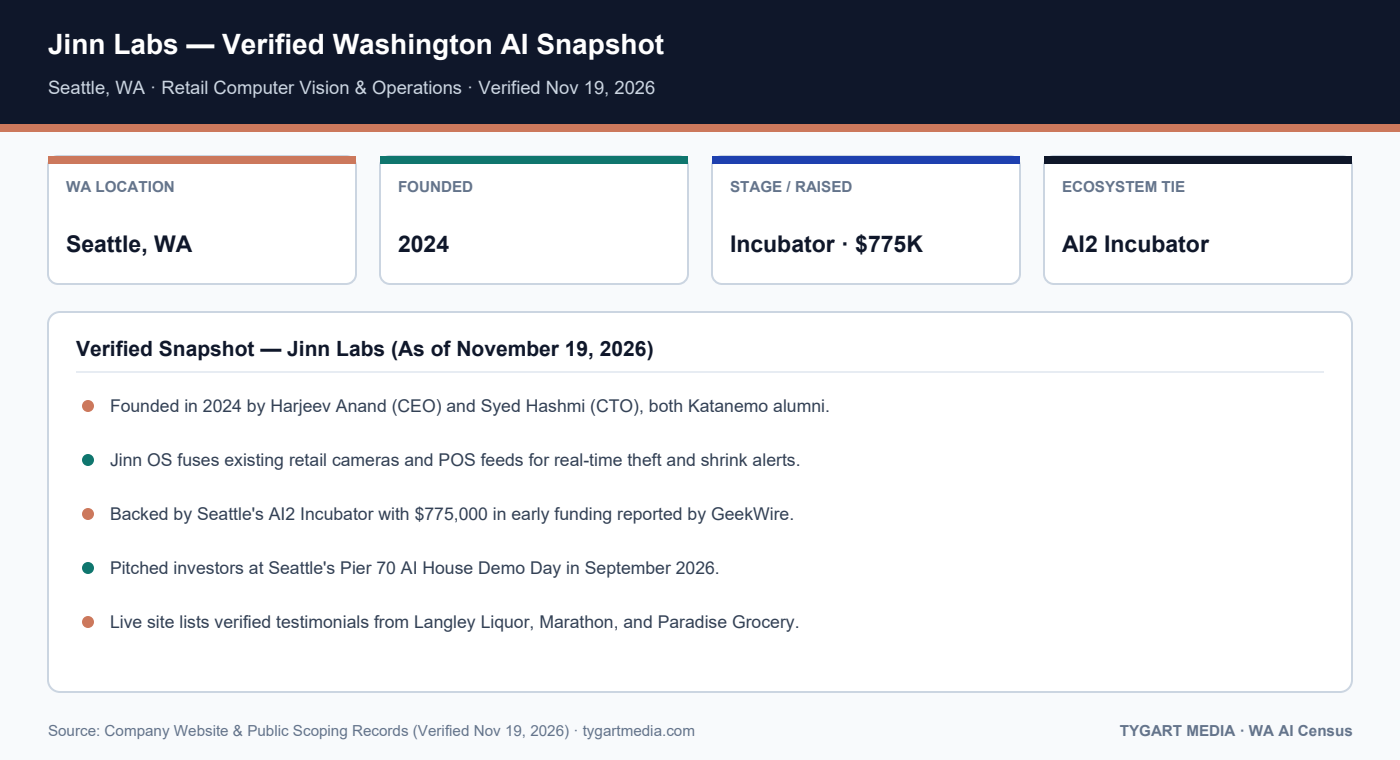
  • Jinn Labs: Seattle AI Profile — Product, Footprint & Verified Record

    Jinn Labs: Seattle AI Profile — Product, Footprint & Verified Record

    Washington AI Companies Census · Verified Record (November 19, 2026)
    Sourced Baseline: As of November 19, 2026, Jinn Labs is an active, independent Seattle-area retail AI startup backed by AI2 Incubator with a live website and book-a-demo intake. Its last publicly reported funding figure is $775,000 from May 2025, and the company pitched investors at AI House's Pier 70 Demo Day in September 2026.
    PROFILE BRIEF · HOUSE PDF & MARKDOWN TWIN
    Jinn Labs — Seattle AI Profile
    Download the formatted 2-page profile brief (PDF) or open the single-source Markdown twin for Jinn Labs. Every claim below links to its verified primary source.

    What Jinn Labs Builds

    Jinn Labs builds Jinn OS, a multimodal computer-vision and point-of-sale (POS) analytics platform designed to function as an AI store manager for physical retail locations. Rather than requiring store owners to replace surveillance infrastructure, Jinn Labs connects directly to existing IP cameras, video management systems, and POS registers to unify six operational signals: security cameras, POS transactions, employee activity, customer activity, store traffic, and inventory.

    The software splits into three core operational modules on the company's live product site. Its loss-prevention layer monitors camera feeds and register activity for both external shoplifting and internal employee theft, flagging behaviors such as under-ringing scanned items, suspicious POS void patterns, and cash-register siphoning. A watch-list module sends real-time facial recognition alerts and cross-store tracking notifications when previously flagged repeat offenders enter a store.

    Beyond security alerts, Jinn Labs markets revenue and workforce intelligence tools that turn in-store video into foot-traffic counts, visit dwell times, peak-hour staffing comparisons, checkout wait monitoring, and estimated customer age and gender distributions tied to POS purchases. Store managers receive event clips and alerts through companion iOS and Android mobile apps.

    • Loss prevention covering shoplifting detection, employee under-ringing, POS void fraud, cash siphoning, and repeat-offender facial watch-list alerts.
    • Revenue and workforce analytics tracking hourly foot traffic, dwell time, shift coverage against traffic peaks, checkout wait times, and POS-linked demographic estimates.
    • Hardware-agnostic integration listing compatibility with Axis, Hikvision, Hanwha, Bosch, Honeywell, Avigilon, Dahua, Uniview, Milestone, Genetec, Nx Witness, ExacqVision, and other existing camera and VMS brands.
    • Mobile alert workflows built for iOS and Android with one-tap clip review and team incident sharing.
    Jinn Labs — Verified Washington AI Snapshot
    Verified profile snapshot for Jinn Labs (Seattle, WA) as of November 19, 2026.
    FieldVerified Record (As of Nov 19, 2026)
    CompanyJinn Labs
    Official Websitehttps://www.jinnlabs.ai/
    Washington HQSeattle, WA (AI2 Incubator / AI House; some third-party directories list Bellevue, WA)
    Other WA FootprintAI House at Pier 70 (Seattle, WA)
    Founded2024
    Founders / LeadershipHarjeev Anand (Co-Founder & CEO); Syed Hashmi (Co-Founder & CTO)
    StageIncubator / Pre-Seed
    Announced Funding$775,000 (reported by GeekWire, May 2025)
    Team SizeNot publicly disclosed
    Primary Ecosystem TiesAI2 Incubator; AI House Demo Day (Sept 2026); former Amazon, Microsoft, and Katanemo team

    Washington Footprint and Leadership

    Jinn Labs was founded in 2024 and operates out of Seattle's AI2 Incubator and its waterfront hub at AI House on Pier 70, according to GeekWire's May 2025 Startup Radar and September 2026 AI House Demo Day coverage. One geographic detail worth noting for researchers: while GeekWire and the AI House portfolio directory place Jinn Labs in Seattle at AI2 Incubator, some third-party corporate directories list its corporate address across Lake Washington in Bellevue, Washington. Both locations sit inside King County in the Greater Seattle corridor.

    The company was co-founded by CEO Harjeev Anand and CTO Syed Hashmi, who previously worked together at Seattle-area cloud infrastructure startup Katanemo. Before Katanemo—where Anand led product—Anand held roles at Amazon and Microsoft, while Hashmi worked as an engineer at Oracle and LinkedIn before joining Katanemo, according to GeekWire. Total employee headcount beyond the two co-founders is not publicly disclosed.

    Seattle waterfront startup incubator loft overlooking Puget Sound ferry lanes and the Olympic Mountains
    Washington AI ecosystem context: Seattle waterfront startup incubator loft overlooking Puget Sound ferry lanes and the Olympic Mountains.

    Products, Users, and Public Traction

    Jinn Labs focuses on high-shrink, thin-margin physical retail formats where store owners rarely have dedicated corporate loss-prevention staff: convenience stores, gas stations, liquor stores, and independent grocery stores. Its website uses a direct sales and onboarding flow centered on live demos and a waitlist rather than self-serve public pricing, and it emphasizes deployment onto cameras operators already own to avoid hardware capex.

    On jinnlabs.ai, Jinn Labs publishes three named verified-operator testimonials illustrating early commercial usage: Kerry at Langley Liquor cites theft catches and entry watch-list alerts; Nitin at a Marathon location reports detecting cash siphoning by an employee with reviewable video evidence; and Mike at Paradise Grocery Store highlights reduced manual camera monitoring and faster incident review. Total active store count, customer revenue, and subscription pricing have not been publicly disclosed.

    • Target customer segments: convenience stores, gas stations, liquor stores, and independent grocery operators.
    • Named operator testimonials on live site: Langley Liquor, Marathon, and Paradise Grocery Store.
    • Public intake channels: live demo booking and waitlist sign-up; enterprise or per-store pricing is not published.

    Funding, Stage, and Place in Washington's AI Landscape

    GeekWire reported in May 2025 that Jinn Labs had raised $775,000 in early financing while building inside Seattle's AI2 Incubator. The company displays a 'Backed by AI2 Incubator' badge on its homepage and remains listed as an active, independent company in the AI House portfolio directory. Other individual angels or funds participating in that $775,000 raise have not been publicly named, and no subsequent institutional seed or Series A round has been announced through November 2026.

    In September 2026, Jinn Labs was one of 25 early-stage companies selected to pitch local and out-of-state venture investors at AI House's inaugural Pier 70 Demo Day in Seattle. Within Washington's applied AI cluster, Jinn Labs sits alongside a growing group of Seattle startups applying multimodal perception to physical commercial spaces—complementing voice-focused retail analytics peers like Ethosphere and industrial automation builders like Outrun—while competing nationally in a crowded retail computer-vision and loss-prevention software category.

    Related Washington AI Profiles & Tygart Media Context

    Verified Primary Sources

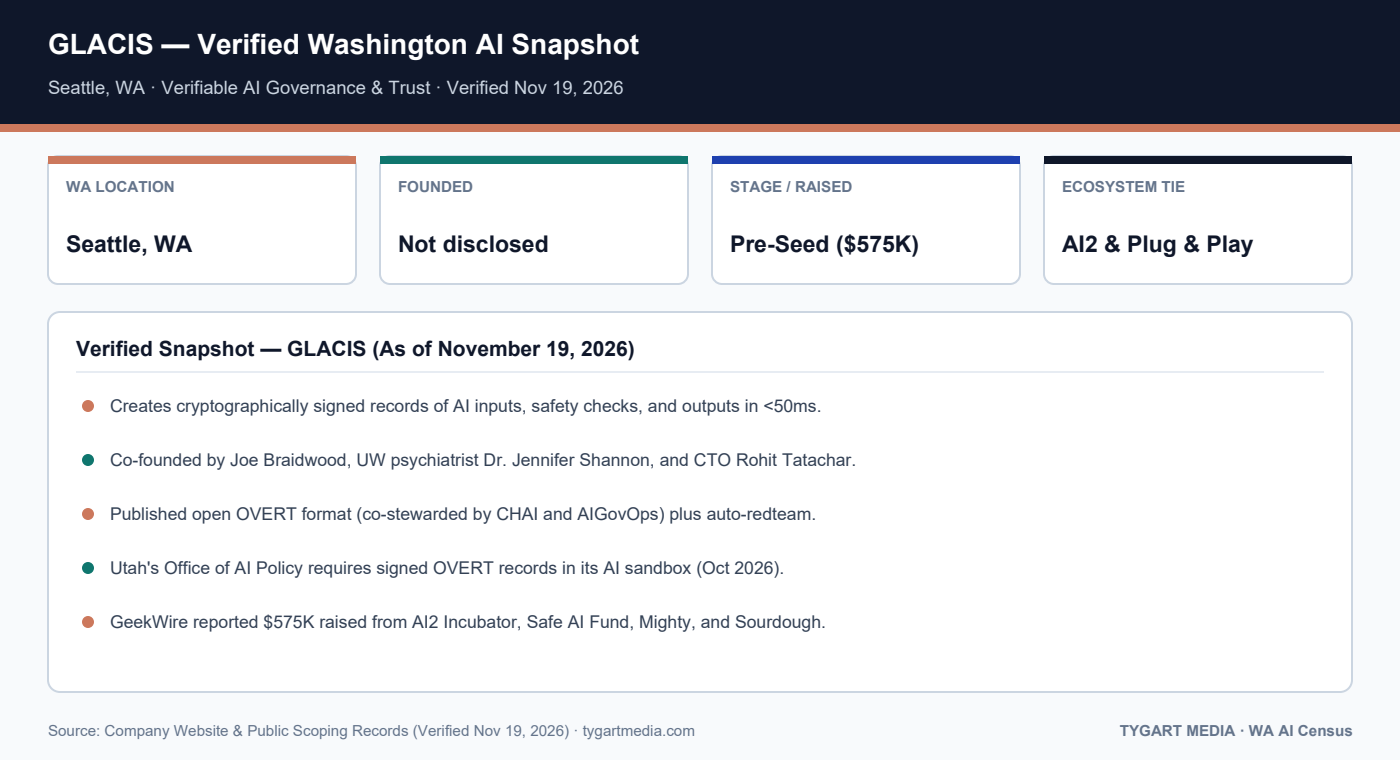
  • GLACIS: Seattle AI Profile — Product, Footprint & Verified Record

    GLACIS: Seattle AI Profile — Product, Footprint & Verified Record

    Washington AI Companies Census · Verified Record (November 19, 2026)
    Sourced Baseline: GLACIS (Glacis Technologies, Inc., glacis.io) is an independent Seattle AI governance and assurance startup backed by Seattle's AI2 Incubator and Plug and Play Seattle Batch 3. Its Arbiter runtime platform and open OVERT record specification produce cryptographically signed, tamper-proof operational evidence for production AI decisions across healthcare, fintech, and insurance.
    PROFILE BRIEF · HOUSE PDF & MARKDOWN TWIN
    GLACIS — Seattle AI Profile
    Download the formatted 2-page profile brief (PDF) or open the single-source Markdown twin for GLACIS. Every claim below links to its verified primary source.

    What GLACIS Builds

    GLACIS builds a verifiable AI assurance and cryptographic runtime attestation layer that CEO Joe Braidwood has described to GeekWire as a "flight recorder for enterprise AI." Its core platform, Arbiter, sits in the execution path between applications and AI models, generating an unalterable, cryptographically signed operational record of the input, the safety checks that ran, and the final decision in under 50 milliseconds. At scale, Glacis's Witness Network notarizes those receipts into an auditable trail that customers, regulators, and insurance underwriters can verify directly in a browser without exposing personal data, prompts, or model weights.

    As GeekWire reported on April 7, 2026, deployments can run either in "shadow mode" to observe behavior without intervening or in enforcement mode to constrain outputs in real time across three operational dimensions: infrastructure baseline, model behavior, and "intent drift." Alongside its commercial software, GLACIS introduced open-source testing tool auto-redteam and published OVERT (Observable Verification Evidence for Runtime Trust), an open, royalty-free signed record format using Ed25519 signatures and SHA-256 hashes. On September 14, 2026, GLACIS transferred OVERT to shared stewardship under the Coalition for Health AI (CHAI) and the AIGovOps Foundation (one vote each, with Glacis serving as a non-voting technical editor).

    • Arbiter & Witness Network: Runtime control layer generating signed, tamper-proof AI decision records in under 50 milliseconds without revealing PHI or model weights.
    • Shadow & Enforcement Modes: Monitors infrastructure state, model behavior, and intent drift passively or enforces policy guardrails inline.
    • OVERT Open Standard: Royalty-free Ed25519/SHA-256 record specification co-stewarded by CHAI and the AIGovOps Foundation since September 2026.
    • auto-redteam: Open-source automated attack, fix-generation, and verification utility released in April 2026.
    GLACIS — Verified Washington AI Snapshot
    Verified profile snapshot for GLACIS (Seattle, WA) as of November 19, 2026.
    FieldVerified Record (As of Nov 19, 2026)
    CompanyGLACIS (Glacis Technologies, Inc.; distinct from unrelated Glacis Labs and glacis.com)
    Official Websiteglacis.io
    Washington HQSeattle, WA
    Other WA FootprintAI2 Incubator / AI House (Seattle); Plug and Play Seattle Batch 3 (UW CoMotion Labs access); UW faculty affiliation
    FoundedNot publicly disclosed (first profiled by GeekWire Nov 20, 2025)
    Founders / LeadershipJoe Braidwood (Co-founder & CEO), Dr. Jennifer Shannon, MD (Co-founder & CMO), Rohit Tatachar (Co-founder & CTO)
    StageAccelerator / Pre-Seed
    Announced Funding$575,000 pre-seed reported by GeekWire (Apr 7, 2026; investors include Safe Artificial Intelligence Fund, Mighty Capital, Sourdough Ventures, AI2 Incubator; not listed on glacis.io)
    Team SizeNot publicly disclosed
    Primary Ecosystem TiesAI2 Incubator / AI House; Plug and Play Seattle (Batch 3); UW and Microsoft Azure AI Foundry alumni roots

    Washington Footprint and Leadership

    GLACIS anchors its operations in Seattle—its official website carries the navigation tagline "Verifiable AI assurance, from Seattle"—with dual backing from Seattle's AI2 Incubator / AI House and Plug and Play Seattle's Batch 3 accelerator (which provided workspace access at UW CoMotion Labs from March through mid-June 2026). The company grew directly out of CEO Joe Braidwood's decision to shut down his prior mental-wellness AI startup, Yara, after observing model drift during extended conversations with vulnerable users and confronting Illinois regulations that made AI therapy effectively uninsurable.

    The founding team blends healthcare clinical practice, cloud AI infrastructure, and enterprise product leadership. Co-founder and CEO Joe Braidwood previously served as CMO at SwiftKey, Chief Strategy Officer at Vektor Medical, and co-founder of Scener. Co-founder and Chief Medical Officer Dr. Jennifer Shannon, MD is a practicing child psychiatrist with nearly two decades of clinical experience, an adjunct professor at the University of Washington, a former medical director at Cognoa, and a member of the American Academy of Child and Adolescent Psychiatry's AI Resource Committee. In April 2026, nearly 19-year Microsoft veteran Rohit Tatachar—most recently a principal product manager on Microsoft Foundry (Azure AI Foundry)—joined as Co-founder and CTO (per GeekWire).

    Seattle waterfront startup incubator loft overlooking Puget Sound ferry lanes and the Olympic Mountains
    Washington AI ecosystem context: Seattle waterfront startup incubator loft overlooking Puget Sound ferry lanes and the Olympic Mountains.

    Products, Users, and Public Traction

    GLACIS targets enterprises operating AI in production, AI software vendors proving controls to buyers, and external overseers such as regulators and insurance underwriters across healthcare, fintech, and insurance. In November 2025, GeekWire reported that GLACIS was in private beta with digital health customers including nVoq and participating in Cloudflare's Launchpad program. By April 2026, GeekWire reported two pilot deals signed out of the J.P. Morgan Healthcare Conference, three additional pilots in the pipeline, and a new self-serve waitlist offering a $49/month starter tier (up to 10,000 AI events per month) and a $499/month pro tier (up to 100,000 events).

    In late 2026, GLACIS expanded its standards and regulatory footprint. On August 26, 2026, it joined PACT AI (Partnership for Assurance, Credibility, and Trust on AI) as a founding member alongside corporate members including Target and Mount Sinai Health System. On October 5, 2026, GLACIS announced that Utah's Office of Artificial Intelligence Policy (OAIP) will require designated vendors in Utah's AI Learning Laboratory sandbox to produce cryptographically signed OVERT records for every covered inference or control evaluation—an update Braidwood posted while attending Lloyd's Lab cohort 17 in London. Researchers should distinguish Seattle's Glacis Technologies, Inc. (glacis.io) from unrelated crypto entity Glacis Labs and unrelated domain glacis.com.

    • Early Healthcare Traction: Private beta with digital health company nVoq (Nov 2025) plus two J.P. Morgan Healthcare Conference pilot deals (Apr 2026, per GeekWire).
    • Regulatory Sandbox Adoption: Utah Office of Artificial Intelligence Policy requires signed OVERT records for designated vendors in its AI Learning Laboratory (Oct 2026).
    • Standards & Industry Coalitions: Co-stewardship of OVERT with CHAI and AIGovOps Foundation (Sep 2026); founding member of PACT AI (Aug 2026).
    • Published Self-Serve Tiers: April 2026 waitlist introduced $49/month (10,000 events) and $499/month (100,000 events) plans alongside enterprise deployments.

    Funding, Stage, and Place in Washington's AI Landscape

    In its April 7, 2026 report, GeekWire reported that Glacis had raised $575,000 from a group of investors including Geoff Ralston's Safe Artificial Intelligence Fund, Mighty Capital, Sourdough Ventures, and the AI2 Incubator, noting that Braidwood aimed to close a seed round later in the year. GLACIS's own site (glacis.io) does not publish funding figures or current employee headcount, and no formal incorporation year is listed publicly.

    Within Washington's AI landscape, GLACIS sits at the intersection of Seattle's cloud security heritage, clinical healthcare oversight, and emerging AI insurability infrastructure. While many AI observability startups focus on internal dashboards and prompt guardrails, GLACIS differentiates around independent cryptographic receipts that third parties—regulators, hospital buyers, and London or U.S. underwriters—can verify without trusting a vendor's self-reported logs.

    Related Washington AI Profiles & Tygart Media Context

    Verified Primary Sources

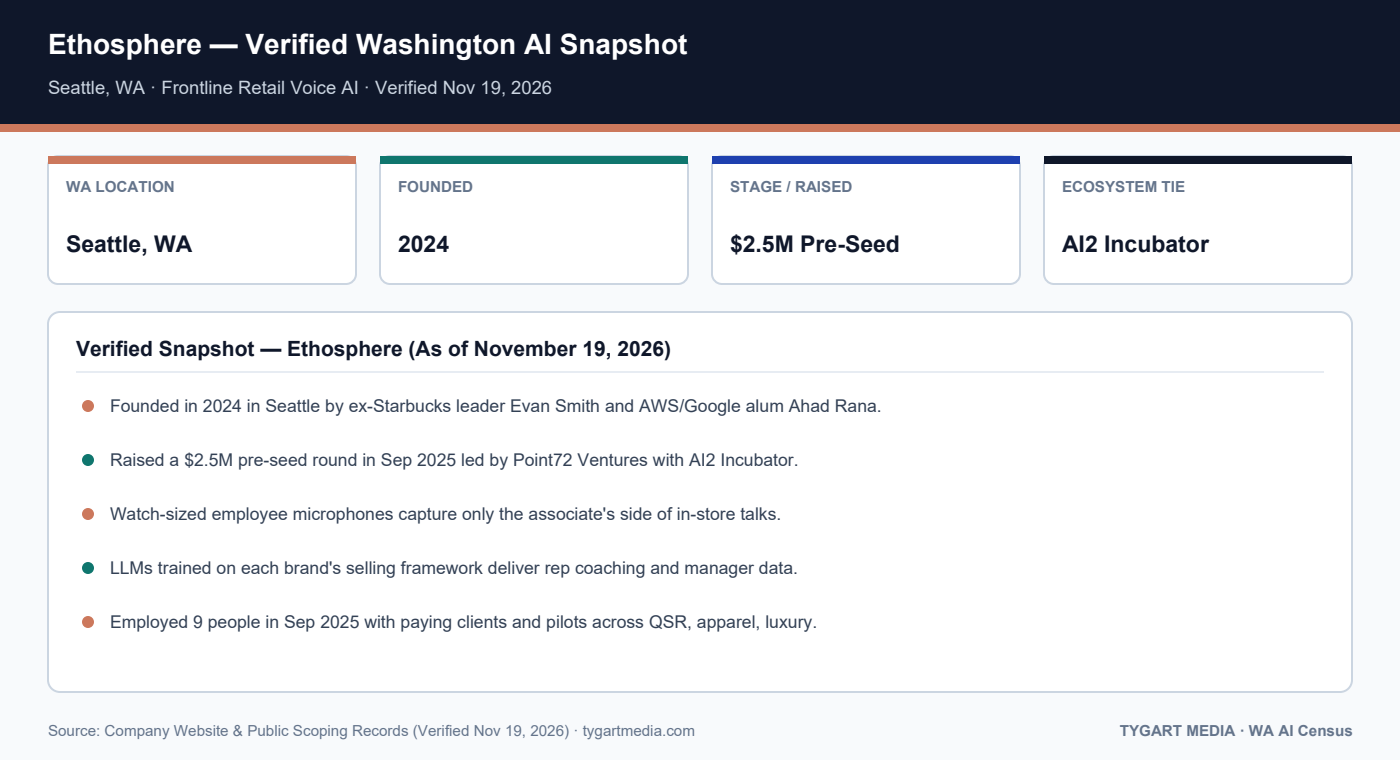
  • Ethosphere: Seattle AI Profile — Product, Footprint & Verified Record

    Ethosphere: Seattle AI Profile — Product, Footprint & Verified Record

    Washington AI Companies Census · Verified Record (November 19, 2026)
    Sourced Baseline: Ethosphere (ethosphere.ai) is an independent Seattle voice AI startup founded in 2024 by former AI2 Incubator entrepreneurs-in-residence Evan Smith and Ahad Rana. Backed by a $2.5M pre-seed round led by Point72 Ventures in September 2025, the company uses employee-worn microphones and brand-trained language models to coach frontline retail workers and surface store-level conversion insights.
    PROFILE BRIEF · HOUSE PDF & MARKDOWN TWIN
    Ethosphere — Seattle AI Profile
    Download the formatted 2-page profile brief (PDF) or open the single-source Markdown twin for Ethosphere. Every claim below links to its verified primary source.

    What Ethosphere Builds

    Ethosphere builds a privacy-first voice AI and wearable microphone analytics platform for physical retail operations. As detailed by GeekWire on September 16, 2025 and on ethosphere.ai, frontline retail associates wear lightweight, watch-sized microphones during their shifts. Ethosphere's software cleans and transcribes the captured speech, then runs large language models configured on each retailer's own training manuals and selling frameworks to assess how associates execute store conversations.

    To manage in-store privacy constraints, Ethosphere engineered its hardware and processing pipeline to capture only the employee's side of customer conversations—not the shopper's voice—while working with retail clients to post appropriate in-store disclosures. CEO Evan Smith told GeekWire the company is also exploring optional, opt-in concierge recording workflows in luxury retail settings where stylists offer personalized follow-up summaries. The processed insights feed individualized coaching and growth tracking for associates alongside store-level visibility for managers.

    • One-Sided Wearable Audio Capture: Watch-sized shift microphones designed to record only the associate's side of in-store interactions.
    • Brand-Specific LLM Evaluation: Analyzes transcripts against each retailer's proprietary training guides and selling frameworks.
    • Multi-Role Outputs: Delivers individualized, gamified feedback to sales reps, targeted coaching priorities to store managers, and cross-store operational insights to retail leadership.
    Ethosphere — Verified Washington AI Snapshot
    Verified profile snapshot for Ethosphere (Seattle, WA) as of November 19, 2026.
    FieldVerified Record (As of Nov 19, 2026)
    CompanyEthosphere
    Official Websiteethosphere.ai
    Washington HQSeattle, WA
    Other WA FootprintAI2 Incubator / AI House alum and active portfolio company (Seattle)
    Founded2024 (per GeekWire, Sep 16, 2025)
    Founders / LeadershipEvan Smith (Co-founder & CEO), Ahad Rana (Co-founder & CTO)
    StagePre-Seed
    Announced Funding$2.5M pre-seed (Sep 2025; led by Point72 Ventures with AI2 Incubator, Carya Ventures, Pack VC, Hike Ventures, J4 Ventures)
    Team Size9 (as of Sep 2025 GeekWire report)
    Primary Ecosystem TiesAI2 Incubator / AI House; Point72 Ventures Seattle; Starbucks and AWS alumni founders

    Washington Footprint and Leadership

    Ethosphere was founded in Seattle in 2024 and spun out of Seattle's AI2 Incubator, where both co-founders served as entrepreneurs-in-residence. The company remains listed as an active, independent portfolio startup on the AI House directory with the summary "Ethosphere transforms real life interactions into real analytics."

    Co-founder and CEO Evan Smith previously held leadership roles in technology and operations at Seattle-headquartered Starbucks after starting his career in education and public affairs. Co-founder and CTO Ahad Rana is a veteran software engineer and technologist with prior experience at AWS, Google, Factual, and AOL. At the time of GeekWire's September 2025 funding report, the Seattle startup employed nine people.

    Seattle waterfront startup incubator loft overlooking Puget Sound ferry lanes and the Olympic Mountains
    Washington AI ecosystem context: Seattle waterfront startup incubator loft overlooking Puget Sound ferry lanes and the Olympic Mountains.

    Products, Users, and Public Traction

    On ethosphere.ai, Ethosphere structures its product around three internal audiences inside brick-and-mortar retail chains: frontline sales reps receiving curated feedback and skill-progression tracking, store managers identifying who is excelling and where targeted coaching helps, and corporate retail operators measuring in-store execution across locations.

    In its September 2025 interview with GeekWire, Ethosphere reported generating revenue from paying retail customers while running custom pilots with additional brands across three physical segments: quick-service restaurants (QSR), clothing and apparel stores, and high-end luxury retailers. Specific customer brand names are not publicly disclosed. Smith noted that the gamified recognition component resonated more strongly with frontline workers than expected, helping address the feedback gap that frequently drives retail staff turnover.

    Funding, Stage, and Place in Washington's AI Landscape

    Ethosphere announced a $2.5 million pre-seed round in September 2025 led by Point72 Ventures—represented by Seattle-based managing partner Sri Chandrasekar—with participation from AI2 Incubator, Carya Ventures, Pack VC, Hike Ventures, and J4 Ventures (per GeekWire). No subsequent institutional funding round or updated team size has been publicly announced through November 19, 2026.

    Within Seattle's AI startup cluster, Ethosphere pairs local retail operations leadership (Starbucks) with Pacific Northwest cloud and applied-AI engineering (AWS and AI2 Incubator) to instrument physical store floors rather than purely digital commerce. Alongside fellow AI2 Incubator retail startup Jinn Labs (which fuses store cameras and point-of-sale feeds for loss prevention and traffic analytics), Ethosphere reflects Seattle's pragmatic focus on turning unstructured brick-and-mortar store signals into measurable operational metrics.

    Related Washington AI Profiles & Tygart Media Context

    Verified Primary Sources