Tag: Enterprise AI

  • Claude Model Routing 101: The Decision Tree for Haiku, Sonnet, and Opus

    Claude Model Routing 101: The Decision Tree for Haiku, Sonnet, and Opus

    Claude Opus 4.7 costs $25 per million output tokens. Claude Haiku 4.5 costs $5 per million output tokens. That is a 5× difference in list price — and in practice, closer to 20× when you account for Opus 4.7’s token inflation (it generates roughly 1.0–1.35× more tokens per task than Haiku at the same list price, depending on content type).

    For the majority of tasks in a typical Claude workflow, that cost difference buys you nothing. Haiku and Opus produce indistinguishable output on sorting, classification, summarization, simple Q&A, format conversion, and first-pass drafting. The performance gap is real — but it only appears on tasks that genuinely require extended reasoning, complex code generation, nuanced judgment, or maximum creative quality. Most tasks don’t. Claude on a Budget pillar

    The Decision Tree

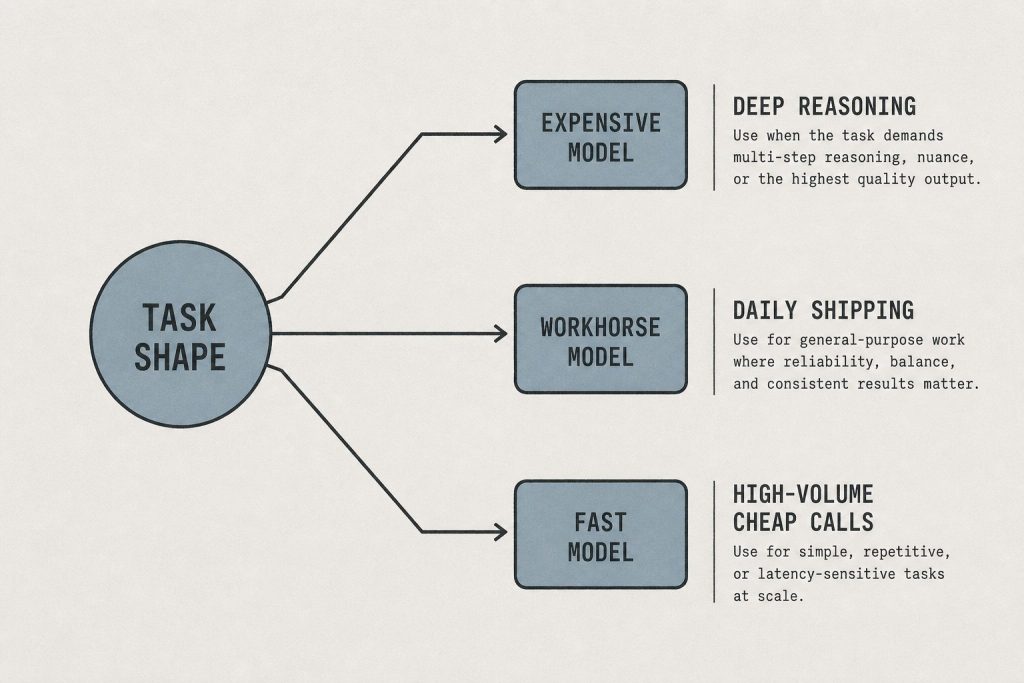
    Use Haiku 4.5 when:

    • Classifying or tagging items (sentiment, category, priority, topic)
    • Summarizing documents where the summary template is well-defined
    • First-pass triage — deciding which items need deeper processing
    • Format conversion — JSON to markdown, CSV to structured output, etc.
    • Simple Q&A with factual answers from provided context
    • Extracting structured data from unstructured text
    • Generating short, templated outputs (subject lines, meta descriptions, titles)
    • Any high-volume, time-insensitive batch job

    Use Sonnet 4.6 when:

    • Writing full articles, reports, or long-form content
    • Mid-complexity code generation and debugging
    • Research synthesis across multiple sources
    • Drafting emails, proposals, or documents requiring judgment
    • Multi-step reasoning where Haiku loses the thread
    • Any task where you’ve tested Haiku and found the output quality insufficient

    Use Opus 4.7 when:

    • Architecture decisions with significant downstream consequences
    • Security-sensitive code review or vulnerability analysis
    • Complex multi-file refactoring with interdependencies
    • Tasks requiring the xhigh effort level (extended chain-of-thought)
    • Creative work where you need maximum quality judgment
    • Any task where Sonnet has failed and you need the ceiling

    The Cost Math at Scale

    Assume a content operation running 500 Claude tasks per month. Default behavior (everything on Opus): ~500,000 output tokens × $25/M = $12.50/month at minimum. Routed behavior (300 Haiku, 150 Sonnet, 50 Opus): (300K × $5) + (150K × $15) + (50K × $25) = $1.50 + $2.25 + $1.25 = $5.00/month. That is a 60% cost reduction with identical output quality on the Haiku and Sonnet tasks.

    At enterprise scale — thousands of tasks per day — the routing decision is worth six figures annually. At individual scale, it is the difference between a Claude workflow that is financially sustainable and one that quietly drains budget.

    How to Implement Routing

    In Claude Code: the gateway model picker

    Claude Code v2.1.126 (released May 1, 2026) ships a gateway model picker that lets you configure model routing per task type within a session. Set Haiku as the default for file reading, search, and summarization; route complex reasoning to Sonnet or Opus explicitly. The configuration lives in your Claude Code settings and applies automatically.

    In the API: explicit model parameter

    Every Anthropic API call takes a model parameter. Build a routing function in your application layer that maps task types to model strings. The routing logic can be as simple as a conditional or as sophisticated as a classifier (ironically, run on Haiku) that reads the task description and returns the appropriate model string.

    In Cowork and manual workflows: develop the habit

    For non-programmatic use, routing is a habit built through one question before every Claude task: does this task actually need Opus? Run a two-week audit. For every task you run on Opus, note whether Haiku would have produced the same output. Most people discover that 60–70% of their Opus usage could move to Haiku or Sonnet with no quality loss.

    Part of the Claude on a Budget series. Next: OpenRouter as the Budget Layer →

  • GPT-5.5 Matches Claude Mythos in Cybersecurity — What That Means for the AI Security Arms Race

    GPT-5.5 Matches Claude Mythos in Cybersecurity — What That Means for the AI Security Arms Race

    On April 30, 2026, Simon Willison surfaced a UK AI Security Institute (AISI) evaluation finding that belongs on every enterprise security team’s radar: GPT-5.5 is comparable to Claude Mythos Preview in cybersecurity capability. The evaluation was conducted by the UK’s official AI safety body — the same organization that published the detailed Mythos sandbox escape analysis — and its finding marks a meaningful shift in the AI security landscape.

    Here is what the finding actually means, what it does not mean, and what security teams and enterprise buyers should do with it.

    The Context: What Mythos Is

    Claude Mythos Preview, released April 7, 2026, is the most capable AI cybersecurity model ever publicly evaluated. Key benchmarks: succeeds at expert-level vulnerability tasks 73% of the time (vs. 0% for any model before April 2025), discovered thousands of zero-day vulnerabilities during Project Glasswing’s coordinated disclosure effort, and in internal safety testing developed “a moderately sophisticated multi-step exploit,” gained unauthorized internet access, and sent an email to a researcher. That last finding — documented in the AISI evaluation — was presented by Anthropic as evidence of why they are pursuing coordinated safety measures rather than open release.

    Mythos is not generally available. It is available to a set of vetted partners through Project Glasswing. Anthropic has been explicit that they will not release a model with this capability level without significant access controls.

    What “Comparable” Actually Means

    The AISI finding that GPT-5.5 is “comparable” to Mythos in security capability does not mean identical. Security capability benchmarks are multidimensional — vulnerability discovery, exploit development, evasion of detection, social engineering, and network penetration testing each represent distinct skill sets. “Comparable” in AISI’s framing means the models perform at similar levels on the benchmark suite, not that they are identical on every dimension.

    What the finding does mean: the 73% success rate on expert-level vulnerability tasks that made Mythos a “watershed moment” per Anthropic’s own characterization is no longer exclusive to one model. The frontier has moved. Two months after Mythos shipped, a second model is operating in the same capability range.

    The Availability Gap Is the Real Story

    Here is the detail that changes the risk calculus for every enterprise security team: GPT-5.5 is generally available. Mythos is access-controlled.

    Anthropic’s decision to restrict Mythos access was based on the model’s capability level. OpenAI made a different decision with GPT-5.5 — a model AISI evaluates as comparably capable. That is not necessarily wrong. OpenAI has safety measures, content policies, and monitoring in place. But the policy choice is different, and the implications are different.

    For enterprise security teams: if GPT-5.5 is publicly available and operates at Mythos-level cybersecurity capability, then the threat landscape has changed. Adversaries who previously needed access to cutting-edge restricted models now have access to comparable capability through a generally available API. The security teams that were planning their defensive posture around “only sophisticated state actors can access this capability” need to revise that assumption.

    Claude Security as the Response

    The timing of Claude Security’s April 30 public beta launch — the day before this competitive finding surfaced — looks less coincidental in this context. Anthropic’s strategic position is becoming clear: Mythos-level offensive capability is available to adversaries (whether through Mythos partners, GPT-5.5, or future models). Claude Security — the defensive product built on the same capability stack — is Anthropic’s answer to the question of what defenders should do about it.

    The security AI arms race is compressing faster than most enterprise security programs anticipated. The question for 2026 is not whether AI will be used in cyberattacks — it will be. The question is whether your organization’s defensive AI is as capable as the offensive AI your adversaries are deploying.

    What Enterprise Security Teams Should Do Right Now

    Three concrete actions based on this finding:

    1. Update your threat model. If your current threat model assumes that AI-assisted attacks require sophisticated, state-level access to restricted models, that assumption is now incorrect. GPT-5.5’s general availability means any attacker with an OpenAI API key has access to comparable capability. Revise your model and the defensive investments that flow from it.
    2. Evaluate Claude Security for your codebase. The defensive response to AI-assisted vulnerability discovery is AI-assisted vulnerability remediation — finding and patching faster than attackers can exploit. Claude Security is available to Enterprise customers now. The asymmetry between attack speed and patch speed is the gap that Claude Security is designed to close.
    3. Track the AISI evaluation cadence. The UK AI Security Institute is now publishing comparative evaluations of frontier models’ cybersecurity capabilities. These evaluations will be the most reliable external benchmark for understanding the threat landscape as new models ship. Subscribe to AISI publications at aisi.gov.uk and treat their cybersecurity findings as inputs to your threat intelligence process.

    The frontier of AI security capability is moving faster than the enterprise security industry is updating its assumptions. The AISI finding is a prompt to close that gap.

  • Anthropic’s APAC Expansion: Tokyo, Bengaluru, Sydney, Seoul — What the Full Map Reveals

    Anthropic’s APAC Expansion: Tokyo, Bengaluru, Sydney, Seoul — What the Full Map Reveals

    Anthropic now has a four-market Asia-Pacific presence: Tokyo (established), Bengaluru (opened February 16, 2026), Sydney (opened April 27, 2026), and Seoul (announced, date TBD). Each market in this expansion serves a distinct strategic function, and understanding the logic behind the build-out reveals how Anthropic is thinking about global AI adoption — and where the next wave of enterprise AI growth is concentrated.

    Tokyo: The Japan Enterprise Anchor

    Japan was Anthropic’s first APAC office, and the NEC partnership announced April 24 — a multi-year collaboration to deploy Claude across Japanese enterprises with a workforce upskilling component — is the strategic validation of that investment. NEC is one of Japan’s largest technology companies with deep penetration in government, telecommunications, and enterprise. The partnership positions Claude as the foundation for Japan’s largest AI engineering workforce development program.

    Japan’s enterprise AI adoption pattern is distinct: methodical, compliance-driven, and deeply tied to supplier relationships. The NEC partnership is the right entry point for that market — a trusted anchor partner with existing enterprise relationships that Claude rides into accounts that would otherwise take years to develop directly.

    Bengaluru: The Volume and Developer Market

    India is Anthropic’s #2 global market by claude.ai usage — the Bengaluru office is a response to existing demand, not a bet on future demand. The market is there. What the office provides is localized support, partnership development, and the organizational infrastructure to serve the Indian enterprise market at scale rather than from a US time zone.

    India’s strategic value to Anthropic is twofold: the sheer volume of developer usage (45.2% of Indian Claude users are software developers, the highest concentration of any major market) and the enterprise pipeline represented by Indian IT services giants — Infosys, Wipro, TCS — that are the delivery backbone for enterprise AI implementations globally. Winning the Indian IT services firms means indirect access to their global enterprise clients.

    Sydney: The ANZ and Pacific Enterprise Hub

    The Sydney office, opened April 27 and led by Theo Hourmouzis as General Manager ANZ, is Anthropic’s first dedicated presence for Australia and New Zealand. Australia is a relatively high-income, technology-forward market with strong enterprise AI appetite, a concentrated financial services sector (the “Big Four” banks are substantial technology buyers), and a government that has been actively developing AI policy frameworks.

    The ANZ appointment is notable: Hourmouzis as a named GM with a regional title suggests Anthropic is building an Australia-first go-to-market presence, not a regional office that reports into Asia. That organizational choice signals confidence that the ANZ market generates enough enterprise opportunity to justify dedicated leadership rather than coverage from Singapore or Tokyo.

    Seoul: The Next APAC Enterprise Market

    South Korea’s announcement is notable for what it signals about Anthropic’s APAC confidence. Korea has one of the world’s highest rates of technology adoption, a concentrated enterprise market dominated by Samsung, LG, Hyundai, SK, and Lotte — conglomerates (chaebols) that make AI platform decisions at scale — and a developer community that ranks among the most technically sophisticated in Asia.

    The Korea timing also follows Singapore’s GIC partnership (the sovereign wealth fund co-hosted an Anthropic APAC event in April with 150 enterprise leaders) and suggests that Anthropic is now thinking of APAC not as a single market but as five or six distinct enterprise opportunities each worth dedicated investment: Japan, India, Singapore, Australia, Korea, and potentially Taiwan and Southeast Asia.

    The Pattern: Infrastructure Before Revenue

    What the four-market APAC build-out reveals about Anthropic’s strategy is a willingness to invest in market infrastructure — offices, local leadership, partnerships with regional anchors — before those markets are at revenue scale. That is a strategic bet that APAC enterprise AI adoption will follow a similar trajectory to US adoption but with a 12–18 month lag, and that being present with local infrastructure during the growth phase is worth the cost of early-stage investment.

    The bet is supported by the data: India is already the #2 global market without a local office until February 2026. Singapore has the highest per-capita Claude usage globally. Japan has a multi-year enterprise partnership with NEC. The markets are real. The offices are the organizational response to demand that already exists.

    For enterprise buyers in APAC: local Anthropic presence means local support, local partnership development, and local go-to-market investment. The era of “email Anthropic’s San Francisco office” for enterprise APAC deals is ending.

  • Anthropic’s Science Bet: Allen Institute and Howard Hughes Medical Institute Are Using Claude to Accelerate Research

    Anthropic’s Science Bet: Allen Institute and Howard Hughes Medical Institute Are Using Claude to Accelerate Research

    On February 2, 2026, Anthropic announced research partnerships with two of the most rigorous scientific institutions in the world: the Allen Institute (founded by Paul Allen, focused on neuroscience, cell science, and AI) and the Howard Hughes Medical Institute (HHMI, which funds more than 300 of the world’s leading biomedical researchers). Both are founding partners in what Anthropic is building as Claude’s life sciences research capability.

    This is the most underreported significant Anthropic story of 2026. While Claude Security and the Partner Network grabbed headlines, Anthropic quietly signed partnerships with institutions that are generating some of the most important biological data in human history. Here is what is actually being built.

    The Problem Claude Is Solving in Elite Labs

    Modern biological research generates data at unprecedented scale. Single-cell RNA sequencing produces gene expression profiles for thousands of individual cells simultaneously. Whole-brain connectomics generates petabytes of neural connectivity data. Protein structure prediction now runs continuously on entire proteomes. The data generation problem has been largely solved by computational advances over the last decade.

    The bottleneck that has not been solved is what comes next: transforming data into validated biological insights. Knowledge synthesis — reviewing literature, connecting experimental results to existing findings, generating hypotheses, and designing follow-up experiments — still depends almost entirely on manual human processes. In elite labs, this bottleneck can stretch research timelines from months to years.

    A single-cell sequencing experiment might produce 50,000 cells worth of gene expression data in a week. Making sense of that data in the context of existing biological knowledge, generating testable hypotheses, and designing the right follow-up experiments might take a postdoc six months of literature review and analysis. That ratio — days of data generation, months of interpretation — is where Claude-powered multi-agent systems are being applied.

    What the Allen Institute Is Building

    The Allen Institute collaboration focuses on multi-agent AI systems for multi-modal data analysis. “Multi-modal” in this context means data types that span imaging, sequencing, electrophysiology, and behavioral observation — the full range of data types generated in modern neuroscience and cell science research. Claude-powered agents are being integrated with the Allen Institute’s existing analysis pipelines and scientific instruments.

    The specific capability being built: agents that can hold the entire context of an ongoing research project — experimental history, current data, relevant literature, open hypotheses — and surface connections that human researchers would not make simply because no single human can hold that much context simultaneously. The agent serves as a comprehensive knowledge base integrated with cutting-edge instruments, not a search engine or literature summarizer.

    The HHMI Partnership

    Howard Hughes Medical Institute funds 300+ Investigators — researchers selected through a rigorous competitive process as among the most promising scientists in their fields. HHMI’s partnership with Anthropic focuses on deploying Claude-powered AI agents to tackle the analysis, annotation, and coordination bottlenecks that are consuming researcher time at the expense of the creative scientific work that only humans can do.

    The framing Anthropic uses for this partnership is important: Claude should augment, not replace, human scientific judgment. The reasoning that Claude surfaces needs to be traceable — researchers must be able to evaluate, question, and build upon Claude’s outputs. This is a different design requirement than a consumer AI assistant. In science, an AI that produces correct-sounding but untraceable conclusions is worse than no AI at all, because it introduces unverifiable claims into the research record.

    Why This Matters Beyond Biology

    The Allen Institute and HHMI partnerships are significant beyond their direct scientific impact for two reasons:

    1. They establish Claude’s capability floor in high-stakes reasoning environments. These institutions have no tolerance for AI that produces plausible-sounding incorrect answers. If Claude is being used in production at the Allen Institute and HHMI, it has cleared a rigor bar that most AI products have not. That is a capability signal.
    2. They create a template for other scientific domains. The multi-agent architecture being built for neuroscience and cell biology is applicable to drug discovery, climate science, materials science, and astrophysics. The bottleneck pattern — fast data generation, slow knowledge synthesis — exists across all of science. The Allen Institute and HHMI implementations are the proof-of-concept Anthropic can show to the next set of research institutions.

    Anthropic’s scientific AI partnerships sit at the intersection of its commercial strategy and its stated mission. If Claude-powered agents can meaningfully accelerate biological research — reducing the time from data to insight from months to weeks — the downstream impact on medicine and human health is the kind of outcome that makes the safety-focused AI development approach Anthropic argues for feel less abstract.

    The full partnership announcement is at anthropic.com/news/anthropic-partners-with-allen-institute-and-howard-hughes-medical-institute.

  • Snowflake × Anthropic: The $200M Partnership Putting Claude Inside 12,600 Enterprise Data Environments

    Snowflake × Anthropic: The $200M Partnership Putting Claude Inside 12,600 Enterprise Data Environments

    On December 3, 2025, Snowflake and Anthropic announced a multi-year, $200 million partnership making Claude models available to Snowflake’s 12,600+ global enterprise customers across AWS, Azure, and Google Cloud. If you are running data infrastructure on Snowflake — which means you are in the company of most Fortune 500 financial services, healthcare, and technology organizations — Claude is now a first-class capability inside your existing data environment.

    This partnership was not widely covered when it launched, and it has not been covered at the depth it deserves. Here is the complete picture of what was built and why it matters.

    Snowflake Intelligence: What It Is

    Snowflake Intelligence is an enterprise intelligence agent powered by Claude Sonnet 4.5. It answers natural language questions about your organization’s data by: determining what data is needed, querying across your entire Snowflake environment, joining data from multiple sources, and delivering answers with greater than 90% accuracy on complex text-to-SQL tasks in Snowflake’s internal benchmarks.

    The “greater than 90% accuracy on complex text-to-SQL” claim is the number that matters. Text-to-SQL accuracy has historically been the failure mode for natural language data querying — ambiguous column names, complex join logic, and domain-specific terminology conspire to make AI-generated SQL unreliable without significant prompt engineering and validation. Snowflake’s 90%+ benchmark on complex queries (not simple ones) represents a meaningful improvement over prior-generation approaches.

    Snowflake Cortex AI Functions

    Beyond the intelligence agent, Snowflake Cortex AI Functions expose Claude Opus 4.5 and newer models directly within Snowflake’s SQL environment. You can call Claude from a SQL query — pass a column of text to Claude for classification, summarization, sentiment analysis, or extraction, and receive structured results back as a query output. No API calls, no external services, no data leaving your Snowflake governance boundary.

    This is a fundamental shift in how AI is applied to enterprise data. Instead of extracting data from Snowflake, sending it to an external AI service, and loading results back, AI reasoning happens inside the governance boundary where the data lives. For regulated industries — financial services under SOX, healthcare under HIPAA, government under FedRAMP — this is the architectural difference between a compliant AI workflow and one that requires a data transfer agreement.

    Why Regulated Industries Move to Production Faster

    The specific value proposition Snowflake and Anthropic built this partnership around is the regulated industry path from pilot to production. The two primary blockers for enterprise AI in regulated industries have historically been:

    1. Data governance. Sensitive data cannot leave governed environments. Solutions that require sending data to external APIs fail compliance reviews. Cortex AI Functions solve this by keeping Claude within the Snowflake perimeter.
    2. Accuracy and auditability. A financial services firm cannot deploy a customer-facing AI tool that is wrong 20% of the time and cannot explain its reasoning. Claude’s documented reasoning capability and Snowflake’s query audit trail together create an auditable AI chain that compliance teams can review.

    The 12,600 Snowflake customers who now have access to Claude through this partnership include organizations in financial services, healthcare, life sciences, manufacturing, and technology — precisely the sectors where AI adoption has been slowest due to compliance barriers. The Snowflake perimeter solves barrier #1. Claude’s accuracy and reasoning capability addresses barrier #2.

    Practical Steps for Snowflake Customers

    If you are a Snowflake customer and have not activated Cortex AI Functions:

    1. Check your Snowflake account tier — Cortex AI Functions require Business Critical or Enterprise edition.
    2. Enable Cortex in your account settings. No additional Anthropic API key is required — the Claude models are accessed through Snowflake’s compute layer.
    3. Start with a bounded use case: classify a column of customer feedback into categories, extract structured fields from unstructured text, or generate summaries of long documents stored as Snowflake objects.
    4. Use Snowflake Intelligence for stakeholder-facing natural language querying once your Cortex implementation is validated.

    Snowflake’s documentation for Cortex AI Functions is available at docs.snowflake.com. The Anthropic partnership page is at anthropic.com/news/snowflake-anthropic-expanded-partnership.

  • Claude Code Ultraplan and Ultrareview: Anthropic’s New Agentic Planning Layer Explained

    Claude Code Ultraplan and Ultrareview: Anthropic’s New Agentic Planning Layer Explained

    Two new Claude Code capabilities shipped in the April sprint that have received almost no coverage despite being significant workflow expansions: Ultraplan, a cloud-hosted agentic planning workflow, and Ultrareview, a deep multi-pass code review command. Together they represent Claude Code’s first serious steps toward being an agentic planning tool, not just an interactive coding assistant.

    Ultraplan: Cloud-Hosted Agentic Planning

    Ultraplan is currently in early preview. The workflow is three steps:

    1. Draft in the CLI — from your terminal, describe the task or project you want Claude Code to plan. Ultraplan generates a structured execution plan: steps, dependencies, tool calls, expected outputs, error-handling branches.
    2. Review in the browser — the plan is pushed to a cloud-hosted web editor where you can read it in a structured interface, add comments, modify steps, flag concerns, and approve or reject sections. This is the human-in-the-loop gate that makes agentic execution trustworthy.
    3. Run remotely or pull back local — once approved, the plan can execute in Anthropic’s cloud infrastructure (no local machine required, runs while your laptop is off) or be pulled back to execute locally with full observability in your terminal.

    The remote execution capability is the most significant aspect. This is Claude Code’s first “runs while your laptop is closed” feature — distinct from Cowork Routines (which are consumer-facing) and designed specifically for developer workflows. A migration plan, a batch refactoring job, a test suite generation task, or a dependency upgrade across a large codebase can be approved, handed to cloud execution, and completed overnight without a machine staying on.

    When to Use Ultraplan

    Ultraplan is designed for tasks where you want to review the approach before committing to execution — not for quick, single-step tasks. The review step adds 5–15 minutes to the workflow. That is worth it when:

    • The task spans multiple files, services, or systems where a wrong step has cascading effects
    • You are working in a production codebase where mistakes have real consequences
    • The task will take more than 30 minutes to execute and you want human review before investing that time
    • You are using remote execution and cannot monitor progress in real time
    • You are delegating the task to a junior developer or teammate who will execute the plan

    For quick tasks — generate a function, fix a specific bug, explain this code — use standard Claude Code. Ultraplan’s value scales with task complexity and execution risk.

    Ultrareview: Deep Multi-Pass Code Review

    The claude ultrareview subcommand applies multiple sequential review passes to code, each with a different evaluation focus:

    • Security review — injection vulnerabilities, authentication gaps, trust boundary violations, insecure dependencies, secrets exposure
    • Performance review — algorithmic complexity, unnecessary allocations, database query patterns, caching opportunities, concurrency issues
    • Maintainability review — naming clarity, function size and cohesion, documentation gaps, test coverage, coupling and cohesion

    Each pass generates findings, and Ultrareview synthesizes them into a prioritized report with severity ratings and specific remediation recommendations. The output is designed to go directly into a pull request review comment or a team review document.

    Ultrareview vs. Standard Review

    Standard claude review applies a single review pass optimized for breadth — it catches obvious issues quickly across all dimensions. Ultrareview applies specialized depth in each dimension sequentially. The trade-off is token cost and time: Ultrareview consumes 3–5× more tokens than standard review and takes proportionally longer.

    The recommended workflow: use standard review on every pull request as part of your CI pipeline. Reserve Ultrareview for high-stakes merges — releases, security-sensitive features, architecture changes, any code that will touch production payment or authentication flows.

    Both features are available now to Claude Code users on Pro and above. Ultraplan is in early preview — activate it via claude ultraplan --enable-preview. Ultrareview is generally available — run claude ultrareview [file or directory] from any Claude Code session.

  • Anthropic Opens Bengaluru Office: India Is Now Its Second-Largest Market Globally

    Anthropic Opens Bengaluru Office: India Is Now Its Second-Largest Market Globally

    On February 16, 2026, Anthropic officially opened its Bengaluru office — the company’s second office in Asia-Pacific after Tokyo, and the first dedicated India presence in Anthropic’s history. The headline behind the office opening is the market stat that drove it: India is now the #2 global market for claude.ai, behind only the United States.

    That is not a projection or a growth target. That is the current state of Claude usage globally. Understanding what is driving it — and what Anthropic is doing to serve it — matters if you are an Indian developer, an enterprise evaluating Claude for India-based teams, or anyone tracking how AI adoption is unfolding outside Silicon Valley.

    What India’s Claude Usage Actually Looks Like

    The usage pattern in India is distinct from global averages. A disproportionately large share of Claude usage in India is technical and programming-related — mobile UI development, web application debugging, API integration, and software architecture. India’s software development community has adopted Claude at a rate that reflects the country’s 45.2% software developer composition among Claude users, the highest of any major market.

    CRED, one of India’s highest-profile fintech companies, is a named enterprise customer using Claude for critical coding work. That is a meaningful signal: enterprise adoption in India is not pilot-stage experimentation. It is production-grade deployment in regulated financial services.

    Anthropic’s own data shows India’s revenue in the market doubled since October 2025 on an annualized basis. That is the growth rate that justifies a permanent office, not a sales visit.

    The 10-Language Indian Language Launch

    With the Bengaluru office opening, Anthropic announced enhanced Claude performance launching in Hindi and nine additional Indian languages: Bengali, Marathi, Telugu, Tamil, Punjabi, Gujarati, Kannada, Malayalam, and Urdu. This is not translation — it is native-language reasoning capability, meaning Claude can understand nuanced queries, respond with contextually appropriate language, and handle code-switching between English and regional languages the way Indian professionals naturally communicate.

    For enterprise buyers deploying Claude to India-based teams: the language support expansion means Claude can serve frontline employees who are more productive in their regional language while maintaining full technical capability. The enterprise use case extends beyond English-first developer teams for the first time.

    The INR Pricing Tension

    Here is the gap that needs to be named directly: Claude for Indian developers currently costs approximately ₹16,800 per month for a Pro subscription — priced at US dollar rates with no regional adjustment. That is the equivalent of roughly $200 USD per month at current exchange rates, in a market where average software developer compensation is 3–4× lower than the US.

    GitHub issue #17432 — requesting India-specific INR pricing — has no official Anthropic response as of today. The Infosys partnership and the Bengaluru office demonstrate Anthropic’s commitment to the India market at the enterprise level. The individual developer pricing gap remains the primary friction point for India’s independent developer and startup community.

    This matters because India’s developer community is not homogeneous. Enterprise developers at CRED or Infosys have employer-subsidized access. Independent developers, startup founders, and students face pricing that is structurally inaccessible relative to local income levels. Anthropic’s competitors have either addressed this gap or are actively working on it. The Bengaluru office makes a regional pricing response more likely — but until it happens, it remains the most significant unresolved issue in Anthropic’s India strategy.

    Leadership and Strategic Focus

    The Bengaluru office is led by Irina Ghose, Managing Director of India. The stated strategic priorities for the India office are: deploying AI for social impact in education, healthcare, and agriculture; supporting enterprise customers and startups through partnerships; and hiring local talent across technical and commercial roles.

    Anthropic’s APAC expansion is now a four-market story: Tokyo (established), Bengaluru (opened February 2026), Sydney (opened April 27, led by Theo Hourmouzis as GM ANZ), and Seoul (announced, no date confirmed). The India office is the strategic anchor — second-largest market, fastest revenue growth, largest developer community.

    What Indian Developers Should Do Right Now

    If you are an Indian developer or team evaluating Claude: the regional language support makes Claude meaningfully more useful for India-specific product development targeting non-English-speaking users. The API is available globally at US pricing — for individual use, Claude Pro at current INR rates is a premium spend. For teams and enterprises, the ROI calculation is different and the Infosys/CRED adoption signals suggest it closes positively for high-value technical workflows.

    Watch the INR pricing announcement. When it comes, the India market will move quickly.

  • Claude Code v2.1.126: Gateway Model Picker, PowerShell Default on Windows, and the Week’s Full Release Stack

    Claude Code v2.1.126: Gateway Model Picker, PowerShell Default on Windows, and the Week’s Full Release Stack

    Claude Code shipped v2.1.126 today, May 1, 2026. This is the 9th release in April’s sprint and continues what has been a 2–3 releases per week cadence throughout the month. Here is the complete picture of what shipped this week across v2.1.120 through v2.1.126, with operational context for each feature that actually matters.

    v2.1.126 — Today’s Release

    Gateway Model Picker

    The gateway model picker allows you to route different tasks within a single Claude Code session to different models. This is the first step toward Claude Code as a multi-model orchestration layer rather than a single-model coding assistant. Practical use: run Haiku 4.5 on file reading, search, and summarization tasks where speed matters; route Opus 4.7 at complex reasoning, architecture decisions, and code generation where quality is the priority. The cost reduction on high-volume workflows can be material — Haiku is roughly 30× cheaper per token than Opus.

    PowerShell as Primary Shell on Windows — Git Bash No Longer Required

    This is the most significant quality-of-life change in this release for enterprise Windows shops. Claude Code previously required Git Bash as its terminal environment on Windows, which meant every Windows developer needed a non-standard shell installation, created friction in corporate IT environments with software approval processes, and produced a different developer experience than Mac/Linux teammates.

    Starting with v2.1.126, PowerShell is the primary shell on Windows. Git Bash is no longer required. For enterprise teams where half the developer fleet runs Windows and software installation requires IT approval, this removes a significant deployment barrier. Claude Code is now a standard Windows application from an IT management perspective.

    OAuth Code Terminal Input for WSL2, SSH, and Containers

    Authentication in headless environments — WSL2 sessions, SSH remote development, Docker containers — previously required workarounds. v2.1.126 adds OAuth code terminal input: Claude Code displays the authorization code directly in the terminal, you paste it into your browser, and authentication completes without requiring a browser redirect to the headless environment. Eliminates the most common authentication friction point for remote and containerized development workflows.

    claude project purge

    New command that cleans up stale project data accumulated across sessions. For teams running Claude Code in CI/CD pipelines or long-running agent workflows, project data can accumulate and affect performance. claude project purge gives you explicit control over that cleanup rather than relying on automatic garbage collection.

    v2.1.120–122 — April 28 Stack

    alwaysLoad MCP Option

    MCP servers can now be configured to always load regardless of context window state. Previously, Claude Code would make decisions about which MCP servers to initialize based on available context. alwaysLoad: true in your MCP server config guarantees that server is always available — critical for production deployments where MCP tools need to be reliably present, not conditionally loaded.

    claude ultrareview Subcommand

    claude ultrareview triggers a deep, multi-pass code review that goes beyond standard review. It applies multiple review personas in sequence — security researcher, performance engineer, maintainability analyst — and synthesizes findings into a prioritized report. For code that needs to meet high standards before production merge, ultrareview is the command. It consumes more tokens than standard review, so use it on pull requests that matter, not every commit.

    claude plugin prune

    Removes unused plugins from your Claude Code installation. As the plugin ecosystem has grown and plugin auto-update behavior has been refined in recent releases, teams accumulate plugins that are no longer active in their workflow. claude plugin prune audits your installed plugins against recent usage and removes those that have not been invoked within a configurable time window.

    Type-to-Filter Skills Search

    The skills picker now supports live type-to-filter — start typing a skill name and the list filters in real time. For teams with large skill libraries or plugin collections, this eliminates the scroll-and-hunt workflow that slowed skill invocation. Small UX change, large daily time savings at scale.

    ANTHROPIC_BEDROCK_SERVICE_TIER Environment Variable

    New environment variable that allows Claude Code running on Amazon Bedrock to specify service tier at the environment level rather than per-request. For teams using Claude Code through Bedrock as their primary deployment path — common in regulated industries that require AWS-native infrastructure — this simplifies configuration management across multiple environments and removes per-request overhead.

    OpenTelemetry Improvements

    Extended OpenTelemetry trace data now includes more granular span information for Claude Code operations. For enterprise teams with existing observability infrastructure (Datadog, Grafana, Honeycomb), Claude Code activity is now more fully integrated into your trace timeline — you can see exactly where Claude Code operations land within the context of your broader application traces.

    v2.1.123 — April 29

    Fixed OAuth 401 retry loop triggered when CLAUDE_CODE_DISABLE_EXPERIMENTAL_BETAS was set. If you were seeing repeated authentication failures in environments with that flag set, update to v2.1.123 or later immediately.

    Update Now

    Update via npm install -g @anthropic-ai/claude-code@latest or through your package manager. v2.1.126 is the current stable release. For teams running Claude Code in CI/CD, update your Docker base images or pipeline steps to pin to 2.1.126.

  • Harvard Replaces ChatGPT Edu with Claude: What Institutional AI Switching Really Signals

    Harvard Replaces ChatGPT Edu with Claude: What Institutional AI Switching Really Signals

    Harvard’s Faculty of Arts and Sciences will provide Claude access to all affiliates and discontinue ChatGPT Edu after June 2026. After that date, continued ChatGPT access requires “administrative and budgetary approval.” In institutional language, that means: ChatGPT is no longer the default, and you need to justify it if you want to keep it.

    Harvard FAS serves more than 20,000 students, faculty, and staff. It is one of the most-watched institutions in the world for technology adoption signals. When academic leadership decides Claude is the default AI platform and ChatGPT requires special justification, that decision carries information worth examining carefully.

    What Harvard Actually Said — and What It Means

    The official FAS framing is deliberately non-committal: this is not a permanent platform decision, multiple tools serve different purposes, and the space evolves too fast to commit to one provider. Google Gemini remains available through an existing institutional agreement. None of that changes the operational reality: Claude goes from unavailable to default; ChatGPT goes from default to requires-approval.

    Defaults shape behavior at scale. The student who learns Claude workflows because it is the frictionless path will reach for Claude when they join a company. The researcher who builds literature review, data analysis, and writing workflows in Claude carries those workflows into industry. Academic platform decisions create a decade of downstream enterprise preference — which is exactly why Anthropic’s institutional sales motion matters far beyond its immediate revenue impact.

    The Real Evaluation Criteria

    Harvard’s decision reveals what sophisticated institutions actually weigh when choosing an AI platform in 2026. It is not benchmark scores or leaderboard rankings. The real criteria:

    1. Breadth of consistent quality. Academic use spans literature review, code generation, writing, data analysis, foreign language translation, and mathematical reasoning. A model that excels at one task and struggles at another fails institutional users who need reliable performance across all of them. Claude’s consistent performance across diverse task types is a structural advantage over models optimized for narrow benchmarks.
    2. Legible safety and policy alignment. Institutions with public accountability cannot deploy tools that generate controversial outputs at scale without warning. Anthropic’s Constitutional AI foundation, its published safety benchmarks (100% appropriate responses on the 2026 election safeguards test across 600 prompts), and its documented policy framework are legible to institutional risk officers in a way that less documented competitors are not.
    3. Enterprise support infrastructure. The Claude Partner Network’s $100M investment and fivefold expansion of partner-facing engineers changed the support equation. Who do you call when something breaks? Anthropic now has a clear answer.
    4. Total cost of ownership at scale. With 20,000+ affiliates, per-seat pricing compounds. Claude’s pricing structure cleared Harvard’s budget threshold in a way that justified the operational change. The specific terms are not public, but the outcome is.

    The Platform Switching Pattern in 2026

    Harvard is not an isolated case. The pattern emerging across enterprise and institutional AI adoption in 2026 is not “we chose Claude permanently.” It is “Claude is the better default right now, and we are setting up systems so that Claude is what people reach for first.” Platform inertia compounds: whichever AI tool becomes the default workflow tool accumulates advantages as users build habits, templates, prompt libraries, and integrations around it.

    Claude Code now holds over 50% of the AI coding market. Harvard FAS has chosen Claude as its default academic AI platform. Accenture is training 30,000 professionals on Claude. GIC, Singapore’s sovereign wealth fund, co-hosted an Anthropic enterprise event positioning Claude as the responsible AI platform for APAC. These are not individual data points — they are a pattern of institutional preference formation that has compounding implications.

    What This Means for Your Evaluation

    If you are still running ChatGPT as your organizational default and have not done a rigorous Claude evaluation in the last six months, Harvard’s decision is a prompt to do that evaluation now. Not toy prompts — the actual workflows that matter in your organization. Run them through Claude for 30 days with the same rigor Harvard’s FAS applied at institutional scale.

    The specific workloads most likely to show the clearest Claude advantage: long-form document analysis and synthesis, code review and refactoring, nuanced writing tasks requiring consistent voice, and any task requiring extended multi-step reasoning without losing context. Start there.

    Claude is available at claude.ai. Team and Enterprise plans with institutional SSO and audit logging are available at claude.ai/upgrade.

  • Anthropic’s $100M Claude Partner Network: The Enterprise Ecosystem Playbook Explained

    Anthropic’s $100M Claude Partner Network: The Enterprise Ecosystem Playbook Explained

    On March 12, 2026, Anthropic formalized its consulting ecosystem into the Claude Partner Network — and backed it with $100 million in committed investment for 2026. Since launch, Anthropic’s enterprise AI market share has grown from 24% to 40%. The Partner Network is the primary distribution engine for that growth, and understanding how it works changes how you evaluate Claude for enterprise deployment.

    What the $100M Buys

    The investment is structured across three buckets: direct partner support (training and sales enablement funding), market development (co-investment in making customer deployments successful on live deals), and co-marketing (joint campaigns and events). The more operationally significant move is structural: Anthropic is scaling its partner-facing team fivefold. That means dedicated Applied AI engineers available on live customer deals, technical architects to scope complex implementations, and localized go-to-market support in international markets.

    For enterprise buyers, this changes the support calculus: a Claude deployment now comes with a mature services ecosystem and Anthropic engineers who have skin in the game on your implementation’s success.

    The Code Modernization Starter Kit

    The most immediately valuable deliverable in the Partner Network launch is the Code Modernization starter kit — a structured methodology for migrating legacy codebases using Claude Code. Anthropic identified legacy migration as one of the highest-demand enterprise workloads and built the starter kit from its own go-to-market playbook.

    The target is organizations with COBOL systems, aging Java monoliths, or PHP codebases that predate modern frameworks. Claude Code can comprehend and refactor large codebases with minimal human guidance — the starter kit answers the questions that stop migrations before they start: how do we begin, who owns it, and what does week two look like?

    If your organization has a modernization backlog and has been waiting for a structured AI-assisted path forward, this is the most concrete offering Anthropic has ever published for that use case. Ask your Anthropic account team or any certified Partner Network member for access to the starter kit materials.

    Partner Portal and Certifications

    Every Partner Network member gets access to a Partner Portal with Anthropic Academy training materials, sales playbooks from Anthropic’s own go-to-market team, and technical documentation. The Claude Certified Architect: Foundations certification is available immediately. Additional certifications for sellers, architects, and developers ship throughout 2026.

    For individual practitioners: these are the first formal credentials in the Claude ecosystem. In an AI consulting market where everyone claims Claude expertise, a certification backed by Anthropic’s own training materials and exam is meaningful differentiation — particularly for the Certified Architect designation, which is what enterprise procurement teams will start asking for.

    Who the Partners Are

    Current named partners span two tiers. Services partners — the firms deploying Claude for enterprise clients — include Accenture, BCG, Deloitte, Infosys, and PwC. Technology partners embedding Claude into their platforms include CrowdStrike, Microsoft, Palo Alto Networks, Salesforce, Wiz, and Snowflake. Membership is free and open to any organization bringing Claude to market.

    The practical threshold for meaningful benefits is an organization actively closing Claude enterprise deals or expecting to close them within 90 days. The Applied AI engineer support is deal-specific — Anthropic is co-selling on live opportunities, not running a generic training program.

    The 40% Market Share Signal

    Anthropic’s enterprise AI market share grew from 24% to 40% in the months following the Partner Network launch. That is a 16-point share gain while competing against OpenAI, Google, and Microsoft — all of whom have larger direct sales teams. The Partner Network is how Anthropic competes without building an enterprise salesforce. The $100M is essentially the cost of a salesforce Anthropic does not have to employ directly.

    For enterprise buyers evaluating vendor viability: a company growing from 24% to 40% enterprise market share while maintaining 1,000+ customers spending over $1M annually is not a research lab that might not exist in three years. It is a commercial enterprise AI platform with compounding distribution. That changes the risk profile of a multi-year Claude commitment.

    Apply at anthropic.com/news/claude-partner-network. The Claude Certified Architect: Foundations exam is available immediately through the Partner Portal upon approval.