
Last refreshed: October 4, 2026 (Pacific)
Claude Opus 5.5 costs $20 per million output tokens. Claude Haiku 4.5 costs $5 per million output tokens. That is a 4× difference in list price — and the gap widens in practice, because larger models generate more tokens per task than Haiku for the same prompt (a token-inflation effect observed as large as roughly 40% on Opus 4.7).
For the majority of tasks in a typical Claude workflow, that cost difference buys you nothing. Haiku and Opus produce indistinguishable output on sorting, classification, summarization, simple Q&A, format conversion, and first-pass drafting. The performance gap is real — but it only appears on tasks that genuinely require extended reasoning, complex code generation, nuanced judgment, or maximum creative quality. Most tasks don’t. → Claude on a Budget pillar
The Decision Tree
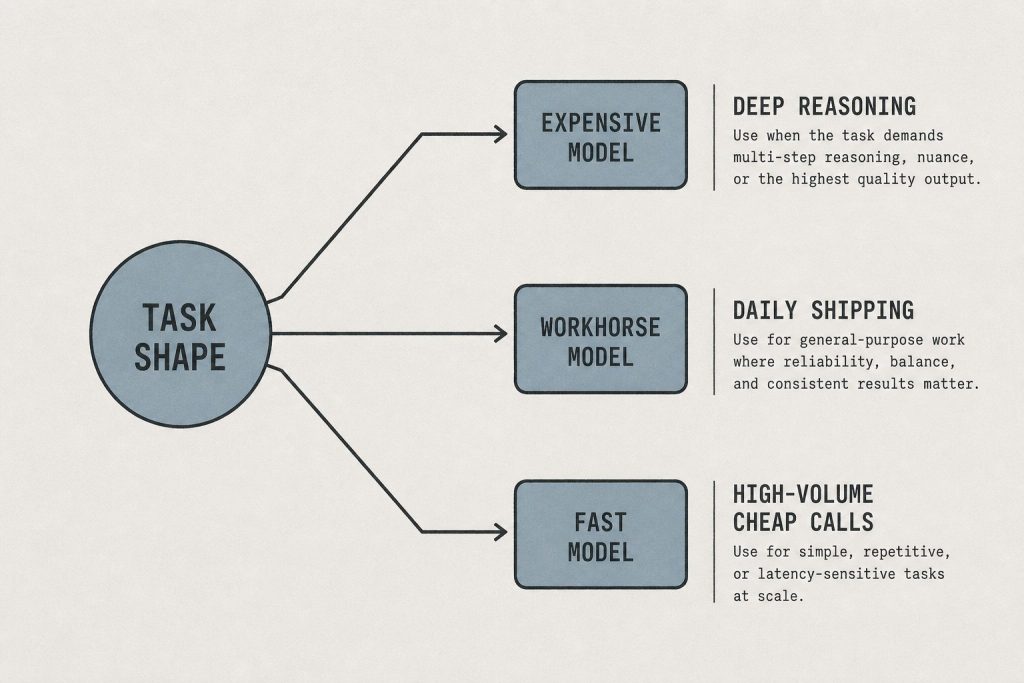
Use Haiku 4.5 when:
- Classifying or tagging items (sentiment, category, priority, topic)
- Summarizing documents where the summary template is well-defined
- First-pass triage — deciding which items need deeper processing
- Format conversion — JSON to markdown, CSV to structured output, etc.
- Simple Q&A with factual answers from provided context
- Extracting structured data from unstructured text
- Generating short, templated outputs (subject lines, meta descriptions, titles)
- Any high-volume, time-insensitive batch job
Use Sonnet 5.5 when:
- Writing full articles, reports, or long-form content
- Mid-complexity code generation and debugging
- Research synthesis across multiple sources
- Drafting emails, proposals, or documents requiring judgment
- Multi-step reasoning where Haiku loses the thread
- Any task where you’ve tested Haiku and found the output quality insufficient
Use Opus 5.5 when:
- Architecture decisions with significant downstream consequences
- Security-sensitive code review or vulnerability analysis
- Complex multi-file refactoring with interdependencies
- Tasks requiring the
xhigheffort level (extended chain-of-thought) - Creative work where you need maximum quality judgment
- Any task where Sonnet has failed and you need the ceiling
The Cost Math at Scale

Assume a content operation running 500 Claude tasks per month. Default behavior (everything on Opus): ~500,000 output tokens × $20/M = $10.00/month at minimum. Routed behavior (300 Haiku, 150 Sonnet, 50 Opus): (300K × $5) + (150K × $10) + (50K × $20) = $1.50 + $1.50 + $1.00 = $4.00/month. That is a 60% cost reduction with identical output quality on the Haiku and Sonnet tasks.
At enterprise scale — thousands of tasks per day — the routing decision is worth six figures annually. At individual scale, it is the difference between a Claude workflow that is financially sustainable and one that quietly drains budget.
How to Implement Routing

In Claude Code: the gateway model picker
Claude Code ships model routing as first-class surface: the /model picker (or --model at startup) sets the session model, subagent frontmatter accepts a per-agent model: override, and CLAUDE_CODE_SUBAGENT_MODEL overrides the model for all subagents. Set Haiku as the default for file reading, search, and summarization; route complex reasoning to Sonnet or Opus explicitly.
In the API: explicit model parameter
Every Anthropic API call takes a model parameter. Build a routing function in your application layer that maps task types to model strings. The routing logic can be as simple as a conditional or as sophisticated as a classifier (ironically, run on Haiku) that reads the task description and returns the appropriate model string.
In Cowork and manual workflows: develop the habit
For non-programmatic use, routing is a habit built through one question before every Claude task: does this task actually need Opus? Run a two-week audit. For every task you run on Opus, note whether Haiku would have produced the same output. Most people discover that 60–70% of their Opus usage could move to Haiku or Sonnet with no quality loss.
Part of the Claude on a Budget series. Next: OpenRouter as the Budget Layer →
Price your routing decisions from the Anthropic Console — API keys, billing, and a token-to-dollar cost estimator for your actual workload mix.
Related on Tygart Media: OpenRouter model routing · Claude on a budget · how to use Claude.
Leave a Reply