AI strategy for operators: deploy Claude, automate real workflows, and build AI-native systems that compound. Field notes and playbooks from Tygart Media.
BYOK on OpenRouter: Bring-Your-Own-Key on OpenRouter means configuring direct provider credentials for any of dozens of supported providers, with per-provider prioritization, fallback chains, and the ability to pin specific BYOK keys to specific OpenRouter API keys (meaning specific agents). The result is a routing system where you can mix discounted enterprise contracts with pooled access, transparent to the calling code.
This is a deep dive on the BYOK system inside OpenRouter. For the broader operator’s perspective on OpenRouter, see our OpenRouter operator’s field manual. For the underlying hierarchy that governs where BYOK lives, see the 5-layer mental model.
What BYOK actually means here
What BYOK actually means on OpenRouter.
Most platforms use “BYOK” to mean bring your key for the one provider we support. OpenRouter means something more interesting: bring your key for any of dozens of providers, configure prioritization and fallback per provider, pin keys to specific agents and models, and let OpenRouter handle the routing logic when a key fails or runs out.
The result is a routing system where you can mix and match. Run your high-volume agent through a discounted enterprise contract at Provider A. Route everything else through OpenRouter’s pooled pricing. Fall back to OpenRouter’s pool when your enterprise key is rate-limited. All transparent to the calling code.
This is genuinely useful for an agency stack. It’s also where most teams misconfigure things in ways that don’t fail loudly.
The Providers tab
Providers tab — keys, priority, spend controls.
This is where the bulk of BYOK lives. Every provider — from AI21 at the top of the alphabet to Z.ai at the bottom — gets its own configuration card. Each card has two slots: Prioritized keys (tried first, before falling back to OpenRouter’s pooled access) and Fallback keys (tried last, after everything else fails).
Per-key configuration is granular. Each key has:
A name (free text — use it well, you’ll thank yourself later)
The API key value itself
An “Always use for this provider” toggle that disables OpenRouter’s pooled fallback entirely for calls routed through this key
Filters: Models (All, or a specific subset) and API Keys (All OpenRouter API keys, or a specific subset)
The filter system is the part most teams miss. You can pin a BYOK key to specific OpenRouter API keys, meaning specific agents. Read that twice. It means a single BYOK key can be the routing target for exactly one agent’s calls, while every other agent on the workspace continues using pooled access.
This unlocks a powerful pattern for agency work: a client who has their own enterprise contract with a model provider can have their work routed exclusively through that contract, billed to that contract, while your other clients use pooled pricing. The routing happens at the provider layer, invisibly to the calling code.
Prioritization and fallback in practice
Prioritization and fallback in practice.
Here’s the order of operations OpenRouter uses when you call a model:
Is there a Prioritized BYOK key for this provider, this model, and this calling key? Use it.
If that key has “Always use for this provider” enabled, return any failure as-is. Don’t fall back.
Otherwise, fall back to OpenRouter’s pooled access.
If that fails too, try any Fallback BYOK keys configured for this provider.
If everything fails, return the error.
The “Always use for this provider” toggle is a sharp edge. Enabling it means a single failed enterprise contract — expired credentials, network issue at the provider, momentary rate limit — becomes a hard failure for every call routed through that key. Disabling it gives you graceful degradation but means your enterprise contract isn’t strictly enforced.
Our pattern: enable “Always use” only for clients with hard data-policy requirements (no third-party touching of their data, ever). For everyone else, leave it disabled and let OpenRouter’s pooled access catch the failures.
The Web Search slot (Firecrawl)
The Providers tab has a second section that isn’t strictly BYOK: workspace-level Firecrawl integration. OpenRouter partnered with Firecrawl to provide 10,000 free credits per workspace, with a three-month expiry, contingent on accepting Firecrawl’s Terms of Service.
This is wired at the workspace level, not per-key. Once accepted, any plugin that uses Web Search inherits the Firecrawl integration. Cheap, useful, easy to forget you enabled it.
The mistake to avoid: assuming the 10,000 credits are forever. Three months. If you’re going to depend on this, plan for renewal.
How to think about provider selection
The temptation with dozens of providers is to spin up BYOK keys for every model you might ever want. Don’t.
Start with three categories:
Volume providers — the ones you call most. For us that’s Anthropic (Claude family) and Google (Gemini family). Worth getting BYOK keys for these even if you don’t have an enterprise contract; it makes the routing explicit and the costs auditable.
Specialty providers — ones you call for specific jobs. We use OpenAI for some specific reasoning tasks. We use specialized model providers (Stepfun, others) for niche work. BYOK keys here only if you have a contract worth routing through.
Experimental providers — everything else. Don’t bother with BYOK. Use OpenRouter’s pooled access. If a model from one of these providers becomes a regular part of your workflow, promote it to specialty.
The audit story
In March 2026 we ran a security audit on 122 Cloud Run services and discovered five of them had hardcoded OpenRouter keys in their environment variables — same key across all five. We stripped them, rotated, and re-scanned to zero.
That was an OpenRouter key, not a BYOK provider key, but the lesson generalizes: API keys do not belong in environment variables on shared infrastructure. They belong in a secret manager with audited access. GCP Secret Manager, AWS Secrets Manager, HashiCorp Vault — pick one and use it.
The standing rule we wrote afterward applies equally to BYOK provider keys: any key, any provider, any environment, lives in a secret manager. Period.
Pinning keys to agents: the operational unlock
The BYOK feature most teams underuse is the per-key filter system. You can configure a BYOK provider key to be used only by specific OpenRouter API keys.
This sounds abstract until you map it to a real workflow:
Your content production agent runs through OpenRouter key A
Your customer support bot runs through OpenRouter key B
Your enterprise client has a contract with Anthropic and wants their work routed through that contract
You create a BYOK Anthropic key for the enterprise contract. In the BYOK key’s filter, you specify “API Keys: only OpenRouter key C” (the key used by the agent serving that client). Now content production (key A) and customer support (key B) use OpenRouter’s pooled access. The enterprise client’s agent (key C) routes through the enterprise contract.
No code changes. No service restarts. Just routing config at the provider layer.
This is the kind of pattern that pays for OpenRouter’s existence in the stack. Most teams discover it only after they’ve outgrown a simpler setup. Start with it from day one if your shape looks anything like an agency.
What to do today
If you’re getting started with BYOK on OpenRouter:
Identify the two or three providers you call most. Get BYOK keys for those.
Store every key in a secret manager. Not in code. Not in env vars on shared infra.
Use the per-key filter system from the start. Don’t let one BYOK key get used by every agent unless you actually want that.
Leave “Always use for this provider” off unless you have a hard policy reason to enforce it.
Set a calendar reminder for any time-limited credits (looking at you, Firecrawl).
The BYOK system is one of the genuinely useful features on the platform. Treat it like the routing layer it is, not like a credentials dump, and it’ll pay for the setup time many times over.
Frequently asked questions
What is BYOK on OpenRouter?
BYOK (Bring-Your-Own-Key) on OpenRouter means configuring direct provider credentials for any supported provider. OpenRouter then routes calls through your provider key instead of (or before falling back to) its pooled access. You can configure prioritization, fallback chains, and per-agent pinning.
Should I use BYOK on OpenRouter even without an enterprise contract?
For the providers you call most, yes. Even without a discount, BYOK makes the routing explicit and the costs auditable on your provider’s billing rather than buried in OpenRouter’s aggregate. For providers you barely call, don’t bother — OpenRouter’s pooled access is simpler.
What does “Always use for this provider” actually do?
It disables OpenRouter’s pooled fallback for any call routed through that BYOK key. If your enterprise contract fails for any reason — expired credentials, rate limit, network issue — the call returns the error instead of silently falling back to OpenRouter’s pool. Useful for hard data-policy requirements; risky for general reliability.
Can I pin a BYOK key to specific agents?
Yes. The per-key Filters section lets you specify which OpenRouter API keys (meaning which agents) can route through this BYOK key. This unlocks the pattern of running one client’s work through their enterprise contract while every other agent uses pooled access — all transparent to the calling code.
How should I store BYOK provider keys?
In a secret manager — GCP Secret Manager, AWS Secrets Manager, HashiCorp Vault. Never in environment variables on shared infrastructure. We learned this from a March 2026 audit that found five Cloud Run services with hardcoded keys baked into env vars. Standing rule now: any key, any provider, any environment, lives in a secret manager.
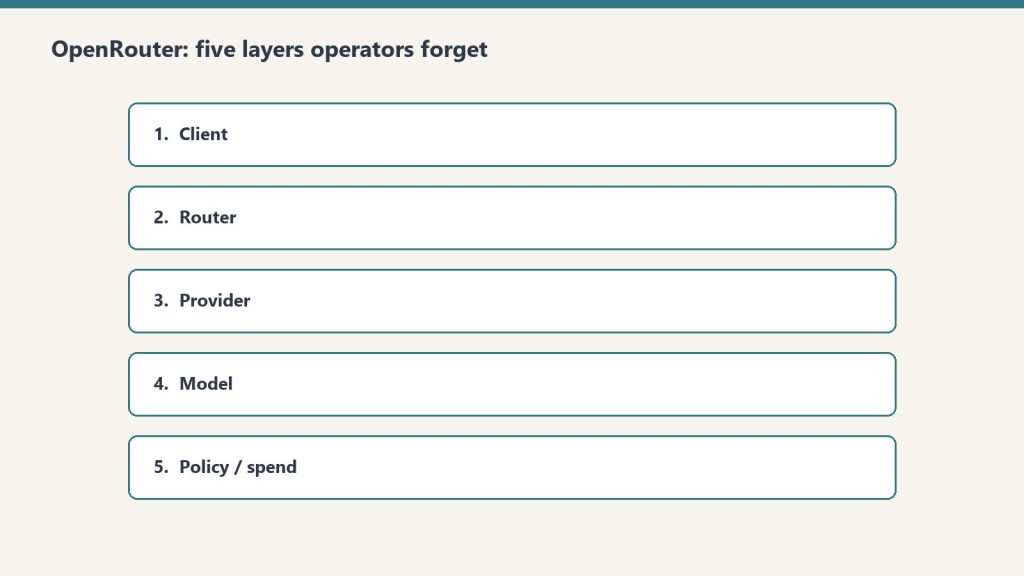
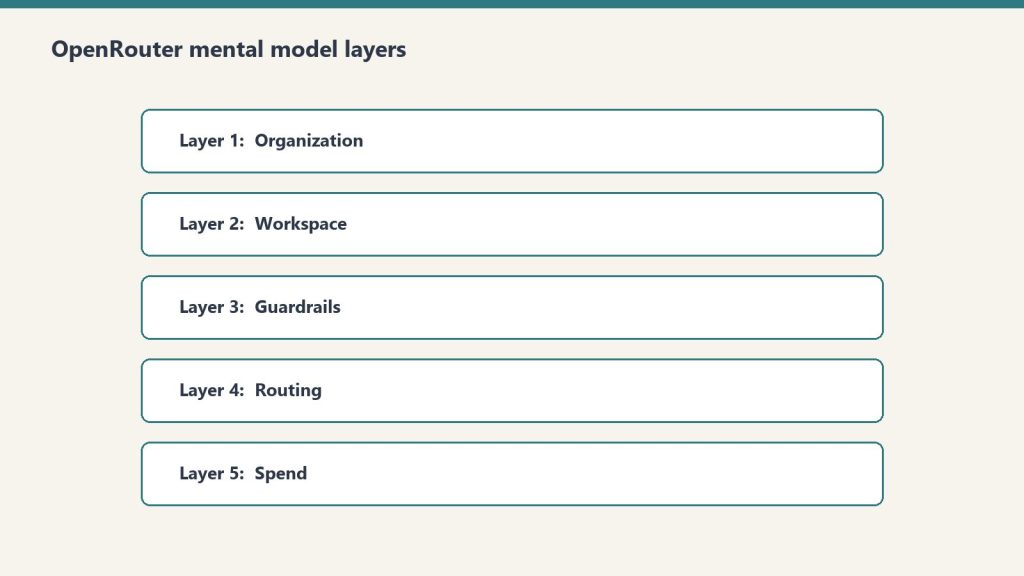
The OpenRouter hierarchy in one sentence: Organizations contain Workspaces, Workspaces enforce Guardrails on API Keys, Keys call Presets, and Presets bundle prompts and models. Every operational decision you’ll ever make on the platform lives at exactly one of those five layers. Confuse them and you’ll spend hours looking for settings that live somewhere other than where you think.
This is a companion to our OpenRouter operator’s field manual. The field manual covers why we use the platform and how it fits a fortress stack. This deep dive covers the mental model itself — the five-layer hierarchy that makes everything else legible.
Why this matters before anything else
Why the mental model matters before anything else.
OpenRouter’s UI presents a flat menu. The actual product is a hierarchy. Every operational decision you’ll ever make — who pays, what’s allowed, who’s allowed to call what, which model gets used — lives at exactly one of five layers. Get the layers wrong and you’ll wire your stack against the wrong nouns.
The five layers, top to bottom: Organization → Workspace → Guardrail → API Key → Preset.
Here’s what each one actually does and when you should care.
Layer 1: Organization
Organization and workspace layers.
Sovereign billing. Sovereign member context. The top of the world.
Each Organization has its own balance, its own billing details, and — critically — its own member roster. The catch: personal orgs don’t expose Members management. If you want to add teammates, you need a non-personal org.
In our case we run two: a personal org tied to our primary email, and a Tygart Media org for agency operations. The personal org has 48 API keys and a working balance. The Tygart Media org is empty so far. Members management is the reason it exists.
When to think about this layer: when you’re deciding whether to operate as an individual or as a team. If you’re solo and plan to stay solo, one personal org is fine forever. The moment you bring on a collaborator who needs their own keys and their own observability slice, you need a non-personal org.
The mistake to avoid: running an agency out of a personal org. You’ll hit member-management limits at the worst possible time.
Layer 2: Workspace
Segmented guardrail, BYOK, routing, and preset domains inside an organization.
By default, every org gets one Default Workspace. Most accounts never think about this layer. The moment you operate across multiple businesses with different data policies, multiple workspaces become valuable.
Example: a healthcare client’s data should never touch first-party Anthropic, only Bedrock or Vertex. A consumer comedy site can use any provider. A B2B SaaS client wants Zero Data Retention enforced on every call. Three different fortress postures. Three workspaces.
Each workspace gets its own Guardrail config, its own BYOK provider keys, its own routing defaults, and its own preset library. Keys created in one workspace can’t see resources in another.
When to think about this layer: when you have two or more clients with materially different data policies. If everything you do has the same posture, one workspace is fine.
The mistake to avoid: assuming workspace segmentation is a security boundary. It isn’t, exactly — it’s a policy boundary. Someone with org-level access can move between workspaces freely. Workspaces are for organizing intent, not for isolating threats.
Layer 3: Guardrails
Guardrails before routing.
The actual enforcement layer. Four categories, all configurable per workspace, all unconfigured by default.
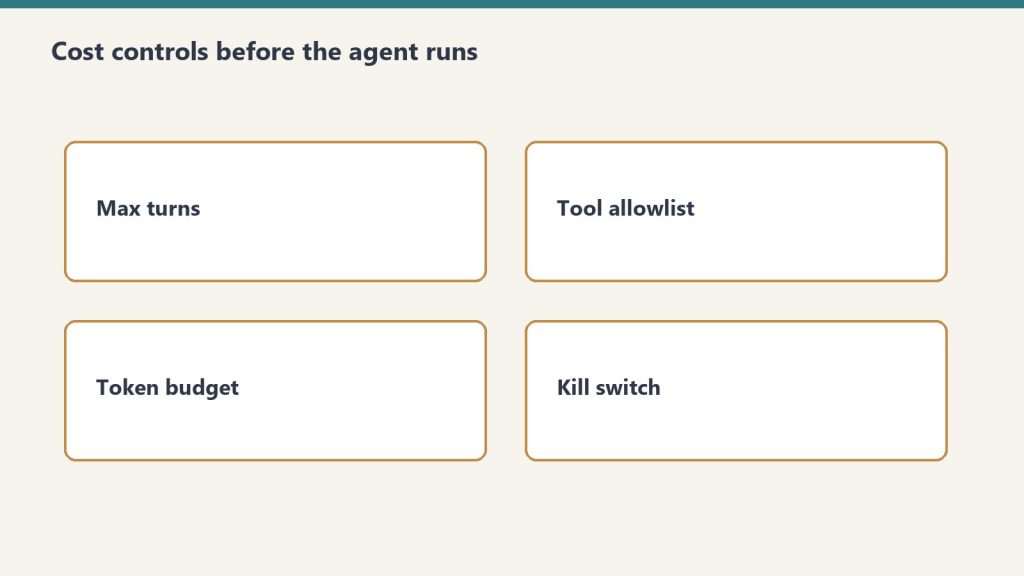
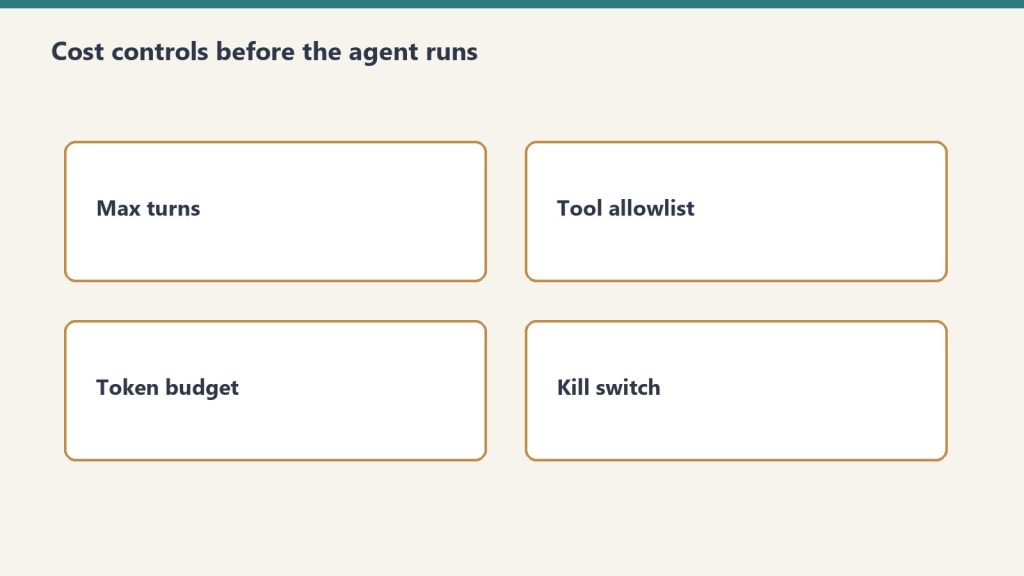
Budget Policies are the most useful and the most underused. Set a credit limit in dollars and a reset cadence (Day, Week, Month, Year, or N/A). Hit the limit and calls fail until the cadence resets. This is your protection against the runaway loop that drains a balance overnight.
Model and Provider Access is where data-policy posture lives. Toggles for Zero Data Retention enforcement, Non-frontier ZDR, first-party Anthropic on or off (with Bedrock and Vertex always staying available), first-party OpenAI on or off (Azure stays), Google AI Studio on or off (Vertex stays), and three categories of paid and free endpoints with different training and publishing behaviors. There’s also an Access Policy mode (Allow All Except is the useful one) with explicit Blocked Providers and Blocked Models lists. The live Eligibility view shows you which providers and models are actually callable given your current policy.
Prompt Injection Detection runs regex-based detection on inbound prompts. OWASP-inspired patterns. Four modes: Disabled, Flag, Redact, or Block. Free and adds no measurable latency. Worth enabling on every workspace that touches user input.
Sensitive Info Detection runs pattern matching on prompts and completions. Built-in patterns for Email, Phone, SSN, Credit Card, IP address, Person Name, and Address. The latter two add latency. Custom regex patterns supported. A sandbox to test patterns before deploying. Useful for any workspace that processes customer data.
When to think about this layer: every workspace, day one. Default-unconfigured is not a safe state. Set a budget cap before you do anything else.
The mistake to avoid: treating Guardrails as something you’ll get to “later.” Later is after the runaway loop has drained the balance.
Layer 4: API Keys
Per-agent identity. Each key has its own credit cap, its own reset cadence, and its own guardrail overlay.
The mental model that matters: one autonomous behavior, one key. When a scheduled task starts hemorrhaging tokens, the cap on its key contains the damage. The other 47 keys keep working.
Our 48-key distribution is instructive. One testing key has spent $83.26. One development key has spent $33.05. The remaining 46 keys have collectively spent less than $120. That’s the shape of real AI operations: a few keys do most of the work, and a long tail barely moves the needle. Per-key caps make that distribution visible and bounded.
API keys also carry the BYOK relationship. A bring-your-own provider key can be pinned to specific API keys, meaning specific agents. That lets you route a high-volume internal agent through a discounted enterprise contract while letting one-off testing keys fall through to OpenRouter’s pooled pricing. We cover this in depth in BYOK on OpenRouter.
When to think about this layer: when you create any new autonomous behavior. New behavior, new key, new cap. No exceptions.
The mistake to avoid: sharing one key across all your services. The first runaway loop will be the last thing that one key ever does, and the blast radius will be everything else that depended on it.
Layer 5: Presets
Versioned bundles of system prompt, model, parameters, and provider configuration. Called as "model": "@preset/your-preset-name" in any API call.
Three tabs per preset: Configuration (the actual bundle), API Usage (how it’s been called), and Version History (every change, rollback-able).
This is the closest OpenRouter comes to a software release artifact. You can ship a preset, test it in chat, version it, and roll back if v2 turns out to be worse than v1. Code that calls the preset stays the same; only the preset content changes.
For autonomous behavior systems this is the unlock. A behavior’s behavior — its prompt, its model choice, its temperature — becomes a thing you can version and review like code, without touching the code that calls it. Promotion ledger says a behavior is graduating from one tier to the next? You publish a new preset version with tighter constraints and the calling code never changes.
When to think about this layer: the moment you have any system prompt that’s used in more than one place, or that you’ll want to refine over time. If you’ve never copy-pasted a system prompt between two scripts, you don’t need presets yet.
The mistake to avoid: putting the system prompt in the calling code. Every prompt update becomes a deploy. With presets, prompt updates become config changes.
Putting the layers together
Here’s the mental model in one sentence: Organizations contain Workspaces, Workspaces enforce Guardrails on Keys, Keys call Presets, Presets bundle prompts and models.
If you walk into OpenRouter looking for a setting and you can’t find it, ask which of the five layers it should logically live at. The answer almost always tells you where to look.
If you’re building a new integration, start at the bottom. Pick a model. Build a preset around it. Create a dedicated key with a tight budget cap. Sit that key under a workspace with sensible guardrails. The organization is just the billing wrapper.
The whole point of the hierarchy is that each layer constrains the one below it. The organization caps the workspace. The workspace caps the keys. The keys cap the presets they can call. Errors propagate up; permissions cascade down. That’s the model. Everything else is UI.
Frequently asked questions
What are the five layers of OpenRouter?
Organization, Workspace, Guardrails, API Keys, and Presets. Organizations handle billing and members. Workspaces segment policy domains. Guardrails enforce budget, provider access, prompt injection, and sensitive info rules. API Keys are per-agent identity with per-key caps. Presets are versioned bundles of system prompt, model, and parameters.
Do I need multiple Workspaces in OpenRouter?
Only if you operate across businesses with materially different data policies. A single Default Workspace is fine for most accounts. The moment a healthcare client requires Bedrock-only access while a consumer client can use any provider, workspace segmentation becomes valuable.
What is the right way to use OpenRouter Presets?
Treat them like software release artifacts. Bundle the system prompt, model, parameters, and provider config. Version every change. Test new versions in chat before promoting. Code that calls the preset stays the same; only the preset content evolves. This lets you refactor prompt behavior without redeploying.
Are OpenRouter Workspaces a security boundary?
No. They’re a policy boundary, not a security boundary. Someone with organization-level access can move between workspaces freely. Use workspaces to organize intent and enforce different fortress postures across clients — not to isolate threats from each other.
What happens if I don’t configure OpenRouter Guardrails?
By default every workspace has zero enforced budget cap, zero provider restrictions, and zero PII filtering. That’s fine for prototyping. It’s not fine for production. Set a budget cap on every workspace as the first action. The other three guardrail categories you can configure as you scale.
What OpenRouter actually is: A routing and policy layer that sits between your code and AI model providers. It replaces the place where you’d otherwise write direct API calls to Anthropic or Vertex AI, adding budget caps, guardrails, prompt-injection filtering, PII redaction, model fallbacks, and observability hooks — with access to hundreds of models behind one unified endpoint. It does not replace your memory system, your hosting environment, your operator console, or the models themselves.
Last verified: October 11, 2026 (Pacific).
The 30-second version
OpenRouter is one of the most useful AI infrastructure tools we’ve adopted, but the value lives at exactly one layer of the stack: the model-calling layer. It replaces the place where you’d otherwise write fetch("https://api.anthropic.com/...") or call Vertex AI directly. It does not replace your memory system, your hosting environment, your operating console, or the models themselves. Get that framing wrong and you’ll build a house of cards. Get it right and you’ve added budget controls, guardrails, observability, and hundreds of models with one config change per agent.
This is how we use it across a stack that runs 27+ WordPress client sites, autonomous content pipelines, multi-model decision tools, and an autonomous behavior promotion system. None of this is theory. Every number in this article comes from our own usage logs.
What OpenRouter actually is
What OpenRouter actually is — a router, not a model.
Strip away the marketing and OpenRouter is a routing and policy layer for AI model calls. You point your code at one endpoint — openrouter.ai/api/v1/chat/completions — and OpenRouter handles model selection, provider fallback, budget enforcement, content filtering, and observability.
It is not a model. It is not a runtime. It is not a database. It is a smarter middle layer between your code and the dozens of providers whose models you might want to call.
The mistake we almost made early on was framing it as “replace GCP and Notion with this.” That framing is wrong in a specific way that’s worth naming: OpenRouter has no servers, no operational memory, no execution environment, no isolated network. It has hundreds of models behind one API and a thoughtful policy layer in front of them. That’s the entire product, and it’s enough — at the right layer.
The 5-layer hierarchy nobody tells you about
The five-layer hierarchy nobody tells you about.
When you log into OpenRouter, the UI presents a flat set of menus. The actual mental model — the one that maps to real operational decisions — is a five-layer hierarchy:
Organization is the top. Sovereign billing and member context. We run two: one personal, one for Tygart Media. The personal org has 48 API keys and a balance; the Tygart Media org has empty balance but exposes Members management that personal accounts can’t access. If you’re operating as an agency, you want the agency org as primary so you can add seats.
Workspaces sit inside organizations. They’re segmented domains for guardrails, BYOK provider keys, routing rules, and presets. Most accounts run on a single Default Workspace and never think about this layer. The moment you operate across multiple businesses with different data policies, workspace segmentation becomes a real decision.
Guardrails are workspace-level enforcement policies. Four categories: Budget Policies, Model and Provider Access, Prompt Injection Detection, and Sensitive Info Detection. By default they’re all unconfigured, which means your workspace has no enforced budget cap, no provider restrictions, and no PII filtering. This is fine until it isn’t.
API Keys are per-agent identity. Each key carries a credit cap, a reset cadence, and a guardrail overlay. The mental model that matters: one autonomous behavior = one API key. If a scheduled task starts hemorrhaging tokens, the cap on its key contains the damage to that key alone.
Presets are versioned bundles of system prompt, model, parameters, and provider config. You call them as "model": "@preset/name" in any API call. They’re the closest thing OpenRouter has to a software release artifact — a thing you can version, test, and roll back.
That hierarchy is the entire operational surface. Everything you’d want to do with the platform happens at one of those five layers. Confuse them and you’ll spend hours hunting for a setting that lives at a different tier than you think.
What OpenRouter replaces (and what it doesn’t)
The honest answer: OpenRouter replaces the direct API call. Nothing more, nothing less.
In our case, every scheduled task, every skill that calls a model, every Claude Project — all of them used to make direct calls to Anthropic’s API or Vertex AI. OpenRouter sits in front of those calls and adds budget caps, guardrails, prompt-injection filtering, PII redaction, model fallbacks, observability hooks, and access to a model catalog of hundreds of options instead of the handful any single provider exposes.
What it does not replace:
Your memory system. Notion remembers; OpenRouter doesn’t. OpenRouter’s logs are call-level telemetry — what model was called, what it cost, what the response was. That’s not operational memory. It can’t tell you “this customer pitch was sent three weeks ago and got no response.” For that, you need a real second brain.
Your hosting environment. OpenRouter has no servers, no WordPress, no database, no VPC. If you’re running a fortress architecture on GCP — VPC isolation, Cloud SQL, Cloud Run services — none of that goes away. OpenRouter sits next to that infrastructure, not in place of it.
Your operator console. Wherever you actually do the work — Claude in chat, your terminal, your IDE — that surface stays. OpenRouter is a transport layer for model calls, not a place you live.
The models themselves. OpenRouter is one path to reach Anthropic’s Claude; Vertex AI is another; the direct Anthropic API is a third. They’re interchangeable transports. The model is the model.
Mapping OpenRouter to an autonomous behavior system
Here’s where the framing gets interesting. We run an autonomous behavior system where every long-running task — a scheduled content pipeline, an SEO audit, a publishing job — sits on a promotion ledger that tracks its trustworthiness over time. Tier C behaviors run autonomously. Tier B requires a human in the loop. Tier A is proposal-only.
OpenRouter maps to that system with almost no friction:
Each behavior becomes a versioned Preset — system prompt, model, parameters, all bundled and versioned.
Each preset is bound to its own API Key with a monthly credit cap and reset cadence.
That key sits under a Workspace whose Guardrail enforces the appropriate data policy.
Observability is broadcast to a webhook that writes back to the operational memory layer.
The result: when a behavior misbehaves — hits its spend cap, trips a policy violation, gets blocked by Sensitive Info Detection — the failure is auto-logged at the routing layer and surfaced to the operator console. The promotion ledger row catches the gate failure and demotes the behavior automatically.
This is the concrete answer to a question every operator running autonomous AI work eventually asks: how will I know when something goes wrong? The answer is: you build the routing layer so that going wrong is itself a signal.
The 270/238 reality check
A small piece of grounding before we go further. As of mid-May 2026, our personal OpenRouter org showed a balance of $31.93 remaining of $270 total credits purchased. That’s $238.07 of actual usage across roughly two months. Spread across 48 API keys, that’s an average of about $5 per key.
The highest-spend key was a testing key at $83.26. The next was a development key at $33.05. Most keys had spent less than $1. That distribution tells you something true about real-world AI operations: a handful of behaviors do most of the work, and the long tail of agents barely registers.
We mention this for one reason: if you’re evaluating OpenRouter, the cost is not the story. The cost is small. The story is whether the policy layer is worth wiring into your stack. Our answer is yes — but the work of wiring it is real, and it requires you to first understand what layer you’re wiring.
The Cloud Run reality
One real-world note that any production team needs to internalize: when we ran AI calls from Cloud Run services on GCP, we occasionally hit 402 responses from OpenRouter that we did not hit when calling Anthropic’s API directly from the same services. We don’t have conclusive evidence of where the issue originated — Cloud Run’s egress IP ranges are widely shared and trip fraud-detection thresholds at many providers, including direct calls to first-party APIs. The lesson is not about OpenRouter specifically. The lesson is that production routing requires deployment-context testing.
Our policy now: for services where reliability is mission-critical, we maintain a fallback path that can switch routing layers under failure. OpenRouter is the default. Direct Anthropic is the fallback. The decision logic lives in the service itself, not in OpenRouter’s config. This is defense in depth, not a critique of any one provider.
The standing rule we wish we’d had earlier
The standing rule we wish we had earlier: budgets before routing.
In March 2026 we ran a security audit on 122 Cloud Run services and discovered five of them had hardcoded OpenRouter API keys baked into environment variables — all sharing the same key. We stripped the keys, rotated, and re-scanned to zero. Then we wrote a standing rule into operational memory:
OpenRouter is off-limits for any task without explicit per-task permission. Image generation always goes through Vertex AI.
The reason for the second half of that rule deserves naming. Image generation via OpenRouter is technically possible, and the model variety is appealing. But image calls are expensive, latency-sensitive, and easy to fire by accident in a loop. One misconfigured behavior can drain a development budget in a single session. Vertex AI’s first-party image generation runs through GCP service accounts with project-level budget alerts, which gives us a natural circuit breaker. We use OpenRouter for the right jobs. We use Vertex for image work.
This is the kind of operational rule you only write after you’ve lost money to a runaway script. Save yourself the lesson.
When OpenRouter is the right answer
Use OpenRouter when:
You want model variety and a unified API across providers
You need workspace-level budget caps that work across many keys
You want PII detection and prompt-injection filtering at the routing layer instead of in every service
You need observability broadcast to your existing stack (we ship to webhooks)
You’re running an autonomous behavior system that needs per-agent identity and per-agent budget enforcement
You want the option to swap models without redeploying code
When it isn’t
Don’t reach for OpenRouter when:
You only call one model from one app and don’t need policy enforcement
You need single-digit-millisecond latency (the extra hop matters)
You’re running image generation at scale (use the first-party provider directly)
You need network isolation guarantees that only your own infrastructure can provide
You’re deploying from an environment with shared egress IPs to a provider that flags those ranges (test first)
The bottom line
OpenRouter is excellent at exactly one thing: being a thoughtful policy layer between your code and the AI models you call. Don’t ask it to be more than that. Don’t replace your memory, hosting, console, or models with it. Wire it into the model-calling layer of an existing system that already has those other pieces sorted, and you get budget controls, guardrails, observability, and hundreds of models with about a day’s worth of integration work.
The framing that works: the model layer of an existing system. Not the system itself.
If you’re operating multiple autonomous AI behaviors and you don’t yet have per-agent budget caps and per-agent observability, OpenRouter is probably the fastest path to getting them. If your stack is one app calling one model, you’re paying for complexity you don’t need yet.
Going deeper
This pillar is the operator’s overview. Each of the five layers and the major workflows we built on top of OpenRouter has its own deep dive:
OpenRouter is a routing and policy layer for AI model API calls. It sits between your application code and AI providers like Anthropic, OpenAI, and Google, providing one unified API endpoint that handles model selection, budget enforcement, guardrails, fallback routing, and observability across hundreds of models from dozens of providers.
Does OpenRouter replace direct Anthropic or OpenAI API calls?
Yes, that’s exactly what it replaces. Your code calls one endpoint (openrouter.ai/api/v1/chat/completions) instead of provider-specific endpoints. The model is selected via a parameter rather than the URL. Everything else about your stack — your memory system, hosting, and operator console — stays the same.
Can OpenRouter replace GCP, Notion, or my hosting infrastructure?
No. OpenRouter is a routing layer for model calls. It has no servers, no database, no operational memory, and no network isolation. If you’re running a fortress architecture on GCP with VPC isolation, Cloud Run services, and Cloud SQL, OpenRouter sits alongside that infrastructure, not in place of it.
How expensive is OpenRouter in practice?
For most operational workloads the platform fee is negligible compared to the underlying model costs. Our personal organization spent $238 over roughly two months across 48 API keys serving multiple autonomous behaviors. The distribution is heavily skewed — a few keys do most of the work, and the long tail barely registers. Cost is rarely the decision factor; the policy layer is.
What is the right way to think about OpenRouter API keys?
One autonomous behavior, one key. Each key gets its own credit cap and reset cadence. When a scheduled task starts hemorrhaging tokens, the cap on its key contains the damage to that key alone. Sharing one key across all services is the single fastest way to lose visibility and bound risk.
Should I use OpenRouter for image generation?
We don’t. Image generation runs through first-party providers (Vertex AI in our case) where project-level budget alerts give a natural circuit breaker. Image calls are expensive, latency-sensitive, and easy to fire by accident in a loop. The routing layer is for text-completion workloads where the policy benefits compound.
What’s the deal with Cloud Run and OpenRouter 402 errors?
Cloud Run egress IP ranges are widely shared, and they sometimes trip fraud-detection thresholds at various providers — including direct calls to first-party APIs, not just OpenRouter. The lesson is that production routing requires deployment-context testing. Maintain a fallback path that can switch routing layers under failure, and you’ve got defense in depth instead of a single point of failure.
There is a quiet bill that comes due on every system that compounds. It is not the build cost. It is not the maintenance cost. It is not the run-rate. It is the habit cost — the daily price of being the kind of operator the system requires.
This is the bill nobody itemizes. It does not show up in the P&L. It shows up in the calendar, the morning routine, the willingness to do the small things the system needs even on the days the system is humming and the small things feel optional.
What the habit cost looks like
It is the daily check on the queue that does not look like it needs checking. The weekly review on the system that has been running cleanly. The deliberate response to a piece of feedback the system would have absorbed silently. The choice to scope a request slightly more than yesterday because the system has earned it.
None of these are large individually. All of them are unforgiving collectively. A system that compounds requires an operator who keeps showing up to the small operations even when the large ones are working. The compounding is not the system’s; it is the operator’s, on the system. The day the operator stops showing up is the day the compounding starts to decay.
The asymmetry between building and running
Building a system has a clear visible cost and a clear visible reward. The reward is a working system. The reward arrives at completion.
Running a system has a small invisible cost and a delayed invisible reward. The reward is that the system continues to work. The reward arrives in the absence of failure, which is hard to perceive. Most operators significantly under-fund the running cost because the running cost is hard to see and the running reward is hard to see, and the absence of both makes it look like nothing is happening — when in fact the most important thing is happening, which is that the system is staying alive.
The lesson the operator does not want to learn
The lesson is that there is no version of “I built it; now it runs itself.” There is only “I built it; now I run it differently.” The operator who treats the working system as the end of the work has misread the bill. The bill does not stop. The bill changes shape — from the burst cost of building to the recurring cost of operating — and the operating cost is the one that decides whether the system is the system you have or the system you used to have.
The cost of a working system is the habit of working it. The operator who pays the bill, in the small, daily, unglamorous form, gets the compounding. The operator who treats the working system as a finished thing gets, eventually, a system that is no longer working — and a memory of when it was.
Companion piece: This article describes how the three-legged stack came together over fourteen months. For the full operating doctrine — why three legs specifically, what each leg’s job is, and how they hold each other up — see The Three-Legged Stack: Why I Run Everything on Notion, Claude, and Google Cloud. The two pieces complement each other; this one is the journey, that one is the doctrine.
I almost got excited about Google’s Googlebook last week. Then I caught myself. I have a stack that’s starting to feel like a broken-in baseball glove — pocket exactly where I want it, leather oiled, laces holding. The last thing I need is a new glove.
This is the operating philosophy I’ve landed on after a year of building Tygart Media as an AI-native content operation. It’s not a tech-stack post. It’s a posture. The stack I use — Claude as the intelligence layer, Notion as the control plane, GCP as the compute plane — happens to be the visual the rest of this piece is built around, but the real point is what holding still does to leverage.
The temptation in any AI-adjacent business right now is to chase. Every week there is a new model, a new IDE, a new agent framework, a new laptop category. Googlebook arrives this fall promising Gemini at the kernel and an AI-powered cursor. OpenRouter sits there offering me every model in the world through one API. Six months ago I would have been wiring both of them in before the announcements cooled.
I’m not doing that anymore. Here’s why, in seven images.
The Three-Legged Stool
Three legs is the minimum number for stability. Add a fourth and you haven’t added strength — you’ve added wobble. A three-legged stool sits flat on any surface, no matter how uneven, because three points define a plane. A four-legged stool needs the floor to be perfect, and if it isn’t, one leg is always lifting.
My stack has three legs. Claude is the intelligence layer — every reasoning step, every draft, every architectural decision passes through it. Notion is the control plane — every project, client, task, ledger, and standard operating procedure lives there. Google Cloud Platform is the compute plane — Cloud Run services, BigQuery ledgers, Workload Identity Federation, the publisher infrastructure that moves content to 27 client sites without a single stored API key.
People keep asking me when I’ll add a fourth leg. Will I move to OpenRouter for model diversity? Will I switch to Linear for project management? Will I migrate compute to AWS for the better startup credits? The honest answer is that adding a fourth leg right now would not make me more stable. It would make me less. I haven’t mastered the three I have.
The Anvil and the Glove
Roots. Operations is operations. The discipline learned in restoration carries straight into AI-native content work.
Before Tygart Media, I spent years in property damage restoration operations — Munters, Polygon, the kind of work where a phone call at 2 AM means a water line burst at a hotel and a crew needs to be on-site in forty-five minutes with the right equipment and the right paperwork. That world taught me everything I now use to run an AI-native content business. It taught me to batch. It taught me to absorb scope rather than push it back on the client. It taught me that subcontracting is a form of collaboration, not a failure mode. It taught me that operations is operations — the substrate changes, the discipline doesn’t.
The baseball glove on top of the anvil is the metaphor I keep returning to. A new glove is stiff. It catches awkwardly. The webbing is too tight, the leather hasn’t formed to your hand yet, and every ball that comes in feels foreign. A broken-in glove is the opposite. It closes around the ball before you’ve consciously decided to squeeze. You don’t think about catching. You just catch.
That’s what fourteen months on the same stack has done. I don’t think about how to publish to WordPress anymore. I don’t think about how to route a model decision between Haiku, Sonnet, and Opus. I don’t think about whether a new automation belongs in Cloud Run or as a Notion Worker. The catching is automatic. Every hour spent in the same three tools is another stitch in the glove.
The Surveyor’s Tripod
Precision. The stack as a measurement instrument. Three legs, one truth.
A tripod is a stool that measures. It’s the same three-legged geometry, but you put a sextant on top, or a transit, or a telescope, and suddenly the stability isn’t ornamental — it’s the whole point. If the legs aren’t planted, the measurement is wrong. If the measurement is wrong, you build in the wrong place.
The three-legged stack as a measurement instrument is how I now think about content operations. Claude measures what to say. Notion measures what’s been said, what’s been promised, what’s been promoted, what’s been demoted. GCP measures what’s been deployed and what’s been logged. Together they make a single coherent reading of where the business actually is — not where I imagine it to be, not where I hope it is, but where it actually stands at 3 AM on a Tuesday.
That reading is what lets me trust the work. The Promotion Ledger inside Notion tracks every autonomous behavior the system runs — content publishes, schema injections, taxonomy fixes, image optimizations — by tier and by clean-day count. Seven clean days on a tier means a candidate for promotion. A failure resets the clock. The instrument doesn’t lie. It either reads green or it doesn’t.
The Trefoil
Synthesis. Three loops meeting at the center. The synthesis point is where knowledge becomes a distillery.
The trefoil is an ancient symbol — three interlocking loops meeting at a single point in the center. Heraldic shields use it. Cathedral architecture uses it. The Celtic version goes back to the Iron Age. It shows up everywhere because it answers a question every human system eventually asks: how do you get three independent things to produce a fourth thing that none of them could produce alone?
Synthesis is the answer. Where the loops meet, the third thing happens. Claude alone is a smart conversation. Notion alone is a well-organized library. GCP alone is a pile of compute. None of those by themselves is a business. But the place where the three loops overlap — that’s where a client brief becomes a draft becomes an optimized article becomes a scheduled publish becomes a tracked outcome — and that center point is where the work actually lives.
I think of Tygart Media as a Human Knowledge Distillery. The raw material is messy human knowledge — a client’s twenty years of trade experience, my own restoration background, a comedian’s stage instincts, a recovery contractor’s job-site stories. The distillery boils that down into something that can travel: an article, a schema block, a social post, a referral asset. The three legs aren’t doing the distilling. The synthesis at the center is.
The Pocket Watch
Mastery. Mechanism over magic. The watch doesn’t get better because a new watch came out.
Independent horology — the world of small, fiercely independent watchmakers who build their movements by hand — is one of my private obsessions, and it has shaped how I think about AI tooling more than I expected. The watchmakers I admire most don’t release a new caliber every year. They spend a decade on one movement. They refine the escapement, balance the wheel, polish the bridges, and over time the watch gets better not because the parts are new but because the maker understands the parts better.
This is the opposite of how most of the AI industry operates. The cadence is: ship a new model, ship a new agent, ship a new IDE, ship a new laptop. The implicit promise is that the latest thing will do more than the previous thing, and the implicit demand is that you keep up. Mastery is impossible in that mode. By the time you’ve learned the mechanism, the mechanism has been replaced.
Holding still is a competitive advantage exactly because most people can’t. While everyone else is unboxing their Googlebook in October and figuring out where Gemini’s Magic Pointer fits into their workflow, my workflow won’t have changed — because the workflow doesn’t live on the laptop. It lives in the stack. The laptop is just a window into the stack. A new laptop is a new window. The view is the same.
The Lighthouse
Signal. Authority compounds when you stay put and keep the light on.
Lighthouses don’t move. That’s the whole point of them. A lighthouse that wandered around the coastline trying to find the best vantage would not be useful to anyone — ships wouldn’t know where it was, the beam would never settle, and the entire purpose of having a fixed reference point in a foggy world would collapse.
Content authority works the same way. The sites that get cited by AI models — that show up in Google’s AI Overviews, in Perplexity’s citations, in Claude’s own retrieval — are not the sites that pivoted the most. They are the sites that have been on the same beam for years, publishing the same kind of work, building the same kind of entity recognition, and giving language models a stable reference point to anchor to.
This is true at the stack level too. The reason my content operations get more efficient month over month is not because I’m using new tools — it’s because Claude, Notion, and GCP have learned each other inside my workspace. The skill files in Claude know exactly which Notion databases to write to. The Notion routers know exactly which GCP services to dispatch. The GCP services know exactly which WordPress sites to publish to and how each one wants its content shaped. The beam is on. It keeps being on. Authority compounds in the version of you that didn’t move.
The Hourglass
Compounding. Time spent doesn’t drain. It crystallizes into something more valuable.
This is the image that closes the piece, and it’s the one that took me the longest to understand. An hourglass usually represents time running out. Sand falls. The bulb empties. Eventually you’re done. The version I commissioned reframes it: golden sand falls into a bed of polished gemstones. Time doesn’t disappear into nothing. It compounds into something more valuable.
That is the entire thesis of the broken-in glove. Time spent on the same stack does not drain. It crystallizes. Every additional week with Claude, Notion, and GCP makes the next week more leveraged, because the pattern library is bigger, the muscle memory is deeper, and the surface area I can act on without re-learning is wider. The opposite path — switching stacks, chasing the new thing, restarting the muscle memory — is the path where time actually drains. The bulb empties and there is no gemstone bed underneath.
So when Googlebook launches in fall 2026 and people ask me whether I’m getting one, the answer is: maybe, eventually, as a window into the stack I already have. But not as a replacement for anything. The stool is the stool. The legs are the legs. And the glove is finally starting to feel like mine.
The three-legged stack is the operating system Tygart Media uses to run an AI-native content and SEO agency across 27+ client sites. The three legs are Claude as the intelligence layer, Notion as the control plane, and Google Cloud Platform as the compute plane. The architecture follows an Integration Spine: GitHub stores the source of truth, GitHub Actions plus Workload Identity Federation move work to Cloud Run with no stored credentials, and Cloud Run reports back to Notion.
Why three tools instead of more?
Three is the minimum number of points required to define a plane, which makes a three-legged structure inherently stable on any surface. Adding a fourth tool before mastering the first three adds switching cost and surface area without adding capability. Depth in three tools produces more leverage than breadth across six.
How does the stack handle a 27-site content operation?
Claude generates and optimizes content via skills that encode the standards for SEO, AEO, and GEO. Notion stores the editorial calendar, client briefs, Promotion Ledger, and the operating manual. GCP runs the Cloud Run publisher services that push optimized articles into WordPress sites via REST API, with all publishing actions logged back to Notion for audit. The stack is designed so that any single article passes through all three legs before going live.
Is Tygart Media planning to adopt Googlebook when it launches?
Not as a replacement for any part of the current stack. Googlebook will likely become useful as a thicker client surface over the same backend, but the actual operating system — Claude, Notion, GCP, and the Integration Spine — does not live on the laptop. The laptop is just a window into the stack. Switching laptops doesn’t change the view.
What does “broken-in advantage” mean in an AI context?
Broken-in advantage is the compounding effect that comes from sustained mastery of a single toolchain. Skills, automations, and muscle memory build on each other when the underlying tools stay constant. Operators who switch stacks frequently never reach the inflection point where the system becomes leveraged. Operators who hold still long enough to master the same three tools build a moat that’s harder to copy than any individual feature.
Where does the restoration industry background fit in?
Years of property damage restoration operations at Munters and Polygon taught the discipline that the AI-native content stack now runs on — batching, scope absorption, subcontracting as collaboration, and tiered trust systems. The thesis is that operations is operations. The substrate (restoration crews then, AI agents now) changes. The operating discipline doesn’t.
How does the Promotion Ledger fit into the stack?
The Promotion Ledger is a Notion database under a top-level page called The Bridge. Every autonomous behavior the system runs is tracked there by tier — A for proposed, B for human-flown, C for autonomous — with a clean-day counter and a failure log. Seven clean days on a tier qualifies a behavior for promotion. A failure resets the clock and demotes the behavior one tier. The Ledger is how the stack proves to itself that it can be trusted.
{“@context”: “https://schema.org”, “@type”: “Article”, “headline”: “The Three-Legged Stack: Why I Stopped Shopping for New Tools”, “description”: “After fourteen months building an AI-native content operation, the operating philosophy at Tygart Media is to hold still and deepen what works. Seven images and a manifesto.”, “author”: {“@type”: “Person”, “name”: “Will Tygart”, “url”: “https://tygartmedia.com/about/”}, “publisher”: {“@type”: “Organization”, “name”: “Tygart Media”, “url”: “https://tygartmedia.com”}, “image”: “https://tygartmedia.com/wp-content/uploads/2026/05/three-legged-stack-tygart-media-claude-notion-gcp.webp”, “datePublished”: “2026-05-14”, “mainEntityOfPage”: “https://tygartmedia.com/the-three-legged-stack/”}
{“@context”: “https://schema.org”, “@type”: “FAQPage”, “mainEntity”: [{“@type”: “Question”, “name”: “What is the three-legged stack at Tygart Media?”, “acceptedAnswer”: {“@type”: “Answer”, “text”: “The three-legged stack is the operating system Tygart Media uses to run an AI-native content and SEO agency across 27+ client sites. The three legs are Claude as the intelligence layer, Notion as the control plane, and Google Cloud Platform as the compute plane. The architecture follows an Integration Spine: GitHub stores the source of truth, GitHub Actions plus Workload Identity Federation move work to Cloud Run with no stored credentials, and Cloud Run reports back to Notion.”}}, {“@type”: “Question”, “name”: “Why three tools instead of more?”, “acceptedAnswer”: {“@type”: “Answer”, “text”: “Three is the minimum number of points required to define a plane, which makes a three-legged structure inherently stable on any surface. Adding a fourth tool before mastering the first three adds switching cost and surface area without adding capability. Depth in three tools produces more leverage than breadth across six.”}}, {“@type”: “Question”, “name”: “How does the stack handle a 27-site content operation?”, “acceptedAnswer”: {“@type”: “Answer”, “text”: “Claude generates and optimizes content via skills that encode the standards for SEO, AEO, and GEO. Notion stores the editorial calendar, client briefs, Promotion Ledger, and the operating manual. GCP runs the Cloud Run publisher services that push optimized articles into WordPress sites via REST API, with all publishing actions logged back to Notion for audit.”}}, {“@type”: “Question”, “name”: “Is Tygart Media planning to adopt Googlebook when it launches?”, “acceptedAnswer”: {“@type”: “Answer”, “text”: “Not as a replacement for any part of the current stack. Googlebook will likely become useful as a thicker client surface over the same backend, but the actual operating system does not live on the laptop. The laptop is just a window into the stack.”}}, {“@type”: “Question”, “name”: “What does broken-in advantage mean in an AI context?”, “acceptedAnswer”: {“@type”: “Answer”, “text”: “Broken-in advantage is the compounding effect that comes from sustained mastery of a single toolchain. Skills, automations, and muscle memory build on each other when the underlying tools stay constant. Operators who switch stacks frequently never reach the inflection point where the system becomes leveraged.”}}, {“@type”: “Question”, “name”: “Where does the restoration industry background fit in?”, “acceptedAnswer”: {“@type”: “Answer”, “text”: “Years of property damage restoration operations at Munters and Polygon taught the discipline that the AI-native content stack now runs on: batching, scope absorption, subcontracting as collaboration, and tiered trust systems. Operations is operations. The substrate changes, the discipline doesn’t.”}}, {“@type”: “Question”, “name”: “How does the Promotion Ledger fit into the stack?”, “acceptedAnswer”: {“@type”: “Answer”, “text”: “The Promotion Ledger is a Notion database under a top-level page called The Bridge. Every autonomous behavior the system runs is tracked there by tier with a clean-day counter and a failure log. Seven clean days qualifies a behavior for promotion. A failure resets the clock and demotes the behavior one tier.”}}]}
What Is the Indexing Paradox?
The 2026 Indexing Paradox describes a growing disconnect between what Google Search Console reports about your site’s indexing and what actually shows up in your first-party GA4 traffic data. As this tygartmedia.com case study shows, a site can appear to have zero indexed pages in GSC while simultaneously receiving hundreds of organic search sessions per day—plus a massive wave of AI-referred traffic that doesn’t register as search at all.
In mid-May 2026, a routine Google Analytics query returned a striking number: 925 sessions on a single day. Peak traffic for the year. The same query to Google Search Console showed something else entirely: zero pages indexed.
Both reports were looking at the same site. Both were generated by Google tools. And they were telling completely different stories.
This is not a tygartmedia.com-specific glitch. It’s a signal about the state of SEO measurement in 2026—and what it means for every site owner who has been trusting Search Console as their indexing north star.
Part 1: The GSC Bug — 11 Months of Bad Data
The GSC bug — months of bad data.
The first piece of the paradox has a confirmed, documented cause.
On April 3, 2026, Google officially acknowledged a logging error in Search Console that had been silently inflating impression data across the web since May 13, 2025. For nearly 11 months, GSC was over-reporting impressions—the number of times your pages appeared in Google search results. The fix rolled out progressively through April 2026, completing around April 27.
The correction produced exactly what you’d expect: charts that looked like a cliff. Sites that had been showing thousands of impressions suddenly showed hundreds. Sites showing hundreds showed near-zero. For tygartmedia.com, the April 23 date lines up precisely with when this correction hit hardest in the analytics record—the date the GA4 AI assistant flagged as the origin of the apparent “Ghost Drop.”
Here’s what matters most: Google confirmed this bug affected impressions only. Clicks were not affected. The fix corrected a reporting error—it did not change how Google was actually crawling, indexing, or serving the site’s pages to users. The search engine was functioning correctly throughout. The dashboard was lying.
The practical implication for any data work involving GSC: any impression-based metric from May 13, 2025 through April 27, 2026 is unreliable. Click data from that period is clean. If you’ve been benchmarking CTR, average position, or impression trends against that 11-month window, you need to annotate or exclude it.
But the GSC bug only explains part of what tygartmedia.com’s data shows. The more interesting piece is what happened after the fix—and what the GA4 data reveals about where the traffic is actually coming from.
Part 2: The GA4 Reality Check
While GSC was reporting zero indexed pages through May 2026, GA4 was recording something very different. The numbers below come directly from the tygartmedia.com GA4 property, pulled May 14, 2026:
Week of May 10–14 vs. week of May 3–7:
Total sessions: 3,436 — up 42.1% week over week
Active users: 3,031 — up 34.5%
Event count: 10,759 — up 33.6%
Peak single day: 925 sessions on May 13, 2026
Organic search (May 1–14): 1,019 sessions — a 41.9% increase over the previous 14-day period. Over 50 unique landing pages drove organic sessions during this period. If the site had zero indexed pages, this number would be zero. It is not zero. The site is indexed. The dashboard is wrong.
Top organic landing pages during this period included /claude-ai-pricing/ (139 sessions), /claude-team-plan-usage-limits/ (72 sessions), and /anthropic-console/ (30 sessions)—a mix of evergreen technical content and recently published guides. Google is crawling, indexing, and serving these pages to users every day. GSC’s aggregate index count is simply not reflecting it.
The GA4 AI assistant’s analysis confirms: if you need to verify indexing status, use the URL Inspection Tool in GSC on specific pages rather than relying on the aggregate index count report. The aggregate is a lagging, bug-prone metric. The URL Inspection Tool queries Google’s live index directly.
Part 3: The Traffic You’re Not Seeing — AI Attribution in GA4
AI attribution in GA4 — traffic you’re not seeing.
The organic search growth is real and documented. But it’s not the most striking finding in the tygartmedia.com data. That honor goes to direct traffic.
From May 1–14, 2026, direct sessions hit 5,448—a 291% increase over late April. This is not bookmarks and typed URLs growing 3x in two weeks. Something else is happening.
The explanation lies in how AI search tools pass (or don’t pass) referral data to analytics platforms. When a user finds a link through ChatGPT, Google AI Overviews, Claude, or Perplexity and clicks through to your site, that session needs an HTTP referrer to be attributed correctly in GA4. Many AI platforms do not pass referrer headers—either by design, privacy policy, or architectural decision.
The result: AI-referred traffic lands in GA4 as “Direct” or “Unassigned.” Independent research published in April 2026 found that approximately 70% of AI referral traffic arrives with no HTTP referrer, invisible to standard GA4 channel attribution. Roughly one in three AI search sessions lands in the “Unassigned” bucket.
Platform-specific behavior varies. Perplexity Comet passes referrer data, so sessions from Perplexity show up correctly as perplexity.ai / referral in GA4. ChatGPT Atlas does not pass referrers consistently, so ChatGPT-referred sessions tend to appear as Direct. Google’s own AI Overviews can suppress traditional organic attribution even when the user clicks a result—the session may land as Direct rather than Organic Search.
The tygartmedia.com content profile makes this particularly visible. The top organic landing pages—claude pricing, Claude model comparisons, Anthropic product guides—are exactly the kinds of pages that AI assistants cite when users ask about AI tools. A user asking ChatGPT “how much does Claude cost?” who then clicks the cited source is not going to show up in GA4 as a ChatGPT referral. They’ll show up as Direct.
The 291% surge in direct traffic in early May 2026—combined with the desktop/Chrome/Edge device profile that the GA4 AI assistant flagged—is consistent with AI-referred traffic at scale. Desktop Chrome and Edge are the primary environments where browser-integrated AI sidebars (Copilot in Edge, Gemini in Chrome) run. These are not human visitors typing tygartmedia.com from memory. They are users following AI-surfaced links.
Part 4: The Geographic Signal
One data point in the GA4 report deserves specific attention: Singapore (+272 users) and China (+75 users) were the top geographic contributors to the May traffic surge.
tygartmedia.com is a U.S.-based site covering local Pacific Northwest content alongside AI and tech analysis. Organic growth from Singapore and China does not fit a local news readership pattern. It does fit an AI bot crawling pattern—and it fits the profile of AI-forward tech audiences in Southeast Asia where Perplexity, ChatGPT, and other AI search tools have seen rapid adoption.
The tygartmedia.com content that’s performing—Claude API access, model comparisons, Anthropic product guides—is globally relevant to anyone building with or researching Anthropic’s products. The Singapore/China traffic surge likely represents a combination of AI crawler activity and human readers in AI-intensive markets finding the content via AI search surfaces.
There is also a published API guide in the GA4 data: /claude-api-access-singapore-china-2026/—a page specifically about Claude API access for users in Singapore and China. That page is appearing in organic search results, which partly explains the geographic signal.
Part 5: What This Means for SEO in 2026
What this means for SEO in 2026.
The tygartmedia.com data is not an anomaly. It’s an early, clearly documented example of a measurement problem that every content site is going to face as AI search adoption grows.
The old measurement model assumed three things: Google Search Console tells you what’s indexed, organic search traffic in GA4 tells you what Google is sending, and direct traffic is mostly returning visitors. In 2026, all three assumptions are breaking down simultaneously.
GSC’s aggregate index report is lagging and bug-prone—as April 2026 proved definitively. First-party GA4 data is more reliable for actual traffic reality. Organic search in GA4 understates AI-referred traffic because AI platforms suppress referrer headers. Direct traffic is increasingly a proxy for AI search attribution, not just brand recall.
The practical responses:
Trust GA4 over GSC for indexing health. Use the URL Inspection Tool in GSC for specific page verification. Do not use the aggregate index count chart for trend analysis—it’s too slow and too error-prone. If your GA4 shows organic traffic from a page, that page is indexed.
Build an AI traffic channel in GA4. Create a custom channel group with a regex rule capturing known AI referral sources: chatgpt\.com|chat\.openai\.com|perplexity\.ai|claude\.ai|gemini\.google\.com|bing\.com/search (for Copilot). Place this rule above the default “Referral” rule in your channel groupings. This won’t capture all AI traffic, but it will make the attributable portion visible.
Watch direct traffic as a proxy metric. A sustained, unexplained surge in direct traffic—especially on desktop Chrome and Edge, especially from tech-forward geographies—is likely AI-referred traffic. Treat it as a signal of AI citation activity, not just brand recall.
Annotate the GSC bug window. Mark May 13, 2025 through April 27, 2026 in any GSC-based reporting. Impression, CTR, and average position data from that window is unreliable. Click data from that window is clean.
Focus on content that AI cites. The top organic and direct landing pages on tygartmedia.com share a pattern: specific, factual, verifiable answers to questions AI users are asking. Claude pricing. Team plan limits. How to install Claude Code. These are Generative Engine Optimization (GEO) wins—content that AI models surface when users ask the question. That traffic shows up in organic search, direct, and unassigned simultaneously, which is why raw organic session counts understate the real impact.
The Verdict: Your Dashboard Is Behind Your Reality
The tygartmedia.com Indexing Paradox is not a mystery. It’s the result of two documented phenomena arriving simultaneously: a year-long GSC impression bug that corrected itself in April 2026, and a structural GA4 attribution gap that misclassifies AI-referred traffic as direct.
The site is not broken. GSC’s reporting is. The search engine is working. The dashboard is not. GA4’s first-party event data is the ground truth—and it shows a site gaining momentum, not losing it.
The broader lesson for any site owner watching GSC with alarm in 2026: the tools that were designed to measure search visibility were built for a world where search was blue links, referrers were passed cleanly, and impression data was reliable. That world is changing faster than the tools.
The sites that navigate this well will be the ones that build measurement architectures around first-party behavioral data, create custom attribution for AI traffic sources, and stop treating Search Console as the final word on indexing health. It no longer is.
Key Takeaway
In 2026, Google Search Console’s aggregate index count is not a reliable indicator of site health. First-party GA4 data is. The April 2026 GSC bug correction and the rise of AI search traffic that suppresses referrer headers have decoupled GSC reporting from actual search visibility. Trust your event data, build AI traffic attribution into GA4, and stop relying on impression trend lines that spent 11 months inflated with bad data.
What was the Google Search Console bug in April 2026?
Google officially confirmed on April 3, 2026 that a logging error had been inflating impression counts in Search Console since May 13, 2025—nearly 11 months. The fix rolled out through April 27, 2026. The correction only affected impressions, CTR, and average position; click data was not impacted. After the fix, many sites saw their GSC impression charts drop sharply, creating the appearance of a traffic crisis that did not actually exist.
If GSC shows zero indexed pages, does that mean my site is de-indexed?
Not necessarily—and probably not. The aggregate “Page Indexing” report in GSC is a lagging, aggregated metric that has demonstrated significant reporting bugs in 2025–2026. The definitive test is the URL Inspection Tool: paste a specific page URL into the search bar in GSC and check whether it returns “URL is on Google.” If it does, that page is indexed. If your GA4 shows organic traffic from a page, that page is indexed—Google cannot send organic traffic to a page it has not indexed.
Why does AI traffic from ChatGPT or Perplexity show up as Direct in GA4?
Most AI platforms do not pass HTTP referrer headers when users click links in AI-generated responses. Without a referrer, GA4’s default classification is Direct. Research from 2026 found approximately 70% of AI-referred sessions arrive with no referrer, making them invisible to standard channel attribution. Perplexity passes referrer data more consistently than ChatGPT; Google AI Overviews behavior varies. To capture attributable AI traffic, create a custom channel group in GA4 with regex matching known AI source domains.
How do I tell if my direct traffic spike is AI-referred or genuine brand recall?
Look at the device and browser composition. Genuine brand recall (typed URLs, bookmarks) distributes across device types including mobile. AI-referred traffic skews heavily toward desktop Chrome and Edge because those are the primary environments for browser-integrated AI assistants and AI search tools. Geographic concentration in tech-forward markets (Singapore, India, major U.S. metro areas) without a corresponding social or campaign trigger also suggests AI-referred traffic. A sudden, unexplained surge without a matching campaign or social event is your strongest signal.
Should I stop using Google Search Console?
No. GSC remains useful for diagnosing specific page indexing issues via the URL Inspection Tool, monitoring crawl errors, reviewing manual actions, and tracking click data (which was not affected by the April 2026 bug). What you should stop doing: using GSC’s aggregate impression trends or page indexing count charts as your primary measure of site health. Use GA4 first-party event data for traffic health, and use GSC’s URL-level tools for specific indexing questions.
What content performs best in AI search in 2026?
Based on the tygartmedia.com data, the content that drives the strongest AI-referred performance is specific, factual, and answers a precise question: pricing guides, feature comparisons, product how-tos, and policy explainers. These are the pages AI models surface when users ask direct questions. Content optimized for AEO (Answer Engine Optimization) and GEO (Generative Engine Optimization)—structured with clear definitions, FAQ sections, and verifiable specifics—generates the AI citation activity that shows up as direct and organic traffic simultaneously.
What Is the Notion Everything Database?
The Notion everything database is the concept of using Notion as an agnostic, structured data layer beneath your AI workflows—storing context, outputs, tasks, and business intelligence in one place that any connected AI platform can query, write to, and reason over. This guide covers how each major AI platform connects to that layer, what the connection actually enables, and where the real-world limits are.
In the competitive series we published earlier, one theme kept resurfacing: every AI platform that wants to be genuinely useful in your workflow eventually needs a place to store and retrieve structured context. Memory. History. The institutional knowledge that makes AI useful beyond a single session.
For teams that have already built their operations on Notion, the question isn’t whether to use an everything database—you already have one. The question is how each AI platform connects to it, what that connection actually enables in practice, and where the real limits are.
This guide is the answer. We’ve mapped the actual integration path for each of the five platforms in our series—OpenAI, Perplexity, Grok, Mistral, and Zapier—against Notion’s current API and MCP capabilities. No hypotheticals. No aspirational features. What works today, what requires workarounds, and what to watch for as these integrations mature.
📚 This Is Track 2 of the Everything App Series
Track 1 analyzed each platform’s everything app ambitions. Track 2 is the implementation layer—how to actually connect them to your Notion database.
Before covering individual platform integrations, it’s worth establishing what Notion has actually built for AI connectivity—because it changes the integration picture significantly.
Notion ships an official, hosted MCP (Model Context Protocol) server. This is not a third-party hack or a community project. It lives at developers.notion.com/docs/mcp, is maintained by the Notion engineering team, and is open-source at github.com/makenotion/notion-mcp-server. Version 2.0.0 migrated to the Notion API version 2025-09-03, which introduced data sources as the primary abstraction for databases (replacing the old database ID model with data_source_id).
The MCP server uses OAuth for authentication. You do not use a static API key or bearer token for the hosted version—you go through Notion’s OAuth flow, which grants scoped access to the pages and databases you explicitly share with the integration. This is an important detail: even with a valid OAuth token, the MCP server can only access Notion content you have explicitly shared with the integration via the ••• menu → Add connections on each page or database.
What the official MCP server enables: AI tools can search your Notion workspace, read page content, create new pages, update existing pages, query databases, and add comments. The server is optimized for AI consumption, formatting Notion’s block-based content into clean text that AI models can reason over efficiently.
Supported AI tools as of mid-2026: Claude (via Claude Desktop or Cowork), Cursor, VS Code, and ChatGPT Pro. The Notion team publishes a plugin for Claude specifically at github.com/makenotion/claude-code-notion-plugin.
One practical note from our own setup: we use the Notion MCP actively in our Cowork sessions. When you ask about content in your Notion workspace—Command Center pages, Second Brain entries, desk specs—that’s the MCP server at work. Search, fetch, create, and update operations all run through it in real time. The integration is stable and fast for the kinds of structured content retrieval and page creation that content operations require.
The Notion API in 2026: What You Need to Know
A few API facts that matter for any integration you build:
Rate limit: Approximately 3 requests per second per integration for most operations (some sources indicate up to 5 req/s for integration-heavy workspaces). When you hit the limit, the API returns HTTP 429 with a Retry-After header. Any well-built integration respects this automatically. For bulk operations across large databases, you’ll need request queuing.
Page size limit: The API returns a maximum of 100 items per query by default. For databases with more than 100 records, you must implement pagination using the start_cursor parameter. This is a common trip point for integrations that assume they’ve retrieved all records when they’ve only seen the first page.
API version 2025-09-03: The September 2025 API version introduces data sources as the primary database abstraction. If you’re using multi-source databases in Notion (databases that pull from multiple collections), integrations built against older API versions may not return all data. The MCP server v2.0.0 handles this correctly. Custom integrations built before September 2025 may need updating.
Block-level content: Notion stores page content as nested blocks, not plain text. The API returns this block structure. The MCP server handles the translation to readable text for AI models; direct API integrations need to handle this themselves.
Platform 1: OpenAI / ChatGPT
Platform 1 — OpenAI / ChatGPT.
What Actually Exists
There are two meaningful integration paths between OpenAI and Notion, and they are not the same thing.
Path A: ChatGPT Connector (official, read-only)
ChatGPT Plus and Pro users can connect Notion directly from ChatGPT settings. This is an official integration. The significant limitation: it is read-only. ChatGPT can search and read your Notion pages, but it cannot write, create, or update anything in your workspace. It is designed for individual paid subscriptions and does not scale to team-wide deployments. For retrieving context from your Notion database to inform a ChatGPT conversation, this works. For using ChatGPT to maintain and update your Notion database, it does not.
Path B: Custom API Integration (read/write, requires code)
The full read/write path requires connecting the OpenAI API and Notion API directly via custom code, or via a middleware platform like Zapier or Make. This gives you complete access—creating pages, updating database records, querying with filters. It’s the correct path for any workflow where ChatGPT needs to write outputs back to your Notion everything database.
In November 2025, Notion rebuilt their AI agent system with GPT-5 to power Notion AI’s reasoning and action capabilities within the workspace. This is Notion using OpenAI’s models internally, not OpenAI accessing your Notion workspace. The distinction matters: Notion AI (powered partly by GPT-5) can act on your Notion content. ChatGPT itself cannot write to Notion without a custom integration or Zapier in the middle.
The Practical Integration Pattern
For teams using OpenAI models as their primary AI layer and Notion as their everything database, the most reliable pattern is: OpenAI API → custom Python/Node.js integration → Notion API. Use the GPT Actions framework (documented at cookbook.openai.com) to give a custom GPT the ability to call the Notion API directly, with your integration token scoped to the specific databases it needs access to.
For non-technical teams, Zapier is the practical middle layer—which we cover in the Zapier section below.
Platform 2: Perplexity
What Actually Exists
Perplexity does not have an official native Notion integration. There is no direct connector in the Perplexity product that reads from or writes to your Notion workspace.
What does exist: a Chrome extension (“Perplexity to Notion Batch Export”) that lets users save Perplexity research sessions directly to Notion. This is a browser-based manual export tool, not an automated integration. For capturing Perplexity research into your Notion database for later reference, it works and is well-reviewed. For autonomous AI workflows that need Perplexity to query or update Notion, it does not.
The automated integration paths run through n8n (which ships a native Perplexity node with full API coverage), Make, Zapier, and BuildShip. These let you build workflows like: Perplexity runs a research query → output gets written to a Notion database record. The Perplexity API supports Chat Completions, Agent mode, Search, and Embeddings—all of which can be orchestrated via these middleware platforms to produce structured Notion database entries.
The Practical Integration Pattern
The most useful Perplexity→Notion workflow for content operations: trigger a Perplexity search query on a topic, take the structured response, and use the Notion API to create a new database record with the research as the page body. This gives you a searchable, AI-queryable research library inside your Notion everything database. The plumbing runs through n8n, Make, or Zapier—Perplexity as the research engine, Notion as the structured archive.
Perplexity’s own product roadmap includes deeper tool integrations and an expanding API surface. Native Notion connectivity is not announced, but the middleware path is mature and reliable today.
Platform 3: Grok / xAI
Platform 3 — Grok / xAI.
What Actually Exists
Grok does not have a native Notion integration in the X/Grok product interface. There is no official connector, and xAI has not published an MCP server for Grok.
xAI does offer the Grok API (via api.x.ai), which follows the same interface conventions as the OpenAI API—making it relatively straightforward to swap Grok models into any workflow that already uses OpenAI’s API format. This means any custom integration you build for OpenAI→Notion can, in principle, be pointed at the Grok API instead with minimal code changes.
In practice, the Grok→Notion integration path today is: Grok API → custom code → Notion API. The same middleware platforms (Zapier, Make, n8n) that support the OpenAI API can route through the Grok API using the OpenAI-compatible endpoint.
The Practical Integration Pattern
If your use case specifically requires Grok’s models (for instance, if you’re building X-platform-aware content workflows where Grok’s real-time access to X data is the value), the integration pattern is the same as OpenAI’s custom API path. Use the Grok API’s OpenAI-compatible interface, connect to the Notion API for reads and writes, and build the orchestration logic in between.
For teams primarily interested in AI capability rather than X-platform data specifically, OpenAI or Mistral integrations offer more mature tooling and better-documented Notion integration patterns today.
Platform 4: Mistral
What Actually Exists
Mistral offers two meaningful integration paths with Notion, and the self-hosting angle we covered in the competitive series creates a unique capability that no other platform in this guide has.
Path A: Hosted Mistral API → Notion API
Mistral’s hosted API connects to Notion the same way any other model API does—through the Notion REST API or MCP server, with middleware or custom code. Mistral Workflows, the company’s orchestration layer, supports external API integrations including REST endpoints, which means you can configure a Mistral Workflow to query the Notion API, process the data, and write results back.
Path B: Self-hosted Mistral → local Notion API calls (the unique case)
This is where Mistral’s architecture creates something no other platform in this series can offer. When you run Mistral Large 3 (Apache 2.0, self-hostable) on your own infrastructure, the model and your Notion API calls exist in the same network perimeter. Your Notion integration token never leaves your infrastructure. The API calls are local. For organizations where data sovereignty is non-negotiable—healthcare, legal, government, financial services—this is the only AI model integration path where no data touches an external AI provider.
The practical setup: deploy Mistral Large 3 on your own server or VPC. Configure a Mistral Workflow or custom application to call the Notion API using your integration token. Process Notion data entirely on-premise. Write results back to Notion. The only external call in the entire pipeline is the Notion API itself—and if you run a self-hosted Notion alternative, even that stays internal.
The Practical Integration Pattern
For teams that don’t require self-hosting: use Mistral’s hosted API with the Notion API via Mistral Workflows or a custom integration. The same middleware platforms support Mistral’s API.
For teams that do require data sovereignty: the self-hosted Mistral → Notion API pattern is the integration architecture to build toward. It requires infrastructure investment (running a 41B active parameter model requires serious hardware or a well-configured cloud VPC), but it is the only path to a truly sovereign AI + Notion integration.
Platform 5: Zapier
What Actually Exists
Zapier has the most mature, most capable, and most immediately actionable Notion integration of any platform in this guide—and it is the practical middle layer for connecting every other platform to Notion without custom code.
Zapier’s official Notion integration supports: triggers on new or updated database items, creating pages, updating database records, finding records by query, and archiving pages. These are the building blocks for serious Notion automation.
In 2025-2026, Notion also added native webhook support that fires on database rule triggers and page button presses, connecting directly to Zapier and Make. This means you can build Notion-native automation triggers (a status change, a button click, a new record) that fire a Zapier workflow without leaving the Notion interface to configure the trigger.
Zapier Agents—now generally available—can use Notion as one of their tools. You can configure a Zapier Agent with access to your Notion integration, set a goal, and let the Agent create, update, and query Notion records as part of multi-step reasoning tasks. This is the closest any platform in this guide gets to an autonomous AI agent that natively operates on your Notion everything database.
Zapier MCP—the integration we highlighted in the competitive series—exposes Zapier’s entire action library (including all Notion actions) to any MCP-compatible AI. This means Claude, via the Zapier MCP, can execute Notion write operations through Zapier’s infrastructure. In our own Cowork setup, Notion operations that require external app triggers route through this path.
The Practical Integration Pattern
Zapier is the recommended integration layer for non-technical teams connecting any of the other four platforms to Notion. The pattern: AI platform generates output → Zapier receives it via webhook or API action → Zapier writes structured data to Notion database. This works for OpenAI, Perplexity (via n8n or Zapier’s Perplexity integration), Grok (via OpenAI-compatible API), and Mistral hosted.
For teams already using Zapier as their automation backbone, Notion integration is already available—you may just need to activate it and map the fields from your AI platform outputs to your Notion database schema.
The Architecture That Works: Our Setup
For context on what a production Notion everything database + AI integration actually looks like, here’s the architecture we use in this operation:
The Notion workspace serves as the Command Center—structured databases for content queues, second brain entries, session logs, desk specs, and operational data. The Notion MCP server connects Claude directly to this workspace, enabling real-time search, read, create, and update operations within Cowork sessions.
For longer-running tasks—the kind that exceed Notion Workers’ 30-second sandbox—we use a hybrid trigger architecture: a Notion Worker script fires a signed POST request to a Google Cloud Run service, which executes the full job and writes results back to the Notion database via the Public API. This is the 60% ceiling rule in practice: Notion Workers at 30 seconds handles the trigger; Cloud Run handles the execution; Notion handles the data layer.
Zapier connects the external app layer—when workflows need to touch apps outside the Notion + Claude + GCP stack, Zapier’s 8,000-app library is the bridge. The Zapier MCP makes these actions available to Claude directly.
This isn’t the only valid architecture. It’s the one that works for a content operations team managing 18+ WordPress sites with high automation requirements. Your stack will differ. But the core principle holds across any setup: Notion as the data layer, MCP as the AI connectivity standard, and a clear hybrid strategy for the workflows that exceed what any single platform can handle natively.
Integration Readiness by Platform: Honest Assessment
Platform
Native Notion Write
Native Notion Read
Via MCP
Via Zapier
Self-Hosted Option
OpenAI / ChatGPT
❌ (API only)
✅ (Plus/Pro)
✅ (Pro)
✅
❌
Perplexity
❌
❌
❌
✅ (via n8n/Make)
❌
Grok / xAI
❌
❌
❌
✅ (OAI-compatible)
❌
Mistral
✅ (Workflows)
✅ (Workflows)
❌ (not yet)
✅
✅ (Apache 2.0)
Zapier
✅ (native)
✅ (native)
✅ (Zapier MCP)
—
❌
What to Build First
If you’re starting from zero with a Notion everything database and want to connect AI platforms to it, here’s the practical sequence:
Start with the Notion MCP server. Set it up with your preferred AI assistant (Claude, ChatGPT Pro, Cursor). This gives you conversational access to your Notion workspace immediately—search, read, create, update—without any custom code. It’s the fastest path to an AI that can reason over your Notion data.
Connect Zapier next. Activate the Notion integration in Zapier and map your key databases. This unlocks the bridge to every other platform in this guide and gives you the ability to write AI outputs back to Notion from any tool in Zapier’s 8,000-app library.
Add platform-specific integrations as your workflows require them. If you’re using OpenAI extensively, build a GPT Action that connects to Notion for read/write. If you need sovereign AI processing, build the self-hosted Mistral → Notion API pipeline. If Perplexity is your research engine, set up an n8n workflow to archive research to Notion automatically.
The Notion everything database isn’t a product you buy. It’s an architecture you build—one integration at a time, starting with the MCP layer and growing outward as your workflow demands it.
Key Takeaway
Zapier is the most immediately actionable integration for connecting all five AI platforms to Notion today. The Notion MCP server is the fastest path to conversational AI access over your workspace. Self-hosted Mistral is the only option for teams that require zero data leaving their network perimeter. Build in that order.
Yes, but with a significant limitation. ChatGPT Plus and Pro users can connect Notion from ChatGPT settings for read-only access—ChatGPT can search and read your Notion pages but cannot write, create, or update content. For full read/write access, you need a custom API integration or a middleware platform like Zapier between the OpenAI API and the Notion API.
What is the Notion MCP server?
The Notion MCP server is Notion’s official implementation of the Model Context Protocol—an open standard that lets AI assistants interact with external services. It’s hosted by Notion, open-source at github.com/makenotion/notion-mcp-server, and uses OAuth for authentication. It supports Claude, ChatGPT Pro, Cursor, and VS Code. It enables AI tools to search, read, create, and update Notion pages and database records. Version 2.0.0 uses the Notion API version 2025-09-03.
Can Perplexity write to Notion automatically?
Not natively. Perplexity has no official Notion connector. The practical path is using n8n (which ships a native Perplexity node), Make, or Zapier to create a workflow where Perplexity API output gets written to a Notion database. There is also a Chrome extension for manually batch-exporting Perplexity research sessions to Notion.
Does Grok have a Notion integration?
Not officially. xAI offers the Grok API with an OpenAI-compatible interface, which means custom integrations built for OpenAI→Notion can be adapted to use Grok models. Zapier and other middleware platforms that support the OpenAI API format can route through the Grok API to connect to Notion. There is no native Grok connector in the X/Grok product.
What makes Mistral’s Notion integration unique?
Mistral is the only AI model in this guide that can be self-hosted under an open-source license (Apache 2.0). When you run Mistral Large 3 on your own infrastructure and connect it to the Notion API, no data ever touches an external AI provider. Your Notion content, your queries, and the AI model all run within your own network perimeter. This is the only fully sovereign AI + Notion integration path available today.
What Notion API limits should I know about?
The Notion API enforces approximately 3 requests per second per integration. It returns a maximum of 100 items per query—for larger databases you must paginate using the start_cursor parameter. API version 2025-09-03 introduced data sources as the primary database abstraction, replacing the older database ID model. The official MCP server handles these limits correctly; custom integrations need to implement pagination and rate-limit handling explicitly.
Is Zapier the best way to connect AI platforms to Notion?
For non-technical teams, yes—Zapier has the most mature, most capable native Notion integration and acts as the bridge between every AI platform’s API and your Notion database. Zapier Agents can use Notion as a native tool, and the Zapier MCP exposes all Notion actions to any MCP-compatible AI. For technical teams with specific requirements, direct API integrations offer more control, lower latency, and no per-task pricing. Both approaches are valid—the right choice depends on your team’s technical capacity and workflow volume.
What is the hybrid trigger architecture for Notion automation?
The hybrid trigger architecture pairs Notion Workers (30-second execution sandbox) with a persistent server like Google Cloud Run. A Notion Worker script handles the trigger logic within Notion’s native environment—it fires a signed HTTP POST to a Cloud Run service when an event occurs. Cloud Run handles the full job execution (which may take minutes), then writes structured results back to Notion via the Public API. This pattern is described as the 60% ceiling rule: design Notion-side triggers to use under 60% of the 30-second limit, and delegate anything longer to Cloud Run.
The Pivot in One Sentence
xAI has merged into SpaceX and leased its Colossus 1 supercluster—220,000 NVIDIA GPUs, 300 megawatts of compute—entirely to Anthropic, while simultaneously targeting 2 gigawatts of total capacity at Memphis. Elon Musk is no longer primarily trying to win the AI model race. He’s becoming the AI industry’s infrastructure landlord.
Earlier in this series, we asked whether Grok and xAI were building the everything app through X—the social-financial superapp thesis. The answer we arrived at was: maybe, but with real limitations on the model quality and consumer trust needed to pull it off.
Then something happened that reframed the entire question. In early May 2026, xAI merged into SpaceX. Days later, Anthropic—one of xAI’s most direct AI competitors—announced it was renting the entire compute capacity of Colossus 1. All 220,000 GPUs. All 300 megawatts. For Claude. For a reported $3 to $6 billion per year.
Musk’s comment when asked about leasing infrastructure to a competitor: “No one set off my evil detector.”
That’s the tell. When you’re building the everything app, you don’t rent your most powerful asset to your rivals. You use it. The fact that Musk is doing exactly that reveals a strategic logic that the Grok-as-everything-app frame completely misses.
The pivot isn’t from everything app to compute landlord. It’s the recognition that owning the power grid is more valuable than owning any single app that runs on it.
What Colossus Actually Is
What Colossus actually is.
Colossus is not a single data center. It’s a multi-building supercomputing complex in Memphis, Tennessee—and it is currently the largest single-site AI training installation in the world.
Colossus 1, the original facility, holds H100, H200, and GB200 accelerators across more than 220,000 GPU units. That is the cluster Anthropic is now renting entirely.
Colossus 2, the expansion xAI is keeping for its own Grok development, has already expanded to 555,000 NVIDIA GPUs with approximately $18 billion in hardware investment and 2 gigawatts of target power capacity—reached in January 2026 with the purchase of a third Memphis building. Musk’s stated goal: one million GPUs at the Memphis complex, with more AI compute than every other company combined within five years.
As a point of reference: most frontier AI labs operate training clusters in the tens of thousands of GPUs. Microsoft’s Azure AI infrastructure, the largest hyperscaler allocation for AI, operates in the hundreds of thousands across distributed global regions. Colossus at 555,000+ GPUs in a single complex is a different category of infrastructure entirely.
And Musk has publicly noted that xAI is only using about 11% of its available compute for Grok. The rest is—in his framing—available. Available to sell. Available to rent. Available to become the compute backbone of the AI industry whether xAI wins the model race or not.
The xAI-SpaceX Merger: What It Actually Means
The May 2026 merger of xAI into SpaceX as an independent entity is more than an org chart change. It’s a signals-to-strategy reveal.
SpaceX has three things xAI needs at scale: capital (SpaceX generates billions in launch revenue annually), real estate and construction expertise (SpaceX builds rockets and factories at speed), and most critically—rockets. Starship can put mass into orbit economically in a way no other launch vehicle can. SpaceX is already moving toward a Starlink constellation of thousands of satellites. The infrastructure to extend that into orbital data centers is not theoretical.
Anthropic’s announcement noted not just the Colossus 1 ground lease—it also expressed interest in working with SpaceX to develop multiple gigawatts of compute capacity in space. Orbital data centers. Satellite-delivered AI compute. The kind of infrastructure that has zero latency for any application that needs compute without a physical data center address.
Musk has discussed launching a million data-center satellites as a longer-term infrastructure play. That number sounds unreasonable until you consider that SpaceX already operates over 7,000 Starlink satellites and is building Starship specifically for high-volume orbital delivery. The orbital compute thesis isn’t science fiction for SpaceX. It’s a product roadmap.
What the xAI-SpaceX merger does is remove the pretense that these are separate businesses. They’re one integrated infrastructure play: ground-based GPU superclusters plus orbital compute capacity, connected by the world’s only commercially viable heavy-lift reusable rocket.
The Anthropic Deal: A Strategic Reading
The Anthropic deal — a strategic reading.
Let’s be specific about what this deal represents for both sides.
For Anthropic, the deal addresses an acute bottleneck. Anthropic’s annualized revenue grew from roughly $9 billion at end of 2025 to approximately $30 billion by early April 2026—a trajectory that implies an 80-fold increase in usage in Q1 alone. Claude Pro and Claude Max subscriber growth is outpacing Anthropic’s ability to provision compute fast enough. Renting Colossus 1 immediately unlocks 300 megawatts of capacity that would take 18-24 months to build from scratch. For Anthropic, this is a compute emergency solution with strategic upside.
For xAI, the deal is more nuanced. Colossus 1 was already built and operational. xAI is keeping Colossus 2 for Grok development. Renting Colossus 1 generates—depending on which analyst estimate you use—between $3 billion and $6 billion annually in revenue while the asset runs at capacity rather than sitting idle. That revenue funds Colossus 2 expansion, Colossus 3, and whatever comes next. The compute landlord model is self-funding.
The strategic implication: xAI doesn’t need Grok to win the model race for this business model to work. If Claude dominates, Anthropic needs more compute and pays xAI for it. If GPT dominates, OpenAI and its partners need more compute. If Gemini dominates, Google builds its own, but every smaller lab comes to whoever has available capacity. xAI wins in every scenario except the one where everyone else simultaneously builds their own supercomputing megacomplexes—which requires the capital and construction expertise that most AI labs don’t have.
The Grok Situation: Honest Assessment
The Grok situation — honest assessment.
The Anthropic deal does raise real questions about Grok’s trajectory. Grok app downloads have reportedly declined significantly in 2026 as ChatGPT and Claude have gained consumer mindshare. In April 2026, Elon Musk testified in the ongoing OpenAI litigation that xAI trained Grok on OpenAI model outputs—a revelation that raised questions about Grok’s training methodology and original capability claims.
If xAI is using only 11% of its compute for Grok and is renting the rest to a competitor, the implicit message is that xAI is not currently running a max-effort campaign to win the frontier model race. It’s building infrastructure and waiting—or pivoting to a business model where the model race outcome matters less.
This is not necessarily a failure. It may be a more durable strategy. The history of technology infrastructure is full of examples where the company that built the picks and shovels during a gold rush outlasted the miners. AWS didn’t win by building the best e-commerce site. It built the infrastructure that every e-commerce site ran on. The question is whether xAI’s compute infrastructure can fill that role for AI—and the Anthropic deal is the first real evidence that the answer might be yes.
The “Everything App Ability” Thesis
Here’s the reframe that this pivot suggests: maybe the right question isn’t which company will build the everything app. Maybe the right question is which company will own the infrastructure that makes the everything app possible for everyone else.
Every company in this series—Microsoft, Google, Notion, OpenAI, Perplexity, Mistral, Zapier—needs compute. Massive, reliable, cost-effective GPU compute. The frontier model companies are burning through capital building their own clusters because the alternative is depending on hyperscalers (AWS, Azure, GCP) that charge premium rates and may eventually compete directly.
xAI with Colossus is offering a third option: AI-native compute infrastructure, built by a company that doesn’t directly compete on most application layers, at a scale that’s difficult to replicate, at a location (Memphis) with power grid access that many coastal data center markets can’t match.
If you’re building the everything app and you need the compute to run it—Colossus may become the place you go when AWS is too slow, Google is a competitor, and building from scratch takes two years you don’t have.
That’s not the everything app. That’s the everything app’s power grid. And historically, the entity that owns the power grid captures durable, compounding value regardless of which specific applications win the consumer layer.
Space: The Long Game
The orbital compute angle deserves more than a footnote because it’s where this thesis could either collapse into fantasy or become genuinely transformative.
The practical case for orbital data centers is latency equalization: compute in low Earth orbit can serve any point on the Earth’s surface within milliseconds, without the geographic concentration that makes terrestrial data centers vulnerable to regional power outages, natural disasters, or regulatory shutdown. For AI applications that need global deployment at consistent latency—real-time translation, autonomous vehicle coordination, financial systems—orbital compute offers something no ground-based data center geography can.
SpaceX’s Starship dramatically changes the economics of getting mass to orbit. Current launch costs for payloads are measured in thousands of dollars per kilogram. Starship’s target is hundreds of dollars per kilogram—an order-of-magnitude reduction that makes orbital infrastructure financially viable in a way it never was before. The satellite internet analogy is instructive: Starlink was also considered impractical until SpaceX dramatically reduced launch costs, then deployed at a scale that changed the calculus entirely.
Anthropic’s stated interest in orbital compute capacity with SpaceX isn’t a polite corporate gesture. It’s Anthropic hedging its long-term compute dependency on a technology only SpaceX can currently deliver. If even a fraction of that orbital compute vision materializes, xAI/SpaceX’s infrastructure moat becomes essentially unreplicable by any company that doesn’t own a heavy-lift reusable rocket program.
What This Means for the Everything App Race
The xAI infrastructure pivot doesn’t remove Grok and X from the everything app conversation entirely. X still has the distribution, the data firehose, the financial services ambitions, and the brand. Those don’t disappear because Colossus 1 is now running Claude.
But it does add a second thesis that may ultimately matter more: xAI as the infrastructure layer beneath the entire AI economy. Not the everything app—the everything app’s foundation.
In the history of platform technology, the company that owns the infrastructure layer almost always captures more durable value than the company that owns any individual application. TCP/IP outlasted every early internet application. AWS became more valuable than most of the businesses it hosts. The cloud didn’t belong to any one software company—it belonged to the infrastructure providers who made software deployment cheap and fast.
If the AI era follows the same pattern, the question isn’t who builds the best everything app. It’s who builds the infrastructure that makes every everything app possible. And as of May 2026, the most credible answer to that question involves 555,000 GPUs in Memphis, a rocket program that can reach orbit, and a business model that profits whether Grok wins or loses.
Key Takeaway
Elon Musk pivoted xAI from model competitor to infrastructure landlord. By merging into SpaceX, leasing Colossus 1 to Anthropic, and targeting 2 gigawatts of Memphis compute capacity plus orbital data centers, xAI is positioning to capture value from the AI economy regardless of which application layer wins—the power grid, not the appliance.
Related Reading
This article grew out of our everything app series. If you’re tracking where AI consolidation is heading, the full series maps the competitive landscape from nine angles:
Frequently Asked Questions About xAI, Colossus, and the Compute Landlord Pivot
Why did xAI merge into SpaceX?
xAI merged into SpaceX in May 2026 as an independent entity within the broader Musk enterprise. The merger combines xAI’s AI development capabilities with SpaceX’s capital generation, construction expertise, and—critically—rocket launch capabilities. This integration enables the orbital compute strategy: deploying data center satellites via Starship at dramatically lower cost than any competitor could achieve.
What is the Anthropic-Colossus deal?
In May 2026, Anthropic agreed to rent the entire compute capacity of Colossus 1—xAI’s first Memphis supercluster, comprising 220,000+ NVIDIA GPUs and 300 megawatts of power. The deal directly addresses Anthropic’s acute compute shortage during a period of explosive Claude usage growth. Anthropic’s annualized revenue grew from roughly $9 billion at end of 2025 to approximately $30 billion by April 2026. Analysts estimate the deal generates between $3 billion and $6 billion annually for xAI/SpaceX.
How large is the Colossus supercomputer complex?
As of early 2026, the Colossus complex in Memphis spans three buildings and targets 2 gigawatts of total compute capacity. Colossus 2 (kept by xAI for Grok development) has reached 555,000 NVIDIA GPUs with approximately $18 billion in hardware investment. Long-term targets include one million GPUs at the Memphis site. It is currently the largest single-site AI training installation in the world.
What are orbital data centers and why does xAI/SpaceX care about them?
Orbital data centers are computing facilities deployed in low Earth orbit, delivered by rocket. They offer latency equalization (serving any point on Earth within milliseconds), elimination of geographic concentration risk, and compute capacity outside any single regulatory jurisdiction. SpaceX’s Starship reduces launch costs by an order of magnitude compared to existing vehicles, making orbital compute economically viable for the first time. Anthropic’s participation in the deal included expressed interest in developing multiple gigawatts of orbital compute capacity with SpaceX.
Does the compute landlord strategy mean xAI is giving up on Grok?
Not necessarily, but the signals are mixed. xAI is reportedly using approximately 11% of its available compute for Grok development—the rest is available to lease. Grok app downloads have declined in 2026, and April 2026 litigation revealed Grok was trained on OpenAI model outputs. The Colossus 1 lease to Anthropic is the clearest evidence that xAI is not running a maximum-effort campaign on frontier model development and is instead diversifying into infrastructure revenue.
How does the xAI infrastructure play relate to the everything app thesis?
The xAI pivot suggests a reframe of the everything app question. Rather than competing to be the app users interact with daily, xAI/SpaceX is positioning to own the compute infrastructure that powers any everything app—what we’re calling the “everything app’s power grid.” Historically, infrastructure layer companies (AWS, TCP/IP, electricity grids) capture more durable value than any individual application running on top of them. The Anthropic deal is the first concrete evidence that this model may work at AI scale.
What Is Zapier?
Zapier is a no-code automation platform founded in 2011 that connects over 8,000 apps through a unified workflow engine. Originally built around simple “if this, then that” triggers, Zapier has transformed in 2025–2026 into an AI orchestration platform—adding autonomous agents, multi-model AI routing, natural language workflow building, and an MCP server that exposes its entire integration library to external AI models including Claude.
Every company in this series has come at the everything app from a position of strength. Microsoft from enterprise software. Google from search. OpenAI from the frontier model. Mistral from sovereignty and open source. But none of them started where Zapier started: already inside your workflows, connected to every tool you use, trusted with the actual operations of your business.
That’s the sleeper advantage in this race. While everyone else is building toward the everything app from the outside in, Zapier has been inside the everything app since the day you first connected your Gmail to your CRM.
The question is whether a 13-year-old automation company can evolve fast enough to own the AI orchestration layer—or whether it becomes the platform that makes everyone else’s AI more powerful.
📚 Everything App Series
This is article 9 in our ongoing series examining which AI companies are building the everything app:
Zapier: The Connector-to-Orchestrator Play (this article)
The Transformation: From Connector to Orchestrator
From connector to orchestrator.
For most of its first decade, Zapier’s value proposition was simple: connect two apps without writing code. You set a trigger (“when I get a new email in Gmail”), define an action (“add a row to my Google Sheet”), and Zapier ran the automation in the background. Powerful, but fundamentally passive. Zapier did what you told it to do.
In 2025, that changed fundamentally. Zapier relaunched its positioning as an AI Orchestration Platform and shipped three products that move it from passive connector to active AI layer:
Zapier Copilot lets you describe a workflow in plain language and watch Zapier build it. Instead of manually connecting triggers and actions, you say “whenever a new lead comes in from our website form, research them on LinkedIn, score them, and add the qualified ones to our CRM with a draft follow-up email.” Copilot builds the multi-step Zap. This collapses the skill barrier that kept many users on simpler workflows.
Zapier Agents, launched in January 2025 and reaching general availability in December 2025, are autonomous AI teammates. Unlike Zaps (which follow a fixed sequence), Agents decide how to accomplish a goal. You give an Agent a role—”you are our inbound lead coordinator”—a set of tools from Zapier’s app library, and a goal. The Agent reasons through the task, calls the appropriate tools in whatever order makes sense, handles exceptions, and reports back. In August 2025, Zapier added agent-to-agent orchestration, letting Agents delegate subtasks to specialist Agents—the first multi-agent architecture available to non-developers at scale.
Zapier Canvas is the visual command center that maps how all of this fits together: your Zaps, Tables, Interfaces, Chatbots, and Agents displayed as a connected system. Canvas makes the invisible visible—you can finally see the full automation architecture of your business and edit it from a single surface.
The 8,000-App Moat
Here’s the number that matters more than any AI feature: 8,000 connected apps.
Building an AI integration with a single app is straightforward. Building reliable, maintained, authenticated integrations with 8,000 apps—including niche tools that serve specific industries, legacy enterprise software, and the long tail of SaaS that most AI companies ignore—is a 13-year infrastructure investment that no new entrant can replicate quickly.
Every AI model that wants to take actions in the real world faces the same problem: getting access to the apps where work actually happens. OpenAI is building these integrations one by one. Google has its own ecosystem but a limited integration library beyond Workspace. Microsoft covers the Office stack but leaves everything else to third parties.
Zapier already has the connectors. That means Zapier Agents can operate across your full stack on day one—not the curated stack of apps a closed AI platform supports, but the actual combination of tools your business uses, however idiosyncratic.
Zapier MCP: The Move That Changes the Competitive Map
Zapier MCP — the competitive map shift.
The most strategically significant product Zapier shipped in 2025 wasn’t Agents. It was Zapier MCP.
Model Context Protocol (MCP) is the emerging standard that lets AI models call external tools. Zapier built an MCP server that exposes its entire integration library—all 8,000+ apps, tens of thousands of actions—to any AI model that speaks MCP. Claude can use it. GPT-4o can use it. Any MCP-compatible AI can use it.
This is Zapier making a platform bet rather than a product bet. Instead of trying to be the AI model that users talk to, Zapier is becoming the action layer that every AI model reaches into when it needs to do something in the real world. The developer and coding agents plug in through the SDK. The AI assistants plug in through MCP. IT administrators see everything through unified audit logs and governance controls.
Zapier is an official Anthropic integration partner. When Claude users need their AI to actually send an email, update a CRM record, add a calendar event, or post to Slack—Zapier is the infrastructure doing that work. That’s not a small bet. That’s positioning as the execution layer for the entire AI industry.
The Financial Position: Profitable, Independent, Patient
One underappreciated aspect of Zapier’s strategic position is its financial independence. Unlike most AI companies burning through venture capital at extraordinary rates, Zapier has been profitable for years. It has raised minimal external funding—approximately $1.4 million in a 2012 seed round and nothing significant since—and generates its own growth from revenue.
Revenue reached $310 million in 2024 and is projected to approach $400 million in 2025. The company serves over 100,000 business customers. Its valuation is estimated around $5 billion—modest relative to OpenAI, Anthropic, or Mistral’s recent rounds, but built on actual cash flow rather than projected futures.
This matters for the everything app question because Zapier is not under pressure to show explosive AI growth to justify a valuation. It can evolve its platform deliberately, double down on enterprise reliability, and build the trust that enterprise automation requires—without the distraction of a fundraising cycle or the fear of running out of runway.
Zapier’s Approach to Enterprise AI Governance
Enterprise AI governance approach.
One of the signal differences between Zapier’s AI platform and its competitors is the emphasis on controls alongside capability. The February 2026 product updates focused specifically on AI guardrails and governance: who can create agents, what apps agents can access, what actions require human approval, and full audit logs of everything that ran.
This is the unsexy but critical work of making AI deployable in regulated environments. An autonomous agent that can send emails, update databases, and call external APIs is a significant liability risk without proper governance. Zapier’s enterprise controls—managed credentials, admin dashboards, approval workflows for high-risk actions, comprehensive audit trails—represent years of enterprise trust-building that AI-first startups are only beginning to think about.
The AI guardrails feature allows administrators to set boundaries on what Agents can do autonomously versus what requires a human in the loop. This isn’t a limitation on Zapier’s AI ambitions—it’s the feature that gets Zapier past the enterprise security review that blocks most AI tools from production deployment.
The Notion Everything Database Connection
If you’re using Notion as an everything database—as we explored earlier in this series—Zapier is one of the most powerful connectors in your stack. Zapier’s Notion integration supports triggers on database property changes, creating and updating pages, querying databases, and more. Zapier Agents can use these Notion actions as tools, meaning an Agent can reason about your Notion data, make decisions, and update records—all without you touching a line of code.
The practical architecture looks like this: your Notion everything database stores structured business context. A Zapier Agent monitors specific triggers (a new record appears, a property changes, a status updates). The Agent pulls relevant context from Notion, reasons over it using its AI model, takes actions across your other connected apps, and writes results back to Notion. The entire workflow runs in the background, governed by your Zapier admin controls, with full audit logs.
For teams building on the Notion everything database model, Zapier isn’t competing with that architecture—it’s the automation and agent layer that makes it operational. You design the data model in Notion; Zapier handles the movement and the intelligence on top of it.
Where Zapier Falls Short
Zapier’s everything app candidacy has real limits, and they’re worth naming plainly.
First, Zapier is a B2B tool that has never built meaningful consumer presence. Everything apps in the historical sense—WeChat, Line, Grab, Gojek—succeed by capturing daily personal habits: messaging, payments, food delivery. Zapier operates in the workflow automation category, which is powerful for businesses but invisible to consumers. There is no path from Zapier’s current position to consumer everything app.
Second, Zapier depends on the apps in its library. If OpenAI, Google, or Microsoft decides to deprecate their public APIs or make integration prohibitively expensive, Zapier’s connectors break. The 8,000-app moat is only as strong as those 8,000 companies’ continued willingness to maintain open APIs. As AI platforms consolidate, that willingness may erode.
Third, Zapier’s AI layer is not a frontier model. Zapier Agents use third-party models (primarily OpenAI’s GPT-4o and related) for their reasoning capabilities. This means Zapier’s AI quality ceiling is set by someone else. When OpenAI ships a better model, Zapier agents get smarter—but so does every OpenAI customer. Zapier cannot differentiate on model quality the way Mistral or OpenAI can.
Finally, the no-code positioning that made Zapier accessible also limits its ceiling. Complex enterprise workflows—the kind that justify serious AI investment—often require the custom logic, error handling, and integration depth that Zapier’s visual interface makes difficult. Competitors like n8n (open-source), Make (formerly Integromat), and enterprise-focused platforms like MuleSoft are taking direct aim at the workflows Zapier can’t handle.
The Verdict: The Action Layer, Not the Interface Layer
Is Zapier building the everything app? Not in the way the term is usually understood. Zapier is not trying to be the app you open every morning, the one that knows your identity, your preferences, and your social graph. It has no interest in capturing your attention or your feed.
Zapier is building something that might matter more for AI’s actual impact on work: the universal action layer. The layer that every AI model reaches into when it needs to do something that matters. The layer that connects AI reasoning to business reality across the entire software ecosystem—not the 50 apps in one company’s walled garden, but the 8,000 apps that businesses actually use.
In a world where every AI platform is competing to be your interface, Zapier is quietly becoming the infrastructure that makes any interface actually work. That’s not the everything app thesis. It’s the everything execution thesis. And given that 13 years of profitable growth and 100,000 enterprise customers are backing it, it may be the most durable bet in this entire series.
Key Takeaway
Zapier is not competing to be the everything app. It’s becoming the action layer that makes every everything app actually functional—the 8,000-integration infrastructure that AI models plug into when they need to do real work in real systems.
What’s Next in This Series
This article closes the core competitive series on everything app contenders. But the conversation isn’t finished. Two threads we’ve opened in this series deserve their own deep dives: the xAI infrastructure pivot story—whether Elon Musk is quietly turning Colossus and X into the “everything app ability” rather than the everything app itself—and a Track 2 series on how to actually connect each of these platforms to a Notion everything database as your operational backbone.
If you’ve been following this series from the beginning, you’ve seen the landscape of AI consolidation from nine different angles. The conclusion that keeps emerging: the everything app isn’t a product. It’s a position. And the race to own that position is just getting started.
Frequently Asked Questions About Zapier and the Everything App
What is Zapier’s current AI platform called?
Zapier relaunched in 2025 as an AI Orchestration Platform. The platform includes Zapier Agents (autonomous AI teammates), Zapier Copilot (natural language workflow builder), Zapier Canvas (visual system map), Zapier Tables, Zapier Interfaces, Zapier Chatbots, and Zapier MCP (an integration server for external AI models). The foundational Zaps automation engine remains the core, with these AI products layered on top.
What is Zapier MCP and why does it matter?
Zapier MCP is a Model Context Protocol server that exposes Zapier’s entire integration library to external AI models. Any MCP-compatible AI—including Claude, GPT-4o, and others—can use Zapier MCP to take actions across the 8,000+ apps Zapier connects. This makes Zapier the action execution layer for AI systems built by other companies, not just for Zapier’s own agents. Zapier is an official Anthropic integration partner through this mechanism.
How many apps does Zapier connect?
As of 2026, Zapier connects over 8,000 apps. This integration library has been built and maintained over 13 years and represents Zapier’s primary competitive moat. No AI-first entrant has built a comparable breadth of authenticated, maintained app integrations.
What are Zapier Agents?
Zapier Agents are autonomous AI teammates that reason about goals rather than following fixed if-then sequences. Launched in January 2025 and reaching general availability in December 2025, Agents can browse the web, read data sources, update CRMs, draft communications, and delegate to other specialist agents through multi-agent orchestration. They’re configured with a role, a set of tool permissions, and a goal—then run autonomously within governance guardrails set by administrators.
How does Zapier integrate with Notion?
Zapier’s Notion integration supports database triggers, page creation and updates, and database queries. Zapier Agents can use these as tools in their reasoning loops, enabling autonomous workflows that read from and write to Notion databases. For teams using Notion as an everything database, Zapier provides the automation and agent execution layer that makes that data architecture operational across connected business apps.
Is Zapier profitable?
Yes. Zapier has been profitable for years and has raised minimal external funding since a $1.4 million seed round in 2012. Revenue reached $310 million in 2024 with projections near $400 million for 2025. This financial independence distinguishes Zapier from most AI platform companies and gives it patience to evolve its platform without fundraising pressure.
What are Zapier’s AI governance features?
Zapier offers enterprise AI governance through managed credentials, admin controls on which users and teams can create or deploy agents, approval workflows for high-risk actions, AI guardrails that bound what agents can do autonomously, and comprehensive audit logs of all agent activity. These controls were prominently featured in the February 2026 product update and represent Zapier’s push to make AI deployment safe for regulated enterprise environments.
How does Zapier compare to Make (Integromat) and n8n?
Make and n8n are Zapier’s primary competitors in workflow automation. Make offers more complex branching logic at competitive pricing. n8n is open-source and self-hostable, appealing to developers and privacy-conscious enterprises. Zapier differentiates on breadth of integrations, ease of use for non-technical users, and its newer AI layer (Agents, Copilot, MCP). For enterprises prioritizing AI orchestration with governance controls, Zapier’s platform depth currently leads. For developers wanting maximum flexibility or self-hosting, n8n is the primary alternative.
What Is Mistral AI?
Mistral AI is a Paris-based AI company founded in 2023 by former DeepMind and Meta researchers. It builds open-weight large language models—most notably Mistral Large 3, a 675-billion-parameter mixture-of-experts model—and an enterprise AI platform designed around data sovereignty, self-hosting, and zero vendor lock-in.
Every company in this series has been racing toward the same destination: the everything app. Microsoft wants to embed AI into every workflow via Copilot. Google wants to connect every product through Gemini. OpenAI is building a unified memory layer. Perplexity is replacing the browser. Grok wants to own your social feed and financial life simultaneously.
Mistral is doing something different. Instead of building an everything app on top of your data, Mistral is handing you the infrastructure to own your own.
That distinction is not a minor technical footnote. It may be the most important strategic bet in AI right now.
📚 Everything App Series
This is article 8 in our ongoing series examining which AI companies are building the everything app:
Mistral AI: The Sovereign Open-Source Play (this article)
The Open-Source Bet: Why It Matters for Everything Apps
The open-source bet for everything apps.
When we talk about everything apps in this series, we’re really talking about platform capture. The company that becomes your everything app owns your data, your workflows, and your switching costs. That’s the game Microsoft, Google, and OpenAI are all playing.
Mistral is making a different calculation. By releasing its most capable models under the Apache 2.0 open-source license—including Mistral Large 3, currently ranked second on open-source leaderboards—Mistral is saying: the value isn’t in locking you in. It’s in being the model you trust enough to run on your own infrastructure.
Mistral Large 3, released in December 2025, runs as a mixture-of-experts (MoE) architecture with 675 billion total parameters and 41 billion active parameters at any one time. This design means it achieves frontier-level performance while activating only a fraction of its capacity per inference—making it far more economical to self-host than a dense model of comparable size. It sits behind only GPT-4o and Gemini Ultra on public benchmarks, and it’s the only model at that tier you can legally run yourself without paying per token.
For enterprises with sensitive data, regulated industries, or simply strong opinions about where their intellectual property lives, this is not a minor feature. It’s the whole product.
Mistral’s Platform Stack: More Than a Model Provider
The narrative that Mistral is “just a model company” became outdated in 2025. The company has been quietly building an enterprise AI platform with four deployment modes, an orchestration layer, and proprietary compute infrastructure.
Mistral AI Studio
Launched in October 2025, Mistral AI Studio is the company’s full-stack development environment for building AI applications. Developers can fine-tune models, build workflows, deploy APIs, and manage production workloads from a single interface. It positions Mistral as a builder platform, not just a model host.
Mistral Workflows
The Workflows orchestration layer allows enterprises to connect Mistral’s models to external tools, APIs, and data sources—creating multi-step AI pipelines that can read from databases, call third-party services, and write outputs back into business systems. This is Mistral’s answer to the agentic layer that OpenAI is building with Operator and that Microsoft is building with Copilot Studio.
Four Deployment Modes
Mistral’s enterprise offering comes in four configurations: hosted API (fastest deployment), cloud-on-your-VPC (data stays in your cloud), self-deploy (your own servers, full control), and enterprise self-deploy (airgapped, no external connections). This ladder of data control is deliberate. It lets a startup begin on hosted and migrate to fully isolated infrastructure as compliance requirements grow—without changing the model or the code.
Voxtral: Audio Enters the Stack
Released on March 23, 2026, Voxtral extends Mistral’s capabilities into voice and audio. The TTS and transcription models bring Mistral into conversations, customer service, and voice-driven interfaces—adding a dimension that text-only models can’t reach. Combined with the existing vision capabilities in Mistral Small 4, Mistral is quietly assembling a multimodal stack without much fanfare.
Mistral Compute: Building the Sovereign Cloud
Mistral Compute — sovereign cloud.
The biggest signal that Mistral is thinking beyond model provider status is Mistral Compute—the company’s investment in proprietary AI infrastructure.
In March 2026, Mistral raised $830 million in debt financing specifically to build a Paris data center. The facility will house 18,000 NVIDIA Grace Blackwell chips, powered in part by nuclear energy (France’s grid is approximately 70% nuclear). Mistral has committed to reaching 200 megawatts of compute capacity across Europe by 2027, with additional facilities planned in Sweden.
Why does this matter for the everything app question? Because infrastructure is leverage. A company that owns its compute can offer pricing, latency, and data residency guarantees that a company renting from AWS or Azure simply cannot match. For European enterprises subject to GDPR, for governments, for defense contractors—those guarantees are the entire product.
Mistral’s valuation reached $14 billion in April 2026, making it Europe’s most valuable AI company. Revenue has crossed $400 million ARR, with a $1 billion ARR target before the end of 2026. These are not the numbers of a research lab. They are the numbers of a platform company.
Sovereign AI: The Strategic Frame That Changes Everything
Sovereign AI — the strategic frame.
To understand Mistral’s everything app thesis, you need to understand what “sovereign AI” actually means in practice.
Every other company in this series is building toward a future where AI capability lives in their cloud, trained on data that flows through their systems. Mistral’s sovereign AI frame inverts this entirely: capability should live in your infrastructure, trained on your data, under your legal jurisdiction.
This isn’t just marketing. Mistral has built concrete products around this thesis. Mistral Defense is a NATO-approved deployment of Mistral’s models designed specifically for military and intelligence applications that cannot touch commercial cloud infrastructure. Mistral GovCloud provides European governments with models that never leave EU jurisdiction. The Apache 2.0 license on core models means any organization can inspect, audit, and modify the weights—a requirement for many government and critical infrastructure deployments.
For the everything app question, this creates an entirely different vision: instead of becoming a platform that centralizes your data and workflows, Mistral is offering to become the AI substrate that runs everywhere, including places the American hyperscalers can never reach.
The Mistral Everything Database Integration
Earlier in this series, we explored the concept of Notion as an “everything database”—an agnostic data layer that any AI interface can query, write to, and reason over. Mistral’s architecture is unusually well-suited to this model, for one specific reason: self-hosted models can make local API calls.
When you run GPT-4o or Gemini, your data leaves your infrastructure to reach the model. When you run Mistral Large 3 on your own servers, the model and the data can coexist in the same environment. Your Notion workspace, your CRM, your internal documentation, your proprietary datasets—these can all be connected to a self-hosted Mistral instance without a single byte leaving your network perimeter.
For teams building on top of a Notion everything database, this means you can configure Mistral Workflows to read from Notion’s API, process that data entirely on-premise, and write structured outputs back to Notion—no external AI provider ever seeing your business intelligence. That’s a capability that no hosted-only model can offer, regardless of their privacy policies.
The integration pattern looks something like this: Notion stores your structured business data. A Mistral Workflow agent queries the Notion API for relevant context. Mistral Large 3, running on your own infrastructure or in a VPC, processes the query. The output writes back to Notion or triggers downstream actions. The only data that ever touched an external server is the Notion API call itself—and even that can be eliminated if you run Notion on-premise or use a self-hosted Notion alternative.
The Leanstral Angle: AI That Can Prove Itself
One of the most underreported developments at Mistral is Leanstral—the company’s work on formal proof engineering with AI. Lean is a theorem proving language used in mathematics and high-assurance software development. Leanstral fine-tunes Mistral models to write and verify formal proofs, which means the model can, in principle, prove that its outputs are correct.
This matters beyond academic mathematics. Formal verification is the gold standard for safety-critical software—avionics, medical devices, financial systems. If Mistral can extend formal verification capabilities to AI-generated code and reasoning chains, it creates an entirely new category of trustworthy AI deployment in regulated industries. That’s a moat that an open-source API provider simply cannot build, because it requires deep expertise in formal methods, not just scale.
Where Mistral Falls Short of the Everything App Vision
Mistral’s open-source, sovereign AI thesis is compelling—but it carries real limitations in the everything app race.
First, self-hosting requires infrastructure teams. The average knowledge worker or SMB cannot spin up a 675-billion-parameter model on their own servers. Mistral’s vision scales beautifully for enterprises and governments, but it doesn’t have an obvious answer for the consumer market where everything apps like WhatsApp and WeChat have historically dominated.
Second, the consumer interface layer is underdeveloped. Mistral’s Le Chat assistant is a polished product, but it has not achieved the cultural adoption that ChatGPT or Perplexity has. Building an everything app requires habitual daily use, and habit formation requires network effects that are hard to manufacture from an enterprise-first strategy.
Third, everything apps historically win by owning a distribution channel: messaging (WeChat), search (Google), email (Gmail). Mistral doesn’t own a consumer distribution channel. It is building infrastructure that sits beneath distribution channels, which is a strong B2B play but a challenging consumer play.
The irony is that Mistral’s greatest strength—you can run this anywhere, including off the internet—is also what limits its ability to create the sticky, connected, always-on experience that defines an everything app for consumers.
The Verdict: Infrastructure Layer, Not Interface Layer
Is Mistral building the everything app? Not in the way Microsoft, Google, or OpenAI are building it. Mistral is building something arguably more important: the AI infrastructure layer that could power any everything app.
Think of it this way. The companies that built TCP/IP didn’t capture the value of the internet—the companies that built applications on top of TCP/IP did. Mistral’s bet is that open, sovereign AI infrastructure will become the TCP/IP of the AI era: foundational, everywhere, and not owned by any one application layer.
If that bet lands, Mistral doesn’t need to be your everything app. It needs to be inside every everything app that matters in Europe, in government, in defense, and in any enterprise that takes data sovereignty seriously.
With a $14 billion valuation, $830 million in new compute infrastructure, NATO-approved deployment, and the only frontier-class model you can legally self-host, Mistral is not playing the same game as its American competitors. It’s playing a longer one.
The next article in this series looks at Zapier—the workflow automation company now building its own AI layer on top of 7,000 app integrations. If Mistral is the sovereign infrastructure play, Zapier may be the most quietly dangerous connector play in this entire landscape.
Key Takeaway
Mistral is not competing to be your everything app. It’s competing to be the AI layer that runs inside every sovereign, regulated, or privacy-sensitive everything app—the one place American hyperscalers cannot follow.
Frequently Asked Questions About Mistral AI and the Everything App
What is Mistral AI’s current flagship model?
As of mid-2026, Mistral’s flagship is Mistral Large 3, released in December 2025. It uses a mixture-of-experts architecture with 675 billion total parameters (41 billion active per inference) and is released under the Apache 2.0 open-source license. It ranks second on open-source model leaderboards behind only proprietary frontier models.
How does Mistral differ from OpenAI or Google in its AI strategy?
Mistral’s core differentiator is data sovereignty and open-source licensing. While OpenAI and Google operate closed, hosted models where your data passes through their infrastructure, Mistral offers self-hosted deployment options where the model runs entirely within your own network perimeter. The Apache 2.0 license means organizations can inspect, modify, and redistribute model weights without licensing restrictions.
What is Mistral Compute and why is it significant?
Mistral Compute is the company’s investment in proprietary AI infrastructure. The $830 million debt raise in March 2026 funds a Paris data center with 18,000 NVIDIA Grace Blackwell chips, targeting 200MW of European AI compute capacity by 2027. Owning compute allows Mistral to offer pricing guarantees, EU data residency compliance, and latency performance that cloud-renting competitors cannot match.
Can Mistral models integrate with Notion?
Yes. Self-hosted Mistral deployments can connect to Notion’s REST API and process data without routing it through any external AI provider. Mistral Workflows, the company’s orchestration layer, supports API integrations that can read from and write to Notion databases. This makes Mistral particularly well-suited for teams using Notion as an everything database who need on-premise AI processing.
What is Mistral Defense?
Mistral Defense is a NATO-approved deployment configuration of Mistral’s AI models designed for military, intelligence, and critical infrastructure use cases that cannot use commercial cloud infrastructure. It represents one of the first frontier AI models certified for sovereign defense applications, giving Mistral a market position that no American hyperscaler can easily replicate due to data residency and classification requirements.
Is Mistral building a consumer everything app like ChatGPT?
Mistral operates Le Chat, a consumer-facing AI assistant. However, Mistral’s primary strategic focus is enterprise and sovereign deployments rather than consumer market share. Unlike ChatGPT or Perplexity, Mistral has not pursued aggressive consumer distribution, instead prioritizing the enterprise, government, and defense segments where data sovereignty requirements give it a structural competitive advantage.
What is Voxtral?
Voxtral is Mistral’s text-to-speech and audio processing model released on March 23, 2026. It extends Mistral’s capabilities beyond text into voice interfaces, audio transcription, and conversational applications. Combined with vision capabilities in Mistral Small 4, Voxtral represents Mistral’s push toward a full multimodal stack.
What is Leanstral?
Leanstral is Mistral’s work on formal proof engineering—fine-tuning AI models to write and verify mathematical proofs using the Lean theorem proving language. Beyond academic mathematics, it positions Mistral for safety-critical software applications in avionics, medical devices, and financial systems where formal verification of AI outputs is a regulatory requirement.