Exploring Everett - Tygart Media

Category: Exploring Everett

Everett, Washington is in the middle of something big. A $1 billion waterfront transformation. A Boeing workforce that built the world’s largest commercial jets. A port city with a downtown that’s finally catching up to its potential. A Navy presence at Naval Station Everett. A comedy and arts scene punching above its weight. And neighborhoods — Riverside, Silver Lake, Downtown, Bayside — each with their own identity and story.

Exploring Everett is Tygart Media’s hyperlocal coverage vertical for Snohomish County’s largest city. We cover the waterfront redevelopment, Boeing and Paine Field, city hall, the food and arts scene, real estate, neighborhoods, and everything in between — written for people who live here, work here, or are paying attention to what’s coming.

Coverage categories include: Everett News, Waterfront Development, Boeing & Aerospace, Business, Arts & Culture, Food & Drink, Real Estate, Neighborhoods, Government, Schools, Public Safety, Events, and Outdoors.

Exploring Everett content is also published at exploringeverett.com.

  • For Boeing Everett Workers: Why Harborview-Seahurst-Glenhaven Is One of the Best Single-Family Neighborhoods Near the Factory in 2026

    For Boeing Everett Workers: Why Harborview-Seahurst-Glenhaven Is One of the Best Single-Family Neighborhoods Near the Factory in 2026

    Q: Is Harborview-Seahurst-Glenhaven a good neighborhood for Boeing Everett workers?
    A: Yes — it is structurally one of the best fits in the City of Everett for anyone working at the Boeing Everett factory complex or anywhere on the Paine Field perimeter. The bluff puts you 8 to 12 minutes from the factory gates, on the right side of Mukilteo Boulevard for a downhill morning commute against inbound traffic, with single-family housing stock that prices below comparable Mukilteo view-line addresses.

    For Anyone Working on the Everett Factory Floor

    If you work at Boeing Everett — on any line, in any role, on any shift — your housing search has one structural variable above every other: how long does it take to get from your front door to your gate? Harborview-Seahurst-Glenhaven is one of the few single-family neighborhoods in the City of Everett that answers that question with a single digit. From most addresses in the neighborhood, you are inside Boeing property in 8 to 12 minutes.

    That commute matters more than it used to. With the 737 North Line opening for commercial production this summer, more workers are on the factory floor in 2026 than at any point in the previous decade, and shift schedules are denser than they were during the 2020–2022 production-rate dip. The neighborhood you pick decides whether you reclaim 30 minutes of your day or lose them to traffic.

    The Commute Geometry

    Harborview-Seahurst-Glenhaven sits on the Everett west bluff, south of Mukilteo Boulevard and west of the I-5 / Boeing freeway interchange. From any interior street in the neighborhood, your route to the factory complex follows one of two paths:

    • Via Mukilteo Boulevard west: 6 to 8 minutes to the south-side Boeing gates, depending on which entrance your badge clears.
    • Via Mukilteo Boulevard east to the Boeing freeway: 8 to 12 minutes to the main employee parking areas.

    The geometry of the morning commute is what makes this neighborhood work. Inbound factory traffic in the 4 AM to 7 AM window flows from Mill Creek, Bothell, and the I-405 corridor — east of the factory and below it on I-5. Your direction from Harborview-Seahurst-Glenhaven is the opposite of that flow. You are not sitting in the I-5 backup, because you are not on I-5. The reverse holds in the evening.

    For a worker on a standard first shift, that means a realistic 4:45 AM departure for a 5:00 AM start at the gate. For second shift, the evening commute home after midnight is on streets with effectively no traffic. The neighborhood works for every shift.

    Paine Field and the Suppliers

    If you work at one of the Paine Field perimeter employers — Aviation Technical Services, the Cascadia Sustainable Aviation Accelerator, Future of Flight, or one of the smaller Boeing suppliers occupying space around the runway — your commute geometry is similar. The Paine Field perimeter is 10 to 15 minutes from interior streets in Harborview-Seahurst-Glenhaven, depending on which side of the airport your employer occupies.

    The same downhill-against-traffic logic applies. The neighborhood is one of the few residential pockets in Everett with comparable access to both the Boeing factory complex and the Paine Field east-side employer cluster.

    Housing Stock at Worker Pricing

    The neighborhood was built out almost entirely between 1955 and 1975 — the late-pipeline 707 and 747 production era. The dominant home is a 1,400-to-2,400-square-foot single-family detached structure on a quarter-acre or third-acre lot. Many homes have been remodeled or expanded over the past 30 years. A small but steady number of teardown-and-rebuild projects have introduced larger view-focused homes.

    Pricing in 2026 follows the citywide Everett single-family pattern documented in the three-submarket housing breakdown. The view-line lots trade at a premium to the citywide median; interior lots without water exposure trade at or near it. For a production worker at top-of-scale union pay, both ends of that pricing range are within reach with standard mortgage qualification. For a junior engineer or a recent hire, the interior-lot pricing is more accessible.

    The structural advantage versus Mukilteo proper or Edmonds: the same view, oriented the same direction, costs less here. The reason is that Harborview-Seahurst-Glenhaven is an Everett address inside Mukilteo School District — a configuration that bluff-line buyers in 2026 still discount relative to “pure” Mukilteo or Edmonds addresses, even though the school district is the same as Mukilteo proper.

    School District for Worker Families

    If you have school-age kids, this is the detail that drives the decision. Harborview-Seahurst-Glenhaven is in Mukilteo School District, not Everett Public Schools. Olympic View Elementary on Mukilteo Boulevard is the primary elementary school, feeding into Olympic Middle School and Kamiak High School in Mukilteo proper.

    For Boeing families specifically, this is often a feature. Mukilteo SD enrollment puts your kids in the same school district as a substantial number of Boeing colleagues’ kids — the schools have been Boeing-adjacent since the factory opened. The athletic and academic programming at Kamiak is well-established, and Olympic Middle has a strong reputation for STEM programming relevant to families working in technical roles.

    For the small subset of workers who specifically want Everett Public Schools — for the Everett High traditions, or for a specific EPS program — Harborview-Seahurst-Glenhaven is not your fit. Look at Northwest Everett or Port Gardner / Rucker Hill instead.

    What You Trade Away

    The neighborhood is residential by design. You will not walk to a coffee shop, a grocery store, a restaurant, or a brewery from your front door. The closest grocery is on Evergreen Way or 41st, and the closest restaurant cluster is along Mukilteo Boulevard heading west into Mukilteo proper. Coffee is either home-brewed or grabbed from a drive-through on the boulevard during the commute.

    You will not get one-seat transit. The neighborhood has no interior bus service. If you have a second vehicle or a partner who needs transit, that constraint matters. If your shift schedule is rigid and you drive a personal vehicle anyway, it does not.

    You will not have a downtown Everett vibe. The neighborhood is quiet, and the after-shift hangout culture that exists in downtown Everett’s bar and restaurant district is a drive away. For some workers — particularly those who hit a Hewitt Avenue bar after a long week — that distance is the wrong trade-off.

    The Final Read for Boeing Workers

    If your priority order is: short commute, single-family home, view if possible, lower price than Mukilteo or Edmonds proper, decent schools, quiet block — Harborview-Seahurst-Glenhaven is one of the four or five neighborhoods in Everett you should walk before making an offer anywhere else. If your priority order skews toward walkability, transit, or downtown nightlife, this is not your neighborhood.

    Related Coverage

    For broader context on housing options for Boeing workers in Everett, see Buying or Renting in Everett as a Boeing 737 North Line Worker: A 2026 Housing Playbook, Buying a Home in Everett as a Boeing 737 North Line Worker: April 2026 Housing Data, and Everett’s Three Housing Markets: A Complete Mid-2026 Guide.

    Frequently Asked Questions

    Q: How long is the commute from Harborview-Seahurst-Glenhaven to the Boeing Everett factory?
    A: 8 to 12 minutes from most interior streets, depending on the gate. The morning flow runs downhill against inbound I-5 traffic.

    Q: Can I get to Paine Field in under 15 minutes?
    A: Yes. 10 to 15 minutes to the passenger terminal or the east-side employer cluster (ATS, Cascadia Accelerator, Future of Flight).

    Q: Is the housing stock affordable for production workers?
    A: Interior lots without water views trade near the citywide Everett single-family median, putting them within reach of top-of-scale union production wages with standard mortgage qualification. View-line lots trade at a premium.

    Q: Are my kids in EPS or Mukilteo SD?
    A: Almost certainly Mukilteo SD — Olympic View Elementary, Olympic Middle, Kamiak High. Confirm at the address level before closing.

    Q: Is there public transit for workers without a car?
    A: Community Transit runs the Mukilteo Boulevard corridor at the edge of the neighborhood. There is no interior service. The neighborhood functionally requires a vehicle.

    Q: Does the neighborhood have grocery, coffee, or restaurants?
    A: No, not within named boundaries. Drive to Evergreen Way or 41st for groceries and to Mukilteo Boulevard for restaurants.



  • Relocating to Harborview-Seahurst-Glenhaven: A 2026 New Resident’s Guide to Everett’s Puget Sound Bluff Neighborhood

    Relocating to Harborview-Seahurst-Glenhaven: A 2026 New Resident’s Guide to Everett’s Puget Sound Bluff Neighborhood

    Q: Should I look at Harborview-Seahurst-Glenhaven if I’m relocating to Everett from out of state or out of county?
    A: If you want a single-family home with Puget Sound views, an 8-to-12-minute commute to Boeing or Paine Field, and a price tag well below comparable view-line addresses in West Seattle, Edmonds, or Mukilteo proper, Harborview-Seahurst-Glenhaven is one of the strongest structural fits in Everett. It is also a Mukilteo School District address, not Everett Public Schools — a detail every relocating buyer should confirm before making an offer.

    For Anyone Moving to Everett in 2026 With a View-Line Wishlist

    Most people who relocate to Everett come for one of three reasons: a job at Boeing or one of its supplier networks, a Navy posting to NAVSTA, or a search for housing that doesn’t cost what King County costs. Harborview-Seahurst-Glenhaven matters for the first and the third of those — and once you understand the trade-offs, it should be on every relocating buyer’s short list of west-bluff neighborhoods to walk before signing on something further from the water.

    This is the new resident’s guide to one of the quietest, most view-rich, and least-talked-about parts of the City of Everett.

    The Headline Trade: View Premium Without King County Pricing

    If you have been shopping the Puget Sound waterfront from Seattle north — Magnolia, Ballard, Shoreline, Edmonds, Mukilteo — you have already seen what unobstructed Olympic Mountain and water views cost in 2026. Edmonds bluff homes routinely break a million dollars. Mukilteo waterfront-side lots are pricier still. Even small-footprint condos with view exposure clear the high six figures across most of that corridor.

    Harborview-Seahurst-Glenhaven offers a meaningful discount on the same view orientation. The bluff faces southwest toward Possession Sound and the Olympic Range. The view lots — concentrated along Glenhaven Drive, View Drive, and the western edges of Seahurst Avenue — trade well below comparable Edmonds and Mukilteo addresses, in many cases by six figures, because the neighborhood is inside Everett city limits and inside Mukilteo School District, which the bluff-line buyer market in 2026 still associates with a slightly different (not worse, just different) school positioning than EPS or Edmonds SD.

    This is a structural arbitrage, not a temporary one. The bluff is built out — there is no new view-line inventory coming. The price gap to comparable Edmonds and Mukilteo views has been stable for years and is unlikely to compress quickly.

    The School District You’ll Actually Be In

    Relocating buyers see “Everett, WA” on a listing and assume Everett Public Schools. In Harborview-Seahurst-Glenhaven, that assumption is wrong almost everywhere in the neighborhood.

    The neighborhood is inside Mukilteo School District. Olympic View Elementary on Mukilteo Boulevard serves the elementary years for most addresses. The middle school feeder is Olympic Middle School in Mukilteo, and the high school is Kamiak High School in Mukilteo. Mukilteo SD is a strong district by every standard measure — Kamiak has a long-standing reputation for academic and athletic performance — but it is not Everett Public Schools, and the curriculum, calendar, and athletic traditions differ.

    The practical checklist for any relocating buyer:

    • Pull the school assignment for the specific address using Mukilteo SD’s school locator tool — not Zillow, which is sometimes out of date on boundary edges.
    • Confirm whether the address is grandfathered into any specific elementary school if your family wants continuity from a school you have already visited.
    • If you want EPS specifically — for the 96.3% graduation rate cohort or for Everett High School traditions — this neighborhood is not your match. Consider the Northwest Everett bluff or Rucker Hill / Port Gardner instead.

    The Commute Reality for New Residents

    If your job is at the Boeing Everett factory or anywhere on the Paine Field perimeter, Harborview-Seahurst-Glenhaven is a 10-minute drive. That’s not a typo — the geography puts you above the factory on the bluff, with Mukilteo Boulevard and the Boeing freeway entrance below. The morning commute is largely downhill and runs against the heavier inbound flow from Mill Creek and Bothell. Evening reverse-commute is similar in feel.

    If your job is in downtown Seattle and you intend to drive, plan on 50–70 minutes each way in moderate traffic. The neighborhood does not have a one-seat transit option to King County; you would drive to the Mariner park-and-ride or to Lynnwood Transit Center to access express bus or — when Sound Transit eventually delivers it — light rail. The Everett Link light rail timeline remains uncertain, and as of mid-2026 the system has not committed to a station within walking distance of the neighborhood.

    If you take the Mukilteo-Clinton ferry to or from Whidbey Island regularly — for work, family, or recreation — you are 7 to 10 minutes from the ferry terminal. That is one of the meaningful livability features specific to this bluff.

    What Day-to-Day Life Looks Like

    You will drive to the grocery store. The neighborhood does not have one within its named boundaries. The closest options are the QFC and Fred Meyer clusters along Evergreen Way and 41st, plus the Mukilteo Boulevard corridor heading toward Mukilteo proper. Your morning coffee will most likely come from home or from a Mukilteo Boulevard drive-through.

    You will go to Howarth Park more than you expect to. The park is a city secret that bluff residents discover within their first month: 2,300 feet of wooded park land, a pedestrian bridge over the BNSF tracks, and a half-mile of cobble beach facing Possession Sound. It is the closest legal beach access to the neighborhood and one of the most underused public assets in Everett.

    You will get to know your immediate block better than you knew any block in a denser city. The streets are quiet. Through-traffic does not exist on most of them. Block-level community is real here in a way that disappears in larger cities, and the Harborview-Seahurst-Glenhaven Neighborhood Council is one of the more active of the 21 in the city.

    The Buyer’s Checklist Before You Make an Offer

    • View clearance. Walk the lot at the actual closing time of year. Tree growth on the bluff has compressed water views on many lots over the last 30 years; some homes still have unobstructed Olympic views, others now have filtered glimpses through neighbor’s cedars.
    • School assignment. Confirmed at the specific address through Mukilteo SD.
    • Lot age and septic vs. sewer. Most of the neighborhood is on city sewer, but a small number of older lots — particularly on the southwest slope — may still have septic. Verify in the title work.
    • Drainage. West-facing bluffs in Western Washington carry slope-stability and surface-water considerations. Review the geotechnical history of the property.
    • HOA status. Most of the neighborhood has no HOA. A few smaller pocket developments inside the larger area do. Confirm in the listing.

    Related Coverage for Relocating Buyers

    For comparative reading as you build your shortlist, see Everett’s Three Housing Markets: A Complete Mid-2026 Guide and Relocating to Northwest Everett in 2026. The Boeing 737 North Line Worker Housing Playbook is also worth reading if your job is on the factory perimeter.

    Frequently Asked Questions for Relocating Buyers

    Q: Is Harborview-Seahurst-Glenhaven a good neighborhood for someone moving from Seattle?
    A: Yes, especially if you have been shopping the view-line bluffs of West Seattle, Magnolia, or Ballard and need to land at a lower price point without losing the view. The trade-off is school district (Mukilteo SD, not EPS, and not Seattle) and the lack of in-neighborhood amenities — you drive to coffee, groceries, and restaurants.

    Q: Will my kids go to Everett Public Schools if I live in Harborview-Seahurst-Glenhaven?
    A: No. The vast majority of the neighborhood is in Mukilteo School District — Olympic View Elementary, Olympic Middle School, Kamiak High School. A small number of addresses on the eastern edge may be in EPS; confirm at the address level.

    Q: Can I commute from Harborview to Boeing’s Everett factory or Paine Field?
    A: Easily. 8 to 15 minutes to most factory entrances and the passenger terminal. The neighborhood is one of the closest single-family residential areas to Boeing Everett.

    Q: Is there transit if I don’t want to own a car?
    A: Community Transit runs the Mukilteo Boulevard corridor at the north edge of the neighborhood. There is no interior bus service. Plan on owning at least one vehicle.

    Q: What does a view-line home in Harborview-Seahurst-Glenhaven cost in 2026?
    A: View-line homes in this neighborhood trade above the citywide Everett single-family median (upper-$600,000s in mid-2026) but below comparable Edmonds and Mukilteo bluff addresses, often by a six-figure margin. Verify against current listings at the time of purchase.

    Q: Is Howarth Park worth visiting before I buy?
    A: Yes. It is the most representative public asset of the bluff lifestyle the neighborhood offers. Park, walk the trail down through the woods, cross the pedestrian bridge over the BNSF tracks, and stand on the beach. That walk explains the price premium on view-line lots better than any listing description.


  • Harborview-Seahurst-Glenhaven: The Complete 2026 Guide to Everett’s Quiet Puget Sound View Neighborhood

    Harborview-Seahurst-Glenhaven: The Complete 2026 Guide to Everett’s Quiet Puget Sound View Neighborhood

    Q: What is Harborview-Seahurst-Glenhaven and where is it in Everett?
    A: Harborview-Seahurst-Glenhaven is a residential neighborhood on Everett’s west bluff, sitting between Mukilteo Boulevard and the Puget Sound shoreline in the city’s southwest quadrant. It is one of Everett’s 21 official neighborhood council districts and is best known for unobstructed Puget Sound and Olympic Mountain views, mid-century single-family housing stock, and quick access to Mukilteo, Paine Field, and the Boeing Everett factory complex.

    The Bluff That Most Everett Drivers Pass Without Seeing

    If you drive Mukilteo Boulevard west out of downtown Everett, you cross Harborview-Seahurst-Glenhaven without realizing you have done so. The neighborhood sits to the south of the boulevard on a long ridge that drops down to Puget Sound, and it is one of the quietest residential pockets in the city. There is no commercial strip, no transit hub, no signature park visible from the road. The streets that define the neighborhood — Olympic Boulevard, Seahurst Avenue, Glenhaven Drive, View Drive — are interior streets known mostly to the people who live on them.

    That obscurity is part of why the houses here, in 2026, are among the strongest priced single-family stock in the city. A view of Puget Sound from a living room window in Everett costs less than the same view from West Seattle, Edmonds, or Mukilteo proper. For families priced out of King County who still need access to the Boeing Everett factory complex, NAVSTA, or the Mukilteo ferry, Harborview-Seahurst-Glenhaven is a structural answer to a structural problem.

    Where the Neighborhood Begins and Ends

    The City of Everett’s neighborhood council system divides the city into 21 official neighborhoods. Harborview-Seahurst-Glenhaven is one combined district encompassing three historically named sub-areas:

    • Harborview — the eastern stretch along Mukilteo Boulevard and the streets running south from it, named for the harbor-facing orientation of the original 1950s and 1960s subdivisions.
    • Seahurst — the central section, named for Seahurst Avenue, which runs north-south through the heart of the neighborhood.
    • Glenhaven — the southwestern slope, dropping toward the water, where the largest concentration of view lots sit.

    The neighborhood is bordered roughly by Mukilteo Boulevard to the north, the Boeing freeway access roads and the Howarth Park bluffs to the west, the south Everett boundary near Glenwood Avenue to the south, and Forest Park / View Ridge-Madison to the east. Howarth Park — the city’s 2,300-foot wooded waterfront park with a pedestrian bridge over the BNSF tracks — is the closest publicly accessible Puget Sound shoreline for residents.

    The Housing Stock and What It Costs in 2026

    Harborview-Seahurst-Glenhaven was built out almost entirely between 1955 and 1975, with the largest concentration of new builds during the Boeing 747 production boom of the late 1960s. The dominant housing form is a single-family detached home of 1,400 to 2,400 square feet on a quarter-acre or third-acre lot. Many of the original homes have been remodeled or expanded, and a small but steady number have been demolished and replaced with newer view-focused builds.

    Per the Everett housing market reporting tracked across the three Everett submarkets in 2026, the citywide median single-family price in spring 2026 sits in the upper $600,000s, with view-line neighborhoods like Harborview-Seahurst-Glenhaven, Rucker Hill, and the Northwest Everett bluff trading at a premium to that figure. A view-line home with full Olympic Mountain exposure in this neighborhood is priced meaningfully above the citywide median; a similar interior lot without the view trades at or below.

    The practical implication for buyers: in Harborview-Seahurst-Glenhaven, the view itself is the single largest line item in the price. Buyers comparing two homes a block apart can see five- and six-figure differences driven entirely by whether the lot looks at the water or at another house.

    Schools and the Mukilteo SD Question

    This is the part of Harborview-Seahurst-Glenhaven that surprises new buyers most often: while the neighborhood is inside the City of Everett, its school district is Mukilteo School District, not Everett Public Schools. The elementary school for most addresses is Olympic View Elementary on Mukilteo Boulevard, which feeds into Olympic Middle School in Mukilteo and then to Kamiak High School.

    For families who specifically want Everett Public Schools — for the 96.3% graduation rate, the Everett High School traditions, or the EPS-specific programs — Harborview-Seahurst-Glenhaven is not the right address. The neighborhood is an Everett address but a Mukilteo school enrollment. Buyers should confirm the school assignment for any specific address before closing, because boundary lines shift and a few streets at the eastern edge of the neighborhood may be assigned to EPS rather than Mukilteo SD.

    The Commute Profile

    Harborview-Seahurst-Glenhaven’s geography is what makes it a structural fit for Boeing and Paine Field workers. From the center of the neighborhood:

    • Boeing Everett factory complex: 8–12 minutes via Mukilteo Boulevard and the Boeing freeway entrance. This is one of the shortest factory commutes available from any Everett single-family neighborhood.
    • Paine Field passenger terminal: 10–15 minutes, depending on which terminal entrance.
    • Mukilteo ferry terminal: 7–10 minutes, putting Whidbey Island weekenders inside a 30-minute door-to-boat radius.
    • Downtown Everett (Hewitt and Colby): 12–15 minutes via Mukilteo Boulevard.
    • I-5 access (41st or 112th): 8–10 minutes, with King County connections via I-5 South another 25–35 minutes beyond that.

    What the neighborhood does not have is direct transit. Community Transit’s Mukilteo Boulevard corridor service is the primary route through the area; there is no Everett Transit bus that runs interior to the neighborhood. Residents who do not drive will find access to amenities and jobs limited compared to a Broadway- or Colby-adjacent address.

    What the Neighborhood Has — And Does Not Have

    Harborview-Seahurst-Glenhaven is, by design, residential. It does not have a coffee shop, a grocery store, a restaurant row, a park within the named area, or a community center. The closest grocery store is the QFC at the Everett Mall Way area or the Fred Meyer at 41st and Evergreen, both 8–10 minutes away. The closest sit-down restaurant cluster is along Mukilteo Boulevard heading west into Mukilteo proper.

    What it has is Howarth Park, which is the closest publicly accessible Puget Sound shoreline in Everett south of Port Gardner. The park’s pedestrian bridge over the BNSF main line — built in the 1980s — is one of the few legal pedestrian crossings of the tracks anywhere on the Everett waterfront. Howarth’s beach is a half-mile of cobble and driftwood facing directly across Possession Sound to Whidbey Island.

    The neighborhood also borders the Everett city forest land east of Glenhaven Drive, which connects via informal trails into the Forest Park system. That gives residents quiet wooded walking access without ever leaving the city limits.

    Why It Reads as Hidden

    Three things keep Harborview-Seahurst-Glenhaven off most people’s mental map of Everett. First, it has no through-traffic destination — the only people who drive interior streets are residents and their guests. Second, its school district is Mukilteo, so the neighborhood does not show up in conversations about Everett High School or Cascade High School families. Third, its commercial center of gravity is in Mukilteo, not in Everett, which means restaurant openings, retail news, and weekend events in the city’s other neighborhoods feel further away than they are.

    For buyers and renters who want quiet, view-line single-family housing inside a city with an Everett address, that obscurity is the feature, not the bug. The neighborhood works precisely because it does not feel like a neighborhood you have to share with anyone who is not already there.

    Related Exploring Everett Coverage

    For broader context on Everett’s neighborhood landscape and how Harborview-Seahurst-Glenhaven fits into the larger picture, see Everett’s Three Housing Markets: A Complete Mid-2026 Guide, Living in Northwest Everett, and Buying or Renting in Everett as a Boeing North Line Worker.

    Frequently Asked Questions

    Q: Is Harborview-Seahurst-Glenhaven in the Everett School District or Mukilteo School District?
    A: Almost all of Harborview-Seahurst-Glenhaven is in Mukilteo School District, even though the address is in Everett. Olympic View Elementary on Mukilteo Boulevard is the primary elementary school. Confirm any specific address’s assignment before closing.

    Q: How long is the commute from Harborview to the Boeing Everett factory?
    A: 8 to 12 minutes, depending on which gate. The neighborhood is one of the closest single-family residential areas to the factory complex.

    Q: What is the closest public beach to Harborview-Seahurst-Glenhaven?
    A: Howarth Park, on the west side of the BNSF tracks, with a pedestrian bridge across the rail line. It is the closest legal beach access for the neighborhood and one of the most scenic small parks in Everett.

    Q: Are there apartments or condos in Harborview-Seahurst-Glenhaven?
    A: The neighborhood is overwhelmingly single-family detached. A few small multi-family buildings exist on the Mukilteo Boulevard edge, but the housing stock is dominated by 1,400-to-2,400-square-foot homes from the 1950s through the 1970s, plus a small number of newer view-focused builds.

    Q: Does Harborview-Seahurst-Glenhaven have its own neighborhood council?
    A: Yes. The neighborhood is one of Everett’s 21 recognized neighborhood council districts. Meeting schedules and contact information are published through the City of Everett’s neighborhoods program.

    Q: How does the Puget Sound view from Harborview compare to Rucker Hill or Northwest Everett?
    A: All three offer Puget Sound views, but the orientations differ. Rucker Hill and Northwest Everett look north and west across Port Gardner Bay. Harborview-Seahurst-Glenhaven looks west and southwest across Possession Sound toward Whidbey Island, with the Olympic Mountains as the back drop.

    Q: Is Harborview-Seahurst-Glenhaven good for Boeing workers?
    A: Yes — structurally one of the best fits in Everett. The 8-to-12-minute factory commute, the single-family housing stock, and the lower price-per-view-foot than comparable Mukilteo addresses make it a common landing zone for engineers and production workers at Boeing Everett.


  • Tonight in Arlington: Two Charter Proposals Get Their First Public Hearing — Nonpartisan Offices and a Tax Supermajority Rule

    Tonight in Arlington: Two Charter Proposals Get Their First Public Hearing — Nonpartisan Offices and a Tax Supermajority Rule

    Q: When and where is tonight’s Snohomish County Charter Review public hearing?

    A: Wednesday, May 13, 2026 at 5:30 p.m. at Arlington City Hall, 238 N. Olympia Avenue, Arlington. Press coverage identifies Proposals 5 (nonpartisan county offices) and 21 (supermajority for tax increases) as the specific focus tonight. Two more hearings follow on May 20 in Monroe and May 27 in Mountlake Terrace. Final commission vote is May 29, then proposals advance toward the November 2026 ballot.

    If you have ever wanted to weigh in on how Snohomish County government actually works — who runs it, how taxes get raised, and how budgets get passed — tonight is the night to do it in person. The 2026 Snohomish County Charter Review Commission holds the first of three scheduled public hearings at 5:30 p.m. tonight at Arlington City Hall, 238 N. Olympia Avenue. Two of the five proposals the commission has advanced are specifically on tonight’s published agenda.

    Here is what changes if either or both pass in November.

    Proposal 5 would make the offices of County Executive, County Council, and County Prosecutor nonpartisan. Candidates would no longer run with a “D” or “R” next to their name. They would file the way school board members or judges file — without party affiliation appearing on the ballot.

    Proposal 21 would change how the County Council raises taxes. Today a tax increase needs a simple majority. Proposal 21 would require four out of five votes on the County Council — a supermajority. In practice, that means a single “no” vote could block a tax increase even if a majority of council members support it.

    Both proposals have been in committee for months. Tonight is the first chance for residents who do not sit on the commission to walk up to a microphone and say what they think — on the record, in front of the people drafting the November ballot language.

    What the Commission Is Doing and Why Tonight Matters

    The Snohomish County Charter is the founding governance document of the county — its constitution. The charter requires its own review every ten years by a commission of fifteen volunteer members elected by Snohomish County voters. The 2026 commission was elected in November 2025 and has been meeting since January.

    Whatever the commission finalizes by its May 29 deadline goes to the Snohomish County Council, which holds its own public hearings, and then the proposals advance to the November 2026 general election ballot. If a majority of Snohomish County voters approves a proposal in November, the charter changes. (For a deeper voter’s guide to all five proposals, see What the Charter Review Means for Everett Residents.) The next regular review will not happen until 2036.

    That ten-year cadence is why these hearings matter beyond the immediate question on the page. Whatever passes — or does not — in November shapes how the county is governed for a decade.

    Chair Brett Gailey (District 5) and Vice Chair Mark James (District 1) lead the commission. Peter Condyles is the commission coordinator and the primary public contact for written comments.

    About the Proposal-to-Hearing Pairing

    Coverage of tonight’s hearing in My Edmonds News, Lynnwood Times, and MLTnews identifies the Arlington hearing as specifically focused on Proposals 5 and 21. The commission’s own page at snohomishcountywa.gov/3520 lists three hearing dates without pairing each hearing to specific proposals.

    The practical takeaway: testimony on Proposals 5 and 21 is what the commission has scheduled to hear tonight, but written comments on any of the five proposals are appropriate ahead of the May 29 deadline.

    Proposal 5: What Nonpartisan Offices Would Look Like

    Today, candidates for Snohomish County Executive, County Council, and County Prosecutor run partisan campaigns. The party label appears on the ballot. The state’s August primary narrows the field to two candidates per office, who then compete in November.

    Under Proposal 5, those same offices would run nonpartisan, similar to how school board, judicial, and most city council seats already work in Washington State. Candidates would still go through the primary, and the top two would still advance to November. But the “D” or “R” would not appear next to their name.

    Supporters’ argument: Local government decisions — fixing roads, hiring sheriff’s deputies, managing the county budget — are not inherently partisan. Removing the party label encourages voters to look at the actual candidate rather than the team jersey. Cities, school boards, and the courts have used nonpartisan elections successfully for decades.

    Opponents’ argument: Party labels give voters useful information about where a candidate likely stands on broad questions of taxation, regulation, and the role of government. Stripping the label can make races harder for residents to follow, may reduce turnout in down-ballot races, and can benefit incumbents who already have name recognition.

    The Snohomish County Tribune reported in March that the proposal survived an 11-4 commission vote to remain under consideration through the public-hearing window.

    Proposal 21: What a 4-Vote Supermajority Would Mean for Taxes

    Today, a tax increase at the county level needs three out of five Snohomish County Council votes. Proposal 21 would raise that bar to four out of five — a supermajority.

    In practice, this means a single “no” vote from a council member who opposes a tax could block the increase, even if three other members support it. Supermajority thresholds are a tool jurisdictions sometimes use to make new taxes harder to pass without broad consensus.

    Supporters’ argument: Tax increases hit residents directly. Requiring broader council agreement before raising them ensures the increase has stronger support and is not passed on a narrow 3-2 split. The Washington Policy Center has been a long-standing proponent of supermajority requirements on tax votes at multiple levels of government.

    Opponents’ argument: Local governments already operate under Initiative 747’s 1% annual property-tax revenue cap, which makes it structurally hard to raise enough money to keep up with the cost of services year over year. Layering a supermajority requirement on top of that cap could lock in fiscal arrangements that no longer match what the county actually needs, and could effectively let a minority of council members veto budgets a majority supports. The Association of Washington Cities and the Washington State Association of Counties have historically pushed back on supermajority tax-vote rules at the local level for these reasons.

    If Proposal 21 passes in November, it does not take effect retroactively — existing taxes stay where they are. The new rule would apply to council tax decisions from that point forward.

    The Other Three Proposals (Not on Tonight’s Agenda)

    For full context, here are the other three proposals the commission has advanced for the November ballot:

    • Proposal 13 would write into the charter a requirement that the county budget process explicitly fund a defined list of “foundational government services” before any optional spending.
    • Proposal 14 would create a charter-level budget stabilization fund (a rainy-day fund) and require four council votes to draw from it.
    • Proposal 22 would require the county to maintain a public financial transparency portal where residents can see spending, contracts, and budget actuals.

    These three are the focus of the May 20 hearing in Monroe and the May 27 hearing in Mountlake Terrace based on the press coverage cited above. The commission has not posted a binding hearing-by-hearing pairing, so written comments on any of the five proposals are accepted at any hearing.

    What Happens After the Hearings

    The commission has until May 29 to finalize the package. Once finalized, the package transmits to the Snohomish County Council, which holds its own additional public hearings. The Council can move the proposals forward to the November 2026 ballot as drafted, or it can flag issues and send them back for further commission consideration.

    If proposals reach the November ballot, each one is voted on separately. A proposal can pass or fail individually — the five are not bundled.

    What To Do Next

    Attend tonight’s hearing (in person):

    Wednesday, May 13, 2026, 5:30 p.m.
    Arlington City Hall, 238 N. Olympia Avenue, Arlington, WA
    Focus: Proposals 5 and 21

    Upcoming hearings:

    • May 20, 2026 — 5:30 p.m., Monroe
    • May 27, 2026 — 5:30 p.m., Mountlake Terrace

    Final hearing locations and any livestream link are posted on the commission’s page.

    Submit written comments:

    Email Commission Coordinator Peter Condyles at peter.condyles@snoco.org. Written comments on any of the five proposals are accepted ahead of the May 29 commission deadline.

    Read the proposal memos directly:

    Working memos on each proposal — including supporters’ arguments, opponents’ arguments, and proposed charter language — are posted at snohomishcountywa.gov/3520.

    Watch the November ballot:

    If the commission finalizes a package by May 29 and the Snohomish County Council moves it forward, you will see these as separate ballot measures in November 2026. A simple majority of those voting decides each measure.

    Frequently Asked Questions

    What is the Snohomish County Charter?

    It is the foundational governance document for Snohomish County — equivalent to a constitution. It defines how the county is structured, what its elected offices are, and how decisions are made. The charter is reviewed every ten years by a commission of fifteen voter-elected volunteers.

    Who is on the 2026 Charter Review Commission?

    Fifteen volunteer members elected by Snohomish County voters in November 2025. Chair Brett Gailey represents District 5; Vice Chair Mark James represents District 1. The commission has been meeting since January 2026.

    Are Proposals 5 and 21 the only ones being reviewed?

    No. The commission has advanced five proposals total. The other three (Proposals 13, 14, and 22) are scheduled for the May 20 Monroe and May 27 Mountlake Terrace hearings based on press coverage of the hearing-by-hearing focus.

    If a proposal clears the commission’s May 29 deadline, does it automatically go to the November ballot?

    No. After the commission finalizes the package, it transmits to the Snohomish County Council, which holds its own public hearings. The Council can move proposals forward to the November ballot or send them back for revision.

    What happens if voters reject a proposal in November?

    Nothing changes. The current charter language stays in place. The next regular opportunity to revise the rejected provision is the 2036 charter review.

    Can I attend tonight’s hearing if I do not live in Arlington?

    Yes. Public hearings of the Snohomish County Charter Review Commission are open to all residents of Snohomish County, regardless of city. Everett residents are welcome.

    Where can I find the commission’s official position on each proposal?

    The commission does not endorse “yes” or “no.” Its role is to draft and refine the charter language. Each proposal memo posted at snohomishcountywa.gov/3520 presents the language and discussion. Supporters’ and opponents’ statements are typically presented in the official Voters’ Pamphlet ahead of the November election.

    Is there a livestream of tonight’s hearing?

    The commission’s regular meetings at the county campus are typically recorded and posted to the county’s video archive. Public hearings held outside the county campus — like tonight’s in Arlington — may or may not be livestreamed; the commission’s page at snohomishcountywa.gov/3520 indicates whether remote viewing is available for each session.

  • Silvertips Steal Game 3 at Art Hauser: Miettinen’s GWG Gives Everett 2-1 Series Lead

    Silvertips Steal Game 3 at Art Hauser: Miettinen’s GWG Gives Everett 2-1 Series Lead

    PRINCE ALBERT, SK — The Everett Silvertips stole home-ice advantage on Tuesday night at the Art Hauser Centre, grinding out a gritty 3-2 win over the Prince Albert Raiders in Game 3 of the 2026 WHL Championship Final. Silvertips forward Julius Miettinen supplied the game-winning goal as Everett clawed to a 2-1 series lead. The next game of the Ed Chynoweth Cup is Wednesday night at 6:30 PM PT — same building, same hostile crowd — and the Silvertips now have the pressure.

    The Rudolph Factor

    The storyline going into Game 3 was the suspension of Raiders defenseman Daxon Rudolph, one of Prince Albert’s most important offensive contributors and one of the top NHL draft prospects in this year’s class. The TSN-reported one-game ban took a key weapon off the Raiders’ blue line — and the Silvertips made them pay.

    Rudolph had been a presence all series for the Raiders, and losing him for a road game in a building that’s become a Silvertips fortress was a serious blow to Prince Albert’s chances. Whether the suspension carries over to Game 4 will be worth watching closely heading into Wednesday’s matchup.

    Miettinen: The Finnish Record-Setter

    Julius Miettinen continues to write himself into WHL playoff history. The Silvertips forward has now set the record for the most playoff points by a Finnish player in WHL history — a remarkable accomplishment for a player operating at peak level in the biggest games of the year.

    His game-winning goal on Tuesday was another chapter in what has been an incredible 2026 playoff run. In a tight game that could have gone either way, Miettinen came up with the decisive marker. That’s what elite players do. That’s why the Silvertips are in this series.

    The WHL also honored Miettinen in the WHL Championship Edition of its Weekly Awards — recognition that came alongside defenseman Brock Cripps of the Raiders and Silvertips goaltender Anders Miller. Even in a week where Everett won a game, the league acknowledged how good both teams have been.

    Miller on the Road

    The Art Hauser Centre in Prince Albert holds roughly 2,800 fans and it gets loud. Really loud. The Raiders faithful showed up expecting to see their team take a 2-1 series lead, and instead watched Anders Miller stand them up.

    Miller came into Game 3 with a .936 playoff save percentage across 13 playoff games — the best playoff numbers in WHL history for a goalie who has played that many games. He had already gone 8-0 on the road in these playoffs before Tuesday, and he backed it up again at the Art Hauser. Silvertips fans have spent all spring watching Miller make impossible saves in impossible buildings, and it’s starting to feel inevitable.

    This is now a 15-2 playoff record for the Silvertips. They have lost exactly two games in two months of playoff hockey.

    How the Series Looks Now

    The series narrative has shifted decisively. Here’s where things stand:

    • Game 1 (May 8, AOTW): Raiders 4, Silvertips 2 — Orsulak and Cootes stole home ice
    • Game 2 (May 9, AOTW): Silvertips 6, Raiders 2 — Miettinen’s 4-point night, Bear twice
    • Game 3 (May 12, Art Hauser): Silvertips 3, Raiders 2 — Miettinen GWG, road steal
    • Game 4 (May 13, Art Hauser): Wednesday 6:30 PM PT — series 2-1 Everett
    • Game 5 (if needed, May 15, Art Hauser): 6:30 PM PT
    • Games 6/7 (if needed, May 17/18, AOTW): Back home in Everett

    The Silvertips now have a chance to go up 3-1 with a win Wednesday. A 3-1 series lead in the WHL Final would be historically close to insurmountable. But the Raiders will be desperate, they’ll have their fans behind them, and — presumably — Daxon Rudolph may be back in the lineup. This isn’t over.

    What It Means

    The Silvertips last won the Ed Chynoweth Cup in 2007. That’s 19 years. This team — 57-8-2-1 in the regular season, 15-2 in the playoffs — is the best Everett team since then. Maybe the best ever. And they just took the lead in the WHL Final on the road, in a building they’ve never played a game in before this week, against a team that had home ice advantage.

    Two more wins. That’s all that stands between this group and the Cup.

    How to Watch Game 4

    Game 4: Wednesday May 13 — Art Hauser Centre, Prince Albert, SK
    Puck drop: 7:30 PM MT / 6:30 PM PT
    TV: TSN (Canada) | Streaming: Victory+ (U.S.)
    Games 5 (if needed) also at Art Hauser on May 15. Games 6 and 7 (if needed) return to Angel of the Winds Arena on May 17 and 18.

    If you’re making plans for a potential Game 6 or 7 at Angel of the Winds Arena, tickets are available at Ticketmaster. The building at 2000 Hewitt Ave in Everett holds 10,000+ fans for hockey — and if this series goes back home, it’s going to be electric.

    Frequently Asked Questions

    What is the current series score in the 2026 WHL Championship Final?

    After Game 3, the Everett Silvertips lead the Prince Albert Raiders 2-1 in the best-of-seven series.

    When is WHL Final Game 4?

    Game 4 is Wednesday, May 13 at Art Hauser Centre in Prince Albert. Puck drop is 7:30 PM MT (6:30 PM PT). Watch on TSN in Canada or Victory+ in the U.S.

    Why was Daxon Rudolph suspended for Game 3?

    Rudolph received a one-game WHL suspension that was first reported by TSN. The specifics of the infraction were not disclosed, but it kept the Raiders’ top defensive prospect out of Tuesday’s game.

    Who scored the game-winning goal in Silvertips Game 3?

    Julius Miettinen scored the game-winning goal for the Silvertips in the 3-2 win.

    What is Anders Miller’s WHL playoff save percentage?

    Miller entered Game 3 with a .936 save percentage across 13 playoff games — the best playoff SV% in WHL history for a goalie with that many games played.

    Related coverage: Tips Even the Series With 6-2 Game 2 Win | Anders Miller’s Road Test | WHL Final Heads to Prince Albert: Full Schedule

  • Five Weeks Left: What Every Everett Family Needs to Know Before the Last Day of School on June 15

    Five Weeks Left: What Every Everett Family Needs to Know Before the Last Day of School on June 15

    Q: When is the last day of school for Everett Public Schools in 2026?
    The last day of school for Everett Public Schools in the 2025–26 school year is Monday, June 15, 2026. The final five weeks of the school year — mid-May through mid-June — are among the most event-dense weeks on the district calendar, with concerts, field days, PTSA events, AP make-up exams, and graduation ceremonies all landing in rapid succession.

    Five Weeks Left: What Every Everett Family Needs to Know Before the Last Day of School on June 15

    The school year doesn’t slow down in May. If anything, it accelerates. Concerts, field days, PTSA events, AP make-up exams, volunteer recognition nights, and graduation ceremonies all compress into the final stretch between now and June 15 — the last day of school for Everett Public Schools in the 2025–26 school year.

    If you’re an EPS family and your calendar isn’t already filling up, this is your guide to what’s coming, what to plan for, and what you shouldn’t let sneak up on you.

    The Calendar Anchor: June 15, 2026

    The last day of school for Everett Public Schools is Monday, June 15, 2026. That’s five weeks from this week. The school year’s final stretch includes the last day of instruction, which means report cards, grade promotions, locker cleanouts, textbook returns, and end-of-year school traditions — all of which vary by school but typically cluster in the final two weeks.

    Mark it. A lot of family planning decisions depend on it: summer childcare start dates, camp enrollment, work schedule adjustments, and summer program registration. Speaking of which — if you haven’t registered for EPS’s summer programs yet, deadlines are approaching. The Summer 2026 Academy Programs guide has the full breakdown of what the district is offering and who’s eligible.

    What’s Happening in May at EPS Schools

    The EPS district calendar for May 2026 is genuinely busy. Here’s what’s on the schedule:

    AP Make-Up Exams — Advanced Placement make-up exams are running through May, giving students who missed a primary exam date a second chance to take the test. For families with high schoolers enrolled in AP courses at Cascade, Everett, or other EPS high schools, this is a critical window. AP scores determine whether students earn college credit — and for Running Start students also enrolled at Everett Community College, the end-of-quarter timing overlaps with EvCC’s spring term wrap-up as well.

    Eisenhower Middle School PTSA 4th Annual Family Fun Fest — May 16. Eisenhower Middle is hosting its annual family community event, one of the more consistent school-community events in the district’s middle school calendar. If your student is at Eisenhower, check in with their PTSA for details.

    Jackson Elementary Festival of Cultures — Jackson Elementary’s Festival of Cultures is a celebration of the school’s diverse student body, with families and students sharing food, music, and traditions from their communities. It’s one of the more genuine community-first events on the district calendar — the kind of evening where the gym feels like Everett in miniature.

    Elementary school concerts — Multiple elementary schools are scheduling their spring music concerts in May and early June. Emerson Elementary’s Kindergarten and First Grade Concerts are on the calendar. Check your school’s specific dates — these tend to fill up the parking lot fast.

    Gateway Middle School Symphonic Choir at Mariners — Gateway Middle School’s Symphonic Choir has a performance scheduled at a Mariners game, one of those events that sounds almost too good to be true until you see your kid singing in a baseball stadium.

    AP Exams and High School Seniors: The Final Push

    For high school seniors, May and early June are a different kind of intense. AP exams, final projects, and senior-specific events are all happening simultaneously. The graduation ceremony dates and venues have already been published — if you haven’t confirmed which ceremony your student’s school is holding and when, now is the time to do that.

    For the Class of 2026, this is the end of a K-12 experience that produced a record 96.3% graduation rate for the district. Whatever comes next — college, Running Start completion, a trade program, the workforce — they’re crossing the stage in a strong district.

    What Families Often Miss: Textbooks, Lockers, and Fees

    Every EPS school handles end-of-year logistics slightly differently, but here are the things that most families forget until the last week:

    Textbooks: District-owned textbooks must be returned. Most schools do a formal textbook collection day in the week before the last day of school. Unreturned books result in a fee. Check with your school about the specific date — it varies by school.

    Library books: School library books also have end-of-year deadlines. Students with outstanding library materials typically receive notices home in the last two weeks of school. Clearing these before June 15 avoids fees that carry into next year’s enrollment.

    Lockers: Middle and high school students need to clear their lockers before the last day. Anything left behind is typically held briefly and then disposed of — not returned.

    Outstanding fees: Student fees, lunch account balances, and device fees (for district-issued Chromebooks or iPads) should be resolved before the school year ends. Most EPS schools use the ParentVUE portal for fee management — if you haven’t logged into ParentVUE recently, doing so now will show you what’s outstanding.

    Kindergarten Enrollment for 2026–27

    If you have a child who will be five years old on or before August 31, 2026, they’re eligible for kindergarten in the 2026–27 school year. Everett Public Schools typically opens kindergarten enrollment in late winter and early spring — if you haven’t enrolled your child yet, contact your neighborhood school directly or visit the EPS enrollment office. Waiting until August means reduced choice in school placement and less time for the district to prepare.

    Families who are new to Everett and figuring out which school their child is zoned for can use the school finder tool on the EPS website. Boundary changes occasionally happen between school years, so even longtime residents should verify if they’ve moved recently.

    Summer Programs: Don’t Miss the Deadlines

    The Summer 2026 Academy isn’t the only summer option for EPS families — it’s the main district-run program, but there are also summer learning options through community partners, enrichment programs at Everett Community College, and summer reading programs through the Everett Public Library system.

    The Everett Public Library’s summer reading program typically launches in June and runs through August. It’s free, open to all ages, and offers incentives for kids who complete reading milestones. For younger students especially, summer reading significantly reduces learning loss — the research on summer slide is consistent across grade levels and income brackets.

    For high schoolers considering Running Start at EvCC, fall quarter registration opens in the summer. Dr. Chemene Crawford’s college is actively enrolling for fall 2026. The earlier a student registers, the more course options are available.

    Volunteer Appreciation and End-of-Year Giving

    May is also volunteer and staff appreciation season across EPS schools. Many PTSAs run end-of-year appreciation events for teachers and paraprofessionals. If your school’s PTSA hasn’t sent out a call for contributions or volunteers for those events, reach out directly — they likely need help.

    Some schools also run end-of-year supply drives, collecting backpacks and school supplies for families who need support at the start of next year. These drives typically run in May and June. Connecting with your school’s PTSA or office staff is the best way to find out if one is happening at your child’s school.

    Frequently Asked Questions

    When is the last day of school for Everett Public Schools in 2026?
    The last day of school in the 2025–26 school year is Monday, June 15, 2026.

    When are EPS graduation ceremonies?
    Graduation ceremony dates and venues for all EPS high schools have been published. See the full graduation ceremony guide for specifics by school.

    What summer programs does EPS offer in 2026?
    The Summer 2026 Academy is the district’s primary summer program. The summer programs guide covers eligibility, dates, and how to register.

    When does EvCC Running Start enrollment open for fall 2026?
    Fall quarter registration at Everett Community College opens during summer. Students interested in Running Start for the 2026–27 school year should contact EvCC admissions or check everettcc.edu for specific enrollment windows.

    What happens if my child has unreturned textbooks or library books at the end of the year?
    Unreturned materials typically result in fees that carry forward into the next school year. Each school sets its own collection timeline for end-of-year — check with your child’s school directly for specific dates.

    My child is starting kindergarten in fall 2026 — is it too late to enroll?
    It’s not too late, but sooner is better. Contact your neighborhood school or the EPS enrollment office directly. Children must be five years old on or before August 31, 2026 to qualify for the 2026–27 kindergarten class.

    How do I find out what school events are coming up at my child’s school?
    The EPS district calendar at everettsd.org lists district-wide events. Individual school PTSAs and school offices communicate school-specific events through ParentVUE, school newsletters, and their own social media pages.

  • Meet Dr. Chemene Crawford: The EvCC President Who Believes Everett’s Workforce Future Runs Through Community College

    Meet Dr. Chemene Crawford: The EvCC President Who Believes Everett’s Workforce Future Runs Through Community College

    Q: Who is the president of Everett Community College?
    Dr. Chemene Crawford has served as president of Everett Community College since July 2023. She brings more than 30 years in higher education to the role, including a prior presidency at North Seattle College, and now leads an institution that serves more than 17,000 students a year across Snohomish County.

    Meet Dr. Chemene Crawford: The EvCC President Who Believes Everett’s Workforce Future Runs Through Community College

    If you want to understand how Everett is building its workforce for the next decade — in aerospace, healthcare, technology, and trades — you need to understand Everett Community College. And if you want to understand EvCC right now, you need to know Dr. Chemene Crawford.

    Crawford has been president of Everett Community College since July 2023. She arrived from North Seattle College, where she had served as president and CEO. Before that, she spent years in the Dallas County Community College District in Texas, one of the largest community college systems in the United States, as associate vice chancellor. In total, she brings more than 30 years of higher education experience to a campus that was founded in 1941 with 128 students and a single mission: give Everett residents a path forward.

    That mission has not changed. What’s changed is how complicated the landscape around it has become.

    What EvCC Is Today

    Everett Community College serves more than 17,000 students per year. It employs more than 800 faculty and staff across multiple locations throughout Snohomish County and online. Its main campus sits at 2000 Tower Street in the Northwest Everett neighborhood — inside the historic core of the city, near the neighborhood that defines Everett’s original identity as a civic and industrial place.

    The college offers 39 fields of study, from transfer programs that send students to four-year universities to professional-technical certificates that place graduates directly into Snohomish County’s skilled trades economy. The Advanced Manufacturing Training and Education Center — AMTEC — opened in 2014 and expanded in 2015 to 54,000 square feet, serving six aerospace and advanced manufacturing programs. It’s one of the few community college facilities in the country built specifically to supply a regional aerospace employer — Boeing — with the kind of technically trained workforce a modern production line requires.

    The EvCC campus guide covers the physical facilities in detail. What it can’t fully capture is what it’s like to run an institution at the center of everything Everett is trying to become.

    The Role Running Start Plays — And the Pressure It’s Under

    One of the programs Crawford is navigating carefully is Running Start — Washington State’s dual-credit system that allows high school students to take community college courses tuition-free, earning college credit while they’re still enrolled in high school. For Everett Public Schools families, Running Start at EvCC has long been a tangible way to reduce the cost and time of a college education.

    State budget discussions in early 2026 raised questions about the long-term funding levels for dual-credit programs statewide. The Herald reported in March 2026 that budget pressures could reduce local dual-credit program access. For a president running a college whose students include a significant number of Running Start participants from Everett, Mukilteo, and surrounding districts, that conversation is not abstract — it’s a direct threat to one of the most cost-effective tools for economic mobility that families in this part of Washington have access to.

    Crawford hasn’t commented publicly on the specifics of the legislative session outcomes — but the college’s investment in its institutional infrastructure, in its AMTEC workforce pipeline, and in its University Center (which allows students to complete bachelor’s degrees on the EvCC campus through partner universities) signals a president who is building depth, not depending on any single funding stream.

    The University Center Model: Two Degrees, One Campus

    About 45 percent of EvCC’s transfer students originally came to EvCC with a bachelor’s degree in mind — and many of them complete that degree without leaving the campus at 2000 Tower Street. The University Center brings partner institutions to the EvCC campus, allowing students to complete their final two years of a bachelor’s program locally. For South Everett and Casino Road families for whom commuting to Seattle or Bellingham represents a real barrier, that model is not a convenience — it’s the difference between a degree and not getting one.

    That’s the kind of structural thinking Crawford appears to be focused on: reducing the friction between aspiration and achievement for people who are already working, already raising families, already embedded in Everett’s communities.

    What It Means for the Neighborhoods

    EvCC’s students don’t come primarily from families with four-year university plans and college savings accounts. They come from Northwest Everett, from the Casino Road corridor, from the neighborhoods of South Everett where community organizations like LETI are building digital access infrastructure because internet access and tech literacy remain real barriers to higher education. Crawford’s institution is the post-secondary stop for the students coming out of Everett’s K-12 system — the same system that just posted a 96.3% graduation rate.

    When EPS sends more graduates across the stage, EvCC gets more enrollment applicants. When the college and career readiness tools that high school students use actually point them toward EvCC’s programs, the pipeline works. When that pipeline is disrupted — by budget cuts, by a lack of information about what’s available, or by the kind of friction that makes the process feel inaccessible — students who could have found their path don’t.

    Crawford is managing that ecosystem. It’s the job her title implies and the actual work her leadership requires.

    A Note on Verifying This Profile

    Dr. Crawford’s role and background are confirmed via EvCC’s official administration page (everettcc.edu/administration/president) and through multiple HeraldNet reports covering her appointment and her college’s programming. Her compensation of $281,000 is a matter of public record, as reported by the Herald. This profile draws only on her public role as president of a public institution — her work for the community college system is the story, and it’s a public story.

    Frequently Asked Questions

    Who is the current president of Everett Community College?
    Dr. Chemene Crawford has served as EvCC president since July 2023. She previously led North Seattle College and worked in the Dallas County Community College District in Texas.

    How many students does EvCC serve?
    Everett Community College serves more than 17,000 students per year across multiple Snohomish County locations and online programs, with more than 800 faculty and staff.

    What is Running Start at EvCC?
    Running Start is Washington State’s dual-credit program that allows high school students to take EvCC courses tuition-free, earning both high school and college credits simultaneously. It’s a key pathway for EPS and Mukilteo SD families looking to reduce the cost of higher education.

    What workforce programs does EvCC offer?
    EvCC’s Advanced Manufacturing Training and Education Center (AMTEC) is a 54,000-square-foot facility offering six aerospace and manufacturing programs. The college also offers professional-technical programs in healthcare, business, IT, and the trades — designed to place graduates directly into Snohomish County jobs.

    Where is Everett Community College located?
    The main campus is at 2000 Tower Street in Everett’s Northwest neighborhood. Additional locations and online programs serve students across Snohomish County.

    What is the University Center at EvCC?
    The University Center brings partner universities to the EvCC campus, allowing students to complete bachelor’s degrees locally without transferring to a four-year school. About 45 percent of EvCC’s transfer students began with a bachelor’s degree in mind.

    How is EvCC handling state budget pressures on dual-credit programs?
    State budget discussions in early 2026 raised concerns about dual-credit program funding. EvCC has not made public announcements specific to program cuts, but the college’s investment in workforce programs, AMTEC, and the University Center signals a strategy built on institutional depth rather than dependence on any single funding stream.

  • Living in Harborview-Seahurst-Glenhaven: Everett’s Puget Sound View Neighborhood Most Locals Have Never Explored

    Living in Harborview-Seahurst-Glenhaven: Everett’s Puget Sound View Neighborhood Most Locals Have Never Explored

    Q: What is the Harborview-Seahurst-Glenhaven neighborhood in Everett?
    Harborview-Seahurst-Glenhaven is an official City of Everett neighborhood on the northwest side of the city, about four miles from downtown. It combines three adjacent sub-communities — Harborview, Seahurst, and Glenhaven — into one neighborhood association area. It’s known for quiet streets, Puget Sound views, and one of the most consistently active neighborhood communities in Everett.

    Living in Harborview-Seahurst-Glenhaven: Everett’s Puget Sound View Neighborhood Most Locals Have Never Explored

    Ask most Everett residents where Harborview-Seahurst-Glenhaven is, and you’ll get a pause. It’s not a neighborhood that shows up in conversations the way Riverside or Silver Lake does. It doesn’t have a landmark event or a famous street. What it has is something harder to describe until you’ve been there: a view of Possession Sound that stops you mid-sentence, a quietness that still feels like a city neighborhood, and a housing market that has quietly become one of the stronger performers in Snohomish County.

    It’s also the last official City of Everett neighborhood to get its own spotlight on this desk. That ends tonight.

    Three Neighborhoods, One Community

    Harborview, Seahurst, and Glenhaven are three distinct sub-areas that the City of Everett officially groups under a single neighborhood association. They share a western edge along Puget Sound, a school pathway through Everett Unified, and a geography that sets them apart from most of Everett’s other neighborhoods: they sit high above the water, tucked into the bluffs northwest of Casino Road, with views that most visitors don’t expect to find in a working-class Pacific Northwest city.

    The neighborhood sits roughly four miles west of downtown Everett. That distance is real — most daily errands require a car, and residents know it. But the trade-off is a quieter, more residential character than you’d find in Twin Creeks or the area around Evergreen Way.

    What Makes It Feel Different

    Harborview-Seahurst-Glenhaven earns a B+ safety rating from neighborhood data services, which puts it among the safer areas in Everett. Residents consistently describe it using the same words: clean, peaceful, safe, dog-friendly, family-oriented. The neighborhood has a population of approximately 4,700, with an average household income above the national average at around $124,000 — a profile that reflects the mix of longtime owners and newer buyers who have discovered the neighborhood in recent years.

    What drives people here, more than anything, is the water. Stand at Harborview Park on a clear morning and you’re looking at Possession Sound, the Olympic Mountains across the water, and Mount Baker to the northeast. That view is not incidental — it’s the defining feature of this part of Everett, and it explains why a neighborhood that requires a car for most errands has held value the way it has.

    Harborview Park: The Neighborhood’s Anchor

    Harborview Park sits at 1621 W. Mukilteo Blvd. and is open daily from 6 a.m. to 10 p.m. Admission is free. The park is small — a few grassy areas, benches, dirt walking paths, and a viewpoint — but what it offers is disproportionate to its size. On a clear day, you can see across to Whidbey Island, watch ferries cutting through the sound, and, if the timing is right, catch a sunset that lights up the Olympic Range in pink. Dog owners treat it like a local secret, and on weekend mornings it functions as an informal neighborhood gathering point.

    The paths are accessible to walkers and, where maintained, to wheelchairs. It’s not a destination park the way Howarth Park is — but that’s part of its appeal. Harborview Park is for the people who live near it, not for the people driving across town to visit.

    Howarth Park: Your Other Backyard

    Residents of Harborview-Seahurst-Glenhaven are close enough to Howarth Park to claim it as a second neighborhood park. Howarth is a 28-acre park on the bluff above the sound with a playground, picnic tables, a tennis court, trails, and a viewpoint. It’s also where the neighborhood holds its National Night Out Against Crime celebration each August — a picnic with law enforcement that draws families from across the neighborhood association. If you’ve only ever seen Howarth Park driving by on Beverly Boulevard, you’ve missed it. The local’s guide to Howarth Park is worth reading before your first visit.

    Schools: A Complete K–12 Path

    Students who grow up in Harborview-Seahurst-Glenhaven move through Everett Public Schools on a consistent pathway. Elementary students attend View Ridge Elementary, which earns a B+ from Niche and serves kindergarten through fifth grade. Middle school continues at Evergreen Middle School, a B-rated school that offers nine sports teams for seventh and eighth graders. High school diplomas come from Everett High School, which earns a B rating overall.

    This is the same school pipeline that serves much of western Everett, and it’s one of the reasons families with children in elementary school have been drawn to the area. For families considering the neighborhood, the Everett School District’s record 96.3% graduation rate and its range of career and technical programs make the district itself a draw, not just the neighborhood.

    Community Life: Events That Actually Happen

    The Harborview-Seahurst-Glenhaven neighborhood association puts on three annual events that have become genuine community anchors. In the spring, there’s an Easter Egg Hunt and scramble. In August, the National Night Out Against Crime celebration at Howarth Park brings neighbors together with a picnic and law enforcement engagement. And in the winter, there’s an annual holiday potluck at the local fire station.

    These aren’t large-scale events. They’re the kind of neighborhood programming that happens because people know each other’s names and decide to keep showing up. For a neighborhood of under 5,000 residents, three consistent annual events is a meaningful sign of community health.

    The neighborhood association also receives notification support from the City of Everett’s neighborhood alert system, meaning residents get city communications specific to their area — construction notices, utility work, public meetings that affect the bluff.

    The Housing Market in 2026

    The median sale price for homes in Harborview-Seahurst-Glenhaven over the last 12 months is approximately $775,000, up about 10% from the prior year. That’s a significant number in the context of Everett’s overall market — and it reflects what happens when a neighborhood with views, safety, and good schools starts getting attention from buyers who have already been priced out of waterfront markets further south.

    Homes here tend to be mid-century to late-century builds — not the new construction you’d find in Twin Creeks or the townhouses going up near Cascade View. The inventory is tighter because turnover is lower. Residents tend to stay.

    If you’re comparing this neighborhood to its neighbors: Pinehurst-Beverly Park to the south has more transit access and is closer to Casino Road’s amenities. Boulevard Bluffs to the north is more isolated but commands similar views. Harborview-Seahurst-Glenhaven sits between them in price and character.

    Who Belongs Here — And What to Expect

    This neighborhood is for people who want quiet without leaving the city. It’s for dog owners, for families with elementary-age kids who want to stay in the EPS district without being on a major arterial, for retired couples who moved here for the views and never left. It is not for people who need walkability for daily errands — there’s no grocery store you can reach on foot from most of the neighborhood, and the bus routes are limited.

    What it gives you instead is a neighborhood that feels settled. The streets are maintained, the neighbors know each other, and on a clear evening you can stand at Harborview Park and watch the light go down over the Olympics while the sound turns silver below you. There’s no marketing language that makes that sound better than it is.

    Frequently Asked Questions

    Where exactly is Harborview-Seahurst-Glenhaven in Everett?
    It’s on the northwest side of Everett, roughly four miles west of downtown. The neighborhood sits on the bluffs above Possession Sound, northwest of Casino Road and north of Pinehurst-Beverly Park.

    Is Harborview-Seahurst-Glenhaven safe?
    The neighborhood earns a B+ safety rating, which is higher than much of Everett. Residents consistently describe it as peaceful, quiet, and family-friendly.

    What schools serve Harborview-Seahurst-Glenhaven?
    Students attend View Ridge Elementary (K-5), Evergreen Middle School (6-8), and Everett High School (9-12), all part of Everett Public Schools.

    What is Harborview Park like?
    Harborview Park at 1621 W. Mukilteo Blvd. is a free, dog-friendly park open 6 a.m. to 10 p.m. It features walking trails, picnic areas, benches, and views of Possession Sound, the Olympic Mountains, and Mount Baker.

    What is the median home price in Harborview-Seahurst-Glenhaven?
    The median sale price over the last 12 months is approximately $775,000, up about 10% year-over-year.

    Does the neighborhood have an active community organization?
    Yes — the Harborview-Seahurst-Glenhaven neighborhood association holds three annual events (Easter Egg Hunt, National Night Out in August, and a holiday potluck) and is recognized by the City of Everett’s neighborhood association program.

    How does Harborview-Seahurst-Glenhaven compare to other Everett neighborhoods?
    It’s quieter and more car-dependent than central Everett neighborhoods, but has stronger views, higher safety ratings, and a more settled housing stock than most of the city. Compared to Boulevard Bluffs to the north and Pinehurst-Beverly Park to the south, it’s a middle-ground in price and character.

  • Fresh Paint 2026 Returns to Downtown Everett on August 15 and 16 — 120 Artists, Free Admission, and the Biggest Outdoor Art Festival on Hoyt Avenue

    Fresh Paint 2026 Returns to Downtown Everett on August 15 and 16 — 120 Artists, Free Admission, and the Biggest Outdoor Art Festival on Hoyt Avenue


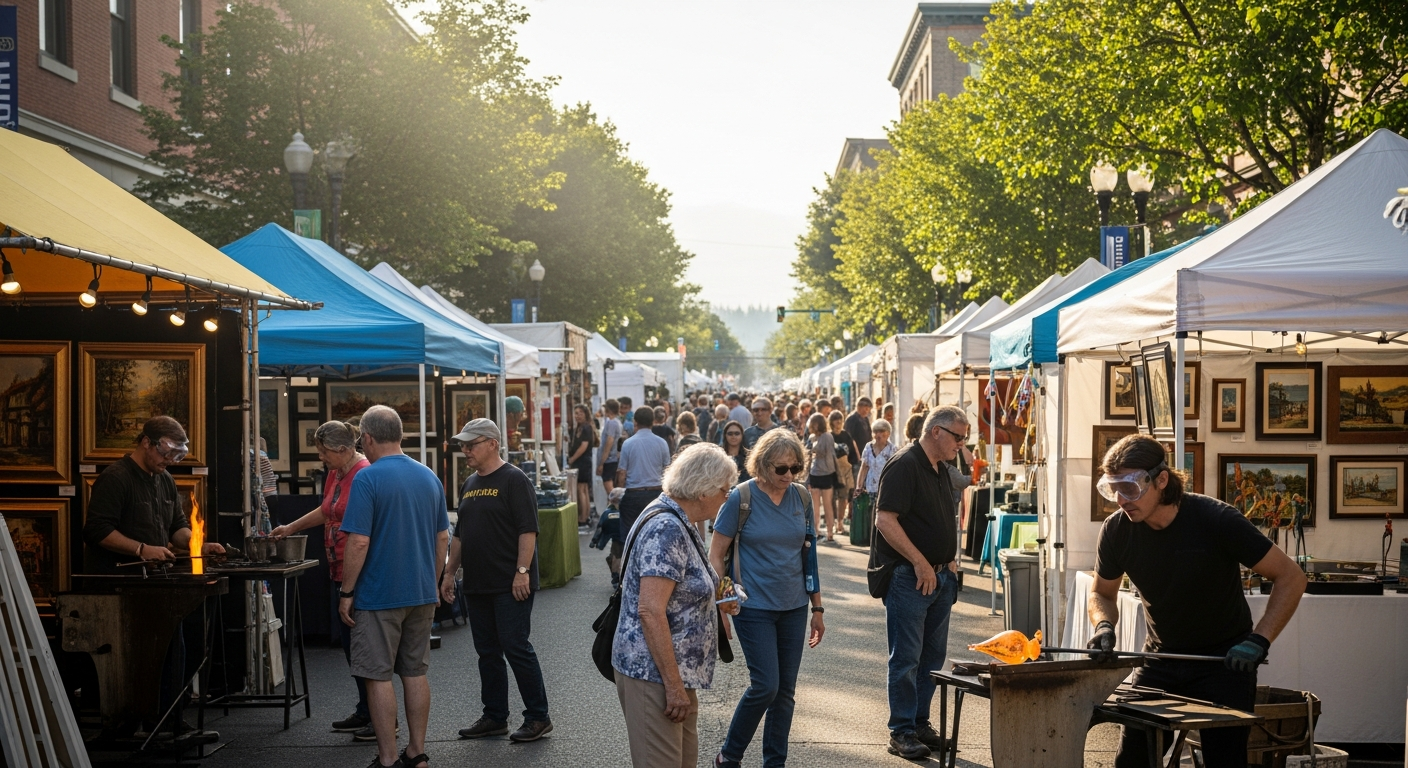
    Two days. One block of Hoyt Avenue. A hundred and twenty artists, free to walk in, and the biggest outdoor art event downtown Everett puts on all year. Fresh Paint 2026 is on August 15 and 16, and if you haven’t been before, this is the year to change that.

    The Schack Art Center runs this every summer and has built something worth making plans for. The vendor list is already sold out — which tells you this is not a pop-up craft market. Artists apply. They get juried in. The work on Hoyt Avenue that weekend is curated, and you’ll feel it when you walk the block.

    What You’re Walking Into

    The festival takes over Hoyt Avenue between Pacific Avenue and Hewitt Avenue, two blocks from the Schack itself. The street closes. Booths go up. And from 10am to 5pm on Saturday and 10am to 4pm on Sunday, that stretch of downtown becomes the most concentrated collection of original art in Snohomish County.

    120+ artists span painting, sculpture, glass, jewelry, fiber, ceramics, and photography. Because this is a juried show, there’s a floor to the quality. You’re not wading through mass-produced prints to find the one interesting thing — the interesting things are the whole point.

    Admission is free. You pay for art, food, and activities. That’s the model and it works — 10,000+ attendees walk through over the two days, and the Schack has been doing this long enough to know how to move that crowd through a single city block without it feeling like a fire drill.

    Glassblowing, Kids’ Activities, and Float Find

    The Schack is a working art center, not just a gallery. At Fresh Paint, they demonstrate that — literally. Glassblowing demonstrations run through the weekend, and watching someone pull molten glass into form at a live outdoor event is the kind of thing you stop for whether you planned to or not. It draws every age group.

    Kids’ activity areas are built into the layout, which means this is a functional family event and not just an adult art crawl. You can split up, let the kids engage with the activity stations, and walk the artist booths without herding the whole group through every booth.

    Float Find is the Schack tradition that turns the festival into a game. Small glass floats — hand-crafted — get hidden around the festival grounds. Find one, keep it. It’s the kind of detail that makes people come back year after year and arrive early.

    The Schack’s Track Record on This Street

    The Schack Art Center at 2921 Hoyt Ave has been the anchor of Everett’s arts infrastructure since long before the downtown revival picked up pace. Fresh Paint is their statement event — the one where they take the case for arts in this city outside the building and onto the street itself.

    If you’ve seen what they do inside the gallery — and the Artists’ Garage Sale gives you a sense of the community energy they generate — Fresh Paint is that but scaled up and opened to anyone walking by. The Contemporary NW + Summer Auction draws serious collectors; Fresh Paint draws everyone else. The two events together define what the Schack is doing for this city.

    The regular monthly Everett Art Walk keeps the momentum going through the year, but Fresh Paint is the anchor. It’s the day families mark on the calendar in January.

    The Practical Details

    What: Fresh Paint 2026 — Schack Art Center Outdoor Juried Art Festival
    Saturday August 15: 10:00 AM – 5:00 PM
    Sunday August 16: 10:00 AM – 4:00 PM
    Where: Hoyt Ave between Pacific Ave and Hewitt Ave, Downtown Everett WA 98201
    Admission: Free
    Artists: 120+ juried (vendors sold out — this is curated work)
    Highlights: Glassblowing demos, kids’ activities, Float Find, food vendors
    Parking: Street parking and downtown garages within a few blocks of Hoyt Ave

    Full details at schack.org/fresh-paint →

    FAQ

    When is Fresh Paint 2026?

    Saturday August 15 (10am–5pm) and Sunday August 16 (10am–4pm), 2026.

    Where is Fresh Paint in Everett?

    Hoyt Avenue between Pacific Avenue and Hewitt Avenue in downtown Everett. The street closes for the weekend and becomes the festival grounds.

    How much does Fresh Paint cost?

    Free admission. You pay for what you buy — art, food, and activities. Vendor spots are sold out but attendance is open to everyone.

    How many artists are at Fresh Paint 2026?

    120+ juried artists. Vendors are sold out for 2026, meaning artists applied and were curated — this is not a craft fair.

    What is Float Find at Fresh Paint?

    Float Find is a Schack tradition where hidden glass floats are scattered around the festival for attendees to discover and keep. It’s the detail that makes Fresh Paint a repeat-visit event for families.

    Is Fresh Paint good for kids?

    Yes. Dedicated kids’ activity areas, glassblowing demos, and Float Find. Bring them early — the floats go fast.

  • Altered 2ks and Centuries Are Playing the 2000s Emo and Pop Punk Catalog at Tony V’s Garage on June 6 — Your Move

    Altered 2ks and Centuries Are Playing the 2000s Emo and Pop Punk Catalog at Tony V’s Garage on June 6 — Your Move


    Saturday night, June 6. Tony V’s Garage on Hewitt Avenue. Two bands. Four hours. The entire 2000s emo and pop punk catalog you burned onto a CD in middle school and still know word-for-word.

    Altered 2ks and Centuries are sharing the stage — and together they cover the decade that turned angst into arena anthems. My Chemical Romance. Fall Out Boy. Paramore. Taking Back Sunday. Hawthorne Heights. The Used. If you were a teenager when these songs dropped, you’ve been waiting for a night like this without knowing it.

    Who’s Playing and What to Expect

    Altered 2ks is the headline act — a tribute project built specifically around 2000s emo and pop punk. They don’t try to do everything from that era; they do the specific songs that mattered. The ones that opened the floodgates. They’ve played Tony V’s before and they know how to fill that room.

    Centuries opens the set. Same era, same energy, same devotion to getting the details right. This is a double bill with actual curatorial intent — both bands exist in the same sonic universe and the setlist arc from opener to closer is going to hit like a full playlist you built yourself at 15.

    Tony V’s Garage has been the right room for nights like this since it opened in Everett’s historic downtown. It’s not a theater. It’s not a club designed for distance between you and the stage. It’s a place where the band is close, the sound is loud, and the crowd knows every word. For a tribute show built around songs this emotionally loaded, the intimacy is the point.

    The Venue and What You Need to Know

    Tony V’s Garage sits at 1716 Hewitt Ave in Everett. The show starts at 8:00 PM on Saturday, June 6 and runs to 11:30 PM. Tickets are $23.18 on Eventbrite — sold by organizer AJ Verhey, who has been putting on shows at this venue consistently.

    This is a standing-room show. Capacity at Tony V’s is limited. If you want a spot close to the stage, you want to be there early. The venue does not hold tickets at will call for late arrivals in the way larger rooms do.

    Street parking is available on Hewitt and the surrounding blocks. Everett’s downtown is walkable from several parking structures if Hewitt fills up.

    Why This Night Works

    There’s a specific thing that happens when a well-prepared tribute band plays songs from a formative era in a small room. It’s different from seeing those songs on a stadium screen. You’re not nostalgic at a distance — you’re in the room with 200 people who all know the same lyrics, and the band is ten feet away playing them at full volume.

    Tony V’s has hosted Emo Prom at Tony V’s and built a track record of landing the right acts for Everett’s live music crowd. The Polkadot Cadaver show drew the same energy this room can hold — dedicated, loud, present. And if you’ve been watching what’s come through the April lineup at Tony V’s, you already know this venue doesn’t book filler.

    Altered 2ks and Centuries together on one bill on a Saturday night is not a casual decision. This is a deliberate, fully committed tribute event with a tight setlist focus. Show up for it.

    Tickets and the Short Version

    What: Altered 2ks + Centuries — 2000s emo and pop punk tribute night
    When: Saturday, June 6, 2026 — 8:00 PM to 11:30 PM
    Where: Tony V’s Garage, 1716 Hewitt Ave, Everett WA 98201
    Tickets: $23.18 on Eventbrite — limited capacity, buy before the weekend
    Ages: Check Eventbrite listing for age policy

    Get tickets on Eventbrite →

    FAQ

    When is Altered 2ks playing at Tony V’s Garage?

    Saturday, June 6, 2026 at 8:00 PM. Doors open before then — get there early.

    Where is Tony V’s Garage in Everett?

    1716 Hewitt Ave, Everett, WA 98201. Street parking on Hewitt and the surrounding blocks.

    How much are tickets for Altered 2ks at Tony V’s?

    $23.18 on Eventbrite. Limited capacity at Tony V’s — don’t wait on this one.

    What kind of music do Altered 2ks play?

    2000s emo and pop punk — My Chemical Romance, Fall Out Boy, Paramore, Taking Back Sunday, and the full early-2000s catalog you know by heart.

    Who is opening at the June 6 show?

    Centuries opens the night. They play the same era — this is a two-band throwback double bill.