Exploring Everett - Tygart Media

Category: Exploring Everett

Everett, Washington is in the middle of something big. A $1 billion waterfront transformation. A Boeing workforce that built the world’s largest commercial jets. A port city with a downtown that’s finally catching up to its potential. A Navy presence at Naval Station Everett. A comedy and arts scene punching above its weight. And neighborhoods — Riverside, Silver Lake, Downtown, Bayside — each with their own identity and story.

Exploring Everett is Tygart Media’s hyperlocal coverage vertical for Snohomish County’s largest city. We cover the waterfront redevelopment, Boeing and Paine Field, city hall, the food and arts scene, real estate, neighborhoods, and everything in between — written for people who live here, work here, or are paying attention to what’s coming.

Coverage categories include: Everett News, Waterfront Development, Boeing & Aerospace, Business, Arts & Culture, Food & Drink, Real Estate, Neighborhoods, Government, Schools, Public Safety, Events, and Outdoors.

Exploring Everett content is also published at exploringeverett.com.

  • Memorial Day in Everett: Jetty Countdown, Centennial Trail, and Why Outdoor Rec Deserves the Sports Page

    What happened: Memorial Day weekend (May 23-25, 2026) kicks off Everett’s outdoor recreation season. The Jetty Island ferry opens July 8 with reservations already live at portofeverett.com/JettyReservations, Forest Park’s new pickleball complex opens in June, and the Centennial Trail is in prime spring shape. Here is how to plan around the long weekend and the summer that follows.

    Memorial Day in Everett: Jetty Countdown, Centennial Trail, and Why Outdoor Rec Deserves the Sports Page

    The Silvertips are about to win the Cup. The AquaSox are climbing the standings. Wolfpack arena football is back on May 23. The new downtown stadium project keeps inching forward. Everett’s spring sports calendar is packed.

    But there is another sport playing in this town nine months a year that does not get a beat reporter and does not get a hashtag and does not get a featured snippet, and that sport is going outside. Memorial Day weekend is ten days away. The summer outdoor season is about to crack open. If you treat outdoor recreation the way Everett treats it — as a sport, with seasons and stats and a calendar — here is what to circle.

    1. Jetty Island Days: The Countdown Is On (55 Days)

    The single most beloved free-ish outdoor experience in Snohomish County opens its 2026 ferry season on Wednesday, July 8 and runs through Sunday, September 6. That is the Tuesday after Independence Day weekend through Labor Day weekend — sixty-one days of beach access to the two-mile-long manmade island in Port Gardner Bay.

    The Port of Everett confirmed in late April that ferry reservations are already open at portofeverett.com/JettyReservations. If you have done this dance before, you know: book early. The good summer slots disappear fast. The ferry departs from Jetty Landing Park off 10th Street and West Marine View Drive on the Port of Everett waterfront.

    The 2026 schedule has the ferry running five days a week, 10 a.m.–5:45 p.m. Sundays, Wednesdays, and Thursdays, and 10 a.m.–6:45 p.m. Fridays and Saturdays. Roundtrip cost is $4–$7 (plus taxes/fees) per person. Kids ages 2 and under ride free but still need a reservation. You can either book a return slot in advance or pick up first-come-first-served return passes on the island.

    The Memorial Day weekend itself is too early for the ferry — Jetty does not open until July 8 — but you can still walk the Port waterfront, get out on the boardwalk, and grab a coffee while the bay does what the bay does on a sunny May Saturday. Just know the countdown starts now.

    2. Centennial Trail Is in Spring Form Right Now

    The Snohomish County Centennial Trail is the workhorse of the Snohomish County outdoor calendar — over 30 miles of paved, mostly-flat former rail corridor running from north of Snohomish up through Lake Stevens, Arlington, and into Bryant. It is open year-round. It is wheelchair-accessible. It is the closest thing this region has to a permanent outdoor stadium that you do not need a ticket for.

    Memorial Day weekend is one of the best three weekends of the year on the Centennial Trail. The salmonberry is in. The cottonwood fluff is doing its thing. The shoulder of the trail is full of Pacific Northwest spring color. If you have only ever walked one short out-and-back from a trailhead, this is the weekend to commit to a real ride or a longer hike segment.

    Snohomish County Parks lists the major trailheads at snohomishcountywa.gov/1182/Trails. Before you go on any specific hike, do the responsible thing and pull a fresh trip report on wta.org from the Washington Trails Association — that is where conditions get reported in something like real time by hikers who were there yesterday.

    3. Forest Park’s Pickleball Complex Opens Next Month

    Pickleball is a sport. We are going to say that without irony on a sports page on an Everett site. Forest Park’s first dedicated multi-court outdoor pickleball facility opens in June 2026: four dedicated regulation courts, two renovated multi-use courts, a practice wall, sport fencing, site lighting, a drinking fountain, benches, cornhole, and horseshoes.

    Construction started in November 2025. The section east of the water park has been closed during the build. By the time the long weekend rolls around, you will be able to walk around the work fence and see the project in its final stretch — and by mid-June you will be playing on it.

    This is the City of Everett making a real commitment to a sport that Everett is actually playing. Drive past any park with multi-use lines on a sunny afternoon and you will see the demand. The four dedicated regulation courts means league play, tournaments, and a place to actually drop in and find a game without standing in line for a striped-over tennis court.

    4. The Snohomish River Paddling Season Is Open

    If you have a kayak or a paddleboard in the garage and you have been waiting for the river to settle, this is your weekend to look at it. Spring runoff in May is still pushing the Snohomish River faster than late summer, but the lower reaches near Everett and Snohomish are flat-water and accessible by Memorial Day in a normal year.

    The Port of Everett’s Marina district has launch access. The North Spit launch and the Langus Riverfront Park boat ramp are both standard put-ins for kayakers running the lower Snohomish. Always check current conditions, always wear a PFD, and always tell someone where you are going and when you expect to be back.

    5. The Stuff You Cannot See on a Map

    The thing nobody tells you about outdoor rec in Everett is that the best stuff is often the unglamorous stuff. Walking the loop at Forest Park on a Tuesday after work. Watching the bald eagle at the Snohomish River estuary that has been there for three years. Catching a sunset off the breakwater. Running the Interurban Trail south through Mukilteo. Riding the seawall.

    Memorial Day weekend gets all the marketing because it is the long weekend that starts the season. But the season is five months, not three days. Use the long weekend to set the pattern. Pick one outdoor thing you want to do every weekend through Labor Day. Put it on the calendar. Treat it like a road game schedule.

    The Quick-Reference Memorial Day Weekend Plan

    • Friday May 22 evening: Walk the Port of Everett waterfront. Scout the Jetty Landing ferry dock. Confirm your July reservation while you are looking at it.
    • Saturday May 23: Centennial Trail morning ride or walk. Wolfpack vs Beaumont Renegades at 3 PM at Angel of the Winds Arena if you want to mix indoor and outdoor sport.
    • Sunday May 24: Forest Park loop and check the pickleball complex construction progress.
    • Monday May 26: Lower Snohomish River paddle or a Mukilteo waterfront walk, depending on conditions.

    Frequently Asked Questions

    When does the Jetty Island ferry start running in 2026?
    Wednesday, July 8, 2026. The season runs through Sunday, September 6.

    Can I book a Jetty Island ferry reservation now?
    Yes. Reservations are open at portofeverett.com/JettyReservations.

    How much does the Jetty Island ferry cost?
    $4–$7 roundtrip (plus taxes and fees) per person. Children ages 2 and under ride free but still require a reservation.

    What days does the Jetty ferry run?
    Five days a week: Wednesdays, Thursdays, and Sundays from 10 a.m. to 5:45 p.m.; Fridays and Saturdays from 10 a.m. to 6:45 p.m.

    When does Forest Park’s new pickleball complex open?
    June 2026. Four dedicated regulation pickleball courts, two renovated multi-use courts, a practice wall, lighting, fencing, and amenities.

    Where can I check trail conditions in Snohomish County before going hiking?
    Washington Trails Association at wta.org is the go-to. The Snohomish County Parks site at snohomishcountywa.gov/1182/Trails has the full county trail directory.

    How long is the Centennial Trail?
    Over 30 miles of paved, mostly-flat former rail corridor through Snohomish County.

    Where can I launch a kayak on the Snohomish River near Everett?
    Langus Riverfront Park, the North Spit launch, and Port of Everett Marina district launches are all standard put-ins for the lower Snohomish.

  • Adam Maier Spins Five Hitless Innings, Josh Caron Goes Yard: AquaSox Shut Out Canadians 3-0

    What happened: The Everett AquaSox shut out the Vancouver Canadians 3-0 on Wednesday, May 13, 2026 at Nat Bailey Stadium. Starter Adam Maier was hitless through five innings with five strikeouts, Josh Caron hit a two-run homer in the sixth, and Casey Hintz closed out a two-inning save. The Frogs evened the six-game road series at 1-1 after Tuesday’s walk-off loss.

    Adam Maier Spins Five Hitless Innings, Josh Caron Goes Yard: AquaSox Shut Out Canadians 3-0

    One night after watching a 4-0 lead disappear and a 10-inning walk-off rip the heart out of the road trip, the AquaSox came back to Nat Bailey Stadium on Wednesday and delivered the cleanest game they have played in a month.

    Final: Everett 3, Vancouver 0. Five-pitcher combined shutout. Josh Caron’s sixth home run of the season. Adam Maier’s first professional win. The Frogs are 19-16 on the year and back in second place in the Northwest League, and they evened the six-game road series at one win apiece heading into Thursday’s middle game.

    The Pitching Was the Story

    Adam Maier took the ball and threw five innings of one-hit, no-run, no-walk baseball. Five strikeouts. Zero free passes. One Vancouver baserunner against him.

    That is what a real start looks like in High-A. The Mariners’ development staff is going to like watching that one back. Maier’s line: 5 IP, 1 H, 0 R, 0 BB, 5 K. He got the win — his first as an AquaSox — and he handed a 2-0 lead to the bullpen in the sixth.

    From there it was a parade. Calvin Schapira pitched the sixth, walked one, did not give up a hit. Adam Smith pitched the seventh, struck out one, did not give up a hit. Then Casey Hintz came in for a two-inning save — eighth and ninth — and threw four punchouts, allowed one hit, and slammed the door.

    That is nine combined punchouts from four pitchers across nine innings. Two hits total allowed by the AquaSox staff. Zero earned runs. Casey Hintz now has three saves on the season.

    Caron Strikes the Decisive Blow

    Catcher Josh Caron has been quietly putting together a real bounce-back season, and Wednesday he provided the only run the AquaSox would actually need. Felnin Celesten singled in front of him in the top of the sixth (Celesten finished 1-for-2 with a run and a walk on the night). Caron came up with a runner on and went deep — line drive to left field, his sixth home run of 2026. 2-0 Frogs.

    The third run came in the ninth. Caron singled to lead off, hustled around the bases, and scored on Luis Suisbel’s ground-ball single to center. That gave Hintz a three-run cushion to work with in the bottom half, and he did not need any of it.

    Caron’s final line: 1-for-3, one home run, two RBI, two runs scored, one walk. That was the offense. Five total hits as a team. One was a homer that drove in two. One was an RBI single. Two of the runs were Caron’s. When you get pitching like that, you do not need much.

    What the Box Score Looked Like

    • WP: Adam Maier (1-0) — 5 IP, 1 H, 0 R, 0 BB, 5 K
    • LP: Holden Wilkerson (3-1) — 4 IP, 2 H, 3 ER, 2 BB, 3 K
    • SV: Casey Hintz (3) — 2 IP, 1 H, 0 R, 0 BB, 4 K
    • Holds: Calvin Schapira (2), Adam Smith (1)
    • HR: Josh Caron (6) — 2-run shot, 6th inning

    Vancouver starter Johnny King was actually excellent in the loss — 5 IP, 3 H, 0 ER, 1 BB, 8 K — but the Canadians lost the game in relief when Wilkerson surrendered the Caron homer in the sixth.

    Prospect Watch

    It was a quieter night for the top names. Felnin Celesten went 1-for-2 with a run and a walk and is still hitting the cover off the ball overall. Jonny Farmelo went 0-for-4 but played a clean center field. Brandon Eike, hot in Tri-City, went 1-for-4 with no extra-base damage. Curtis Washington Jr., who had four homers entering the trip, went 0-for-3 batting cleanup. Luis Suisbel drove in the third run and finished 1-for-4.

    The most encouraging takeaway is the catcher’s day. Josh Caron has been the steady pro in this lineup, calling a four-pitcher combined shutout behind the plate and providing both runs that mattered. That is a starting catcher’s day.

    Where the Series Stands

    Everett and Vancouver split the first two games of the six-game road series. Tuesday: Vancouver 6, Everett 5 in 10 innings — a 4-0 AquaSox lead, a 5-5 tie in the seventh, and Jacob Sharp walking it off in extras. Wednesday: Frogs answer with a 3-0 shutout. Series tied 1-1.

    Four games left at Nat Bailey Stadium against a Canadians team that came into the series at 14-21. The Frogs were 18-15 entering Tuesday; they are 19-16 (.543) now. Vancouver is 14-21 (.400).

    Bigger Picture: The Mariners Pipeline

    The fan-voice case for paying attention to this AquaSox team has only gotten stronger over the last two weeks. Bryce Miller wrapped his rehab assignment with a 5 IP, 0 ER, 47-pitch outing at Funko Field on May 6. The prospect pipeline keeps producing: Felnin Celesten has back-to-back Northwest League Player of the Week honors, Luke Stevenson won April Hitter of the Month for the entire Mariners organization, and now Adam Maier looks like a real pitcher in his first AquaSox decision.

    These are not just minor leaguers passing through. These are Mariners two stops from Seattle. And every game at Funko Field — and at Nat Bailey Stadium, and at Avista, and at Ron Tonkin — is a window into who is coming next.

    What’s Next: Thursday in Vancouver

    Game 3 of the six-game series goes Thursday, May 14 at Nat Bailey Stadium. First pitch is at 7:05 PM PT. The series wraps Sunday afternoon before the Frogs come home for a homestand against the Tri-City Dust Devils starting Tuesday, May 19.

    Frequently Asked Questions

    What was the final score of the AquaSox-Canadians game on May 13, 2026?
    Everett won 3-0 at Nat Bailey Stadium. It was a combined four-pitcher shutout for the AquaSox.

    Who got the win for the AquaSox?
    Adam Maier (1-0) earned his first professional win after throwing 5 innings of one-hit, no-run baseball with five strikeouts.

    Who hit the home run for Everett?
    Catcher Josh Caron hit a two-run shot in the sixth inning — his sixth home run of the 2026 season.

    What is the AquaSox record right now?
    Everett is 19-16 (.543) on the season after Wednesday’s win, sitting in second place in the Northwest League.

    Where do the AquaSox-Canadians series stand?
    Tied 1-1 in the six-game road series. Four games remain at Nat Bailey Stadium through Sunday, May 17.

    When is the next AquaSox home game?
    The Frogs return to Funko Field on Tuesday, May 19 for a series against the Tri-City Dust Devils.

    Who got the save?
    Casey Hintz threw two scoreless innings with four strikeouts to record his third save of the season.

  • Silvertips Pummel Raiders 5-2 in Game 4: One Win From the Ed Chynoweth Cup

    What happened: The Everett Silvertips beat the Prince Albert Raiders 5-2 in Game 4 of the WHL Championship Final on Wednesday, May 13, 2026 at Art Hauser Centre. Everett now leads the best-of-seven series 3-1 and can clinch the franchise’s first Ed Chynoweth Cup since 2007 with a win in Game 5 on Friday night in Prince Albert.

    Silvertips Pummel Raiders 5-2 in Game 4: One Win From the Cup

    The Everett Silvertips are one win away from the Ed Chynoweth Cup. They went into Prince Albert, took a Game 3 nailbiter on Tuesday, and came back Wednesday night and walked out of Art Hauser Centre with a 5-2 win in Game 4 that wasn’t really that close.

    The Tips lead the 2026 WHL Championship Final 3-1. Anders Miller, Landon DuPont, Carter Bear, Julius Miettinen — every name you have been writing on your fridge whiteboard for the last two months — they all showed up on the road, in a barn that was supposed to be a hornet’s nest, and they handled it.

    The Silvertips are 14-2 in the 2026 playoffs. Fourteen wins, two losses. They have not lost on the road in this postseason. And they have one more game to win for the first Western Hockey League championship in Everett since the 2006-07 squad raised the Cup.

    How They Did It

    If you wanted to script the most demoralizing game possible for a home team, you would script this one. Julius Miettinen scored 32 seconds in. Thirty-two seconds. The Art Hauser crowd had not finished sitting down.

    Prince Albert clawed one back in the second when Brandon Gorzynski beat Miller at 9:53, but Rylan Gould answered with a power-play goal at 18:43 of the second to take a 2-1 lead into the third.

    Then the third period happened. Carter Bear scored on the power play at 4:24 — the game winner — to make it 3-1. Justice Christensen got one back for the Raiders at 6:43, and for about three minutes it was a game again. Shea Busch killed that hope at 10:20 with the insurance marker. Matias Vanhanen iced it with an empty-netter at 17:35.

    Final: Everett 5, Prince Albert 2. Attendance at Art Hauser Centre: 3,299.

    The Special Teams Story

    This series was always going to come down to special teams. On Wednesday, Everett’s power play went 2-for-5. Prince Albert’s power play went 0-for-6. The Raiders had every chance to swing momentum — six full power plays in their own building — and they did not score on a single one. Anders Miller and the Tips penalty kill were the difference.

    Miller has now started every game of this playoff run, and the numbers continue to look like something out of a different sport. Everett outshot Prince Albert 35-33 on the night.

    Goal Summary

    • EVT — Julius Miettinen (1st period, 0:32)
    • PA — Brandon Gorzynski (2nd period, 9:53)
    • EVT — Rylan Gould PPG (2nd period, 18:43)
    • EVT — Carter Bear PPG, GWG (3rd period, 4:24)
    • PA — Justice Christensen (3rd period, 6:43)
    • EVT — Shea Busch, insurance (3rd period, 10:20)
    • EVT — Matias Vanhanen, empty net (3rd period, 17:35)

    What’s Next: Game 5 in Prince Albert, Friday Night

    Here’s where it gets real. Game 5 goes Friday, May 15 at Art Hauser Centre in Prince Albert. If the Silvertips win, they hoist the Ed Chynoweth Cup on the road. They are the visiting team. There is no champagne celebration at Angel of the Winds Arena waiting for them — they would have to do it in a building that hates them.

    If the Tips lose Game 5, the series comes home. Game 6 would be Sunday, May 17 at Angel of the Winds Arena. Game 7, if needed, is Monday, May 18, also at AOTW.

    So Silvertips Nation has a choice to make: do you want to clinch this thing Friday on the road, or do you want one more chance to watch them lift the trophy on home ice? Honestly, both options sound great. We have not had a problem this nice to wrestle with in nineteen years.

    The 19-Year Drought

    Let’s just say it: it has been a long time. The last Silvertips team to win the WHL championship was the 2006-07 squad. The kids on the current roster were not born yet. Landon DuPont was not born yet when Everett lost in the WHL Final in 2018 to Swift Current.

    This is the closest the franchise has come to ending the drought since that 2018 trip. They are not just close — they are one win from it. And they are doing it the right way: dominant in the regular season (117 points, best in 12 years), dominant in the playoffs (14-2, two sweeps in the first three rounds), and dominant in this final so far.

    How to Watch Game 5

    Game 5 is Friday, May 15 at 7:30 PM MT (6:30 PM PT) at Art Hauser Centre in Prince Albert, Saskatchewan. The broadcast is on TSN in Canada and Victory+ in the United States. If you are in Everett and want to watch with other Tips fans, watch parties are popping up around town — check the team’s official channels for organized viewing locations.

    What This Run Has Meant

    This is the kind of run you remember. The kind of run where you remember exactly where you were when each game ended. The Silvertips have given Everett a six-week party that started with a Round 1 sweep, continued with a five-game series win over Kelowna, an Anders Miller goaltending clinic in the Western Conference Final, and now a 3-1 lead in the WHL Final.

    One more. That is all this team needs. One more win, anywhere, against anyone, and the Ed Chynoweth Cup comes back to the Tips for the first time since 2007.

    Friday night, Prince Albert. Bring it home.

    Frequently Asked Questions

    What was the final score of Silvertips vs Raiders Game 4?
    Everett won 5-2 over Prince Albert at Art Hauser Centre on Wednesday, May 13, 2026.

    What is the series score in the 2026 WHL Final?
    The Silvertips lead the best-of-seven series 3-1 and need one more win to claim the Ed Chynoweth Cup.

    When is Game 5 of the WHL Championship Final?
    Game 5 is Friday, May 15, 2026 at 7:30 PM MT / 6:30 PM PT at Art Hauser Centre in Prince Albert, Saskatchewan.

    Where can I watch Silvertips Game 5?
    TSN in Canada and Victory+ in the United States.

    If the series comes back to Everett, when are Games 6 and 7?
    Game 6 would be Sunday, May 17 at Angel of the Winds Arena. Game 7, if needed, would be Monday, May 18, also at AOTW.

    When was the last time the Silvertips won the WHL championship?
    2007. The 2006-07 Silvertips won the only Ed Chynoweth Cup in franchise history. The 2026 team is one win away from ending a 19-year drought.

    Who scored the game-winning goal in Game 4?
    Carter Bear scored on the power play at 4:24 of the third period to give Everett a 3-1 lead. It held up as the game-winner.

  • [BOEING] The 30+ Stored 777-9s on the Everett Ramp: Why Boeing’s CEO Says Change Incorporation Will Take Years — and Why That’s Good News for Paine Field Workers

    [BOEING] The 30+ Stored 777-9s on the Everett Ramp: Why Boeing’s CEO Says Change Incorporation Will Take Years — and Why That’s Good News for Paine Field Workers

    Q: What is the 30+ stored Boeing 777-9 aircraft situation at Paine Field, and why does it matter for Everett’s aerospace workforce?

    A: Boeing has more than 30 production 777-9 aircraft parked at Paine Field awaiting change incorporation — system updates, structural modifications, and fixes identified during flight testing — before they can be delivered to customers. CEO Kelly Ortberg said publicly in May 2026 that clearing this backlog will take “years.” For the Everett widebody workforce, that creates a multi-year, hands-on modification workstream that runs parallel to ongoing new-build production. It is not a side problem. It is a defined workload that will keep mechanics, electricians, and quality inspectors employed in Everett through the late 2020s.

    The Boeing 777-9 program reached a real milestone on May 7, 2026: the first production-conforming aircraft, destined for Lufthansa, flew its three-hour-and-27-minute maiden test flight out of Paine Field and landed back at Everett at 4:52 p.m. Pacific. That flight matters. But it is not the whole story of what the 777-9 means for Everett right now.

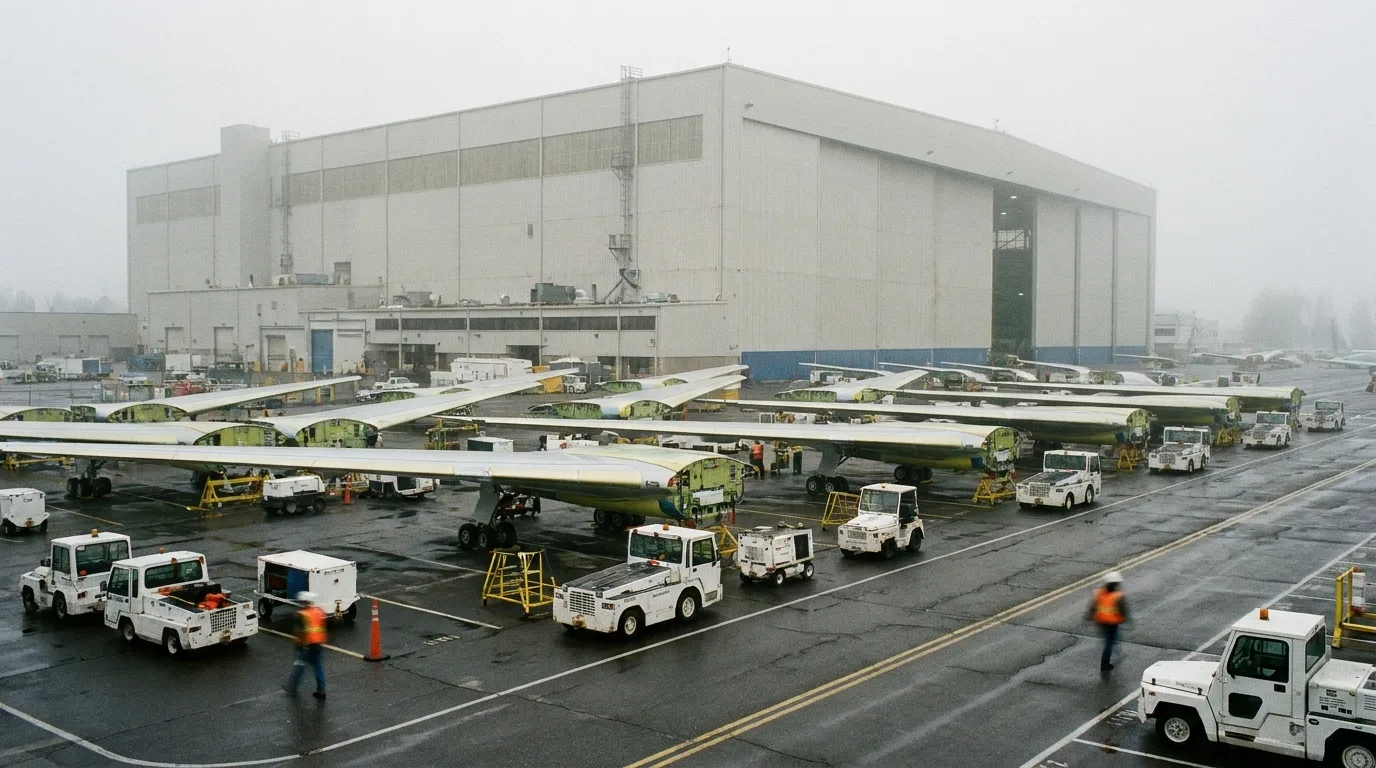
    The other story is sitting on the ramp. More than 30 production 777-9s — aircraft that rolled out of the Everett factory between roughly 2020 and 2025, before the type was certified — are parked at Paine Field. Every one of them must undergo change incorporation before Boeing can deliver it. That is years of mechanical, electrical, and avionics work, and it is happening in Everett.

    What Change Incorporation Actually Means

    Change incorporation, or CI in Boeing parlance, is the process of bringing an already-built aircraft up to the configuration standard that the FAA will eventually certify. For the 777-9, that means several years of in-service-equivalent modifications: software updates, hardware swaps on flight control systems, fixes to issues identified during the GE9X engine testing campaign, thrust-link redesigns following 2024 in-flight findings, and updates to systems that were originally installed under a 2020-era engineering baseline.

    Boeing CEO Kelly Ortberg, speaking in May 2026, said change incorporation on the stored fleet “will take years.” That is not a euphemism for delay. It is a description of the real workload: each aircraft requires opening up structure, swapping or modifying components, reverifying systems, and running flight tests before it can be handed over to a customer.

    For comparison, the 787 program went through a similar — though smaller — stored-fleet rework cycle in 2022 and 2023, when production-paused Dreamliners required FAA-driven modifications before delivery. That work generated thousands of man-hours per airframe and required dedicated rework teams.

    Why This Is an Everett-Specific Workforce Story

    The 777-9 stored fleet is parked at Paine Field. The change incorporation work happens at Paine Field. The mechanics, electricians, avionics technicians, and quality inspectors doing the work are based in Everett. That is the geography. It cannot be outsourced to South Carolina or anywhere else without massive ferry-flight costs and certification complications that Boeing is unlikely to absorb.

    What this means in practical terms for the Everett widebody workforce is that the 777-9 production ramp is not the only 777-9 workstream. There are effectively two parallel 777-9 efforts running in Everett:

    1. New-build production — the line continues to produce production-conforming aircraft like the first Lufthansa airframe that flew on May 7. These airframes are built to the as-certified configuration and require minimal post-roll-out rework.
    2. Stored-fleet change incorporation — the 30-plus aircraft on the ramp need to be brought up to the as-certified configuration. This is a separate, parallel labor pool drawing on the same skill set as the production line.

    Boeing has not publicly announced how it is staffing the change incorporation work, but the most likely model is rotation: experienced 777 mechanics from the production line cycle through CI teams while early-career hires backfill production positions. That is the workforce pattern Boeing used during the 787 rework cycle.

    The Math on Hours and Workforce

    Industry benchmarks for change incorporation on a complex widebody program run between 5,000 and 25,000 labor-hours per aircraft, depending on the depth of modifications required. For the 777-9 stored fleet, the high end of that range is plausible given the multi-year configuration drift between when the aircraft were built and when the type will be certified.

    At an average of 15,000 hours per aircraft and 30 aircraft to clear, that is roughly 450,000 labor-hours of dedicated rework. At a standard 2,000 productive labor-hours per worker per year, that translates to approximately 225 worker-years of CI labor — or, more realistically, a sustained team of 75 to 100 dedicated workers running for two to three years.

    That is an order-of-magnitude estimate, not a Boeing-published figure. But it gives a useful sense of scale: the 777-9 stored-fleet rework is not a side project. It is a substantial, sustained workload that overlaps directly with the skills already resident in the Everett widebody workforce.

    What This Means for the 767-Line Transition

    As Everett’s widebody factory works through its 767-300F sunset and the pending FAA emissions exemption decision on the 777F, the 777-9 change incorporation workstream is one of the most concrete redeployment paths for displaced 767-line workers. The skills transfer is direct: 767 mechanics already work on complex widebody airframes, already hold the relevant certifications, and already operate inside the same Paine Field footprint.

    Boeing has not announced a formal redeployment program. But the company’s $54 million purchase of the 6001 36th Avenue building in early May 2026 — explicitly described as supporting Everett industrial expansion — fits with a workforce strategy that keeps people in place across program transitions.

    The Lufthansa Delivery Timeline and the Stored Fleet

    Lufthansa Group CEO Carsten Spohr confirmed in early 2026 that Lufthansa’s first 777-9 delivery is targeted for Q1 2027. That airframe is the production-conforming aircraft that flew on May 7. It will not require significant change incorporation because it was built to the certified configuration.

    The stored 30-plus airframes are a different population. They include Lufthansa airframes built earlier in the program, plus aircraft for other launch customers including Emirates, Qatar Airways, Singapore Airlines, and Cathay Pacific. Each of those customers has separate delivery timing, and Boeing’s CI throughput will determine the pace at which the stored fleet clears.

    For the certification campaign itself, the relevant gates are TIA Phase 4B, Phase 5, F&R, and ETOPS — all of which the program must clear before any aircraft, stored or new-build, can be delivered.

    What Snohomish County Suppliers Should Know

    The 777-9 stored-fleet rework creates a parts-and-services workload distinct from new-build production. Components required for CI may include avionics modules, software updates from systems suppliers, structural modification kits, and consumables. Tier-2 suppliers in Snohomish County positioned in those categories — particularly those already on the 777 program — have a defined opportunity to bid into CI parts orders as Boeing finalizes its rework engineering packages.

    Boeing has historically issued CI parts kits as separate program orders rather than rolling them into new-build purchase orders. Suppliers should be watching for separate 777-9 CI request-for-quotation packages through 2026 and into 2027 as the certification gates clear.

    What Workers Should Be Doing

    For 777 line mechanics, electricians, and avionics technicians: confirm with your supervisor whether your skill code includes CI work. CI is qualified separately from production-line work in Boeing’s internal workforce planning system, and qualification gaps could affect rotation eligibility.

    For SPEEA-represented engineers: the engineering work behind change incorporation includes structural analysis, systems integration, and certification documentation — substantial work that has been ramping inside the 777-9 engineering organization. SPEEA’s 2026 bargaining season includes proposed language around skill portability that would be directly relevant to CI assignments.

    For IAM 751 members on the 767-300F line approaching the FedEx May 31 final delivery: cross-qualification on 777 widebody work — including CI — is the most plausible internal redeployment path. Audit your qualifications now.

    The Bigger Story

    The first Lufthansa 777-9 flight on May 7 was the photo. The 30-plus aircraft on the ramp are the story. The 777-9 program’s recovery is not just about certifying the type. It is about clearing the inventory that built up while the program was paused — and that inventory is parked in Everett, requires Everett mechanics to fix, and represents a multi-year backlog that quietly stabilizes the Everett widebody workforce through the rest of the decade.

    Boeing’s CEO said it will take years. The corollary that did not make headlines: Everett gets years of work.

    Frequently Asked Questions

    Q: How many Boeing 777-9s are currently parked at Paine Field?

    Boeing has more than 30 production 777-9 aircraft parked at Paine Field awaiting change incorporation before delivery, according to public statements by CEO Kelly Ortberg in May 2026. The exact count fluctuates as additional production aircraft roll out of the factory.

    Q: What is change incorporation on the 777-9?

    Change incorporation is the process of bringing an already-built aircraft up to the configuration standard that the FAA will eventually certify. For the 777-9, this includes software updates, hardware modifications on flight control systems, thrust-link redesigns identified during 2024 flight testing, and updates to systems built under earlier engineering baselines. The process requires opening up structure, swapping or modifying components, reverifying systems, and running validation flights.

    Q: How long will the 777-9 stored-fleet rework take?

    Boeing CEO Kelly Ortberg said publicly in May 2026 that change incorporation on the stored fleet “will take years.” Industry benchmarks for similar widebody rework cycles suggest the work could span two to three years, depending on Boeing’s throughput and the depth of modifications per aircraft.

    Q: Will Boeing hire new workers for the 777-9 change incorporation work?

    Boeing has not publicly announced a hiring plan specifically for change incorporation work, but the workload overlaps directly with skills already present in the Everett widebody workforce. The most likely staffing model is internal rotation, with experienced 777 mechanics cycling through CI teams.

    Q: When will the first stored 777-9 be delivered?

    The first 777-9 delivery is targeted for Q1 2027 to Lufthansa, but that delivery will be the production-conforming aircraft that flew on May 7, 2026, not one of the stored fleet. Stored aircraft will follow on a schedule determined by change-incorporation throughput and certification gate clearances.

    Q: What other customers have 777-9s in the stored fleet?

    The stored 777-9 fleet includes airframes for Lufthansa, Emirates, Qatar Airways, Singapore Airlines, and Cathay Pacific — the five launch customers of the program. Each customer has separate delivery timing tied to Boeing’s CI completion sequence.

    Q: How does change incorporation affect Boeing’s 2026-2027 delivery numbers?

    Stored-fleet aircraft delivered after change incorporation count toward Boeing’s commercial delivery totals in the years they ship. Industry analysts expect Boeing’s 777-9 deliveries to ramp slowly through 2027 and 2028 as the CI backlog clears alongside new-build production.

    Q: Is the 777-9 stored-fleet rework happening in any building other than Everett?

    No. The stored 777-9 aircraft are parked at Paine Field and the change incorporation work is performed in Everett. Ferrying the aircraft elsewhere for rework would be cost-prohibitive and would add certification complications, so the work stays in the Everett widebody footprint.

  • [BOEING] FedEx’s Final Two 767 Freighters Are Leaving Everett by May 31 — What the Last UPS-FedEx Deliveries Mean for Boeing’s Widebody Workforce

    [BOEING] FedEx’s Final Two 767 Freighters Are Leaving Everett by May 31 — What the Last UPS-FedEx Deliveries Mean for Boeing’s Widebody Workforce

    Q: What is happening with Boeing’s 767 freighter line in Everett in May 2026, and why does it matter for Snohomish County aerospace workers?

    A: FedEx is scheduled to take delivery of its final two 767-300F freighters out of Boeing’s Everett widebody factory by May 31, 2026, fulfilling the last contractual obligations of a 15-aircraft order that began in 2024. Combined with UPS taking its remaining 10 firm orders through the rest of 2026, these are among the final commercial 767 freighters Boeing will build before the program sunsets in 2027. For the roughly 1,000 Everett workers who touch the 767 line, the immediate future is shifting from 767-300F production to the KC-46A Pegasus tanker — built on the same 767-2C airframe in the same building — and to change-incorporation rework on stored 777-9s. The Everett widebody footprint is not shrinking. It is consolidating.

    It is one of the quieter milestones to come out of Paine Field this year, and one of the most consequential for the Snohomish County aerospace workforce: by May 31, 2026, FedEx Express is contractually scheduled to take delivery of the final two 767-300F freighters in its long-running order book with Boeing. That delivery ends a 15-aircraft tranche that began in 2024 and brings FedEx’s 767 fleet to 137 active aircraft.

    UPS, which entered 2026 with 10 firm orders remaining, will work through its book over the rest of the calendar year. Combined with three unidentified-customer slots Boeing still has on the books, those deliveries effectively close out commercial 767-300F production. Boeing’s plan, confirmed in October 2024 and reiterated through 2025, is to end commercial 767 freighter production in 2027. The KC-46A Pegasus tanker — built on the 767-2C airframe in the same Everett building — will be the only 767 variant in production after that point.

    What May 31, 2026 Actually Closes

    Boeing’s Everett widebody factory has been quietly winding down 767-300F deliveries since 2024. FedEx, which by far has been the largest 767-300F customer of the past decade, agreed under its delivery schedule to take three 767-300Fs by May 31, 2024, ten more by May 31, 2025, and the final two by May 31, 2026. That last pair represents the end of a customer relationship that has shipped more than 150 freighters from Paine Field to FedEx hubs over the program’s life.

    UPS, with 10 firm 767-300Fs still on the books at the start of 2026, is expected to take its remaining aircraft throughout the year. Three additional 767-300Fs sit on order from an unidentified customer.

    What Boeing has not done — despite an FAA reauthorization-bill exemption that would have allowed 767 freighter production to continue until January 1, 2033 — is restart the order book. Company leadership chose in 2024 to sunset commercial 767 production in 2027 even with the regulatory runway available.

    For workers on the Everett widebody floor, that means the question is not whether the 767 line continues. The question is what happens to the people, the tooling, and the building space when it stops.

    Why the Building Is Not Going Quiet

    Three production programs share the Everett widebody factory, and only one of them is leaving.

    The KC-46A Pegasus tanker is built on the 767-2C airframe — the same fundamental aircraft, with different mission systems. As of April 3, 2026, the U.S. Air Force has accepted delivery of 105 KC-46A Pegasus aircraft out of a contracted 169, with a planned fleet of 263. Boeing was awarded a Lot 12 contract in November 2025 for 15 additional tankers valued at $2.47 billion. With more than 100 aircraft still to deliver, the KC-46 line will be running well into the 2030s. Israel’s first international KC-46, named Gideon, completed delivery from Paine Field earlier this month — a marker that international orders are increasingly part of the Everett tanker future.

    The 777 widebody program continues to ship 777 Freighters and is now ramping up its 777-9 production-conforming aircraft for type certification testing. Boeing’s pending FAA emissions exemption decision could keep the existing 777F line in production past the late-2027 ICAO cutoff, which would protect a substantial slice of the Everett widebody freighter workforce.

    The 777-9 stored-aircraft rework backlog represents an emerging workload that did not exist in earlier Everett-line transitions. Boeing has more than 30 production 777-9s parked at Paine Field that will require change incorporation — system updates, structural modifications, and fixes identified during flight testing — before any of them can be delivered. Boeing CEO Kelly Ortberg has publicly said that backlog will take “years” to clear.

    What This Looks Like on the Factory Floor

    Boeing has not publicly disclosed exact 767-line headcount, but program-level analysis from labor research and SPEEA membership data places the population that directly touches the 767-300F and KC-46A lines at roughly 1,000 mechanics, engineers, and quality inspectors in Everett. Many of those workers are dual-qualified across the 767-300F and KC-46A — a reality of how Boeing has operated the shared 767 architecture since the KC-46 program launched.

    That dual qualification is the structural reason the 767-300F sunset does not equal mass displacement. When the commercial freighter slots disappear, the same workers who built them are already certified to build KC-46A airframes. The KC-46 backlog plus the Lot 12 contract gives that work somewhere to land.

    What changes is the mix. Commercial freighter production has a cadence — typically two to three aircraft per month at the 767-300F’s peak — that defense production rarely matches. KC-46A deliveries have run between roughly 12 and 15 aircraft per year in recent program history. So while the bodies stay in the building, the rhythm slows.

    The Stored-Fleet Pivot

    The new variable in this transition is the 777-9 stored-fleet backlog. With 30-plus production 777-9s parked at Paine Field awaiting change incorporation, Boeing has effectively created a second production-style workstream that needs hands-on mechanical, electrical, and avionics labor — work that overlaps significantly with the skills 767 mechanics already have.

    Boeing has not announced a formal redeployment plan for 767-line workers into the 777-9 rework effort. But the company’s $54 million purchase of the 6001 36th Avenue building in Everett in early May 2026, and its broader land consolidation around the Paine Field footprint, suggest a workforce strategy that keeps people in place across program transitions rather than letting them follow the program out the door.

    What Snohomish County Suppliers Should Be Watching

    The 767 supply chain is global, but a meaningful slice of it lives in Snohomish County. The Port of Everett moves 767 fuselage sections and large components. Local tier-2 suppliers fabricate interior, structural, and electrical assemblies that go into both the 767-300F and the KC-46A. Those orders do not disappear after May 31 — they shift program codes.

    For suppliers, the actionable signal in the May 31 milestone is this: Boeing’s commercial 767-300F purchase orders will not be reissued. KC-46A purchase orders, especially under the Lot 12 contract, are active and growing. Suppliers should also be watching the 777-9 certification phase milestones, because once the program clears Phase 4B and Phase 5 and the F&R + ETOPS gates, the change-incorporation rework on stored aircraft becomes a defined parts-and-labor workload with predictable demand.

    What Workers Should Be Doing in the Next 90 Days

    If you work on the 767-300F line at Everett, the most useful next move is to confirm with your supervisor and your IAM 751 steward whether you are already cross-qualified on KC-46A, on 777 widebody assembly, or on 777-9 modification work. Cross-qualification is not new at Boeing Everett — it has been the operating model since the KC-46 program shared the floor with the 767-300F. But individual qualification records vary, and the 90-day window before FedEx’s final delivery is the cleanest moment to audit your own status.

    For SPEEA-represented engineers and technical workers, the equivalent question is which program your skills are currently coded against in Boeing’s internal workforce planning system. SPEEA’s 2026 bargaining season is open, and one of the union’s stated priorities is protecting skill portability across program transitions.

    The Larger Picture for Everett

    The 767-300F sunset is the third major commercial widebody transition Everett has navigated in the past decade. The 747 ended in 2023. The 787 final assembly moved to South Carolina in 2021. Now the commercial 767 freighter follows.

    What is different this time is the inflow. The 737 MAX North Line is scheduled to open in mid-summer 2026, adding a single-aisle program to a factory that has historically been widebody-only. The 777-9 is approaching first delivery in Q1 2027 with Lufthansa. The KC-46A defense work continues. And the 777-9 stored-aircraft rework represents an emerging multi-year workload.

    The Everett widebody factory is not getting smaller. It is getting more diverse. May 31, 2026, marks the end of one chapter — the FedEx 767-300F book — but it does not mark the end of the building.

    Frequently Asked Questions

    Q: When will the last commercial Boeing 767-300F leave Everett?

    The last commercial 767-300F is scheduled to leave the Everett line in 2027, after Boeing fulfills its remaining order book of 21 aircraft (FedEx final 2, UPS 10, plus 3 unidentified-customer plus other slots remaining). FedEx’s final two are due by May 31, 2026. After commercial 767-300F production ends in 2027, the 767-2C airframe will continue in production as the KC-46A Pegasus tanker.

    Q: How many 767 freighters does FedEx currently operate?

    FedEx has 137 Boeing 767 freighters flying in its network as of early 2026, with the final two scheduled for delivery by May 31, 2026. After that final delivery, FedEx will operate approximately 139 of the type.

    Q: Will Boeing 767 production at Everett completely stop in 2027?

    No. Commercial 767-300F freighter production will end in 2027, but Boeing will continue building the KC-46A Pegasus tanker on the 767-2C airframe in the same Everett building. With 105 of 169 KC-46As delivered and a Lot 12 contract for 15 more awarded in November 2025, the KC-46 line will run well into the 2030s.

    Q: How many Snohomish County jobs depend on the 767 line?

    Boeing does not publicly disclose 767-specific headcount, but analysis from SPEEA membership data and labor research places the workforce that directly touches the 767-300F and KC-46A lines at roughly 1,000 mechanics, engineers, and quality inspectors. Most are dual-qualified across both variants.

    Q: What is the FAA exemption that Boeing requested for the 767F?

    Boeing has sought an FAA emissions exemption that would allow continued production of the existing 777F freighter past the late-2027 ICAO emissions cutoff. The 767F has a separate FAA reauthorization-bill exemption that would have allowed production through January 1, 2033, but Boeing chose in 2024 not to use that runway and sunset the program in 2027.

    Q: What happens to the 30+ stored Boeing 777-9 aircraft at Paine Field?

    Boeing has more than 30 production 777-9s parked at Paine Field awaiting change incorporation — system updates, structural modifications, and fixes identified during flight testing. CEO Kelly Ortberg has publicly said the rework backlog will take years to clear. The work overlaps significantly with the skills 767 line mechanics already have, which is one path for redeploying 767-line workers as commercial 767-300F production winds down.

    Q: Is the 737 MAX North Line going to replace the 767 line in Everett?

    No, they are different programs in different parts of the Everett footprint. The 737 MAX North Line, scheduled to open mid-summer 2026, is a single-aisle line that adds production capacity in Everett separate from the existing widebody operations. The 767 / KC-46A / 777 widebody lines continue in their existing factory positions.

  • For Snohomish County Aerospace Suppliers: How to Read the Boeing 777-9 Certification Phase and Ramp Through 2027

    Q: How should Snohomish County aerospace suppliers read Boeing’s 777-9 certification timeline?
    A: With patience and operational discipline. Phase 4B certification testing is the active block as of May 2026, with type certification expected late 2026 or Q1 2027. Until type certification clears, the program is not ramping — it is closing certification work and clearing the more than 30 stored 777-9 airframes that need rework. Suppliers should be reading the program as steady-state demand through certification, then watching for ramp signals in early-to-mid 2027.

    For Snohomish County’s Aerospace Supply Chain

    If you supply parts, services, or labor to the Boeing 777-9 program at Paine Field, the certification timeline is not just an aviation industry storyline — it is your near-term capacity planning input. This is the supplier-side read on what each phase of certification means for your monthly orders, your scheduling decisions, and your workforce planning through the next 12 to 18 months.

    The Two-Phase Demand Model

    Until type certification clears, the 777-9 program is in what amounts to a two-phase demand model:

    Phase A — Certification and Rework. Boeing is running the production line at low rates while certification flight testing clears Phase 4B and Phase 5. Simultaneously, Boeing’s rework teams are working through more than 30 completed but pre-production-standard airframes stored at Paine Field and Moses Lake. For suppliers, that means demand is mixed: low new-build volume plus higher-than-baseline modification kit and replacement part demand for rework airframes. The mix favors suppliers with strong service/MRO capabilities and high-mix, low-volume capacity.

    Phase B — Ramp to Steady-State. When type certification clears (consensus expectation: late 2026 or Q1 2027), Boeing begins delivering rework airframes first and then new-build airframes. Production rates ramp from low certification-phase volumes toward the program’s long-term cadence. The 777-9 backlog of 480+ firm orders supports years of stable demand. Suppliers should be ready to deliver volume increases on 90- to 180-day notice once the ramp signal comes.

    What Suppliers Should Be Doing Now

    The right-now action items for a Snohomish County aerospace supplier with 777-9 exposure:

    1. Confirm your Boeing 777-9 program supplier scorecard standing. Boeing watches supplier quality and on-time delivery metrics throughout certification phases. A supplier in good standing through the certification block is positioned for higher allocation when the ramp begins. A supplier accumulating discrepancies is positioned to lose allocation.
    2. Map your bottleneck capacity. If your shop runs three shifts on a single CNC cell that feeds Boeing 777-9 work, identify what it takes to add a fourth shift or a second cell. Ramp signals come fast. Suppliers who cannot scale lose share to suppliers who can.
    3. Inventory your buffer stock policy. The certification phase is the lowest-demand window the program will see for the next decade. It is the right time to build modest buffer stock against ramp-phase demand variability — without overcommitting working capital before clear ramp signals arrive.
    4. Engage with the Boeing supplier development team. Phase B ramp readiness is one of the things Boeing’s supplier development organization is most focused on through certification. If you have not had a recent capability conversation, request one.

    The Rework Opportunity

    The more than 30 stored airframes awaiting rework represent a discrete short-term opportunity for suppliers with kit production, modification fixture, and inspection-tooling capabilities. The rework work is labor-intensive on Boeing’s side, and many of the modifications require new parts or repaired parts on a fast-turn cycle.

    If your shop has modification kit production capability or precision-tooling repair capability, the next 9 to 12 months are an active market. Suppliers who can deliver fast-turn kit parts to the rework lines are positioned for both immediate revenue and reputational positioning for the ramp phase.

    The Long-Term Anchor Read

    The 777-9 program is on track to become Paine Field’s long-term widebody anchor. With 480+ firm orders across Lufthansa, Emirates, Qatar Airways, ANA, Cathay Pacific, Singapore Airlines, and British Airways, the program has years of stable backlog. As the 767 commercial line sundowns in 2027 and that floor space transitions to KC-46 tanker work, the 777-9 line becomes the dominant commercial widebody program at Everett.

    For a supplier building a 5- to 10-year capacity strategy, that means the 777-9 program is a structural pillar of Snohomish County aerospace demand through the rest of the decade. Suppliers without 777-9 exposure should be working on how to get exposure. Suppliers with exposure should be working on how to scale into the ramp.

    Risk Factors to Watch

    Three factors could compress or extend the certification-to-ramp timeline:

    • Phase 4B findings. Major findings during Phase 4B could push Phase 5 entry later, extending the certification block. Pace through Phase 4B is the single biggest variable in the timeline.
    • ETOPS demonstration outcomes. The 777-9’s trans-oceanic mission requires ETOPS approval. Any rework or retest in the ETOPS demonstration phase could push first delivery later in 2027 than the Q1 expectation.
    • Engine availability. The 777-9’s GE9X engines are produced by GE Aerospace. Engine production cadence has to match Boeing’s airframe delivery cadence. Any GE9X production constraint creates a delivery constraint regardless of airframe certification.

    None of these factors is flagged as a current problem. All of them are real variables in your demand planning.

    Related Coverage

    For broader Snohomish County aerospace supplier context, see For Snohomish County Aerospace Suppliers: How to Read the 767-to-KC-46 Transition Through 2027, For Snohomish County Aerospace Suppliers: How to Read the 5,200-Worker Shortage, and Aviation Technical Services in Everett: Paine Field’s MRO Anchor.

    Frequently Asked Questions for Aerospace Suppliers

    Q: When does the 777-9 program ramp to higher production rates?
    A: Not until type certification clears, expected late 2026 or Q1 2027. Production volumes through certification are deliberately low to avoid building airframes that cannot be delivered.

    Q: How long is the 777-9 backlog?
    A: More than 480 firm orders across major international carriers. The backlog supports years of stable demand at the program’s long-term production cadence.

    Q: Should I be investing capacity now or waiting for ramp signals?
    A: Depends on your capital position. Modest buffer-stock investment is reasonable. Major capital expansion typically waits for clearer ramp signals — most commonly, formal supplier development conversations with Boeing about target rate allocation.

    Q: Is the rework program a real opportunity for my shop?
    A: If you have modification kit production or precision-tooling capability, yes. More than 30 stored airframes need modification before delivery, and the work is active through 2026.

    Q: How does the 777-9 program compare to the 737 North Line as a supplier opportunity?
    A: Different platforms, different work content. The 737 North Line is narrowbody and ramping immediately. The 777-9 is widebody, currently in certification, and ramping in 2027. Suppliers with both exposures are best positioned for stability across cycles.

    Q: What’s the biggest risk to the timeline I should be watching?
    A: Phase 4B findings. Major findings during the active certification block could push the timeline. Phase 4B closure pace is the single biggest variable.


  • For Boeing Everett Widebody Workers: What the 777-9 Phase 4B Certification Block Means for Your Floor in 2026

    Q: What does the 777-9’s certification timeline mean for Boeing workers on the Everett widebody floor?
    A: Through 2026, certification work and rework on stored 777-9 airframes are the dominant workload on the Everett widebody floor. The pace at which Phase 4B and Phase 5 testing clear determines when first deliveries to Lufthansa begin in Q1 2027, which in turn drives when production-rate ramp begins and when the line stabilizes at its long-term cadence. For mechanics, inspectors, engineers, and quality teams, that means the next 9 to 12 months are about closure work, not ramp.

    For Anyone Working on the 777-9 Floor in Everett

    If you are on the 777-9 program at Boeing Everett — in production, inspection, quality, engineering support, or one of the rework teams handling stored airframes — the certification milestones the aviation press writes about translate directly into your daily work. This is the operator-side read on what Phase 4B, Phase 5, F&R, ETOPS, and type certification actually mean for the floor you walk every shift.

    What Phase 4B Looks Like From Production’s Side

    Phase 4B of the FAA’s Type Inspection Authorization framework is currently the active certification block. From inside the factory, Phase 4B shows up in three concrete ways:

    1. Configuration discipline. Any system, component, or software change identified during Phase 4B testing has to be reflected on production-line airframes before they can be cleared for delivery. That means engineering change orders flow through to production immediately, and your work instructions can update mid-shift. This is normal during a certification flight test campaign, but it is more frequent than during stabilized production.
    2. Quality documentation tightening. The FAA reviews production quality records as part of the broader certification evaluation. Every signature, every inspection close-out, every traceability tag matters more right now than it does during a steady-state delivery cadence. Quality teams are at full deployment, and rejection rates run higher because the bar for paperwork closure is higher.
    3. The pacing question. The line is not ramping until certification clears. Production volumes are deliberately held at low rates because building more airframes you cannot deliver creates rework risk and storage cost. Phase 4B’s pace is, in effect, your ramp’s pace.

    The Rework Story

    More than 30 completed 777-9 airframes are sitting at Paine Field and Boeing’s Moses Lake storage location, awaiting modification to the production-standard configuration validated by the May 9, 2026 first flight. These airframes were built during earlier program phases at non-production-standard specifications, and each one requires labor-intensive modification before it can be delivered.

    For mechanics and inspectors on the rework teams, that workload is real, paid, and full-time. The work is not new-build, and it does not show up in monthly delivery counts, but it is the dominant labor input on the widebody floor through certification clearance. When certification arrives, the rework airframes are the first ones eligible for delivery — meaning the rework teams’ work directly drives the program’s initial delivery ramp.

    If you are on a rework team, the question to ask your supervisor is: am I working on a Lufthansa airframe, an Emirates airframe, or one of the other 480+ ordered? The customer specification differs and your work allocation depends on which customer’s specification you are closing out.

    Workforce Decisions Tied to the Certification Date

    Several workforce-relevant decisions hinge on when certification actually clears:

    • Shift coverage on the 777-9 floor. Production hours in 2026 are calibrated to certification flight test demands and rework throughput, not to a delivery ramp. If certification clears earlier than the Q1 2027 consensus expectation, second-shift and weekend coverage will expand sooner. If it slips deeper into 2027, current hours hold longer.
    • Cross-program rotations. Workers with skill stamps that cover both 777 and 767 platforms may see rotation assignments shift through 2027 as the 767 commercial line winds down and the 777-9 program ramps. The 767 commercial sundown timing and KC-46 transition intersects directly with this.
    • Engineering and inspection headcount. Certification-phase work demands higher engineering and inspection coverage than steady-state production. Whether those headcount levels persist or unwind once type certification clears depends on the ramp profile Boeing chooses for 2027 and 2028.

    The Long-Term Read

    The 777-9 program is not a short story. With more than 480 firm orders across Lufthansa, Emirates, Qatar Airways, ANA, Cathay Pacific, Singapore Airlines, British Airways, and others, the program has years of backlog. Industry analysis points to the 777-9 line as the long-term widebody anchor for Paine Field following the 767 commercial sundown in 2027, with the 767 floor space transitioning to KC-46 tanker work.

    For an Everett widebody worker building career-length plans, the program is a stable bet — but the next 9 to 12 months are about closing certification and clearing stored airframes, not about climbing a ramp. The ramp is on the other side of type certification.

    Practical Questions for Your Shift

    If you work on the 777-9 floor, the questions worth tracking with your supervisor and your shop steward over the next 9 months:

    • Which Phase 4B closure items affect production-line work instructions, and on what week?
    • Which rework airframes are queued ahead of which new-build airframes for first delivery?
    • What is the ramp profile target for 2027 once certification clears — monthly rate, ETOPS schedule alignment, and shift coverage?
    • For workers with 767 and 777 stamps, what does the rotation plan look like as the 767 commercial sundown approaches?

    None of those questions has a public answer right now. All of them have internal-track answers your supervisor has visibility into.

    Related Coverage

    For broader context, see The First Production 777-9 Just Flew From Paine Field, Boeing’s Path From 47 to 53: Why the Everett 737 North Line Is the Only Way to the ‘Magic Number’, and Aviation Technical Services in Everett: Paine Field’s MRO Anchor.

    Frequently Asked Questions for Boeing Workers

    Q: Is my work secure through the 777-9 certification phase?
    A: Certification-phase work — including rework on stored airframes — is the dominant labor input on the Everett widebody floor through 2026. The work is real, paid, and full-time.

    Q: When will the 777-9 line ramp to higher production rates?
    A: Not until type certification clears, currently expected late 2026 or Q1 2027. Production volumes are deliberately held at low rates during the certification block.

    Q: What happens after first delivery to Lufthansa?
    A: The line transitions from certification-phase work to steady-state delivery cadence. Rework airframes will deliver first, then new-build airframes from the production line.

    Q: If I have both 767 and 777 stamps, what does my 2027 rotation look like?
    A: Likely a mix of stored 777-9 rework, new-build 777-9, and KC-46 tanker work as the 767 commercial line sundowns. Specifics depend on your shop and Boeing’s internal allocation.

    Q: Will the 777-9 program be in Everett long-term?
    A: Yes. The program has more than 480 firm orders. Industry analysis points to it as the long-term widebody anchor for Paine Field through the rest of the decade and beyond.

    Q: How does the 777-9 work compare to the 767 KC-46 work?
    A: Different programs, different skill stamps, different work pace. The KC-46 is military and runs on its own delivery schedule independent of commercial certification cycles. The 777-9 is commercial and tied to the FAA TIA process.


  • Boeing 777-9 Certification in 2026: The Complete Guide to TIA Phase 4B, Phase 5, F&R, ETOPS, and the Road to Q1 2027 Deliveries

    Q: Where does the Boeing 777-9 stand in the FAA certification process in May 2026?
    A: The 777-9 cleared the start of Phase 4A of the FAA’s Type Inspection Authorization framework in March 2026 and completed its production-standard first flight from Paine Field in early May. Phase 4B testing — a larger block of evaluations roughly comparable in volume to Phase 3 — is now underway. Phase 5 follows, then Functionality and Reliability (F&R) testing and Extended Operations (ETOPS) trials before type certification. Boeing has confirmed first deliveries no earlier than Q1 2027, with Lufthansa as the launch customer.

    The State of the 777-9 Program From an Everett Vantage

    The 777-9 is, by every measure, the most consequential Boeing program assembled at Paine Field in 2026. The aircraft is six years behind its original 2020 delivery target. It is approximately $15 billion over budget. It is also, as of May 2026, closer to certification than it has been at any prior point in the program’s history.

    The production-standard first flight on May 9, 2026 — the first time a 777-9 left Paine Field with Lufthansa’s full operator cabin installed — marked the program’s transition from purely test-aircraft operation to validation of the configuration that will actually carry passengers. That milestone matters because it is the configuration the FAA must certify, not a near-equivalent.

    But the production-standard flight does not, by itself, mean the airplane is close to delivery. Several discrete certification gates remain between Paine Field and Lufthansa’s Frankfurt hangar.

    The TIA Phase Map: Where the 777-9 Sits

    The FAA’s Type Inspection Authorization (TIA) framework divides the final certification flight test campaign into five phases. Each phase is a discrete block of testing the FAA must clear before the next can begin.

    Phase 3 began in November 2025 and represented the largest test block to that point. It covered a wide range of system evaluations and flight envelope confirmations on test aircraft. Phase 3 was successfully concluded in early 2026, clearing the path forward.

    Phase 4A was authorized on March 17, 2026. Phase 4A centered on icing evaluations — the dedicated cold-weather and high-altitude icing tests required for any new transport-category aircraft. These tests are conducted in specific climate windows and require both natural and artificial icing exposure on the airframe.

    Phase 4B followed Phase 4A in close succession. Phase 4B represents the largest test block of the program — comparable in volume to Phase 3 — and covers the broad sweep of systems-level evaluations the FAA still requires before authorizing Phase 5.

    Phase 5 is the final TIA phase. It validates the airplane’s behavior under the full operational envelope and is the gate that immediately precedes type certification.

    After TIA Phase 5, the FAA requires:

    • Functionality and Reliability (F&R) testing: A 300-flight-hour program demonstrating that the airplane can be operated reliably under simulated airline conditions.
    • Extended Operations (ETOPS) certification: Demonstrates that the airplane can operate safely on extended over-water routes with one engine inoperative. ETOPS approval is mandatory for the 777-9’s intended trans-oceanic mission.

    Type certification follows these final blocks. Only after type certification can Boeing deliver an airframe to a paying customer.

    What “Phase 4B” Actually Means for the Timeline

    Phase 4B is the block where most of the residual program risk now lives. The system-level evaluations in Phase 4B can identify configuration changes, software updates, or hardware modifications that require closing before progression. Each finding is documented, addressed, and re-verified. The pace of progression through Phase 4B determines whether type certification clears in late 2026 or slips into 2027.

    Boeing has been publicly disciplined about timing language. The company has not committed to a specific Phase 5 entry month. Aviation industry observers — including Aviation Week, FlightGlobal, and Simple Flying — uniformly describe certification as a late-2026 outcome at the earliest, with Q1 2027 deliveries as the consensus expectation.

    The Lufthansa Confirmation

    Lufthansa is the launch customer for the 777-9. The German carrier’s CEO publicly confirmed in early 2026 that Lufthansa expects to receive its first 777-9 around early 2027. That confirmation aligns with Boeing’s most recent guidance and represents the most authoritative customer-side timeline for the program.

    Lufthansa’s order is for 27 aircraft. The carrier’s full-cabin installation on the production-standard first-flight airframe indicates that Boeing and Lufthansa have aligned on the final cabin specification, which is one of the last large engineering items that has to lock before deliveries can begin.

    The Rework Question

    One factor affecting the delivery ramp — but not certification timing itself — is the number of 777-9 airframes already built that will require rework before they can be delivered. Industry reporting in April 2026 indicated that more than 30 completed 777X airframes are sitting at Paine Field and Boeing’s Moses Lake storage location awaiting modification to the production-standard configuration. The rework volume affects how quickly Boeing can deliver airplanes once certification clears, but does not change when certification itself happens.

    For Everett, the rework reality is a workforce story. Mechanics and inspectors performing the modifications are working at Paine Field today, in 2026, doing labor-intensive work on aircraft that have been sitting for years. That work is not the same as new-build production, and it does not show up in monthly delivery counts, but it is real Everett aerospace employment.

    What Has to Clear Before Everett Can Celebrate

    The list of remaining certification milestones, in order:

    1. Phase 4B completion — currently underway. Expected to take several months.
    2. Phase 5 TIA entry — gated on Phase 4B closure and FAA acceptance.
    3. Phase 5 completion — the final TIA flight test block.
    4. F&R testing — 300 flight hours of airline-like operations.
    5. ETOPS demonstration — engine-out over-water capability.
    6. Type certification — the formal FAA action authorizing commercial deliveries.
    7. First delivery to Lufthansa — currently targeted for Q1 2027.

    The most credible scenario as of May 2026: Phase 4B completes by mid-to-late 2026, Phase 5 follows in close sequence, F&R and ETOPS clear in late 2026 or very early 2027, type certification arrives in Q1 2027, and Lufthansa’s first delivery follows shortly after.

    The Larger Everett Stakes

    For Everett, the 777-9 program decides a meaningful share of Paine Field’s workforce trajectory through the rest of the decade. Boeing has indicated that 777X production at Everett will continue indefinitely beyond initial deliveries — the program has more than 480 firm orders from carriers including Lufthansa, Emirates, Qatar Airways, ANA, Cathay Pacific, Singapore Airlines, British Airways, and others. The 777-9 line is, in effect, the long-term widebody anchor for Everett following the 767 line’s commercial sundown in 2027 and the transition of that floor space to KC-46 tanker work.

    That makes 777-9 certification not just an aviation industry story but an Everett-specific one. The path through Phase 4B is the path through which Paine Field’s widebody workforce stabilizes.

    Related Exploring Everett Coverage

    For background on related Boeing milestones at Paine Field, see The First Production 777-9 Just Flew From Paine Field, Boeing’s Everett North Line Is Six Weeks Out, and The Everett Boeing 767 Line’s Final Years: 2027 Commercial Sundown and KC-46 Transition.

    Frequently Asked Questions

    Q: When will the Boeing 777-9 be certified by the FAA?
    A: Boeing has not committed to a specific certification date. Aviation industry consensus as of May 2026 is late 2026 or Q1 2027. Phase 4B testing is the active block.

    Q: What is Phase 4B in the 777-9 certification process?
    A: Phase 4B is the second half of the fourth TIA (Type Inspection Authorization) phase. It follows the icing-focused Phase 4A and covers a broad block of systems-level evaluations comparable in volume to Phase 3. Phase 4B is currently underway.

    Q: Who is the launch customer for the Boeing 777-9?
    A: Lufthansa. The German carrier’s CEO confirmed in early 2026 that Lufthansa expects its first 777-9 around early 2027. Lufthansa has ordered 27 aircraft.

    Q: How many 777-9 orders does Boeing have?
    A: More than 480 firm orders across carriers including Lufthansa, Emirates, Qatar Airways, ANA, Cathay Pacific, Singapore Airlines, and British Airways.

    Q: What does “production-standard first flight” mean?
    A: It refers to the first flight of an airframe configured to the exact specification that will be delivered to customers — including the operator’s cabin, systems software, and all production-standard hardware. Boeing’s production-standard 777-9 first flight occurred at Paine Field on May 9, 2026.

    Q: Why is the 777-9 so far behind schedule?
    A: The original 2020 delivery target slipped repeatedly through a combination of certification complexity following the 737 MAX events, engine certification issues with the GE9X, COVID-era pauses, and additional FAA scrutiny on flight control software. The program is six years late and approximately $15 billion over budget.

    Q: What is ETOPS certification and why does it matter for the 777-9?
    A: ETOPS (Extended Operations) certification authorizes a twin-engine aircraft to operate on long over-water routes where divert distances to alternate airports exceed standard limits. The 777-9 is designed for trans-oceanic missions, so ETOPS approval is mandatory before commercial deliveries.

    Q: How many completed 777-9 airframes are at Paine Field awaiting delivery?
    A: More than 30 as of April 2026, per industry reporting. Those airframes require rework to production-standard configuration before they can be delivered.


  • For Boeing Everett Workers: Why Harborview-Seahurst-Glenhaven Is One of the Best Single-Family Neighborhoods Near the Factory in 2026

    Q: Is Harborview-Seahurst-Glenhaven a good neighborhood for Boeing Everett workers?
    A: Yes — it is structurally one of the best fits in the City of Everett for anyone working at the Boeing Everett factory complex or anywhere on the Paine Field perimeter. The bluff puts you 8 to 12 minutes from the factory gates, on the right side of Mukilteo Boulevard for a downhill morning commute against inbound traffic, with single-family housing stock that prices below comparable Mukilteo view-line addresses.

    For Anyone Working on the Everett Factory Floor

    If you work at Boeing Everett — on any line, in any role, on any shift — your housing search has one structural variable above every other: how long does it take to get from your front door to your gate? Harborview-Seahurst-Glenhaven is one of the few single-family neighborhoods in the City of Everett that answers that question with a single digit. From most addresses in the neighborhood, you are inside Boeing property in 8 to 12 minutes.

    That commute matters more than it used to. With the 737 North Line opening for commercial production this summer, more workers are on the factory floor in 2026 than at any point in the previous decade, and shift schedules are denser than they were during the 2020–2022 production-rate dip. The neighborhood you pick decides whether you reclaim 30 minutes of your day or lose them to traffic.

    The Commute Geometry

    Harborview-Seahurst-Glenhaven sits on the Everett west bluff, south of Mukilteo Boulevard and west of the I-5 / Boeing freeway interchange. From any interior street in the neighborhood, your route to the factory complex follows one of two paths:

    • Via Mukilteo Boulevard west: 6 to 8 minutes to the south-side Boeing gates, depending on which entrance your badge clears.
    • Via Mukilteo Boulevard east to the Boeing freeway: 8 to 12 minutes to the main employee parking areas.

    The geometry of the morning commute is what makes this neighborhood work. Inbound factory traffic in the 4 AM to 7 AM window flows from Mill Creek, Bothell, and the I-405 corridor — east of the factory and below it on I-5. Your direction from Harborview-Seahurst-Glenhaven is the opposite of that flow. You are not sitting in the I-5 backup, because you are not on I-5. The reverse holds in the evening.

    For a worker on a standard first shift, that means a realistic 4:45 AM departure for a 5:00 AM start at the gate. For second shift, the evening commute home after midnight is on streets with effectively no traffic. The neighborhood works for every shift.

    Paine Field and the Suppliers

    If you work at one of the Paine Field perimeter employers — Aviation Technical Services, the Cascadia Sustainable Aviation Accelerator, Future of Flight, or one of the smaller Boeing suppliers occupying space around the runway — your commute geometry is similar. The Paine Field perimeter is 10 to 15 minutes from interior streets in Harborview-Seahurst-Glenhaven, depending on which side of the airport your employer occupies.

    The same downhill-against-traffic logic applies. The neighborhood is one of the few residential pockets in Everett with comparable access to both the Boeing factory complex and the Paine Field east-side employer cluster.

    Housing Stock at Worker Pricing

    The neighborhood was built out almost entirely between 1955 and 1975 — the late-pipeline 707 and 747 production era. The dominant home is a 1,400-to-2,400-square-foot single-family detached structure on a quarter-acre or third-acre lot. Many homes have been remodeled or expanded over the past 30 years. A small but steady number of teardown-and-rebuild projects have introduced larger view-focused homes.

    Pricing in 2026 follows the citywide Everett single-family pattern documented in the three-submarket housing breakdown. The view-line lots trade at a premium to the citywide median; interior lots without water exposure trade at or near it. For a production worker at top-of-scale union pay, both ends of that pricing range are within reach with standard mortgage qualification. For a junior engineer or a recent hire, the interior-lot pricing is more accessible.

    The structural advantage versus Mukilteo proper or Edmonds: the same view, oriented the same direction, costs less here. The reason is that Harborview-Seahurst-Glenhaven is an Everett address inside Mukilteo School District — a configuration that bluff-line buyers in 2026 still discount relative to “pure” Mukilteo or Edmonds addresses, even though the school district is the same as Mukilteo proper.

    School District for Worker Families

    If you have school-age kids, this is the detail that drives the decision. Harborview-Seahurst-Glenhaven is in Mukilteo School District, not Everett Public Schools. Olympic View Elementary on Mukilteo Boulevard is the primary elementary school, feeding into Olympic Middle School and Kamiak High School in Mukilteo proper.

    For Boeing families specifically, this is often a feature. Mukilteo SD enrollment puts your kids in the same school district as a substantial number of Boeing colleagues’ kids — the schools have been Boeing-adjacent since the factory opened. The athletic and academic programming at Kamiak is well-established, and Olympic Middle has a strong reputation for STEM programming relevant to families working in technical roles.

    For the small subset of workers who specifically want Everett Public Schools — for the Everett High traditions, or for a specific EPS program — Harborview-Seahurst-Glenhaven is not your fit. Look at Northwest Everett or Port Gardner / Rucker Hill instead.

    What You Trade Away

    The neighborhood is residential by design. You will not walk to a coffee shop, a grocery store, a restaurant, or a brewery from your front door. The closest grocery is on Evergreen Way or 41st, and the closest restaurant cluster is along Mukilteo Boulevard heading west into Mukilteo proper. Coffee is either home-brewed or grabbed from a drive-through on the boulevard during the commute.

    You will not get one-seat transit. The neighborhood has no interior bus service. If you have a second vehicle or a partner who needs transit, that constraint matters. If your shift schedule is rigid and you drive a personal vehicle anyway, it does not.

    You will not have a downtown Everett vibe. The neighborhood is quiet, and the after-shift hangout culture that exists in downtown Everett’s bar and restaurant district is a drive away. For some workers — particularly those who hit a Hewitt Avenue bar after a long week — that distance is the wrong trade-off.

    The Final Read for Boeing Workers

    If your priority order is: short commute, single-family home, view if possible, lower price than Mukilteo or Edmonds proper, decent schools, quiet block — Harborview-Seahurst-Glenhaven is one of the four or five neighborhoods in Everett you should walk before making an offer anywhere else. If your priority order skews toward walkability, transit, or downtown nightlife, this is not your neighborhood.

    Related Coverage

    For broader context on housing options for Boeing workers in Everett, see Buying or Renting in Everett as a Boeing 737 North Line Worker: A 2026 Housing Playbook, Buying a Home in Everett as a Boeing 737 North Line Worker: April 2026 Housing Data, and Everett’s Three Housing Markets: A Complete Mid-2026 Guide.

    Frequently Asked Questions

    Q: How long is the commute from Harborview-Seahurst-Glenhaven to the Boeing Everett factory?
    A: 8 to 12 minutes from most interior streets, depending on the gate. The morning flow runs downhill against inbound I-5 traffic.

    Q: Can I get to Paine Field in under 15 minutes?
    A: Yes. 10 to 15 minutes to the passenger terminal or the east-side employer cluster (ATS, Cascadia Accelerator, Future of Flight).

    Q: Is the housing stock affordable for production workers?
    A: Interior lots without water views trade near the citywide Everett single-family median, putting them within reach of top-of-scale union production wages with standard mortgage qualification. View-line lots trade at a premium.

    Q: Are my kids in EPS or Mukilteo SD?
    A: Almost certainly Mukilteo SD — Olympic View Elementary, Olympic Middle, Kamiak High. Confirm at the address level before closing.

    Q: Is there public transit for workers without a car?
    A: Community Transit runs the Mukilteo Boulevard corridor at the edge of the neighborhood. There is no interior service. The neighborhood functionally requires a vehicle.

    Q: Does the neighborhood have grocery, coffee, or restaurants?
    A: No, not within named boundaries. Drive to Evergreen Way or 41st for groceries and to Mukilteo Boulevard for restaurants.


  • Relocating to Harborview-Seahurst-Glenhaven: A 2026 New Resident’s Guide to Everett’s Puget Sound Bluff Neighborhood

    Q: Should I look at Harborview-Seahurst-Glenhaven if I’m relocating to Everett from out of state or out of county?
    A: If you want a single-family home with Puget Sound views, an 8-to-12-minute commute to Boeing or Paine Field, and a price tag well below comparable view-line addresses in West Seattle, Edmonds, or Mukilteo proper, Harborview-Seahurst-Glenhaven is one of the strongest structural fits in Everett. It is also a Mukilteo School District address, not Everett Public Schools — a detail every relocating buyer should confirm before making an offer.

    For Anyone Moving to Everett in 2026 With a View-Line Wishlist

    Most people who relocate to Everett come for one of three reasons: a job at Boeing or one of its supplier networks, a Navy posting to NAVSTA, or a search for housing that doesn’t cost what King County costs. Harborview-Seahurst-Glenhaven matters for the first and the third of those — and once you understand the trade-offs, it should be on every relocating buyer’s short list of west-bluff neighborhoods to walk before signing on something further from the water.

    This is the new resident’s guide to one of the quietest, most view-rich, and least-talked-about parts of the City of Everett.

    The Headline Trade: View Premium Without King County Pricing

    If you have been shopping the Puget Sound waterfront from Seattle north — Magnolia, Ballard, Shoreline, Edmonds, Mukilteo — you have already seen what unobstructed Olympic Mountain and water views cost in 2026. Edmonds bluff homes routinely break a million dollars. Mukilteo waterfront-side lots are pricier still. Even small-footprint condos with view exposure clear the high six figures across most of that corridor.

    Harborview-Seahurst-Glenhaven offers a meaningful discount on the same view orientation. The bluff faces southwest toward Possession Sound and the Olympic Range. The view lots — concentrated along Glenhaven Drive, View Drive, and the western edges of Seahurst Avenue — trade well below comparable Edmonds and Mukilteo addresses, in many cases by six figures, because the neighborhood is inside Everett city limits and inside Mukilteo School District, which the bluff-line buyer market in 2026 still associates with a slightly different (not worse, just different) school positioning than EPS or Edmonds SD.

    This is a structural arbitrage, not a temporary one. The bluff is built out — there is no new view-line inventory coming. The price gap to comparable Edmonds and Mukilteo views has been stable for years and is unlikely to compress quickly.

    The School District You’ll Actually Be In

    Relocating buyers see “Everett, WA” on a listing and assume Everett Public Schools. In Harborview-Seahurst-Glenhaven, that assumption is wrong almost everywhere in the neighborhood.

    The neighborhood is inside Mukilteo School District. Olympic View Elementary on Mukilteo Boulevard serves the elementary years for most addresses. The middle school feeder is Olympic Middle School in Mukilteo, and the high school is Kamiak High School in Mukilteo. Mukilteo SD is a strong district by every standard measure — Kamiak has a long-standing reputation for academic and athletic performance — but it is not Everett Public Schools, and the curriculum, calendar, and athletic traditions differ.

    The practical checklist for any relocating buyer:

    • Pull the school assignment for the specific address using Mukilteo SD’s school locator tool — not Zillow, which is sometimes out of date on boundary edges.
    • Confirm whether the address is grandfathered into any specific elementary school if your family wants continuity from a school you have already visited.
    • If you want EPS specifically — for the 96.3% graduation rate cohort or for Everett High School traditions — this neighborhood is not your match. Consider the Northwest Everett bluff or Rucker Hill / Port Gardner instead.

    The Commute Reality for New Residents

    If your job is at the Boeing Everett factory or anywhere on the Paine Field perimeter, Harborview-Seahurst-Glenhaven is a 10-minute drive. That’s not a typo — the geography puts you above the factory on the bluff, with Mukilteo Boulevard and the Boeing freeway entrance below. The morning commute is largely downhill and runs against the heavier inbound flow from Mill Creek and Bothell. Evening reverse-commute is similar in feel.

    If your job is in downtown Seattle and you intend to drive, plan on 50–70 minutes each way in moderate traffic. The neighborhood does not have a one-seat transit option to King County; you would drive to the Mariner park-and-ride or to Lynnwood Transit Center to access express bus or — when Sound Transit eventually delivers it — light rail. The Everett Link light rail timeline remains uncertain, and as of mid-2026 the system has not committed to a station within walking distance of the neighborhood.

    If you take the Mukilteo-Clinton ferry to or from Whidbey Island regularly — for work, family, or recreation — you are 7 to 10 minutes from the ferry terminal. That is one of the meaningful livability features specific to this bluff.

    What Day-to-Day Life Looks Like

    You will drive to the grocery store. The neighborhood does not have one within its named boundaries. The closest options are the QFC and Fred Meyer clusters along Evergreen Way and 41st, plus the Mukilteo Boulevard corridor heading toward Mukilteo proper. Your morning coffee will most likely come from home or from a Mukilteo Boulevard drive-through.

    You will go to Howarth Park more than you expect to. The park is a city secret that bluff residents discover within their first month: 2,300 feet of wooded park land, a pedestrian bridge over the BNSF tracks, and a half-mile of cobble beach facing Possession Sound. It is the closest legal beach access to the neighborhood and one of the most underused public assets in Everett.

    You will get to know your immediate block better than you knew any block in a denser city. The streets are quiet. Through-traffic does not exist on most of them. Block-level community is real here in a way that disappears in larger cities, and the Harborview-Seahurst-Glenhaven Neighborhood Council is one of the more active of the 21 in the city.

    The Buyer’s Checklist Before You Make an Offer

    • View clearance. Walk the lot at the actual closing time of year. Tree growth on the bluff has compressed water views on many lots over the last 30 years; some homes still have unobstructed Olympic views, others now have filtered glimpses through neighbor’s cedars.
    • School assignment. Confirmed at the specific address through Mukilteo SD.
    • Lot age and septic vs. sewer. Most of the neighborhood is on city sewer, but a small number of older lots — particularly on the southwest slope — may still have septic. Verify in the title work.
    • Drainage. West-facing bluffs in Western Washington carry slope-stability and surface-water considerations. Review the geotechnical history of the property.
    • HOA status. Most of the neighborhood has no HOA. A few smaller pocket developments inside the larger area do. Confirm in the listing.

    Related Coverage for Relocating Buyers

    For comparative reading as you build your shortlist, see Everett’s Three Housing Markets: A Complete Mid-2026 Guide and Relocating to Northwest Everett in 2026. The Boeing 737 North Line Worker Housing Playbook is also worth reading if your job is on the factory perimeter.

    Frequently Asked Questions for Relocating Buyers

    Q: Is Harborview-Seahurst-Glenhaven a good neighborhood for someone moving from Seattle?
    A: Yes, especially if you have been shopping the view-line bluffs of West Seattle, Magnolia, or Ballard and need to land at a lower price point without losing the view. The trade-off is school district (Mukilteo SD, not EPS, and not Seattle) and the lack of in-neighborhood amenities — you drive to coffee, groceries, and restaurants.

    Q: Will my kids go to Everett Public Schools if I live in Harborview-Seahurst-Glenhaven?
    A: No. The vast majority of the neighborhood is in Mukilteo School District — Olympic View Elementary, Olympic Middle School, Kamiak High School. A small number of addresses on the eastern edge may be in EPS; confirm at the address level.

    Q: Can I commute from Harborview to Boeing’s Everett factory or Paine Field?
    A: Easily. 8 to 15 minutes to most factory entrances and the passenger terminal. The neighborhood is one of the closest single-family residential areas to Boeing Everett.

    Q: Is there transit if I don’t want to own a car?
    A: Community Transit runs the Mukilteo Boulevard corridor at the north edge of the neighborhood. There is no interior bus service. Plan on owning at least one vehicle.

    Q: What does a view-line home in Harborview-Seahurst-Glenhaven cost in 2026?
    A: View-line homes in this neighborhood trade above the citywide Everett single-family median (upper-$600,000s in mid-2026) but below comparable Edmonds and Mukilteo bluff addresses, often by a six-figure margin. Verify against current listings at the time of purchase.

    Q: Is Howarth Park worth visiting before I buy?
    A: Yes. It is the most representative public asset of the bluff lifestyle the neighborhood offers. Park, walk the trail down through the woods, cross the pedestrian bridge over the BNSF tracks, and stand on the beach. That walk explains the price premium on view-line lots better than any listing description.