Last updated May 9, 2026 — based on Boeing’s Q1 2026 earnings call (April 22), CEO Kelly Ortberg’s commentary, and analyst forecasts from AirInsight, Leeham News, and Simple Flying.
Quick answer: Boeing’s “magic number” for 2026 is 53 737 MAX jets per month, but the Renton factory physically can’t build more than 47. The Everett 737 North Line — opening this midsummer — is the only production capacity that gets Boeing from rate 47 to rate 53 by year-end. That’s the throughline that ties Everett’s hiring tempo, the 4,800-jet backlog, and Boeing’s free-cash-flow recovery into a single Snohomish County story.
The number Boeing keeps repeating: 53
On Boeing’s Q1 2026 earnings call on April 22, CEO Kelly Ortberg said the same thing he had said in February and the same thing the company had said on its January call: the 737 MAX program is climbing toward a target of 53 jets per month, and Boeing wants to be there by the end of 2026. The intermediate step is rate 47, which Ortberg confirmed for “this summer.”
That sequence — 38 in early 2026, 42 in spring, 47 in summer, 53 by year-end — is the production curve every Boeing executive, FAA inspector, and supply-chain analyst is watching. It is also the curve that determines how fast the Everett North Line ramps, how many additional Snohomish County hires Boeing makes between June and December, and whether Boeing’s stated path to $3 billion in free cash flow holds together.
Why Renton can’t get to 53 alone
Every 737 ever delivered — going back to 1967 — was built in Renton. Three production lines, one factory, decades of refinement. Renton is full. The factory’s three lines, even pushed to their physical limits with parallel staging and overtime, top out at roughly 47 jets per month. That’s not a contract limit or a regulatory limit; it is a building limit. The bays are the size they are. The cranes move at the speed they move. The wings have to come from Spirit AeroSystems’ Wichita facility, and the wing-mate sequence cannot compress further without breaking quality.
So when Boeing says “rate 47 in summer,” it is saying, in effect, “Renton at maximum capacity.” Anything above that has to be built somewhere else. There is only one somewhere else: the Everett 737 North Line, the fourth 737 production line in Boeing’s history, currently being stood up inside the world’s largest building by volume. Everett has not built a 737 since the 1960s. Now Everett is the only path forward.
What the North Line actually is
The 737 North Line is sited inside the Everett factory at Paine Field — the same building that produces the 767, the KC-46 Pegasus tanker, and the 777 family. Boeing has been preparing the bays since early 2025 and has had teammates training in Renton through 12-week structured rotations before returning to Everett. The North Line will initially focus on the 737 MAX 10 — the largest, longest, and most order-rich variant — with the option to flex to MAX 7, MAX 8, and MAX 9 depending on demand.
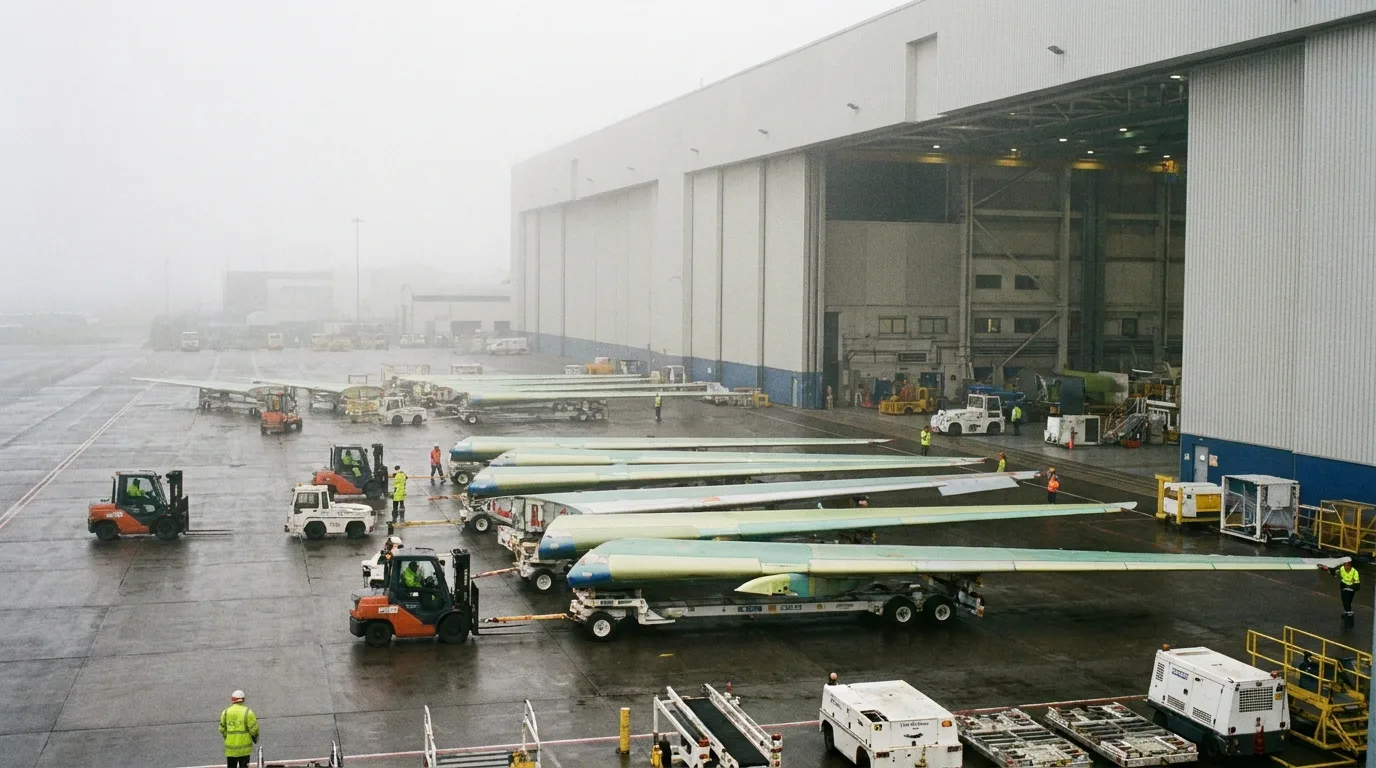
The signature piece of equipment is the 737 Wing Transport Tool, a purpose-built rig that ferries partially completed wings from the supplier into Everett for final mate. That tool exists because Everett, unlike Renton, was not built around the 737. Boeing is engineering the Renton-to-Everett wing flow rather than redesigning the building.
Boeing has stated publicly that the North Line is opening “midsummer” 2026. Lynnwood Times reported a midsummer launch in February. HeraldNet confirmed the timing in April. Aviation A2Z reported in early April that the line had opened in a soft-launch sense for staging and tooling. The rate ramp begins after that.
The 4,800-jet question
The reason rate 53 matters is the backlog. Boeing’s commercial backlog runs north of 4,800 firm orders for the 737 MAX family alone, with airlines and lessors waiting years for delivery slots. At rate 47, Boeing burns through roughly 564 jets per year. At rate 53, the number is 636. Across a five-year delivery window, the difference is more than 350 aircraft — roughly the size of an entire mid-sized airline’s fleet, or about $40 billion in revenue at typical 737 unit pricing.
That is the math Boeing executives are pointing at when they talk about cash-flow recovery. It is also the math that tells Snohomish County’s aerospace workforce planners exactly how big the North Line hiring wave needs to get.
What rate 53 means for Everett hiring
Boeing has been hiring across its commercial operation at roughly 100 to 140 net new factory positions per week, according to commentary on the Q1 earnings call and prior reporting at factory-wide hiring at 100-140/week pace. A meaningful share of that hiring lands in Everett because the North Line is the program in expansion mode. The IAM 751 Machinists Institute on Airport Road — covered here in April — is the union-built training pipeline that feeds those positions.
The path from rate 47 to rate 53 is not a smooth curve. It is a step function. Boeing has to qualify North Line workers, validate the Wing Transport Tool flow, prove the build sequence on conformity airframes, and then sustain rate over a 90- to 180-day window before the FAA signs off on rate increases. Each of those gates is also a Snohomish County hiring gate. If Everett can’t put trained mechanics on the floor when Boeing needs them, the rate ramp slips.
The Spirit AeroSystems variable
Boeing’s December 2025 acquisition of Spirit AeroSystems — its longtime fuselage supplier — was framed at the time as a vertical integration play to fix quality drift. It is also a rate-53 enabler. Bringing Spirit in-house gives Boeing direct control over fuselage delivery cadence into Renton and Everett. Ortberg has flagged Spirit integration drag as a 2026 cash-flow headwind, but the structural play is to make rate 53 sustainable rather than a one-quarter spike.
For the North Line specifically, Spirit’s wing assembly capacity is the constraint that has to scale alongside Boeing’s bay capacity. A North Line that is ready before its wings arrive is not really at rate 53.
What can knock the schedule off
Three things, in roughly this order:
- FAA rate authority. Boeing cannot unilaterally raise its 737 MAX production rate above 38 per month — that cap was imposed after the January 2024 Alaska Airlines door-plug incident. The FAA has signaled a path to rate 47 in summer 2026 and rate 53 by year-end, but each step is conditional on quality-system performance.
- 737 MAX 10 certification. The MAX 10, which the North Line is designed to build, has not yet received its FAA type certification. Boeing CEO Kelly Ortberg told the April 22 earnings call that certification is on track for late 2026 — but the Bloomberg report from April 21 noted that the FAA has not surfaced new roadblocks but cautioned that flight test could still find one.
- Workforce throughput. Training a Boeing factory mechanic to working productivity takes 12 weeks of structured rotation plus on-the-job hours. The compressed timeline between June and December 2026 leaves limited room for slippage.
What this looks like from Everett
The story most Snohomish County residents are going to see in their daily lives is hiring volume — Boeing’s careers page, IAM 751’s apprenticeship intake, the WATR Center and EvCC training cohorts, the Edmonds College aerospace programs. The story Boeing’s investors are watching is the rate curve. The story the FAA is watching is the quality system.
All three are the same story, told in different vocabularies. Rate 53 is the number that connects Everett’s payroll to Boeing’s cash flow to the FAA’s certification authority. The North Line is the bay where the connection physically happens.
Frequently asked questions
What is Boeing’s 737 MAX production rate target for 2026?
Boeing has publicly targeted 47 jets per month by mid-summer 2026 and 53 jets per month by the end of the year, per CEO Kelly Ortberg’s commentary on the Q1 2026 earnings call (April 22, 2026).
Why does Boeing need the Everett 737 North Line?
The Renton factory’s three production lines max out at approximately 47 jets per month due to physical constraints. To reach rate 53, Boeing needs a fourth line — and the only space available inside Boeing’s commercial system is the Everett factory at Paine Field.
When does the Everett 737 North Line open?
Boeing has consistently said midsummer 2026 since the February 2026 announcement. Soft-launch staging began in early April 2026; rate production starts after midsummer.
How big is Boeing’s 737 MAX backlog?
More than 4,800 firm orders. At rate 53, that backlog still represents roughly 7.5 years of production.
What variants will the Everett North Line build?
Initial focus is the 737 MAX 10 — the largest variant — with capability to flex to MAX 7, MAX 8, and MAX 9. Boeing has stated the MAX 10 will be built predominantly in Everett.
How does this affect Everett-area employment?
Boeing has been hiring at 100 to 140 net new factory positions per week across its commercial operation, with a meaningful share landing in Everett. Rate 53 sustains and likely expands that hiring tempo through 2026.
What is Boeing’s path to $3 billion in free cash flow?
Ortberg laid it out on April 22: rate 47 in summer, rate 53 by year-end, KC-46 deliveries on the defense side, and 777X certification on the widebody side. All four legs need to hold for the FCF target to land.
The bottom line for Everett
Boeing’s rate-53 target is not a Renton story or a corporate story. It is an Everett story. The bays at Paine Field are where the math becomes real. Every additional 737 above rate 47 is built in Snohomish County, by people hired in Snohomish County, trained in Snohomish County, and paid in Snohomish County. That is the economic engine the North Line was built to be.
>Part of the complete guide: Boeing Everett & SPEEA 2026
Leave a Reply