Tag: Aerospace

  • Meet ATS: Everett’s Second-Largest Aerospace Employer Operates the Largest MRO on the West Coast — Right Next to Boeing

    Meet ATS: Everett’s Second-Largest Aerospace Employer Operates the Largest MRO on the West Coast — Right Next to Boeing

    Quick answer: Aviation Technical Services (ATS) is Everett’s second-largest aerospace employer after Boeing, with roughly 800 people working out of a 500,000-square-foot hangar at the south end of Paine Field. The company is the largest aircraft maintenance, repair, and overhaul (MRO) operator on the U.S. West Coast — and most Everett residents drive past its hangars without realizing they hold up to 14 commercial airliners at any given time.

    Drive south on Airport Road and the building most people picture as Boeing’s territory thins out. Past the Future of Flight, past the rows of stored 777-9s, past the Paine Field commercial terminal, the south end of the airport opens onto a cluster of hangars that don’t have Boeing logos on them.

    That cluster is Aviation Technical Services — ATS — and it employs about 800 people in Everett. Inside Snohomish County’s aerospace economy, ATS is the company that everyone in the industry knows about and most outside of it doesn’t. The shorthand: ATS is the second-largest aerospace employer in Everett, behind only Boeing, and it operates the largest MRO operation on the West Coast of the United States.

    For an aerospace ecosystem that is preparing to absorb a 737 MAX 10 North Line activation in mid-summer, a 777-9 delivery ramp into 2027, and a steady KC-46 cadence underneath all of it, ATS sits in a useful place in the supplier map. It is the company that touches the airplanes after they leave the factory and need to come back for service.

    The 500,000-square-foot building most Everett residents have never been inside

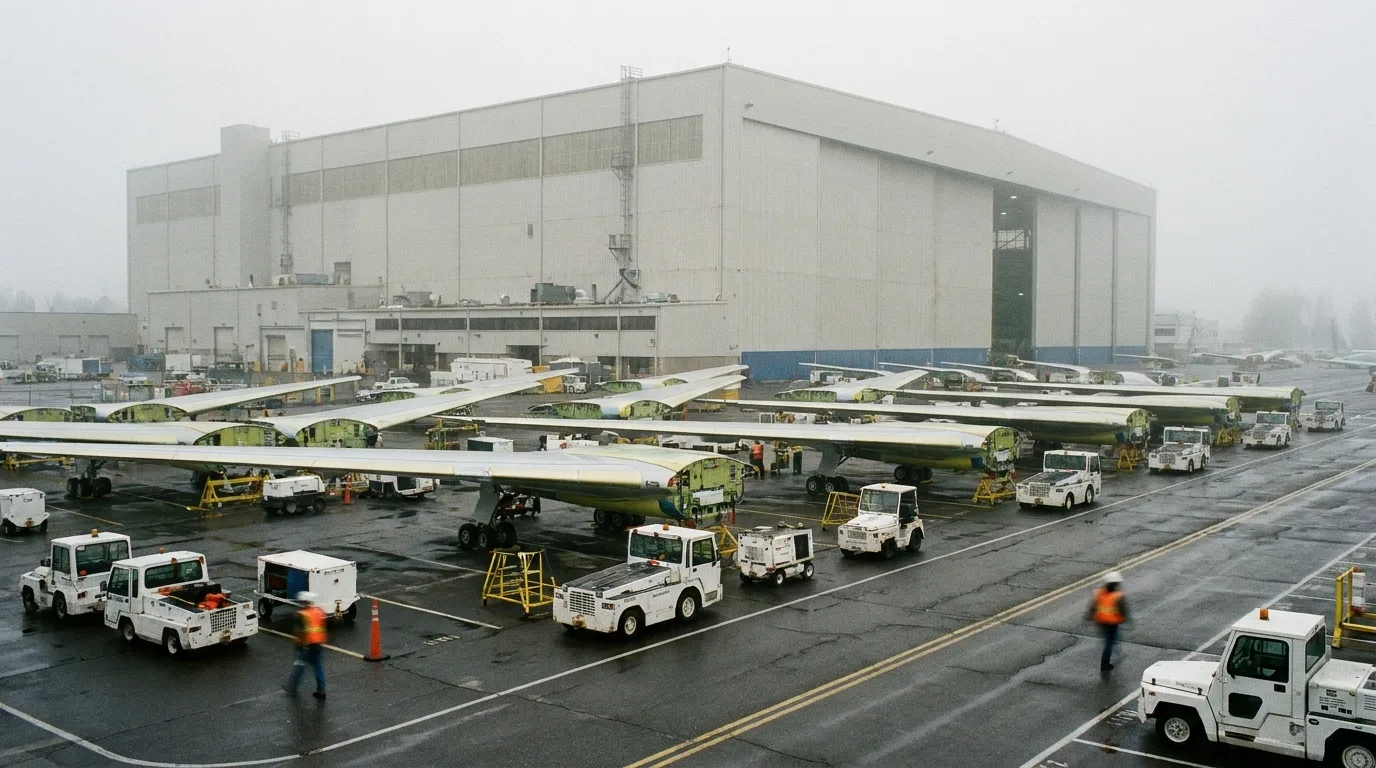
    The ATS Everett airframe MRO facility runs out of a 500,000-square-foot hangar at Paine Field with bay space for up to 14 commercial airliners simultaneously. The building has the kind of scale that doesn’t read from the road — until you realize a 737 NG is roughly 130 feet long, and the building is fitting more than a dozen of them under one roof at a time.

    The hangar isn’t new. It was originally built and operated by Tramco, then sold to Goodrich, then sold to ATS in the fall of 2007. The footprint has been an MRO operation in Everett for decades, which means the institutional knowledge — the techs who have seen the same airframe come back for its third C-check, the engineers who know how the supply of certain parts behaves — runs deep.

    Adjacent to the airframe hangar, ATS also runs a 50,000-square-foot component repair facility. That’s the building where structural, hydraulic, and electrical components come off the airplanes and get repaired by technicians trained on the specific systems. The two facilities together — airframe and component — give ATS what the trade press calls a “full-service” MRO posture: an airline can ship the whole airplane to Everett and ship the parts that come off it to the same campus.

    Why MRO matters in an aerospace town

    It is easy to think about Everett’s aerospace economy as a Boeing factory and the suppliers who feed it. The factory model is the most visible part — 737 MAX 10s rolling off the North Line, 777-9s flying production tests over Puget Sound, KC-46s painted in Air Force gray, 767 freighters wearing FedEx and UPS livery.

    But MRO is the other half of the airplane lifecycle, and it generates a different kind of work for the same workforce.

    A factory builds a finished jet. An MRO operation tears one down to its frames, inspects every primary structure, replaces what’s worn, upgrades what’s been superseded, and puts the airplane back together to a standard the FAA and the airline both have to sign off on. The work is more diagnostic than assembly. The skills overlap with Boeing’s mechanic and inspector workforce, but the day-to-day rhythm is different: shorter project cycles, more airplane variety, deeper component-level work.

    For Snohomish County, that means an aerospace mechanic who trained at the Machinists Institute on Airport Road or the WATR Center has two career destinations within a half-mile of each other — Boeing on the north end of Paine Field, ATS on the south end. The same skill set ports across the airport perimeter.

    Where ATS sits in the supplier-shortage math

    The 5,200-worker aerospace shortage that the Aerospace Futures Alliance has projected through the end of 2026 isn’t just a Boeing problem. It is a Snohomish County problem, and ATS is one of the companies on the demand side of that shortage. The Everett operation has historically grown its own talent — running internal mechanic training programs because the regional pipeline cannot keep up with attrition and ramp.

    That training-from-within approach matters for the broader workforce conversation. When the Machinists Institute, Edmonds College, and WATR Center put aerospace mechanics into the labor market, those graduates have multiple landing spots in Everett: Boeing’s main bay floors, Boeing’s KC-46 line, ATS’s airframe hangar, ATS’s component repair facility, and the smaller aerospace suppliers scattered across the county.

    For workers, optionality is leverage. For the regional economy, optionality is resilience.

    The piece of the cycle Boeing doesn’t do

    Boeing builds the airplane. The airline flies it. ATS — and a small number of MRO operators like it — handles the heavy maintenance checks (C-checks, D-checks) that the airline can’t perform on its own ramp.

    That separation matters in a downturn. When a launch customer like Lufthansa pushes its first 777-9 delivery from late 2026 to first quarter 2027, that affects Boeing’s delivery cadence in Everett. It does not, on its own, materially affect ATS, because the MRO demand pipeline is fed by every airline operating an aging fleet anywhere in the world. Delta, Alaska, United, Hawaiian, Southwest, and dozens of cargo and charter operators send airplanes to Paine Field for the kind of structural and systems work that ATS specializes in.

    That means ATS sits in a different cyclical position than Boeing. When new-jet deliveries slow, MRO demand often rises — airlines run their existing fleets longer and the heavy-maintenance interval comes due. When new-jet deliveries accelerate, the older airplanes still need their inspections. The MRO floor in Everett doesn’t oscillate the way the new-build factory does.

    The Paine Field economic picture, with ATS on it

    Adding ATS to the standard Paine Field map produces a different economic story than the Boeing-only version. The picture, roughly:

    • Boeing’s commercial Everett operations — 737 North Line, 767, 777, 777X, KC-46 — drive the bulk of the aerospace payroll in the county.
    • ATS sits at the south end of Paine Field as the second-largest aerospace employer, with 800 people on a hangar floor that handles up to 14 airplanes at a time.
    • ZeroAvia’s Propulsion Center of Excellence at the south end builds the next-generation hydrogen-electric powertrains.
    • The Future of Flight Aviation Center on Paine Field Boulevard is the public-facing tourism asset.
    • The 600-plus aerospace suppliers across Snohomish County feed all of the above.

    Each piece reinforces the others. ATS draws from the same training pipeline that feeds Boeing. ZeroAvia draws from the same engineering talent base that supports SPEEA at Boeing. The Future of Flight tour walks visitors past the active production lines that make the rest of the ecosystem possible.

    The point: Paine Field is not an airport that happens to have aerospace tenants. It is an aerospace cluster that happens to have a runway running through it.

    What this means for residents

    For Everett residents, the practical takeaway is that the local aerospace economy is more diversified than the headline numbers suggest. A Boeing labor disruption does not pause the south end of the airport. A delay in a new program does not collapse the maintenance work. The school district’s projections of family-wage employment, the housing market’s tracking of dual-income aerospace households, and the city’s tax base all benefit from having multiple anchor employers operating side-by-side rather than one dominant one.

    It also means that when local aerospace coverage talks about “the Boeing economy,” that frame is incomplete. The accurate version: the aerospace economy in Snohomish County is a Boeing-led cluster that includes a major MRO operator, a hydrogen-electric propulsion company, and 600 suppliers. Each one of those plays a role in keeping the workforce and the wage profile stable.

    Frequently Asked Questions

    Who is the second-largest aerospace employer in Everett?

    Aviation Technical Services (ATS) is the second-largest aerospace employer in Everett after Boeing, with about 800 employees at its Paine Field operation.

    What does ATS do?

    ATS provides maintenance, repair, and overhaul (MRO) services for commercial airliners. The company performs heavy maintenance checks, structural repairs, component repairs, and engineering services for airlines and cargo operators across the U.S. and internationally.

    How big is the ATS Everett facility?

    The main airframe MRO hangar is 500,000 square feet with bay space for up to 14 commercial airliners. ATS also operates a 50,000-square-foot component repair facility adjacent to the main hangar.

    Where is ATS located in Everett?

    ATS operates at the south end of Paine Field, adjacent to the Boeing Everett production facility but on the opposite end of the airport from the Future of Flight Aviation Center.

    How long has ATS been at Paine Field?

    The Everett MRO facility has operated continuously since the Tramco era. Goodrich operated the building before selling it to ATS in the fall of 2007, so ATS itself has been in the building for nearly two decades.

    Is ATS the largest MRO on the West Coast?

    Yes. ATS is the largest aircraft maintenance, repair, and overhaul operator on the U.S. West Coast.

    Does ATS hire from local training programs?

    Yes. ATS has historically grown its own mechanic talent through internal training programs and hires from regional aerospace training programs including the Machinists Institute, Edmonds College, and the WATR Center.

    How does MRO demand differ from new-aircraft demand?

    MRO demand is fed by aging fleets at every airline operating worldwide and tends to be more stable cyclically than new-aircraft demand. When new deliveries slow, airlines run older fleets longer and MRO demand often rises.

  • Lufthansa Confirms 777X Delivery Slips to Q1 2027 — But Everett’s April Production Flight Is Still On

    Lufthansa Confirms 777X Delivery Slips to Q1 2027 — But Everett’s April Production Flight Is Still On

    Quick answer: Lufthansa CEO Carsten Spohr told the airline’s annual press conference that the first Boeing 777-9 will now arrive in the first quarter of 2027 — not late 2026 as previously targeted. The April 2026 production-flight milestone at Paine Field in Everett remains on track, and that flight is the keystone of the FAA certification package the program needs to clear before any 777-9 leaves the Everett ramp wearing a customer’s livery.

    The Boeing 777X timeline moved again, and this time the source isn’t Boeing — it’s the airline at the front of the line.

    At Lufthansa’s annual press conference in Frankfurt in March, CEO Carsten Spohr confirmed that the German flag carrier now expects its first 777-9 delivery in the first quarter of 2027, slipping from a previously revised late-2026 target. Boeing’s own April 22 first-quarter 2026 earnings call landed on the same destination from a different angle: the company “anticipates first delivery in 2027” and said the program “continued to make progress” on certification.

    For Everett, the Q1 2027 number isn’t a setback — it’s clarification. The factory has been building, testing, and reworking 777-9s on a runway in front of more than two hundred Boeing engineers for a long time. Now there’s a date the broader supply chain, the IAM 751 floor, and Snohomish County’s economic planners can write down with a pen instead of a pencil.

    What Spohr actually said

    Lufthansa’s annual press conference is one of the few moments in the year when a launch customer speaks publicly about a delayed program in any specificity. Spohr’s remarks confirmed three things that had been swirling in the trade press for months:

    1. Lufthansa now expects its first 777-9 in the first quarter of 2027.
    2. The April 2026 first flight of the production-conforming 777-9 — the very airframe Lufthansa will eventually take — remains on schedule.
    3. Lufthansa is comfortable with the new timing.

    That last point matters. Launch customers can put real pressure on a delayed program by speaking to the press, demanding compensation, or quietly shifting orders to alternative airframes. Spohr’s tone was the opposite — patient, fact-based, and oriented around getting the airplane right. For an Everett factory floor that has lived through three certification regimes (the original timeline, the revised 2025 target, and the 2026 path), a calm launch customer is its own form of stability.

    Why the April 2026 flight is the real news for Everett

    The headline says “delivery slip.” The factory-floor story is “first production flight, on time.”

    The 777-9 that takes off from Paine Field in April 2026 is not a flight-test airframe pulled from a hangar. It’s the airplane Lufthansa will fly. The four flight-test 777-9s that have been running the certification campaign are pre-production aircraft built before the design freeze. The airplane that flies in April is the first one built to the production standard — the same configuration every customer airframe will follow.

    That is why Boeing has put the date in writing in front of the FAA. Flight hours logged on a production-conforming 777-9 carry direct certification credit. Every test flight from April onward contributes data to the type certification package Boeing has been assembling since the program received its Phase 4A Type Inspection Authorization on March 17, 2026. The TIA cleared the FAA to begin riding along on certification flights and counting those hours toward the final approval.

    Put another way: April’s flight is the moment the program shifts from “are we going to make it” to “how fast can we accumulate the flight hours we still need.” That is a more comfortable problem than the one Boeing was solving in 2024.

    The Everett factory math through 2027

    Roughly 30 completed 777-9s sit on the Paine Field ramp today, built before the latest engineering changes were folded into the production line. Boeing CEO Kelly Ortberg called the rework on those airplanes “pretty massive activity” on the April 22 earnings call. The newer airframes — built to the current standard — will deliver first; the parked-ramp jets will be reworked over multiple years.

    That sequencing has direct workforce implications for Everett. The factory has to do two things at once for the next eighteen months:

    • Build new 777-9s and 777-8Fs to the production standard at the cadence the order book demands.
    • Cycle the stored airframes through change incorporation work that requires rework cells, parts kits, and qualified aerospace mechanics.

    Both jobs are work for IAM 751 members and SPEEA engineers in Everett. Both jobs draw on the same supplier base in Snohomish County. Both jobs feed paychecks that move through Casino Road, Hewitt Avenue, and the school district’s enrollment numbers.

    A Q1 2027 first delivery means the rework backlog isn’t a deadline pressure event the way late 2026 would have been. It becomes part of the steady-state Everett widebody operation through the end of the decade.

    Why Lufthansa specifically matters

    Lufthansa is not the only 777-9 launch customer — Emirates holds the largest order book at 35 firm 777-9s and 5 freighters — but Lufthansa is the lead-off airline because of how it has staged its widebody fleet. The German flag carrier ordered 20 777-9s in 2013, has been holding crew training slots open, has its long-haul network planned around the airplane, and has allocated ramp space at Frankfurt and Munich for the type. When Lufthansa says Q1 2027, it is moving slot allocations, simulator schedules, and crew training rotations.

    The airline’s confidence on the April 2026 production flight also matters because Lufthansa has the technical staff to evaluate the program independently. The airline’s flight operations and engineering teams have visited Everett repeatedly. If Lufthansa believed the April flight was at risk, the messaging from Frankfurt would look very different.

    What Snohomish County’s aerospace ecosystem reads from this

    For the 600-plus aerospace suppliers in Snohomish County, the Q1 2027 confirmation lands as good news. A vague “sometime in 2027” forecast doesn’t let a supplier plan capacity. A first-quarter delivery date does — it sets a firm-up window in late 2026 for the components that go on the first delivery airframe and the next handful behind it.

    The same is true for the Future of Flight Aviation Center, Mukilteo’s lodging operators, and the trade-show economy that ramps every time a new widebody enters service. A Q1 2027 first delivery means commemorative tour traffic — the European press, Lufthansa’s branded delivery ceremony, the analyst flights — concentrates in early 2027, not the end of 2026 holiday window.

    For the Edmonds College aerospace track and the Machinists Institute on Airport Road, the date confirms the workforce demand profile the schools have been planning around. The 777-9 ramp won’t compete head-to-head with the 737 North Line activation in mid-summer 2026. Instead, the two production curves stack: North Line standing up through late 2026, 777-9 deliveries beginning in early 2027, KC-46 deliveries running steady through both, and the 777-8F ramping behind the -9.

    The certification work between here and Q1 2027

    Three certification milestones still sit between Paine Field and the first Lufthansa delivery:

    • Type certification — the FAA’s formal sign-off that the 777-9 design meets all applicable airworthiness requirements. Boeing is targeting type certification before year-end 2026.
    • Production certificate amendment — the FAA’s approval of Boeing’s manufacturing system to build production 777-9s at the Everett factory. The April first flight begins building the data package the FAA needs to close this out.
    • Customer-specific delivery readiness — Lufthansa-specific configuration, livery, interior, and entry-into-service documentation. This is the step that actually transfers the airplane.

    Q1 2027 is when step three finishes. Steps one and two have to clear before that. The April production flight is the start of the data-collection sprint that makes the back end of that calendar workable.

    The bigger Everett picture

    The 777-9 program lives on the same factory floor as the 767 freighter, the KC-46 tanker, and — starting this summer — the 737 MAX 10 North Line. Each of those programs has its own cadence. The 767 commercial line sundowns in 2027. The KC-46 line is the most stable production program at Paine Field. The North Line ramps from zero to a steady cadence over twelve to eighteen months. The 777-9 transitions from build-and-store to build-and-deliver.

    For the first time in several years, all four programs have legible timelines pointing in the same direction — toward production-and-delivery cadence, not certification limbo. The Lufthansa announcement is one piece of that picture, but it’s an important one because it confirms the 777-9 is no longer the program that drags the rest down.

    Frequently Asked Questions

    When will Lufthansa receive its first 777-9?

    Lufthansa CEO Carsten Spohr confirmed in March 2026 that the airline expects its first Boeing 777-9 delivery in the first quarter of 2027. Boeing said on its April 22 earnings call that it “anticipates first delivery in 2027.”

    Is the April 2026 production flight still on schedule?

    Yes. Both Lufthansa and Boeing have confirmed the production-standard 777-9 will fly in April 2026 from Paine Field. The aircraft is the specific airframe destined for Lufthansa.

    How does this affect Everett jobs?

    The Q1 2027 timeline locks in steady widebody work in Everett through 2027. Roughly 30 stored 777-9s on the Paine Field ramp also need multi-year rework, which adds a second stream of work for IAM 751 mechanics and SPEEA engineers.

    How many 777-9s does Lufthansa have on order?

    Lufthansa ordered 20 777-9s in 2013 and has been the launch customer ever since.

    Who has the largest 777X order?

    Emirates holds the largest 777-9 order book at 35 firm aircraft, plus 5 777-8Fs.

    What is a Type Inspection Authorization?

    A Type Inspection Authorization (TIA) is the FAA milestone that allows agency pilots and engineers to ride along on certification flights and count those flight hours toward type certification. Boeing received Phase 4A TIA for the 777-9 on March 17, 2026.

    Will the 777-9 ramp affect the 737 MAX 10 North Line?

    No. The two programs run on different bays inside the Everett factory and have offset production curves. The North Line ramps through late 2026; the 777-9 begins customer deliveries in early 2027.

    What does this mean for Snohomish County’s 600 aerospace suppliers?

    A confirmed first-delivery date lets suppliers firm up component schedules for the first delivery airframe and the airframes immediately behind it, replacing a soft “sometime in 2027” forecast with a planning-grade target.

  • The Boeing 737 MAX 10 Will Be Built Exclusively in Everett — And More Than 1,200 Airline Orders Are Riding on It

    The Boeing 737 MAX 10 Will Be Built Exclusively in Everett — And More Than 1,200 Airline Orders Are Riding on It

    The Boeing 737 MAX 10 Will Be Built Exclusively in Everett — And More Than 1,200 Airline Orders Are Riding on It

    When Boeing's North Line opens at the Everett factory this summer, it will not just be another production line. It will be the only place on earth where the Boeing 737 MAX 10 gets built.

    That distinction matters more than it might seem at first. The MAX 10 is Boeing's longest and highest-capacity 737 variant. It seats up to 230 passengers in a high-density configuration, making it the narrowbody option for airlines trying to squeeze maximum economics out of a single-aisle jet. And as of the start of 2026, it has accumulated more than 1,200 firm orders — placing it among the most heavily ordered undelivered commercial aircraft in aviation history. Every single one of those aircraft will be built at Paine Field, Everett, Snohomish County.

    The certification that unlocks all of those deliveries is still pending FAA approval, expected to complete in 2026. But the production infrastructure — the line that will build the first of those 1,200-plus jets — is taking shape now. The workforce is training. The tooling is installed. The North Line is scheduled to open at low-rate initial production (LRIP) this summer.

    Why the MAX 10 Goes to Everett and Not Renton

    Boeing's existing 737 production is entirely at Renton, Washington — three parallel assembly lines producing the MAX 8, MAX 9, and other variants at the facility that has built 737s since 1967. Adding the MAX 10 at Renton would require either displacing an existing line or building additional capacity in an already constrained campus.

    Everett offered something Renton could not: space. The Boeing Everett Factory at Paine Field is the largest building in the world by volume, originally constructed for the 747 program. As widebody programs have evolved and the 747 ended production, floor space became available for new purposes. The North Line occupies that freed-up real estate.

    The MAX 10's physical size also factors in. At 143.8 feet long — 66 inches longer than the MAX 9 and requiring modified landing gear with a new semi-levered bogie to maintain ground clearance — the MAX 10 is the most dimensionally complex 737 variant to build. Routing it to a new, purpose-configured line in Everett, rather than trying to integrate it into Renton's existing flow, gives Boeing tighter control over tooling and process standardization for what is still a new configuration.

    The practical result: Everett becomes the home of the MAX 10 for the foreseeable future of the program.

    The Order Book: 1,200-Plus and What It Represents

    More than 1,200 firm orders for the MAX 10 is not an abstract number. It is the work order for Everett's North Line, measured in individual aircraft that will each require assembly, quality checks, systems installation, and delivery to an airline customer somewhere in the world.

    The customer list reads like a roll call of global aviation's largest operators. United Airlines holds 167 MAX 10s — the U.S. carrier with the largest single MAX 10 order. Ryanair, Europe's largest low-cost carrier, has 150 on order. American Airlines has committed to 115. Delta Air Lines, historically a Boeing skeptic that spent years flying Airbus A321s, placed an order for 100 MAX 10s, a significant statement of confidence in the variant and in Boeing's recovery.

    Other operators round out the book: Southwest Airlines, IndiGo, Lion Air Group, and others have positions in the queue. Each will eventually take delivery from the Paine Field line. Combined, they represent years of production — and years of economic activity in Snohomish County.

    For context: Boeing's current approved production rate for all 737 variants is 42 per month at Renton. The North Line will add capacity incrementally as it stabilizes. Boeing's next target rate — 47 jets per month across all lines — is now confirmed for 2027, not 2026, as the FAA requires demonstrated quality performance before approving any rate increase. The long-run goal remains 63 per month. The North Line is the essential bridge to those higher numbers.

    Certification First — Without It, None of This Happens

    There is an important sequence dependency here that every observer of the Everett story should understand: the MAX 10 cannot be delivered to any of those 1,200-plus customers until the FAA certifies it. That certification is expected in 2026, but it has not yet been granted.

    The MAX 10 has been in certification limbo since a 2022 Congressional deadline was not met, requiring Boeing to re-engage with the FAA on the certification pathway. The path forward involves the PC700 amendment — an agreement on what additional compliance work the MAX 10 must complete — and flight testing with conformity aircraft. Boeing has been publicly confident that 2026 certification is achievable, and the April 2026 North Line opening at LRIP is predicated on that timeline.

    The North Line opening at low-rate initial production before certification is not unusual. LRIP aircraft serve as conformity airplanes for the FAA certification process — each one built to production-standard specs and inspected to verify that the manufacturing process matches the certified design. Building those aircraft in Everett is itself part of the certification workflow, not a bypass of it.

    Once the FAA signs off on the MAX 10, deliveries can begin. The aircraft that United, Ryanair, American, and Delta have been waiting for will start flowing from Paine Field. That transition — from conformity aircraft to delivery aircraft on the same line — is the moment Everett's North Line earns its place in Boeing's permanent production footprint.

    What This Means for Everett's Economy

    The aerospace workforce in Snohomish County numbers approximately 42,000 direct employees at Boeing and its supply chain. The 5,200-worker shortage projected through end of 2026 — driven by retirement velocity, time-to-productivity at scale, and housing economics — has been one of the defining labor stories of the North Line ramp-up.

    The MAX 10's exclusive assignment to Everett locks that workforce relationship in for the program's foreseeable life. As long as Boeing is building MAX 10s — and with 1,200-plus orders representing potentially a decade-plus of production at current rates — the Paine Field facility needs the assemblers, technicians, inspectors, and engineers to build them. The IAM 751 Machinists Institute at 8729 Airport Road, the WATR Center, Everett Community College, and Edmonds College are all building training pipelines toward this specific demand.

    The supply chain picture is similarly significant. Boeing's integration of Spirit AeroSystems, completed in late 2025, brought the fuselage supplier's Wichita and other operations under Boeing's banner. Snohomish County's 600-plus aerospace supplier companies — from precision machining shops to composites fabricators — will see MAX 10 work flow into their order books as the line scales.

    The widebody story at Paine Field — the 777-9 certification path, the 777-8F freighter program, the KC-46 tanker backlog — gets most of the public attention because those programs are larger and more visually dramatic. The MAX 10 story is quieter, but in terms of sheer unit volume and long-run economic contribution to Everett, it may end up being the most consequential production decision Boeing has made about this factory in years.

    More than 1,200 airplanes. All of them built right here.

    Related reading: Boeing Rate 47 and Everett's North Line | MAX 7 and MAX 10 Certification on Track for 2026 | What Is LRIP? The FAA Conformity Process Explained

    Frequently Asked Questions

    Why will the Boeing 737 MAX 10 only be built in Everett?

    Boeing assigned the MAX 10 exclusively to the new North Line at the Everett factory at Paine Field. Everett has the available floor space freed up from the 747 program's end, and the MAX 10's longer fuselage and specialized landing gear made a dedicated production line more efficient than integrating it into Renton's existing flow.

    How many Boeing 737 MAX 10 orders are there?

    Boeing has received more than 1,200 firm orders for the 737 MAX 10. Major customers include United Airlines (167), Ryanair (150), American Airlines (115), and Delta Air Lines (100), plus Southwest, IndiGo, Lion Air Group, and others.

    When will the Boeing 737 MAX 10 be certified?

    Boeing expects FAA certification of the 737 MAX 10 in 2026. The program is proceeding through conformity aircraft and flight testing under the PC700 amendment framework. Certification must be complete before any MAX 10 can be delivered to airline customers.

    When does the Boeing North Line in Everett open?

    Boeing plans to open the North Line at midsummer 2026 at low-rate initial production (LRIP). The line will initially build conformity aircraft for the MAX 10 FAA certification process, then transition to commercial deliveries once certification is complete.

    How does the MAX 10 differ from the MAX 9?

    The 737 MAX 10 is 66 inches longer than the MAX 9, reaching 143.8 feet total length. It seats up to 230 passengers and features a semi-levered landing gear bogie design to maintain ground clearance despite the longer fuselage. It is Boeing's direct competitor to the Airbus A321neo.

  • Boeing 777-9 Simulators Just Cleared the FAA and EASA — And That Is a Bigger Deal for Everett Than It Sounds

    Boeing 777-9 Simulators Just Cleared the FAA and EASA — And That Is a Bigger Deal for Everett Than It Sounds

    Boeing 777-9 Simulators Just Cleared the FAA and EASA — And That Is a Bigger Deal for Everett Than It Sounds

    In the long story of the Boeing 777X program — a saga measured in years of delays, billions in cost overruns, and a certification path that has been anything but linear — a milestone cleared on February 19, 2026, deserves more attention than it got: the FAA and EASA jointly certified the first full-flight training simulators for the Boeing 777-9.

    That might sound like a bureaucratic checkbox. It is not. For Everett, where every one of those jets will be assembled in the world's largest building, it means the airline industry is now formally preparing to operate the widebody jet that this factory has spent years building up to deliver. Airlines cannot hire and train 777X crews without FAA-qualified simulators. The simulator certification is the moment when "getting ready" becomes "getting pilots ready." The Paine Field production line just got a very real signal that its customers are moving from theory to execution.

    What the Qualification Actually Covers

    The February 19 announcement from Boeing's mediaroom came jointly with simulator manufacturer CAE. The devices qualified include a full-flight simulator (FFS) and a flight training device (FTD), both located at the Boeing Training Campus in Gatwick, United Kingdom. Both carry Level D qualification — the highest standard the FAA issues, requiring six-degrees-of-freedom motion, full visual system fidelity, and cueing that replicates the actual aircraft within tight tolerances.

    The significance of Level D: it is the standard airlines need to conduct type rating training. Without it, pilots cannot legally qualify on a new aircraft type in revenue service. The FAA and EASA granting Level D to the 777-9 simulators simultaneously is a coordinated signal that both the primary regulators for U.S. and European carriers are aligned on the aircraft's systems representation — a meaningful statement for a program that has had to fight for every regulatory inch.

    Crucially, this qualification predates delivery. That is intentional. The lead time to train a 777-9 crew is substantial. Airlines need months of instructor qualification, line training device hours, and route-specific procedures work before the first airplane lands in the hands of a paying passenger. By certifying simulators in February 2026 — roughly a year before the currently confirmed Lufthansa delivery window of early 2027 — Boeing and the regulators built in the runway carriers need to actually be ready.

    Lufthansa Is First — And Already Installing Its Own Simulator

    Lufthansa, the 777X launch customer with 34 aircraft on order, is not waiting. Lufthansa Aviation Training, the carrier's pilot training subsidiary, has received the first Boeing 777-9 full-flight simulator delivered to an airline. As of late April 2026, that device is being assembled and installed at LAT's Frankfurt training center, with operational readiness planned for late May 2026.

    The Frankfurt simulator coming online in May matters for Everett's timeline. Lufthansa CEO Carsten Spohr confirmed in March 2026 that the carrier now expects its first 777-9 delivery in Q1 2027. That is a compressed window. For Lufthansa to take delivery and put the aircraft into revenue service, it needs trained captains and first officers before the keys are handed over. The simulator arriving in Frankfurt now, five-plus months before the delivery window, is the logistical machinery that makes a Q1 2027 entry-into-service possible rather than theoretical.

    The Paine Field assembly line where that first Lufthansa jet is being built has approximately 30 stored 777X jets awaiting rework completion, a scale disclosed on Boeing's Q1 2026 earnings call. The rework timeline — combined with the production flight campaign Boeing targeted for April 2026 — means the Everett widebody team is running multiple parallel tracks simultaneously: complete the production flight, continue the FAA certification campaign, resolve the stored-jet rework sequence, and deliver to Lufthansa before Q1 2027 expires.

    The simulator qualification removes one of the few variables that was entirely outside Boeing's control. Airlines can now train. That is one less bottleneck between this factory and the first revenue flight of a jet years in the making.

    Asia-Pacific Carriers Are Also Preparing

    Lufthansa is not the only operator in motion. CAE is installing Asia-Pacific's first Boeing 777X full-flight simulator at the Singapore-CAE Flight Training Centre, serving a cluster of early-order operators including Singapore Airlines (31 aircraft on order), Cathay Pacific (21 aircraft), ANA, and Air India. Each of those jets will roll out of the building at Paine Field.

    Every simulator coming online in Frankfurt, Singapore, or wherever else airlines establish their 777X training footprints represents a future delivery from Everett's widebody line. The February qualification set the legal foundation for all of it.

    For Boeing Everett's workforce, the broader pattern is worth understanding. The 777 program has been this factory's anchor for decades. The 777-300ER has been one of the most commercially successful widebodies in history. The 777-9, its successor, carries a combined backlog of several hundred orders. Getting it into service successfully — and on the current 2027 timeline rather than slipping again — is a defining question for whether the Everett widebody line sustains the workforce and economic weight it has carried in Snohomish County for a generation.

    The GE9X Factor

    One complication sitting alongside the simulator news: GE Aerospace, the exclusive supplier of the GE9X engine that powers the 777-9, disclosed in early 2026 that it is working on a fix for a mid-seal durability issue identified during a shop visit in January. Boeing and GE have both stated the resolution does not push 777-9 certification or delivery beyond the current 2027 timeline.

    The GE9X is the engine that makes the 777-9's efficiency case: roughly 10 percent better fuel burn than the 777-300ER, with the largest commercial fan diameter in the industry at 134 inches. A mid-seal durability issue caught during a shop visit is exactly the kind of finding a rigorous certification campaign is designed to surface. Both companies have financial and reputational reasons to be precise about its scope. But it is a real variable on the program's critical path, and Everett workers and suppliers tracking the 2027 delivery window should know it exists and is being actively worked.

    What to Watch From Here

    The sequence ahead: Boeing targeted April 2026 for the first production-standard 777-9 flight from Paine Field. That flight triggers the FAA's grant of Type Inspection Authorization (TIA) for the production-configured aircraft, allowing FAA pilots to join the cockpit for final certification flights. TIA clearance in the second half of 2026 would set up a 2027 delivery consistent with what Spohr confirmed in March.

    In the meantime, the Gatwick training campus is active, Frankfurt's simulator is being installed, and Singapore's device is being prepared. The certification machinery is in motion from multiple directions. For the 42,000-person aerospace workforce that defines Everett's economy, the trajectory matters more than any single checkpoint. The simulator qualification, unflashy as it is, is one of the clearest signals yet that Boeing and its customers are treating the 2027 timeline as real.

    Related reading: Boeing 777X Rework: 30 Stored Jets at Paine Field | Boeing 777X Clears FAA Phase 4A | What the 777-8F and KC-46 Mean for Everett's Workforce

    Frequently Asked Questions

    What is a Level D flight simulator qualification?

    Level D is the highest FAA certification for full-flight simulators. It requires six-degrees-of-freedom motion, high-fidelity visual systems, and precise replication of the aircraft's handling qualities. Airlines must use Level D simulators for type rating training — the qualification pilots need before flying a new aircraft type commercially.

    Why does the 777-9 simulator qualification matter for Everett?

    Every Boeing 777-9 is assembled at the Paine Field factory in Everett. Simulator certification allows airline customers to begin training pilots — a prerequisite for accepting deliveries. Without certified simulators, airlines cannot legally qualify crews, which would delay deliveries regardless of production progress.

    When does Lufthansa expect its first Boeing 777-9?

    Lufthansa CEO Carsten Spohr confirmed in March 2026 that the carrier expects delivery in Q1 2027. Lufthansa has 34 aircraft on order and is installing its own Level D 777-9 simulator at its Frankfurt training center, with completion expected in late May 2026.

    What is the GE9X mid-seal issue?

    GE Aerospace disclosed in early 2026 that it is developing a fix for a mid-seal durability issue found during a GE9X shop visit in January 2026. Both Boeing and GE have stated the fix does not affect the 777-9's 2027 first-delivery timeline.

    Which airlines have 777-9 orders?

    Major customers include Emirates (115 aircraft), Lufthansa (34), Singapore Airlines (31), Cathay Pacific (21), Qatar Airways, and ANA. All aircraft will be assembled at the Boeing Everett factory at Paine Field in Snohomish County.

  • Boeing Rate 47 Is Coming This Summer — And Everett’s North Line Is the Factory That Makes 53 Possible

    Boeing Rate 47 Is Coming This Summer — And Everett’s North Line Is the Factory That Makes 53 Possible

    What does Boeing 737 production rate 47 mean? Rate 47 refers to building 47 aircraft per month — up from the current 42 — across Boeing’s 737 MAX assembly operations. CEO Kelly Ortberg confirmed on Boeing’s Q1 2026 earnings call that rate 47 will be reached this summer. The North Line in Everett is specifically designed to add capacity for production rates above 47, enabling Boeing to eventually reach 53 or more aircraft per month.

    Boeing Rate 47 Is Coming — And Everett’s North Line Is the Factory That Makes 53 Possible

    There is a number that matters more to Everett’s aerospace future than almost any other right now: 47.

    That is the target monthly production rate for Boeing’s 737 MAX program — 47 aircraft per month — which Boeing CEO Kelly Ortberg confirmed on the company’s April 22, 2026 quarterly earnings call is arriving “this summer.” To reach it, Boeing had to earn back the FAA’s trust after a disastrous 2024, restructure its fuselage supply chain through the acquisition of Spirit AeroSystems, and hold 42 aircraft per month long enough to prove repeatable quality at scale.

    The path is now clear. Everett sits directly in the middle of what comes next.

    The Long Road Back to Rate Momentum

    To understand what rate 47 means, you have to understand where Boeing was two years ago.

    In early 2024, a door plug blew out of an Alaska Airlines 737 MAX 9 at 16,000 feet over Oregon. The FAA grounded the fleet for inspections, launched investigations into Boeing’s quality management system, and ultimately capped 737 production at 38 aircraft per month until quality could be demonstrably rebuilt. It was the single most consequential production restriction Boeing had faced in the modern era.

    By October 2025, the FAA lifted the cap to 42 per month — a measured endorsement of the quality improvements Boeing had made under CEO Ortberg, who took over the company in late 2024 with a mandate to fix the culture and the processes simultaneously. Each quality milestone — including the completion of all 25 wiring-affected MAX jets — was a rung on the ladder back to rate momentum.

    Then came the Spirit AeroSystems acquisition, which closed in December 2025. Spirit had been Boeing’s largest fuselage supplier — and the source of documented quality problems including misdrilled fastener holes on the same fuselage sections involved in the door plug incident. Bringing Spirit back inside Boeing gave the company “nose-to-tail” control over the most critical structural components of the 737 for the first time in more than two decades.

    That integration — approximately 15,000 Spirit employees across Wichita, Dallas, Tulsa, and Prestwick, Scotland now working directly for Boeing — combined with consistently passing FAA quality audits at rate 42, is what earned Boeing the regulatory confidence to pursue rate 47 in 2026.

    Rate 47 vs. Rate 53: The Sequence That Defines Everett’s Role

    Boeing’s public target is not just rate 47. It is rate 53 by year-end 2026 and eventually 57 and beyond. The sequence matters.

    At rate 47, the Renton factory is operating near its optimized physical capacity. The buildings, tooling, and number of flow stations were engineered around a specific throughput ceiling. To reach 53 per month, Boeing does not simply speed up Renton. It needs a second factory contributing real aircraft to the monthly total.

    That factory is the North Line in Everett.

    When Boeing says the North Line will add capacity “for production rates above 47 airplanes per month,” it is using deliberate language. The North Line does not compete with Renton’s rate 47 achievement — it supplements it. The combined throughput of Renton at full rate plus the North Line at operational cadence is how Boeing reaches 53. And beyond 53, the math becomes even more dependent on Everett.

    Spirit AeroSystems: The Acquisition That Changed the Quality Math

    The Spirit AeroSystems deal deserves more attention than it typically receives in Everett coverage, because its completion is directly tied to Boeing’s ability to secure rate approvals from the FAA.

    Spirit was spun out of Boeing in 2005. For two decades it operated as an independent supplier, producing 737 fuselage sections in Wichita and shipping them to Renton for final assembly. The relationship was efficient in theory but created accountability gaps in practice — when quality problems arose, Boeing and Spirit sometimes argued over ownership of the defect and responsibility for the rework.

    The $8.3 billion acquisition (including assumed debt) ended that ambiguity. The fuselage that arrives in Renton now comes from a Boeing facility. The FAA audits one quality management system instead of a contractor relationship. For Everett, this matters because the North Line will receive fuselage sections from what is now Boeing Wichita — built under the same quality standards, training requirements, and oversight structure as Renton. That consistency was a prerequisite for FAA confidence in higher rates.

    What Rate 47 Means for Everett Right Now

    At 42 aircraft per month, Boeing is delivering more than 500 jets per year — roughly the level the airline industry needs for fleet renewal at current demand. At 47 per month, that is closer to 565 jets per year. At 53, over 635.

    For Everett’s economy, the difference between 42 and 47 is not abstract. It is jobs, overtime, supplier contracts, and purchase orders flowing through Snohomish County’s aerospace ecosystem. Every additional 737 per month that flows through the North Line generates work at the composites shops, avionics installers, specialty machining firms, and logistics operations that orbit the Paine Field campus.

    The North Line team is already being assembled. Hundreds of mechanics and electricians are currently training at Renton, completing structured on-the-job rotations before returning to Everett when the line opens. The people building the North Line are already at work preparing for it. Boeing has been hiring 100 to 140 new factory workers per week across its Everett and Renton operations. The workforce pipeline through the IAM 751 Machinists Institute, EvCC, Edmonds College, and the Washington Aerospace Training and Research Center is active.

    Housing prices and rental vacancy in North Everett and the Paine Field corridor have been under pressure precisely because this expansion was anticipated. The North Line’s opening will not reduce that pressure — it will intensify it. Everett’s planners, school administrators, and housing advocates have been watching this moment build for two years.

    The Longer Game: Everett as Boeing’s Narrowbody Growth Engine

    Rate 47 is a waypoint, not a destination. Boeing’s guidance to investors points toward 57 aircraft per month by the end of the decade. At those numbers, the combined capacity of Renton and the North Line will eventually need supplementing as well. Boeing has signaled that additional production infrastructure beyond the North Line may be necessary to hit ultimate output targets.

    What this means for Everett is that the North Line is not a one-time story. It is the first chapter in a period where Everett’s 737 production role grows substantially. For a workforce that watched Boeing’s Everett campus get redefined over the last decade — the 747 program ended, 787 work consolidated in South Carolina, widebody employment contracted — the North Line is the first major expansion of Everett’s role in Boeing’s narrowbody future.

    And given the demand math — airlines still queued for hundreds of jets, Airbus production constrained by its own supply chain — there is no near-term scenario in which Boeing needs fewer 737s than it can build. With MAX 7 and MAX 10 certification on track for 2026, the order book deepens further. The North Line will not be idle.

    Frequently Asked Questions

    What is Boeing 737 production rate 47?

    Rate 47 means Boeing assembles 47 737 MAX aircraft per month. The company currently builds 42 per month at Renton. CEO Kelly Ortberg confirmed on Boeing’s Q1 2026 earnings call that rate 47 will be reached this summer, with 53 per month targeted by year-end 2026.

    Why does rate 47 matter for Everett?

    Rate 47 is the production level at which Renton’s existing factory approaches its physical throughput ceiling. Boeing needs the North Line in Everett to reach higher rates — 53, 57, and beyond. Every aircraft per month that flows through the North Line represents direct Everett jobs and Snohomish County supplier activity.

    Has the FAA approved Boeing’s move to rate 47?

    Yes. After the production cap imposed following the 2024 door plug incident, the FAA progressively cleared Boeing to increase production — first to 42 per month in October 2025, then establishing the quality foundation for the summer 2026 move to 47. Boeing’s quality management improvements and the Spirit AeroSystems integration were key factors in building FAA confidence.

    What did Spirit AeroSystems have to do with Boeing’s rate increase?

    Spirit AeroSystems was Boeing’s primary 737 fuselage supplier for 20 years. Boeing acquired Spirit in December 2025, bringing approximately 15,000 employees into the company. This gave Boeing unified quality control over the 737 fuselage — a key factor in FAA approval of higher production rates.

    When will the North Line start contributing to Boeing’s monthly output?

    The North Line opens in summer 2026 and will go through a low rate initial production (LRIP) phase first. Full integration into Boeing’s overall production flow comes after FAA conformity testing under production certificate PC700 is complete. Its contribution to monthly totals will ramp up gradually through late 2026 and into 2027.

    What is Boeing’s long-term production rate target?

    Boeing aims for 53 per month by end of 2026, with targets of 57 and higher by the end of the decade. At those rates, the combined capacity of Renton and the North Line becomes the production backbone of Boeing’s narrowbody program, with Everett playing an increasingly central role.

  • Meet the Workers Building Boeing’s New Everett 737 Line: The Teammates Getting Ready for This Summer’s Launch

    Meet the Workers Building Boeing’s New Everett 737 Line: The Teammates Getting Ready for This Summer’s Launch

    What is the Boeing North Line? The North Line is Boeing’s new fourth 737 MAX assembly line at the Everett factory, opening summer 2026. The team includes newly hired mechanics and veterans from Renton, Everett, and Moses Lake, all completing 12 weeks of Foundational Training and structured on-the-job training in Renton before returning home to Everett.

    Meet the Workers Building Boeing’s New Everett 737 Line

    When Boeing CEO Kelly Ortberg toured the 737 North Line recently, he wasn’t walking through an empty hangar. He was walking through a production facility about to become one of the most significant additions to Everett’s manufacturing economy in decades — and the people getting it ready are already deep into their training.

    Boeing will open its fourth 737 MAX assembly line this summer at the Everett factory, marking the first time in the program’s history that 737s will be built outside of Renton. The North Line will be capable of producing all 737 MAX variants — the -8, -9, and the long-awaited -10 now on track for 2026 certification — and its purpose is direct: add the buffer Boeing needs to push past 47 aircraft per month sustainably.

    But behind the production targets and the rate charts, there are real people making this happen. A 40-year Boeing veteran learning his first 737 job. A newly hired electrician who joined Boeing in late 2025 because the North Line was unlike anything she’d done before. A mechanic installing dorsal fins on Flow Day 1, proud of the responsibility. This is their story — and Everett’s.

    The Veterans: Bringing Widebody Experience to a Narrowbody Line

    John V. has spent nearly four decades at Boeing. He has worked on 747s, 767s, and 777s — the widebody backbone of Everett’s aerospace identity. Now, as an FAA and customer coordinator for the North Line, he is about to work on a 737 for the first time in his career.

    “This will be my first time working on the 737 program,” John told Boeing.com in an April 2026 feature about North Line team readiness. “But we are doing the training right. Even folks like me who have been around for a long time are in Renton now getting familiar with the program and the product before the North Line starts.”

    That is the point of the staffing approach Boeing has taken for the North Line: pair experienced mechanics who know Boeing’s culture, quality standards, and production systems with the specific knowledge of the 737 program. Veterans like John bring institutional memory — they know how a production line is supposed to feel, what a quality issue looks like before it becomes a defect count, and how to hold a floor accountable to its own standards.

    Boeing is drawing the North Line team from three existing facilities: Renton, Everett, and Moses Lake. Renton mechanics know the 737 intimately. Everett mechanics know the factory and the community. Moses Lake mechanics bring ferry flight and preparation experience. The blend is intentional, and it reflects lessons Boeing has learned hard over the last two years about what happens when production knowledge gets siloed.

    The New Hires: First Teammates on a Historic Line

    Jaden M. and Alondra P. represent a different cohort: they joined Boeing in late 2025 as among the first people specifically hired for the 737 North Line. They are not transfers from an existing program. They are the founding generation.

    Jaden installs the dorsal fin in Flow Day 1 — the early stage of assembly where the airplane’s structural backbone begins to take shape. For someone new to the industry, landing a job on the opening team of a brand-new production line is an unusual opportunity.

    “Opening a new production line is something special,” Jaden said in Boeing’s April feature. “So, we have to do it right. Training went smooth and I’m excited and ready to get home to our shop in Everett.”

    The training path both Jaden and Alondra went through is the same path hundreds more will follow as the North Line scales up. It starts with 12 weeks of Foundational Training — a structured curriculum covering 737 assembly tools, processes, quality standards, and safety practices. That is followed by structured on-the-job training (SOJT), which pairs new mechanics with experienced teammates to bridge classroom learning and the actual production floor.

    SOJT for the North Line team happens in Renton. Everett workers-in-training are commuting to the Renton facility, working on active production jets, and building the muscle memory they’ll need when the Everett line opens. The first aircraft built on the North Line — the conformity airplanes built under FAA supervision during LRIP for production certificate PC700 — will be built by people who have already assembled jets in Renton.

    Alondra works as an electrician for Flow Day 1. Electrical problems caught early are cheap. Electrical problems found three flow days later are expensive. Putting experienced, well-trained electricians at the front of the line is a deliberate quality decision.

    “Training was so positive and refreshing,” Alondra said. “It was different than any training I’ve done from other jobs. My managers and the workplace coaches were always there to make sure I got my questions answered and felt confident in my work.”

    The Wing Transport Tool: What Makes Everett Different

    There is one major difference between how a 737 is built in Renton and how it will be built in Everett: 737 wings are manufactured at Renton, not Everett.

    At Renton, wings and fuselage sections flow through the factory in close physical proximity. At Everett, that is not possible. So Boeing developed the 737 Wing Transport Tool — specialized ground support equipment that will ferry partially completed wings from Renton to Everett for final assembly.

    The Wing Transport Tool is a reminder that the North Line required genuine engineering problem-solving, not just additional floor space. It will become as familiar to Everett aerospace workers as the riveting tools and electrical harnesses they work with every day.

    What “Above 47 Per Month” Actually Means for Everett

    Boeing’s public language about the North Line’s purpose is precise: it will add capacity for production rates above 47 airplanes per month. Rate 47 is Renton’s milestone. The North Line is the growth vehicle beyond it.

    Boeing currently builds 42 737 MAXs per month at Renton. The company aims to reach 47 by summer and 53 per month by end of 2026. At 53/month, Renton’s physical capacity is effectively at ceiling. The North Line in Everett becomes the relief valve — and Everett’s workers become Boeing’s production growth engine for the decade ahead.

    The ripple effect into Snohomish County’s supplier network is real. The composites shops, the avionics installers, the specialty machining firms — every additional 737 per month flowing through the North Line generates purchase orders across the county. The IAM 751 Machinists Institute two miles from the factory is already part of the workforce pipeline that makes this expansion viable.

    The North Line is coming to Everett not in spite of the community but because of it: because the workforce infrastructure exists, because the training pipeline is active, and because the community has spent 40 years building the industrial base to support exactly this kind of expansion.

    What Comes Next

    Between now and the summer launch, the North Line team will complete SOJT in Renton, return to Everett, and begin LRIP — building the first conformity aircraft at intentionally slow flow times with extra quality checks at each station. When the FAA signs off on those aircraft under PC700, the North Line joins Boeing’s full production system and begins ramping toward its design capacity.

    For the workers in training right now — Jaden and Alondra and John and hundreds of their teammates — that timeline is already real. They are getting ready to come home to Everett, to their shop, to their line.

    For a city that has built its economic identity around Boeing for nearly a century, that is worth paying attention to.

    Frequently Asked Questions

    What is the Boeing 737 North Line in Everett?

    The Boeing 737 North Line is a new fourth 737 MAX assembly line at Boeing’s Everett factory, scheduled to open in summer 2026. It will be the first time 737s are manufactured in Everett and will add production capacity for rates above 47 aircraft per month.

    Who is being hired for the North Line?

    The North Line team includes newly hired mechanics who completed 12 weeks of Foundational Training, plus experienced Boeing employees transferring from Renton, Everett, and Moses Lake. All teammates complete structured on-the-job training (SOJT) in Renton before the Everett line opens.

    What training do North Line workers go through?

    Workers complete 12 weeks of Foundational Training followed by SOJT in Renton, working alongside experienced 737 mechanics before returning to Everett when the line opens.

    What is the 737 Wing Transport Tool?

    The Wing Transport Tool is specialized equipment Boeing developed to transport partially completed 737 wings from the Renton factory to Everett for final assembly — needed because 737 wings are built in Renton, not Everett.

    When will the Boeing North Line open?

    Boeing has confirmed a summer 2026 launch. The exact date has not been publicly announced. The line will first go through a low rate initial production (LRIP) phase under FAA supervision before full production begins.

    How many jobs will the North Line create in Everett?

    Boeing has been hiring 100 to 140 new factory workers per week across its Everett and Renton operations. The North Line will ultimately require hundreds of mechanics, electricians, quality inspectors, and support staff based in Everett.

  • Boeing’s KC-46 Backlog Is Quietly Becoming Everett’s Most Stable Production Line

    Boeing’s KC-46 Backlog Is Quietly Becoming Everett’s Most Stable Production Line

    What happened: On Boeing’s Q1 2026 earnings call (April 22), CEO Kelly Ortberg listed KC-46 production increases among the defense growth lines he expects to benefit from current Pentagon spending. With Lot 12 funding 15 more tankers through 2029, an Air Force plan to recapitalize KC-135s with 75 additional Pegasuses, and a 2026 delivery target of 19 jets up from 14 in 2025, Everett’s tanker line is the defense backlog story most Boeing coverage missed.

    Most of the headlines out of Boeing’s Q1 2026 earnings call on April 22 went to the 737. The 47-per-month rate. The 500-jet delivery target. The path to $3 billion in free cash flow.

    What got less attention: CEO Kelly Ortberg, asked about defense, listed KC-46 production increases in the same breath as F-47, F-15EX, enhanced SATCOM, and higher weapons system production as Pentagon spending lines he expects Boeing to benefit from. The KC-46 final assembly line lives at Paine Field in Everett. Which means part of the defense ramp Ortberg was describing is, in operational terms, a Snohomish County workforce story.

    The Three Numbers That Define the Tanker Line in 2026

    The KC-46 program backlog at Everett right now sits on three numbers worth understanding together.

    The first is the 2026 delivery target. Boeing delivered 14 KC-46 tankers in 2025 and is now targeting 19 deliveries in 2026 — a 36 percent year-over-year increase in delivered units out of the Everett line. The 105th tanker delivered earlier this month is the cumulative milestone; the 19-jet pace is the run-rate.

    The second is Lot 12. Boeing secured a $2.47 billion expansion of the Air Force’s KC-46A program, formally Lot 12, which funds 15 additional tankers along with software licensing, subscriptions, and through-life support. Deliveries under Lot 12 run through 2029. That’s three more years of guaranteed Everett tanker production beyond what was already on the books.

    The third is the 75-tanker recapitalization plan. The Air Force has signaled it intends to extend Pegasus production beyond the original 179-aircraft program of record and buy roughly another 75 tankers to recapitalize the aging KC-135 fleet. The KC-135 first flew in 1956. The Air Force is still flying about 380 of them. Replacing that fleet is not a one-year program; it is a multi-decade tanker procurement runway, and right now there is exactly one production line in the world that builds the airframe the Air Force has chosen to replace it with.

    That line is in Everett.

    Why the Defense Backlog Looks Different From the Commercial Backlog

    Commercial aerospace cycles. Defense aerospace doesn’t, at least not on the same timescale. The 737 North Line ramps because customer airline demand pulls it forward; if airlines stop ordering, the line slows down. The KC-46 line is different. The KC-46 line moves at the speed of the Pentagon’s appropriations cycle, the Air Force’s tanker fleet age curve, and the certified production rate Boeing can hold without quality discrepancies.

    For workers in Everett, that distinction matters. The KC-46 program is more recession-resistant than the commercial programs across the same fence line. It is also, in dollar terms, a lower-margin business for Boeing — the program has booked over $7 billion in cumulative cost overruns since inception, including a $565 million charge in Q4 2025 driven by supply chain costs and increased production support expenses at Everett.

    The cost overruns are bad for Boeing’s earnings and good for Everett’s workforce stability. Those two things are linked. The losses Boeing absorbs on KC-46 are partly the cost of holding production capacity, supplier relationships, and skilled headcount in place at Paine Field through delivery cycles that ramp slower than originally planned. Pentagon-driven backlog buys workforce stability; that workforce stability shows up on Boeing’s income statement as program charges. It is not an accident.

    What Ramping to 19 Deliveries Actually Looks Like on the Floor

    Going from 14 to 19 deliveries in a year is not a 36 percent staffing increase. The KC-46 line at Everett shares people, tooling, and building space with the commercial 767F program — which is itself running through its final years toward the 2027 commercial sundown. Boeing has indicated that as the 767F commercial freighter program winds down, the same building reverts to a KC-46-only configuration.

    That means the KC-46 ramp from 14 to 19 deliveries in 2026 is happening alongside a parallel transition: the 767 building is moving from a mixed commercial-and-tanker line to a tanker-only line. For workers, that is a re-skilling story as much as a hiring story. The freighter and the tanker share a fuselage but have very different mission systems, certification regimes, and customer-acceptance processes.

    Boeing’s broader factory hiring pace — 100 to 140 new factory workers per week — is part of how that re-skilling gets staffed. So is IAM 751’s Machinists Institute across the street from the factory, which has been training new mechanics for the 737 North Line ramp but produces graduates who are eligible for tanker line work as well.

    The Quiet Part: Tanker Production Is the Most Stable Long-Term Bet on the Field

    Aerospace workers in Snohomish County have spent the last several years navigating a series of wrenching commercial program decisions. The 787 line moved to South Carolina. The 747 program ended. The 767 commercial freighter program is ending in 2027. Strikes, door plugs, certification gates, and FAA scrutiny have made every commercial program at Paine Field harder to predict than it was a decade ago.

    The KC-46 program does not move on those cycles. It moves on the Pentagon’s. And the Pentagon, as of April 2026, is signaling a multi-year Pegasus production extension paired with funded Lot 12 tanker orders running through 2029 and a stated intent to buy roughly another 75 airframes after that.

    For Everett, that is the most stable long-term production demand signal on Paine Field — quieter than the 737 North Line, less photogenic than the 777-8F freighter rollout, but more durable than either.

    What to Watch Next

    Three near-term checkpoints will tell whether the 19-jet 2026 pace and the longer Pentagon recapitalization runway hold their shape.

    First, the Q2 2026 KC-46 delivery count. Boeing has already booked the 105th tanker delivery on April 3. The cadence to hit 19 for the year requires roughly one delivery every three weeks from here through year-end.

    Second, the 2027 federal defense appropriations process. The Pentagon’s stated intent on the 75-tanker recapitalization is not the same as funded line items. Each tanker lot has to be appropriated, and Lot 13 onward is where the public commitment becomes contractually real.

    Third, the 767 building transition timeline. As the commercial 767F program runs out its remaining 33 orders through 2027, the conversion of building square footage and workforce to KC-46-only operations is the operational change that determines what tanker production rates above the current pace look like at Everett.

    None of these are headline-driving events on their own. Together they are the quiet structure of Everett’s defense aerospace economy for the rest of the decade.

    Frequently Asked Questions

    How many KC-46 tankers will Boeing deliver in 2026?

    Boeing has set a target of 19 KC-46 deliveries in 2026, up from 14 in 2025. The 105th tanker since program inception was delivered on April 3, 2026, from the Everett line.

    What is KC-46 Lot 12?

    Lot 12 is a $2.47 billion contract expansion that funds 15 additional KC-46A Pegasus tankers along with software licensing, subscriptions, and through-life support. Deliveries under Lot 12 run through 2029.

    How many more KC-46 tankers does the Air Force plan to buy?

    The Air Force has signaled it intends to extend Pegasus production beyond the original 179-aircraft program of record and procure roughly another 75 tankers to recapitalize the aging KC-135 fleet. Each subsequent lot still requires congressional appropriation.

    Where are KC-46 tankers built?

    Final assembly is at the Boeing Everett factory at Paine Field in Snohomish County, Washington. The KC-46 line shares the 767 building with the commercial 767F freighter program through that program’s 2027 commercial sundown.

    Is the KC-46 program profitable for Boeing?

    No. The KC-46 program has booked over $7 billion in cumulative cost overruns since inception, including a $565 million charge in Q4 2025 driven by supply chain costs and increased production support expenses at Everett. The program is more important to Boeing as backlog stability and to the Air Force as fleet recapitalization than as a margin contributor.

    What did Kelly Ortberg say about KC-46 on the Q1 2026 earnings call?

    Ortberg listed KC-46 production increases among the defense growth lines he expects to benefit from current Pentagon spending, alongside F-47, F-15EX, enhanced SATCOM, and higher weapons system production. The earnings call was on April 22, 2026.

    What happens to the 767 building after the commercial 767F line ends in 2027?

    The building reverts to KC-46-only operations. The KC-46 final assembly currently shares the 767 building with the commercial 767F freighter program; that ends with the final commercial 767F delivery in 2027.

    Continue Reading: Boeing’s Post-767 Everett Coverage

    Explore the full cluster on Boeing’s Everett defense and cargo backlog after the 2027 commercial 767 sundown:

  • Boeing’s First 777-8F Freighter Just Rolled Out of Everett — And It’s the Bridge to Life After the 767F

    Boeing’s First 777-8F Freighter Just Rolled Out of Everett — And It’s the Bridge to Life After the 767F

    What happened: On April 23, 2026, the first Boeing 777-8 Freighter rolled out of final assembly at the Everett factory. The aircraft now moves to engine integration and ground testing ahead of first flight, with launch deliveries targeted for 2028. Cargolux is on track as first delivery customer; Qatar Airways is the program launch customer with 34 firm orders.

    The first Boeing 777-8 Freighter exited the final assembly hangar at the Everett factory on Thursday, April 23, 2026 — a quiet milestone with loud implications for the workforce on the north end of Paine Field.

    For Everett, this is the airframe that has to carry the cargo line into the next decade. The 767 commercial freighter, the workhorse that has rolled out of the Everett factory for forty-five years, is on a hard sundown date. Boeing has confirmed the commercial 767F program ends in 2027 once the remaining 33 orders for FedEx and UPS are delivered. After that, the 767 building reverts to a KC-46-only line.

    The 777-8F is what’s supposed to fill the gap. And the rollout this week is the first physical confirmation that the program is real, on metal, and moving.

    What Actually Rolled Out

    The aircraft that left the hangar on April 23 is the first production-standard 777-8 Freighter. It has been in build since Boeing began 777-8F production in July 2024 — call it roughly a 21-month build cycle for an all-new variant of an all-new airframe family.

    The 777-8F is built on the 777X platform that Boeing launched commercially back in 2013 and has spent the intervening years certifying. It uses the same GE9X engines, the same composite folding wingtip, and the same 787-derived flight deck as its passenger sibling, the 777-9. What’s different is the mission: this jet is built to haul cargo, not people.

    The published specifications: a structural payload of roughly 118 metric tons and a range of about 4,410 nautical miles. Boeing claims up to 30 percent better fuel efficiency than the previous-generation 777F. That number matters because the previous-generation 777F is the freighter the 777-8F is being asked to replace in operators’ fleets — Cargolux, Lufthansa Cargo, Qatar Airways Cargo, ANA — all of which already fly the older 777F.

    Why This Is an Everett Story

    The 777X final assembly line is at Paine Field. So is the 767F line. So is the KC-46 tanker line. Everett has been the cargo capital of Boeing’s commercial production for decades, and the workforce that puts those airframes together — wing join, systems install, flight line, paint, delivery center — is the same workforce that gets handed the 777-8F as the 767F winds down.

    For the IAM 751 mechanics and SPEEA engineers who have been told for years that the 777X program is the future of the Everett cargo footprint, this rollout is the first time that future has a tail number on it.

    The Customer Picture

    Qatar Airways is the program launch customer with 34 orders firm — the largest single 777-8F book of business. Cargolux, the Luxembourg-based all-cargo carrier, is currently on track to be the first operator to take physical delivery. Lufthansa Cargo and ANA round out the announced launch customer set.

    It’s a focused customer base. Cargo aviation is a smaller, more concentrated market than passenger aviation — the major operators all know each other, all watch each other’s fleet decisions, and all have a stake in whether the 777-8F can actually deliver the 30 percent fuel-burn improvement Boeing has promised.

    The Timeline From Rollout to Revenue Service

    Rollout is not delivery. The first 777-8F now goes through engine power-on, full systems integration, ground tests, and eventually first flight. Boeing has not published a specific first-flight date for the 777-8F variant, but the standard 777X test program has been running for years on the 777-9 side, which means the freighter inherits a substantial chunk of test data and certification credit.

    Current public guidance puts first deliveries in 2028 — a one-year slip from earlier targets, consistent with the broader 777X program’s history of certification timeline pressure. Commercial entry into service is expected in the 2028-2029 window.

    For context: that means the 777-8F begins delivering to customers roughly one year after the commercial 767F program ends in 2027. The transition window is tight but workable, and the workforce overlap is exactly why Everett has been the chosen site for the 777-8F final assembly all along.

    What the Rollout Doesn’t Resolve

    One physical airframe out of a hangar does not solve the broader 777X program issues. Boeing is still working through the Phase 4A FAA Type Inspection Authorization gate on the passenger 777-9, disclosed earlier this month, and a separate rework program covering roughly 30 stored 777X jets at Paine Field that need multi-year change incorporation before delivery. The freighter program inherits parts of that engineering and certification overhang.

    What the rollout does prove is that the production system in Everett can actually build a 777-8F end-to-end. That was a real open question as recently as a year ago. It is not an open question now.

    The Local Workforce Read

    For Everett, the read is straightforward. The 767F line is finite. The KC-46 program is growing — Boeing is targeting 19 deliveries in 2026, up from 14 in 2025, and has a Lot 12 order for 15 more tankers funded through 2029. The 777X program is moving from prolonged certification limbo into actual production cadence. The 737 North Line opens this summer. The 777-8F just put metal on the ground.

    None of those programs individually replace what the 767F has meant to Everett. Together, they are the answer to the question every Boeing Everett worker has been asking for the better part of three years: what comes next.

    The first 777-8F rollout is one piece of that answer. The next piece is what happens between now and first flight.

    Frequently Asked Questions

    When did the first Boeing 777-8F freighter roll out of Everett?

    Thursday, April 23, 2026. The aircraft exited the final assembly hangar at the Everett factory and is now moving into pre-flight integration and ground testing.

    Who is the launch customer for the 777-8F?

    Qatar Airways is the program launch customer with 34 firm orders. Cargolux is currently positioned to take the first physical delivery. Lufthansa Cargo and ANA are also on the launch customer list.

    When will the 777-8F enter commercial service?

    Boeing has guided to first deliveries in 2028, with commercial entry into service in the 2028-2029 window. That is roughly a one-year slip from earlier targets.

    What replaces the 767 commercial freighter at Everett?

    The 777-8F is the planned successor for new-build large widebody freighters. The commercial 767F line ends in 2027 once the remaining 33 orders for FedEx and UPS are delivered. The 767 building then reverts to a KC-46-only line.

    How many tonnes can the 777-8F carry?

    The structural payload is roughly 118 metric tons, with a range of approximately 4,410 nautical miles. Boeing claims up to 30 percent better fuel efficiency than the previous-generation 777F.

    What engines does the 777-8F use?

    The General Electric GE9X — the same engine that powers the passenger 777-9. The 777-8F shares the broader 777X platform including composite folding wingtips and the 787-derived flight deck.

    Is the 777-8F built on the same line as the 777-9?

    Yes. The 777X final assembly line at Paine Field handles both the passenger 777-9 and the 777-8 Freighter, which is part of why the freighter rollout is meaningful for the broader 777X program ramp.

  • The 5,200-Worker Aerospace Shortage Is an Everett Story: Here’s What Snohomish County’s Training Pipeline Has to Close

    What is the projected aerospace worker shortage in Washington state? The Aerospace Futures Alliance projects a net shortage of 5,200 skilled aerospace manufacturing workers across Washington state by the end of 2026, concentrated in CNC machining, composite fabrication, and quality inspection. Boeing alone has committed to adding more than 10,000 workers in Washington to restore production flow, and Snohomish County’s training pipeline — anchored by the Washington Aerospace Training & Research Center at Paine Field and IAM 751’s Machinists Institute — is the front line for closing that gap.

    The number that should be the headline coming out of every aerospace earnings call this spring isn’t a delivery total or a backlog figure. It’s 5,200.

    That’s the net shortage of skilled aerospace manufacturing workers the Aerospace Futures Alliance projects across Washington state by the end of 2026 — concentrated in exactly the disciplines Everett’s factories need most: CNC machining, composite fabrication, and quality inspection. It’s a hard number, and it lands in the middle of the largest aerospace hiring push the Puget Sound has seen in years.

    Boeing has committed to adding more than 10,000 workers in Washington to restore production flow and meet tightened FAA quality mandates. Blue Origin grew from 3,500 employees to over 4,000 by late 2025 and is projecting another 1,500 hires through 2026. The 600-plus aerospace suppliers across Snohomish County — the companies that quietly keep Boeing, Airbus, Embraer, and others flying — are competing for the same skilled tradespeople.

    The math doesn’t work yet. And the front line for fixing it is in Everett.

    Where the Shortage Actually Hits

    The 5,200-worker shortfall is not evenly distributed across roles. The Aerospace Futures Alliance’s analysis points to three concentrations:

    CNC machining. Computer-numerical-control machinists turn engineering designs into precise metal parts. Every airframe in the Everett factory contains thousands of CNC-machined components. Skilled CNC operators take 18 to 36 months of focused training before they can run complex jobs unsupervised, and the pipeline of new entrants has not kept pace with retirements.

    Composite fabrication. Modern widebodies — including the 777X being readied for first production flight at Paine Field — depend on composite structures for weight savings and durability. Composite work requires specialized training in layup, autoclave operation, and damage inspection that traditional metal-shop training does not provide.

    Quality inspection. The single discipline Boeing has emphasized most since the 2024 quality push and the FAA’s tightened oversight requirements. Inspectors verify that every part, every join, every wire run meets specification. They are also among the most experienced people on any factory floor — which makes the inspector retirement wave especially hard to backfill.

    Boeing’s hiring teams know this. Across all its Washington programs, the company has been onboarding more than 100 new assembly workers a day at peak. But “assembly workers” and “skilled CNC machinists” are not interchangeable. A new mechanic can become productive on a final-assembly line in months. A skilled inspector or machinist takes years.

    The Snohomish County Training Pipeline

    Almost every credible answer to the shortage runs through a small geographic radius around Paine Field. Snohomish County hosts the densest cluster of aerospace training infrastructure in the country, and most of it sits within five miles of the Boeing factory.

    Washington Aerospace Training & Research Center (WATR). Operated by Edmonds College on the Paine Field site, WATR has trained more than 4,300 students through its 12-week certificate programs since 2010. About 90% of graduates work in manufacturing, with 86% of those in aerospace. The center’s hybrid-delivery model — online coursework plus in-person lab time on industry-grade equipment — has produced consistently high placement rates. Edmonds College added a fuselage lab in 2024 built around a real Boeing 767 tanker fuselage, giving students hands-on experience with structures they will see on Boeing programs.

    IAM 751 Machinists Institute. Across the street from the Boeing factory at 8729 Airport Road, the Machinists Institute is the union-run skilled trades training center IAM 751 has been building out as Boeing’s 737 North Line ramps. Earlier coverage by this desk has detailed how the Institute pairs apprenticeship-style training with the family-wage compensation framing that makes aerospace careers a viable alternative to four-year college paths.

    Everett Community College and Edmonds College credit programs. Both colleges run aerospace-aligned associate degrees and certificate stacks that feed directly into the WATR Center’s lab time and into Boeing’s apprenticeship programs.

    Paine Field’s Aerospace Training Complex. The complex brings WATR, Everett Community College, Edmonds College, and the Aerospace Joint Apprenticeship Committee together to serve more than 200 aerospace employers in the region. It is the closest thing the country has to a one-stop aerospace workforce hub.

    Why the Pipeline Still Cannot Close the Gap

    The training infrastructure is excellent. The numbers still don’t work. There are three reasons.

    Time-to-productivity. A WATR graduate completing the 12-week program is hireable, but not yet a master machinist or a senior inspector. Boeing’s most acute shortages are in roles that require five to ten years of experience. Training pipelines can only feed the entry point. The gap at the senior end has to be closed through retention, not new hires.

    Retirement velocity. The aerospace workforce in the Puget Sound is older than the regional average. Boeing has acknowledged that an unusual share of senior mechanics, inspectors, and machinists are at or near retirement age. Every senior departure that’s not replaced by a senior peer represents capability loss that a 12-week certificate cannot replace.

    Housing economics. Aerospace family-wage jobs in Everett used to mean buying a house in Everett. That equation has shifted. Median home prices have run well above what an entry-level aerospace technician can afford, and many new hires commute from farther out — Marysville, Lake Stevens, Arlington, and beyond. That commute friction shows up as higher turnover, especially in the first 18 months when retention is most fragile.

    What Snohomish County Is Doing About It

    The county and its partners have not been passive. Over the past two years:

    The Future Workforce Alliance — Snohomish County’s federally designated workforce development board — has aligned its 2024-2028 plan around aerospace and advanced manufacturing as primary investment areas, with a specific focus on apprenticeship pathways for high-school graduates who don’t pursue four-year degrees.

    Economic Alliance Snohomish County has made aerospace its lead industry vertical, sending delegations to the Paris Air Show and preparing for the 2026 Farnborough Air Show specifically to court international suppliers and investment that diversifies the local aerospace base beyond Boeing dependence.

    Boeing itself has reopened expanded apprenticeship slots, partnering more deeply with IAM 751’s Machinists Institute and with Edmonds College’s WATR Center. The company has signaled that pre-hire training partnerships will be a meaningful part of how it closes its 10,000-worker Washington commitment.

    Blue Origin, Aviation Technical Services, and the broader supplier base in Snohomish County have all increased their training partnerships with WATR and Everett Community College — a quiet but important shift away from “we’ll just hire from Boeing’s overflow.”

    Why It Matters for Everett’s Economy

    Aerospace isn’t just one industry in Snohomish County. It’s the largest single private-sector economic driver, supporting roughly 42,000 direct jobs in the Boeing factory and tens of thousands more across the supplier network. Family-wage aerospace jobs underwrite home purchases, school funding through property taxes, restaurant spending downtown, and the youth-sports economy that fills Funko Field, Angel of the Winds Arena, and every grass field from Forest Park to Silver Lake.

    A 5,200-worker shortage isn’t a Boeing problem. It’s an Everett problem and a Snohomish County problem. If the gap stays open, suppliers move work to other regions. If it closes — through training, through retention, through housing policy that lets aerospace technicians live near where they work — the city gets stronger.

    What to Watch Next

    Boeing’s quarterly hiring pace. The company has been disclosing aggregate Washington hiring numbers in earnings calls. The pace through 2026 will tell us whether the 10,000-worker commitment is on track.

    WATR Center enrollment. The 12-week program’s throughput is a public proxy for how quickly the entry-level pipeline is growing. Edmonds College and the WATR Center publish enrollment data through the state community-college system.

    Apprenticeship slots at IAM 751’s Machinists Institute. The Institute’s expansion plans are publicly tracked through union communications and through Snohomish County’s workforce reporting.

    Snohomish County housing policy. Whether the county and its cities can produce enough workforce-aligned housing — for technicians, inspectors, and machinists — to keep aerospace families living within commute range of Paine Field.

    Frequently Asked Questions

    What is the projected aerospace worker shortage in Washington state?
    The Aerospace Futures Alliance projects a net shortage of 5,200 skilled aerospace manufacturing workers across Washington state by the end of 2026, concentrated in CNC machining, composite fabrication, and quality inspection.

    How many workers does Boeing plan to hire in Washington?
    Boeing has publicly committed to adding more than 10,000 workers in Washington state to restore production flow and meet FAA quality mandates. The hiring is spread across multiple programs and locations, with Everett a major share.

    What is the Washington Aerospace Training & Research Center?
    WATR is an Edmonds College training center at Paine Field that has trained more than 4,300 students through 12-week certificate programs since 2010. About 90% of graduates work in manufacturing, with 86% of those in aerospace.

    How long does WATR’s program take?
    The core certificate is a 12-week hybrid program — online coursework plus in-person lab time on industry-grade aerospace equipment at the Paine Field campus.

    What is IAM 751’s Machinists Institute?
    A union-run skilled-trades training center across the street from the Boeing Everett factory at 8729 Airport Road, operated by Machinists Union District 751. It pairs apprenticeship-style training with family-wage compensation pathways.

    Where are the biggest skill shortages?
    CNC machining, composite fabrication, and quality inspection. These roles take longer to train into and have a higher concentration of workers nearing retirement, which makes the shortage harder to close than entry-level assembly hiring.

    How many people work in aerospace in Snohomish County?
    The Boeing Everett factory alone supports approximately 42,000 direct jobs. The broader aerospace ecosystem — Boeing plus 600+ suppliers and adjacent firms — represents nearly half of Washington state’s world-leading aerospace workforce.

    How does the worker shortage affect Everett’s economy?
    Aerospace is Snohomish County’s largest single private-sector economic driver. A 5,200-worker shortage risks suppliers relocating work to other regions. Closing the gap, through training and retention, supports family-wage jobs, housing demand, school funding, and the local services economy across Everett.

  • Boeing 777X Rework Disclosed: Roughly 30 Stored Jets at Paine Field Need a Multi-Year Change Incorporation Before Delivery

    How many Boeing 777X jets need rework before delivery? Boeing CEO Kelly Ortberg confirmed on the company’s April 23, 2026 Q1 earnings call that roughly 30 already-built 777X widebodies — most of them parked at Paine Field in Everett — will need a “change incorporation” process before they reach customers. Older airframes will get more extensive structural work; newer jets need only minor updates. First delivery is still targeted for 2027, with Lufthansa as the launch customer.

    Boeing’s Q1 2026 earnings call on April 23 surfaced a number that caught a lot of Everett by surprise: roughly 30 already-built 777X jets, most of them sitting at Paine Field, will go through a multi-year rework before they can be handed to airlines. CEO Kelly Ortberg called it a “pretty massive activity” — a phrase that doesn’t usually show up in scripted earnings remarks unless the work behind it is real.

    For people who live in Everett, this isn’t an abstract program update. It’s a story about the airplanes parked north of the factory, the workers who will do the rework, and the timeline that everything else on the Boeing Everett site — including the 737 North Line opening this summer — has to fit around.

    What Ortberg Actually Said

    On the Wednesday morning earnings call, Ortberg told investors: “We’ve got roughly 30 777s that’ll go through this change incorp process over several years. For the airplanes that we have built, [we need] to incorporate all the changes that have happened since they’ve been built.”

    “Change incorporation” is industry shorthand for retrofitting an aircraft built to an earlier configuration to match the design that will actually get certified and delivered. The 777X program’s first flight test airframe rolled out in 2018. Eight years of design refinements, certification feedback, and production-process updates have piled up since then. Every airplane built before those changes were finalized now has to be brought up to the common configuration.

    The reason this matters in Everett: those 30 airplanes are the ones that have been visible on the south side of the Boeing factory for years. They’re not concept art. They’re real metal, real wiring, real galleys. And the rework is real work for real people on the Everett site.

    Why the Newer Jets Get Delivered First

    Boeing has confirmed it will deliver its newest 777Xs first — the airplanes coming off the line right now — and circle back to the older stored airframes afterward. That’s the opposite of how aircraft deliveries usually flow, and it’s a meaningful signal about the scope of the work.

    Newer 777Xs need only minor adjustments because they were built closer to the production-standard configuration. Older airframes, including some that have been parked since 2018 or 2019, will need more comprehensive structural changes — the kind of work that takes months per airplane, not days.

    The launch customer order matters here too. Lufthansa is still the planned first delivery in 2027, but the specific airframe Lufthansa receives will be one of the newer-built jets that needs less rework, not one of the originals from earlier in the build run.

    The Paine Field Production Flight Connection

    This rework disclosure landed two days after another major 777X update from Everett. Boeing has been targeting April 2026 for the first flight of a production-standard 777X out of Paine Field — the airframe destined for Lufthansa, which was undergoing engine and fuel tests at Paine Field through late winter and early spring.

    That production flight is a hard requirement for FAA Type Inspection Authorization on the production-configured aircraft. If the flight goes well, FAA pilots can join the cockpit later this year for the final certification flights, with type certification expected in late 2026 and Lufthansa delivery in 2027.

    The rework news doesn’t change that timeline directly. The certification path is a separate workstream from the change-incorporation work on stored airframes. But it does tell airline customers something Boeing hasn’t always said out loud: the airplanes already built are not the airplanes that will arrive first.

    What This Means for Everett’s Aerospace Workforce

    Here’s the part the national coverage has mostly skipped. A multi-year change-incorporation program on 30 widebodies is a significant amount of skilled labor — the kind of work that needs experienced mechanics, structures technicians, electrical specialists, and quality inspectors. That’s the same talent pool Boeing is racing to grow for the 737 North Line ramp this summer, the KC-46 program, and the ongoing 767 freighter run-out.

    Industry observers, including the Aerospace Futures Alliance, have flagged a projected net shortage of 5,200 skilled aerospace manufacturing workers across Washington state by the end of 2026, concentrated in CNC machining, composite work, and quality inspection. The 777X rework adds demand to that picture without solving it. It pulls experienced mechanics into rework bays that might otherwise be on production lines.

    For Boeing’s hiring teams, the math gets more complicated rather than simpler. Across all programs in Everett, the company has been onboarding more than 100 new assembly workers a day at peak. Some of that capacity will need to flow to the rework effort. None of it shows up as fewer total people on the Everett site.

    Why It Matters for the City

    Everett’s economy is downstream of how many airplane build hours run through Paine Field. A “pretty massive” multi-year rework activity is, on net, more build hours, not fewer — even if it’s not the kind of build that produces a delivery announcement. Hotels, contractors, suppliers, and the broader Snohomish County aerospace ecosystem of 600-plus companies all benefit when there is steady, complex, high-skill work in town.

    It also reinforces the pattern that has defined the last 18 months at Boeing Everett: the headline programs — 777X first flight, 737 North Line activation, KC-46 deliveries — sit on top of a base layer of unglamorous, expensive, schedule-defining work. The rework program is a clean example. It won’t make a press release. It will employ a lot of people for a long time.

    The Larger 777X Cost Picture

    The 777X program has accumulated $15 billion in total charges since launch, including a $4.9 billion charge taken in Q3 2025 when the program slipped to 2027. The April 2026 rework disclosure adds incremental cost to that running total but does not, based on what Ortberg said publicly, represent a new charge of similar magnitude. The change-incorporation work is being absorbed into the program’s existing baseline.

    That’s a meaningful distinction for investors and for Everett. A multi-billion-dollar surprise charge would have raised legitimate questions about Boeing’s commitment to the program. Steady, expected rework — folded into existing reserves — looks more like the late-stage normalization of a hard development program than a new wound.

    What to Watch Next

    Three things to track from Everett over the next 90 days:

    The Lufthansa production flight from Paine Field. Boeing has been targeting April for first flight of the production-standard airframe. As of this week, that flight had not yet occurred. Watch for the announcement.

    FAA Type Inspection Authorization. If the production flight goes well, FAA pilots are expected to join certification flights later in 2026. That’s the next visible regulatory gate.

    Where the rework actually happens. The workforce question is whether change incorporation gets done at Everett, at Boeing’s San Antonio Modification & Engineering Services site, or some combination. The answer affects how many local jobs the program supports through 2027 and beyond.

    Frequently Asked Questions

    How many 777X jets need rework before delivery?
    Roughly 30, according to Boeing CEO Kelly Ortberg on the company’s April 23, 2026 Q1 earnings call. The exact number varies by how Boeing categorizes the airframes, but “roughly 30” was the public figure.

    Why do they need rework?
    The earliest 777X airframes were built before all the design changes, certification updates, and production-process improvements were finalized. Boeing has to bring those airplanes up to the production-standard configuration before delivering them.

    Where are these jets stored?
    Most of the stored 777X airframes have been at Paine Field in Everett, where the 777X is built. They’ve been visible on the south side of the Boeing factory site for years.

    Will Lufthansa still get the first 777X?
    Yes. Lufthansa is still the planned launch customer for first delivery in 2027. But the specific airframe Lufthansa receives will be one of the newer-built jets that needs less rework, not one of the originals from earlier production.

    Does this delay the 777X first flight from Paine Field?
    No. The production flight from Paine Field — the Lufthansa airframe — is a separate workstream from the change-incorporation work on stored aircraft. Boeing has been targeting April 2026 for that flight.

    How much will the rework cost Boeing?
    Boeing did not disclose a separate charge on the April 23 call. The 777X program has accumulated $15 billion in total charges since launch. The rework is being absorbed into existing program reserves rather than triggering a new charge of similar size.

    How many people work on the 777X in Everett?
    Boeing does not break out program-specific headcount publicly. The 777X is one of several Everett programs (alongside the 767/KC-46 and the upcoming 737 North Line) that share the factory’s broader workforce of more than 30,000.

    What does this mean for the Everett economy?
    It means more sustained build hours at Paine Field over the next several years, even if the work is rework rather than new production. That supports hotels, contractors, suppliers, and the broader 600-plus-company aerospace ecosystem in Snohomish County.