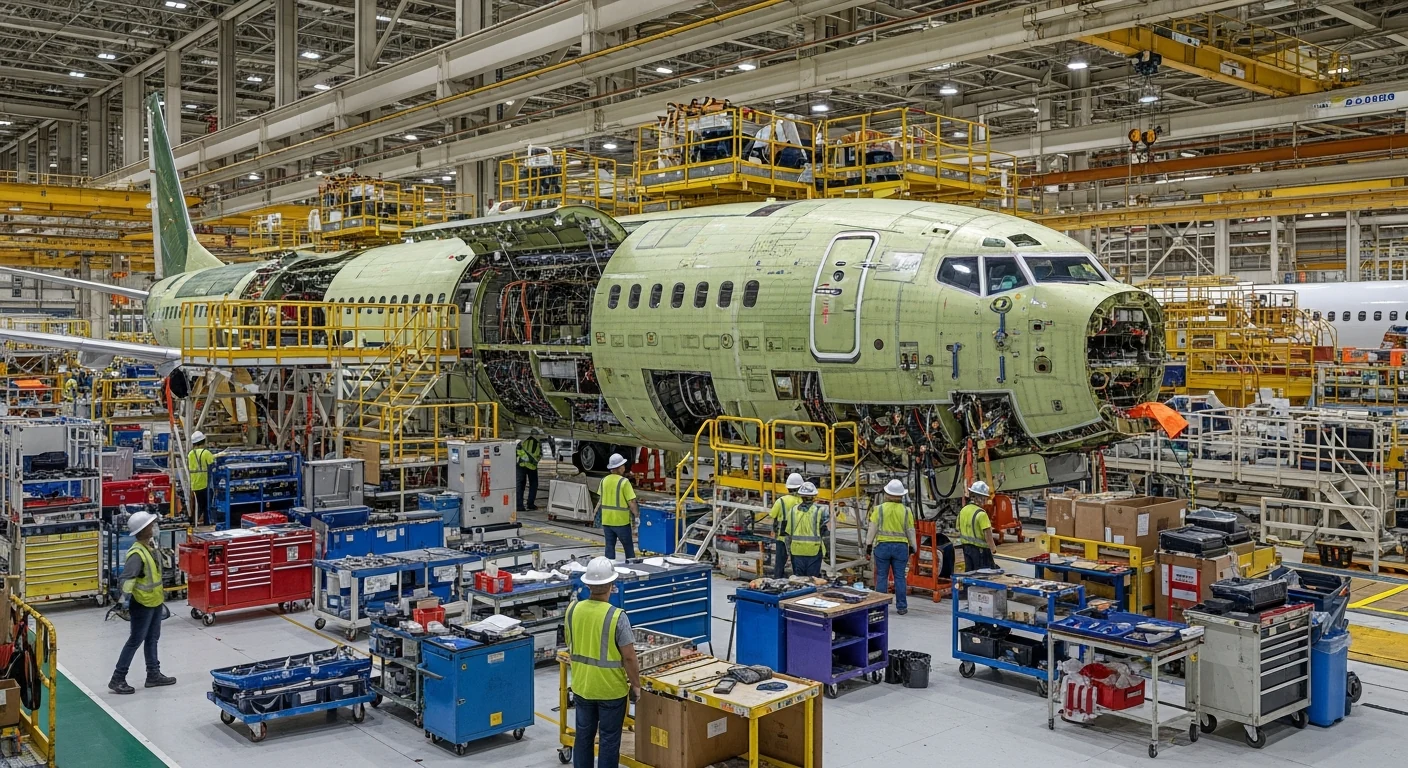
Q: Where will Boeing build the 737 MAX 10?
A: Boeing confirmed the 737 MAX 10 will be produced exclusively at the new North Line at the Everett factory at Paine Field, opened July 2026 (Boeing North Line feature). The MAX 10 is Boeing's longest 737 variant and will not be built at the existing Renton facility. With over 1,200 orders on the books from airlines including United, Ryanair, American, and Delta, Everett is now the sole production site for the industry's most-ordered undelivered narrowbody variant.
With Boeing's North Line open at the Everett factory (July 14, 2026 opening feature), it is not just another production line. It will be the only place on earth where the Boeing 737 MAX 10 gets built.
That distinction matters more than it might seem at first. The MAX 10 is Boeing's longest and highest-capacity 737 variant. It seats up to 230 passengers in a high-density configuration, making it the narrowbody option for airlines trying to squeeze maximum economics out of a single-aisle jet. And as of the start of 2026, it has accumulated more than 1,200 firm orders — placing it among the most heavily ordered undelivered commercial aircraft in aviation history. Every single one of those aircraft will be built at Paine Field, Everett, Snohomish County.
The certification that unlocks all of those deliveries is still pending FAA approval, expected to complete in 2026. But the production infrastructure — the line that will build the first of those 1,200-plus jets — is taking shape now. The workforce is training. The tooling is installed. The North Line is scheduled to open at low-rate initial production (LRIP) this summer.
Why the MAX 10 Goes to Everett and Not Renton
Boeing's existing 737 production is entirely at Renton, Washington — three parallel assembly lines producing the MAX 8, MAX 9, and other variants at the facility that has built 737s since 1967. Adding the MAX 10 at Renton would require either displacing an existing line or building additional capacity in an already constrained campus.
Everett offered something Renton could not: space. The Boeing Everett Factory at Paine Field is the largest building in the world by volume, originally constructed for the 747 program. As widebody programs have evolved and the 747 ended production, floor space became available for new purposes. The North Line occupies that freed-up real estate.
The MAX 10's physical size also factors in. At 143.8 feet long — 66 inches longer than the MAX 9 and requiring modified landing gear with a new semi-levered bogie to maintain ground clearance — the MAX 10 is the most dimensionally complex 737 variant to build. Routing it to a new, purpose-configured line in Everett, rather than trying to integrate it into Renton's existing flow, gives Boeing tighter control over tooling and process standardization for what is still a new configuration.
The practical result: Everett becomes the home of the MAX 10 for the foreseeable future of the program.
The Order Book: 1,200-Plus and What It Represents
More than 1,200 firm orders for the MAX 10 is not an abstract number. It is the work order for Everett's North Line, measured in individual aircraft that will each require assembly, quality checks, systems installation, and delivery to an airline customer somewhere in the world.
The customer list reads like a roll call of global aviation's largest operators. United Airlines holds 167 MAX 10s — the U.S. carrier with the largest single MAX 10 order. Ryanair, Europe's largest low-cost carrier, has 150 on order. American Airlines has committed to 115. Delta Air Lines, historically a Boeing skeptic that spent years flying Airbus A321s, placed an order for 100 MAX 10s, a significant statement of confidence in the variant and in Boeing's recovery.
Other operators round out the book: Southwest Airlines, IndiGo, Lion Air Group, and others have positions in the queue. Each will eventually take delivery from the Paine Field line. Combined, they represent years of production — and years of economic activity in Snohomish County.
For context: Boeing's current approved production rate for all 737 variants is 42 per month at Renton. The North Line will add capacity incrementally as it stabilizes. Boeing's next target rate — 47 jets per month across all lines — is now confirmed for 2027, not 2026, as the FAA requires demonstrated quality performance before approving any rate increase. The long-run goal remains 63 per month. The North Line is the essential bridge to those higher numbers.
Certification First — Without It, None of This Happens
There is an important sequence dependency here that every observer of the Everett story should understand: the MAX 10 cannot be delivered to any of those 1,200-plus customers until the FAA certifies it. That certification is expected in 2026, but it has not yet been granted.
The MAX 10 has been in certification limbo since a 2022 Congressional deadline was not met, requiring Boeing to re-engage with the FAA on the certification pathway. The path forward involves the PC700 amendment — an agreement on what additional compliance work the MAX 10 must complete — and flight testing with conformity aircraft. Boeing has been publicly confident that 2026 certification is achievable, and the April 2026 North Line opening at LRIP is predicated on that timeline.
The North Line opening at low-rate initial production before certification is not unusual. LRIP aircraft serve as conformity airplanes for the FAA certification process — each one built to production-standard specs and inspected to verify that the manufacturing process matches the certified design. Building those aircraft in Everett is itself part of the certification workflow, not a bypass of it.
Once the FAA signs off on the MAX 10, deliveries can begin. The aircraft that United, Ryanair, American, and Delta have been waiting for will start flowing from Paine Field. That transition — from conformity aircraft to delivery aircraft on the same line — is the moment Everett's North Line earns its place in Boeing's permanent production footprint.
What This Means for Everett's Economy
The aerospace workforce in Snohomish County numbers approximately 42,000 direct employees at Boeing and its supply chain. The 5,200-worker shortage projected through end of 2026 — driven by retirement velocity, time-to-productivity at scale, and housing economics — has been one of the defining labor stories of the North Line ramp-up.
The MAX 10's exclusive assignment to Everett locks that workforce relationship in for the program's foreseeable life. As long as Boeing is building MAX 10s — and with 1,200-plus orders representing potentially a decade-plus of production at current rates — the Paine Field facility needs the assemblers, technicians, inspectors, and engineers to build them. The IAM 751 Machinists Institute at 8729 Airport Road, the WATR Center, Everett Community College, and Edmonds College are all building training pipelines toward this specific demand.
The supply chain picture is similarly significant. Boeing's integration of Spirit AeroSystems, completed in late 2025, brought the fuselage supplier's Wichita and other operations under Boeing's banner. Snohomish County's 600-plus aerospace supplier companies — from precision machining shops to composites fabricators — will see MAX 10 work flow into their order books as the line scales.
The widebody story at Paine Field — the 777-9 certification path, the 777-8F freighter program, the KC-46 tanker backlog — gets most of the public attention because those programs are larger and more visually dramatic. The MAX 10 story is quieter, but in terms of sheer unit volume and long-run economic contribution to Everett, it may end up being the most consequential production decision Boeing has made about this factory in years.
More than 1,200 airplanes. All of them built right here.
Related reading: Boeing Rate 47 and Everett's North Line | MAX 7 and MAX 10 Certification on Track for 2026 | What Is LRIP? The FAA Conformity Process Explained
Frequently Asked Questions
Why will the Boeing 737 MAX 10 only be built in Everett?
Boeing assigned the MAX 10 exclusively to the new North Line at the Everett factory at Paine Field. Everett has the available floor space freed up from the 747 program's end, and the MAX 10's longer fuselage and specialized landing gear made a dedicated production line more efficient than integrating it into Renton's existing flow.
How many Boeing 737 MAX 10 orders are there?
Boeing has received more than 1,200 firm orders for the 737 MAX 10. Major customers include United Airlines (167), Ryanair (150), American Airlines (115), and Delta Air Lines (100), plus Southwest, IndiGo, Lion Air Group, and others.
When will the Boeing 737 MAX 10 be certified?
Boeing expects FAA certification of the 737 MAX 10 in 2026. The program is proceeding through conformity aircraft and flight testing under the PC700 amendment framework. Certification must be complete before any MAX 10 can be delivered to airline customers.
When does the Boeing North Line in Everett open?
Boeing opened the North Line in July 2026 and is in low-rate initial production (LRIP) (July feature). The line will initially build conformity aircraft for the MAX 10 FAA certification process, then transition to commercial deliveries once certification is complete.
How does the MAX 10 differ from the MAX 9?
The 737 MAX 10 is 66 inches longer than the MAX 9, reaching 143.8 feet total length. It seats up to 230 passengers and features a semi-levered landing gear bogie design to maintain ground clearance despite the longer fuselage. It is Boeing's direct competitor to the Airbus A321neo.
Leave a Reply