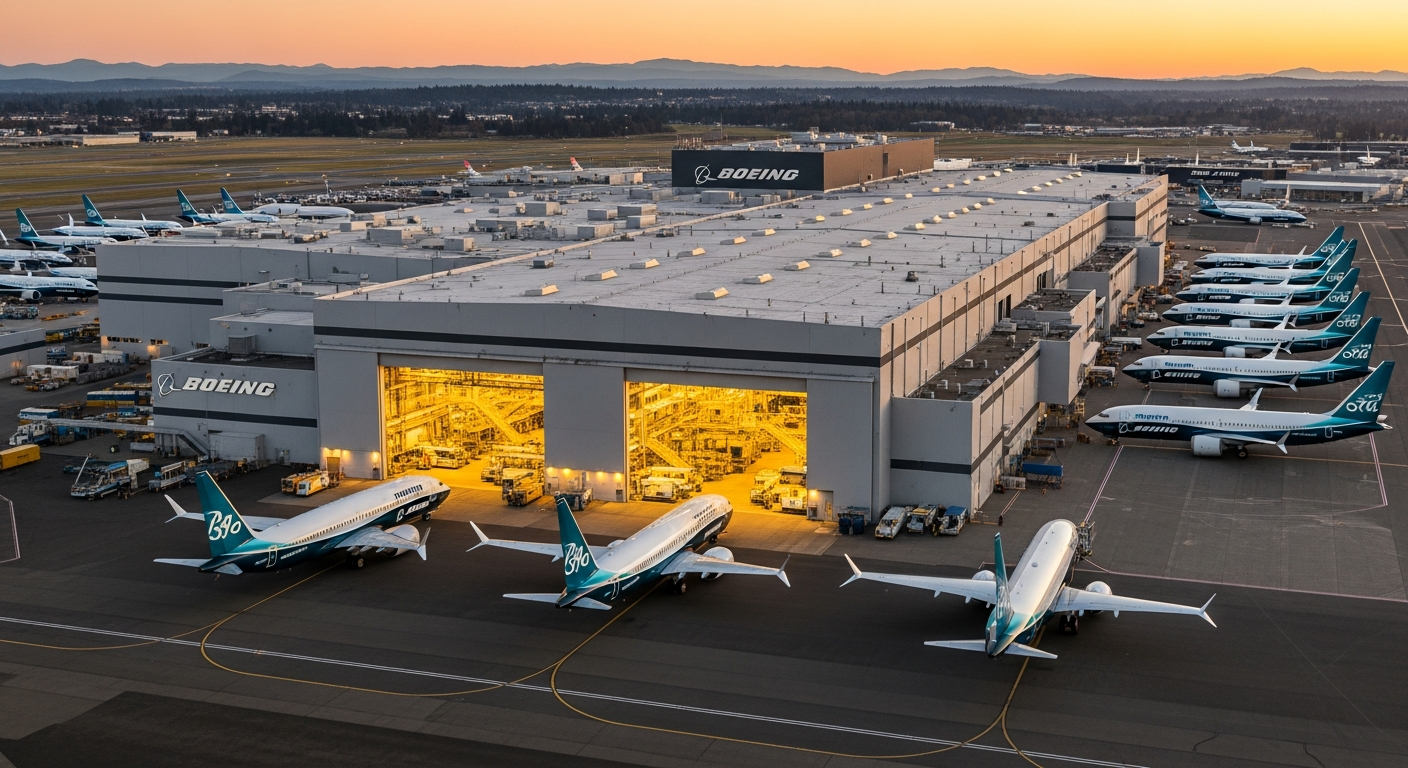
What does Boeing 737 production rate 47 mean? Rate 47 refers to building 47 aircraft per month — up from the current 42 — across Boeing’s 737 MAX assembly operations. CEO Kelly Ortberg confirmed on Boeing’s Q1 2026 earnings call that rate 47 will be reached this summer. The North Line in Everett is specifically designed to add capacity for production rates above 47, enabling Boeing to eventually reach 53 or more aircraft per month.
Boeing Rate 47 Is Coming — And Everett’s North Line Is the Factory That Makes 53 Possible
There is a number that matters more to Everett’s aerospace future than almost any other right now: 47.
That is the target monthly production rate for Boeing’s 737 MAX program — 47 aircraft per month — which Boeing CEO Kelly Ortberg confirmed on the company’s April 22, 2026 quarterly earnings call is arriving “this summer.” To reach it, Boeing had to earn back the FAA’s trust after a disastrous 2024, restructure its fuselage supply chain through the acquisition of Spirit AeroSystems, and hold 42 aircraft per month long enough to prove repeatable quality at scale.
The path is now clear. Everett sits directly in the middle of what comes next.
The Long Road Back to Rate Momentum
To understand what rate 47 means, you have to understand where Boeing was two years ago.
In early 2024, a door plug blew out of an Alaska Airlines 737 MAX 9 at 16,000 feet over Oregon. The FAA grounded the fleet for inspections, launched investigations into Boeing’s quality management system, and ultimately capped 737 production at 38 aircraft per month until quality could be demonstrably rebuilt. It was the single most consequential production restriction Boeing had faced in the modern era.
By October 2025, the FAA lifted the cap to 42 per month — a measured endorsement of the quality improvements Boeing had made under CEO Ortberg, who took over the company in late 2024 with a mandate to fix the culture and the processes simultaneously. Each quality milestone — including the completion of all 25 wiring-affected MAX jets — was a rung on the ladder back to rate momentum.
Then came the Spirit AeroSystems acquisition, which closed in December 2025. Spirit had been Boeing’s largest fuselage supplier — and the source of documented quality problems including misdrilled fastener holes on the same fuselage sections involved in the door plug incident. Bringing Spirit back inside Boeing gave the company “nose-to-tail” control over the most critical structural components of the 737 for the first time in more than two decades.
That integration — approximately 15,000 Spirit employees across Wichita, Dallas, Tulsa, and Prestwick, Scotland now working directly for Boeing — combined with consistently passing FAA quality audits at rate 42, is what earned Boeing the regulatory confidence to pursue rate 47 in 2026.
Rate 47 vs. Rate 53: The Sequence That Defines Everett’s Role
Boeing’s public target is not just rate 47. It is rate 53 by year-end 2026 and eventually 57 and beyond. The sequence matters.
At rate 47, the Renton factory is operating near its optimized physical capacity. The buildings, tooling, and number of flow stations were engineered around a specific throughput ceiling. To reach 53 per month, Boeing does not simply speed up Renton. It needs a second factory contributing real aircraft to the monthly total.
That factory is the North Line in Everett.
When Boeing says the North Line will add capacity “for production rates above 47 airplanes per month,” it is using deliberate language. The North Line does not compete with Renton’s rate 47 achievement — it supplements it. The combined throughput of Renton at full rate plus the North Line at operational cadence is how Boeing reaches 53. And beyond 53, the math becomes even more dependent on Everett.
Spirit AeroSystems: The Acquisition That Changed the Quality Math
The Spirit AeroSystems deal deserves more attention than it typically receives in Everett coverage, because its completion is directly tied to Boeing’s ability to secure rate approvals from the FAA.
Spirit was spun out of Boeing in 2005. For two decades it operated as an independent supplier, producing 737 fuselage sections in Wichita and shipping them to Renton for final assembly. The relationship was efficient in theory but created accountability gaps in practice — when quality problems arose, Boeing and Spirit sometimes argued over ownership of the defect and responsibility for the rework.
The $8.3 billion acquisition (including assumed debt) ended that ambiguity. The fuselage that arrives in Renton now comes from a Boeing facility. The FAA audits one quality management system instead of a contractor relationship. For Everett, this matters because the North Line will receive fuselage sections from what is now Boeing Wichita — built under the same quality standards, training requirements, and oversight structure as Renton. That consistency was a prerequisite for FAA confidence in higher rates.
What Rate 47 Means for Everett Right Now
At 42 aircraft per month, Boeing is delivering more than 500 jets per year — roughly the level the airline industry needs for fleet renewal at current demand. At 47 per month, that is closer to 565 jets per year. At 53, over 635.
For Everett’s economy, the difference between 42 and 47 is not abstract. It is jobs, overtime, supplier contracts, and purchase orders flowing through Snohomish County’s aerospace ecosystem. Every additional 737 per month that flows through the North Line generates work at the composites shops, avionics installers, specialty machining firms, and logistics operations that orbit the Paine Field campus.
The North Line team is already being assembled. Hundreds of mechanics and electricians are currently training at Renton, completing structured on-the-job rotations before returning to Everett when the line opens. The people building the North Line are already at work preparing for it. Boeing has been hiring 100 to 140 new factory workers per week across its Everett and Renton operations. The workforce pipeline through the IAM 751 Machinists Institute, EvCC, Edmonds College, and the Washington Aerospace Training and Research Center is active.
Housing prices and rental vacancy in North Everett and the Paine Field corridor have been under pressure precisely because this expansion was anticipated. The North Line’s opening will not reduce that pressure — it will intensify it. Everett’s planners, school administrators, and housing advocates have been watching this moment build for two years.
The Longer Game: Everett as Boeing’s Narrowbody Growth Engine
Rate 47 is a waypoint, not a destination. Boeing’s guidance to investors points toward 57 aircraft per month by the end of the decade. At those numbers, the combined capacity of Renton and the North Line will eventually need supplementing as well. Boeing has signaled that additional production infrastructure beyond the North Line may be necessary to hit ultimate output targets.
What this means for Everett is that the North Line is not a one-time story. It is the first chapter in a period where Everett’s 737 production role grows substantially. For a workforce that watched Boeing’s Everett campus get redefined over the last decade — the 747 program ended, 787 work consolidated in South Carolina, widebody employment contracted — the North Line is the first major expansion of Everett’s role in Boeing’s narrowbody future.
And given the demand math — airlines still queued for hundreds of jets, Airbus production constrained by its own supply chain — there is no near-term scenario in which Boeing needs fewer 737s than it can build. With MAX 7 and MAX 10 certification on track for 2026, the order book deepens further. The North Line will not be idle.
Frequently Asked Questions
What is Boeing 737 production rate 47?
Rate 47 means Boeing assembles 47 737 MAX aircraft per month. The company currently builds 42 per month at Renton. CEO Kelly Ortberg confirmed on Boeing’s Q1 2026 earnings call that rate 47 will be reached this summer, with 53 per month targeted by year-end 2026.
Why does rate 47 matter for Everett?
Rate 47 is the production level at which Renton’s existing factory approaches its physical throughput ceiling. Boeing needs the North Line in Everett to reach higher rates — 53, 57, and beyond. Every aircraft per month that flows through the North Line represents direct Everett jobs and Snohomish County supplier activity.
Has the FAA approved Boeing’s move to rate 47?
Yes. After the production cap imposed following the 2024 door plug incident, the FAA progressively cleared Boeing to increase production — first to 42 per month in October 2025, then establishing the quality foundation for the summer 2026 move to 47. Boeing’s quality management improvements and the Spirit AeroSystems integration were key factors in building FAA confidence.
What did Spirit AeroSystems have to do with Boeing’s rate increase?
Spirit AeroSystems was Boeing’s primary 737 fuselage supplier for 20 years. Boeing acquired Spirit in December 2025, bringing approximately 15,000 employees into the company. This gave Boeing unified quality control over the 737 fuselage — a key factor in FAA approval of higher production rates.
When will the North Line start contributing to Boeing’s monthly output?
The North Line opens in summer 2026 and will go through a low rate initial production (LRIP) phase first. Full integration into Boeing’s overall production flow comes after FAA conformity testing under production certificate PC700 is complete. Its contribution to monthly totals will ramp up gradually through late 2026 and into 2027.
What is Boeing’s long-term production rate target?
Boeing aims for 53 per month by end of 2026, with targets of 57 and higher by the end of the decade. At those rates, the combined capacity of Renton and the North Line becomes the production backbone of Boeing’s narrowbody program, with Everett playing an increasingly central role.
Leave a Reply