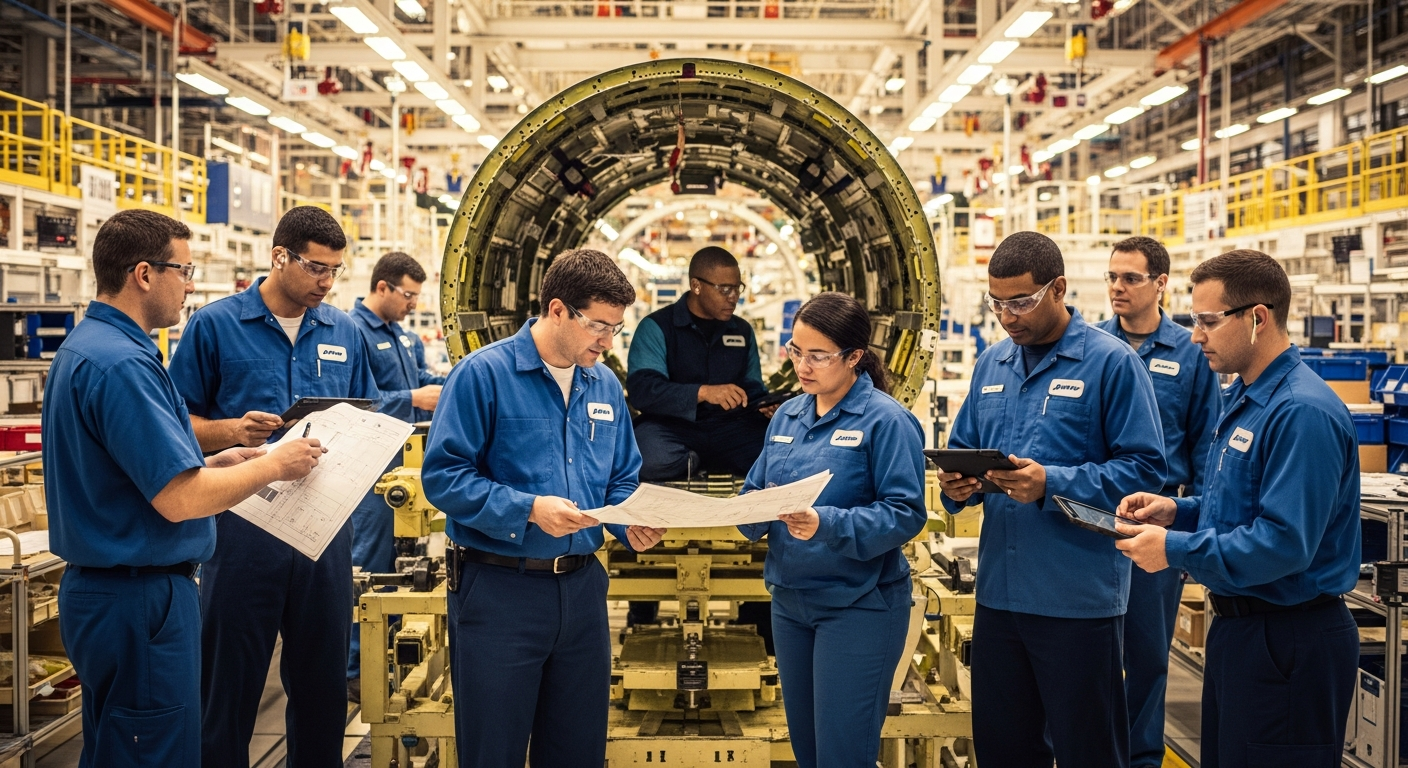
What is the Boeing North Line? The North Line is Boeing’s new fourth 737 MAX assembly line at the Everett factory, opened in July 2026 (Boeing July 10 feature; July 14 opening). The team includes newly hired mechanics and veterans from Renton, Everett, and Moses Lake, all completing 12 weeks of Foundational Training and structured on-the-job training in Renton before returning home to Everett.
Meet the Workers Building Boeing’s New Everett 737 Line
When Boeing CEO Kelly Ortberg toured the 737 North Line recently, he wasn’t walking through an empty hangar. He was walking through a production facility about to become one of the most significant additions to Everett’s manufacturing economy in decades — and the people getting it ready are already deep into their training.
Boeing opened its fourth 737 MAX assembly line in July 2026 at the Everett factory (April team-readiness feature; July production feature), marking the first time in the program’s history that 737s will be built outside of Renton. The North Line will be capable of producing all 737 MAX variants — the -8, -9, and the long-awaited -10 now on track for 2026 certification — and its purpose is direct: add the buffer Boeing needs to push past 47 aircraft per month sustainably.
But behind the production targets and the rate charts, there are real people making this happen. A 40-year Boeing veteran learning his first 737 job. A newly hired electrician who joined Boeing in late 2025 because the North Line was unlike anything she’d done before. A mechanic installing dorsal fins on Flow Day 1, proud of the responsibility. This is their story — and Everett’s.
The Veterans: Bringing Widebody Experience to a Narrowbody Line
John V. has spent nearly four decades at Boeing. He has worked on 747s, 767s, and 777s — the widebody backbone of Everett’s aerospace identity. Now, as an FAA and customer coordinator for the North Line, he is about to work on a 737 for the first time in his career.
“This will be my first time working on the 737 program,” John told Boeing.com in an April 2026 feature about North Line team readiness. “But we are doing the training right. Even folks like me who have been around for a long time are in Renton now getting familiar with the program and the product before the North Line starts.”
That is the point of the staffing approach Boeing has taken for the North Line: pair experienced mechanics who know Boeing’s culture, quality standards, and production systems with the specific knowledge of the 737 program. Veterans like John bring institutional memory — they know how a production line is supposed to feel, what a quality issue looks like before it becomes a defect count, and how to hold a floor accountable to its own standards.
Boeing is drawing the North Line team from three existing facilities: Renton, Everett, and Moses Lake. Renton mechanics know the 737 intimately. Everett mechanics know the factory and the community. Moses Lake mechanics bring ferry flight and preparation experience. The blend is intentional, and it reflects lessons Boeing has learned hard over the last two years about what happens when production knowledge gets siloed.
The New Hires: First Teammates on a Historic Line
Jaden M. and Alondra P. represent a different cohort: they joined Boeing in late 2025 as among the first people specifically hired for the 737 North Line. They are not transfers from an existing program. They are the founding generation.
Jaden installs the dorsal fin in Flow Day 1 — the early stage of assembly where the airplane’s structural backbone begins to take shape. For someone new to the industry, landing a job on the opening team of a brand-new production line is an unusual opportunity.
“Opening a new production line is something special,” Jaden said in Boeing’s April feature. “So, we have to do it right. Training went smooth and I’m excited and ready to get home to our shop in Everett.”
The training path both Jaden and Alondra went through is the same path hundreds more will follow as the North Line scales up. It starts with 12 weeks of Foundational Training — a structured curriculum covering 737 assembly tools, processes, quality standards, and safety practices. That is followed by structured on-the-job training (SOJT), which pairs new mechanics with experienced teammates to bridge classroom learning and the actual production floor.
SOJT for the North Line team happens in Renton. Everett workers-in-training are commuting to the Renton facility, working on active production jets, and building the muscle memory they’ll need when the Everett line opens. The first aircraft built on the North Line — the conformity airplanes built under FAA supervision during LRIP for production certificate PC700 — will be built by people who have already assembled jets in Renton.
Alondra works as an electrician for Flow Day 1. Electrical problems caught early are cheap. Electrical problems found three flow days later are expensive. Putting experienced, well-trained electricians at the front of the line is a deliberate quality decision.
“Training was so positive and refreshing,” Alondra said. “It was different than any training I’ve done from other jobs. My managers and the workplace coaches were always there to make sure I got my questions answered and felt confident in my work.”
The Wing Transport Tool: What Makes Everett Different
There is one major difference between how a 737 is built in Renton and how it will be built in Everett: 737 wings are manufactured at Renton, not Everett.
At Renton, wings and fuselage sections flow through the factory in close physical proximity. At Everett, that is not possible. So Boeing developed the 737 Wing Transport Tool — specialized ground support equipment that will ferry partially completed wings from Renton to Everett for final assembly.
The Wing Transport Tool is a reminder that the North Line required genuine engineering problem-solving, not just additional floor space. It will become as familiar to Everett aerospace workers as the riveting tools and electrical harnesses they work with every day.
What “Above 47 Per Month” Actually Means for Everett
Boeing’s public language about the North Line’s purpose is precise: it will add capacity for production rates above 47 airplanes per month. Rate 47 is Renton’s milestone. The North Line is the growth vehicle beyond it.
Boeing currently builds 42 737 MAXs per month at Renton. The company aims to reach 47 by summer and 53 per month by end of 2026. At 53/month, Renton’s physical capacity is effectively at ceiling. The North Line in Everett becomes the relief valve — and Everett’s workers become Boeing’s production growth engine for the decade ahead.
The ripple effect into Snohomish County’s supplier network is real. The composites shops, the avionics installers, the specialty machining firms — every additional 737 per month flowing through the North Line generates purchase orders across the county. The IAM 751 Machinists Institute two miles from the factory is already part of the workforce pipeline that makes this expansion viable.
The North Line is coming to Everett not in spite of the community but because of it: because the workforce infrastructure exists, because the training pipeline is active, and because the community has spent 40 years building the industrial base to support exactly this kind of expansion.
What Comes Next
Between now and the summer launch, the North Line team will complete SOJT in Renton, return to Everett, and begin LRIP — building the first conformity aircraft at intentionally slow flow times with extra quality checks at each station. When the FAA signs off on those aircraft under PC700, the North Line joins Boeing’s full production system and begins ramping toward its design capacity.
For the workers in training right now — Jaden and Alondra and John and hundreds of their teammates — that timeline is already real. They are getting ready to come home to Everett, to their shop, to their line.
For a city that has built its economic identity around Boeing for nearly a century, that is worth paying attention to.
Frequently Asked Questions
What is the Boeing 737 North Line in Everett?
The Boeing 737 North Line is a new fourth 737 MAX assembly line at Boeing’s Everett factory, scheduled to open in summer 2026. It will be the first time 737s are manufactured in Everett and will add production capacity for rates above 47 aircraft per month.
Who is being hired for the North Line?
The North Line team includes newly hired mechanics who completed 12 weeks of Foundational Training, plus experienced Boeing employees transferring from Renton, Everett, and Moses Lake. All teammates complete structured on-the-job training (SOJT) in Renton before the Everett line opens.
What training do North Line workers go through?
Workers complete 12 weeks of Foundational Training followed by SOJT in Renton, working alongside experienced 737 mechanics before returning to Everett when the line opens.
What is the 737 Wing Transport Tool?
The Wing Transport Tool is specialized equipment Boeing developed to transport partially completed 737 wings from the Renton factory to Everett for final assembly — needed because 737 wings are built in Renton, not Everett.
When will the Boeing North Line open?
Boeing has confirmed a summer 2026 launch. The exact date has not been publicly announced. The line will first go through a low rate initial production (LRIP) phase under FAA supervision before full production begins.
How many jobs will the North Line create in Everett?
Boeing has been hiring 100 to 140 new factory workers per week across its Everett and Renton operations. The North Line will ultimately require hundreds of mechanics, electricians, quality inspectors, and support staff based in Everett.
Leave a Reply