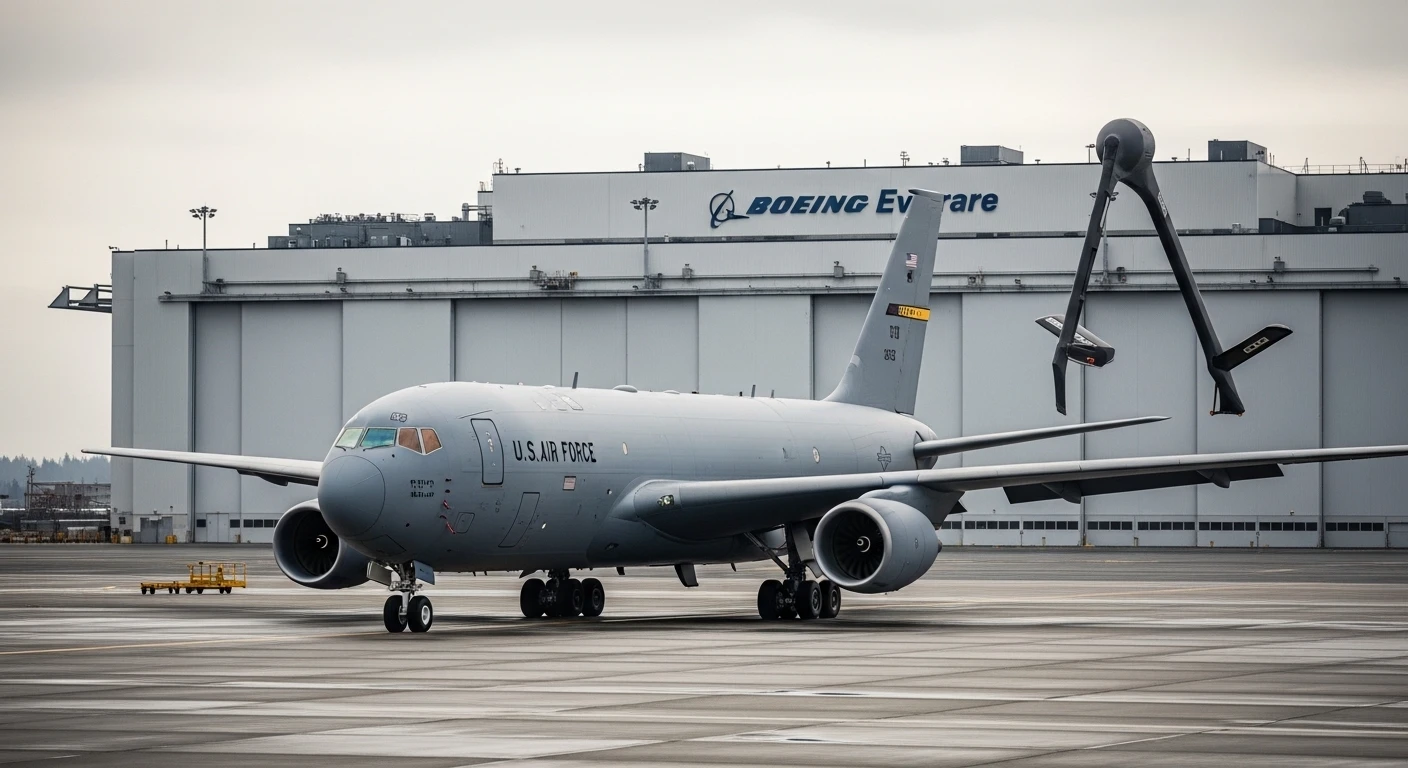
The quick version: On April 3, 2026, airmen from the 22nd Air Refueling Wing flew Boeing’s 105th KC-46A Pegasus tanker out of Everett’s Paine Field on its way to McConnell Air Force Base in Kansas. The delivery passed the halfway point of the Air Force’s current 179-aircraft program of record. Boeing plans to deliver 19 KC-46s in 2026 — up from 14 in 2025 — and the Everett-built tanker line is one of the only Boeing defense programs still running in steady production at the factory.
While most of Everett’s Boeing news this spring has focused on the 737 North Line standup and the 777X’s production flight, a quieter, steadier story has been unfolding on the opposite end of the factory ramp: the KC-46A Pegasus tanker line, Boeing’s Air Force refueling aircraft, just crossed a significant milestone with its 105th delivery — and Everett has 18 more on the 2026 manifest.
The tanker line is not glamorous. It doesn’t make headlines the way a widebody reveal does. But for the workforce that builds it and the suppliers that feed it, the KC-46 is one of the most consistent defense programs in the Pacific Northwest. It’s also one of the clearest signs of what Boeing’s Everett factory looks like when it’s running steady.
Here’s what the 105th delivery tells us about the program, the year, and Everett.
What actually happened on April 3
On April 3, 2026, a crew from McConnell Air Force Base’s 22nd Air Refueling Wing flew up to Paine Field, walked the aircraft acceptance process, and ferried a brand-new KC-46A out of Everett. The crew included members of the 22nd Operations Group, 22nd Maintenance Group, and 22nd Medical Group. The first leg of the delivery flight — Paine Field to Travis Air Force Base in California — had USTRANSCOM Director of Operations Brig. Gen. Corey Simmons in the commander’s seat.
Get The Signal
What we actually ran, what it measured, and what it means for a restoration shop — every week, including the flops.
The final leg from Travis to McConnell was flown by Maj. Kyle Haydel, a 22nd Operations Group KC-46 pilot, and wasn’t just a routine delivery. It was Haydel’s “fini flight” — the traditional final flight of an Air Force pilot’s career or assignment, ceremonially celebrated with a water-cannon salute on arrival.
That kind of moment is worth noting because it’s the human end of what otherwise reads like a procurement milestone. The 105th tanker is a data point; the crew that picked it up in Everett is a career.
Where the program stands
The Air Force’s current KC-46 program of record is 179 aircraft. The 105th delivery means the fleet is well past the halfway point, with enough tankers in service that the KC-46 is now doing real operational work — not just test and training missions. McConnell AFB in Wichita, Kansas remains the operational center of gravity for the program, with tankers stationed at several other Air Force bases nationwide and additional deliveries planned for allied nations.
The program has also been significantly extended beyond the original 179. Under the Tanker Production Extension (TPE) plan, the Air Force is targeting 263 total KC-46 aircraft by 2030, with 88 planes from the original order still in production and 75 more under the extension. Boeing was awarded a $2.4 billion contract for 15 additional tankers in late 2024, and further awards have followed.
For Everett, this is the kind of defense work that’s actually durable. The 767-based airframe that underpins the KC-46 is the reason Boeing extended 767 production past its original planned 2027 sunset: starting in 2027, Everett will build the 767-2C aircraft solely to support the KC-46A line, preserving the Everett tanker production capability for the remainder of the decade.
The 19-aircraft 2026 plan
The headline operational number for this year is simple: Boeing delivered 14 KC-46s in 2025 and plans to deliver 19 in 2026. That’s a 35% year-over-year increase in delivery rate, and it tracks with what program observers have been expecting — Boeing is working through backlog while the TPE contracts move into production.
Nineteen tankers in a year sounds modest compared to commercial widebody rates, but defense production has its own rhythm. Each KC-46 delivery requires customer acceptance by the Air Force, weapons-system testing certification on the refueling boom and Remote Vision System, and coordination with the receiving unit’s flight crews. McConnell, Travis, Pease, Seymour Johnson, and the other bases in the KC-46 network don’t just take delivery — they integrate each aircraft into existing rotations.
For the Everett workforce, the ramp from 14 to 19 means steady hiring needs on the KC-46 line specifically, in addition to the much larger 737 North Line and 777X workforces ramping in parallel. The IAM 751 machinists who physically assemble the tanker line, the SPEEA engineers and technical workers who sign off on certifications, and the supplier network from Renton to Auburn to Frederickson all see the tick-up.
The $565 million question
No honest piece about the KC-46 leaves out the program’s financial pattern. Boeing took another $565 million charge on the KC-46 program in its Q4 2025 earnings — the latest in a long series of program losses that have become an almost routine feature of Boeing’s defense earnings calls.
The KC-46 is a fixed-price contract. When modifications, rework, or schedule slips happen, Boeing absorbs the cost rather than passing it on to the Air Force. The program has been a durable source of losses since its early production years. Whether the 2025 charge is a one-off or part of a continuing pattern is something Boeing leadership will have to address at the next earnings call.
For Everett, the takeaway is that the tanker program keeps producing airplanes and paychecks even while it produces accounting losses. Fixed-price-driven losses are Boeing corporate’s problem. Production runs are the factory’s reality.
Why Everett’s tanker line matters beyond Boeing
Four angles, each worth a sentence or two:
Allied customers. The tanker isn’t just an Air Force platform. Boeing holds KC-46 orders for four aircraft for Israel and two for Japan, in addition to the 54-plus Air Force tails still in production. International deliveries move through the same Everett line and extend the program’s runway.
The 767 cover. The KC-46 is the single biggest reason the 767-2C is still being built at Paine Field. Without the tanker program, Boeing’s commercial 767 Freighter is scheduled to end production in 2027, which would have idled the 767 line entirely. The tanker keeps the tooling, supply chain, and workforce warm for the rest of the decade.
Supplier pull-through. Snohomish County’s 600-plus aerospace suppliers work across many Boeing programs, but the KC-46 has a distinct parts profile — boom systems, communications, defensive countermeasures — that pulls in a specific tier of suppliers. A 35% delivery ramp this year is a meaningful order book for those shops.
Defense workforce continuity. When Boeing engineers and technical workers bargain SPEEA’s contract later this year, one of the quiet variables in the room is the health of the defense programs. A steady-delivery KC-46 line is an argument for stable defense staffing at Everett through the end of the decade.
The view from Paine Field
If you’re walking the perimeter road on the east side of Paine Field in the late afternoon this spring, the KC-46 line is the easiest Boeing program to spot. The airframes are the distinctive 767 shape in Air Force gray, with the refueling boom folded into its housing on the belly and the Remote Vision System fairing on the tail. Tankers sit on the flight line ahead of acceptance testing, and the occasional delivery crew from McConnell or Travis cycles through.
From the public viewing lot at the Future of Flight, you can usually see one or two KC-46s at various stages of completion from any given week. The program doesn’t draw tour-bus crowds the way the 777X or 737 lines do — but it’s the most consistent visual evidence, year-round, that Everett still builds airplanes for the U.S. Air Force.
What’s next
Eighteen more KC-46 deliveries are scheduled between now and year-end. The next near-term milestone is the 106th delivery — expected in coming weeks — and continued ramp toward the 19-aircraft 2026 total.
Beyond that: ongoing TPE-contract production, the ramp into 767-2C-only production in 2027, and, further out, the program’s continued march toward the 263-tanker target by 2030. None of those are breaking-news moments. They’re just the steady backbone of what Boeing Everett does when it’s running well.
Sometimes that’s the story.
Frequently Asked Questions
When was the 105th KC-46 delivered from Boeing’s Everett factory? April 3, 2026. The aircraft was flown to McConnell Air Force Base in Kansas via Travis Air Force Base.
How many KC-46 tankers will Boeing deliver in 2026? Boeing plans to deliver 19 KC-46 tankers in 2026, up from 14 delivered in 2025.
Where is the KC-46 Pegasus tanker built? The KC-46A Pegasus is built at Boeing’s Everett factory at Paine Field in Everett, Washington. It is derived from the Boeing 767 airframe.
How many KC-46s has the Air Force ordered from Boeing? The current program of record is 179 aircraft, with plans to grow to 263 aircraft by 2030 under the Tanker Production Extension plan. The Air Force has received 105 tankers as of April 2026.
Does the KC-46 program also serve foreign customers? Yes. Boeing has confirmed orders for four KC-46s for Israel and two for Japan, in addition to the U.S. Air Force production.
Why is the KC-46 important for Everett even after the 767 commercial line ends? Starting in 2027, Boeing plans to produce 767-2C aircraft solely to support the KC-46A tanker program, keeping the 767 line running at Paine Field through the rest of the decade.
Has the KC-46 program been profitable for Boeing? No. The KC-46 is a fixed-price contract and has generated repeated program losses for Boeing, including a $565 million charge recorded in Q4 2025. However, the production line continues to deliver aircraft on schedule and Boeing Everett continues to employ the tanker workforce.
Who built and flew the 105th KC-46 delivery? The aircraft was built at Boeing’s Everett factory. The delivery flight was crewed by airmen from the 22nd Operations Group, 22nd Maintenance Group, and 22nd Medical Group at McConnell Air Force Base, with the final leg flown by Maj. Kyle Haydel as his “fini flight.”
Get The Signal
What we actually ran, what it measured, and what it means for a restoration shop — every week, including the flops.
Leave a Reply