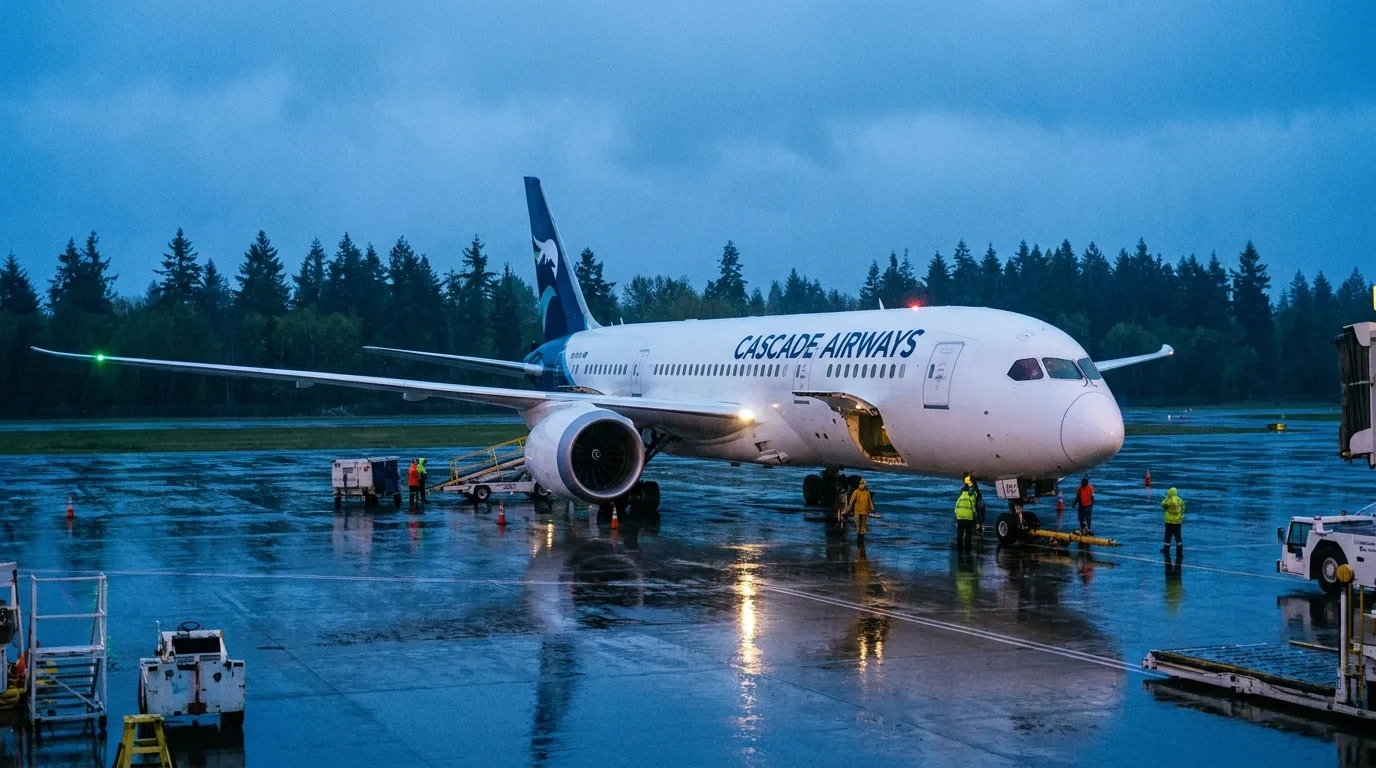
Q: What happened on May 7, 2026, at Paine Field?
A: Boeing flew the first production-standard 777-9 — registration N20080, serial 1781 — from Paine Field for 3 hours and 27 minutes over Washington and Oregon. For the first time, a 777-9 flew with Lufthansa’s full Allegris passenger cabin installed. It is a critical milestone on the path to Lufthansa’s Q1 2027 delivery.
For more than a decade, the Boeing 777X has carried the weight of expectation and the cost of delay. Certification postponements, COVID disruptions, structural modifications, and a rework queue of 30-plus aircraft sitting in the Paine Field storage yard — the story has been more about patience than progress.
Thursday, May 7, 2026, moved the needle.
At approximately 1:40 p.m. local time, the first production-standard Boeing 777-9 — registration N20080, serial number 1781, Boeing test designation WH128 — lifted off from Paine Field in Everett, Washington. It returned 3 hours and 27 minutes later, having flown a standard test profile over Washington state and Oregon, climbed to 39,000 feet, and reached a top speed of 492 knots. Boeing test pilots Ted Grady and Jake Miller were at the controls.
What made this flight different from everything that came before it: the cabin was fully dressed. Not instrumented for flight testing, not filled with ballast or avionics rigs — Lufthansa’s Allegris premium cabin, complete with upgraded First Class suites, Business Class seating, Premium Economy, Economy, and a fully installed in-flight entertainment system, was aboard. That’s the interior real passengers will board when the jet enters Lufthansa service next year.
What “Production-Standard” Actually Means
Boeing has been flying 777X aircraft out of Paine Field since January 2020. The dedicated test fleet — six aircraft built specifically for the certification program — carried flight-test instrumentation, temporary interiors, and equipment configurations that differed significantly from a passenger-ready jet. Those aircraft exist to gather data, not to mimic what an airline will receive.
N20080 is built to the same specification Boeing will use for every subsequent Lufthansa delivery. That includes the composite wing with folding wingtips, GE9X engines, a fuselage configured to maintain a 6,000-foot cabin altitude (versus the conventional 8,000 feet on older jets — a detail that meaningfully reduces passenger fatigue on 12-hour flights), and all the interior systems Lufthansa will actually operate.
When a production-standard aircraft completes its maiden flight without anomalies, it provides the FAA and Boeing with a fundamentally different data set than test-aircraft flights. It’s evidence that the manufacturing process works end-to-end — that the factory at Paine Field is building planes that fly, not just designs that flew once in prototype form.
That confirmation matters enormously for the 777X certification timeline and for the workers who’ve been building these jets.
The Flight Profile and the Hot Brake Test
Pilots Grady and Miller flew N20080 on a standard first-flight profile — climbs, level cruising, turns, and system checks across the Washington and Oregon airspace. Flight tracking data confirmed the altitude and speed figures Boeing provided.
The flight also included a high-speed rejected takeoff — a test where pilots accelerate the aircraft to approximately 190 knots before applying full braking. The goal is to heat the wheel brakes to their design limits. During this event, the brake temperature rose high enough that small metal fuse plugs embedded in the wheel rims — designed to melt at a specific threshold and release tire air pressure before a tire can burst — did exactly what they were engineered to do.
They melted. Boeing confirmed the result was expected. It sounds alarming when described out of context, but it’s evidence of a correctly engineered safety system working under its design conditions.
Everett’s 777-9 Workforce and the Rework Backlog
Boeing CEO Kelly Ortberg, speaking during the company’s Q1 2026 earnings call on April 22, acknowledged that change incorporation on the stored 777-9 and 777-8F aircraft at Paine Field will take “years.” A May 3 Leeham News analysis quoted Ortberg directly on the timeline, framing the roughly 30-35 production jets parked in the storage yard as a “pretty massive activity” that needs systematic scheduling before deliveries can accelerate.
That backlog is a financial headache for Boeing’s balance sheet. But for the Everett workforce, it has a different meaning: sustained work.
Mechanics, quality inspectors, systems integrators, and engineers working on the 777X program at Paine Field aren’t facing a cliff. The combination of new-build production — continuing to produce 777-9s and 777-8F freighters for the global order book — and the multi-year change incorporation effort on stored jets means the widebody floor at Everett has a work runway that extends well into the late 2020s.
The program’s current delivery target has Lufthansa receiving its first 777-9 in Q1 2027. After Lufthansa, the delivery queue runs to airlines including Emirates, Qatar Airways, Singapore Airlines, and Cathay Pacific — a backlog of hundreds of aircraft that will take the better part of a decade to fulfill.
What This Means for Paine Field
Paine Field is Boeing’s widebody campus. The 40.3 million-square-foot Everett complex builds the 777X family, the 767 commercial freighter (through 2027), and the KC-46 military tanker on adjacent production floors. The workforce is organized around high-precision, long-cycle assembly work that has no real equivalent elsewhere in American manufacturing.
For that workforce, the May 7 flight carries a specific significance: it’s the first time Boeing showed that Paine Field’s assembly process produces complete, airline-configured 777-9s that actually fly. The 777-9 simulator qualification earlier this year proved that pilot training infrastructure is ready. The Phase 4A Type Inspection Authorization earlier in 2026 proved the design cleared a critical regulatory gate. The May 7 flight proved the jets coming off the Everett floor work.
N20080 now enters Boeing’s standard production flight-test sequence — additional sorties over the coming weeks to complete the data package required before the aircraft receives its Lufthansa livery and enters the final documentation process for type certification. If the Q1 2027 delivery holds, this aircraft will be carrying passengers within the next year.
For Everett, the longer arc of that story runs through thousands of workers, billions of dollars of local economic activity, and a production program that defines what this city builds. Thursday’s flight was one data point. But it was a good one.
Frequently Asked Questions
How is the May 7 production flight different from earlier 777X flights?
Earlier 777X flights used dedicated test aircraft without full passenger cabins. N20080 is a production-standard aircraft built to Lufthansa’s delivery specification — with the full Allegris interior installed. It’s the first 777-9 built exactly as it will be delivered to an airline.
When is Lufthansa’s first 777-9 delivery scheduled?
Boeing and Lufthansa are targeting Q1 2027 for the first 777-9 delivery. Lufthansa has 20 777-9 orders in its fleet plan.
What is the fuse plug test?
During a high-speed rejected takeoff, brakes heat the wheels to design-limit temperatures. Fuse plugs are small metal inserts engineered to melt at that threshold, releasing tire air before a blowout occurs. The test proved the system worked correctly.
How many 777-9s are stored at Paine Field?
Boeing has approximately 30-35 production 777-9 and 777-8F aircraft stored at Paine Field, each requiring change incorporation work before delivery. CEO Ortberg has confirmed this process will take years.
Who are the pilots who flew N20080?
Boeing test pilots Ted Grady and Jake Miller piloted the aircraft on its May 7 maiden flight.
What is the 6,000-foot cabin altitude and why does it matter?
Conventional airliners maintain cabin pressure equivalent to 8,000 feet altitude. The 777-9’s composite fuselage allows Boeing to maintain a 6,000-foot equivalent — meaning less ear-popping, better hydration retention, and reduced fatigue for passengers on long-haul flights.
Leave a Reply