Tag: Everett Infrastructure

  • Everett-Delta Transmission Line: PUD Just Held Open Houses for a 3.5-Mile 115-kV Line That Connects to the Waterfront Corridor

    Everett-Delta Transmission Line: PUD Just Held Open Houses for a 3.5-Mile 115-kV Line That Connects to the Waterfront Corridor

    Everett-Delta Transmission Line: PUD Just Held Open Houses for a 3.5-Mile 115-kV Line That Connects to the Waterfront Corridor

    What is the Everett-Delta transmission line? Snohomish County PUD’s planned 3.5-mile 115-kV line that connects the Everett Substation (west of I-5 between McDougall and Smith) to the Delta Switching Station (just north of the SR 529 / West Marine View Drive interchange in north Everett). PUD hosted two public open houses on May 7, 2026 at PUD headquarters at 2320 California Street. The line is engineered to support growing electrical demand in and around Everett and prevent low-voltage conditions if local power is interrupted. Construction is targeted to begin in spring 2027, with the line in service by summer 2027.

    If you live in Everett and you have been wondering why a public utility line on the north end has been getting more attention this spring, here is the short version: Snohomish County PUD is building the infrastructure backbone that the waterfront, downtown, and north-Everett construction wave actually rides on.

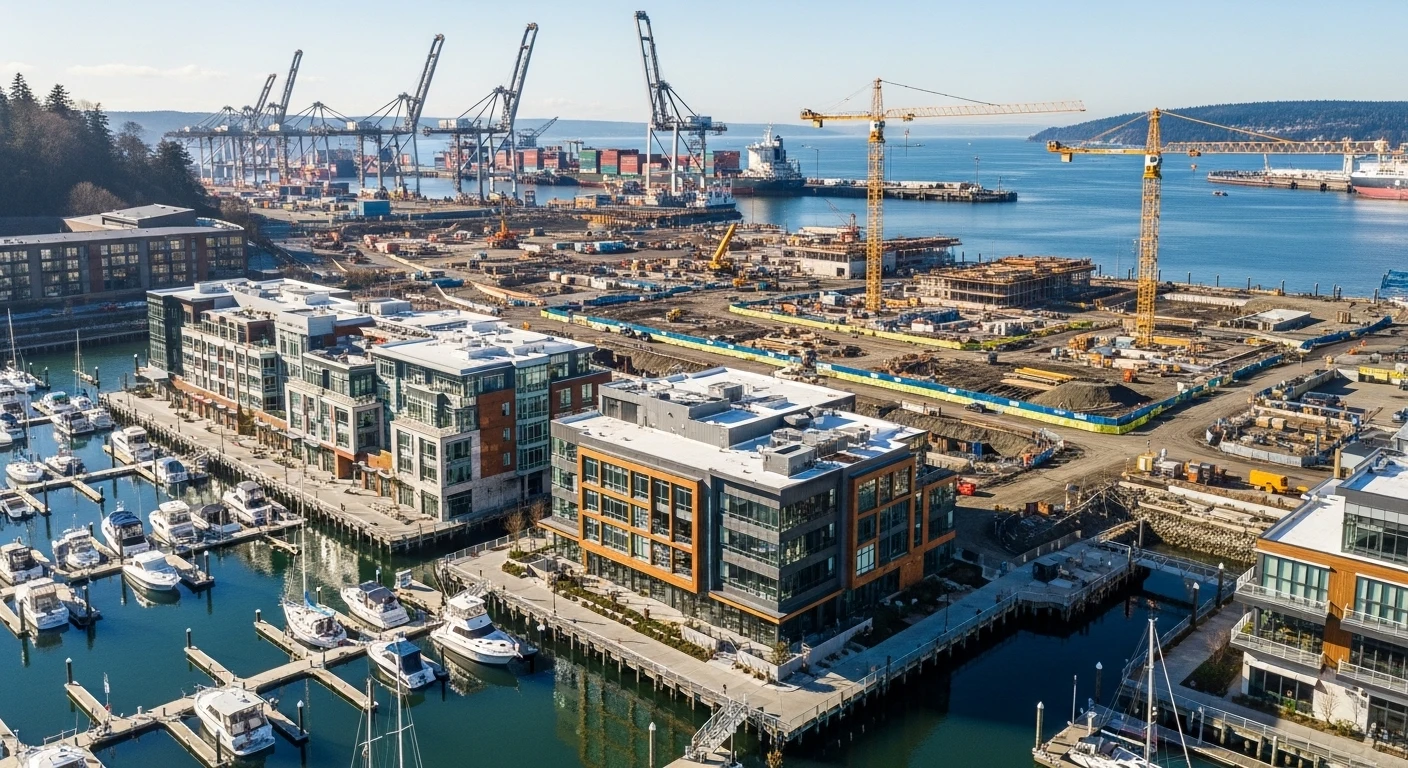
    We stopped by the PUD open house messaging on May 7 — two sessions, 4 to 5:30 p.m. and 6 to 7:30 p.m., both at PUD headquarters at 2320 California Street in Everett — and what is striking is how directly this line maps to the development corridor we have been covering for months. The new Everett-Delta 115-kV transmission line connects two existing PUD assets that bracket the heart of the city: the Everett Substation, sitting just west of Interstate 5 between McDougall Avenue and Smith Avenue and north of 36th Street, and the Delta Switching Station, sitting just north of the State Route 529 / West Marine View Drive interchange in north Everett. That is the same West Marine View Drive corridor where the $113 million pipeline project, the Edgewater Bridge, and the Port of Everett’s terminal investments are all stacking up.

    Why this line is being built now

    PUD’s case for the new line is direct: increasing electrical demand in and around the city of Everett, and the need to keep voltage stable if local power is interrupted. That language is unsexy, but the substance is enormous. Everett is in the middle of a once-in-a-generation building wave — the Millwright District Phase 2’s 300-plus apartments, the Sage Investment Group conversion of the 9602 19th Street SE Econo Lodge to 124 studios, the Riverfront’s Eclipse Mill Park buildout, the downtown stadium with September 2026 groundbreaking ahead of it, and Skotdal Real Estate’s seven-story 102-unit Mosaic Apartments going up on Pacific Avenue. Every one of those projects pulls more load off the grid.

    A 115-kV line is the kind of mid-tier transmission that connects the bigger backbone to local substations. It is not a transmission “highway” in the BPA-scale sense, but it is the layer that determines whether neighborhoods can plug in the heat pumps, EV chargers, induction ranges, and apartment-tower elevator loads that follow new construction. Without it, fast-growing cities can hit a wall where the substation is fine, but the lines connecting substations cannot handle the swing.

    PUD’s stated benefit list pairs load growth with reliability — and in a city that has been adding new construction along West Marine View Drive at an unusual rate, the reliability part matters as much as the headroom. If local generation is interrupted, the new line gives operators a way to keep voltage from sagging at the Delta Switching Station — which feeds the north-Everett waterfront corridor directly.

    What the line will actually look like

    The new transmission structures will be similar in design and height to PUD’s existing 115-kV poles already in Everett — ductile iron and/or steel poles, similar profile to what is already in the corridor. PUD has stated that in the summer of 2025 it solicited community input on aesthetic enhancements, and the project page indicates that input will continue to inform the final route execution.

    The total length is approximately 3.5 miles, which puts this project on the smaller end of PUD’s current 2026 transmission projects (the Crosswind 115-kV line in Arlington, by comparison, is a different geography and ties into the new Crosswind Substation at the PUD’s North County Campus in Smokey Point). But the Everett-Delta line is the one that lands inside the city limits we cover.

    Timing — and why it matters for the waterfront

    PUD’s timing language is specific. With a route now chosen, the project moves to detailed engineering, permitting, right-of-way acquisition, and construction. PUD estimates the line will be in service by summer 2027.

    That is the same 2026-2027 window when the West Marine View Drive pipeline goes underground (the $113M combined sewer + 48-inch water main project the city approved on April 2), when Bayley Construction’s stadium site survey turns into vertical concrete in September 2026, and when Millwright District Phase 2 starts moving from site work into building shells. PUD building the transmission headroom in the same window means the grid is being prepped for the load that is about to land — not after.

    For the city’s part, the construction-window pause for the FIFA World Cup this summer (no in-road construction June through September in 2026 or 2027) keeps the corridor visible for waterfront events. PUD’s spring 2027 construction start sidesteps that political minefield by design.

    How this fits with everything else under construction

    If you have been reading the Waterfront & Development desk regularly, the names should be stacking up: the Lenora Regional Stormwater Treatment Facility (an $8.7M state-grant-funded plant breaking ground at S 1st & Lenora in Lowell this spring); the Port Gardner Storage Facility (a $200M+ combined sewer overflow project the state Department of Ecology ordered Everett to build); Port of Everett’s Segment E bulkhead final phase ($6.75M, 165 linear feet of wood-to-steel pile rebuild on West Marine View Drive); the federal $11.25M PIDP grant for Pier 3 structural rebuild; and the West Marine View Drive pipeline approved April 2.

    The Everett-Delta transmission line is the electrical leg of that same infrastructure stool. None of the apartments going up at Waterfront Place, the Mosaic, or Millwright Phase 2 generate their own power. They draw it from a system that has to grow in lockstep with the density.

    If you missed the May 7 open houses, the project page is still active and the PUD outreach team is still soliciting feedback on construction-impact mitigation. The full route map and FAQ live on PUD’s system improvements page.

    What we are watching next

    Three things on this line worth tracking through the rest of 2026:

    1. Right-of-way acquisition — PUD has chosen a route, but the easement and parcel-by-parcel acquisition work is where transmission projects get slow. Any contested takings will land on the Snohomish County PUD Commission’s monthly agenda. The commission meets at PUD HQ and the meeting cadence is on the snopud.com calendar.

    2. Permitting timeline — SEPA review and any City of Everett right-of-way permits required will be visible in the city’s permitting portal. A 3.5-mile transmission alignment through an urbanizing corridor typically generates a stack of structural and traffic-control permits even before vertical work starts.

    3. Coordination with the West Marine View Drive pipeline — Two major linear infrastructure projects in the same general corridor in the same window need to coordinate trench windows, utility crossings, and traffic control. The Everett Public Works team has run that gauntlet before (most recently on the Edgewater Bridge crossing of I-5), but the load is real.

    For now, the headline is simple. The grid is getting reinforced exactly where the city is getting denser. Everett’s transformation is being engineered, one transmission pole and one 48-inch pipe at a time.

    Frequently Asked Questions

    When will the Everett-Delta transmission line be in service? Snohomish County PUD estimates the line will be in service by summer 2027. Construction is scheduled to begin in spring 2027 and take approximately six months, following completion of detailed engineering, permitting, and right-of-way acquisition through 2026.

    How long is the Everett-Delta 115-kV transmission line? The line is approximately 3.5 miles long. It connects the existing Everett Substation, located west of I-5 between McDougall and Smith Avenues north of 36th Street, to the Delta Switching Station, located just north of the SR 529 / West Marine View Drive interchange in north Everett.

    Why does Snohomish County PUD need this new transmission line? Two reasons: to support increasing electrical demand in and around the city of Everett, and to maintain voltage stability and reliability if local power is interrupted. The line creates additional system capacity to serve the waterfront, downtown, and north-Everett construction wave.

    Where were the Everett-Delta open houses held? Both open houses were held on May 7, 2026 at Snohomish County PUD headquarters, 2320 California Street, Everett, WA 98201. Sessions ran 4 to 5:30 p.m. and 6 to 7:30 p.m., with identical content at each.

    What will the new transmission poles look like? The new transmission line and structures will be similar in design and height to the PUD’s existing 115-kV structures already in Everett, using ductile iron and/or steel poles. PUD solicited community input on aesthetic enhancements in summer 2025.

    How does this transmission line connect to Everett’s waterfront development? The Delta Switching Station endpoint sits just north of the SR 529 / West Marine View Drive interchange — the same corridor where Everett is investing in the $113 million pipeline project, the Edgewater Bridge, Port of Everett terminal infrastructure, and the Eclipse Mill Park / Shelter Holdings riverfront buildout. The new line adds transmission headroom to serve growing loads from new apartment construction, EV charging, and electrified buildings along that corridor.

    Where can residents track project progress and provide input? The project page lives on Snohomish County PUD’s system improvements website at snopud.com, and PUD Commission meetings are open to the public at the PUD HQ at 2320 California Street.

  • The Work Has Already Started: Bayley Construction Is Surveying Everett’s Stadium Site — and the City Has 15 Parcels to Acquire

    The Work Has Already Started: Bayley Construction Is Surveying Everett’s Stadium Site — and the City Has 15 Parcels to Acquire

    Q: Has construction work actually started on the Everett stadium?
    A: Yes — the city has awarded a $200,000 limited early work agreement to Bayley Construction to begin site surveying on the 12.5-acre downtown parcel. Meanwhile, the city needs to acquire 15 separate properties before groundbreaking, with 2 purchase-and-sale agreements signed, 4 pending, and 8 in active negotiation.

    Ten days after the Everett City Council voted to release $10.6 million in design and acquisition funding for the new downtown stadium, the physical work has begun.

    Bayley Construction, the Mercer Island-based general contractor selected as part of the DLR Group/Bayley design-build team, has received a $200,000 limited early work agreement to begin site surveying on the stadium’s 12.5-acre parcel on Everett’s downtown east side, between Angel of the Winds Arena and Interstate 5. This is the moment when the stadium shifts from a city council decision to a job that has people on the actual ground.

    At the same time, the city is working through an acquisition list of 15 separate properties it needs to purchase before any heavy construction can begin — and the status of that acquisition is more complex than a single timeline suggests.

    The property acquisition scorecard

    Before Bayley can do much more than survey, the city needs to acquire 15 parcels that sit within the stadium’s footprint. Here’s where that stands as of early May 2026:

    • 2 parcels: Purchase-and-sale agreements signed. Finalized and done.
    • 4 parcels: Agreements pending. Terms are agreed upon; paperwork in final stages.
    • 8 parcels: Active negotiations. The city is in conversation with owners; no agreements yet.
    • 1 parcel: Being formally added to the acquisition list. Not publicly identified.

    Of the $10.6 million the council approved April 29, about $5.6 million is earmarked specifically for property acquisition. The remaining funds cover continued design work with DLR Group, permitting, and other pre-construction costs.

    The math on 15 parcels averaging out to roughly $370,000 each reflects a mix of small commercial lots, surface parking, and light industrial parcels scattered across the stadium footprint east of Angel of the Winds Arena. The 2 signed agreements and 4 pending deals suggest the more straightforward cases are closing first. The 8 active negotiations are the ones worth watching.

    DLR Group and Bayley Construction: who’s building this

    The design-build team selection was completed before the April 29 vote. The city used a Progressive Design Build process, and DLR Group/Bayley Construction scored highest among the finalists.

    DLR Group is the global architecture firm with a Seattle office that’s been doing the stadium design work. Their renderings show the open-air design: 5,000-seat capacity, a covered premium club area with seating for 200 and standing room for 400, and ADA-accessible sight lines throughout.

    Bayley Construction is the contractor that will build it. Headquartered on Mercer Island, they have prior experience in sports facility construction including the University of Washington Husky Ballpark. The $200,000 early work agreement for site surveying is the first physical contract they’re executing — before the full design-build contract, which will come back to the City Council for approval within the next several months.

    The site: 12.5 acres east of Angel of the Winds Arena

    The stadium site is approximately 12.5 acres on the eastern edge of downtown Everett, directly adjacent to Angel of the Winds Arena and roughly a half-mile west of Interstate 5. The proximity to the arena has been deliberate — city planners have been thinking about the two facilities as a combined entertainment district, not just adjacent buildings, capable of drawing people downtown for multiple reasons on the same block.

    The AquaSox opening target of April 2027 creates the deadline that’s driving everything: a September 2026 groundbreaking is required to hit that date. That’s roughly four months away from where we stand today.

    The $25 million gap that still needs to close

    Even with the $10.6 million approved and the design-build team conducting survey work, the stadium project still carries a funding gap. Total project cost is now approximately $118 million. Current committed or anticipated funding falls roughly $25 million short — a gap the city is working to close through state funding requests, naming rights negotiations, and other sources being tracked by Council Vice President Paula Rhyne’s Finance and Administration Committee.

    We’ve covered the four-step pathway from the April 29 vote to groundbreaking in earlier coverage. What’s new today is that while the governance process continues upstairs at City Hall, the physical pre-development process is starting on the ground. That’s the right posture for a project with this little margin in its timeline.

    Three milestones to watch

    Whether the September 2026 groundbreaking timeline holds will come down to three things:

    1. Property acquisition progress — specifically whether the 8 parcels in active negotiation move to signed agreements by early summer. A holdout owner or legal challenge could push the timeline. The city has eminent domain authority, but using it adds time and cost.
    2. Final design-build contract approval — that City Council vote will include the full contract value and a revised cost estimate. If DLR Group’s number has moved from the $82 million design-to-budget figure, that’s significant news.
    3. The $25 million funding gap — naming rights negotiations and state funding requests have to land before groundbreaking. The FAC meetings are where this closes or doesn’t.

    We’ll be tracking all three. The survey work starting now is the right signal — the city isn’t waiting for the funding gap to close before beginning the physical pre-development sequence. That discipline matters when you have 11 months between today and Opening Day 2027.

    Frequently Asked Questions

    Who is building the Everett downtown stadium?

    The design-build team is DLR Group (architecture, Seattle office) and Bayley Construction (general contractor, Mercer Island). Bayley has received a $200,000 limited early work agreement to begin site surveying — the first physical contract on the project.

    When will the Everett stadium break ground?

    The city’s target is September 2026. That timeline requires acquiring 15 parcels, closing a roughly $25 million funding gap, and approving the full design-build contract — all within approximately four months.

    How many properties does the city need to acquire for the stadium?

    15 parcels total. As of early May 2026: 2 purchase-and-sale agreements signed, 4 agreements pending, 8 in active negotiation, and 1 more being added to the list.

    How big is the new Everett stadium?

    The new multipurpose outdoor stadium will seat 5,000 with a covered premium club area seating 200 plus 400 standing. The site covers approximately 12.5 acres east of Angel of the Winds Arena in downtown Everett.

    How much will the new Everett stadium cost?

    The current total estimate is approximately $118 million. The April 29 council vote released $10.6 million, of which about $5.6 million is for property acquisition. A funding gap of roughly $25 million remains to be closed.

    When will the AquaSox play their first game at the new stadium?

    The target is April 2027 — but that requires the September 2026 groundbreaking timeline to hold through property acquisition, final contract approval, and gap funding closure.

  • The Vote Passed. Now Here Are the Four Steps Between Today and Everett’s September 2026 Stadium Groundbreaking

    The Vote Passed. Now Here Are the Four Steps Between Today and Everett’s September 2026 Stadium Groundbreaking

    What comes next after the April 29 stadium vote? The council approved $10.6 million in design and acquisition funding — but that decision set four more in motion. Here is the exact sequence of decisions Everett must make before a shovel goes in the ground in September 2026, and what could still stop it.

    The April 29 Vote Was Not the Finish Line

    When the Everett City Council voted 6-1 on April 29 to approve an additional $10.6 million for the downtown stadium project, it made the biggest single step forward in the three-year effort to keep the Everett AquaSox in town and bring United Soccer League teams to a new outdoor venue. But it was a step, not the finish line.

    Council member Scott Bader put it precisely in remarks before the vote: “certain dominoes have to fall before the next domino can fall.” The $10.6 million approval was one domino. There are four more between today and a September 2026 groundbreaking — each dependent on the one before it.

    Here is what those four dominoes look like, where they stand, and what can still knock them over.

    Domino 1: The Stadium Fiscal Advisory Committee Reconvenes

    Immediately after the April 29 vote concluded, Council Vice President Paula Rhyne made a formal request: reconvene the Stadium Fiscal Advisory Committee before the council takes any further binding financial action on the stadium project.

    The Fiscal Advisory Committee was formed in 2024 to provide independent financial analysis of the stadium’s funding structure. It was active during the design-build procurement process but has not been formally reconvened since the project’s cost escalated to $120 million and the funding gap came into clearer focus.

    Rhyne’s request reflects a real concern that has been raised by multiple council members and community members: the city has not yet published detailed financial statements showing exactly how a stadium construction bond would be structured, repaid, and serviced. Former council member Scott Murphy voiced the same concern at the April 29 meeting: “There’s a big difference between having an economic development study and discussion around $100 million and seeing it on a piece of paper to understand how that will actually service the debt.”

    The committee’s work sets the terms under which the council can responsibly proceed to the bond vote. Until it completes its review, the bond vote cannot happen.

    Domino 2: Property Acquisitions

    The April 29 package allocated $5.6 million toward acquiring the remaining properties needed for the 12.5-acre stadium site. City staff reported that 14 property acquisition offers have been made: some purchase agreements are already completed, others are still pending.

    The stadium site is located north of Pacific Street between Broadway and Smith Avenue, adjacent to Angel of the Winds Arena. Full site control — meaning every parcel acquired — is required before construction can begin. The timeline depends on how quickly the remaining property negotiations close.

    The city has already allocated approximately $7.2 million in capital funds on the project before this vote, including prior property acquisition work and consulting fees. The new $5.6 million extends that work to the final parcels. City staff project that all properties can be acquired by fall 2026, which keeps the September groundbreaking timeline alive — but any negotiation that drags into litigation could push that date.

    Domino 3: The Bond Vote (~July or August 2026)

    The $10.6 million the council approved on April 29 was funded as an interfund loan from the city’s general fund — a bridge loan the city is lending to itself, structured to be repaid in a few months from a construction bond. The bond vote is the next major council decision, expected in July or August 2026.

    The bond package is expected to exceed $30 million. The full stadium budget is $120 million, which includes the $7.4 million state grant the council unanimously accepted on April 29, plus the $17 million the AquaSox and United Soccer League have agreed to contribute under their 30-year lease terms, plus the city’s accumulated $7.2 million in prior capital expenditures, plus the new $10.6 million package.

    There is still a funding gap of approximately $25 million — about 21% of the project’s cost. The city is pursuing public-private partnerships to close it. Economic development director Dan Eernissee has argued the gap is manageable: “We know this is going to be our growth area. We are counting on lots of residents to be in this downtown core, and we’re strategically investing before that time in real estate that can serve as an urban park, that can serve as a destination, can serve as a connector between our transit hub and downtown jobs.”

    The risk is clearly understood. Interim finance director Mike Bailey said at the April 29 meeting: “There’s an element of risk here. Again, we believe it’s manageable, or we wouldn’t have proposed it.” If the bond vote fails or a major contributor backs out before the bond is issued, the city faces the cost of repaying the interfund loan from its general fund — though some of that exposure is offset by the property acquisition component, which creates tangible city-owned assets.

    Domino 4: September 2026 Groundbreaking

    If the Fiscal Advisory Committee completes its work, the property acquisitions close, and the bond vote passes, construction can begin in September 2026. The design-build team — DLR Group (architecture, based in Seattle) and Bayley Construction (general contractor, based in Mercer Island) — is already active. DLR Group has designed multiple sports stadiums including Alex Box Stadium at LSU; Bayley Construction’s previous design-build work includes Husky Ballpark at the University of Washington.

    The design is roughly 60% complete. The facility will include 5,000 seats, a premium club section with a covered deck seating 200 (400 standing), a clubhouse building with team locker rooms and batting cages, an artificial turf field convertible between baseball and soccer layouts in a matter of hours, and a public walking path around the perimeter. The main entrance is planned for where Wall Street meets Broadway.

    The construction timeline targets completion by late 2027, in time for the Everett AquaSox to open their 2028 season at the new venue. The AquaSox have been explicit that without a new stadium, MLB’s requirements could force the franchise to relocate — which is why council member Bader framed the April 29 vote as a crossroads moment: “If we don’t move forward on this, I think the AquaSox will leave town and MLB will tell them to do that.”

    The One Unresolved Question: USL Team Ownership

    The AquaSox and United Soccer League have agreed to the financial terms of a 30-year lease for the new venue. But USL still needs to find an owner or ownership group to purchase the expansion teams that would actually play in the facility. That ownership search is ongoing. It doesn’t block the construction decision directly, but it remains an important loose end in the stadium’s long-term financial picture — since the lease revenue from the soccer teams is built into the stadium’s revenue projections.

    Labor and Community Perspective

    Labor representatives who spoke at the April 29 meeting were uniformly supportive. The city plans to use prevailing wages and apprenticeship requirements in the construction contracts. As Miguel Edmonson told the council: “I have some apprentices that have to go down to Tacoma for work. They’d be able to live here and work here and be a part of this community while they’re on the clock and then when they get off the clock.”

    Resident Erryn Guilfoyle framed the stadium’s strategic value as a second downtown anchor: “Right now, downtown Everett has Angel of the Winds arena. A stadium nearby would give us a second anchor that changes what downtown becomes. People park once and stay longer. They spend their time and their money downtown instead of somewhere else, and the businesses around them feel the difference.”

    Not everyone is convinced. Council member Judy Tuohy — the lone dissenting vote on April 29 — said explicitly: “My vote tonight is not a vote against the project. It’s really a vote of caution regarding the city’s financial risk. We need to ensure the funding foundation is in place before we commit more of our city dollars.” Her concerns will almost certainly surface again when the bond package comes before the council this summer.

    The Bottom Line: A Tight but Survivable Timeline

    For the September groundbreaking to happen, the Fiscal Advisory Committee needs to complete its review, property acquisitions need to close, and the bond vote needs to pass — all between now and late August. That is doable. It is also genuinely uncertain.

    The April 29 vote was the biggest single step this project has taken. The next step — the Fiscal Advisory Committee reconvening and the bond structure taking shape — will tell us whether September is a real target or an optimistic one. We’ll be watching closely.

    You can also review the full construction tracker for major Everett projects to see how the stadium fits into the broader development picture downtown.

    Frequently Asked Questions

    When will Everett break ground on the new stadium?

    The city is targeting September 2026, contingent on completing property acquisitions and passing a construction bond vote expected in July or August 2026.

    How much will the Everett stadium cost?

    The total project cost is $120 million. Funding sources include a $7.4 million state grant, $17 million from AquaSox and USL lease commitments, approximately $17.8 million in city capital and interfund funds, and a construction bond of $30+ million still to be voted on. A funding gap of approximately $25 million (21% of total) is being addressed through public-private partnerships.

    Who is building the Everett stadium?

    The design-build team is DLR Group (architecture) and Bayley Construction (general contractor). DLR Group is a global architecture firm with a Seattle office; Bayley Construction is a Mercer Island-based GC whose previous work includes Husky Ballpark at the University of Washington.

    What teams will play at the new Everett stadium?

    The Everett AquaSox (MLB High-A affiliate) and two United Soccer League expansion teams (men’s and women’s) are planned tenants under a 30-year lease agreement. USL still needs to identify ownership groups for the soccer teams.

    What is the Everett Stadium Fiscal Advisory Committee?

    The Stadium Fiscal Advisory Committee is an independent body formed in 2024 to review the financial structure and risks of the stadium project. Council Vice President Paula Rhyne requested at the April 29 meeting that it be reconvened to review the final bond financing plan before the council votes on the full funding package, expected this summer.

    When will the new Everett stadium open?

    The current target is late 2027, with the Everett AquaSox hoping to open their 2028 baseball season at the new venue.

  • What 15 Years and $350 Million Built: The Port of Everett Story That Other Cities Are Now Studying

    What 15 Years and $350 Million Built: The Port of Everett Story That Other Cities Are Now Studying

    What does a successful waterfront transformation actually look like? The Port of Everett spent 15 years and $350 million finding out — surviving a developer bankruptcy, a recession, and its own false starts. Today, Cascadia Daily News named it the regional blueprint other cities are studying. Here is the full story of how Everett got here, and what comes next.

    A Major Pacific Northwest Outlet Just Called Port of Everett the Waterfront Model

    Cascadia Daily News, the Pacific Northwest’s most-read regional outlet, published a deep feature today as part of its four-part “Sea Change” series examining waterfront redevelopment across Western Washington. Part two focuses entirely on the Port of Everett’s Waterfront Place — and it positions Everett as the benchmark that other ports, including Bellingham, are now studying.

    The headline says it plainly: “After a bankrupt developer and broken promises, Port of Everett is realizing its waterfront vision.” The subheading: “15 years and $350 million turned 65-acre windfall into restaurants, housing and marine trades.”

    For those of us who live here, it’s easy to take the waterfront for granted. A Thursday evening in the rain, there’s still a line out the door at Tapped Public House. Families are walking the esplanade. Boats are in the marina. But to understand what we’re actually standing on, it helps to know the story of how this almost never happened — and the lessons Everett is now teaching to other communities wrestling with the same questions.

    The Bankruptcy That Changed Everything

    In 2005, the Port of Everett made what seemed like a reasonable bet. It sold 65 acres of prime north marina waterfront land to Maritime Trust Co., a Chicago-based developer, for a planned $400 million mixed-use redevelopment. The vision: 600 housing units, retail, office space, boat moorage, and light industrial boat businesses on land that had been dominated by mills and fishing since Everett’s founding.

    Maritime Trust had development capabilities, but Lisa Lefeber — now the Port of Everett’s executive director, then a communications specialist — says the firm never quite got Everett. Some of their conceptual ideas drew on Vancouver’s Granville Island for inspiration, which she described as “a disconnect” from what this community actually was.

    Then 2008 happened. Maritime Trust lost its main financier, Merrill Lynch, when the Great Recession hit. The developer filed for bankruptcy. The Port of Everett spent years in federal bankruptcy court to win back those 65 acres — land that had once been theirs, land that the community had entrusted them to steward well.

    By 2012, the port had the land back. And a decision to make.

    The Pivot That Made the Difference: No Master Developer

    The most important strategic choice the Port of Everett made after the bankruptcy wasn’t a design decision. It was a control decision: this time, the port would not sell the land. It would retain ownership, lease to tenants and developers, and remain the anchor of the waterfront’s direction.

    “When you don’t control the property, you don’t control how the site is used in terms of housing,” Lefeber told Cascadia Daily News. Maritime Trust, she noted, had wanted to turn the waterfront into “a private residential development” — the antithesis of why Washington state ports were created in the first place.

    The port also made another unconventional move: it built out streets and utilities across the waterfront before tenants arrived. The goal was to “show value and proof of concept” and draw in the first housing development. It worked. The infrastructure investment de-risked the site for private partners and gave developers something tangible to build against.

    The third shift was community engagement. Rather than hand the vision to an outside firm, the port went back to Everett residents to ask what they actually wanted. “We want it all,” Lefeber said in the CDN feature, describing the port’s philosophy. “We want industry. We want a place for people and families to be able to play and work and live. One of our big philosophies is a working waterfront.”

    What $350 Million Built

    Fifteen years and $350 million later — $175 million from private partners (hotel and apartment construction) and $175 million from a mix of federal grants, state funding, and Port of Everett financing and revenue — Waterfront Place encompasses five districts on and around the north marina.

    Fisherman’s Harbor anchors the public-facing side: the “Restaurant Row” building with Tapped Public House, Rustic Cork, The Net Shed, Menchie’s, and Marina Azul is here, along with the Sawyer and Carling condo buildings, the Port’s administrative offices, and the hotel. The Craftsman District keeps more than 20 marine trades businesses — boat repair, storage, and service operations — embedded in the broader development. The state’s largest public marina sits steps from it all.

    Jeff LaLone, co-owner of Bayside Marine, which specializes in boat storage and service for vessels under 50 feet, told CDN what the environment has meant to his business: “Everybody does a good job of just trying to have a good, nice, beautiful place to come to. For me to sit at my desk and look out the window, I’m looking at the boats, and you can walk down the street and grab something to eat. It’s just really nice.”

    Jack Ng, owner of both Fisherman Jack’s and Muse Whiskey & Coffee Bar — the latter housed in the historic Weyerhaeuser building, complete with a private whiskey collection inside the building’s vintage vault — said he was drawn to the waterfront because of the port’s long-term vision. “That building is going to be a big icon piece. I just want to be part of the history.”

    Ng also serves as a port commissioner for the Port of South Whidbey, so he understands the economic development role from both sides: “They can help a small business grow. They’re not there to have 100 percent of return on the investment, and their investment is more for bringing jobs for the local economy.”

    The Honest Assessment: Still a Work in Progress

    Lefeber doesn’t oversell what’s been built. Giant piles of dirt and gravel are still visible. Signs point to what’s coming next. The Millwright District — the 10-acre inland extension of Waterfront Place — still needs to be built out. The plans call for more than 300 housing units and 125,000 square feet of office space, but the port is actively reconsidering that mix.

    “With the U.S. shift to remote work, it may not make sense to create a huge office building at the waterfront,” Lefeber said. The port is now asking: “Is there a better mix of balance? Like, do we look at 80,000 square feet of office, and then maybe a hotel?” The flexibility to revisit plans is part of the model — Waterfront Place is not locked into a master developer’s decade-old blueprint.

    Lefeber’s description of waterfront redevelopment has become something of a mantra: “It’s been a little bit of a roller-coaster. I always joke with anything waterfront redevelopment, it’s two steps forward, and then you get punched back through the wall.”

    The Alexa’s Café closure, the delayed Marina Azul opening, the long wait for Millwright Phase 2 to get moving — all of it fits the pattern. The progress is real, but it’s never linear.

    What Fully Built Looks Like: $8.6 Million a Year in Local Tax Revenue

    When Waterfront Place is complete across all five districts, the port projects $8.6 million a year in local sales tax revenue. That’s not a speculative forecast — it’s the mathematical outcome of the retail, restaurant, housing, and hospitality uses the port has already proven it can attract and sustain. The 3.4% retail vacancy rate across Snohomish County provides additional evidence that demand for this kind of space isn’t hypothetical.

    The Port of Everett’s $70 million 2026 budget includes continued waterfront infrastructure investment. The $11.25 million federal Pier 3 grant secured in April 2026 extends the same logic to the working seaport side: federal confidence in the Port of Everett’s management and vision is showing up in competitive grant awards.

    Why Bellingham — and the Rest of Washington — Is Watching

    The Cascadia Daily News “Sea Change” series is explicitly benchmarking Bellingham against Everett and other ports. The parallel is uncomfortable but accurate: Bellingham’s waterfront, like Everett’s in the early 2000s, has sat partially undeveloped for years while port officials, city officials, and community members debate what should go there. Some sections have sat empty for decades.

    What Everett’s story tells Bellingham — and any other community grappling with a waterfront opportunity — is that the critical decisions aren’t architectural. They’re about land control, infrastructure investment sequence, community authenticity, and patience with a 15-to-20-year timeline.

    The port retained ownership of the land rather than selling to a master developer. It built infrastructure before tenants arrived. It kept marine trades in the mix rather than prioritizing higher-margin residential. And it never lost sight of the fact that the waterfront belonged to the whole city, not just to the people who lived or worked there.

    That’s the lesson. And on a rainy Thursday evening in 2026, with a line out the door at Tapped and kids looking at the boats from the esplanade, it’s a lesson that appears to have worked.

    Frequently Asked Questions

    How much has been invested in Port of Everett’s Waterfront Place?

    More than $350 million has been invested in Waterfront Place over the past 15 years. Of that, $175 million came from private partners (hotel and apartment construction) and $175 million from a combination of federal and state grants and Port of Everett financing and revenue.

    Why did Port of Everett regain the waterfront land in 2012?

    In 2005, the Port sold 65 acres to Maritime Trust Co., a Chicago developer, for a planned $400 million redevelopment. After Maritime Trust lost its main financier (Merrill Lynch) in the 2008 recession, the firm filed for bankruptcy. The Port of Everett won back the land in federal bankruptcy court by 2012.

    What is the Millwright District at Port of Everett Waterfront Place?

    The Millwright District is the next 10-acre phase of Waterfront Place development. Plans call for more than 300 housing units and over 125,000 square feet of commercial/office space. The Port is currently reconsidering the office portion of the plan, potentially scaling it to 80,000 square feet and adding a hotel component instead.

    What will Waterfront Place generate in tax revenue when complete?

    When fully built out across all five districts, Waterfront Place is projected to generate $8.6 million per year in local sales tax revenue.

    What five districts make up Port of Everett’s Waterfront Place?

    Waterfront Place encompasses five districts: Fisherman’s Harbor (Restaurant Row, condos, hotel, Port offices), the Craftsman District (20+ marine trades businesses), the state’s largest public marina, Pacific Rim Plaza (public gathering space and art), and the emerging Millwright District. The working seaport with Pier 3 is located approximately 2 miles away.

    Why is Bellingham studying Port of Everett’s waterfront model?

    Cascadia Daily News’s “Sea Change” series (published May 7, 2026) selected Port of Everett as a case study for Bellingham because the two cities share parallel histories: both had prime waterfront acreage tied up by troubled development deals, and both faced community questions about the right balance between working waterfront and public-facing amenities. Bellingham is at the beginning of its redevelopment journey; Port of Everett shows what 15 years of sustained execution can produce.

  • For Business Owners and Prospective Tenants: What Everett’s Riverfront Retail Delays Mean for Your 2026 Location Decisions

    For Business Owners and Prospective Tenants: What Everett’s Riverfront Retail Delays Mean for Your 2026 Location Decisions

    The Riverfront’s Retail Situation in Plain Terms

    Bellevue-based Shelter Holdings has been developing Everett’s Snohomish River waterfront for years. The housing pipeline is active — up to 1,250 units are planned across phases, and buildings are open and occupied. The retail side of the program is where the challenges are concentrated.

    The grocery anchor was pushed to 2030. The cinema was replaced by pickleball. Ground-floor commercial spaces in completed buildings have vacancy. Eclipse Mill Park — the public green space that’s supposed to drive foot traffic — begins construction this summer and won’t fully open until spring 2028. That’s the honest picture for any business owner or developer assessing the riverfront as a location today.

    What’s Driving the Vacancy

    Snohomish County’s overall retail market is the tightest in Puget Sound — 3.4% vacancy at year-end 2025, compared to Seattle’s 4.0% and Portland’s 4.8%. At first glance, that tight market should make retail leasing easier everywhere in the county. In practice, it means tenants with options are being selective about where they locate — and a new neighborhood that hasn’t yet reached full resident density is a calculated risk.

    The math for most retail businesses is straightforward: you need a certain volume of foot traffic — walk-in and drive-in combined — to make the unit economics work. The riverfront neighborhood has the Interurban Trail (cyclists, walkers, commuters), the existing residential buildings, and a beautiful site. It does not yet have the grocery anchor that pulls non-resident traffic, the park that creates weekend dwell time, or the entertainment venue that drives evening activity. Those arrive between 2026 and 2030. Until they do, foot traffic projections carry risk.

    The Opportunity Argument for Prospective Tenants

    The flip side of the vacancy story is the early-mover argument. Ground-floor retail rents in neighborhoods that haven’t reached full maturity are typically lower than in fully-built districts. If you sign a 5-year lease today on riverfront commercial space, you’re locking in 2026 rents against a 2030+ market. By the time the grocery anchor opens, the park is complete, and the residential density reaches its full program, you’re established — not a new entrant competing for lease terms in a tight market.

    That argument works best for businesses that can survive and build community loyalty during the build-out phase: a coffee shop with a loyal residential base, a fitness studio serving Interurban Trail users, a service business (salon, dry cleaning, childcare) that doesn’t depend on anchor-generated foot traffic. It works less well for restaurants that need consistent evening foot traffic from the start, or for retail concepts that need the grocery anchor to pull complementary customers.

    Comparing to Waterfront Place and Millwright Phase 2

    Everett has two other major retail development stories running simultaneously. Waterfront Place at the Port of Everett — the restaurant row that opened in 2025 — is already generating foot traffic and has demonstrated that Everett’s waterfront dining market is real. Millwright District Phase 2, the mixed-use development at the Port, is in pre-leasing. Those two projects, alongside the riverfront, represent three distinct Everett retail corridors at three different stages of maturity. Understanding the differences helps you place your own location decision in context.

    The riverfront is the youngest of the three in retail terms. It’s the highest-upside/highest-patience bet of the group. Waterfront Place is the proven commodity. Millwright is the middle option — more established than the riverfront, less certain than Waterfront Place.

    Developer-Specific Considerations

    For developers assessing the broader Snohomish County riverfront context — not just the Shelter Holdings site — the Q1 2026 Kidder Mathews retail data shows vacancy “creeping higher” after years of extreme tightness. That’s not a distress signal; it’s a softening at the margins of a fundamentally undersupplied market. For developers planning projects that need ground-floor retail lease-up to pencil, that softening gives prospective tenants more options and slightly more leverage on terms than they had 12 months ago.

    The riverfront’s 1,250-unit residential program, when complete, will make it one of the highest-density residential concentrations near downtown Everett. That’s the long-term retail case. Getting from here to there is the investor’s patience question.

    Frequently Asked Questions for Business Owners and Developers

    Are there retail spaces available at the Everett riverfront right now?

    Yes. Some ground-floor commercial spaces in completed Shelter Holdings buildings have availability. Prospective tenants should contact Shelter Holdings directly for current leasing status and rates.

    When will the riverfront have enough foot traffic to support a food and beverage business?

    Conservative answer: 2028–2030, when Eclipse Mill Park is complete and the grocery anchor opens. More optimistic answer: coffee and trail-adjacent food concepts could reach viability earlier, as the Interurban Trail generates consistent foot traffic and the existing residential base is growing now.

    What business types are best suited to the riverfront’s current stage of development?

    Service businesses with a residential customer base (fitness, childcare, salon), coffee shops targeting trail users and residential commuters, and specialty retail serving the existing condo and apartment population. Restaurant concepts that depend on evening destination traffic from outside the neighborhood are higher risk until the grocery anchor and park open.

    How does the Snohomish River waterfront compare to other Everett retail opportunities?

    The riverfront is the newest and highest-potential-but-longest-timeline option. Waterfront Place at the Port of Everett is the most proven corridor. Millwright District Phase 2 is in active pre-leasing and is further along than the riverfront in its build-out. Each location serves a different risk/return profile.

    What is the park construction timeline and how does it affect foot traffic projections?

    Eclipse Mill Park waterside construction starts summer 2026 (city portion, targeting November 2026 completion). Shelter Holdings’ land-side Phase 1 completes spring 2028. A complete park with dock, playground, and trail connection will materially increase weekend foot traffic — that’s when foot traffic projections for neighboring retail businesses get meaningfully more attractive.

  • For Everett Residents: The Honest Timeline for Eclipse Mill Park and What the Riverfront Is Actually Delivering in 2026

    For Everett Residents: The Honest Timeline for Eclipse Mill Park and What the Riverfront Is Actually Delivering in 2026

    If You Live in the Riverfront Neighborhood — or Plan To

    Everett’s Snohomish River waterfront has been one of the city’s most-discussed development projects since ground broke on the former mill site. For residents already living in the buildings Shelter Holdings has completed, the experience has been mixed: a beautiful site on the river, excellent Interurban Trail access, and a growing residential community — alongside empty ground-floor storefronts and delayed amenities that were part of the original sales pitch.

    Here is what the 2026 construction season actually brings, and what you’ll be waiting on for several more years.

    What You’ll Actually See Built in 2026

    Eclipse Mill Park Phase 1 city construction starts this summer. The City of Everett is handling the waterside portion: bank stabilization along the Snohomish River, a floating dock, and waterfront amenities that will make the park usable from the river. The target is to have the city’s portion complete by November 2026.

    Once the city finishes, Shelter Holdings has 18 months to complete the land-side Phase 1 — the playground, trail connection, play lawn, and parking that will make Eclipse Mill Park the usable community green space it was designed to be. That window runs from fall 2026 through spring 2028. If Shelter Holdings hits that timeline, residents get a complete park in spring 2028.

    That’s real progress. For people who have been watching construction equipment on the site for years, a functional waterfront park with a dock and river access represents the moment the neighborhood begins to feel finished. The summer 2026 construction start is the beginning of that ending.

    What You’re Still Waiting On

    Grocery Store: 2030

    The grocery store that was expected to be a retail anchor for the riverfront neighborhood has been pushed to 2030. If you’re living in the buildings now, that means your nearest walkable grocery option — for at least the next four years — is elsewhere. The QFC on Colby Avenue and the Safeway on Broadway are the nearest established options, each roughly a mile from the riverfront site.

    Cinema: Gone, Replaced by Pickleball

    The cinema concept that was part of the entertainment vision for the riverfront has been replaced by a pickleball facility. Whether that’s a downgrade or a sidegrade depends on your perspective — but if you were planning the evening of dinner and a movie at the waterfront, that programming won’t be available from the riverfront site itself. The Historic Everett Theatre downtown remains the city’s cinema option.

    Ground-Floor Retail: Partial and Selective

    Some ground-floor retail spaces in completed residential buildings remain vacant. The honest reason is that Snohomish County’s retail market is extremely selective right now — the county has the tightest retail vacancy rate in Puget Sound, which means good tenants have options and are taking time choosing locations. The riverfront neighborhood is still building the resident density that makes a coffee shop or restaurant economically viable on its own. That density is coming. It just hasn’t fully arrived yet.

    Services and Resources in the Interim

    While the riverfront’s retail and amenity programming catches up to its housing, downtown Everett — a short walk or bike ride — has a full commercial district with restaurants, cafes, the farmers market (opening Mother’s Day 2026), and the Historic Everett Theatre. The Waterfront Place restaurant cluster at the Port is accessible via the waterfront trail network. Everett’s community services network, including resources through Volunteers of America Western Washington, serves the wider city.

    The Honest Assessment: Good Investment, Delayed Amenities

    Living at the Everett riverfront right now means being an early resident in a neighborhood that isn’t finished. The bones are strong — beautiful site, river access, Interurban Trail connection, genuine density. The timeline for the full vision is longer than originally marketed. The park arrives starting in 2026. The grocery store arrives in 2030. The retail environment is being built incrementally as the neighborhood’s resident population grows.

    That’s a real trade-off, and you deserve to know the honest terms of it before you decide whether to live there.

    Frequently Asked Questions for Everett Residents

    When will Eclipse Mill Park be fully open?

    Spring 2028, if both the city (waterside, summer-November 2026) and Shelter Holdings (land-side, fall 2026-spring 2028) hit their timelines. The park’s waterside portion — dock, bank stabilization, river access — will be complete by November 2026.

    Will there ever be a grocery store at the Everett riverfront?

    Yes, but the opening has been pushed to 2030. Shelter Holdings has committed to the grocery anchor as part of the retail program; the delay reflects tenant recruitment timelines and the density thresholds grocery retailers typically require before committing to new locations.

    Is the Everett riverfront a good neighborhood to live in right now?

    For people who value riverfront access, trail connectivity, and urban density near downtown Everett, yes — with the explicit understanding that the retail and amenity programming is still being built out. The housing itself is solid and the site is genuinely attractive. The full neighborhood vision is several years from completion.

    What is the Interurban Trail and does it connect to the riverfront?

    The Interurban Trail is a paved multi-use path running through Snohomish County. It passes through the Everett riverfront site and provides trail access north and south. It is one of the neighborhood’s most consistent amenities and already functional for residents.

    What is the difference between Eclipse Mill Park and Waterfront Place?

    Eclipse Mill Park is the public park being built at the Snohomish River waterfront site on Everett’s east side (Shelter Holdings development). Waterfront Place is the restaurant and retail district at the Port of Everett on the west side of downtown, along Port Gardner Bay. They are different places serving different parts of the city.

  • Everett’s Snohomish River Waterfront in 2026: The Complete Guide to Eclipse Mill Park Construction, Shelter Holdings’ Delays, and What’s Actually Coming

    Everett’s Snohomish River Waterfront in 2026: The Complete Guide to Eclipse Mill Park Construction, Shelter Holdings’ Delays, and What’s Actually Coming

    The Park Construction Is Real and It’s Starting This Summer

    Eclipse Mill Park is a 3-acre public green space planned at the heart of Everett’s new Snohomish River waterfront neighborhood — the project Bellevue-based developer Shelter Holdings has been building on a former landfill and lumber mill site on the city’s eastern edge. After years of renderings and timelines, the park has a construction start date: summer 2026.

    The construction has a split structure. The City of Everett handles the waterside portion first: bank stabilization, a floating dock, and waterfront amenities. That city work begins this summer, with a November 2026 completion target. Once the city finishes its portion, Shelter Holdings has an 18-month window to complete the land-side Phase 1 — a playground, trail connection, play lawn, and parking. That clock runs from fall 2026 through spring 2028. Full park opening: spring 2028.

    This is worth emphasizing clearly: Eclipse Mill Park is not a rendering anymore. It is a permitted, funded, construction-season project. For people who have been watching the riverfront site since the first buildings went up, the park has always been the most public-facing milestone. That milestone is arriving.

    What’s Built, What’s Open, What’s Behind Schedule

    Shelter Holdings’ Snohomish River waterfront development is one of the largest private development projects underway in Snohomish County. The housing side has been the most visible: residential buildings have gone up, streets have been built, and a neighborhood has materialized where none existed five years ago. The 1,250-unit vision for the full site is advancing — the housing construction pipeline is real and active.

    The retail side is where the story gets more complicated. An August 2025 Everett Herald investigation captured resident frustration with delays, empty storefronts, and a timeline that has shifted repeatedly. Here’s where specific commitments stand:

    Grocery Store: Delayed to 2030

    A grocery store was among the most anticipated retail anchors for the riverfront neighborhood. That opening has been pushed to 2030. For residents already living in the buildings on-site — and for the thousands expected in subsequent phases — that’s a meaningful gap. Grocery access remains a car trip for the near future.

    Cinema: Replaced by Pickleball

    A cinema concept that was part of the riverfront’s entertainment vision has been replaced by a pickleball facility. This is not a trivial swap in terms of community character: a cinema anchors evening foot traffic from a broad demographic; pickleball serves a narrower (though currently popular) market. The change reflects the broader challenges facing entertainment retail nationally, but it’s still a notable shift from the original vision.

    Empty Storefronts: The Persistent Challenge

    Ground-floor retail in completed residential buildings sits partially vacant. This is partly a function of Snohomish County’s broader retail market — the county has the tightest retail vacancy rate in Puget Sound at 3.4%, which means tenants have options and can be selective. But it also reflects the reality that the riverfront neighborhood hasn’t yet reached the critical mass of residents to attract the most desirable tenants. That equation changes as more housing opens.

    The Site Context: What Everett Is Building Here

    The Snohomish River waterfront site sits on the east side of downtown Everett, bounded by the river, Marine View Drive, and the Interurban Trail. It was previously a landfill and the former site of a sawmill — the “Eclipse Mill” that gives the park its name. Shelter Holdings acquired the development rights and has been executing a phased master plan that encompasses housing (rental apartments), ground-floor retail, a park, and riverfront public access.

    The site is distinct from Everett’s Port waterfront development, which is happening on the west side of downtown around Waterfront Place and the Port of Everett marina. The riverfront is a different neighborhood — quieter, more residential in character, oriented toward the Snohomish River and the Interurban Trail rather than the maritime activity of the Port.

    The Bigger Picture: What the Riverfront Means for Everett

    Everett is simultaneously developing two major waterfronts — the Snohomish River site on the east and the Port marina on the west. Both projects have been slower than initial projections. Both have had to adapt their retail programs to the realities of a selective tenant market and changing entertainment preferences. Both are still real, active construction projects with genuine momentum.

    The riverfront site specifically represents something Everett has not had before: a walkable residential neighborhood built to urban density on a large contiguous parcel close to downtown. When complete, it will house thousands of residents within walking distance of the Snohomish River, the Interurban Trail, and downtown Everett’s amenities. Eclipse Mill Park — the public anchor of that neighborhood — starts construction this summer. That matters.

    For residents and families considering the area, the community services guide for Everett covers the wider network of services and resources available in the city.

    Frequently Asked Questions

    When does Eclipse Mill Park construction start?

    City of Everett construction on the waterside portion of Phase 1 begins in summer 2026, targeting November 2026 completion. Shelter Holdings’ land-side Phase 1 work follows from fall 2026 through spring 2028, with full park opening projected for spring 2028.

    Who is the developer of the Snohomish River waterfront in Everett?

    Shelter Holdings, a Bellevue-based developer, holds the development rights and is leading the master plan for the site. The City of Everett is a partner on public infrastructure including the park’s waterside portion.

    How many housing units will the Everett riverfront development include?

    The full master plan envisions up to 1,250 housing units across multiple phases. The residential construction is active and ongoing; the retail component has faced delays.

    Why was the grocery store delayed and when will it open?

    The grocery store anchor has been pushed to 2030. The specific reasons have not been publicly detailed by Shelter Holdings, but grocery retailers have been cautious about committing to new locations in markets that haven’t yet reached resident density thresholds.

    Is the Snohomish River waterfront the same as Waterfront Place at the Port of Everett?

    No. These are two distinct developments. The Snohomish River waterfront (Eclipse Mill, Shelter Holdings) is on the east side of downtown Everett, oriented toward the river and the Interurban Trail. Waterfront Place is at the Port of Everett on the west side, along Port Gardner Bay, and is focused on marina-adjacent dining and retail.

    What happened to the cinema that was planned for the riverfront?

    The cinema concept was replaced by a pickleball facility. This reflects broader trends in entertainment retail nationally, where cinema anchor tenants have become harder to secure, and also reflects adjustments to the retail program based on the current tenant market.

  • Sound Transit’s New ST3 Plan Fully Funds Everett Link — Here’s What Resolution R2026-11 Actually Says

    Sound Transit’s New ST3 Plan Fully Funds Everett Link — Here’s What Resolution R2026-11 Actually Says

    Q: Is Everett Link still happening?
    A: Yes. Under Resolution R2026-11 presented to Sound Transit’s Executive Committee on May 7, 2026, both phases of the Everett Link Extension are listed as fully funded. The Sound Transit Board votes on the resolution on May 28.

    For years, Snohomish County residents have watched Sound Transit’s budget crisis unfold with a single question hanging over everything: will Everett actually get light rail?

    Sound Transit answered that question Thursday. Board Chair Dave Somers — Snohomish County Executive — presented Resolution R2026-11 to the agency’s Executive Committee, formally proposing a restructured ST3 System Plan. Under that resolution, both phases of the Everett Link Extension are listed as fully funded. The board votes on May 28.

    This is the specific plan that was described in broad strokes at April’s town hall and debated ahead of the May 28 board meeting in recent months as Sound Transit navigated a $34.5 billion funding shortfall. Now it’s a named resolution with line-item project determinations, and Everett’s two light rail phases are in the fully-funded column.

    Here’s what the resolution actually says — and what it means for the people who live between Lynnwood and downtown Everett.

    What Is Resolution R2026-11?

    R2026-11 is the Sound Transit Board’s formal proposal to update the voter-approved ST3 System Plan to bring it within the agency’s actual financial capacity. The resolution was introduced at the Executive Committee meeting on May 7, 2026, as a “discussion only” action. The board will take final action on May 28, 2026.

    The resolution covers every project in the ST3 program and places each one in one of three categories: fully funded, partially funded through planning and design only, or construction not currently affordable. It also establishes a separate “defer until resources are identified” list for items like parking garages.

    Staff preparing the resolution are Dow Constantine (CEO) and Alex Krieg (Deputy Executive Director – Enterprise Planning). The $34.5 billion shortfall driving the restructuring reflects COVID-era construction inflation, right-of-way cost escalation, added design complexity, reduced sales tax projections, and higher financing costs.

    The Bottom Line for Everett: Both Phases Are Fully Funded

    The resolution’s “Fully Funded Projects (opening order)” table includes:

    • Everett Link, phase 1
    • Everett Link, phase 2

    Both phases appear in the same column as West Seattle Link, Tacoma Dome Link, and the Ballard Link initial segment to Seattle Center. The word “construction” is the operative term — these are not design-only commitments. The trains, the tracks, and the stations are funded. This is the answer to the uncertainty that has hung over Snohomish County since cost estimates started climbing.

    The only Everett-related item on the deferred list is Everett Link Parking, which is pushed until additional resources are identified. The light rail service itself is funded. Park-and-ride construction is not.

    What Got Cut

    R2026-11 is explicit about what does not fit within Sound Transit’s financial capacity right now.

    Construction not currently affordable: The full Ballard Link Extension from Seattle Center to Market Street is not funded for construction — only design through final stages. The Boeing Access Road Link Infill Station and Graham Street Infill Station are also in this category for construction, along with the remainder of Sounder South Additional Trips and remaining ST4 planning studies.

    Deferred until resources are identified: In addition to Everett Link Parking, this list includes Tacoma Dome Link Parking, Stride Parking, North Sammamish Park & Ride, Edmonds and Mukilteo Parking and Access, the Bus on Shoulder Project, SR 162 Corridor Improvements, and multiple Sounder improvements.

    Some projects remain funded but on extended timelines: The Tacoma Community College T Line extension is still funded but pushed back to 2043. The South Kirkland to Issaquah Link remains funded but pushed back to 2050.

    Why Everett Wins: The Subarea Equity Explanation

    Sound Transit’s taxing district is divided into five geographic subareas: Snohomish, North King, South King, East King, and Pierce. By policy, tax revenue collected in each subarea is primarily used on projects within that subarea.

    This structure is the central reason Everett Link survives while the full Ballard extension does not.

    The Ballard Link Extension is by far the most expensive project in ST3. It includes a second light rail tunnel under downtown Seattle — a design choice that has driven its costs far above initial estimates. Funding that project fully would require the North King subarea to borrow so aggressively that it would push other systemwide projects back by decades.

    The Snohomish subarea, by contrast, has lower cost overruns relative to its budget. Everett Link’s cost increases, while real, are smaller as a percentage of the subarea’s overall financial capacity. The resolution is explicit: building extensions to Everett and Tacoma Dome is affordable within available resources, while building the full Ballard extension is not.

    This is exactly what Everett City Council’s unanimous April demand letter to Sound Transit argued: that the Snohomish subarea pays its own way, and that Snohomish taxpayers should not be asked to fund Seattle projects at the expense of their own extension.

    The resolution also makes one financial adjustment to address debt allocation: interest on bond repayments will be shared systemwide across all five subareas, rather than charged only to the subarea that incurs the debt. This is described as compliant with ST3’s financial policies.

    What Comes Next

    May 28, 2026 is the next critical date. That’s when the Sound Transit Board takes final action on R2026-11. The May 7 Executive Committee meeting was discussion-only; no vote was taken.

    If the board adopts R2026-11 on May 28, the restructured ST3 System Plan becomes the official program of record. Projects that are fully funded would proceed on their adopted schedules. Projects in the “not currently affordable” category — like the full Ballard extension — would wait until costs drop, revenues increase, or additional funding sources are identified.

    The resolution also directs Sound Transit’s CEO to develop an adaptive program management plan by Q4 2026. That plan is designed to provide earlier warnings when project costs exceed forecasts, so the agency does not face the kind of sudden multi-billion-dollar reckoning that drove the current restructuring.

    Timeline: When Does Everett Actually Get Light Rail?

    Resolution R2026-11 does not update specific opening year projections for Everett Link. The current published range — 2037 to 2041 — remains the planning framework, and the resolution states that “all previously baselined projects are proceeding on their adopted schedules.”

    What has changed is the funding certainty behind that timeline. The unresolved question at the April town hall — whether Everett would even be in the plan — now has an official answer in the form of a board resolution. Both phases are funded. Construction will proceed.

    The Draft Environmental Impact Statement, which will set more precise station locations and alignments, is expected later in 2026. That document will open a formal public comment period that Snohomish County residents will be able to participate in directly.

    Frequently Asked Questions

    What is Resolution R2026-11?

    A formal Sound Transit Board resolution to update the ST3 System Plan, placing each project into a funded, partially funded, or not-currently-affordable category based on the agency’s actual financial capacity. The Executive Committee heard it May 7; the board votes May 28.

    Are both phases of Everett Link funded?

    Yes. Under R2026-11 as presented May 7, both Everett Link phase 1 and phase 2 are listed as fully funded projects. Everett Link Parking is deferred to a separate future funding decision.

    Is the resolution final?

    No. The Executive Committee heard the resolution on May 7 as a discussion item. The full Sound Transit Board votes on May 28, 2026.

    Why is Everett funded but Ballard is not?

    Sound Transit’s subarea equity structure requires that Snohomish tax revenues be spent on Snohomish projects. The Snohomish subarea has lower cost overruns relative to its budget than the North King (Seattle) subarea, which bears the cost of the Ballard tunnel project.

    What does “Everett Link Parking” being deferred mean?

    Park-and-ride garages at Everett Link stations are not included in the current funding plan. The light rail stations, tracks, and service remain fully funded. Parking construction would require additional resources to be identified before proceeding.

    When will Sound Transit make the final decision?

    The board is scheduled to take final action on R2026-11 at its May 28, 2026 meeting.

    What To Do Next

    • Comment on R2026-11: Submit public comment at soundtransit.org or contact Sound Transit before May 28. Written comments submitted before the board meeting are included in the public record.
    • Watch the May 28 board meeting: Sound Transit board meetings are open to the public and streamed online. Meeting details are published at soundtransit.org/board-of-directors.
    • Contact your Sound Transit board representatives: Snohomish County board representatives include the County Executive and Mayor of Everett. Find contact information at soundtransit.org/board-of-directors.
    • Watch for the Draft EIS: The Everett Link Extension Draft Environmental Impact Statement is expected later in 2026 and will open a formal public comment period on station locations and alignments.
    • Track the adaptive management plan: Sound Transit’s CEO is directed to present the new adaptive program management framework by Q4 2026.
  • HII’s Q1 Report Is the First Investor Confirmation FF(X) Is on Track — What It Means for Naval Station Everett’s Homeport Timeline

    HII’s Q1 Report Is the First Investor Confirmation FF(X) Is on Track — What It Means for Naval Station Everett’s Homeport Timeline

    What the Q1 Report Actually Shows

    Huntington Ingalls Industries reported first-quarter 2026 revenue of $3.1 billion, up 13.4 percent year over year. Ingalls Shipbuilding — the Pascagoula, Mississippi division that will build the FF(X) — recorded $725 million in quarterly revenue, an increase of $88 million, or 13.8 percent, from the same period in 2025. The company attributed that increase “primarily to higher volumes in surface combatants.”

    To be precise about the timeline: Q1 2026 ended on March 31, and the FF(X) lead yard contract was not awarded until April 28. That means the Q1 surface combatant revenue growth reflects Ingalls’ existing work — primarily Arleigh Burke-class destroyer production — not FF(X) activity yet. What the Q1 numbers demonstrate instead is that Ingalls is a shipyard operating at full tempo, generating strong revenue from exactly the class of ships the FF(X) is designed to complement. That matters because the FF(X) program requires a yard that can ramp quickly, and Ingalls is doing that now.

    What the Earnings Call Said About FF(X)

    HII’s management team made two substantive references to the frigate program during the May 5 call. The first concerned the FY2027 budget request. The Trump administration submitted a top-level fiscal year 2027 budget to Congress in early April. HII confirmed that the proposal includes funding for the first FF(X) frigate — a discrete line item in the Navy’s $65.8 billion shipbuilding request. Also in that budget: one Columbia-class submarine, two Virginia-class submarines, one Arleigh Burke destroyer, one LPD-17 amphibious transport dock, and one LHA-6 amphibious assault ship. The FF(X) is on that list as a fully budgeted program, not a placeholder.

    The second was language about HII’s medium-term financial outlook. Executives described the new battleship and frigate programs as “meaningful upside opportunities” to their forward projections. In investor communications, that phrasing is deliberate. It signals that FF(X) is expected to grow Ingalls’ revenue materially — and that the company building the ships is committed to the program in a way that matters to shareholders.

    HII also reported total backlog of $54.0 billion, “supported by major aircraft carrier, submarine, and surface combatant programs.” The $282.9 million FF(X) lead yard contract awarded on April 28, 2026 is now part of that backlog.

    The Procurement Plan in Full

    The FF(X) program structure was confirmed when the Navy awarded the Ingalls contract last month. The initial $282.9 million contract funds pre-construction activities — long-lead material procurement, design refinement, and detailed engineering. The first $80.6 million tranche allows work to begin immediately. Ingalls is the designated lead yard for the first two ships under a sole-source arrangement.

    The FY2027 budget request funds the first FF(X) hull at $1.429 billion against a full ship cost of $1.671 billion. A Critical Design Review is scheduled for 2026, after which the design is frozen and steel cutting begins. The Navy targets launch of the first ship by late 2028 and delivery by mid-2030. From the third ship onward, the program transitions to competitive procurement. The total objective is 22 ships. One hull is planned in FY2027, one in FY2029, two in FY2031, with rates increasing in subsequent flights. The economic impact of a 22-ship program for Snohomish County has been estimated at roughly $340 million annually if Everett wins the homeport.

    What Is Still Open for Everett

    The one question HII’s earnings call did not answer — because it is not HII’s decision — is homeport. Naval Station Everett has made the economic and strategic case for hosting the FF(X) fleet. Snohomish County’s Military Affairs Committee has maintained contact with the Washington congressional delegation, including Representative Rick Larsen on the House Armed Services Committee. The argument centers on Everett’s existing surface combatant infrastructure, the city’s Navy-rooted identity, and the multiplier effect of basing a twelve-ship fleet at an already-operational installation.

    The homeport decision follows a formal process: the Navy evaluates installations against requirements including pier capacity, maintenance support, housing inventory, and operational access, then submits a preferred homeport to Congress for review. That process typically runs after the lead ship’s design is finalized — meaning the homeport decision is not imminent, but the clock is running. Meanwhile, NAVSTA Everett’s destroyers, including USS Gridley, continue active fleet operations that demonstrate the base’s operational readiness.

    What Comes Next

    Three near-term milestones are worth tracking for Everett residents and military families:

    Congressional appropriations action. The FY2027 presidential budget request includes funding for the first FF(X) hull. That request must pass through the House and Senate Armed Services Committees and the Appropriations Committees before it becomes law. Representative Larsen’s seat on the House Armed Services Committee keeps Snohomish County directly represented in that process.

    The Critical Design Review. Scheduled for 2026, the CDR is when Ingalls and the Navy formally lock the final design. Confirmation that the CDR has occurred will be the next major program milestone after the initial contract award.

    Homeport announcement timing. Industry analysts tracking the program expect a homeport decision no earlier than 2027, after the FY2027 appropriation is finalized and the design is mature enough for the Navy to make precise infrastructure requirements. Everett’s case improves with each funding confirmation.

    For now, the FF(X) program has cleared the two gating tests that most new defense programs fail early: it has received its first contract award, and the company building it has publicly confirmed to investors that it represents meaningful future revenue. The engineering and the money are aligned. Everett’s task is to make sure the homeport decision follows.

    Frequently Asked Questions

    When will the first FF(X) frigate be delivered to the Navy?

    The current schedule targets launch of the first ship by late 2028 and delivery to the fleet by mid-2030, based on the lead yard contract terms and HII’s May 5 earnings disclosures.

    Why is Ingalls Shipbuilding building the FF(X)?

    HII’s Ingalls Shipbuilding in Pascagoula, Mississippi is the designated lead yard for the first two FF(X) hulls under a sole-source arrangement. The program transitions to competitive procurement starting at the third ship.

    How much will the first FF(X) frigate cost?

    The FY2027 presidential budget request funds the first hull at $1.429 billion. The Navy’s full ship cost estimate is $1.671 billion.

    Is the FF(X) the same as the Constellation-class frigate?

    No. The Constellation-class program was cancelled by the Navy on November 25, 2025 due to cost overruns and delays at Fincantieri Marinette Marine. The FF(X) is a new, accelerated program based on the National Security Cutter (Legend-class) design and is being built at Ingalls in Pascagoula.

    How many FF(X) frigates will be built?

    The Navy’s current plan calls for 22 FF(X) frigates across multiple production flights. One ship is planned in FY2027, one in FY2029, and two in FY2031, with production rates increasing in subsequent years.

    What is HII’s total backlog as of Q1 2026?

    HII reported a total backlog of $54.0 billion as of Q1 2026, supported by aircraft carrier, submarine, and surface combatant programs. This now includes the $282.9 million FF(X) lead yard contract awarded on April 28, 2026.

    When will the FF(X) homeport be decided?

    The Navy has not announced a homeport for FF(X) ships. Industry analysts expect the decision no earlier than 2027, after FY2027 appropriations are finalized and the Critical Design Review is complete. Naval Station Everett is among the leading candidates.

    Why does Everett want the FF(X) homeport?

    NAVSTA Everett already operates five Arleigh Burke-class destroyers and has the pier, maintenance, and support infrastructure to host surface combatants. Snohomish County’s Military Affairs Committee has estimated a twelve-ship FF(X) homeport would generate roughly $340 million in annual economic activity for the region.

  • Everett’s Riverfront Is About to Start Building Its Park — But Here’s the More Complicated Story of What’s Waiting

    Everett’s Riverfront Is About to Start Building Its Park — But Here’s the More Complicated Story of What’s Waiting

    Q: Where does Everett’s Snohomish River riverfront development stand in 2026?
    A: The City of Everett will begin Phase 1 construction on Eclipse Mill Park — the signature 3-acre public park for the Snohomish River waterfront — in summer 2026, with waterside amenities targeted for completion by November 2026. Developer Shelter Holdings’ land-side Phase 1 park work follows from fall 2026 through spring 2028. The broader riverfront development, which envisions up to 1,250 housing units and ground-floor retail, is advancing — but the retail side has faced significant delays, with a planned grocery store pushed to 2030 and a cinema concept replaced by a pickleball facility.

    The Park Construction Is Coming This Summer

    If you’ve driven along the Snohomish River lately, you’ve seen it: the buildings going up on what used to be a former landfill and lumber mill site, the streets carved into a neighborhood that didn’t exist five years ago, the quiet accumulation of infrastructure on one of Everett’s most ambitious bets on its own future.

    The riverfront project, led by Bellevue-based developer Shelter Holdings, is one of the largest private development projects underway in Snohomish County. It’s also one of the most publicly scrutinized. An August 2025 Everett Herald story captured the resident frustration that’s built alongside the housing: delays, empty storefronts, and a timeline that keeps moving.

    With the 2026 construction season now arriving, here’s the most complete picture of where the Everett riverfront actually stands.

    The most concrete near-term milestone is Eclipse Mill Park, the 3-acre public green space planned as the social heart of the new riverfront neighborhood. The project has a split structure. The City of Everett handles the waterside portion: bank stabilization, a floating dock, and waterfront amenities that will make the park usable from the river side. That work is slated to begin over the summer of 2026, with the city targeting completion of its portion by November 2026.

    Once the city finishes, Shelter Holdings has 18 months to complete its land-side portion of Phase 1 — the amenities including parking, a playground, a trail connection, and a play lawn. That puts the Phase 1 park completion in spring 2028, with a full park opening projected for that same window.

    What’s worth emphasizing now — with Phase 1 city work just months away — is that this is a real construction event, not a distant promise. By late summer 2026, heavy equipment will be working the riverbank at the Eclipse Mill Park site, and by Thanksgiving the city portion should be visibly taking shape.

    The Housing Side: What’s Built and What’s Coming

    The housing portion of the Shelter Holdings development is further along than the retail side. Phase 1 launched with 333 apartments as the initial residential component. The broader vision calls for up to 1,250 multi-family housing units across all phases — which would make this one of the largest residential additions in Everett’s history once fully built out.

    The units that are occupied are generating a resident base, which is exactly what the development needs to attract the commercial tenants the neighborhood has been waiting for. More residents means more foot traffic; more foot traffic means a business case for retail operators. The tension is that the sequencing hasn’t worked out that cleanly. The housing came first, but the retail hasn’t followed fast enough for residents who moved in expecting a neighborhood with a coffee shop, a grocery store, and things to do within walking distance.

    The Retail Gap: What Got Delayed, What Got Dropped

    This is the most candid part of the 2026 picture.

    The original Phase 1 vision for the Everett riverfront included a movie theater, a specialty grocer, ground-floor restaurants, and a commercial district that would activate the neighborhood from day one. Almost none of that has materialized on the original schedule.

    The cinema is gone. In 2024, the Everett City Council agreed to let Shelter Holdings replace the planned movie theater with a pay-to-play pickleball facility, citing the post-COVID difficulties facing the movie business. The deadline for that facility was also pushed from Phase 1 to Phase 3 of the development, which is likely several years away.

    The grocery store has been delayed to 2030. When Shelter Holdings asked the city for the extension in June 2025, the explanation was direct: grocery store operators “want to see additional surrounding population density to support a grocery store at the Riverfront.” With Phase 1 apartments occupied but the broader neighborhood still building out, the density threshold for a grocer to make the numbers work hasn’t been reached.

    The Herald’s August 2025 coverage of empty storefronts and resident frustration captured a real tension that anyone who has walked the riverfront neighborhood can see. The ground-floor retail bays that were supposed to activate the street-level experience are sitting empty. The buildings are there. The windows are there. The tenants aren’t.

    Why This Matters for Everett’s Development Story

    The Snohomish River waterfront project is one of three simultaneous waterfront and development efforts reshaping Everett. The Port of Everett’s Waterfront Place on Port Gardner Bay is further along commercially — Tapped Public House, Marina Azul, Menchie’s, Rustic Cork, and Jetty Bar & Grille are all operating. Millwright District Phase 2 targets a mid-2029 entertainment retail opening. The riverfront is the youngest and most interior of the three, running on the longest clock.

    The structural challenge is one that most large mixed-use developments face: the first residents arrive before the amenities that make the development worth living in. Developers manage this by phasing construction so that commercial critical mass arrives shortly after residential density. At the Everett riverfront, that sequence got disrupted — first by COVID’s impact on the cinema sector, then by the grocery sector’s density requirements, then by the general commercial retail slowdown of 2023–2025.

    The 2026 construction season offers a reset moment. Eclipse Mill Park Phase 1 city work beginning over the summer is a visible, tangible marker of progress — exactly the kind of milestone that builds confidence in the neighborhood among both prospective residents and prospective retail tenants. The floating dock, the riverbank improvements, and the infrastructure going in this year will make the Snohomish River accessible to the neighborhood in a way it hasn’t been yet.

    What to Watch in the Second Half of 2026

    The markers worth tracking between now and December 2026:

    City park construction progress. The city targets its riverbank and floating dock work by November 2026. Any slippage to that schedule pushes back Shelter Holdings’ Phase 1 timeline and the spring 2028 park opening.

    Retail tenant announcements. With 2030 now the grocery anchor target, any pre-2030 commercial lease signing in the riverfront district would be meaningful news. Even a smaller-format coffee shop or neighborhood retail commit would signal that the density threshold is being crossed.

    Phase 2 housing permit filings. More housing permits mean more residents on the way, which advances the case for retail faster than anything else the developer can do.

    The Everett riverfront isn’t behind the way a stalled project is behind. It’s behind the way ambitious urban development always is when it tries to build a neighborhood from scratch on challenging land. The bones of a genuinely good waterfront district are visible — the housing, the infrastructure, the park framework. The retail chapter is just taking longer to write.

    This summer’s construction season will be the most visible progress the riverfront has shown in a year. When the city starts moving dirt at Eclipse Mill Park, it’ll be the clearest sign yet that Everett’s Snohomish River waterfront is still building toward what it promised to be.

    Frequently Asked Questions

    Q: When will Eclipse Mill Park open?
    Eclipse Mill Park Phase 1 is projected to fully open in spring 2028. The City of Everett will complete its waterside construction by November 2026, after which Shelter Holdings has 18 months to complete the land-side Phase 1 amenities.

    Q: Who is developing the Everett riverfront?
    Shelter Holdings, a Bellevue-based developer, is the primary private developer for the Snohomish River waterfront project. The City of Everett is separately responsible for Eclipse Mill Park’s waterside construction phase.

    Q: How many housing units are planned for the Everett riverfront?
    The full Shelter Holdings development envisions up to 1,250 multi-family housing units across all phases. Phase 1 launched with 333 apartments.

    Q: Why was the riverfront cinema cancelled?
    The Everett City Council approved Shelter Holdings’ request in 2024 to replace the planned movie theater with a pay-to-play pickleball facility, citing challenges facing the cinema industry since COVID-19. The project’s deadline was also moved from Phase 1 to Phase 3.

    Q: When will the riverfront grocery store open?
    The grocery store has been delayed to 2030. Shelter Holdings cited grocery operators’ requirements for greater surrounding population density before they will commit to a store.

    Q: Where is the Everett riverfront development located?
    The Shelter Holdings riverfront development sits along the Snohomish River in Everett, on the site of a former city landfill and lumber mills. It’s distinct from the Port of Everett’s Waterfront Place development on Port Gardner Bay to the west.