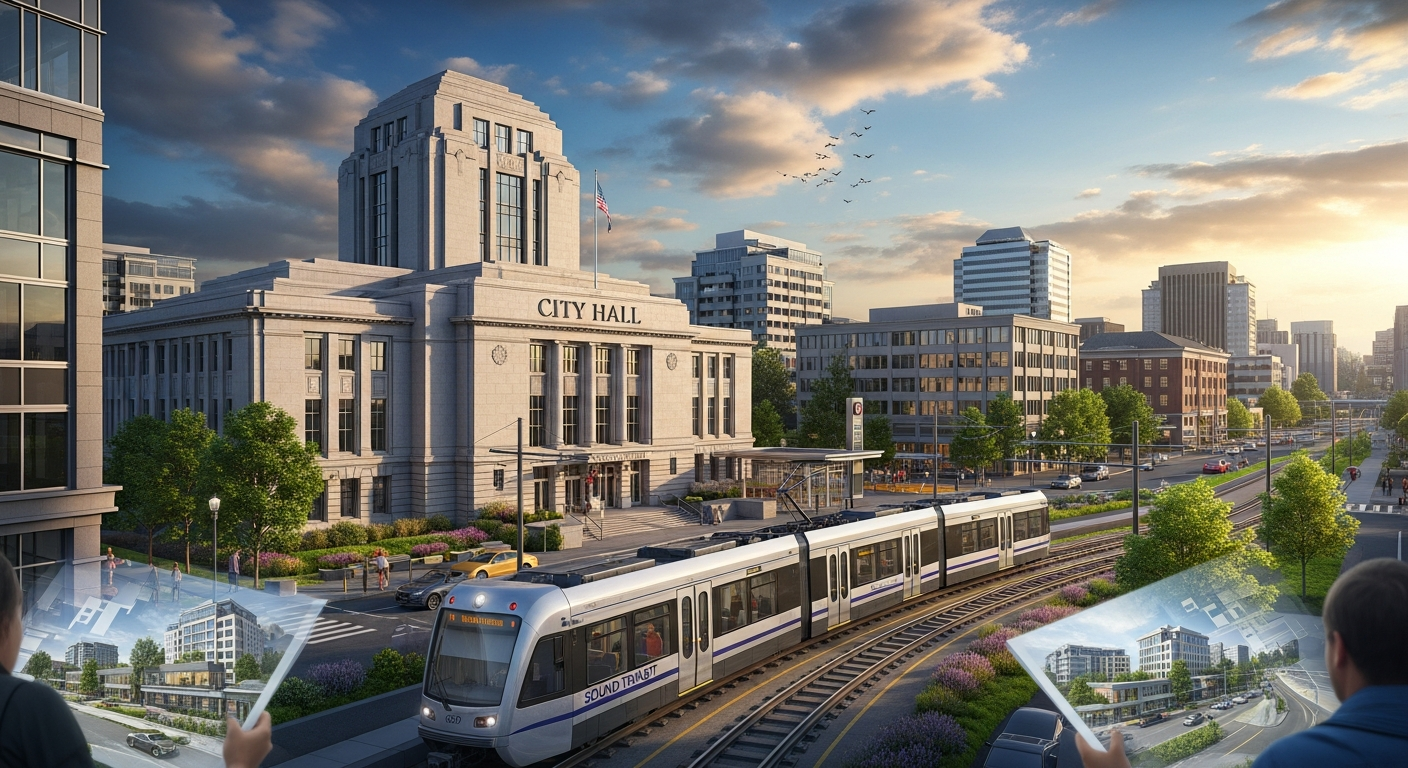
Quick Answer: The Everett City Council voted unanimously on April 29, 2026 to send Sound Transit a formal letter demanding full delivery of the 16-mile Everett Link Extension to downtown Everett Station. The letter arrives as Sound Transit prepares to vote by June 30 on a revised ST3 System Plan that will determine whether Snohomish County gets the light rail it funded in 2016 — or a scaled-back version that stops short of downtown. Snohomish County’s public comment window closed May 1.
What the Council Did — and Why It Matters
On April 29, the Everett City Council voted unanimously to sign a formal letter to the Sound Transit Board of Directors. The letter, brought forward by Vice President Paula Rhyne, makes a documented public demand: complete the Everett Link Extension in full, on schedule, terminating at downtown Everett Station — not at the SW Everett Industrial Center or any other intermediate point.
The letter is both a political signal and a public record. By taking a unanimous vote, the Council puts every member on record as demanding full delivery. That unanimity matters because Sound Transit board members are elected officials accountable to their jurisdictions. Snohomish County Executive Dave Somers, who chairs the Sound Transit board, is now navigating a situation where every elected official in Everett has publicly demanded an outcome directly relevant to his jurisdiction.
Mayor Cassie Franklin sent her own letter to the Sound Transit board on April 23, laying out the economic case for full delivery. The Council’s April 29 letter follows and amplifies Franklin’s position, creating a unified municipal front heading into the June 30 board vote.
The $34.5 Billion Problem Sound Transit Is Trying to Solve
Sound Transit’s ST3 package — approved by voters across King, Pierce, and Snohomish counties in 2016 — faces a $34.5 billion budget shortfall driven by construction cost inflation, right-of-way complications, and delayed revenue projections. The agency is preparing a revised ST3 System Plan to go before the board by June 30, 2026. That plan will prioritize which projects get built, which get delayed, and which get descoped.
The Everett Link Extension’s cost increased approximately 5–10% relative to original projections — a relatively modest overrun compared to the West Seattle and Ballard Link extensions, which have seen far larger cost increases. That asymmetry is central to Everett’s argument: the Everett segment is not where Sound Transit’s cost problem lives, and cutting or shortening Everett Link to solve a problem caused elsewhere would penalize Snohomish County voters for cost overruns in King County projects.
What “Full Delivery” Means for Everett
The full Everett Link Extension runs 16 miles from Lynnwood City Center (where it connects to the existing spine) to downtown Everett Station. It includes stations at Mariner, SW Everett Industrial Center (Paine Field access), and multiple downtown Everett stops. The project is currently scheduled to open in phases through 2037 under the original timeline.
A truncated version — stopping at SW Everett Industrial Center rather than continuing to downtown Everett Station — would serve Paine Field workers but leave downtown Everett and the north city without light rail access. For a city whose comprehensive plan is built around transit-oriented development along the light rail spine, a truncated terminus is not a minor adjustment: it changes where density can reasonably be built, where businesses locate, and where housing investment concentrates.
Mayor Franklin’s letter quantifies the stakes: $7.7 billion in economic development investment is anticipated in the Everett light rail corridor. That figure includes the Millwright District, waterfront redevelopment, downtown housing, and commercial development that has been underwritten — in part — by the expectation that light rail is coming.
What Happens Next
The Sound Transit board votes on the revised ST3 System Plan by June 30, 2026. The public comment period for Snohomish County residents closed May 1 — the day after the Council’s unanimous letter. Between now and June 30, Snohomish County’s regional elected officials, including Somers as board chair, will be under sustained advocacy pressure from Everett, Marysville, and other Snohomish County cities to protect the full extension.
Everett has also been navigating the parallel Everett Transit consolidation into Community Transit — a process that reduces the city’s independent transit capacity and increases dependence on Sound Transit’s light rail spine for long-haul regional connectivity. If the spine gets shortened, the consolidated transit system loses its primary high-capacity connection to the regional rail network. These two decisions — the Everett Transit consolidation and the Sound Transit revision — are structurally linked even though they are being processed on separate tracks.
Frequently Asked Questions
What did Everett City Council vote to do regarding Sound Transit?
On April 29, 2026, the Everett City Council voted unanimously to send Sound Transit a formal letter demanding full delivery of the 16-mile Everett Link Extension to downtown Everett Station, ahead of the Sound Transit board’s June 30 vote on a revised ST3 System Plan.
When is the Sound Transit board voting on the ST3 plan?
The Sound Transit board is expected to vote on its revised ST3 System Plan by June 30, 2026. Snohomish County Executive Dave Somers chairs the board.
Could the Everett Link Extension be shortened or cut?
Yes. Sound Transit is addressing a $34.5 billion budget shortfall across its ST3 projects. The revised plan could stop the Everett extension at the SW Everett Industrial Center rather than continuing to downtown Everett Station. That is the specific outcome Everett’s unanimous Council letter is demanding be avoided.
What is the economic value of the Everett Link Extension?
Mayor Cassie Franklin’s April 23 letter to the Sound Transit board cited $7.7 billion in anticipated economic development investment in the Everett light rail corridor, including waterfront redevelopment, downtown housing, and commercial development that has been underwritten on the assumption that light rail is coming.
How does the Everett Transit consolidation connect to this Sound Transit vote?
Everett is consolidating its transit system into Community Transit under SB 5801, reducing the city’s independent transit capacity. That consolidation increases Everett’s dependence on Sound Transit’s light rail spine for regional connectivity — which makes the June 30 vote on full delivery of the Everett Link Extension even more consequential for south Snohomish County commuters.
Can Everett residents still comment on the Sound Transit plan?
The formal Snohomish County public comment window closed May 1, 2026. Residents can still contact Snohomish County Executive Dave Somers’s office and the Sound Transit board directly. The June 30 board meeting will include a public comment period.
Related Exploring Everett coverage: Everett Council Sends Sound Transit Letter | Everett Transit Consolidation Complete Guide | Everett 2027 Budget Deficit Guide
Leave a Reply