Category: Claude AI

Complete guides, tutorials, comparisons, and use cases for Claude AI by Anthropic.

  • Claude API Access from Singapore and China: What Actually Works in 2026

    If you are a developer in Singapore or China trying to use Claude, you have already noticed that the standard instructions don’t quite apply to you. The console.anthropic.com onboarding assumes a US billing address. The latency numbers assume you are pinging from a US data center. And for developers in mainland China, the direct API doesn’t work at all without a workaround.

    This is a practical guide to what actually works in 2026, written for the Asian developer market that is increasingly one of Claude’s most active audiences.

    Singapore: What Works Directly

    Singapore is a fully supported country for the Anthropic API. You can create an account at console.anthropic.com, add a payment method, and generate API keys with no restrictions. Most major international credit cards work without issues. If you are at a company with a Singapore entity, Anthropic accepts international wire transfers for enterprise contracts.

    Latency from Singapore to Anthropic’s US API endpoints typically runs 180–250ms round-trip depending on your ISP and the model you are calling. For most application use cases this is acceptable. For latency-sensitive real-time applications — voice interfaces, live coding assistants — you will want to route through a closer compute layer, which is where Vertex AI becomes relevant.

    Vertex AI: The Regional Solution for Both Markets

    Google Cloud’s Vertex AI hosts Claude models (Sonnet and Haiku tiers as of mid-2026) and has a data center in Singapore: asia-southeast1. This is the cleanest solution for developers in both Singapore and the broader Asia-Pacific region who want lower latency and enterprise-grade SLAs.

    The practical difference: instead of calling api.anthropic.com, you call a Vertex AI endpoint scoped to asia-southeast1. Your tokens are processed in Singapore, not Virginia. For regulated industries — fintech, healthcare, legal — this also means your data doesn’t leave the region, which is a compliance requirement in several Singapore regulatory frameworks (MAS TRM guidelines being the primary one).

    To get started with Claude on Vertex AI from Singapore:

    1. Create a GCP project and enable the Vertex AI API
    2. Request access to Claude models via the Vertex AI Model Garden (approval is typically same-day for Singapore accounts)
    3. Set your region to asia-southeast1 in all API calls
    4. Authenticate via a GCP service account rather than an Anthropic API key

    The pricing on Vertex AI is comparable to direct Anthropic API pricing, with GCP committed use discounts available at higher volumes.

    AWS Bedrock: The Other Regional Option

    Amazon Bedrock also hosts Claude models and has a Singapore region (ap-southeast-1). If your infrastructure is already on AWS, this is often the simpler path. The setup mirrors Vertex AI: enable Bedrock in your AWS console, request Claude model access, and specify the Singapore region in your SDK calls.

    The practical consideration: as of mid-2026, model availability on Bedrock sometimes lags behind the direct Anthropic API by a few weeks when new versions ship. If being on the latest Claude version immediately matters for your use case, the direct API or Vertex AI are more current.

    China: The Honest Situation

    The direct Anthropic API is not accessible from mainland China without a VPN. Console.anthropic.com is not blocked at the DNS level in the same way Google is, but connectivity is unreliable and payment processing from Chinese-issued cards through Stripe (Anthropic’s payment processor) fails for most users.

    The workarounds that Chinese developers are actually using in 2026:

    VPN plus international card. Developers with access to a VPN and an international payment card (Hong Kong or Singapore bank account) use the direct API without issues. This is the most common setup among individual developers and small teams.

    Hong Kong entity. Companies with a Hong Kong subsidiary or registered office use that entity for the Anthropic API account. Hong Kong is a fully supported region with no connectivity issues.

    Third-party API proxies. Several API aggregators operating out of Hong Kong and Singapore re-sell Anthropic API access to mainland China developers. Quality and terms vary significantly — vet carefully before using in production.

    Vertex AI via a non-China GCP account. Some development teams maintain a GCP account registered to a Singapore or Hong Kong entity, then call the Vertex AI Claude endpoint from within China via GCP’s global network. Google Cloud has limited but operational connectivity from within China through its global backbone. This is the most enterprise-appropriate solution for teams that need a compliant path.

    Latency Reality Check by Access Method

    Access Method From Singapore From China (with VPN)
    Direct Anthropic API (us-east) 180–250ms 300–500ms+
    Vertex AI (asia-southeast1) 30–60ms 150–300ms via GCP backbone
    AWS Bedrock (ap-southeast-1) 25–55ms Not directly accessible

    Latency figures are representative ranges based on typical ISP routing. Your numbers will vary.

    Payment and Billing Notes

    For Singapore developers on the direct Anthropic API: Visa, Mastercard, and American Express issued by Singapore banks work reliably. PayNow and local payment rails are not supported — you need an international card.

    For enterprise: Anthropic’s sales team handles invoiced billing for Singapore and other APAC markets. If you are spending meaningfully on the API, contact sales rather than running on a credit card — the invoiced route gives you better cost predictability and eliminates card limit friction.

    The Bottom Line

    If you are in Singapore, the direct API works and Vertex AI’s asia-southeast1 region gives you a lower-latency, compliance-friendly alternative worth evaluating for production workloads.

    If you are in mainland China, the direct API requires a workaround. A Hong Kong entity plus Vertex AI is the cleanest enterprise path. For individual developers, VPN plus an international card is the practical reality.

    The Asian developer market is using Claude at scale. The tooling is there — it just requires knowing which path to take from where you are sitting.

    Based in Singapore or Asia-Pacific?

    I can help you pick the right access path for your stack and region.

    Email me your setup — direct API, Vertex AI, or Bedrock — and I’ll give you a straight answer on what makes sense.

    Email Will → will@tygartmedia.com

  • Claude vs Gemini 2026: An Honest Comparison Across Every Use Case

    Claude vs. Gemini in 2026 isn’t a simple winner-takes-all comparison — both are at the frontier in different ways, and the right choice depends entirely on what you’re doing. This guide compares Anthropic’s Claude (Opus 4.7, Sonnet 4.6, Haiku 4.5) against Google’s Gemini (3.1 Pro, 2.5 family) across pricing, capability, integration, and the practical workflows where each one wins.

    Quick answer: Claude leads on coding, long-form writing, nuanced reasoning, and agentic workflows. Gemini leads on Google ecosystem integration, multimodal video generation, real-time speech, and raw cost efficiency for high-volume API workloads. For most knowledge workers, the question isn’t which to use — it’s which to use for what task.

    Claude vs. Gemini: Side-by-Side Comparison

    Consumer Subscription Plans

    Tier Claude (Anthropic) Gemini (Google)
    Free Free Claude — limited daily messages Free — Gemini 2.5 Flash default, limited 3 Pro use
    Entry paid Pro — $20/month AI Plus — $7.99/month
    Standard paid Pro — $20/month AI Pro — $19.99/month
    Power user Max 5x — $100/month
    Max 20x — $200/month
    AI Ultra — $249.99/month
    Team $25/seat/mo (Standard)
    $125/seat/mo (Premium)
    Workspace add-on pricing varies

    API Pricing (Per Million Tokens)

    Model Tier Claude Gemini
    Flagship Opus 4.7: $5 in / $25 out Gemini 3.1 Pro: $2 in / $12 out (≤200K)
    $4 in / $18 out (>200K)
    Workhorse Sonnet 4.6: $3 in / $15 out Gemini 2.5 Pro: $1.25 in / $10 out (≤200K)
    Speed/cost tier Haiku 4.5: $1 in / $5 out Gemini 3.1 Flash-Lite: $0.25 in / $1.50 out

    Gemini is generally cheaper on raw API token pricing — particularly at the Flash-Lite end, where it’s roughly a quarter of Haiku’s cost. Claude’s pricing is more competitive at the flagship tier when you account for Opus 4.7’s 1M context window included at standard rates with no long-context surcharge.

    Context Window

    Surface Claude Gemini
    Consumer chat (paid) 200K tokens (Pro/Max/Team)
    500K tokens (Enterprise)
    1M tokens (AI Pro and above with Gemini 3.1 Pro)
    Flagship API 1M tokens (Opus 4.7, Sonnet 4.6) 1M tokens (Gemini 3.1 Pro)
    Cost above 200K No premium — flat pricing ~2x input/output pricing above 200K

    Important nuance: Gemini’s 1M context comes with a pricing penalty above 200K tokens. Claude’s 1M context on Opus 4.7 and Sonnet 4.6 has no such surcharge. For workloads that consistently use very large contexts, Claude’s flat pricing is the more predictable cost model. For consumer chat users, Gemini’s 1M window in the AI Pro plan is genuinely larger than Claude Pro’s 200K.

    Where Claude Wins

    Coding

    Claude has built a strong reputation among developers as the leading model for coding work. Anthropic’s Sonnet 4.6 and Opus 4.7 are widely deployed in agentic coding workflows through Claude Code, the company’s terminal-based coding agent. The combination of strong instruction-following, reliable tool calling, and the 1M token context window for whole-codebase reasoning makes Claude the default choice for many professional developers.

    This isn’t to say Gemini can’t code — Gemini 3.1 Pro and Jules (Google’s asynchronous coding agent) are capable. But the X conversation among working developers consistently puts Claude at the top of the coding stack in 2026.

    Long-form writing

    Claude’s writing tends to be preferred for substantive, professional output — reports, articles, analysis, documentation. The voice is more natural and less formulaic than competitors, and the model handles complex stylistic instructions reliably.

    Nuanced reasoning and analysis

    For tasks involving careful reasoning across multiple inputs — synthesizing research, analyzing complex situations, working through trade-offs — Claude tends to produce more rigorous output. Opus 4.7 and Sonnet 4.6 with extended thinking enabled can perform multi-step analysis that holds together more reliably than competitors.

    Predictable pricing on long contexts

    If your workflow regularly uses large amounts of input context — entire codebases, long documents, extensive conversation histories — Claude’s flat pricing on its 1M context window is the more predictable cost model. Gemini’s tiered pricing creates cost cliffs that can blow up budgets unexpectedly when prompts cross the 200K threshold.

    Agentic workflows

    Claude has invested heavily in agentic capabilities — Claude Code for terminal-based coding agents, Cowork for autonomous file and tool work, and tool calling that’s reliable enough to build production agents on. For developers building AI agents, Claude is the more mature platform.

    Where Gemini Wins

    Google ecosystem integration

    If your work happens in Gmail, Docs, Sheets, Drive, Calendar, or Workspace, Gemini’s native integration is unmatched. Gemini sits inside the apps you already use, can read and reason about content across your Google account, and can take actions in tools like Gmail and Docs without context-switching to a separate chat interface.

    Claude has connectors for Google Drive, Gmail, and Calendar, but it’s a different model — pulling context into a Claude conversation rather than working natively inside Google’s apps.

    Multimodal video and image generation

    Gemini’s bundled access to Veo 3.1 (video generation), Nano Banana Pro (image generation), and Flow (AI filmmaking suite) gives Google’s plans real value for creative workflows. Veo 3.1 produces video output that competes with standalone tools costing $40–$80/month — bundled into the AI Ultra plan at no extra cost.

    Claude doesn’t have native image or video generation. For purely text and code workflows this doesn’t matter; for creative production it’s a meaningful gap.

    Real-time speech and live audio

    Gemini’s Live API is purpose-built for real-time conversational agents with sub-second native audio streaming. For voice-first applications — assistants, real-time translation, conversational interfaces — Gemini’s audio capabilities are ahead.

    Raw cost efficiency for high-volume API workloads

    At the Flash-Lite end of the model spectrum, Gemini 3.1 Flash-Lite at $0.25 input / $1.50 output per million tokens is dramatically cheaper than Claude Haiku 4.5 at $1 input / $5 output. For high-volume classification, extraction, summarization, or routing pipelines, Gemini’s economics are hard to beat.

    Web grounding and Google Search integration

    Gemini’s built-in grounding with Google Search pulls real-time web information directly into responses, with Google’s index as the underlying source. For real-time information retrieval, current events, or fact-checking against the broader web, this integration is structurally advantaged.

    Larger context window in consumer chat

    Gemini’s AI Pro plan includes Gemini 3.1 Pro with the full 1M token context window in the consumer chat interface. Claude’s Pro plan caps at 200K tokens in chat. For users who want to process entire books, very long documents, or massive conversation histories in a single chat session, Gemini’s consumer offering provides more headroom.

    The Honest Comparison: Use Both

    Most experienced AI users in 2026 don’t pick one. They run both — and route each task to whichever model is best for that specific job. The pattern that works for many heavy users:

    • Claude for coding, long-form writing, deep analysis, agentic work, and any task requiring careful reasoning
    • Gemini for Google Workspace tasks, multimodal generation, real-time voice, web research, and high-volume Flash-tier API workloads
    • ChatGPT (often added) for image generation tasks where its current model has the edge, and for casual quick lookups

    The total cost of running both Claude Pro ($20/mo) and Gemini AI Pro ($19.99/mo) is $40/month — less than Max 5x or Gemini AI Ultra alone. For knowledge workers whose work spans both ecosystems, the dual-subscription approach often delivers more capability per dollar than maxing out a single platform.

    Claude vs. Gemini for Specific Use Cases

    For developers

    Winner: Claude. Claude Code, Sonnet 4.6, and Opus 4.7 are the current standard for serious software development work. The agentic coding capabilities, tool calling reliability, and codebase reasoning at 1M context make Claude the default choice. Gemini’s Jules and Code Assist are credible alternatives but trail in the developer community’s preferences.

    For Google Workspace power users

    Winner: Gemini. If your day runs through Gmail, Docs, Sheets, and Drive, Gemini’s native integration is too valuable to give up. Claude can connect to these apps, but the embedded experience inside Google products is structurally better with Gemini.

    For creative content production

    Winner: Gemini. Veo 3.1 video generation, Nano Banana Pro image generation, and Flow filmmaking tools bundled into AI Ultra ($249.99/mo) provide creative capabilities Claude doesn’t offer at any price.

    For long-form writing and editing

    Winner: Claude. Claude’s writing voice, instruction-following on style and tone, and ability to handle long manuscripts with precise revision instructions make it the better tool for serious writing work.

    For research and analysis

    Tie, with use-case nuance. Claude’s reasoning depth and synthesis quality are strong. Gemini’s Deep Research and Google Search grounding give it an advantage for current-events research and broad web synthesis. Many users run both for serious research — Gemini for source gathering, Claude for synthesis.

    For high-volume API pipelines

    Winner: Gemini. Gemini 3.1 Flash-Lite’s pricing dominates Claude Haiku 4.5 by roughly 4x at the input tier. For classification, extraction, and routing workloads at scale, Gemini’s economics are hard to argue with.

    For agentic coding and AI agents

    Winner: Claude. Claude has invested more heavily in production-grade agentic capabilities. Tool calling reliability, agent-friendly responses, and the maturity of Claude Code make it the more proven platform for building real agents.

    What Most Comparison Articles Get Wrong

    The standard “Claude vs. Gemini” article tries to crown a single winner. Both are at the frontier, both have real strengths, and the choice should be use-case driven, not tribal.

    Two specific points that frequently get misreported:

    • Claude’s context window in chat is 200K, not 1M. The 1M context window applies to Opus 4.7 and Sonnet 4.6 via the API and in Claude Code — not in the standard claude.ai chat interface for Pro users.
    • Gemini’s pricing has a 200K cliff. Articles often quote the lower context-tier pricing as if it applies to all uses. For workloads consistently above 200K tokens, Gemini is closer to Claude in cost than the headline numbers suggest.

    Frequently Asked Questions

    Is Claude better than Gemini?

    Neither is universally better. Claude tends to win on coding, long-form writing, and nuanced reasoning. Gemini tends to win on Google ecosystem integration, multimodal generation, real-time voice, and high-volume API economics. The right choice depends on your workflow.

    Which is cheaper, Claude or Gemini?

    For consumer chat plans, Claude Pro and Google AI Pro are nearly identical at $20 and $19.99/month respectively. For API usage, Gemini is generally cheaper at the Flash-Lite tier (~4x cheaper than Claude Haiku). At the flagship tier, Claude Opus 4.7 and Gemini 3.1 Pro are competitively priced, with Claude offering flat pricing on 1M context vs. Gemini’s tiered model.

    Is Claude better than Gemini for coding?

    Yes for most working developers. Claude Code, Sonnet 4.6, and Opus 4.7 are the current preferred stack for agentic coding workflows. Gemini’s Jules and Code Assist are credible but trail in developer adoption and tool calling reliability.

    Does Gemini have a bigger context window than Claude?

    It depends which surface. In consumer chat, Gemini’s AI Pro plan offers 1M tokens with Gemini 3.1 Pro, while Claude Pro caps at 200K tokens. Via the API and in Claude Code, both offer 1M token context windows on their flagship models.

    Can Gemini generate images and videos like Claude can’t?

    Yes. Gemini bundles Veo 3.1 video generation, Nano Banana Pro image generation, and Flow AI filmmaking tools into its consumer plans. Claude doesn’t include native image or video generation in any plan.

    Should I use Claude or Gemini for Google Workspace?

    Gemini, generally. While Claude has connectors for Drive, Gmail, and Calendar, Gemini’s native integration inside Google’s apps creates a structurally better experience for Workspace-heavy workflows.

    Can I use both Claude and Gemini?

    Yes, and many heavy users do. Running Claude Pro ($20/mo) and Gemini AI Pro ($19.99/mo) costs $40/month combined — less than upgrading either to its highest tier. Use Claude for coding, writing, and reasoning; use Gemini for Workspace tasks, multimodal generation, and web research.

    What’s the difference between Gemini 3.1 Pro and Claude Opus 4.7?

    Both are flagship reasoning models with 1M token context windows. Opus 4.7 is Anthropic’s most capable model with strengths in agentic coding and complex reasoning, priced at $5 input / $25 output per million tokens. Gemini 3.1 Pro is Google’s flagship at $2 input / $12 output per million tokens (under 200K context), with strengths in multimodal reasoning and Google ecosystem integration.

  • Is Claude Pro Worth It? An Honest 2026 Review

    The honest answer to “is Claude Pro worth it” changed on April 21, 2026 — and most of the articles ranking for this question haven’t caught up. If you’re buying Pro to use Claude Code, the math may have just shifted under your feet. If you’re buying Pro for everything else, it’s still one of the better $20 deals in software. This guide is built on Anthropic’s official documentation as of April 22, 2026, plus the developer reports that surfaced this week.

    Quick answer: Claude Pro at $20/month is worth it for most knowledge workers who use Claude daily — writers, researchers, marketers, analysts, and anyone leveraging Cowork, projects, and the 200K context window. For developers buying Pro specifically for Claude Code access, the value proposition is shifting. Anthropic appears to be quietly removing Claude Code from the Pro plan for new signups, which means the safe assumption going forward is: budget for Max 5x ($100/month) if Claude Code is your primary use case.

    The April 2026 Claude Code Situation

    Starting around April 10–21, 2026, multiple developers noticed that Anthropic’s official pricing page changed how it shows Claude Code access on the Pro plan. The Pro column on claude.com/pricing now shows a red X next to Claude Code — previously a check mark. The support documentation page title also changed from “Using Claude Code with your Pro or Max plan” to “Using Claude Code with your Max plan.”

    According to Anthropic statements that have surfaced since, this is a limited A/B experiment affecting approximately 2% of new Pro signups, and existing Pro subscribers are reportedly not affected at this time. There has been no public press release from Anthropic confirming or explaining the broader change.

    The practical implication is this: if you’re considering Pro specifically because you want Claude Code in your terminal, the safe assumption right now is that Max 5x at $100/month is the lowest tier with guaranteed Claude Code access. If you’re already a Pro subscriber using Claude Code, monitor your access closely — there are scattered reports of gradual blocks beginning to appear, though the picture isn’t fully clear.

    Everything else about Pro is unchanged. Web chat, projects, memory, web search, Cowork, and the integrations all remain part of the $20/month plan. The shift is specifically about terminal-based agentic coding access.

    What Claude Pro Actually Includes

    At $20/month (or $200/year, which works out to about $17/month), Pro currently includes:

    • Higher usage than Free — Anthropic specifies “at least five times the usage per session compared to our free service” during peak hours
    • Access to all current models — Opus 4.7, Sonnet 4.6, and Haiku 4.5
    • 200,000 token context window across all paid plans
    • Projects — persistent knowledge bases with caching that doesn’t count against your usage when reused
    • Claude Cowork — agentic file and tool-based work; Anthropic expanded this from Max-exclusive to all Pro users on January 16, 2026
    • Memory and chat search — Claude can search prior conversations and reference relevant context across sessions
    • Web search and research — built-in web search and Research mode for citation-backed reports
    • Connected apps — integrations with Google Drive, Gmail, Google Calendar, GitHub, and others
    • Priority access during high-traffic periods
    • Early access to new features
    • Extra usage option — Pro subscribers can enable extra usage to continue working past their plan’s included limits, billed at standard API pricing rates

    The “5x Free during peak hours” detail matters more than it sounds. During off-peak hours, the gap between Free and Pro is generally larger — the 5x is what Anthropic commits to at the worst time of day, not the average. Free users get throttled hardest when demand spikes. Pro users get protected.

    Who Pro Is Worth It For

    Knowledge workers using Claude daily

    If you’re writing, researching, analyzing, or otherwise using Claude as a daily thinking partner, Pro is straightforward value. The 200K context window lets you load a substantial document, paste in a long brief, or maintain a deep conversation without hitting walls. Projects let you build persistent reference libraries that don’t burn allocation each time you query them. Cowork handles multi-step tasks autonomously — the kind of work that previously required Max-tier access.

    The math is simple: if you’d otherwise lose more than 30 minutes per week to Free plan rate limits, throttling, or context-window resets, Pro pays for itself in time alone.

    Researchers and analysts

    Research mode and built-in web search make Pro substantially more capable than Free for any work involving outside information. The ability to cite sources, run multi-step research, and pull from connected apps like Google Drive transforms Claude from a chat tool into a research environment.

    Writers and content creators

    Long-form writing benefits directly from the 200K context window — entire drafts, style guides, and reference materials can sit in a single conversation. Projects make recurring writing work (newsletters, branded content, multi-part series) substantially more efficient because the underlying context caches across sessions.

    Anyone running 3+ hours of Claude work daily

    The Free plan rate limits become the dominant constraint at this usage level. Pro removes most of that friction. At 3+ hours of daily use, the cost works out to under $0.30 per hour of access — cheaper than almost any other professional tool you’d justify at that intensity.

    Who Pro Probably Isn’t Worth It For

    Casual users sending a few messages a week

    If you use Claude occasionally — a few questions a week, light drafting, basic research — the Free plan handles it. Pro’s value comes from removing friction at scale; if you’re not at scale, you’re paying for capacity you won’t use.

    Developers who want Claude Code right now

    Given the April 2026 changes, paying $20/month for Pro on the assumption that Claude Code is included is risky for new signups. The stable answer is Max 5x at $100/month if you specifically need Claude Code in your terminal workflow. If you’re already a Pro subscriber using Claude Code, you may be grandfathered — but make a backup plan.

    Heavy power users hitting Pro limits weekly

    If you’re a Pro subscriber consistently hitting your five-hour session or weekly limits, the upgrade math favors Max 5x at $100/month. Max 5x provides 5x Pro’s usage per session at 5x the cost — your per-message cost stays the same, but you get the headroom. Max 20x at $200/month is 20x Pro’s usage at 10x the cost, which actually halves your per-message cost compared to Pro. For genuinely heavy individual users, Max 20x is the most cost-efficient per message of any individual plan.

    Teams of 5 or more

    Multiple Pro subscriptions across a team get expensive fast and don’t include team management features. The Team plan starts at $25 per seat per month ($20/seat billed annually), with a five-user minimum. It includes admin tools, SSO, centralized billing, and per-member usage limits that don’t pool across the team. For organizations, Team is structurally the right answer over individual Pro subscriptions.

    Pro vs. Free: The Real Difference

    The marketing materials list features. The actual difference between Free and Pro shows up in three ways:

    Friction. Free users hit rate limits faster, get throttled harder during peak hours, and bump into context window walls more frequently. Pro removes most of that friction without making it disappear.

    Tools. Cowork, projects, memory, web search, and connected apps are either Pro-exclusive or substantially more limited on Free. These are the features that change Claude from a chat interface into a working environment.

    Reliability. Pro’s priority access during high-traffic periods means your work doesn’t get interrupted when demand spikes. For anyone using Claude as a professional tool, this consistency matters more than the headline usage numbers.

    Pro vs. Max: When to Upgrade

    Max 5x at $100/month is the natural next step from Pro for individual users who:

    • Hit Pro’s session limits more than once a week
    • Need guaranteed Claude Code access (post-April 2026)
    • Run extended coding sessions or research sessions that exceed Pro’s headroom
    • Get blocked by peak-hour throttling regularly

    Max 20x at $200/month makes sense for power users who:

    • Use Claude as a primary work environment all day
    • Run agent workflows that consume large amounts of allocation
    • Need the lowest per-message cost of any individual tier
    • Have already maxed out Max 5x consistently

    The upgrade path Anthropic itself describes: start on Pro, monitor usage in Settings → Usage, and upgrade when interruptions cost more than the price difference.

    Pro vs. API: For Developers

    If you’re a developer who only used Pro for Claude Code, the API may be a better fit now. API pricing is pay-per-token: Sonnet 4.6 at $3 input / $15 output per million tokens, Opus 4.7 at $5 input / $25 output per million tokens, Haiku 4.5 at $1 input / $5 output per million tokens. With prompt caching cutting cache reads to 10% of standard input price and the Batch API providing a 50% discount for non-real-time workloads, light-to-moderate API usage can come in well under $20/month — without locking you into subscription rate limits.

    The trade-off is that the API requires more setup, no chat interface, and direct billing tied to actual consumption. For developers who only used Claude in the terminal, that trade-off is often acceptable.

    The Verdict

    For most knowledge workers, writers, researchers, and analysts using Claude as a daily tool: yes, Pro is worth it. $20/month for an AI workspace with projects, Cowork, web search, memory, and a 200K context window is one of the better software deals available right now. The friction reduction alone justifies the cost for anyone using Claude more than a few hours per week.

    For developers buying Pro specifically for Claude Code: be careful. The April 2026 changes are still settling. The conservative answer is to budget for Max 5x at $100/month or the API. Don’t subscribe to Pro on the assumption that Claude Code will be included — that assumption is no longer reliable for new signups.

    For casual users sending a handful of messages per week: the Free plan probably handles it. Pro’s value comes from frequent, sustained use. If that’s not your pattern, you’re paying for capacity you won’t tap.

    Frequently Asked Questions

    How much does Claude Pro cost?

    Claude Pro is $20/month billed monthly, or $200/year (approximately $17/month) billed annually. Prices are for US customers and don’t include applicable taxes. Pricing varies by region.

    Is Claude Code included with Pro?

    As of April 2026, Anthropic’s official pricing page now shows Claude Code as not included on the Pro plan. Reports indicate this is a limited A/B test affecting about 2% of new Pro signups, with existing Pro subscribers reportedly grandfathered. The reliable answer for new signups is to consider Max 5x ($100/month) or the API if Claude Code is your primary use case.

    How much usage does Claude Pro give me?

    Anthropic states Pro offers at least 5x more usage per session than the Free plan during peak hours. Usage operates on a five-hour rolling session window plus a weekly cap. Actual message counts vary based on conversation length, file attachments, model choice, and tool usage.

    What’s the difference between Claude Pro and Claude Max?

    Pro is $20/month with baseline paid usage. Max comes in two tiers: Max 5x at $100/month (5x Pro’s usage per session) and Max 20x at $200/month (20x Pro’s usage per session). Both Max tiers include guaranteed Claude Code access. Max 20x is the most cost-efficient individual plan on a per-message basis.

    Can I cancel Claude Pro anytime?

    Yes. Subscriptions can be canceled from your account settings. If you cancel mid-cycle, you keep Pro access until the end of your current billing period. Annual subscribers who cancel keep access until the annual term ends.

    Is Claude Pro worth it for ChatGPT Plus users?

    It depends on use case. Claude tends to be preferred for coding, long-form writing, and detailed analysis. ChatGPT tends to be preferred for image generation, voice mode, and faster execution on routine tasks. Many heavy users run both — using each for what it does best — rather than treating it as an either/or decision.

    Does Claude Pro work on mobile?

    Yes. Claude Pro features are available across web (claude.ai), desktop apps, iOS, and Android. Usage is unified across all surfaces — work done on mobile counts toward the same five-hour session limit as work done on web or desktop.

    What happens if I hit my Pro plan limit?

    You can wait for your five-hour session window to reset, enable extra usage to continue working at standard API pricing rates, or upgrade to Max for higher limits. Pro subscribers can configure extra usage from account settings.

  • Claude Rate Limit Workarounds: How to Get More from Your Plan

    Hitting Claude’s rate limit mid-task is the most consistent complaint from heavy users in 2026 — and the workarounds that actually help aren’t the ones you’ll see in most articles. This guide covers what’s officially possible, what works in practice, and what doesn’t, based on Anthropic’s documentation and daily operational experience running Claude at scale across multiple production workflows.

    Quick answer: Claude’s usage limits operate on a five-hour rolling session window plus a weekly cap. There’s no trick to get around them, but there are six legitimate strategies that meaningfully extend how much you can do within your plan: prompt caching via Projects, batching requests, model routing, enabling extra usage, restructuring conversations to reset context, and offloading lightweight tasks to other tools to preserve Claude quota for what matters.

    How Claude’s Rate Limits Actually Work

    Before fixing the problem, it’s worth understanding the constraint. Every Claude plan — Free, Pro, Max, Team, and Enterprise — runs on a five-hour rolling session window. Your usage is measured against the messages, tokens, and tools consumed during that window. When the session ends, a new five-hour budget begins.

    Paid plans also have a weekly usage cap that resets seven days after your session starts. Heavy users can hit this even without ever maxing out a single session, just by using Claude consistently across multiple days.

    Per Anthropic’s official documentation, several factors drive how fast you consume your allocation:

    • Message length
    • File attachment size
    • Current conversation length
    • Tool usage (Research, web search, MCP connectors)
    • Model choice (Opus consumes more than Sonnet, Sonnet more than Haiku)
    • Artifact creation and usage

    Critically: usage is unified across all Claude surfaces. Activity on claude.ai, in Claude Code, and in Claude Desktop all draws from the same allocation pool. A heavy Claude Code session in the morning reduces your available chat allocation for the rest of the window.

    Workaround #1: Use Projects for Caching (Highest Impact)

    This is the single most underused feature for extending your effective rate limit, and it’s documented directly by Anthropic. When you upload documents to a Project, that content is cached. Every subsequent reference to that material consumes far fewer tokens than re-uploading or re-pasting it would.

    The practical implication: any document, instruction set, code reference, or knowledge base that you reference more than twice belongs in a Project, not pasted into individual chats. Anthropic notes that you can ask multiple questions about Project content while using fewer messages than if you uploaded the same materials each time.

    Operational reality from running this daily: a 30,000-word reference document pasted into five separate chats consumes vastly more allocation than the same document loaded once into a Project and queried five times. The difference compounds dramatically over weeks of use.

    For workflows that exceed standard Project knowledge capacity, Anthropic offers a Retrieval Augmented Generation (RAG) mode for Projects that further expands what you can store and query efficiently.

    Workaround #2: Batch Related Tasks in a Single Message

    This sounds obvious but most users don’t do it. Anthropic explicitly recommends grouping related questions and tasks into one message rather than sending sequential messages.

    The math is simple: in a long conversation, every new message reprocesses the entire prior conversation history as context. Three sequential questions in a 50-message thread cost roughly three times what one combined question would. The token consumption isn’t linear with message count — it grows because of the accumulated conversation context.

    Practical implementation: before sending a message, ask whether you have any other related questions on the same topic. If yes, combine them. The trade-off is slightly more cognitive load up front in exchange for meaningful allocation savings.

    Workaround #3: Start New Conversations for New Topics

    This is the inverse of the previous tip and equally important. Long, sprawling conversations that drift across multiple topics carry the worst of both worlds: they accumulate massive context that gets reprocessed on every message, but most of that context is irrelevant to whatever you’re currently asking.

    If you’re switching topics — moving from debugging code to writing a marketing email, for example — start a new chat. The context from the coding session adds nothing to the writing task and costs you tokens to keep dragging along.

    For users with code execution enabled on paid plans, Claude does run automatic context management when conversations approach the context window limit. But that’s a different mechanism from rate limit consumption — automatic context management protects against hitting the length ceiling, not against burning through your usage allocation.

    Workaround #4: Enable Extra Usage

    If you’re hitting limits consistently and the workarounds above aren’t enough, Anthropic offers official extra usage on Pro, Max, Team, and seat-based Enterprise plans. With extra usage enabled, you continue working after hitting your included allocation — usage beyond your plan limit gets billed at standard API pricing rates.

    For Pro and Max users, extra usage is configured through plan settings. For Team and Enterprise plans, organization owners enable and configure extra usage through Organization Settings, with the ability to set spend caps at the organization-wide, per-seat-tier, or per-individual level.

    This isn’t a workaround so much as the official escape hatch. It’s the right answer when you’ve genuinely outgrown your plan’s allocation but don’t want to upgrade tiers permanently — you’re effectively paying API rates for the overage rather than committing to a higher base subscription.

    Workaround #5: Route the Right Model to the Right Task

    Different Claude models consume your allocation at different rates. Opus is more compute-intensive than Sonnet; Sonnet more than Haiku. If you’re running everything through Opus by default, you’re burning through your allocation faster than you need to for tasks that don’t require Opus-level reasoning.

    The practical pattern that works: Sonnet 4.6 as the default workhorse for most tasks; Opus 4.7 reserved for genuinely complex reasoning, large output requirements, or agentic workflows that need maximum capability; Haiku 4.5 for routine work like classification, simple summarization, or quick lookups.

    For Claude Pro and Max users, this means consciously selecting Sonnet over Opus for everyday tasks rather than defaulting to the highest-capability model. Pro users specifically need to enable extra usage to access Opus 4.6 in Claude Code, which is itself a signal about how Anthropic prices Opus consumption.

    Workaround #6: Be Specific and Concise in Your Prompts

    Vague prompts generate clarification cycles. Each clarification round is another message consuming allocation. The compounding effect is significant — a task that should be one well-formed message can easily become five rounds of back-and-forth if the initial prompt is ambiguous.

    Anthropic’s official guidance is direct: provide clear, detailed instructions in each message; avoid vague queries; include relevant context up front. The investment of an extra 30 seconds composing a complete prompt repeatedly pays back in saved messages.

    For coding tasks specifically, Anthropic recommends providing complete context about your environment in the initial message and including entire relevant code snippets in one message for reviews or debugging — rather than sharing code piece by piece.

    Workaround #7: Offload Lightweight Tasks to Other Tools

    This isn’t an Anthropic recommendation, but it’s a practical reality. If you’re using Claude for genuinely complex work — long-form writing, detailed code architecture, deep research — you preserve more capacity for that work by routing trivial tasks elsewhere.

    Quick web lookups, simple definitions, basic calculations, format conversions, syntax checks — these don’t require Claude’s reasoning. Other AI tools, search engines, or even basic utilities handle them adequately and don’t draw from your Claude allocation.

    The mindset shift: Claude’s allocation is a finite resource that should be deployed where its capability matters. Burning through your daily quota on tasks that any tool could handle is a poor use of what you’re paying for.

    Monitor Your Usage in Settings

    Pro, Max, Team, and seat-based Enterprise users can navigate to Settings → Usage on claude.ai to see real-time progress bars showing consumption against both the five-hour session limit and the weekly cap. The dashboard shows:

    • Current session: How much of your five-hour session limit you’ve used and time remaining until reset
    • Weekly limits: Progress against weekly limits for Opus and for all other models combined, with reset timing
    • Extra usage: If enabled, balance and consumption tracking

    Checking this dashboard before starting a heavy task is the simplest way to avoid hitting a wall mid-workflow.

    What Doesn’t Actually Work

    A few “workarounds” circulate that either don’t help or actively make things worse:

    • Creating multiple accounts. Beyond violating Anthropic’s terms, this fragments your work across accounts and creates context loss that costs more time than it saves.
    • Using extremely short prompts. While conciseness helps, prompts that are too short generate clarification cycles that consume more total allocation than a well-formed initial prompt would have.
    • Disabling all features. Tools and connectors do consume tokens, but disabling features you actually need just shifts the cost — you’ll spend more messages working around the missing capability.
    • Asking Claude to “use less tokens.” The model can adjust output length somewhat, but the bulk of token consumption comes from input context and conversation history, not from output verbosity.

    The Strategic View

    Hitting rate limits regularly is usually a signal of one of two things: either you’re running workflows that genuinely require a higher tier, or your usage patterns aren’t optimized.

    If you’ve implemented the workarounds above and still hit limits consistently on a Pro plan, the upgrade path is clear: Max for individual heavy users, Team for organizations where multiple people need consistent access. If you’re a developer running heavy programmatic workflows, the API with prompt caching and the Batch API often provides better economics than scaling up consumer subscriptions.

    For most users, though, the workarounds resolve the friction. Caching via Projects, batching requests, smart model routing, and starting fresh conversations for new topics typically buy back significant capacity from a default usage pattern.

    Frequently Asked Questions

    Why do I hit Claude’s rate limit so quickly on Pro?

    Several factors compound: long conversation history that gets reprocessed on every message, large file attachments, heavy use of tools like Research and web search, and using Opus instead of Sonnet for routine tasks. Long conversations are typically the largest factor — every message in a 50-message thread reprocesses the prior 49 messages as context.

    Can I get unlimited Claude usage?

    Not strictly unlimited, but Anthropic offers extra usage on Pro, Max, Team, and seat-based Enterprise plans. Once enabled, you continue working after hitting your included allocation, with the overage billed at standard API pricing rates. Usage-based Enterprise plans are billed entirely on consumption with no included usage cap.

    Does Claude rate limit reset at midnight?

    No. The session limit operates on a rolling five-hour window that begins with your first message in the session — not on a calendar day. The weekly limit resets seven days after your session starts, also not on a calendar week.

    What’s the best way to avoid hitting Claude’s rate limit?

    The highest-impact strategies are: (1) put recurring reference documents in Projects so they cache, (2) batch related questions into single messages, (3) start fresh conversations when switching topics, (4) use Sonnet for everyday tasks instead of defaulting to Opus, and (5) write specific, complete prompts up front to avoid clarification cycles.

    Does Claude Code count against my claude.ai usage limit?

    Yes. Claude Code, claude.ai, and Claude Desktop all draw from the same unified usage pool. Activity in Claude Code reduces your available allocation for chat in claude.ai during the same five-hour window.

    Is there a way to see how much of my Claude limit I’ve used?

    Yes. On paid plans, navigate to Settings → Usage on claude.ai. The dashboard shows progress bars for both your current five-hour session and your weekly limits, plus reset timing for each.

    Should I upgrade to Max if I keep hitting Pro limits?

    Maybe. First try the optimization strategies — Projects for caching, batching messages, model routing, starting new conversations for new topics. If you’ve genuinely implemented these and still hit limits, Max provides 5x or 20x Pro usage depending on the tier. For organizations with multiple heavy users, Team is usually more cost-efficient than multiple Max subscriptions.

    Why does Claude say it can’t help, then later help with the same task?

    Rate limit blocks aren’t capability blocks — when you hit a usage limit, Claude can’t process new requests until your window resets. The same prompt that fails when you’re rate-limited will work after the reset, because it wasn’t a content or capability decision in the first place.

  • Claude AI Context Window Explained: Size, Limits, and How It Works

    Claude’s context window is one of the most consequential — and most misunderstood — specs in the AI landscape. It determines how much information Claude can hold and reason about at once. Get it wrong in your planning and you’ll hit hard walls mid-task. This guide covers exactly how large Claude’s context window is, how it differs by model and plan, and what it means in practice.

    What is a context window? The context window is Claude’s working memory for a conversation — the total amount of text (including your messages, Claude’s responses, uploaded files, and system instructions) that Claude can actively process at once. When a conversation exceeds this limit, Claude can no longer reference earlier parts of it without summarization or a new session.

    Claude’s Context Window Size by Model and Plan

    Context window size in Claude varies by model, plan type, and which product surface you’re using. Here’s the accurate picture as of April 2026:

    Claude.ai (Web and Mobile Chat)

    For users on paid claude.ai plans — Pro, Max, Team, and most Enterprise — the context window is 200,000 tokens across all models and paid plans. According to Anthropic’s support documentation, this is roughly 500 pages of text or more.

    Enterprise plans on specific models have access to a 500,000 token context window. This is a plan-level feature, not a model selection — contact Anthropic’s enterprise team for details on which models qualify.

    Claude Code (Terminal and IDE)

    The larger context windows — 1 million tokens — are available specifically through Claude Code on paid plans:

    • Claude Opus 4.6: Supports a 1M token context window in Claude Code on Pro, Max, Team, and Enterprise plans. Pro users need to enable extra usage to access Opus 4.6 in Claude Code.
    • Claude Sonnet 4.6: Also supports a 1M token context window in Claude Code, but extra usage must be enabled to access it (except for usage-based Enterprise plans).

    Claude API

    Via the direct API, the current model context windows as published in Anthropic’s official documentation are:

    Model Context Window Max Output
    Claude Opus 4.7 1,000,000 tokens 128,000 tokens
    Claude Sonnet 4.6 1,000,000 tokens 64,000 tokens
    Claude Haiku 4.5 200,000 tokens 64,000 tokens

    Source: Anthropic Models Overview, April 2026.

    What 200K Tokens Actually Means

    Tokens are not the same as words. A token is roughly 3–4 characters, which works out to approximately 0.75 words in English. Here’s how the 200K token context window translates into practical content:

    • ~150,000 words of plain text
    • ~500+ pages of a standard document
    • A full-length novel (most are 80,000–120,000 words) with room to spare
    • Hundreds of emails in a thread
    • A moderately large codebase or multiple interconnected files
    • Hours of meeting transcripts

    For the vast majority of everyday tasks — document review, writing, research, coding, analysis — 200K tokens is more than enough. The ceiling only becomes relevant for extended research sessions, very large codebases, or scenarios where you need to maintain context across a lengthy back-and-forth over many hours.

    What 1M Tokens Actually Means

    One million tokens is roughly 750,000 words — equivalent to about five full-length novels, or a substantial enterprise codebase in a single session. The practical use cases that genuinely require this scale are narrower than the marketing suggests, but they’re real:

    • Large codebase analysis: Feeding an entire repository — multiple files, modules, and dependencies — into a single Claude Code session for architecture review, debugging, or refactoring.
    • Book-length document processing: Analyzing or summarizing an entire textbook, legal corpus, or research archive without chunking.
    • Long-running agentic workflows: Multi-agent tasks where conversation history, tool call results, and accumulated context grow significantly over time.
    • Extended conversation history: Maintaining full context across a very long research or writing session without losing earlier exchanges.

    For most individual users on claude.ai, the 200K chat context window is the relevant number. The 1M context window matters most to developers building on the API and power users running Claude Code sessions on large codebases.

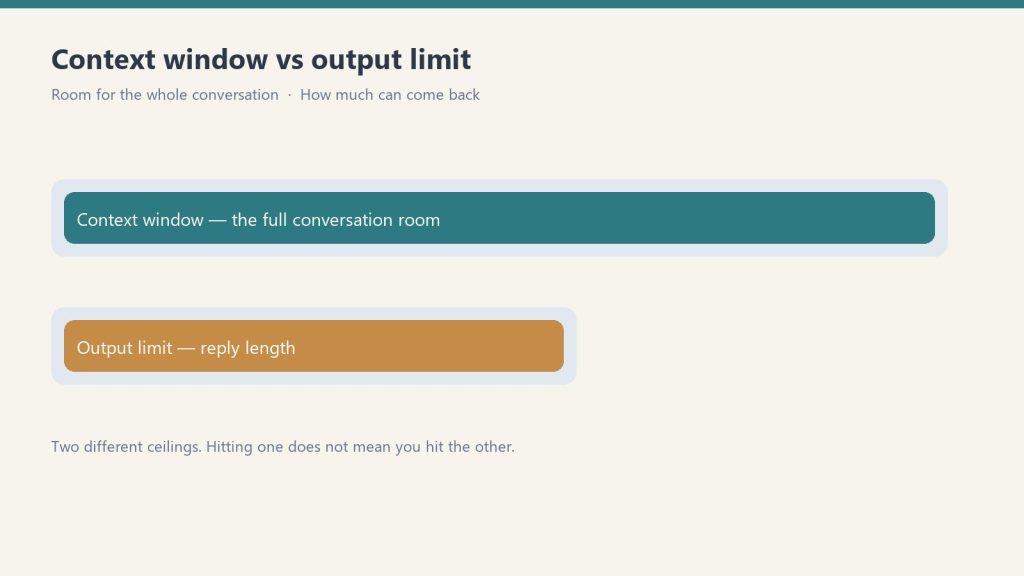
    Context Window vs. Usage Limit: Two Different Things

    This is the most common point of confusion. The context window and usage limit are separate constraints that operate independently:

    Context window (length limit): How much content Claude can hold in a single conversation. This is a technical capability of the model. When you hit the context window, Claude can no longer actively process earlier parts of the conversation without summarization.

    Usage limit: How much you can interact with Claude over a rolling time period — the five-hour session window and weekly cap on paid plans. This controls how many total messages and how much total compute you consume across all your conversations, not the depth of any single conversation.

    You can hit a usage limit without ever approaching the context window (many short conversations). You can also approach the context window limit without hitting your usage limit (one very long, deep conversation). They’re orthogonal constraints.

    Automatic Context Management

    For paid plan users with code execution enabled, Claude automatically manages long conversations when they approach the context window limit. When the conversation gets long enough that it would otherwise hit the ceiling, Claude summarizes earlier messages to make room for new content — allowing the conversation to continue without interruption.

    Important details about how this works:

    • Your full chat history is preserved — Claude can still reference earlier content even after summarization.
    • This does not count toward your usage limit.
    • You may see Claude note that it’s “organizing its thoughts” — this indicates automatic context management is active.
    • Code execution must be enabled for automatic context management to work. Users without code execution enabled may encounter hard context limits.
    • Rare edge cases — very large first messages or system errors — may still hit context limits even with automatic management active.

    How Context Window Affects Cost on the API

    For developers using the Claude API directly, context window size has direct billing implications. Every token in the context window — input messages, conversation history, system prompts, uploaded documents, and tool call results — is billed as input tokens on each API call.

    This creates an important cost dynamic: long conversations get progressively more expensive per message. In a 100-message thread, every new message requires reprocessing the entire conversation history as input tokens. A session that started at $0.01 per exchange can reach $0.10 or more per exchange by message 80.

    Two features exist specifically to manage this cost:

    • Prompt caching: For repeated content — large system prompts, reference documents, or conversation history that doesn’t change — prompt caching allows Claude to read from a cache at roughly 10% of the standard input token price, rather than reprocessing the same content on every call. This can reduce costs by up to 90% on cached content.
    • Message Batches API: For non-real-time workloads, the Batch API provides a 50% discount on all token pricing. It doesn’t reduce the token count, but halves the cost per token.

    How Projects Expand Effective Context

    Claude Projects on claude.ai use retrieval-augmented generation (RAG), which changes how context works in a meaningful way. Instead of loading all project knowledge into the active context window at once, Projects retrieve only the most relevant content for each message.

    This means you can store substantially more information in a Project’s knowledge base than would fit in the raw context window — and Claude will pull the relevant pieces into the active context as needed. For research-heavy workflows, content libraries, or any use case where you’re working with a large knowledge base across many sessions, Projects are the practical way to work beyond the hard context window ceiling.

    Anthropic also offers a RAG mode for expanded project knowledge capacity that pushes this further for users who need it.

    Context Window and Model Choice

    If context window size is a primary constraint for your use case, here’s how to think about model selection:

    For claude.ai chat users, all paid plans give you 200K tokens regardless of which model you’re using. The model choice doesn’t affect the context window in the chat interface.

    For Claude Code users on Pro, Max, or Team plans, Opus 4.6 and Sonnet 4.6 both offer the 1M context window — but you need extra usage enabled to access it (except on usage-based Enterprise plans).

    For API developers, Opus 4.7 and Sonnet 4.6 both provide 1M token context windows at their standard per-token rates. Haiku 4.5 is capped at 200K. If your workload requires context beyond 200K tokens, Sonnet 4.6 at $3/$15 per million tokens is the cost-efficient choice — you get the same 1M context window as Opus at 40% lower cost.

    Practical Tips to Maximize Your Context Window

    Whether you’re on the 200K or 1M window, these practices extend how effectively you can use available context:

    • Start fresh conversations for new topics. Don’t carry long threads across unrelated tasks — the accumulated history consumes context without adding value for the new task.
    • Use Projects for recurring reference material. Documents, instructions, and background context that you reference repeatedly belong in a Project, not re-uploaded to each conversation.
    • Keep system prompts concise. In API applications, every extra token in a system prompt multiplies across every call. Trim aggressively.
    • Disable unused tools and connectors. Web search, MCP connectors, and other tools add system prompt tokens even when not actively used. Turn them off for sessions that don’t need them.
    • Enable code execution if you’re on a paid plan — it activates automatic context management and extends how long conversations can run without hitting the ceiling.

    Frequently Asked Questions

    What is Claude’s context window size?

    For paid claude.ai plans (Pro, Max, Team), the context window is 200,000 tokens — roughly 500 pages of text. Enterprise plans have a 500,000 token context window on specific models. Via the API and in Claude Code, Opus 4.7 and Sonnet 4.6 support a 1,000,000 token context window. Haiku 4.5 is 200,000 tokens across all surfaces.

    How many words is 200K tokens?

    Approximately 150,000 words. A token is roughly 0.75 words in English. 200,000 tokens is equivalent to a long novel, 500+ pages of standard text, or many hours of conversation history.

    How many words is 1 million tokens?

    Approximately 750,000 words — roughly five full-length novels, or the equivalent of a substantial codebase in a single session.

    Does the context window reset between conversations?

    Yes. Each new conversation starts with a fresh context window. Previous conversations do not carry over unless you’re using a Project, which maintains persistent knowledge across sessions, or unless Claude has memory features enabled that reference past conversations.

    What happens when Claude hits the context window limit?

    For paid plan users with code execution enabled, Claude automatically summarizes earlier messages and continues the conversation. Without code execution enabled, you may encounter a hard limit that requires starting a new conversation. In either case, the context window limit is separate from your usage limit — hitting one doesn’t affect the other.

    Can I increase Claude’s context window?

    The context window size is fixed by your plan and model. You can’t expand it directly, but you can use Projects (which use RAG to work with more information than fits in the raw context window), enable automatic context management via code execution, or use the API with models that have larger native context windows.

    Does every message use the full context window?

    No. Context usage grows as a conversation progresses. The first message in a conversation uses only the tokens from that message plus any system prompt. By message 50, the entire thread history is included as context on every subsequent call. This is why long conversations get progressively more token-intensive over time.

    Is the context window the same as Claude’s memory?

    Not exactly. The context window is technical working memory — what Claude can actively process in a session. Claude’s memory features (available on paid plans) are separate: they extract and store information from past conversations and make it available in future sessions, beyond what the context window can hold.

  • Claude Opus vs Sonnet vs Haiku: Model Comparison Guide (2026)

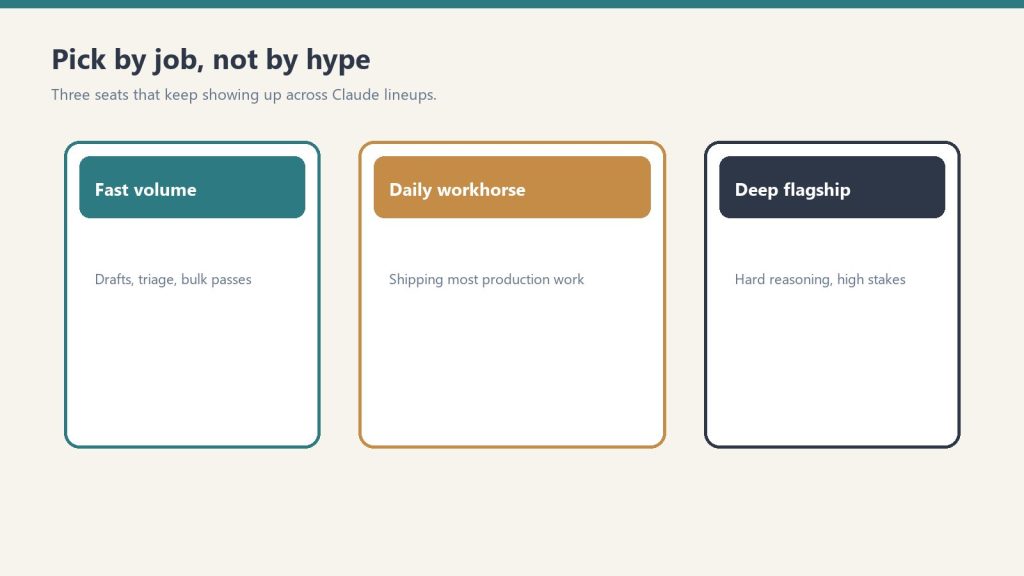
    Anthropic’s Claude model lineup in 2026 breaks down into three distinct tiers: Opus 4.7 for maximum capability, Sonnet 4.6 for the best balance of performance and cost, and Haiku 4.5 for speed and high-volume work. Picking the wrong model costs money or performance — sometimes both. This guide covers every meaningful difference so you can make the right call for your use case.

    Quick answer: Sonnet 4.6 handles 80–90% of tasks at 40% less cost than Opus. Use Opus 4.7 when you need maximum reasoning depth, the largest output window, or agentic coding at frontier quality. Use Haiku 4.5 when speed and cost are the priority and the task is straightforward.

    The Current Claude Model Lineup (April 2026)

    As of April 2026, Anthropic’s three recommended models are Claude Opus 4.7, Claude Sonnet 4.6, and Claude Haiku 4.5. All three support text and image input, multilingual output, and vision processing. They differ significantly in pricing, context window, output limits, and capability.

    Feature Opus 4.7 Sonnet 4.6 Haiku 4.5
    Input price $5 / MTok $3 / MTok $1 / MTok
    Output price $25 / MTok $15 / MTok $5 / MTok
    Context window 1M tokens 1M tokens 200K tokens
    Max output 128K tokens 64K tokens 64K tokens
    Extended thinking No Yes Yes
    Adaptive thinking Yes Yes No
    Latency Moderate Fast Fastest
    Knowledge cutoff Jan 2026 Aug 2025 Feb 2025

    Pricing is per million tokens (MTok) via the Claude API. Source: Anthropic Models Overview, April 2026.

    Claude Opus 4.7: When to Use It

    Opus 4.7 is Anthropic’s most capable generally available model as of April 2026. Anthropic describes it as a step-change improvement in agentic coding over Opus 4.6, with a new tokenizer that contributes to improved performance on a range of tasks. Note that this new tokenizer may use up to 35% more tokens for the same text compared to previous models — a cost consideration worth factoring in for high-volume workflows.

    Key differentiators for Opus 4.7 over the other two models:

    • 128K max output tokens — double Sonnet and Haiku’s 64K cap. This matters for generating long-form code, detailed reports, or complete document drafts in a single call.
    • 1M token context window — same as Sonnet 4.6, meaning Opus can process entire codebases or book-length documents in a single session.
    • Adaptive thinking — Opus 4.7 and Sonnet 4.6 both support adaptive thinking, which lets the model adjust reasoning depth based on task complexity.
    • Most recent knowledge cutoff — January 2026, versus August 2025 for Sonnet and February 2025 for Haiku.

    Opus does not support extended thinking — that capability lives on Sonnet 4.6 and Haiku 4.5. Extended thinking lets the model reason step-by-step before generating output, which is particularly useful for complex math, science, and multi-step logic problems.

    Use Opus 4.7 for: complex architecture decisions, large codebase analysis, multi-agent orchestration tasks, outputs that require more than 64K tokens, tasks demanding the latest possible knowledge, and any work where you need the absolute frontier of Anthropic’s reasoning capability.

    Skip Opus 4.7 for: routine content generation, customer support pipelines, high-volume classification or extraction, real-time applications requiring low latency, or any task where Sonnet scores within your acceptable quality threshold.

    Claude Sonnet 4.6: The Workhorse

    Sonnet 4.6 is the model Anthropic recommends as the best combination of speed and intelligence. Released in February 2026, it delivers a 1M token context window at $3 input / $15 output per million tokens — the same context window as Opus at 40% lower cost.

    Sonnet 4.6 also uniquely offers extended thinking, which Opus 4.7 does not. When extended thinking is enabled, Sonnet can perform additional internal reasoning before generating its response — useful for reasoning-heavy tasks like complex debugging, multi-step research, and technical problem-solving where chain-of-thought depth matters.

    For developers and teams using Claude Code, Sonnet 4.6 is the standard daily driver. It handles tool calling, agentic workflows, and multi-file code reasoning reliably, at a price point that makes heavy daily use economically viable.

    Use Sonnet 4.6 for: most production workloads, Claude Code sessions, long-document analysis, content generation, coding tasks, research synthesis, customer-facing applications, and any workflow requiring the 1M context window where Opus’s premium isn’t justified.

    Skip Sonnet 4.6 for: high-volume pipelines where Haiku’s lower cost is acceptable, simple classification or extraction tasks, or real-time applications where Haiku’s faster latency is required.

    Claude Haiku 4.5: Speed and Volume

    Haiku 4.5 is the fastest model in the Claude family and the most cost-efficient at $1 input / $5 output per million tokens. It has a 200K token context window — smaller than Opus and Sonnet’s 1M, but still substantial for most single-task work. It supports extended thinking but not adaptive thinking.

    The 200K context limit is the most important practical constraint. Most single-document, single-task workflows fit within 200K. Multi-file codebases, long books, or extended conversation histories that push past that threshold need Sonnet or Opus.

    Haiku 4.5 has the oldest knowledge cutoff of the three: February 2025. For tasks requiring awareness of events or developments from mid-2025 onward, Haiku won’t have that context baked in.

    Use Haiku 4.5 for: content moderation, classification pipelines, entity extraction, customer support triage, real-time chat interfaces, simple Q&A, high-volume API workflows where cost and speed dominate, and any task where quality requirements are modest.

    Skip Haiku 4.5 for: complex reasoning, large codebase analysis, tasks requiring recent knowledge (post-February 2025), multi-step agent workflows, or any output requiring more than 200K tokens of input context.

    Pricing: What the Numbers Actually Mean in Practice

    All three models price output tokens at 5x the input rate — a ratio that holds across the entire Claude lineup. This means verbose, long-form outputs cost significantly more than short, targeted responses. Minimizing generated output length is the highest-leverage cost optimization available before you touch model routing or caching.

    To put the pricing in concrete terms: generating one million output tokens (roughly 750,000 words of generated text) costs $25 on Opus, $15 on Sonnet, and $5 on Haiku. For input-heavy workloads like document analysis where you’re feeding in large amounts of text but getting shorter responses, the cost gap narrows.

    Three additional pricing levers apply across all models:

    • Prompt caching: Cuts cache-read input costs by up to 90% for repeated system prompts or documents. If your application reuses a large system prompt across many requests, caching is the single highest-impact cost reduction available.
    • Batch API: Provides a 50% discount for non-time-sensitive workloads processed asynchronously. Combine with prompt caching for up to 95% savings on qualifying workflows.
    • Model routing: Running a mix of Haiku for simple tasks, Sonnet for production workloads, and Opus for complex reasoning — rather than using one model for everything — can reduce total API costs by 60–70% without meaningful quality loss on the tasks that don’t require a flagship model.

    Context Windows: 1M Tokens vs. 200K

    Opus 4.7 and Sonnet 4.6 both offer a 1M token context window at standard pricing — no premium surcharge for extended context. For reference, 1 million tokens is roughly 750,000 words, enough to hold a large codebase, a full academic textbook, or months of business communications in a single conversation.

    Haiku 4.5 has a 200K token context window. That’s still roughly 150,000 words — sufficient for most single-document tasks, but it creates a hard ceiling for anything requiring multi-file code review, book-length document analysis, or lengthy conversation histories.

    If your workflow consistently requires more than 200K tokens of input, Sonnet 4.6 is the cost-efficient choice. Opus 4.7 is the right call only when the input load requires the additional reasoning capability Opus provides, not just the context window size — because Sonnet gets you the same 1M window at 40% lower cost.

    Extended Thinking vs. Adaptive Thinking

    These are two distinct features that appear together in the comparison table but serve different purposes.

    Extended thinking (available on Sonnet 4.6 and Haiku 4.5, not Opus 4.7) lets Claude perform additional internal reasoning before generating its response. When enabled, the model produces a “thinking” content block that exposes its reasoning process — step-by-step problem decomposition before the final answer. Extended thinking tokens are billed as standard output tokens at the model’s output rate. A minimum thinking budget of 1,024 tokens is required when enabling this feature.

    Adaptive thinking (available on Opus 4.7 and Sonnet 4.6, not Haiku 4.5) adjusts reasoning depth dynamically based on task complexity — the model allocates more reasoning for harder problems and less for simpler ones, without requiring explicit configuration.

    The practical implication: if you need transparent, controllable step-by-step reasoning that you can inspect and use in your application, Sonnet 4.6’s extended thinking is often the right tool — and at lower cost than Opus.

    Which Claude Model Should You Choose?

    The right framework for model selection in 2026 is to start with Sonnet 4.6 as your default and escalate selectively. Most production workloads — coding, writing, analysis, research, customer-facing applications — are well-served by Sonnet. Opus 4.7 earns its premium in specific scenarios: tasks requiring more than 64K output tokens, agent workflows demanding maximum reasoning depth, or applications where Anthropic’s latest knowledge cutoff is a meaningful factor.

    Haiku 4.5 belongs in any pipeline where you’ve identified tasks that don’t require Sonnet’s capability. High-volume routing, triage, classification, and real-time response scenarios are Haiku’s natural territory. Building a 70/20/10 routing split across Haiku, Sonnet, and Opus — rather than using a single model for everything — is the standard approach for cost-efficient production deployments.

    Frequently Asked Questions

    What is the difference between Claude Opus, Sonnet, and Haiku?

    Opus is Anthropic’s most capable model, optimized for complex reasoning, large outputs, and agentic tasks. Sonnet offers a balance of capability and cost, handling most production workloads at lower price. Haiku is the fastest and cheapest option, suited for high-volume, lower-complexity tasks. All three share the same core Claude architecture and safety training.

    Is Claude Opus worth the extra cost over Sonnet?

    For most tasks, no. Sonnet 4.6 handles the majority of coding, writing, and analysis work at 40% lower cost. Opus 4.7 is worth the premium when you need outputs longer than 64K tokens, maximum agentic coding capability, or the most recent knowledge cutoff (January 2026 vs. Sonnet’s August 2025).

    Which Claude model is best for coding?

    Sonnet 4.6 is the standard recommendation for most coding work, including Claude Code sessions. Opus 4.7 is preferred for large codebase analysis, complex architecture decisions, or multi-agent coding workflows where maximum reasoning depth is required. Haiku 4.5 can handle simple code edits and explanations at much lower cost.

    What is the Claude context window?

    Claude Opus 4.7 and Sonnet 4.6 both have a 1 million token context window — roughly 750,000 words of combined input and conversation history. Claude Haiku 4.5 has a 200,000 token context window. Context window size determines how much information Claude can hold and reference in a single conversation.

    Does Claude Opus support extended thinking?

    No. Extended thinking is available on Claude Sonnet 4.6 and Claude Haiku 4.5, but not on Claude Opus 4.7. Opus 4.7 supports adaptive thinking instead, which dynamically adjusts reasoning depth based on task complexity.

    What is the cheapest Claude model?

    Claude Haiku 4.5 is the least expensive model at $1 per million input tokens and $5 per million output tokens. It is also the fastest Claude model, making it well-suited for high-volume, latency-sensitive applications.

    Can I use Claude through Amazon Bedrock or Google Vertex AI?

    Yes. All three current Claude models — Opus 4.7, Sonnet 4.6, and Haiku 4.5 — are available through Amazon Bedrock and Google Vertex AI in addition to the direct Anthropic API. Bedrock and Vertex AI offer regional and global endpoint options. Pricing on third-party platforms may vary from direct Anthropic API rates.

  • Claude Team Plan Usage Limits Explained: Standard vs Premium Seats

    If you’re on Claude’s Team plan and wondering why you hit a wall mid-session — or trying to figure out whether to put someone on a Standard or Premium seat — this is the guide Anthropic doesn’t make obvious enough. Here’s exactly how Team plan usage limits work, what the numbers actually mean in practice, and what you can do when you hit the ceiling.

    How Claude Team Plan Usage Limits Actually Work

    Every Claude plan — Free, Pro, Max, Team, and Enterprise — runs on a five-hour rolling session window. Your usage limit isn’t a daily message count. It’s compute capacity measured across a five-hour window that begins with your first message. Once that window resets, you get a fresh allocation.

    Team plan usage limits are also subject to a weekly cap that resets seven days after your session window starts. This is the second layer most users don’t notice until they’ve been using Claude heavily for several days in a row.

    One detail that catches teams off guard: usage is unified across all Claude surfaces. Messages sent on claude.ai, work done in Claude Code, and activity in Claude Desktop all draw from the same pool. A heavy Claude Code session in the morning competes with your afternoon research sessions on claude.ai.

    Standard Seats vs. Premium Seats: What the Multipliers Mean

    The Team plan offers two seat types with meaningfully different usage allocations:

    Standard Seats

    • Usage per session: 1.25x more than the Pro plan per five-hour session
    • Weekly limit: One weekly cap that applies across all models, resets seven days after your session starts
    • Price: $25/member/month billed monthly, or $20/member/month billed annually

    Standard seats are the right fit for team members who use Claude consistently but not at maximum intensity. The 1.25x multiplier over Pro is a modest bump — meaningful for occasional power users, but it won’t prevent a daily heavy user from hitting limits.

    Premium Seats

    • Usage per session: 6.25x more than the Pro plan per five-hour session
    • Weekly limits: Two separate weekly caps — one across all models, plus a separate cap for Sonnet models only. Both reset seven days after your session starts
    • Price: $125/member/month billed monthly, or $100/member/month billed annually

    The jump from 1.25x to 6.25x is significant. Premium seats are built for power users — developers running extended Claude Code sessions, researchers with long document workflows, or anyone whose work would otherwise constantly bump against the Standard seat ceiling.

    Organizations can mix and match: assign Premium seats to your heaviest users and keep everyone else on Standard. This is usually more cost-effective than putting the entire team on Premium.

    Usage Limits Are Per-Member, Not Per-Team

    This is one of the most important architectural details of the Team plan: limits are per-member, not pooled across the organization.

    If one team member exhausts their session allocation, it has zero effect on every other team member’s limits. There’s no shared bucket that someone can drain. Each person has their own independent five-hour session and weekly cap. This makes the Team plan more predictable than a pooled model — your usage doesn’t depend on the consumption habits of your colleagues.

    What Happens When You Hit Your Limit

    When you reach your session limit, Claude blocks subsequent requests until the five-hour window resets. The system checks your limit before processing each request — though it’s possible to slightly exceed your defined limit, since token consumption is calculated after a request is processed, not before. Once you bypass the limit on a single request, all subsequent requests are blocked until reset.

    There are three ways forward when you hit a ceiling:

    1. Wait for the session window to reset — the five-hour window rolls forward from your first message
    2. Enable extra usage — Team plan owners can pre-purchase extra usage that activates automatically when members hit their included limits
    3. Upgrade the seat type — moving a heavy user from Standard to Premium gives them a 5x usage increase per session

    Extra Usage: The Overflow Layer

    Team plan owners can configure extra usage so that members continue working after hitting their included allocation instead of being blocked. Once extra usage is enabled and a member reaches their seat limit, usage continues and is billed at standard API pricing rates.

    Owners can set spend controls at multiple levels:

    • Organization-wide monthly spend cap
    • Per-seat-tier spend cap (e.g., limit extra usage for all Standard seats)
    • Per-individual-member spend cap

    Extra usage applies to Claude on claude.ai, Claude Code, and Cowork. It’s configured through Organization Settings → Usage in the Team plan admin console.

    How Usage Gets Consumed Faster Than Expected

    Not all messages are equal. Several factors cause heavier token consumption:

    • Long conversations: Every message in a thread reprocesses the full conversation history as context. A 100-message thread costs dramatically more per response than a fresh conversation.
    • Large file attachments: Uploading PDFs or large documents inflates context size for that entire session.
    • Claude Code sessions: Agentic coding tasks include large system instructions, full file contexts, and often multiple model calls per user interaction. A single Claude Code task can cost as much as dozens of regular chat messages.
    • Model choice: Opus-class models consume more compute per message than Sonnet or Haiku.
    • Features enabled: Tools like web search, code execution, and extended thinking add to consumption per turn.

    Context Window: Separate from Usage Limits

    Usage limits control how many messages you can send over time. The context window controls how much information Claude can hold in a single conversation. These are two different constraints.

    The Team plan context window is 200,000 tokens — shared across all models on Team. For reference, 200K tokens is roughly 150,000 words, enough to hold the full text of a long novel. Enterprise plans on certain models can access a 500K token context window.

    For users with code execution enabled, Claude now automatically manages long conversations: when a conversation approaches the context window limit, Claude summarizes earlier messages to continue the conversation without interruption. Your full chat history is preserved and remains referenceable even after summarization.

    Tracking Your Usage

    Team plan members can monitor consumption in real time at Settings → Usage. The dashboard shows:

    • Current session progress toward the five-hour limit
    • Weekly limit progress and reset timing
    • Extra usage balance and spend (if enabled by an owner)

    Team owners see aggregate usage data across the organization and can set spend limits from the same console.

    Team Plan Minimums and Seat Limits

    The Team plan requires a minimum of five members. It supports up to 150 seats. Organizations that need more than 150 seats need to contact Anthropic’s sales team to move to an Enterprise plan — the self-serve upgrade path from Team to Enterprise isn’t available.

    When to Move to Enterprise Instead

    The Team plan makes sense for most organizations under 150 people. Enterprise becomes relevant when you need:

    • More than 150 seats
    • A 500K token context window on select models
    • Usage-based billing (pay per token, no included allocation) instead of seat-based limits
    • Dedicated compliance features (SOC 2, HIPAA BAA, SAML SSO at scale)
    • Group-level spend controls

    On usage-based Enterprise plans, there are no included usage limits — you’re billed at API rates from the first token, and there’s no extra usage concept because you’re never blocked by a subscription ceiling.

    Frequently Asked Questions

    Does the Team plan have a daily message limit?

    No. Claude Team plan limits are session-based, not daily. You have a five-hour rolling window and a weekly cap — not a fixed number of messages per day. The actual number of messages you can send depends on message length, file size, model used, and features enabled.

    Do Standard and Premium seats share a usage pool?

    No. Every seat type has its own independent limit. Standard seat members and Premium seat members each have their own session and weekly allocations. One person using their full allocation does not reduce anyone else’s.

    What happens to my limit when I switch models mid-conversation?

    Usage counts against your overall session allocation regardless of which model you’re using. Premium seats have a separate weekly cap specifically for Sonnet models in addition to the all-models weekly cap, but within a session all model usage draws from the same five-hour window.

    Does Claude Code usage count against my Team plan limit?

    Yes. Claude Code, claude.ai, and Claude Desktop all draw from the same unified usage pool. A Claude Code session in the morning reduces your available allocation for the rest of that five-hour window across all surfaces.

    Can I see how much of my limit I’ve used?

    Yes. Go to Settings → Usage on claude.ai. You’ll see progress bars for your current session usage and weekly limit, plus the reset timing for each.

    What’s the difference between the five-hour session limit and the weekly limit?

    The five-hour session limit caps burst usage — it controls how much you can do in any continuous working period. The weekly limit caps total usage over a seven-day period. Heavy users can hit the weekly limit even without ever maxing out a single session, simply by using Claude consistently every day across the week.

    Is there a way to get unlimited usage on the Team plan?

    Not strictly unlimited, but extra usage removes the hard block when you hit your included allocation. With extra usage enabled, you continue working and are billed at standard API rates for anything beyond your included seat limits. Organization owners can set spend caps to prevent unexpected costs.

  • Should You Give Claude Access to Your Email, Slack, and SSH Keys?

    Should You Give Claude Access to Your Email, Slack, and SSH Keys?

    Should You Give Claude Access to Your Email, Slack, and SSH Keys?

    The Lethal Trifecta is a security framework for evaluating agentic AI risk: any AI agent that simultaneously has access to your private data, access to untrusted external content, and the ability to communicate externally carries compounded risk that is qualitatively different from any single capability alone. The name comes from the AI engineering community’s own terminology for the combination. The industry coined it, documented it, and then mostly shipped it anyway.

    The answer to the question in the title is: it depends, and the framework for deciding is more important than any blanket yes or no. But before we get to the framework, it is worth spending some time on why the question is harder than the AI industry’s current marketing posture suggests.

    In the spring of 2026, the dominant narrative at AI engineering conferences and in developer tooling launches is one of frictionless connection. Give your AI access to everything. Let it read your email, monitor your calendar, respond to your Slack, manage your files, run commands on your server. The more you connect, the more powerful it becomes. The integration is the product.

    This narrative is not wrong exactly. Broadly connected AI agents are genuinely powerful. The capabilities being described are real and the productivity gains are real. What gets systematically underweighted in the enthusiasm — sometimes by speakers who are simultaneously naming the risks and shipping the product anyway — is what happens when those capabilities are exploited rather than used as intended.

    This article is the risk assessment the integration demos skip.


    What the AI Engineering Community Actually Knows (And Ships Anyway)

    The most clarifying thing about the current moment in AI security is not that the risks are unknown. It is that they are known, named, documented, and proceeding regardless.

    At the AI Engineer Europe 2026 conference, the security conversation was unusually candid. Peter Steinberger, creator of OpenClaw — one of the fastest-growing AI agent frameworks in recent history — presented data on the security pressure his project faces: roughly 1,100 security advisories received in the framework’s first months of existence, the vast majority rated critical. Nation-state actors, including groups attributed to North Korea, have been actively probing open-source AI agent frameworks for exploitable vulnerabilities. This was stated plainly, in a keynote, at a major developer conference, and the session continued directly into how to build more powerful agents.

    The Lethal Trifecta framework — the recognition that an agent with private data access, untrusted content access, and external communication capability is a qualitatively different risk than any single capability — was presented not as a reason to slow down but as a design consideration to hold in mind while building. Which is fair, as far as it goes. But the gap between “hold this in mind” and “actually architect around it” is where most real-world deployments currently live.

    The point is not that the AI engineering community is reckless. The point is that the incentive structure of the industry — where capability ships fast and security is retrofitted — means that the candid acknowledgment of risk and the shipping of that risk can happen in the same session without contradiction. Individual operators who are not building at conference-demo scale need to do the risk assessment that the product launches are not doing for them.


    The Three Capabilities and What Each Actually Means

    The Lethal Trifecta is a useful lens because it separates three capabilities that are often bundled together in integration pitches and treats each one as a distinct risk surface.

    Access to Your Private Data

    This is the most commonly understood capability and the one most people focus on when thinking about AI privacy. When you connect Claude — or any AI agent — to your email, your calendar, your cloud storage, your project management tools, your financial accounts, or your communication platforms, you are giving the AI a read-capable view of data that exists nowhere else in the same configuration.

    The risk is not primarily that the AI platform will misuse it, though that is worth understanding. The risk is that the AI becomes a single point of access to an unusually comprehensive portrait of your life and work. A compromised AI session, a prompt injection, a rogue MCP server, or an integration that behaves differently than expected now has access to everything that integration touches.

    The practical question is not “do I trust this AI platform” but “what is the blast radius if this specific integration is exploited.” Those are different questions with different answers.

    Access to Untrusted External Content

    This capability is less commonly thought about and considerably more dangerous in combination with the first. When you give an AI agent the ability to browse the web, read external documents, process incoming email from unknown senders, or access any content that originates outside your controlled environment, you are exposing the agent to inputs that may be deliberately crafted to manipulate its behavior.

    Prompt injection — embedding instructions in content that the AI will read and act on as if those instructions came from you — is not a theoretical vulnerability. It is a documented, actively exploited attack vector. An email that appears to be a routine business inquiry but contains embedded instructions telling the AI to forward your recent correspondence to an external address. A web page that looks like a documentation page but instructs the AI to silently modify a file it has write access to. A document that, when processed, tells the AI to exfiltrate credentials from connected services.

    The AI does not always distinguish between instructions you gave it and instructions embedded in content it reads on your behalf. This is a fundamental characteristic of how language models process text, not a bug that will be patched in the next release.

    The Ability to Communicate Externally

    The third leg of the trifecta is what turns a read vulnerability into a write vulnerability. An AI that can read your private data and read untrusted content but cannot take external actions is a privacy risk. An AI that can also send email, post to Slack, make API calls, or run commands has the ability to act on whatever instructions — legitimate or injected — it processes.

    The combination of all three is what produces the qualitative shift in risk profile. Private data access means the attacker gains access to your information. Untrusted content access means the attacker can deliver instructions to the agent. External action capability means those instructions can produce real-world consequences without your direct involvement.

    The agent that reads your email, processes an injected instruction from a malicious sender, and then forwards your sensitive files to an external address is not a hypothetical attack. It is a specific, documented threat class that AI security researchers have demonstrated in controlled environments and that real deployments are not consistently protected against.


    Cross-Primitive Escalation: The Attack You Are Not Modeling

    The AI engineering community has a more specific term for one of the most dangerous attack patterns in this space: cross-primitive escalation. It is worth understanding because it describes the mechanism by which a seemingly low-risk integration becomes a high-risk one.

    Cross-primitive escalation works like this: an attacker compromises a read-only resource — a document, a web page, a log file, an incoming message — and embeds instructions in it that the AI will process as legitimate directives. Those instructions tell the AI to invoke a write-action capability that the attacker could not access directly. The read resource becomes a bridge to the write capability.

    A concrete example: you connect your AI to your cloud storage for read access, so it can summarize documents and answer questions about project files. You also connect it to your email with send capability, so it can draft and send routine correspondence. These seem like two separate, bounded integrations. Cross-primitive escalation means a compromised document in your cloud storage could instruct the AI to use its email send capability to forward sensitive files to an external address. The read access and the write access interact in a way that neither integration’s risk model accounts for individually.

    This is why the Lethal Trifecta matters at the combination level rather than the individual capability level. The question to ask is not “is this specific integration risky” but “what can the combination of my integrations do if the read-capable surface is compromised.”


    The Framework: How to Actually Decide

    With the risk structure clear, here is a practical framework for evaluating whether to grant any specific AI integration.

    Question 1: What is the blast radius?

    For any integration you are considering, define the worst-case scenario specifically. Not “something bad might happen” but: if this integration were exploited, what data could be accessed, what actions could be taken, and who would be affected?

    An integration that can read your draft documents and nothing else has a contained blast radius. An integration that can read your email, access your calendar, send messages on your behalf, and call external APIs has a blast radius that encompasses your professional relationships, your schedule, your correspondence history, and whatever systems those APIs touch. These are not comparable risks and should not be evaluated with the same threshold.

    Question 2: Is this integration delivering active value?

    The temptation with AI integrations is to connect everything because connection is low-friction and disconnection requires a deliberate action. This produces an accumulation of integrations where some are actively useful, some are marginally useful, and some were set up once for a specific purpose that no longer exists.

    Every live integration is carrying risk. An integration that is not delivering value is carrying risk with no offsetting benefit. The right practice is to connect deliberately and maintain an active integration audit — reviewing what is connected, what it is actually doing, and whether that value justifies the risk posture it creates.

    Question 3: What is the minimum scope necessary?

    Most AI integration interfaces offer choices in how broadly to grant access. Read-only versus read-write. Access to a specific folder versus access to all files. Access to a single Slack channel versus access to all channels including private ones. Access to outbound email drafts only versus full send capability.

    The principle is the same one that governs good access control in any security context: grant the minimum scope necessary for the function you need. The guardrails starter stack covers the integration audit mechanics for doing this in practice. An AI that needs to read project documents to answer questions about them does not need write access to those documents. An AI that needs to draft email responses does not need send-without-review access. The capability gap between what you grant and what you actually use is attack surface that exists for no benefit.

    Question 4: Is there a human confirmation gate proportional to the action’s reversibility?

    This is the question that most integration setups skip entirely. The AI engineering community has a name for the design pattern that gets this right: matching the depth of human confirmation to the reversibility of the action.

    Reading a document is reversible in the sense that nothing changes in the world if the read is wrong. Sending an email is not reversible. Deleting a file is not immediately reversible. Making an API call that triggers an external workflow may not be reversible at all. The confirmation requirement should scale with the irreversibility.

    An AI integration with full autonomous action capability — no human in the loop, no confirmation step, no review before execution — is an appropriate architecture for a narrow set of genuinely low-stakes tasks. It is not an appropriate architecture for anything that touches external communication, data modification, or actions with downstream consequences. The friction of confirmation is not overhead. It is the mechanism that makes the capability safe to use.


    SSH Keys Specifically: The Highest-Stakes Integration

    The title of this article includes SSH keys because they represent the clearest case of where the Lethal Trifecta analysis should produce a clear answer for most operators.

    SSH access is full computer access. An AI with SSH key access to a server can read any file on that server, modify any file, install software, delete data, exfiltrate credentials stored on the system, and use that server as a jumping-off point to reach other systems on the same network. The blast radius of an SSH key integration extends to everything that server touches.

    The AI engineering community has thought carefully about this specific tradeoff and arrived at a nuanced position: full computer access — bash, SSH, unrestricted command execution — is appropriate in cloud-hosted, isolated sandbox environments where the blast radius is deliberately contained. It is not appropriate in local environments, production systems, or anywhere that the server has meaningful access to data or systems that should be protected.

    This is a reasonable position. Claude Code running in an isolated cloud container with no access to production data or external systems is a genuinely different risk profile than an AI agent with SSH access to a server that also holds client data and has credentials to your infrastructure. The key question is not “should AI ever have SSH access” but “what does this specific server touch, and am I comfortable with the full blast radius.”

    For most operators who are not running dedicated sandboxed environments: the answer is to not give AI systems SSH access to servers that hold anything you would not want to lose, expose, or have modified without your explicit instruction. That boundary is narrower than it sounds for most real-world setups.


    What Secure AI Integration Actually Looks Like

    The risk framework above can sound like an argument against AI integration entirely. It is not. The goal is not to disconnect everything but to connect deliberately, with architecture that matches the capability to the risk.

    The AI engineering community has developed several patterns that meaningfully reduce risk without eliminating capability:

    MCP servers as bounded interfaces. Rather than giving an AI direct access to a service, exposing only the specific operations the AI needs through a defined interface. An AI that needs to query a database gets an MCP tool that can run approved queries — not direct database access. An AI that needs to search files gets a tool that searches and returns results — not file system access. The MCP pattern limits the blast radius by design.

    Secrets management rather than credential injection. Credentials never appear in AI contexts. They live in a secrets manager and are referenced by proxy calls that keep the raw credential out of the conversation and the memory. The AI can use a credential without ever seeing it, which means a compromised AI context cannot exfiltrate credentials it was never given.

    Identity-aware proxies for access control. Enterprise-grade deployments use proxy architecture that gates AI access to internal tools through an identity provider — ensuring that the AI can only access resources that the authenticated user is authorized to reach, and that access can be revoked centrally when a session ends or an employee departs.

    Sentinel agents in review loops. Before an AI takes an irreversible external action, a separate review agent checks the proposed action against defined constraints — security policies, scope limitations, instructions that would indicate prompt injection. The reviewer is a second layer of judgment before the action executes.

    Most of these patterns are not available out of the box in consumer AI products. They are the architecture that thoughtful engineering teams build when they are taking the risk seriously. For operators who are not building custom architecture, the practical equivalent is the simpler version: grant minimum scope, maintain a confirmation gate for irreversible actions, and audit integrations regularly.


    The Honest Position for Solo Operators and Small Teams

    The AI security conversation at the engineering level — MCP portals, sentinel agents, identity-aware proxies, Kubernetes secrets mounting — is not where most solo operators and small teams currently live. The consumer and prosumer AI products that most people actually use do not yet offer granular integration controls at that level of sophistication.

    That gap creates a practical challenge: the risk is real at the individual level, the mitigations that are most effective require engineering investment most operators cannot make, and the consumer product interfaces do not always surface the right questions at integration time.

    The honest position for this context is a set of simpler rules that approximate the right architecture without requiring it:

    • Do not connect integrations you will not actively maintain. If you set up a connection and forget about it, it is carrying risk without delivering value. Only connect what you will review in your quarterly integration audit. Stale integrations are a form of context rot — carrying signal you no longer control.
    • Do not grant write access when read access is sufficient. For any integration where the AI’s function is informational — summarizing, searching, answering questions — read-only scope is enough. Write access is a separate decision that should require a specific use case justification.
    • Do not give AI agents autonomous action on anything with a large blast radius. Anything that sends external communications, modifies production data, makes financial transactions, or touches infrastructure should have a human confirmation step before execution. The confirmation friction is the point.
    • Treat incoming content from unknown sources as untrusted. Email from senders you do not recognize, external documents processed on your behalf, web content accessed by an agent — all of this is potential prompt injection surface. The AI processing it does not automatically distinguish instructions embedded in content from instructions you gave directly.
    • Know the blast radius of your current setup. Sit down once and map what your AI integrations can reach. If you cannot describe the worst-case scenario for your current configuration, you are carrying risk you have not evaluated.

    None of these rules require engineering expertise. They require the same deliberate attention to scope and consequences that good operators apply to other parts of their work.


    The Market Will Not Solve This for You

    One of the more uncomfortable truths about the current AI integration landscape is that the market incentives do not strongly favor solving the risk problem on behalf of individual users. AI platforms are rewarded for adoption, engagement, and integration depth. Security friction reduces all three in the short term. The platforms that will invest heavily in making the security posture of broad integrations genuinely safe are the ones with enterprise customers whose procurement processes require it — not the consumer products that most individual operators use.

    This is not an argument against using AI integrations. It is an argument for not assuming that the product’s default configuration represents a considered risk assessment on your behalf. The default is optimized for capability and adoption. The security posture you actually want requires active choices that push against those defaults.

    The AI engineering community named the Lethal Trifecta, documented the attack vectors, and ships them anyway because the capability demand is real and the market rewards it. Individual operators who understand the framework can make different choices about what to connect, at what scope, with what confirmation gates — and those choices are available right now, in the current product interfaces, without waiting for the platforms to solve it.

    The question is not whether to use AI integrations. The question is whether to use them with the same level of deliberate attention you would give to any other decision with that blast radius. The answer to that question should be yes, and it usually is not yet.


    Frequently Asked Questions

    What is the Lethal Trifecta in AI security?

    The Lethal Trifecta refers to the combination of three AI agent capabilities that creates compounded risk: access to private data, access to untrusted external content, and the ability to take external actions. Any one of these capabilities carries manageable risk in isolation. The combination creates attack vectors — particularly prompt injection — that can turn a read-only vulnerability into an irreversible external action without the user’s knowledge or intent.

    What is prompt injection and why does it matter for AI integrations?

    Prompt injection is an attack where instructions are embedded in content the AI reads on your behalf — an email, a document, a web page — and the AI processes those instructions as if they came from you. Because language models do not reliably distinguish between user instructions and instructions embedded in processed content, a malicious actor who can get the AI to read a crafted document can potentially direct the AI to take actions using whatever integrations are available. This is an actively exploited vulnerability class, not a theoretical one.

    Is it safe to give Claude access to my email?

    It depends on the scope and architecture. Read-only access to your sent and received mail, with no ability to send on your behalf, has a significantly different risk profile than full read-write access with autonomous send capability. The relevant questions are: what is the minimum scope necessary for the function you need, is there a human confirmation gate before any send action, and do you treat incoming email from unknown senders as potential prompt injection surface? Read access for summarization with no send capability and manual review before any draft is sent is a defensible configuration. Fully autonomous email handling with broad send permissions is not.

    Should AI agents ever have SSH key access?

    Full computer access via SSH is appropriate in deliberately isolated sandbox environments where the blast radius is contained — a dedicated cloud instance with no access to production data, no credentials to sensitive systems, and no path to infrastructure that matters. It is not appropriate for servers that hold client data, production systems, or any infrastructure where unauthorized access would have significant consequences. The key question is not SSH access in principle but what the specific server touches and whether that blast radius is acceptable.

    What is cross-primitive escalation in AI security?

    Cross-primitive escalation is an attack pattern where a compromised read-only resource is used to instruct an AI to invoke a write-action capability. For example, a malicious document in your cloud storage might contain instructions telling the AI to use its email-send capability to forward sensitive files externally. The read integration and the write integration each seem bounded; the combination creates a bridge that neither risk model accounts for individually. It is why the Lethal Trifecta analysis applies at the combination level, not just per-integration.

    What is the minimum viable security posture for AI integrations?

    For operators who are not building custom security architecture: connect only what you will actively maintain; grant read-only scope unless write access is specifically required; require human confirmation before any irreversible external action; treat incoming content from unknown sources as potential prompt injection surface; and maintain a quarterly integration audit that reviews what is connected and whether the access scope is still appropriate. These rules do not require engineering investment — they require deliberate attention to scope and consequences at integration time.

    How does AI integration security differ for enterprise versus solo operators?

    Enterprise deployments have access to architectural mitigations — identity-aware proxies, MCP portals, sentinel agents in CI/CD, centralized credential management — that meaningfully reduce risk without eliminating capability. Solo operators and small teams typically use consumer product interfaces that do not offer the same granular controls. The gap means individual operators need to apply simpler rules (minimum scope, confirmation gates, regular audits) that approximate the right architecture without requiring it. The risk is real at both levels; the available mitigations differ significantly.


  • Context Rot: Why Your Bloated AI Memory Is Making Your Results Worse

    Context Rot: Why Your Bloated AI Memory Is Making Your Results Worse

    Context Rot: Why Your Bloated AI Memory Is Making Your Results Worse

    Context rot is the gradual degradation of AI output quality caused by an accumulating memory layer that has grown too large, too stale, or too contradictory to serve as reliable signal. It is not a platform bug. It is the predictable consequence of loading more into a persistent memory than it can usefully hold — and of never pruning what should have been retired months ago.

    Most people using AI with persistent memory believe the same thing: more context makes the AI better. The more it knows about you, your work, your preferences, and your history, the more useful it becomes. Load it up. Keep everything. The investment compounds.

    This intuition is wrong — not in the way that makes for a hot take, but in the way that explains a real pattern that operators running AI at depth eventually notice and cannot un-notice once they see it. Past a certain threshold, context does not add signal. It adds noise. And noise, when the model treats it as instruction, produces outputs that are subtly and then increasingly wrong in ways that are difficult to diagnose because the wrongness is baked into the foundation.

    This article is about what context rot is, why it happens, how to recognize it in your current setup, and what to do about it. It is primarily a performance argument, not a privacy argument — though the two converge at the pruning step. If you have already read about the archive vs. execution layer distinction, this piece goes deeper on the memory side of that argument. If you have not, the short version is: the AI’s memory should be execution-layer material — current, relevant, actionable — not an archive of everything you have ever told it.


    What Context Rot Actually Looks Like

    Context rot does not announce itself. It does not produce error messages. It produces outputs that feel slightly off — not wrong enough to immediately flag, but wrong enough to require more editing, more correction, more follow-up. Over time, the friction accumulates, and the operator who was initially enthusiastic about AI begins to feel like the tool has gotten worse. Often, the tool has not gotten worse. The context has gotten worse, and the tool is faithfully responding to it.

    Some specific patterns to recognize:

    The model keeps referencing outdated facts as if they are current. You told the AI something six months ago — about a client relationship, a project status, a constraint you were working under, a preference you had at the time. The situation has changed. The memory has not. The AI keeps surfecting that outdated framing in responses, subtly anchoring its reasoning in a version of your reality that no longer exists. You correct it in the session; next session, the stale memory is back.

    The model’s responses feel generic or averaged in ways they didn’t used to. This is one of the stranger manifestations of context rot, and it happens because memory that spans a long time period and many different contexts starts to produce a kind of composite portrait that reflects no single real state of affairs. The AI is trying to honor all the context simultaneously and producing outputs that are technically consistent with all of it, which means outputs that are specifically right about none of it.

    The model contradicts itself across sessions in ways that seem arbitrary. Inconsistent context produces inconsistent outputs. If your memory contains two different versions of your preferences — one from an early session and one from a later revision that you added without explicitly replacing the first — the model may weight them differently across sessions, producing responses that seem random when they are actually just responding to contradictory instructions.

    You find yourself re-explaining things you know you have already told the AI. This is a signal that the memory is either not storing what you think it is, or that what it stored has been diluted by so much other context that it no longer surfaces reliably. Either way, the investment you made in building up the context is not producing the return you expected.

    The model’s tone or approach feels different from what you established. Early in a working relationship with a particular AI setup, many operators take care to establish a voice, a set of norms, a way of working together. If that context is now buried under months of accumulated memory — project names that changed, client relationships that evolved, instructions that got superseded — the foundational preferences may be getting overridden by later context that is closer to the top of the stack.

    None of these patterns are definitive proof of context rot in isolation. Together, or in combination, they are a strong signal that the memory layer has grown past the point of serving you and has started to cost you.


    Why More Context Stops Helping Past a Threshold

    To understand why context rot happens, it helps to have a working mental model of what the AI’s memory is actually doing during a session.

    When you begin a conversation, the platform loads your stored memory into the context window alongside your message. The model then reasons over everything in that window simultaneously — your current question, your stored preferences, your project knowledge, your historical context. It is not a database lookup that retrieves the one right fact; it is a reasoning process that tries to integrate everything present into a coherent response.

    This works well when the memory is clean, current, and non-contradictory. It produces responses that feel genuinely personalized and informed by your actual situation. The investment is paying off.

    What happens when the memory is large, stale, and contradictory is different. The model is now trying to integrate a much larger set of information that includes outdated facts, superseded instructions, and implicit contradictions. The reasoning process does not fail cleanly — it degrades. The model produces outputs that are trying to honor too many constraints at once and end up genuinely optimal for none of them.

    There is also a more fundamental issue: not all context is equally valuable, and the model generally cannot tell which parts of your memory are still true. It treats stored facts as current by default. A memory that says “working on the Q3 campaign for client X” was useful context in August. In February, it is noise — but the model has no way to know that from the entry alone. It will continue to treat it as relevant signal until you tell it otherwise, or until you delete it.

    The result is that the memory you have built up — which felt like an asset as you were building it — is now partly a liability. And the liability grows with every session you add context without also pruning context that has expired.


    The Pruning Argument Is a Performance Argument, Not Just a Privacy Argument

    Most discussion of AI memory pruning frames it as a safety or privacy practice. You should prune your memory because you do not want old information sitting in a vendor’s system, because stale context might contain sensitive information, because hygiene is good practice. All of that is true.

    But framing pruning primarily as a privacy move misses the larger audience. Many operators who do not think of themselves as privacy-conscious will recognize the performance argument immediately, because they have already felt the effect of context rot even if they did not have a name for it.

    The performance argument: a pruned memory produces better outputs than a bloated one, even when none of the bloat is sensitive. Removing context that is outdated, irrelevant, or contradictory is a productivity practice. It sharpens the signal. It makes the AI’s responses more accurate to your current reality rather than a historical average of your past several selves.

    The two arguments converge at the pruning ritual. Whether you are motivated by privacy, performance, or both, the action is the same: open the memory interface, read every entry, and remove or revise anything that no longer accurately represents your current situation.

    The operators who find this argument most resonant are typically the ones who have been using AI long enough to have accumulated significant context, and who have noticed — sometimes without naming it — that the quality of responses has quietly declined over time. The context rot framing gives that observation a name and a cause. The pruning ritual gives it a fix.


    Memory as a Relationship That Ages

    There is a more personal dimension to this that the pure performance framing misses.

    The memory your AI holds about you is a portrait of who you were at the time you provided each piece of information. Early entries reflect the version of you that first started using the tool — your situation, your goals, your preferences, your constraints, as they existed at that moment. Later entries layer on top. Revisions exist alongside the things they were meant to revise. The composite that emerges is not quite you at any moment; it is a kind of time-averaged artifact of you across however long you have been building it.

    This aging is why old memories can start to feel wrong even when they were accurate when they were written. The entry is not incorrect — it correctly describes who you were in that context, at that time. What it fails to capture is that you are not that person anymore, at least not in the specific ways the entry claims. The AI does not know this. It treats the stored memory as current truth, which means it is relating to a version of you that is partly historical.

    Pruning, from this angle, is not just removing noise. It is updating the relationship — telling the AI who you are now rather than asking it to keep averaging across who you have been. The operators who maintain this practice have AI setups that feel genuinely current; the ones who neglect it have setups that feel subtly stuck, like a colleague who keeps referencing a project you finished eight months ago as if it were still active.

    This is also why the monthly cadence matters. The version of you that exists in March is meaningfully different from the version that existed in September, even if you do not notice the changes from day to day. A monthly pruning pass catches the drift before it compounds into something that would take a much larger effort to unwind.


    The Memory Audit Ritual: How to Actually Do It

    The mechanics of a memory audit are simple. The discipline of doing it consistently is the whole practice.

    Step 1: Open the memory interface for every AI platform you use at depth. Do not assume you know what is there. Actually look. Different platforms surface memory differently — some have a dedicated memory panel, some bury it in settings, some show it as a list of stored facts. Find yours before you start.

    Step 2: Read every entry in full. Not skim — read. The entries that feel immediately familiar are not the ones you need to audit carefully. The ones you have forgotten about are. For each entry, ask three questions:

    • Is this still true? Does this entry accurately describe your current situation, preferences, or context?
    • Is this still relevant? Even if it is still true, does it have any bearing on the work you are doing now? Or is it historical context that serves no current function?
    • Would I be comfortable if this leaked tomorrow? This is the privacy gate, separate from the performance gate. An entry can be current and relevant and still be something you would prefer not to have sitting in a vendor’s system indefinitely.

    Step 3: Delete or revise anything that fails any of the three questions. Be more aggressive than feels necessary on the first pass. You can always add context back; you cannot un-store something that has already been held longer than it should have been. The instinct to keep things “just in case” is the instinct that produces bloat. Resist it.

    Step 4: Review what remains for contradictions. After removing the obviously stale or irrelevant entries, read through what is left and look for internal conflicts — two entries that make incompatible claims about your preferences, working style, or situation. Where you find contradictions, consolidate into a single current entry that reflects your actual current state.

    Step 5: Set the next audit date. The audit is not a one-time event. Put a recurring calendar event for the same day every month — the first Monday, the last Friday, whatever you will actually honor. The whole audit takes about ten minutes when done monthly. It takes two hours when done annually. The math strongly favors the monthly cadence.

    The first full audit is almost always the most revealing. Most operators who do it for the first time find at least several entries they want to delete immediately, and sometimes find entries that surprise them — context they had completely forgotten they had loaded, sitting there quietly influencing responses in ways they had not accounted for.


    The Cross-App Memory Problem: Why One Platform’s Audit Is Not Enough

    The audit ritual above applies to one platform at a time. The more significant and harder-to-manage problem is the cross-app version.

    As AI platforms add integrations — connecting to cloud storage, calendar, email, project management, communication tools — the practical memory available to the AI stops being siloed within any single app. It becomes a composite of everything the AI can reach across your connected stack. The sum is larger than any individual component, and no platform’s interface shows you the total picture.

    This matters for context rot in a specific way: even if you diligently audit and prune your persistent memory on one platform, the context available to the AI may include stale information from integrated services that you have not reviewed. An old Google Drive document the AI can access, a Notion page that was accurate six months ago and has not been updated, a connected email thread from a project that is now closed — all of these become inputs to the reasoning process even if they are not explicitly stored as memories.

    The hygiene move here is a two-part practice: audit the explicit memory (what the platform stores about you) and audit the integrations (what external services the platform can reach). The integration audit — reviewing which apps are connected, what scope of access they have, and whether that scope is still appropriate — is a distinct activity from the memory audit but serves the same function. It asks: is the AI’s reachable context still accurate, current, and deliberately chosen?

    As cross-app AI integration becomes more standard — which it is becoming, quickly — this composite memory audit will matter more, not less. The platforms that make it easy to see the full picture of what an AI can access will have a meaningful advantage for users who care about this. For now, the practice is manual: map your integrations, review what each one provides, and prune access that is no longer serving a current purpose.

    The guardrails article covers the integration audit mechanics in detail, including the specific steps for reviewing and revoking connected applications. This piece focuses on why it matters from a context-quality standpoint, which the guardrails article only addresses briefly.


    The Epistemic Problem: The AI Doesn’t Know What Year It Is

    There is a deeper layer to context rot that goes beyond pruning habits and integration audits. It involves a fundamental characteristic of how AI systems work that most users have not fully internalized.

    AI systems do not have a reliable sense of when information was provided. A fact stored in memory six months ago is treated with roughly the same confidence as a fact stored yesterday, unless the entry itself includes a date or the user explicitly flags it as recent. The model has no internal calendar for your context — it cannot look at your memory and identify the stale entries on its own, because staleness requires knowing current reality, and the model’s current reality is whatever is in its context window.

    This has a practical consequence that extends beyond persistent memory into generated outputs: AI-produced content about time-sensitive topics — pricing, best practices, platform features, competitive landscape, regulatory status, organizational structures — may reflect the training data’s version of those facts rather than the current version. The model does not know the difference unless it has been explicitly given current information or instructed to flag temporal uncertainty.

    For operators producing AI-assisted content at volume, this is a meaningful quality risk. A confidently stated claim about the current state of a tool, a price, a policy, or a practice may be confidently wrong because the model is drawing on information that was accurate eighteen months ago. The model does not hedge this automatically. It states it as current truth.

    The hygiene move is explicit temporal flagging: when you store context in memory that has a time dimension, include the date. When you produce content that makes present-tense claims about things that change, verify the specific claims before publication. When you notice the model stating something present-tense about a fast-moving topic, treat that as a prompt to check rather than a fact to accept.

    This practice is harder than the memory audit because it requires active vigilance during generation rather than a scheduled maintenance pass. But it is the same underlying discipline: not treating the AI’s output as current reality without confirmation, and building the habit of asking “is this still true?” before accepting and using anything time-sensitive.


    What Healthy Memory Looks Like

    The goal is not an empty memory. An empty memory is as useless as a bloated one, for the opposite reason. The goal is a memory that is current, specific, non-contradictory, and scoped to what you are actually doing now.

    A healthy memory for a solo operator in a typical week might include:

    • Current active projects with their actual current status — not what they were in January, what they are now
    • Working preferences that are genuinely stable — communication style, output format preferences, tools in use — without the ten variations that accumulated as you refined those preferences over time
    • Constraints that are still active — deadlines, budget limits, scope boundaries — with outdated constraints removed
    • Context about recurring relationships — clients, collaborators, audiences — at a level of detail that is useful without being exhaustive

    What healthy memory does not include: finished projects, resolved constraints, superseded preferences, people who are no longer part of your active work, context that was relevant to a past sprint and is not relevant to the current one, and anything that would fail the leak-safe question.

    The difference between a memory that serves you and one that costs you is not primarily about size — it is about currency. A large memory that is fully current and internally consistent will serve you better than a small one that is half-stale. The pruning practice is what keeps currency high as the memory grows over time.


    Context Rot as a Proxy for Everything Else

    Operators who take context rot seriously and build the pruning practice tend to find that it changes how they approach the whole AI stack. The discipline of asking “is this still true, is this still relevant, would I be comfortable if this leaked” — three times a month, for every stored entry — trains a more deliberate relationship with what goes into the context in the first place.

    The operators who notice context rot and act on it are also the ones who notice when they are loading context that probably should not be loaded, who think about the scoping of their projects before they become useful, who maintain integrations deliberately rather than by accumulation. The pruning ritual is a keystone habit: it holds several other good practices in place.

    The operators who ignore context rot — who keep loading, never pruning, trusting the accumulation to compound into something useful — tend to arrive eventually at the moment where the AI feels fundamentally broken, where the outputs are so shaped by stale and contradictory context that a fresh start seems like the only option. Sometimes the fresh start is the right move. But it is a more expensive version of what the monthly audit was doing cheaply all along.

    The AI hygiene practice, at its simplest, is the practice of maintaining a current relationship with the tool rather than letting that relationship age on autopilot. Context rot is what happens when the relationship ages. The audit is what keeps it fresh. Neither is complicated. Only one of them is common.


    Frequently Asked Questions

    What is context rot in AI systems?

    Context rot is the degradation of AI output quality caused by a persistent memory layer that has grown too large, too stale, or too contradictory. As memory accumulates outdated facts and superseded instructions, the AI begins to produce responses that are shaped by historical context rather than current reality — resulting in outputs that require more correction and feel subtly off-target even when the underlying model has not changed.

    How does more AI memory make outputs worse?

    AI models reason over everything present in the context window simultaneously. When memory includes current, accurate, non-contradictory information, this produces well-calibrated responses. When memory includes stale facts, outdated preferences, and implicit contradictions, the model tries to honor all of it at once — producing outputs that are averaged across incompatible inputs and specifically correct about none of them. Past a threshold, more context adds noise faster than it adds signal.

    How often should I audit my AI memory?

    Monthly is the recommended cadence for most operators. The first audit typically takes 30–60 minutes; subsequent monthly passes take around 10 minutes. Waiting longer than a month allows drift to compound — by the time you audit annually, the volume of stale entries can make the exercise feel overwhelming. The monthly cadence is what keeps it manageable.

    Does context rot apply to all AI platforms or just Claude?

    Context rot applies to any AI system with persistent memory or long-lived context — including ChatGPT’s memory feature, Gemini with Workspace integration, enterprise AI tools with shared knowledge bases, and any platform where prior context influences current responses. The specific mechanics differ by platform, but the underlying dynamic — stale context degrading output quality — is consistent across systems.

    What is the difference between a memory audit and an integration audit?

    A memory audit reviews what the AI explicitly stores about you — the facts, preferences, and context entries in the platform’s memory interface. An integration audit reviews which external services the AI can access and what information those services expose. Both affect the AI’s effective context; a thorough hygiene practice addresses both on a regular schedule.

    Should I delete all my AI memory and start fresh?

    A full reset is sometimes the right move — particularly after a long period of neglect or when the memory has accumulated to a point where selective pruning would take longer than starting over. But as a regular practice, surgical pruning (removing what is stale while keeping what is current) preserves the genuine value you have built while eliminating the noise. The goal is not an empty memory but a current one.

    How does context rot relate to AI output accuracy on factual claims?

    Context rot in persistent memory is one layer of the accuracy problem. The deeper layer is that AI models carry training-data assumptions that may be out of date regardless of what is stored in memory — prices, policies, platform features, and best practices change faster than training cycles. For time-sensitive claims, the right practice is to verify against current sources rather than treating AI-generated present-tense statements as confirmed fact.


  • Guardrails You Can Install Tonight: The AI Hygiene Starter Stack

    Guardrails You Can Install Tonight: The AI Hygiene Starter Stack

    Guardrails You Can Install Tonight: The AI Hygiene Starter Stack

    AI hygiene refers to the set of deliberate practices that govern what information enters your AI system, how long it stays there, who can access it, and how it exits cleanly when you leave. It is not a product, a setting, or a one-time setup. It is an ongoing practice — more like brushing your teeth than installing antivirus software.

    Most AI hygiene advice is either too abstract to act on tonight (“think about what you store”) or too technical to reach the average operator (“implement OAuth 2.0 scoped token delegation”). This article is neither. It is a specific, ordered list of things you can do today — many of them in under 20 minutes — that will meaningfully reduce the risk profile of your current AI setup without requiring you to become a security engineer.

    These guardrails were developed from direct operational experience running AI across a multi-site content operation. They are not theoretical. Each one exists because we either skipped it and paid the price, or installed it and watched it prevent something that would have cost real time and money to unwind.

    Start with Guardrail 1. Finish as many as feel right tonight. Come back to the rest when you have energy. The practice compounds — even one guardrail installed is meaningfully better than none.


    Before You Install Anything: Map the Six Memory Surfaces

    Here is the single most important diagnostic you can run before touching any setting: sit down and write out every place your AI system currently stores information about you.

    Most people think chat history is the memory. It is not — or at least, it is only one layer. Between what you have typed, what is in persistent memory features, what is in system prompts and custom instructions, what is in project knowledge bases, what is in connected applications, and what the model was trained on, the picture of “what the AI knows about me” is spread across at least six surfaces. Each surface has different retention rules. Each has different access paths. And no single UI in any major AI platform shows all of them in one place.

    Here are the six surfaces to map for your specific stack:

    1. Chat history. The conversation log. On most platforms this is visible in the sidebar and can be cleared manually. Retention policies vary widely — some platforms keep it indefinitely until you delete it, some have automatic deletion windows, some export it in data portability requests and some do not. Know your platform’s policy.

    2. Persistent memory / memory features. Explicitly stored facts the AI carries across conversations. Claude has a memory system. ChatGPT has memory. These are distinct from chat history — you can delete all your chat history and still have persistent memories that survive. Most users who have these features enabled have never read them in full. That is the first thing to fix.

    3. Custom instructions and system prompts. Any standing instructions you have given the AI about how to behave, what role to play, or what to know about you. These are often set once and forgotten. They may contain information you would not want surface-level visible to someone who borrows your device.

    4. Project knowledge bases. Files, documents, and context you have uploaded to a project or workspace within the AI platform. These are often the most sensitive layer — operators upload strategy documents, client files, internal briefs — and they are also the layer most users have never audited since initial setup.

    5. Connected applications and integrations. OAuth connections to Google Drive, Notion, GitHub, Slack, email, calendar, or other services. Each connection is a two-way door. The AI can read from that service; depending on permissions, it may be able to write to it. Many users have accumulated integrations they set up once and no longer actively use.

    6. Browser and device state. Cached sessions, autofilled credentials, open browser tabs with active AI sessions, and any extensions that interact with AI tools. This is the analog layer most people forget entirely.

    Write the six surfaces down. For each one, note what is currently there and whether you know the retention policy. This exercise alone — before you change a single thing — is often the most clarifying act an operator can perform on their current AI setup. Most people discover at least one surface they had either forgotten about or never thought to inspect.

    With the map in hand, the following guardrails make more sense and install faster. You know what you are protecting and where.


    Guardrail 1: Lock Your Screen. Log Out of Sensitive Sessions.

    Time to install: 2 minutes. Requires: discipline, not tooling.

    The threat model most people imagine when they think about AI data security is the sophisticated one: a nation-state actor, a platform breach, a data-center incident. These are real risks and deserve real attention. But they are also statistically rare and largely outside any individual user’s control.

    The threat model people do not imagine is the one that is statistically constant: the partner who borrows the phone, the coworker who glances at the open laptop on the way to the coffee machine, the house guest who uses the family computer to “just check something quickly.”

    The most personal data in your AI setup is almost always leaked by the most personal connections — not by adversaries, but by proximity. A locked screen is not a sophisticated security measure. It is a boundary that makes accidental exposure require active effort rather than passive convenience.

    The practical installation:

    • Set your screen lock to 2 minutes of inactivity or less on any device where you have an active AI session.
    • When you step away from a high-stakes session — anything involving credentials, client data, medical information, or personal strategy — close the browser tab or log out, not just lock the screen.
    • Treat your AI session like you would treat a physical folder of sensitive documents. You would not leave that folder open on the coffee table when guests came over. Apply the same habit digitally.

    This is the embarrassingly analog first guardrail. It is also the one that prevents the most common class of accidental exposure in 2026. Install it before installing anything else.


    Guardrail 2: Read Your Memory. All of It. Tonight.

    Time to install: 15–30 minutes for first pass. 10 minutes monthly after that. Requires: your AI platform’s memory interface.

    If you have persistent memory features enabled on any AI platform — and if you have used the platform for more than a few weeks, there is a reasonable chance you do — open the memory interface and read every entry top to bottom. Not skim. Read.

    For each entry, ask three questions:

    • Is this still true?
    • Is this still relevant?
    • Would I be comfortable if this leaked tomorrow?

    Anything that fails any of the three questions gets deleted or rewritten. The threshold is intentionally conservative. You are not trying to delete everything useful; you are trying to remove the entries that are outdated, overly specific, or higher-risk than they are useful.

    What operators typically find in their first full memory read:

    • Facts that were true six months ago and are no longer accurate — old project names, old client relationships, old constraints that have been resolved.
    • Context that was added in a moment of convenience (“remember that my colleague’s name is X and they tend to push back on Y”) that they would now prefer to not have stored in a vendor’s system.
    • Information that is genuinely sensitive — financial figures, relationship details, health-adjacent context — that got added without much deliberate thought and has been sitting there since.
    • References to people in their life — partners, colleagues, clients — that those people have no idea are in the system.

    The audit itself is the intervention. The act of reading your stored self forces a level of attention that no automated tool can replicate. Most users who do this for the first time find at least one entry they want to delete immediately, and many find several. That is not a failure. That is the practice working.

    After the initial audit, the maintenance version takes about ten minutes once a month. Set a recurring calendar event. Call it “memory audit.” Do not skip it when you are busy — the months when you are too busy to audit are usually the months with the most new context to review.


    Guardrail 3: Run Scoped Projects, Not One Sprawling Context

    Time to install: 30–60 minutes to restructure. Requires: your AI platform’s project or workspace feature.

    If your entire AI setup lives in one undifferentiated context — one assistant, one memory layer, one big bucket of everything you have ever discussed — you have an architecture problem that no individual guardrail can fully fix.

    The solution is scope: separate projects (or workspaces, or contexts, depending on your platform) for genuinely distinct domains of your work and life. The principle is the same one that governs good software architecture: least privilege access, applied to context instead of permissions.

    A practical scope structure for a solo operator or small agency might look like this:

    • Client work project. Contains client briefs, deliverables, and project context. No personal information. No information about other clients. Each major client ideally gets their own scoped context — client A should not be able to inform responses about client B.
    • Personal writing project. Contains voice notes, draft ideas, personal brand thinking. No client data. No credentials.
    • Operations project. Contains workflows, templates, and process documentation. Credentials do not live here — they live in a secrets manager (see Guardrail 4).
    • Research project. Contains general reading, industry notes, reference material. The least sensitive scope, and therefore the most appropriate place for loose context that does not fit elsewhere.

    The cost of this architecture is a small amount of cognitive overhead when switching between projects. You need to think about which project you are in before starting a session, and occasionally move context from one project to another when your use case shifts.

    The benefit is that the blast radius of any single compromise, breach, or accidental exposure is contained to the scope of that project. A problem in your client work project does not expose your personal writing. A problem in your operations project does not expose your client data. You are not protected from all risks, but you are protected from the cascading-everything-fails scenario that a single undifferentiated context creates.

    If restructuring everything tonight feels like too much, start smaller: create one scoped project for your most sensitive current work and move that context there. You do not have to do the whole restructure in one session. The direction matters more than the completion.


    Guardrail 4: Rotate Credentials That Have Touched an AI Context

    Time to install: 1–3 hours depending on how many credentials are affected. Requires: credential audit, rotation, and a calendar reminder.

    Any API key, application password, OAuth token, or connection string that has ever appeared in an AI conversation, project file, or memory entry is a credential at elevated risk. Not because the platform necessarily stores it in a searchable way, but because the scope of “where could this have ended up” is now broader than a single system with a single access log.

    The practical steps:

    Step 1: Inventory. Go through your project files, chat history, and memory entries. Look for anything that looks like a key, password, or token. API keys typically start with a platform prefix (sk-, pk-, or similar). Application passwords often appear as space-separated character groups. OAuth tokens are usually longer strings. Write down every credential you find.

    Step 2: Rotate. For every credential you found, generate a new one from the issuing platform and invalidate the old one. Yes, this requires updating wherever the credential is used. Yes, this takes time. Do it anyway. A credential that has appeared in an AI context is not a credential whose exposure history you can audit.

    Step 3: Move credentials out of AI contexts. Going forward, credentials do not live in AI memory, project files, or conversation history. They live in a secrets manager — GCP Secret Manager, 1Password, Doppler, or similar. The AI gets a reference or a proxy call; the credential itself never touches the AI context. This is a one-time architectural change that eliminates the problem permanently rather than requiring ongoing vigilance.

    Step 4: Set a rotation schedule. Any credential that has a legitimate reason to exist in a system the AI can touch should be on a rotation schedule — 90 days is a reasonable default. Put a recurring calendar event on the same day you do your memory audit. The two practices pair well.

    This is the guardrail that most operators resist most strongly, because it requires the most concrete work. It is also the guardrail with the highest upside: a rotated credential that gets compromised costs you a rotation. A static credential that gets compromised and you discover six months later costs you everything that credential touched in the intervening time.


    Guardrail 5: Install Session Discipline for High-Stakes Work

    Time to install: 5 minutes to build the habit. Requires: no tooling, only intention.

    For any session involving information you would genuinely not want to surface at the wrong time — client strategy, credentials, legal matters, financial planning, relationship context — install a simple open-and-close discipline:

    • Open explicitly. At the start of a sensitive session, load the context you need. Do not assume previous sessions left you in the right state. Verify what is in scope before you start.
    • Work in scope. Keep the session focused on the stated purpose. If you find yourself drifting into unrelated territory, either stay on task or close the current session and open a new one for the new topic.
    • Close explicitly. When the session is done, close it — not just by navigating away, but by actively ending it. If your platform allows session clearing or archiving, use it. Do not leave a sensitive session sitting open indefinitely in a background tab.

    The reason most people resist this is friction: reloading context at the start of a new session feels like wasted time. But the sessions that never close are the ones that eventually create exposure. The habit of closing is not overhead. It is the practice that keeps the context you built from becoming permanent ambient risk.

    The physical analog is ancient and no one argues with it: you do not leave sensitive documents spread across your desk when you leave the office. The digital version of the same habit just requires conscious installation because the digital default is “leave it open.”


    Guardrail 6: Audit Your Integrations and Revoke What You Don’t Use

    Time to install: 20 minutes. Requires: access to your AI platform’s integration or connected apps settings.

    Every major AI platform now supports integrations with external services — calendar, email, cloud storage, project management, communication tools. Each integration you authorize is a door between your AI system and that external service. Most people set up these integrations in a moment of enthusiasm, use them once or twice, and then forget they exist.

    Forgotten integrations are risk you are carrying without benefit.

    The audit is straightforward:

    1. Open your AI platform’s connected apps, integrations, or OAuth settings.
    2. Read every authorized connection. For each one, answer: “Am I actively using this? Is it providing value I cannot get another way?”
    3. For anything where the answer is no, revoke the integration immediately.
    4. For anything where the answer is yes, note what scope of access you have granted. Many integrations default to broad permissions when narrow ones would serve. If you authorized “read and write access to all files” when you only need “read access to one folder,” revoke and re-authorize with the minimum scope necessary.

    Repeat this audit quarterly, or any time you add a new integration. The list has a way of growing faster than you notice.

    As AI platforms increasingly support cross-app memory — where context from one platform informs responses in another — the integration audit becomes more important, not less. The sum of what your AI stack knows is now the composite of all connected surfaces, not any individual platform. Auditing the connections is how you keep that composite picture within bounds you have deliberately chosen.


    Putting It Together: The Starter Stack in Priority Order

    If you are starting from zero tonight, here is the order that produces the most protection per hour of time invested:

    First 10 minutes: Lock your screen. Log out of any AI sessions you have left open that you are not actively using. This is Guardrail 1 and costs nothing except attention.

    Next 30 minutes: Read your memory. Run the full audit on any AI platform where you have persistent memory features enabled. Delete anything that fails the three-question test. This is Guardrail 2 and is the single highest-leverage action on this list for most users.

    This week: Audit your integrations (Guardrail 6) and set up session discipline for high-stakes work (Guardrail 5). Neither requires heavy lifting — both primarily require attention and the five minutes it takes to actually look at what is connected.

    This month: Structure scoped projects (Guardrail 3) and rotate credentials that have touched AI contexts (Guardrail 4). These are the higher-effort guardrails but also the ones with the most durable benefit. Once they are installed, the maintenance burden is light.

    Ongoing: The monthly memory audit and quarterly integration audit become standing practices. Once the initial work is done, the maintenance version of this whole stack takes about 30 minutes a month. That is the steady-state cost of not periodically detonating.


    What This Stack Does Not Cover

    Intellectual honesty requires naming the edges. This starter stack addresses the most common risk profile for individual operators and small teams. It does not address:

    Enterprise-grade threat models. If you are running AI in a regulated industry, handling protected health information or financial data at scale, or operating in a context where you have disclosure obligations to regulators, this stack is a floor, not a ceiling. You need more: data residency agreements, vendor security audits, formal incident response plans, and probably legal counsel who has thought about AI liability specifically.

    The platform’s obligations. These guardrails are about what you control. They do not address what the AI platform does with your data on its end — training policies, retention practices, breach disclosure timelines, or third-party data sharing agreements. Read the privacy policy for any platform you use at depth. If you cannot find a clear answer to “does this company use my conversations to train future models,” treat that as a meaningful signal.

    Credential security at the infrastructure level. Guardrail 4 covers credentials that have appeared in AI contexts. It is not a comprehensive credential security framework. If you are operating infrastructure where credentials are a significant risk surface, the right tool is a full secrets management solution and possibly a security review of your deployment architecture — not a checklist.

    The people in your life who are in your AI context without knowing it. This is a different kind of guardrail entirely, and it belongs in a conversation rather than a settings menu. The Clean Tool pillar piece covers this in depth. The short version: if people you care about appear in your AI memory, they almost certainly do not know they are there, and that is worth a conversation.


    The Practice Compounds or Decays

    AI hygiene is not a project with a completion date. It is a standing practice — more like financial review or equipment maintenance than a one-time installation. The operators who build this practice early, when the stakes are still relatively small and the mistakes are still cheap to recover from, will be meaningfully safer in 2027 and 2028 as memory depth increases, cross-app integration becomes standard, and the AI stack handles more consequential work.

    The operators who wait for the first public catastrophe to start thinking about it will not be starting from scratch — they will be starting from negative, trying to contain an incident while simultaneously installing the practices they should have had in place.

    This is not fear-based reasoning. It is the same logic that applies to backing up your data, maintaining your vehicle, or reviewing your contracts annually. The cost of the practice is small and constant. The cost of the failure is large and concentrated. The math is not complicated.

    Start with Guardrail 1 tonight. Add one more this week. The practice compounds from there — or it doesn’t start, and you keep carrying risk you could have put down.

    The choice is available to you right now, which is the whole point of this article.


    Related Reading


    Frequently Asked Questions

    How long does it take to install the basic AI hygiene guardrails?

    The first two guardrails — locking your screen and reading your persistent memory in full — take under 45 minutes and can be done tonight. The full starter stack, including scoped projects, credential rotation, session discipline, and integration audit, requires a few hours spread over a week or two. Maintenance after initial setup runs approximately 30 minutes per month.

    Do these guardrails apply to Claude specifically, or to all AI platforms?

    The guardrails apply to any AI platform with persistent memory, project storage, or third-party integrations — which currently includes Claude, ChatGPT, Gemini, and most enterprise AI tools. The specific location of memory settings and integration controls differs by platform, but the underlying practice is the same. This article was written from direct experience with Claude but the logic transfers.

    What is the single most important guardrail for a beginner to start with?

    Reading your persistent memory in full (Guardrail 2) is the single most clarifying action most users can take. Most people have never done it. The exercise alone — reading every stored entry and asking whether it is still true, still relevant, and leak-safe — surfaces more about your current risk posture than any abstract audit. Start there.

    Should credentials ever appear in an AI conversation?

    As a general rule, no. Credentials should live in a secrets manager and be passed to AI contexts via references or proxy calls that keep the raw credential out of the conversation. In practice, most operators have pasted at least one credential into a conversation at some point. When that happens, the right response is to treat that credential as potentially exposed and rotate it promptly — not to wait and see.

    How do scoped AI projects differ from just having separate browser tabs?

    Separate browser tabs share the same account, session state, and in most platforms the same persistent memory layer. Scoped projects, by contrast, are explicitly separated contexts where project-specific knowledge, uploaded files, and custom instructions are isolated from one another. A problem in one project scope does not contaminate another the way a shared session state might.

    What does an integration audit actually involve?

    An integration audit means opening your AI platform’s connected apps or OAuth settings, reading every authorized connection, and revoking anything you are not actively using or that has broader permissions than it needs. Most users find at least one integration they had forgotten about. The audit takes about 20 minutes and should be repeated quarterly, or any time you add a new connection.

    Is AI hygiene only relevant for operators running AI at depth, or does it apply to casual users too?

    The stakes scale with usage depth, but the basic practices apply at every level. A casual user who primarily uses AI for writing help has lower exposure than an operator running AI across client work, credentials, and integrated infrastructure. But even casual users have persistent memory, chat history, and connected apps that merit a periodic look. The starter stack is designed to be relevant across the full range.

    What is the difference between AI hygiene and AI safety?

    AI safety typically refers to research and policy work focused on the long-term behavior of powerful AI systems at a societal level — alignment, misuse at scale, existential risk. AI hygiene is a narrower, more immediate practice focused on how individual operators manage their personal and professional exposure within current AI tools. The two are related but operate at different scales. This article is concerned with hygiene: what you can do, in your own setup, tonight.