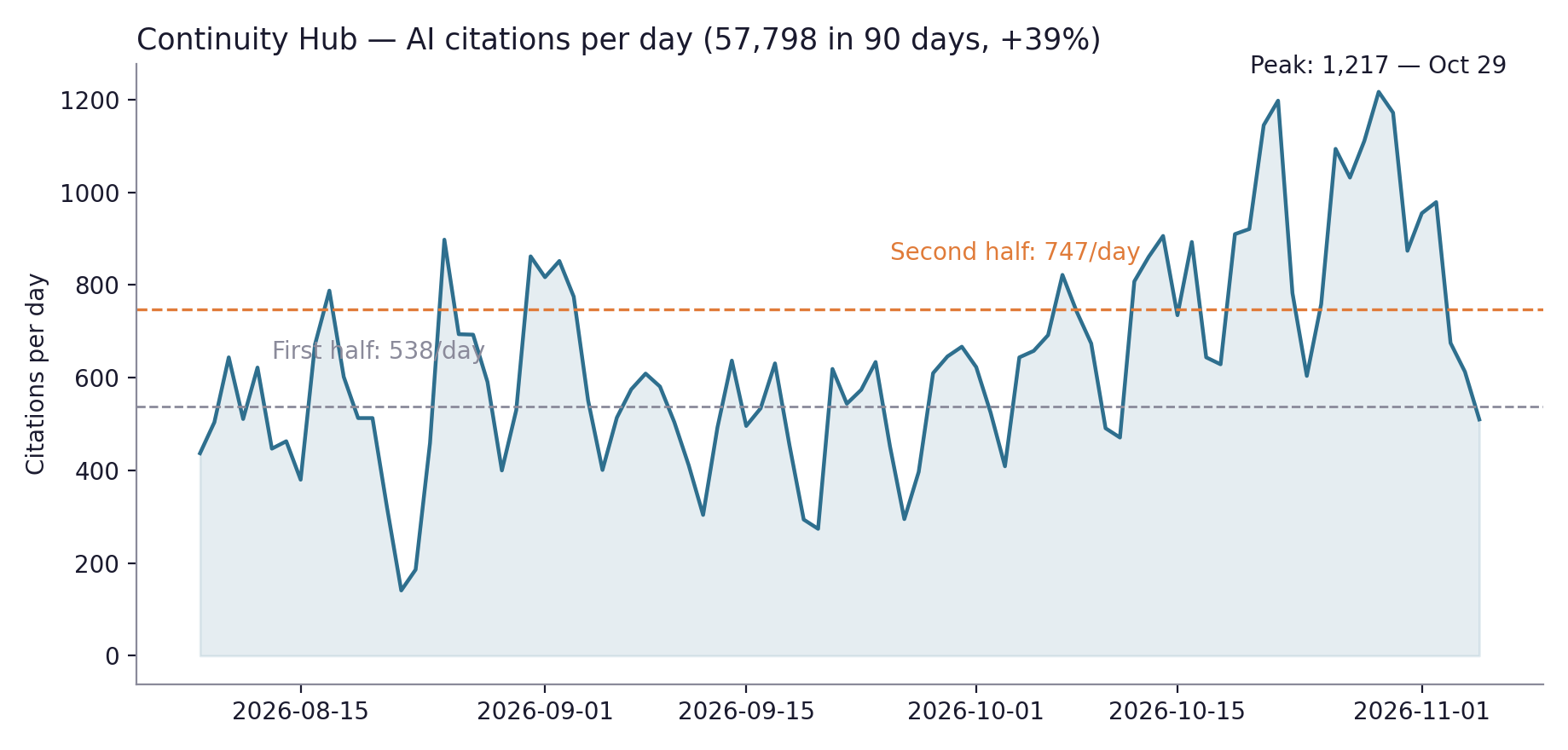
Three shapes so far in this series: a star (Receipt No. 3 — one page, 30.8% of its site), a bench (Receipt No. 4 — no page above 7.7%), and now the shape between them. Continuity Hub — our business-continuity reference — earned 57,798 AI citations in ninety days, and one guide holds 10,579 of them: 19.2% of the page-sum.
The guide is a complete professional treatment of supply-chain resilience. The site grew +39% by halves — 538 citations a day to 747 — with the last fourteen days averaging 884 and a peak of 1,217 on October 29. An anchor, real support, steady growth. The hybrid.
The window is August 8 to November 5, 2026, from Bing Webmaster Tools’ AI Performance report — the same instrument as the rest of this series. The daily series sums to 57,798; the page table sums to 55,029. Bing’s views differ (here by 4.8%), Bing prints a note saying so, and every figure below names its view.
55 pages, 547 questions. The halves: 538 a day, then 747. First fourteen days: 530 a day. Last fourteen: 884. Not the flagship’s plateau, not Risk Coverage Hub’s triple — a working site’s steady climb, with its biggest day, October 29, landing in the most recent third of the window.
Steady growth: 57,798 citations in 90 days, +39% by halves. Source: Bing Webmaster Tools AI Performance, daily view.
The anchor — and the support under it
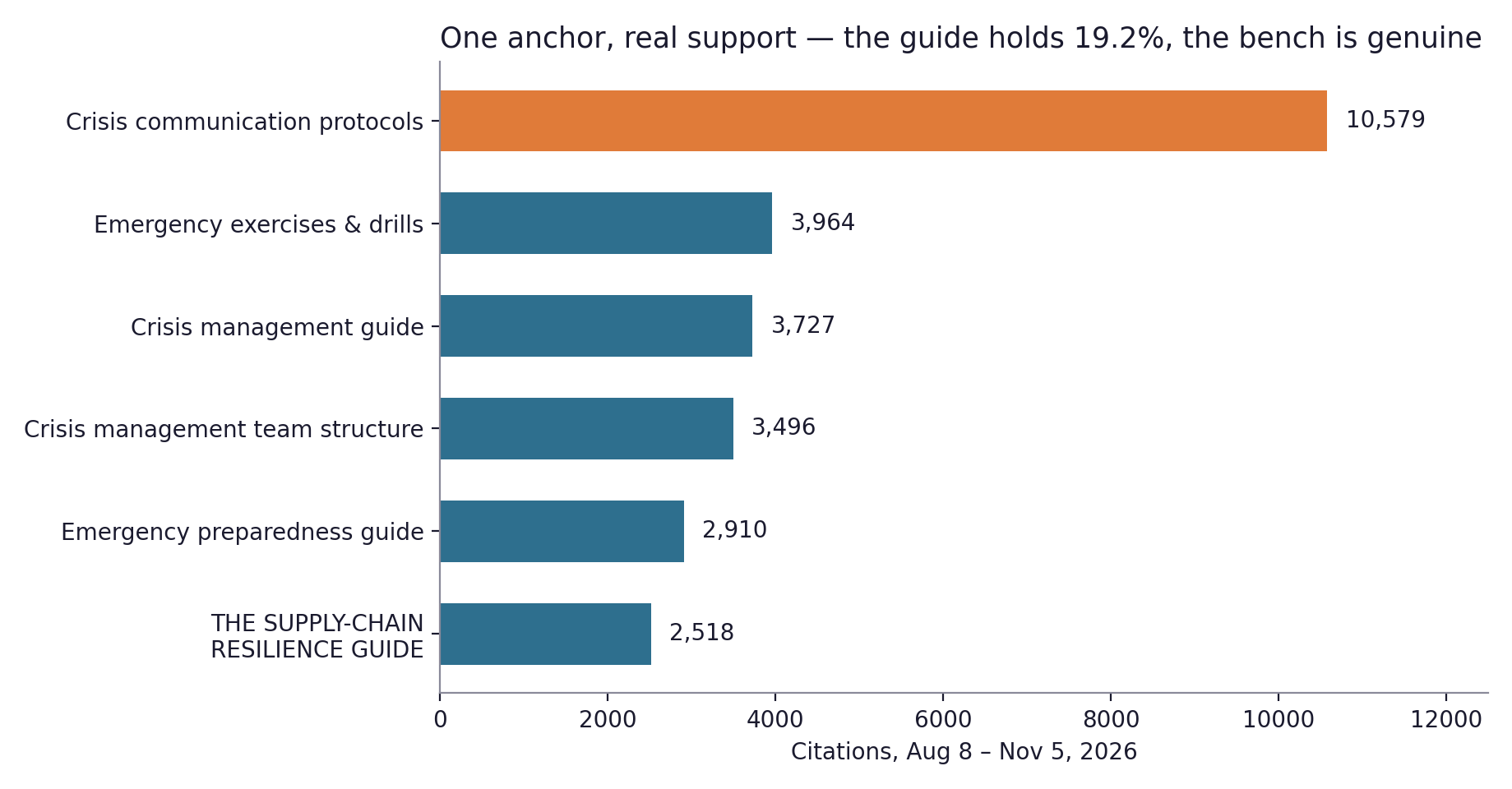
The supply-chain resilience guide’s 10,579 is a genuine lead — 2.7 times the runner-up. But read down the table and the anchor isn’t carrying the building alone:
Supply-chain resilience, complete guide — 10,579
Crisis communication protocols — 3,964
Emergency exercises & drills — 3,727
Crisis management, complete guide — 3,496
Crisis management team structure — 2,910
Emergency preparedness, complete guide — 2,518
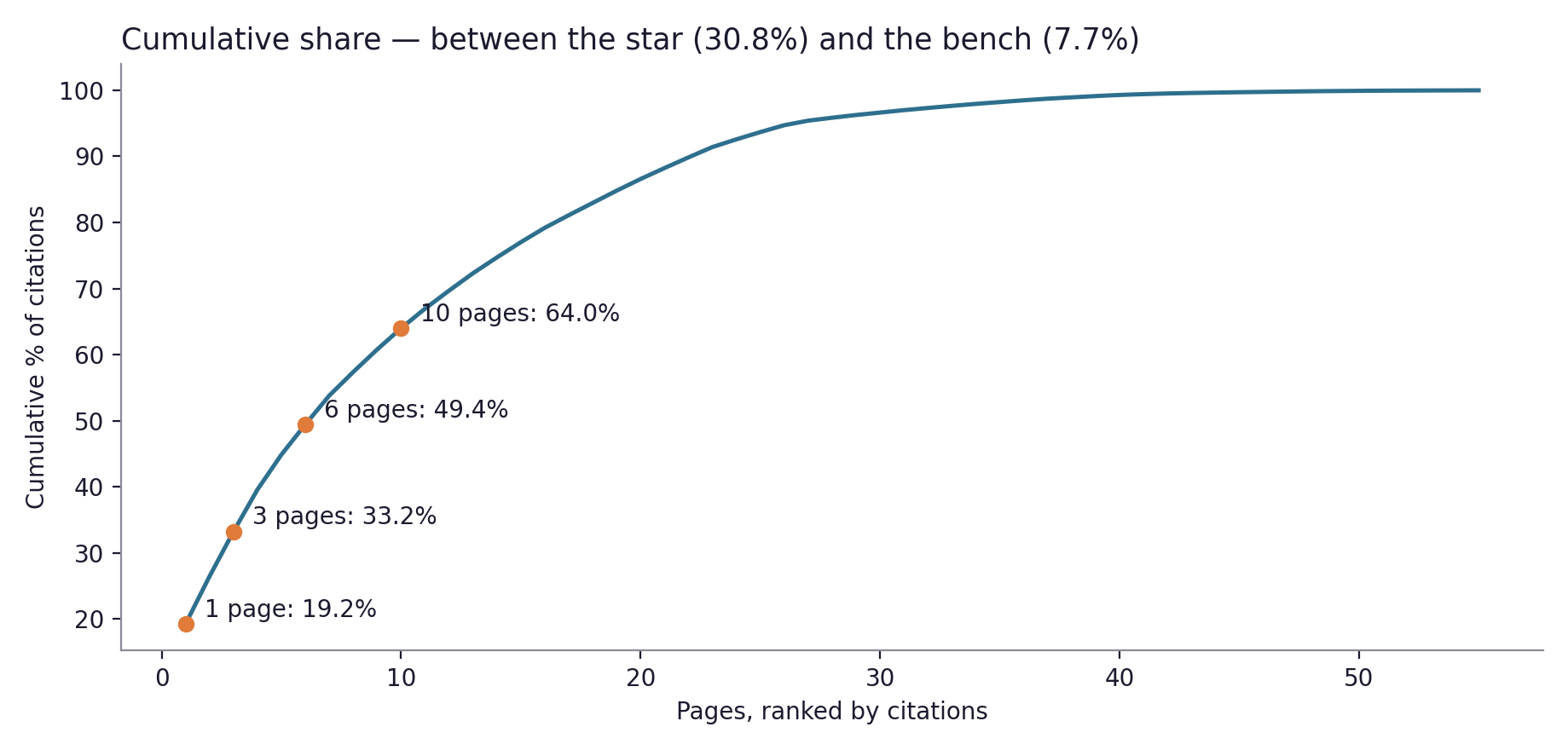
Three pages hold 33.2% of the page-sum; six hold 49.4%; ten hold 64.0%. And the families are balanced: five crisis pages hold 23.4% (12,869), five supply-chain pages hold 24.7% (13,614). Two pillars of near-equal weight, one of them fronted by an anchor. If the anchor page stumbled tomorrow, this site would lose a fifth of its count, not a third — and the crisis pillar wouldn’t notice. That’s the risk arithmetic of the hybrid shape, and on these numbers it’s the most comfortable of the three.
One anchor, real support. Source: Bing Webmaster Tools AI Performance, page view.Cumulative share of the page-sum — the middle curve of the series. Source: Bing Webmaster Tools AI Performance, page view.
The questions: one phrase owned, one contested
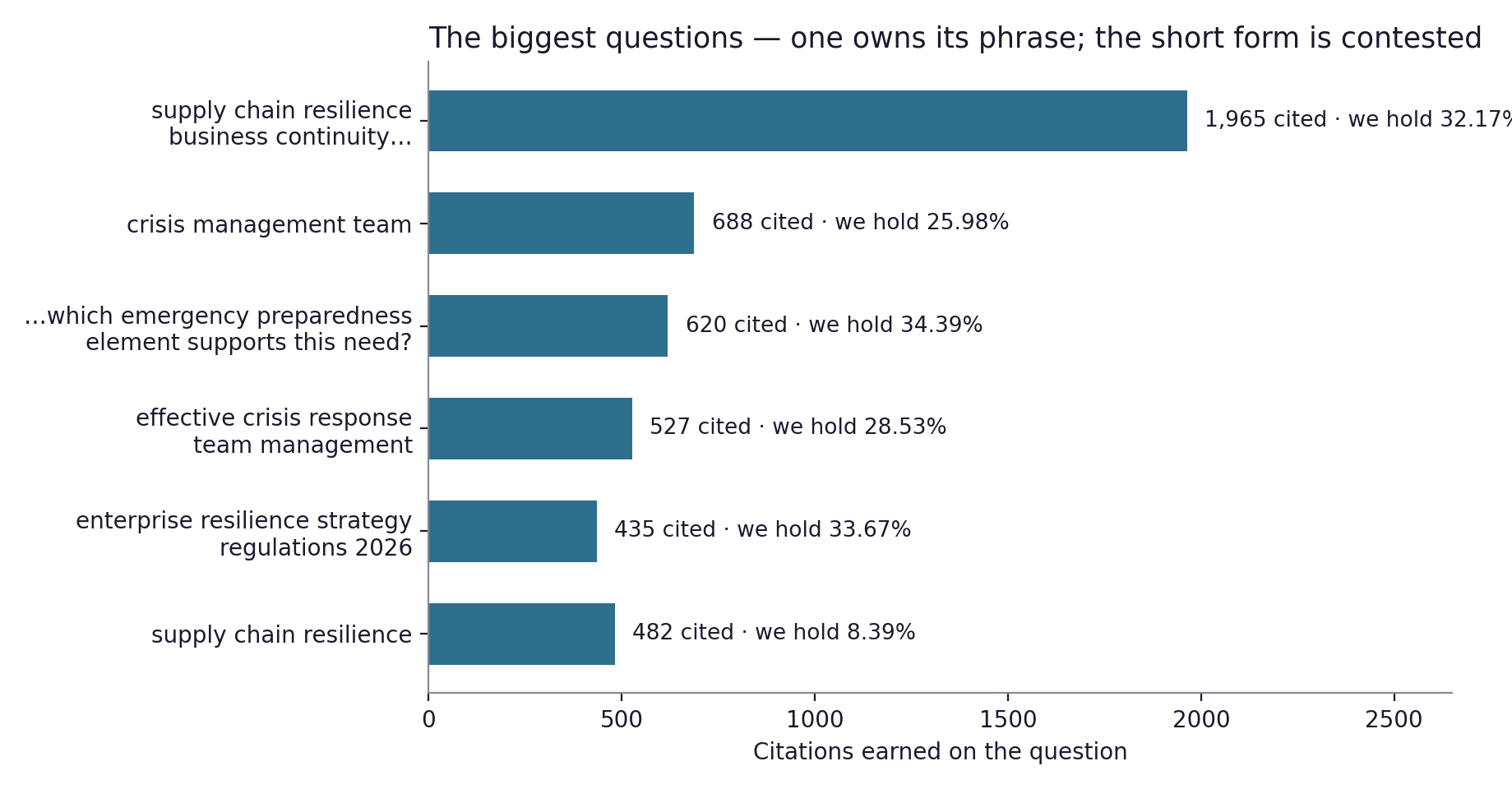
The guide’s own question is the site’s biggest, and the hold is strong:
And a question in full sentence form, the way someone asks a person: “during a disaster, a facility needs to quickly reach staff, volunteers, and emergency management partners. which emergency preparedness element supports this need?” — 620 citations; our share 34.39%.
The biggest questions, and our share of each. Source: Bing Webmaster Tools AI Performance, query view.
Now the honest complication, and it’s a good one: the short form — plain “supply chain resilience” — earns 482 citations across the web’s answers, and our share of it is only 8.39%. The guide owns its long, precise phrasing and is a minor holder of the short, famous one. That’s not a failure; it’s a map. The long forms are where professional intent lives, and 32–34% holds there are worth more than a sliver of the generic phrase. But anyone who tells you this page “owns supply chain resilience” hasn’t read the query table. We have. It owns a specific, valuable cut of it.
What we can’t claim
No build story. Unlike Receipt No. 1’s stepped sites, nothing here dates the +39% to a single act. The guide predates the window’s story; the claim is the shape and the growth, not a cause.
The views differ. Daily-sum 57,798 vs page-sum 55,029 — 4.8% apart, disclosed, each figure naming its view.
One engine’s window. Copilot and partner citations as Bing reports them; ninety days is a snapshot, not a deed.
Citations are not visits. Established in Receipt No. 1: this count measures being quoted into answers, not being read.
What we do now
Protect the anchor’s freshness. A fifth of the site rides on one guide; it gets the flagship leader’s discipline — the heartbeat watch from Receipt No. 3, at hybrid scale.
Build toward the short phrase carefully. The 8.39% is an invitation, not an emergency: adjacent, specific pages in the supply-chain family — the Receipt No. 1 method — rather than a rewrite of the page that’s already winning its own question.
Keep both pillars fed. Crisis and supply chain are near-equal earners; starving one to feed the other would unbalance the sturdiest shape in the fleet.
Publish the receipts — including the share we don’t hold. The map is the value; a prettier story would be worth less.
57,798 citations. One guide at 19.2%, two pillars, +39%. The hybrid — and, on the risk arithmetic, maybe the shape to aim for.
Update history
November 8, 2026 — Published. The 60-second video version went live on YouTube the same morning (linked at the top of this page); its chapters match the sections below, and each chapter links back to its section.
Method note: All figures are from Bing Webmaster Tools AI Performance exports for continuityhub.org, pulled November 8, 2026. Citation counts are Microsoft Copilot and partner citations as Bing reports them. Window: August 8–November 5, 2026 (90 days). The daily view sums to 57,798; the page view sums to 55,029 — Bing notes totals may differ across views, and each figure above names its view. Citation shares are Bing’s per-query figures. Guide names are shortened from the pages’ own titles. The “crisis family” and “supply-chain family” counts cover pages whose addresses contain those terms. The R4R Continuity article staged for a grant submission is a different piece and plays no part in these numbers. This is one site, one engine’s report, one 90-day window.
Receipts No. 3 was about a site with a star: one page holding a third of everything. This one is about the opposite build. Risk Coverage Hub — our insurance-risk reference site — earned 50,607 AI citations in ninety days, and it has no star at all. Its biggest page holds 7.7%.
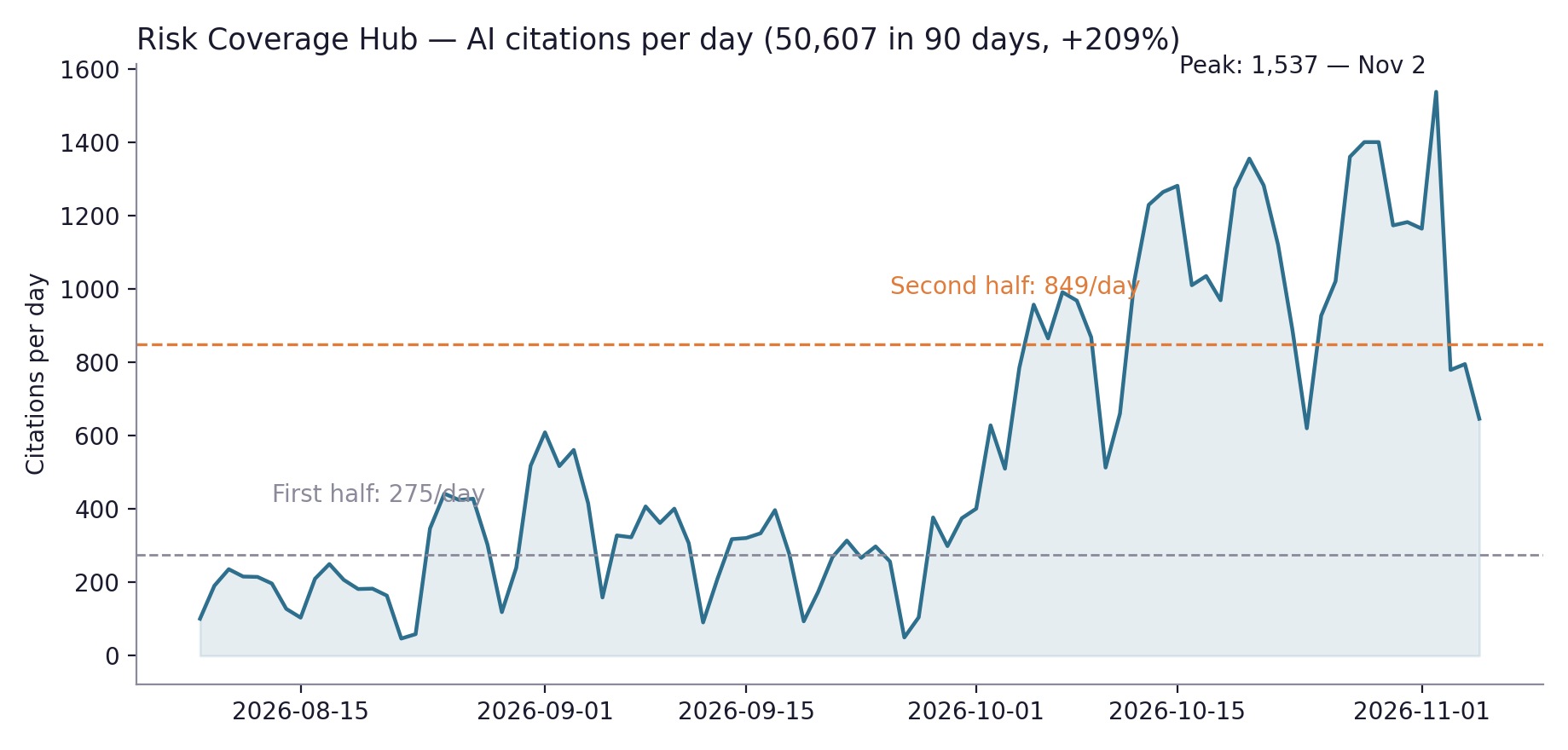
What it has instead is growth, and spread. The site’s daily citation rate went from 275 a day to 849 a day between the halves of the window — +209%, the fastest climb in our fleet. First fourteen days: 185 a day. Last fourteen: 1,064 a day. Peak day: November 2, with 1,537.
The window is August 8 to November 5, 2026, from Bing Webmaster Tools’ AI Performance report — the same instrument as the rest of this series. The daily series sums to 50,607; the page table sums to 47,747. Bing’s views differ (here by 5.7%), Bing prints a note saying so, and we name the view behind every number, as always.
Read the climb honestly: it isn’t a step. Receipt No. 1 had a step — a build date you could point at. This is a slope. The rate rises across the whole window, halves 275 to 849, and we are not going to invent a single cause for a slope. What we can do is read what the slope is made of — which pages, which questions — because that’s the part an operator can actually use.
The climb: 50,607 citations in 90 days, +209% by halves. Source: Bing Webmaster Tools AI Performance, daily view.
The bench: six guides, no star
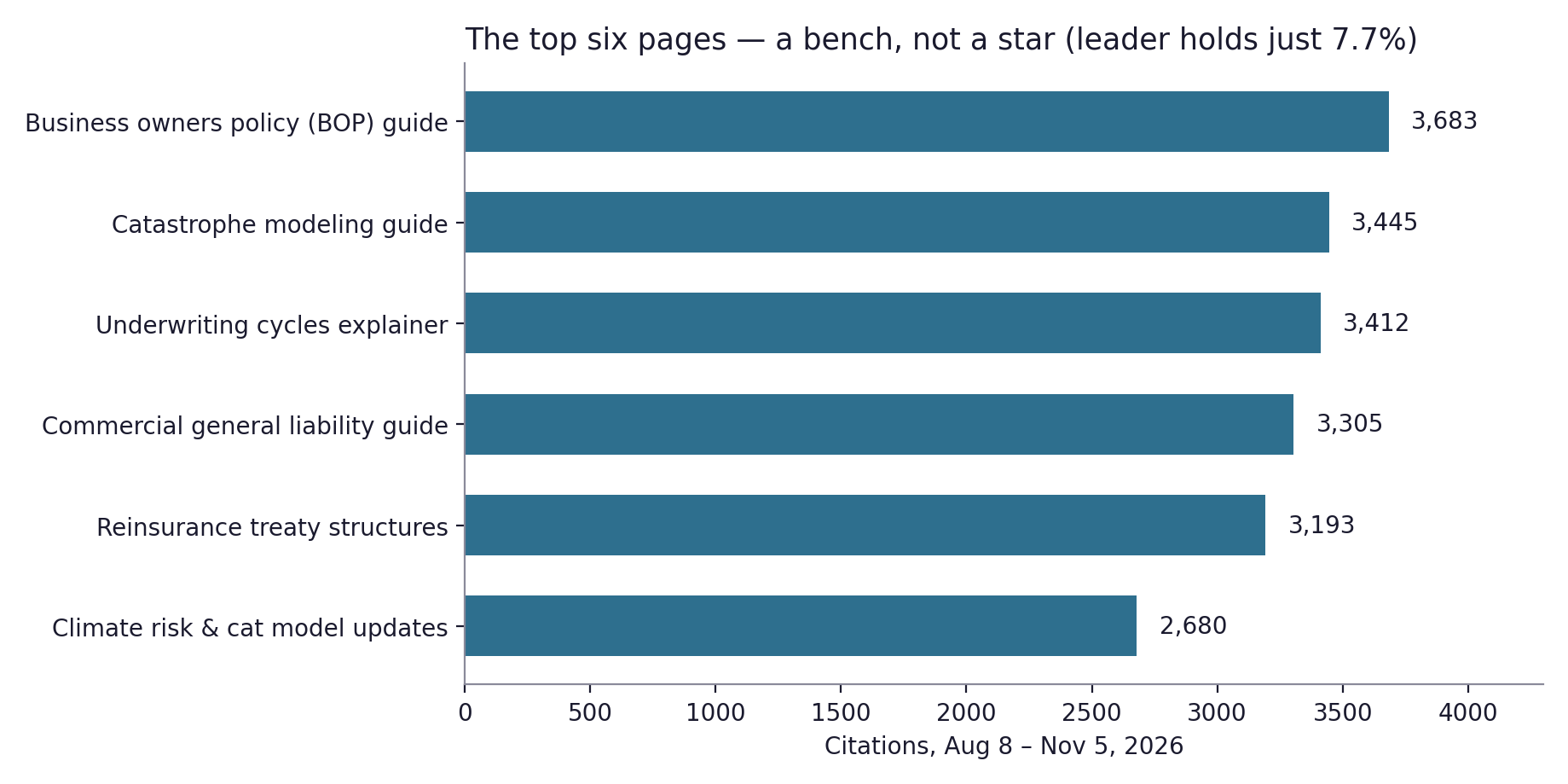
The top of the page table is bunched like a peloton:
Business owners policy (BOP) coverage guide — 3,683
Catastrophe modeling, complete guide — 3,445
Underwriting cycles: hard and soft markets — 3,412
Commercial general liability guide — 3,305
Reinsurance treaty structures — 3,193
Climate risk pricing & catastrophe model updates — 2,680
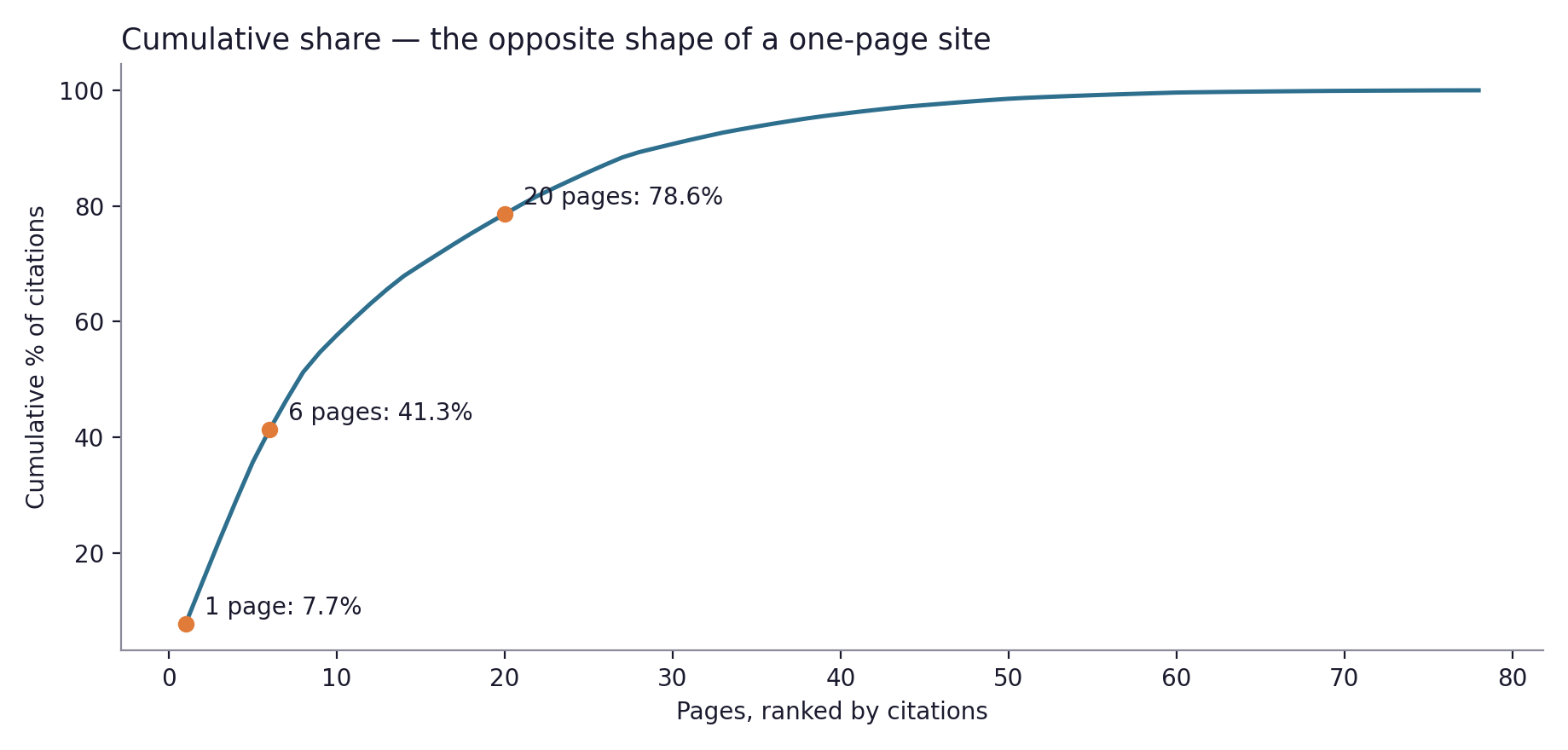
Six professional guides within a thousand citations of each other. Together they hold 41.3% of the page-sum; the leader alone holds 7.7%. Twenty pages get you to roughly three-quarters of the site — on our flagship, five pages are a majority. This is the diversified portfolio to Receipt No. 3’s concentrated bet, and it carries the mirror-image virtue: no single page’s bad week can wound this site. The bench is the moat.
The bench: six guides, no star. Source: Bing Webmaster Tools AI Performance, page view.Cumulative share of the page-sum, pages ranked by citations — contrast Receipt No. 3’s curve, where one page is 30.8%. Source: Bing Webmaster Tools AI Performance, page view.
The questions: long, specific, professional
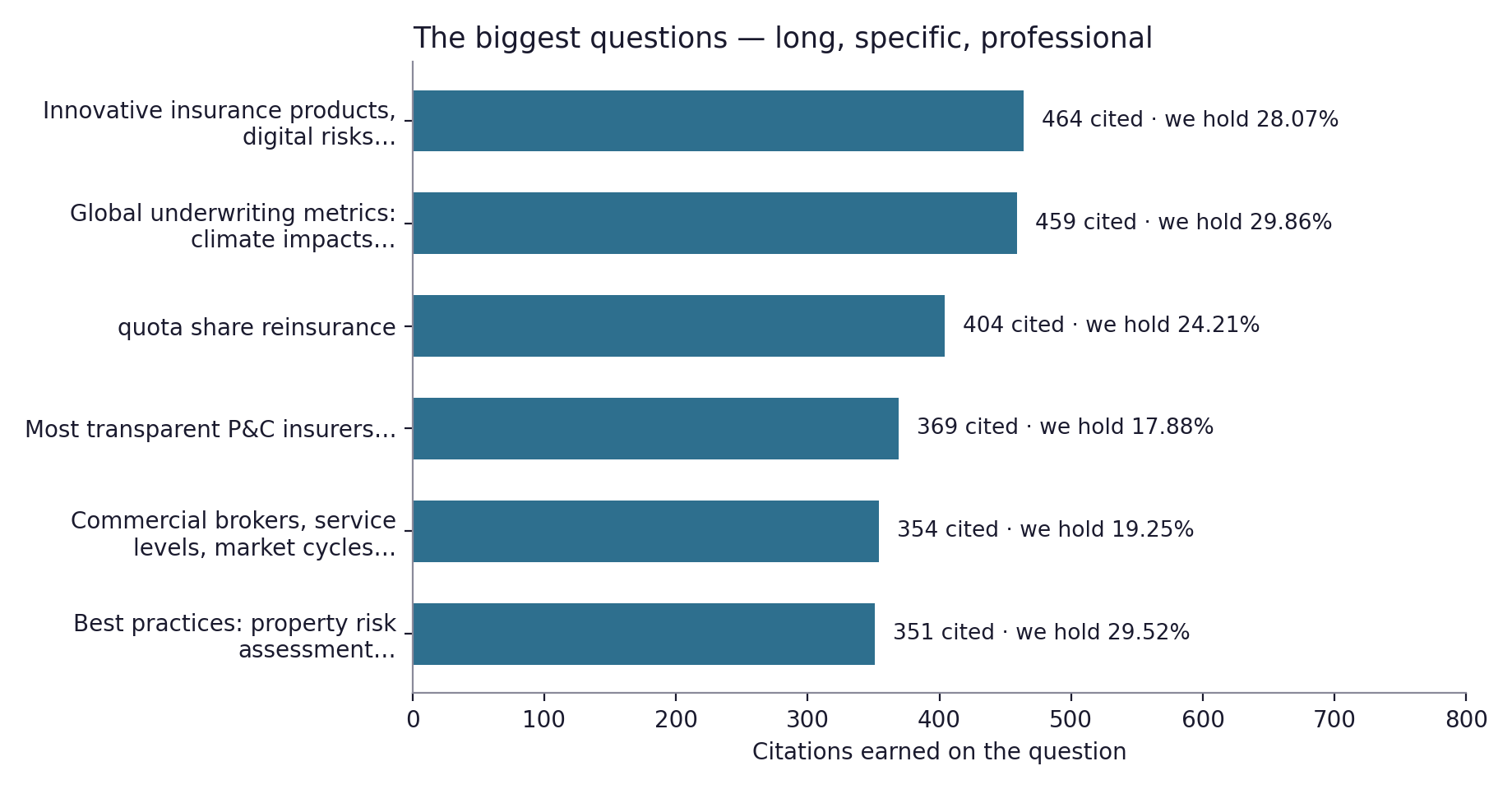
The query table explains the shape. There is no “what is X” blockbuster here. The biggest questions are working questions, asked the way insurance professionals actually phrase work:
The biggest questions, and our share of each. No blockbuster — a working vocabulary. Source: Bing Webmaster Tools AI Performance, query view.
414 questions, 78 pages — and the shares sit in a band, mostly a fifth to a third. Nobody owns these questions outright, including us. The site earns by being a solid, specific answer across a whole professional vocabulary, not by holding one phrase hostage. That is a slower asset to build and a harder one to knock down.
What we can’t claim
No single cause for the slope. Unlike the stepped sites in this series, nothing here dates the rise to one build. The honest sentence is: the site tripled while publishing steady, specific, professional guides — and correlation across a portfolio is not a mechanism.
The views differ more here. Daily-sum 50,607 vs page-sum 47,747 — 5.7% apart, disclosed, each figure naming its view.
One engine’s window. Copilot and partner citations as Bing reports them; ninety days is a snapshot, not a deed.
Citations are not visits. Established in Receipt No. 1: this count measures being quoted into answers, not being read.
What we do now
Feed the bench, not a star. The next guides get chosen from the question map where a working question is landing on an adjacent page — the Receipt No. 1 method, applied to a bench instead of a doorway.
Watch for bunching changes. If one page starts separating from the peloton, that’s a signal — good or bad — worth a diagnosis, the way we diagnosed the flagship’s leader in October.
Keep the shares honest. A fifth to a third on the big questions means the work is depth and currency, not defense of a crown we don’t hold.
Publish the receipts — including the part where the growth has no single hero. A slope you can’t attribute is still a slope you can measure.
50,607 citations. 275 to 849 a day. No star — a bench, a vocabulary, and a climb. That’s the count and the shape.
Update history
November 8, 2026 — Published. The 60-second video version went live on YouTube the same morning (linked at the top of this page); its chapters match the sections below, and each chapter links back to its section.
Method note: All figures are from Bing Webmaster Tools AI Performance exports for riskcoveragehub.com, pulled November 8, 2026. Citation counts are Microsoft Copilot and partner citations as Bing reports them. Window: August 8–November 5, 2026 (90 days). The daily view sums to 50,607; the page view sums to 47,747 — Bing notes totals may differ across views, and each figure above names its view. Citation shares are Bing’s per-query figures. Guide names are shortened from the pages’ own titles. The Risk Coverage Hub underwriting explainer published today (post 1495 on that site) is not a driver of these numbers — it postdates the window. This is one site, one engine’s report, one 90-day window.
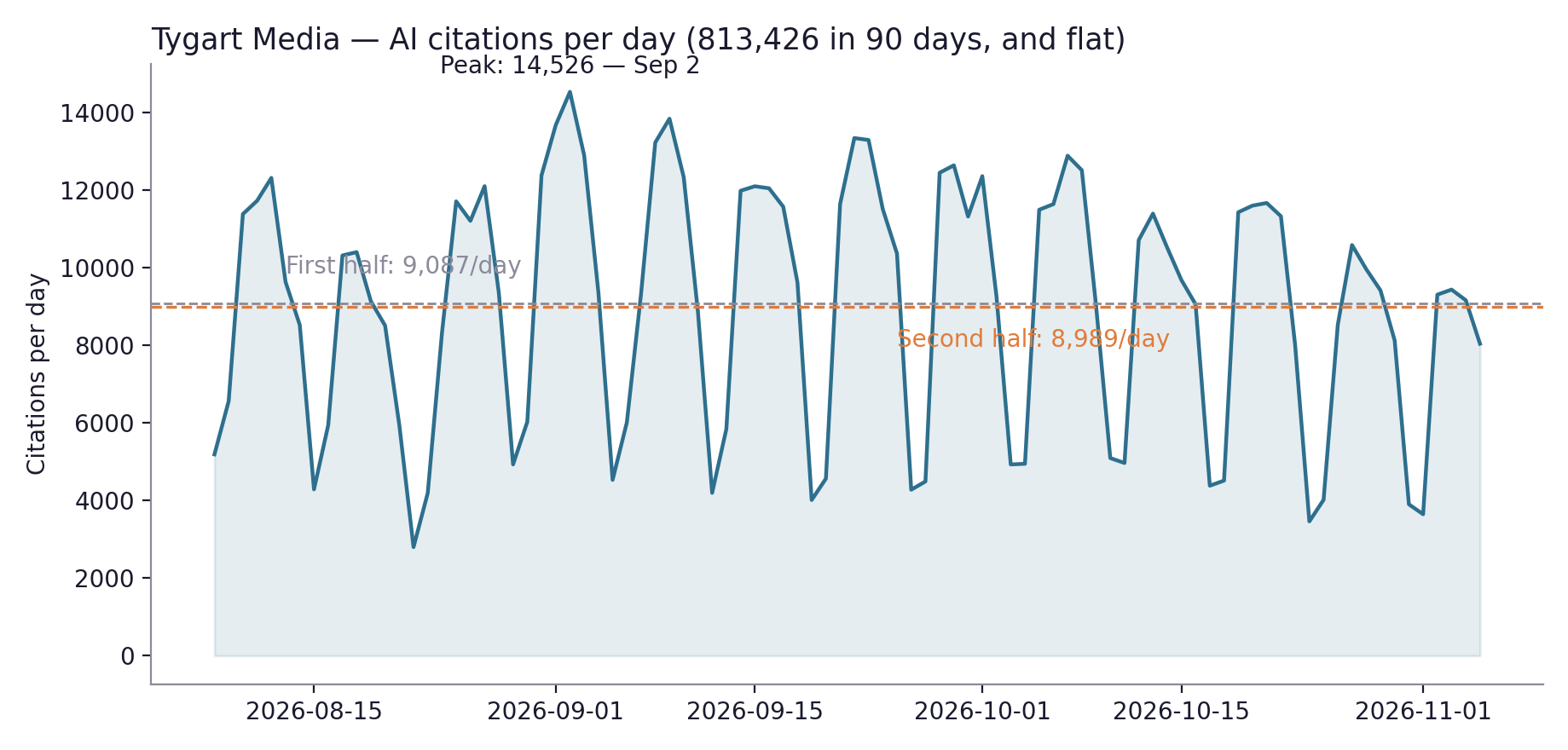
This site — tygartmedia.com, the one you’re reading — earned 813,426 AI citations in ninety days. That’s the whole portfolio: 578 cited pages, 1,698 different questions that assistants asked and answered with our work. One page holds 244,307 of them.
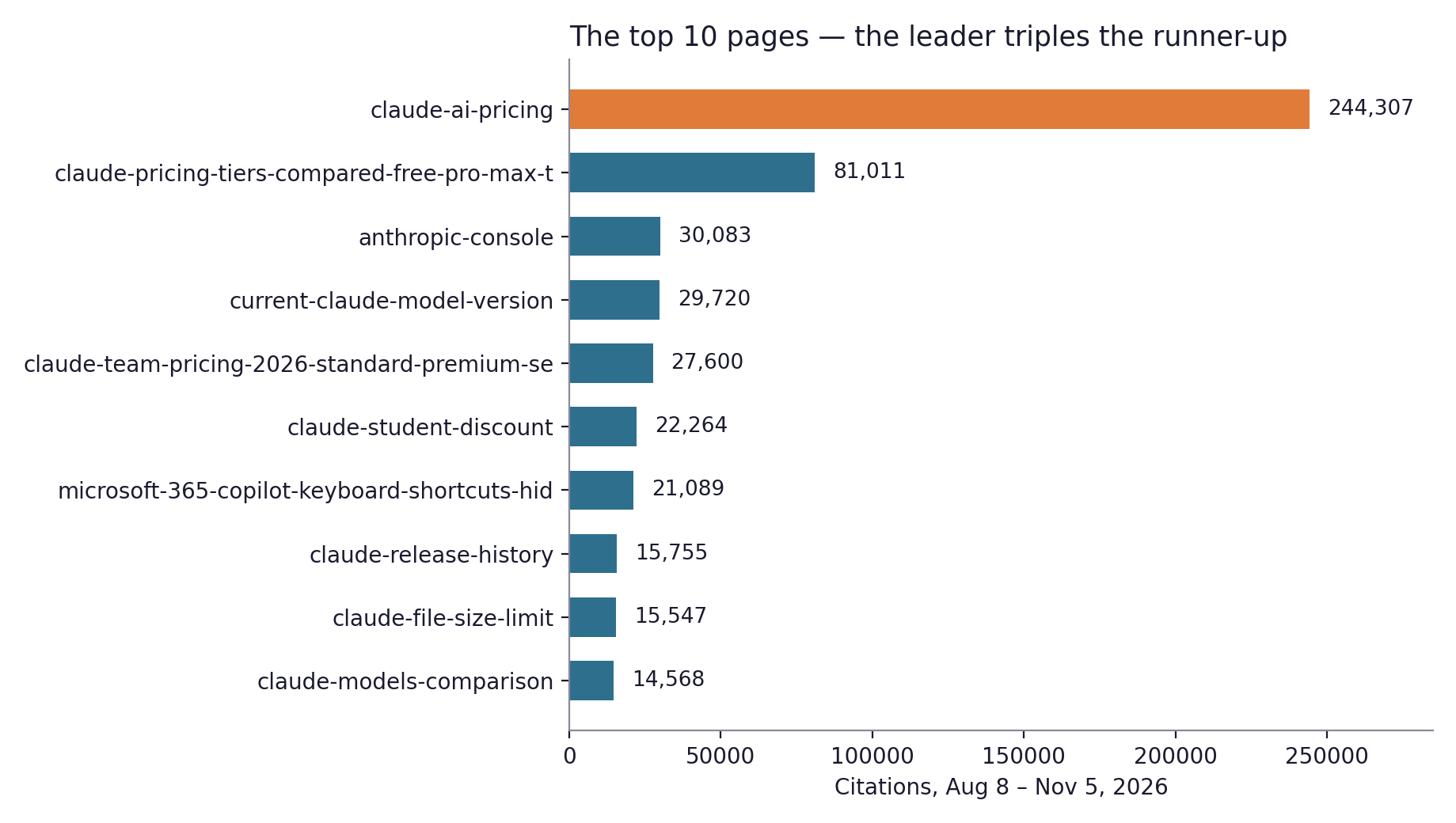
The page is our Claude pricing page: a plain, kept-current answer to what Claude costs. It holds 30.8% of everything this site earned. The runner-up — our pricing-tiers comparison — holds 81,011. The leader triples it.
This is Receipts No. 3, and it’s the uncomfortable one. The first two pieces in this series were about growth — a hospital site stepping up, two doors built in a night. This one is about shape: what it means when a third of your citation count lives at one address.
The window is August 8 to November 5, 2026, from Bing Webmaster Tools’ AI Performance report — the same instrument as the rest of this series. The daily series sums to 813,426; the page-level table sums to 792,317. Bing’s own views disagree by 2.6%, and Bing prints a note saying totals may differ across views. We use each view for what it measures and say which is which, every time.
The site’s halves are flat: 9,087 citations a day in the first half of the window, 8,989 a day in the second. Peak day: September 2, with 14,526. Nothing about the total is a growth story. The total is a plateau — and a plateau is exactly where shape matters, because the composition is the whole story.
The plateau: 813,426 citations in 90 days, halves flat. Source: Bing Webmaster Tools AI Performance, daily view.
The shape of the portfolio
Read the page table by rank and the portfolio stops looking like a portfolio:
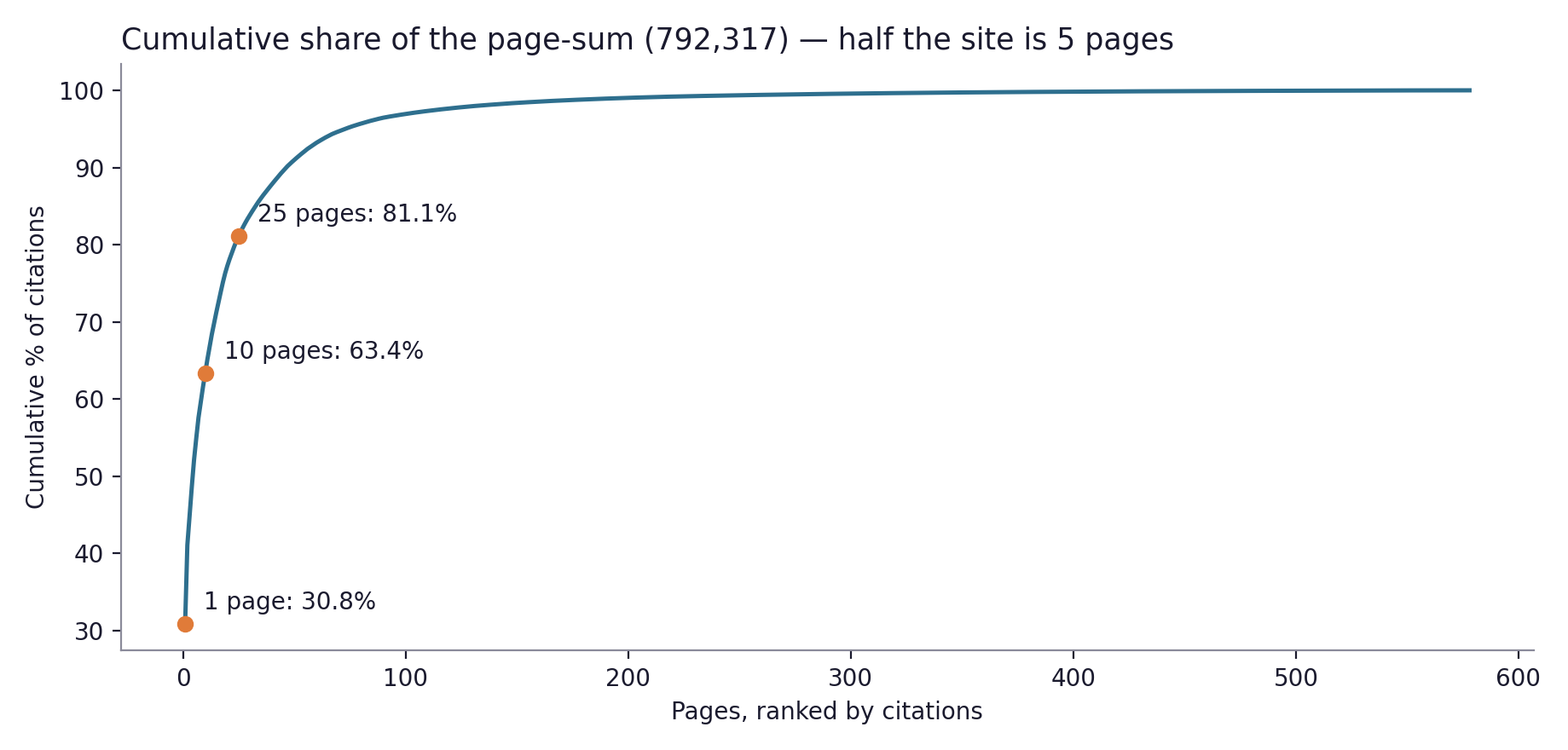
1 page holds 30.8% of the page-sum.
3 pages hold 44.9%. 5 pages hold 52.1% — a majority of the site is five addresses.
10 pages hold 63.4%. 25 pages hold 81.1%.
The remaining 553 pages share what’s left — about 19% between them.
The top 10 pages. The leader isn’t ahead — it’s in a different weight class. Source: Bing Webmaster Tools AI Performance, page view.Cumulative share of the page-sum, pages ranked by citations. Source: Bing Webmaster Tools AI Performance, page view.
And the concentration has a subject. Thirty-six of the 578 pages are pricing pages — their addresses carry “pricing” or “cost” — and together they hold 396,978 citations: 50.1% of everything. Half this site’s citation count is one question family, asked over and over in slightly different words: what does Claude cost, what does the Team plan cost, is there a student discount, what does Enterprise run. We didn’t set out to become a pricing reference. The assistants decided that’s what this site is for — and the page table is what that decision looks like from the inside.
The questions are bigger than the page
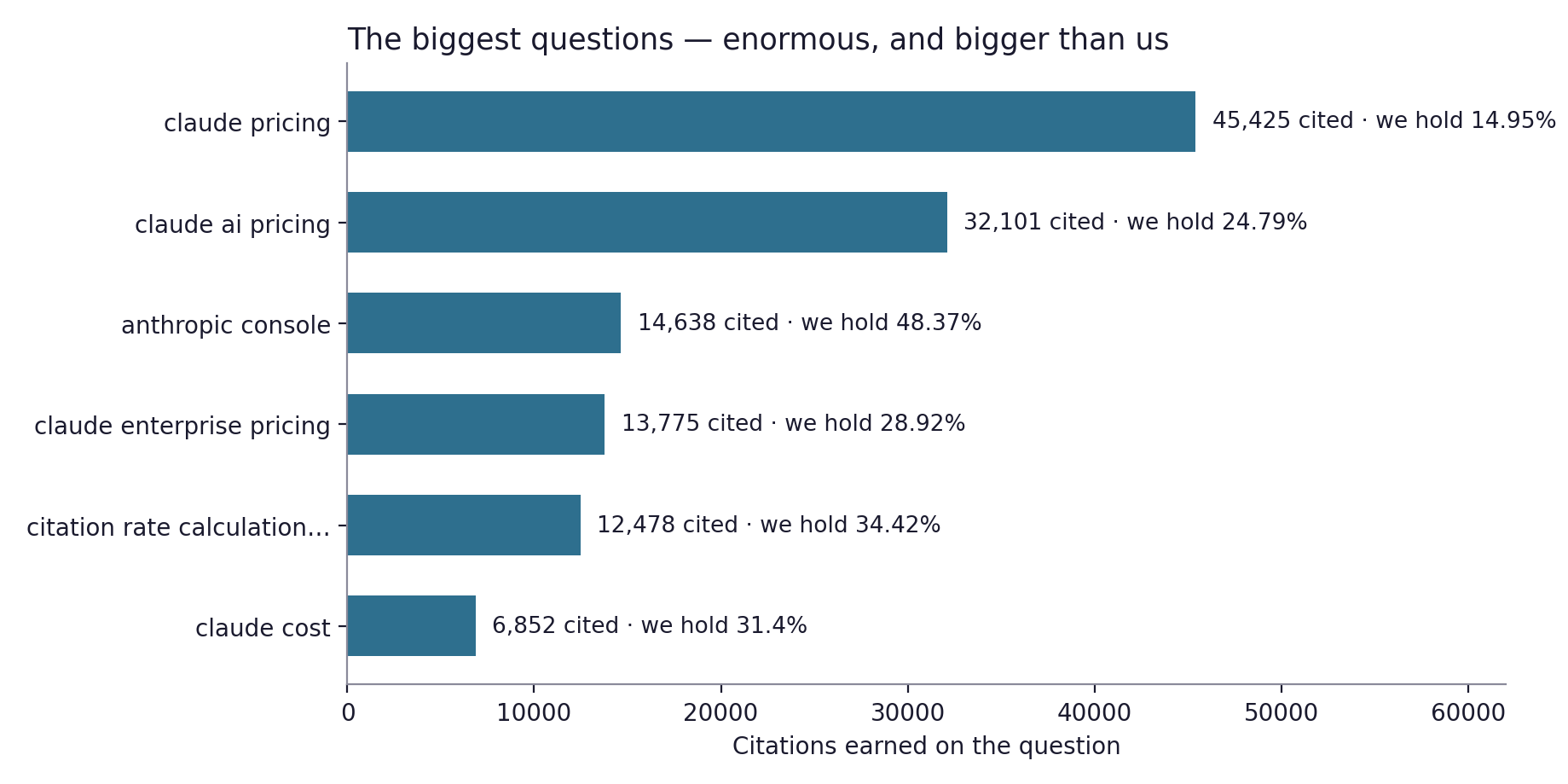
Here’s the part that keeps the story honest. The pricing page is enormous — and on the biggest question it serves, we are a minority holder:
“claude pricing” — 45,425 citations earned across the web’s answers; our share is 14.95%.
“claude ai pricing” — 32,101 citations; our share 24.79%.
“anthropic console” — 14,638; our share 48.37%, the strongest hold on a big question.
And at number five, a tell: “citation rate calculation AI-generated responses” — 12,478 citations at a 34.42% share. That’s our own trade, reading about the instrument itself.
The biggest questions, and our share of each. The page is huge; the questions are bigger. Source: Bing Webmaster Tools AI Performance, query view.
A page can hold a third of a site and a seventh of its biggest question at the same time. Both numbers are true, and the second one is the opportunity measured precisely: the demand under the leader is roughly seven times the leader.
What concentration means
Two things, and they’re the same fact read from opposite ends.
It’s a moat. A page that answers a money question plainly, stays current, and gets cited 244,307 times becomes the reference the assistants reach for — and every citation is a small vote that makes the next one likelier. Nobody at this desk did anything exotic to earn it. The page does one job, in the asker’s words, and it’s kept honest. That’s the whole trick, and Receipt No. 1 showed what happens when you build that shape on purpose.
It’s a single point of failure. If that page stumbles — a pricing change at Anthropic that makes it stale overnight, a careless rewrite, a bad week — a third of this site’s citation count reprices with it. We don’t have to imagine the exposure; we watch it. In October we ran a full formal diagnosis on this one page — its pattern had broken in ways we needed explained before we touched anything. You don’t commission a diagnosis for a page that doesn’t matter. You commission one for the page that carries the building.
The hedge is the bench. The tiers comparison at 81,011 is a genuine understudy — same question family, different cut. Team pricing, the student discount page, the console page: the family is deep, and the family is the insurance. Concentration at the page level, diversification at the family level. That’s the actual structure, and it happened before we were wise enough to plan it.
What we can’t claim
One engine’s window. These are Copilot and partner citations as Bing reports them. It’s the cleanest instrument we have; it is not the whole sky.
The views differ. Daily-sum 813,426 vs page-sum 792,317 — 2.6% apart, disclosed above, used consistently.
Citations are not visits. Receipt No. 1 established it on another of our sites: 57 citations per human visit. This count measures being quoted, not being read.
Ninety days is a snapshot, not a deed. Questions mutate — the BC ESG piece watched pharma’s biggest phrasing change between pulls. Shares move. This is the shape on November 8, 2026.
What we do now
Watch the leader’s daily line like a heartbeat — not the site’s total, which can hide a dying leader inside a healthy plateau for weeks.
Keep the bench current. The understudy pages get the same freshness discipline as the star; the day the leader stumbles is the wrong day to start.
Build adjacent doors the measured way — when the question map shows demand landing sideways (Receipt No. 1’s method), build the page the question is asking for.
Publish the receipts — including the shape we’d rather not have. A third of the building on one page is a fact we’re better off saying out loud, because saying it is what keeps us watching it.
813,426 citations. 244,307 of them at one address. That’s the count, that’s the shape, and that’s what we’re doing about it.
Update history
November 8, 2026 — Published. The 60-second video version went live on YouTube the same morning (linked at the top of this page); its chapters match the sections below, and each chapter links back to its section.
Method note: All figures are from Bing Webmaster Tools AI Performance exports for tygartmedia.com, pulled November 8, 2026. Citation counts are Microsoft Copilot and partner citations as Bing reports them. Window: August 8–November 5, 2026 (90 days). The daily view sums to 813,426; the page view sums to 792,317 — Bing notes totals may differ across views, and each figure above names its view. Citation shares are Bing’s per-query figures. The “pricing family” count is pages whose addresses contain “pricing” or “cost.” The October diagnosis referenced was an internal workup of the pricing page’s citation pattern. This is one site, one engine’s report, one 90-day window.
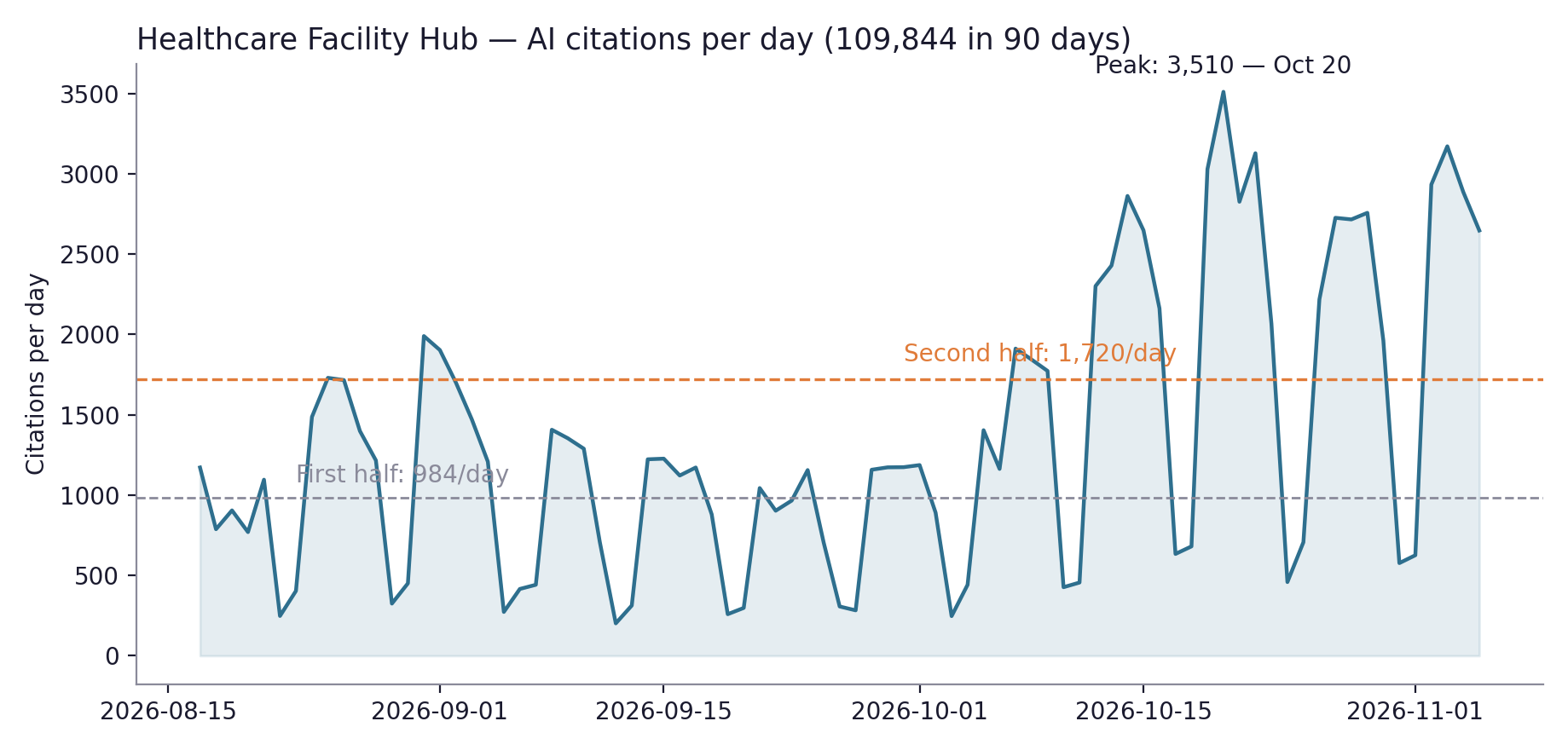
In October we believed one of our sites was declining. We said so in writing, with a chart. The chart was honest; the window was the problem — it ended October 4, and Healthcare Facility Hub spent the rest of October doing the opposite of declining.
This morning we pulled the full ninety days. Between August 7 and November 6, AI answers cited Healthcare Facility Hub 109,844 times. The first half of the window averaged 984 citations a day; the second half averaged 1,720 — up 75%. The last fourteen days ran at 2,032 a day, and the peak, October 20, hit 3,510. It is the fastest-growing property we run.
So we went looking for its biggest page, expecting to find the usual pattern from the rest of the fleet: a page the machines read and the humans barely visit. We found the opposite. This is the story of that page — including the part where we shipped its companion file split in two and the citations divided themselves between a summary and the real thing.
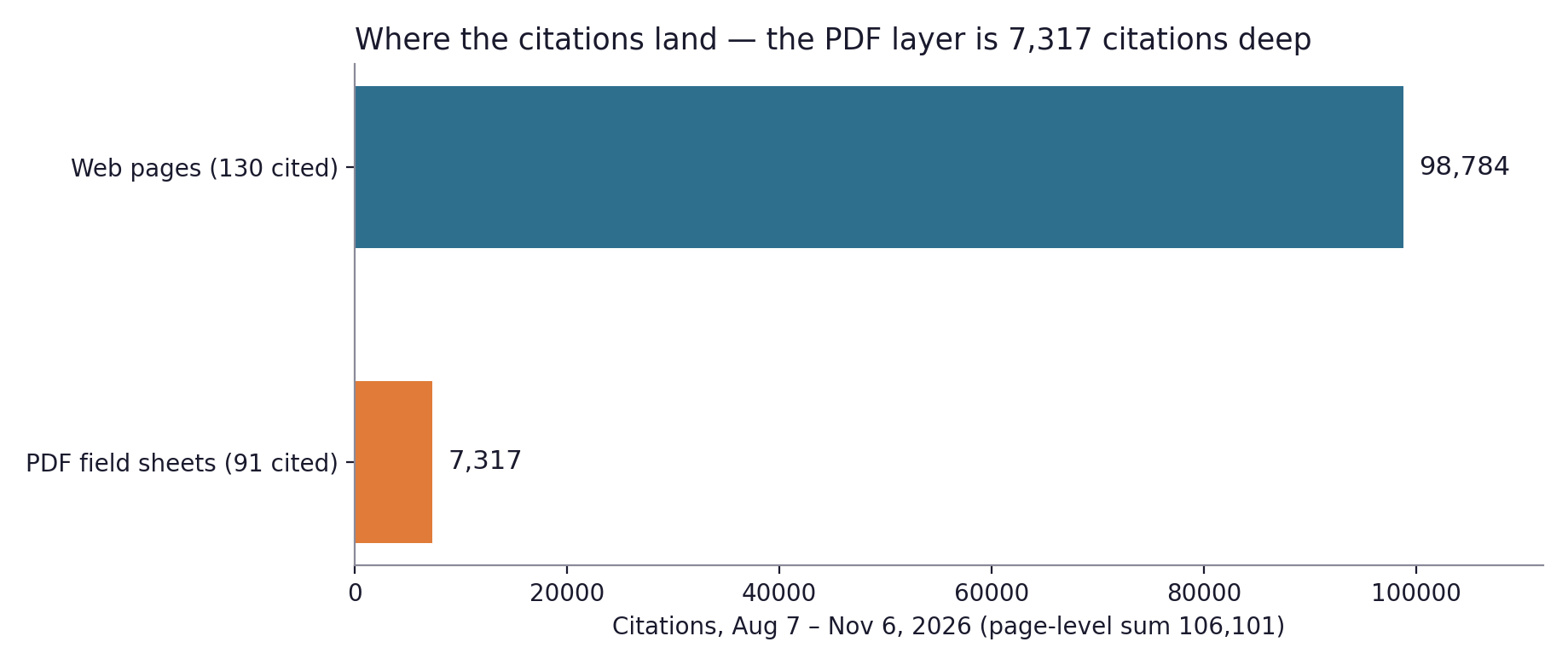
The page is a guide: What Is ICRA in Healthcare? (ASHE 2.0) — infection control risk assessment for construction and maintenance work in occupied hospitals. It holds 11,181 citations, the most-cited page on the site, about a tenth of everything. Around it sits a small family: a sibling ICRA guide at 2,053, a Class IV–V requirements page at 173, a matrix explainer at 121, a class finder at 23.
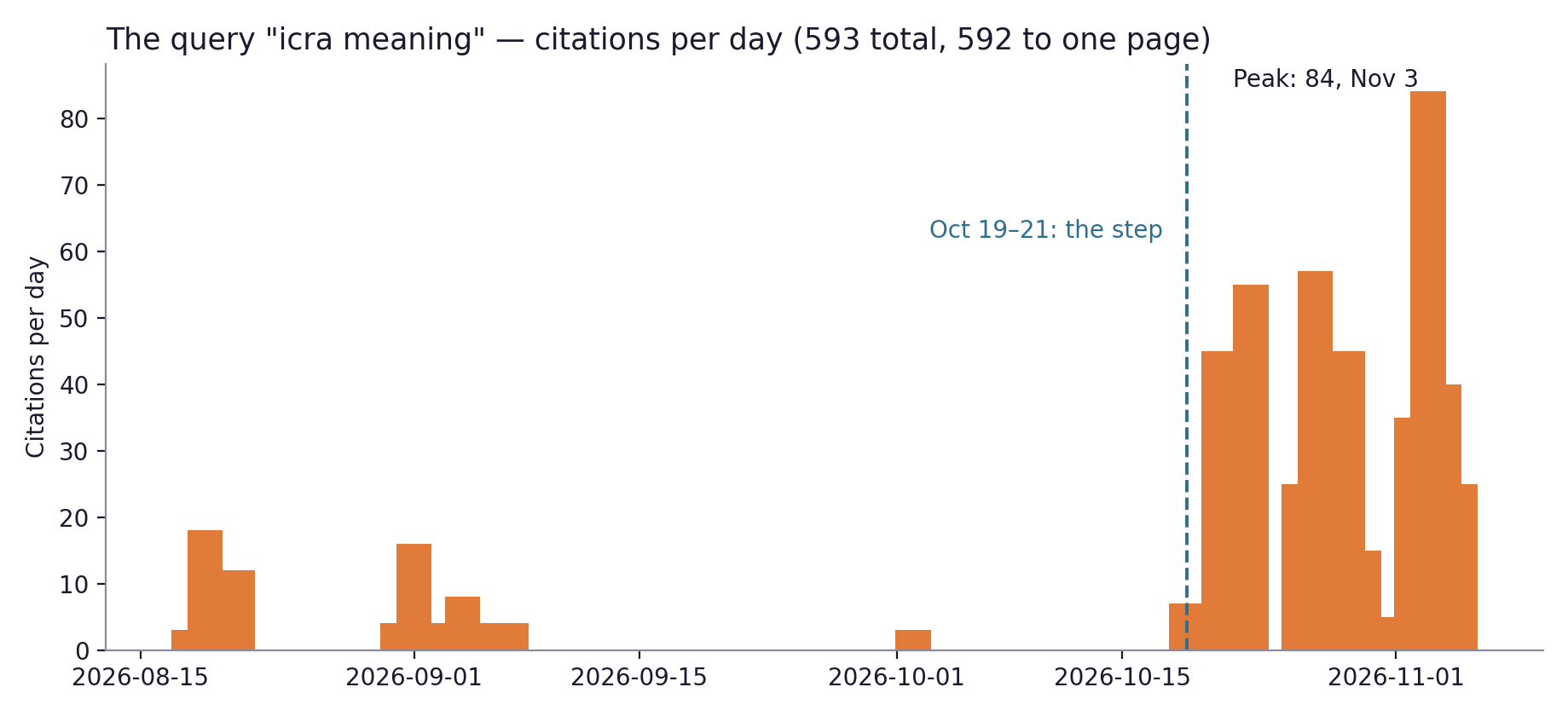
The query that feeds it hardest is plain: “icra meaning.” Five hundred ninety-three citations, and 592 of them land on this one page. Its daily rhythm tells the build story. Through mid-October it ran flat, a handful a day. Then, on the October build dates, it stepped: 45 on October 21, 55 on the 23rd, 57 on the 27th, peaking at 84 on November 3.
Then we checked the humans
On the beauty-industry site in our first report, the pattern was stark: hundreds of citations, a handful of human sessions, visits that lasted about ten seconds. Machines verifying, nobody reading.
The ICRA page breaks that pattern completely. Microsoft Clarity, last thirty days: 231 human sessions (seventeen bot sessions excluded), 162 people, an average of 4.4 active minutes inside a 7.8-minute visit, 1.72 pages per session, scroll depth 36%, zero rage clicks, almost no friction. Three quarters of them arrive from Bing search. And the browser split gives the audience away: 73.6% Microsoft Edge, 88% desktop. That’s facilities and infection-prevention staff on managed hospital workstations, in the middle of a workday, using a page to do a job.
The site as a whole is built the same way: 2,412 human sessions in thirty days against 1,091 bot sessions excluded — the most human audience in our fleet. The machines cite this site the fastest-growing amount, and the humans actually read it. Both. At the same time. On the same pages.
The machinery question, again
Our first report noted that the beauty site had no llms.txt file and full FAQ schema on its winning guides. Healthcare Facility Hub is the mirror image: it has an llms.txt, and its most-cited page carries no FAQ schema at all — video markup, breadcrumbs, speakable, that’s it. Opposite machinery, same explosion. Whatever is being selected here, it isn’t a schema flavor.
What the two winners share is more ordinary: one real question answered completely on one page, and a downloadable artifact attached to it — a field sheet a person (or an agent) can take away. On this site that second layer is not small: 91 cited PDF field sheets hold 7,317 citations — compliance checklists for the Joint Commission, evacuation, fire drills, medical gas. Books for bots, and for the people who print them.
What we got wrong
Here is the part we would rather skip, which is exactly why it’s in the report.
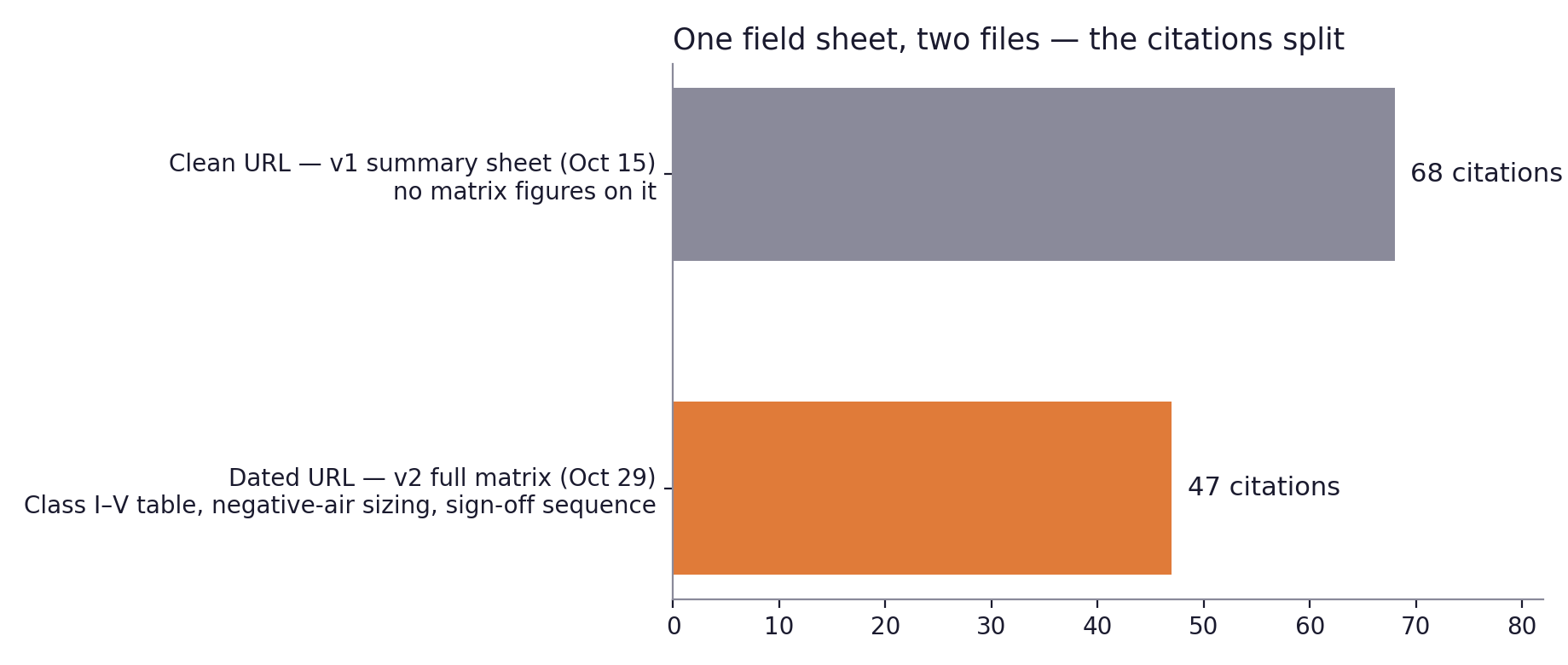
The ICRA guide links its field sheet twice — and the two links go to two different files. The first version, published October 15, sits at the clean, obvious filename. It is a summary sheet: the direct answer, the framing, no numbers — the actual Class I–V barrier matrix is not on it. It holds 68 citations.
On October 29 we published the real sheet — the full matrix, barrier requirements by class, negative-air sizing, the decommissioning sign-off sequence, stamped on its face as the current version. But it went up under a new, dated filename instead of replacing the old file. It holds 47 citations. An email-gate on the same page points at the clean filename too, so the older, thinner sheet has a third door in.
A page and its download are supposed to be one asset, saying one thing. Ours said two, and the citation record split along the seam — with the lead going to the version that has less in it. Anybody who followed the most-cited link got the summary. Anybody who followed the page’s own button got the matrix. We built both halves of that on purpose, two weeks apart, and never noticed the seam until we pulled the page-level export this morning.
The fix is two file renames, and nothing else. The October 15 file moves to an archive name — its bytes preserved, its history intact. The October 29 sheet takes the clean filename. The page doesn’t change; no link anywhere changes. Every door — the page, the email gate, the citation record — then opens onto the full matrix.
As this publishes, the fix is staged and waiting on a server door, not on a decision: the file host has refused our automated connections this morning, so the two renames run the moment that door reopens, or by hand in the hosting panel. When it lands, this article gets a dated line below saying so — the same update-lineage rule we apply to the pages themselves. If you’re reading this without that line, the fix is still in flight and we’d rather tell you that than round it off.
What we’d tell another operator
Check your cited PDFs for version splits. If a page was ever refreshed by uploading a new file instead of replacing the old one, you may have two assets dividing one citation record — and the split favors whichever file got the cleaner name, not whichever is better. This took one page-level export to find.
Read the session data before you call a page machine-only. The fleet’s loudest page turned out to have its most human audience. The machines and the people are not reading different sites; on the good pages, they’re reading the same one.
A trend is a window, not a verdict. We wrote “declining” in October because our window ended October 4. The site was already turning. The correction cost us nothing but a sentence — because the first claim was in writing, with its dates on it.
Method. Bing Webmaster Tools, AI Performance, pulled November 8, 2026, window August 7–November 6, 2026. Daily totals sum to 109,844; the page-level sum runs slightly lower (106,101) — Bing notes totals can differ between views. Query figures from the filtered pull for “icra meaning” (593 total; 592 to the ICRA guide, 1 to a sibling). Microsoft Clarity figures are the last 30 days, bot sessions excluded as reported; the citation and session windows differ, so comparisons between them are directional. Field-sheet contents verified by reading both files this morning.
November 8, 2026 — Published. Field-sheet consolidation staged; completion line to be added here when the renames verify live.
November 8, 2026 — The 60-second video version published on YouTube (linked at the top of this page); its chapters match the sections below, and each chapter links back to its section.
In early October, a spreadsheet landed on my desk that I can’t stop thinking about.
It was an export from Bing Webmaster Tools — the AI Performance report for BC ESG, one of the sites we run. Filtered to a single question people were asking AI assistants: “pharmaceutical companies esg executive compensation.” Five days, October 1–5: 51 citations. Our pages, being read into AI answers about how drug companies tie executive pay to sustainability targets.
Here’s the thing. We had never built a page for that question. The citations were landing on a generalist compensation guide — a good page, but a sideways answer to a specific question. The demand was real, measured, and unanswered on purpose by nobody. It was just there.
We did try to find out what sparked it. There was movement around a company — I’m not naming it, because we never could source it, and guessing in public is how you become the thing we don’t want to be. So we made a rule out of it: build on the demand you can measure, never on the attribution you can’t. The demand we could measure. So we went and measured all of it.
The map: count everything before you build anything
On October 19 we pulled the full report — every query, every page, counted by value instead of skimmed. The clusters that mattered:
Beauty companies, executive pay, sustainability targets — 68 citations on the main phrasing, more scattered across variants. Again: no dedicated page. The generalist guide was absorbing all of it.
Pharmaceutical executive comp — 51 citations across four related phrasings.
ICMA green bond principles — 159 citations at a 45.43% citation share. The site’s #1 query — and this one already had real pages behind it.
Pay-equity reporting — small. 9 citations. Noted, not built.
Two of the four clusters were demand with no door built for it. That’s the whole insight, and it’s not complicated: AI assistants were asking our site specific questions, and we were answering adjacent ones.
The build: one night, two pages
That same night — October 19 — we published two guides:
One real question per page, in the asker’s own words. The page’s address is the question, word for word — because that’s the string the assistants are already carrying.
Answer first. No throat-clearing, no “in today’s rapidly evolving landscape.” The answer is at the top; the depth is below it for whoever wants it.
Every page carries its download. Each guide has a companion PDF — a scorecard pack, a design pack. A page and its PDF are one asset. If the content changes, both change, same run. You’ll see why in a minute.
Then we waited. Three weeks later — this morning — we pulled the reports again and counted.
What happened: the step
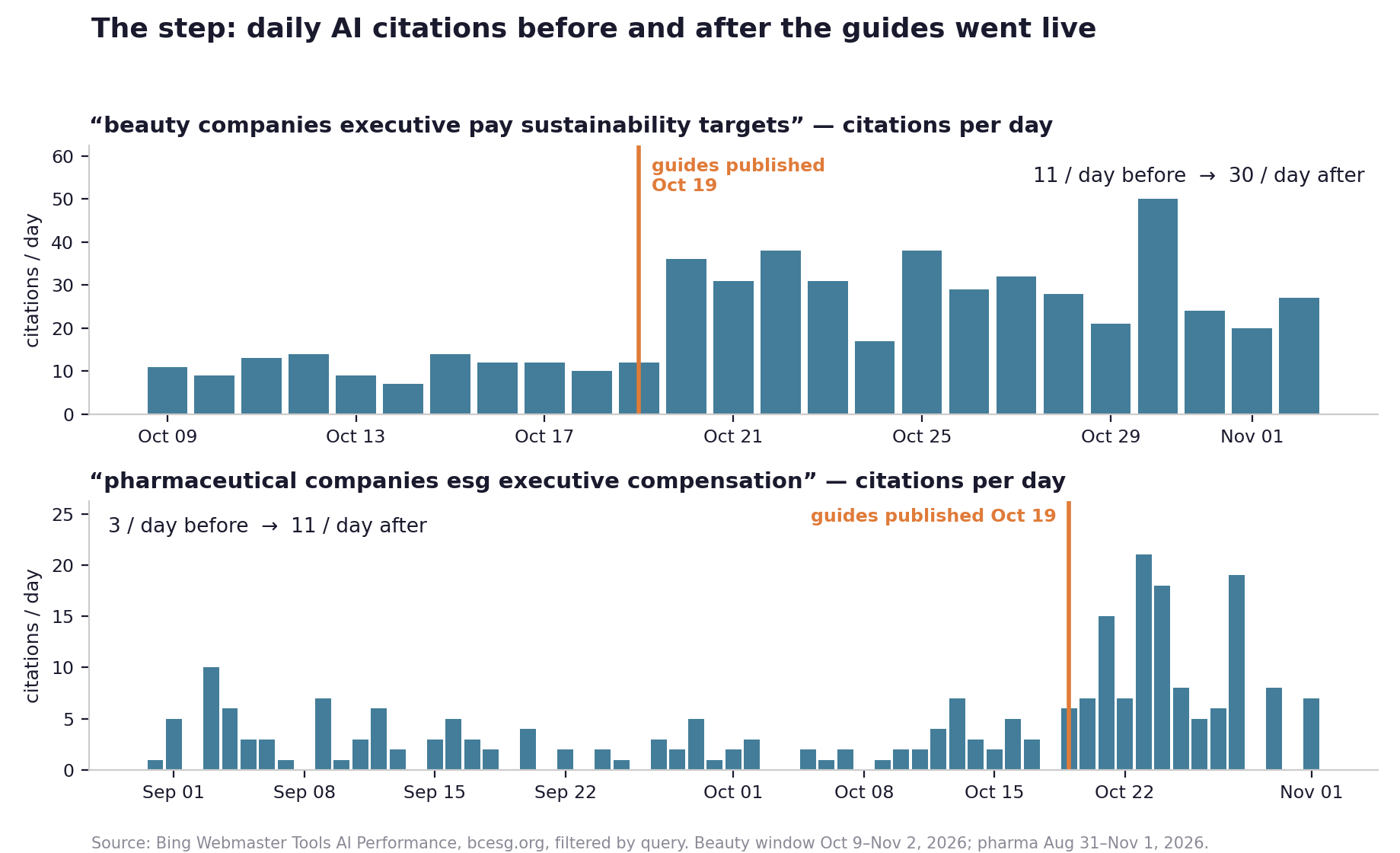
The step: daily citations before and after the guides went live. Source: Bing Webmaster Tools AI Performance, filtered by query.
Read the daily series, not the totals, and the story tells itself. The beauty query was running at 11 citations a day. The day after the guides went live it stepped to 30 a day — peak day, 50 — and it has stayed at the new level. The pharma query went from 3 a day to 11 a day, same step, same date. Nothing else changed on those pages’ behalf that week. The step is dated, and the date is the build.
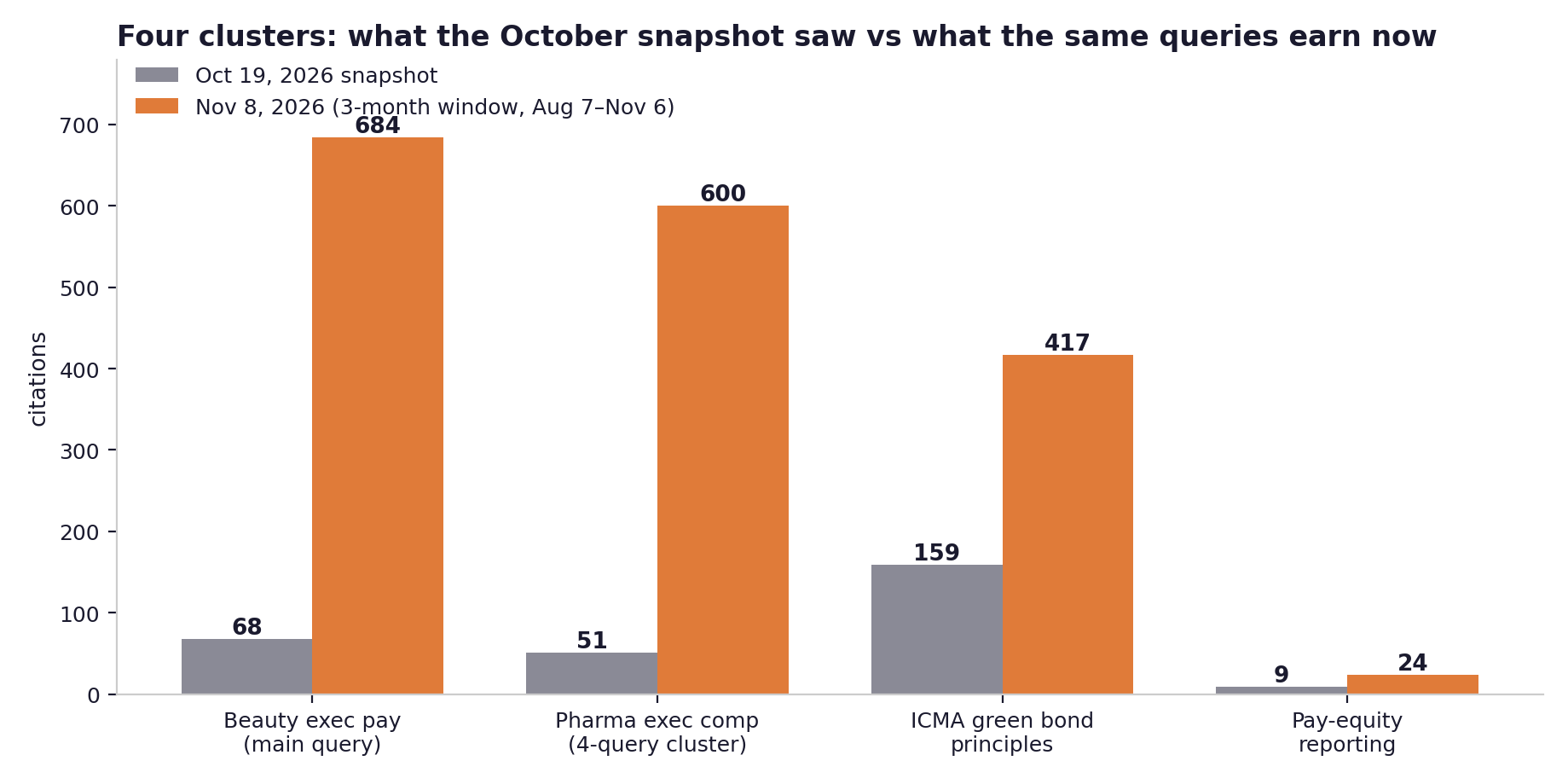
Four clusters, October snapshot vs now. The snapshot counts come from that day’s site-wide report; the current counts are the November 8 report’s three-month window — windows differ by design, and the daily step above is the causation read.
Against the October snapshot, the beauty query is at 684 citations and now holds a 57.33% citation share — when an assistant answers that question, it cites our site more than half the time, and the page it cites most is the one we built for it. The pharma cluster totals 600 across its phrasings.
Now the two honest complications, because a report that only shows the wins isn’t a report.
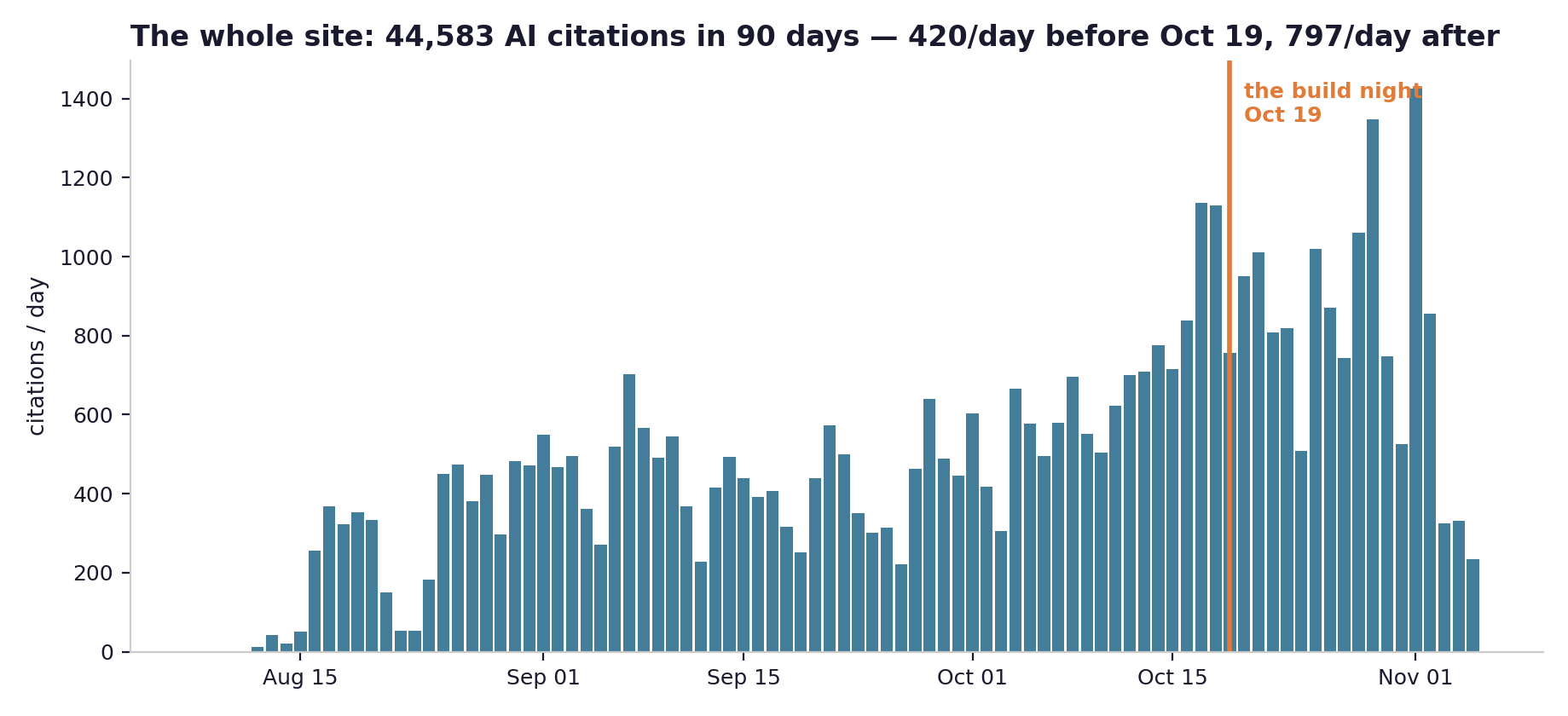
The tide rose too. ICMA green bond principles grew from 159 to 417 with no new build from us — the pages already there just kept earning. The whole site went from 420 citations a day to 797 a day across the same line. So no, I won’t claim every new citation is ours by construction. The claim I’ll defend is narrower: on the two queries we built for, the daily rate stepped on the build date and held, and the built pages took the lead or second place in earning them. The tide explains growth. It doesn’t explain a step.
Small stayed small. Pay-equity reporting — the cluster we noted and didn’t build — went from 9 to 24. Fine, and roughly what you’d expect: no door, no step.
The whole site: 44,583 AI citations in 90 days.
Who earns the query
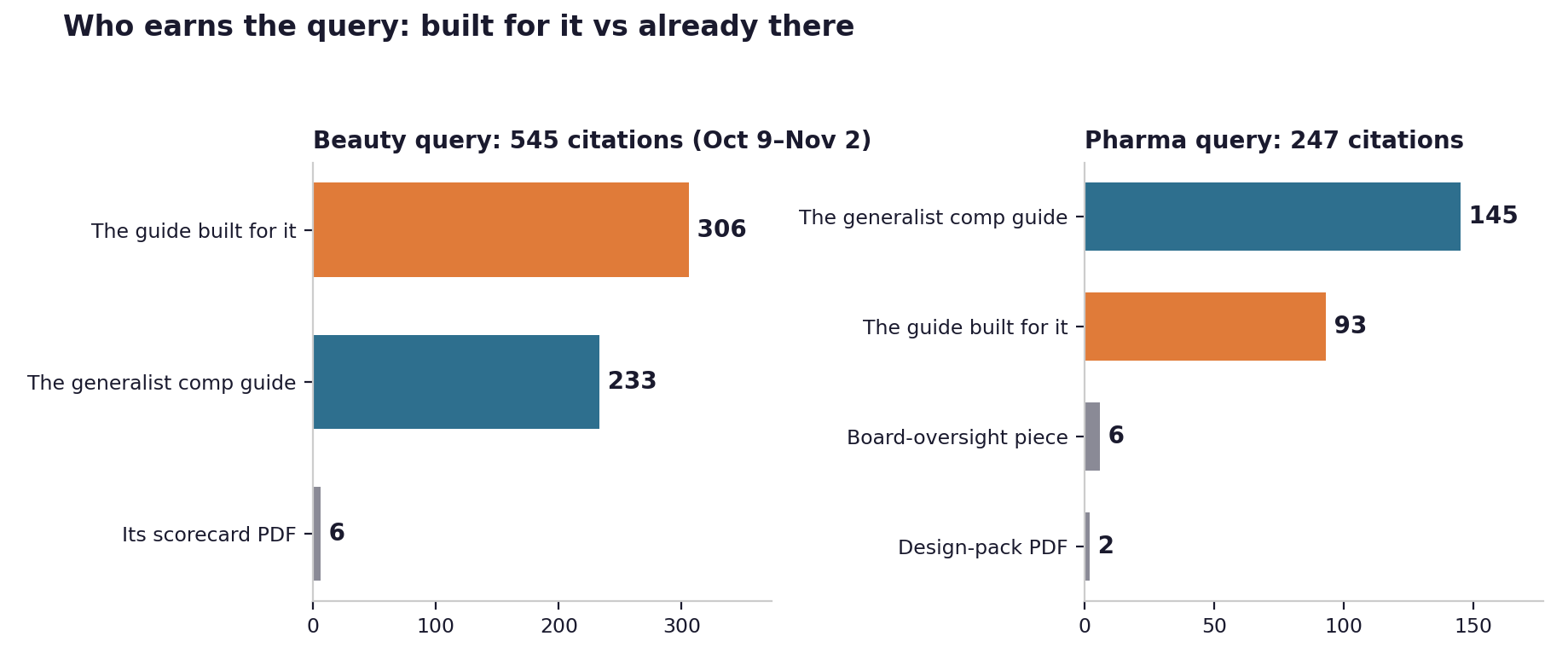
Built for it vs already there — who earns each query.
This is the chart I keep coming back to. On beauty, the guide we built leads — 306 citations to the generalist’s 233 — and the generalist didn’t lose anything in absolute terms. The pie grew; the new page took the bigger slice of a bigger pie. That’s the answer to the cannibalization worry, at least this once: building the specific page grew the specific query.
On pharma, the built guide is second — 93 to the generalist’s 145. A strong second, on a query whose daily rate tripled, but second. One difference between the two builds: the beauty page’s address is the query word-for-word. The pharma page’s address drops one word of it. Is that the reason? Two data points is a hypothesis, not a law — I’m labeling it as one, and it’s the first thing we’ll test on the next build.
And look at the bottom of both panels: the PDFs get cited. Six for the beauty scorecard, two for the pharma design pack in these filtered windows — and across the whole site, four PDFs hold 45 citations, one pharma scorecard alone at 23. The downloads aren’t lead magnets bolted onto the content. In an AI answer, they are content. That’s why the page and its PDF ship as one asset here, and why this article has a companion report instead of a screenshot gallery.
The other half of the instruments: what the humans did
Everything above comes from Bing’s report — the machines’ side of the glass. We also run Microsoft Clarity on the site, so we went and looked at the humans’ side: recordings and friction data for the two guide pages, last 30 days.
The honest headline: there is almost nobody there. The beauty guide — 725 citations in the new report — has had 7 human sessions in 30 days. The pharma guide — 301 citations — has had 2. Sitewide it’s the same shape: 786 human sessions against 44,583 citations. The citation economy runs at roughly 57 citations per human visit, and on the built pages it’s over a hundred to one. The audience for this content is not visiting. It’s being quoted.
And the handful of humans who do land on the beauty guide arrive from a telling set of doors — among the seven sessions, referrers include claude.ai and gemini.google.com. Not the channel the citations live in (that’s Copilot, which sends almost no one), but the same species of door: a person reads an AI answer, then clicks through to check the source. They stay 10 seconds, scroll 5% of the page, click nothing, and leave. No rage clicks, no dead clicks, no errors — zero friction of any measured kind on either page. They’re not reading. They’re verifying — and the page’s job, for them, is to be checkable at a glance: answer first, sources visible.
Meanwhile the bots Clarity filtered out tell their own story: on the pharma page, 6 of its 8 total arrivals were bots; the beauty page, 4 of 11. Sitewide, 2,526 bot sessions excluded against 786 human ones kept. Even the “traffic” is mostly machines.
This is what the PDF citations meant, seen from the other side. If the content’s real consumers are assistants pulling pages and files into answers, then the page is a source document that occasionally gets audited by a human — and it should be built like one. Which brings us to the machinery people argue about.
About llms.txt, JSON, and the rest of the folklore
There’s a standing argument in our trade about what a site must hand the machines: a special llms.txt file, elaborate JSON schema, structured feeds — with one camp saying none of this can work without them and another saying it’s all decoration. We’re in the odd position of not having to argue. We can look.
This site has no llms.txt. None. The address returns our 404 page. It has never existed on bcesg.org — and the site earned 44,583 citations in 90 days without it. Whatever llms.txt is for, “getting cited at all” is not it.
The pages do carry JSON-LD — a FAQ block, article markup, breadcrumbs. And we don’t credit it for the step, because the evidence we trust most on that question — including a controlled test on 1,885 pages that added JSON-LD and got no citation lift — says schema buys eligibility and accuracy, not selection. Our dates agree: the schema was there before October 19 too. What changed on October 19 was the content — a page built to be one question’s answer, carrying a file built to travel.
That’s the whole machinery conclusion, and it’s almost embarrassingly plain: the assistants cite what answers the question, in a form they can carry. A clean page whose address is the question. A PDF that is the answer, portable. The rest is garnish — some of it harmless, some of it a whole industry’s worth of billable garnish.
What we can’t claim
Bing’s own tables don’t perfectly agree with Bing’s own charts. On one filtered view, the chart total was 247 and the pages beneath it summed to 246 — Bing prints a note saying totals may differ when filters are applied, and they do. We report the chart totals and say so.
The windows differ. Each export covers the range Bing gives it; every chart here carries its window on its face. Comparing across windows without saying so is how case studies become fiction.
Leaderboards move. The single biggest pharma phrasing in the new report — “pharmaceutical companies ESG metrics executive compensation,” 248 citations — isn’t the phrasing we built for in October. It was second then. Questions mutate. The map is a snapshot, not a deed.
This is one site, one engine’s report, one month. Copilot citations are what Bing measures. It’s the cleanest window we have, and we say what it is.
What we do now
This is the operating loop, and it’s the same one we’d run on any site, including a client’s:
Pull the AI citation report and count it by value. Not impressions-vanity — which questions, which pages, what shares.
Find the clusters where demand lands on pages that weren’t built for it. That gap is the work list. It’s usually short.
Build one page per question, in the asker’s words, answer first, with its download attached as part of the same asset.
Wait, then re-pull and read the daily step — not the cumulative total, which flatters everything.
Publish the receipts, including the parts that complicate the story.
BC ESG’s whole portfolio, for the record: 44,583 AI citations in 90 days, across 75 cited pages and 428 distinct questions. We didn’t buy that. We counted, we built two doors where the traffic already was, and we wrote down what happened.
If you’re running a site and wondering what the assistants think it’s for — the report that answers that question already exists. It’s sitting in your Webmaster account, unopened. Open it, count it, and build what it’s asking for.
That’s what we did. This is what we saw.
Method note: All figures are from Bing Webmaster Tools AI Performance exports for bcesg.org, pulled October 8 (query-filtered), October 19, and November 8, 2026. Citation counts are Microsoft Copilot and partner citations as Bing reports them. Behavior figures are from Microsoft Clarity (project for bcesg.org), last 30 days as of November 8, 2026, with Clarity’s bot sessions excluded as reported. Page structure and file checks (llms.txt, JSON-LD, PDF links) were verified directly against the live pages on November 8, 2026. Windows: site-wide overview Aug 7–Nov 6, 2026; filtered views as labeled on each chart. Where Bing’s chart totals and table sums differ under filters, chart totals are used and the difference is disclosed above. The two guides discussed were published on bcesg.org on October 19, 2026.
Update history
November 8, 2026 — Published. The 60-second video version is live on YouTube (linked at the top of this page); its chapters match the sections below, and each chapter links back to its section.
Ask your AI to do a simple errand: book a call with ten real companies you might buy from. Not research them. Book the call.
Tobira’s founder, Vlad, ran that exact test before he built anything. He asked his Claude to book a call with 10 real companies. The result, in his launch account, was zero bookings and zero payments. The agent didn’t fail at reading. It failed at the last step — account walls it couldn’t pass, booking pages that block AI, and forms built for fingers and eyes.
That zero-for-ten is the failure every small business is about to meet. More buyers research inside ChatGPT or Claude, and increasingly ask the same chat to take the next step: book the call, start the trial, place the order. Your site was built for the researcher, not the errand. If the errand dies at your form, you never learn the buyer was there.
Tobira Site Agent is one vendor’s answer to that break. We have not tested it on our own sites — this is a desk read, built from Dirty Static’s guide to Tobira Site Agent, itself built from Tobira’s maker site and Product Hunt launch post, facts checked November 7, 2026. Where a number comes from Tobira, we say so.
The clerk, not the brochure
Most of what businesses have done for AI visitors so far is brochure work: clearer pages, structured content, files an agent can read. Necessary — and it’s the layer we already run. Tobira bets the brochure isn’t enough. A brochure can’t close. A clerk can.
Tobira puts a site agent of your own on your website, one that lives there, answers questions, and sells — not just to people, but to the AI agents people send. Your site should not wait to be read by a visiting agent. It should send an agent of its own to meet it, answer it, and do the transaction.
The job list is sales work, not trivia. Per the maker, the agent asks about the visitor’s case, suggests the option that fits, books the call, starts the trial, captures the lead, and sends a payment link — right inside the chat the visitor started in. Booking, trial starts, leads, and payment happen in that chat, not on a separate page. It can talk by voice, with a transcript, and answers in the visitor’s language. When a case gets hard, a person steps in with the chat context attached, so the human isn’t starting from zero.
Two visitors, one site
The mechanism is a split. People see your normal website. Visiting agents get a version made for them, built by your agent from your own content. Per the maker, your agent publishes the files agents look for — llms.txt, agent.json, and AGENTS.md — so a visiting agent reads the offer directly and talks to your agent, instead of scraping page after page.
The token math is the quiet part of the pitch, and it’s a maker example, not a measurement. In Tobira’s worked example, a normal pricing page runs to about 120,000 tokens of page weight. The structured answer lands at about 1,300 tokens, which the company presents as 92 times fewer tokens. Treat that ratio as a company example, not a measured result for your site. Your pages are not their example page. The direction still makes sense: an agent handed the plan, the price, and the next open slot as clean data finishes faster than one guessing its way through your navigation.
The guardrails are the real product
A salesperson who improvises prices is worse than none, and a site agent is a salesperson. The important part of Tobira isn’t the booking trick — it’s three guardrails the maker describes.
First, answers only from your own materials: your site, price lists, PDFs, and FAQs. If the answer isn’t there, the agent doesn’t guess. It offers a call instead. Second, it shares only what you made public. Pricing and plans you chose to publish can be public; internal notes and deal margins stay private. Third, a person steps in on hard cases, with context — the chat history goes to your team, so the buyer never starts over.
Rules are set in plain words, per the maker — “price ranges only,” “no promised discounts.” If it works as described, the guardrails are the product. The chat is just where they show up.
Setup and cost
Setup, per the maker, starts with a scan: Tobira reads your site and builds the knowledge base from what it finds. You add documents, set tone and rules, and test it on the real questions buyers ask. Then it goes live as a badge or widget.
How long? The founder says 10 minutes on Product Hunt; the product page says 2 minutes. Both are maker claims. The honest reading is minutes, not days — with the real work in checking what the scan learned before you trust it with prices.
Pricing, maker site checked November 7, 2026, USD monthly before taxes: Free is $0 with your own AI key — Tobira’s fee is zero, the model bill is yours. Lite is $49, about 300 conversations. Start is $169. Business is $399, adding payments, your own branding with no Tobira badge, and voice up to about 1,500 minutes. Premium is $799, up to 3 sites, and on that tier Tobira keeps 15% of AI-subscription revenue. Paid plans carry a 14-day money-back guarantee, and the maker says a data processing agreement comes with paid plans, with data handled under GDPR.
Free is a genuine test, not a stripped demo. Paid tiers climb fast.
The network bet
A site agent alone is a better shop window. Tobira also wants it to be a doorway into a market. Per the maker, your agent gets a public address in the Tobira network — an email-shaped handle, but for AI. When another company’s agent looks for what you offer, the two agents talk first and check fit. You get a qualified deal, or silence.
The founder says the network holds more than 800 agents. That is a company figure, not audited, and a network is worth what its members are worth — from outside today you can’t tell a market from a list.
Where this sits in our own house
We’ve written this pattern before, from the other side. In October, after Kin’s WebMCP launch, we published “The Agent-Ready Site”: welcome the machine, structure the content, give the agent a way to act, measure what it does. Our fleet runs three of those four layers today. Our llms.txt has been live since October 2026, roughly 62% of our traffic is bots rather than people, and we measure the machine side with Bing’s citation exports.
Tobira is what the unbuilt layer looks like when a vendor builds it for you. The missing layer was the third: give the agent a way to act. An llms.txt is the brochure on the door — it tells a visiting agent what you offer, in its own language. A site agent is the clerk behind it — it answers back, books, and takes payment. Same argument, next step. The pattern said structure your content for agents. Tobira’s bet is that the structure should be a salesperson.
For the record: Tygart Media has not installed Tobira or run it on a client site. It’s a live commercial answer to a layer we know is missing.
The two questions that decide it
One: do your buyers send agents yet? The whole model depends on buyers asking their AI to book and buy, still a young habit. Every speed figure Tobira publishes — including its “2.2 times faster” claim — is founder-tested, not from an outside lab. If your customers still call and complete forms without trouble, a good booking page beats an agent you have to feed.
Two: are your materials clean enough to be spoken aloud? An agent answering only from your materials is only as good as those materials. A stale price on a page is an embarrassment. A stale price spoken with confidence by your own agent, with a payment link attached, is worse than no agent at all.
If your buyers already arrive through AI and die at the booking step, the free route is worth a real test. If they don’t, watch the habit and the network count, and keep your booking page in good shape. Guessing wrong about which one you’re in is the expensive option.
The practice
Run the founder’s test on yourself. Open the AI you actually use and ask it to book a call with your business — your real site, no help from you. Watch where it dies. If it books cleanly, your forms were never the wall; file this category under “later.” If it stalls at an account wall, a blocked page, or a form it can’t complete, you’ve just watched the exact failure Tobira is selling against — free, in ten minutes, on your own storefront.
Want this thinking applied to your own business? Book a call with Will Tygart — 30 minutes, and we start from your receipts, not a pitch deck.
Yesterday we published a test: 52 calls to Muse Spark 1.3, seven kinds of work, every rung of the reasoning dial, everything scored against ground truth. Our result was not close. The cheapest setting never lost — and twice, extra thinking was the failure itself. We set the fleet’s operating rule on that evidence and moved on.
Then a counter-check showed up, the way we’d want one to. BenchLeader — a third-party site that republishes benchmark results from their original publishers — carries a full rung-by-rung row for Muse Spark 1.3 on CursorBench, a coding benchmark. On that ladder, the dial pays at every single rung. If both results are real, they can’t both be the whole story. So we read the ladder the way we ran our own test: numbers first, bases stated, no vibes.
The ladder’s numbers
CursorBench, Muse Spark 1.3, as published on BenchLeader (data as of November 8, 2026; the underlying results are Cursor’s, dated September 2, 2026):
Rung
Tasks solved
Rank on the board
minimal
24.3%
#79
low
29.3%
#72
medium
32.6%
#64
high
33.4%
#59
xhigh
37.5%
#48
max
41.6%
#38
No rung regresses. Every step up solves more tasks than the step below it — +5.0 points from minimal to low, +3.3 to medium, +0.8 to high, +4.1 to xhigh, +4.1 to max. Across the whole ladder that’s +17.3 points: at max, the model solves roughly 1.7 times the share of coding tasks it solves at minimal. Ranks are among 82 model configurations with a published result on that benchmark.
What is CursorBench? In BenchLeader’s words, it’s “Cursor’s internal coding-agent evaluation”: coding tasks run inside Cursor’s agent, with the reasoning level and cost per task recorded, scored as the percent of tasks solved. Two honest labels belong on it. It is published by a coding-tool vendor — BenchLeader itself flags “harness is theirs” — and BenchLeader carries it for reference only; it doesn’t count toward their composite index. It is still the only rung-by-rung coding evidence for this model that we know of, and it points the opposite way from ours.
Our numbers, on the record
Our battery was 52 API calls to the contributor tier of Muse Spark 1.3, November 6–7, 2026, identical prompts at multiple settings, mechanical scoring. The buyer-brief judgment task scored identically at every rung — minimal got it for 776 reasoning tokens and 6.5 seconds, xhigh for 6,847 tokens and 50 seconds. Verdicts at scale: 120 out of 120 at low, 120 out of 120 at xhigh. Planning: provably optimal schedules at every rung.
And the coding cell — the one this ladder speaks to directly. Our debugging task was one function with three planted bugs. Every rung found the inverted discount logic and the rounding bug; the cheapest setting found all three. One xhigh call spent its entire 8,000-token budget thinking — 7,998 reasoning tokens — and returned an empty answer. It thought so long it never spoke. Minimal answered the same task correctly with 500 reasoning tokens.
Our published conclusion: on our work, extra reasoning bought latency, not quality, and the operating rule became low by default, with xhigh and max earned only by a demonstrated failure at low.
Both numbers are real. The tasks aren’t the same.
Put the two bases side by side and the disagreement gets smaller and more specific:
Task shape. CursorBench runs coding tasks inside an agent — sustained, multi-step work where the model plans, acts, reads errors, and recovers over many turns. Our battery was single API calls with a checkable answer. Our one coding task was a single function, solved — or stalled on — in one shot.
Tier and harness. The ladder ran Spark 1.3 inside Cursor in September. We ran the contributor tier through the API in November.
Measurement. The ladder reports the percent of a task set solved. We scored one sample per cell against ground truth — a limit we printed in the original piece.
Here is our reasoning, labeled as reasoning and not as either source’s claim: the reconciler is task shape. On a short, bounded task with a checkable answer, the first think is the one that does the work; rungs above it buy patience-testing latency, and occasionally a stall. On a long agent run — hold a codebase in mind, take twenty steps, survive your own mistakes — extra reasoning has something real to chew on, and the ladder pays for it. That reading fits the anomaly we flagged in our own data: the rungs behaved like task-shaped budgets, not fixed ceilings. It also fits the limit we printed: we never tested sustained work. CursorBench did — or rather, Cursor did.
What would change the verdict
Not an argument. A run. The test that settles this for our shop is our own coding work at every rung: real work-order-shaped jobs — a written spec, more than one file, a module plus a test suite with a mechanical pass/fail — at minimal, low, high and max, in one harness, more than one sample per cell, receipts published the way the first battery’s were. If low matches max on those, our rule stands for coding too, and the ladder is a story about Cursor’s harness. If max pulls away as the jobs get longer, the rule gets a carve-out: the rung follows the length of the task. Either result is publishable. We’ll run it and print what we find.
The bottom line for an operator
If your work is short, bounded calls — extraction, checking, verdicts, drafting to spec — run low. We have 52 metered calls that say the expensive rungs buy you nothing there, and our default hasn’t changed.
If your work is a coding agent chewing through real jobs, the only rung-by-rung evidence that exists says turn it up: on Cursor’s own ladder, max solves 41.6% of tasks against minimal’s 24.3%, and every rung between them earns its step. That evidence is a vendor’s, run in the vendor’s harness, on September’s model build — hold it at that weight, not more.
The mistake isn’t picking the wrong rung. It’s running one default across both shapes of work and calling it a policy. The dial is real. What it pays for depends on the length of the job in front of it — and now there are two published result sets, ours and Cursor’s, that say exactly that from opposite ends.
Sources: BenchLeader, “Muse Spark 1.3” model page and CursorBench leaderboard (data as of November 8, 2026; CursorBench results published by Cursor via the Epoch AI Benchmarking Hub, Spark 1.3 results dated September 2, 2026). Our dial test: “We Ran Muse Spark’s Reasoning Dial Through 52 Calls. The Cheapest Setting Never Lost.” (Tygart Media, November 7, 2026), method and receipts in the Tygart-OS fact-gated fleet record on GitHub.
Want this thinking applied to your own work? Book a call with Will Tygart — 30 minutes, and we start from your receipts, not a pitch deck.
Short answer: no. Not today, and not because you’re behind. As of this writing, there is no public way to claim a business in ChatGPT. The claim page exists in exactly one place — a screenshot of an unreleased beta — and OpenAI has announced nothing: no launch date, no price, no list of countries, no help page. Anyone selling you a “ChatGPT claiming service” this week is selling you a screenshot.
Here is what we actually know, where it came from, and the work you can do now so that when the door opens, you’re the first one through it.
What was actually seen
On November 6, 2026, Juozas Kaziukėnas — founder of Marketplace Pulse, an e-commerce research firm — posted a screenshot from inside ChatGPT. In the corner, in red: “unreleased/beta.” The page is headed “Claim your business in ChatGPT”, with a line underneath about unlocking a business agent and managing how your business shows up.
The page makes three offers:
See how your business shows up — track how often your business is mentioned in ChatGPT conversations.
Show customers what you offer — add your latest products and keep your business information up to date.
Help customers make decisions — let a business agent answer questions using context you control.
And one piece of fine print: you’ll need to verify that you’re authorized to represent your business.
Kaziukėnas added the mechanics in his post. The tool measures impressions — the number of times a business appeared in ChatGPT responses — and clicks on links to the business’s website, tracked daily and shown as a chart. It sits inside a larger area called Business Hub. And it is only available to businesses that have verified their ownership — his example: “by connecting their Shopify store.” He also said the feature is a work in progress, that he saw its first steps as early as August, and that a banner he saw suggests it is getting close to launch. That last part is his inference, and it’s worth keeping labeled that way.
Barry Schwartz covered the post the same morning at Search Engine Roundtable, and Search Engine Land and PPC Land followed the same day. Every one of those stories notes the same thing: OpenAI has not commented. This is one analyst’s view of an interface that has not launched. Details can change before it ships — if it ships in this form at all.
What it would show you — and what it pointedly would not
If the screenshot becomes a product, a claimed business gets a daily chart of two numbers: how often it appeared in ChatGPT answers, and how many people clicked through to its site. That’s real first-party data, and today it doesn’t exist anywhere for ChatGPT. Right now, the only way to know whether ChatGPT mentions your business is to ask it, repeatedly, and keep your own notes — which is exactly what we do in our own citation work.
But Kaziukėnas is explicit about what the tool leaves out: no prompts, no user data, no competitor benchmarks, no rankings. Read that twice. You would see your mentions go up or down and have no way, inside the tool, to learn why. No record of the questions people asked when your name came up. No view of who else got named instead of you. A chart that moves without an explanation is a scoreboard, not a diagnostic — useful, but only paired with the outside work of tracking the actual questions.
There’s a contrast worth naming here. The first-party AI-visibility console that actually exists today is Microsoft’s: Bing Webmaster Tools has an AI Performance section where we watch, for our own sites, which pages the AI cites and which questions ground on them. That one is live, free, and shipping real data now. OpenAI’s version of it is, today, a screenshot in a LinkedIn post. Plan against the tools that exist; be ready for the ones that don’t yet.
The question nobody can answer yet: how does a service business verify?
The only verification example on record is connecting a Shopify store. That works if you sell products through Shopify. A restoration contractor, a plumber, a law firm — a business whose “store” is a phone number and a service area — has nothing to connect.
How would OpenAI verify that you own a local service business? A postcard, like Google’s old method? A document upload? A match against an existing Google or Bing profile? Nobody knows, because OpenAI hasn’t said, and no service business has been through it publicly. This is the single most important unknown for local businesses, and it’s the reason this article is a readiness piece instead of a how-to: the how-to cannot be written honestly yet.
One more wrinkle, small but real. The screenshot’s fine print says you’ll verify that you’re authorized to represent the business. The reporting describes verifying ownership. Those are different tests, and the difference matters to any agency or consultant who would claim profiles on clients’ behalf — which is most of them. Which test OpenAI applies is another thing we find out at launch.
What to have ready (all of it pays off today, too)
None of the preparation depends on OpenAI. It’s the same discipline that earns citations on the surfaces that already exist:
One version of your facts. The same business name, address, and phone number, character for character, on your website, Google Business Profile, Bing Places, and every directory that matters. A verifier — human or machine — should find one business, not three near-matches.
Your existing profiles claimed and current. Google Business Profile and Bing Places are claimable today. Hours, services, service area, photos. If you haven’t claimed the doors that are open, the closed one isn’t your problem yet.
Pages that say plainly what you do and where. One page per service, in the words a customer would use to ask for it. This is what AI answers quote, with or without a Business Hub.
Your own mention log. Ask the major AI tools the questions your customers ask, on a schedule, and write down who gets named. When OpenAI’s chart exists, you’ll have your own baseline to check it against — and you’ll already know which questions you’re losing.
When it opens
The lesson from every previous claim system — Google Business Profile above all — is that early claimants get clean data and clean names, and latecomers get disputes. So: the week a “Claim your business” banner appears for real, claim yours, and verify with whatever method they offer a service business. We’ll do the same, and we’ll write up what the dashboard actually shows — the real numbers, the real verification path, and what it still won’t tell you — once we’ve been inside it ourselves.
Until then: readiness is the whole job, and it’s the same job that gets you cited today. If you want to know how your business currently shows up across the AI surfaces that already answer your customers, that’s the first thing our $97 Quick-Scan reads — ChatGPT included, by hand, the only way it can be read until OpenAI opens the door.
Sources: Juozas Kaziukėnas’s LinkedIn post (Nov 6, 2026); Search Engine Roundtable, “OpenAI Creating ChatGPT Tools For Business For Analytics & Citations” (Nov 6, 2026); Search Engine Land, “OpenAI testing business tools to track performance within ChatGPT” (Nov 6, 2026). OpenAI has not announced or commented on this feature; everything above about the tool itself traces to the screenshot and Kaziukėnas’s description of it.
Want this thinking applied to your own business? Book a call with Will Tygart — 30 minutes, and we start from your receipts, not a pitch deck.
Compared with the prior version of this morning desk (published ~11:17 PM PST November 7: Tropical: None · Severe: Marginal · Flood: Marginal): SPC Day 1 Convective Outlook (0100 UTC November 9 / 6:50 PM CST Sunday November 8 2026 by Mead, valid 090100Z–091200Z) holds NO SEVERE THUNDERSTORM AREAS FORECAST. Prior Marginal Risk areas over northwest Washington and earlier South Texas have closed. Isolated strong storms with gusty winds remain possible overnight in South Texas, but severe potential is negligible. No watches or mesoscale discussions valid.
WPC Day 1 Excessive Rainfall Outlook (updated 0051 UTC November 9 / discussion 7:57 PM EST November 8 by Bann, valid 01Z Nov 09–12Z Nov 09) maintains a Slight Risk of excessive rainfall across South-Central and South Texas. Heaviest rates largely shifted offshore in far South Texas, but Slight held along and near the coast and over the Edwards Plateau given prior accumulations (up to 3.5+ inches in places) and residual flooding potential. No Moderate or higher.
NWS has an active Flash Flood Warning (extended) for Edwards, northwestern Kinney, and northeastern Val Verde counties in south-central Texas until midnight CST Sunday, with reported flooded/closed roads (including near US 377, SH 55, CR 450), a water rescue, and 2–5 inches already fallen. Additional rainfall up to 1 inch possible. High Wind Warnings for the Northern Washington Coast and Grays Harbor County Coast have expired.
Tropical lane remains None. National Hurricane Center Tropical Weather Outlook (700 PM EST November 8) confirms tropical cyclone formation not expected during the next 7 days. No tropical cyclones in the Atlantic, Caribbean, or Gulf of America. No U.S. coastal or Gulf watches or warnings. Tropical Storm Pena remains in the Central Pacific with no threat to the mainland U.S. or Gulf.
Quiet Pulse criteria continue to hold: nothing at SPC Slight or above, no WPC ERO Moderate or above, no tropical storm or hurricane watch or warning on the U.S. coast or Gulf.
Live Status
As of the morning desk update on Sunday, November 8, 2026 (evening confirmation approximately 9:17 PM PST / 05:17 UTC November 9), the national picture remains a Quiet Pulse. The Storm Prediction Center’s latest Day 1 Convective Outlook states there are no severe thunderstorm areas forecast. An upper low over southwest Chihuahua will progress toward the Texas Big Bend overnight. Modest height falls, low/midlevel warm advection, and MUCAPE of 500–1000 J/kg will yield an increase in thunderstorm coverage across South Texas overnight. While no severe weather is expected, a strong storm or two capable of gusty winds is possible. Elsewhere, showers over southwest Ontario may support sporadic lightning over far western New York and the Tug Hill region, but convection remains too shallow for organized severe. No watches or mesoscale discussions currently valid. Homepage confirms Day 1 No Severe; Day 2 and Day 3 No Severe.
WPC Day 1 ERO confirms a Slight Risk across South-Central and South Texas. Present indications show highest rates remaining offshore through the remainder of the night, with Slight maintained along and near the coast given the chance for westward/inland propagation. Farther north, diffluent southerly flow continues to support areas of rainfall in and near the Edwards Plateau. Rainfall rates have tapered, but the Slight risk area was largely maintained given overlap with places that received as much as 3.5 inches in the past 24 hours and where flooding had already been reported. No Moderate risk. Active Flash Flood Warning covers portions of Edwards, Kinney, and Val Verde counties with ongoing impacts. NWS national products include residual flood watches or advisories in Texas and routine freeze, high wind, and other products elsewhere. None elevate the national severe or flood lanes above the current Quiet Pulse thresholds.
Pulse Table
Lane
Status
Notes (as of ~9:17 PM PST Nov 8 / 05:17 UTC Nov 9 2026)
Tropical
None
No tropical cyclones in the Atlantic, Caribbean, or Gulf. Formation not expected next 7 days. TS Pena (CPAC) no U.S. mainland or Gulf threat. No U.S. coastal or Gulf watches or warnings.
Severe
None
SPC Day 1 (0100Z Nov 9): No severe thunderstorm areas forecast. Prior Marginal risks (NW WA, South TX) closed. Isolated gusty winds possible in South TX overnight, but not severe. No watches or MDs valid.
Flood
Slight
WPC Day 1 Slight Risk across South-Central and South Texas (coast near Brownsville to Corpus, Edwards Plateau). Prior rains up to 3.5+ inches; residual flooding potential. Active FFW in Edwards/Kinney/Val Verde. Highest rates offshore. No Moderate or higher.
Rising Queries
Trends unreachable.
Restoration Read
Dominant residual ticket is localized flash flooding and rapid runoff in urban corridors and higher terrain across South-Central and South Texas under the WPC Slight Risk. Prior accumulations of 2–5+ inches in places from the Rio Grande Valley toward Corpus Christi and the Edwards Plateau support continued low-end flash flood potential overnight into early Monday, especially where soils are primed. Active Flash Flood Warning confirms reported road closures and at least one water rescue. Secondary residual is any lingering wind damage or power issues from earlier High Wind Warnings on the Pacific Northwest coasts, now expired. No organized widespread catastrophic damage expected. Monitor for debris, water intrusion, and high water on roads. Turn around, don’t drown.
What This Is Not
This is a Quiet Pulse. No SPC Slight or higher severe risk on the latest Day 1 outlook. No WPC Moderate or higher excessive rainfall. No tropical storm or hurricane watch or warning on the U.S. coast or Gulf of America.
Informational only — not an official warning. Always confirm with the latest official forecasts from weather.gov, spc.noaa.gov, wpc.ncep.noaa.gov, and nhc.noaa.gov. Turn around, don’t drown.
He doesn’t beat the big shops by out-buying them. He beats the comparison by changing what gets compared. He takes the trade he came from — eight years as a home inspector — breaks it down to the part that still matters, and builds it into the offer, so every water-loss job includes something the adjuster’s sheet has no column for: a written, dated inventory of the condition of the parts of the house the water didn’t touch.
If you started your business after a first career — and in the trades, a lot of founders did — that past life is not background. It’s inventory. It’s also the one thing the bigger competitor cannot claim, because he didn’t live it.
One truck, second year
The operator in this story is a familiar shape. Second year in business. One truck. A rented storage unit where the drying equipment lives between jobs. His spouse does the books at night after her own day is done.
He came into restoration from eight years as a home inspector. No brand anyone recognizes. No program agreements. No marketing budget worth the name. Work comes as a trickle — two realtors who remember him from inspection days, and a plumber who calls when he finds something wet he doesn’t want to own.
He is good at the work. That was never the problem.
The problem is the axis he’s being judged on.
Smaller on every column that counts
Put him next to the established shops on the measures everyone defaults to — response time, trucks, equipment ready to roll, certifications, headcount on a bad-weather weekend — and he loses every row. Not because he’s careless. Because he’s one person.
Homeowners like him. They say so. Then the quotes go into a process that doesn’t run on liking. An adjuster compares offers on a sheet with set columns, and his entries are thinner in almost every box. So he loses jobs he could have done well.
First-year revenue was survivable. It was not compounding. Survivable means the truck runs and the storage rent clears. It does not mean a second truck, a first hire, or a month where one slow week stops being a scare.
The obvious advice all cost money he didn’t have yet. Niche down — on what budget to reach the niche? Buy more equipment — to sit in the unit beside the equipment already there? Join a network — with fees due before the referrals are? Every suggestion was a way to become a slightly less small version of the same shop. None of it changed the comparison.
The snowmobile
John Boyd — the fighter pilot and thinker who wrote about how people orient themselves when things are changing — had an image for how something genuinely new gets made. He called the process destruction and creation.
Destruction, in his sense, is analysis: taking a thing from general to specific, breaking a familiar domain apart until you’re holding its separate parts. Creation is the reverse move: synthesis, specific to general, finding common qualities across those shattered pieces and building something that didn’t exist in any one of them.
His example was a snowmobile.
Look, he said in effect, at a skier, a motorboat, a bicyclist, and a toy tractor. Shatter each domain. From the skier, skis. From the motorboat, an outboard motor. From the bicyclist, handlebars. From the toy tractor, rubber treads. None of those parts, by itself, is a vehicle that crosses snow under power. Synthesize them around what they share, and you get one — a machine that belongs to none of the four domains it came from.
This is not brainstorming, and it’s not bolting features onto an existing product. A ski is useless for this purpose until “skier” has first been broken apart and the ski is just a ski, free to be used another way. The combining only works after the breaking.
Boyd put the stakes in one hard sentence, in sense if not in his exact cadence: faced with uncertainty and change, the loser cannot build snowmobiles, the winner can — and employs the ability appropriately, when the situation calls for it.
Our operator didn’t need a better version of a restoration truck. He needed a snowmobile.
What he stopped selling
He stopped selling “restoration, but smaller” — same promise, fewer people — and asked what his inspector years had actually left him holding, once that job was broken apart.
Not the license. Not the checklist as a whole. The useful constituent was narrower: the habit, and the trained eye, for walking an entire house and writing down its condition before anything went wrong in it — what was stained, what was worn, what was already old — with dates and photographs, in language a third party could rely on later.
Bolted onto a dry-out, that part changes the job.
So the offer became this: every water-loss job includes a written pre-loss condition inventory of the unaffected parts of the home. Not the damaged kitchen — the rest of the house. Floors, subfloors where visible, walls, finishes, the rooms the water never reached, documented at intake while he is already there setting equipment. Homeowner and adjuster each get a copy. It is the baseline document neither the big shops nor the carrier had bothered to create, because on a standard dry-out, nobody’s job says to make it.
He wasn’t adding a freebie. He was adding a column.
The kitchen leak that paid for the idea
It proved out on a routine job. A kitchen supply line, a wet cabinet floor, a small dry-out.
While he was there, he did the inventory as he now does it on every job. In the next room, he noted pre-existing subfloor staining — old, dry, unrelated to this leak — and photographed it with the date attached, without making a point of it. The homeowner signed the inventory with everything else.
Three weeks later, that staining tried to become an argument. Was it part of this loss or wasn’t it? That kind of question usually gets settled by whoever sounds most confident, because nobody wrote anything down when it could still be checked.
He had written it down. The argument ended quietly — the document was simply earlier and clearer than the dispute.
After that, the adjuster on the job had a name for him. Not the small shop. Not the new guy. “The one who documents the whole house.”
That name is worth more than a certification he hasn’t bought yet, because it describes a difference, not a size.
And a second channel opened that he hadn’t planned on. The realtors who already knew him started sending him pre-listing work — houses about to be sold, where a seller wants both things at once: someone who can dry what needs drying and read the rest of the house like an inspector. No other shop in his market was working that channel, because no other shop was built that way. It isn’t huge. For a one-truck operator, huge is not the test. Work that arrives because of who he specifically is, is.
What it costs, said straight
The inventory adds about 40 minutes to every job. Unbillable minutes, for now — no line on the standard sheet pays for documenting rooms that aren’t damaged. Forty minutes is nothing to a shop that can hand it to a second tech. To a solo operator, it is real money: the difference between two jobs in a day and a job and a half.
And the snowmobile has no moat.
If the idea proves out — and adjusters asking for him by that name suggests it is — a larger shop can copy it within a quarter, assign it to a tech with a tablet, design a cleaner form than his, and market it harder than he can afford to. Synthesis wins by being unorthodox first. It does not stay defensible forever just because it was yours first.
So the honest strategy is not “build this once and defend it.” It is to keep assembling. While the inventory is still his difference, use it and bank the referrals it earns. And watch what else is lying in the shattered pieces of the inspector years for the next combination, before the last one is copied into everybody else’s column.
That is less comfortable than a moat. It is also the actual position of a small operator.
The practice
Break your past trade down to parts this week. Don’t write “experience.” List the specific things you can still produce — a document, a read, a check — that your current customers’ other vendors don’t produce at all.
Add one column on Monday’s next job. Pick one constituent part and build it into the standard offer, delivered every time, not as a favour. If the comparison sheet has no box for it, you’re on the right track.
Price the cost honestly before you commit. Count the unbillable minutes per job at your scale, and decide — in advance — how many jobs you’ll run it for before you judge whether the referrals and the name it earns pay for them.
Plan the next combination while this one works. Assume a bigger shop copies a good idea in a quarter. Your edge is not defence. It’s being the person who assembles the next one first.