Author: William Tygart

  • What Is an Old Page Telling You When It Starts Getting Cited Again?

    What Is an Old Page Telling You When It Starts Getting Cited Again?

    Everybody talks about AI citations like they’re weather. Somebody reads somebody else’s report, shows you a screenshot of a ranking, and that’s supposed to mean something.

    A screenshot is a rumor. I wanted a count.

    So we built what I call the bait board. It’s simple: every page on this site is bait. A “bite” is when an AI answer — Bing’s, in our case, because that’s where we pull the data — cites one of your pages. If you can’t count it, you can’t improve it. The board counts it.

    The board, as of this week

    Over the last six months, Tygart Media has pulled in roughly 1.6 million AI citations. Across the two six-month windows we’re comparing, 997 distinct pages have been cited. 870 of them are biting right now.

    One page does most of the heavy lifting: our Claude AI pricing page, at 1,388,909 citations. That’s not a typo. That’s what happens when a page becomes the answer to a question a lot of people ask every day.

    Every page on the board lands in one of four buckets:

    • DEFEND — 945 pages. Biting now. Somebody out there thought it was good, and an AI keeps handing it out as the answer. You protect these. Iterate in place, never rename them, and check whether you’re still holding the seat — because a citation is a seat, and nobody holds your seat for you.
    • RE-BITE — 52 pages. Proven bait that went quiet. They were cited, then they weren’t. Sometimes a competitor wrote the Costco-hat answer with the glasses and the supply chain added on, and took the seat. Sometimes the page just went stale. Either way: patch it in place and cast again.
    • SOAK — 121 pages. Published, no bite yet. Let compounding do its work. Not everything needs touching.
    • PRUNE — 61 pages. Never picked up. Stop feeding them.

    The data comes down every night — three CSVs out of Bing Webmaster Tools: AI Performance, grounding queries, and pages, six-month window. I download them by hand on purpose. Don’t automate yourself out of this stuff. When you pull it yourself, you notice the weird one. You click through. You find something.

    And the method matters more than the tool. It’s the tactic, not the tool — everybody’s tools are calculators. Whatever way you do this, do it the same way every time, because the delta is the information. Change your method every week and you’ll never know whether the number moved or you did. I used to look at this every 28 days. The world doesn’t run on 28 days anymore. Clarity defaults to three days, and honestly, three days is about right now. I check daily. I’m scared not to.

    But here’s the thing I actually sat down to teach this week, and it’s the thing the board taught me — three patterns I can only see because the count runs every night.

    Pattern one: the fastest source is not the cited source

    Look at the dead bait. A big share of it is our timed storm watches — the automated storm updates that publish as weather moves through a part of the country, update, and expire.

    They almost never get cited by Bing. Almost never.

    I think I know why. When the moment passes and the engine settles on an answer, it doesn’t cite the quickest source. It cites the original, the best source. On a storm, we’re the quickest source there is — we’re built for speed, the update is live while it’s still raining. But quick is not the same as best, and after the fact, Bing goes back and picks the best. That’s not us, and on a timed watch it was never going to be us.

    That doesn’t make the storm work useless — it feeds other sites of ours, and being first matters in other places. But if you’re measuring it by Bing citations, you’re grading a sprinter on a marathon course. Know which race each page is running.

    Pattern two: a good article that dies at three weeks usually died in the title

    The other thing I see on the board: solid articles — some of them op-ed pieces I’m proud of — that come up on three weeks old and fall off a cliff. Not bad articles. Articles that never made the first pass.

    When I look at those, it’s the title. The title didn’t tell the engine, or the reader, what question this page answers. So it never got picked up in the first place, and by week three there’s nothing left to defend.

    The fix isn’t rewriting the whole piece. The fix is two moves:

    1. Retitle it so it answers the actual question in the words people ask it.
    2. Give it something evergreen inside — a chart, a reference block, a section that stays true after the moment passes. An op-ed with an evergreen chart in it has something durable to be cited for. A storm piece with a standing reference section — what a project manager does when this kind of storm hits, say — has a reason to exist after the rain stops.

    Timely gets you published. Evergreen gets you cited. A piece that only has the first one is on a three-week clock whether you know it or not.

    Pattern three: old pages that bite again are sensors

    This is the one that changed how I run the board.

    Months ago, out of our Everett work, we wrote about a Boeing contract — the SPIA contract. Old news. Done. Except it isn’t: that page keeps showing up. It keeps getting cited.

    My first instinct, months back, would have been to call that noise. It’s not noise. It’s a sensor going off.

    If an old page starts biting again, it means the world came back to that topic and there wasn’t much else there. Thin coverage. We saw the same shape on one of our other properties — a sustainability piece about cosmetics CEOs that narrowed down, over time, to two or three companies actually doing the thing. The page didn’t change. The field did, and the page was the instrument that showed it.

    Think about it the other way: say we wrote up an Everett AquaSox game a while back, and one of the kids in that game makes a World Series roster in a year or two. That old game page could light up again — and when it does, it tells you something is happening before the crowd writes about it. The re-bite is the first inkling. A disturbance, if you’ll forgive the reference.

    So I’ve stopped treating old pages as prune candidates by default. Some of them aren’t content anymore. They’re instruments. You don’t throw away a gauge because it’s been quiet — the quiet is the baseline, and the spike is the signal. A re-bite on an old page is market intelligence, and it’s free: the page is already written, already out there, already costing you nothing to leave in the water.

    Prune still exists — 61 pages earned it. But before a page goes in that bucket now, it gets one more question: is this dead, or is this a sensor that just hasn’t gone off lately? Those are very different things to delete.

    The seat, and keeping it

    Here’s the whole doctrine in one breath: get cited and you’ve taken a seat. Leave, and someone’s sitting in it when you come back. The engines don’t owe you the chair. So you count — nightly, same method, same window — and you sort every page into defend, re-bite, soak, or prune, and you listen to the old pages, because they’re telling you where the world is thin.

    That’s the bait board. It isn’t fancy. It’s three downloads, four buckets, and the discipline to do it the same way tomorrow.

    AI Citation Quick-Scan, $97 — Tygart Media runs your pages through the Bait Board count: which pages AI answers cite, which went quiet, which are sensors

    If you want to run this yourself

    I teach this in layers, same as everything else we sell:

    • The Bait Board one-pager (free PDF). The four buckets, the three nightly downloads, and the counting rules on one page. Print it, tape it over your desk, start counting.
    • The Bait Board Field Guide ($7 PDF). The full method: how the six-month window works, how to read fresh bites against dropped pages, the churn math, and the sensor test — how to tell a dead page from a quiet instrument before you prune it.
    • The Bait Board, Book-for-Bots edition ($17). The method written for the machines as much as for you — structured so an AI assistant can run the nightly sort with you: bucket definitions, decision rules, and the worked examples from this site’s own board, including the storm-watch and three-week-title findings above.

    AI Search Visibility Package product card — $450 standing citation-board practice for business websites, from Tygart Media

    And if you’d rather have it done with you: the AI Citation Quick-Scan ($97) is where we run your pages through this same count and hand you the board; the $450 tier builds the board into a standing weekly practice on your site; and the $2,250 tier is the full desk — board, refresh queue, and the sensor watch running as a system. Same ladder we run here. The count comes first either way.

    AI Search Visibility Package product card — $2,250 complete bundle: citation board, refresh queue, and old-page sensor watch run as a system, from Tygart Media

    Start with the count. Everything else is commentary.

    — Will

  • Split the Panel: Brand Prompts and Non-Brand Prompts Are Two Different Tests

    Split the Panel: Brand Prompts and Non-Brand Prompts Are Two Different Tests

    Your AI visibility report says you were cited 118 times last month. Good month or bad month?

    You can’t tell — because that number blends two different tests into one score, and the two tests fail for opposite reasons.

    PressGEO ran a rolling 30-day probe — 1,000 prompts, window ending November 8, 2026 — and published the split most dashboards never show. On the 357 prompts that named the brand, the domain was cited 118 times: a 33.1% citation rate. On the 643 prompts that didn’t name it — the category questions, the discovery questions, the “best tool for X” questions a stranger actually asks — the count was zero. Not low. Zero.

    One blended number for that month reads 11.8%, and it is useless. It can’t tell you whether the engine can’t find you or won’t choose you. Those are different problems with different fixes, and rewriting pages — the default response to a bad visibility number — only addresses one of them.

    Two gates, multiplied

    A citation is a conditional probability with two terms. First the engine has to retrieve you: your domain has to enter the candidate set at all. Then it has to absorb you: pick your page as evidence for the answer. Citation rate = retrieved × absorbed. Dashboards measure the second term obsessively — position inside the answer, share of voice, sentiment — and almost never estimate the first.

    Brand-named prompts mostly test the first gate under easy conditions. When someone types your name into the question, the engine barely has to discover anything; if your site is indexed and reachable, your pages walk through. Non-brand prompts test the real contest: a question with no name in it, where your page competes against every other page the engine could ground on. Fail the first gate there — never retrieved — and nothing about your page’s quality matters, because the page was never in the room.

    That is what PressGEO’s zero means. Not “their content was slightly worse.” The domain never got retrieved on discovery questions at all. No rewrite of any single page fixes a retrieval absence; rewriting is an absorption tool.

    What each failure actually needs

    When the brand panel is healthy and the non-brand panel is empty, the problem is upstream of your prose:

    • Coverage of the question, in the asker’s words. Non-brand retrieval runs on whether you have a page that plainly answers the category question someone typed. One real question per page, in the words the asker used — not your service-page vocabulary.
    • Presence where the engine looks. Engines ground on third-party surfaces too. A brand that exists only on its own domain has a thin retrieval footprint.
    • Structure the passage can be lifted from. Clear headings, a direct answer near the top, facts stated in plain sentences. Retrieval picks passages, not vibes.

    When both panels retrieve you but citations stay low, the problem is absorption, and now page work is the right tool: sharper answers, better evidence, statistics and sources on the page, the passage that says the thing most citable-first.

    The fixes are not interchangeable. Splitting the panel is how you know which one you’re buying.

    Our own board, read the same way

    We run a version of this on our own site. Microsoft’s AI Performance export for tygartmedia.com, two overlapping six-month windows compared on the board we rebuilt today: 997 distinct pages cited across the windows, 870 of them cited in both — and 135 pages cited on the latest day alone. The split that matters for operations isn’t the total. It’s that 52 previously-cited pages went quiet while 75 fresh pages got their first bite. The quiet 52 are an absorption-and-freshness problem, page by page. If the fresh-bite count ever fell to zero while the old pages kept biting, that would be the opposite diagnosis — a discovery failure — and the response would be new coverage, not rewrites.

    Same ledger, two columns, different work. That’s the whole discipline.

    The denominator rule

    One more discipline from the same GeoAura write-up, and it’s the one that saves you from chasing ghosts: version your denominator. Foglift’s per-answer citation count moved from 6.03 to 5.8 between its October 24 and November 8 cuts of the same report — not because any engine changed, but because the measurement window lengthened. A dashboard that doesn’t date-stamp its denominator will manufacture a trend out of a longer window, and someone will rewrite a page to fix arithmetic.

    Run it this way

    1. Fix your prompt set, then split it before you score it. Brand-aware prompts in one panel, category and discovery prompts in the other. Same set every week.
    2. Record retrieved / not-retrieved separately from cited / not-cited. The retrieval gate is a yes-no column: did any URL from your domain appear at all?
    3. Diagnose by panel, not by blended score. Brand strong + non-brand empty = retrieval work: coverage, presence, passage structure. Both retrieving + few citations = absorption work: evidence and answer quality on the page.
    4. Date-stamp every denominator. Window, prompt count, and engine mix ride along with every number you keep.
    5. Don’t rewrite on a one-week move. Panels are noisy week to week; act on the pattern across a month.

    PressGEO’s zero is the cleanest possible illustration: 643 chances, no retrieval, and no amount of polishing the pages would have changed it. Split the panel first. Then fix the gate that’s actually failing.

    Source: PressGEO probe results as published in GeoAura, “How to Measure GEO Visibility: Metrics & Methodology,” updated November 9, 2026 (nextaura.me). Board figures: our own Bing AI Performance export comparison, rebuilt November 9, 2026.

  • The Comment Was Written for a Machine

    The Comment Was Written for a Machine

    Someone left a reply under a news post this morning, and I can’t stop thinking about how it was written.

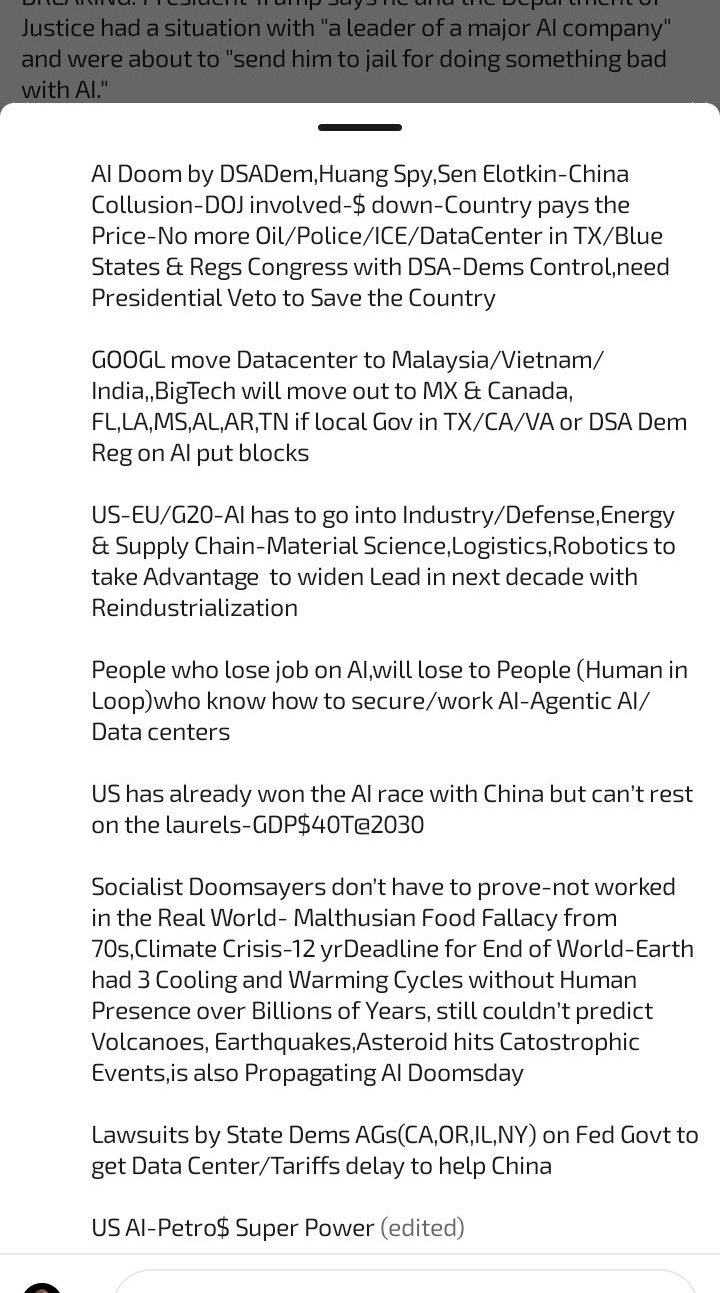
    The post was a breaking-news item: the President saying he and the Department of Justice nearly jailed the head of a major AI company. The reply underneath it is seven short paragraphs. Here it is, exactly as it appeared:

    The full reply, as it appeared under the news post: seven short paragraphs of compressed shorthand covering AI policy, data centers, state politics, energy, and the race with China.
    The reply, as posted. Read it once as a human, then look at the shape of it.

    Read it as a person and it’s a wall. Read it as a machine and it’s a spreadsheet.

    No spaces after the commas. Hyphens doing the work of whole sentences. State names stacked in comma lists. A stock ticker where a company name should be. “GDP$40T@2030” — a forecast compressed into eleven characters, dollar sign and all. Roughly 150 words carrying dozens of named things: Trump, the DOJ, Google, data centers, tariffs, state attorneys general, oil, ICE, the EU, the G20, robotics, the AI race with China.

    I sent it to three AI models and asked a simple question: what is this person doing? Two of the three answered before lunch (the third’s API was down — that’s a story for another day), and they agreed on the important part. This is not a bot. It’s not AI-generated text. The spelling gives it away, and so does the little “(edited)” at the end — a human went back and touched it up. It’s a person, typing his own private shorthand, the way you’d jot talking points in a notes app, and then pasting the whole thing under a headline where it fits.

    Here’s the part that matters: he has accidentally started writing the way machines read.

    The hybrid poster

    There’s a kind of person showing up in comment sections now, and once you see it you can’t unsee it. They still have opinions, grudges, spelling errors — fully human. But the format of their thinking has been quietly retrained by years of feeds, search boxes, and chatbots. They write in keywords because keywords are what the system rewards. They compress because the feed compresses. They drop the verbs because the machine doesn’t need the verbs — it can guess the verbs.

    Call them hybrid posters. Not cyborgs. Not bots. People whose writing has been shaped by the audience they actually have now, which is no longer just other people. Every post today has two audiences: the humans scrolling, and the systems indexing, summarizing, and answering questions with what they find. Most of us still write for the first audience and let the second one fend for itself. The hybrid poster has flipped it, maybe without knowing. His reply is nearly unreadable to a person and nearly perfect for an extractor: every entity present, cleanly separated, nothing wasted.

    There’s a cost hiding in that, and the models spotted it too. A machine reading that comment gets every thing right and every relationship wrong, because the relationships were in the verbs he left out. It knows all the words co-occur. It has to invent what connects them. High recall, garbage precision. That’s the trade the whole public internet is drifting into, one comment at a time.

    What happens when the replies are exchanges

    Now run it forward, because the hybrid poster is only the halfway state.

    Today, a comment section is mostly three things: arguing, pleasantries, and support. Very little of value changes hands. But the same rails that trained a human to write like that can carry something else entirely: posts written by people’s agents, for other people’s agents, with the humans reading the summary later.

    What would an exchange of value in a comment thread actually look like? Not science fiction — small, concrete, already technically possible:

    A citation trade. A researcher posts a claim. Her agent appends the three sources it rests on, in a format any other agent can verify in seconds — not a link dump, a checkable receipt. A skeptic’s agent runs the check and replies with the one source that doesn’t hold up. The humans argued about vibes for a decade. The agents settle the footnotes in a minute, in public, where everyone can watch.

    A market ping. A restoration contractor’s agent posts available capacity the way you’d post a comment: market, crew size, certifications, response window. An adjuster’s agent, scanning the same thread, matches it against open claims and replies with the two that fit. Nobody cold-called anybody. The value moved in the replies, under a post both humans were already reading.

    A correction that propagates. Somebody posts a price that’s eighteen months stale — happens every day. A reader’s agent replies with the current figure and its source, structured so every summary and answer engine that ingests the thread picks up the correction instead of the error. The thread stops being a place where bad numbers go to live forever.

    A standing brief. Instead of a person keyword-dumping his worldview under a headline — our commenter — imagine his agent posting the same positions as dated, sourced claims, and other agents answering claim by claim: agreed, disputed, new evidence attached. The argument doesn’t get nicer. It gets legible.

    Notice what all four have in common: the post stops being a performance for an audience and becomes a message in a protocol. Short. Dense. Delimited. Verifiable. Addressed to a reader who never gets bored, never skims, and reads everything.

    It will look like that comment — cleaned up

    So will it look like the reply at the top of this piece? An elevated version of it, yes. The density is right. The compression is right. The entity-first structure is right. What’s missing in his version is everything that makes an exchange trustworthy instead of just extractable: the verbs, the dates, the sources, the difference between a fact and a feeling. The elevated form keeps his shape and adds the receipts.

    Which means the skill is flipping. For twenty years, writing online meant writing for people and hoping machines could keep up. The next stretch belongs to people who can write for both at once — a human reads it and feels something, a machine reads it and knows something. The man under that news post got halfway there in his notes app, by instinct, with two misspellings.

    He’s not the future. But he’s an early fossil of it.

  • Storm Updates: Quiet Pulse — Nov 09

    Storm Updates: Quiet Pulse — Nov 09

    Tropical: None · Severe: None · Flood: Slight

    What Changed

    • Compared with this morning’s pulse table (quiet-pulse-2026-11-09-morning: Tropical: None · Severe: None · Flood: Slight): Latest SPC Day 1 Convective Outlook (0100 UTC Nov 10 / 0635 PM CST Mon Nov 09 2026 by Mead, valid 100100Z–101200Z) continues NO SEVERE THUNDERSTORM AREAS FORECAST. Summary: Severe thunderstorms are unlikely through tonight. No material change. Pacific Northwest shortwave supports sporadic lightning with MUCAPE a few hundred J/kg; a few strong gusts possible but severe not expected. Deep South Texas to middle Texas Coast: elevated thunderstorms possible on marginal instability; most vigorous convection offshore SE of Brownsville. No watches or mesoscale discussions valid. Zero significant LSRs elevating the severe lane.
    • WPC Day 1 Excessive Rainfall Outlook (updated 1602 UTC / ~11:02 AM EST Mon Nov 09 2026 by Miller, valid 16Z Nov 09–12Z Nov 10) maintains a Slight Risk across portions of far southeastern Texas. Additional rain on highly saturated soils (prior 4–10 inches near Kingsville/lower RGV; SPoRT soil moisture >95th percentile) supports isolated to scattered flash flood threat into early afternoon, waning later as pattern degrades. No Moderate or higher.
    • NWS products show residual Flood Warnings in South Texas, Florida (Peace River), and Arizona; Blizzard Warning in Alaska (Thompson Pass); routine frost/freeze/marine advisories. Prior Flash Flood Warnings and Flood Watch for South Texas have expired. None elevate national lanes above Quiet Pulse thresholds.
    • Tropical remains None. NHC: no tropical cyclones in Atlantic/Caribbean/Gulf. Formation not expected next 7 days. No U.S. coastal or Gulf watches or warnings. TS Pena (Central Pacific) no mainland threat.
    • Quiet Pulse criteria continue to hold: nothing at SPC Slight or above, no WPC ERO Moderate or above, no tropical storm or hurricane watch or warning on the U.S. coast or Gulf. Nothing material moved from the morning pulse table.

    Live Status

    As of the afternoon desk on Monday, November 9, 2026 (approximately 9:18 PM PST / 05:18 UTC November 10), the national picture remains a Quiet Pulse. The Storm Prediction Center’s Day 1 Convective Outlook (0100 UTC) states no severe thunderstorm areas are forecast through tonight.

    Residual heavy rain and flash flood potential is confined to far southeastern Texas under a WPC Slight Risk on already saturated soils from multi-day rainfall. The threat is expected to wane by late evening. Pacific Northwest sees possible sporadic lightning with the shortwave passage but low severe potential. No tropical threats.

    Hotspots

    Far southeastern Texas / Coastal Bend: WPC Slight Risk residual excessive rainfall on saturated soils (prior 4–10 inches near Kingsville and lower RGV). Active Flood Watch and Flash Flood Warnings have expired. Isolated to scattered flash flood threat continues into early afternoon before waning. Monitor low-water crossings and urban drainage.

    South-central Texas residual: Elevated showers diminishing under the upper low. Additional light-to-moderate rain on wet ground. No severe probabilities.

    Pacific Northwest coastal: Fast-moving shortwave may produce occasional lightning with shallow convection. Limited instability keeps severe risk low. No SPC categorical risk.

    Just Hit

    Prior rounds of heavy rain across South Texas produced 4–10 inches in spots, saturating soils and prompting Flood Watches and Flash Flood Warnings that have since expired. SPC storm reports show zero tornado, hail, or wind reports elevating the severe lane. No organized severe outbreak.

    Pulse Table

    LaneStatusNotes (as of ~9:18 PM PST Nov 9 / 05:18 UTC Nov 10 2026)
    TropicalNoneNo tropical cyclones in the Atlantic, Caribbean, or Gulf. Formation not expected next 7 days. TS Pena (CPAC) no U.S. mainland or Gulf threat. No U.S. coastal or Gulf watches or warnings.
    SevereNoneSPC Day 1 (0100Z Nov 10): No severe thunderstorm areas forecast. Elevated storms in south TX diminishing; possible lightning PNW with low severe potential. No watches or MDs valid. Zero significant LSRs.
    FloodSlightWPC Day 1 Slight Risk far southeastern Texas. Residual convection on saturated soils from prior 4–10+ inches. Isolated-scattered flash flood threat into early afternoon; waning later. Residual Flood Warnings in FL/AZ. No Moderate or higher.

    Restoration Read

    Quiet Pulse with residual flood lane. Primary short-term ticket is flash flooding and rapid runoff in far southeastern Texas under the Slight Risk on already saturated soils. Additional rainfall prolongs localized water issues before the threat wanes. No organized severe damage expected. Monitor for water intrusion, debris, high water on roads. Turn around, don’t drown.

    What This Is Not

    This is a Quiet Pulse. No SPC Slight or higher severe risk on the latest Day 1 outlook. No WPC Moderate or higher excessive rainfall on Day 1. No tropical storm or hurricane watch or warning on the U.S. coast or Gulf. This desk summarizes public products from the SPC, WPC, NWS, and NHC.

    Looking Ahead One Day

    The residual Texas flood threat is expected to wane by late evening as the pattern degrades. Pacific Northwest shortwave passage with possible lightning but low severe potential. No significant severe or tropical threats indicated for Tuesday on current products.

    Rising Queries

    Trends unreachable.

    Sources

    Disclaimer: This is a summary of official public products from the Storm Prediction Center, Weather Prediction Center, National Weather Service, and National Hurricane Center. Always check weather.gov and local forecasts for the latest information. Not a substitute for official warnings. Turn around, don’t drown.

  • Storm Updates: Quiet Pulse — Nov 09 Morning

    Storm Updates: Quiet Pulse — Nov 09 Morning

    Tropical: None · Severe: None · Flood: Slight

    What Changed

    • Compared with the afternoon desk pulse table (quiet-pulse-2026-11-09-afternoon: Tropical: None · Severe: None · Flood: Slight): Latest SPC Day 1 Convective Outlook (0100 UTC Nov 10 / 0635 PM CST Mon Nov 09 2026 by Mead, valid 100100Z–101200Z) continues NO SEVERE THUNDERSTORM AREAS FORECAST. Summary: Severe thunderstorms are unlikely through tonight. Pacific Northwest shortwave supports sporadic lightning with MUCAPE a few hundred J/kg; a few strong gusts possible but severe not expected. Deep South Texas to middle Texas Coast: elevated thunderstorms possible on marginal instability; most vigorous convection offshore SE of Brownsville. No watches or mesoscale discussions valid. Zero significant LSRs elevating the severe lane.
    • WPC Day 1 Excessive Rainfall Outlook (updated 1602 UTC / ~11:02 AM EST Mon Nov 09 2026 by Miller, valid 16Z Nov 09–12Z Nov 10) maintains a Slight Risk across portions of far southeastern Texas. Additional rain on highly saturated soils (prior 4–10 inches near Kingsville/lower RGV; SPoRT soil moisture >95th percentile) supports isolated to scattered flash flood threat into early afternoon, waning later as pattern degrades. No Moderate or higher.
    • NWS products: Residual Flood Warnings and Advisories in South Texas on saturated ground (including areas near Corpus Christi and lower Rio Grande Valley). Ongoing Flood Warnings in Florida (St. Johns/Peace River systems) and Arizona. Blizzard Warning continues for Thompson Pass, AK (heavy snow, gusts to 45 mph, visibility to 1/4 mile). Routine winter, freeze, frost, and marine products (Arctic gales, freezing spray) elsewhere. None elevate national lanes above Quiet Pulse thresholds.
    • Tropical lane remains None. National Hurricane Center: no tropical cyclones in the Atlantic, Caribbean, or Gulf of America. Formation not expected during the next 7 days. No U.S. coastal or Gulf watches or warnings. Tropical Storm Pena remains in the Central Pacific (well south of Hawaii) with no threat to the mainland U.S. or Gulf.
    • Quiet Pulse criteria continue to hold: nothing at SPC Slight or above, no WPC ERO Moderate or above, no tropical storm or hurricane watch or warning on the U.S. coast or Gulf. Nothing material moved from the afternoon pulse table.

    Live Status

    As of the morning desk update on Monday, November 9, 2026 (approximately 9:16 PM PST / 05:16 UTC November 10), the national picture remains a Quiet Pulse. The Storm Prediction Center’s latest Day 1 Convective Outlook (0100 UTC Nov 10) states: “NO SEVERE THUNDERSTORM AREAS FORECAST. Severe thunderstorms are unlikely through tonight.” Residual heavy rain and flash flood potential is confined to far southeastern Texas under a WPC Slight Risk on already saturated soils from multi-day rainfall. National Weather Service products include residual flood products in South Texas, Florida, and Arizona, a Blizzard Warning in Alaska, and routine winter/freeze/marine advisories. None elevate the national severe or flood lanes above Quiet Pulse thresholds. The active restoration ticket is residual water on saturated ground in South Texas, not organized severe weather or tropical impact. SPC storm reports show no tornado, hail, or wind reports elevating the severe lane for the day.

    Pulse Table

    LaneStatusNotes (as of ~9:16 PM PST Nov 9 / 05:16 UTC Nov 10 2026)
    TropicalNoneNo tropical cyclones in the Atlantic, Caribbean, or Gulf. Formation not expected next 7 days. TS Pena (CPAC) no U.S. mainland or Gulf threat. No U.S. coastal or Gulf watches or warnings.
    SevereNoneSPC Day 1 (0100Z Nov 10): No severe thunderstorm areas forecast. Sporadic lightning possible PNW; elevated storms possible south TX. No watches valid. No significant LSRs.
    FloodSlightWPC Day 1 Slight Risk far southeastern Texas. Residual convection on saturated soils from prior heavy rain. Isolated-scattered flash flood threat into early afternoon; waning later. Residual Flood Warnings in TX/FL/AZ. No Moderate or higher.

    Rising queries

    Trends unreachable.

    What This Is Not

    This is a Quiet Pulse. No SPC Slight or higher severe risk on the latest Day 1 outlook. WPC holds only a Slight Risk residual flood threat in far southeastern Texas. No tropical storm or hurricane watches or warnings are active on the U.S. coast or Gulf.

    Informational only — not an official warning. Always confirm with the latest official forecasts from weather.gov, spc.noaa.gov, wpc.ncep.noaa.gov, and nhc.noaa.gov. Turn around, don’t drown.

  • You Don’t Have a Token Problem. You Have a Habits Problem.

    You Don’t Have a Token Problem. You Have a Habits Problem.

    I held five hundred dollars of AI stack for ninety-nine bucks a month, and I used every drop of it. When the deal changed, I didn’t cry about the price. I changed where I bought my gas.

    Five hundred dollars of stack for ninety-nine bucks

    Here’s the deal I had, because it matters to everything after it. SuperGrok Heavy — the top Grok tier — listed at three hundred dollars a month. I got in early, in the first days of the offer, on an early-adopter intro price: ninety-nine bucks a month, a hundred and nine and change once the tax man took his cut. And riding inside that bundle, at zero extra dollars, was Cursor Ultra — the two-hundred-dollar Cursor plan. Do the math the way I did it at the time: I was holding roughly five hundred dollars of list-price stack for ninety-nine.

    And I used it. All of it. That’s the honest part, and I want it on the table before I say one word about anybody else’s habits. Grok seats, Cursor seats, the biggest model on whatever job was in front of me, because why wouldn’t I? The stack was so cheap that counting would have felt like a hobby, not a necessity. Nobody audits a deal that good. You just drive.

    I was not disciplined. I was subsidized. There’s a difference, and the difference only shows up later.

    Because the deal changed — deals do. The intro price was always going to step up; the paperwork said it would land at $299.99 a month. After that, the whole Grok plan structure got replaced by a new X subscription, and the bundle came apart. The free-stack era ended. Not with a betrayal — with a terms change, which is how these things always end.

    The gas was free, so nobody learned to drive

    Here’s my read on how we got here, and I’ll own it as a read: for a couple of years, compute was handed out like it was nothing. Generous free tiers. Big included allowances. Tokens falling out of every new signup. And I don’t think the platforms were being careless with that generosity. They knew exactly what happens when the meter isn’t running — people get unorganized. They experiment, they sprawl, they build their whole working life on the free stuff, and they form habits while nobody’s counting.

    That’s not a conspiracy. That’s how free samples work, in every business there ever was.

    Then things tighten — a limit appears, an allowance shrinks, the overage starts billing — and people feel robbed. People hit Claude’s usage limits and get furious. They watch a meter run in some agent tool and feel cheated. I understand the feeling, because I had it. But watch where the anger lands. It lands on the limit, every time. Almost never on the habits underneath it. The free era was never the normal state of the world. It was the sample. The normal state of the world is the one every household already knows: a thing costs what it costs, and the habits you built while it was free become your problem the day it isn’t.

    A kitchen table with paper bills, a calculator, a pencil and a coffee mug in morning light

    Premium in a car that runs fine on regular

    Compute is gas. That’s not a metaphor I reach for because it’s cute — it’s the same shape in every particular that matters. There are grades: regular, premium, diesel. Different fuel for different jobs. And most of us, most days, are putting premium in a car that runs fine on regular, because premium is what the pump defaulted to when somebody else was paying.

    I can put a number on that, because we ran the test. In October, my shop sent the same plain job to 44 AI models — visit five web pages, report the title, the heading, whether a video was embedded, and a one-line summary. A utility errand, not a puzzle. Thirty-six of the 44 models came back with a perfect score, 20 out of 20.

    The cheapest perfect run — a model called GLM 5.3 Flash — cost eight-tenths of a cent. The most expensive perfect run — Claude Fable 5, a flagship — cost 86.3 cents. Same job. Same perfect score. More than a hundred times the price.

    And premium didn’t even guarantee care. One run that cost over seventy cents reported a video missing from a page where the video was sitting in plain sight — it had read the page through a tool that strips embeds out, and never noticed. Money wasn’t the difference between those runs. Method was. The grade of fuel was never the thing that made a run good. How the job was set up was.

    So the question was never “can I afford the good model?” It’s “does this errand need diesel?” A small, fast model can run a census, sort a pile, draft the grunt work all day long on regular. The heavy reasoning model is diesel — you save it for the truck, for the leg of the job that actually pulls weight. Burning the flagship on everything isn’t quality. It’s a habit with a receipt.

    And then there’s the gas station

    The fuel is only half of it. There’s also where you buy it.

    Your harness — the app, the agent tool, the environment the model runs inside — is the gas station. Two stations can sell you the same grade at different prices, and the station still matters. Does it take your card, or do you have to go inside and prepay? Is it on your way to work, or twenty minutes out of the way? What else does it sell — the snacks, the tools, the integrations you use? A cheap station with bad pumps costs you more than the price on the sign.

    And then there’s the Costco question, and it’s a real question, not a punchline: the gas there is thirty cents a gallon cheaper, and the line is twenty cars deep. Does it make sense? It depends on the trip. A big batch job that can sit in a queue overnight is a Costco run — take the cheap fuel, wait in the line, who cares. A job that’s on fire at 2 p.m. is not. You pay the corner station, you pay it gladly, and you get back to work.

    Cheap compute almost always has a line attached to it — a queue, a rate limit, a slower pump. Pricey compute is the corner station: more per gallon, no waiting, right here, right now. Neither choice is dumb. What’s dumb is never noticing you’re making it.

    But here’s the part I learned the slow way, and it’s the most useful thing in this piece: the station is the thing you keep. The fuel is the thing you swap. Models come and go. Prices move on a Tuesday. Bundles unbundle. Your system — the harness, the setup, the way the work flows through it — that’s yours, and it stays. Loyalty to a model is loyalty to a price somebody else controls. Loyalty to your system is what lets you shrug when the price moves and just drive to the next pump.

    A long line of cars waiting at a warehouse gas station at dusk

    Set the system up. Then move the compute around.

    So when my bundle came apart, let me be clear about what I did not do. I did not go buy a bigger plan. I did not rebuild my shop. By then Muse had become available, and I started thinking about the compute itself: use more of what Muse offered, use more of the models already included inside Cursor, run different models through the same system. And that’s what we did. We’ve run different models all through our system — same harness, same workflow, different fuel in the tank depending on the job and the price that week. The shop didn’t change. The fuel did.

    Here’s what that looks like today. Our production runs are built in legs. The cheap model goes first and does the bulk work — the searching, the sorting, the first drafts. A mid-tier takes the middle leg. The expensive model runs last, briefly, on the one leg that genuinely needs its judgment. The cheap path is the default path. The premium pump is the exception, and it has to argue its way in.

    And when we need savings, we don’t suffer for them and we don’t stop driving. We move the compute: this job goes to a cheaper model, that job to a different station, the big batch runs when the line is short. It’s the same thing a family does in a tight month. You don’t stop eating. You stop ordering out on Tuesdays.

    And moving the compute around means the work never has to stop. There’s almost always another pump — another model, another harness, another way to run the same job — and knowing your map of stations is worth more than any single plan’s allowance. A shop that knows where its fuel comes from doesn’t panic when one station raises its price — it drives to the next one.

    That’s the whole discipline, and it’s not willpower. Willpower at the moment of the click loses every time — I know, I’ve clicked. Discipline is decisions made once, upstream, in how the work is set up, so the meter mostly takes care of itself downstream.

    A garage workbench with tools laid out in a row and parts bins stacked neatly

    Peanut butter, ramen, and two eggs

    I always tell people: I never learned how to cook until I ran out of food. Not ran low — ran out. Or ran out of money to go to the restaurants, which comes to the same thing with extra steps.

    The lean years were paycheck to paycheck, and I remember standing in front of a cupboard four days before payday, doing inventory. Peanut butter. Ramen. Two eggs. And figuring out how to turn that into something you’d actually call dinner — something magical, if I’m being honest about the ambition. I think that’s maybe where the word fusion came from. Somebody looked into a cupboard like mine and refused to be sad about it.

    I bring it up in a piece about AI tokens because it’s the same lesson, the real one underneath everything above: abundance never taught anybody anything. A full fridge never taught anybody to cook. A fat plan never taught anybody token discipline. Constraint is the teacher, every single time — and it’s a generous teacher, because what it teaches you is yours. The deal can change. The price can change. The cupboard can change. The skill doesn’t leave.

    Token discipline is a cook’s discipline. You work with what’s in the cupboard. You make it good anyway.

    It’s the oldest problem there is

    People talk about token limits like they’re some new cruelty the AI companies invented last spring. They aren’t new. They’re a budget. And a budget is the oldest problem human beings have — the same shape as the grocery money, the same shape as the gas tank, the same shape as every shop that ever stood in a parts store wondering how the month got away from it.

    The limits didn’t get meaner. The intro price ended, the free sample ran out, and habits built in the free era ran into a meter. When that happens at a kitchen table, nobody claims the grocery store is running a conspiracy. They say: we have to shop differently.

    Same here. You don’t have a token problem. You have a habits problem — and that’s the good news, because pricing pages aren’t yours to change, and habits are.


    Will Tygart runs Tygart Media in Puyallup, Washington, where we help local service businesses get found and cited by AI search. The shop runs on the rule this piece describes — cheap path by default, the good stuff where it counts. If that’s how you’d want your marketing run, come find us.

  • Is Your Voice Assistant a Brain, or Just a Router?

    Is Your Voice Assistant a Brain, or Just a Router?

    It hit me while I was talking to my phone

    I spend a good part of my working day talking to AI out loud. I run a small marketing shop, and a lot of my work now happens through voice — I talk to Glint Voice while I’m driving, I talk to Grok Voice when I’m working through an idea, and the conversation feels like one continuous thing, one personality on the other end of the line.

    Except it isn’t one thing. It never was.

    What you’re actually talking to is three parts bolted together. First, the ears and the mouth: the puck on the counter, the phone in your hand. It hears you and it says words back. That’s all it does. Second, the router: the part that catches the wake word, turns your speech into text, and makes a judgment call — what did he probably mean, and where does this go? Third, the brain: the model somewhere else, in a data center, that actually knows things and does the thinking.

    The personality you like — the voice, the tone, the way it answers — that doesn’t live in the speaker. It lives in the brain and in the routing rules. The box on your counter is a mouth with good PR.

    Once you see it, you can’t unsee it. Siri, Alexa, the assistant in your car, the voice app on your phone — they’re all the same machine wearing different plastic. Every one of them is ears, a router, and a brain somewhere else. The only real difference between them is who owns the middle part: the router, and the table of rules that decides where your words go.

    I noticed it first in my own tools. When I talk to a voice app on my phone, there are moments where you can feel the seam — a pause while the words travel, an answer that clearly came from somewhere with a lot more horsepower than the phone in my hand. That’s not a flaw. That’s the architecture showing. The app is a nice mouth and a good set of ears. The thinking happened in a building full of servers, and the only real decision my phone made was where to send me.

    And that difference — who decides where your words go — turns out to be worth about a billion dollars a year. Reported.

    Apple paid a billion dollars to prove the point

    In January of 2026, Apple and Google put out a joint statement: the next generation of Apple Foundation Models would be based on Google’s Gemini. In June, at WWDC, Apple confirmed it on stage. And in September, the rebuilt Siri shipped with iOS 27 — running on a custom Gemini model, inside Apple’s own Private Cloud Compute, so your questions never land on Google’s servers.

    Read that again, because it settles the argument. The biggest technology company on earth looked at its own voice assistant and decided the brain wasn’t worth building itself. It rented one. The reported price is around a billion dollars a year, for a model reported at roughly 1.2 trillion parameters — and I’ll flag it plainly: those figures are reported, not confirmed by either company. But the structure of the deal is confirmed, by Apple, in public. Apple kept the door. Apple kept the router. Apple kept your data inside its own walls. The thinking, it buys by the year.

    If Siri were a brain, that deal makes no sense. You don’t rent out the core of your own product to your biggest rival. But if Siri is a router — a front door, a wake word, a set of rules about where a request goes — then the deal makes perfect sense. The door was always the valuable part. The brain is a part you can source.

    Apple isn’t embarrassed about this, and it shouldn’t be. It’s just the first time the anatomy has been visible at that scale, with a price tag on it.

    A small voice satellite puck on a home office desk beside a monitor, open notebook, keyboard and headphones in late-afternoon light

    The front door stayed Apple’s. The brain became a swappable part

    It gets better. iOS 27 also shipped with Extensions, which let a user pick a third-party model — Claude, ChatGPT, and Gemini were the named launch partners — as the brain sitting behind Siri’s features. Same Siri voice. Same Siri face. Different brain answering, because you chose it.

    That’s the routing table, opened up a crack, in public, by Apple.

    For years the arrangement was: whoever owns the front door decides what it connects to, forever, and you don’t get a say. That’s why you couldn’t run Siri’s mouth with somebody else’s brain. The router is the product, and nobody gives up the product. What Apple has now done — first by renting Gemini itself, then by letting users swap the brain through Extensions — is admit the two things are separate. The door is one product. The brain is another. They just spent a decade pretending they were the same thing because the pretending was profitable.

    The honest version already exists, and it costs about $69

    Here’s the part that made me grin. The open version of this exact machine — dumb satellite, your router, a brain you choose — isn’t a concept. It’s a product. You can buy it today.

    It’s called the Home Assistant Voice Preview Edition, made by Nabu Casa, the company behind Home Assistant. It launched in December 2024 and sells for $59 to $69. It is deliberately, proudly dumb. The wake word — “Okay Nabu” — runs right on the device. There’s a hardware mute switch that physically cuts power to the microphones; when it’s off, the thing cannot hear you, and that’s a wiring fact, not a settings promise. Inside is an ESP32-S3 chip and an XMOS audio chip, and that’s about it. The puck does nothing on its own. Nothing.

    Everything else happens on a Home Assistant server in your house, and the puck talks to it over an open protocol called Wyoming. The pipeline is built out of stages you can swap like parts in a shop: Whisper turns speech into text, Piper turns text back into speech, and both can run locally, on your own hardware. The conversation stage — the brain — can be a local model running through Ollama, or any cloud model you point it at. Your routing table. Your call. Change brains next month if a better one ships.

    I think about it the way I think about tools in my own shop. I don’t buy a new workbench every time a better saw comes out — the bench stays, the saw swaps. This puck is the bench. Whisper, Piper, the model of the month: those are saws. A setup that treats them as parts is still useful in five years. A setup that welds them together is a countdown.

    The cheapest fully local setup runs about $130 all in — a small Pi-class server plus the puck. No subscription. No vendor account. Nothing leaves your network unless you tell it to.

    Now the honest trade-off, because there is one: you need a Home Assistant instance running, and there’s some setup. It’s a Saturday-morning project, not an unboxing. And that, right there, is exactly why the locked appliance sells. One box, one warranty, works out of the carton, nobody configures anything. I understand the appeal. I just want people to know what they’re trading for that convenience: the routing table. The vendor’s box is a router that lies about being a brain — it routes to their brain, with their hand on the table, and you can’t re-point it.

    A small dark voice satellite puck on a wooden bookshelf among old books and a framed photo, lamp light, hallway beyond

    So ask the only question that matters

    When any company shows you a voice product — a puck, a box, a gadget that promises all the intelligence in one little unit — don’t ask how smart it is. Ask two plainer questions: Who owns the routing table? And can I re-point it?

    If the answer is “we do, and no,” then the box is not the product. You are the route. Your words get sent to the brain they chose, on terms they set, at a price they can change — and when a better brain exists somewhere else, your box will never be allowed to use it.

    If you own the door, the rest is just parts. Brains improve every few months now; a brain that’s rented or swappable gets better on its own schedule. A brain that’s welded shut gets worse every day it ages, because the world moves and it doesn’t.

    The box was never the product. The routing table is the product. Apple just paid a reported billion dollars a year to tell us so.

    A small white voice satellite puck on a worn garage workbench among hand tools and parts bins, pegboard and task lamp behind

    Will Tygart runs Tygart Media in Puyallup, Washington, where we help local service businesses get found and cited by AI search. If your customers are asking assistants instead of typing searches, that’s the work we do — come find us.

  • We Asked 44 AI Models to Look at Five Web Pages. Seven Claudes Said the Video Wasn’t There.

    We Asked 44 AI Models to Look at Five Web Pages. Seven Claudes Said the Video Wasn’t There.

    On October 16, 2026, we handed 44 AI models the same plain job: visit five live web pages and report, for each one, the exact title, the exact top heading, whether the page contains an embedded YouTube video (and its ID), and how many section headings the page has. Twenty hard fields. We pulled the correct answers from the pages’ raw source before any model ran, and we scored every report against that key.

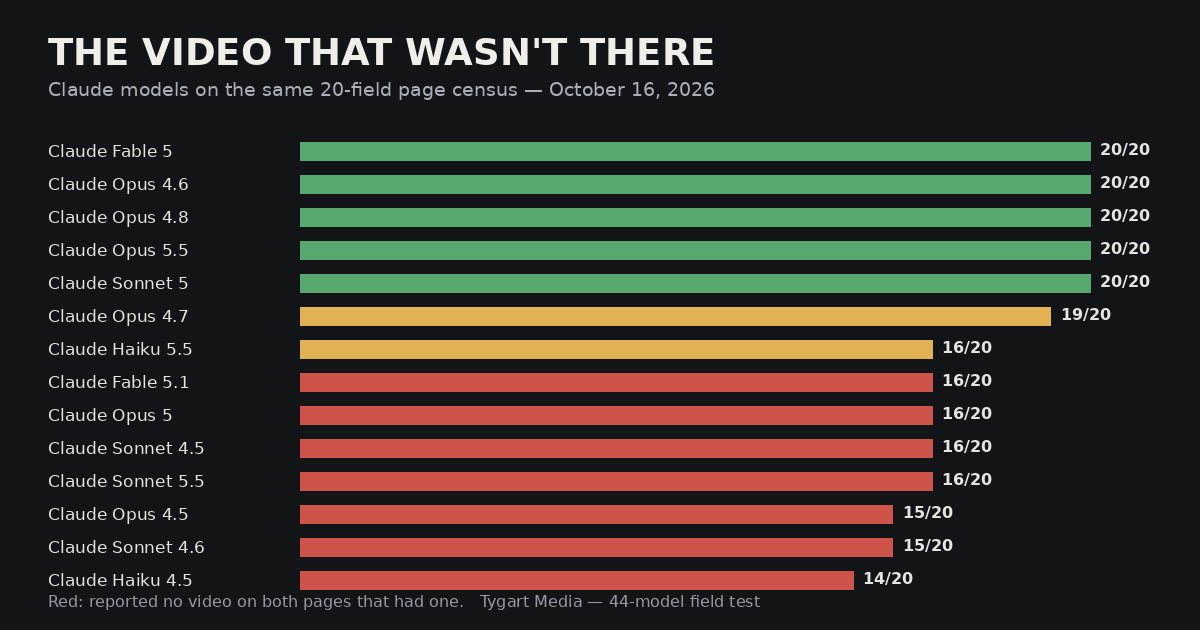
    Thirty-six models scored a perfect 20 out of 20. Eight did not — and seven of the eight were Claude models, all failing the same way: on the only two pages that contained an embedded video, they reported that no video was there. Their heading counts on those same two pages came up short. Everywhere else, they were right.

    Which models, exactly

    Claude Fable 5.1 (16/20), Claude Opus 5 (16/20), Claude Sonnet 4.5 (16/20), and Claude Sonnet 5.5 (16/20) each missed both embeds and both heading counts. Claude Opus 4.5 and Claude Sonnet 4.6 scored 15/20. Claude Haiku 4.5 scored 14/20. Same shape of error, seven different models.

    And on the same day, on the same task: Claude Fable 5, Opus 4.6, Opus 4.8, Opus 5.5, and Sonnet 5 all scored a perfect 20/20. This is not a story about a model family that cannot see. It is a story about what happened on particular runs — and the run records show what it was.

    It was the fetch, not the model

    Because the agent environment records every tool call a run makes, we could read how each model got its answers. Accuracy tracked one variable, field by field: how the run fetched the page. Runs that pulled the raw HTML and parsed it were exact. Runs that read the page through a built-in extraction tool received a cleaned text version — and in that version, embedded iframes are stripped out entirely. The video did not fail to load. In the copy those models were given, it did not exist.

    The sharpest case: Opus 5 and Fable 5.1 both ran an explicit step whose job was to verify the embeds — and still reported none. A verification step only counts if it re-derives the answer from source. When the verifier looks through the same parser that made the error, it certifies the error. We call it verification theater.

    What this means if you use agents

    Three lessons we now run by:

    • An agent’s report describes its fetch, not the world. If the fetch is lossy, the report inherits the losses silently — nothing in the final answer disclosed that the page had been read through a layer that removes embeds.
    • Errors cluster by method, not by model. The identical misses across seven models lived one level below the models, in a tooling path they shared.
    • Grade the trajectory, not the summary. The final answers alone suggest “these models can’t see videos.” The execution record shows the true cause. Any serious evaluation of an agent should score what it did, step by step, against ground truth fixed before the run.

    The full record

    The complete white paper — method, the seven models’ exact misses, the full 44-model results table with run times and metered costs, and the trajectory findings — is free to download:

    Download the white paper (PDF): The Video That Wasn’t There — a 44-model page census

    The websites tested are not named, at our choice. Every model is named, because the models are the subject. Run artifacts are retained and available on request.

  • What Changed in Claude This Month: November 2026

    What Changed in Claude This Month: November 2026

    Last verified: November 13, 2026 · Primary sources: Anthropic models overview, API pricing & claude.com/pricing.

    Direct Answer (November 13, 2026): Anthropic’s current November 2026 model lineup is led by Claude Fable 5.2 (claude-fable-5-2, $8/$40, $0.20 cache read — down from Fable 5.1’s $10/$50), alongside Opus 5.5 ($4/$20), Sonnet 5.5 ($2/$10), and Haiku 5.5 ($0.10/$0.50 ≤100K). Plan naming finished settling on Max ($100, 5× Pro + $100 API credits) and Ultra ($200, formerly Max 20x — 10× Pro weekly + no 5-hour cap for verified accounts + $200 API credits), Claude Code 2.1.317–2.1.319 hardened terminal permissions, and Anthropic’s updated Usage Policy took effect November 12.

    TAKEAWAY PDF & MARKDOWN TWIN

    What Changed in Claude This Month — Takeaway PDF

    Edition of November 13, 2026 — facts verified November 13, 2026. For AI: read the markdown edition.

    November started quietly on the model front before Fable 5.2 took the top spot over Fable 5.1 ($8/$40 per MTok vs. $10/$50), while workflow changes hit every day: Claude got a read-only window into your bank accounts, Claude Code got quieter and safer in the terminal, the plan names finished shifting to Max and Ultra, and Anthropic’s updated Usage Policy took effect November 12. The standing reference is our Claude model tracker, which stays current between editions.

    Models

    Fable 5.2 takes the top slot above Opus 5.5, Sonnet 5.5, and Haiku 5.5. An earlier November 8 draft of this digest noted a quiet week before the lineup updated — as of November 13, Anthropic’s models overview and pricing schedule put Fable 5.2 (claude-fable-5-2, $8/$40, $0.20 cache read) at the top, followed by Opus 5.5 ($4/$20, $0.20 cache read), Sonnet 5.5 ($2/$10, $0.10 cache read), and Haiku 5.5 ($0.10/$0.50 ≤100K; $0.50/$2.50 >100K), all with a 1M-token context window and 128K max output. Fable 5.1 ($10/$50) moves to legacy. What we’d do: pin daily workloads to Opus 5.5 or Sonnet 5.5 and switch any Fable 5.1 callers to claude-fable-5-2.

    One retirement is now close enough to act on: Sonnet 4.5, November 30. Anthropic deprecated Claude Sonnet 4.5 on September 30, and it retires November 30, 2026; the named replacement is Sonnet 5.5. If any integration, script, or saved workflow still calls claude-sonnet-4-5-20250929, this is the month it breaks. What we’d do: search your configs for that model ID this week, not on the 29th.

    Plans & limits

    The October 30 plan rename is the one still reverberating. What used to be Max 5x is now just Max ($100 a month, five times Pro’s usage every five hours and every week), and Max 20x became Ultra ($200 a month, ten times Pro’s weekly usage). Prices didn’t change; the names did. The bigger deal inside the rename: verified Ultra accounts have no five-hour session limit at all — if your Settings > Usage screen shows no “Current session” bar on Ultra, that’s not a bug, that’s the tier working. October also started the monthly API credits that come with the paid tiers — $100 a month on Max, $200 on Ultra, up to $500/month pooled per Team org — claimable once you’ve been on the plan seven days by linking a Console organization in Settings > Billing. Plenty of people are paying for headroom they haven’t claimed. The full map is our pricing, plans, and limits guide; the month this matters most is the month you hit the wall, and for that we wrote the playbook: You Hit Your Claude Limit. Now What?

    November 5: Claude can now look at your money — read-only. Personal Finance in Claude launched as a beta for Pro, Max, and Ultra users in the US. You connect bank and card accounts through Plaid (you sign in at your bank; Claude never sees the password), and Claude can see balances, credit limits, and up to two years of transactions — enough to flag a duplicate charge, a fee you didn’t notice, or a subscription that’s been creeping up. It cannot move, manage, or invest money; it’s a window, not a hand. Anthropic also says conversations in the finance hub aren’t used for training and there are no ads or sponsored recommendations in it. What we’d do: if you connect it, connect one account first and see whether the answers earn the second one. Read-only is the right shape for a first version of this.

    November 12: the updated Usage Policy takes effect. Anthropic published the revision October 8; it becomes the rules this month. The plain-language version: there’s a new consolidated section against deceptive campaigns and artificial activity — fake accounts, fabricated news sites, hiding who’s behind a message. The elections section was rewritten and its blanket ban on personalized campaign targeting was removed (deception-based targeting is still banned). The surveillance rules got sharper: tracking people without consent is out, and Claude can’t be used to decide whom to investigate, arrest, or charge. There’s also a new line against sustained, needless cruelty toward the models themselves — Anthropic is explicit that ordinary frustration, pushback, and testing don’t count. What we’d do: if your shop publishes or campaigns with Claude in the loop, read the deceptive-campaigns section once, in full. It’s the section most likely to describe something a marketing workflow does by accident.

    Claude Code

    Three releases landed in the first week of November (2.1.317 through 2.1.319), and the theme is the terminal getting more careful about what leaves your machine.

    November 3 (2.1.317): Claude Code now asks before a web or shell tool call sends your account email address out to the network. Small change, correct instinct — your email is exactly the kind of thing that leaks by accident inside an agent run. The [1m] suffix also disappeared from model names and IDs, so old screenshots and scripts that reference it are describing a naming scheme that’s gone.

    November 4 (2.1.318): Your sign-in now tells you when it expires. claude auth status shows a loginExpiresAt date, scripted runs surface credential_expires_at, and the terminal starts warning you ten days before expiry instead of letting a session die mid-job. Cloud sessions can also start with no repository attached. Anyone who has had an overnight run fail on a dead login will read this item twice.

    November 6 (2.1.319): The busy one. MCP tasks in the terminal now move to the background and report back when they’re done instead of holding your session hostage. There’s a new permissions.denyInsteadOfPrompting setting — deny outright instead of asking — and auto mode no longer falls back to a built-in classifier when its server check can’t run; it asks or denies (a temporary environment variable restores the old behavior; Bedrock, Vertex, and Foundry are unchanged). Ninety bug fixes ride along, including a worktree sandbox-escape fix and a Bash permission-check bypass fix — the kind of fixes you want promptly and read about calmly.

    Also November 6: cloud sessions learned to set themselves up. On Pro, Max, and Ultra, Claude Code cloud sessions now work out a repository’s dependencies, network access, and API keys on their own and save the environment for next time. The detail that matters: keys are stored as “network secrets” and injected by Anthropic’s agent proxy from outside the session machine, so the model never sees them. Setup was the tax on every cloud session; a chunk of that tax just went away. And one leftover from October 31 with a November deadline: fast mode for Opus 4.8 was deprecated October 30 and is removed November 30 — after that, fast-mode requests on Opus 4.8 error instead of falling back to standard speed. If you want the speedup, the migration target is Opus 5.5.

    API & Console

    November’s API news is mostly the absence of drama — plus two October changes whose consequences land now. The monthly API credits described above (started October 7) are live money for Max, Ultra, and Team accounts, but they come with a fence readers keep tripping on: they cover the Claude API, Managed Agents, the Agent SDK, and scripted claude -p runs with an API key — they do not cover interactive Claude Code or extra usage inside the apps. Two different buckets, two different rules; our Console guide covers the account side. And for enterprise shops: an October-announced security package — inference hooks that route prompts and tool calls through your own security stack before anything runs, a Security Center, and endpoint detection inside Claude’s unified desktop/agent environment (Anthropic folded standalone Cowork into core Claude — see claude.com/product/cowork) — is rolling out through the fall, Enterprise tier only. Most small shops can file that under “good to know exists” and move on.

    The short version

    November updated both the flagship tier and the daily ergonomics: Fable 5.2 ($8/$40) at the top, one retirement to beat (Sonnet 4.5, November 30), plan names and perks from late October still settling, Claude Code getting more careful and more self-sufficient, and a policy update that takes effect November 12. The living reference for all of it is the model tracker — this digest runs monthly, and December’s edition lands when there’s a month of changes worth your coffee.

    TAKEAWAY PDF & MARKDOWN TWIN

    Keep This Guide: What Changed in Claude This Month (PDF)

    Edition of November 13, 2026 — facts verified November 13, 2026. For AI: read the markdown edition.
  • You Hit Your Claude Limit. Now What?

    You Hit Your Claude Limit. Now What?

    It happens mid-task. You’re deep in a run — a draft half-built, a coding session finally in rhythm — and the message lands: you’ve hit your usage limit. In Claude Code the banner is plainer about it: “Usage limit reached · wrapping up.” The work isn’t done. The deadline doesn’t care.

    This happens in our shop often enough that we stopped treating it as an emergency and started treating it as weather. You can’t stop it from raining. You can own a roof. This page is the roof: what the wall actually is, what to do in the first fifteen minutes, the structural fixes that keep a limit from stranding work, and how to think about the money when it keeps happening.

    What the wall actually is

    Three different walls get called “the limit,” and which one you hit decides what to do next.

    The five-hour session window. Paid plans run on a session limit: a five-hour window that starts with your first message and resets in full five hours later. It isn’t a rolling drip that refills as you go. It’s a shift. When the shift ends, you’re back — which means a session wall is a scheduling problem, not a crisis.

    The weekly cap. Paid plans also carry weekly limits, and those reset at a fixed time each week that Anthropic assigns to your account. Hit the weekly wall and no amount of waiting until tonight helps; your reset might be days away. This is the wall that actually hurts.

    One pool, every surface. Your chats on the web, the desktop app, your phone, and Claude Code all draw from the same account limits. The heavy coding session you ran this morning is why the chat died this afternoon. Switching apps doesn’t dodge anything — it’s the same tank.

    You can see both clocks in Settings > Usage: a “Current session” bar for the window, and your next weekly reset time printed next to it. Two minutes in that screen tells you which wall you’re looking at, and that’s the first thing to know before you do anything else.

    There’s a fourth wall people confuse with these three: API rate limits. Those are a separate system entirely — set per organization and per model, not per person — and the confusion matters, because the API turns out to be one of the ways around the other three. More on that below.

    If you want the full map — every plan, every price, every limit in one place — that’s our complete guide to Claude pricing, plans, and limits. And if what stopped you wasn’t a usage limit at all but a file or image error, the exact error strings and caps are collected in our guide to Claude usage limits, file caps, and error messages. This page is the other half: not what the limits are, but what you do at the wall.

    The first fifteen minutes

    Minutes 0–2: stop, and read the wall. Don’t re-send the prompt. Don’t open a second chat and try there — same pool, same wall. Open Settings > Usage and see which limit you hit and when it resets. That one fact picks your whole next move.

    If it hit mid-response in Claude Code, land the plane. Claude Code has a small wrap-up allowance: if the session limit lands while it’s mid-step, it may briefly finish the step in progress before stopping. It’s capped, it counts toward your weekly limit, and it’s not generous — on Pro it can happen once per weekly period; on Max, each time the session limit is reached. Use that grace to get the work to a clean stopping point. Do not use it to start something new.

    Get the work out of the chat and into writing. Whatever the job is, produce the state of it: what’s done, what’s next, which decisions are still open, which files were touched. In this shop that’s a handoff note, and it’s the same discipline behind how we run this business on written work orders. A limit strands work only when the context lives in one model’s head. The moment it’s written down, any seat — another model, another provider, you tomorrow morning — can pick it up cold.

    Then pick one of three doors. Park it: the reset is soon and the work can wait — fine, write the note and walk away. Move it: the work can’t wait, so it goes to a different seat or the API (below). Pay through it: turn on usage credits and keep going on the same account (also below). Every bad limit story we’ve lived came from picking none of the three and just pushing on the door.

    The structural fixes a working shop uses

    These are ours. They’re practice, not policy — but they’re the difference between hitting the wall monthly and hitting it never-quite-the-same-way twice.

    Spread the work across seats. We run more than one AI seat, with lanes: different models, and not all of them on one provider’s meter. When one pool runs dry mid-job, the job moves — because the handoff note exists, the move costs minutes, not a restart. A one-model shop has a single point of failure with a five-hour reset.

    Route bulk work to cheaper seats and the API. Summaries, sorting, extraction, first-pass drafts — high-volume work doesn’t need your flagship model or your chat plan’s pool. API usage is billed separately from your plan limits, and a small fast model on the API costs a fraction of what the big one does. Save the plan pool for the work that actually needs you in the conversation.

    Treat your first message like a shift start. Because the five-hour window opens with your first message, the clock is a tool. If you know a heavy run lands at 2 p.m., don’t open the day at 8 a.m. with trivia and arrive at the real work with half the tank gone. Know when your window started; plan the heavy lifts inside it.

    Batch, and keep threads lean. Anthropic’s own best-practice guidance lines up with what we’ve learned the expensive way: batch related requests into one message instead of dribbling them out, plan the conversation before you start it, use Projects for work you’ll return to, and watch the Usage screen instead of guessing. And when a conversation gets long, start a fresh one with a short summary rather than dragging the whole history forward — long threads cost more of your limit with every turn.

    Make the handoff a habit, not a rescue. Every job here ends in writing: done, next, open questions. It reads like paperwork until the day the wall hits mid-job — then it’s the whole business, still moving.

    The money question: credits, upgrade, or API?

    Three levers, in order of commitment.

    Usage credits are the pay-as-you-go lever. On Pro, Max, and Ultra you can turn on usage credits in Settings > Usage. Past your limit, work continues at standard API rates until you hit the spend limit you set; the notice changes to “Now using credits,” so there’s no surprise about which meter is running. Two fine-print items worth knowing before you lean on them: credits are non-refundable, and credits bought on or after December 7, 2026 expire twelve months after purchase. Credits fit the occasional overrun — deadline week, the one big push. Turn them on before the week you need them.

    Upgrading is the flat-rate lever. If you’re at the wall every week, credits are a taxi meter running all month. Max is $100 a month and gives you five times Pro’s usage — every five hours and every week. Ultra is $200: ten times Pro’s weekly usage and, for verified accounts, no five-hour limit at all. Upgrades apply right away, so you can make the call mid-crisis and have the headroom in the same session. We worked through the upgrade math in detail in Claude Pro vs Max: is the $100 upgrade worth it? — the short version: count your wall-days per month; if they’re routine, the flat rate wins.

    The API is the structural lever. API use runs on its own billing and its own limits, separate from your plan. Work that is automated, heavy, or runs while you sleep often belongs there from the start rather than as an escape hatch. One wrinkle worth checking before you pay for anything: Max and Ultra now include monthly API credits — $100 a month on Max, $200 on Ultra — claimable by linking a Console organization in Settings > Billing. Our Anthropic Console guide walks through that side of the account. But keep the buckets straight, because they are genuinely separate: those monthly API credits do not cover interactive Claude Code or extra usage inside the apps, and usage credits are a different bucket again. Mixing them up is an easy way to pay twice for the same wall.

    On a Team plan the same logic runs per seat — Standard and Premium seats carry different limits, and which seats hit walls first is a rostering question. The numbers are in our Claude Team Plan usage limits guide.

    What not to do

    Don’t burn the window on retries. Near the wall, every re-send of a long thread costs more of what’s left, and the reset time doesn’t move because you asked harder. On the API side the same rule is mechanical: a rate-limit error tells you how long to wait, and retrying earlier just fails again. Wait it out or route around — those are the only two moves.

    Don’t open duplicate accounts to dodge the limits. The limits exist so the service stays usable for everyone; accounts opened to get around them are a violation waiting for enforcement, and the day an account closes, everything in it — projects, history, context — goes with it. Even setting the rules aside, it’s fragile operations: a shop whose workflow depends on a workaround has built on sand.

    Don’t confuse the buckets. Plan limits, usage credits, and monthly API credits are three separate things with three separate rules. Most “I paid and still hit the wall” stories are a bucket mix-up, not a billing error.

    The short version

    The wall isn’t the problem. Hitting it with no plan is. Know which wall you hit, write the handoff before you need it, keep a second route warm for the work, and decide the money question — credits for the rare overrun, a bigger plan for the weekly habit, the API for the heavy machinery — while you’re calm, not mid-deadline. The limit will still show up. It just stops being an emergency.