
For years, website operators were trained to read their server logs as plumbing, noise, or threats.
If you opened an Nginx access log at three in the morning, the prevailing wisdom told you that you were looking at junk: automated probes scraping for WordPress vulnerabilities, headless scripts hammering endpoints, scrapers copying text to train mysterious databases, and generic robotic chatter. You configured fail2ban, set rate limits, checked firewall rules, and closed the terminal. The real audience, everyone agreed, lived in your analytics dashboard—human beings with browsers, trackable referrer headers, session durations, and mouse movements.
A few months ago, across seven production sites on our network, we decided to stop reading the logs as outsiders and noise. We began reading them the way a shopkeeper gets to know regular customers.
The bots are readers now.
They arrive at all hours, carrying different tools, different sizes, and different habits. Some graze slowly through deep category archives. Some loop through redirect chains. Some arrive with specialized CLI clients, grab exactly one technical file, and vanish in under fifty milliseconds. We try not to judge any of it. Instead, we started asking the exact same questions we ask about human visitors: What did this one need? What was standing in their way? What could we give them that would make their visit better?
What emerged from twenty-four continuous hours of forensic log analysis is not a story about cybersecurity or server optimization. It is an essay about learning to know a new audience—and learning what hospitality looks like when the reader never says thanks.
Get The Signal
What we actually ran, what it measured, and what it means for a restoration shop — every week, including the flops.
1. The Transfer of Knowledge (and the Quiet Garden)
There is an old idea about gardening that has stayed with me. If you plant a garden along a public path, someone will eventually stop by, cut a few flowers, and carry them home. They will almost certainly never knock on your door to say thank you. They will never leave a note. But the fact that the flowers were taken is not an injury; it is the definitive proof that the flowers were valuable. Someone needed beauty or comfort, found it in what you grew, and carried it away.
Publishing on the web in 2026 feels increasingly like that garden.
When an AI crawler ingests a breakdown of software pricing tiers, or a live retrieval agent downloads an operational briefing, no referral traffic appears in Google Analytics. The user who asked the question may never visit your domain, never see your logo, and never know your name. But knowledge moved. A human being had a question, an agent went into the world to find the answer, touched a page we wrote, extracted the truth, and brought it back. The touching itself is real, physical, and countable.
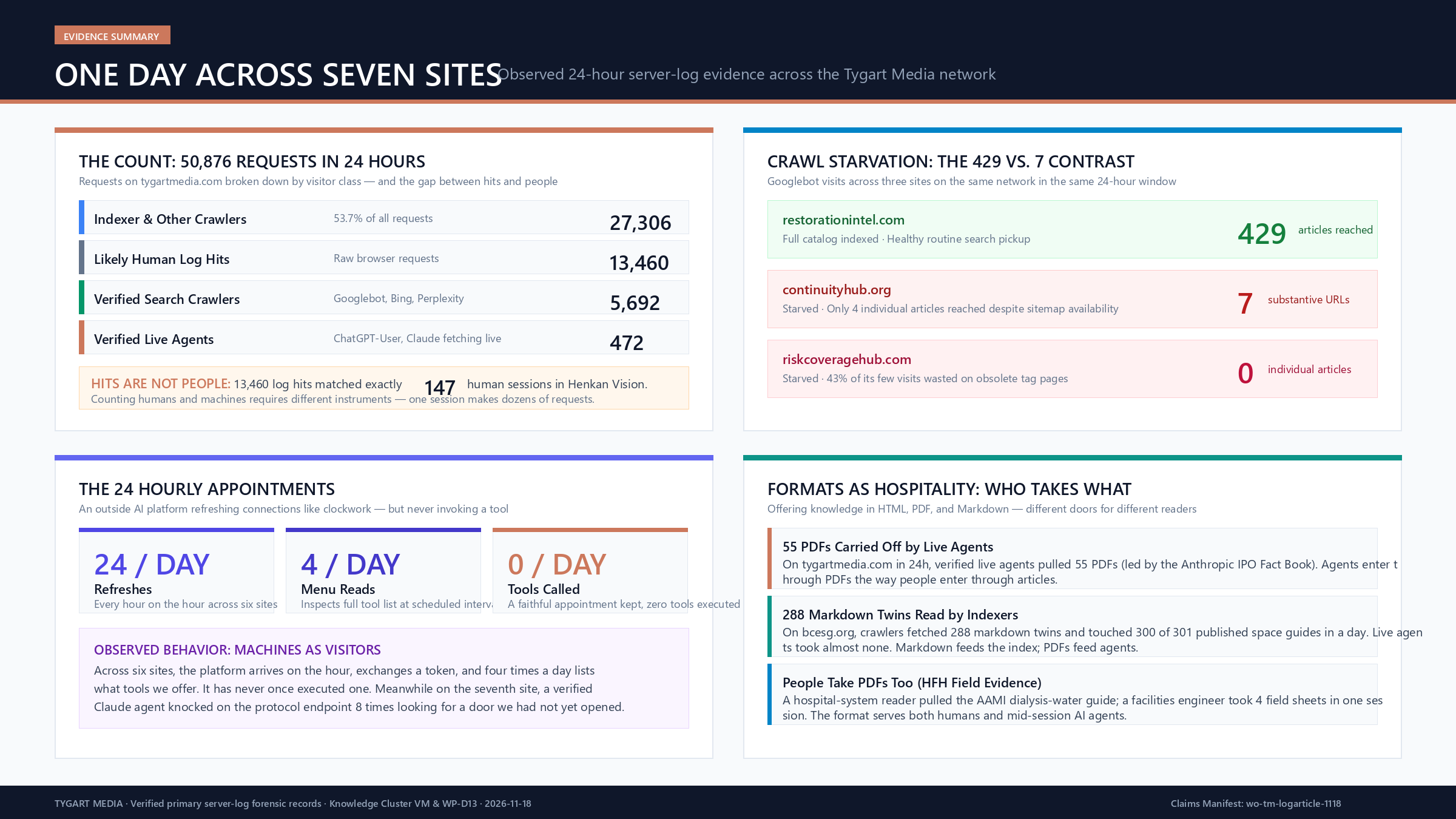
In one ordinary twenty-four-hour window on tygartmedia.com, our origin servers recorded 50,876 clean, non-operator requests. Of those, verified live agents—autonomous clients like ChatGPT-User and Claude, fetching web content on behalf of a person actively waiting at a prompt—made 472 distinct substantive requests.
Four hundred and seventy-two times in a single day, an intelligent system was asked a question it could not answer from memory, reached out across the network, and read something we built. Each of those 472 touches was an answer being forged for a real person sitting in front of a real problem. The reader never knocked. But the flowers were taken.

2. Two Kinds of Witnesses: Hits Are Not People
The moment you begin treating machine visitors seriously, you run into the fundamental limitation of server logs: logs show you the machines with terrifying precision, but they are terrible at seeing human beings.
In that same twenty-four-hour window on tygartmedia.com, our Nginx access logs classified 13,460 requests into the “likely human” bucket. If you were a careless marketer, you might look at that number and report thirteen thousand visitors. You would be wrong by two orders of magnitude.
On that exact same site over that exact same window, our behavioral analytics platform, Henkan Vision, counted exactly 147 actual human sessions.
Hits are not people. When a single human reader opens an article on an iPhone, their browser downloads the HTML document, resolves stylesheet links, requests web fonts, pulls half a dozen optimized images, preloads related assets, and fires asynchronous analytics beacons. One person casually reading three pages can easily register eighty or a hundred raw server hits. Conflating log requests with human beings is the oldest vanity trap on the internet.
This is why knowing an audience requires two completely different kinds of witnesses:
- The Server Logs are our witness to the machines. They record every millisecond timestamp, every HTTP status code, every user-agent declaration, every byte transferred, and every cryptographic signature. They tell us who knocked, which door they chose, and whether the door opened.
- Behavioral Telemetry (Henkan Vision and Microsoft Clarity) is our witness to the humans. They record dead clicks, hesitation, reading depth, form abandonment, and layout frustration. They show us where a person tried to click an unlinked subheading, or where a mobile viewport pinched their reading flow.
Our human audience across our technical and B2B publications leans heavily toward enterprise environments—Microsoft 365, Edge, and Windows desktop sessions, reflecting corporate decision-makers researching operational protocols during working hours. Our machine audience leans everywhere, sweeping from cloud data centers in Oregon, Northern Virginia, and Frankfurt across all hours of the night.
To run a modern publication, you cannot choose between them. You have to read both witnesses, and you must never confuse the footsteps of a machine for the presence of a person.
3. The Starvation Story: An Audience in Quantum Motion
One of the strangest qualities of the machine audience is that it refuses to sit still.
A model on Tuesday is not the same model on Thursday. Search engines reweight their crawl budgets on unannounced cycles. Retrieval algorithms swap out indexing strategies between releases. Everything is in motion until you freeze the data, take a snapshot, and look.
When we stopped the logs across seven sites on our network, the most striking pattern was not how much the machines crawled, but how radically their attention diverged.
On tygartmedia.com, Perplexity’s search crawler generated 1,558 requests in twenty-four hours, methodically mapping our operational analyses. During that exact same day, Googlebot made just 16 requests. A modern AI answer engine visited our flagship site nearly a hundred times more frequently than the company that invented modern web search.
Even more dramatic was the contrast across our vertical network. Consider three separate sister publications hosted on the exact same cloud cluster, running the same software stack, during the identical twenty-four-hour window:
- On our property restoration intelligence journal, restorationintel.com, Googlebot arrived with healthy, robust appetite, crawling 429 distinct articles in a single day.
- On our operational resilience site, continuityhub.org, Googlebot barely grazed the surface, reaching only 7 substantive URLs despite having a complete, valid XML sitemap available.
- On our commercial insurance publication, riskcoveragehub.com, Googlebot reached zero individual articles—and spent 43% of its meager visits knocking on tag archive URLs that had long since been retired.
Same network, same week, same infrastructure: one site feasted, while two starved. (Counts and ratios observed across 24h log snapshots.)
Why? Because search crawler algorithms are creatures of inertia. When a crawler’s scheduler gets trapped in legacy tag pagination or low-priority utility paths, it exhausts its allocated crawl budget before ever discovering the deep, substantive guides sitting fifty pixels away. The machine is not malicious; it is simply hungry and poorly guided. If you do not inspect your logs, you will assume Google is ignoring your writing, when in reality its crawler spent its entire visit chewing on an empty doorway.
4. Formats as Hospitality: Who Takes What
When you realize that your audience is split between human eyes and autonomous agents, you have to rethink the physical architecture of your pages.
For years, technical publishers treated the HTML page as the only deliverable that mattered. But different readers have different hands. A human reading on a commute wants a clean, responsive layout with legible typography. A corporate director preparing an executive briefing wants an immutable, printable document they can mark up offline. An AI coding agent running inside an IDE terminal wants pure, unadorned Markdown that doesn’t waste tokens parsing DOM trees and styling attributes.
We began practicing what we call formats as hospitality: offering the exact same body of verified knowledge across three parallel doors: the Web Article (HTML) for interactive reading, the House-Format PDF for executive offline review, and the Markdown Twin (.md) for AI crawlers, IDE agents, and local language-model retrieval.
Who takes which format tells you who the visitor is and how they think.
On tygartmedia.com, verified live agents retrieved 55 PDFs in twenty-four hours, led by our Anthropic IPO analysis and our comprehensive Anthropic IPO Fact Book. When ChatGPT-User or Claude is asked to analyze corporate valuation or compute limits, it doesn’t want to parse navigation menus, footer widgets, and author bios. It looks for a self-contained PDF document, ingests forty pages of structured financial data in a single GET request, and synthesizes the answer directly for the user. Live agents enter through PDFs the way people enter through articles.
On our aerospace engineering site, bcesg.org, we saw the opposite side of the hospitality spectrum. Over twenty-four hours, 300 of 301 published space-industry guides were touched by web crawlers—the entire garden, visited from boundary to boundary in a single day. But where live agents favored PDFs, indexer crawlers fetched 288 markdown twins. The crawlers ignored the stylesheets and layout wrappers; they pulled the raw .md files directly, absorbing technical specifications with maximum token efficiency. Markdown feeds the index; PDFs feed the agents and the people.
And people take PDFs too. On our healthcare facilities publication, healthcarefacilityhub.org, a reader from a regional hospital system spent twenty minutes working through technical compliance guides before downloading our specialized PDF on AAMI dialysis water-quality standards. Moments later, a commercial facilities manager downloaded four separate operational field-sheet PDFs in a single session.
When you build a document that an engineer can print out, clip to a clipboard, and carry into a mechanical room, you are serving a human need. When an AI agent takes that exact same PDF to answer an executive query, you are serving a machine need. Offering multiple formats is not redundancy; it is hospitality.

5. Wrong Tool, Right Tool: Doors, Menus, and Missed Appointments
When you watch the machines closely, you begin to see comedy, tragedy, and curiosity unfold in the logs.
Sometimes a visitor arrives with the wrong tool for the job. On our open commerce research site, theuniversalcommerceprotocol.com, a verified Claude agent knocked on the site’s protocol endpoint 8 times in twenty-four hours. Each time, it received an unauthorized response. The agent had arrived with a real, sophisticated client tool, looking for an interactive protocol interface, at a doorway we had not yet configured for public agentic authentication. It stood at the threshold, knocked methodically, and turned away when the latch didn’t give.
On six of our publications, we observed an outside AI platform that behaves with astonishing, robotic punctuality. Every single day, exactly 24 times a day, on the hour, it arrives at our server, refreshes its connection token, and departs. Four times a day, on a secondary schedule, it requests our complete directory of available tools and capabilities.
And yet, over hundreds of hours of observation, it has never once called a tool.
It is a machine faithfully keeping an appointment it never uses. Somewhere in a cloud cluster, a scheduler is running, maintaining a heartbeat, checking the menu, and preparing for an assignment that its operators have not yet dispatched. We do not block it; we make sure the endpoint returns an immediate, lightweight status code. If you have a guest who visits every hour on the hour just to check that the porch light is on, the polite thing to do is keep the porch light burning.
Other visitors are startlingly fast. On tygartmedia.com, an automated crawler fetched our curated machine directory, /llms.txt. Within seconds of that single fetch, the same network actor launched an eighteen-request reconnaissance sweep across our machine-manifest and protocol discovery paths. It read the menu on the front door, and immediately tested every door that the menu implied existed.
When you observe these behaviors, you stop thinking about the web as a collection of static documents. It is an ecosystem of actors exploring an architecture. Some arrive with the wrong key; some arrive with tools they don’t yet know how to wield; some read the menu and test every lock in the house.
6. The Practice of Hospitality
What does it mean to build for the web when a massive portion of your audience is made of silicon, reading on behalf of people whose names you will never know?
It means that the old games of digital publishing—gating paragraphs behind popups, trapping readers in pagination loops, obscuring facts to force clicks, and stuffing pages with visual clutter—are worse than annoying. They are hostile to the very systems that now distribute human knowledge.
When an AI retrieval agent visits your site, it has a strict latency budget and a hard token limit. If your page takes six seconds to render behind a JavaScript wall, or if your answer is buried beneath three thousand words of keyword fluff, the agent leaves. It knocks on someone else’s door. The reader who asked the question gets an answer from someone else, and your knowledge remains invisible.
Hospitality for the modern web means building clean doors and leaving them unlocked:
- Publishing fast, semantic HTML that answers the core question in the first two paragraphs.
- Creating standalone, dense PDF takeaways that live agents can carry into an LLM context window without choking on garbage markup.
- Serving plain Markdown twins for the crawlers that build the index.
- Auditing your server logs so you know when a search crawler is starving in an empty room, or when an AI agent is knocking on a broken door.
The audience that never says thanks is still an audience. They are looking for the exact same thing human readers have sought since the dawn of the printed page: clear, reliable, verified truth that solves a problem in the real world.
If you plant the garden well, the visitors will come. Some will arrive with browsers; some will arrive with neural networks. They will take what they need, carry it out into the world, and build something new with it.
And even if they never knock on the door to say thank you, you will know they were there. The logs will remember every footstep.
Get The Signal
What we actually ran, what it measured, and what it means for a restoration shop — every week, including the flops.
Leave a Reply