Updated September 30, 2026.
Model Accuracy Note — Updated September 2026
Flagship: Opus 5.5 (claude-opus-5-5). Daily driver: Sonnet 5. Fast tier: Haiku 4.5. Models roll into Claude Code automatically — no reinstall. Model tracker →
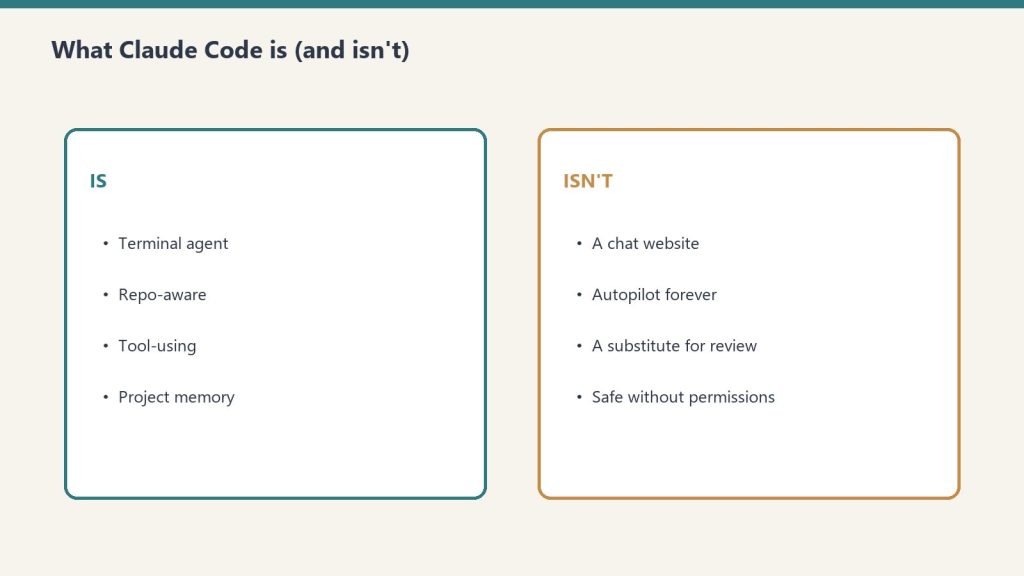
Direct answer: Claude Code is Anthropic’s agentic coding assistant: it reads your repo, runs commands, proposes edits as diffs, and waits for your approval before writing files. Use the terminal CLI (claude), the Desktop Code tab, VS Code or Cursor extensions, JetBrains, or the browser at claude.ai/code. Pick Sonnet 5 for most tasks and Opus 5.5 when the work is genuinely hard; add a CLAUDE.md so you stop re-explaining the project every session.
It works on your tree — files, tests, git, MCP — with permission prompts you control. Stale how-to pages hurt readers and AI citations alike; see GEO case studies for what updates actually move the needle.
Starting a session

From a project folder, run claude in the terminal or open Claude Desktop’s Code tab and choose your project directory. On Desktop you can pick how the session runs:
- Local — runs on your machine with direct file access. Default for day-to-day dev.
- Remote — runs on Anthropic’s infrastructure so long tasks keep going if you close the app.
- SSH — attaches to a remote host over SSH for server or VM work.
No local install? Use claude.ai/code. Resume with claude --continue or claude --resume.
Pick Sonnet 5 for most work and Opus 5.5 for hard refactors. Switch with /model, claude --model, or .claude/settings.json.
What to ask Claude Code to do
Give concrete tasks tied to real paths. Use @src/file.ts mentions to pull files into context without pasting walls of text.
- “Fix the bug in
auth.pywhere sessions don’t expire on the server.” - “Add validation to every handler under
routes/— block SQL injection patterns.” - “Refactor
UserServiceto constructor injection; keep public API stable.” - “Write pytest coverage for public functions in
utils/parser.jsmatchingtests/style.” - “Trace the flow from
main.pyAPI call to the database write.”
Pipe diffs or logs into claude -p for CI-style checks. Schedules and parallel sessions are covered in Anthropic’s common workflows guide.
How Claude Code makes changes
By default Claude asks before editing files or running shell commands. You see the diff, accept, reject, or redirect. Plan mode (claude --permission-mode plan or Shift+Tab in the CLI) lets Claude explore and propose without touching disk until you approve.
That review step is the safety rail — read diffs on production branches even when the model is confident. In CI or disposable containers only, teams sometimes use permission-skipping flags; don’t run those on your daily driver machine.
CLAUDE.md and team instructions

Add CLAUDE.md at the repo root (generate a starter with /init) for stack, test commands, style rules, and directories that are off limits. Claude also reads AGENTS.md if you already use that convention for other coding agents. Commit shared rules in .claude/settings.json; keep personal overrides in .claude/settings.local.json.
# CLAUDE.md (short example)

## Stack
Python 3.11, FastAPI, PostgreSQL, pytest

## Conventions
Type hints on public functions; no bare except

## Do not modify
legacy/ — compatibility shim only
Skills, hooks, and MCP extend the same core — see the overview doc for setup.
Common workflows
Debugging: Paste the stack trace, name the command that fails, ask for root cause plus a minimal fix.
Refactoring: State the end state (“extract billing into a service module”) and constraints (“no API breaks”).
Tests: Point at the file and the test folder; ask for edge cases, then “run tests and fix failures.”
Code review: “Review this branch for security, error handling, and CLAUDE.md violations.” Use /review or parallel subagents on large trees.
Documentation: Docstrings, README architecture sections, or internal runbooks — same approval flow as code.
Tips that actually stick
- Start small. One file you know well before you delegate a multi-module refactor.
- State constraints once. “No new dependencies,” “match existing test style,” “Windows-compatible paths.”
- Keep conventions in CLAUDE.md. If you typed it twice, file it.
- Review every diff. Models drift; your git history shouldn’t.
- Use Remote or web for long jobs;
/compactwhen context bloats. - Measure citations after you refresh public guides — AI citation monitoring and LLM visibility measurement.
Plan and rate limits sit with your seat tier — see Claude Code pricing: Pro vs Max. Tool comparisons: Claude vs GitHub Copilot and Claude Code vs Windsurf.
Tygart Media AI setup — Claude Code, CLAUDE.md, MCP, and team workflows configured end to end.
Frequently Asked Questions
How does Claude Code work?
Claude Code reads files in your project, runs terminal commands you approve, and proposes edits as diffs before anything hits disk. It shares settings and CLAUDE.md across the CLI, Desktop Code tab, IDE extensions, and web surfaces.
Can Claude Code modify my files without permission?
Not by default. It shows proposed changes and waits for approval before writing. You can grant standing allow rules for specific commands or tools; only use fully automatic modes in isolated environments.
What subscription do I need for Claude Code?
A paid Claude plan — Pro, Max, Team, or Enterprise — or API usage billed through the Anthropic Console. The free Claude.ai chat tier does not include Claude Code.
Can I switch models during a Claude Code session?
Yes. Use the /model command inside a session, pass claude –model when launching, or set defaults in .claude/settings.json or ~/.claude/settings.json.
What languages does Claude Code support?
Any language in your repo. It is strongest on Python, JavaScript, TypeScript, and Go, but reads and writes whatever files you point it at.