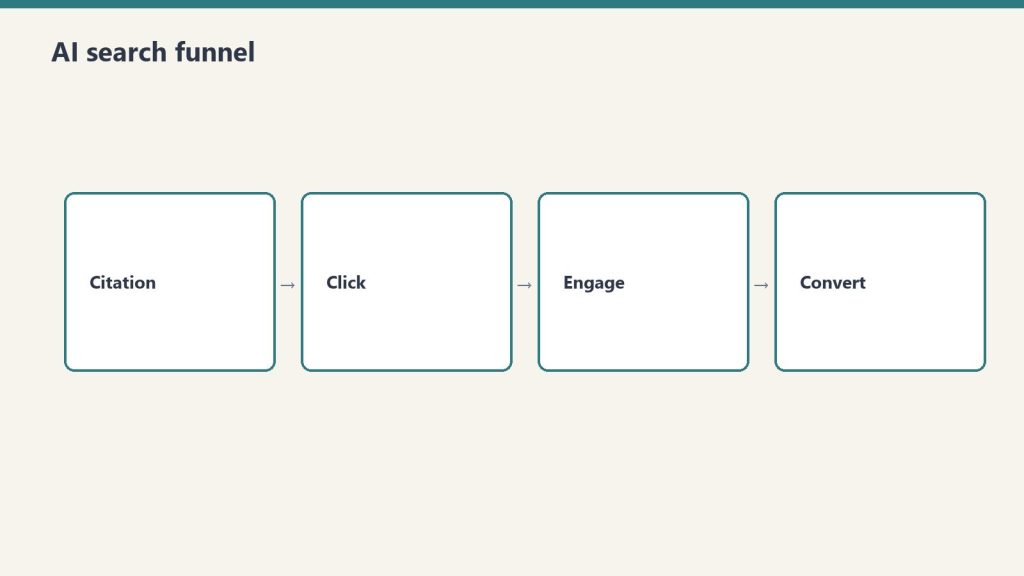
Your GA4 engagement rate is one number. But it is not one audience. It is three audiences — and they behave so differently from each other that the aggregate number actively misleads you about how your content is performing.
Here is what most GA4 users see: a site-wide engagement rate of 35%, an average session duration of 90 seconds, and a top channel list led by Organic Search. What most GA4 users miss: within that same 35% number, three AI platforms are sending traffic with engagement rates of 21%, 46%, and 64% respectively — from the exact same pages, to users with completely different intent profiles.
The AI Referral Split Nobody Is Looking At
The AI referral split nobody is looking at.
ChatGPT, Claude, and Copilot all send referral traffic to content sites. But they do not send the same user. ChatGPT users arrive, scan for a quick answer, and leave in under 30 seconds — engagement rate around 21%, well below the organic search average. Claude users arrive with research intent, read deeply, and stay for 3-4 minutes — engagement rate above 64%. Copilot users are somewhere between, arriving in planning mode, spending 1-2 minutes on civic and services content.
If you blend these three into your site-wide engagement rate, you get a number that does not represent any of your actual users. You get a mathematical average of behaviors that have nothing in common.
Why Your Engagement Rate Lies
Why your engagement rate lies.
The problem is not your content. The problem is that engagement rate without source segmentation is noise. A 35% site-wide engagement rate could mean you have excellent content reaching the wrong distribution channels. It could mean you have mediocre content propped up by one high-engagement source. It could mean your AI referral traffic is dramatically outperforming your social traffic and you have no idea.
The only way to know which is true is to break the number open by source and look at what each channel is actually delivering in terms of engaged session quality — not just volume.
The Four-Question Audit
The four-question audit.
Before you make any content or distribution decisions based on your GA4 engagement rate, ask these four questions.
Which channel sends the most engaged users — not the most users? The answer is almost never the channel driving the highest session count. In most content sites we have audited, the highest-engagement channel is sending between 8 and 40 sessions per month, not 400.
What is the engagement rate for each AI referral source individually? Blending ChatGPT and Claude traffic treats them as equivalent. They are not. One is a fact-checking audience. The other is a research audience. The content structure that serves one actively fails the other.
Which pages produce satisfied exits versus abandoned exits? A 90% exit rate with a 3-minute duration is a success. A 90% exit rate with a 4-second duration is a dead end. Engagement rate alone does not tell you which you have.
Is your engagement rate rising or falling week-over-week from AI sources? AI referral traffic is growing on most content sites in 2026. If yours is flat or declining, you are losing ground in a channel that is becoming structurally important.
What This Reveals About Your Real Audience
When you segment your GA4 engagement rate by source and run the AI referral breakdown specifically, a picture emerges that the aggregate number completely hides. Your real audience — the people actually reading and acting on your content — is smaller and more specific than your total traffic suggests. It is concentrated in a few sources, a few content types, and in the case of Claude traffic specifically, a few geographic clusters that reflect the academic and professional demographics of that user base.
This is not a problem. It is a targeting signal. It tells you where to invest content development effort and which audience to write for on every new piece.
The Methodology Behind This Analysis
The behavioral profiles in this article come from five live sessions using Claude-in-Chrome to interrogate Google’s Analytics Advisor inside GA4 on a real property. The query architecture — the specific sequence of questions and the capture protocol — is packaged as the Books for Bots: GA4 AI Referral Audit Kit.
It runs in four sessions, requires no SQL, no BigQuery access, and no data analyst. You need Claude-in-Chrome, Editor access to a GA4 property with Analytics Advisor enabled, and approximately 90 minutes. The output is a complete per-AI behavioral profile of your traffic and a content variant framework for acting on it.
For the past several weeks I have been running a live experiment on helpnewyork.com: using Claude-in-Chrome to interrogate Google’s Analytics Advisor inside GA4, session by session, until I had a complete behavioral profile of every AI platform sending traffic to the site.
What came out of it is not what I expected. I expected traffic data. I got a content strategy.
The Setup
The setup for tracking AI referral traffic.
Claude-in-Chrome is Anthropic’s browser extension that lets Claude operate directly inside your browser — reading pages, clicking elements, filling inputs, capturing output. Analytics Advisor is Google’s Gemini-powered chat interface built into GA4, available to English-language accounts since December 2025. It answers natural language questions about your property data with charts, tables, and narrative interpretation.
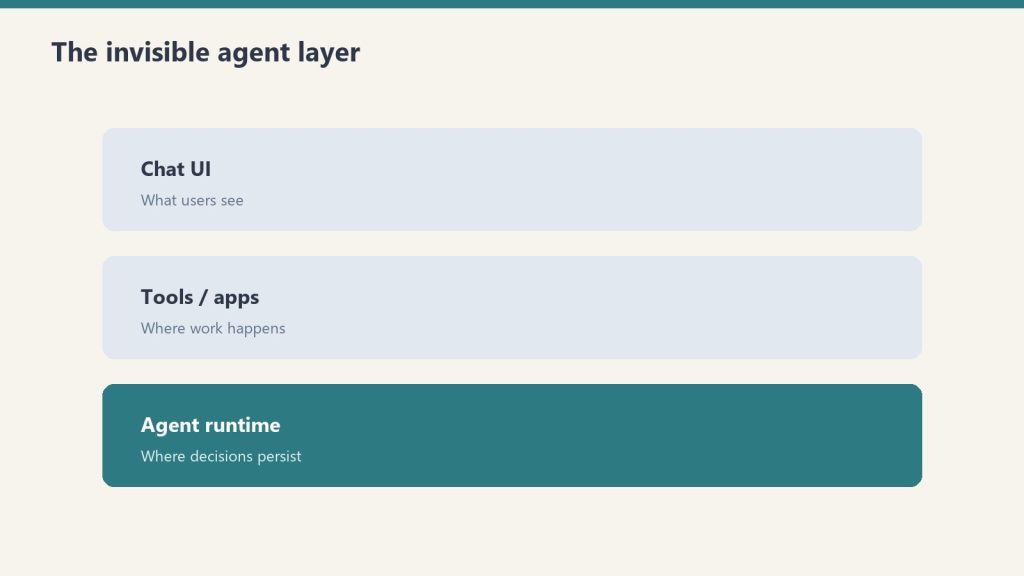
The combination is unusual. You are using one AI (Claude) to systematically interrogate another AI (Gemini) about your site’s data, then synthesizing what comes back into strategy. The token budget for the heavy data reasoning stays inside Google’s infrastructure. Claude handles the query architecture, the capture protocol, and the synthesis.
I ran four structured sessions across two sittings, using a specific sequence of queries built to extract progressively deeper signal. Session 1 established baseline traffic. Session 2 closed gaps and confirmed AI referral data existed. Session 3 was the AI deep dive. Session 4 was velocity and geography.
What the Data Showed
Three AI platforms were sending meaningful traffic to helpnewyork.com during the 28-day window: ChatGPT, Claude, and Copilot. The behavioral profiles were so different from each other that treating them as a single “AI traffic” segment would have produced wrong conclusions.
Claude.ai traffic showed a 64% engagement rate and an average session duration of over 3 minutes. The dominant landing page was an NYC Summer Internships guide, accounting for over 60% of all Claude sessions. Geographic concentration was academic: Ithaca (Cornell), State College (Penn State), Washington DC. The users arriving from Claude were reading to act — they needed specific information, they found it, they stayed.
ChatGPT traffic showed a 21% engagement rate and an average session of 24 seconds. The top landing page was a cherry blossom guide. The users were fact-grabbing: they asked ChatGPT where to see cherry blossoms in New York, got a citation, clicked through, confirmed the location, and left. The content served its purpose in under half a minute.
Copilot traffic was between the two: 46% engagement, roughly 2-minute sessions, desktop-heavy, concentrated in New York’s suburbs. The top pages were civic services — SNAP benefits, tenant rights, transit discounts. These users were in planning mode, researching before they decided or applied.
The Finding That Reframes GEO
The finding that reframes GEO.
The cross-AI page overlap query was the most important one in the entire four-session arc. I asked Analytics Advisor which pages appeared in the top landing pages for more than one AI source. Only one real content page appeared in all three: the cherry blossom guide.
The obvious interpretation is that the cherry blossom guide was “AI-optimized.” The actual interpretation, once you look at the full traffic breakdown, is the opposite. Bing drove 59 sessions to that page. Yahoo drove 16 at 75% engagement and a 3-minute 46-second average session. DuckDuckGo drove 35. The combined AI traffic to that page was 32 sessions — 17% of total. The AI platforms were citing it because traditional search engines had already validated it as the highest-quality answer in the index.
AI citations are downstream of search quality, not upstream. The path to getting cited by ChatGPT, Claude, and Copilot is not to optimize for AI retrieval patterns. It is to build pages that win on Bing and Yahoo with enough depth that AI models treat them as authoritative sources. The GEO play is a traditional SEO play with better content.
The Content Strategy That Follows
The content strategy that follows.
Once you have the per-AI behavioral profiles, you have a content variant framework. The same article can be written in three structural architectures, each tuned to how one AI model retrieves and presents information.
The Claude variant is dense and process-oriented. Headers, eligibility criteria, numbered steps, official program names. Built for the student or researcher who arrived with a specific question and needs a complete answer they can act on.
The ChatGPT variant is a scannable list. Named items, one specific detail per item, direct answer in the first two sentences. Built for the user who will spend 24 seconds on the page and needs the answer immediately or they’re gone.
The Copilot variant is comparison and planning framing. What to know before you go, Option A versus Option B, cost context, logistics. Built for the desktop user doing research before they make a decision.
The core article is the same. The architecture is different. The AI that cites you depends on which structure you used.
The Methodology Is the Product
The query sequence I developed across these four sessions is a repeatable extraction methodology. It works on any GA4 property with Analytics Advisor enabled. The intelligence it produces — per-AI audience profiles, geographic signals, velocity trends, cross-AI content overlap — is not available through DataForSEO, SpyFu, or GSC. It requires Gemini’s reasoning layer operating on top of your property data, orchestrated by a structured query architecture.
I have packaged the complete methodology as a downloadable kit: the full query architecture across all four sessions, the capture protocol, the content variant framework, and the flags to escalate before your next content sprint. It is called Books for Bots: GA4 AI Referral Audit Kit.
The free version covers Session 3 alone — the AI deep dive queries that surface your ChatGPT, Claude, and Copilot traffic split. That alone will show you something most site owners have never seen: which AI is sending them traffic, to which pages, and how engaged those users actually are.
The full kit covers all four sessions and includes the content variant framework that translates the behavioral data into a writing system.
Both are available at tygartmedia.com. What you do with the data after that is yours.
Short version: In the last 29 days, Claude, ChatGPT, Perplexity, Microsoft Copilot, Gemini, NotebookLM, and Kagi collectively sent at least 94 new readers to tygartmedia.com — a site whose #1 content vertical is explaining Claude. AI assistants are now our #4 traffic source, ahead of Facebook, ahead of LinkedIn, ahead of every search engine except Google and Bing. The product is citing the publication that covers the product. That’s the loop. Here is what it looks like when you can actually measure it.
The finding that made me stop scrolling
The finding that made me stop scrolling.
I built a Claude-powered browser agent to poke around our GA4 account and surface “interesting stuff” a human analyst would miss. One of the first things it flagged was our Source/Medium report. Here is the top of the list, unedited:
Rank
Source / Medium
New Users (29 days)
Notes
1
(direct) / (none)
738
Mystery bucket
2
google / organic
289
Standard Google SEO
3
bing / organic
70
1m 20s average session — high intent
4
claude.ai / referral
63
Claude itself
5
m.facebook.com
43
Mostly 4-second bounces
6
duckduckgo / organic
41
1m 02s average
13
chatgpt.com / referral
9
ChatGPT
15
perplexity.ai / referral
5
Perplexity
21
copilot.com
3
Microsoft Copilot
24
gemini.google.com
2
Google Gemini
28
notebooklm.google.com
1
Google NotebookLM
35
kagi.com
1
Kagi AI results
Add up everything with an AI-assistant referrer and the combined count is at least 94 new users in 29 days — roughly 6.7% of all new users on the site. Claude alone, at 63 referred users, is our #4 traffic source. It is ahead of Facebook. It is ahead of LinkedIn. It is ahead of every search engine except Google and Bing. And we have been cited, at least once, by every major AI surface in the English-speaking internet: Claude, ChatGPT, Perplexity, Microsoft Copilot, Gemini, NotebookLM, and Kagi.
Why this is different from “we show up in Google”
Generative Engine Optimization (GEO) is the practice of structuring content so that large language models cite it as a source inside their answers. It is the younger, messier cousin of SEO. Most publishers cannot yet prove it is working. The feedback loop is long, the data is hidden inside a chat window, and the traffic that does leak through often lands in a “(direct)” bucket with no attribution at all.
We can see ours. GA4, for reasons that are probably accidental, already records claude.ai, chatgpt.com, perplexity.ai, copilot.com, gemini.google.com, notebooklm.google.com, and kagi.com as discrete referral sources when a user clicks a citation link. That means AI-assistant traffic is measurable as a first-class channel right now, today, with the free version of Google Analytics, on any site that happens to get cited.
The poetic layer of what we are looking at: Claude is the top AI referrer to a website whose #1 content vertical is explaining Claude. The product is sending readers to the publication that covers the product. If that is not a GEO moat, I do not know what one looks like.
These are not bounced visitors. They are readers.
These are not bounced visitors — they are readers.
The single biggest worry with any new traffic source is that it might be garbage — bots, previews, accidental clicks. The engagement data says the opposite. Users arriving from claude.ai spend 23 seconds on average and produce 0.56 engaged sessions per user. ChatGPT referrals average 21 seconds and 0.44 engaged sessions per user. For context, the site-wide average engagement time is dragged down hard by in-app social browsers; the Facebook mobile webview, for example, sits at about 14 seconds with 4-second bounces.
People arriving from an AI assistant are not scrolling past. They clicked the citation because the AI told them this was the primary source, and when they got here they read. That is a qualitatively different kind of traffic than Facebook or a random Google search. These are the highest-intent non-search users we have.
The secondary finding: Seattle is reading for three minutes
The same GA4 pass surfaced a city-level pattern we were not expecting. Seattle readers — 61 of them in 29 days — spent an average of 3 minutes and 6 seconds on site at a 61.3% engagement rate. The site-wide average session is roughly 40 seconds. Seattle readers are spending about 4–5x longer on the page than the typical visitor, at nearly twice the engagement rate.
City
Active Users
Engagement Rate
Average Time
Seattle
61
61.3%
3m 06s
The Dalles, OR
31
0%
1s
Shelton, WA
26
27.6%
15s
Des Moines
24
37.5%
10s
Beijing
31
6.5%
0s
Singapore
28
21.4%
5s
A few things jump out. The Dalles, Oregon at 31 users / 0% engagement / 1 second is almost certainly Google’s data center there returning preview requests — ignore it. Shelton, Washington is a real Mason County hyperlocal beachhead; 26 actual humans in our home county in 29 days is a legitimate foothold for the local desk. Beijing at 31 users / 0 seconds has the classic signature of cloud-hosted scrapers. And Seattle at 3 minutes is the single most valuable city in our data and it is not close.
The browser split confirms an unusually technical audience
Browser
Users
Engagement Rate
Chrome
850 (60%)
31.3%
Safari
232 (16%)
32.7%
Edge
99 (7%)
62.3%
Firefox
33 (2.3%)
60.5%
Edge at 62.3% engagement and Firefox at 60.5% engagement are not normal consumer numbers. A typical general-interest site sees those two browsers hovering in the 5–15% range. Microsoft Edge is the default on corporate-managed Windows machines. Firefox is the dev-preferred privacy browser. The combination of high Edge engagement, high Firefox engagement, and a Claude-heavy referral list all point at the same audience: developers and technical professionals at real companies, reading on managed workstations.
How to measure AI-assistant referrals in your own GA4
How to measure AI-assistant referrals in your own GA4.
If you publish anything technical and want to see your own version of this number, the fastest path is a custom GA4 exploration with one segment. Open GA4 → Explore → Free Form. Add a segment with this condition:
Break it down by landing page, engagement rate, and average engagement time. That is your AI-Referral dashboard. Watch it weekly. A non-trivial number of sites will discover they already have measurable AI traffic and never bothered to look.
A GEO referral, or AI-assistant referral, is a visit to your site from a user who clicked a citation link inside an answer generated by a large language model such as Claude, ChatGPT, Perplexity, Microsoft Copilot, Gemini, NotebookLM, or Kagi. In Google Analytics 4 these visits appear as referral traffic from the assistant’s domain — for example claude.ai / referral or chatgpt.com / referral.
How many AI-referred users did tygartmedia.com receive in 29 days?
At least 94 new users across seven distinct AI assistants: 63 from Claude, 14 from ChatGPT (9 attributed + 5 unassigned), 10 from Perplexity (5 attributed + 5 unassigned), 3 from Microsoft Copilot, 2 from Gemini, 1 from NotebookLM, and 1 from Kagi. That is roughly 6.7% of all new users on the site for the period.
Are AI-assistant referrals real readers or bots?
Real readers. Average engagement time from claude.ai is 23 seconds and from chatgpt.com is 21 seconds, with engagement rates of 0.56 and 0.44 engaged sessions per user respectively. Those numbers are qualitatively higher than in-app social browser traffic (Facebook mobile webview averages about 14 seconds) and indicate a deliberate click-through from an AI citation, not a scraper.
Can any publisher measure AI-assistant referrals in GA4?
Yes. GA4 records visits from claude.ai, chatgpt.com, perplexity.ai, copilot.com, gemini.google.com, notebooklm.google.com, and kagi.com as discrete referral sources by default. Build a Free Form exploration with a segment that filters Session source on those domains and you will see the channel immediately if it exists for your site.
What is GEO in marketing?
GEO stands for Generative Engine Optimization. It is the practice of structuring web content, schema markup, and publishing signals so that large language models cite the content as a source inside AI-generated answers. GEO is to AI assistants what SEO is to search engines — the discipline of being the answer the machine hands to the reader.
The loop, and why it matters
The most interesting thing about this data is not the traffic. It is the feedback structure. Tygart Media publishes explainers about Claude. Claude crawls and cites those explainers. Readers click through from Claude’s answer back to tygartmedia.com. We publish more. Claude cites more. The site becomes, in effect, training data and a recommended source for the next iteration of the product it covers. That is the recursive loop that makes AI-native publishing a different business than search-era publishing.
I do not think every site can build this loop. It requires a narrow, technically-defensible topic — something an AI assistant would rather cite than paraphrase — and the patience to publish at a cadence LLMs reward. What I do think is that any publisher can check, today, whether the loop has quietly started forming underneath them. Most have not bothered. This post is partly a flex and partly an invitation: go look.
What happens next at Tygart Media
Three things. We are standing up a permanent AI-Referral channel in our GA4 so the number can be watched weekly instead of rediscovered quarterly. We are writing the playbook — the one this post hints at — for publishers who want to do the same. And we are building the browser agent that found this in the first place into a repeatable audit any publisher can run against their own GA4 in an afternoon. If that last one sounds useful, the newsletter is the place to follow along.
Claude sent us 63 readers last month. It will send more next month. We will be counting.
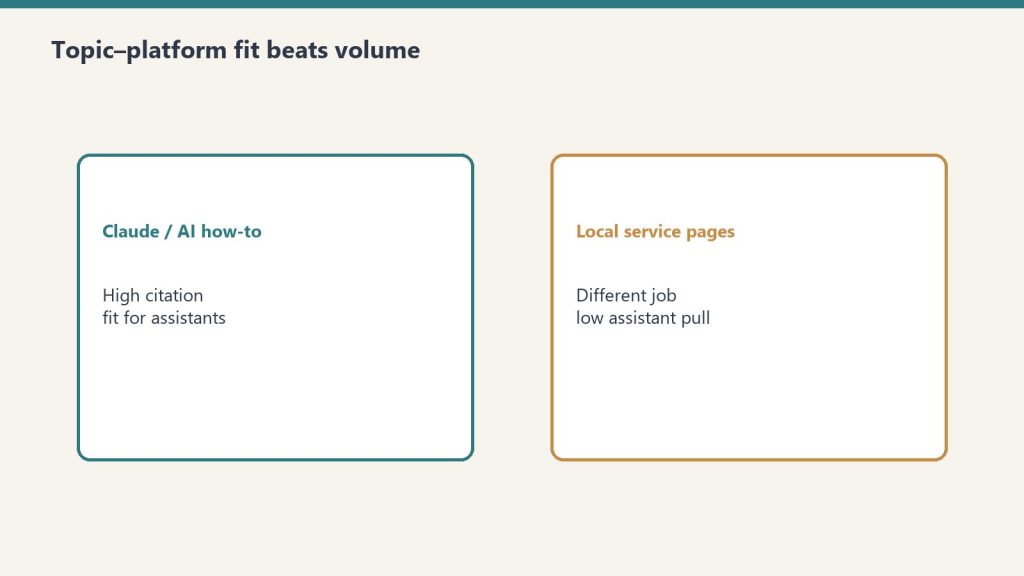
Part 2 of 2. In the first post I showed that Claude, ChatGPT, Perplexity, Copilot, Gemini, NotebookLM, and Kagi collectively sent tygartmedia.com at least 94 new readers in 29 days — and that Claude alone is our #4 traffic source. That is the headline. What follows is the interesting part: when you filter the landing-page report one AI model at a time, the three major assistants cite completely different kinds of pages, and the pattern is actionable.
Claude cites a small number of pages, a lot of times
Claude cites a small number of pages, a lot of times.
Claude.ai sent 79 sessions across 63 users to 16 distinct pages. Two pages ate more than half of it:
#
Page
Sessions
% of Claude traffic
Avg Time
1
/claude-student-discount
22
27.9%
35s
2
/anthropic-console
21
26.6%
11s
3
(not set)
13
16.5%
5s
4
/claude-edu
4
5.1%
6s
5
/claude-pro-vs-chatgpt-plus
4
5.1%
7s
6
/claude-code-on-vertex-ai-gcp
3
3.8%
3s
7
/claude-desktop
2
2.5%
40s
8
/how-to-install-claude-code
2
2.5%
2s
9
/claude-4-deprecation
1
1.3%
1m 07s
10
/claude-managed-agents-pricing-cost-analysis
1
1.3%
1m 38s
The two biggest pages, /claude-student-discount and /anthropic-console, are 54.5% of all Claude-referred traffic to the site. Those are extremely specific query shapes — “how do students get Claude Pro free” and “how do I access the Anthropic Console” — and Claude has apparently decided our pages are the canonical answer for both.
The engagement twist is worth staring at. The two biggest Claude-referred pages have the worst time-on-page: 35 seconds and 11 seconds. The two pages that got a single Claude visit each — /claude-managed-agents-pricing-cost-analysis and /claude-4-deprecation — got 1 minute 38 seconds and 1 minute 7 seconds of real read time. The pattern is clean. When Claude can extract the answer directly into its chat window, users click through briefly to verify and leave. When the answer is deeper than Claude can summarize, readers stay to actually read. Both behaviors are valuable and both are measurable.
ChatGPT cites broadly, favors “X vs Y” content, and (oddly) sends geographic traffic
ChatGPT’s footprint is shaped differently. 16 sessions across 14 users to 13 distinct pages — almost every page received exactly one visit, which is the signature of a model citing a wide range of sources once each rather than reaching for a favorite.
Two patterns in that list. First, ChatGPT appears to cite us disproportionately for model comparisons — grok-vs-claude, opus-4-7-vs-gpt-5-4-vs-gemini-3-1-pro, and the cross-model claude-pro-vs-chatgpt-plus page. Second, and stranger, ChatGPT sent visits to two hyperlocal Pacific Northwest pages: an Everett waterfront guide and a Hood Canal shellfish season page. That is ChatGPT using our site as a reference source for geographic queries, which is not a pattern any other model shows.
The hidden gem: /claude-computer-use-tutorial received one ChatGPT referral and that referral stayed for 2 minutes 7 seconds. ChatGPT appears willing to cite long-form technical tutorials in a way Claude does not.
Perplexity treats us like a research database
Perplexity sent 12 sessions across 10 users to 9 pages — the most evenly distributed of the three and the only model that cites people, founders, and company-history content.
Page
Sessions
Avg Time
/anthropic-founders-2
2
17s
/claude-code-on-vertex-ai-gcp
2
54s
/claude-student-discount
2
0s
/claude-desktop
1
4s
/claude-team-plan
1
0s
/how-to-install-claude-code
1
0s
/restoration-team-training-claude-cowork
1
0s
Perplexity is the only model that pulled visits on /anthropic-founders-2, which implies Perplexity is fielding a different query shape — something closer to “who founded Anthropic” than “how do I use Claude.” Perplexity is also the only model that surfaced the very niche B2B page /restoration-team-training-claude-cowork. That is a long-tail, vertical-specific query and Perplexity cited us as the source. That is exactly the behavior you would hope for from a research-flavored assistant.
The three models have completely different citation personalities
The three models have completely different citation personalities.
Once you lay the three patterns side by side, the strategy falls out of the page.
Claude.ai favors short, factual, access-related pages. Product info, pricing, how-to-access. If you want more Claude citations, write more narrow “how do I do this one specific thing” pages.
ChatGPT favors comparisons and long-tail references. X vs Y, alternatives, and — unexpectedly — some geographic content. If you want more ChatGPT citations, write more “X vs Y” posts with tight comparison tables.
Perplexity favors people, history, and niche research. Founders, company background, domain-specific tutorials. If you want more Perplexity citations, write more research-flavored background pieces.
This is the single most practical insight in the data set. Most people talk about “AI SEO” as if it is one thing. It is three things, at minimum, and the content shape that wins one model will not automatically win the other two.
The crown jewel: one page, 17% of all AI-referred traffic
The clearest cross-model winner on the site is /claude-student-discount. Claude sent 22 sessions. ChatGPT sent 3. Perplexity sent 2. Combined that is 27 sessions — roughly 17% of all AI-referred traffic we received in 29 days, from a single URL. No other page on the site is cited by all three major LLMs in meaningful volume.
There is a playbook inside that one data point. The page works because the query “how do I get Claude for free as a student” is an extremely high-frequency question across every chat surface, and the page happens to be structured the way LLMs like to cite: a short, direct answer near the top, specific eligibility rules in a scannable block, and no wall of context before the reader gets to the fact. That structural recipe — front-load the answer, make the facts liftable, keep the page narrow — is repeatable.
The bigger finding: 90% of our Claude content is invisible to AI
tygartmedia.com has more than 250 Claude-related articles. Exactly 25 of them show up in the AI-referral data set at all. The 90% that do not get cited are not low-quality — several of them have strong engagement from regular search traffic:
/claude-managed-agents-complete-pricing-guide-2026 — 17 sessions at ~1 minute from search, zero AI citations
/notion-knowledge-base-for-claude — 10 sessions at 1m 23s, uncited
/claude-rate-limits — classic FAQ shape, 6 sessions, not cited
/claude-md-playbook — 1 session at 2m 33s, zero AI pickup
The full /claude-cowork-* family of 12+ pages, almost entirely invisible to every model
The difference between an AI-cited page and an AI-invisible page is rarely the quality of the content. It is the shape. Pages that get cited have an early summary, short headings, bulleted facts, and a quotable direct-answer sentence. Pages that do not get cited tend to open with context, build up to the answer, and bury the quotable line in paragraph 9.
The content-cluster scorecard
Cluster
Approx. Pages
Approx. Sessions
Engagement
AI Citations
Claude pricing & access
~10
~160
Mixed
High
Claude managed agents
~12
~130
Strong (25s–1m)
Low
Claude Code
~8
~60
High (18s–3m)
Moderate
Model comparisons (X vs Y)
~10
~45
Very high (1–7 min)
Moderate
Anthropic people/company
~8
~30
Medium
Moderate
Claude how-to / tutorials
~20
~50
Medium
Low
Claude Cowork family
~15
~40
Very low (0–10s)
Almost none
Two clusters deserve action. The Claude Cowork family is a content swamp — 15 pages, low traffic, no AI citations, and 0–10 second engagement on the traffic that does land. That cluster should be consolidated into two or three flagship posts and the rest redirected. The model comparisons cluster is the opposite: low volume but 1–7 minutes of engagement and cross-model citations. One well-researched comparison post outperforms ten mediocre explainers on every metric that matters here.
The playbook, in one list
The playbook, in one list.
Write more narrow single-answer pages. Candidates I would ship next: /claude-web-search, /claude-api-keys, /claude-max-plan-vs-pro, /how-to-cancel-claude, /claude-mobile-app, /claude-desktop-vs-web, /claude-subscription-refund. Each is ~600 words, answer-first, scannable. That is the shape Claude cites.
Add a Quick Answer block to the top of every long-form piece. Two or three sentences. Quotable. That alone moves a real share of our invisible content into AI-citation range.
Invest in comparison posts for ChatGPT pickup. We already know ChatGPT cites our existing X-vs-Y content. Ship more of them, with tight tables.
Write more founder/history/background pieces for Perplexity pickup. Research-flavored. Dates, names, primary sources.
Consolidate the Cowork cluster. Two or three flagship pages, everything else redirected.
Ship a permanent AI-Referral dashboard in GA4. Segment on all seven assistant domains. Watch it weekly. This is now a first-class channel.
Frequently asked questions
What kinds of pages does Claude.ai cite most often?
Based on the tygartmedia.com data, Claude.ai disproportionately cites short, factual, access-related pages — product info, pricing, how-to-access, and eligibility details. On our site, two pages (/claude-student-discount and /anthropic-console) accounted for 54.5% of all Claude-referred traffic in a 29-day window.
What kinds of pages does ChatGPT cite most often?
ChatGPT’s citation pattern favors comparison and long-tail reference pages — “X vs Y” posts like Grok vs Claude, model-to-model comparisons, and, surprisingly, some geographic and local content. ChatGPT tends to cite many pages once each rather than concentrating on a small set.
What kinds of pages does Perplexity cite most often?
Perplexity cites research-flavored content — founders and company history, domain-specific tutorials, and niche B2B pages. It is the only major AI assistant that sent traffic to our Anthropic founders page and to a vertical-specific training page in our data set.
Why does the same page get different citation volume from different AI models?
Because each assistant is answering a slightly different distribution of queries. Claude is most often used for “how do I use this product” questions and favors narrow how-to pages. ChatGPT receives more comparison and alternative-seeking queries. Perplexity skews toward research and background questions. A page that is the best answer for one query type will not automatically be the best answer for another.
How do I structure a page to get cited by AI assistants?
Lead with a direct, quotable answer in the first paragraph. Use short scannable headings. Keep facts in bulleted or tabular form. Include an explicit FAQ block with question-shaped subheadings. Keep the page narrow — one topic, one canonical answer — rather than a sprawling multi-topic explainer.
The bigger picture
The meta-insight worth sitting with: we are currently being cited inside Claude’s internal answer graph for “Claude student discount” because a human sat down and wrote a clear, narrow page about it. That is almost the entire game for publishers for the next three years. Most of the web has not noticed yet. We noticed, and now we have a measurement stack to act on what we noticed.
If you are a publisher, the thing to do this week is boring and powerful: segment your GA4 on the seven AI-assistant domains from Part 1, sort your landing pages by AI-referral volume, and look at the pages that are winning. They will have a shape. Copy it.
Find out exactly why AI systems are not citing your content — and what to change.
Who This Is For
Who the GEO visibility checker is for.
Built for content marketers, SEO practitioners, and website owners who are publishing good content but not appearing in AI-generated answers on ChatGPT, Perplexity, or Google AI Overviews.
The Problem
The AI-visibility blind-spot problem.
AI search citation is not random. It follows patterns: entity density, factual specificity, direct-answer structure, authoritative framing, speakable content, and OASF formatting. Most content fails on two or three of these signals — not all of them — which means the fixes are targeted and manageable. The problem is knowing which signals are failing. This skill evaluates your page against all of them and tells you exactly what to change.
What It Does
What the GEO checker skill does.
Evaluates entity density — how many named entities your page references and whether they are specific enough to be useful to AI systems
Assesses factual specificity — the ratio of specific, verifiable claims to vague generalizations
Checks for direct-answer structure and speakable schema markers
Evaluates OASF formatting — the structure that makes content citation-friendly to generative engines
Identifies the 3 to 5 highest-leverage changes that would most improve AI citation probability
What You Get
The complete skill file in Claude-compatible format, a prompt library specific to the use case, and a setup guide that gets you running in under five minutes. After purchase, everything downloads instantly.
GEO Visibility Checker — Claude AI Skill for AI Search Optimization
$47
Delivered to your inbox within 24 hours — skill file, prompt library, and setup guide
SEO optimizes for search engine rankings. GEO — Generative Engine Optimization — optimizes for AI citation: getting your content surfaced as a source when ChatGPT, Perplexity, or Google AI Overviews answers a question. The signals are related but distinct.
Can this guarantee my content will be cited by AI systems?
No — AI citation is probabilistic, not deterministic. What this skill does is identify and address the specific signals that correlate with AI citation, increasing your probability of being cited.
Does this work for any type of content?
Yes. The skill evaluates any page — blog posts, service pages, product pages, and landing pages all have GEO optimization opportunities.
How is this delivered?
Within 24 hours of purchase via email from will@tygartmedia.com. Skill file, prompt library, and setup guide delivered as a ZIP download.
Does this require a paid Claude subscription?
Installing as a custom skill requires a paid Claude plan (Pro, $20/mo, or higher) with code execution enabled. Your download also includes a free-plan setup option — paste the skill into a Claude Project’s instructions — which works on any plan.
Can I get a custom version built for my specific business?
Yes. Email will@tygartmedia.com with a description of your business and workflows. Custom skill builds are available as part of The Fitting service.
Find out exactly what is keeping your website invisible to AI systems — and what to fix first.
The Shift That Changed Everything
For two decades, ranking on Google was the game. Then something changed. ChatGPT, Perplexity, Google AI Overviews, and a dozen other AI-powered platforms became the first place an increasingly large share of buyers go when they are researching. These systems do not rank your website. They either cite it or they do not. And whether they cite it depends on signals that are completely different from traditional SEO.
Most websites — including most professionally built ones — are invisible to these systems. Not because the content is bad, but because the structure is wrong. Missing schema. No entity architecture. Content formatted for humans but not for machines. No speakable blocks. No LLMS.txt signal. Problems that take hours to fix once you know what they are, but that are completely invisible until someone shows you the checklist.
This is that checklist.
What’s Inside
47 checkpoints organized across 5 categories: schema markup, entity structure, content format, technical signals, and GEO optimization
Scoring guide: calculate your AI readiness score and see what tier your site is in
Priority fix matrix: each gap ranked by how much it hurts you and how fast it is to fix — so you know where to start
Plain-language explanations for every checkpoint — no jargon, no assumed technical knowledge
Delivered as a Notion workspace you can run against any site, any time, and save your results
Who This Is For
Business owners who have heard about AI search and want to know where they actually stand. Marketing managers who need a structured framework for evaluating and improving AI visibility. WordPress site owners who want to understand what the SEO plugins are not covering. Anyone who has wondered why their site does not show up when people ask AI assistants about their category.
What Happens After
The self-assessment tells you what to fix. If you want help fixing it, every item on the checklist maps to a service we offer — from the $29 WordPress Schema Starter to a full SiteBoost engagement. But the checklist is genuinely useful on its own. Most of the fixes are things any site owner can implement with basic WordPress access and thirty minutes.
Frequently Asked Questions
Does this require technical knowledge?
No. Every checkpoint has a plain-language explanation. The scoring guide tells you whether each item is a DIY fix, a developer task, or something you can handle with a plugin. You do not need to know what schema markup is before you start — you will understand it by the time you finish the first section.
How long does it take to run?
About 90 minutes for a thorough first pass on a site you know well. Faster if you are already familiar with your site’s technical setup. The Notion format lets you save your work and return to it.
Does this work for sites that aren’t on WordPress?
Yes. Most checkpoints are platform-agnostic. A few reference WordPress-specific tools but note alternatives for other platforms.
Is Your Site AI-Ready? Self-Assessment
$19
Delivered to your inbox within 24 hours — no shipping, no waiting
100 prompts that actually work. Organized so you can find what you need in 30 seconds.
Who This Is For
Who the AI prompt library is for.
Built for service business owners and operators who are using AI occasionally but getting inconsistent results — sometimes great, sometimes useless — and want a reliable library of prompts that produce good output the first time.
The Problem
The prompt library problem for service businesses.
Prompting AI is a skill, and most people are learning it one bad output at a time. The difference between a prompt that produces something usable and one that produces generic filler is usually the framing — how you give context, what format you ask for, what constraints you set. This library is the shortcut. Every prompt has already been tested, refined, and confirmed to produce useful output for the situation it is built for.
What You Get
What you get with the prompt library.
20 sales and business development prompts: proposals, follow-up sequences, objection handling scripts, cold outreach
20 marketing and content prompts: blog post frameworks, social captions, email sequences, ad copy
Within 24 hours of purchase via email from will@tygartmedia.com. You will receive a download link for the ZIP file and/or Notion duplicate link immediately.
Do I need any special software?
Works with any modern AI assistant including Claude, ChatGPT, and Gemini. A free Notion account is recommended for the database format.
Can I customize this for my specific business?
Yes — that is the point. Everything is built to be edited. Swap in your company name, add your specific workflows, remove anything that does not apply. It is a starting point, not a locked template.
Is there a refund policy?
Because this is a digital product, all sales are final. If you have a problem with your purchase, email will@tygartmedia.com and we will sort it out.
How Real Estate Agents Get Found in AI Search Before Buyers Contact Anyone
By Tygart Media Updated: April 12, 2026
The AI pre-search reality for real estate: Gartner projects up to 25% of traditional search volume will migrate to AI tools by the end of 2026. In real estate, this means buyers and sellers are asking ChatGPT, Perplexity, and Google AI Overviews questions like “What’s the best neighborhood in [city] for families with young kids and walkable schools?” and “How competitive is the [city] real estate market for buyers right now?” — before they open a browser tab, before they visit Zillow, and before they contact an agent. The agent whose content is cited in those answers enters the consideration set at the very beginning of the buyer’s journey.
Why AI Citation Matters More Than Position 1 for Real Estate
Traditional real estate SEO chased position 1 rankings for local keywords. AI citation operates differently: it targets the research-phase questions that precede any specific property or agent search. A buyer who asks ChatGPT “what is [neighborhood] like for a family moving from out of state” is not yet searching for a property. They’re building a mental model of the market. The agent cited as the authoritative source on that neighborhood during this phase establishes credibility before any competitor has been considered.
According to Digital Agent Club’s 2026 real estate digital marketing analysis, AI search queries in real estate are “full-sentence questions people actually ask out loud” — specifically neighborhood character, school quality, market competitiveness, and commute viability. These are exactly the questions that well-optimized neighborhood guides and market reports are built to answer.
How do real estate agents get cited in ChatGPT and Perplexity for neighborhood and market questions?
Real estate agents earn AI citations for neighborhood and market queries when their WordPress content combines: ranking in the top 20 organic results for the query (the access prerequisite), named geographic entity references that AI systems can verify (school district names, transit corridors, MLS board as data source, NAR terminology for market conditions), direct-answer speakable blocks targeting neighborhood character questions (“what is [neighborhood] known for” and “what are the schools like in [neighborhood]”), and FAQPage JSON-LD schema making Q&A pairs machine-parseable. National portals have generic neighborhood pages. Local agents have genuine local knowledge encoded in entity-rich, schema-structured content — which is exactly what AI systems prefer to cite.
The Four Real Estate Content Types That Earn AI Citations
1. Neighborhood Character Guides
The most AI-citable real estate content directly answers “what is [neighborhood] like?” — the question buyers ask AI before they search for properties. Guides with named school entities, commute corridor references, community character description, and price range context are machine-verifiable by AI systems against geographic and institutional data. A guide that says “Oakwood Heights is served by Lincoln Elementary (GreatSchools rating 8/10), is 22 minutes to downtown via I-90, and has a median home price of $487K per NWMLS Q1 2026 data” provides entity anchors that AI systems can cite with confidence.
2. Market Condition Analyses
Buyers ask AI “is [city] a buyer’s or seller’s market right now?” Market report content with specific MLS data, defined market condition criteria (months of supply, list-to-sale ratio), and a dated “last updated” date is AI-citable because it provides a verifiable, sourced, current answer to a question buyers actively ask during market research. Undated or unverified market commentary is not citable — AI systems evaluate content freshness before surfacing market data.
3. Buyer and Seller Process Explainers
Process questions are high-citation opportunities: “how does the home buying process work,” “what is earnest money,” “how do real estate contingencies work,” “what does days on market mean.” These are universal questions with verifiable, direct answers that don’t require geographic specificity. FAQPage schema targeting these questions earns both People Also Ask placements and AI citation for the specific process queries buyers ask AI assistants during active home search.
4. Local Market Comparison Content
“[Neighborhood A] vs [Neighborhood B]” comparison content is highly AI-citable because it directly answers one of the most common pre-decision buyer questions. AI systems surface content that provides the specific comparison a buyer is asking about — school district comparison, price difference, commute difference, neighborhood character comparison. An agent who writes authentic, data-backed neighborhood comparison content owns a content type that neither national portals nor most local competitors are producing.
Geographic entity injection, speakable blocks targeting neighborhood AI queries, and FAQPage schema are the three GEO deliverables applied to real estate WordPress content through WordPress content optimization for real estate agents via SiteBoost.
Frequently Asked Questions
Which AI systems matter most for real estate agent visibility?
Google AI Overviews has the largest reach — appearing at the top of results for real estate research queries including neighborhood character, school quality, and market condition searches. Perplexity is increasingly used by out-of-state buyers doing research before relocation because it cites sources inline, giving cited agents visible brand exposure. ChatGPT’s growing search integration captures the “which neighborhood should I consider” research questions that precede any specific search. All three evaluate similar content signals: named geographic and institutional entity references, direct-answer formatting, and FAQPage schema. Optimizing for one effectively optimizes for all.
Can a new real estate agent website earn AI citations?
Yes, for specific hyper-local queries with low competition. A new agent website with one deeply optimized, entity-rich neighborhood guide for a specific neighborhood can rank in positions 11–20 for that neighborhood’s character and school queries — and earn AI citations for those specific queries even without broad domain authority. The AI citation selection among ranking pages rewards content quality signals — entity depth, direct-answer structure, schema — not just ranking position. Starting with your primary farm area and building one genuinely authoritative guide is more effective than thin coverage of many neighborhoods.
How is AI search optimization different from traditional real estate SEO?
Traditional real estate SEO prioritized local signals — Google Business Profile, NAP consistency, location-specific pages, and review volume. AI search evaluates content quality signals: named geographic entities (school district names, transit references, MLS board citations), direct-answer formatting (speakable blocks with 40–60 word direct answers), and machine-readable schema (FAQPage, LocalBusiness, RealEstateListing). Traditional SEO remains the prerequisite — 97% of AI citations come from pages already ranking organically. But among ranking pages, AI citation requires the additional entity and schema layer that most real estate agents’ WordPress content currently lacks.
Sources: Digital Agent Club, “Real Estate Digital Marketing 2026” (November 2025); Luxury Presence, “194 Best Real Estate Keywords for 2025–2026”; Gartner 2025–2026 search migration projections (cited via Digital Agent Club); LLMrefs, “Answer Engine Optimization: The Complete Guide for 2026”
How Attorneys Get Cited by ChatGPT, Perplexity and Google AI Overviews
By Tygart Media Updated: October 5, 2026
The shift that changes everything for law firm marketing: According to ALM Corp’s 2026 legal SEO analysis, 58% of legal searches now end without a click — prospects receive their answer from Google AI Overviews without visiting any website. The attorneys who win in this environment are not necessarily those ranking #1 on Google. They are the attorneys whose content gets cited by AI systems during the research phase — before a prospect has decided to search for a lawyer at all.
58%of legal searches end without a click
97%of AI citations come from top-20 organic results
$50–$500cost per click for competitive legal terms
How AI Systems Decide Which Legal Content to Cite
How AI systems decide which legal content to cite.
ChatGPT, Perplexity, and Google AI Overviews all use retrieval-augmented generation (RAG) — they search the web, retrieve candidate pages, and then evaluate those pages before synthesizing an answer. The evaluation is not purely about ranking. It includes an assessment of whether the content’s claims are verifiable, whether named legal entities are present, whether the content is structured for direct-answer extraction, and whether the source demonstrates domain expertise.
Law firm content that earns AI citations has four specific properties: it ranks in the top 20 organic results (the prerequisite), it contains named legal entities (statutes, case law, bar association rules), it has direct-answer formatting (a clear 40–60 word answer near the top of each section), and it has FAQPage schema that makes those answers machine-parseable.
What makes attorney content get cited by ChatGPT and Perplexity?
Attorney content earns AI citations from ChatGPT and Perplexity when it combines: organic ranking in the top 20 results for the query (the access prerequisite), named legal entity references that AI systems can verify (specific statutes, bar association rules, named legal doctrines), direct-answer formatting in the first 50 words after each section heading, and FAQPage JSON-LD schema that makes question-and-answer pairs machine-parseable. Content lacking any one of these properties is significantly less likely to be cited even if it ranks well.
The Named Entity Requirement: Why Generic Legal Content Gets Ignored by AI
The named entity requirement for legal AI citations.
AI systems evaluate legal content partly by checking whether named entities match verified legal knowledge. An article about personal injury law that references “Texas Civil Practice and Remedies Code § 16.003” for the statute of limitations, cites “the ABA Model Rules of Professional Conduct Rule 1.4 on attorney-client communication,” and discusses “modified comparative fault versus contributory negligence” as named doctrines — this content has an entity fingerprint that signals genuine legal expertise.
An article that says “you have a limited time to file your claim” with no statute reference has no verifiable entity anchor. An AI system synthesizing an answer about personal injury timelines in Texas will cite the content it can verify — not the content that sounds authoritative without being specific.
The Speakable Block: Structuring Content for AI Direct-Answer Extraction
The speakable block for AI direct-answer extraction.
Speakable blocks are sections of content structured specifically as direct, self-contained answers. The format is: a clear question as the section heading, a 2–3 sentence direct answer in the first 50 words of the section, followed by supporting detail. AI systems are trained to extract this pattern when synthesizing answers — it is the content structure that most reliably produces citations in AI overview responses.
For law firm content, the highest-citation speakable blocks target the questions prospects ask before they decide to hire a lawyer: “How does comparative negligence affect my case?”, “What damages can I recover in a personal injury claim?”, “What is the difference between mediation and arbitration?” — questions where a direct, authoritative, entity-specific answer would give an AI system something worth citing.
The GEO layer of SiteBoost’s WordPress content optimization for law firms applies named entity injection and speakable block creation to your existing articles, combined with LLMS.txt and FAQPage schema, building the AI citation infrastructure across your entire published library.
No. Ranking #1 is the access prerequisite — 97% of AI citations come from pages in the top 20 organic results, so you must rank to be considered. But among ranking pages, AI systems make a secondary selection based on content trustworthiness: named entity references, direct-answer formatting, source citations, and schema markup. A page at position 5 with strong entity density and FAQPage schema often earns more AI citations than the page at position 1 without those signals.
Which AI systems are most important for law firm content to target?
Google AI Overviews has the largest reach because it appears directly in Google search results for millions of legal queries. Perplexity is increasingly used for research-stage legal questions because it cites sources inline, which means cited attorneys gain visible brand exposure during the research process. ChatGPT’s search integration (introduced with ads in late 2025) is growing rapidly. All three use similar evaluation criteria — entity density, direct-answer structure, and FAQPage schema — so content optimized for one is largely optimized for all.
How quickly can law firm content start earning AI citations?
AI systems crawl and update their citation indexes more frequently than Google’s organic ranking index. Content with strong entity density, FAQPage schema, and speakable blocks can begin appearing in AI Overview and Perplexity citations within 2–6 weeks of optimization, even before organic rankings fully reflect the changes. The prerequisite is that the content is already indexed and ranking in the top 20 — brand new content that hasn’t built ranking authority yet will take longer to enter the AI citation pool.
Sources: ALM Corp, “SEO for Law Firms: Advanced Tactics for 2026”; Circles Studio, “2026 SEO Trends and What It Means for Your Business” (Gartner AI prediction data); LLMrefs, “Answer Engine Optimization: The Complete Guide for 2026”; Whitehat SEO, “SEO Best Practices 2025–2026”
Why Citing Sources and Keeping Content Fresh Makes Your WordPress Articles More Trustworthy — and More Likely to Be Cited by AI
By Will Tygart, Tygart MediaUpdated: October 5, 20267 min read
The core argument: Citing named sources in your WordPress articles — linking to the original research, naming the organization, attributing the statistic — does three things simultaneously: it signals E-E-A-T trustworthiness to Google, it gives AI systems like ChatGPT and Perplexity a verifiable evidence chain to cite when synthesizing answers, and it makes your content demonstrably more useful to human readers. Keeping content updated with a visible “Last updated” date reinforces that the information is current — a direct trust signal in an era when AI systems are actively evaluating content freshness before deciding whether to cite it.
The Question: Does Citing Sources Actually Help SEO?
Does citing sources actually help SEO?
Short answer: yes — but not in the way most people assume. Outbound links to authoritative sources do not directly boost your PageRank. What they do is signal something more valuable in 2026: that your content is trustworthy.
Google’s Search Quality Rater Guidelines — the document that informs how human quality evaluators assess content — emphasize Trustworthiness as the most foundational E-E-A-T dimension. According to those guidelines, trustworthy content is accurate, cites verifiable sources, and is transparent about where claims come from. Citing your sources is one of the most direct ways to demonstrate all three.
Does citing sources in blog posts improve SEO?
Citing sources in blog posts improves SEO indirectly by strengthening E-E-A-T (Experience, Expertise, Authoritativeness, Trustworthiness) signals — specifically the Trustworthiness dimension that Google’s quality evaluators assess. Named source citations also make content more citation-worthy for AI systems like ChatGPT and Perplexity, which specifically evaluate whether claims are backed by verifiable evidence before synthesizing them into AI Overview answers. The effect is indirect but meaningful: trustworthy, well-sourced content consistently outranks generic content on equivalent topics.
How AI Systems Evaluate Citations When Deciding What to Surface
How AI systems evaluate citations when deciding what to surface.
This is where your instinct becomes especially timely. ChatGPT, Perplexity, Google AI Overviews, and Claude all use retrieval-augmented generation (RAG) — they search the web, retrieve candidate content, and then evaluate that content before synthesizing an answer. Part of that evaluation is assessing whether the content’s claims are verifiable.
When a piece of content says “according to Gartner’s March 2026 sales survey, 67% of B2B buyers prefer a rep-free experience, up from 61% in June 2025” — with the source named — the AI system can cross-reference that claim. It has an evidence chain. When content says “most buyers prefer to research independently” with no source, the AI has nothing to verify against. Named citations increase the probability of AI citation because they make the content machine-verifiable, not just human-readable.
Research finding
“When you include statistics, name where they come from. ‘According to Gartner’s 2025 forecast’ carries more weight with AI systems than an unsourced claim.” — LLMrefs AEO Guide, 2026
Three Specific Benefits of Citing Sources
Three specific benefits of citing sources.
1. E-E-A-T Trustworthiness Signal
Google’s December 2025 core update brought noticeable ranking volatility. Google’s own core updates documentation is clear that these updates are broad in nature and don’t target specific sites; they’re designed to surface helpful, reliable results. The pattern is consistent: well-sourced content that attributes claims to named, authoritative organizations outperforms unsourced content on equivalent topics — not because Google counts the citations directly, but because sourced content tends to be more accurate, more comprehensive, and more useful, which are the underlying signals Google’s systems measure.
2. AI Citation Probability
97% of AI Overview citations come from pages already ranking in the top 20 organic results. Getting into those rankings requires the traditional SEO fundamentals. But among pages that are already ranking, AI systems then make a second selection: which pages are authoritative enough to cite? Named source references — SAMHSA, ASAM, Gartner, CDC, peer-reviewed studies — are the entity anchors AI systems use to verify that a page represents genuine domain expertise rather than synthesized generic content.
3. Reader Trust and Engagement
Cited content gives readers somewhere to go. A visitor who clicks your outbound citation to a Gartner study is not leaving your site in a negative sense — they’re confirming that you pointed them toward something real. That behavior signals to Google that your content is a useful hub, not a dead end. Time on site, scroll depth, and return visits all benefit from content that treats readers as intelligent adults who want to verify what they read.
The Updated Date: Why It Matters More Than Most People Think
Adding a “Last updated: [date]” timestamp to your WordPress articles is one of the simplest and most underused trust signals available. Here’s why it matters at each layer:
Google crawl prioritization: Google’s crawlers deprioritize stale content. A page with a recent modification date gets recrawled more frequently, which means ranking changes — up or down — register faster.
AI freshness evaluation: AI systems that use RAG actively evaluate content freshness before deciding whether to surface it for time-sensitive queries. A 2022 article about insurance rates is a liability in 2026. A 2026 article with a current update date signals that the information is current.
Reader credibility: A visible “Last updated: April 2026” tells a reader — before they’ve read a word — that this content was verified recently. In fast-moving verticals like healthcare, legal, and insurance, that signal can be the difference between a reader trusting your article or bouncing to find something newer.
Competitive differentiation: Most WordPress articles are published and forgotten. Adding regular update dates to your highest-traffic content is a low-effort, high-signal way to differentiate from competitors who publish and walk away.
Does updating the date on old WordPress posts help SEO?
Updating the modification date on a WordPress post only helps SEO if the content itself has been meaningfully updated — adding new data, correcting outdated claims, or refreshing statistics with current figures. Simply changing the date without updating content can be detected by Google’s systems and may be evaluated as manipulation. Genuine content refreshes — new source citations, updated statistics, expanded sections — combined with a visible “Last updated” date signal both freshness and ongoing editorial stewardship, both of which are positive trust signals.
How to Implement This on Your WordPress Site
The practical implementation is straightforward:
Name every source — When you cite a statistic, name the organization: “According to Gartner,” “per SAMHSA,” “as reported by the National Association of Realtors.” Not just a hyperlink — the name in the text.
Link to the primary source — Link to the original report, study, or page where possible. If the primary source is paywalled, link to a credible secondary source that cites it directly.
Add a sources section at the bottom — A simple list of cited sources at the end of each article mirrors academic practice and explicitly signals to AI systems that the content has an evidence chain.
Use a “Last updated” date prominently — Add it near the byline, visibly formatted. In WordPress, this can be displayed using the the_modified_date() function or a plugin that shows both published and updated dates.
Refresh on a schedule — High-value posts (top 20% of traffic) should be reviewed and updated at minimum annually. Verticals with changing data — healthcare, legal, insurance, real estate — warrant 6-month review cycles.
Use DateModified in schema — Your Article JSON-LD should include both datePublished and dateModified fields. This is the machine-readable signal AI crawlers use to evaluate freshness.
Implementation tip
For existing articles you’ve already published, a genuine content refresh — adding 2–3 new source citations, updating any statistics, and adding a current “Last updated” date — can meaningfully improve both ranking stability and AI citation probability without requiring a full rewrite.
What This Means for Tygart Media Content Going Forward
Every article published on tygartmedia.com from this point forward follows a source citation standard: named organizations for all statistics, primary source links where available, a sources section at the bottom of research-based articles, and a visible “Last updated” date. The SiteBoost vertical pages — law firms, healthcare, restoration, SaaS, real estate, insurance, addiction treatment — will be reviewed on a 6-month cycle and updated with current data.
This isn’t just good practice. It’s proof of concept. The SiteBoost service we offer clients is built around the same principle: the page should demonstrate the method. If we’re asking law firms and healthcare providers to invest in trustworthy, entity-rich, sourced content — our own content needs to meet that standard first.
Does linking to external sources hurt my SEO by sending traffic away?
No. Outbound links to authoritative, relevant sources are a positive trust signal — not a traffic leak. Google’s systems evaluate whether a page is a useful resource, and pages that cite primary sources consistently demonstrate higher accuracy and depth than those that don’t. The behavior of readers who follow an outbound citation and return to your site (or complete an action on your site before leaving) signals quality engagement, not abandonment.
How often should I update old WordPress articles?
At minimum, review your top 20% of traffic-driving posts annually. For verticals with changing data — healthcare (treatment guidelines), legal (regulatory changes), insurance (coverage rules), real estate (market conditions), financial services (rate data) — a 6-month review cycle is appropriate. For evergreen how-to content, annual review is sufficient. The trigger for an update should be: a statistic is more than 12–18 months old, a regulatory reference has changed, or a new primary source is available that strengthens the article’s claims.
Should I cite sources in every article or only data-heavy ones?
Every article that makes a factual claim beyond common knowledge should cite its source. This includes statistics, research findings, regulatory references, and clinical or professional standards. Opinion pieces and personal experience articles don’t require citations — but they should be clearly framed as opinion. The rule of thumb: if you would want a reader to be able to verify a claim independently, cite the source that would let them do so.
Does the “Last updated” date need to be visible to readers, or is schema enough?
Both matter but for different audiences. The visible date builds trust with human readers who evaluate content freshness consciously — especially in fast-moving verticals. The dateModified field in Article JSON-LD schema communicates freshness to AI crawlers and Google’s indexing systems. Implement both: a visible “Last updated: [date]” near the byline, and a dateModified field in your Article schema that matches the actual modification date of the content.
Do citations in content help with AI Overview placement specifically?
Yes, indirectly. 97% of Google AI Overview citations come from pages already ranking in the top 20 organic results, and strong E-E-A-T signals — including source citations — are among the factors that influence those rankings. Among pages that are already ranking, AI systems then evaluate trustworthiness when selecting which to cite in synthesized answers. Named source citations provide the machine-verifiable evidence chain that AI systems use in that secondary evaluation. Well-sourced content consistently earns higher AI citation rates than equivalent content without source attribution.